THE MANUFACTURING PROCESSES OF STEEL PENS.
Reading edition
The steel from which the greater part of the metallic pens are manufactured comes from Sheffield. Notwithstanding the many names given by the venders of steel pens to the material from which they are manufactured there are but two sorts—good and bad—and therefore Peruvian, Damascus, Amalgam, and Silver Steel are but fancy names. As a matter of fact, where a number of prefixes are used to describe the quality of an article it is generally found to have no claim to any of them.
The raw material is received from Sheffield in sheets six feet in length, one foot five inches in width, and 23 or 26 Birmingham wire- gauge in thickness. The first operation is the cutting of these sheets into strips of convenient width. They are then packed in an oblong iron box, placed with the open top downward in another box of the same material, and the interstices are filled up with a composition to exclude the air. The boxes are placed in a muffle, where they remain until they have gradually attained a dull red heat, and the muffle is allowed to gradually cool, or else the boxes are placed in a cooling chamber. When the boxes have been reduced to a temperature which will admit of their being handled, the contents (technically called a charge) are emptied out. Now, it will be found that the strips of steel are covered with bits of small scale, sticking to them like a loose skin, and if this were not removed before the next process— rolling—the steel, instead of being perfectly smooth, would be marked with a number of indentations, rendering it very unsightly. In order to get rid of this excrescence, the strips are immersed in a bath of diluted sulphuric acid, which loosens the scale, and are then placed in wood barrels to which broken pebbles and water are added. The barrels are kept revolving until the whole of the scaly substance has been removed and the strips have assumed a silver-gray appearance. The steel is now ready for manipulation in the rolling mill, where it is passed between successive pairs of rolls until it has been reduced to the required gauge, and this operation has to be performed with such nicety that a variation of one thousand part of an inch in the thickness of the strip would make such an alteration in the flexibility of the pens made from it as to cause considerable dissatisfaction to the purchasers of the article.
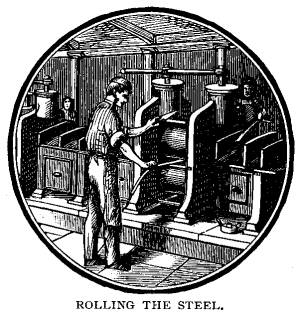
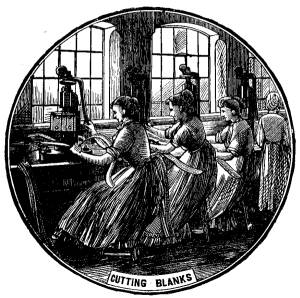
The steel on leaving the mill is conveyed to the gauging room, and it will be found to have increased to three times its original length, and now appears with a bright surface. Hitherto the operations have been conducted by men and boys; but now, in the course of manufacture, the pens will enter on a series of processes in which the quick and delicate fingers of women and girls play an important part. The strips of steel are now given out to the cutters. The Toolmaker, who, as a rule, both makes and sets the tools, has placed in what is known as a bolster a die, having a hole perforated through it of the exact shape of the blank to be cut; and attached to the bottom of the screwed bolt of the press is a punch, also bearing the exact shape of the blank. The girl with her left hand introduces one of the strips of steel at the back of the press, and, pulling the handle toward her with the right hand, the screw descends, driving the punch into the bed, and in so doing has perforated the strip of steel with a scissors-like cut, making a blank which falls through the opening in the die into a drawer below. Now, with her left hand she pulls the strip toward her until it is stopped by a little projection called a guide; and again the right hand moves the handle, the screw descends, and another blank is cut. The operation is continued until the whole of one side of the strip is perforated; it is then reversed and the other side treated in a similar way. If you were to hold up the strip thus manipulated—now called scrap—you would find that in some particular part the perforations approach so nearly to each other as to form a slight bar, which breaks easily between the thumb and finger. This is rendered necessary from the fact that steel scrap is worth only one-fifth of the value of the raw material, and, as under the most favorable conditions, the scrap averages one-third the original weight given out for cutting, it behooves the manufacturer to reduce the scrap as much as practicable. If these blanks are examined, a small V-shaped indentation, looking like a defect, will be found upon the upper edge of that part inserted in the holder. This small mark plays an important part in the succeeding processes. To a casual observer there does not appear much difference between the two sides of the blank; but, however well the tools are made, that side of the blank which is uppermost in cutting out will be rougher than the under side. This mark enables the operator to distinguish at a glance the smooth side, and by always keeping the rough side upward the burr is polished off in a later process.
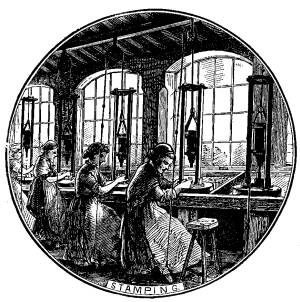
The blanks are now ready to be passed to the next process—marking. This operation is performed by a female, with the aid of a stamp. The precise mark required is cut upon a piece of steel, and, being placed in the hammer of the stamp, the girl puts her right foot into a stirrup attached to a rope, which is passed round a pulley, and, pressing downward, causes the hammer to ascend. Taking a handful of blanks with her left hand, by a dexterous motion she makes a little train of them between the thumb and finger in parallel order, presenting the first in the most ready position to be passed to the other hand. The right hand is brought toward the left, and, taking a blank, places it with the point toward the worker in a guide upon the bed of the stamp, then by suddenly letting the hammer descend a blow is struck upon the blank, which gives an impression of the name cut upon the punch. The quick fingers of the operator pass backward and forward with such rapidity that a skillful girl will mark from two hundred to two hundred and fifty gross per day. If the mark required is unusually large, the marking process is deferred until after the pen has been pierced, in order that the blank may be annealed (or softened), which takes the impression more readily than the hard steel.
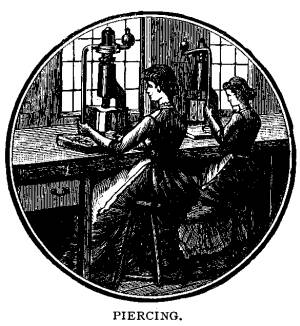
Now, in order to make a metallic pen suitable for writing it is necessary to consider some means of producing elasticity, and also to devise some method by which the smooth steel shall cause the ink to attach itself to the pen. This is brought about by the next process— piercing. In this operation the tools are of a very delicate character, and as the center pierce (the aperture in which the slit terminates) is frequently of an ornamental design the tools, being small, have to be made with great precision. The piercing punch and bed having been fixed in a screw press, and an ingenious arrangement of guides fastened thereto, the girl selects a blank from a tray on her left hand, and, placing it in its proper position by the aid of the guides, pushes the fly of the press from her, the screw descends, driving the punch into the bed, and the operation of piercing is completed.
The blanks are still moderately hard, and before they can be made to take the shape of a pen it is necessary that they should be softened, which is effected by the process called annealing. The blanks having been freed from the dust and garbase that has become attached to them are carefully placed in round iron pots, which are again inclosed in larger ones and covered over with charcoal dust to prevent the entrance of gases, and put into the muffle, heated to a dull red, and then allowed to cool.
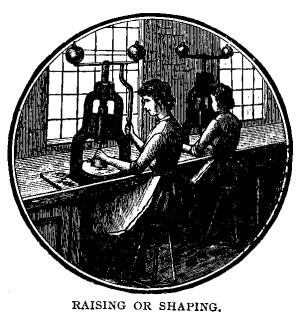
The blanks are now soft and pliable, readily taking the various shapes into which pens are made by the next process, called raising. This operation is performed by the aid of a punch and die fitted into a screw-press. The punch is fitted into a contrivance called a false nose, fixed in the bottom of the screw of the press; and the die or bed is placed in a cylindrical piece of steel (called a bolster) with a groove cut for the reception of the die, the bolster being fastened to the bottom of the press by a screw underneath. The punch and die being fixed so as to exactly fit each other, the toolmaker places a small piece of tissue paper between them, takes an impression, examines it, and proceeds to rectify any inequality in the pressure, so as to insure perfection in the shape. This being accomplished, the toolmaker fixes four pieces of steel (called guides) to the bolster in such positions that the operator is enabled to slide the blank into the bed, where it is held by the guides till the punch descends, forces the blank into the bed, and gives the pen its shape. The article is now narrower than it was in its blank form, and the girl pushes it through the tools with a small stick held in the hand with which she works the press handle, while with the other hand she places another blank in its position in the bed.
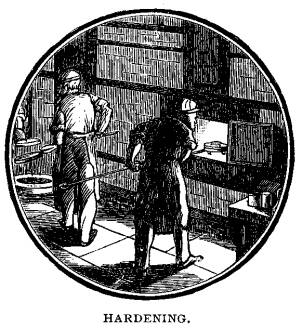
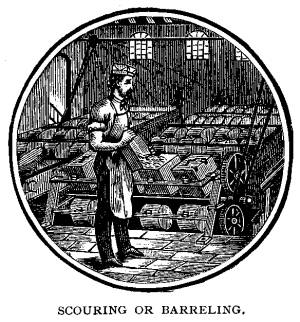
The pen is now shaped or raised, but it is still soft, and consequently another process is necessitated—hardening. This is effected by placing the pens in thin layers in round pans with lids. They are placed in the muffle for a period varying from twenty to thirty minutes, during which time they have acquired a bright red heat. The workman then withdraws them and empties the contents into a large bucket immersed in a tank of oil. The bucket is perforated at the bottom, and being elevated, the oil drains off. The pens are next placed in a perforated cylinder, which, being set in motion, revolves and drains off the remainder of the oil. The pens are still greasy, and as brittle as glass; and in order to free them from the grease they are again placed in perforated buckets and immersed in a tank of boiling soda water. After they are freed from the grease the pens are put into an iron cylinder, which is kept revolving over a charcoal fire until they are softened or tempered down to the special degree required. In this process the workman is guided by the color, which indicates the varying temperature of the metal of which the articles are made. Brittleness has given place to pliability, but the pens are black in color and scratch at the point, and to remedy this defect they are subjected to the next process—scouring. In order to do this the pens are dipped in a bath of diluted sulphuric acid—called pickle—which frees the articles from any extraneous substances they may have acquired in the hardening and tempering processes. This requires to be done with great care, or the acid would injure the steel. The pens are then placed in iron barrels with a quantity of water and small pebbly-looking material. This latter material is composed of annealing pots broken and ground fine enough to pass readily through a fine riddle. The barrel being set in motion, the pens are scoured for periods varying from five to eight hours, and are placed again in barrels with dry pot for about the same period, after which they are put into other barrels together with a quantity of dry sawdust. On being taken out of these barrels the body of the pen has acquired a bright silver color, and the point has been rounded.
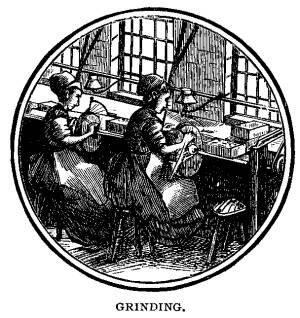
The article has now the shape and appearance of a finished pen, and yet it possesses none of its characteristics, and, if tried, will be found to have no more action than a lead pencil, as it is deficient in that important part of a writing instrument—the slit. Before being slit the pen is ground between the centre pierce and the point. This process is performed by girls, with the aid of what is called a “bob” or “glazer.” The “bob” is a circular piece of alder wood about ten and a half inches in diameter and half an inch in width. Round this a piece of leather is stretched and dressed with emery. A spindle is driven through the centre, and the two ends placed in sockets. The “bob” is set in motion by means of a leather band, and the girl holding a pen firmly, with a light touch grinds off a portion of the surface.
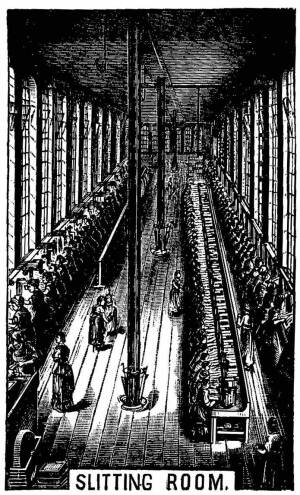
This operation being completed, the last and most important mechanical operation has to be performed—slitting. The tools with which this process is effected are two oblong pieces of steel about an inch and a half long, three-eighths of an inch thick, and an inch and a quarter wide. These are called the cutters, and upon the preparation and setting of these the successful issue of the process depends. The edges of these cutters are equal in delicacy to the cutting edge of a razor, but the shape is more suggestive of a portion cut from the thickest part of a large pair of shears. The cutter being fixed in the press, a pair of guides are screwed on either side, and a small tool called a table, or rest, being attached to the contrivance called a bolster, which holds the bottom cutter, the operator takes a pen, places it on the table, pushes the point up toward the guide, pulls the handle, the upper cutter descends, meets the lower one, and the process of slitting is completed.
Now, although this operation completes the mechanical processes of pen making, the article is by no means finished. If you examine the pen now you will find that the outer edge of each point is smooth, while the inside edges which have just been made by the slit are sharp and scratch. To remove this defect the operation of “barreling” has to be again resorted to. The pens are again placed in the iron barrels with pounded pot, kept revolving from five to six hours, and finally polished in sawdust.
The pens are now of a bright silver-steel color and perfectly smooth, but as they are required in various tints, they are colored and afterward varnished to prevent rust. To accomplish the first of these results the articles are placed in a copper or iron cylinder and kept revolving over a coke fire until the requisite tint is obtained, the color depending upon the temperature of the cylinder. If the pens are intended to be lacquered they are placed in a solution of shellac dissolved in methylated spirits. The spirit is drained off, and the pens are placed in wire cylinders and kept revolving until the action of the air dries the lacquer. They are then scattered upon iron trays, inserted in an oven, and the heat diffuses the lacquer equally over the surface of the pens, so that when they have cooled down they have a glossy appearance, which gives to them an air of finish and prevents rust.
The pen is now finished as far as manufacturing processes are concerned, yet before it can be offered to the public it has to undergo a rigid examination called ”looking over.” This is performed by trained girls, and when the defective ones have been sorted out the good pens are sent to the finished warehouse to be put up into boxes. These boxes are of various descriptions, adapted to suit the markets for which they are intended. In many instances the labels which form the covers of the boxes are elaborately printed from first-class designs, and some of them have highly-finished steel engravings of royal personages and celebrities in the scientific, literary, musical, and political world. The quantities contained in these boxes vary with the countries for which they are intended; for the manufacturers study the wants of their customers, and do not offer articles counted in dozens to people who reckon by tens.
We have now traced the manufacture of this little article from its beginning as a plain piece of steel through all its stages until it has developed into that indispensable requisite of daily life—a pen.