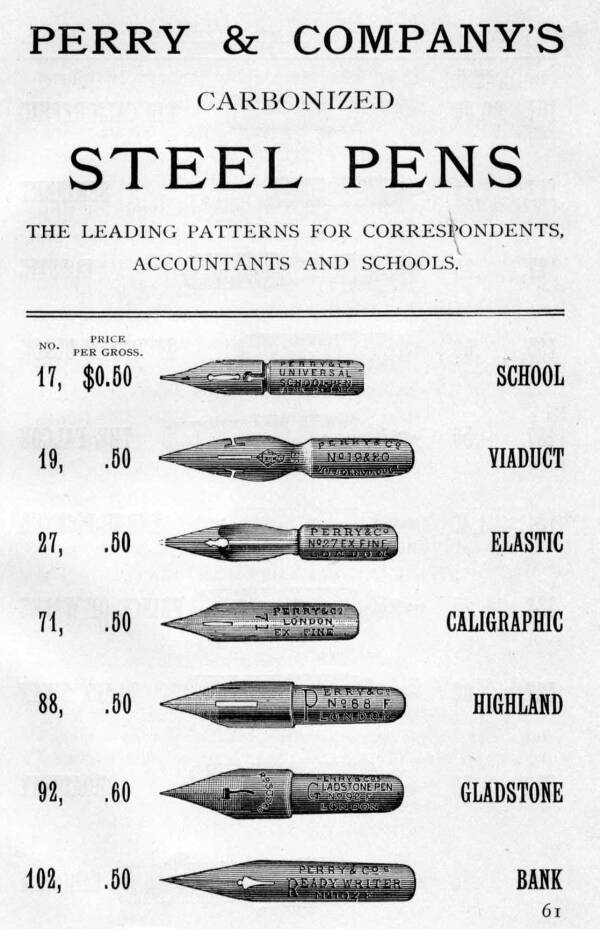
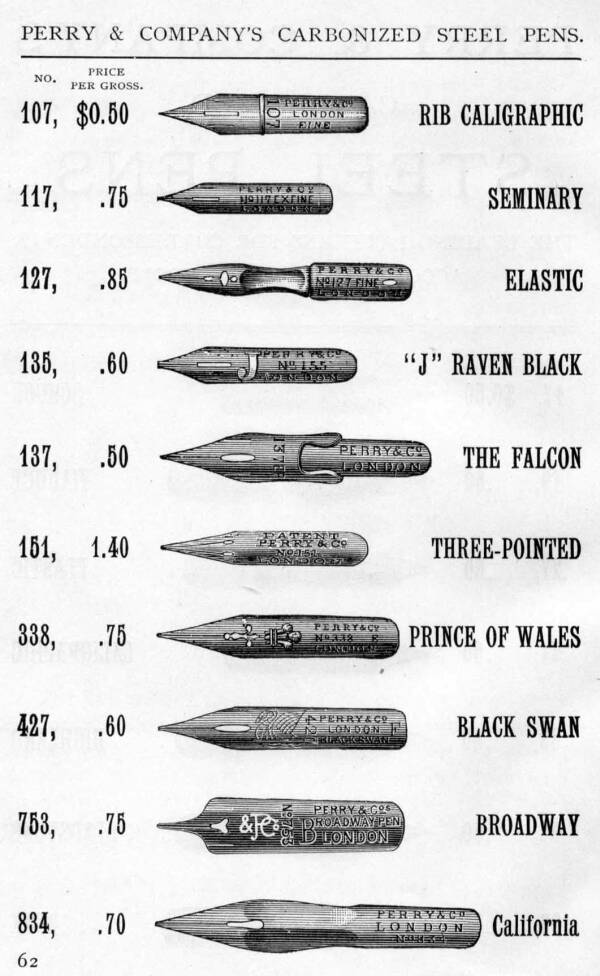
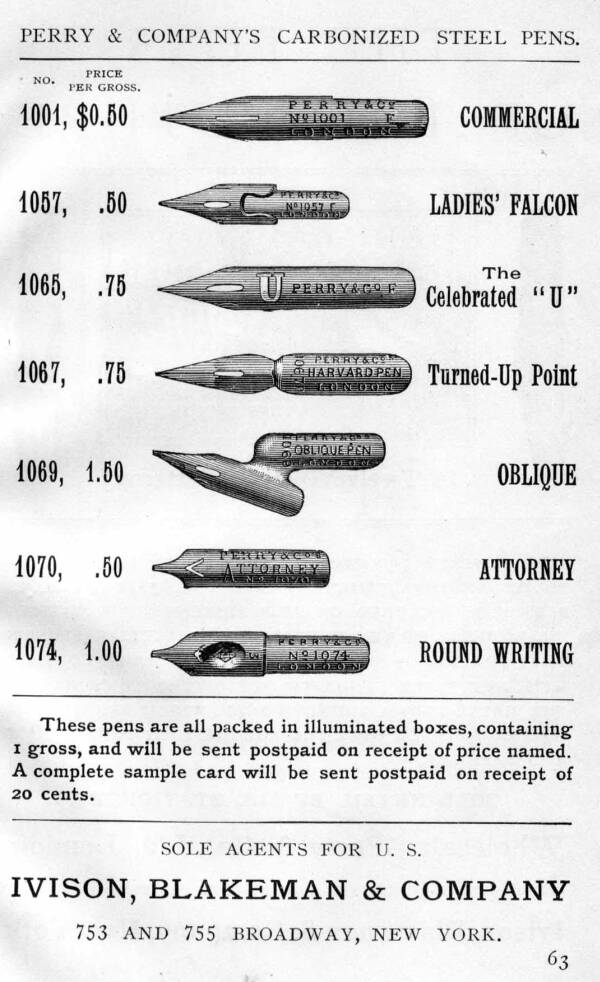
HISTORY OF THE PERRYIAN PEN WORKS.
Reading edition
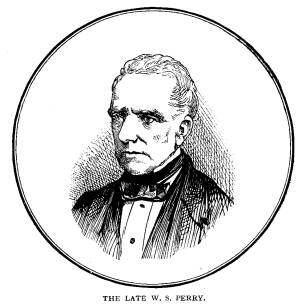
The firm of Messrs. Perry & Co., London, was founded in the year 1824 by Mr. James Perry, who carried on business originally in Manchester, then in London. Mr. James Perry died in the year 1843. Mr. Stephen Perry, who conducted the business afterward in partnership with Mr. Hayes and others, died in the year 1873, and was succeeded by his sons, Messrs. Joseph John and Lewis Henry Perry. The firm of Perry & Co. was known all over Europe as the house which first introduced to the commercial world steel pens of a superior quality, and in many countries steel pens are now known under the general denomination of ”Perry pens.” The first pens were manufactured by Perry & Co. in London, principally from flattened or ribbon steel wire, and in the year 1828 Mr. Josiah, afterward Sir Josiah, Mason, then a manufacturer of steel split rings, produced steel pens so much superior to the pens made up to that period that Messrs. Perry & Co. entered into contracts with him for the sole supply of all the pens they might require; this connection continued up to the time of the formation of this company. In the meantime, Messrs. Perry & Co. had also introduced the sale of elastic bands and pencil cases; the production of the latter was confided to Mr. W.E. Wiley, who, in the year 1850, began the manufacture first of gold pens, afterward of pencil cases. Messrs. Perry & Co. also contracted with Mr. Wiley for the purchase of all the pencil cases they might dispose of, and thus Mr. Wiley's works assumed gigantic proportions. Mr. Alfred Sommerville, who had been connected with the steel-pen trade since its infancy, established the firm of A. Sommerville & Co. in the year 1851. Although he, in the year 1857, began manufacturing steel pens in connection with a partner, he likewise contracted with Mr. Josiah Mason for a superior class of steel pens, principally intended for the Continental markets, and many of which were either his own invention or suggested by him. Mr. Sommerville desiring to retire from business, Sir Josiah Mason purchased his trade in the year 1870, but continued to carry it on under the old style of A. Sommerville & Co. These four businesses being so intimately connected and dependent upon each other, some gentlemen of eminence in the manufacturing town of Birmingham decided, in conjunction with some of the leading proprietors, to establish a limited company, for the purpose of uniting and amalgamating inseparably the various establishments, and thus the company of ”Perry & Co., Limited,” was formed.
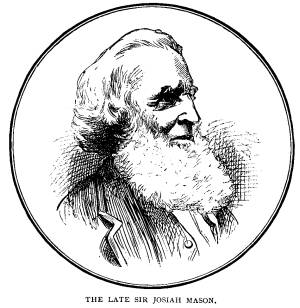
On the spot forming the principal entrance to the works, Mr. Samuel Harrison, in the year 1778, founded a manufactory in which he carried on his invention of steel split rings; but Mr. Harrison, who was an ingenious mechanic, also manufactured mathematical instruments, some of which were used by Dr. Priestley in his researches, and on one occasion he made a steel pen for Dr. Priestley, probably the first steel pen ever produced. Mr. Josiah Mason succeeded to the business of Mr. Harrison in 1823, and in 1828 began the manufacture of steel pens. For several years he gave his whole attention to improvements in the manufacture of steel pens, and Mr. Perry took out several most important patents for the improvement of steel pens, many of which have not been surpassed in ingenuity or in utility, and the principal among them, the so-called “double patent,” is universally applied by the pen trade to a great number of pens to this very day. In 1842 Mr. Mason's attention was absorbed by the process of electroplating and gilding, at that time invented and carried on by Mr. Elkington, in partnership with whom he founded the great firm of Elkington, Mason & Co. For some years the production of pens flagged, but in 1852 a nephew of Sir Josiah Mason, Mr. Isaac Smith (deceased in 1868), gave a new stimulus to the manufacture of pens, and from that time the production gradually increased until it assumed its present proportions. The manufactory now covers nearly two acres; it occupies a whole square and fronts four streets. In the building fronting Lancaster Street (five stories high) the offices, warehouses and storerooms of finished goods are distributed. The underground floor forms a huge machine shop, in which all the presses, rolls, and general iron and machine work employed throughout the manufactory are produced by skillful mechanics. Behind the front building there are several courtyards and quadrangles, in the largest of which are placed in a row five double-flue boilers, each 20 feet long by 7 feet diameter, working at a pressure of more than 55 lb. to the square inch, supplying the steam power both for propelling the steam engines and for heating the manufactory. In the rolling mill, measuing 64 by 38 feet, three double-cylinder engines, working up to 293 indicated horsepower, give motion to 18 pairs of rolls, rolling four to six tons of steel per week. The largest workshops are the slitting and grinding rooms, 64 by 38 feet, the latter 24 feet high. In the slitting room 90 girls apply the last mechanical process to the manufacture of steel pens, in slitting them by presses of ingenious construction. In the grinding room more than 160 girls are busily employed cross and straight grinding steel pens on wood cylinders covered with emery. The room in which the finished pens are placed in boxes measures 54 by 30 feet, and in it alone are employed 50 girls boxing and labeling steel pens, or fitting penholder tips on handles of various materials, principally of cedar. In that part of the building having a frontage on Corporation Street there is a dining room 86 feet 6 inches long by 68 feet wide, fitted up with tables to accommodate 600 people. Here the employees are served with a warm dinner at prices varying from 2d. to 6d. At one end of the room there is a stage, where dramatic entertainments and concerts are given in the winter season by the workpeople. At the other end there is a library, in a glazed partition, containing about 2,000 volumes of standard works. These books are issued to the hands employed by the firm free. One of the important features of this manufactory is the employment of muffles heated by gas produced from Siemens's gas generators. These muffles allow the heat to be regulated to a nicety, and enable the company to carry on the process of annealing and hardening to very great perfection.
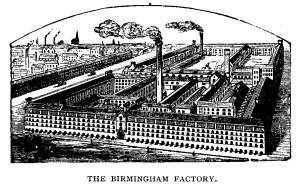
The manufacture of steel pens employs in all about 900 workpeople, the weekly production is 45,000 gross, which quantity will shortly be increased to 50,000 gross, per week. Six smaller steam engines are employed independently of those already mentioned in various parts of the works. The manufacture of penholder sticks is carried on in two separate buildings. Penholder sticks were produced by Mr. Mason as far back as 1835, but their manufacture had lapsed; it was only resumed eight years ago, since which time, by new and ingenious machinery, principally the inventions of Mr. W. E. Wiley, the managing director, it has assumed proportions of great magnitude.
The pencil case and solitaire works carried on by Mr. Wiley, first alone, and then in co-partnership with his son in Graham Street, have now been transferred to Lancaster Street.
Pencil cases, first introduced by Messrs. Mordan & Lund, in London, have undergone various changes and improvements, the principal of which was a lead holder passing through the point of the pencil case, which was slit for that purpose. This invention was patented by Mr. Wiley in the year 1857, and created a complete revolution in the pencil-case trade, as it enabled the manufacturers to use a thicker and longer lead, which could be propelled and withdrawn at will and would last in daily use more than six months. This patented mechanism was introduced into cases made from hard wood, bone and ivory, but since the year 1868 a composition called aluminium gold, so resembling gold that it cannot be distinguished from it, and resisting the effects of oxidation, consequently free from tarnish, made a further revolution in the pencil-case trade, enabling the million to possess an elegant and highly-wrought pencil case at a very moderate price. Messrs. Perry & Co., of London, gave to this manufacture publicity in every part of Europe, and the quantities produced and sold are incredible.
In 1874 a new patent was added to the many inventions for which this establishment was famous. Its purpose was to produce a solitaire stud made in two parts, so as to enable its ready application without the trouble of passing a button of large diameter through a small buttonhole. A self-acting steel spring is fixed in the upper part of the stud, and snaps as soon as inserted into the lower part, where a slight pressure on two projections releases the springs and permits the separation of the two parts. These solitaires are manufactured of gold, silver, and a variety of other metals, the principal of which is gold plate. There are now more than five hundred patterns in existence, and this useful manufacture grows daily in extension. Perry & Co.'s paper binders, an article now universally used for fastening together loose papers, cloth patterns, etc., are produced in infinite styles and sizes, principally by self-acting machinery.
The total number of workpeople employed in the company's manufactories exceeds 1,300.
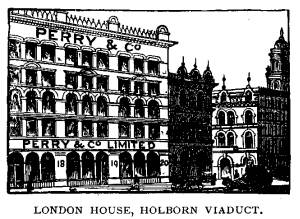
The business of Perry & Co. was carried on for more than forty years at 37 Red Lion Square, London, but the increase of business and the reconstruction of London required that a more central position should be found for the development of the commercial department of the company. Large and handsome warehouses having been constructed on the Holborn Viaduct, the company transferred their London depot to a building five stories high on the side fronting the Holborn Viaduct and eight stories high at the back. In this immense warehouse are stored not only the produce of the manufactories of this company, but also special articles for which this firm has been famous for the last thirty years, principally the elastic or endless bands, patented by Mr. Daft and Mr. Stephen Perry, and originally introduced by Perry & Co. in conjunction with McIntosh & Co., afterward in conjunction with Warne & Co. Perry's Royal Aromatic Bands are now an indispensable article, and may be procured in every city of the world. Every fancy article required by stationers can be found in these vast stores. An illustrated price current which appears monthly, and which numbers more than 120 pages, gives fair idea of the variety of articles of which samples and stock can be found ready for daily delivery. The increase of business has been so rapid that the company found it necessary to lease the adjoining premises, which is stored with some of the two thousand articles forming the staple trade of the London depot, and the principal of which are the following: American Letter Files, Clips (now manufactured in Lancaster Street), Marking and other Inks, Aromatic Bands, Audascript Pens, Bostonite Goods, Cigar Lighters, Copying Ink and Copying Ink Powder, Copying Ink Pencils, Copying Presses, Corrugated Imperial Bands, Essence of Ink, Grease Extractors, India Rubber for Erasing, Ink and Pencil Erasers, Ink Extractors, Patent and other Inkstands in every variety, Key Rings, Letter Clips, Letter Files, Metallic Books, Paper Binders, Pencil Point Protectors, Pencils and Pencil Cases, Penholders, Pen Knives, Pen Racks, Gold Pens, Portfolios, Presses, Scotch Tartan Fancy Goods, Solitaires or Sleeve Links, etc., etc., etc.
This establishment is under the exclusive management of Mr. Joseph J. Perry, managing director.
[The illustrations in this work are engraved from pen-and-ink sketches executed by Walter Langley with a Perry's No. 25 pen.]