Front matter
Reading edition
THE STORY OF
THE INDIAN MUTINY
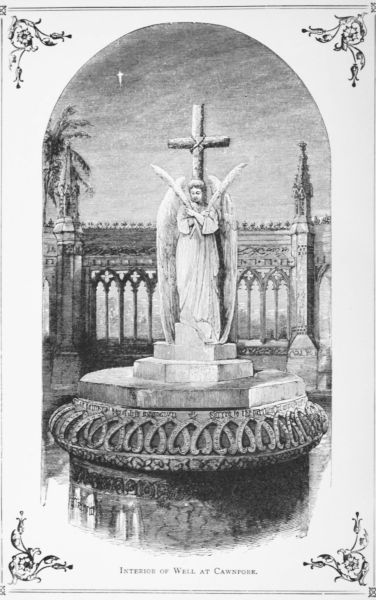
Interior of Well at Cawnpore. Frontispiece
THE STORY OF
THE INDIAN MUTINY
BY
ASCOTT R. HOPE
AUTHOR OF "MEN OF THE BACKWOODS," "YOUNG TRAVELLERS' TALES," ETC.
WITH MAPS AND ILLUSTRATIONS
LONDON
FREDERICK WARNE AND CO.
AND NEW YORK
1896
[All rights reserved]
Richard Clay & Sons, Limited,
London & Bungay.
PREFACE
The story of the great Indian Mutiny has often been told in whole or in part. In this book, while historical outlines are carefully preserved, it is attempted to throw into relief the more picturesque episodes, and to bring out illustrative incidents of personal adventure likely to attract young readers. With such a theme, if any reader will only suffer some needful gravity in the introduction, he may be promised a narrative of heroism and romance which the dullest treatment could hardly make unexciting.
A.R.H.
CONTENTS
CHAP. PAGE
I. INDIA: ITS PEOPLES AND RULERS 1
II. THE OUTBREAK 24
III. THE SPREAD OF INSURRECTION 45
IV. THE CONFLAGRATION 72
V. THE CITIES OF REFUGE 92
VI. THE FALL OF DELHI 138
VII. THE DEFENCE OF LUCKNOW 164
VIII. LORD CLYDE'S CAMPAIGNS 199
IX. THE EXTINCTION 227
APPENDIX 241
THE STORY OF
THE INDIAN MUTINY
CHAPTER I
INDIA: ITS PEOPLES AND RULERS
A troubled history has all along been that of the great tongue of land which, occupying the same position in Asia as Italy in Europe, is equal to half our continent, with a population growing towards three hundred millions. Far back into fabulous ages, we see it threatened by mythical or shadowy conquerors, Hercules, Semiramis, Sesostris, Cyrus; whelmed beneath inroads of nameless warriors from Central Asia; emerging first into historical distinctness with Alexander the Great's expedition to the valley of the Indus, from which came that familiar name given to dark-skinned races on both sides of the globe. Our era brought in new wars of spoil or of creed; Tartars, Arabs, Turcomans and Afghans in turn struggled among each other for its ancient wealth; and India knew little peace till it had passed under the dominion of a company of British merchants, who for a century held it by the sword as proudly as any martial conqueror.
This rich region having always invited conquest, its present population is seen to consist of different layers left by successive invasions. First, we have fragments of a pre-historic people, chiefly in the hill districts to which they were driven ages ago, whose very tribe-names, meaning slaves or labourers, sometimes tell how once they became subject to stronger neighbours; but behind them again there are traces of even older aborigines. Next, the open parts of the country are found over-run by a fair-skinned Aryan race, of the same stock as ourselves, whose pure descendants are the high-caste Brahmins and Rajpoots of our day, while a mixture of their blood with that of the older tribes has produced the mass of the Hindoo inhabitants. Over them lie patches of another quality of flesh and blood, deposited by the fresh streams of Moslem inroad, as in the case of our Saxons and Normans. But whereas with us, Briton, Saxon and Norman are so welded into one nation, unless in mountainous retreats, that most Englishmen hardly know what blood runs mingled in their veins, here a very imperfect fusion has taken place between varied peoples, held jealously aloof by pride of race, by superstition, by hatred of rival faiths, and still speaking many different languages, with the mongrel mixture called Hindostani as the main means of intercommunication. The peculiarity of the latest conquest, our own, is that the dominant strangers show small desire to settle for life in the country subject to them, yet we have added a new element in the half-caste or Eurasian strain, through which, also, and but slightly by other means, have we been able to affect the religious belief of this motley population.
Religion may be taken as the keynote of Indian life and history. While our ancestors were still dark-minded barbarians, their Aryan kinsmen, migrating to Hindostan, had developed a singular degree of culture, especially in religious thought. Before Greece or Rome became illustrious, the hymns of the Vedas bespeak lofty ideas of the unseen, and the Brahminical priesthood appear as philosophers, legislators and poets of no mean rank. The first historical notices of India show a high level, not only of material but of moral civilization, as well as a manly temper of warriors well able to defend the soil they had won.
This enervating climate, however, with its easy efforts for existence, has proved an influence of degeneracy, and most clearly so in the matter of belief. Good seed, which here sprang up so quickly, was always apt to wither under a too scorching sun, or to run to rank foliage rather than to fruit. Early Brahminism, itself a marked growth in thought, after a time began to be choked by the heathenism it had overshadowed. It sent out a new shoot in Buddhism, a faith of noble ideals, which to this day surpasses all others in the number of its adherents. This, in turn, became a jungle of sapless formulas, and after a thousand years died out on the land of its birth. Then grew up modern Hindooism, a union of Brahminical dreams of divinity and Buddhist love for humanity, interwoven with the aboriginal superstitions, the whole forming a tangled maze, where the great Hindoo trinity of Brahma the Creator, Vishnu the Preserver, and Siva the Destroyer, take Protean shapes as a pantheon of innumerable gods, amid which higher minds may turn upwards seeking one Almighty Spirit, but the vulgar crowd fix their attention rather on grotesque idols, base fetishes, symbols of fear and sensuality, fitly adored with degrading rites and barbarous observances. All efforts have hitherto little availed to clear this deeply-rooted wilderness of misbelief. Enlightened Hindoos, who see the errors of their religion, yet find it difficult to shake off the mental slavery of the "unchangeable East." Our missionaries have to deplore the little real success that attends their efforts. Beneath the sweltering sky of Hindostan, spiritual life remains a day-dream or a nightmare; reformers are ever silenced by fanatics; virtues are frittered down into foolish scruples; harmful customs cumber the ground, hindering the growth of progressive institutions.
The great encumbrance of Indian life is the system of caste, doubly fostered by religion and pride of race. Originally the conquering Aryans became divided into Brahmins or priests, Rajpoots or warriors, and Vaisyas or husbandmen, still distinguished as the "twice-born" castes, who wear the sacred thread, badge of this spiritual aristocracy; while under the common name of Sudras or serfs, were included all the despised aboriginal tribes. Then the mixed population, formed by amalgamation between the latter and the lower ranks of their masters, went on splitting up into other recognized castes, as the superior classes, who took a pride in keeping their stock pure, grew themselves divided among separate tribes or castes; and thus arose a complex segregation of society into countless bodies, cut off from each other by almost impassable barriers of rank and occupation. There are now thousands of these castes, marked out by descent, by calling, or by locality, the members of which cannot intermarry, may seldom eat together, and must not touch food cooked by an inferior; even the shadow of an outsider falling upon his meal might cause a high-caste Hindoo to throw it away and go fasting. Each trade is a separate caste, each order of servant; and the man who makes his master's bed would shrink from the touch of the sweeper who cleans out his bath-room. Yet caste does not always coincide with social position; a powerful prince may be born of a low caste, and the native officer who gives orders to a high-caste Brahmin in the ranks, must bow before him when his sacred character is to be enlisted for the services of a family festival.
The origin of this organized exclusion becomes illustrated by the conduct of our own countrymen in India, among whom any penniless subaltern is apt to display at the best a haughty tolerance for the high-titled descendants of native kings, while he holds aloof from Englishmen of inferior station, and openly despises the half-caste Eurasian, who in turn affects contempt for the heathen Hindoo. We, indeed, have common sense enough, or at least sense of humour, not to let our prejudices degenerate into the ridiculous scrupulosity which forbids a Rajah to dine in the same room with his guests, or a coolie to set profane lips to his neighbour's drinking vessel. Railway travelling, military service, association with Europeans, cannot but do much to break down these burdensome restrictions; and enlightened natives, in public or in private, begin to neglect them, though it is to be feared that they too often copy the worse rather than the better parts of our example. But among the mass of the ignorant people, the least infringement of the rules of caste is looked upon with horror, and to become an outcast pariah, through any offence against them, is the ruin in this world which it seems in the next.
Another main barrier to progress here, has long been the slavish condition of women, not improved by the next creed which came to modify Hindoo institutions. Buddhism was hardly extinct in India, when Mohamedan incursions began to put a strain of new blood into the physical degeneration of the Hindoos, and though the Crescent, except in parts, has never superseded the symbols of the older religion, these two, dwelling side by side, could not be without their reaction on each other's practice. It was the north of the peninsula that became most frequently overflowed by inroads of its Moslem neighbours, while Hindooism was left longer unassailed in the south, where also the aboriginal fetish worships had of old their citadels. Even in the north the conquests of Islam were long temporary and partial, irruptions of pirates or mountain-robbers, able to prey upon the wealth of India only through the want of cohesion among its Rajpoot lords. These early invaders either returned with their booty, or remained to quarrel over it between themselves, or were spoiled of it by fresh swarms from beyond the Himalayas.
By the beginning of the thirteenth century, we find a Mohamedan empire set up at Delhi by a dynasty known as the Slave Kings, who, before long, gave place to rival adventurers. The power of the Crescent now began to extend into Southern India, yet revolts of vassals and viceroys kept it continually unstable. At the close of next century, the redoubtable Tamerlane captured Delhi, giving it up to an orgy of slaughter; but this devastating conqueror retired beyond the mountains and left India divided between warring princes, Hindoo and Moslem. Four generations later, Tamerlane's descendant Baber returned to make more enduring conquests; then it was by his grandson, Akbar, that the Mogul empire became firmly founded.
Akbar the Great, whose long reign roughly coincides with that of our Queen Elizabeth, was rarely enlightened for an Oriental despot. By a policy of religious toleration, he won over the Hindoo princes, while he reduced the independent Mohamedan chiefs under his authority, and did much towards welding Northern India into a powerful union of provinces, ruled through his lieutenants. His less wise heirs, cursed by self-indulgent luxury and by family discords, added to the splendour rather than to the strength of this dominion. Its last famous reign was that of Aurungzebe, covering the second half of the seventeenth century. A bigoted Mohamedan, he alienated the Hindoos by persecution, while he spent many years in conquering the independent Moslem kings of the south, only to ripen the decay of his vast empire. After his death, it began to go to pieces like that of Alexander the Great. His feeble successors dwindled into puppets in the hands of one or another artful minister. Their satraps at a distance, under various titles, asserted a practical autocracy. And now had sprung up a new Hindoo power, the warlike hordes of the Mahrattas, whose great leader Sivajee, from his hill-forts among the Western Ghauts, began to make these ravaging horsemen feared far and wide, till their raids were the terror of all India.
Among the quickly-fading glories of the Mogul Empire, almost unnoticed came the appearance of the new strangers who would inherit it. The Portuguese were the first Europeans to arrive, at the beginning of the sixteenth century, when all the gorgeous East was still a wonderland of wealth in Christian imaginations. Then followed the Dutch, who, however, fixed their chief attention upon the spice islands of the Archipelago. On the last day of A.D. 1600, the East India Company was incorporated by royal charter at London, none yet dreaming to what greatness it would rise. A few years later, an English ambassador, sent by James I., made his way to the Court of the Great Mogul, and received assurances of favour and encouragement for trade. About the same time, our first settlement was made on the Coromandel coast. In 1615 a factory was established at Surat, on the other side of India; then, half-a-century later, the head-quarters of the enterprise were shifted to Bombay, ceded by Portugal in 1661, which, being an island, seemed safe from Sivajee's plundering horsemen.
In the meanwhile, other trading stations had been acquired in Bengal. At the end of the century, the Company is found taking a more independent stand, purchasing land, erecting fortifications, and arming its servants to resist the dangers which threatened trade in this disordered region. Such was the humble origin of the three Presidencies of Madras, Bombay, and Bengal, the last of which became the most important, and its chief station, Calcutta, the residence of the Governor-General.
Other European nations appeared in the field, but our only formidable rival here was France, the Portuguese making little of their claim to monopoly, now represented by the settlements of Goa, best known as the breeding place for a mongrel race of servants. One more stock of emigrants must not be omitted from mention. Centuries before a European ship had touched India, a remnant of Persian fire-worshippers, flying from Mohamedan persecution, settled upon the west coast, where, though few in numbers, by their wealth, intelligence, and commercial enterprise, these Parsees have grown to be an influential element in the population, excelling, like the Jews in Europe, as traders and men of business.
The eighteenth century saw the ruin of Aurungzebe's empire going on apace. Sikhs and Rajpoots threw off its yoke; hereditary kingdoms were clutched for themselves out of the wreck by its ambitious viceroys; in 1739 the Persian Nadir Shah plundered the treasures of Delhi; after him came fresh hordes of Afghan horsemen. The greatest power in India was now the Mahratta Confederacy, under hereditary ministers bearing the title of Peshwa, who, like the Mayors of the Palace in Old France, usurped all real power, keeping Sivajee's unworthy heirs in sumptuous seclusion; a form of government that has often been brought about in Oriental States. The Peshwas, with their capital at Poona, ruled over the Deccan, the great tableland of the south; but the Mahratta incursions were carried as far as Delhi and Calcutta; and throughout India reigned a lawless disorder, inviting the interference of any hand strong enough to seize the opportunity.
It was the French who, having failed as traders, first sought to make political profit out of this confusion. Dupleix, Governor of Pondicherry, conceived lofty ideas of founding a new empire under the shadow of the old one, and to this end, began by trying to get rid of his English neighbours. In 1746 Madras was captured by the French, to be restored indeed at the peace of Aix-la-Chapelle; but though there came peace in Europe between the two nations, their East India Companies remained at jealous war. Dupleix, mixing in the intrigues of native ambition, made himself, for a time, predominant in the south; and we seemed like to lose all hold here, but for the appearance on the scene of one who was to prove arbiter of India's destinies.
Every one knows how the young subaltern Robert Clive, by his gallant defence of Arcot, suddenly sprang into fame, and at once turned the scale of prestige in favour of his countrymen. The French went on losing influence, till, in 1761, it was the turn of their settlements to be conquered. Dupleix died in disgrace with his ungrateful sovereign, while Clive was heaped with honours and rewards, soon earned by services in another field of action.
Before the French were fully humbled in the south, he had been summoned to Calcutta to chastise the despicable Nawab of Bengal, Surajah Dowlah, for that notorious atrocity of the "Black Hole," where nearly a hundred and fifty Englishmen were shut up in a stifling den not twenty feet square, from which few of them came out alive. Following Dupleix's example, Clive plunged into political intrigue, and undertook to supplant Surajah Dowlah by a prince of his own choosing. At Plassey, with three thousand men, only a third of them Europeans, he routed the tyrant's army, fifty thousand strong—a momentous battle that counts as the foundation of our sovereignty in India. A new Nawab was set up, nominally under appointment from Delhi, but really as the servant of the English Company, who now obtained a considerable grant of land as well as an enormous sum in compensation for their losses by Surajah Dowlah's occupation of Calcutta. A few years later their nominee was dethroned in favour of a more compliant one, who also had to pay handsomely for his elevation. He ventured to rebel, but to no purpose. Lord Clive pushed the English arms as far as Allahabad; and henceforth, with whatever puppet on the throne and with whatever show of homage to the high-titled suzerain at Delhi, the Company were the actual masters of Bengal.
All over India spread the renown of Clive's small but well-trained Sepoy army. His subjugation of the effeminate Bengalees, Macaulay may well compare to a war of sheep and wolves; but this young English officer went on to defy the more warlike levies of the north-west. He seized the Dutch settlements that threatened armed rivalry in Bengal; he almost extinguished the French ones. A harder task he had in curbing the rapacity of his own countrymen, who, among the temptations that beset such rapid ascendancy, bid fair to become the worst oppressors of their virtual subjects.
The next great ruler of Bengal was Warren Hastings, who organized a system of administration for the territory conquered by Clive, and began with collecting the revenues directly through the hands of English officers. Private greed was now restrained; but the Governor must justify his policy and satisfy his employers, by sending home large sums of money, which in the long run had to be wrung from the unhappy natives; and this necessity led the agents of the Directors into many questionable acts. It was a great step from the fortified trading posts of last century to levying taxes and tribute, maintaining an army and navy, selling provinces and dictating to princes. But by this time the conscience of the English people was being roused, and it began to be understood how India, for all its princely treasures, was the home of a poor and much-enduring population, which our duty should be to protect rather than to spoil. Returning to England, Warren Hastings was solemnly impeached before the House of Lords for his high-handed oppression. That famous trial, in which more than one English Cicero denounced our pro-consul as a second Verres, dragged itself out for seven years, and ended in a verdict of acquittal, which posterity has not fully confirmed, yet with the recognition of extenuating circumstances in the novelty and difficulty of the criminal's office.
We now held the valley of the Ganges up to Benares, and were soon making further acquisitions in that direction. In the Bombay Presidency we came into collision with the Mahrattas, in Madras with Hyder Ali, the tyrant of Mysore. The result of these wars proved our arms not so invincible as in the case of the timid Bengalees, but more than one gallant action made native princes cautious how they trifled with our friendship. Fortunately for us, the mutual jealousy of neighbour potentates prevented them from combining to drive our small armies out of India, and we were able to deal with them one by one. We had now no European rival to fear, though more than one Indian despot kept French troops in his service, or natives trained and officered by Frenchmen. Napoleon Bonaparte, most illustrious of French adventurers, had an eye to romantic conquest in the East; but we know how he found occupation elsewhere, and did not come here to meet the adversary who in the end proved his master. For it was in India that Wellington won his first laurels, under his brother, Lord Wellesley, a Governor-General resolute to make England paramount over the ruins of the Mogul Empire. The Nizam of Hyderabad was persuaded to dismiss his French guards, and become the vassal of England, as his descendant still is. Tippoo, Hyder Ali's son, fell at the renowned storm of his stronghold, Seringapatam, in the last year of the century. The Mahrattas were attacked in the Deccan, where Wellington gained the battle of Assaye, while in the north Lord Lake mastered Delhi and Agra. But the princes of this great confederacy were not fully humbled till the third Mahratta war in 1818, under the Governorship of Lord Hastings; before which the Goorkhas of the Himalayas, and the Pindaree robbers of Central India, had also been taught the lesson of submission. Presently we were carrying our arms across the sea, and wresting Assam from the Burmese. The crowning exploit of this victorious period was the siege of Bhurtpore, a fortress believed in India to be impregnable, from which in 1805 an English army had fallen back, but now in 1827 its capture went far to make the natives look on us as irresistible. The once-dreaded name of the Emperor was a cloak for our power, as it had been for the Mahrattas', while Calcutta had taken the place of Delhi as capital, through the primacy of Bengal among the three Presidencies, whose bounds had stretched to touch each other all across India.
Lord William Bentinck, who now became Governor-General, earned a different kind of glory by his sympathetic labours for the true welfare of the millions whom those wide conquests had placed under our rule. He began to make war on the crimes of barbarous superstition—the burning of hapless widows, the murders of infants, the secret assassinations by fanatical devotees. But with his successor opened a new series of campaigns that were not always illustrious to the British arms. Russia had taken the place of France as the bugbear of our Indian predominancy. Alarmed by Muscovite intrigues in Afghanistan, Lord Auckland entered upon a course of unwise and disastrous interference with the politics of that country. We succeeded in dethroning the usurper, Dost Mahomed, of whom we could more easily have made an ally. But in 1841 the people of Cabul rose against us; our army of occupation had to retreat in the depth of winter; assailed by hardy mountain tribes, they perished miserably among the rocks of the Khyber Pass; and out of thousands only one man reached Jellalabad to tell the tale. Sale's brave defence of that poor fortress did something towards retrieving our disgrace, and next year an avenging army returned to work bootless destruction at Cabul, leaving a legacy of ill-will that has been dearly inherited by our own generation.
More substantial conquests followed. Scindia, one of the old Mahratta princes, was brought more effectively under British control. At the same time, the Moslem Ameers of Scinde were overcome by Sir Charles Napier. We then stood face to face with the last great independent power of Hindostan, and the foeman who proved most worthy of our steel. The Sikhs, a manly race, originally a sect of Hindoo reformers, had risen from Mogul persecution to become lords of the Punjaub, "country of the five rivers," which all along has been the great battle-field of Indian history. Runjeet Singh, their masterful ruler for forty years, had carefully avoided a struggle with the British, which soon after his death was brought on by the turbulent bellicosity of the people, made audacious through our Afghan reverses. The two Sikh wars of 1845 and 1848 were marked by long and desperate battles; Sobraon, Chillianwallah, and Goojerat are remembered for the bravery and the slaughter on both sides, but finally the Punjaub was over-run, disarmed, and turned into a British province.
Several smaller states also were annexed about this time, through the failure of legitimate heirs, and our Government's refusal to recognize the Hindoo custom of adoption. A second Burmese war resulted in the acquisition of another province beyond the Gulf of Bengal. Lastly, the King of Oudh, whose incapable tyranny seemed beyond cure, had to submit to be pensioned off and see his ill-governed dominions pass under British administration. This signalized the end of Lord Dalhousie's term of vigorous government, who, while carrying out a policy of somewhat high-handed annexation, had shown himself not less active in the construction of roads, canals, railways, telegraph lines, and in all ways accomplished much to extend, consolidate, and develop what, partly by accident, partly by force of circumstances, and partly by far-seeing design, had in less than a century become a mighty empire. There might well be elephants then alive that had served us when we were struggling to keep a precarious foothold on the coasts of India.
Such great and rapid changes could not be worked without leaving sore grudges and dangerous cankers of discontent. Our policy had been so much dictated by selfish strength, that it is no wonder if the natives should conceive respect rather than love for us. Even after higher motives began to come into play, our best intentions were apt to be misunderstood by those placed under us, or to be foiled by our own want of sympathy with and our ignorance of their feelings. The strong points and the weak ones of the two races are almost poles apart, and neither has proved ready to learn from the other. Our characteristic virtues of truth and honesty are hardly comprehensible to the slavish Oriental, who for his part displays a flattering courtesy and gentle kindliness, with which appears in harsh contrast our frankly blunt masterfulness, often degenerating into insolence of manner and foolish contempt for all that is not English. While many of our best officers have shown a spirit of enlightened and conscientious interest in their duties, the average Briton, who goes out to India merely to gain money more easily than at home, is unhappily too seldom the man to conciliate the prejudices of those whom he treats as contemptible "niggers," knowing and caring little about their ancient civilization. The very pride of our superiority seems against us: other conquerors, more willing to let themselves down to the level of the conquered, have proved less unsuccessful in winning their good-will. Still, these natives cannot but come to see the advantage of having rulers whose word may be trusted. For long, honest efforts have been made to exercise among all sects and classes an even-handed justice, hitherto little known in India, the chief hindrance to which lies in the corruption of the native subordinates, on whom our magistrates have largely to rely for the details of their administration.
At all events, the mass of the population, broken to the yoke of many masters, had accepted ours with apparent resignation, even if they might soon forget the grinding tyrannies from which we had delivered them. Some fiercer spirits muttered their hatred, but kept silence before our authorities. Some real grievances, here and there, passed too much unnoticed, and sufferings brought about by over-taxation or other injustice worked through the hasty inexperience of officials. In certain large towns, the suppressed rage of hostile believers was not always restrained from breaking into riot at the great religious festivals, but these outbreaks we could easily put a stop to; and the differences of creed and caste seemed our best security against any dangerous combination to expel us. Some princes, whose quasi-independent states were allowed to lie like islands among our fully-conquered territory, might at times uneasily remember the martial glories of their predecessors, but knew well how they held their idle sceptres only on our sufferance, and took care not to neglect any hint of good behaviour offered them by the British resident at their courts, as real an authority as the Peshwas or Nizams of the past.
From the Himalayas to Cape Comorin, from Beloochistan to the borders of China, England was recognized as the Paramount Power of this vast country, over which at length reigned the Pax Britannica, and seemed little like to be seriously disturbed when, in 1856, Lord Canning came out as Governor-General.
CHAPTER II
THE OUTBREAK
The almost complete conquest of India had been chiefly carried out through troops raised among its own natives, drilled and led by European officers. Here and there, in the course of a century, their commanders had been forced to repress attempts at mutiny, such as might take place in any army; but on the whole this Sepoy force had proved remarkably faithful to the Company in whose service haughty Rajpoot and warlike Moslem were proud to enlist, and counted for wealth its hire of a few pence a day. So great was the trust put in our native army, and so unexpected the outbreak of 1857, that we had then no more than about forty thousand English soldiers scattered over India, among six times their number of troops, who looked upon us chiefly as formidable masters.
Strict officers of the old school judged that the beginning of the mischief lay in making too much of our native soldiery. They had come to understand how far England's power in India depended upon them, while they were unable to form an adequate idea of its resources at the other side of the world. Changes in organization are accused of lessening the Sepoys' respect for their regimental officers, the best of whom, also, were commonly taken away from their military duties to fill coveted posts in the civil service. Flattery and indulgence had slackened their discipline at the same time that it came to be tried by unfamiliar causes of irritation. The main difficulty in managing these troops lay in the superstitious customs and prejudices which make so large part of a Hindoo's life. Our rule has been to respect their ideas of religion; but this was not possible in all the claims of military service. Sepoys believed their caste in danger, when called upon to cross the sea to make war in Burma or Persia. Marched into the cold heights of Afghanistan, they had to be forbidden the ceremonial daily bathings in which they would have devoutly persisted at the risk of their lives; and they fancied themselves defiled by the sheepskin-jackets given them there as protection against the climate. Through such novel experiences, suspicion began to spring up among them that the English designed to change their religion by force.
This suspicion grew to a height when, after the Crimean War, a wave of unrest and expectation passed over our Eastern possessions. In every bazaar, the discontented spoke ignorantly of the power of Russia as a match for their conqueror. Our disasters in Afghanistan had already shown us to be not invincible. An old story spread that the British rule was fated to come to an end one hundred years after the battle of Plassey, A.D. 1757. Now, the century having elapsed, secret messengers were found going from village to village bearing mysterious tokens in the shape of chupatties, flat cakes of unleavened bread, which everywhere stirred the people as a sacrament of disaffection. For once, Moslem and Hindoo seemed united in a vague hope that the time was at hand when they should be able to shake off the yoke of a race so repellent to both in faith, habits, and manners.
The centre of the agitation was in the north-western provinces of Bengal, where the recent annexation of Oudh, though meant as a real boon to the ill-governed people of that fertile country, had not been carried out without mistakes, wrongs and heart-burnings. Here also appeared a Moulvie, or prophet, like the Mahdi of the Soudan, preaching a holy war against the infidels, to excite the ever-smouldering embers of Mohamedan fanaticism, a revival of which has in our century spread all over the East. The Bengal army was mainly recruited from this region; and when the civil population were in such an unquiet state, we need not be surprised to find the Sepoys ripe for disorder, many of whom, deeply in debt to native usurers, had the natural desire of "new things," that, before and since the days of Cataline, has so often inspired conspiracies.
What brought their seditious mood to a head was the famous incident of the greased cartridges, often given as the main cause of the Mutiny, though it seems more justly compared to a spark falling upon an invisible train of explosive material. The Enfield rifle having been introduced into the native army, it was whispered from regiment to regiment that the new cartridges were to be greased with the fat of cows or of swine. Now, a chief point of Oriental religious sentiment is an exaggerated respect for animal life, carried so far that one sect of strict devotees may, in certain Indian cities, be seen wearing a cloth over their mouths, lest by accident they should swallow a fly; were they familiar with the discoveries of the microscope, they could only be consistent by abstaining from every drop of water. The cow is a special object of reverence among Hindoos, who are shocked by nothing so much as our apparent impiety in eating beef. The pig is held in detestation by Mussulmen. A majority of the Bengal army were high-caste Brahmins or Rajpoots, with an admixture of Mohamedans drawn from that part of India where their creed had taken firmest root. Both alike were horrified to think that they might be called on not only to handle but to touch with their lips such pollution as they imagined in animal fat.
It was in vain the Government proclaimed that no unclean matters should be used in the cartridges issued to them; that they might grease their cartridges for themselves; that they would be allowed to tear off the ends instead of biting them, as was the way in those muzzle-loading days. The suspicion had taken so strong a hold that in more than one case the new ammunition was mutinously rejected. Religious and political agitators eagerly seized this chance of fomenting their own designs. A fable spread among the Sepoys that the English, determined to destroy their caste as a preliminary to forced conversion, had ground up cows' bones to mix with the flour supplied to them. At Lucknow, the simple incident of a regimental surgeon tasting a bottle of medicine had been enough to raise a tumult among men who were convinced that he thus designed to pollute the faith of their sick comrades. Our officers, hardly able to treat such tales seriously, were forced to pay heed to the spirit underlying them, which through the early months of 1857 displayed itself ominously in frequent incendiary fires at the various stations, the stealthy Oriental's first symptom of lawlessness. Still, few Englishmen estimated aright the gravity of the situation; and the Government failed in the prompt severity judged needful only after the event. Two mutineers were hanged;[1] two insubordinate regiments had been disbanded, to spread their seditious murmurs all over Bengal; but the danger was not fully realized till, like a thunderbolt, came news of the open outbreak at Meerut, forty miles from Delhi.
The scenes of the Mutiny can ill be conceived without some description of an Indian "station." Usually the Cantonments lie two or three miles out of the native city, forming a town in themselves, the buildings widespread by the dusty maidan that serves as a parade-ground. On one side will be the barracks of the European troops, the scattered bungalows of officers and civilians, each in its roomy "compound," the church, the treasury, and other public places. On the other lie the "lines," long rows of huts in which the Sepoys live after their own fashion with their wives and families, overlooked only by their staff of native officers, who bear fine titles and perform important duties, but with whom the youngest English subaltern scorns familiar comradeship. Between are a maze of bazaars, forming an always open market, and the crowded abodes of the camp-followers who swarm about an Indian army.
At Meerut, one of the largest military stations in India, the native lines stretched for over three miles, and stood too far apart from the European quarters. Here were stationed more than a thousand English troops of all arms, and three Sepoy regiments, among whom the 3rd Light Cavalry had in April shown insubordination over the new cartridges. Of ninety men, all but five flatly refused to touch them when ordered. The eighty-five recalcitrants were arrested, tried by court-martial of their native officers, and sentenced to ten years' imprisonment. On Saturday, May 9th, at a general parade, these sowars, or Sepoy troopers, were put in irons and marched off to jail.
To all appearance, the mutinous feeling had been cowed by this example. But beneath the smooth surface, where English eyes had too little skill to read the native heart, were boiling fierce passions soon to take shape in reckless acts. Next evening, while our people were making ready for church, a disorderly band of sowars galloped to the jail, and released their comrades, along with many hundreds of other prisoners. Here was a ready-made mob of scoundrels, who at once began to plunder among the bungalows. The excitement quickly spread to the 11th and 20th native infantry regiments. Several of their officers hastened among them, trying to calm the tumult. But a cry arose that the European soldiers were upon them, and this drove the men of the 20th into a panic of fury. They stormed the "bells of arms," small dome-like buildings used as magazines, and got hold of their muskets. Colonel Finnis, commander of the 11th, had more success in quieting his men, but was shot down by the other regiment.
A murderous uproar broke loose through the Cantonments. The 11th are said to have refused to fire on their officers, and to have escorted white women and children out of danger; but their good dispositions were soon swept away in the torrent of disorder. The Sepoys of the 20th and 3rd Cavalry fell to shooting and hacking every defenceless European they met with. A crowd of budmashes, "roughs," as we should call them, poured out of the city to share the congenial work of robbery and bloodshed, in which they took the foremost part. The thatched roofs of bungalows were easily set on fire, that the inmates might be driven out to slaughter. In an hour all was wild riot; and the sun set upon a fearful scene of blazing houses, shrieking victims and frenzied butchers, strange horrors of that Sabbath evening, too often to be renewed within the next few weeks.
The English troops, already assembled for Church-parade, should at once have been marched to crush this sudden rising. But the General in command showed himself incompetent. There were delays and mistakes; and not till darkness had fallen was a force brought up, too late to be of any use beyond scaring the plunderers. By this time most of the Sepoys had hurried off towards Delhi, leaving the gleaning of murder and pillage to the rabble. Our soldiers fell back to their own quarters, where were gathered for defence the whole Christian community, many of whom, bereaved and destitute, after barely escaping with their lives, saw the sky glowing from the conflagration of their ruined houses, and might be thankful if they had not to shudder for the unknown fate of husband or child. Eager officers vainly begged the General to spare them some small force with which the mob of mutineers could have been pursued and dispersed; at least to let them gallop through the night to Delhi, and give warning there of what was at hand. The man unluckily charged with such responsibility did nothing of what might well have been done—a neglect which was nearly to cost us our Indian Empire.
To both sides, the securing of Delhi was of the highest importance. This magnificent city, in native eyes, still enjoyed the prestige of a capital. Its ancient renown and famous monuments made it specially sacred for the Mussulmen, whose rule had once flourished here. In its vast palace still lived the descendant of the Great Moguls, a feeble old man, who, under the shadowy title of king, was allowed, among thousands of poverty-stricken kinsmen and retainers, to retain in part the pomp, if not the power, of his haughty ancestors. To keep up the show of his sovereignty, the English refrained from occupying the city with their troops, who lay quartered outside, beyond a ridge overlooking it from the north; and even here there were no English soldiers. Such was the prize about to fall easily into the hands of the rebels.
Their secret messengers had already let the discontented within the city know what might be expected, while the only hint our officers had was in the breaking of the telegraph wire from Meerut. Still, uneasy vigilance being the order of the day, the authorities were on Monday morning startled by the report of a number of horsemen hurrying along the Meerut road. The magistrate, Mr. Hutchinson, at once galloped out to the Cantonments to warn the Brigadier in command, then returned to the city, where the chief civil officials had hastened to their posts, though hardly yet aware what danger was at hand. But, before anything could be done to stop them, the van of the mutineers had crossed the bridge of boats and seized the Calcutta Gate, the guard of native police offering no resistance; and the way was thus clear for the main body following not far behind. A second band of troopers forded the Jumna, and entered the city at another point.
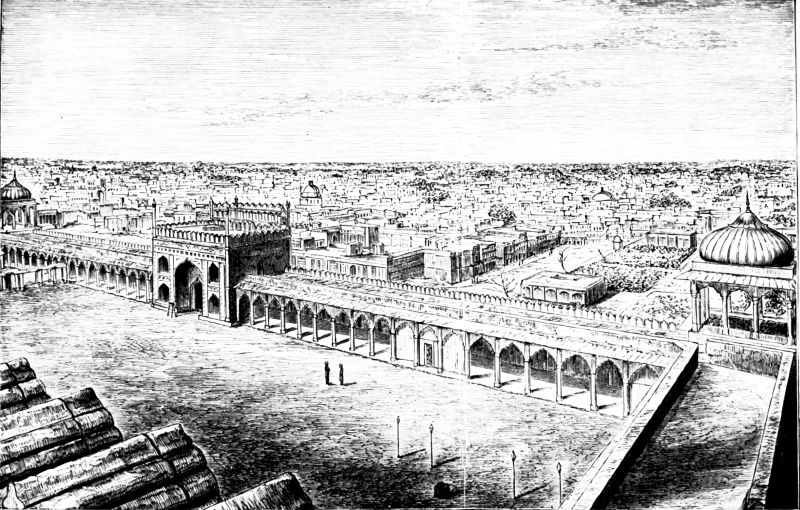
Delhi, from the Outer Court of the Jumma Musjid. Page 34.
Some of these forerunners made straight for the palace, which should rather be described as a fortified citadel, forced their way into the presence of the doting old king, and, with or without his consent, proclaimed him leader of the movement. A swarm of his fanatical retainers eagerly joined them; they soon began to wreak their fury by massacring several Englishmen and ladies who had quarters here. Others broke open the prison and released its inmates, to swell the bloodthirsty mob gathering like vultures to a carcase. The main body of the mutineers, as soon as it arrived, split up into small bodies that spread themselves over the city for pillage, destruction and murder. In one quarter, there was a terrible slaughter of the poorer class of Europeans and of Eurasian Christians, who, in unusual numbers, lived within the walls of Delhi, not as elsewhere, under protection of the Cantonments outside. Women and children were ruthlessly butchered. Clerks, school-masters, printers, were killed at their work; doctors, missionaries, converts, none might be spared who bore the hated name. Some, flying or hiding for their lives, only prolonged their agony for hours or days. A few succeeded finally in making their escape. About fifty were confined miserably in an underground apartment of the palace, to be led out and massacred after a few days.
A regiment of Sepoys had been marched from the Cantonments to repress the disorder. But, as soon as they entered the city, they let their officers be shot down by the mutineers, and themselves dispersed in excited confusion. A detachment on guard at the Cashmere Gate held firm for a time, but evidently could not be depended on. Later in the day, they too turned upon their English officers. More than one officer was simply driven away by his men without injury; others were fired upon; others made their escape by leaping or letting themselves down into the ditch, as did several ladies who had taken refuge here with the main guard. These survivors fled to the Cantonments, where for hours their countrymen had been gathering together in almost helpless anxiety. No sure news came back from the city; but they could guess what was going on within from the uproar, the firing, the rising flames—at length from a sudden cloud of smoke and dust, followed by a terrible explosion, that marked the first heroic deed of the Indian Mutiny.
The magazine within the walls, on the site of the present post-office, was garrisoned by only nine Europeans under a young artillery lieutenant, named Willoughby. Set on his guard betimes, he took all possible measures for defence, calmly preparing to blow up the magazine, if it came to the worst. The native gunners soon deserted; the reinforcement urgently demanded did not appear; he found himself cut off in a city full of foes raging round his important charge, which presently, in the name of the King of Delhi, he was summoned to surrender. For a time this little band stood in trying suspense, while the insurgents worked up their courage for an attack. It appears that they expected the English troops to be upon them, hour by hour, and awaited the return of a messenger who could report the road from Meerut clear. Then on they came in crowds, storming at the gates, scaling the walls, to be again and again swept back by the fire of cannon in the hands of nine desperate men.
Three hours these nine held their post amid a rain of bullets, till Willoughby saw that he must be overwhelmed beneath numbers. One last look he took towards the Meerut road, in vain hope to see a cloud of dust marking the advance of the English troops that still lay idly there. Then he gave the word. In an instant the building was hurled into the air, with hundreds of its assailants, and it is said that five hundred people were killed in the streets by the far-reaching explosion. The man who had fired the train and two others fell victims of their courage; six managed to escape over the ruins in the confusion, poor Willoughby to be obscurely murdered two or three days later. The rest received the Victoria Cross, so often won, and still more often earned, in those stirring days. A son of one of these heroes is author of the well-known novel Eight Days, which, under a transparent veil of fiction, gives a minutely faithful description of what went on in and about Delhi at that terrible time.
Meanwhile, at the Cantonments, the officers' families and other fugitives had gathered in the Flagstaff Tower, a small circular building on the ridge, where, huddled stiflingly together, they suffered torments almost equal to those of the Black Hole of Calcutta. Their only sure guard consisted of the drummer boys, who, in Sepoy regiments, are usually half-caste Christians. These, armed for the nonce, were posted close round the tower; before it stood two guns served by native artillerymen to command the road from the city; and part of two regiments were still kept to a show of duty, but hourly their demeanour grew more threatening, till, when called upon to move forward, they at length flatly refused. Two or three gentlemen, stationed on the roof of the tower, in the scorching sun, held themselves ready to fire upon the first of their more than doubtful auxiliaries who should break into open mutiny. The Sepoys, for their part, under the eyes of the Sahibs, remained for a time in hesitation, uncertain how to act; and some of them allowed themselves to be deprived of their bayonets, which were stored away in the tower.
One messenger had ridden out towards Meerut to demand succour, but only to be shot down by the Sepoys. Another, disguised as a native, made the same attempt to no purpose. Brigadier Graves, still hoping for the arrival of European troops from Meerut, would not for a time hear of retreat. But when it became evident that the handful of band-boys and civilians were all he could trust to defend the tower packed with scared women and crying children; when fugitives from the city brought news that all there was lost; when the Sepoys here began to fire at their officers, whose orders were hardly listened to; when it became plain that the guns would not be used against the mutineers, he saw nothing for it but flight before darkness came on. Towards sunset, the refugees of the tower went off in disorder, on foot, on horseback, in their carriages, each as he could, many of the men hampered with helpless families. The Sepoys did not stop them; some even urged their officers to save themselves; but the guard of a large powder magazine refused to allow it to be blown up; and it proved impossible to carry off the guns.
Through the rapidly falling night, these poor English people scattered in search of safety, some making for Meerut, some northwards for Kurnaul, some wandering lost among the roused villages. Yesterday they had been the haughty lords of an obsequious race; now they were to find how little love had often been beneath the fear of English power. In many cases, indeed, the country-folk proved kind and helpful to bewildered fugitives; not a few owed their lives to the devotion of attached servants, or to the prudence if not the loyalty of native chiefs, who still thought best to stand so far on our side. But others, the news of their calamity spreading before them, fell into the hands of cruel and insolent foes, to be mocked, tortured and murdered.
Dr. Batson's adventures may be referred to, as one example of many. It was he, surgeon of a Sepoy regiment, who had volunteered, as above mentioned, to carry a message to Meerut in the disguise of a fakir, or religious beggar. Taking leave of his wife and daughters, he stained his face, hands, and feet to look like a native, and dressed himself in the costume which perhaps he had already used for some light-hearted masquerade. Thus arrayed, he made through the city without detection, but found the bridge of boats broken, houses burning everywhere, and country people rushing up to plunder the deserted bungalows. Turning back towards the Cantonments to reach a ferry in that direction, he excited the suspicion of some Sepoys, who fired at him; then he ran away to fall into the hands of villagers, who stripped him stark naked. In this plight, he had nothing for it but to hurry on after the fugitives making for Kurnaul. Before he had gone a mile, two sowars rode up to kill him. Luckily, Dr. Batson was familiar with the Mohamedan religion, as well as with their language; and while they ferociously cut at him with their swords, he threw himself on the ground in a supplicating attitude, praising the Prophet, and in his name begging for mercy, which was granted him as not seeming to be much of a Christian, or because they could not get at him without taking the trouble to dismount. Another mile he struggled on, then became surrounded by a mob, who tied the "Kaffir's" arms behind his back and were calling out for a sword to cut off his head, when some alarm scattered them, and he could once more take flight. His next encounter was with a party of Hindoo smiths employed at the Delhi Magazine. They stopped him, with very different intentions, for they invited the naked Sahib to their village, and gave him food, clothes, and a bed, on which he could not sleep after the strain of such a day.
For several days he remained in this village, the people taking a kindly interest in him on account of his acquaintance with their language and customs; and the fact of his being a doctor also told in his favour. But then came a rumour that all the Englishmen in India had been killed, and that the King of Delhi had proclaimed it death to conceal a Christian. On this, his native friends hid him in a mango grove, feeding him by night on bread and water. Nine days of anxious solitude he spent here, burned by the sun, scared at night by prowling jackals, but hardly thought himself better off when a new place of concealment was found in a stifling house out of which he dared not stir. It being reported that horsemen were hunting the villages for English refugees, his protectors thought well to get rid of him under charge of a real fakir, who carefully dressed and schooled him for the part. Through several villages they took their pilgrimage, and the disguised doctor passed off as a Cashmeeree fakir with such success that he got his share of what alms were going, and seems to have been only once suspected, through his blue eyes, by a brother holy man, who, however, winked at the deception. After wandering for twenty-five days, he had the fortune to fall in with a party of English troops.
Dr. Batson, we see, owed his escape to an intimate knowledge of the people, such as few Englishmen had to help them. His experience was that the Mohamedans were much more fierce against us than the mild Hindoo. But both religions had their proportion of covetous and cruel spirits, who at such a time would be sure to come to the front.
Like wolves scenting prey, gangs of robbers sprang up along the roads upon which the unfortunate travellers were struggling on, often under painful difficulties; and many fell victims whose fate was never rightly known. Others, wounded or exhausted, lay down to die by the way. Those who contrived to reach a haven of safety, had almost all moving tales to tell of adventure, of suffering, of perilous escape—tales such as, in the course of the next months, would be too common all over Northern India, and would not lose in the telling.
Many as these atrocities were, they might have been multiplied tenfold had the rebels acted with more prudence and less passion. So little did we know of the minds of our native soldiers, that it is still a matter of debate how far the Mutiny had been the work of deliberate design. But, at the time, it was widely believed by men too excited to be calm judges, that the outbreak at Meerut came a mercy in disguise, as it brought about the premature and incomplete explosion of a deep-laid plot for the whole Bengal army to rise on the same day, when thousands of Europeans, taken without warning and defence at a hundred different points, might have perished in a general massacre.
FOOTNOTES:
CHAPTER III
THE SPREAD OF INSURRECTION
"The Sepoys have come in from Meerut, and are burning everything.... We must shut up," had been the last message flashed from Delhi by a young clerk, who was killed in the act of sending it. This news, kept secret for a few hours by the authorities, was soon startling the English stations, north and west, and was put out of doubt by reports of the fugitives, as they came to spread their dismay from various points. On this side, fortunately, reigned the energy and foresight which had so disastrously failed at Meerut. Lahore, the capital of the Punjaub, swarmed with fierce fanatics, who would willingly have emulated the deeds of their brethren at Meerut and Delhi. In the Cantonments, a few miles off, were four regiments of Sepoys, held in check only by a small force of Europeans. But here Mr. Montgomery, the Commissioner in charge, showed a prompt mastery of the situation. He at once assembled a council of the chief civil and military officers; and, not without doubt on the part of some of his advisers, resolved to disarm the dangerous regiments before they should be excited to the revolt they were already conspiring.
Next day, May 12, a ball was to be given at the Cantonments. Lest the Sepoys should take warning, it went on as if nothing were the matter; but many of the dancers must have been in no festive mood, at a scene to recall that famous revelry on the night before Quatre Bras. The officers had their arms at hand in the ball-room. Dancing was kept up till two in the morning; then at early dawn, the whole brigade was turned out on the parade-ground. The native regiments were suddenly ordered to pile arms. They hesitated in obeying; but the thin line of English soldiers confronting them fell back to reveal twelve guns, loaded with grape, behind which the infantry ramrods rang fear into their doubtful hearts. Sullenly they gave up their arms, 2500 Sepoys cowed before not one-fourth their number. At the same time, the fort in the city was made safe by the disarming of its native garrison. Picquets of Europeans were posted at various points, and arrangements made for defence against any sudden rising.
Similar bold and prompt measures to secure other stations, forts, and arsenals of the Punjaub, at once checked the spread of the mutiny in this direction, and afforded a base of operations for its suppression. But, on other sides, it ran through the country like wild-fire—here blazing up into sudden revolt; there smouldering for weeks before it gathered head; at one place crackling out almost as soon as kindled; at another resolutely trampled down by vigilant authority; elsewhere quickly growing to a conflagration that swept over the richest provinces of India, unchaining the fiercest passions of its mixed population, and destroying for a time all landmarks of law and order. Men had to show, then, of what stuff they were made. While some of our countrymen gave way before the danger, or even precipitated it through panic or indecision, others stood fast at their posts, and by proud audacity were able to hold the wavering natives to allegiance, and still to keep hundreds of thousands overawed before the name of English rule. Not seldom was it seen how mere boldness proved the best policy in dealing with a race tamed by centuries of bondage; yet, in too many cases, gallantry, honour, devotion to duty, fell sacrificed under the rage of maddened rebels.
It is impossible here to track the irregular progress of the revolt, or to dwell on its countless episodes of heroism and suffering. Pitiable was the lot of all English people in the disturbed districts, most pitiable that of officials who, obliged to expose their own lives from hour to hour, had to fear for wife and child a fate worse than death. At their isolated posts, they heard daily rumours of fresh risings, treasons, massacres, and knew not how soon the same perils might burst upon themselves and their families. For weeks, sometimes, they had to wait in sickening suspense, a handful of whites among crowds of dusky faces, scowling on them more threateningly from day to day, with no guard but men who would be the first to turn their arms upon those whose safety was entrusted to them. To many it must have been a relief when the outbreak came, and they saw clearly how to deal with false friends and open foes. Then, at a season of the Indian year when activity and exposure are hurtful to the health of Europeans, for whom life, through that sweltering heat, seems made only tolerable by elaborate contrivances and the services of obsequious attendants, these sorely-tried people had to fight for their lives, pent-up in some improvised stronghold, wanting perhaps ammunition, or food, or, worst torment in such a climate, water, till relief came, often only in the form of death. Or, again, it might be their chance to fly, sun-scorched, destitute, desperate, skulking like thieves and beggars among a population risen in arms against the power and the creed they represented. It should never be forgotten how certain natives, indeed, showed kindness and pity towards their fallen masters. We have seen that in some cases the mutinous Sepoys let their officers go unhurt; occasionally they risked their own lives to protect English women and children against the fury of their comrades. But one horrible atrocity after another warned the masterful race how little they had now to hope from the love or fear of those from whom they had exacted such flattering servility in quiet times.
Among the natives themselves, the excesses of the Mutiny were hardly less calamitous. Many, if not most, were hurried into it by panic or excitement, or the persuasion of the more designing, and their hearts soon misgave them when they saw the fruit of their wild deeds, still more when they considered the punishment likely to follow. Anarchy, as usual, sprang up behind rebellion. Debtors fell upon their creditors; neighbours fought with neighbours; old feuds were revived; fanaticism and crime ran rampant over the ruins of British justice. Towns were sacked, jails broken open, treasuries plundered. Broken bands of Sepoys and released convicts roamed about the country, murdering and pillaging unchecked. Tribes of hereditary robbers eagerly returned to their old ways, now that our police need no longer be feared. The native police, themselves recruited from the dangerous classes, were frequently the first to set an example of rebellion. Not a few native officials, it should be said, gave honourable proofs of their fidelity, through all risks, while the mass of them behaved like hirelings, or displayed their inward hostility.
The more thoughtful part of the population might well hesitate on which side to declare; some prudently did their best to stand well with both, in case of any event; but those who had much to lose must soon have regretted the firm rule of our Government. On the whole, it may be said that the princes and nobles, where not carried away by ambition or religious zeal, remained more or less loyal to our cause, having better means than the ignorant mob of judging that our power would yet right itself, though crippled by such a sudden storm and staggering like to founder in so troubled waters. But in Oudh and other recently-annexed districts, where the Zemindars and Talookdars, or chief landowners, had often been treated with real harshness in the settlement of revenue, this class naturally proved hostile, yet not more so than the poor peasants, to whom our rule had rather been a benefit. The latter, indeed, acted in great part less like determined rebels than like foolish school-boys, who, finding themselves all at once rid of a strict pedagogue, had seized the opportunity for a holiday-spell of disorder; as with the Sepoys themselves, defection sometimes seemed a matter of childish impulse, and there would come a moment of infectious excitement, in which the least breath of chance turned them into staunch friends or ruthless foes. Except in Oudh, it may be said, the movement was in general a military mutiny rather than a popular insurrection, while everywhere, of course, the bad characters of the locality took so favourable an occasion for violence.
To gain some clear idea of what was going on over a region that would make a large country in Europe, it seems best to take one narrative as a good example of many. This means somewhat neglecting the rules of proportion required in a regular historical narrative. It will also lead to an overlapping of chapters in the order of time. In any case it must be difficult to arrange orderly the multifarious and entangled episodes of this story; and the plan of our book rather is to present its characteristic outlines in scenes which cannot always be shifted to mark the exact succession of events, but which will roughly exhibit the main stages of the struggle.
Let us, then, dismount from the high horse of history, to follow a representative tale of Personal Adventures by Mr. W. Edwards, Magistrate and Collector at Budaon in Rohilcund, the district lying on the Ganges between Delhi and Oudh. Almost at once after the outbreak at Meerut, his country began to show signs of epidemic lawlessness. Just in time, Mr. Edwards sent his wife and child off to the hill-station of Nainee Tal; then it was ten weeks before he could hear of their safety. A British officer, of course, had nothing for it but to stick to his post, all the more closely now that it was one of danger. The danger soon began to be apparent. What news did reach him was of robbers springing up all round, Sepoys in mutiny, convicts being let loose; and amid this growing disorder, he stood the ruler of more than a million men, with no force to back him but doubtfully loyal natives, and no European officials nearer than Bareilly, the head-quarters of the district, thirty miles off. His best friend was a Sikh servant named Wuzeer Singh, a native Christian, who was to show rare fidelity throughout the most trying circumstances.
At the end of the month, he had the satisfaction of a visit from one of his colleagues, and good news of a small Sepoy force, under an English officer, on its way to help him. But this gleam of hope was soon extinguished. For the last time, on Sunday, May 31st, he assembled at his house a little congregation with whom he was accustomed to hold Christian services. In the middle of the night, a sowar came galloping as for his life, to report that Bareilly was up, that the Sepoys there were in full mutiny, and the roads covered by thousands of scoundrels released from the jail. His brother magistrate at once dashed off to his own post. Mr. Edwards thought it his duty to remain to the last, like the captain of a sinking ship.
In the forenoon a few white men and Eurasians gathered at his house for poor protection. He wished them to disperse, believing that each could better escape separately, while their sticking together would only attract attention; but the others seemed too much overcome by fear to act for themselves, and refused to leave him. The stifling day wore on in anxious rumours. In the afternoon, the native officer in charge of the treasury came to ask Edwards to join the guard there, assuring him with solemn oaths that the men meant to be faithful. He was about to start, when Wuzeer Singh earnestly entreated him not to trust them. He took the advice, and afterwards learned that these men had been waiting to murder him. They would not come to his house, for fear the plundering of the treasury might begin in their absence.
About 6 p.m. the mutineers from Bareilly arrived; and tumultuous shouts announced that Sepoys, police, prisoners and all had broken loose at Budaon. Now the magistrate might think of himself, all show of authority being gone. He mounted his wife's horse, that had been standing saddled all day, and rode off, accompanied by two European indigo-planters and a Customs officer. His Eurasian clerk and his family he was obliged to leave, as they had no means of conveyance but a buggy, and the roads were blocked. All he could do for them was to consign them to the care of an influential native who happened to come up; and, as luckily these people were almost as dark as Hindoos, they succeeded in hiding themselves, at all events for a time.
Mr. Edwards had not ridden far when he met a Mohamedan sheikh, who proposed to him to take refuge at his house, some three miles in another direction. He turned with this well-wisher; then, passing his own bungalow again, saw how in ten minutes the plundering of it had already begun, his servants being first at the work. Wuzeer Singh and another faithful follower accompanied him, carrying 150 rupees in their waist-bands; that was all he had in the world but his watch, revolver, a little Testament, and a purse which had just arrived from England as a birthday present, which he kept about him as a dear gift rather than for use. Such a man in the East is not used to carrying money, but trusts his servants to act as purse-bearers, who will not cheat him more than is the custom. A groom had been entrusted with a change of clothes; but he soon disappeared.
When the party reached the house where they had been promised shelter, one of the family came out, respectfully informing their leader that they would not be safe here, but they must go on to a village about eighteen miles off. Mr. Edwards was much annoyed at this inhospitable reception, which afterwards turned out a blessing in disguise, for presently a band of horsemen arrived in search of him, and he would probably have been murdered, if he had not now been on the way to that further refuge.
Till midnight the fugitives rode through by-ways and fields, and villages swarming with armed crowds, who let the Englishmen pass in silence under the convoy of their chief. He took them to a house of his in a small village, where, after thanking heaven for their escape, they lay down to rest on the flat roof. The magistrate, for one, weary and worn out as he was, could hardly close an eye after the excitement of such a day. Early in the morning, they were roused up by the sheikh, who told them they must cross the Ganges at once, as their enemies would soon be in pursuit. So they did, fired at by an excited crowd assembled for the plunder of a neighbouring village, whose bullets luckily did not come near them.
On the other side, they were received by a Mohamedan gentleman, who was the more civil to them, as he heard that two English officials, with a large body of horse, were in the neighbourhood to restore order. Edwards and his party joined their countrymen, but found that the main body of expected troops had mutinied and made for Delhi, while their escort of sixty sowars was in such a doubtful disposition, that they were glad to send most of them off on pretence of guarding a treasury, which these men at once plundered, and dispersed.
With twenty troopers, whose fidelity they had to trust, the Englishmen started for Agra, but soon turned back, the road being blocked by mutineers marching to Delhi. They hardly knew which way to take. A party of two hundred Sepoys was reported to be hunting them out. Their escort grew so insolent, that they thought best to dismiss these fellows to go where they pleased; then, for a moment, it seemed as if the troopers were about to fall on them, but after a short consultation turned and rode off. The Englishmen, having been twenty hours on horseback, came back to the village from which they had started.
But they could not be safe here, and after a day's halt determined to separate. The other two civilians made a fresh attempt to push on for Agra. Edwards would not desert his companions, encumbrance as they were to him, for local chiefs, who might be willing to shelter Government officers at some risk, in the hope of getting credit for it on the re-establishment of our power, were unwilling to extend their services to these private persons. He had received a message asking him to come back to Budaon, as the mutineers had left it, and things were comparatively quiet there. He afterwards understood this to be a snare, the Sepoys being much exasperated against him because less money had been found in the treasury than they expected. But now he decided to return with the three who shared his fortunes.
They had first to cross the Ganges. On regaining the house of a zemindar, who had been a friendly enough host two days before, they met with a colder reception, for meanwhile this native gentleman had heard the worst news of the spread of mutiny. He agreed to provide them with a boat, but it proved too small to carry their horses across. All they could get out of the zemindar was an evident desire to be rid of them, and he strongly recommended them to make for Furruckabad, sixty miles off, where, he said, no mutiny had taken place. Hearing that the other side of the Ganges was all ablaze with pillage and destruction, they saw nothing for it but to follow this advice.
They set out, then, by night, and passed by several villages without being molested. At daybreak they reached a large place, where they presented themselves to the chief proprietor, who was polite, but would hardly let them into his house, while a brother of his, drunk with opium, seemed disposed to shoot them on the spot. The chief did relax so far as to give them some breakfast, then packed them off under escort of five horsemen to the care of a neighbour. Before leaving, he insisted on having a certificate that he had treated them well, a suspicious sign; and Wuzeer Singh overheard the escort saying that they were all to be killed. Putting a good face on the chance of having to fight for their lives, they reached a river-side village, where they were promised a boat to take them to Futtehgurh, the English station near Furruckabad. But instead of a boat, about the house in which they waited for it, a crowd of armed men appeared, with such menacing looks, that the Englishmen mounted and rode off, to find their way barred by a body of horse. They turned back. Then the crowd began to fire, and their escort at once galloped away. So did the Englishmen; but one of them, who rode a camel, fell into the hands of the mob and was cut to pieces.
The other three cleared a way for themselves, and rejoined their escort, who looked rather ill-pleased that they had escaped. Their leader, however, had shown some traces of pity, and now on Edwards appealing to him as a husband and a father, he undertook to save their lives if he could, and conducted them back to his master, who seemed sorry for what had happened, but would not keep them in the house beyond nightfall.
Disguised in native dress, their own clothes being burned to conceal all trace of their visit, they set forth again under the charge of two guides, and this time were more fortunate. Riding all night, once chased for their lives, at daybreak they reached the house of Mr. Probyn, Collector of Furruckabad, from whom they had a hearty welcome, but little cheering news.
The Sepoys at Futtehgurh had broken out, then had been brought back to their duty for a time, but could not be depended on. A large number of the Europeans had gone down the Ganges in boats to Cawnpore; others, among them Probyn's wife and children, were sheltered in a fort across the river, belonging to a zemindar named Hurdeo Buksh. Edwards was for going to Cawnpore, but that very day came the news of the rising there. After consultation with the officers at Futtehgurh, he agreed to accompany Probyn to Hurdeo Buksh's fort, where he found a number of acquaintances and colleagues living in great discomfort, and without much show of protection, in the dilapidated defences of this native stronghold.
Uncertainty and doubt reigned among these unfortunate people also. As the colonel of the Sepoy regiment at the station persisted in believing it staunch, and as some hopeful news from Delhi seemed calculated to keep it so, after two or three days most of the refugees returned to Futtehgurh. Probyn, however, preferred to trust his native friend; and Edwards, though the others judged him rash, decided to stay with Hurdeo Buksh. Here he was now joined by the faithful Wuzeer Singh, who had been separated from him in that riot on the river bank, but had lost no time in seeking his master out with the money entrusted to him.
When two days more had passed, a band of mutineers arrived from another station, flushed with massacre, and this was the signal for the Futtehgurh regiment to rise. The Europeans had taken refuge in the fort there; outside its walls all was uproar, villagers and Sepoys fighting for the plunder. Hurdeo Buksh at once assembled his feudal retainers, a thousand in number, and dug out from various hiding places the guns which he had concealed on the English Government ordering these petty chiefs to give up all their ordnance. He explained to his guests that a body of mutineers was coming to attack the fort, led by a false report that the two Collectors had several lakhs of treasure with them. They must at once go into hiding in an out-of-the-way village, as he could not trust his followers to fight for them. The Englishmen were unwilling to leave even such doubtful shelter as the fort offered, but when this Rajpoot chief gave them his right hand, pledging his honour for their safety, as far as in him lay, they knew he might be trusted, and consented to go.
Carrying their bedding, arms, and the Probyns' four little children, they crossed the Ramgunga, and reached the place where their quarters were to be, a filthy enclosure from which the cattle and goats were cleared out to make room for them. There at least they remained undisturbed; but after a few days were startled by sounds of heavy firing from Futtehgurh, where the Europeans were now being besieged in the fort. Contradictory rumours kept Probyn and Edwards in painful suspense, and when trustworthy news did come it was not assuring. The little force in the fort, some thirty fighting men, with twice that tale of women and children, could not hold out much longer. But several days and nights passed, and still the cannonading went on incessantly.
On the morning of the fifth day there was a sudden silence, which might mean that the attack had been given up, or that the resistance had been overpowered. Some hours later came fresh sounds of quick and irregular firing from another quarter, further down the river. While our miserable refugees were asking themselves what this portended, a messenger from Hurdeo Buksh came to tell them that the English had during the night evacuated the fort and fled in boats, only to be discovered and pursued, so the shots they now heard must be the death-knells of their wretched countrymen. Still, however, came conflicting stories. At one time the boats were said to be out of range, then to have sunk. The firing ceased, to break out again for an hour towards evening. At last they heard that one boat had escaped to Cawnpore, but that another had grounded, most of the people on board being massacred or drowned.
It would take too long to trace all the further perils of Edwards and the Probyns, who for weeks to come remained hidden in a cow-house for the most part, owing their safety chiefly to the heavy rains, that after a time turned their place of refuge into an island. Their presence here had been betrayed, and the Nawab of Furruckabad kept pressing Hurdeo Buksh to give them up; but on the whole he proved a staunch protector, though more than once he seemed ready to get rid of so compromising guests. At one time, he had started them off by boat for Cawnpore, to certain death, as they believed; at another, they were to fly to Lucknow, disguised as natives, but that plan was frustrated by bad news of how things were going there; then again there was a design of smuggling them off to the hills; and once it was even proposed that they should abandon the children and take to the jungle. They were glad to be allowed to remain in their wretched shelter, where sometimes they durst not show themselves, or the rain kept them close prisoners. Poor Mrs. Probyn's baby wasted away for want of proper nourishment. When it died they had to bury it in the darkness, thankful to find a dry spot on which to dig a grave. Another of the children had the same miserable fate. The whole party grew thin and weak on their poor native fare. Two books they had, which were a great comfort to them, a Bible and a copy of Brydges on Psalm cix. On the fly-leaf of the latter Edwards wrote a note to his wife at Nainee Tal, and had the joy of hearing from her that she and his child were safe. The natives who carried these communications did so at the risk of their lives; but the severity used to any one caught acting as messenger for the English, did not prevent more than one letter from reaching the refugees.
Their native neighbours, on the whole, were kind, at least not showing any hatred towards them. By and by both Hurdeo Buksh and his dependents began to exhibit more active friendship, a sign of the advance of the English troops to reconquer the districts deluged by rebellion. Finally, at the end of August, their miserable condition was relieved by a message from General Havelock, who had now reached Cawnpore. Thither they set out, running the gauntlet of fresh dangers on the river, and could hardly believe their good fortune when at length they found themselves safe among British bayonets. The whole story is a most moving one, and should be read in full in Mr. Edwards' book, to the interest of which this abridgment by no means does justice, since its object is rather to show the state of the country than to enlarge on individual adventures and sufferings.
One passage in his party's obscure experiences brings us back to the highway of history. More than a month after the fall of Futtehguhr, there had appeared at their refuge a tall, lean, spectral-looking figure, almost naked and dripping with water, in whom Edwards with difficulty recognized a young Mr. Jones, heard of by them as having escaped from the boats to another of Hurdeo Buksh's villages. There he had been hiding ever since, and now, in his weak state, burst into tears at the sight of a countryman again and the sound of an English voice. From him they learned with horror all the particulars of the massacre that had been enacted within their hearing.
The little garrison of the Futtehgurh citadel had defended themselves till their ammunition was almost exhausted as well as their strength, while the Sepoys had begun to blow down their walls by the explosion of mines. Hampered by women and children, their only way of escape was the Ganges, that flowed by this fort. Early in the morning of July 3 they embarked in three boats to drop down the river. But their flight was soon discovered, and daylight showed them pursued by the bloodthirsty Sepoys. The swift current of the Ganges helped them so well that they might have got off safe but for the shallows that obstruct its channel. One of the boats soon grounded, and its people had to be transferred to another under fire. This second boat in turn, on which Jones now was, stuck fast on another sandbank opposite a village, the inhabitants of which turned out against it with matchlocks; and two guns opened fire from the bank. As the men were repelling this attack, and trying in vain to move off their heavy ark, there drifted down upon them a boat full of Sepoys, who, after pouring in a deadly volley, boarded the helpless craft. Most of its passengers, not already killed or wounded, jumped overboard. What followed, as related by Jones to Edwards, makes a too true picture of that terrible time.
"The water was up to their waists, and the current running very strong; the bottom was shifting sand, which made it most difficult to maintain a footing, and several of those who took to the river were at once swept off and drowned. Jones himself had scarcely got into the water when he was hit by a musket ball, which grazed the right shoulder, without damaging the bone. At the same moment he saw Major Robertson, who was standing in the stream supporting his wife with one arm and carrying his little child in the other, wounded by a musket ball in the thigh. Mrs. Robertson was washed out of her husband's grasp and immediately drowned. Robertson then put the child on his shoulder and swam away down the stream. Jones, finding that he could do no more good, wounded as he was, determined to try to save his own life by swimming down the river, hoping to reach the leading boat. As he struck out from the boat, he saw poor Mr. Fisher, the chaplain, almost in the same position as Robertson, holding his little son, a beautiful boy eight or nine years old, in one arm, while with the other he supported his wife. Mrs. Fisher was swaying about in the stream almost insensible, and her husband could with great difficulty retain his footing.
"When Jones had got clear of the boat, he continued alternately swimming and floating for five or six miles, when just as it was growing dusk, he saw the leading boat anchored for the night. He reached it, much exhausted by swimming, and by the pain of his wound and of his back; which, as he was naked to the waist, had been blistered and made raw by the scorching sun. On being taken on board, he found that the only casualty which had occurred to this party since leaving Futtehguhr, was the death of one of the Miss Goldies, who had been killed by a grape shot from one of the guns on the bank near Singheerampore.
"Mrs. Lowis—who had maintained her fortitude throughout, and was indefatigable during the siege in preparing tea and refreshment for the men—immediately got him some brandy and water and food, and he was then able to acquaint them with the miserable fate of his own party, of whom he supposed himself to be the sole survivor. The boat remained anchored in the same spot all night. Towards morning a voice was heard from the bank, hailing the boat. It proved to be that of Mr. Fisher, who, though badly wounded in the thigh, had managed by swimming a portion of the way, then landing and walking along the bank, to overtake the boat. He was helped on board more dead than alive, and raved about his poor wife and son, both of whom were drowned.
"At dawn they weighed anchor and proceeded down the stream; but very slowly, as there was no pilot or skilful steersman on board, and only the exhausted officers as rowers. Towards evening they became so exhausted that they made for a village on the Oudh side of the Ganges, in hopes of being able to procure some milk for the children and food for themselves. The villagers brought supplies, and did not show any ill-will or attempt to attack the party.
"The boat was so crowded with its freight of from seventy to eighty human beings, that Jones could find no space to lie down and sleep; he therefore determined, as he was quite exhausted, to go on shore and endeavour to get some rest. A villager brought him a charpoy, on which he lay down and fell fast asleep. He was roused by a summons from Colonel Smith to rejoin the boat, as they were on the point of starting; but finding himself very stiff and scarcely able to move, he determined to remain where he was, as he thought he might as well die on shore as in the boat: in either case he regarded death as inevitable. He therefore sent back a message that he could not come, and begged to be left behind. Colonel Smith after this sent him two more urgent requests to join the boat, which at length departed without him. He slept till morning, when a poor Brahmin took pity on him and permitted him to remain in a little shed, where he was partially sheltered from the sun. There he remained unmolested by the villagers, and protected by the Brahmin, until he was permitted to join us."
In the absence of other surgery, Jones had a happy thought for treating his wound, which else might have killed him by mortification. He got a little puppy to lick it morning and evening, then it at once began to improve. But he was still in a sorry state when, wading and swimming all night over the inundated country, he managed to join Edwards' party.
Two of his companions, who had also escaped alive, were hidden in other villages without being able to communicate with each other. Three unhappy ladies and a child had been taken back captive to Futtehguhr. There, three weeks later, by order of the Nawab, who played the tyrant here for a time, they were blown away from guns or shot down by grape, along with some scores of native Christians, on whom the Sepoys thus wreaked the infuriation of their defeat by Havelock's troops. The first boat's crew had gained Cawnpore, only to be involved in its still more awful tragedy.
Before coming to that part of the story, let us turn from the provinces now deluged by rebellion, to see what was being done elsewhere to make head against such a torrent.
CHAPTER IV
THE CONFLAGRATION
On the second day after the rising at Meerut, Calcutta had been electrified by a telegram from Agra. The central government seemed at first hardly to realize the gravity of the crisis. But when further bad news came in, Lord Canning recognized that our Indian Empire was at stake, and began to act with an energy, in which his character and his inexperience of Indian affairs had made him hitherto wanting; and if to some he seemed still deficient in grasp of such perilous affairs, it may be said of him that he never lost his head, as did others whose counsels were more vehement. He looked around for every European soldier within reach; he called for aid on Madras and Ceylon; he ordered the troops returning from the war happily ended in Persia, to be sent at once to Calcutta; he took upon himself the responsibility of arresting an expedition on its way from England to make war in China, but now more urgently needed for the rescue of India. Weeks must pass, however, before he could assemble a force fit to cope with the mutiny, while every English bayonet was demanded at a dozen points nearer the capital, and the Government knew not how far to trust its embarrassing native army.
All was confusion, suspicion, and doubt, when the first measures of precaution suggested by the danger might prove the very means of inflaming it. The practical question, anxiously debated in so many cases, was whether or no to disarm the Sepoys, at the risk of hurrying other detachments into mutiny, and imperilling the lives of English people, helpless in their hands. Most officers of Sepoy regiments, indeed, refused to believe that their own men could be untrue, and indignantly protested against their being disarmed—a blind confidence often repaid by death at the hands of these very men, when their turn came to break loose from the bonds of discipline. But one treacherous tragedy after another decided the doubt, sometimes too late; and where it was still thought well to accept the Sepoys' professions of loyalty, they were vigilantly guarded by English soldiers, who thus could not be spared to march against the open mutineers.
Paralyzed by want of trustworthy troops, Lord Canning could do little at present but give his lieutenants in the North-West leave to act as they thought best—leave which they were fain in any case to take, the rebellion soon cutting them off from communication with the seat of Government. But there, most fortunately, were found men fit to deal with the emergency, and to create resources in what to some might have seemed a hopeless situation. At the season when the Mutiny broke out, English officials who can leave their posts willingly take refuge at the cool hill-stations of the Himalayas. General Anson, the Commander-in-Chief, had betaken himself to Simla, the principal of these sanatoriums, lying north of Delhi and of the military station at Umballa. Here the alarming news came to cut short his holiday. Naturally reluctant to believe the worst, he yet could not but order a concentration of troops at Umballa, where he arrived in the course of three or four days.
A more masterful spirit was already at work upon the scene of action, if not by his personal presence, through the zealous colleagues inspired by his teaching and example as a ruler of men. Sir John Lawrence, Chief Commissioner of the Punjaub, had also been recalled on his way to the hills, to find himself practically independent governor of that side of India. At once rising to the emergency, as soon as he had taken the first measures, already anticipated indeed by his deputies, for the safety of his own province, he saw that the one thing to be aimed at was the recovery of Delhi, the very name of which would be a tower of strength to the mutineers. The Commander-in-Chief's eyes were mainly open to the difficulties of such an enterprise; and the staff, fettered by red-tape, cried out upon the impossibility of advancing in the unprepared state of his army. Lawrence never ceased to urge that, with or without guns and stores, everything must be risked to strike an immediate blow at Delhi, which might check the spread of rebellion by restoring our lost prestige. His tireless subordinates did the impossible in collecting supplies and means of transport. Anson, urged to the same effect by the Governor-General as by Lawrence, doubtfully agreed to lose no time in carrying out their policy of a march on Delhi. This is not the only instance throughout the Indian Mutiny where the hesitations and weakness of military men were happily overruled by the resolute counsels of civilians. The ordinary precautions of warfare had often to be disregarded in the struggle now at hand.
The difficulties, indeed, might well have seemed appalling. At Umballa itself, an abortive attempt at mutiny had taken place on the fatal 10th. General Anson, who, like some other Queen's officers, had hitherto been apt to despise the Sepoys, now went to the other extreme in flattering them, and let their officers hamper him by a promise that they should not be disarmed. At his back, the fashionable station of Simla was thrown into panic by a disturbance among the Goorkhas posted there. Hundreds of English people fled to the woods and mountains in terror, till it was found that the Goorkhas could easily be brought to reason. They luckily showed no fellow-feeling with the Bengal Sepoys; and soldiers from this warlike mountain race served us well throughout the Mutiny. The native princes of the neighbourhood also gave timely help of their troops and by furnishing supplies.