Front matter (continued 3)
Reading edition
With fifty of his irregular troopers, Hodson galloped off to the tomb, an enormous mausoleum of red stone, inlaid with marble and surmounted by a marble dome, its square court-yard enclosed in lofty battlemented walls with towers and gateways, forming a veritable fortress, which had indeed, in former days, served as a citadel of refuge. That Sunday afternoon the sacred enclosure swarmed with an excited multitude, among whom Hodson and his men stood for two hours, awaiting an answer to their summons for the king's surrender. Cowering in a dimly-lit cell within, the unhappy old man was long in making up his mind; but finally, yielding to the terrified or traitorous councils of those around him, he came forth with his favourite wife and youngest son, and gave up his arms, asking from the Englishman's own lips a renewal of the promise that their lives should be spared. In palanquins they were slowly carried back to his gorgeous palace, where the descendant of the Moguls found himself now a prisoner, treated with contempt, and indebted for his life to the promise of an English officer—a promise openly regretted by some in the then temper of the conquerors.
A more doubtful deed of prowess was to make Hodson doubly notorious. Learning that two of the king's sons and a grandson were still lurking in that tomb of their ancestors, he went out again next day with a hundred troopers, and demanded their unconditional surrender. Again the crowd stood cowed before his haughty courage. Again the fugitives spent time in useless parley, while, surrounded by thousands of sullen natives, Hodson bore himself as if he had an army at his back. At length the princes, overcome by the determination of this masterful Briton, came forth from their retreat, and gave themselves up to his mercy. They were placed in a cart, and taken towards the city under a small guard, Hodson remaining behind for an hour or two to see the crowd give up its arms, as they actually did at his command; then he galloped after the captives, and overtook them not far from the walls of Delhi.
Thus far all had gone well; but now came the dark feature of the story that has given rise to so much debate. Hodson's account is that the mob, which he had hitherto treated with such cool contempt, became threatening when he had almost reached the Lahore Gate, causing a fear that the prisoners might even yet be rescued. His accusers assert that he let himself be overcome by the lust for vengeful slaughter which then possessed too many a British heart. Riding up to the cart, he ordered the princes to dismount and strip. Then, in a loud voice proclaiming them the murderers of English women and children, with his own hand he shot all three dead. The naked bodies, thus slain without trial or deliberation, were exposed to public view in the Chandnee Chouk, as stern warning of what it was to rouse the old Adam in English nature.
Wilson's army might now draw a deep breath of relief after successfully performing such a critical operation, the results of which should be quickly and widely felt. Like a surgeon's lancet, it had at last been able to prick the festering sore that was the chief head of far-spread inflammation. The fall of the Mogul's capital was a signal for rebellion to hide its head elsewhere. Doubtful friends, wavering allies, were confirmed, as our open enemies were dismayed, by the tidings which let India's dusky millions know how British might had prevailed against the proudest defiance.
At the seat of war, indeed, this good effect was not at once so apparent as might have been expected; the result being rather to let loose thousands of desperate Sepoys for roving mischief, while even hitherto inactive mutineers now rushed into the field as if urged by resentful fury. But immediate and most welcome was the relief in the Punjaub, where our power seemed strained to breaking-point by the tension of delay in an enterprise for which almost all its trustworthy troops had been drawn away, leaving the country at the mercy of any sudden rising, such as did take place at two or three points among the agitated population. But the fear of that danger was lost in the good news from Delhi, as soon as it could be trusted.
Not the least trouble of our people in those days was the want of certain news, to let them know how it stood with their cause amid the blinding waves of rebellion. The mails were stopped or passed irregularly. Native messengers could not be depended upon, magnifying the danger through terror, or dissembling it through ill-will; truth is always a rare commodity in India. Many a tiny letter went and came rolled in an inch of quill sewed away in the bearer's dress, or carried in his mouth to be swallowed in an instant, for, if detected, he was like to be severely punished. Officers were fain to correspond with each other by microscopic missives written in Greek characters, a remnant of scholarship thus turned to account against the case of their falling into hostile hands. The natives, for their part, though often ill-served by their own ignorance and proneness to exaggeration, were marvellously quick to catch the rumours of our misfortunes, which spread from mouth to mouth as by some invisible telegraph. They did not prove always so ready to appreciate the signs of a coming restoration of our supremacy, once the tide had turned. All over India the eyes of white men and black had been fixed eagerly on Delhi; then while English hearts had become more than once vainly exalted by false rumours of its fall, when this did take place at length, the population, even of the surrounding country, showed themselves slow to believe in the catastrophe.
General Wilson at once followed up his success by sending out a column under Colonel Greathed to pursue the Sepoys who were making for Oudh. All went smoothly with this expedition, till Greathed had letters urgently begging him to turn aside for the relief of Agra, believed to be threatened by the advance of another army of mutineers from Central India. By forced marches the column made for Agra, where it arrived on the morning of October 10, and was received with great jubilation by the crowd pent up within the walls. But to the end it seemed as if the drama enacted on that gorgeous scene was destined to have tragi-comic features. The Agra people, under the mistaken idea that their enemies had fallen back, gave themselves to welcoming their friends, when mutual congratulations were rudely interrupted by the arrival, after all, of the Sepoys, who had almost got into the place without being observed. Sir George Campbell, so well-known both as an Indian official and as a member of Parliament, describes the scene of amazement and confusion that followed. He was at breakfast with a friend who had ventured to re-occupy his house beyond the walls, when a sound of firing was heard, at first taken for a salute, but soon suggesting something more serious. Sir George got out his horse, borrowed a revolver, and galloped down to the parade, on which he found round shot hopping about like cricket-balls.
"It turned out that the enemy had completely surprised us. Instead of retreating, they had that morning marched straight down the metalled high-road—not merely a surprise party, but the whole force, bag and baggage, with all their material and many guns, including some exceedingly large ones; but no one took the least notice of them. There was a highly-organized Intelligence Department at Agra, who got unlimited news, true and false, but on this occasion no one brought any news at all. The only circumstance to favour the advance was that the high millet crops were on the ground, some of them ten or twelve feet high, and so the force marching down the road was not so visible as it would have been at another time. They reached the point where the road crossed the parade-ground quite unobserved. They probably had some scouts, and discovering our troops there, arranged themselves and got their guns in position before they announced themselves to us. The first attack was made by a few fanatics, who rushed in and cut down two or three of our men, but were not numerous enough to do material harm. If the enemy's real forces had made a rush in the same way, when no one expected them, there is no saying what might have happened; but, fortunately, as natives generally do, they believed in and stuck to their great guns, and instead of charging in, they opened that heavy fire which had disturbed us at breakfast."
The Sepoys, in fact, had also been surprised, not knowing that a European force had reached Agra before them. Our soldiers at once got under arms; then a battery of artillery, the 9th Lancers, and a regiment of Sikhs were first to arrive on the ground. The rest came up before long, at first in some doubt as to who was friend or foe. A charge of the enemy's cavalry had almost been taken for our own people running away. Then these troopers, broken by a charge of the Lancers, "were galloping about the parade and our men firing at them as if it were a kind of big battue." Some of the routed sowars got near enough to the lines to cause a general panic there; and the way to the scene of action was blocked by men wildly galloping back for the fort, some of them, it is said, on artillery horses which they had stolen. "Everybody was riding over everybody else."
Once the confusion got straightened out, however, the hardened Delhi troops were not long in repelling this unexpected attack. A tumbrel blew up among the Sepoys, and that seemed to be a sign of disheartenment for them. They began to give way, making a stand here and there, but soon fled in complete rout, leaving their baggage and guns to the victors, who chased them for several miles.
Sir George Campbell, though a civilian, has to boast of more than one amusing exploit on this battle-field. In the heat of pursuit, his horse ran away with him, and, much against his will, carried him right towards a band of Sepoys hurrying off a train of guns. All he could do was to wave his sword and shout, partly to bring up assistance, and partly in the hope of frightening the enemy. It is said that the battle of Alma was perhaps decided by the accident of Lord Raglan rashly straying right within the Russian position, when the enemy, seeing an English general officer and his staff among them, took it for granted that all must be lost. So it was with these Sepoys, who forthwith ran away, leaving three guns, which Sir George could claim to have captured by his single arm, but did not know what to do with them. It occurred to him to shoot the leading bullock of each gun-team, to prevent the rest getting away, while he went to seek for assistance; then he found that his borrowed pistol would not go off. In the end, the three guns were brought back to Agra in triumph, and probably form part of the show of obsolete artillery and ammunition exhibited to travellers within the walls of its vast fortress.
"One more adventure I had which somewhat detracted from my triumph with the guns. I overtook an armed rebel, not a Sepoy, but a native matchlock-man; he threw away his gun, but I saw that he had still a large powder-horn and an old-fashioned pistol in his belt; my blood was up, and I dealt him a mighty stroke with my sword, expecting to cut him almost in two, but my swordsmanship was not perfect; he did not fall dead as I expected; on the contrary, he took off his turban, and presenting his bare head to me, pointed to a small scratch and said, 'There, Sahib, evidently God did not intend you to kill me, so you may as well let me off now.' I felt very small; evidently he had the best of the argument. But he was of a forgiving disposition, and relieved my embarrassment by cheerful conversation, while he professed, as natives do, that he would serve me for the rest of his life. I made him throw away any arms he still had, safe-conducted him to the nearest field, and we parted excellent friends; but I did not feel that I had come very gloriously out of it. I have never since attempted to use a sword as an offensive weapon, nor, I think I may say, attempted to take the life of any fellow-creature."
Such amusing episodes come welcome in this grimly tragic story. But, indeed, it is remarkable to note how our countrymen, at the worst, never quite lost their sense of humour. Some singular proofs of Mark Tapleyish spirit, under depressing circumstances, are supplied by Mr. J.W. Sherer's narrative, incorporated in Colonel Maude's recent Memoirs of the Mutiny. Mr. Sherer, like Edwards, had to run from his post, and came near to sharing the same woes, but while the latter's book might be signed Il Penseroso, the other is all L'Allegro. Looking over Indian papers of that day, among the most dismaying news and the most painful rumours, one finds squibs in bad verse and rough jokes, not always in the best taste, directed against officers who seemed wanting in courage, or stations where the community had given way to ludicrous panic without sufficient cause. Some unintended absurdities appear, also, due no doubt to native compositors or to extraordinary haste, as when one newspaper declares that a certain regiment has "covered itself with immoral glory!"
On the whole, however, editors were more disposed to be bloodthirsty than facetious. After forty years have put us in a position to look more calmly on that welter of hate and dread, one reads with a smile how fiercely the men of pen and ink called out for prompt action, for rapid movements, for ruthless severities—why was not Delhi taken at once?—why were reinforcements not hurried up to this point or that?—what was such and such an officer about that he did not overcome all resistance as easily as it could be done on paper? The time was now at hand, when these remonstrances could be made with less unreason. The rebellion had been fairly got under with the fall of Delhi; and the rest would mainly be a matter of patience and vigilance, though at one point the flames still glowed in perilous conflagration.
FOOTNOTES:
CHAPTER VII
THE DEFENCE OF LUCKNOW
The focus of the insurrection was now at Lucknow, where ever since the end of June the Residency defences had been besieged by the rebels of Oudh, and thus most serviceably kept engaged a host of fighters, who might else have marched to turn the wavering scale at Delhi. Apart from its practical result, the gallantry displayed, both by the much-tried garrison and by two armies which successfully broke through to their aid, has marked this defence as one of the principal scenes of the Indian Mutiny and one of the most stirring episodes in modern history. Some of the closing scenes of the war, also, long after the Residency had been gloriously abandoned, came to be enacted round the same spot, for ever sacred to English valour.
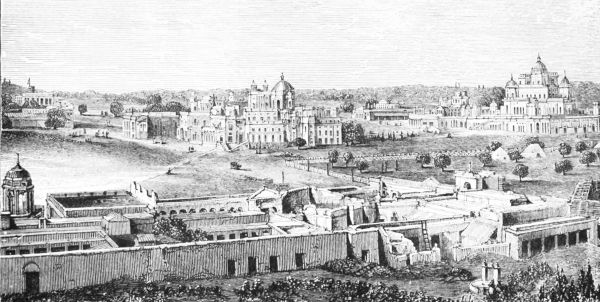
City of Lucknow. Page 164.
There is no Englishman's heart but must thrill to behold those patches of blackened and riddled ruin, half-hidden among gorgeous Eastern flowers, where idle cannon stand now as trophies by the battered walls, and brown-limbed gardeners water the smooth turf-lawns once drenched with so brave blood. Set in a beautiful garden, the remnants of the Residency buildings are preserved no less reverently than the tombs and monuments of their defenders, over which rises the flowery mound that bears aloft a white cross sacred to the memory of the Christian dead, famous and nameless, lying side by side around. Pillars and tablets carefully record the situation of this and that post, house, or battery, some hardly traceable now, some mere shells, or no more than names; but the ground has been so much changed by the clearing away of débris and the demolition of adjacent structures, that it is difficult for us to realize the scene, some of the chief actors in which, years afterwards, found themselves not quite clear as to all its original features. A model, however, preserved in the Lucknow Museum, presents the localities restored as far as possible to their original state, according to the best authorities, giving us some idea of what this frail fortress was, and exciting our amazement that it held out for a single day.[5]
We must not, then, imagine a citadel enclosed by solid walls like those of Delhi or the palatial fort at Agra, but a group of buildings widely scattered round the tower of the Residency, the outer ones turned each into a defensive work, with its own separate garrison, the gaps between filled up as means or accidents of situation best allowed. Mud walls, banks, hedges, ditches, lanes, trees, palisades and barricades, were all put to use for these irregular and extemporary fortifications, composed among other materials of carriages, carts, boxes, valuable furniture, and even a priceless library that went to stop bullets. It would take too long to give a full description of all the points made memorable by this siege, such as the Bailey Guard Gate, the Cawnpore Battery, the Sikh Square, Gubbins' House, the Church Post, the Redan, which formed the most salient features of the circle marked out for defence. The hastily thrown-up bastions were not finished when that rout of Chinhut made them so needful. A bolder enemy might have carried the lines at once with a rush. The half-ruined buildings outside gave the assailants cover within pistol-shot of the besieged; while indeed the latter were thus to a large extent shielded against artillery fire, as had been Lawrence's design in not completing his work of destruction here. Some of the rebel batteries played upon the works at a range of from fifty to a hundred yards. On one side, only a dozen yards of roadway separated the fighters; and from behind their palisades the loyal Sepoys could often exchange abuse, as well as shots, with the mutineers, who would steal up at night, tempting them to desert, as many did in the course of the siege, yet not so many as might have been expected under such trying circumstances.
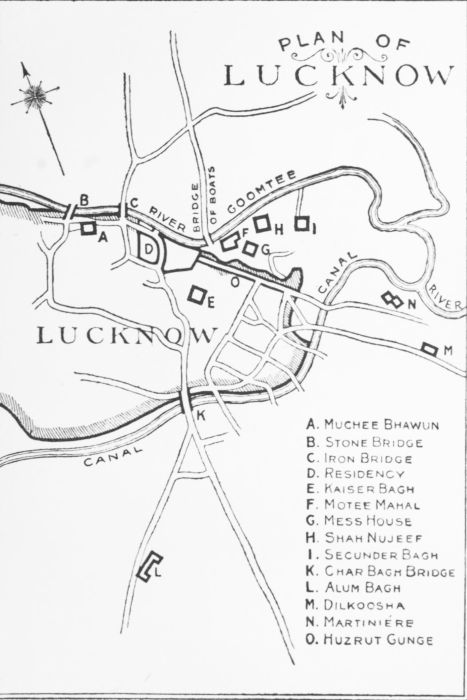
PLAN OF LUCKNOW Page 160.
This entrenchment was occupied by nearly a thousand soldiers, civilians, clerks, traders, or travellers turned by necessity into fighting-men, with a rather less number of staunch Sepoys, as well as about five hundred women and children, shuddering at the peril of a fate so fearful that English ladies kept poison ready for suicide in case of the worst, and loving husbands promised to shoot their wives dead, rather than let them fall alive into hands freshly blood-stained from the horrors of Cawnpore. As there a girls' school were among the victims, so at Lucknow the motley garrison included the boys of the Martinière College, whose experiences have been already mentioned. In all, counting some hundreds of native servants, not far short of three thousand persons must have been crowded within an irregular enclosure about a mile round, where on that disastrous last day of June the enemy's bullets began to fly across a scene of dismay and confusion—men hardly yet knowing their places or their duties; women wild with fear; bullocks, deserted by their attendants, wandering stupidly about in search of food; horses, maddened by thirst, kicking and biting one another, in the torment which no one had time to relieve. The siege had come to find these people too little prepared for its trials, or for the length to which it was protracted. Some thought they might have to hold out a fortnight. Few guessed that their ordeal would endure nearly five months.
When, on June 30th, the city fell into the hands of the rebels, we still occupied another position not far from the Residency, the old fortress of Muchee Bhawun, which, though more imposing in appearance, was not fit to resist artillery, nor, after the losses of Chinhut, were there men enough to defend both points. On the second day of the siege, therefore, Colonel Palmer, commanding here, was ordered by semaphore signals from the Residency tower, to bring his force into the other entrenchment, spiking the guns, and blowing up what ammunition he could not carry away. At midnight he marched silently through the city, without attracting any notice from the enemy, who were perhaps too busy plundering elsewhere. They had hardly joined their comrades, when a terrific explosion announced the destruction of the Muchee Bhawun, blown up by a train set to go off in half-an-hour. One soldier had been accidentally left behind, who, strange to say, escaped unhurt from the explosion, and next morning walked coolly into the Residency, meeting no one to stop him, perhaps because he was quite naked, and the people took him for a madman or a holy man!
It was sad news that awaited Colonel Palmer. His daughter, while sitting in an upper room of the Residency, had been wounded by a shell, one of the first among many victims. She died in a few days, by which time the besieged had to mourn a greater loss. The Residency building, elevated above the rest, was soon seen to be a prominent mark for the enemy's fire, and on the first day, after a shell had burst harmlessly in his own room, Lawrence was begged to move into less dangerous quarters. With characteristic carelessness of self, he put off doing so; then next morning, July 2, was mortally wounded while lying on his bed. Two days later he died, visited by many weeping friends, of whom he took leave in the spirit of an earnest Christian. Well known is the epitaph which, amid the din of shot and shell, he dictated for his grave: "Here lies Henry Lawrence, who tried to do his duty. May the Lord have mercy on his soul!" He nominated Major Banks as his successor in the Commissionership and Brigadier Inglis to command the troops. The latter had his wife with him throughout all, to whose recently published reminiscences we owe one of the most interesting narratives of the siege.
Gloom fell upon the garrison when they came to learn this heavy loss. Every man had so much to do at his own post, that he hardly knew what went on a few hundred yards off, and some days seem to have passed before it leaked out to all how their leader had been buried "darkly at dead of night," in the same pit with less distinguished dead. A common grave had to be dug each night, the churchyard being exposed to fire. Every day now had its tale of deaths, soon from fifteen to twenty, once the enemy had got the range and given up wild firing at random—an average which grew smaller as the besieged were taught to be more cautious in exposing themselves. Six weeks passed before the diary of the chaplain's wife can record, for once, a day without a single funeral. Death was busy everywhere in various forms. Men were more than once buried beneath the ruins of houses crushed by the storm of shot. Delicate women panted for air in crowded cellars, and sickened amid the pestilential stenches that beset every corner of the entrenchment, or despairingly saw their children pine away for want of proper nourishment. The poor sufferers in hospital would sometimes be wounded afresh or killed outright by balls crashing among them. An amputation was almost certain death in that congregation of gangrened sufferers, increased hour by hour. There were daily duties to be done always at the peril of men's lives, and spots where no one could show himself without the risk of drawing fire. "Many a poor fellow was shot, who was too proud to run past places where bullets danced on the walls like a handful of peas in a fry-pan." One building, called "Johannes' House," overlooking the defences as it did, was long a thorn in the side of the besieged, from the top of which a negro eunuch, whom they nicknamed "Bob the Nailer," was believed to have shot down dozens of them by the unerring aim of a double-barrelled rifle that gave him such grim celebrity.
The native servants soon began to desert, adding to the troubles of masters whose pride and practice had been to do nothing that could be helped for themselves. Then the younger Martinière boys were told off to take their place in the cramped households, set to perform the menial services looked upon as belonging to the lowest caste. They attended the sick, too, and were of especial use in defending them against an Egyptian plague of flies which assailed the entrenchment, as well as in pulling punkahs to cool fevered brows. All these school-boys, whose terrible holidays began so unseasonably, took their turns in washing, grinding corn, bringing wood and water, besides general fetching and carrying at various posts, while some dozen of the oldest stood guard, musket in hand, or helped to work the signals on the tower—a service of no small danger, as the movements of the semaphore drew a hot fire; and, what with the clumsiness of the apparatus and the cutting of the ropes by shot, it took three hours to convey the order for evacuation of the Muchee Bhawun.
Though their post seems to have been an exposed one, just opposite Johannes' House, where that black marksman stationed himself, and where the enemy were literally just across the street, the school-boys had throughout only two of their number wounded, while two died of disease. Mr. Hilton, whose narrative has been already quoted, can tell of more than one narrow escape, once when a spent cannon-ball passed between his legs; again when a fragment of shell smashed the cooking pot from which he was about to draw his ration; and another time he was assisting to work the semaphore on the roof, when a shell burst so near as to disgust him with that duty. He did manage to get hurt in a singular manner. A badly-aimed shell from one of their own batteries fell into the court-yard where he was sitting, and in the wild stampede which ensued he stumbled over his sister and cut his knee on a sharp stone. This wound ought to have healed in a few days, but constant hardship had thrown him into such a bad state of health, that it festered and kept him in pain for more than two months, under the terrible warning that his leg might have to be amputated if he did not take care of it.
Before this accident he had entered into his duties as a soldier with rather more zeal than discretion. The boys trusted with arms, used, it seems, to take ten or twenty rounds to the top of the house, and fire through the loop-holes at whatever seemed a fair target. Fed on stews of tough beef and coarse chupatties, the hand-cakes of the country, their mouths watered at the sight of pumpkins and other vegetables growing in Johannes' garden, just beyond the line of their defences, so near yet so far out of reach; for the Sepoy marksmen were always on the watch to shoot any one who exposed himself here. Seeing they could not get these gourds for themselves, the lads found amusement in shooting at them to spoil them at least for the enemy. But this sport was soon interfered with. One boy having been wounded by a rebel lurking in the sheds opposite, Hilton and a comrade, named Luffman, went up to the roof to get a shot at the fellow. While they were firing from a loop-hole protected by a basket full of rubbish, another boy came out to join them with a fresh supply of ammunition; then their attention being for a moment diverted to him, the Sepoy over the way saw his chance for an aim. His bullet struck Luffman's musket, glanced along the barrel, and lodged in the lad's left shoulder. This accident drew on the young marksmen a severe reprimand from the Principal, and their supplies of ammunition for promiscuous shooting were henceforth cut off.
Mr. Hilton makes no complaint on his own account; but Mr. Rees, an ex-master of the Martinière, who has also given us an account of the siege, says that the boys were rather put upon in his opinion. He describes them as going about "more filthy than others, and apparently more neglected and hungry." Up till the end of June they had been able to draw supplies of food and clean clothes from the college. Now they were reduced to what they had on their backs, a serious trial in the Indian climate, and had to do their washing for themselves as best they could. The Martinière was in the hands of the mutineers, who had wreaked their wrath by digging up poor General Martin's tomb and scattering his bones.
One honourable charge these youngsters had. There was a store of wines and spirits in the garrison, which some of the soldiers broke into, and were once found helplessly drunk when called to arms on a sudden alarm. After that, the liquor was guarded in the Martinière post, till it could be disposed of so as to do least mischief.
The women, who in private houses or in the underground vaults of the Residency were kept out of danger as well as possible, had their share of toils, to which some would be little used. Many found enough to do in looking after their own ailing families. Others distinguished themselves by zeal in tending the sick and wounded. The wonder is that the diseases which had broken out from the first did not sweep off the whole community, pent up in such unwholesome confinement. Fortunately, in the course of a few days, a heavy shower of rain fell to wash away the filth that was poisoning them. This was the opening of the rainy season, on the whole welcome, yet not an unmixed blessing. The climate of India runs always to extremes; so glare and dust were exchanged only for the enervation of a perpetual vapour-bath.
In heat and wet, by night and day, every able-bodied man must take weary spells of watching and working, and at all hours be ready to run to his post on the first sign of danger. Nearly fifty guns had to be served. Officers and men, civilians and soldiers, black and white, laboured side by side, a tool in one hand, it may be said, a weapon in the other. At the quietest intervals, they had to be repairing their defences, shifting guns, carrying stores, burying the bodies of putrid animals. Constant false alarms kept them harassed before they had completed their works. For hours together the enemy sometimes went on shouting and sounding the advance, without showing themselves, so that all night the defenders, exhausted by the day's toil, might still have to stand on guard. Yet, overwrought as they were, small parties would here and there dash from their lines to spike a gun or drive away the occupants of some annoying outpost.
On our side there were many instances of daring prowess, but few of cowardice and shirking, as is testified by Lady Inglis. "As an example of brilliant courage, which to my mind made him one of the heroes of the siege, I must instance Private Cuney, H.M. 32nd. His exploits were marvellous; he was backed by a Sepoy named Kandial, who simply adored him. Single-handed and without any orders, Cuney would go outside our position, and he knew more of the enemy's movements than any one else. It was impossible to be really angry with him. Over and over again he was put into the guard-room for disobedience of orders, and as often let out when there was fighting to be done. On one occasion he surprised one of the enemy's batteries, into which he crawled, followed by his faithful Sepoy, bayoneting four men, and spiking the guns. If ever there was a man deserving the V.C., it was Cuney. He seemed to bear a charmed life. He was often wounded, and several times left his bed to volunteer for a sortie. He loved fighting for its own sake. After surviving the perils of the siege, he was at last killed in a sortie made after General Havelock's arrival."
Three weeks passed thus before the besiegers, swarming soon in tens of thousands around them, took courage for a general assault. The signal was an ineffectual explosion of a mine against the Redan battery; then from all sides they came pouring up to the works under cover of their cannon. But here every man was at his post to receive them desperately, many believing that their last hour was come. Some of the wounded had staggered out of hospital, pale and blood-stained, to lend a weak hand in the defence. The whole enclosure became quickly buried in sulphureous smoke, so that men hardly saw how the fight went in front of them, and still less knew but that their comrades had been overwhelmed at some other point, as well they might be, and whether at any moment the raging foe might not break in upon their rear. Again and again the Sepoys were urged on, to be mowed down by grape and musketry. Here they got right under our guns, driven away by hand grenades, bricks toppled over upon them, and whatever missiles came to hand; there they brought ladders against the walls, but were not allowed to make use of them. At one point, led on by the green standard of Islam in the hands of a reckless fanatic, they succeeded in bursting open a gate, only to block up the opening by their corpses. Four hours the din went on, under the fatal blaze of a July sun; but at length the enemy fled, leaving some thousands fallen round the unbroken walls, within which a surprisingly small number had been hurt.
This repulse put new heart into the victors, so much in need of cheering; and their spirits were soon raised still further by news of Havelock's army on its way to relieve them. They were not without communications from the outside world. An old pensioner named Unged several times managed to slip through the enemy's lines, bringing back messages and letters which were not always good news. Thus they had learned the fate of their kinsmen at Cawnpore; and their own temporary elation soon passed away under continued sufferings and losses.
The day after the assault, Major Banks was shot dead. Others who could be ill-spared fell one by one, every man placed hors de combat leaving more work to be done by his overstrained comrades. Then there were dissensions among the remaining leaders. The English soldiers, made reckless by peril, sometimes gave way to a spirit of insubordination, or disgraced themselves by drunkenness. The Sepoys could not be fully trusted. The enemy, there was reason to fear, had spies within the place to report its weak points and the embarrassment of its defenders. A proof of this was that they had ceased firing on the hospital when some native dignitaries, held as prisoners, were quartered there in the lucky thought of making them a shield for the sick. It was hard on those hostages, who had to take their share of the general want and peril. The rations of coarse beef and unground grain were found insufficient to keep the garrison in good case; and before long these had to be reduced, while the price of the smallest luxury had risen beyond the means of most. If a hen laid an egg it came as a god-send; a poor mother might have to beg in vain for a little milk for her dying child. What the English soldiers missed most was tobacco; and when some of the Sikhs deserted, they left a message that it was because they had no opium. The priceless Crown Jewels of Oudh, and the public treasure guarded in the Residency, were dross indeed in the eyes of men longing for the simplest comforts. How yearningly they fixed their eyes on the green gardens and parks blooming among the towers of Lucknow! And Havelock did not come to fulfil their hopes, soon dashed by news that he had been forced to fall back on Cawnpore, to recruit his own wasted forces.
At the beginning of August, our people had heard heavy firing and the sound of English music in the city, which brought them out cheering and shaking hands with each other on the tops of the houses, eager to catch the first sight of their approaching friends. That night they slept little, and rose to be bitterly disappointed. The rebels tauntingly derided this short-lived joy, shouting over the cause of yesterday's commotion. They had been saluting the boy crowned as puppet-king of Oudh. Their bands, indeed, were often heard playing familiar tunes, taught them in quieter days, and always wound up their concerts with "God Save the Queen!" which must have sounded a strange mockery in those English ears. Once it was the turn of the English to make a joyful demonstration, firing off a general salute on a report of the fall of Delhi, which turned out false, or at least premature.
On August 10, the Sepoys delivered another assault, but were more easily beaten off this time. It began by the explosion of a mine, which threw down the front of the Martinière post, ruining also some fifty feet of palisading and other bulwarks on each side. The assailants wanted boldness to master the breach thus made; but they lodged themselves in an underground room of this house, from which they had to be expelled by hand-grenades, dropped among them through a hole in the floor, and they got no further within the quickly-restored defences. At first, it is said, they could have walked in through an open door, which Mr. Schilling and his boys had the credit of shutting in their faces. The School would all have been blown up, but for the good fortune of having just been called in to prayers in an inner room. Three soldiers had been hurled by the explosion on to the enemy's ground, but ran back into the entrenchment, unhurt, under a shower of bullets.
The Sepoys' fire was kept up as hotly as ever, though at times they seemed to be badly off for shot, sending in such strange projectiles as logs of wood bound with iron, stones hollowed out for shells, twisted telegraph wires, copper coins and bullocks' horns; even the occasional use of bows and arrows lent a mediæval feature to the siege.
Their main effort now seemed directed to the destruction of the walls by mining. Here they were foiled, chiefly through the vigilance of Captain Fulton, an engineer-officer, who took a leading part in the defence, only to die before its end, like so many others. In the ranks of the 32nd, he found a number of old Cornish miners, with whose help he diligently countermined the subterranean attacks. Now the burrowing Sepoy broke through into an unsuspected aperture, to find Fulton patiently awaiting him, pistol in hand. Again, a deep-sunk gallery from within would be pushed so far, that our men blew up not only the enemy's mine, but a house full of his soldiers. The garrison had always their ears strained to catch those muffled blows, which announced new perils approaching them underground; then, as soon as the situation and direction of the mine could be recognized, Fulton went to work and the dusky pioneers either gave up the attempt or came on to their doom.
Once, however, they did catch the watchers at fault. At the corner of the defences called the Sikh Square, the warning sounds were mistaken for the trampling of horses tied up close by—a mistake first revealed by an explosion which made a breach in the works, overwhelming some of its defenders and hurling others into the air, most of whom came off with slight hurt. The Sepoys rushed on, but did not venture beyond the gap they had made, while some time passed before our men could dislodge them. One native officer was shot within the defences, the first and last time they were ever penetrated till they came to be abandoned. Of nearly forty mines attempted, this was the only one that could be called a success.
Several unhappy drummers, buried among the ruins, cried lamentably for assistance; but the risk of going to their assistance under fire was too great. A brave fellow did steal forward, and with a saw attempted to release one of the men held down by a beam across his chest, but the Sepoys drove him back when they saw what he was at. These half-buried lads had all died a miserable death of suffocation or thirst, if not from their injuries, when towards nightfall a party of the 32nd, shielding themselves behind bullet-proof shutters, advanced to recapture the lost ground at the point of the bayonet, which they not only did, and barricaded the breach with doors, but, while they were about it, made a dash forth to blow up some small houses that had given cover to the enemy.
This was one of several gallant sorties, in another of which Johannes' House was blown up, and the redoubtable "Bob the Nailer" killed in the act of exercising his deadly skill from the top of it. But his place as a marksman was taken by a brother negro of scarcely less fatal fame; and the enemy always expressed their resentment for these attacks by fresh bouts of more furious bombardment. Once, they had nearly destroyed a vital point of our line by piling up a bonfire against the Bailey Guard Gate; but Lieutenant R.H.M. Aitken, the burly Scot who held this post with his Sepoys, rushed out and extinguished the flames, under a rain of bullets, before much mischief could be done.
By this time the inmates of the Residency, from looking death so hard in the face, had grown strangely callous both to suffering and to danger. Men now showed themselves indifferent before the most heart-rending spectacles, while they coolly undertook perilous tasks at which, two months ago, the boldest would have hesitated. Children could be seen playing with grape-shot for marbles, and making little mines instead of mud-pies. Women took slight notice of the hair-breadth escapes that happened daily with them as with others. "Balls fall at our feet," says Mr. Rees in his journal, "and we continue the conversation without a remark; bullets graze our very hair, and we never speak of them. Narrow escapes are so very common that even women and children cease to notice them. They are the rule, not the exception. At one time a bullet passed through my hat; at another, I escaped being shot dead by one of the enemy's best riflemen, by an unfortunate soldier passing unexpectedly before me, and receiving the wound through the temples instead; at another, I moved off from a place where, in less than the twinkling of an eye afterwards, a musket-ball stuck in the wall. At another, again, I was covered with dust and pieces of brick by a round-shot that struck the wall not two inches away from me; at another, again, a shell burst a couple of yards away from me, killing an old woman and wounding a native boy and a native cook, one dangerously, the other slightly—but no; I must stop, for I could never exhaust the catalogue of hair-breadth escapes which every man in the garrison can speak of as well as myself."
Still, their hearts could not but grow heavy at times, especially as the feast of the Mohurrem drew near, when Moslem zeal might be expected to stimulate its votaries to more desperate fury. Desertions went on fast among the servants, and it was feared that, if relief came not soon, the Sepoys would go over to their mutinous comrades, who daily tried to seduce them with threats and promises. Some native Christians and half-castes, of whom better might have been expected, did run away in a body, only to be butchered by the fanatics among whom they so faithlessly cast their fortunes. A third of the Europeans had perished; the rest were worn with sickness and suffering, but they had not lost an inch of ground.
It was no fault of Havelock if he still lay at Cawnpore, forty miles away. Once and again he had advanced, beating the enemy every time they ventured to face him; but after two pitched battles, in which this fearless General had already had six horses killed under him, and several minor combats, the country-people rising up about him in fierce opposition, cholera also decimating the ranks, his losses were so heavy that he could not yet hope to force a way to Lucknow, much less through the narrow streets, where every house might be found a fortress.
Now reinforcements were being pushed up from Calcutta; and at the end of August, the besieged had a letter promising relief in twenty-five days. "Do not negotiate," was Havelock's warning to them, "but rather perish, sword in hand." So they meant to do, if it came to that, rather than fall alive into the power of such a cruel and treacherous foe. Meanwhile, there was nothing for it but to hold out doggedly till their deliverer could gather strength to reach them.
On September 5 the enemy tried another assault, which was more of a failure than ever. Evidently, on their side, they were losing heart. And at last, on the night of the 22nd, Unged, the trusty messenger, rushed into the entrenchment under fire, with news that Havelock and Outram were at hand. The latter's noble generosity here is one of his best titles to fame. He came to supersede the General who had so long strained every nerve in vain; but, knowing how Havelock had at heart the well-deserved honour of relieving Lucknow, the "Bayard of India," for the time, waived his own right to command, serving as a volunteer till this task should have been accomplished. In this, Sir James Outram afterwards judged himself to have done wrong, as putting sentiment before duty.
Two days of suspense followed, every ear within the Residency bent to catch the sound of the cannon of the advancing army. On the third day, the welcome din drew nearer, clouds of smoke marked the progress of a hot battle through the streets, and, as a hopeful sign, routed natives could be seen flying by hundreds, their bridges of boats breaking down under a confused mob of horsemen and foot-passengers, camels, elephants, and carriages. Havelock had forced the Char Bagh bridge of the canal, and was working round by its inner bank, to turn along the north side of the city, the ground here being more open. But all that long day lasted the doubt and the fear, as well as the joy, for our troops, their entrance once won into Lucknow, had to make a devious circuit about the most thickly-built quarters, and after all blunderingly fought their way, inch by inch, through the streets into a narrow winding road that led to the Residency. It was not till nightfall those strained eyes within could, by flashes of deadly fire, see the van of their countrymen struggling up to the riddled buildings, where—
"Ever upon the topmost roof our banner of England blew."
The struggling progress of the column is described, in a letter home, by Mr. Willock, a young civilian, who had volunteered to share its perils.
"The fire from the King's Palace, known as the 'Kaiser Bagh,' was so severe that we had to run double-quick in front of it, as hard as we could; and a scene of great confusion ensued when we halted—guns and infantry mixed up, soldiers wandering in search of their companies, and the wounded in the dhoolies carried here and there without any orders. We had been there about half-an-hour when the Second Brigade joined us, passing in front of the palace, emerging from a narrow lane close to it. Here they had to pass under the very walls, while the rebels on the walls hurled down stones and bricks, and even spat at our fellows, a fierce fire being kept up from the loop-holes. After a little time order was re-established, and after a fresh examination of the map, the column was drawn up, and we started again. It was cruel work—brave troops being exposed to such unfair fighting. What can men do against loop-holed houses, when they have no time to enter a city, taking house by house? In fact, we ran the gauntlet regularly through the streets.
"After we passed the Palace, our men were knocked down like sheep, without being able to return the fire of the enemy with any effect. We passed on some little way, when we came to a sudden turning to the left, with a huge gateway in front, and through this we had to pass, under a shower of balls from the houses on each side. The Sikhs and 5th Fusiliers got to the front, and kept up a steady fire at the houses for some time, with the hope of lessening the enemy's musketry fire, but it was no use. Excited men can seldom fire into loop-holes with any certainty, and we had to make the best of our way up the street, turning sharp round to the right, when we found ourselves in a long, wide street, with sheets of fire shooting out from the houses. On we went, about a quarter of a mile, being peppered from all sides, when suddenly we found ourselves opposite to a large gateway, with folding doors completely riddled with round-shot and musket-balls, the entrance to a large enclosure.
"At the side of this was a small doorway, half blocked up by a low mud wall; the Europeans and Sikhs were struggling to get through, while the bullets were whistling about them. I could not think what was up, and why we should be going in there; but after forcing my way up to the door, and getting my head and shoulders over the wall, I found myself being pulled over by a great unwashed hairy creature,[6] who set me on my legs and patted me on the back, and, to my astonishment, I found myself in the 'Bailey Guard!'"
The scene then ensuing has been often described—the garrison pressing forward with cheers of welcome and triumph—the rough Highlanders suddenly appearing through the darkness among the ruins they had fought so many battles to save—their begrimed faces running with tears in the torchlight, as they caught up in their arms the pale children, and kissed their country-women, too, in that spasm of glad emotion; even the ladies ready to hug them for hysteric joy—the gaunt, crippled figures tottering out to join in the general rejoicing, now that for a moment all believed their trials at an end. That picturesque incident of a Highland Jessie, first to catch the distant strains of the bagpipes, appears to be a fiction. But bagpipes were not wanting; and one of the defenders, strolling over as soon as he could leave his own post, hardly able to believe the good news true, tells us how he found dancing going on to the music of two Highland pipers—a demonstration, however, soon put a stop to by Havelock's orders.
Havelock had cause to think this no time for dancing. While the common soldiers might exult over their melodramatic victory, the leaders knew too well at what a cost it had been won, and what dangers still encompassed them. Not all the little army of two thousand five hundred men had pushed through on that memorable evening. Nearly a fifth part of them were lost in the attempt. Neill had been shot dead, with the goal already in sight. Outram himself was hurt. It had been necessary to leave most of the wounded on the way, many of whom, deserted by the natives who bore their litters, suffered a horrible fate, massacred or burned alive while their comrades were making merry within the works. Part of the relieving force bivouacked all night on the road outside, where in the confusion a lamentable affair occurred, some of our faithful Sepoys at the Bailey Gate being attacked in mistake by the excited new-comers.
Only two days later, the rear-guard, hampered by the heavy guns, could join its commander at the Residency; and even then a force, in charge of baggage and ammunition, was left besieged in the Alum Bagh, a fortified park beyond the city, which henceforth became an isolated English outpost.
The relieving army had been hurried on at all risks, under a mistaken belief that the garrison was in immediate straits of famine. It turned out they had still food to last some weeks, even with so many more mouths to fill, an unreckoned store of grain having been found heaped up, by Lawrence's foresight, in the plunge-bath below the Residency. Means of transport, however, were wanting; and Outram, who now assumed command, could not undertake to fight his way out again with the encumbrance of a long train of non-combatants. Much less was he in a position to clear the city, still occupied by the enemy in overwhelming numbers. All he could do was to hold on where he was, awaiting the arrival of another army now on the march.
It was a relief and not a rescue over which so much jubilation had been spent. It came just in time, now that the fall of Delhi had set free a swarm of Sepoys to swell the ranks of the Lucknow besiegers. The mere sight of their countrymen, and the sure news they brought, was enough to put fresh spirit into the defenders, who, by the help of such a reinforcement, no longer doubted to hold the fortress that had sheltered them for three miserable months, with the loss of more than seven hundred combatants by death and desertion.
Here, then, the siege entered upon a second period, the characteristic of which was an extended position occupied by the garrison. Now that they had plenty of men, they seized some of the adjacent palaces, and pushed their lines down to the river-bank. Like men risen from a long sickness, they stretched their legs on the ground that for weeks had been raining death into their enclosure. There must have been a strange satisfaction in strolling out from their own half-ruined abodes, to examine the damage they had wrought among the enemy's works, at the risk of an occasional shot from his new posts, as the Martinière boys found when they let curiosity get the better of caution.
Some of these youngsters soon managed to run into mischief. A few days after the relief, being sent out to pick up firewood among the débris, they stole a look where still lay the mutilated corpses of Havelock's wounded men murdered so basely, then rambled into one of the royal palaces—a labyrinth of courts, gardens, gateways, passages, pavilions, verandahs, halls, and so forth, all in the bewildering style of Eastern magnificence, where it was difficult not to lose one's way. Here a general plunder was going on, and our people, even gleaning after the Sepoys, could help themselves freely to silks, satins, velvets, cloth of gold, embroideries, costly brocade, swords, books, pictures, and all sorts of valuables. In some rooms were nothing but boxes full of gorgeous china, ransacked so eagerly that the floors soon became covered a foot deep with broken crockery. Others of the besieged pounced most willingly upon articles of food, especially on tea, tobacco, and vegetables, which to them seemed treasures indeed. For their part, the Martinière boys ferreted out a store of fireworks, and must needs set off some rockets towards the enemy. One of these dangerous playthings, however, exploded in their hands, kindling others and setting fire to the building. The boys scampered out without being noticed, and took care to hold their tongues about this adventure, so that it was not ascertained at the time, though strongly suspected, on whom to lay the blame of a conflagration that went on for several days. The former King of Oudh who built this costly pile, little thought how one day its glories were to perish by the idle hands of a pack of careless school-boys.
The trials of the garrison were by no means over. Sickness continued to make havoc among them for want of wholesome food, especially of vegetables, the best part of their diet being tough artillery bullocks. The smallest luxury was still at famine price. The cold weather drawing on found many of these poor people ill-provided with clothing. One officer had gained asylum here in such a ragged state, that he was fain to make himself a suit of clothes from the green cloth of the Residency billiard-table. All were heartily sick of confinement and anxiety. Yet nearly two months more had to be passed in a state of blockade, the enemy no longer at such close quarters, but still bombarding them with his artillery, and keeping them on the alert by persistent attempts to mine their defences.
They were now, however, able to do more than stand on the defensive, making vigorous sallies, before which the Sepoys readily gave way, and held their own ground only by the weight of numbers. Good news, too, cheered the inmates of this ark of refuge. All round them the flood of mutiny seemed to be subsiding. Delhi had fallen at length, while they still held their shattered asylum. Sir Colin Campbell was coming to make a clean sweep of the rebel bands who kept Oudh in fear and confusion. The heroes of Lucknow knew for certain that they were not forgotten by their countrymen. They could trust England to be proud of them, and felt how every heart at home would now be throbbing with the emotion, which the Laureate was one day to put into deathless verse.
"Men will forget what we suffer and not what we do. We can fight— But to be soldier all day and be sentinel all through the night! Ever the mine and assault, our sallies, their lying alarms, Bugles and drums in the darkness, and shoutings and soundings to arms; Ever the labour of fifty that had to be done by five; Ever the marvel among us that one should be left alive; Ever the day with its traitorous death from the loop-holes around; Ever the night with its coffinless corpse to be laid in the ground.
Grief for our perishing children, and never a moment for grief; Toil and ineffable weariness, faltering hopes of relief; Havelock baffled, or beaten, or butchered for all that we knew. Then day and night, night and day, coming down on the still shattered walls, Millions of musket bullets and thousands of cannon balls— But ever upon the topmost roof our banner of England blew."
FOOTNOTES:
CHAPTER VIII
LORD CLYDE'S CAMPAIGNS
Sir Colin Campbell, soon to earn the title of Lord Clyde, had arrived at Calcutta in the middle of August, as Commander-in-Chief of an army still on its way from England by the slow route of the Cape. He could do nothing for the moment but stir up the authorities in providing stores and transport for his men when they came to hand. All the troops available in Bengal were needed to guard the disarmed Sepoys here, and to keep clear the six hundred miles of road to Allahabad, infested as it was by flying bands of mutineers and robbers. But if he had no English soldiers to command, there was a brigade of sailors, five hundred strong, who under their daring leader, Captain William Peel, steamed up the Ganges, ahead of the army, to which more than once they were to show the way on an unfamiliar element.
In the course of next month, arrived the troops of the intercepted China expedition, a detachment from the Cape, and other bodies coming in by driblets, who were at once forwarded to Allahabad, part of the way by rail and then by bullock-trains. A considerable force of Madras Sepoys, more faithful than their Bengal comrades, was also at the disposal of the Government, and helped to restore order in the country about the line of march, still so much agitated that reinforcements moving to the front were apt to be turned aside to put down local disturbances. Sir Colin himself, hurrying forward along the Grand Trunk Road, had almost been captured by a party of rebels.
On November 1, he was at Allahabad, from which his troops were already pushing on towards Cawnpore, not without an encounter, where the Naval Brigade won their first laurels on land. Two days later, Sir Colin reached Cawnpore, and at once had to make a choice of urgent tasks. To his left, the state of Central India had become threatening. The revolted Gwalior Contingent Sepoys, in the service of Scindia, had long been kept inactive by their nominal master; but after the fall of Delhi, they marched against us under Tantia Topee, the Mahratta chief who had carried out the massacre at Cawnpore, and now comes forward as one of the chief generals on the native side. This army, swollen by bands from Delhi, approached to menace the English communications on the Ganges, if it were not faced before our men turned to the right for the relief of Lucknow. The question was, whether or not to deal with Tantia Topee at once. But Sir Colin, misled like Havelock by a false estimate of the provisions in the Residency, decided at all risks to lose no time in carrying off the garrison there, even though he must leave a powerful enemy in his rear. Over and over again in this war, English generals had to neglect the most established rules of strategy, trusting to the ignorance or the cowardice of their opponents. Yet Tantia Topee showed himself a leader who could by no means be trusted for failing to improve his opportunities.
Leaving behind him, then, five hundred Europeans and a body of Madras Sepoys, under General Windham, to hold the passage of the Ganges at Cawnpore, the Commander-in-Chief marched northwards to join Sir Hope Grant, awaiting him with a column released from Delhi; and the combined force moved upon the Alum Bagh, still held by a detachment of Outram's force. From this point they were able to communicate with the Residency by means of a semaphore telegraph erected on its roof, worked according to the instructions of the Penny Cyclopædia, which happened to be in the hands of the besieged. Native messengers also passed to and fro, through whom Outram had generously recommended the relieving army to attack Tantia Topee first, letting his garrison hold out upon reduced rations, as he thought they could do till the end of November. He had thus furnished Sir Colin with plans of the city and directions that would be most useful to the latter as a stranger. But it seemed important to give him some guide fully to be trusted for more precise information as to the localities through which he must make his attack. A bold civilian, named Kavanagh, volunteered to go from the Residency to the camp, on this dangerous errand, by which he well-earned the Victoria Cross.
In company with a native, himself dyed and disguised as one of the desperadoes who swarmed about Lucknow, Kavanagh left our lines by swimming over the river, re-crossed it by a bridge, and walked through the chief street, meeting few people, none of whom recognized him for a European. Outside the city, the two companions lost their way, but were actually set right by a picket of the rebels, who here and there challenged them or let them pass without notice. Before daybreak they fell in with the British outposts, and at noon a flag on the Alum Bagh informed the garrison of their emissary's safe arrival.
On November 12, Sir Colin reached the Alum Bagh, where he spent one more day in making final arrangements; then, on the 14th, he set out to begin the series of combats by which he must reach a hand to our beleaguered countrymen. His army, with reinforcements coming up at the last moment from Cawnpore, numbered some five thousand men and fifty guns, made up in great part of fragments of several regiments, the backbone of it the 93rd Highlanders, fresh from England, and steeled by the Crimean battles in which they had learned to trust their present leader. These precious lives had to be husbanded for further pressing work; and in any case he naturally sought a safer road than that on which Havelock had lost a third of his force.
One looking at the map of Lucknow might be puzzled to explain the circuitous route taken by both generals from the Alum Bagh to the Residency, which stand directly opposite each other on either side of the city, some three or four miles apart. Running a gauntlet of street-fighting was the main peril to be avoided. Then, not only should the approach be made as far as possible through open suburbs, but while the Residency quarter is bounded by the windings of the Goomtee to the north, the south and east sides are defended by the Canal, a deep curved ravine, in the wet season filled with water. Instead of forcing his way, like Havelock, over its nearest bridge, Sir Colin meant to make a sweep half-round the city on the further side of this channel, taking the rebels by surprise at an unexpected point, as well as hoping to avoid the fire of the Kaiser Bagh, a huge royal palace, which was their head-quarters, and commanded the usual road to the Residency.
His first move was to the Dilkoosha, a hunting palace with a walled enclosure, which he fortified as a depôt for his stores and for the great train of vehicles provided to carry off the women and children. The same day he seized the Martinière College close by, and pushed his position towards the banks of the Canal, from their side of which the enemy made hostile demonstrations. Next day was spent in final arrangements and in repelling attacks. By ostentatious activity in that direction, the Sepoys were led to believe that they would be assailed on the English left; but on the morning of the 16th Sir Colin marched off by his right, crossed the bed of the Canal, dry at this point, gained the bank of the river, and penetrated the straggling suburbs upon the enemy's rear, with no more than three thousand men, the rest left posted so as to keep open his retreat. A small force this for a week's fighting, under most difficult circumstances,against enormous odds, where a way must again and again be opened through fortified buildings!
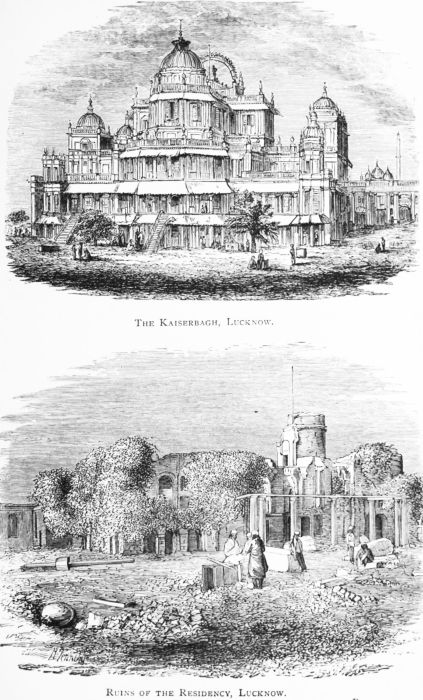
The Kaiserbagh, Lucknow. Ruins of the Residency, Lucknow. Page 204.
The line of march lay along narrow winding lanes and through woods and mud walls, that for a time sheltered our troops from fire. The first obstacle encountered was the Secunder Bagh, one of those walled gardens which played such a part in the operations about Lucknow and Delhi. Its gloomy ruins stand to-day to tell a dreadful tale. The approaches had first to be cleared, and the walls battered by guns that could hardly be forced up a steep bank under terrible fire. In half-an-hour, a small hole had been knocked through one gate, then, Highlanders and Sikhs racing to be foremost in the fierce assault, the enclosure was carried, where two thousand mutineers were caught as in a trap. Some fought desperately to the last; some threw down their arms begging for mercy, but found no mercy in hearts maddened by the remembrance of slaughtered women and children. "Cawnpore!" was the cry with which our men drove their bayonets home; and when the wild din of fire and sword, of shrieks and curses, at length fell silent, this pleasure-garden ran with the blood of two thousand dusky corpses, piled in heaps or strewn over every foot of ground. We may blame the spirit of barbaric revenge; but we had not seen that well at Cawnpore.
The advance was now resumed across a plain dotted by houses and gardens, where soon it came once more to a stand before the Shah Nujeef, a mosque surrounded with high loop-holed walls, that proved a harder nut to crack than the Secunder Bagh. For hours it was battered and assaulted in vain, the General himself leading his Highlanders to the charge. In vain the guns of Peel's Naval Brigade were once brought up within a few yards of the walls, worked as resolutely as if their commander had been laying his ship beside an enemy's. In vain brave men rushed to their death at those fiery loop-holes, while behind them reigned a scene of perilous confusion, the soldiers able neither to advance nor retreat among blazing buildings and deadly missiles. The narrow road had become choked up by the train of camels and other animals, so that ammunition could scarcely be forced to the front. From the opposite side of the river, the enemy brought a heavy gun to bear upon the disordered ranks. Our batteries had to be withdrawn under cover of a searching rocket-fire.
For a moment Sir Colin feared all might be lost. Yet, after all, what seems little better than an accident put an easy end to this desperate contest. At nightfall, a sergeant of the 93rd, prowling round the obstinate wall, discovered a fissure through which the Highlanders tore their way, to see the white-clad Sepoys flitting out through the smoke before them. Our men could now lie down on their arms, happy to think that the worst part of the task was over.
Next morning, the same laborious and deadly work went on. Other large buildings had to be hastily bombarded and a way broken through them, in presence of a host strong enough to surround the scanty force. But this day the amazed enemy seemed to have his hands too full to interfere much with our progress. Parties had been thrown out towards the city, on Sir Colin's left, to form a chain of posts which should cover his advance and secure his retreat. Meanwhile, also, the garrison of the Residency were busy on their side, with mines and sorties, pushing forward to meet the relieving army, who spent most of the day in breaching a building known as the Mess House. This was at length carried, as well as a palace beyond, called the Motee Mahal, by gallant assaults, foremost in which were two of our most illustrious living soldiers, Lord Wolseley and Sir Frederick Roberts.
Between the relievers and the defences of the Residency there now remained only a few hundred yards of open space, swept by the guns of the Kaiser Bagh. Mr. Kavanagh appears to have been the first man who reached the garrison with his good news; then Outram and Havelock rode forward under hot fire to meet Sir Colin Campbell on that hard won battle-field, over which for days they had been anxiously tracing his slow progress.
This relief may seem to fall short of the dramatic effect of Havelock's, though it has grand features of its own, and from a military point of view is a more admirable achievement. To many of the beleaguered it brought a sore disappointment, when they learned that their countrymen had come only to carry them away, and that, after all, they must abandon this already famous citadel to the foe they had so long kept at bay by their own strength—the one spot in Oudh where the English flag had never been lowered throughout all the perils of the rebellion. Inglis offered to go on holding the place against any odds, if left with six hundred men and due supplies; but Sir Colin, while admiring his spirit, was in no mind for sentiment, aware that not a man could be spared to idle defiance. At first he had been for giving them only two hours to prepare their departure. A delay of a few days, however, was won from or forced upon him by the circumstances to be reckoned with—days to him full of anxious responsibility, and for his men of fresh perils.
On Nov. 19, a hot fire was opened against the Kaiser Bagh, the enemy thus led to believe in an assault imminent here. Under cover of this demonstration, the non-combatants were first moved out in small groups behind the screen of posts held through the suburbs, all reaching the Dilkoosha safely. At midnight of the 22nd the soldiers followed, the covering posts withdrawn as they passed, and the whole force was brought off without the loss of a man, while the Sepoys blinded their own eyes by continuing to bombard the deserted entrenchment. The garrison were naturally loth to leave it a prey to such a foe, who could neither drive them out nor prevent them from marching away before his face. They had to abandon most of their belongings to be plundered, the army being already too much hampered by its train. The public treasure, however, was carried off, and the Sepoys so far disappointed of a prize they had striven in vain to wrest from these poor works. The guns also had been saved or rendered unserviceable. It was trying work for the women, their road being at some points under fire, so that they had to catch up the children and make a run for it; then, once behind safe walls again, they must wait two or three days in suspense for husbands and fathers, who might have to cut their way out, if the Sepoys became aware what was going on.
Among the first to leave were the Martinière boys, whom we have left out of sight for a time. Some of these juvenile heroes, however, had been too eager about getting away. The elder ones, who carried arms, forgot that they were numbered as soldiers, and must wait for orders before retiring. Next day they had a sharp hint of this in being arrested and sent back under escort to the Residency, where a bold face of defence was still maintained, the enemy to be kept in ignorance of our proposed retreat. We may suppose that the young deserters were let off easily; and, on the day after, Hilton and another boy, having satisfied military punctilio, obtained an honourable exit by being sent off in charge of two ponies conveying money and other valuable property belonging to the College. On the way they came under fire of an enemy's battery across the river, and a shot whizzed so near that the ponies ran off and upset their precious burden; then the boys, helped by some of Peel's sailors, who were replying to the Sepoy fire, had much ado in picking up the rupees and catching their restive beasts; but, without further adventure, once more reached the camp at Dilkoosha, where, with plenty to eat, and the new sense of being able to eat it in safety, they could listen to the roar of guns still resounding in the city.
The final scene is described for us by Captain Birch, who had throughout acted as aide-de-camp to Inglis:—"First, the garrison in immediate contact with the enemy, at the furthest extremity of the Residency position, was marched out. Every other garrison in turn fell in behind it, and so passed out through the Bailey Guard Gate, till the whole of our position was evacuated. Then came the turn of Havelock's force, which was similarly withdrawn post by post, marching in rear of our garrison. After them again came the forces of the Commander-in-Chief, which joined on in the rear of Havelock's force. Regiment by regiment was withdrawn with the utmost order and regularity. The whole operation resembled the movement of a telescope. Stern silence was kept, and the enemy took no alarm. Never shall I forget that eventful night. The withdrawal of the fourteen garrisons which occupied our defensive positions was entrusted to three staff-officers—Captain Wilson, assistant Adjutant-General; the Brigade-Major, and myself, as aide-de-camp. Brigadier Inglis stood at the Bailey Guard Gate as his gallant garrison defiled past him; with him was Sir James Outram, commanding the division. The night was dark, but on our side, near the Residency-house, the hot gun-metal from some guns, which we burst before leaving, set fire to the heap of wood used as a rampart, which I have before described, and lighted up the place. The noise of the bursting of the guns, and the blazing of the rampart, should have set the enemy on the qui vive, but they took no notice. Somehow, a doubt arose whether the full tale of garrisons had passed the gate. Some counted thirteen, and some fourteen; probably two had got mixed; but, to make certain, I was sent back to Innes' post, the furthest garrison, to see if all had been withdrawn. The utter stillness and solitude of the deserted position, with which I was so familiar, struck coldly on my nerves; I had to go, and go I did. Had the enemy known of our departure, they would ere this have occupied our places, and there was also a chance of individuals or single parties having got in for the sake of plunder; but I did not meet a living soul. I think I may fairly claim to have seen the last of the Residency of Lucknow before its abandonment to the enemy. Captain Waterman, 13th Native Infantry, however, was the last involuntarily to leave; he fell asleep after his name had been called, and woke up to find himself alone; he escaped in safety, but the fright sent him off his head for a time. As I made my report to the commanders at the gate, Sir James Outram waved his hand to Brigadier Inglis to precede him in departure, but the Brigadier stood firm, and claimed to be the last to leave the ground which he and his gallant regiment had so stoutly defended. Sir James Outram smiled, then, extending his hand, said, 'Let us go out together;' so, shaking hands, these two heroic spirits, side by side, descended the declivity outside our battered gate. Immediately behind them came the staff, and the place of honour again became the subject of dispute between Captain Wilson and myself; but the former was weak from all the hardships and privations he had undergone, and could not stand the trick of shoulder to shoulder learned in the Harrow football fields. Prone on the earth he lay, till he rolled down the hill, and I was the last of the staff to leave the Bailey Guard Gate."
On the 23rd all were united at the Dilkoosha; but here the successful retreat became overclouded by a heavy loss. Havelock, worn out through care and disease, died before he could know of the honours bestowed upon him by his grateful countrymen, yet happy in being able to say truly: "I have for forty years so ruled my life that, when death came, I might face it without fear." Under a tree, marked only with a rudely scrawled initial, he was left buried at the Alum Bagh, till a prouder monument should signalize his grave as one of the many holy spots "where England's patriot soldiers lie."
There was no time then for mourning. Leaving Outram with a strong detachment at the Alum Bagh, to keep Lucknow in check, Sir Colin hurried by forced marches to Cawnpore, where his bridge of boats across the Ganges was now in serious danger. As the long train of refugees approached it, they were again greeted by the familiar sound of cannon, telling how hard a little band of English troops fought to keep open for them the way to safety. The city was in flames, and a hot battle going on beyond the river, when Sir Colin appeared upon the scene, not an hour too soon, for his small force here had been driven out of its camp into the entrenchment covering the bridge. "Our soldiers do not withdraw well," an observer drily remarked of this almost disastrous affair.
Next day, he crossed the Ganges to confront Tantia Topee with less unequal force. Before doing anything more, he must get rid of his encumbering charge, some of whom had died in the haste of that anxious march. On December 3, the non-combatants were sent off towards Allahabad, on carriages or on foot, till they came to the unfinished railway, and had what was for many of them their first experience of railroad travelling. As soon as they were well out of danger, on December 6, was fought the third battle of Cawnpore, which ended in a disastrous rout of the rebels.
This victory could not be immediately followed up, owing to want of transport, the carriages having been sent off to Allahabad. But Sir Colin now felt himself master of the situation, with also the "cold weather," as it is called by comparison, in favour of English soldiers, and laid his plans for thoroughly reconquering the country, step by step. We need not track all his careful movements, which lasted through the winter, and indeed beyond the end of next year; it would be a too tedious repetition of hopeless combats and flights on the part of the enemy, hiding and running before our forces, who eagerly sought every chance of bringing them to bay. The dramatic interest of the story is largely gone, now that its end becomes a foregone conclusion. So leaving Sir Colin and his lieutenants to sweep the Doab, we return next spring to see him make an end of Lucknow, which all along figures so prominently in these troubles. It was here that the rebellion died hardest, since in Oudh it had more the character of a popular rising, and not of a mere military mutiny.
The Commander-in-Chief would have preferred to go on with a slow and sure conquest of Rohilcund, letting Lucknow blaze itself out for the meanwhile; but the Governor-General urged him to a speedy conquest of that city, for the sake of the prestige its mastership gave, so much value being attached to the superficial impressions of power we could make on the native mind. As it was, Sir Colin thought well to wait, through most of the cold weather, for the arrival of reinforcements, in part still delayed by the task of restoring order on the way. Then also he was expecting a slow Goorkha army under Jung Bahadoor, the ruler of Nepaul, who, having offered his assistance, might take offence if the siege were begun without him. The newspapers and other irresponsible critics attacked our general for what seemed strange inaction. Indeed, he was judged over-cautious by officers who with a few hundreds of English soldiers had seen exploits accomplished such as he delayed to undertake with thousands. He at least justified himself by final success, and none have a right to blame him who do not know the difficulty of assembling and providing for the movements of an army where every European soldier needs the services of natives and beasts of burden, and every animal, too, must have at least one attendant.
It was not till the beginning of March that he set out from Cawnpore with the strongest British force ever seen in India—twenty thousand soldiers, followed by a train fourteen miles long; camels, elephants, horses, ponies, goats, sheep, dogs, and even poultry, with stores and tents; litters for the sick in the rear of each regiment; innumerable servants, grooms, grass-cutters, water-carriers, porters, traders and women—a motley crowd from every part of India; and over all a hovering cloud of kites and vultures, ready to swoop down on the refuse of this moving multitude and the carnage that would soon mark its advance. As it dragged its slow length along, moreover, the army now unwound a trail of telegraph wire, through which its head could at any moment communicate with his base of operations, and with Lord Canning, who had made Allahabad the seat of his Government, to be nearer the field.
Yet such a force was small enough to assail a hostile city some score of miles in circuit, holding a population estimated at from half a million upwards, and a garrison that, with revolted troops and fierce swashbucklers, was believed to be still over a hundred thousand strong. Their leaders were a woman and a priest—the Moulvie, who at the outset became notorious by preaching a religious war against us infidels, then all along appears to have been the animating spirit of that protracted struggle; and the Begum, mother of a boy set up as King of Oudh. This poor lad got little good out of his kingship; and even those in real authority about him must have had their hands full in trying to control his turbulent subjects.
But there was some military rule among the rebels, and during the winter they had been diligent in fortifying their huge stronghold. A high earthen parapet, like a railway embankment, had been thrown up along the banks of the Canal, itself a valuable defence, now rendered impassable where Sir Colin crossed before, with trenches and rifle-pits beyond; inside this a line of palaces connected by earthworks formed a second barrier; and the citadel was the Kaiser Bagh, a vast square of courtyards crowned by battlements, spires and cupolas, gilt or glaringly painted—a semi-barbaric Versailles. This, though it had no great strength in itself, was put in a position of defence. The chief streets were blocked by barriers or stockades, and the houses loop-holed and otherwise turned to account as fortifications wherever the assailants might be expected to force their way. Still, after the exploits again and again performed by handfuls against hosts, there was no one in our army who now for a moment doubted of success.
As they approached that doomed city, the English soldiers were greeted by the cannon of the Alum Bagh, where all winter Outram, with four thousand men, had coolly held himself in face of such a swarm of enemies. On March 4th, Sir Colin was encamped in the parks about the Dilkoosha, from the roof of which he surveyed the wide prospect of palaces and gardens before him, while his outposts kept up a duel of artillery and musketry with the Martinière opposite, where the rebels had established themselves. He soon saw the weak point in their scheme of defence. They had omitted to fortify the city on its north side, supposing this to be protected sufficiently by the river, the two permanent bridges of which were a long way up, beyond the Residency, and approached on the further bank through straggling suburbs. Here, then, the enemy not being prepared, was the best place to attack; and though before more resolute and skilful opponents, it would be counted rash to separate the two wings of an army by a deep river, under the circumstances, this was what Sir Colin resolved to do. A pontoon-bridge was thrown across the Goomtee, by which, on the 6th, Outram crossed with a column of all arms, to encamp near Chinhut, the scene of our reverse under Sir Henry Lawrence.
The next two days were spent in pushing back the enemy, who had soon discovered Outram's movements; and by the morning of the 9th, he had established himself on the left side of the river, with a battery enfilading the rear of the first defensive line running from its right bank. Just as the guns were about to open fire, it appeared that the rebels had not stayed for any further hint to be off. On the opposite side could be seen a detachment of Highlanders waiting to carry the abandoned wall. Shouts and gestures failing to attract their attention, a brave young officer volunteered to swim over the river to make certain how matters stood; and presently a dripping figure was seen on the top of the parapet, beckoning up the Highlanders, who rushed in to find the works here abandoned to them without a blow. The Martinière, close by, was carried with almost equal ease, the Sepoys swarming out like rats from a sinking ship; and thus quickly a footing had already been gained in those elaborate defences. Before the day was over, we held the enemy's first line of defence.
For another two days, the operations went on without a check, Outram advancing on the opposite side as far as the bridges and bombarding the works in the city from flank and rear, while Sir Colin took and occupied, one by one, the strong buildings, some of which, already familiar to his companions in the former attack, were found still tainted by the corpses of its victims, but this time gave not so much trouble. Jung Bahadoor now arrived with his Goorkhas, enabling the line of assault to be extended to the left. Two more days, Sir Colin sapped and stormed his way through fortified buildings on the open ground between the river and the city, choosing this slow progress rather than expose his men to the risk of street-fighting. On the 14th, the third line of works was seized, and our men pressed eagerly forward into the courts and gardens of the Kaiser Bagh, which at once fell into their hands with some confused slaughter.
This rapid success came so unexpectedly, that no arrangements had been made for restraining the triumphant soldiery from such a wild orgy of spoil and destruction as now burst loose through that spacious pleasure-house. The scene has been vividly described by Dr. Russell, the Times Correspondent, who was an eye-witness—walls broken down, blazing or ball-pitted; statues and fountains reddened with blood; dead or dying Sepoys in the orange-groves and summer-houses; at every door a crowd of powder-grimed soldiers blowing open the locks, or smashing the panels with the butt ends of their muskets; their officers in vain trying to recall them to discipline; the men, "drunk with plunder," smashing vases and mirrors, ripping up pictures, making bonfires of costly furniture, tearing away gems from their setting, breaking open lids, staggering out loaded with porcelain, tapestry, caskets of jewels, splendid arms and robes, strangely disguised in shawls and head-dresses of magnificent plumes. Even parrots, monkeys, and other tame animals were made part of the booty. One man offered Dr. Russell for a hundred rupees a chain of precious stones afterwards sold for several thousand pounds; another was excitedly carrying off a string of glass prisms from a chandelier, taking them for priceless emeralds; some might be seen swathed in cloth of gold, or flinging away too cumbrous treasures that would have been a small fortune to them. This wasteful robbery broke loose while the din of shots and yells still echoed through the battered walls and labyrinthine corridors of the palace. Then, as fresh bands poured in to share the loot, white men and black, these comrades had almost turned their weapons on each other in the rage of greed; and, meantime, without gathered a crowd of more timid but not less eager camp-followers, waiting till the lions had gorged themselves, to fall like jackals upon the leavings of the spoil. To this had come the rich magnificence of the kings of Oudh.
Amid such distraction, the victors thought little of following up their routed enemy, whose ruin, however, would have been overwhelming had Outram, as was his own wish, now crossed the nearest bridge to fall upon the mass of dismayed fugitives. Sir Colin had given him leave to do so on condition of not losing a single man—an emphatic caution, perhaps not meant to be taken literally; but Outram, whom nobody could suspect of failing in hardihood, interpreted it as keeping him inactive. Thus a great number of rebels now made their escape, scattering over the country. Many still clung to the further buildings, which remained to be carried. Even two days later some of them had the boldness to sally out against our rear at the Alum Bagh, and the Moulvie, their leader, did not take flight for some days. But, after the capture of the chief palace, the rest could be only a matter of time.
By the end of a week, with little further opposition, on March 21, we had mastered the whole city, to find it almost deserted by its terrified inhabitants, after enjoying for almost a year the doubtful benefits of independence.
The British soldiers were now lodged in the palaces of Oudh, and might stroll admiringly through the ruins of that wretched fortress which, in the hands of their countrymen, had held out as many months as it had taken them days to overcome the formidable works of the enemy. Their victory was followed up by a proclamation from the Governor-General, that in the opinion of many seemed harsh and unwise, since, with a few exceptions, it declared the lands of Oudh forfeit to the conquering power. The natural tendency of this was to drive the dispossessed nobles and landowners into a guerilla warfare, in which they were supported by the rebels escaped from Lucknow to scatter over the country, taking as strongholds the forts and jungles that abound in it. Nearly a year, indeed, passed before Oudh was fully pacified.
After sending out columns to deal with some of the most conspicuous points of danger, Sir Colin moved into Rohilcund, his next task being the reduction of its no less contumacious population. On May 5th, a sharp fight decided the fate of Bareilly, its capital. Then he was recalled by the Oudh rebels, growing to some head again under that persistent foe the Moulvie. But, next month, the Moulvie fell in a petty affray with some of his own countrymen—a too inglorious end for one of our most hearty and determined opponents, who seems to have had the gifts of a leader as well as of a preacher of rebellion.
Again may be hurried over a monotonous record of almost constant success. The troops had suffered so frightfully from heat, that they must now be allowed a little repose through the rainy season. With next winter began the slow work of hunting down the rebels, in which Sir Hope Grant took a leading part. By the spring of 1859, those still in arms had been driven into Nepaul, or forced to take shelter in the pestilential, tiger-haunted jungles of the Terai, while throughout Hindostan burned bungalows were rebuilding, broken telegraph-posts replacing, officials coming back to their stations; and the machinery of law and order became gradually brought again into gear, under the dread of a race that could so well assert its supremacy.