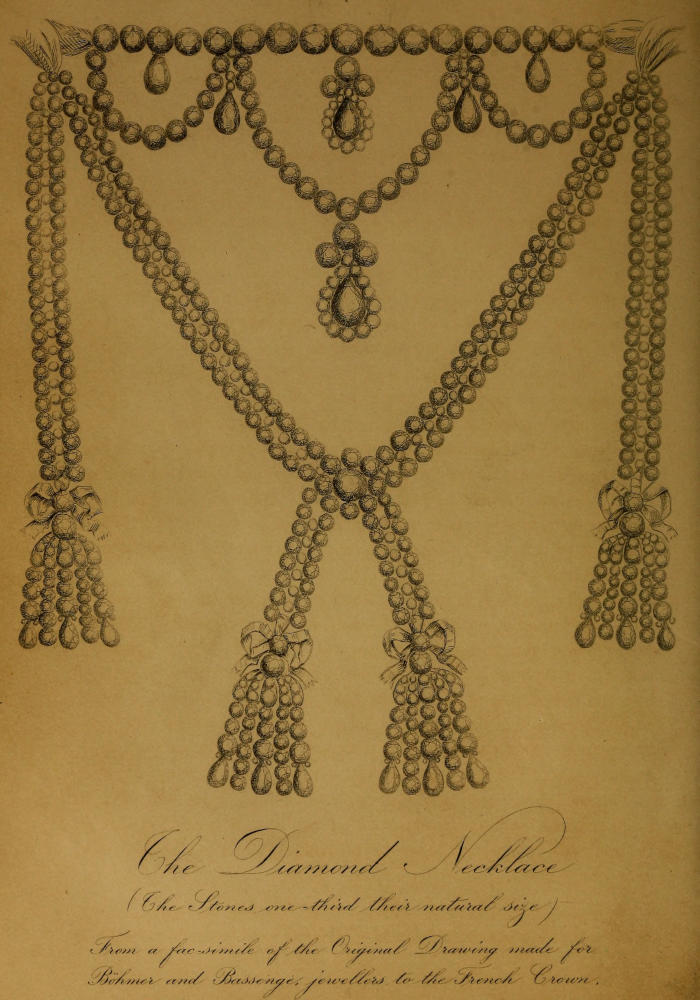
XV. 1784. Nov. GRAND DOINGS AT BAR-SUR-AUBE.
Reading edition
The sudden possession of a large sum of money produced in the countess an invincible desire to return for a time to Bar-sur-Aube, where a few years previously she had suffered so much poverty, but where she could now display a little pomp. Late in the autumn of 1784, young Beugnot received a very amiable letter from Madame de la Motte, in which she announced to him that having several days to spare, she was about to spend them at Bar-sur-Aube with her friends. “She informed me, in an easy off-hand manner,” observes the count, “that she had sent in advance her carriage and saddle-horses, which would be five days on the road, as she had been recommended not to fatigue them, and that she herself would arrive two days afterwards. She apprised her sister-in-law, Madame de la Tour, of her coming in much the same terms, and gave her certain particular directions as to the lodging of herself and suite. Madame de la Tour came to me quite bewildered, and asked me what it all meant, to which I replied that I was as much in the dark as she was. Having compared letters, we agreed that there was a mystification of the worst kind about the affair, but resolved that we would not be duped, and that no preparations should be made for lodging the princess and her suite, and moreover that we would both preserve strict silence with reference to the letters we had received.
“How great was our joint astonishment when on the appointed day we beheld a large heavily-laden waggon, drawn by a fine team, and followed by two led horses of great value, drive into the town. A steward who arrived with the waggon instantly gave orders for more provisions than would have sufficed to victual the best house in the town for a period of six months. People stared at each other when they met in the streets, and wondered what this new chapter in the ‘Arabian Nights’ could possibly mean, and were still wondering when the Count and Countess de la Motte, preceded by two outriders in handsome liveries, drove leisurely through the main street of Bar-sur-Aube in a very elegant berline.”[104] Two years before they had left the place with borrowed money and no other clothes but those they had on; now they returned in their own carriage, with their couriers and saddle-horses, and actually required a waggon to convey their wardrobe!
The town of Bar-sur-Aube, on the banks of the river, the name of which it bears, is built partly on the slope of a mountain and partly in a valley, and has on its mountain side the remains of some extensive Roman fortifications said to have been constructed by Cæsar during his invasion of Gaul. In by-gone times the town was encompassed by a massive stone wall, and had its moats, ramparts, and four ancient gateways, with a garrison of arquebusiers and militiamen. Its fortifications, however, have been long since demolished, and pleasant gardens now occupy their site. At the present day Bar-sur-Aube boasts several ancient churches and chapels containing handsome carved altar-pieces, and many curious antique monuments, and has also its convents, hospitals, college, and theatre.
The one object of historical interest that commonly attracts the attention of strangers is the little Gothic chapel in the centre of the old stone bridge of seven arches which spans the river Aube, built to mark the spot where, upwards of four centuries since, Charles VII. caused the Bastard de Bourbon, chief of the gang of écorcheurs (flayers)—so called because they stripped the unfortunate wretches that chanced to fall into their hands of every particle of clothing, and who had for a long time ravaged the Champagne—to be sewn up in a sack and drowned in the river beneath. In the old parts of the town the houses are chiefly of wood, and some of the more picturesque among them have large figures of saints forming their supports. Most of those erected during the last eighty or ninety years, however, are built entirely of stone. The outskirts of Bar-sur-Aube are planted with trees, and laid out in public walks, gardens, and orchards; beyond which a chain of low hills, covered with vines or dense plantations of foliage, gives a picturesque aspect to the surrounding country. Owing to the favourable situation of the town and the productive nature of the adjacent districts, Bar-sur-Aube does an extensive trade in various kinds of grain, horses, cattle, wine, brandy, fruit, wool, leather, linen, iron, glass, pottery, and stone and timber for building purposes.
Bar-sur-Aube has something of a history of its own, for it has been the scene of several stirring historical events. It was occupied by the Romans during their invasion of Gaul, was ravaged by Attila, and was pillaged by our own Edward III. in 1360. About four centuries later the inhabitants of Bar-sur-Aube welcomed with great display Louis the Well-Beloved when he passed through the town on his return from the siege of Fribourg. In January, 1814, the Allies, then marching upon Paris, appeared before Bar-sur-Aube, and after a series of hard-fought engagements forced Marshal Mortier, who held the town, to beat a rapid retreat under cover of the night. While in the occupation of the Allies, a conference of the ministers of the different powers was held at Bar-sur-Aube, when Lord Castlereagh resolutely refused all subsidies to the vacillating Bernadotte unless he agreed to support Marshal Blucher with two corps d’armée, and so enable the Allies to continue their march upon Paris. At this period there were three crowned heads, the Emperors of Russia and Austria, and the King of Prussia, installed in comparatively humble lodgings in this second-rate provincial town. After the battle of Montmirail, on the 11th of February, the Allies, who were retreating, turned and made a stand, and compelled the French army to retire across the river Aube. On this occasion the town was twice taken and retaken after several severe engagements. In the year following, about three weeks after the battle of Waterloo, the Allies, to the number of 200,000 strong, again appeared before Bar-sur-Aube. This time there was no enemy to face them, so they quietly took possession of the place, and levied heavy contributions on the inhabitants, leaving a garrison of a couple of thousand men behind them, when they pursued their unopposed march upon Paris.[105]
The De la Mottes spend several weeks at Bar-sur-Aube, give grand dinner and supper parties to those who consent to visit them, discharge all their debts with the cardinal’s money, and assume all the airs of genuine nobility. Most of the inhabitants eat their meat and drink their wine without instituting any curious inquiries as to the source of their strange prosperity; but there was one whose piercing intelligence penetrated every outward vanity, whose keen eye discerned the truth then more distinctly than others have done since, after the exposure of a long trial by the Court of Parliament, and the still more searching investigations of fifty historians. This sagacious man was M. de la Tour, who had married the count’s sister. When he dined at the De la Motte table, the countess herself, to whom all others submitted, quailed beneath his cutting sarcasms.
“I chanced to be alone with M. de la Tour,” says Beugnot, “on the day of Madame de la Motte’s arrival. ‘Am I not a thousand times right,’ said he to me, ‘when I assert that Paris contains the worst persons in the world? In what other place, I ask you, would this little vixen and her big lanky husband have been able to obtain by swindling the things which they are displaying before our astonished eyes? Your good father excepted’—Beugnot’s father, it will be remembered, had lent the De la Mottes a thousand livres a few years previously—‘whom would they have found here willing to lend them a crown? and yet in half an hour they have unpacked more silver plate than there is in the whole town besides, not even excepting the chalices and ornaments of the altar.’... ‘Do you not know,’ remarked I, ‘that Madame de la Motte is protected by the queen?’ ‘I’ll say nothing as to the queen’s protection,’ replied La Tour. ‘Between you and me, the wife of our lord the king is not the most prudent person in the world; still she is not such a fool as to have anything to do with people of their stamp, I warrant.’”
The evening after the De la Mottes’ arrival they gave a supper to a few intimate friends, which, according to Beugnot, would have been considered magnificent for any kind of guests even in Paris. “Although the town of Bar-sur-Aube,” observes he, “is one of the most ancient cities of the Gauls, never perhaps had such luxury been seen in it before, not even when Cæsar did it the honour of stopping there to hang—as they say—the mayor and councillors of that epoch. Faithful to an understanding we had previously come to, La Tour and I ate with good appetites, and without taking particular notice of anything, as though, in fact, we were both accustomed to such festivities. We kept the conversation in our own hands, taking care to confine it to subjects which rendered it difficult for the most expert talker to interpose a remark in praise of any of the things spread before us. M. de la Motte did not like this; he wished to make us admire the dinner-service, which was of a new pattern, and of very fine workmanship. La Tour contended that services of this kind had been known for a very long time, but had gone out on account of their clumsiness. The nil admirari was persevered in with respect to everything, and to the very end.
“At last Madame de la Motte thought she had found grace in our eyes in praising a fowl, one of the finest which had just been removed from the table, informing us at the same time that she had ordered the courier to bring her a supply of this kind of poultry so long as she remained at Bar-sur-Aube, because to her taste ordinary country fowls were not eatable. ‘I ask your pardon, madam,’ interposed La Tour, in a serious tone, ‘but I am by no means of your opinion. I consider a country capon such as you have been speaking of, when properly fattened, to be vastly superior to all your Normandy and Mans cocks and pullets, the flesh of which is soft, insipid, and dripping with fat. But after the capon has been fed on a good plan, it must be roasted in a proper manner, and for this purpose I care little about the jack. I very much prefer to have the spit turned by a boy of the family, or even by a dog.’
“Madame de la Motte lost patience at the sort of honour paid to her by her husband’s relation before four tall footmen who had been brought from Paris clothed in liveries covered with gold lace. ‘Sir,’ said she to La Tour, in a spiteful manner, ‘I feel edified at your preference; it is the result of a country taste which we know you carry to its fullest extent.’ ‘I agree with you there, madam,’ replied La Tour; ‘country taste or family taste are much the same, and you know, madam, I value one just as much as I do the other.’
“This conversation shortened supper. ‘How do you think I have paid my score?’ inquired La Tour of me in a low tone of voice. ‘You have been almost too liberal,’ replied I. ‘Not at all; only I was resolved to put down both husband and wife should they have the impertinence to ask me to admire anything. The masquerade which has commenced this evening is a sort of triumph for these people, and I reserve for myself the part of the soldier who on the way tells wholesome truths to the hero of the festival!’”[106]
Madame de la Motte called Beugnot into her room, and began complaining to him of the insolence of her husband’s brother-in-law. “She told me,” says Beugnot, “that her fortune had changed, that she was now in a good position, both as regarded herself and those belonging to her, and that we were all interested in adopting a different manner towards her. She hinted something of the very high connection she was keeping up at Versailles, and ended by remarking that she did not think she could remain with us the fortnight she had promised herself. I proffered her a first example of the new style of behaviour which she desired by not asking her a single question. I merely undertook to beg her brother-in-law to be more prudent for the future, without, however, anticipating much success from my intervention.”
The third day of the countess’s sojourn at Bar-sur-Aube was occupied by her in paying visits to people in the neighbourhood. She dressed herself out with all the taste which can result from an excess of magnificence, her robes being of the finest Lyons embroidery, and she herself sparkling with diamonds. She had, moreover, a complete set of topazes, which she also took care to display. “She made herself,” says Beugnot, “almost ridiculously engaging and familiar with the neighbouring nobility and gentry. Great and small were alike enchanted with her. They returned her visits, but when she wished to go further, and give some little fêtes, the respectable women of the place excused themselves under various pretexts, and Madame de la Motte found herself reduced to the young men and the women of her husband’s family, so thorough was the respect for manners at this time in a little provincial town. ‘Madame de la Motte,’ said these good ladies to me, ‘is a charming woman, and we like her very much; but why do you wish us to give our girls ideas of which they have no need, and which will perhaps awaken in them desires they can never gratify?’
“I was wanting,” resumes Beugnot, “neither in respect nor discretion towards Madame de la Motte. She seemed to have completely forgotten our old relations, and on this point I was in unison with her. I had become to her simply a well-bred man with whom she could speak on any subject. She told me of the secret vexations she endured through the deplorable position of her husband’s family. I consoled her as well as I could, always observing to her that a residence in a little town was in her case quite a mistake—that she ought to have an hôtel at Paris and a château in the country. She replied that she did not wish to buy land, because she was about to obtain the estates belonging to her family, on which she proposed to build. The hôtel in Paris she allowed to pass without notice, but she admitted that she wished to possess one at Bar-sur-Aube, where she could spend the summer months until her projected château was built. I took the liberty of opposing this idea of purchasing a house at Bar-sur-Aube, and maintained that it would be in far better taste to inhabit a cottage while the château was being built by its side; but Madame de la Motte, who had already received many valuable lessons on this subject, did not the less persist in her desire to display her magnificence in those places which had been witnesses of her former misery. She purchased, in spite of my remonstrances, a house at Bar-sur-Aube, for which she paid twice as much as it was worth, and then gave it up to architects, who considered it their duty to commit all the stupidities which the property admitted of, and a few more.”[107]
“As the period of the countess’s sojourn at Bar-sur-Aube drew to a close, people grew angry with those who had held aloof from visiting her. M. de la Tour alone underwent no change. I had begged of him to consider the notable alteration which opulence, though sudden, had wrought in the manners and behaviour of both the count and countess. ‘I half agree with you,’ replied he. ‘The wife is a hussy who has gained in penetration; but the husband has lost in every way—he left us a fool and comes back to us a coxcomb. I persist in thinking badly of them, and even in speaking badly of them, so long as they do not reveal to me by what honest means they have acquired in the short space of six months what we now know them to be possessed of. Whom will they or you persuade that the king, the queen, the Count d’Artois, the contrôleur-général—in a word, I know not what powerful persons—have thrown heaps of gold to people who simply asked for bread? The age I know is fertile in extravagance, but not exactly of this kind. Husband and wife have spread a little report around that madame is in favour with the queen. I have noticed them at this for the last fortnight, and if they had mentioned a single word of it in my presence, I had a little story ready for them about the Countess de Gazon[108] and the Queen of Congo with which I should have made all the lookers-on laugh at their expense.
“‘My dear friend,’ continued La Tour, ‘they are altogether far too impertinent, and it is really shameful that people should be duped so cheaply. Believe every word they say if you please, but for my part I adhere to what I know. Now I know, through you, that madame has relations with the Cardinal de Rohan, since she has been conveyed five or six times to his eminence’s hôtel at your expense. Possibly she has since been transported there on her own light foot. Of all the acquaintances of this fine lady, the Cardinal de Rohan is the only one to whom prodigality on a grand scale is not impossible. There are then two conclusions—either he has supplied the money for all that we see, or else it has been stolen from him. I ask your pardon for the second horn of my dilemma, but only on condition that you grant me the first; and yet I confess I can only with great difficulty understand how a little village hussy like her can have succeeded in seducing a prince, a prelate, and a scape-grace of such importance.’”[109]
A few days before her departure from Bar-sur-Aube the countess placed in the hands of young Beugnot a rouleau of fifty louis in discharge of certain small loans which he had at various times accommodated her with. “I explained to her,” remarks Beugnot, “that I could not say exactly what she owed me, but that I was quite certain the amount was below 1200 livres.[110] ‘Nevertheless take it,’ replied she; ‘and if there is anything over, give it to your mother for her poor pensioners.’” Beugnot, on making up the account, found he had been paid twenty louis too many, which in accordance with the countess’s instructions he handed over to his mother. So favourable and lasting an impression did this act of generosity make on Madame Beugnot, that she could never afterwards be brought to believe in the truth of any of the crimes charged against this unhappy woman.