Chapter XXX · THE CONGO CAMPAIGN IN ENGLAND
Reading edition
Some English Traits.
THE English are an admirable people, who have excelled in every department of human effort; but the evidence of the more critical among them, with whom love of fair play counts for as much as pride of race, has never failed to reveal in the national character (as of course in the character of every nation) a goodly number of weak spots whereat the critic and the wit may profitably direct their shafts. John Bull, the trader, is a keen-eyed, hard-headed bargainer. Good; it behoves every merchant to be no less. He regards the whole world as his farm by right divine, and resents his exclusion from any part of it. When his remonstrance is met by counter-remonstrance, he points to his home markets and his colonies, and emphasises the fact that these British markets are open (long after his own trade has been firmly established therein) to the traders of the world.
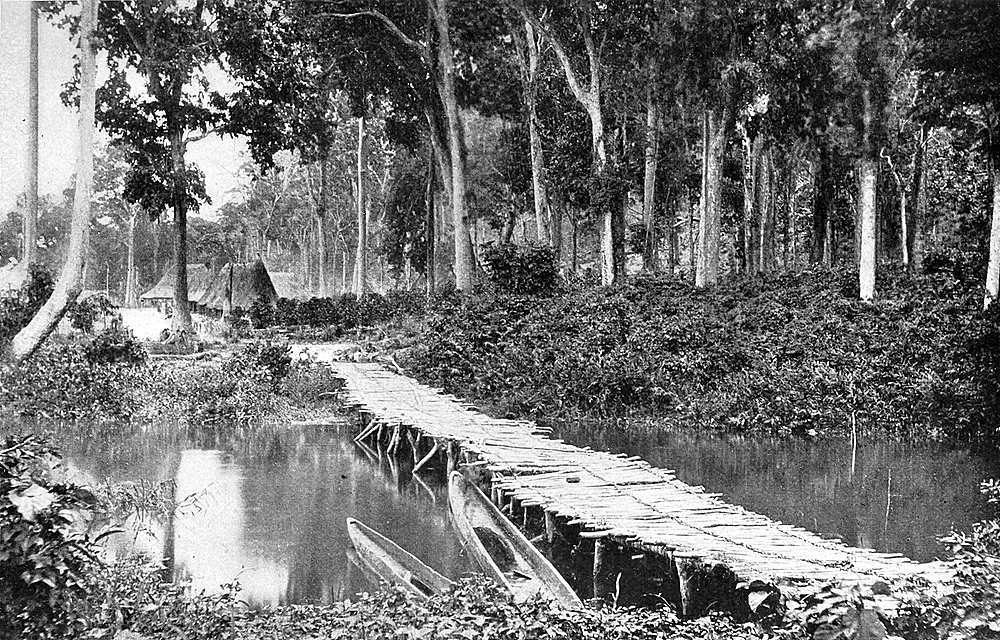
A Beautiful Spot in Mayumbe.
But it is in his ultra-sentimental mood that John Bull is seen at his worst. Has there been a conflict between some semi-barbarous tribes in that seething cauldron of discontent, the Balkans, and the Sultan’s troops have thrashed them indiscriminately and dispersed them, John Bull, or at least that part of him which wears white ties and is described as “reverend,” rushes off to Exeter Hall and demands the prayers of the churches and the forces of his Government for the suppression of the inhuman atrocities which he denounces. (Incidentally, but in unmistakable terms, he at the same time calls the attention of his audience to the joyful fact that it is their duty and privilege to assist in this good work by giving liberally of their money.) Of course it is but a section of the English people which approves and supports this sort of thing, and a still smaller section that exploits it. But in a country politically constituted as England is, where the suffrage is almost universal, it is sufficiently large and influential to influence from time to time the conduct of the British Government. This is more particularly the case where the interests of the pseudo-humanitarians and those of the traders happen to coincide. On such occasions, fortunately somewhat rare, the spectacle of Cant and Commerce in alliance is enough to bring a smile to the face of a sphinx.
A Strange Alliance.
Protestant missionaries of various sects, in rivalry with each other, but often alike in being envious of the superior results obtained by Roman Catholic missionaries in the Congo Free State, denounce the Congo Government as a gang of barbarous extortioners, oppressors, murderers. A small but active set of Liverpool merchants, dismayed at finding that what twenty years ago they regarded as worthless has, under judicious Belgian administration, become a valuable asset, and some of whom appear willing to resort to any means by which they may at least be enabled to share the prize, join their forces to those of the missionaries. Lies fall as thickly as leaves in Vallombrosa. No sooner is one mendacious story refuted than ten others take its place. The Congo campaign multiplies its adherents, it gathers force daily, its voice becomes more and more thunderous, until at last it invades the British House of Commons and moves a British minister to write a puerile dispatch to the Great Powers, which the Great Powers, in the exercise of their common-sense, politely ignore. Only up to a certain point does Baron Münchausen triumph. Verb. sap.
Why is John Bull Silent?
What magnificent material for the mouthings of certain English ultra-humanitarians would be the lynching of Negroes in our own Southern States! The jail-breakings, the hangings, shootings, and burnings—could more effective subjects for stereopticon slides and the perfervid oratory of paid lecturers be devised? And all true and ready to hand, needing neither lies nor distortions! Alas! nothing can be made out of that campaign. It will not pay to call our country to account for its neglect or failure to suppress these things. The United States own a fleet which, if not as strong as it should be, is sufficiently powerful to inspire respect; and our President can at any time call up an army of a million citizen soldiers, volunteers of proved valour. With the Congo Free State this is not the case. Caution was ever a prominent characteristic of John Bull, and he has carefully noted that fact. Neutral little Belgium may safely be bullied, her King libelled, and his enterprise misrepresented and held up to the scorn of an undiscriminating world, too busy to undertake a careful analysis of motives or even to distinguish between the true and the false.
Judicial consideration of the English campaign against the Congo, naturally a difficult task, is rendered doubly so by the general suppression of material evidence favourable to that State. From motives best known to their proprietors, one or two important London newspapers, ever ready to afford space for an attack upon the Congo Government, however violent or by whomsoever made, frequently decline to publish replies thereto. Indeed, the more complete the refutation, and the greater the authority of the writer, the less chance of its acceptance for publication in these newspapers. Upon several occasions has Major Harrison been refused space for his temperate letters to the Morning Post, and the Daily News, the principal support of the Aborigines Protection Society, is avowedly against the continued existence of the Congo Free State. A complete answer to Mr. Roger Casement’s Report, prepared by the Congo Government, was unanimously rejected by London editors. This most unjust partisanship extends even to English press reports of proceedings in the House of Commons, of which one might reasonably expect to find in English journals a complete record; or where the exigencies of space necessitate condensation, that at least that editorial operation should be performed without bias. That expectation meets with disappointment.
On June 9, 1904, Sir Charles Dilke, with a fine show of virtue which has not always characterised his conduct, delivered a speech in the House of Commons wherein he assumes the truth of the various libels upon the Congo Government prepared by missionaries, merchants, and dismissed employees. That speech, and the speeches of such other members of the British House of Commons as for various reasons have been induced to follow a similar course, have been reported in extenso, while the speech of Mr. John Campbell, member for South Armagh, has not so much as been referred to. Mr. Campbell derided the Congophobes’ plea that they have at heart only the interests of humanity.
The gold [he remarked] of that fine phrase is alloyed with other arguments. Commercial considerations have also their weight. Some speakers began by talking of humanity and ended with commerce. Others began with commerce and ended with humanity. One honourable member had thrown overboard the humanitarian theme and flatly talked business. But, in spite of all the ornamental flowers of philanthropy, the groundwork of all these speeches is—commerce. The true motive which prompts the Anti-Congo campaign, conducted with such vigour in this country and within these walls, was exposed in a few words by Stanley when he said: “The sentiment that inspires the charges against the Congo is jealousy. The Congo is succeeding better than any other State in Africa.”
One would suppose that sentiments such as these, supported by the authority of Stanley, would at least be as worthy of a few lines in an English newspaper as the vague charges of cruelty alleged by some missionaries based upon what they have been told that somebody else has heard, etc. But, no! such references are rigidly suppressed in a large section of the English press, just as much of Mr. Casement’s Report that is favourable to the Congo Government has been suppressed.[44]
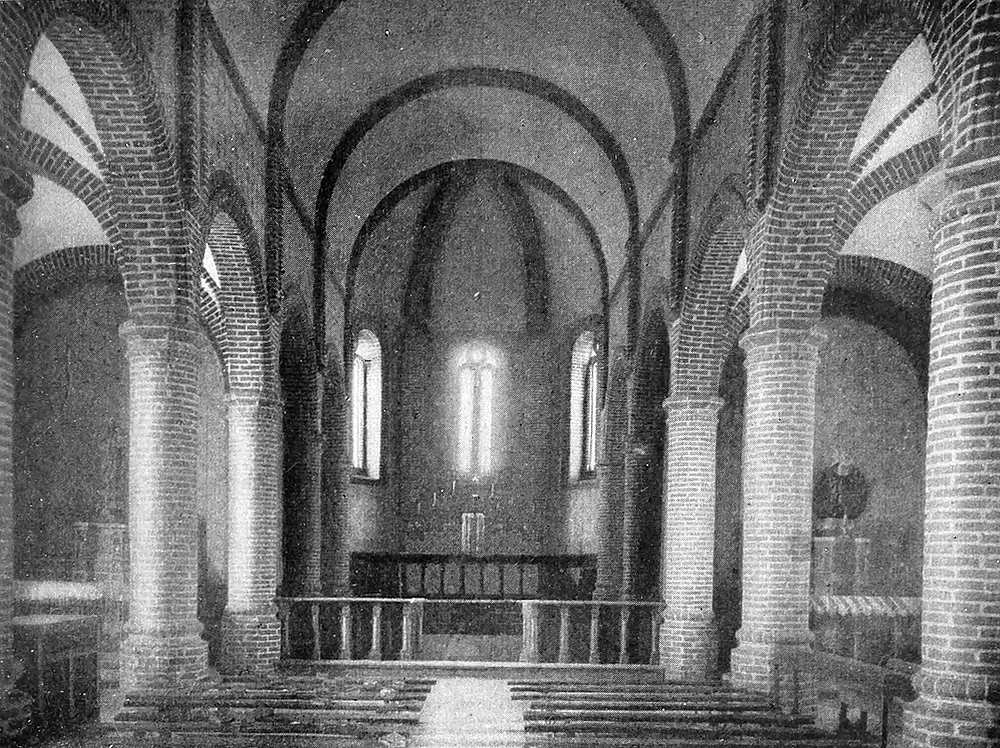
Interior of Cathedral, Baudouinville (Tanganyika).
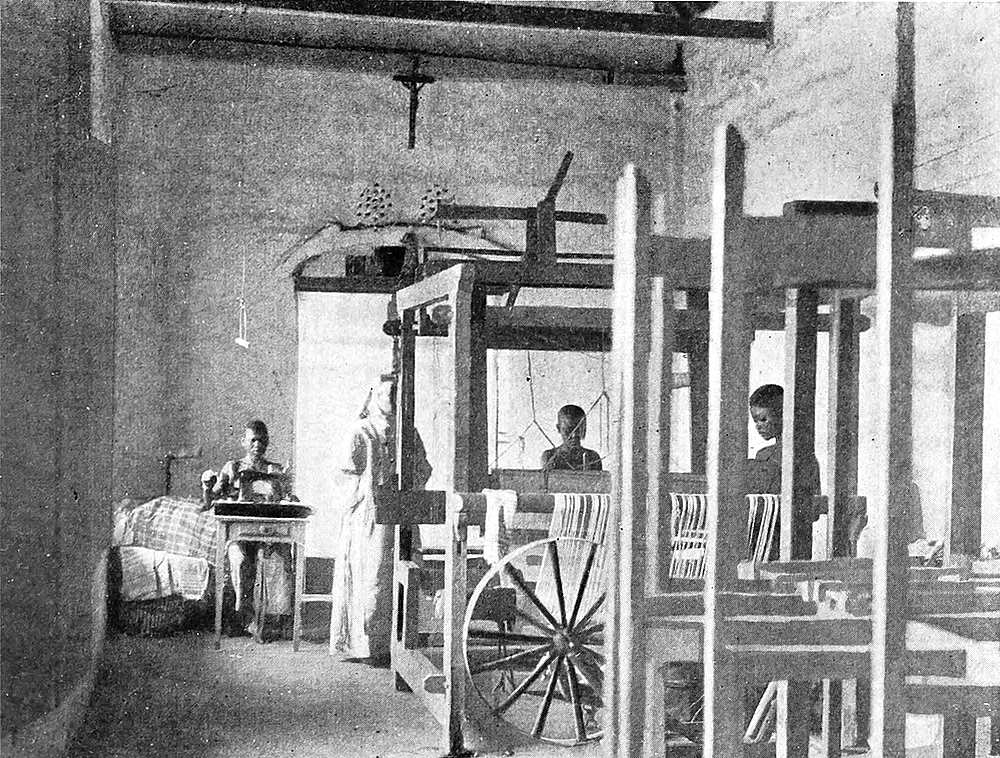
Sisters of New Antwerp Teaching Natives to Weave.
Just as this book is going to press particulars come to hand of an incident which throws a strong light upon, the methods adopted by the enemies of the Congo Free State in manufacturing evidence against it. The paid officers of the Congo Reform Association in Liverpool, the Aborigines’ Protection Society, and kindred organisations, must find it increasingly difficult to justify their existence when tactics such as are here exposed have to be resorted to.[45]
A Typical Congophobe Method.
In 1902, on the recommendation of a high official of the Free State, Mr. Antoine Benedetti, a cultured gentleman belonging to an ancient and wealthy family in Sicily, was appointed chief commissary—a post which had never before been conferred on a foreigner on account of its special responsibilities. This rapid promotion shows in what esteem Mr. Benedetti was held by his chiefs.
Mr. Benedetti returned to Europe on November 7, 1904, and when requested to give his chiefs some information on the existing situation in the Congo, related circumstances which might well be considered fit for a novel, if their accuracy were not vouched for by authentic documents.
While at Boma, Mr. Benedetti noticed that a Negro named Shanu, a British subject from Lagos, was trying to discover his opinions on Congo policy and administration. Shanu having been at one time in the employ of the State, Mr. Benedetti suspected nothing; but in the course of conversation with the Negro, he perceived what Shanu wanted to get from him. Shanu boasted to Mr. Benedetti of the humanitarian character of the English campaign against the Congo, and he further hinted that, if he were correctly informed, Mr. Benedetti would surely join in the said campaign, a course which would be of great advantage to him. Mr. Benedetti pretended to share the views of Shanu, who thereupon pushed the matter home by producing some letters of Mr. Edmund Deville Morel, Secretary of the Congo Reform Association.
In one of these letters, Mr. Morel informs Shanu that Mr. Benedetti, commissary at Boma, has been spoken of to him as one who would be a valuable acquisition in the English campaign against the Congo. Mr. Benedetti at once saw what was expected of him; he realised that efforts were being made to enlist in the anti-Congo campaign the numerous Italians in the service of the Free State; and, with the sole desire of protecting the honour of his fellow-countrymen in the Congo, he resolved to defeat Mr. Morel’s plans. With a view of gaining Shanu’s confidence, he declared himself to be on the Negro’s side, and by so doing compromised himself in the eyes of his official colleagues. He told Shanu—who lost no time in informing Mr. Morel—that by virtue of his position, he was able to make some startling revelations. Shanu thereupon suggested that he should send in his resignation, giving as the reason certain compromising allegations against the Free State. Shanu then wrote to Mr. Morel to the effect that he and Mr. Benedetti agreed that the latter was just the man to lead the campaign against the Congo. On the receipt of Mr. Morel’s reply, the departure of Mr. Benedetti was decided upon.
Mr. Benedetti was promised his passage money to Europe, as well as compensation for the loss of his place under the Free State, and, later, a handsome bonus. Mr. Morel requested Mr. Benedetti to meet him at the Exchange Station Hotel, Liverpool, on the 19th November, and to announce his arrival by the following telegram:
“Morel care Jellani arrived Benedetti.”
Under these circumstances, Mr. Benedetti sent in his resignation, alleging that private business called him to Europe. He left by the SS. Philippeville, and the British Consul at Boma gave him ten pounds sterling for his travelling expenses. The receipt for this sum was made out by Mr. Benedetti in the name of Shanu.
Up to the time of his departure, Mr. Benedetti had discharged his duties so well that he was congratulated by the local authorities. Having spoken to nobody about the course he was adopting, so little was his sudden departure understood that his colleagues were mystified. He could not, of course, enlighten them without showing his hand. Mr. Benedetti landed at Antwerp on November 7th, and on the 17th arrived at Liverpool, having previously despatched to Mr. Morel the telegram agreed upon. After some delay Mr. Morel went to see Mr. Benedetti at the Exchange Station Hotel in that city.
Mr. Morel appeared somewhat distrustful, and asked Mr. Benedetti if he had authenticating documents. The latter produced some unimportant papers, which he pretended were valuable, and told the Secretary of the Congo Reform Association some sensational stories of absolutely imaginary crimes. In short, Mr. Benedetti played his game so well that Mr. Morel no longer hesitated to close the affair, but said he would introduce to him a gentleman who was greatly interested in the Congo.
In response to a telephonic message from Mr. Morel there arrived Mr. John Holt, a merchant, of Dale Street, Liverpool. Mr. Holt is Vice-President of the Liverpool Chamber of Commerce and a member of the Congo Reform Association. Mr. Morel told Mr. Holt what Mr. Benedetti had said, and then certain practical questions were discussed. It was agreed that Mr. Benedetti should relate in the West African Mail the stories that he had just invented; but Mr. Benedetti, wishing to gain time, stated that he would rather publish them first in Italy, after which the organ of the Congo Reform Association might reproduce them. It was decided also to issue a pamphlet, for which Mr. Benedetti was to receive eighty pounds. Some generous promises were made to Mr. Benedetti: five hundred pounds as damages and his fare paid to Teneriffe by the Congo Reform Association. At Teneriffe, it was agreed, he should seek to poison the minds of Italian officers returning from the Congo. Later, Mr. Holt was to go to Italy where, together with Mr. Benedetti, he was to subsidise a newspaper to attack the Congo, and if this newspaper war resulted in the King of Italy recalling Italian officers serving in the Congo, Mr. Benedetti was to receive a further sum of four thousand pounds.
The former commissary of Boma would not accept verbal promises; he requested a document. He demanded first of all a contract for the publication of the pamphlet. Mr. Benedetti invited Mr. Morel and Mr. Holt to dinner, and it was during this dinner on the 19th of November that the clauses of the contract were discussed. Conversation was carried on to a late hour and Mr. Holt, in an unguarded moment, remarked that in England everything was done by and for the sake of business, and that sentiment was obliged to give way to trade. The signing of the contract was fixed for eleven o’clock on the morning of the 21st of November, 1904, when the three gentlemen concerned attended and the following document was drawn up and signed. The text is in English and French:
Between Mr. Benedetti and Mr. Morel it is agreed as follows:—Mr. Benedetti agrees to publish in a special pamphlet all the statements that he made and proved by means of documents on the evening of the 19th of November at the Exchange Station Hotel, in the presence of Mr. Morel and Mr. Holt, as well as various other facts the evidence of which is in his possession in Italy.
Mr. Benedetti shall first submit to Mr. Morel, before the 5th of December, a rough copy of his pamphlet in English and Italian. Upon this rough copy Mr. Morel reserves the right to make corrections, and to send these corrections to Mr. Benedetti by the 9th of December, unless prevented by force majeure.
As soon as the pamphlet has been approved by Mr. Morel, Mr. Benedetti shall send to Mr. Morel a corrected copy (if corrections have been made) in English and Italian, as well as a copy of the original documents in his possession, certified by the British Consul on the original text.
Mr. Benedetti undertakes to be ready to publish all by 22nd December, or by such date as Mr. Morel shall telegraph to him.
In any case, Mr. Benedetti will not publish all or any part of the pamphlet without previous understanding with Mr. Morel as to the date.
Mr. Benedetti undertakes to place at Mr. Morel’s disposal, after the publication of the pamphlet, all original papers referred to in the said pamphlet, and Mr. Morel undertakes to return them, if required.
Mr. Morel deposits a thousand francs for Mr. Benedetti’s travelling expenses from Boma.
Mr. Morel undertakes to pay Mr. Benedetti the sum of two thousand francs, which sum represents the loss to Mr. Benedetti of his situation in the Congo State, owing to the publication of statements made in the said pamphlet, as soon as he receives from Mr. Benedetti notice that the pamphlet has been published in Italy, and a copy of the pamphlet.
Mr. Morel undertakes to pay the expenses incurred in publishing the pamphlet in Italy up to the sum of five hundred francs. Mr. Benedetti undertakes to send two hundred copies of the pamphlet to Mr. Morel.
It is understood on both sides that the above entirely covers all relations between Mr. Benedetti and Mr. Morel.
Mr. Morel undertakes to obtain from Mr. Shanu, of Boma, the receipt for the two hundred and fifty francs handed by Mr. Benedetti to Mr. Shanu, and to deduct the sum from the two thousand francs above mentioned.
Signed the 21st November, 1904, at Liverpool Exchange Station Hotel.
E. D. Morel. A. Benedetti.
Witness to signatures of A. Benedetti and E. D. Morel:
John Holt, merchant, 81 Dale Street, Liverpool.
It is not without interest to call attention to the final clause, concerning the receipt for the 250 francs which Mr. Benedetti had given to Shanu, as a guarantee of the £10 which the British Consul at Boma had given him before his departure.
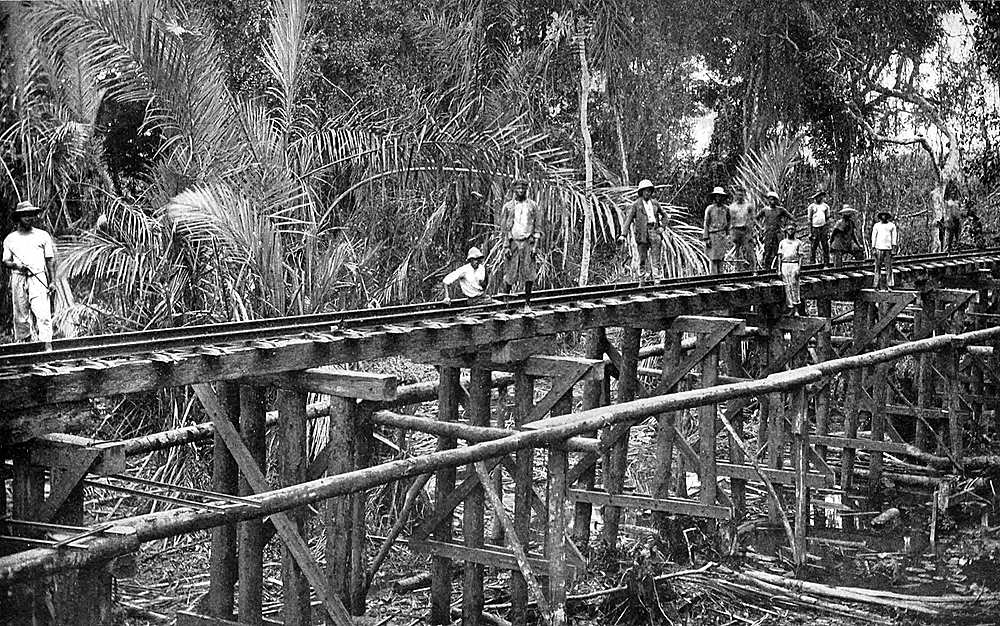
Building a Bridge for the Cataracts Railroad, 1897.
As to the clause concerning the thousand francs which Mr. Morel undertook to pay Benedetti for his travelling expenses from Boma, it came about through the fact that his departure from Boma was not in accord with the regulations. As his engagement was not terminated, the question of his being sent home at the expense of the Congo Free State was not settled. Mr. Holt took from his pocket a roll of Bank of England notes and paid Mr. Benedetti £40.
As soon as he was in possession of this contract, Mr. Benedetti returned to Brussels, whence he sent Mr. Morel the following letter:
Brussels, 30th November, 1904. Mr. E. D. Morel, Liverpool,
I have the pleasure of remitting herewith to you a cheque on the South Wales Bank, Limited, No. 109,880, to the order of Mr. John Holt, merchant, Dale Street, Liverpool, for £40, which this latter gave me in the Exchange Station Hotel, Liverpool, on the 21st of this month.
I will also send you a sum of £10 in exchange for the receipt of Shanu, which you promised to procure for me.
You made a mistake, Sir, when you thought I would play into your hands in your campaign against the Congo, and thus do grievous harm to my countrymen working in the Congo.
Believe me, my conduct, from my first interview with Shanu, when acting for you, till my telegram from Paris on the 28th of this month, was dictated by a sentiment of duty and patriotism.
A. Benedetti.
The telegram to which Mr. Benedetti alludes was addressed to Mr. Morel from Paris, and was to call his attention to an article in the Tribuna favourable to the Congo, and to ask him for arguments in answer to this article for publication in an Italian paper. Mr. Morel replied that he had not had time to get the Tribuna article translated.
This edifying incident needs no comment. When the denial of its genuineness, or a qualification of its meaning and purpose, comes, it is understood that the Congo Administration will publish a facsimile of Mr. Morel’s contract with Mr. Benedetti, bearing his signature and the signature of Mr. John Holt, merchant-philanthropist, Vice-President of the Liverpool Chamber of Commerce, etc., in order that intelligent people may form their own conclusions upon it at first hand.
Mr. Morel writes to the London Times of December 19, 1904, defending the part he has played in this Benedetti incident. “You persist,” says Mr. Morel (addressing M. Roland de Marès), “to make readers believe that I proposed to pay M. Benedetti for false testimony, whereas my rôle was limited to giving him the opportunity he asked for (that is to say, to come to Europe and to publish under his own name, in the interests of truth and of his fellow-countrymen), by defraying the expenses of his journey and the positive pecuniary losses which his action would involve, and by participating in the printing expenses of his pamphlet.”