Chapter XXVI · TRADE, REVENUE, AND TAXES
Reading edition
Among the earlier trading companies on the West Coast of Africa was the house of Regis et Cie., established at Banana in 1858, whose successors, Daumas, Béraud et Cie., were carrying on a considerable business when Stanley explored inland from the mouth of the Congo in 1878. The old Dutch house, the Afrikaansche Handels-Vennootschap, of Rotterdam, had a branch at Boma in 1860, and the Portuguese firm of Valle & Azvedo, and the agents of Hatton & Cookson, of Liverpool, opened trading depots near by a few years later. These firms had, however, very little direct trade with the interior of the Congo Basin, commerce in their early time being confined to the coast. Trade with the interior is almost entirely due to the Belgians.
Before the Free State was founded the trade of Central Africa was chiefly in slaves. As a Belgian writer quaintly observes, the slave was at once the means of labour, the main capital, the vehicle of transport, the common currency, and the usual tribute given to satisfy the covetousness of native chiefs. The slave was the standard of wealth and the element of power. In order to estimate the influence of the slave trade as an economical factor in barbarous communities, and compare it with the trade régime of civilisation, it would be necessary to imagine dealings in some object representing all these uses in our markets.[26]
To destroy the slave trade creates the problem of substituting a trade that is legitimate, that is founded upon the natural resources of the country. It simultaneously creates the problem of labour. The soil depends upon the man in the ratio in which man depends upon the soil. The Belgians heard from Stanley what vast wealth the Congo contained; but that wealth lay behind difficulties so great that no one in Europe ventured to pursue it until the indomitable personality of one man inspired men with the courage to undertake a seemingly hopeless task. Without a railway from Matadi to Stanley Pool commerce could not develop in the Congo Basin. This was Stanley’s opinion. His judgment that the Congo had little value without such a railway in the region of the Cataracts has been justified. The Belgians built the railway at a cost nearly treble that of the original estimate. In fact, while others have been groaning and droning and musing upon the ethical theories of ideal colonisation and civilisation, in pamphlets and innocuous books, the Belgians have followed their own gospel of work and been at their task throughout the waking hours of each day. Spontaneous initiative, timely energy, unremitting labour, these appear to be the characteristics of Belgian dominance in Congoland. Having regard to the habit Europeans have of considering Americans the great exemplars of an age of materialism and hustle, there is almost an element of humour in the fact that one of the first Congolese companies formed under the ægis of the Free State was founded by an American, General Henry S. Sanford, sometime United States Minister at Brussels. This was the Sanford Exploring Expedition, constituted by General Sanford and M. Georges Brugmann in 1887. Its business was that of dealing directly with the natives for rubber and ivory, and it and the Mateba Syndicate and the Compagnie du Congo pour le Commerce et l’Industrie are generally regarded as the pioneers of organised trade in the interior of Central Africa. It would seem, therefore, that the accident of a king’s friendship with an American minister, whose wise counsel he often consulted, might justify at least sentimental interest in the welfare of a region where the restless spirit of strenuous American life had manifested its tendencies nearly twenty years ago. Since the day when General Sanford set the example, forty-eight Belgian and fourteen foreign companies, with an original capital of 136,000,000 francs, have established a commerce in Congoland which is attracting the envy of some and the admiration of many throughout the world.
Before indicating the practical details of the trade and revenue of the State, a brief glance at the ten years before the Brussels Conference enabled it to create its support by levying import duties will recall the fact that from 1878 to 1890 King Leopold personally expended upwards of 3,000,000 francs a year for the founding and maintenance of the State, irrespective of the meagre support derived from other sources. Indeed, no one felt disposed to support an African enterprise which promised to yield only “enlightened niggers.” As Stanley sarcastically said in his lectures in England, too many of his audience measured “civilisation” by the dividends it produced. The inability of the Free State to support itself from enthusiastic humanitarians outside of Belgium was significantly indicated in 1886, when the revenue of the State was less than 75,000 francs! The exports, chiefly ivory, were only 1,750,000 francs, and the Congo Association, when it was merged in the State, possessed only thirteen stations. Out of two hundred and fifty-four foreigners on the Congo in 1885-1886, only forty-six were Belgians. In fact, nothing looked gloomier than the prospect of the new State in the African jungle; and yet one man, with a superhuman sense of the future, continued to pour gold and his labours upon that dark and distant land with its thirty million unenlightened souls. Now, when from a wilderness and savagery have been evolved civilisation, a thriving industry, a prolific field and growing market, religion, order, and prosperity, all that the early pioneer did is utterly lost and forgotten in the noisy controversy over a rich spoil.
It was by the Brussels Act of 1890 that the State acquired the right to levy taxes and impose customs dues. What Leopold II. had expended on behalf of the State in its long formative period was beyond recovery. It will be recalled that the Belgian Parliament had sanctioned a loan to the State of 25,000,000 francs, 5,000,000 francs to be paid soon after the Brussels Conference, the remainder at the rate of 2,000,000 francs a year. To this sum the King, having abandoned all claim to the huge sum he had previously advanced to the State, now added an annual subsidy of 1,000,000 francs. The State, therefore, began the development of its resources with an assured income of 3,000,000 francs a year—not a large sum when compared with the responsibility of fighting cannibal slave-raiders with one hand while tilling the soil, constructing railways, creating posts and missions, and organising the State’s machinery with the other. Beside the task in Congoland, the early American colonist enjoyed a holiday in a land of greater security and healthfulness.
The revenues first provided were on the export of rubber and ivory. These were fixed, after agreement with the neighbouring States of France and Portugal, at ten per cent. The duty on vegetable products was fixed at five per cent. Import duties were as follows: On arms, ammunition, and salt, ten per cent.; merchandise of any kind, six per cent.; on spirits, fifteen francs per hectolitre[27] at 50° of the centesimal alcoholmetre; boats, machinery, and articles for industrial and agricultural use were exempt till May, 1898, and thereafter paid only three per cent.
The tax on caoutchouc (rubber) was first fixed at twenty-five centimes a kilogramme (about five cents on two pounds) equivalent to four per cent. on its value in Europe. When, however, the Cataracts Railway was finished, and human porterage along the route from Stanley Pool to Matadi abolished, the tax on rubber was increased to eight per cent. of its European value. Another decree of the same date (February, 1898) provided for the payment of a licence of 5000 francs by all persons establishing a rubber factory or depôt in the domains. Other sources of revenue are coffee, tea, cocoa, gum-copal, palm oil, palm nuts, rice, tobacco, maize, sugarcane, vegetables, fruit, cinnamon, pepper, ginger, vanilla, nutmegs, cloves, and spices.
Great credit is due the local administrators of the Free State for the progress they have made in a long list of cultivated products, and the growth of the country’s export trade resulting from Belgian and native co-operation and industry. For instance, in 1887 the total exports amounted to only 1,980,441 francs[28], in 1891, 5,353,519 francs, and in 1903, 54,597,835.21.
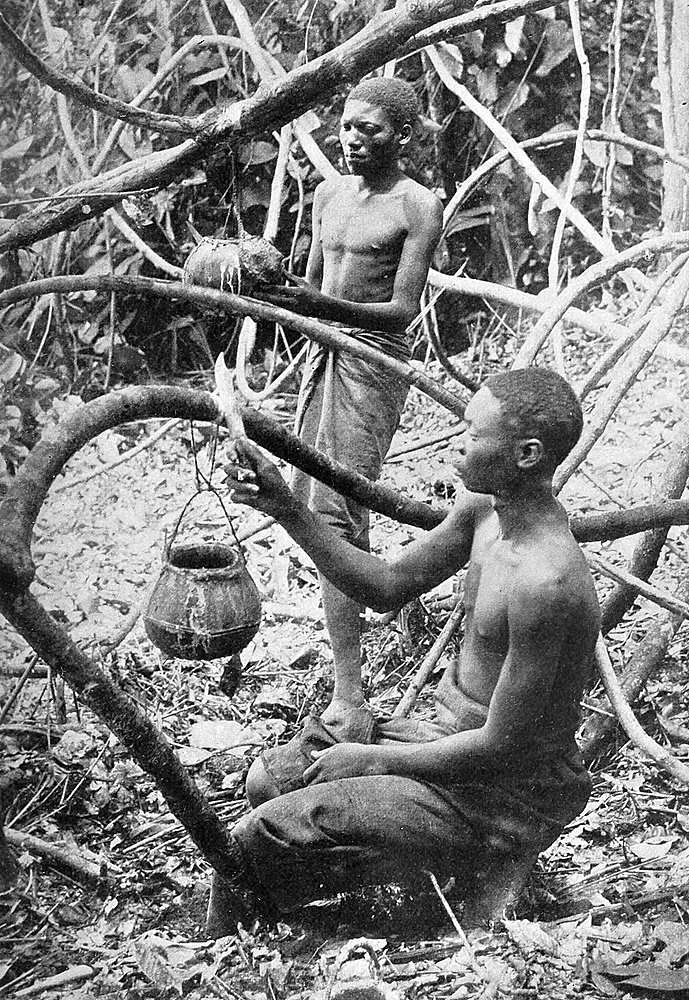
Collecting Rubber in Forest of Lusambo (Lualaba-Kassai).
The following tables indicate at a glance the products imported and exported, their comparison with previous years, and their value:
STATISTICS OF PRODUCTS EXPORTED FROM THE CONGO FREE STATE DURING 1903
Exports Special Commerce General Commerce
Quantity Value Quantity Value
Kilog.[29] Frs. Cs. Kilog. Frs. Cs.
Arachides 328,463 65,692.60 461,652 92,330.40
Coffee 136,148 129,340.60 172,674 164,040.30
Rubber 5,917,983 47,343,864.00 6,594,804 52,758,432.00
White Copal 341,883 649,577.70 342,317 650,402.30
Palm Oil 1,647,434 971,986.06 1,848,092 1,090,374.28
Ivory 184,954 3,791,557.00 353,679 7,250,419.50
Palm Nuts 4,957,635 1,487,290.50 5,909,900 1,772,970.00
Cocoa 89,365 125,111.00 89,365 125,111.00
Beans 740 222.00 740 222.00
Maize 4,750 546.25 4,750 546.25
Rough Gold 5 15,000.00 5 15,000.00
Rice 33,654 16,827.00 33,654 16,827.00
Sésame 35,810 17,905.00
Tobacco 235 70.50 235 70.50
Wood 5 m. 3 750.00 5 m. 3 750.00
Totals 54,597,835.21 63,955,400.53
TOTAL VALUE OF EXPORTS FOR 1903
Place of Export Special General
Commerce Commerce
Frs. Cs. Frs. Cs.
Free State (Upper Congo) 51,790,451.05 {54,597,835.21
" " (Lower Congo) 2,807,384.16
French Possessions (Upper Congo) 6,738,689.35
Portuguese Possessions (Left Bank of the Congo) 1,293,043.47
German Possessions (West Coast of Africa) 895,611.50
Portuguese Possessions (Basin of the Shiloango) 271,840.18
Portuguese Possessions (Sea Coast) 158,380.82
Totals 54,597,835.21 63,955,400.53
COMPARISON OF EXPORTS FOR 1903 WITH THOSE OF PREVIOUS YEARS
Years Values
Special General
Commerce Commerce
Frs. Cs. Frs. Cs.
Second half-year,1886[30] 886,432.03 3,456,050.41
Year 1887 1,980,441.45 7,667,969.41
” 1888 2,609,300.35 7,392,348.17
” 1889 4,297,543.85 8,572,519.19
” 1890 8,242,199.43 14,109,781.27
” 1891 5,353,519.37 10,535,619.25
” 1892 5,487,632.89 7,529,979.68
” 1893 6,106,134.68 7,514,791.39
” 1894 8,761,622.15 11,031,704.48
” 1895 10,943,019.07 12,135,656.16
” 1896 12,389,599.85 15,091,137.62
” 1897 15,146,976.32 17,457,090.85
” 1898 22,163,481.86 25,396,706.40
” 1899 36,061,959.25 39,138,283.67
” 1900 47,377,401.33 51,775,978.09
” 1901 50,488,394.31 54,007,581.07
” 1902 50,069,514.97 56,962,349.44
” 1903 54,597,835.21 63,955,400.53
TOTAL VALUE OF EXPORTS FOR 1903
Destination Special General
Commerce Commerce
Frs. Cs. Frs. Cs.
Belgium 51,944,628.76 60,119,981.46
Portuguese Possessions (Sea Coast) 1,786,869.55 1,872,934.45
Low Countries 415,558.85 1,293,801.56
England 213,602.45 297,676.91
Portuguese Possessions (Left Bank of the Congo) 66,433.75 85,057.75
Portugal 63,471.62 85,823.62
British Possessions (East Coast of Africa) 50,327.50 50,327.50
Germany 22,074.48 103,797.78
French Possessions (Upper Congo) 16,269.75 16,269.75
France 6,238.00 17,369.25
German Possessions (East Coast of Africa) 7,277.50 7,277.50
German Possessions (West Coast of Africa) 2,500.00 2,500.00
Italy 1,312.00 1,312.00
British Possessions (West Coast of Africa) 820.00 820.00
Sweden and Norway 287.00 287.00
United States of America 164.00 164.00
54,597,835.21 63,995,400.00
STATISTICS OF GOODS IMPORTED INTO THE CONGO FREE STATE DURING 1903
Summary
Goods Values
Special General
Commerce Commerce
Frs. Cs. Frs. Cs.
Matches 17,367.67 21,375.79
Live Animals and Fodder Horned Cattle 15,360.00 15,360.00
Sheep 2,197.20 2,197.20
Pigs 48.00 48.00
Horses 7,379.48 7,379.48
Donkeys and Mules 10,370.40 10,370.40
Others 227.40 227.40
Fodder 1,654.08 1,654.08
Arms, Ammunition, and belts Cannons 66,306.18 66,306.18
Piston Guns 34,788.66 48,541.45
Flint Guns 26,848.44 74,585.18
Other Guns (Improved Systems) 68,215.97 90,044.50
Pistols and Revolvers 10,295.82 12,347.82
Charge Pieces 23,516.53 23,834.71
Side Arms 1,356.26 1,356.26
Cartridges 292,323.80 308,606.84
Caps 8,889.14 16,558.34
Gunpowder 167,024.44 271,145.04
Ordinary and Blasting Powder 2,046.61 2,963.41
Explosives 48,183.67 48,183.67
Sundries 76,749.90 79,268.93
Belts 33,720.30 34,141.26
Boats, Engines, and Detached Pieces for Boats Steamers 845,957.00 845,957.00
Engines and Boilers 30,920.00 56,332.83
Charge Pieces for Engines and Boilers 223,517.94 302,308.83
Boats and Sailing Vessels 66,950.00 66,950.00
Detached Pieces for Boats 715,858.90 715,858.90
Canoes 22,981.20 22,981.20
Sail-Cloth 5,216.44 6,553.18
Anchors and Chains for Navy 2,585.71 2,848.27
Wood for Masts 120.60 120.60
Other Rigging and Apparatus 8,781.91 9,302.88
N. B.—The Special Commerce includes goods for consumption which are declared directly they arrive, or at the time of their removal from the warehouse.
General Commerce embraces all goods which enter the territory of the State that may be declared for consumption, transit, or warehouse.
Goods Values
Special General
Commerce Commerce
Frs. Cs. Frs. Cs.
Jewelry and Clock-work Gold and Silver Jewelry 183.30 183.30
Other Jewelry 4,806.60 7,144.68
Watches and Fittings 11,315.99 11,635.07
Clocks and Alarums 5,819.75 5,963.75
Carved Wood and Wooden Objects 287,143.01 325,245.95
Liquors Beer 203,181.34 207,279.72
Brandy, at 50 Degrees or Less 96,725.40 116,101.64
Brandy, at more than 50 Degrees 113,987.22 147,452.99
Other Brandy (including Liqueurs) 85,148.69 133,834.91
Wines 890,618.56 1,053,073.73
Candles 39,473.91 49,133.16
Coffee 16,041.49 24,265.51
Camping Equipments 60,143.52 66,217.44
Fuel Briquettes of Coal 220,681.79 220,681.79
Coke 103.20 103.20
Coal 1,470.36 1,470.36
Charcoal 1,574.83 1,574.83
Rope, Cord, and Fishing Implements 49,973.37 54,429.73
Colours, Varnish, and Painters’ Materials 90,181.70 96,694.46
Alimentary Provisions Canned Meats, Fish, Vegetables, Butter, Cheese, etc 2,117,536.81 2,501,029.49
Starch, Biscuits, Flour, etc 378,337.04 478,102.87
Seeds (Beans, Oatmeal, Lentils, Barley, etc.) 8,696.69 9,331.56
Dried Fish 516,216.60 547,529.61
Potatoes and Onions 67,376.77 73,211.63
Rice 412,772.93 472,494.35
Salt 101,206.70 132,471.30
Sundries (Spices, Yeast, Tea, etc) 175,696.59 220,038.06
Chemicals 42,450.49 46,085.27
Pottery and Earthenware 51,218.48 58,014.07
Seeds and Berries 33,491.80 36,869.80
Clothing and Lingerie 1,112,571.28 1,284,929.00
Harness and Saddlery 35,262.87 51,670.17
Oils, Grease, and Bitumen Petroleum 41,865.91 44,597.69
Oils, Tar, Grease, Resin, etc 126,940.40 133,992.10
Tools, Scientific Apparatus, etc 126,258.93 134,216.20
Machines, Engines 29,400.00 29,400.00
Cars 46,073.88 46,073.88
Goods Values
Special General
Commerce Commerce
Machinery, Tools, Telegraph and Telephone Apparatus, Metallic Structures Machines and Various Machinery 244,595.21 291,491.21
Charge Pieces and Accessories 147,997.82 150,092.90
Various Tools 300,770.38 322,553.56
Material and Apparatus for Telegraph and Telephone 32,454.55 40,776.55
Various Metallic Structures 337,512.43 340,782.43
Building Materials Bricks 2,098.38 2,098.38
Lime 13,166.52 14,541.84
Cement 98,351.29 100,560.41
Other Material 116,396.30 128,908.61
Mercery and Perfumery 135,047.31 163,413.99
Metals Steel Bars 596.46 1,681.08
Steel 209.52 2,292.10
Steel Rails 378,287.50 378,287.50
Steel Plates 4,941.61 7,587.61
Other Steel 1,335.60 1,454.40
Copper and Brass 479,356.67 522,850.66
Other Copper and Brass 21,452.05 27,190.16
Tin 1,667.14 1,979.14
Iron Bars 885.32 1,583.24
Pure Iron 2,772.24 2,772.24
Iron Nails 55,678.83 58,704.06
Iron 6,544.36 9,386.68
Iron Girders 602.48 602.48
Sheet Iron 68,334.43 77,021.87
Other Iron 32,279.45 49,102.97
Mercury 348.90 348.90
Lead 1,489.99 2,704.75
Zinc 6,792.88 8,515.78
Furniture and Furnishings 119,458.27 133,537.33
Papers, Cards, Office Stationery Account-Books and Papers 73,873.84 76,413.49
Papers and Cards 28,598.79 31,743.82
Office Stationery and Printed Matter (Sundry) 115,664.81 139,694.47
Chemical Products 63,644.81 70,509.15
Pharmaceutical Products 224,577.48 248,789.45
Ironmongery (Kitchen Utensils, Household Articles, Sundries such as Copper and Iron Bands, Mirrors, etc.) 640,032.60 784,079.20
Soaps 91,364.23 106,753.67
Tobacco Cigars and Cigarettes 80,874.89 102,181.71
Other Tobacco 72,897.57 91,313.90
Tissues Unbleached Cotton 835,792.11 895,633.90
Bleached Cotton 141,243.69 180,482.79
Goods Values
Special General
Commerce Commerce
Tissues Printed Cotton 688,813.04 772,302.83
Dyes, Cotton 3,966,602.10 4,632,076.80
Other Kinds, Cotton 123,052.95 132,819.78
Raw Wool 152.06
Woollen Prints 446.94 446.94
Woollen Dyes 52,766.94 54,174.68
Woollen Cloth 1,060.20 1,060.20
Other Wool 48,863.76 60,844.02
Hemp and Jute 190,920.12 223,715.70
Silks 8,914.84 14,228.44
Velvet 6,995.52 9,330.42
Shawls 2,036.26 7,083.20
Carpet 17,685.73 22,616.82
Awnings, oil-cloth, and Tarpaulin 58,068.92 60,320.68
Glassware and Fancy Glass Glassware 50,128.43 58,606.07
Fancy Glass 253,278.71 324,955.06
Totals 20,896,331.02 23,933,375.02
IMPORTS
Year 1903
RECAPITULATORY TABLE, SHOWING COUNTRIES FROM WHICH PRODUCTS WERE IMPORTED
Countries Special General
Commerce Commerce
Frs. Cs. Frs. Cs.
Belgium 15,699,535.09 16,524,451.18
England 2,390,779.79 2,790,509.07
Germany 639,098.72 781,608.72
France 584,372.36 1,724,921.27
Low Countries 491,758.23 975,031.13
Portuguese Possessions (Sea Coast) 451,903.78 478,443.69
Portugal 155,500.81 160,004.16
Austria 110,976.30 115,275.70
Denmark 85,195.04 85,607.06
Italy 76,616.46 81,730.76
Switzerland 69,763.40 69,857.22
Countries Special General
Commerce Commerce
Frs. Cs. Frs. Cs.
English Possessions (East Coast, Africa) 59,210.70 59,210.73
Spain (Canary Isles) 27,645.02 27,645.02
Zanzibar 13,301.28 13,301.28
Sweden and Norway 11,790.87 12,077.07
Portuguese Possessions (Left Bank of the Congo) 8,245.69 8,245.69
British Possessions (West Coast, Africa) 5,467.20 5,467.20
United States of America 5,274.33 9,285.88
Senegal 4,800.00 4,800.00
Algeria 2,647.20 2,971.20
Spain 1,141.55 1,166.03
French Possessions (Upper Congo) 731.28 1,121.28
German Possessions (East Coast, Africa) 434.82 434.82
Grand Duchy of Luxembourg 84.00 148.86
Republic of Liberia 60.00 60.00
Totals 20,896,331.02 23,933,375.02
COMPARISON OF IMPORTS FOR 1903 WITH THOSE OF PRECEDING YEARS
Years Values
Special General
Commerce Commerce
Frs. Cs. Frs. Cs.
From May 9th to December 31st, 1892[31] 4,984,455.15 5,679,195.16
Year 1893 9,175,103.34 10,148,418.26
” 1894 11,194,722.96 11,854,021.72
” 1895 10,685,847.99 11,836,033.76
” 1896 15,227,776.44 16,040,370.80
” 1897 22,181,462.49 23,427,197.83
” 1898 23,084,446.65 25,185,138.66
” 1899 22,325,846.71 27,102,581.18
” 1900 24,724,108.91 31,803,213.96
” 1901 23,102,064.07 26,793,079.37
” 1902 18,080,909.25 20,699,723.98
” 1903 20,896,331.02 23,933,375.02
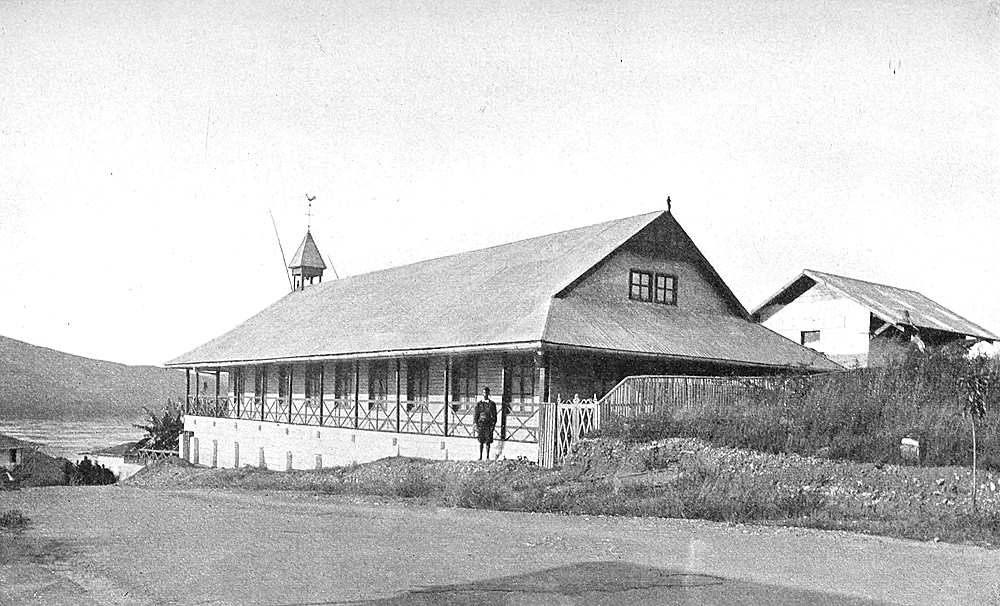
Church and Rectory, Matadi.
These tables show what has provided the enemies of the Congo Free State with a great deal of puerile prattle—an excess of exports over imports which is more apparent than real. One of the bitter critics who write from Liverpool repeats the charge in the press that the Sovereign of the Free State is denuding the Congo of its natural resources by exporting more than he imports. In this respect a German writer in Der Tag, Berlin, September, 26, 1904, not at all friendly to the Congo State (because it is diverting the Zanzibar trade of the Fatherland), has some pertinent things to say of the excess of exports over imports in the British colonies of South Nigeria and Lagos. Herr Eberhard von Schkopp discusses the Congolese, British, French, and German trade statistics in the following concise manner:
In 1901 the Congo State importations reached twenty-three million francs whilst the exports attained fifty millions, and the transit trade seven millions. This excess of exports over imports has been turned to account to support the attacks—justified besides—upon the Congo State’s system of government.
If that circumstance is of a kind to weigh in the balance, it ought to be imputed as a ground of complaint against all nations carrying on a practical colonial policy, and whose possessions export more than they import. The Congo State is neither the only nor even the first colony where this excess has been exhibited.
The exports of the English colony of South Nigeria have always surpassed the imports. Here are the figures:
1896 1897 1898 1899 1900
Imports 750,000 655,000 640,000 732,000 723,000 pounds ster.
Exports 844,000 785,000 750,000 774,000 888,000 pounds ster.
Statistics of the trade of the English colony of Lagos:
1896 1897 1898 1899 1900
Imports 881,000 758,000 892,000 960,000 832,000 pounds ster.
Exports 975,000 810,000 882,000 915,000 885,000 pounds ster.
Here also, except for 1898 and 1899, the total of exports exceeds that of imports. The case is the same with the commerce of the Gold Coast and the Gambia.
The French colonies also—Ivory Coast, Dahomey, Guinea, and French Congo—can also boast of having frequently had their exports higher than their imports.
No one has ever yet pretended to make that a grievance against the English and the French, and it must appear astonishing that the favourable trade statistics of the Congo State should lead to an attack on the system of its administration.
It would be very desirable if, following the example of the Congo State, and as we have seen of the English and French colonies, our possessions [the German] across the sea were to show exports exceeding their imports. For a commercial firm that is the best proof of success, and it cannot in any way be concluded from this fact that the “poor” blacks of Africa are being exploited by Europeans devoid of conscience.
But let us see if the Congo State exports really do exceed the imports, and if so, by what sum. The exports of the State are estimated in the tables at their value in Antwerp, after they have been harvested, prepared for transport from remote parts of the Congo Basin, stood charges of porterage, freight, export duties, taxes, insurance, brokerage at the African and European terminals, and merchant profits of an indefinite measure—in all, at least half their European value. The original value of Central African ivory, rubber, palm oil, gum copal, and other exports is, in fact, less than half their market value in Europe. In other words, if the exports of the Congo State were estimated at their value as they left the forests or the native collector, instead of aggregating 54,597,835.21 francs for the year 1903, they would show but 27,298,917.16 francs.
On the other hand, the imports, also estimated at their European value, but having similar distances to undergo and similar charges to bear, represent when they reach their consumers at least double their invoiced European cost. On a proper basis of value in their ultimate African market the imports for the year 1903 would amount to 42,792,662.04 francs. Thus the exports would stand at 27,298,917.16 francs, and the imports at 42,792,662.04 francs for the year 1903.
But even this is not a just comparison with the exports and imports of the British colonies, inasmuch as in the colony of Lagos, for instance, the imports include about sixty-five per cent. of alcoholic liquors,[32] leaving the native the beneficiary of an aggregate import of really civilising products of only thirty-five per cent. of the total, while the Congo imports, containing only five per cent. of alcoholic liquors, bestows upon the native legitimate products for his civilisation to the extent of ninety-five per cent. of the total of all the imports of the State. Deducting, therefore, from the Lagos imports sixty of their sixty-five per cent. of gin, rum, and whisky, thereby placing them on an equation with the imports of the Congo, we find in Herr von Schkopp’s figures an arraignment of Lagos “civilisation” which indicates where the real curse of Central Africa abides.
The foregoing is an astonishing record of exports and imports for a country practically developed in the short period which has elapsed since 1886. Congolese products are largely sent to Antwerp and, as the tables show, Belgium is by far the largest exporter and importer. A few years ago England was the chief exporter to the Congo of its cotton stuffs and other goods, but the same laggard spirit which caused Englishmen once interested in the Anglo-Belgian India-Rubber Company (known as the Abir) and other undertakings to abandon their Congolese enterprises has lost England a large and growing market in Central Africa. That the Belgians have developed the Mid-African trade by dint of hard work, organisation, and the risk of capital, is a state of things intolerable to those who have neglected and lost it. The awkward English monetary system is alone responsible for a large percentage of the world-wide diminution of British trade. All other nations have shown greater adaptability to the characteristics of foreign markets, and the capabilities and peculiarities of the peoples who compose those markets. The Germans, French, and Americans circulate their catalogues and price lists in the language of the country where they seek a market and quote prices in its coin, giving the equivalents in francs, marks, and dollars. British merchants, on the other hand, have adhered to their ancient custom of employing a monetary system so needlessly cumbersome that it can hardly be attributed to intelligent origin.
Belgian manufacturers have patiently studied the needs of the natives and have successfully endeavoured to supply them with the textures and food stuffs, machinery, agricultural implements, and building material which, being of simple construction, they are capable of putting to intelligent use.
The mineral wealth of the country which prospecting during the last five years has revealed in many sections of the Congo Basin, it is not the purpose of this volume to more than mention. Fine outcroppings of gold, coal, and copper have been discovered in the Katanga district in the south-eastern corner of the State. It has lately been rumoured in Europe that foreign prospectors have discovered territory marvellously rich in gold near the borders of British East Africa in the south, and again in the Enclave of Lado in the north. On this subject, and the likelihood of early and interesting mineral developments in that region, the Congo State authorities appear to have considerable knowledge. They do not, however, discuss the matter with any degree of candour. When the secret of certain political phases of Congolese history shall have been revealed, a connexion may be found between the mining and rubber industry and the calumnious campaign now proceeding against the State. But with that story, the present volume has naught to do.
The State’s revenue, consisting of import and export dues, tolls, excise, and direct personal taxation, is indicated in the following table:
1902 Nature of Receipts 1903
Estimates Estimates
Frs. Frs.
3,000.00 Registration Taxes 3,000.00
70,000.00 Sale and Letting of Domanial Land, Timber Felling, etc 20,000.00
Customs Duties on Exports,
Frs. 4,550,000.00
6,055,000.00 Customs Duties on Imports, including 6,150,000.00
the Duties on Alcohol,
Frs. 1,600,000.00
580,000.00 Direct Personal Taxation 600,000.00
1,000.00 Road Tolls 1,000.00
125,000.00 Taxes on Timber Felling 140,000.00
155,000.00 Postal Receipts 155,000.00
55,000.00 Maritime Rates 60,000.00
25,000.00 Judicial Receipts 25,000.00
8,000.00 Chancery Duties 6,000.00
4,160,000.00 Transport, and Different Services of the State 3,100,000.00
60,000.00 Taxes on Portage 60,000.00
15,452,000.00 Proceeds from the Private Domain of the State, from Tributes and Taxes Paid in Kind by the Natives 16,440,000.00
1,703,000.00 Interests and Dividends 1,100,000.00
122,000.00 Fees for Licences Granted to Congolese Companies 105,000.00
135,000.00 Extra and Casual Receipts 125,000.00
28,709,000.00 Total Receipts 28,090,000.00
It will be observed that by far the greater proportion of the State’s revenue is derived from the State lands (Domaine privé), which is fully considered in a succeeding chapter. Direct personal taxation is a comparatively small item, being only 600,000 francs, or one forty-seventh part of the year’s budget. Import duties, including duties on alcohol, are only 1,600,000 francs, while duties on exports amount to 4,550,000 francs. These duties were, as hereinbefore stated, fixed by arrangement with France and Portugal on April 8, 1892, for a term of ten years, and by a protocol dated May 10, 1902, extended until July 2, 1905.
The export duty collected on India-rubber and ivory under these tariff agreements between the interested Powers are as follows:
Ivory, in pieces or sticks Frs. 10 per kilo.
Tusks of less weight than 6 kilos ” 16 ” ”
Tusks above 6 kilos in weight ” 21 ” ”
India-rubber ” 4 ” ”
“Personal taxes,” says Descamps, “are levied upon three bases: 1, The area of inhabited buildings and enclosures; 2, the number of employés in service; 3, the ships and boats used by tax-payers.” As to the taxes en nature, levied upon the natives and already referred to in a previous chapter, the Chevalier de Cuvelier, Secretary of State of the Congo Free State, says in his official capacity in the Bulletin Officiel for June, 1903, that “it is as legitimate as any other kind of tax. It does not impose upon the native obligations of a different nature or heavier than the system of taxation employed in neighbouring colonies, such, for instance, as the British hut-tax. It is the native’s contribution to the public charges incurred by the State in exchange for the protection given him. In the Congo State this participation in the State’s support is light, seeing that it represents on an average not more than forty hours of native labour in a month.” It is the payment of tax in this form that the State terms prestation, which, if literally translated, would mean enforced labour upon roads.
In 1902 a general reduction of direct taxation was decreed. At the same time the taxation of all religious, charitable, and scientific institutions and enterprises was reduced to 50 per cent. of the rate which prevailed when the State had no revenue from import dues or from its domain lands. By a decree of 25th June, 1902, all personal taxes are entitled to one-fifth reduction so long as the State lands (domaine), tributes, and taxes in kind, yield the sum of 17,000,000 francs annually. In order to develop and extend the public highways, and works increasing the facilities of commerce, religion, agriculture, etc., the native prestations and their proper distribution have formed the subject of numerous decrees, all seeking to equitably adjust this form of taxation. One of the later decrees, that of 18th November, 1903, provides, amongst other measures protective of the native, that “In order to fix the tax justly and equitably among the natives, the territorial chiefs must take into account the nature of the work to be done, the age and the skill of the natives subjected to the prestation, and finally the obligation of the State to remunerate the natives for all work done by them.”[33]
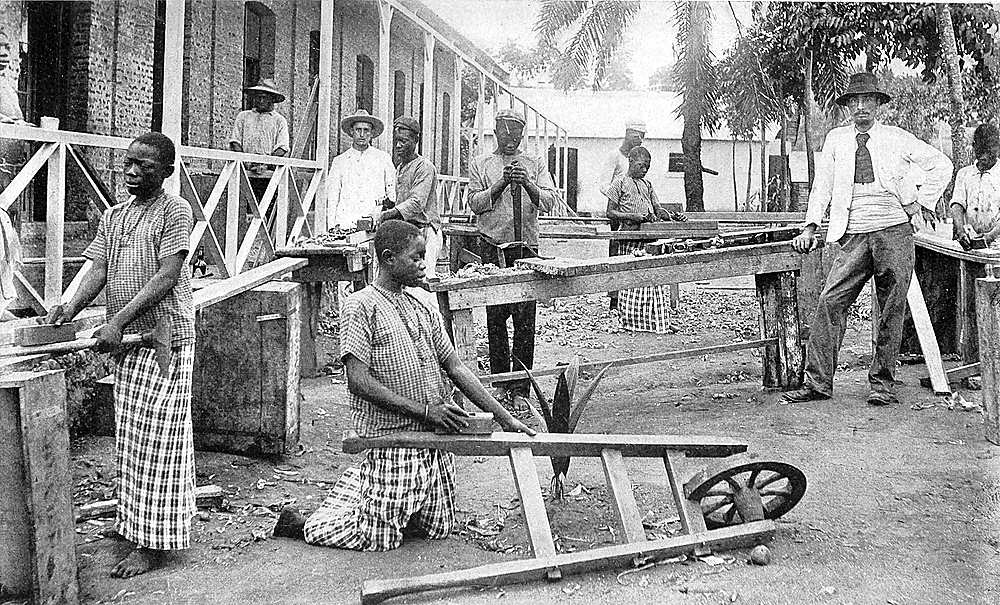
Native Carpenters at Work, Mission of New Antwerp, 1897.
The items constituting the State’s annual expenditure throw an interesting light on the subject of these native prestations in the Congo State. The State’s enemies found their charges of slavery largely upon the fact that the State enforces this labour upon the natives instead of imposing a tax in specie. In 1903 the State paid to its European officials and employés in the Congo force publique the sum of 1,800,000 francs, whereas during the same period the wages it paid to natives in the same service amounted to 2,050,000 francs. In developing the State lands at a cost of 6,014,790 francs during that year, the sum of 2,802,190 francs was paid to natives as wages. For extending agriculture and replanting India-rubber vines the sum of 1,373,932 francs was expended in 1903. The following items, taken from the table of expenditure for the same year, may be interesting:
Home Department
Frs.
The Administrative Service of Europe 165,000.00
The Administrative Service of Africa 3,180,310.00
The Army 7,701,765.00
Naval Expenditure 2,023,376.00
Sanitary Department 504,120.00
Public Works 1,081,885.00
Missions and Educational Establishments 121,425.00
Expenses relating to some Transports in Africa, not Drawn up in the Budget 1,600,000.00
Financial Department
The Administrative Service of Europe 99,000.00
The Administrative Service of Africa 503,065.00
Agriculture 1,373,932.00
Exploitation of the Domain 6,041,790.00
Savings-Bank, Interest of the Loans and Guaranteed Stock 1,656,228.00
Foreign Office and Justice
Administrative Service of Europe 227,100.00
Postal Department 66,000.00
Navigation 140,200.00
Justice 910,000.00
Worship 250,000.00
The currency of the Congo Free State consists of copper, silver, and gold coins and paper notes. The former are issued under a decree of 27th July, 1887, which established the monetary system upon the gold standard. The gold coins are of the value of twenty francs; the silver coins are the five, two, one franc, and the fifty centime piece. The copper coins are the ten, five, two, and one centime pieces.
Paper Currency. By a decree of February 7, 1896, with the object of facilitating business transactions between the different parts of the State, banknotes of the State, payable to the bearer at the General Treasury of the Congo Free State, in Brussels, were issued. This decree sanctioned a first issue of notes to the value of 400,000 francs.
An order of the Secretary of State of February 8, 1896, limited the value of the issued notes to a sum of 269,850 francs, comprising 2,000 notes of 100 francs each, and 6,985 ten franc notes.
Formerly, in the Lower Congo, agents of the State and merchants were accustomed to give the natives, in exchange for their services, a mokande or cheque, which enabled them to purchase what they required at the factories.
It is evident that silver, copper, and paper currency of the State have a great advantage over the mokande or cheque system, these latter often being only payable at a fixed date and by certain persons. At first the circulation of money was slow and difficult. It was only with a good deal of trouble that foreign money was displaced in the Lower Congo, and in the interior there was the same difficulty in abolishing the custom of barter, and the usage of the mitako, or brass wire.
Finally, to accelerate the introduction of State currency, the Government decreed:
1. To pay the soldiers and native workmen in cash, and also to pay in the same manner for all goods bought from the natives by the State;
2. To stop all payments in kind at the stations of the Lower Congo;
3. To substitute for the rations formerly issued by the State to the agents, an equivalent in cash, and so forth.
Immediately after the enforcing of these measures the State currency began to circulate rapidly, and merchants no longer hesitated to open retail stores, where the natives in the employment of the State and commercial companies, and other natives as well, came to exchange their money for European goods.
At the present time, in the region south of Stanley Pool, the greater part of the commercial transactions between Europeans and natives is carried on through the medium of the State currency, and in the native markets it is no longer possible to purchase anything except with the silver or copper Congolese money—the preference being given to silver.[34]
The native’s love of tinsel causes a large quantity of the silver and copper coins put into circulation to disappear from the sphere of commerce. Congolese vanity manifests itself in many forms. Necklaces, earrings, bracelets, anklets, and other ornaments are made of the State coins, and worn by the men and women of all the tribes which come in touch with the Congo coinage. Powerful chiefs are often buried with many coins placed upon their bodies.