PART III The Story of Sir Launcelot and Elaine the Fair
Reading edition
Here followeth the history of Sir Launcelot's wanderings and of how he came to the town of Corbin, and of how he slew the great Worm of Corbin that for somewhiles brought sorrow and death to the folk of Corbin. Here you shall also read the history of Elaine the Fair, the King's daughter of Corbin, and of how for her sake Sir Launcelot fought in the tournament at Astolat.
All these and several other things are herein duly set forth, so that, should you please to read that which is hereafter written, I believe you shall find a great deal of pleasure and entertainment in that history.
Chapter First
How Sir Launcelot rode errant and how he assumed to undertake the Adventure of the Worm of Corbin.
And now you shall be told how it befell Sir Launcelot after that he had fought with Sir Gareth and had made him knight as told in the history of Sir Gareth.
You are to know that after Sir Launcelot left Sir Gareth he went his way very cheerfully, and many times he bethought him of how the damsel Lynette had taken Sir Gareth to be a kitchen knave, and at that thought he would laugh with great joy of so excellent a jest.
Sir Launcelot rideth errant.
So with great cheerfulness of spirit he rode ever onward upon his way, whilst the daylight slanted farther and farther toward sunset. And, after awhile, the sun sunk in the West, and the silence of the twilight fell like to a soft mantle of silence upon the entire earth. The darkness fell, the earth melted here and there into shadow and every sound came very clear and loud as though the bright and luminous sky that arched overhead was a great hollow bell of crystal that echoed back every sudden noise with extraordinary clearness. Then Sir Launcelot was both hungry and athirst and he wist not where he might find refreshment to satisfy the needs of his body.
Sir Launcelot meeteth the strolling minstrels.
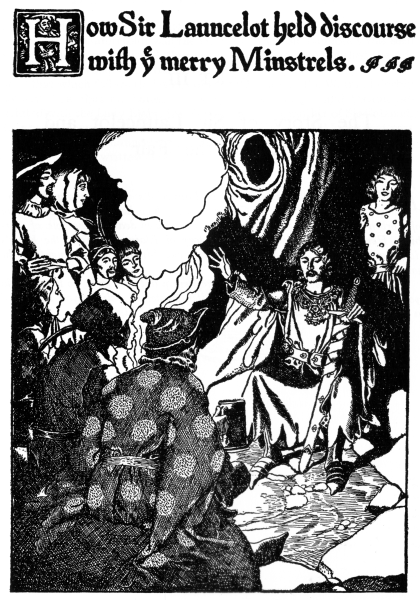
So, thinking of food and drink, he was presently aware of the light of a fire shining in the gray of the falling twilight and thitherward he directed his way, and in a little pass, he came to where there was a merry party of strolling minstrels gathered around about that bright and cheerful fire. Some of these fellows were clad in blue and some in yellow and some in red and some in green and some in raiment pied of many colors. And all they were eating with great appetite a savory stew of mutton and lentils seasoned with onions and washed down with lusty draughts of ale and wine which they poured forth, ever and anon, from big round-bellied skins into horns and cups that were held to catch it.
These jolly fellows, beholding Sir Launcelot coming to them through the dusk, gave him welcome with loud voices of acclaim and besought him to descend from horseback and to eat with them, and Sir Launcelot was right glad to do so.
So he dismounted from his horse and eased it of its saddle and turned it loose to browse as it listed upon the grass of the wayside. And he laid aside his shield and his spear and his sword and his helmet and he sat him down with those minstrels and fell to eating and drinking with might and main. And the minstrels bade him to take good cheer and to eat and drink all that he desired and Sir Launcelot did so.
The minstrels chaunt.
Then, after Sir Launcelot and the minstrels had supped their fill, those lusty fellows brought forth other skins of wine and filling again the several cups and flagons they all fell to drinking and making merry. And several of the minstrels brought forth lutes and others brought forth viols, and anon he who was the chief minstrel called upon one to stand forth and sing, and that fellow did so, chaunting a rondel in praise of his sweetheart's eyes. After that, another sang of battle and still another sang in praise of pleasant living; meantime the others accompanied, with lute and viol, those who sang, and Sir Launcelot listened to their music with great pleasure of heart.
All about them lay the deep silence of the moonlit night with only that one red spot of fire and of cheerful mirth in the midst of it, and the fire shone very bright upon the armor of the knight and lit up all those quaint fellows in red and green and yellow and blue and pied so that they stood forth against the blackness behind them as though they had been carved out from it with a sharp knife.
Then he who was chief among the minstrels said to Sir Launcelot, "Messire, will ye not also sing?" At this Sir Launcelot laughed, and quoth he: "Nay, good fellows, I cannot sing as ye do, but I will tell ye a story an ye list to hear me."
Sir Launcelot telleth a conte.
At that they all cried out to tell them that story and thereupon he did so, telling them a certain goodly conte of two knights who loved a lady, but she loved neither of them, having set her heart upon an esquire of low degree. So of these two knights the one became an hermit and the other by force of his knighthood brought it to pass that the esquire was exalted from his squirehood to become a king. But when the esquire became a king the lady would have none of him, but turned her love to the knight who had exalted him to his high estate. So the lady left the esquire who was king and married the noble knight who had made him king, and so, having made choice of the greatest and the noblest of all the three, she dwelt happily with him to the end of her life.
To this the minstrels listed in silence and when Sir Launcelot had finished they gave him great applause without measure.
After that the minstrels sang again and Sir Launcelot told them another tale of chivalry; and so with good cheer the night passed pleasantly away until the great round moon, bright and full like to a bubble of shining silver, floated high in the sky above their heads, very bright and as glorious as day and bathing all the world in a flood of still white light, most wonderful to behold.
Sir Launcelot would leave the minstrels.
Then perceiving it to be midnight, Sir Launcelot bestirred himself, and he said: "Good fellows, I thank ye with all my heart for the entertainment ye have given me, but now I am refreshed I must go again upon my way."
To this he who was chief among the minstrels said: "Sir Knight, we would fain that you would remain with us to-night and would travel with us upon our way to-morrow, for indeed you are the pleasantest and cheerfulest knight that ever we met in all of our lives."
He asketh of some adventure.
At this Sir Launcelot laughed with great good will, and he said: "Good fellows, I give you gramercy for your fair regard. Ye are indeed a merry company and were I not a knight methinks I would rather be one of your party than one of any other company that ever I fell in with. But it may not be, for, lo! I am a knight and I must e'en go about my business as becometh one who weareth spurs of gold. So here and now we part. Ne'theless you may haply do me one service, and that is to tell me whether anywhere hereabout is to be found an adventure such as may beseem a knight of good credit to undertake."
Upon this one of those minstrels spake saying: "Messire, I know where there is an adventure, which, if you achieve it, will bring you such great credit that I believe Sir Launcelot of the Lake himself would not have greater credit than you."
At this Sir Launcelot laughed with great good will. "Well," quoth he, "I would not be overbold, yet this I may say, that anything Sir Launcelot of the Lake might not fear to undertake, that also I shall not fear to assume, and whatever he might find strength to do that also I may hope to accomplish. For indeed I may tell ye that I hold myself to be altogether as good and worthy a knight as ever is Sir Launcelot of the Lake."
"Ha!" quoth the chief minstrel, "I perceive, Sir Knight, that thou hast a very good opinion of thyself. Now, were Sir Launcelot here, haply thou wouldst not venture to reckon thyself so high as thou now dost."
At that all those minstrels laughed in great measure, and Sir Launcelot laughed with them as loud as any. "Good fellows," said he, "I believe I reckon myself to be no better than another man born of woman, yet this I have to say: Oftentimes have I beheld Sir Launcelot and sometimes have I contended against his will, but never at any time have I found him to be stronger or worthier than am I myself. But let us not debate so small a matter as this. Let us instead learn what is that adventure concerning which yonder good fellow hath to advise us."
"Messire," quoth the minstrel, "have ye ever heard tell of the Worm of Corbin?"
"Nay," said Sir Launcelot, "but tell thou me of it."
The minstrel telleth of the Worm of Corbin.
"Sir," said the minstrel, "I will do so. You are to know that some ways to a considerable distance to the eastward of this place there is a very large fair noble town hight Corbin; and the King of that country is King Pelles. Now one time it chanced that Queen Morgana le Fay and the Queen of North Wales were upon a visit to Corbin, and whilst they were there there was given in that place a great jousting and feast in their honor.
Of the damsel who came to the feast of the King.
"Whilst King Pelles sat at table with the two queens (all of his court and his daughter Elaine the Fair being with him) there came into the pavilion where the feast was held a wonderfully fair damsel, tall and straight and clad from top to toe in flame-colored satin. In her hand she bare a paten of silver and upon the paten was a napkin, and on the napkin there was a wonderful ring of gold set with a clear blue stone. And the damsel spoke in a voice both high and clear, saying: 'Lords and Ladies, here have I a ring that may only be worn by the fairest and worthiest lady in this room.'
"At these words, as you may suppose, there was a great deal of wonder and much expectation, and a great deal of talk. For some said that one lady should by rights have that ring and some said that another lady should have it.
Of how Queen Morgana tryeth the ring.
"Now the first to essay that ring was Queen Morgana le Fay, for she supposed that this was a masque devised by King Pelles in honor of her. So she took the ring in her hand and essayed to pass it upon her finger, but lo! it would not pass the first joint thereof.
"At that Queen Morgana was filled with wrath, but still she dissembled her anger and sat, waiting to see what would next befall.
Of how the Queen of North Wales tryeth the ring.
"So after Queen Morgana le Fay had thus failed to wear that ring, the Queen of North Wales said unto herself, 'Haply King Pelles may intend this ring for me.' So she also took the ring and would have placed it upon her finger, but lo! it grew so large that it would not stay where it was placed, but fell off upon the table before the whole court of the King.
"At this many who were there laughed aloud, and thereat the Queen of North Wales was filled with anger and mortification as much as Queen Morgana le Fay had been. But she also dissembled her anger before the court and sat to watch what would befall.
"So after these two queens had so essayed, several others of the ladies who were there each tried to put the ring upon her finger, but no one could do so, for either it was too large, or else it was too small. Then last of all the Lady Elaine the Fair, the King's daughter, essayed the adventure of the ring, and lo! it fitted her as exactly as though it had been made for her.
"At this both of those two queens aforesaid were more angered than ever, for each said to herself, 'Certes, this King hath done this to put affront upon us.' So that night they communed together what they should do to punish King Pelles of Corbin and the Town of Corbin for that affront which they deemed themselves to have suffered.
Of how Queen Morgana layeth a curse upon the town.
"Now the next morning those two queens quitted the court, and as they and their attendants passed by the market-place of the town they perceived where there lay a great flat stone that marked the centre of the town. Then Queen Morgana le Fay cried out: 'See ye yonder stone! Beneath that slab there shall breed a great Worm and that Worm shall bring sorrow and dole to this place ten thousand times more than the shame which I suffered here yesterday. For that stone shall be enchanted so that no man may lift it. And beneath that stone the Worm shall live; and ever and anon it shall come forth and seize some fair young virgin of this town and shall bear her away to its hiding-place and shall there devour her for its food.'
"So it was as the Queen said, and now that Worm dwelleth at Corbin beneath the stone, and ever bringeth sorrow and death to that place. And it cometh out only at night, so that the terror of the Worm of Corbin is greater than it would otherwise be, for no eye hath ever beheld it in its comings and its goings. So if any champion shall achieve the death of that Worm, he shall be held to have done a deed worthy of Sir Launcelot of the Lake himself."
"Friend," said Sir Launcelot, "thou sayest true and that were indeed a most worthy quest for any knight to undertake. As for me, I am so eager to enter upon that quest that I can hardly stay my patience."
With this saying, Sir Launcelot rose from where he sat; and he whistled his horse to him and when his horse had come to where he was he put the saddle upon its back. And he took his shield and spear in his hand and mounted upon his charger and made him ready to leave that place.
But ere he departed, the chief minstrel and several others came to him, and the chief minstrel laid his hand upon the horse's neck and he said: "I pray you, Messire, tell us who you are who have seen Sir Launcelot of the Lake so often and who declare yourself to be as good a knight as he."
Sir Launcelot revealeth himself to the minstrels.
Then Sir Launcelot laughed and he said: "Good friend, I am riding errant as you behold. In these my travels I would fain withhold my name from the knowledge of men. Nevertheless, since we have eaten and drunk together, and since we have cohabited in good fellowship together, I will tell you that I myself am that very Sir Launcelot whom ye appear to hold in such high regard. Wherefore it is that I am, certes, as good as he could possibly be, let that be saying much or saying little."
So saying, Sir Launcelot set spurs to his horse and rode away and left them astonished at his words. And long after he had left those merry fellows he could hear their voices in the distance babbling together very loud with wonder that Sir Launcelot of the Lake had been amongst them for all that time without any one of them suspecting him who he was. For by this time all the world knew Sir Launcelot of the Lake to be the greatest champion that ever the world had seen from the very beginning unto that time.
After that, Sir Launcelot rode forward upon his way toward the eastward through the moonlit night, and by and by he entered a great space of forest land. And somewhile after he had entered that woodland the summer day began to dawn and all the birds began at first to chirp and then to sing very blithely and with a great multitude of happy voices from out of every leafy thicket. Then up leapt the jolly sun and touched all the upper leafage of the trees and turned them into gold.
Sir Launcelot beholdeth Corbin.
And anon the sun rose high and higher and when it was very high in the heavens Sir Launcelot came out of the forest into an open country of level meadows and of pasture-lands. And in the midst of that place, a great way off, he beheld where there was a fair walled town set upon a hill with a smooth shining river at its foot, and he wist that this must be the Town of Corbin of which the strolling minstrels had told him the night before.
So Sir Launcelot rode forward and drew near the town. And as he drew closer to it he thought that this was one of the fairest towns that ever he had beheld in all of his life. For the castle of the town and the houses of the town were all built else of stone or else of brick, and a thousand windows sparkled in the brightness of the day, shining like to stars in heaven. And the river that flowed beside the town wound down between fair green meadows which lay upon either side, and betwixt banks of reeds and rushes and pollard willows, and it was like to a great serpent of pure silver lying in the grass. The walls of the castle and the walls of the town came down to the river, and stood with their feet, as it were, in the clear and crystal-bright water, and there were trees that overhung the water upon this side and upon that, and there was a bridge with three arches that crossed over the river and led to the town. All these things Sir Launcelot beheld and so it was that the town appeared exceedingly pleasant to his eyes.
Sir Launcelot bespeaks the town's folk.
Now when Sir Launcelot had come pretty close to the town he met a party of town-folk with several pack-mules hung with bells and laden with parcels of goods. These Sir Launcelot bespoke, saying, "I pray ye, fair folk, tell me, is this the Town of Corbin?" Thereunto they replied, "Yea, Sir Knight, this is that town." Sir Launcelot said, "Why are ye so sad and downcast?" Whereunto the chief of that party—a right reverend man with a long white beard—made reply: "Sir Knight, wherefore do you ask us why we are sad? Whence come you that you have not heard how we are cursed in this town by a Worm that torments us very grievously; and how is it that you have not heard tell how that Worm devoureth every now and then a tender virgin from our midst?"
"Sir," quoth Sir Launcelot, "I have indeed heard of this Worm that bringeth you so much woe and dole. Know ye that it is because of this very Worm that I have come hither. For I purpose, if God's grace be with me, to destroy that vile thing and so to set ye all free from the curse that lies upon you!"
"Alas, Sir Knight," quoth the old man, speaking very sorrowfully, "I do not doubt that you are possessed of all the courage necessary for this undertaking, yet for all that you may not hope to succeed in your quest. For even if you were able to slay the Worm, yet you could not come at it. For you are to know that it lyeth beneath a great stone and that the stone is sealed by magic which Queen Morgana le Fay set upon it so that no man may raise it from where it lyeth."
Sir Launcelot speaketh words of cheer.
Then Sir Launcelot spoke words of good cheer to that old man and to his companions, saying: "Let that be as it may, yet for all that ye need not despair of succor. Know ye not that naught can be achieved until it first be essayed? As for that enchantment that lyeth upon the stone, I tell ye this: Behold this ring which I wear upon my finger! It is sovereign against all magic whatsoever, wherefore I know that the spells which bind this stone into its place cannot prevail against the counter magic of this ring. So ye shall be well assured that I shall lift that stone, and after that, when it shall be lifted and when it shall come to battle betwixt me and that Worm, then shall the issue lie altogether with God, His Grace and Mercy."
How Sir Launcelot entered Corbin.
Now when those who were there heard what Sir Launcelot said, their hearts were filled with hope and joy, for it seemed to them that here indeed might be a champion who should deliver them out of their distresses. Wherefore when they heard his words they presently lifted up their voices in loud acclaim, some crying, "God be with you!" and some crying, "God save you from destruction!" some crying this, and some crying that.
Then Sir Launcelot smiled upon them and said, "Save you good people," and therewith set spurs to flank and rode away.
But many of those who were there went with him, running beside his horse, seeking to touch him and even to touch the horse which he rode. And all the time they gave him loud acclaim without measure and without stint.
For the virtue of Sir Launcelot went forth from him like a shining light wherefore it seemed to them that here was one who should certainly free them from the curse that lay upon them.
And thus it was that Sir Launcelot of the Lake rode across that three-spanned bridge and into the Town of Corbin and so to his adventure with the Worm of Corbin.

Chapter Second
How Sir Launcelot slew the Worm of Corbin, and how he was carried thereafter to the Castle of Corbin and to King Pelles and to the Lady Elaine the Fair.
The folk of the town welcome Sir Launcelot.
So thus it was that Sir Launcelot entered the town of Corbin to slay the Dragon that lay beneath the stone. And with his coming a great multitude gathered very quickly, hurrying from all sides, crying out and blessing him as he rode forward upon his way. And ever a great roar of voices sounded all about him like to the noise of many waters.
Sir Launcelot cometh to the place of the Dragon.
So, upborn by that multitude, Sir Launcelot went forward very steadfastly toward the market-place of the town, in the midst of which lay that great stone, aforetold of, with the Worm beneath it. And when he had reached the place, he bade the multitude abide where they were.
So, upon that command, the people stood afar off, and Sir Launcelot went forward alone to where was the slab of stone. And he looked down upon the slab and beheld that it was very flat and wide and so big that three men might hardly hope to lift it. Besides this, he beheld that it had been sealed by magic as had been reported to him, for many strange letters and figures had been engraved into the face of the stone.
Now you are to remember that it was aforetold of in the "Book of the Champions of the Round Table" that Sir Launcelot wore upon his finger a ring which the Lady of the Lake had given him when he quitted the Lake; and you all remember that that ring was of such a sort that he who wore it might dissolve all evil magic or enchantment against which he should direct his efforts. Wherefore it was that Sir Launcelot was aware, as he had already told the people outside of the walls of the town, that he might lift that stone even if another, because of the magic that was upon it, should not be able to stir it where it lay.
So Sir Launcelot put aside his sword and his shield and he went forward to the slab and he seized the slab in both of his hands. And he bent his back and lifted, and lo! the bands of enchantment that lay upon the stone were snapped and the slab moved and stirred in the bed wherein it lay.
Sir Launcelot lifteth the stone.
Then when the multitude of the people who gazed upon him beheld the slab how it moved and stirred in its bed, a great shout went up from several thousand lips like to one mighty voice of outcry. Therewith Sir Launcelot bent again to the stone and heaved with all his might. And lo! he lifted the stone and he raised it and he rolled it over upon the earth.
Then he looked down into the hole that was beneath the stone and he was aware that there lay something in the hole that moved. And anon he beheld two green and glassy eyes that opened upon him and looked up at him from out of the hole; and he beheld that those eyes were covered over as with a thin film to shelter them from the dazzling light of the daytime. And as Sir Launcelot gazed he beheld that that thing which lay within the hole began to crawl out of the hole, and Sir Launcelot beheld that it was a huge worm, covered all over with livid scales as hard as flint. And the Worm lifted the fore part of its body to the height of a tall man and gaped very dreadfully with a great mouth an ell wide, and all glistening with three rows of white and shining teeth. And Sir Launcelot beheld that the Worm had as many as a thousand feet, and that each foot was armed with a great claw like the claw of a lion, as hard as flint, and very venomous with poison. And the Worm hissed at Sir Launcelot. And its breath was like the odor of Death.
The Worm of Corbin cometh forth.
Such was that dreadful terrible Worm that lay beneath the stone at Corbin. And when the people of the town saw it thus appear before them in the broad light of day, they shrieked aloud with the terror of that which they beheld. For it was like to something that had come to life out of a dreadful dream, and it did not seem possible that such a thing should ever have been beheld by the living eyes of man.
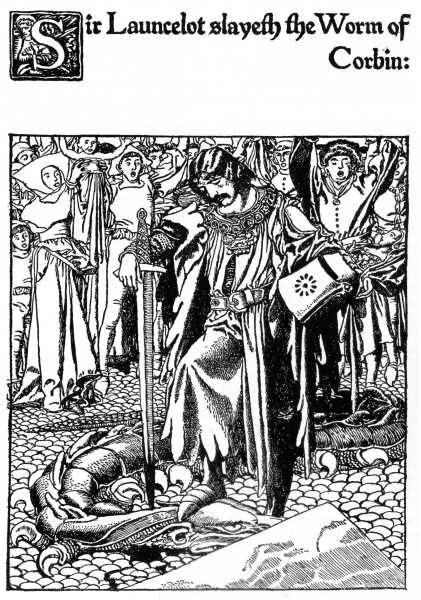
But Sir Launcelot beholding the Worm in all its terror leaped to where was his sword and he seized his sword in both hands and he ran at the Worm and lashed at it a blow so mighty that it might easily have split an oak tree. But the scales of the Worm were like adamant for hardness wherefore the stroke of the sword pierced them not but glanced aside without harming the creature.
Then when the Worm felt itself thus smitten, it hissed again in a manner very terrible and loud, and it reached out toward Sir Launcelot and strove to catch him into the embrace of a hundred of its sharp claws. But Sir Launcelot sprang aside from the embraces of the Worm and he smote it again and again, yet could not in any wise cut through the scales that covered its body. And at every blow the Worm hissed more terribly and sought to catch Sir Launcelot into its embraces.
Sir Launcelot doeth battle with the Worm.
Thus for a long time Sir Launcelot avoided the Worm, but, by and by it came to pass that he began to wax faint and weary with leaping from side to side, weighed down as he was with his armor. So, at last, it befell that the Worm catched Sir Launcelot in the hook of one of its claws, and thereupon they who looked on at that battle beheld how in a moment it had embraced Sir Launcelot in several hundred of its claws so that his body was wellnigh hidden in that embrace. And the Worm, when it so held Sir Launcelot in its embrace, tore at him with its claws and strove to bite him with its shining teeth. And anon it catched its claws in the armor of Sir Launcelot and it tore away the epaulier upon the left side of Sir Launcelot's shoulder, and it tore away the iron boot that covered his left thigh, and it cut with its claws through the flesh of the left shoulder of Sir Launcelot and through the flesh of his thigh to the very bone, so that the blood gushed out in a crimson stream and ran down over his armor and over the claws of the Worm.
Then Sir Launcelot, finding himself as it were thus in the very embrace of Death, put forth all his strength and tore away free from the clutches of the Worm ere it was able to do him further harm. And seeing how that the case was now so ill with him, he catched the haft of his sword in both of his hands, and he rushed at the creature and he stabbed with his sword into the gaping mouth of the creature and down into its gullet so that the cross-piece of the sword smote against the teeth of the creature's mouth.
Then when the Worm felt that dreadful terrible stroke driven thus into its very vitals, it roared like a bull in its torments, and it straightway rolled over upon the ground writhing and lashing the entire length of its body, bellowing so that those who heard it felt the marrow in their bones melt for terror.
Sir Launcelot slayeth the Worm.
But Sir Launcelot, looking down upon the lashings of the Worm, beheld where there appeared to be a soft place nigh to the belly and beneath the scales of the back and sides, and therewith he rushed at the Worm and plunged his sword twice and thrice into that soft spot, whereupon, lo! thick blood, as black as ink, gushed forth after those strokes. Then again Sir Launcelot pierced the Worm twice and thrice in such another place and thereafter it presently ceased to bellow in that wise and lay shuddering and writhing in death, rustling its dry scales upon the earth in its last throes of life.
Then Sir Launcelot beheld that his work was done and he stood leaning upon his sword, panting and covered all over with the blood and slime of that dreadful battle. And the people beholding how that the Worm was now slain, fell to shouting aloud beyond measure. And they came running from all sides to that place like to a flood so that they filled the entire market-place. And they crowded around and gazed upon the Worm with horror, and they gazed upon Sir Launcelot in wonder that Heaven should have sent so wonderful a Champion to save them out of their distresses. And ever Sir Launcelot stood there leaning upon his sword panting and with the blood flowing down from his shoulder and his thigh so that all that side of his body was ensanguined with shining red.
The knights of Corbin do honor to Sir Launcelot.
So as he stood there, there came a party of knights riding into that place. These thrust their way through the multitude to where Sir Launcelot was in the midst of the crowd as aforesaid. When they had come to Sir Launcelot the chief of those knights said, "Sir, art thou he who hath slain the Worm?" Sir Launcelot said, "Thou seest that I am he." Then he who spoke to Sir Launcelot said, "Messire, I fear me you are sorely hurt in this battle." Quoth Sir Launcelot: "I am hurt indeed, but not more hurt than I have been several times before and yet live as you behold me."
Then those knights went and looked upon the Worm where it lay and they gazed upon it with wonder and with loathing. And they gave great praise beyond measure to the knight who had slain it.
After that they sent for a litter and they laid Sir Launcelot upon the litter and bare him away into the Castle of Corbin where King Pelles of Corbin was then holding his court in royal pomp of circumstance. And they brought Sir Launcelot to a fair chamber of the castle where a number of attendants came to him and eased him of his armor and led him to a bath of tepid water steeped with healing herbs. And there came a skilful leech and searched the wounds of Sir Launcelot and spread soothing unguents upon them and bound them up with swathings of linen. And after that they bare Sir Launcelot to a fair soft couch spread with snow-white linen and laid him thereon, and he was greatly at ease and much comforted in body.
King Pelles of Corbin doeth honor to Sir Launcelot.
Then after all this was done in that wise, there came King Pelles of Corbin to that place for to visit Sir Launcelot, and with him came his son, Sir Lavaine, and his daughter, the Lady Elaine the Fair. And Sir Launcelot beheld that King Pelles was a very noble haughty lord, for his beard and his hair were long and amplelike to the mane of a lion, and resembled threads of gold sprinkled with threads of silver. And he was clad all in a robe of purple studded over with shining jewels and he wore a fillet of gold about his head set with several gems of great price. Upon the right hand of King Pelles there came his son, Sir Lavaine—a very noble young knight, newly created by the bath—and upon his left hand there came his daughter, the Lady Elaine the Fair.
Of the Lady Elaine the Fair.
Then Sir Launcelot looked upon the Lady Elaine the Fair and it seemed to him that she was the most beautiful maiden that ever he had beheld in all of his life. For he saw that her hair was soft and yellow and shining like to the finest silk; that her eyebrows were curved and very fine, as though they had been marked with a sharp and delicate pencil; that her eyes were very large and perfectly blue and very lustrous, and as bright as precious jewels; that her forehead was like cream for whiteness; that her cheeks were like roses for softness of blush; that her lips were like coral for redness, and that betwixt her lips her teeth were white, like to pearls for whiteness.
Such was the Lady Elaine, as Sir Launcelot beheld her, and he was amazed at her surpassing beauty, and at the tender grace of her virgin youth.
Then King Pelles and Sir Lavaine and the Fair Elaine came close to where Sir Launcelot lay upon his couch, and there they kneeled them down upon the ground. And King Pelles spake, saying: "Messire, what thanks shall we find fit to give to you who have freed this entire land from the dreadful curse that lay upon it?" "Lord," said Sir Launcelot, "thank not me but give your thanks to God whose tool and instrument I was in this undertaking." "Messire," quoth King Pelles, "I have not forgot to give thanks to God. Nevertheless seeing the instrument which He hath fitted to His hand is so perfect an instrument, one may praise that also. So we do praise you and give thanks from our heart to you for the deliverance which you have brought to us. Now I pray you tell me who you are who have brought this great succor to our state, for methinks you must be some famous hero, and I would fain thank you in your own name for what you have done to benefit us."
"Lord," said Sir Launcelot, "this you must forgive me if I tell you not my name. For there is supposed to be shame upon my name, wherefore I am now known as le Chevalier Malfait, because in the eyes of those to whom I am accountable I have done amiss."
"Well," quoth King Pelles, "I dare be sworn you have not at any time done greatly amiss in that which you have done. Nevertheless an you will have it so, so it shall be as you will, and with us all of this place you shall be known as le Chevalier Malfait until such time as it pleases you to assume your proper name and title."
Sir Launcelot lyeth sick in Corbin.
Thus I have told you all the circumstances of that famous adventure of the Worm of Corbin and there remaineth now only this to say: That Sir Launcelot did not recover from his hurt as soon as he had supposed he would. For the venom of the Dragon had got into his blood, wherefore even after a twelvemonth had gone by, he still remained in the castle of King Pelles at Corbin, albeit he was by that time quite healed in his body.
And also there is this to tell—that at the end of the twelvemonth aforesaid, King Pelles came to Sir Launcelot and said to him: "Messire, I would that you would henceforth dwell with us at this court. For not only would you be a great credit to any court in which you live, but here we all love you as one loveth the apple of his eye."
Sir Launcelot remaineth at Corbin.
"Lord," said Sir Launcelot, "ye cannot love me more than I love ye all who have been so good to me in the days of my sickness and disease. So I will be exceedingly rejoiced to remain with ye yet a while longer; for this is indeed a pleasant haven in which to rest in the long and toilsome journey of life, and I have nowhere else to go."
Then King Pelles took Sir Launcelot into his arms and kissed him upon the brow and so they became plighted in friendship unto one another.
So Sir Launcelot remained at Corbin and went not any farther errant at that time.
But meantime, and for all that while, there was great wonder at the court of King Arthur whither Sir Launcelot had gone and what had become of him that no one in all of the world heard tell aught of him.

Chapter Third
How King Arthur proclaimed a tournament at Astolat, and how King Pelles of Corbin went with his court thither to that place. Also how Sir Launcelot and Sir Lavaine had encounter with two knights in the highway thitherward.
King Arthur proclaimeth a tournament.
Now it fell upon a time that King Arthur proclaimed a great tournament to be held at Astolat, upon Lady's Day Assumption. And the King sent word of this tournament throughout all the land, both east and west and north and south. So it came about that word of the tournament was brought one day by herald to King Pelles at Corbin, and when this news came to him he ordained that his court should make them ready to go to Astolat to that passage of arms, in pursuance of the word that the herald of King Arthur had brought to Corbin.
Sir Launcelot is troubled.
Then Sir Launcelot was much troubled in his mind for he said to himself, "I fear me that if I go unto Astolat with this court there may be some one there who will know me." For Sir Launcelot was still very bitterly affronted at his kinsmen because that they had chid him so greatly for the manner in which he had ridden in a cart upon that adventure to rescue Queen Guinevere as aforetold of. For the pride of Sir Launcelot was stiff and stubborn and he could not bring himself to bend it or to break it. Neither could he bring himself to overlook such an affront as that which he had suffered from the words that Sir Lionel and Sir Ector de Marishad said to him. Wherefore, until full justification had been rendered unto him, he was unwilling that any of his former companions should behold him or know him who he was.
Yet did he not see how he could refuse to obey the behest of King Pelles, for as he was now become a knight of the court of the King of Corbin he was bound to obey whatsoever that King should command him to do. Wherefore he wist not what to do in this case, and so was much troubled in mind.
King Pelles talketh with Sir Launcelot.
Now King Pelles was aware how it was with le Chevalier Malfait and that he was unwilling to go to the tournament at Astolat. So one day the King took Sir Launcelot aside and he said to him: "Messire, will you not also go with our court to this tournament that King Arthur hath proclaimed?"
To this Sir Launcelot said, "Lord, I would rather that I did not go."
King Pelles said: "Sir Knight, far be it from me to urge you to go if it be greatly against your wishes; yet you are to know that it will be a very sad thing for all of us if you do not go with us. For it is the truth that you are, beyond all others, the foremost of our court, and its most bright and shining light; wherefore it will be sad for us if we go thither without you."
Then Sir Launcelot looked very steadfastly at King Pelles and his heart went out toward the King and he said, "Do you then desire my company so very greatly?" King Pelles said, "Yea." "Well," said Sir Launcelot, "let it be so and I will go with you." And at that saying King Pelles was glad beyond measure.
So when the time came Sir Launcelot made him ready to go with the others to Astolat, and when the day of departure arrived he went with them.
King Pelles and his court journey to Astolat.
Thereafter they travelled by easy stages toward Astolat, and upon the third day after their departure from Corbin they came to the castle of a certain Earl, which castle stood about three leagues or a little more from the town. This Earl was a kinsman of King Pelles and in great amity with him, wherefore he was glad to have the King and his court to lodge with him at that time. And they of Corbin were also glad, for this was a very noble excellent place in which to lodge and all the other castles and inns nigh to Astolat were at that time very full of folk.
So it came about that King Pelles and his court remained several days at that place, and in all that time Sir Launcelot kept himself ever in retreat, lest some one with whom he was acquainted should chance to see him and know him who he was. To this end, and that he might conceal himself, Sir Launcelot was most often with the court of the Lady Elaine the Fair and not often with the court of the King.
The Lady Elaine and Sir Launcelot talk together.
Now the Lady Elaine was not very well pleased with this, for she held Sir Launcelot in great admiration above all other men, and she would fain have had him stand forth with the other knights who were there, so that his nobility might be manifested amongst them. So one day whilst they two sat together in the garden of the castle of that Earl (the court of the Lady Elaine and several lords of the King's court being near by playing at ball) the Lady Elaine spake her mind to Sir Launcelot upon this point saying: "Fair Sir, will you not take part in this noble and knightly tournament the day after to-morrow?"
To this Sir Launcelot replied, "Nay, Lady."
She said to him: "Why will you not so, Messire? Methinks with your prowess you might win yourself very great credit thereat."
Then for a little Sir Launcelot was silent, and after a little he said to her: "Lady, do you disremember that I call myself le Chevalier Malfait? That name I have assumed because my friends and my kinsmen deem that I have done amiss in a certain thing. Now, since they are of that opinion I am very greatly displeased with them, and would fain avoid them until I am justified in their sight. At this tournament there will be many of those who knew me aforetime and I would fain avoid them if I am able to do so. Wherefore it is that I am disinclined to take part in the battle which the King hath ordained."
After this they were silent for a little, and then by and by the Lady Elaine said: "Sir Knight Malfait, I would I knew who you really are and who are your fellows of whom you speak." At that Sir Launcelot smiled and said: "Lady, I may not tell you at this present who I am nor who they are, but only that they are very good worthy knights and gentlemen." "Aye," quoth the Lady Elaine, "that I may very well believe."
So at that time no more was said concerning this matter but ever the mind of the Lady Elaine rested upon that thing—to wit, that Sir Launcelot should take part in that tournament aforesaid. So at another time when they were alone together, she said: "Sir Knight Malfait, I would that thou wouldst do me a great favor." Sir Launcelot said: "Lady, ask whatsoever thou wilt, and if it is in my power to do that thing, and if it is according to the honor of my knighthood, then I shall assuredly do whatsoever thou dost ask of me."
"Sir," quoth the Lady Elaine, "this is what I would fain ask of thee if I might have it. It is that thou wouldst suffer me to purvey thee a suit of strange armor so that thy friends might not know thee therein, and that thou wouldst go to the tournament disguised in that wise. And I would that thou wouldst wear my favor at that tournament so that I might have glory in that battle because of thee."
Sir Launcelot will take part in the tournament.
Then Sir Launcelot sighed very deeply, and he looked steadfastly at the Lady Elaine, and he said: "Lady, you know not how great a thing it is you ask of my pride, for I would fain remain unknown as I am at this present. And you know not what it is you ask of my knighthood, for wit ye it must be against my one-time friends and companions-in-arms that you would have me contend. So it is that if I should have success in such an affair as this, whatsoever credit I should win therein shall bring discredit unto them. Moreover, I must tell you that never in all of my life have I worn the favor of any lady, having vowed my knighthood to one who is a queen and the wife of a king. Natheless, though all this is so, yet far be it from me to refuse a boon when it is you who ask it of me. For I speak the truth, Lady, when I say that I would freely lay down my life at your bidding. So in this case, maugre all that I have said, I will even do as you ask me, wherefore, if you will purvey me that armor of which you speak, I will do your will in all ways that I am able."
So spake Sir Launcelot, and thereat the Lady Elaine smiled upon him in such wise and with such great loving-kindness that it was as though both her joy and her great love stood revealed in the midst of that smile. Quoth she: "Assuredly I shall gain great honor and glory at thy hands. For I believe that thou art indeed one of the very greatest and foremost knights in all of the world, as well as the perfect peer of all noble gentlemen."
Now the Earl, the lord of that castle, had a son hight Sir Tyre, who was then lying abed, ill of a flux, and the armor of Sir Tyre was at that place. So the Lady Elaine went to the Earl and she besought him to lend her that armor for the use of Sir Launcelot, and the Earl listened to her and gave it to her.
So she had the armor of Sir Tyre brought to Sir Launcelot and thus the Lady Elaine purveyed him in all wise for that tournament so that no one might know him who he was.
The Lady Elaine giveth her sleeve to Sir Launcelot.
Then, after all this had been accomplished, the Lady Elaine came to the chamber where Sir Launcelot was, and her brother Sir Lavaine was with her. And the Lady bore in her hand a sleeve of flame-colored satin very richly bedight with many pearls of great price. And she said to Sir Launcelot: "I beseech you to take this sleeve, Sir Knight, and I beseech you that you wear it as a favor for my sake."
Then Sir Launcelot smiled very kindly upon the Lady Elaine and he said, "Will this give you pleasure?" and she said, "Yea." Then Sir Launcelot smiled again and he said, "It shall be in all things as you will have it." So he took the sleeve, and he wound it about the crest of the helmet he was to wear at the tournament, and the sleeve formed a wreath of satin about the helmet like to a wreath of fire. And the pearls upon the wreath were like to drops of dew as you behold them of an early morning. Wherefore because of the brightness of that wreath and because of the pearls upon it, the favor of the Lady Elaine was of such a sort that all the world could not but see it what it was. And so Sir Launcelot accepted the favor of the Lady Elaine the Fair.
Then after Sir Launcelot had thus accepted that favor, Sir Lavaine spake and said: "Sir Knight Malfait, I beseech you that you will take me with you unto this tournament as your knight-companion. For I believe that in your company I shall assuredly gain me great honor and much glory and renown, wherefore I ask of you that you will grant me this great courtesy."
Sir Launcelot accepteth Sir Lavaine as his companion.
Then Sir Launcelot looked upon Sir Lavaine and smiled upon him and loved him exceedingly, and he said to Sir Lavaine: "Friend, I will gladly accept thee as my companion-in-arms, and I believe in very sooth that it would be hard for me to find any one whom I would be better pleased to have with me at such a time." And so it was that Sir Lavaine also had his will with Sir Launcelot.
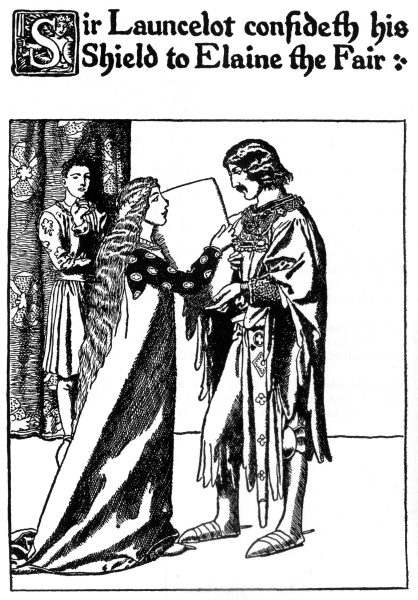
Then Sir Launcelot turned him to the Lady Elaine and said, "Lady, see you this shield and this armor of mine?" And she said, "Yea, I see them."
Sir Launcelot said: "Lady, this shield is a very precious thing to me, for it and all mine armor was given to me by a very wonderful lady who is not of this world in which we mortals dwell. Since that time she gave mine armor to me I have sought ever and in all wise to use those defences as became a gentleman so that whatever mark of battle there should be upon them there should be no mark of dishonor to mar their brightness. Now I beseech you for to take this shield and that armor to your maiden bower and to hold them there in trust for me and that as sacredly as though they were your very life." Therewith Sir Launcelot gave the Lady Elaine his shield and he said: "I charge you, Lady, for to let no one touch this shield or to meddle with it until I return hither to reclaim it and mine armor of you." And the Lady Elaine said: "It shall be as you say, and I shall hold this shield and this armor as sacred as my life."
Sir Launcelot and Sir Lavaine depart for Astolat.
So these matters were all brought to settlement and the next day Sir Launcelot in the armor of Sir Tyre, and Sir Lavaine in his own armor, rode out from the castle of that Earl and away from that place and so betook their way toward Astolat.
Now it chanced that same day that two very worthy knights of King Arthur's court were upon that road on which Sir Launcelot and Sir Lavaine travelled to Astolat, and these two knights were Sir Gawaine and Sir Mador de la Porte. With these were several lords who paid homage and respect to them, and all that party stood beneath the shade of several trees nigh to a water-mill where it was very cool and pleasant. And some of those who were there sat upon their horses, and some had dismounted therefrom and were lying in the cool and pleasant grass beneath the shade.
Then Sir Gawaine perceived where Sir Launcelot and Sir Lavaine came riding and he said to those who were with him: "Behold yonder two knights coming hitherward. Now I am of a mind that Sir Mador de la Porte and I shall try a fall with them, so stand ye by and see what happeneth."
Sir Gawaine and Sir Mador bespeak Sir Launcelot and Sir Lavaine.
So Sir Gawaine and Sir Mador took horse and rode a little forward and met the two and saluted them very courteously, and Sir Launcelot and Sir Lavaine saluted those others in like manner. Then Sir Gawaine said: "Messires, I pray ye tell me who ye are and whither ye go upon this pass."
Now Sir Launcelot knew very well who those two knights were because of the devices upon their shields. Wherefore he changed his voice a little when he answered Sir Gawaine so that Sir Gawaine should not know him. And he said: "Messire, I know not by what right ye demand such knowledge of us, nevertheless I may tell you that I am called le Chevalier Malfait, and this, my comrade, is hight Sir Lavaine of Corbin. As for our journey and its purpose, I may furthermore tell you that we intend, God willing, to enter the tournament at Astolat to-morrow, in which friendly battle you also, doubtless, intend to take a part."
Then Sir Gawaine said: "Tell me, Sir Knight Malfait, will you and your companion try a fall with me and my companions-in-arms?"
Now Sir Launcelot had no very great relish for such an encounter as that for he feared by some hap he should betray himself who he was. Yet he wist that he must accept the challenge of Sir Gawaine, wherefore after a little while of silence he said: "Sir Knight, we two would fain go our way in peace, but an it cannot be otherwise we must needs accept your challenge. But will you not let be and suffer us to pass onward?"
"Well," said Sir Gawaine, "this is a strange thing that you should pretend to aspire to that tournament of to-morrow and yet have no heart to meet in friendly tilt two knights whom you encounter upon the way."
"Sir," quoth Sir Launcelot, "we fear you not in any wise, wherefore, make yourselves ready in God's name, and we upon our side will do our endeavor."
The four knights run a tilt.
Sir Gawaine is overthrown.
So Sir Gawaine and Sir Mador de la Porte made themselves ready as Sir Launcelot had advised, and when they were in all ways prepared they withdrew to a little distance so as to have a good course to run. Then when all were ready for that encounter, each knight shouted and set spurs to his horse, and all four thundered together with such violence that the ground trembled beneath them. So they met in the middle of the course and so furious was the meeting of those four good knights that you might have heard the roar of that encounter for half a mile away or more. In that encounter both Sir Lavaine and Sir Mador broke each his spear upon his enemy and neither of them suffered a fall. But Sir Gawaine had no such fortune for his spear broke into splinters unto the very truncheon thereof, and the spear of Sir Launcelot held, so that Sir Gawaine was lifted out from his saddle and flung upon the ground with such violence that he rolled thrice or four times over and over before he ceased to fall.
Now those who looked upon that encounter were well assured that Sir Gawaine would easily overthrow his opponent into the dust, for Sir Gawaine was held to be one of the very greatest knights in all of the world. Wherefore it was that when they beheld how violently he had been flung to earth by that unknown knight against whom he had tilted, they were astonished beyond all bounds of wonderment.
But Sir Mador de la Porte, when he beheld how Sir Gawaine lay there in the dust as though dead, voided his horse and ran to the fallen knight where he lay. And he raised the umbril of Sir Gawaine's helmet, and lo! the face of Sir Gawaine was like to the face of one who was dead. And at first Sir Mador thought that he was dead, but after a while Sir Gawaine sighed and then sighed again, and thereupon Sir Mador knew that he was not dead, but in a swoon from the violence of the fall. And Sir Mador rejoiced very greatly that no more ill had come of that encounter.
Then Sir Mador turned to Sir Launcelot, and cried out: "Sir Knight Malfait, go thy way in the fiend's name. For indeed thou art well named Malfait, seeing what an evil thing it is that thou hast done to this worshipful knight. For wit you that this is none other than Sir Gawaine, the nephew of King Arthur himself, whom you have overthrown; and had you slain him, as at first I believed you had, it would have been a very ill thing for you. Moreover, you are to know that this knight was to have been the leader of all those upon King Arthur's side in the battle to-morrow-day, but now God knows if he will be able to wear armor again for many days to come. Wherefore go thy way and trouble us no more."
Quoth Sir Launcelot: "Well, Sir Knight, this quarrel was altogether of your own seeking, and not of ours. Wherefore, if ill hath befallen this worshipful knight, it is of his own devising and not of mine."
But Sir Mador only cried out the more vehemently: "Go your way! Go your way, and leave us in peace!" And thereupon Sir Launcelot and Sir Lavaine drew their bridle reins and set heel to horse and rode away from that place, leaving Sir Mador and those others who were there to cherish Sir Gawaine and to revive him from his swoon as best they might.
Sir Bernard of Astolat followeth Sir Launcelot and Sir Lavaine.
Now there was among those knights who were with Sir Gawaine and Sir Mador a certain old and very worthy knight of Astolat, hight Sir Bernard, surnamed of Astolat. Seeing Sir Launcelot and Sir Lavaine departing in that wise, Sir Bernard hied him after them and when he had come up with them he saluted them, and said, "Messires, I pray ye tell me where it is ye lodge this night."
Sir Launcelot said: "Fair Sir, we know not where we lodge for we go to seek such lodging as we may find in Astolat."
Sir Bernard said: "You will find no lodging in Astolat this night, for all places are full. Now I pray ye that you will lodge with me, for I have a very good and comely house and I shall be greatly honored for to have you lodge with me. For I make my vow, Sir Knight Malfait, that never saw I such a buffet as that which you gave to Sir Gawaine anon. Nor do I believe that ever Sir Launcelot of the Lake himself could have done more doughtily than you did in that encounter. Wherefore, I think that you will win you great glory to-morrow-day, and that I shall have due worship if so be that ye two shall have lodged with me over this night."
Then Sir Launcelot laughed, and he said to Sir Bernard: "Well, Sir Knight, I give you gramercy for your courtesy, and so we will gladly take up our inn with you until the time of the tournament. Only this I demand, that we shall be privily lodged apart from any one else, for we wish it that we shall not be known until to-morrow and after this tournament shall have transpired."
"Messire," quoth Sir Bernard, "it shall all be as you desire."
So those three rode on their way together until they had come to Astolat and to the habitation of Sir Bernard of Astolat.
Sir Launcelot lodgeth with Sir Bernard.
King Arthur knoweth Sir Launcelot.
Now the habitation of Sir Bernard was a very fair house over against the castle of Astolat where King Arthur and his court had taken up their inn. And there was a high terraced garden belonging to the castle of Astolat, and the garden overlooked the garden of the house of Sir Bernard. That day it chanced that King Arthur was walking back and forth in that terraced garden where the air blew cool over the plats of flowers and grass. As the King so walked he chanced to look down over the edge of the terrace into the garden of Sir Bernard's house, and at that time Sir Launcelot was walking privily in the garden for to refresh himself, and no one was with him. At that time Sir Launcelot had laid aside his armor for the sake of coolness and was walking in light raiment and bareheaded to the air, wherefore it befell that King Arthur immediately knew him who he was.
Then the King was much astonished to see Sir Launcelot in that place, and he said to himself, "What does Sir Launcelot here?" And at first the King was of a mind to send word to Sir Launcelot, bidding him to come to where he was. But afterward he bethought him that mayhap Sir Launcelot would be displeased at being thus summoned to declare himself. For the King perceived that Sir Launcelot did not choose to be known to any one at that time. So King Arthur said to himself: "Well, let be! To-morrow, I dare say, Sir Launcelot will declare himself in such a wise as shall astonish a great many knights who shall do battle against him upon yonder meadow-of-battle. Wherefore, let him e'en declare himself in his own fashion."
Thus it was that King Arthur communed within himself. Wherefore he did not betray the presence of Sir Launcelot to anybody at that time, but kept that matter shut in his own bosom.
Nevertheless, when he had come again to where was his court, he said to the knights there assembled: "Messires, I have this day beheld a certain knight who hath come hither who will I believe play his play with the best of you all at the jousts to-morrow." The knights who were there said to the King: "We pray you, Lord, tell us who that knight is, so that we may pay him such regard as he is worthy of." "Nay," quoth King Arthur, "I will not tell you at this time who is that knight, but haply you will know to-morrow who he is."
Then one of the knights who was there said: "Mayhap that was the knight who overthrew Sir Gawaine this day in the highroad over against the town a little distance away. He calleth himself le Chevalier Malfait, and hath for his companion a youthful knight hight Sir Lavaine, the King's son of Corbin."
Then King Arthur laughed, and said, "Like enough that was he." And so the King departed into his lodging, leaving all those knights much wondering who that knight could be of whom the King spoke to them.
Thus it was that Sir Launcelot and Sir Lavaine came to Astolat, and now followeth the history of that famous bout at arms so far as it affected Sir Launcelot of the Lake and his companion-at-arms, Sir Lavaine of Corbin. For in that affair at arms, as you shall presently hear tell, Sir Lavaine gained him such great glory and renown that thereafter he was regarded as one of the great heroes of chivalry, and by and by received that crowning honor of becoming a knight-companion of the Round Table.

Chapter Fourth
How Sir Launcelot and Sir Lavaine fought in the tournament at Astolat. How Sir Launcelot was wounded in that affair, and how Sir Lavaine brought him unto a place of safety.
Of the lists at Astolat.
So it is true that in these days one may not hope ever to behold a sight like to the field-of-battle at Astolat upon Lady's Day Assumption, when that tournament proclaimed by King Arthur was about to be fought before the eyes of the King. For upon that morning—which was wonderfully bright and clear and warm—the entire green meadow was altogether covered over with a moving throng of people of all degrees—lords and ladies, knights and dames, esquires, burghers, yeomen and tradesfolk—all moving, each toward some stand from whence he might view the battle that was about to take place. And here were gay attires and bright colors and the fluttering of silk and the flash and sparkle of shining baubles, and because of the sheen and sparkle of all these the whole world appeared to be quick with life and motion.
Yet ever by little and little this confusion of many people pushing themselves hither and thither resolved itself to order as one by one that multitude took seat and brought itself to quietness. And so it came to pass at last that the field prepared for battle was cleared of all save a few who lingered and whom the guardians of the lists pushed back into their places.
The knights-contestant enter the field-of-battle.
Then, all being thus brought to order, the Marshal of the Tourney blew his trumpet, and straightway there entered upon this side of that wide meadow and upon that side thereof the two companies of knights who were to contend the one against the other.
Then, lo! how the sunlight flashed upon shining armor! How it catched the pens and bannerets so that they twinkled at tips of lances like to sparks of fire! How war-horses neighed for love of battle! How armor clashed and shield plates rang as those goodly companies of knights brought themselves by degrees into array for battle!
Upon the one end of the meadow there gathered the knights-champion who were of the party of King Arthur, and the chiefs of that party were the King of Scots and the King of Ireland, and with them were many knights of the Round Table, much renowned both in song and battle. And the number of knights of that company were two hundred and ten in all.
Of the two parties-contestant.
Upon the other end of the meadow of battle there assembled the party of those who were to withstand the party of King Arthur; and the chiefs of that company were the King of North Wales and the King of an Hundred Knights, and the King of Northumberland and Galahaut the High Prince. And though there were no knights of the Round Table in that company, yet there were many champions of very great renown and high credit in courts of chivalry. And the number of that party were two hundred thirty and two.
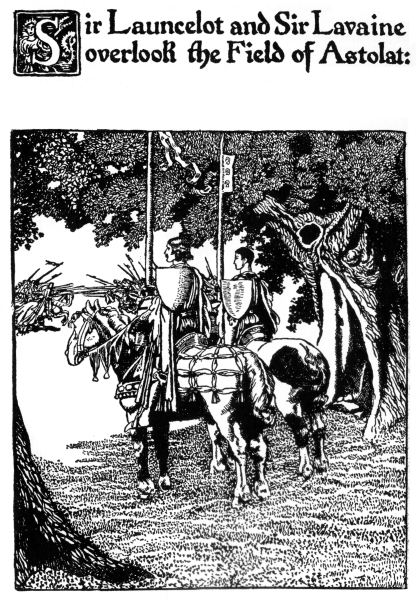
Sir Launcelot and Sir Lavaine overlook the field of Astolat.
Now near to a certain part of the field-of-battle the trees of the forest came down close to the meadow, and made, as it were, a green wall of foliage circumjacent to that part of the field. Here, beneath the shade of the green trees of the forest where it was cool and shady and very still, Sir Launcelot and Sir Lavaine had taken stand at a certain place whence they could look out upon those two parties of knights there gathered in battle array. And, that while, the eyes of Sir Lavaine shone like sparks of light and his cheeks were flaming red, like as though they were on fire, and his breath was thick and stifled when he breathed it. For this was the first great battle in which he had ever taken a part and he wist not what was to befall him in that affair at arms.
But that same while Sir Launcelot neither moved nor spake but sat his horse like to a statue made of iron; calm and steadfast and gazing very steadily out upon that plain before him.
Then Sir Lavaine spake in a voice wonderfully high and clear. "Messire," said he, "upon what side do you will that we take part in this battle?"
Quoth Sir Launcelot: "To neither party do I yet will that we shall join us. Rather let us wait a while and observe the issue of this battle, and when we behold that one side is about to lose in the battle then will we join with that side. For if so be we aid to bring victory out of defeat for that party, then shall our credit and our glory be magnified in that same degree." And Sir Lavaine said, "Sir, thou speakest with great wisdom."
Then, as those two watched in that wise, they beheld that three knights-champion came forth from one side and that three champions came forth from the other side and they wist that these six champions were to engage man to man and so to test the strength of this side and of that ere the two arrays should join in battle-royal. And Sir Launcelot knew these six champions very well and he declared to Sir Lavaine who they were. To wit, he declared that the champions upon King Arthur's side were the King of Scots and the King of Ireland and Sir Palamydes, and that the knights of the other party were the King of Northumberland, and the King of an Hundred Knights, and Galahaut the High Prince.
How the battle openeth.
Then, even as Sir Launcelot was telling Sir Lavaine who were these six champions who thus stood forth to undertake battle against one another, the herald blew his trumpet very loud and shrill. And therewith, in an instant of time, each knight had set spurs to his horse, and each horse leaped forward from his station and rushed forward, and so they came, three knights against three, like to thunderbolts launched against one another. So they met together in the midst of the course with a crash of splintering wood and a roar of armor that might easily have been heard a mile away. In that meeting Sir Palamydes and Sir Galahaut the High Prince smote down one another into the dust. And the King of an Hundred Knights smote down King Angus of Ireland with such terrible violence that he lay like dead upon the ground and had to be borne away out of the field by his esquires and could not again do battle that day. As to the King of Northumberland and the King of Scots, they broke each his lance upon the other without suffering a fall. So that first encounter was somewhat to the advantage of the party against King Arthur.
Of the grand assault at arms.
Then all who beheld that noble encounter of knight against knight shouted aloud in acclaim, and the shout of that vast acclaim was like the multitudinous roaring of a strong wind in the forest. Thereupon in the midst of all that roaring the herald blew his trump again and therewith the two parties contestant rushed the one upon the other, the earth shaking and trembling beneath that charge like to an earthquake. So in another moment they met together in such an uproar of iron and cracking of splintered wood that the ears of those who heard that meeting were stunned with the crash thereof. Then all the air was full of dust and splinters of wood and scraps and shreds of silk and of plumes. Anon, out of a thick red cloud of dust there arose the roar of a mighty battle; the shouts of men, the neighing of horses, the crash of blows and the groans of those who fell. At times, some knight would come forth out of the press reeling in the saddle and all red from some wound he had got. At other times, a party of esquires would run into that cloud, presently to come forth again bearing with them a wounded knight whom they had rescued. At other parts of the field there were knights armed with spears who ran tilt against one another, and ever and anon a knight would be flung from the saddle or else horse and knight would roll together upon the earth all in a smother of dust.
So for a while the battle was toward and yet no one could see how it went. For what with all that dust and the contending of single champions, no one could tell whether it inclined to this side or to that.
But after a while the dust lifted a little, and those who contended became fewer upon one side than upon the other and so stinted the fierceness of their battle.
Then it was that those who looked down upon that battle beheld that the party of King Arthur was pushing their opponents back, little by little, toward the barriers upon their side of the field (and if so be they were pushed altogether against that barrier then was their battle lost for good).
Then Sir Launcelot said to Sir Lavaine: "Behold yonder company of noble knights, how that they hold together and stand against their enemies in spite of that defeat which must certainly fall upon them in the end."
"I see it," said Sir Lavaine, "and have great pity for them."
"Hast thou so?" said Sir Launcelot. "Then let us take side with that side which is so sore bestead, for I believe that if you will help me a little we may well aid them and maybe stay the ill-fortune that seems like to overwhelm them."
"Sir," quoth Sir Lavaine, "spare not, and I upon my side will do the best that I am able for to help you."
Sir Launcelot and Sir Lavaine take part in the battle.
So with that Sir Launcelot and Sir Lavaine rode out from the forest wherein they had sheltered themselves, and they set their spears in rest and they drove forward to where those knights were doing combat. And they drove faster and faster forward until they drove full tilt into the thickest of the press.
The history of these things saith that in this charge and in other charges that he made in that onset, Sir Launcelot smote down Sir Brandiles, and Sir Sagramore, and Sir Dodinas, and Sir Kay, and Sir Griflet, and the history saith that he smote down all those good knights of the Round Table with one spear ere that spear burst asunder. And the same history saith that Sir Lavaine smote down Sir Lucian the botteler and Sir Bedivere with one spear in that charge and that then that spear also was burst into pieces. And the history saith that Sir Launcelot got him another spear and that Sir Lavaine did likewise and that thereafter they two charged again as they had done before. And it saith that in this second assault Sir Launcelot smote down Sir Agravaine, and Sir Gaheris and Sir Modred and Sir Melyot of Logres, and that Sir Lavaine smote down Sir Hozanna le Cure Hardy, and that after that those second spears were burst in assault as the first had been.
Then Sir Lavaine withdrew a little to get another spear, but by that time the madness of battle was upon Sir Launcelot so that he drew his sword and he ran into the thickest of the press and smote upon the right hand and the left hand with all his might and main so that in a wonderfully short pass he had smitten down Sir Safir and Sir Epynogris and Sir Galleron. And so terrible were the buffets he gave that all who were nigh to him drew away from him from fear of the terrible blows which he bestowed upon whomsoever came within his reach.
The Lady Elaine taketh joy in the battle.
By now all who looked upon that field were aware of how terrible a battle it was that the knight of the red sleeve fought against his enemies, wherefore they shouted aloud with a great voice of outcry and loud acclaim. And the Lady Elaine the Fair beheld how her champion did battle, and seeing him she could not contain the passion of her joy, but laughed and wept and trembled for that joy. And she catched King Pelles ever by the arm and cried out to him, "Lord! Lord! see what our champion doeth and what my brother doeth!" and King Pelles said, "I see! I see!" and held tight hold of the rail of the dais before him.
Then King Arthur where he sat said to those about him: "Behold yonder champion, what battle it is he doeth. Saw ye ever a better battle than that?" And they say, "Nay, never so great a battle!"
But when Sir Gawaine beheld the flame-colored sleeve that the champion wore about his helmet, he said to King Arthur, "Yonder knight is he who cast me down yesterday into the dust of the highway over against the town," and Sir Gawaine said, "because of that and because of the battle he now doeth, I would deem yonder knight to be none other than Sir Launcelot of the Lake. And yet it cannot be Sir Launcelot, for this knight weareth the sleeve of some lady as a favor upon his helmet, and all the world knoweth that Sir Launcelot would never wear the favor of any lady in such a wise as that."
Of the pause in battle.
Meantime the battle was stayed for a little while, for at that time it seemed as though neither horse nor man could do any more for that while. Yet though the battle was stayed, nevertheless each knight braced himself for a greater battle than that which had gone before. For all knew that now indeed the time had come when either one party or the other must win that battle. So in that pause of battle Sir Launcelot and Sir Lavaine each chose him a good strong new spear of ash wood, and each drank a cup of lusty spiced wine for to refresh his strength.
And, ere they began to battle afresh, Sir Bors de Ganis and Sir Ector de Maris and Sir Lionel upon the other side called together such kindred of their blood as were upon that field: to wit, Sir Blamor de Ganis, Sir Bleoberis and Sir Aliduke, Sir Galihadan, and Sir Bellanger—all these knights being of Sir Launcelot's kin. These say to one another: "If we do not overthrow yonder single knight who fights so wonderfully against us we shall certes lose this battle. For never knight fought so unless it was Sir Launcelot. For lo! he himself is the single bulwark against us in this battle."
So it was that these kinsmen of Sir Launcelot ordained it that they should join themselves together for to overthrow that knight by main strength if need be.
His kinsmen take battle against Sir Launcelot.
Sir Launcelot is wounded.
Then anon the battle was called again and anon each side hurled itself against the other side, well knowing that at this time it must be else to conquer or else to lose. And in that charge the kinsmen of Sir Launcelot hurled themselves against that knight of the red sleeve and against those who were by him. And Sir Bors and Sir Ector and Sir Lionel drave three at once at Sir Launcelot and he drave against them—one against three. But so heavy was the might of the assault of those three, that they overthrew the horse of Sir Launcelot by the weight of their three horses so that the horse of Sir Launcelot and Sir Launcelot himself were cast down upon the earth beneath the feet of the horses of those who charged against him. And in that charge the spear of Sir Bors smote Sir Launcelot in the side, and the point of the spear burst through the armor of Sir Launcelot and pierced deep into his side. Therewith the head of the spear brake from the truncheon and remained thrust deep into the side of Sir Launcelot, and Sir Launcelot groaned aloud, deeming that he had got his death wound.
So Sir Launcelot lay upon the ground and could not rise and he would maybe have been beaten to death beneath the feet of the horses. But Sir Lavaine beheld how it was with him, whereat he shouted aloud with a great voice and he and all that party rushed to the aid of Sir Launcelot. And Sir Lavaine smote down the King of Scots at one blow from out of his saddle. And he turned the horse of the King of Scots to where Sir Launcelot lay. And he stood above Sir Launcelot and defended him against the assault of all those others who were around about, and so, maugre their vehement assaults, he brought Sir Launcelot to horse again.
Then Sir Launcelot was clean wode because of the passion of agony he suffered from that grievous wound he had got. Wherefore he drew his sword and he stood up in his stirrups and he smote right and left like a madman. And he smote down one after the other Sir Lionel and Sir Bors de Ganis, and he smote Sir Bleoberis such a buffet that he fell down to the earth in a swoon as if he had been dead. And in that time Sir Lavaine smote down Sir Bellanger, and two other knights of worship and renown. Then Sir Launcelot turned him about and smote Sir Blamor down from off his horse and with that Sir Ector made at him. But Sir Launcelot was blind with his passion of battle and of pain, and he wist not who that was who came against him. Wherefore he turned upon Sir Ector and he smote him so dreadful terrible a buffet, that the head of Sir Ector hung down low upon the neck of his horse. Then Sir Launcelot catched Sir Ector and rushed off the helm from the head of Sir Ector with intent to slay him, for at that time he was so mad that he wist not where he was or what he did.
Sir Launcelot spareth Sir Ector.
Then he beheld the face of his brother Sir Ector, and he beheld that face all white and wan from the blow he himself had struck, and he beheld his brother's cheeks all white and streaked with blood, and therewith his senses returned to him, and in that instant he wist where he was and what he did. Thereupon he cried out in a great and terrible voice: "Woe! Woe! Woe is me! what is it that I do!" And therewith he rushed away from that place where Sir Ector was, and he rushed into the thickest of the press, striking right and left like a madman in fury.
And it stands recorded that all in all in that battle Sir Launcelot struck down thirty knights with his own hand, and that sixteen of those thirty were knights of the Round Table. And it is recorded that Sir Lavaine struck down fourteen knights and that six of those knights were knights of the Round Table. And it was because of Sir Launcelot and Sir Lavaine that their party prevailed in that battle. For, because beholding how they fought, their party took great heart and added strength to strength and so drave their enemies back across the meadow-of-battle until they were pushed back against the barriers of their side of the meadow and so the battle was won.
And thus that was achieved that else had been lost had not Sir Launcelot and Sir Lavaine lent their aid to that party with whom they joined in battle against the party of King Arthur.
But Sir Launcelot sat wounded nigh to death. Yea, he deemed that the sickness and the sweat of death was even then upon him, for an exceeding faintness overclouded his spirit. To him where he sat came the King of North Wales and the King of Northumberland and the King of an Hundred Knights and these say to him: "Sir, may God bless you, for without your aid, and that of your companion this day had certes been lost to us." And then they said: "Now we pray you that you will come with us to King Arthur so that you may receive at his hands the prize you have so worshipfully deserved." Thus they spake very cheerfully, for not one of those worthies knew that Sir Launcelot had been so sorely wounded in the battle he had fought.
Sir Launcelot would fain depart.
Then Sir Launcelot spake in a very weak voice, so that it sounded like to one speaking from a very great distance away. And he said: "Fair lords, if I have won credit in this I have paid a fair price for it, for I am sore hurt and wist not what to do. Now this I pray of you that you will suffer me to depart from this place, for I am in great pain and would fain go away from here to somewhere I may have aid and comforts."
Then those three kings would have had him go to a fair pavilion for to have his wound searched and dressed, but ever he besought them to suffer him to depart. So they suffered him, and he rode very slowly away from that place, and Sir Lavaine rode with him.
So it was that Sir Launcelot and Sir Lavaine did battle at that famous tournament at Astolat as I have told you.
And now if you would know how it fared with Sir Launcelot after he rode away from that place, wounded as aforesaid, you shall immediately hear of it in that which followeth.

Chapter Fifth
How Sir Launcelot escaped wounded into the forest, and how Sir Gawaine discovered to the court of King Pelles who was le Chevalier Malfait.
So Sir Launcelot and Sir Lavaine rode away from that field of battle. And they rode together into the forest, and all that while Sir Launcelot contained his suffering to himself so that Sir Lavaine wist not how grievous was his wound nor how great was the passion of agony that he then endured because of that hurt. But after they had ridden a mile or two or three into the woodland, Sir Launcelot could no longer thus contain himself, wherefore he let droop his head very low and he groaned with great dolor. Then Sir Lavaine was aware that some grievous hurt must have befallen Sir Launcelot. Wherefore he cried out: "Messire, I fear me ye are sore hurt. Now tell me, I beseech you, how is it with you?"
Sir Launcelot declareth his wound.
Then Sir Launcelot groaned again and he said: "Woe is me! I suffer much pain." And therewith he made to dismount from his horse and would have fallen had not Sir Lavaine catched him and upheld him. After that Sir Lavaine aided Sir Launcelot down from his horse, and Sir Launcelot leaned against a tree of the forest, groaning as from the bottom of his soul, and Sir Lavaine wist not what to do to help him. Then Sir Launcelot turned his eyes, all faint and dim, upon Sir Lavaine, and he said: "Oh, gentle knight, Sir Lavaine, for the mercy of God I beseech you to pluck forth the blade of a spear that has pierced into my side, for I suffer a great pang of torment."
Then Sir Lavaine was aware of what sort was that wound and he made haste to strip off the body armor from Sir Launcelot. So, when that body armor was thus removed, Sir Lavaine beheld a grievous wound where the blade of the spear had pierced deep into the side of Sir Launcelot a little above the midriff. And Sir Lavaine perceived that the blade of the spear was yet in the wound and that the hurt was very deep. So beholding that wound Sir Lavaine wept, and cried out: "Dear my Lord! Woe is me! I dare not pull out that blade; for an I do so, I dread me sore that you will die here in the forest ere aid can be brought to you and so it shall be I who killed you."
"No matter," said Sir Launcelot, speaking very faint and with failing breath. "Do as I bid you, for the point of that blade lieth near to my heart and I suffer a great deal of pain from it."
Sir Lavaine draweth for the steel.
Then Sir Lavaine laid hold of the shaft of the spear, and he strove to draw forth the blade from out Sir Launcelot's side, yet he could not do so. And thereupon Sir Launcelot cried aloud in a very piercing voice, "Spare not! Spare not! but pull forth that steel!" So with that Sir Lavaine plucked again with all his might and he drew the steel forth from out of the wound. And as the blade came forth from out of the flesh, Sir Launcelot cried out again in a voice very loud and shrill, saying, "God! God! that this should be!" And with that a great issue of blood gushed out of the wound like a crimson fountain and Sir Launcelot sank down upon the ground in a swoon that was like the swoon of death.
Then Sir Lavaine believed that he had assuredly slain Sir Launcelot, wherefore he wept aloud with a great passion of grief, smiting his hands together and crying, "Woe is me! For I have slain my dear lord!" Thereupon he kneeled down beside Sir Launcelot and fell to feeling his heart. And he perceived that the heart still beat but very faintly, and so he wist that Sir Launcelot was not dead but only in a deadly swoon.
So Sir Lavaine turned Sir Launcelot where that the wind blew upon him and after a while Sir Launcelot opened his eyes again. Then with his sight all swimming he beheld Sir Lavaine kneeling beside him weeping, and he said, speaking in a voice very weak and faint, "Lavaine, am I yet alive?" And Sir Lavaine said, "Yea, Lord." Sir Launcelot said, "Then bear me away from this place." And Sir Lavaine said, "Whither shall I take you?" Sir Launcelot said: "Listen, Friend, bear me away into the forest to the westward of here. For after a while to the westward of this place you shall find a forest path that runs across your way. And you shall take that path toward the right hand and so you will come after another while to the hut of an hermit of the forest. Bring me to that holy man; for if any one can cure me of this hurt he alone can do so." Sir Lavaine said: "Lord, how shall I take you such a journey as that, so that you shall not die?" Sir Launcelot replied: "I know not how you shall take me, but this I know: that if you take me not to that place I shall certes die here before your eyes in this forest."
Sir Lavaine beareth Sir Launcelot thence.
So Sir Lavaine, weeping, made a litter of straight young trees and he laid his cloak upon the litter and he bound the litter to the horses. Then he lifted Sir Launcelot and laid him upon the litter as though it were a little child whom he laid there. Thereafter he took the foremost horse by the bridle, and so, led away into the forest whither Sir Launcelot had bidden him to go.
So in that wise they travelled in the forest for a great while and by and by night descended and the full moon arose all white and shining into the sky. And it rose ever higher and higher and it shone down upon the forest woodlands so that here it was all bright and there it was all agloom with shadow; and anon Sir Lavaine, as he led the horses in that wise, would walk in that silver silent light and anon he would be lost in those shadows. And all that while Sir Launcelot lay so still that several times Sir Lavaine thought haply he was dead. Then he would say, "Sir, art thou dead?" And ever Sir Launcelot would answer, "Not yet."