PART II The Story of Sir Gareth of Orkney
Reading edition
And now followeth the history of Sir Gareth of Orkney, who came unknown to the court of his uncle, King Arthur; who was there treated with great indignity by Sir Kay the Seneschal; who was befriended by his brother, Sir Gawaine, and who afterward went errant with a damsel hight Lynette, meeting whilst with her several bel-adventures which shall hereinafter be duly told of.
So if you would know how it fared with that young knight, you must cease to consider the further adventures of Sir Launcelot at this place, and must now read of those other adventures of this youth, who was the youngest son of King Lot and Queen Margaise of Orkney. But after they are ended, then shall the further history of the adventures of Sir Launcelot be considered once more.
Chapter First
How Sir Gareth of Orkney came to the Castle of Kynkennedon where King Arthur was holding court, and how it fared with him at that place.
Of Gareth of Orkney.
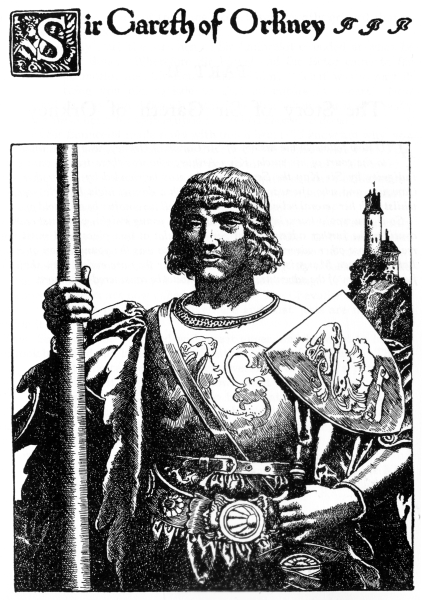
The youngest son of King Lot of Orkney and of his Queen, who was the Lady Margaise, sister of King Arthur, was a youth hight Gareth of Orkney. This young, noble, high-born prince was the most beautiful of all his royal race, for not only was he exceedingly tall and stalwart of frame—standing a full head bigger than the biggest of any at his father's court—and not only was he the strongest and the most agile and the most skilful at all knightly sports, and not only was he gentle in speech and exceedingly courteous in demeanor to all with whom he held discourse, but he was so beautiful of countenance that I do not believe that an angel of Paradise could be more fair to look upon than he. For his hair was bright and ruddy, shining like to pure gold, his cheeks were red and they and his chin were covered over with a soft and budding bloom of beard like to a dust of gold upon his face; his eyes were blue and shining and his neck and throat were round and white like to a pillar of alabaster.
How they of the court praise Gareth.
Now King Lot and Queen Margaise loved Gareth above any of their other children, and so it befell that all those who dwelt at the King's court took every occasion to praise young Gareth, both to his face and before the faces of the King and Queen, his father and mother. For these would sometimes say: "Lo! this youth sendeth forth such a glory of royal beauty and grace and dignity from him that even were he clad in fustian instead of cloth of gold yet would all the world know him to be of royal strain as plainly as though he were clothed in royal attire fitting for such a princely youth to wear. For, behold! the splendor of his royalty lieth in his spirit and not in his raiment, and so it is that it shineth forth from his countenance."
Queen Margaise bespeaketh Gareth.
Now it came to pass that when Gareth was twenty years of age, his mother, Queen Margaise, called him to her in her bower where she was with her maidens, and she bade him to sit down beside her and he did as she commanded, taking his place upon a couch spread with purple cloth embroidered with silver lions whereon the Queen was sitting at that time. Then Queen Margaise gazed long upon her beautiful son, and her heart yearned over him with pride and glory because of his strength and grace. And by and by she said: "My son, now that thou hast reached to the fulness of thy stature and girth and art come to the threshold of thy manhood, it is time for thee to win for thyself the glory of knighthood such as shall become thee, earning it by such deeds as shall be worthy of the royal race from which thou hast sprung. Accordingly, I would now have it that thou shouldst go to the court of my brother, King Arthur, and that thou shouldst there take thy stand with that noble and worthy companionship of the Champions of the Round Table, of whom thy brothers shine forth like bright planets in the midst of a galaxy of stars. So I would have it that thou shouldst go to the court of the great King, my brother, a week from to-day, and to that end I would have it that thou shouldst go in charge of three of the noblest lords of this court and in such a state of pomp and circumstance as may befit one who is, as thou art, the son of a royal father and mother and the nephew of that great King who is the overlord of this entire realm."
Gareth departeth for the court of King Arthur.
Thus spake Queen Margaise, and in accordance with that saying Gareth set forth a sennight from that time for the court of King Arthur. With him there rode three very noble haughty lords of the court as the Queen had ordained, and with these went esquires and attendants to the number of threescore ten and four. In the midst of that company young Gareth rode upon a cream white horse, and all the harness and furnishings of the horse upon which he rode were of gold, and the saddle upon which he sat was stamped with gold and riveted with rivets of gold, and Gareth himself was clad all in cloth of gold, so, what with all of these and his fair beautiful face in the bright sunlight (the day being wonderfully clear and fair) the royal youth appeared to shine with such a glistering splendor that it was as though a star of remarkable glory had fallen from the heavens and had found lodgment in his person upon the earth.
So it was that the young Gareth rode forth upon his way to the court of his uncle, the King.
That evening, he and his company rested for the night in a glade of the forest and there the attendants set up a pavilion of purple silk for him. Around about this pavilion were other pavilions for those three lords who accompanied him as his companions in the journey and for their esquires and attendants.
Now that night Gareth lodged alone in his pavilion saving only that his dwarf, Axatalese, lay within the tent nigh to the door thereof. And it came to pass that Gareth could not sleep that night but lay awake, looking into the darkness and thinking of many things. And he said to himself: "Why is it that I should go thus in state to the court of the King and in that wise to win his especial favor? Lo! It were better that I should go as any other youth of birth and breeding rather than in this royal estate. For, if I am worthy, as men say of me, then my worth shall be made manifest by my deeds and not because of the state in which I travel."
Thus Gareth communed within himself and he said: "I will go to the court of mine uncle the King as a simple traveller and not as a prince travelling in state."
So somewhat before the dawning of the day, he arose very softly and went to where the dwarf lay, and he touched Axatalese upon the shoulder, and he said, "Axatalese, awake." Thereupon the dwarf awoke and sat up and looked about him in the darkness of the dawning, bewildered by the sleep that still beclouded his brain.
Then Gareth said, still speaking in a whisper: "Listen to what I say, but make no noise lest you arouse those who lay around about us." And Axatalese said, "Lord, I listen, and I will be silent."
Then Gareth said: "Axatalese, arise and fetch me hither some garments of plain green cloth, and aid me to clothe myself in those garments. Then thou and I will go forward alone and without attendants to King Arthur's court. For so I would come before the King in that guise and not travelling in the estate of a prince who may claim his favor because of the chance of birth. For I would have it that whatsoever good fortune I win, that fortune should come to me by mine own endeavor, and not because of the accident of birth."
Then Axatalese was greatly troubled, and he said: "Lord, think well of what you do, for, lo! your mother, the Queen, hath provided this escort for you; wherefore, haply, she will be very angry if you should do as you say, and should depart from those whom she appointed to accompany you."
"No matter," quoth Gareth; "let that be as it may, but do you as I tell you and go you straightway, very quietly, and carry out my commands. And see to it that no one shall be disturbed in your going or coming, for it is my purpose that we two shall go privily away from this place and that no one shall be aware of our going."
Gareth escapeth from his companions.
So spake Gareth, and Axatalese was aware that his command must be obeyed. So the dwarf went very quietly to do Gareth's bidding, and anon he returned with the clothes of a certain one of the attendants, and the clothes were of plain green cloth, and Gareth clad himself in that simple raiment. Then he and the dwarf went forth from the pavilion and they went to where the horses were, and they chose two of the horses and saddled them and bridled them with saddles and harness and trappings of plain leather, such as the least of the attendants might use—and in all of that time no one of those in attendance upon Gareth was aware of what he had done. Then Gareth and the dwarf rode away from that place and still all the others slept, and they slept for a long while after.
And be it here said that when those three lords who were in charge of Gareth awoke and found that he and Axatalese were gone, they were filled with terror and dismay, for they wist not why he was gone nor whither, and they dreaded the anger of the Queen, Gareth's mother. Then the chief of those lords said: "Lo! here are we betrayed by this young prince and his dwarf. For he hath left us and taken himself away, we know not whither, and so we dare not return to the court of Orkney again. For should we return without him they will assuredly punish us for suffering him to depart, and that punishment may come even to the taking of our lives."
Then another of those lords said: "Messire, those words are very true, so let us not return unto the court of Orkney, but let us escape unto some other part of the realm where the wrath of the King and Queen may not reach us."
So it was as that lord said, for straightway they departed from that place and went to a part of the realm where neither the King and Queen of Orkney nor King Arthur might hear of them, and there they abode for that time and for some time afterward.
How King Arthur sat at feast.
Now at this time King Arthur was celebrating the Feast of Pentecost at the Castle of Kynkennedon. With him sat all the great lords of his court and all the Knights-companion of the Round Table who were not upon adventure in some other part of the realm. As they so sat at high feast, filling the hall with a great sound of merriment and good cheer, commingled with the chanting of minstrels and the music of harps and viols, there came one to where the King sat, and he said to him: "Lord, there is a fellow without who demandeth to have speech with you, face to face. Nor know we what to do in this case, for he will not be gainsaid, but ever maketh that demand aforesaid."
Then King Arthur said: "Hah! say you so? Now what manner of man is he? Is he a king or a duke or a high prince that he maketh such a demand as that?" "Lord," said the messenger, "he is none of these, but only a youth of twenty years, tall and very large of frame and beautiful of face, and very proud and haughty in bearing. And he is clad like to a yeoman in cloth of plain green, wherefore we know not what to think of that demand he maketh to have speech with you." King Arthur said, "What attendants hath he with him?" And the messenger said, "He hath no attendants of any kind, saving only a dwarf who followeth after him."
Quoth the King: "Well, at this Feast of Pentecost far be it from me to deny any man speech with me. So fetch this one hither that we may see what manner of man he is."
Gareth cometh before the King.
Therewith in obedience to the King's command, that attendant went forth and anon he returned, bringing Gareth and the dwarf Axatalese with him. And Gareth walked very proudly and haughtily up the hall and all who looked upon him marvelled at his height and his girth and at the beauty of his countenance. And many said: "Certes, that is a very noble-appearing man to be clad in such plain raiment of green, for, from his manner and his bearing, he would otherwise appear to be some nobleman's son, or some one of other high degree."
So Gareth walked up the length of the hall with all gazing upon him, and so he came and stood before the King and looked the King in the face, regarding him very steadfastly and without any fear or awe—and few there were who could so regard King Arthur.
Now Sir Kay the Seneschal stood behind the King's seat and when he beheld how young Gareth fronted the King, look for look, he was very wroth at the demeanor of that youth who stood thus before that royal majesty. So he spoke aloud before all those who sat there in hall, saying, to Gareth: "Sirrah, who are you who darest thus to stand with such assurance in the presence of the Great King? Wit you it is not for such as you to stand before such majesty, and have speech with it. Rather you should veil your face and hang your head in that awful presence."
Then Gareth looked at Sir Kay very calmly and he said, "Who are you who speak such words to me?" and all were amazed at the haughtiness of his tones and voice.
And King Arthur was also much astonished that a youth, clad thus like a yeoman, should thus speak to a great lord of the court such as Sir Kay. Wherefore the King wist not what to think of such a bearing. Then anon he said: "Fair youth, whence come you and who are you who speaketh thus so boldly to a great lord of our court and before our very face?" And Gareth said: "Lord, I am one who hath come hither from a great distance to crave two boons of you."
Quoth the King: "At this time, and at this Feast of Pentecost I may not refuse any one a boon who asketh it of me. So, if these two boons are fit for one of your condition to have, they shall be granted unto you."
Gareth asketh his boon.
Then Gareth said: "Lord, this is the first boon that I would ask of thee. I ask not for knighthood nor for courtly favor. All that I ask is that thou wilt permit me to dwell here at court for a year and that thou wilt provide me with lodging and with clothing and with meat and with drink for that time. Then at the end of a year, if I have proved myself patient to wait, I shall crave a second boon of thee."
Now many who were there heard what it was that strange youth asked as a boon, and that he besought not knighthood or honor at the King's hands, but bread and meat and drink and lodging, wherefore several of them laughed a great deal at the nature of that boon. As for the King, he smiled not, but he inclined his head very calmly and said: "Fair youth if that is all the boon thou hast to ask of us at this time, then thou shalt have thy will with all welcome." And he said: "Kay, see to it that this youth hath his desires in these things, and that he hath lodging and clothing and food and drink for an entire year from this time."
Then Sir Kay looked very scornfully upon Gareth and said: "It shall be as you will. As for thee, fellow, I will see to it that thou art fed until thou art as fat as any porker."
So spake Sir Kay, and when young Gareth heard the words his face flamed red with wrath and the veins stood out upon his forehead like cords. But he controlled his anger to calmness and anon he said: "Messire, you do but hear my words, knowing nothing of the purpose that lyeth within my mind. Wherefore then do you scorn me since you know naught of my purpose?"
Then Sir Kay looked upon the youth with anger and he said: "Sirrah, thou speaketh very saucily to those who are thy betters. Learn to bridle thy tongue or otherwise it may be very ill with thee."
So spake Sir Kay, but Gareth answered him not. Otherwise he turned to the King and bowed low, as though he had not heard the speech that Sir Kay had uttered.
Then he turned and went away from the King's presence with the dwarf Axatalese following close after him.
Sir Gawaine loveth Gareth.
Now Sir Gawaine sat not far distant from the King and so he had heard all that had passed. And he beheld the indignation of Gareth against Sir Kay, and the heart of Sir Gawaine went out very strongly toward this haughty and beautiful youth—albeit he wist not why it was that he felt love for him, nor that Gareth was his own brother. So it befell that after Gareth had departed from the King's presence in that wise, Sir Gawaine arose and followed after him; and when he had come up with Gareth he touched him upon the arm and said, "Come with me, fair youth." And Gareth did so. So after that Sir Gawaine led Gareth to another place, and when they were come thither he said to him: "Fair youth, I prythee tell me who you are and whence you come, and why it is that you asked such a boon as that from the King's Majesty."
Then Gareth looked upon Sir Gawaine and knowing that it was his brother whom he gazed upon he loved him a very great deal. Ne'theless he contained his love and said: "Messire, why ask you me that? See you not from the raiment I wear who I am and what is my degree? As for the boon which I asked, wit you that I asked it because I needed a roof to shelter me and meat and drink to sustain my life."
Then Sir Gawaine was astonished at the pride and haughtiness of the youth's reply, wherefore he said: "Fair youth, I know not what to think; yet I well believe it was not for the sake of the food and drink and lodging that thou didst so beseech that boon of the King, for methinks that thou art very different from what thou appearest to be. Now I find that my heart goeth out to thee with a very singular degree of love, wherefore I am of a mind to take thee into my favor and to have thee dwell near me at mine inn." And Gareth said to his brother, "Sir, thou art very good to me."
Sir Gawaine traineth Gareth in knightly skill.
So it was that after that time Sir Gawaine took Gareth into his favor and did many acts of kindness unto the youth. And so Gareth dwelt nigh to Sir Gawaine, and Sir Gawaine instructed him in the use of arms. And ever Sir Gawaine was astonished that the youth should learn so quickly and so well the arts of chivalry and of knighthood. For Sir Gawaine wist not that Gareth had been taught many of these things, and that others came easily to him by nature, because of the royal and knightly blood from which he had sprung.
Sir Kay scorneth Gareth.
And ever in the same measure that Sir Gawaine bestowed his favor upon Gareth, in that degree Sir Kay scorned him. So it came to pass that when Sir Kay would meet Gareth he would say to whomsoever was present at that time, some such words as these: "Lo! you! this is our kitchen knave who had no spirit to ask of the King's Majesty any higher boon than this, that he be allowed to sup fat broth in the kitchen." So Sir Kay ever called Gareth a kitchen knave, and so calling him he would maybe say, "Sirrah, get thee upon the other side of me, for the wind bloweth toward me and thou smellest vilely of the kitchen." And because Sir Kay perceived that the hands of Gareth were soft and very white he named the youth "Beaumains," saying, "Look you at this kitchen knave, how fat and white are his hands from dwelling in lazy idleness." So Gareth was known as "Beaumains" by all those who were of the King's court.
But when Sir Gawaine heard this talk of Sir Kay he remembered him of how Sir Percival had been one time scorned by Sir Kay in such a manner as this. And Sir Gawaine said: "Messire, let be, and torment not this youth, lest evil befall thee. Remember how thou didst hold Sir Percival in scorn when he was a youth, and how he struck thee such a buffet that he nigh broke thy neck."
Then Sir Kay looked very sourly upon Sir Gawaine, and said, "This Beaumains is not such as Sir Percival was when he was young." And Sir Gawaine laughed and said, "Nevertheless, be thou warned in season."
So it was that Gareth dwelt for a year at the King's court, eating the meat of idleness. And many laughed at him and made sport of him who would have paid him court and honor had they known who he was and what was his estate. Yet ever Gareth contained himself in patience, biding his time until it should have come, and making no complaint of the manner in which he was treated.
And now if you would hear how young Gareth won him honor and knighthood, I pray you read that which followeth, for therein are those things told of at some length.

Chapter Second
How Gareth set forth upon an adventure with a young damsel hight Lynette; how he fought with Sir Kay, and how Sir Launcelot made him a knight. Also in this it is told of several other happenings that befell Gareth, called Beaumains, at this time.
So passed a year as aforetold, and Gareth lodged with the household of King Arthur and had food and drink as much as he desired. And in all that time Gareth ate his food and drank his drink at a side table, for Sir Kay would not permit him to sit at the same table with the lords and knights and ladies of the King's court. For Sir Kay would say, "This kitchen knave shall not eat at table with gentle folk but at a side table by himself," and so Gareth fed at a table by himself. And ever Sir Kay called Gareth "Beaumains" in scornful jest and all the court called him "Beaumains" because Sir Kay did so.
King Arthur sitteth again at feast.
Now at the end of that year when the Feast of Pentecost had come again, King Arthur was holding his court at Caerleon-upon-Usk, and at the high Feast of Pentecost there sat, as usual at the King's table, the lords and the ladies of the court and all the Knights of the Round Table who were not upon adventure that took them elsewhither.
A damsel appeareth before the King.
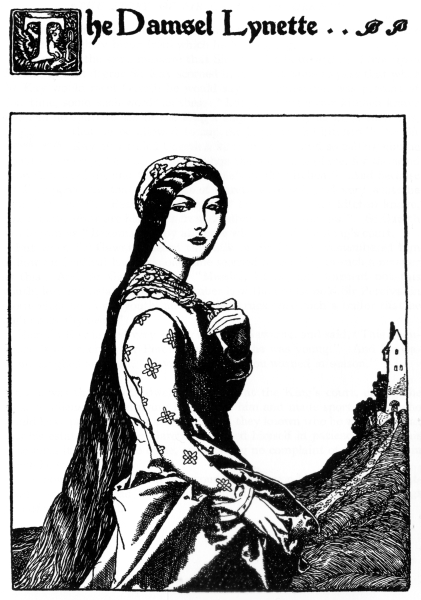
As they so sat eating and drinking there came into the hall a slender maiden of not more than sixteen years old. And the maiden was exceedingly beautiful, for her hair was as black as ebony and was like to threads of fine black silk for softness and brightness. And her eyes were as black as jet and very bright and shining, and her face was like ivory for clearness and whiteness and her lips were red like to coral for redness. She was clad all in flame-colored satin, embroidered with threads of gold and she wore a bright shining chaplet of gold about her brows so that what with her raiment of flame-color and with her embroidery and ornaments of shining gold, the maiden came up the hall like to a fiery vision of beauty, insomuch that all turned to behold her in passing, and many stood in their places that they might see her the better.
The damsel asketh for a champion.
Thus the damsel came up the hall until she had reached to that place where King Arthur sat at the head of the feast, and when she had come there she kneeled down and set her hands together as in prayer, palm to palm. And King Arthur looked upon her and was pleased with her beauty, and he said, "Damsel, what is it thou wouldst have of us?" The damsel said: "Lord, I would have the aid of some good worthy knight of thy court who should act as champion in behalf of my sister." And the King said, "What ails thy sister?"
Quoth the damsel: "Lord, my sister is tormented by a very evil disposed knight who maketh demand of her for wife. But my sister hateth this knight and will have naught to do with him, wherefore he sitteth ever before her castle and challengeth whomsoever cometh thitherward, and will not suffer any one to go in to the castle or come out thence without his permission. Now I come hither upon my sister's behalf to seek a champion who shall liberate her from this duress."
Then said the King, "Who is thy sister and who is this knight who tormenteth her?" To the which the damsel made reply: "I may not tell you my sister's name, for she is very proud and haughty, and is very much ashamed that she should be held in duress by that knight against her will. But as for the knight who tormenteth her, I may tell you that he is hight the Red Knight of the Red Lands."
Then King Arthur said: "I know not any such knight as that. Is there any one of you hereabouts who knoweth him?" And Sir Gawaine said: "Lord, I know him very well, for I met him one time in battle and it was such hard ado for me to hold mine own against him that even to this day I know not rightly whether he was better than I or whether I was better than he." Then King Arthur said: "Fair damsel, that must be a very strong and powerful knight, since Sir Gawaine speaketh of him in this wise. But touching this affair of thy sister, know you not that it is not likely that any knight of renown will be found to champion a lady of whose name or degree he knoweth naught? If thou wilt tell the name of thy sister and wilt declare her degree I doubt not there are many good worthy knights of this court any one of whom would gladly champion her cause."
So spake the King, but the damsel only shook her head and said, "Lord, I may not tell my sister's name, for I am forbidden to do so."
Then the King said: "That is a pity for I fear me thou wilt not easily find thee a champion in that case." And he said, "Damsel, what is thy name?" And she said, "Sir, it is Lynette." The King said, "That is a fair name and thou art very fair of face."
Then the King looked about him and he said: "Is there any knight in this court who will undertake this adventure in behalf of that fair lady, even though she will not declare her name and degree? If such there be, he hath my free will and consent for to do so."
So spake the King, but no one immediately answered, for no one cared to take up such a quarrel against so strong a knight, not knowing for whom it was that that quarrel was to be taken up.
Now he whom all called Beaumains was at that time sitting at his side table a little distance away, and he heard all that passed. Likewise he observed how that no one arose to assume that adventure and at that he was very indignant. For he said to himself: "This damsel is very fair, and the case of her sister is a very hard case, and I wonder that no good and well-approved knight will take that adventure upon him."
But still no one appeared to assume that quarrel of the unknown lady and so, at last, Beaumains himself arose from where he sat, and came forward before them all to where the King was and at that time the damsel was still kneeling before the King.
Gareth asketh his second boon.
Then the King beholding Beaumains standing there said, "Beaumains, what is it thou wouldst have?" and Beaumains said: "Lord, I have now dwelt in this court for a year from the time that I first came hither. That time when I first stood before thee I besought two boons of thee and one of them thou didst grant me and the other thou didst promise to grant me. According to that first boon, I had since that time had lodging beneath thy roof and food and drink from thy table, as much as ever I desired. But now hath come the time when I would fain ask that other boon of thee."
Then King Arthur wondered a very great deal, and he said, "Speak, Beaumains, and ask what thou wilt and the boon is thine."
"Lord," said Beaumains, "this is the boon I would ask. I beseech thee that thou wilt suffer me to assume this adventure upon behalf of that lady who will not tell her name."
Now when they of the court who sat near to the King heard what boon it was that the kitchen knave, Beaumains, besought of the King, a great deal of laughter arose upon all sides, for it seemed to all to be a very good jest that Beaumains should assume such an undertaking as that, which no knight of the court chose to undertake. Only King Arthur did not laugh. Otherwise he spake with great dignity saying: "Beaumains, methinks thou knowest not what boon it is thou hast asked. Ne'theless, be the peril thine. For since thou hast asked that boon, and since I have passed my promise, I cannot refrain from granting that which thou hast besought of me."
Then Sir Kay came forward and he spake to the damsel, saying, "Fair damsel, know you who this fellow is who asketh to be appointed champion for to defend your lady sister?" and Lynette said, "Nay, I know not; but I pray you tell me who he is."
"I will do so," quoth Sir Kay. "Wit you that this fellow is a kitchen knave who came hither a year ago and besought as a royal boon from the King that he should have meat and drink and lodging. Since then he hath been well fed every day at a table I have set aside for him. So he hath grown fat and proud and high of spirit and thinketh himself haply to be a champion worthy to undertake such an adventure as that which he hath besought leave to assume."
The damsel Lynette is angry.
So said Sir Kay, and when the damsel Lynette heard his words her face flamed all as red as fire and she turned to King Arthur and said: "My Lord King, what shame and indignity is this that you would put upon me and my sister? I came hither beseeching you for a champion to defend my sister against her oppressor and instead of a champion you give me a kitchen knave for that service."
"Lady," quoth King Arthur very calmly, "this Beaumains hath besought a boon of me and I have promised him that favor. Accordingly, I must needs fulfil my promise to him. But this I tell thee, that I believe him to be very different from what he appeareth to be; and I tell thee that if he faileth in this adventure which he hath assumed, then will I give thee another champion that shall haply be more to thy liking than he."
But Lynette was very exceedingly wroth and she would not be appeased by the King's words; yet she dared say no word of her indignation to the King's Majesty. Accordingly she turned and went away from that place very haughtily, looking neither to the one side nor to the other, but gazing straight before her as she went out from that hall.
Then after she was gone Sir Gawaine came and stood before the King and said: "Messire and Lord, I have faith that greater things shall come of this adventure than any one hereabouts supposeth it possible to happen. For Beaumains is no such kitchen knave as Sir Kay proclaimeth him to be, but something very different from that, as Sir Kay himself shall mayhap discover some day. For a year this Beaumains hath dwelt nigh me and I have seen him do much that ye know not of. Now I pray you, Lord, to suffer me to purvey him with armor fit for this undertaking and I believe he will some time bring honor both to you and to me—to you because you granted him this boon, to me because I provided him with armor." Then King Arthur said to Sir Gawaine, "Messire, let it be as you say."
Sir Gawaine armeth Beaumains.
So Sir Gawaine took Beaumains away with him to his own lodging-place and here he provided the youth with armor. And he provided him with a shield and a sword and a good stout spear. And he provided him with a fine horse, such as a knight who was to go errant might well care to ride upon. Then when Beaumains was provided in all this way, Sir Gawaine wished him God-speed and Beaumains took horse and departed after the maiden Lynette. And Axatalese the dwarf rode with Beaumains upon a gray mule, as his esquire.
Now by the time all this had been accomplished—to wit, the arming and horsing of Beaumains—Lynette had gone so far upon her way that Beaumains and Axatalese were compelled to ride for two leagues and more at a very fast pace ere they could overtake her.
Lynette scorneth Beaumains.
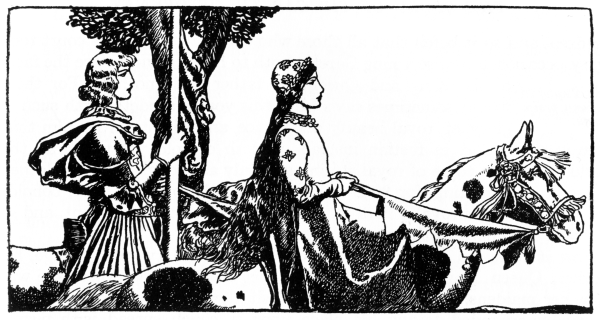
And when they did overtake her she was more angry than ever to behold that misshapen dwarf accompanying the kitchen knave who was her appointed champion. Wherefore when Beaumains had come nigh to her, she cried out, "Sirrah, art thou Beaumains, the kitchen knave?" And Gareth said, "Aye, I am he whom they call Beaumains." Then she cried out upon him, "Return thee whence thou hast come for I will have none of thee!"
To this angry address Beaumains replied, speaking very mildly and with great dignity: "Lady, the King hath appointed me to ride with you upon this adventure, wherefore, with you, I must now do as I have been commanded. For having embarked in this affair, I must needs give my service to you, even if you should order me to do otherwise." "Well," quoth she, "if you will not do as I bid you, then I tell you this; that I will straightway take a path that will lead you into such dangers as you have no thought of, and from which you will be not at all likely to escape with your life."
To this Beaumains replied, speaking still very calmly and with great courtesy: "Lady, that shall be altogether as you ordain. And I venture to say to you that no matter into what dangers you may bring me, still I have great hope that I shall bring you out thence with safety and so be of service to you and your lady sister. Wherefore, whithersoever you lead, thither will I follow you."
Then Lynette was still more angry that Beaumains should be so calm and courteous to her who was so angry and uncourteous to him, wherefore she hardened her heart toward him and said: "Sirrah, since I cannot rid me of you, I bid you ride upon the other side of the way, for methinks you smell very strongly of the kitchen in which you have dwelt."
To these words Beaumains bowed his head with great dignity and said, "Lady, it shall be as you command." And therewith he drew rein to the other side of the highway to that upon which she rode. Then Lynette laughed, and she said: "Ride a little farther behind me, for still methinks I smell the savor of the kitchen." And Beaumains did as she commanded and withdrew him still farther away from her.
Sir Kay followeth Beaumains.
Now some while after Beaumains had ridden after Lynette as aforetold, Sir Kay said to certain of those who were nigh him: "I am of a mind to ride after our kitchen knave and to have a fall of him, for it would be a very good thing to teach him such a lesson as he needs." So according to that saying, Sir Kay went to his inn and donned his armor. And he chose him a good stout spear and he took horse and rode away after Beaumains with intent to do as he had said. So he rode at a good pace and for a long time and by and by he beheld Lynette and Beaumains and the dwarf where they rode along the highway at some distance before him. Then Sir Kay called out in a great voice, saying: "Stay, Beaumains, turn thou thitherward. For I am come to overthrow thee and to take that damsel away from thee."
Then Lynette turned her head and beheld Sir Kay where he came, and with that she pointed and said: "Look, thou kitchen knave, yonder cometh a right knight in pursuit of thee. Now haply thou hadst best flee away ere harm befall thee."
But to this address Beaumains paid no heed, otherwise he turned about his horse and straightway put himself into array for defence. And as Sir Kay drew nigh, Beaumains beheld the device upon his shield and knew who was the knight who came thitherward and that it was Sir Kay who followed after him and called upon him to stay.
Then Beaumains remembered him of all the many affronts that Sir Kay had put upon him for all that year past and with that his anger grew very hot within him. And he said to himself: "This is well met; for now my time hath come. For either this is the day of satisfaction for me or else it is the day in which I shall lay my dead body down beside the highroad."
Meantime Sir Kay had come nigh, and finding that Beaumains had prepared himself, he also made himself straightway ready for battle. Then Lynette drew her palfrey to one side of the way and to a place whence she might behold all that befell.
Sir Kay doeth battle with Beaumains.
So when Beaumains and Sir Kay were in all ways prepared, each gave shout and drave forward very violently to the assault. And they met in the midst of that course and in that encounter the spear of Sir Kay held and the spear of Beaumains, because it was not very well directed, was broken into several pieces, so that he would have fallen only for the address of horsemanship that Sir Gawaine had taught him in the year that had passed.
But when Lynette beheld how that the spear of Beaumains was broken in that wise, and how that he was nearly cast out of the saddle in that encounter, she laughed very high and shrill. And she cried out in a loud voice: "Hah! thou kitchen knave, if thou showest not better address than that, thou wilt not be likely to succeed in this adventure that thou hast undertaken."
Now Beaumains heard the high laughter of Lynette and the words that she called out to him and with that he was more angry than ever. So therewith he ground his teeth together, and, casting aside the stump of his spear which he still held in his hand, he drew his sword and made at Sir Kay with all his might and main. And he put aside Sir Kay's defence with great violence, and having done so he rose up in his stirrups and lashed a blow at Sir Kay that fell upon his helm like to a bolt of lightning. For in that one blow Beaumains lashed forth all his rage and the indignation of a whole year of the scorn of Sir Kay. And he launched forth all the anger that he felt against the damsel Lynette who had also scorned him.
Beaumains smiteth down Sir Kay.
So fierce and terrible was that blow he struck that I misdoubt that any knight in all the world could have stood against it, far less could Sir Kay stand against it. For straightway upon receiving that stroke the senses of Sir Kay scattered all abroad and darkness fell roaring upon his sight and he fell down from off his horse and lay there upon the ground as though he was dead. Then Beaumains stood above him smiling very grimly. And he said, "Well, Sir Kay, how like you that blow from the hands of the kitchen knave?" but Sir Kay answered him not one word as you may suppose.
Therewith, having so spoken, Beaumains dismounted from his horse and he called the dwarf Axatalese to him and he said: "Axatalese, dismount from thy mule and tie it to yonder bush and take thou the horse of this knight and mount upon it instead." And Axatalese did as his master commanded. And Beaumains said to Sir Kay when he still lay in his swoon, "Sir Knight, I will borrow of you your spear, since I now have none of mine own," and therewith he took the spear of Sir Kay into his hand. And he took the shield of Sir Kay and hung it upon the pommel of the saddle of the horse of Sir Kay that he had given to Axatalese, and after that he mounted his own horse and rode away from that place, leaving Sir Kay lying where he was in the middle of the way.
And Lynette also rode away and ever Beaumains followed her in silence. So they rode for a while and then at last and by and by the damsel fell alaughing in great measure. And she turned her to Beaumains, and said, "Sirrah, thou kitchen knave, dost thou take pride to thyself?" and Beaumains said, "Nay, Lady." She said: "See that thou takest no pride, for thou didst but overcome that knight by the force of thy youth and strength, whilst he broke thy spear and wellnigh cast thee out of thy saddle because of his greater skill."
Then Beaumains bowed his head and said, "Lady, that may very well be." At that Lynette laughed again, and she said, "Sirrah, thou art forgetting thyself and thou ridest too near to me. Now I bid thee ride farther away so that I may not smell the savor of the kitchen," and Beaumains said, "As you command, so it shall be," and therewith he drew rein to a little greater distance.
And here it may be told of Sir Kay that some while after Beaumains had gone he bestirred himself and arose and looked about him, and for some while he knew not what had befallen him nor where he was. Then anon he remembered and he wist that he had suffered great shame and humiliation at the hands of Beaumains the kitchen knave. And he saw that in that encounter he had lost his shield and his spear and his horse and that naught was left for him to ride upon saving only that poor gray mule upon which the dwarf of Beaumains had been riding.
Sir Kay returneth to court, ashamed.
Then Sir Kay wist not what to do, but there was naught else left for him but to mount that mule and ride back again whence he had come. So he did and when he reached the King's court there was such laughing and jesting concerning his adventure that he scarce dared to lift his voice in speech or to raise his face in the court for a week from that time. But Sir Gawaine made no speech nor jest of the mishap that Sir Kay had suffered, only he smiled very grimly and said, "Sir, you would have done well to have hearkened to what I said to you," and Sir Kay, though at most times he had bitter speech enough and to spare, had naught whatever to say to Sir Gawaine in reply.
And now we turn again to Beaumains and Lynette as they rode onward upon their way as aforetold.
They behold a white knight.
For after that last speech of Lynette's, they went onward in silence, and ever Lynette looked this way and that as though she wist not that any such man as Beaumains was within the space of a league of that place. So travelling they came, toward the sloping of the afternoon, to a place nigh to the edge of a woodland where was a smooth and level space of grass surrounded on all sides but one by the trees of the forest. Here they beheld a knight who was just come out of the forest, and he was clad all in white armor and he rode upon a white horse. And the sun was shining so far aslant at that time that the light thereof was very red, like to pure gold. And the beams of the sun fell upon the skirts of the forest so that all the thick foliage of the woodland was entirely bathed in that golden light. And the same light flashed upon the polished armor of the knight and shone here and there very gloriously as though several stars of singular radiance had fallen from heaven and had catched upon that lonely knight-rider, who drew rein at their approach and so sat watching their coming.
Then Lynette turned to Beaumains and she said: "Sir kitchen knave, look you! yonder is a right knight with whom you may hardly hope to have ado. Now turn you about and get you gone while there is yet time, otherwise you may suffer harm at his hands."
To this Beaumains made no reply; otherwise, he rode forward very calmly and when he had come pretty nigh he bespoke that single knight in a loud clear voice, saying, "Sir Knight, I pray you do me battle."
At this address that knight aforesaid was very much astonished, and he said: "Sir, what offence have I done to you that you should claim battle of me in so curt a fashion? Gladly will I give you your will, but wit you not that all courtesy is due from one knight to another upon such an occasion?"
To this Beaumains made no reply, but turning his horse about he rode to a little distance and there made him ready for the encounter that was about to befall. For at that time his heart was so full of anger at the scorn of Lynette that he could not trust himself with speech, and indeed I verily believe that he knew not very well where he was or what he did.
Meantime the White Knight had also put himself into array for battle and when all was prepared they immediately launched the one against the other with such violence that the ground trembled and shook beneath their charge.
So they met with great crashing and uproar in the midst of the course and in that meeting the spear of Beaumains was broken into a great many pieces and he himself was cast out of his saddle and down to the ground with such violence that he was for a little while altogether stunned by the force of his fall.
Then Lynette laughed so high and so shrill that Beaumains heard her even in the midst of his swoon, and with that his spirit came back to him again and straightway he leaped up to his feet and drew his sword. And he cried out to the White Knight: "Sir Knight, come down from off thy horse and do battle with me afoot, for never will I be satisfied with this mischance that I have suffered."
Then the White Knight said: "Messire, how is this? I have no such cause of battle with you as that." But all the more Beaumains cried out with great vehemence, "Descend, Sir Knight, descend and fight me afoot."
"Well," quoth the White Knight, "since you will have it so, so it shall be."
Beaumains doeth battle with the White Knight.
Thereupon he voided his horse and drew his sword and straightway setting his shield before him, he came forward to the assault of Beaumains. Then immediately they met together, each lashing very fiercely at the other, and so that battle began. And so it continued, each foining and tracing this way and that like two wild bulls at battle, but ever lashing stroke upon stroke at one another. Soon the armor of each was stained in places with red, for each had suffered some wound or hurt at this place or at that. Yet ever Beaumains fought with might and main, for he was so strengthened by his passion of rage that rather would he have died than yield in that battle.
So they fought with astounding fierceness for a considerable while, and then, at last, the White Knight called out, "Sir, I pray you stay this battle for a little," and with that Beaumains ceased his lashing and stood leaning upon his sword, panting for breath.
And the White Champion also leaned upon his sword and panted, and anon he said, "Sir, I pray you tell me your name. For I make my vow to you that never have I met any knight who hath fought a greater battle than you have fought this day—and yet I may tell you that I have fought with a great many of the very best knights of this realm."
"Messire," quoth Beaumains, "I may not declare my name at this present, for there are several good reasons why I will not do so. But though I may not do as you demand of me, nevertheless I beseech you that you will extend that favor unto me and will declare to me your name and your degree."
"Well," said the White Knight, "never yet have I refused that courtesy to any one who hath asked it of me. Wit ye then that I am called Sir Launcelot of the Lake."
Beaumains knoweth Sir Launcelot.
Now when Beaumains heard this that the White Knight said and when he wist that it was none other than Sir Launcelot against whom he had been fighting for that while, he was filled with great wonder and astonishment and a sort of fear. So straightway he flung aside his sword and he kneeled down before Sir Launcelot and set his palms together. And he said: "Messire, what have I done, to do battle against you? Rather would I have done battle against mine own brother than against you. Know you that you are the man of all others whom I most revere and admire. Now I pray you, Messire, if I have done well in your sight in this battle which I have fought, that you grant me a boon that I have to ask of you and of no other man."
Quoth Sir Launcelot: "What boon is it thou wouldst have? Ask it and if it is meet that I grant it to thee, then assuredly it shall be thine. As for that battle which thou hast done, let me tell thee of a truth that I believe that I have never before met a stronger or a more worthy champion than thou art. So now I prithee ask thy boon that I may have the pleasure of granting it to thee."
Then Beaumains said: "Sir, it is this. Wit you that I am not yet made knight, but am no more than a bachelor at arms. So if you think that I am not unworthy of that honor, I pray you make me a knight at this present and with your own hand."
"Sir," said Sir Launcelot, "that may not be until I know thy name and of what degree and worthiness thou art. For it is not allowed for a knight to make a knight of another man until first he is well assured of that other's degree and estate, no matter what deed of arms that other may have done. But if thou wilt tell me thy name and thy degree, then I doubt not that I shall be rejoiced to make a knight of thee."
Unto this Beaumains said, "Sir, I will tell you my name and degree if so be I may whisper it in your ear." And Sir Launcelot said, "Tell it to me as you list and in such manner as may be pleasing to you." So Beaumains set his lips to Sir Launcelot's ear and he told him his name and his degree. And he told Sir Launcelot many things that had befallen him of late, and Sir Launcelot was astonished beyond measure at all that he heard. Then when Beaumains had told all these several things, Sir Launcelot said: "Messire, I wonder no more that you should have done so great battle as you did against me, seeing what blood you have in your veins and of what royal race you are sprung. Gladly will I make you knight, for I believe in time you will surpass even your own brothers in glory of knighthood, wherefore I shall have great credit in having made you a knight."
Sir Launcelot maketh Sir Gareth a knight.
Therewith Sir Launcelot took his sword in his hand, and Beaumains kneeled. And Sir Launcelot laid the blade thereof upon the shoulder of Beaumains and so made him knight by accolade. And he said, "Rise, Sir Gareth!" and Sir Gareth arose and stood upon his feet, and his heart was so expanded with joy that it appeared to him that he had the strength of ten men rather than one man in his single body.
Now the damsel Lynette had been observing all this from afar, and from that distance she could hear naught of what one champion said to the other, and she beheld what they did with very great wonderment and perplexity. Anon came Sir Launcelot and Sir Gareth to where she was, and when they were come near she said to Sir Launcelot, "Know you, Messire, who is this with whom you walk?" And Sir Launcelot said, "Yea, damsel, methinks I should know him." Lynette said: "I believe that you do not know him, for I am well assured that he is a kitchen knave of King Arthur's court. He hath followed me hither against my will, clad in armor which I believe he hath no entitlement to wear, and I cannot drive him from me."
Then Sir Launcelot laughed and he said: "Damsel, you know not what you say. Peace! Be still, or else you will bring shame upon yourself."
Then Lynette regarded Sir Launcelot for a while very seriously and anon she said, "Messire, I pray you tell me who you are who take me thus to task." And at that Sir Launcelot laughed again and said: "Damsel, I will not tell you my name, but mayhap if you ask my name of this worthy gentleman who is with you, he will tell you what it is."
Sir Launcelot leaveth Sir Gareth.
Then Sir Launcelot turned him to Sir Gareth and he said: "Friend, here I must leave you, for I have business that taketh me in another direction. So God save you and fare you well until we shall meet again. And if you will keep upon yonder path and follow it, it will bring you by and by to a fair priory of the forest, and there you and your damsel may have lodging for the night."
Thereupon Sir Launcelot bowed in courtesy both to Sir Gareth and to the damsel Lynette and so took his departure, wending his way whither he was minded to go and so in a little was lost to sight.
Then Lynette and Sir Gareth and the dwarf also went their way, taking that path that led to the priory of which Sir Launcelot had spoken; and there they found lodgment for the night—the damsel at one place, Sir Gareth at another.
And now if you would hear more concerning Sir Gareth and Lynette and of what befell them, I pray you read further, for these things shall there be duly set forth for your entertainment.

Chapter Third
How Sir Gareth and Lynette travelled farther upon their way; how Sir Gareth won the pass of the river against two strong knights, and how he overcame the Black Knight of the Black Lands. Also how he saved a good worthy knight from six thieves who held him in duress.
Now when the next morning had come, all bright and dewy and very clear like to crystal, Lynette arose and departed from that forest priory where she had lodged over-night, giving no news to Sir Gareth of her going. And at that time the birds were singing everywhere with might and main. Everywhere the May was abloom, the apple orchards were fragrant with blossoms, and field and meadow-land were spread thick with a variegated carpet of pretty wild flowers of divers colors, very fair to see.
So Lynette rode alone, all through the dewy morn, amid these fair meadow-lands and orchards belonging to the priory, making her way toward the dark and shady belt of forest that surrounded those smooth and verdant fields upon all sides. And ever she gazed behind her very slyly, but beheld no one immediately following after her.
For it was some while ere Sir Gareth arose from his couch to find the damsel gone. And when he did arise he was vexed beyond measure that she had departed. So he donned his armor in all haste and as soon as might be he followed hard after her, galloping his horse very violently through those fair and blooming meadows aforesaid, with the dwarf Axatalese following fast after him upon Sir Kay's war-horse.
Sir Gareth followeth Lynette again.
So Sir Gareth made all speed, and by and by he perceived the damsel where she was, and at that time she was just entering into the forest shades. So he drove forward still more rapidly and anon he came up with her and thereupon he saluted and said, "Save you, Lady!" Upon that salutation Lynette looked about, as though in surprise, and said, "Hah, thou kitchen knave, art thou there?" And Sir Gareth said, "Yea, Lady." And Lynette said: "Methought thou hadst enough of adventure yestereve when that same White Knight rolled thee down into the dust and beat thee in a fair fight afterward." Sir Gareth said, "Lady, thou speakest bitter words to me!" and Lynette laughed, and she said: "Well, Sir Knave, it seems that I cannot speak words that are so bitter as to prevent thee from following after me for I see that I am not to be free from thee in spite of my will to that end." And then she said: "Now I bid thee to ride a little farther away from me, for even yet thou savorest very strongly of the kitchen, and the savor thereof spoileth the fair savor of the morning."
So spake Lynette, and thereupon Sir Gareth drew rein a little farther, and so followed after her some distance away as he had done the day before.
Lynette telleth Sir Gareth of the robber knights.
After that they went a considerable ways in silence, and then by and by Lynette turned her head toward Sir Gareth and spake, saying: "Sirrah, knowest thou whither this path upon which we travel will lead us?" And Sir Gareth said, "Nay, Lady, I know not." "Alas for thee," quoth Lynette, "for I am to tell thee that this path leadeth toward a certain ford of a river, which same ford is guarded by two strong and powerful knights who are brothers. Of these two knights I heard yesternight at the priory that they are very savage robbers, and that, of those who would pass the ford of the river, some they slay and others they rob or else make captive for the sake of ransom. Now I am making my way toward that place where are these two knights in the belief that they may rid me of thee. So be thou advised whilst there is yet time; withdraw thee from this adventure and return whither thou hast come, or else, mayhap, a very great deal of harm may befall thee."
"Lady," quoth Sir Gareth, "were there twenty knights instead of two at that ford and were each of those twenty ten times as strong as either of the two are likely to be, yet would I follow after thee to the end of this adventure. Mayhap it may be my good fortune to rid the world of these two evil knights."
Then Lynette lifted up her eyes toward Heaven. "Alas," quoth she, "I see that never will I be rid of this kitchen knave until all the pride is beaten out of his body." And after that they rode their way without saying anything more at that time.
Anon, and when the sun had risen pretty high toward the middle of the morning, they came out of the forest and into a fair open plain of considerable extent. Here Sir Gareth perceived that there was a smooth wide river that flowed down through the midst of the plain. And he perceived that the road ran toward the river and crossed it by a shallow gravelly ford. And he perceived that upon the other side of the river was a tall, grim, and very forbidding castle that stood on high and overlooked the ford, and so he wist that this must be the ford guarded by those two knights of whom Lynette had spoken.
So as they drew nearer to the ford, Sir Gareth beheld a pillar of stone beside the way, and he saw that a great bugle horn of brass was chained fast to this pillar. Then Lynette pointed to the bugle horn and she said: "Sir Kitchen Knave, seest thou yon bugle horn? Thou had best not blow upon that horn for if thou dost thou will arouse those two knights who guard this ford and they will come forth from the castle and it will certes fare very ill with thee."
Sir Gareth challengeth the robber knights.
Then Sir Gareth said, "Say you so, Lady?" Therewith he went straight to where the horn hung by its chain, and he seized it in both hands and blew upon it so violently that it was as though the brazen horn would be burst with his blowing. For the sound thereof flew far and wide, and came echoing back from the distant walls of the castle as though the trump of doom had been sounded in those parts.
Therewith, and after a little while, the portcullis of the castle was uplifted and the drawbridge let fall and there issued forth two knights very large and stout of frame and very forbidding of appearance. These two knights rode down toward the ford and when they had come nigh to it he who was the bigger of the two drave down to the edge of the water and called across to Sir Gareth, "Who are you who dareth to blow so loudly upon our bugle horn?" And to him Sir Gareth replied: "Sir, I blew upon that horn to let you know that I was here and that I come with intent to rid the world of you, if so be God shall be with me in mine endeavor."
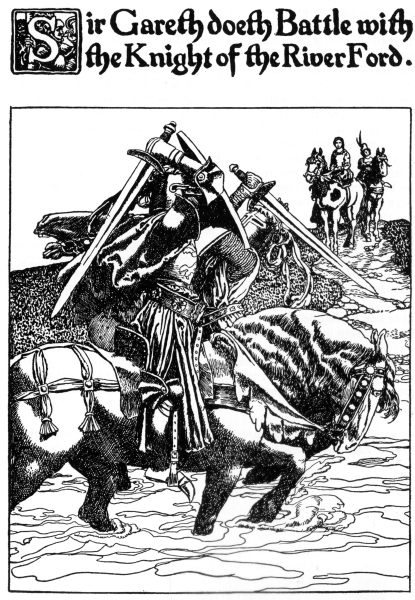
At that the knight upon the other bank was so enraged that he cast aside his spear and drew his sword and drave straightway into the waters of the ford, splashing with a noise like to thunder. And Sir Gareth also cast aside his spear and drew his sword and drave into the ford with great violence.
Sir Gareth overthroweth the knight of the ford.
So they met in the midst of the river and the knight of the ford lashed at Sir Gareth a most terrible and vehement blow, which stroke Sir Gareth put aside with great skill so that it harmed him not. Then Sir Gareth upon his part lifted himself on high and lashed at the knight so woful and terrible a blow that his horse tottered under the stroke and the knight himself catched at the pommel of his saddle to save himself from falling. Then Sir Gareth lashed at him another stroke and with that the knight swooned away into darkness and fell out of his saddle and into the water. And the river where he fell was very deep so that when he sank beneath the water he did not rise again, although Sir Gareth waited some while for him to do so.
Sir Gareth overthroweth the second knight.
Then Sir Gareth, perceiving how that he had finished this enemy, drave his horse very violently across the ford, and to the farther bank, and the knight who was there upon that side of the river drave down against Sir Gareth with his spear in rest with intent to thrust him through the body. But Sir Gareth was aware of his coming and so when the knight of the river was immediately upon him, he put aside the point of the spear with his shield with great skill and address. Then he rode up the length of the spear and when he had come nigh enough he rose up in his stirrup and lashed at the knight of the river so dreadful deadly a blow that nor shield nor helm could withstand that stroke. For the sword of Sir Gareth clave through the shield of the knight, and it clave through the helm and deep into his brain-pan. And with that the knight of the river fell headlong from his saddle and lay upon the ground without life or motion wherewith to rise again. Then Sir Gareth leaped very nimbly out of his saddle and ran to him to finish the work that he had begun. And Sir Gareth plucked away the helm of the knight and looked into his face and therewith beheld that his work was very well done, for already that fallen knight was in the act of yielding up the ghost.
Then Sir Gareth wiped his sword and drave it back again into its sheath; and he remounted his horse and rode very quietly back to where the damsel waited for him upon the farther bank. And the damsel looked at Sir Gareth very strangely but Sir Gareth regarded her not at all.
So Sir Gareth brought Lynette safely across the ford and afterward they rode on their way as they had aforetime done—the damsel in the lead and Sir Gareth and Axatalese following after at a distance.
Lynette mocketh at Sir Gareth.
So after they had ridden a long while the damsel turned her about in the saddle and looked at Sir Gareth and she said, "Hah, Beaumains, dost thou take pride in what thou hast done?" And Sir Gareth said, "Nay, Lady; God forbid that I should take pride in any such thing as that." Quoth Lynette: "I am glad that thou dost not take pride in it; for I beheld thy battle from afar and I saw how fortune favored thee. For the first of those two knights, his horse stumbled in the river and so he fell into the water and was drowned; and thou didst strike the second knight with thy sword ere he was well prepared for his defence and so thou wert able to slay him."
"Lady," quoth Sir Gareth very calmly, "that which thou sayest doth not in anywise change the circumstances of what I did. For now my work is done and so I leave it to God His mercy to judge whether I did that thing well or whether I did it ill." "Hah," said Lynette, "meseemeth you speak very saucily for a kitchen knave." And Sir Gareth said, still speaking very calmly, "Think you so, Lady?" And Lynette said, "Yea," and she said, "I see that thou still ever forgettest my commands, for thou art riding so nigh to me that methinks I smell the kitchen. Now I prythee draw a little farther away." And Sir Gareth said, "Damsel, it shall be as you command." And therewith he drew rein so as to ride at a little greater distance, and Lynette laughed to see him do so.
Now some little while about the prime of the day they came to a certain grassy place of considerable extent, and at that place was a black hawthorn bush, very aged and gnarled and full of thorns that stood alone beside the highroad, and as they drew nigh to it they perceived that there was hung upon the thorn bush a great black shield bearing the device of the red gryphon, and they saw that a great black spear, bearing a black pennon with the device of a red gryphon leaned beside the shield. And they beheld that near by the bush was a noble black horse with trappings and housings all of black, and the horse cropped the grass that grew at that place.
They behold the black knight at his meal.
All this they beheld, and as they came still nearer they perceived that upon the other side of the hawthorn bush there was a knight clad all in black armor, and they saw that the knight sat beside a great flat stone and ate his midday meal that lay spread out upon the stone. And the knight was unaware of their coming but ever ate with great appetite of the food that was spread before him.
Then Lynette drew rein while they were yet at some distance and she laughed and pointed toward the hawthorn bush, behind which sat the knight, and she said: "Sir Kitchen Knave, look you yonder and behold that knight. Seest thou the device upon his shield? I know that device very well and so I may tell thee that that knight is hight Sir Perard and that he is brother of Sir Percevant of Hind, and that he is a very strong, worthy, noble knight and one of great renown in deeds of arms. This is a very different sort of knight from those thou didst overcome at the ford of the river, wherefore be thou advised by me and turn thee about and get thee gone ere yonder knight seest thee, or else harm will certainly befall thee."
Quoth Sir Gareth: "Damsel, having followed you so far and through several dangers it is not very likely that I shall turn back at this, even if there be as much peril in it as you say."
"Very well," said Lynette, "then if ill befall thee thou art to blame thyself therefor and not blame me." Therewith speaking, she tightened the rein of her palfrey and so rode forward toward that hawthorn bush aforesaid.
Now when they had come a little more close to that place, the Black Knight, Sir Perard, was aware of their coming and looked up and beheld them. Then, seeing that it was an armed knight and a damsel that were coming thitherward, Sir Perard arose very slowly and with great dignity and set his helm upon his head, and so he made him ready for whatsoever might befall. Then when he had so prepared himself he came out into the road for to meet them. Then when Sir Gareth and the damsel were come pretty nigh, Sir Perard bespake Sir Gareth, saying: "Sir Knight, I pray you of your courtesy for to tell me who you are and whither you go?"
Quoth Sir Gareth: "I may not tell you who I am, but ask you this damsel and she will tell you."
Then Sir Perard was greatly surprised at that reply and he said, "Is this a jest?" And he said: "Damsel, since I am directed to you, I pray of you tell to me the name and the degree of this knight."
Upon this Lynette fell alaughing in great measure and she said: "Messire, since you ask me that thing, I have to tell you that this fellow is a certain kitchen knave, hight Beaumains, who hath followed me hither from the court of King Arthur, and I have to tell you further that many times I have bid him begone and leave me, but he will not do so, but continually followeth after me."
"Fair damsel," quoth the Black Knight, speaking with great dignity, "you are pleased to jest with me, for this is no kitchen knave I trow but a very good worshipful knight of whom you are pleased to say such things."
Then Sir Gareth spake very sternly, saying, "Messire, I will not have you or any man gainsay what this lady sayeth." And the Black Knight, still speaking with great dignity, said: "How may I do otherwise than gainsay her, seeing that you wear armor that is indented with the marks of battle? For who ever heard of a kitchen knave wearing such armor?" "Ne'theless," quoth Sir Gareth, "either you must acknowledge what this lady sayeth of me, or else you must do battle with me so that I may defend what she sayeth."
"Sir," said the Black Knight, "in that case I will do battle with you, for I cannot accept the saying of this lady."
Sir Gareth doeth battle with the Black Knight.
So therewith Sir Perard took down his shield from off the blackthorn bush and he took his spear into his hand and whistled his horse to him. And he mounted his horse and made him in all ways ready for battle. Meanwhile Sir Gareth waited very composedly and with great calmness of bearing until the other was in all wise prepared. Then Sir Perard said, "I am ready, Messire." And therewith each knight drew rein and withdrew to such a distance as was fitting for a course to an assault. Then when this was accomplished, each knight shouted to his steed and each charged forward against the other with a terrible speed and violence. So they met in the midst of the course with a crash that might have been heard for two furlongs. In that meeting the spear of each knight was broken into many pieces, even to the hand that held it, and the horse of each staggered back and would haply have fallen had not the knight rider brought him to foot again with shout and prick of spur and with great address of horsemanship. Then each knight voided his horse and each drew his sword and therewith rushed to an assault at arms. And each smote the other again and again and yet again, lashing such blows that it sounded as though several blacksmiths were smiting amain upon their anvils, and for a while neither knight had any advantage over the other, but each fought for that time a well-matched battle. Then of a sudden Lynette cried out very shrilly: "Sir Perard! Sir Perard! Noble, worthy knight! Wilt thou suffer a kitchen knave to have his will of thee?"
So she cried out very loud and shrill and Sir Gareth heard the words she uttered. Then a great anger came upon him so that he was uplifted by it, as though the strength of several had entered into his body. So straightway he redoubled his battle to twice what it had been before, giving stroke upon stroke, so that the Black Knight was forced to bear back before the fierceness and violence of his assault. Then Sir Gareth perceived that Sir Perard began to weary a very great deal in that fight and to bear his defences full low, and therewith he redoubled his blows and smote Sir Perard upon the helm so fiercely that his brains swam like water and his head hung low upon his breast.
Then, perceiving how that Sir Perard fainted, Sir Gareth ran to him and catched him by the helm and dragged him down upon his knees, and he rushed off the helm of Sir Perard, and catched him by the hair and dragged down his neck so that he might have slain him had he chosen to do so.
Then Sir Perard, perceiving how near death was to him, catched Sir Gareth about the knees, and cried out on high, "Messire, spare my life, for so thou hast it at thy mercy." Quoth Sir Gareth, "Sir Knight, I will not spare thy life unless this lady beseech it of me."
Then Lynette cried out: "Fie upon thee, thou saucy varlet! Who art thou that I should ask a favor of thee?"
Lynette asketh the life of the Black Knight.
Then Sir Perard cried out, "Fair Lady, I beseech thee that thou beg my life at the hands of this knight," and thereupon Lynette said: "Fie upon it that it must needs be so. But indeed I cannot suffer so worshipful a knight as thou art, Sir Perard, to be slain by the hand of a kitchen knave. So, Sirrah Beaumains, I bid thee stay thy hand and spare this knight his life."
Upon this speech, Sir Gareth released his hold upon Sir Perard and said, "Arise, Sir Knight, for I will spare thy life upon this lady's behest." And therewith Sir Perard arose and stood upon his feet. And Sir Perard said: "Sir, thou hast conquered me in fair battle and for that reason I have yielded me to thee. Now, I prythee tell me, hast thou any commands that thou wouldst lay upon me?" Quoth Sir Gareth: "Yea, Messire, I have a command to lay upon you and this is that command: It is that you straightway go to the court of King Arthur and pay your duty unto him. And you are to say unto King Arthur that Beaumains, the kitchen knave, hath sent you unto him. And I pray you give him news of me and tell him it fareth well with me." And Sir Perard said, "Messire, it shall be done according to your bidding." And Sir Gareth said, "See that it is so."
Now in all these things that Sir Gareth did and said he ever bore himself with such dignity and haughtiness that a knight of ten years' standing would not have acted with more dignity than he. And after he had settled those affairs in that wise, he turned to Lynette and addressed himself to her, saying, "Lady, if so be thou art now ready to depart I am ready to accompany thee," and with that the damsel took her departure and Sir Gareth and Axatalese followed after her. So they left that place of battle and soon after they had gone Sir Perard departed upon his way to the court of King Arthur as he had been commanded to do by Sir Gareth as aforesaid.
Now after Lynette and Sir Gareth had ridden some while in silence, Lynette turned her face and looked upon Sir Gareth. And she said, "Sir Kitchen Knave, I would I knew who thou really art." To the which Sir Gareth answered very calmly, "Thou hast declared several times who I am and that I am a kitchen knave from King Arthur's court." Then Lynette laughed and she said, "True, I had nigh forgot." And she said, "Ride not so near to me for still, I believe, thou savorest of the kitchen." And thereupon Sir Gareth withdrew to that same distance he had assumed before.
They behold one fleeing from the forest.
Now somewhile toward the approach of eventide, Sir Gareth and Lynette and Axatalese came away from that part of the country and to where the forest began again. And it befell that as they approached the forest they beheld of a sudden one who came spurring out of the woodlands riding upon a white horse, driving very furiously and at full speed. This rider when he was come nigh suddenly drew rein, and flinging himself from the saddle he ran to Sir Gareth and catched him by the stirrup, crying out: "Sir Knight! Sir Knight! I crave you of your worship that you will lend your aid in a case of woful need!" Then Sir Gareth beheld that this one who had come to him in this wise was an esquire, clad in green and yellow and that he was one of good appearance and of quality. And Sir Gareth said: "Fair Friend, I prythee tell me what service it is that thou wouldst have of me?"
"Sir," cried that esquire, "my master, who is a knight of these marches, is beset within the forest yonder by several thieves and I fear they will slay him unless help cometh to him in short order." Sir Gareth said, "Where is your master?" And the esquire said, "Follow me and I will bring you to him."
Sir Gareth driveth to rescue the wounded knight.
So the esquire mounted his horse again and drave away with all speed and Sir Gareth set spurs to his horse and also drave away at speed, and Lynette and the dwarf followed with speed after Sir Gareth. So anon they entered the forest and coursed therethrough for a little ways and then Sir Gareth perceived where at a short distance there was a knight set with his back against a tree defending himself against six great and brawny villains clad in full armor. And Sir Gareth beheld that there were three other villains who lay dead upon the ground, but that the knight was in a sorry case, bleeding from several wounds and very weary with his battle. Thereupon, beholding this, Sir Gareth drew his sword and cried out in a very loud voice: "Have at ye, villains! Have at ye!" and therewith drave into the midst of that contest. And the thieves were astonished at the violence of his coming so that they knew not what to do, for Sir Gareth drave into their midst without let or pause of any sort. And ere they recovered from their astonishment, Sir Gareth struck one of the villains to the earth at a single blow and then he smote down another. And a third would have defended himself, but Sir Gareth rose up in his stirrups and he smote him so full and terrible a buffet that he clave through his morion and through his head to the very teeth of his head.
Sir Gareth slayeth the thieves.
Then beholding that dreadful terrible blow that Sir Gareth had struck their companion, the other three villains were adread for their lives, and fled shrieking away into the forest. But Sir Gareth would not let them escape but charged after them with great fury. And the three thieves found that they could not escape, and that there was naught else for them to do but to turn and stand at bay and so they did. But Sir Gareth would not be stayed by this, but he drave straightway into their midst and struck upon this side and upon that, so that maugre their defence all three of those villains were presently stretched, all bathed in their blood, upon the ground. Then Sir Gareth rode back again, wiping his sword very calmly ere he put it back into its sheath.
So anon he came to where was that knight whom he had saved and at that time Lynette and Axatalese and the esquire were lending such aid to the wounded man as his case demanded.
But when that knight beheld Sir Gareth returning from his battle, he broke away from the others and came to Sir Gareth and embraced him about the knee and said, "Messire, you have certes saved my life." And he said: "I pray you tell me what great and worshipful knight you are who doeth such wonderful battle as I beheld. Never would I have supposed it possible that any single knight could have overthrown six armed men with such ease as I have beheld you do this day."
Lynette mocketh Sir Gareth.
Now Lynette was standing by at that time and her eyes were wonderfully bright and shining and she looked very strangely upon Sir Gareth. Then hearing what that knight said whom Sir Gareth had rescued she burst out laughing very shrilly and piercingly and she cried out, "Sir Knight, wit you who this is who hath saved your life?" The knight said, "Nay, damsel, I know not." She said: "Wit you then that this is a kitchen knave of King Arthur's court hight Beaumains, so hight because of the whiteness of his hands. He hath followed me hither against my will, and I cannot drive him from me."
Then that knight was very much astonished and he said: "Fair damsel, certes you jest with me, for indeed this is some very noble and well-approved knight of great worship. For no one but such a knight as that could have done such deeds of arms as I beheld this day."
Sir Gareth rebuketh the knight.
Now at that time Sir Gareth was very weary with the battles he had fought during the day, and his body was sore with several wounds that he had suffered, and his spirit was very greatly vexed with the scorn with which Lynette had ever treated him for all this while, wherefore he had but little patience to deal to any man. So straightway he turned him toward that knight and he spake very sternly to him, saying: "Messire, do you intend to gainsay that which this lady sayeth to you concerning me? Wit you that I will not suffer her word to be put in question in any wise. Wherefore, if she is pleased to say that I am a scullion lad, so for her sake you must believe it to be."
At this that knight was more astonished than before, and he wist not what to think. So anon he said: "Messire, certes I meant no offence to you, for how should I mean offence to one who hath done me such service as you have rendered to me this day?"
"Well," quoth Sir Gareth, "in this I am greatly offended that you should gainsay that which this lady is pleased to say. Wit you that for this while I am this lady's champion, and so I will suffer no one to gainsay her." So said Sir Gareth, and when he had ended that saying, Lynette laughed and laughed again with all her might and main. And she cried out, "Well said, thou kitchen knave!" unto the which speech Sir Gareth made no reply.
Then that knight said to Sir Gareth and to Lynette: "Messire, and thou, fair damsel, I know not what all this meaneth but haply you know. But I see, Sir Knight, that thou art wounded in several places, and I doubt not that you are both aweary with your travels, wherefore I pray you that you will come with me to my castle which is not a very great distance away from this, and I beseech you there to lodge and to refresh you for this night."
To this Lynette said: "That which thou sayest pleases me very greatly, Messire, for indeed I am aweary and would fain rest me a little. So let us go forward to your castle. But this Beaumains must ride not so close to us for indeed I cannot abide the odor of the kitchen."
So after that they all departed from that place, and ever Sir Gareth rode at a distance as the damsel had commanded him to do.
They come to the castle of the knight.
Now after they had gone a considerable way they came out of the forest and into a valley wherein stood the castle of that knight. And it was a very fair and noble castle and the valley was exceedingly fertile with many rich fields and meadows and with several plantations of trees, both of fruit trees and otherwise. Through this fruitful valley they came to the castle and they rode into the castle courtyard with a great noise of horses' hoofs upon the cobblestones, and at that coming many of the attendants of the castle came running for to take their horses and to serve them.
Then Lynette gazed about her and she said to the knight of the castle, "Messire, who are these?" He said: "Fair damsel, these are they who would take your horse and the horse of that noble knight your companion, and others are they who would wait upon you and upon him to serve you both." Then Lynette said: "Not so, Sir Knight, my horse they may take and me they may serve, but it is not meet that a kitchen knave such as Beaumains should be waited upon in that wise, wherefore I bid you to suffer him to wait upon himself."
Sir Gareth serveth himself.
Upon this speech Sir Gareth turned him to the knight of the castle and his face was very calm, albeit his eyes shone like sparks of fire and he said, speaking very haughtily: "Messire, whitherward is the stable? I pray you to tell me so that I may house my good horse and wait upon myself as this lady, whom I have undertaken to serve, hath commanded me to do." Then the knight of the castle was much troubled and knew not what to reply; yet anon he said, "Messire, I know not what to say in this case but an you ask me I must say the stable lieth yonderways."
So spake the knight, and thereupon Sir Gareth turned him without another word and rode away, still very calmly, leaving them alone.
So after that the knight and Lynette entered the castle. But the knight, when he was alone, called to him the steward of the castle and he said to him: "Go you and search out that noble and worthy knight, for assuredly he is some great and famous champion. See you that he is served in all wise that such an one should be served, and spare naught to comfort him and put him at his ease, for this day he hath certes saved my life." So the steward did as he was bidden and that evening Sir Gareth was served in all wise befitting for a knight royal such as he really was.
Now when the next day was come, and when it was time for Lynette and Sir Gareth and Axatalese the dwarf to depart from that place, the knight of the castle came to Sir Gareth where he sat upon his horse. And he laid his hand upon the stirrup of Sir Gareth and he said: "Messire, I pray you tell me, is there any service that I may do you that you would have of me?"
Sir Gareth biddeth the knight to do service.
Then Sir Gareth looked down upon that knight and he said: "Sir, there is a service you could render me an you chose to do so, and this is that service: it is that you should go to the court of King Arthur with all the estate that is befitting for one of your degree. And when you have come to the court I would fain have you tell King Arthur that Beaumains, the kitchen knave, hath sent you to him for to pay your court unto him. And I would have you tell the King and Sir Gawaine how it hath fared with me so far as you are aware of." Thus said Sir Gareth, and to him the knight of the castle made reply: "Sir, it shall be done as you ordain; for all those things I will do exactly as you commanded me."
So after that they three departed upon their way, the damsel Lynette riding ahead and Sir Gareth and the dwarf riding some distance behind.
And now if you would hear what other adventures befell Sir Gareth and Lynette at this time I pray you to read further, for there these several things are told of in due order.
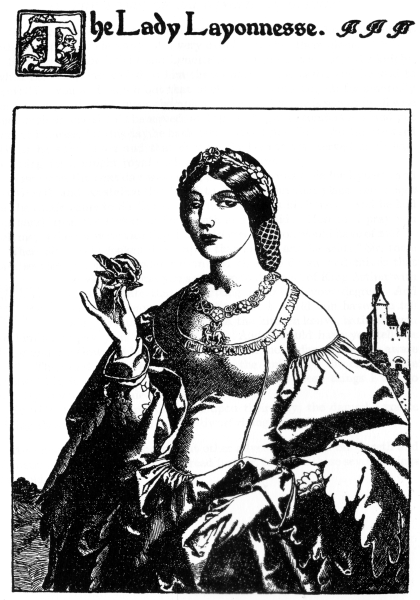

Chapter Fourth
How Sir Gareth met Sir Percevant of Hind, and how he came to Castle Dangerous and had speech with the Lady Layonnesse. Also how the Lady Layonnesse accepted him for her champion.
So the damsel Lynette followed by Sir Gareth and the dwarf travelled for all that morning and a part of the afternoon without let or stay of any sort and without meeting with any adventure whatsoever, and in all that time the damsel said no word to Sir Gareth whether of good or ill, but ever kept her eyes fixed straight before her as though very much occupied with thought.
They behold a fair pavilion in a valley.
So about two hours or three after the prime of the day they came to the top of a very long steep hill, and there beneath them in the valley that lay below the hill, Sir Gareth perceived that a considerable company and one that appeared to be of great estate were foregathered. For at that place there were a number of pavilions of divers colored silk and above each pavilion there flew a silken banner bearing the device of the owner of that pavilion. And in the midst of all those other pavilions there was one that was manifestly the pavilion of the knight-champion or of the overlord of all the others. For that pavilion was of crimson silk embroidered with figures in threads of silver and black, and above the pavilion there flew a banner of very great size, which same was also of crimson silk embroidered in silver and black with the figure of a leopard couchant.