PART III The Winning of a Queen
Reading edition
SO, having told you how King Arthur obtained that very excellent sword, Excalibur, for a weapon of defence, I shall now presently recount sundry other noble and knightly adventures whereby he won for himself a most beautiful and gentle lady for his Queen.
For, though all the world is very well acquainted with the renown of that perfectly gracious dame, the Lady Guinevere, yet I do not think that the whole story of those adventures by the which King Arthur won her good favor hath ever yet been told.
So as the matter hereinafter to be related contains not only the narrative of that affair, but also the account of a certain enchanted disguise which King Arthur assumed for his purposes, as well as sundry adventures of very knightly daring which he undertook, I have great hope that he who reads what I have written shall find it both an agreeable and an entertaining history.
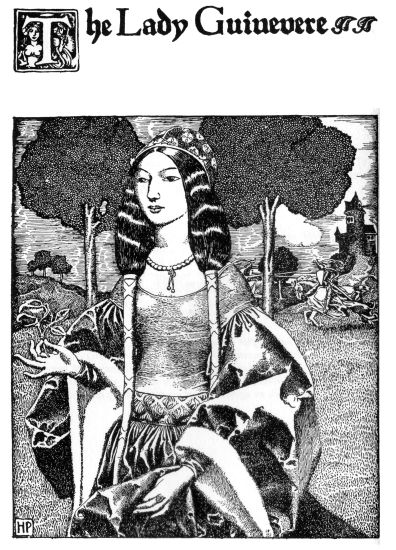
Chapter First.
How King Arthur Went to Tintagalon with Four of His Court, and How He Disguised Himself for a Certain Purpose.
How King Arthur held a feast at Carleon upon Usk.
NOW, upon a certain day King Arthur proclaimed a high feast, which was held at Carleon upon Usk. Many noble guests were bidden, and an exceedingly splendid Court gathered at the King’s castle. For at that feast there sat seven kings and five queens in royal state, and there were high lords and beautiful ladies of degree, to the number of three score and seven; and there were a multitude of those famous knights of the King’s Court who were reckoned the most renowned in arms in all of Christendom. And of all this great gathering of kings, lords, and knights, not one man looked askance at his neighbor, but all were united in good fellowship. Wherefore, when the young King looked about him and beheld such peace and amity among all these noble lords where, aforetime, had been discord and ill-regard: “Certes,” quoth he to himself, “it is wonderful how this reign of mine hath knit men together in kindness and good fellowship!” And because of such thoughts as these, his spirit took wings like unto a bird and sang within him.
Now while the King sat thus at feast, lo! there came an herald-messenger from the west-country. And the herald came and stood before the King, and said: “Greeting to thee, King Arthur!”
Then the King said: “Speak, and tell me, what is thy message?”
A herald-messenger comes from the west-country.
To which the herald made reply: “I come from King Leodegrance of Cameliard, who is in sore trouble. For thus it is: His enemy and thine enemy, King Ryence of North Wales (he who at one time in contempt of thee commanded thee to send him thy beard for to trim his mantle), doth make sundry demands of my master, King Leodegrance, which demands King Leodegrance is altogether loath to fulfil. And King Ryence of North Wales threateneth to bring war into Cameliard because King Leodegrance doth not immediately fulfil those demands. Now King Leodegrance hath no such array of knights and armed men as he one time had gathered about him for to defend his kingdom against assault. For, since thou in thy majesty hath brought peace to this realm and hath reduced the power of all those kings under thee, those knights who once made the Court of King Leodegrance so famous have gone elsewhither for to seek better opportunities for their great valor and prowess at arms than his peaceful Court may afford. Wherefore my master, King Leodegrance, doth beseech aid of thee, who art his King and Overlord.”
To these things that the herald-messenger said, King Arthur, and all that Court that feasted with him, listened in entire silence. And the King’s countenance, which erstwhiles had been expanded with cheerfulness, became overcast and dark with anger. “Ha!” he cried, “this is, verily, no good news that thou hast brought hither to our feast. Now I will give what aid I am able to thy master, King Leodegrance, in this extremity, and that right speedily. But tell me, sir herald, what things are they that King Ryence demandeth of thy master?”
“That I will tell you, Lord,” quoth the herald-messenger. “Firstly, King Ryence maketh demand upon my master of a great part of those lands of Cameliard that march upon the borders of North Wales. Secondly, he maketh demand that the Lady Guinevere, the King’s daughter, be delivered in marriage unto Duke Mordaunt of North Umber, who is of kin unto King Ryence, and that Duke, though a mighty warrior, is so evil of appearance, and so violent of temper, that I believe that there is not his like for ugliness or for madness of humor in all of the world.”
King Arthur is very angry at the message which the herald bringeth.
Now when King Arthur heard this that the messenger said he was immediately seized with an extraordinary passion of anger. For his eyes appeared, an it were, to shoot forth sparks of pure light, his face flamed like fire, and he ground his teeth together like the stones of a quern. Then he immediately rose from the chair where he sat and went forth from that place, and all those who beheld his anger shuddered thereat and turned their eyes away from his countenance.
Then King Arthur went into an inner room of the castle by himself, and there he walked up and down for a great while, and in that time no one of his household dared to come nigh to him. And the reason of the King’s wrath was this: that ever since he had lain wounded and sick nigh unto death in the forest, he bare in mind how the Lady Guinevere had suddenly appeared before him like some tall, straight, shining angel who had descended unto him out of Paradise—all full of pity, and exceedingly beautiful. Wherefore, at thought of that wicked, mad Duke Mordaunt of North Umber making demand unto marriage with her, he was seized with a rage so violent that it shook his spirit like a mighty wind.
So, for a long while, he walked up and down in his wrath as aforesaid, and no one durst come nigh unto him, but all stood afar off, watching him from a distance.
Then, after a while, he gave command that Merlin, and Sir Ulfius, and Sir Kay should come to him at that place where he was. And when they had come thither he talked to them for a considerable time, bidding Merlin for to make ready to go upon a journey with him, and bidding Sir Ulfius and Sir Kay for to gather together a large army of chosen knights and armed men, and to bring that army straightway into those parts coadjacent to the royal castle of Tintagalon, which same standeth close to the borders of North Wales and of Cameliard.
So Sir Ulfius and Sir Kay went about to do as King Arthur commanded, and Merlin also went about to do as he commanded; and the next day King Arthur and Merlin, together with certain famous knights of the King’s Court who were the most approved at arms of all those about him—to wit, Sir Gawaine, and Sir Ewaine (who were nephews unto the King), and Sir Pellias and Sir Geraint, the son of Erbin—set forth for Tintagalon across the forest-land of Usk.
How King Arthur came to Tintagalon.
So they travelled for all that day and a part of the next, and that without adventure or misadventure of any sort. So they came, at last, to that large and noble castle, hight Tintagalon, which guards the country bordering upon Cameliard and North Wales. Here King Arthur was received with great rejoicing; for whithersoever the King went the people loved him very dearly. Wherefore the folk of Tintagalon were very glad when he came unto them.
Now the morning after King Arthur had come unto Tintagalon (the summer night having been very warm), he and Merlin were glad to arise betimes to go abroad for to enjoy the dewy freshness of the early daytime. So, in the cool of the day, they walked together in the garden (which was a very pleasant place), and beneath the shadow of a tall, straight tower. And all around about were many trees with a good shade, where the little birds sang sweetly in the cheerfulness of the summer weather.
And here King Arthur opened his mind very freely to Merlin, and he said: “Merlin, I do believe that the Lady Guinevere is the fairest lady in all of the world; wherefore my heart seems ever to be entirely filled with love for her, and that to such a degree that I think of her continually by day (whether I be eating, or drinking, or walking, or sitting still, or going about my business), and likewise I dream of her many times at night. And this has been the case with me, Merlin, ever since a month ago, when I lay sick in that hermit’s cell in the forest, what time she came and stood beside me like a shining angel out of Paradise. So I am not willing that any other man than I should have her for his wife.
King Arthur openeth his heart to Merlin.
“Now I know very well that thou art wonderfully cunning in those arts of magic that may change a man in his appearance so that even those who know him best may not recognize him. Wherefore I very greatly desire it of thee that thou wilt so disguise me that I may go, unknown of any man, into Cameliard, and that I may dwell there in such a way that I may see the Lady Guinevere every day. For I tell thee very truly that I greatly desire to behold her in such a wise that she may not be in any way witting of my regard. Likewise I would fain see for myself how great may be the perils that encompass King Leodegrance—the King being my right good friend.”
“My Lord King,” said Merlin, “it shall be as thou desirest, and this morning I will cause thee to be so disguised that no one in all the world shall be able to know thee who thou art.”
So that morning, a little before the prime, Merlin came unto the King where he was and gave him a little cap. And the cap was of such a sort that when the King set it upon his head he assumed, upon the instant, the appearance of a rude and rustic fellow from the country-side. Then the King commanded that a jerkin of rough frieze should be brought to him, and with this he covered his royal and knightly vestments, and with it he hid that golden collar and its jewel, pendent, which he continually wore about his neck. Then, setting the cup upon his head, he assumed at once the guise of that peasant hind.
King Arthur quits Tintagalon in disguise.
Whereupon, being thus entirely disguised, he quitted Tintagalon unknown of any man, and took his way a-foot unto the town of Cameliard.
Now toward the slanting of the day he drew nigh to that place, and lo! he beheld before him a large and considerable town of many comely houses with red walls and shining windows. And the houses of the town sat all upon a high, steep hill, the one overlooking the other, and the town itself was encompassed around about by a great wall, high and strong. And a great castle guarded the town, and the castle had very many towers and roofs. And all round about the tower were many fair gardens and lawns and meadows, and several orchards and groves of trees with thick and pleasing shade. Now at that time of the day the sky behind the tower was all, as it were, an entire flame of fire, so that the towers and the battlements of the castle and the roofs and the chimneys thereof stood altogether black against the brightness of the light. And, behold! great flocks of pigeons encircled the towers of the castle in a continual flight against that fiery sky. So, because King Arthur was a-weary with walking for all that day, it appeared to him that he had hardly ever beheld in all of his life so fair and pleasing a place as that excellent castle with its gardens and lawns and groves of trees.
King Arthur comes to Cameliard.
Thus came King Arthur unto the castle of Cameliard, in the guise of a poor peasant from the country-side, and no man in all of the world knew him who he was.
So, having reached the castle, he made inquiries for the head gardener thereof; and when he had speech with the gardener he besought him that he might be taken into service into that part of the garden that appertained to the dwelling-place of the Lady Guinevere. Then the gardener looked upon him and saw that he was tall and strong and well framed, wherefore he liked him very well and took him into service even as he desired.
And thus it was that King Arthur of Britain became a gardener’s boy at Cameliard.
King Arthur dwelleth as gardner’s boy at the castle.
Now the King was very glad to be in that garden; for in this pleasant summer season the Lady Guinevere came every day to walk with her damsels among the flowers, and King Arthur, all disguised as a peasant gardener boy, beheld her very many times when she came thither.
So King Arthur abode at that place for above a week, and he took no care that in all that time he enjoyed none of his kingly estate, but was only gardener’s boy in the castle garden of Cameliard.
Now it happened upon a day when the weather was very warm, that one of the damsels who was in attendance upon the Lady Guinevere, arose all in the early morning whiles the air was still cool and refreshing. So, leaving the Lady Guinevere still sleeping, this damsel, whose name was Mellicene of the White Hand, went into the ante-room and, opening the casement thereof, looked forth into that garden of roses which adjoined the Lady Guinevere’s bower.
Now there was at that place a carven marble figure of a youth, holding in his arms a marble ewer, and a fountain of water, as clear as crystal, flowed out from the ewer into a basin of marble. And the figure, and the fountain, and the marble basin into which the fountain flowed lay beneath the shadow of a linden-tree. And all around was a thick growth of roses, so that the place was entirely hidden, saving only from those windows of the castle that were above.
The damsel beholds a knight at the fountain.
So it befell that as the damsel looked down thitherward out of the window, she beheld a very wonderful sight. For, lo! a strange knight kneeled beside the fountain and bathed his face and his bosom in the crystal water thereof. And the damsel saw that the sunlight fell down through the leaves of the linden-tree and lay upon that strange knight. And she perceived that his hair and his beard were of the color of red gold—shining surpassingly in the brightness of the morning. And she beheld that his brow and his throat and his bosom were white like alabaster. And she beheld that around his neck and shoulders there hung a golden collar of marvellous beauty, so that when the sunlight shone upon it it flashed like pure lightning.
So, beholding this strange appearance—as it were a vision—the damsel Mellicine stood for a long while, all entranced with wonder and with pleasure, and wist not whether that which she saw was a dream or no dream, nor whether he who sat there was a spirit, or whether he was a man of flesh and blood.
Then, by and by, recovering somewhat from her astonishment, she withdrew herself softly from the casement, and, turning about, ran fleetly down the turret stairs, and so came out thence into that fair and blooming garden at the foot of the tower. So she ran through the garden with all speed and silence, and thus came down an alley-way and to the marble fountain and the linden-trees and the rose-trees around about where she had anon beheld that strange knight bathing himself in the crystal waters.
The damsel findeth only the gardener’s boy.
But King Arthur had heard the coming of that damsel, and had speedily set the cap upon his head again. So that when the damsel Mellicene came thither, she found no one by the fountain but the gardener’s boy. Of him she demanded: “Who art thou, fellow? And why sittest thou here by the fountain?”
And unto her he replied: “I am the gardener’s lad who came a short time ago to take service at this place.”
“Then tell me, fellow,” quoth she, “and tell me truly. Who was that young knight who was here beside the fountain but now, and whither hath he gone?” “Lady, whereunto,” he said, “there has been no one at this fountain this day, but only I.”
“Nay, fellow,” she cried, “thou art deceiving me, for I do assure thee that with mine own eyes I beheld but now, where a strange young knight sat bathing himself in the waters of this fountain.” And the gardener’s boy said, “Lady, that which I have told you is the very truth, for indeed there hath no one been here this morn but only I. Wherefore, an thou deemest thou hast seen anyone else, thou art certainly mistaken.”
At this the damsel set her look upon him, in great perplexity. Likewise, she marvelled very greatly, for she could not altogether disbelieve him. Nor yet could she entirely believe him either, because her eyes had beheld that which she had beheld, and she wotted that she had not been mistaken. Therefore she knew not what to think, and, because of her perplexity, she felt a very great displeasure at that gardener’s boy. “Truly, wherefore,” she said, “if thou art deceiving me, I shall certainly cause thee to suffer a great deal of pain, for I shall have thee whipped with cords.” Thereupon she turned and went away from that place, much marvelling at that strange thing, and wondering what it all signified.
That morning she told unto the Lady Guinevere all that she had seen, but the Lady Guinevere only laughed at her and mocked her, telling her that she had been asleep and dreaming, when she beheld that vision. And, indeed, the damsel herself had begun to think this must be the case. Nevertheless, she thereafter looked out every morning from her casement window, albeit she beheld nothing for a great while, for King Arthur came not soon to that place again.
So, by and by, there befell another certain morning when she looked out of the casement and, lo! there sat that strange knight by the fountain once more as he had aforetime sat. And he bathed his face and his bosom in the water as he had aforetime done. And he appeared as comely and as noble as he had appeared before; and his hair and his young beard shone like gold as they had shone before in the sun. And this time she beheld that his collar of gold lay upon the brink of the fountain beside him, and it sparkled with great splendor in the sunlight the whiles he bathed his bosom. Then, after that damsel had regarded him for a considerable time, she ran with all speed to the chamber where the Lady Guinevere still lay, and she cried in a loud voice, “Lady! lady! arouse thee and come with me! For, lo! that same young knight whom I beheld before, is even now bathing himself at the fountain under the linden-tree.”
Then the Lady Guinevere, greatly marvelling, aroused herself right quickly, and, dighting herself with all speed, went with the damsel unto that casement window which looked out into that part of the garden.
The Lady Guinevere beholds the knight at the fountain.
And there she herself beheld the young knight where he laved himself at the fountain. And she saw that his hair and his beard shone like gold in the sunlight; and she saw that his undervestment was of purple linen threaded with gold; and she saw that beside him lay that cunningly wrought collar of gold inset with many jewels of various colors, and the collar shone with great splendor where it lay upon the marble verge of the fountain.
Somewhiles she gazed, exceedingly astonished; then she commanded the damsel Mellicene for to come with her, and therewith she turned and descended the turret stairs, and went quickly out into the garden, as her damsel had done aforetime. Then, as that damsel had done, she straightway hastened with all speed down the alley-way toward the fountain.
But, behold! when she had come there, she found no young knight, but only the gardener boy, exactly as had happened with the damsel Mellicene aforetime. For King Arthur had heard her coming, and had immediately put that enchanted cap upon his head. Then the Lady Guinevere marvelled very greatly to find there only the gardener’s boy, and she wist not what to think of so strange a thing. Wherefore she demanded of him, even as Mellicene had done, whither had gone the young knight whom she had beheld anon there at the fountain. And unto her the gardener lad made answer as aforetime: “Lady! there hath been no one at this place at any time this morning, but only I.”
Now when King Arthur had donned his cap at the coming of the Lady, he had, in his great haste, forgotten his golden collar, and this Guinevere beheld where it lay shining very brightly, beside the margin of the fountain. “How now!” quoth she. “Wouldst thou dare to make a mock of me? Now tell me, thou fellow, do gardeners’ boys in the land whence thou didst come wear golden collars about their necks like unto that collar that lieth yonder beside the fountain? Now, an I had thee well whipped, it would be thy rightful due. But take thou that bauble yonder and give it unto him to whom it doth rightfully belong, and tell him from me that it doth ill become a true belted knight for to hide himself away in the privy gardens of a lady.” Then turned she with the damsel Mellicene, and left she that place and went back again into her bower.
Yet, indeed for all that day, as she sat over her ’broidery, she did never cease to marvel and to wonder how it was possible that that strange young knight should so suddenly have vanished away and left only the poor gardener’s boy in his stead. Nor, for a long time, might she unriddle that strange thing.
Then, of a sudden, at that time when the heat of the day was sloping toward the cooler part of the afternoon, she aroused herself because of a thought that had come in an instant unto her. So she called the damsel Mellicene to come to her, and she bade her to go and tell the gardener’s lad for to fetch her straightway a basket of fresh roses for to adorn her tower chamber.
The gardener’s boy weareth his cap before the Lady Guinevere.
So Mellicene went and did as she bade, and after considerable time the gardener’s lad came bearing a great basket of roses. And, lo! he wore his cap upon his head. And all the damsels in waiting upon the Lady Guinevere, when they saw how he wore his cap in her presence, cried out upon him, and Mellicene of the White Hand demanded of him: “What! How now, Sir boor! Dost thou know so little of what is due unto a king’s daughter that thou dost wear thy cap even in the presence of the Lady Guinevere? Now I bid thee straightway to take thy cap off thy head.”
And to her King Arthur made answer: “Lady, I cannot take off my cap.”
Quoth the Lady Guinevere: “And why canst thou not take off thy cap, thou surly fellow?”
“Lady,” said he, “I cannot take off my cap, because I have an ugly place upon my head.”
“Then wear thy cap,” quoth the Lady Guinevere. “Only fetch thou the roses unto me.”
The Lady Guinevere discovers the knight of the fountain.
And so at her bidding, he brought the roses to her. But when he had come nigh unto the lady, she, of a sudden, snatched at the cap and plucked it off from his head. Then, lo! he was upon the instant transformed; for instead of the gardener’s boy there stood before the Lady Guinevere and her damsel the appearance of a noble young knight with hair and beard like threads of gold. Then he let fall his basket of roses so that the flowers were scattered all over the floor, and he stood and looked at all who were there. And some of those damsels in attendance upon the Lady Guinevere shrieked, and others stood still from pure amazement and wist not how to believe what their eyes beheld. But not one of those ladies knew that he whom she beheld was King Arthur. Nevertheless the Lady Guinevere remembered that this was the knight whom she had found so sorely wounded, lying in the hermit’s cell in the forest.
Then she laughed and flung him back his cap again. “Take thy cap,” quoth she, “and go thy ways, thou gardener’s boy who hath an ugly place upon his head.” Thus she said because she was minded to mock him.
But King Arthur did not reply to her, but straightway, with great sobriety of aspect, set his cap upon his head again. So resuming his humble guise once more, he turned and quitted that place, leaving those roses scattered all over the floor even as they had fallen.
And after that time, whenever the Lady Guinevere would come upon the gardener’s lad in the garden, she would say unto her damsel in such a voice that he might hear her speech: “Lo! yonder is the gardener’s lad who hath an ugly place upon his head so that he must always wear his cap for to hide it.”
Thus she spake openly, mocking at him; but privily she bade her damsels to say naught concerning these things, but to keep unto themselves all those things which had befallen.

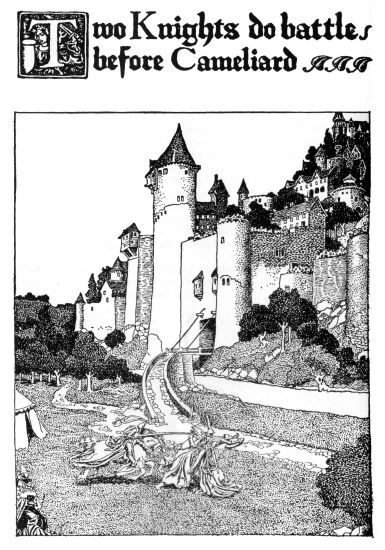
Chapter Second.

How King Ryence Came to Cameliard and How King Arthur Fought With the Duke of North Umber.
King Ryence and Duke Mordaunt come to Cameliard.
NOW, upon a certain day at this time there came a messenger to the Court of King Leodegrance, with news that King Ryence of North Wales and Duke Mordaunt of North Umber were coming thither and that they brought with them a very noble and considerable Court of knights and lords. At this news King Leodegrance was much troubled in spirit, for he wist not what such a visit might betoken; and yet he greatly feared that it boded ill for him. So on that day when King Ryence and the Duke of North Umber appeared before the castle, King Leodegrance went forth to greet them and they three met together in the meadows that lie beneath the castle walls of Cameliard.
There King Leodegrance bade those others welcome in such manner as was fitting, desiring them that they should come into the castle with him so that he might entertain them according to their degree.
The King and the Duke send challenge to King Leodegrance.
But to this courtesy upon the part of King Leodegrance, King Ryence deigned no pleasing reply. “Nay,” quoth he, “we go not with thee into thy castle, King Leodegrance, until we learn whether thou art our friend or our enemy. For just now we are, certes, no such good friends with thee that we care to sit down at thy table and eat of thy salt. Nor may we be aught but enemies of thine until thou hast first satisfied our demands; to wit, that thou givest to me those lands which I demand of thee and that thou givest unto my cousin, Duke Mordaunt of North Umber, the Lady Guinevere to be his wife. In these matters thou hast it in thy power to make us either thy friends or thine enemies. Wherefore we shall abide here, outside of thy castle, for five days, in the which time thou mayst frame thine answer, and so we may know whether we shall be friends or enemies.”
“And in the meantime,” quoth Duke Mordaunt of North Umber, “I do hold myself ready for to contest my right unto the hand of the Lady Guinevere with any knight of thy Court who hath a mind to deny my just title thereto; and if thou hast no knight in all thy Court who can successfully assay a bout of arms with me, thou thyself canst hardly hope to succeed in defending thyself against that great army of knights whom King Ryence hath gathered together to bring against thee in case thou denyest us that which we ask.”
Then was King Leodegrance exceedingly cast down in his spirits, for he feared those proud lords and he wist not what to say in answer to them. Wherefore he turned and walked back into his castle again, beset with great anxiety and sorrow of spirit. And King Ryence, and Duke Mordaunt and their Court of lords and knights pitched their pavilions in those meadows over against the castle, so that the plain was entirely covered with those pavilions. And there they took up their inn with great rejoicing and with the sound of feasting and singing and merry-making, for it was an exceeding noble Court King Ryence had gathered about him.
Duke Mordaunt rides before the castle.
And when the next morning had come Duke Mordaunt of North Umber went forth clad all in armor of proof. And he rode up and down the field before the castle and gave great challenge to those within; daring any knight to come forth for to meet him in knightly encounter. “Ho!” he cried, “how now, ye Knights of Cameliard! Is there no one to come forth to meet me? How then may ye hope to contend with the Knights of North Wales, an ye fear to meet with one single Knight from North Umber?” So he scoffed at them in his pride, and none dared to come forth from Cameliard against him. For the Duke of North Umber was one of the most famous knights of his day, and one of exceeding strength and success at arms, and there was now, in these times of peace, no one of King Leodegrance’s Court who was at all able to face a warrior of his approved skill and valor. Wherefore, no one took up that challenge which the Duke of North Umber gave to the Court of Cameliard. Meantime many people gathered upon the walls of Cameliard and gazed down therefrom upon that proud and haughty duke, all bedight in his splendid armor, and all were grieved and ashamed that there was no one in that peaceful town to go out against him. And all the lords and knights of King Ryence’s Court came and stood in front of the King’s pavilion and laughed and clapped their hands together, and cheered Duke Mordaunt, as he so rode up and down before them. And the greater they were expanded with mirth, the more abashed were the people of Cameliard. “Ho! Ho!” cried that proud Duke. “How now! Will no one come forth to meet me? How then may ye of Cameliard hope to face the King of North Wales and all his knightly array of which I am but one man?” And the people of Cameliard, gathered upon the walls, listened to him with shame and sorrow.
Now all this while King Arthur digged in the garden; but, nevertheless, he was well aware of everything that passed and of how that the Duke of North Umber rode up and down so proudly before the castle walls. So, of a sudden, it came to him that he could not abide this any longer. Wherefore he laid aside his spade and went out secretly by a postern way, and so up into the town.
Now there was in Cameliard an exceedingly rich merchant, by name Ralph of Cardiff, and the renown of his possessions and his high estate had reached even unto King Arthur’s ears at Carleon. Accordingly it was unto his house that King Arthur directed his steps.
King Arthur seeks armor to do battle.
And while he was in a narrow way, not far from the merchant’s house, he took off his magic cap of disguise and assumed somewhat of his noble appearance once more, for he was now of a mind to show his knightliness unto those who looked upon him. Accordingly, when he stood before the rich merchant in his closet, and when the merchant looked up into his face, he wist not what to think to behold so noble a lord clad all in frieze. For though King Arthur was a stranger to the good man, so that he knew not his countenance, yet that merchant wist that he was no ordinary knight, but that he must assuredly be one of high degree and in authority, even though he was clad in frieze.
Then King Arthur opened the breast of his jerkin and showed the merchant the gold collar that hung around his neck. And also he showed beneath the rough coat of frieze how that there was an undergarment of fine purple silk embroidered with gold. And then he showed to the good man his own signet ring, and when the merchant saw it, he knew it to be the ring of the King of Britain. Wherefore, beholding these tokens of high and lordly authority, the merchant arose and stood before the King and doffed his cap.
“Sir Merchant,” quoth the King, “know that I am a stranger knight in disguise in this place. Ne’theless, I may tell thee that I am a very good friend to King Leodegrance and wish him exceeding well. Thou art surely aware of how the Duke of North Umber rides continually up and down before the King’s castle, and challenges anyone within to come forth for to fight against him in behalf of the Lady Guinevere. Now I am of a mind to assay that combat mine own self, and I hope a very great deal that I shall succeed in upholding the honor of Cameliard and of bringing shame upon its enemies.
“Sir Merchant, I know very well that thou hast several suits of noble armor in thy treasury, for the fame of them hath reached unto mine ears though I dwell a considerable distance from this place. Wherefore I desire that thou shalt provide me in the best manner that thou art able to do, so that I may straightway assay a bout of arms with that Duke of North Umber. Moreover, I do pledge thee my knightly word that thou shalt be fully recompensed for the best suit of armor that thou canst let me have, and that in a very little while.”
“My Lord,” said Master Ralph, “I perceive that thou art no ordinary errant knight, but rather someone of extraordinary estate; wherefore it is a very great pleasure to fulfil all thy behests. But even an thou wert other than thou art, I would be altogether willing to equip thee with armor, seeing that thou hast a mind to ride forth against yonder duke.”
Upon this he rang a little silver bell that stood nigh to him, and in answer to its sound several attendants immediately appeared. Into their hands he intrusted the person of the King, bidding them to do him extraordinary honor. Accordingly, certain of those attendants prepared for the King a bath of tepid water perfumed with ambergris, very grateful to the person. And after he was bathed in this bath and was wiped with soft linen towels, other attendants conducted him to a hall all hung with tapestries and ’broideries, and at this place a noble feast had been spread ready for his refreshment. Here that lordly merchant himself ministered to the King’s wants, serving him with various meats—very dainty, and of several sorts—and likewise with fine white bread. And he poured him wine of various countries—some as red as ruby, others as yellow as gold; and indeed the King had hardly ever enjoyed a better feast than that which the merchant, Ralph of Cardiff, had thus spread for him.
King Arthur is armed by Ralph of Cardiff.
And after he had entirely refreshed himself with eating, there came six pages richly clad in sarsanet of azure, and these, taking the King to an apartment of great state, they there clad him in a suit of Spanish armor, very cunningly wrought and all inlaid with gold. And the like of that armor was hardly to be found in all of the land. The juppon and the several trappings of the armor were all of satin and as white as milk. And the shield was white, and altogether without emblazonment or device of any sort. Then these attendants conducted the King into the courtyard, and there stood a noble war-horse, as white as milk, and all the trappings of the horse were of milk-white cloth without emblazonment or adornment of any sort; and the bridle and the bridle rein were all studded over with bosses of silver.
Then after the attendants had aided King Arthur to mount this steed, the lordly merchant came forward and gave him many words of good cheer, and so the king bade him adieu and rode away, all shining in white and glittering in fine armor, wherefore he resembled the full moon in harvest season.
And as he drave down the stony streets of the town, the people turned and gazed after him, for he made a very noble appearance as he passed along the narrow way between the houses of the town.
So King Arthur directed his way to the postern gate of the castle, and, having reached that place, he dismounted and tied his horse. Then he straightway entered the garden, and there, finding an attendant, he made demand that he should have present speech with the Lady Guinevere. So the attendant, all amazed at his lordly presence, went and delivered the message, and by and by the Lady Guinevere came, much wondering, and passed along a gallery with several of her damsels, until she had come over above where King Arthur was. And when King Arthur looked up and saw her above him, he loved her exceeding well. And he said to her: “Lady, I have great will to do thee such honor as I am able. For I go forth now to do combat with that Duke of North Umber who rides up and down before this castle. Moreover, I hope and verily believe that I shall encompass his downfall; accordingly, I do beseech of thee some token, such as a lady may give unto a knight for to wear when that knight rides forth to do her honor.”
The Lady Guinevere accepts King Arthur for her champion.
Then the Lady Guinevere said: “Certes, Sir Knight, I would that I knew who thou art. Yet, though I know not, nevertheless I am altogether willing for to take thee for my champion as thou offerest. So, touching that token thou speakest of, if thou wilt tell me what thing it is that thou desirest, I will gladly give it to thee.”
“An that be so, Lady,” said King Arthur, “I would fain have that necklace that thou wearest about thy throat. For, meseems that if I had that tied about my arm, I would find my valor greatly increased thereby.”
“Pardee, Sir Knight,” said the Lady, “what thou desirest of me thou shalt assuredly have.” Thereupon speaking, she took from her long, smooth neck the necklace of pearls which she wore, and dropped the same down to King Arthur where he stood.
And King Arthur took the necklace and tied it about his arm, and he gave great thanks for it. Then he saluted the Lady Guinevere with very knightly grace, and she saluted him, and then, straightway, he went forth from that place, greatly expanded with joy that the Lady Guinevere had shown him such favor.
Now the report had gone about Cameliard that a knight was to go forth to fight the Duke of North Umber. Wherefore great crowds gathered upon the walls, and King Leodegrance and the Lady Guinevere and all the Court of the King came to that part of the castle walls overlooking the meadow where the Duke of North Umber defended. Wherefore, so great a concourse was presently assembled, that any knight might be encouraged to do his utmost before such a multitude as that which looked down upon the field.
Then of a sudden the portcullis of the castle was lifted, and the bridge let fall, and the White Champion rode forth to that encounter which he had undertaken. And, as he drave across that narrow bridge, the hoofs of his war-horse smote the boards with a noise like to thunder, and when he came out into the sunlight, lo! his armor flamed of a sudden like unto lightning, and when the people saw him they shouted aloud.
Then when the Duke of North Umber beheld a knight all clad in white, he rode straightway to him and spoke to him with words of knightly greeting. “Messire,” he said, “I perceive that thou bearest no crest upon thy helm, nor hast thou a device of any sort upon thy shield, wherefore I know not who thou art. Ne’theless, I do believe that thou art a knight of good quality and of approved courage, or else thou wouldst not have thus come to this place.”
“Certes, Sir Knight,” said King Arthur, “I am of a quality equal to thine own. And as for my courage, I do believe that it hath been approved in as many encounters as even thine own hath been.”
“Sir Knight,” quoth the Duke of Umber, “thou speakest with a very large spirit. Ne’theless, thou mayst make such prayers as thou art able, for I shall now presently so cast thee down from thy seat, so that thou shalt never rise again; for so have I served better men than ever thou mayst hope to be.”
To this King Arthur made answer with great calmness of demeanor: “That shall be according to the will of Heaven, Sir Knight, and not according to thy will.”
King Arthur overthrows Duke Mordaunt.
So each knight saluted the other and rode to his assigned station, and there each dressed his spear and his shield, and made him ready for the encounter. Then a silence fell upon all so great that a man might hear his own heart beat in the stillness. So, for a small space, each knight sat like a statue made of iron. Then, of a sudden, each shouted to his war-horse, and drave spurs into his flank, and launched forth from his station. And so they met in the midst of the course with a noise like unto a violent thunder-clap. And lo! the spear of the Duke of North Umber burst into splinters unto the very truncheon thereof; but the spear of King Arthur broke not, but held, so that the Duke was cast out of his saddle like a windmill—whirling in the air and smiting the earth so that the ground shuddered beneath him. And indeed he rolled full three times over and over ere he ceased to fall.
Then all the people upon the wall shouted with might and main, so that the noise thereof was altogether astonishing; for they had hardly hoped that their champion should have proved so extraordinarily strong and skilful.
Meanwhile, those of King Ryence’s Court ran immediately to the Duke of Umber where he lay upon the earth, and they straightway unlaced his helm for to give him air. And first they thought that he was dead, and then they thought that he was like to die; for, behold! he lay without any life or motion. Nor did he recover from that swoon wherein he lay for the space of full two hours and more.
Now whilst the attendants were thus busied about Duke Mordaunt of North Umber, King Arthur sat his horse, very quietly, observing all that they did. Then, perceiving that his enemy was not dead, he turned him about and rode away from that place.
Nor did he return unto Cameliard at that time, for he deemed that he had not yet entirely done with these enemies to the peace of his realm, wherefore he was minded not yet to return the horse and the armor to the merchant, but to keep them for a while for another occasion.
So he bethought him of how, coming to Cameliard, he had passed through an arm of the forest where certain wood-choppers were at work felling the trees. Wherefore, remembering that place, he thought that he would betake him thither and leave his horse and armor in the care of those rude folk until he would need those things once more. So now he rode away into the country-side, leaving behind him the town and the castle and all the noise of shouting and rejoicing; nor did he once so much as turn his head to look back toward that place where he had so violently overthrown his enemy.
And now you shall presently hear of certain pleasant adventures of a very joyous sort that befell him ere he had accomplished all his purposes. For when a man is a king among men, as was King Arthur, then is he of such a calm and equal temper that neither victory nor defeat may cause him to become either unduly exalted in his own opinion or so troubled in spirit as to be altogether cast down into despair. So if you would become like to King Arthur, then you shall take all your triumphs as he took this victory, for you will not be turned aside from your final purposes by the great applause that many men may give you, but you will first finish your work that you have set yourself to perform, ere you give yourself ease to sit you down and to enjoy the fruits of your victory.
Yea, he who is a true king of men, will not say to himself, “Lo! I am worthy to be crowned with laurels;” but rather will he say to himself, “What more is there that I may do to make the world the better because of my endeavors?”
Chapter Third.

How King Arthur Encountered Four Knights and of What Befell Thereby.
NOW, the day was extraordinarily sweet and pleasant unto one so lusty of frame and so lithe of heart as was good King Arthur. For the bright clouds swam smoothly across the blue sky in prodigious volumes of vapor, and the wind blew across the long grass of the meadow lands, and across the fields of growing wheat, so that a multitude of waves travelled over the hills and valleys like an it were across an entire sea of green. And now all the earth would be darkened with wide shadows from those clouds, and, anon, everything would burst out, of a sudden, into a wonderful radiance of sunlight once more. And the little birds they sang all gayly in the hedge-rows and the leafy thickets as though they would burst their tiny throats with singing, and the cock crowed, strong and lusty, from the farm croft, and all was so blithe and comely that the young King, with the visor of his helmet uplifted to the refreshment of the gentle breeze, would sometimes carol very joyously in his journeying. So travelled King Arthur in all that gay and tender summer season, when the earth was young and the time was of long-gone-by.
Now, you are to remember that when King Arthur had come from Carleon unto the castle of Tintagalon, he had brought with him four young knights for to bear him company. And those knights aforesaid were as follows: There was Sir Gawaine, the son of King Lot and of Queen Margaise, and there was Sir Ewaine, the son of King Uriens and of Queen Morgana la Fay (and these two were nephews, half in blood, unto the King), and there was Sir Pellias, and there was Sir Geraint, the son of Erbin. These were the four noble young knights who had come with King Arthur from Camelot unto Tintagalon.
King Arthur cometh upon a knight entertaining the ladies in green.
Now it befell, as King Arthur rode all gayly in the summer time as aforesaid, that he came to a certain part of the road where he beheld before him a tall and comely tower that stood upon a green hillock immediately by the roadside. And lo! there stood upon the balcony of that tower three fair demoiselles, clad all in green taffeta. And on the high road in front of the castle there was a knight clad all in very fine armor. And the knight sat upon a noble war-horse, and in his hands he held a lute, and he played upon the lute and sang in a voice of extraordinary sweetness. Whiles he sang those three ladies in green taffeta listened to him with great cheerfulness of mien. And whenever that knight would stint his singing, then those three ladies would clap their hands together with great acclaim, and would bid him to sing to them again; and so he would do with great readiness of spirit.
All this King Arthur beheld, and it appeared to him to be a very pleasant sight, wherefore he rejoiced at it exceedingly.
And as he drew nigh, lo! he beheld that the knight who thus sat upon his horse and played upon the lute and sang unto the accompaniment thereof, was none other than Sir Geraint, the son of Erbin. For that knight wore upon his crest the figure of a gryphon, and the device upon his shield was two gryphons rampant facing one another upon a field azure, and King Arthur knew that this was the crest and the device of Sir Geraint. And when the King perceived who was the knight who sat there and sang, he laughed unto himself and straightway closed his visor and made him ready for such encounter as might, perchance, befall. So he drew nigh to where the knight sang and the ladies listened.
Now when Sir Geraint perceived King Arthur approach, he ceased singing and hung up his lute behind him across his shoulder. Then, casting upward his look to those three fair ladies above him, quoth he: “Mesdames, ye have been pleased to listen to that singing which I have assayed altogether in your honor. Now, likewise, in your honor, I will perform a deed of knightly prowess which I very much hope shall bring great glory to you. For, if ye will be pleased to lend me that encouragement which your very great beauty can so easily afford, ye shall behold me, I doubt not, overthrow yonder knight completely, and that to your great credit and renown.”
“Sir Knight,” said that lady who spoke for the others, “you are, truly, a lord of noble bearing and exceedingly pleasing of address, wherefore we do wish you great success in this undertaking; and we do believe that you will succeed in that which you assay to do.”
Upon these Sir Geraint gave those three demoiselles great thanks for their words, and thereupon he closed the visor of his helmet. So, dressing his spear and shield, and saluting those three ladies with great humility of demeanor, he went forth to meet King Arthur where he now sat at a little distance, very quietly and soberly awaiting his pleasure.
Now Sir Geraint knew not King Arthur because he wore no crest upon his helm and no device upon his shield, wherefore as he saluted him he made speech to him in this wise: “Ha! Messire, I know not who thou art, seeing that thou bearest neither crest nor device. Ne’theless, I am minded to do thee such honor as I may in running a tilt with thee upon the behalf of those three demoiselles whom thou beholdest yonder upon that balcony. For I do affirm, and am ready to maintain the same with my knightly person, that those ladies are fairer than thy lady, whomsoever she may be.”
“Sir Knight,” quoth King Arthur, “I will gladly run a course with thee in honor of my lady; for, I may tell thee, she is a princess, and is held by many to be the most beautiful dame in all of the world. But I will only contend with thee upon one condition, and the condition is this—that he who is overthrown shall yield himself as servant unto the other for seven days, and in that time he shall do all that may be required of him.”
“I will accept thy gage, Sir Unknown Knight,” quoth Sir Geraint, “and when I have overthrown thee, I will yield thee unto those fair ladies yonder for to be their servant for seven days. And I do tell thee that there are a great many knights who would certainly regard that as being both a pleasant and an honorable task.”
“And should I so chance as to overthrow thee,” said King Arthur, “I will send thee for to serve my lady for that same period of time, and that will be even a pleasanter and a more honorable task than that which thou hast a mind for me to perform.”
King Arthur overthrows Sir Geraint.
So each knight saluted the other, and thereupon each took such a stand as should cast the encounter immediately beneath where those three fair demoiselles looked down from the balcony. Then each knight dressed his spear and his shield, and, having made ready for the encounter, each sat for a small space entirely prepared. Then each shouted to his war-horse, and drave spur into its flank, and launched forth with wonderful speed to the assault. So they met in the very midst of the course with a force so vehement that the noise thereof was wonderfully appalling for to hear. And each knight smote the other in the very centre of his defences. And, lo! the spear of Sir Geraint burst into small pieces, even to the truncheon thereof; but the spear of King Arthur held, and Sir Geraint was cast so violently backward that both he and his horse were overthrown into the dust with a tumult like to a monstrous roaring of thunder.
And when Sir Geraint had recovered his footing, he was, for awhile, so astonished that he wist not where he stood, for never had he been so overthrown in all of his life before. Then, coming quickly unto himself again, he straightway drew forth his sword and called upon King Arthur with exceeding vehemence for to come down from out of his saddle, and to fight him afoot.
“Nay, not so, Sir Knight,” said King Arthur, “I will not have to do with thee in that way. Moreover, thou art not to forget that thou hast promised to give thyself unto me as my servant for seven days, for, assuredly, I have entirely overcome thee in this encounter, and now thou art pledged unto me to be my servant.”
Then Sir Geraint knew not what to say, being altogether abashed with shame and vexation at his overthrow. Ne’theless, he perceived that he must uphold his knightly word unto that which he had pledged himself to do; wherefore, he put up his sword again, though with exceeding discontent. “Sir Knight,” said he, “I do acknowledge myself to have been overcome in this encounter, wherefore I yield myself now unto thy commands, according to my plighted word.”
King Arthur sendeth Sir Geraint to the Lady Guinevere.
“Then I do place my commands upon thee in this wise,” quoth King Arthur. “My command is, that thou goest straightway unto the Lady Guinevere at Cameliard, and that thou tellest her that thou hast been overthrown by that knight to whom she gave her necklace as a token. Moreover, I do desire that thou shalt obey her in everything that she may command thee to do, and that for the space of seven days to come.”
“Sir Knight,” quoth Sir Geraint, “that which thou biddest me to do, I will perform according to thy commands.”
Thereupon he mounted his horse and went his way. And King Arthur went his way. And those three ladies who stood upon the balcony of the castle were exceedingly glad that they had beheld so noble an assay-at-arms as that which they had looked down upon.
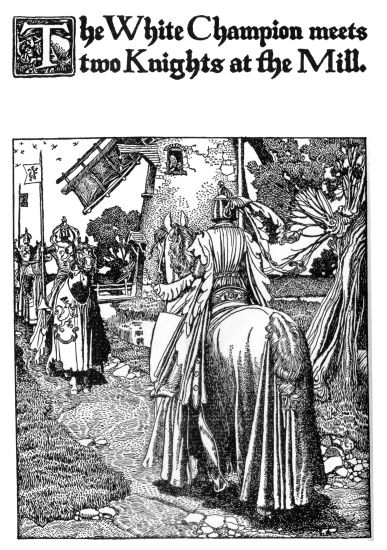
Now, after King Arthur had travelled forward for the distance of two or three leagues or more, he came to a certain place of moorlands, where were many ditches of water, and where the heron and the marsh-hen sought harborage in the sedge. And here, at sundry points, were several windmills, with their sails all turning slowly in the sunlight before a wind which blew across the level plains of ooze. And at this place there was a long, straight causeway, with two long rows of pollard willows, one upon either hand. Now, when he had come nigh the middle of this causeway, King Arthur perceived two knights, who sat their horses in the shade of a great windmill that stood upon one side of the roadway. And a large shadow of the sails moved ever and anon across the roadway as the wheel of the mill turned slowly afore the wind. And all about the mill, and everywhere about, were great quantities of swallows that darted hither and thither like bees about a hive in midsummer. And King Arthur saw that those two knights, as they sat in the shadow of the mill, were eating of a great loaf of rye bread, fresh baked and of brittle crust; and they ate fair white cheese, which things the miller, all white with dust, served to them. But when these two knights perceived King Arthur, they immediately ceased eating that bread and cheese, and straightway closed their helmets. As for the miller, when he saw them thus prepare themselves, he went quickly back into the mill and shut the door thereof, and then went and looked out of a window which was over above where the knights were standing.
King Arthur cometh upon two knights at the windmill.
But King Arthur made very merry unto himself when he perceived that those two knights were Sir Gawaine and Sir Ewaine. For he knew that the one was Sir Gawaine because that the crest of his helmet was a leopard rampant, and because he bore upon his shield the device of a leopard rampant upon a field gules; and he knew that the other was Sir Ewaine, because he bore upon his crest an unicorn, and because the device upon his shield was that of a lady holding a naked sword in her hand, which same was upon a field or. Accordingly, whiles he was yet at some distance, King Arthur closed his helmet so that those two young knights might not know who he was.
So, when he had come anear to the two knights, Sir Gawaine rode forward for a little distance for to meet him. “Sir Knight,” quoth he, “thou must know that this is soothly parlous ground whereon thou hast ventured; for there is no byway hence across the morass, and thou mayst not go forward without trying a tilt with me.”
“Sir Knight,” said King Arthur, “and I am very willing to run a tilt with thee. Ne’theless, I will only encounter thee upon one condition, and that is this: that he who is overthrown shall serve the other entirely for the space of seven full days.”
“I do accept thy gage, Sir Knight,” quoth Sir Gawaine. For he said unto himself, “Of a surety, so exceedingly strong and skilful a knight as I shall easily encompass the overthrow of this unknown knight.”
King Arthur overthrows Sir Gawaine.
So each knight immediately took his appointed station, and having dressed his spear and his shield, and having fully prepared himself in every manner, and having rested for a little space, each suddenly shouted to his horse, and drave spur into the flanks thereof, and so rushed to the encounter. And each knight smote the other in the midst of his defence, and lo! the spear of Sir Gawaine burst into fragments. But the spear of King Arthur held, so that Sir Gawaine was lifted entirely out of his saddle and over the crupper of his horse. And indeed he fell with wonderful violence into the dust. Nor could he immediately rise from that fall, but lay all bedazed for a little while. And when he did arise, he perceived that the white knight who had overthrown him sat nigh to him upon his horse.
Then King Arthur spake and said: “Sir Knight, I have altogether overthrown thee, and so thou must now serve me according to thy knightly word.”
Then up spake Sir Ewaine, who sat nearby upon his horse. “Not so, Sir Knight,” he said; “not so, nor until thou hast had to do with me. For I do make demand of thee that thou shalt straightway joust with me. And if I overthrow thee I will claim of thee that thou shalt release my cousin from that servitude unto which he hath pledged himself. But if thou overthrowst me, then will I serve thee even as he hath pledged himself to serve thee.”
“Sir Knight,” said King Arthur, “I do accept thy gage with all readiness of spirit!”
King Arthur overthrows Sir Ewaine.
So each knight took his assigned place and dressed himself for the encounter. Then they shouted, and drave together, rushing the one upon the other like unto two rams upon the hillside. And the spear of Sir Ewaine was also shivered into pieces. But King Arthur’s spear held, so that the girths of Sir Ewaine’s saddle were burst apart, and both the saddle and the knight were swept off the horse’s back with such violence that a tower falling could not have made a greater noise than did Sir Ewaine when he smote the dust of that causeway.
King Arthur sendeth the two knights to the Lady Guinevere.
Then Sir Ewaine arose to his feet and gazed upon him, all filled with entire amazement. To him came King Arthur, and bespake him thus: “Ha, Sir Knight, meseems that thou hast been fairly overcome this day. And so, according to your promises, both thou and yonder other knight must fulfil all my commands for the space of full seven days to come. Now this is the command that I set upon ye both: that ye shall straightway go unto the Lady Guinevere at Cameliard and shall take her greeting from her knight. And ye shall say to her that her knight unto whom she gave her necklace, hath sent ye, who are King’s sons, for to do obedience unto her. And all that she shall command ye to do in the space of these seven days that are to come, that shall ye perform even unto the smallest grain.”
“Sir Knight,” said Sir Gawaine, “so we will do according to thy commands, having pledged ourselves thereunto. But when these seven days are passed, I do make my vow that I shall seek thee out and shall carry this combat unto its entire extremity. For it may happen to any knight to be unhorsed as I have been, yet I do believe that I may have a better success with thee an I battle with thee to the extremity of my endeavor.”
“Sir Knight,” said King Arthur, “it shall be even as thou desirest. Yet I do verily believe that when these seven days are passed thou wilt not have such a great desire for to fight with me as thou now hast.”
Having so spoken, King Arthur saluted those two knights and they saluted him. And then he turned his horse and went his way. And whenever he bethought him of how those two good knights had fallen before his assault, and when he thought of how astonished and abashed they had been at their overthrow, he laughed aloud for pure mirth, and vowed unto himself that he had never in all of his life engaged in so joyous an adventure as this.
So when Sir Ewaine had mended the girths of his saddle then he and Sir Gawaine mounted their horses and betook their way toward Cameliard much cast down in spirits.
Then the miller came forth from the mill once more, greatly rejoiced at having beheld such a wonderfully knightly encounter from so safe a place as that from which he had beheld it.
And so King Arthur rode onward with great content of mind until the slanting of the afternoon had come, and by that time he had come nigh to that arm of the forest-land which he had in mind as the proper place where he might leave his horse and his armor.
Now as he drew nigh to this part of the forest skirts, he perceived before him at the roadside a gnarled and stunted oak-tree. And he perceived that upon the oak-tree there hung a shield, and that underneath the shield were written these words in fair large letters:
“Whoso smiteth upon this shield Doeth so at the peril of his body.”
Then King Arthur was filled with a great spirit, and, uplifting his spear, he smote upon that shield so that it rang like thunder.
King Arthur smites the shield of the White Knight.
Then immediately King Arthur heard a voice issue out of the forest crying, “Who hath dared to assail my shield!” And straightway there came out thence a knight of large frame, riding upon a horse white, like that which King Arthur himself rode. And the trappings of the horse and of the knight were all white like unto the trappings of King Arthur and his horse. And the knight bore upon his helmet as his crest a swan with outspread wings, and upon his shield he bore the emblazonment of three swans upon a field argent. And because of the crest and the emblazonment of the shield, King Arthur knew that this knight was Sir Pellias, who had come with him from Camelot to Tintagalon.
So when Sir Pellias had come nigh to where King Arthur waited for him, he drew rein and bespake him with great sternness of voice: “Ho! Ho! Sir Knight,” quoted he. “Why didst thou dare to smite upon my shield! Verily, that blow shall bring thee great peril and dole. Now, prepare to defend thyself straightway because of what thou hast done.”
“Stay! Stay! Sir Knight,” said King Arthur, “it shall be as thou wouldst have it; and I will do combat with thee. Yet will I not assay this adventure until thou hast agreed that the knight who is overcome in the encounter shall serve the other in whatsoever manner that other may desire, for the space of one se’night from this time.”
“Sir Knight,” said Sir Pellias, “I do accept that risk, wherefore I bid thee now presently to prepare thyself for the encounter.”
King Arthur overthrows Sir Pellias.
Thereupon each knight took his station and dressed his spear and shield. And when they had prepared themselves, they immediately launched together with a violence like to two stones cast from a catapult. So they met in the midst of the course, and again King Arthur was entirely successful in that assault which he made. For the spear of Sir Pellias burst to pieces, and the spear of King Arthur held; and Sir Pellias was cast with passing violence out of his saddle for the distance of more than half a spear’s length behind the crupper of his horse. Nor did he altogether recover from that fall for a long time, so that King Arthur had to wait beside him for a considerable while ere he was able to lift himself up from the ground whereon he lay.
King Arthur sendeth Sir Pellias to the Lady Guinevere.
“Ha! Sir Knight,” said King Arthur, “assuredly it hath not gone well with thee this day, for thou hast been entirely overthrown and now thou must straightway redeem thy pledge to serve me for seven days hereafter. Wherefore, I now set it upon thee as my command, that thou shalt go straightway unto Cameliard, and that thou shalt greet the Lady Guinevere from me, telling her that her knight unto whom she gave her necklace hath been successful in battle with thee. Likewise I set it upon thee that thou shalt obey her for the space of seven days in whatsoever she may command thee to do.”
“Sir Knight,” said Sir Pellias, “it shall even be as thou dost ordain. Yet I would that I knew who thou art, for I do declare that I have never yet in all my life been overthrown as thou hast overthrown me. And, indeed, I think that there are very few men in the world who could serve me as thou hast served me.”
“Sir Knight,” said King Arthur, “some time thou shalt know who I am. But, as yet, I am bound to entire secrecy.”
Thereupon he saluted Sir Pellias and turned and entered the forest and was gone.
And Sir Pellias mounted his horse and betook him to Cameliard, much cast down and disturbed in spirit, yet much marvelling who that knight could be who had served him as he had been served.
The Lady Guinevere is pleased with her champion.
So that day there came to Cameliard, first Sir Geraint and then Sir Gawaine and Sir Ewaine, and last of all there came Sir Pellias. And when these four beheld one another they were all abashed so that one scarce dared to look the other in the face. And when they came before the Lady Guinevere and made their condition known to her, and told her how that knight who wore her necklace had overthrown them all and had sent them thither to serve her for a se’night, and when she reckoned how great and famous were those four knights in deeds of chivalry, she was exceedingly exalted that her knight should have approved himself so great in those deeds of arms which he had undertaken to perform. But she greatly marvelled who that champion could be, and debated those things in her own mind. For it was a thing altogether unheard of that one knight, in one day, and with a single spear, should have overthrown five such well proved and famous knights as Duke Mordaunt of North Umber, Sir Geraint, Sir Gawaine, Sir Ewaine, and Sir Pellias. So she gave herself great joy that she had bestowed the gift of her necklace upon so worthy a knight, and she was exceedingly uplifted with extraordinary pleasure at the thought of the credit he had endowed her withal.
King Arthur resumes his disguise.
Now after King Arthur had entered the forest, he came by and by to where those wood-choppers, afore spoken of, plied their craft. And he abided with them for that night; and when the next morning had come, he intrusted them with his horse and armor, charging them to guard those things with all care, and that they should be wonderfully rewarded therefor. Then he took his departure from that place with intent to return unto Cameliard. And he was clad in that jerkin of frieze which he had worn ever since he had left Tintagalon.
And when he had reached the outskirts of the forest, he set his cap of disguise upon his head and so resumed his mean appearance once more. So, his knightliness being entirely hidden, he returned to Cameliard for to be gardener’s boy as he had been before.
Chapter Fourth.

How the Four Knights Served the Lady Guinevere.
The gardener chideth his boy.
NOW, when King Arthur returned to Cameliard once more (which fell upon the afternoon of a second day), he found the gardener waiting for him, exceedingly filled with wrath. And the gardener had a long birchen rod which he had fetched thither for to punish his boy withal, when that he should have returned to the garden again. So when he saw King Arthur he said: “Thou knave! wherefore didst thou quit thy work to go a-gadding?” And King Arthur laughed and said: “Touch me not.” At this, the gardener waxed so exceeding wroth, that he catched the King by the collar of his jerkin with intent to beat him, saying: “Dost thou laugh at me, knave, and make a mock at me? Now I will beat thee well for the offence thou hast committed.”
Then, when King Arthur felt that man’s hand laid upon him, and when he heard the words that the gardener spake in his wrath, his royal spirit waxed very big within him and he cried out: “Ha, wretch! wouldst thou dare to lay thy hands upon my sacred person?” So saying, he seized the gardener by the wrists, and took the rod straight away from him, and struck him with it across the shoulders. And when that poor knave felt himself thus in the powerful grasp of the angry King, and when he felt the rod upon his shoulders, he straightway lifted up a great outcry, albeit the blow hurt him not a whit. “Now get thee gone!” quoth King Arthur, “and trouble me no more; else will I serve thee in a way that will not at all belike thee.” Herewith he loosed that poor man and let him go; and the gardener was so bemazed with terror, that both the earth and the sky swam before him. For King Arthur’s eyes had flashed upon him like lightning, and those two hands had held his wrists with wonderful power. Wherefore, when the King let him go he gat him away as quickly as might be, all trembling and sweating with a great fear.
The gardener complaineth to the Lady Guinevere.
So he went straight to the Lady Guinevere and complained to her of the manner in which he had been treated. “Lady,” quoth he, weeping with the memory of his terror, “my boy goeth away for a day or more, I know not whither; and when I would whip him for quitting his work he taketh the rod straight away from me and beateth me with it. Wherefore, now, I prithee, deal with him as is fitting, and let several strong men drive him away from this place with rods.”
Then the Lady Guinevere laughed. “Let be!” she said, “and meddle with him no more; for, indeed, he appeareth to be a very saucy fellow. As for thee! take thou no heed of his coming or his going, and haply I will deal with him in such a way as shall be fitting.”
Whereupon the gardener went his way, greatly marvelling that the Lady Guinevere should be so mild in dealing with that toward knave. And the Lady Guinevere went her way, very merry. For she began to bethink her that there was soothly some excellent reason why it should happen that when the White Champion, who did such wonderful deeds, should come thither, then that gardener’s boy should go; and that when that same Champion should go, then the gardener’s boy should come thitherward again. Wherefore she suspected many things, and was wonderfully merry and cheerful of spirit.
The Lady Guinevere mocketh the gardener’s boy.
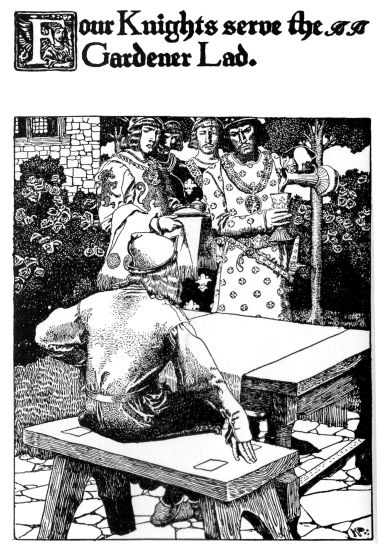
Now, that day, in the afternoon, the Lady Guinevere chanced to walk in the garden with her damsels, and with her walked those four noble knights who had been sent thither by her White Champion, to wit, Sir Gawaine, Sir Ewaine, Sir Geraint, and Sir Pellias. And the gardener’s lad was digging in the gardens; and as they passed by where he was the Lady Guinevere laughed aloud and cried out: “Look! Look! Messires and Ladies! Yonder is a very saucy fellow for to be a gardener’s lad, for he continually weareth his cap, even when he standeth in the presence of lords and ladies.”
Then Sir Gawaine up and spake, saying: “Is it even so? Now will I straightway go to yonder knave, and will take his hat off for him, and that in a way so greatly to his misliking, that I do not believe that he will ever offend by wearing it in our presence again.”
At this the Lady Guinevere laughed a very great deal. “Let be!” she said, “let be! Sir Gawaine! it would ill beseem one so gentle as thou art to have to do with yonder saucy fellow. Moreover, he doth assure us all that he hath an ugly place upon his head, wherefore let him wear his cap in God’s mercy.”
The Duke of North Umber issueth a second challenge.
Thus the Lady Guinevere, though she suspected a very great deal, was yet pleased to make a mock of him whom she suspected.
Now that day Duke Mordaunt of North Umber had entirely recovered from those sore hurts that he had suffered from his overthrow at the hands of the White Champion. Wherefore, the next morning having come, he appeared again before the castle as he had appeared aforetime—clad all in complete armor. So this time there rode before him two heralds, and when the duke and the two heralds had come to that part of the meadows that lay immediately before the castle of Cameliard, the heralds blew their trumpets exceedingly loud. So at the sound of the trumpets many people came and gathered upon the walls; and King Leodegrance came, and took stand upon a lesser tower that looked down upon the plain where were the Duke of North Umber and the two heralds. Then the Duke of North Umber lifted up his eyes and beheld King Leodegrance where he stood over above him upon the top of that tower, and he cried out in a loud voice: “What ho! King Leodegrance! Thou shalt not think because I suffered a fall from my horse through the mischance of an assault at arms, that thou art therefore quit of me. Yet, ne’theless, I do now make this fair proffer unto thee. To-morrow day I shall appear before this castle with six knights-companion. Now if thou hast any seven knights who are able to stand against me and my companions in an assault at arms—whether with spears or swords, or ahorse or afoot—then shall I engage myself for to give over all pretence whatsoever unto the hand of the Lady Guinevere. But if thou canst not provide such champions to contend successfully against me and my knights-companion, then shall I not only lay claim to Lady Guinevere, but I shall likewise seize upon and shall hold for mine own, three certain castles of thine that stand upon the borders of North Umber. And, likewise, I shall seize upon and shall hold for mine own all the lands and glebes appertaining unto those same castles. Moreover, this challenge of mine shall hold only until to-morrow at set of sun; after the which time it shall be null and void. Wherefore, King Leodegrance, thou hadst best look to it straightway to provide thee with such champions as may defend thee from these demands aforesaid.”
King Leodegrance is downcast.
Hereupon those two heralds blew their trumpets once more, and Duke Mordaunt of North Umber turned his horse about and went away from that place. Then King Leodegrance also went his way, very sorrowful and downcast in his spirits. For he said to himself: “Is it at all likely that another champion shall come unto me like that wonderful White Champion who came two days since, I know not whence, for to defend me against mine enemies? And, touching that same White Champion; if I know not whence he came, so also I know not whither he hath departed; how then shall I know where to seek him to beseech his further aid in this time of mine extremity?” Wherefore he went his way, very sorrowful, and wist not what he was to do for to defend himself. So being thus exceedingly troubled in his spirit, he went straight unto his own room, and there shut himself therein; nor would he see any man nor speak unto anyone, but gave himself over entirely unto sorrow and despair.
The Lady Guinevere beseecheth aid of the four knights.
Now in this extremity the Lady Guinevere bethought her of those four knights who had been pledged for to serve her for seven days. So she went unto them where they were and she bespoke them in this wise: “Messires, ye have been sent hither pledged for to serve me for seven days. Now I do ordain it of thee that you will take this challenge of Duke Mordaunt upon you at my behest, and I do much desire that you go forth to-morrow-day for to meet this Duke of North Umber and his knights-companion in battle. For ye are terribly powerful knights, and I do believe you may easily defend us against our enemies.”
But Sir Gawaine said, “Not so, Lady; not so! For though we are pledged unto thy service, yet are we not pledged unto the service of King Leodegrance, thy father. Nor have we quarrel of any sort with this Duke of North Umber, nor with his six knights-companion. For we are knights of King Arthur, his Court, nor may we, except at his command, take any foreign quarrel upon us in the service of another king.”
Then was the Lady Guinevere exceedingly angry, wherefore she said with great heat: “Either thou art a wonderfully faithful lord unto thy King, Sir Gawaine, or else thou fearest to meet this Duke of North Umber and his knights-companion.”
And at this speech of the Lady Guinevere’s, Sir Gawaine was also exceedingly wroth, wherefore he made reply: “An thou wert a knight and not a lady, Dame Guinevere, thou wouldst think three or four times ere thou wouldst find courage to speak those words unto me.” Whereupon he arose and went out from that place with a countenance all inflamed with wrath. And the Lady Guinevere went away also from that place and to her bower, where she wept a very great deal, both from sorrow and from anger.
King Arthur sendeth the gardener upon a mission.
Now all this while King Arthur had been very well aware of everything that passed; wherefore he by and by arose and went out and found the gardener. And he took the gardener strongly by the collar of his coat and held him where he was. And he said to him: “Sirrah! I have a command to set upon thee, and thou shalt perform that command to the letter, else, an thou perform it not, a very great deal of pain may befall thee.” Herewith speaking, he thrust his hand into the bosom of his jerkin and brought forth thence that necklace of pearls which the Lady Guinevere had given him from about her neck. And he said further unto the gardener: “Thou shalt take this necklace to the Lady Guinevere and thou shalt say to her thus: that she is to send me forthwith bread and meat and wine and comfits from her own table. And thou shalt say unto her that I desire her to summon those four knights—to wit, Sir Gawaine, Sir Ewaine, Sir Geraint, and Sir Pellias—and that she is to bid those four for to come and serve me with those things for my refreshment. And thou art to say unto her that she is to lay her commands upon those knights that they are further to serve me according as I may command, and that they are henceforth to be my servants and not her servants. And these are the commands that I lay upon thee; that thou art to say these things unto the Lady Guinevere.”
Now when the gardener heard those words he was so astonished that he wist not what to think, for he deemed that the gardener’s lad had gone altogether mad. Wherefore he lifted up his voice and cried aloud, “How now! What is this thou sayest! Verily, should I do such a thing as this thou bidst me to do, either it will cost me my life or else it will cost thee thy life. For who would dare for to say such words unto the Lady Guinevere?”
But King Arthur said: “Ne’theless, thou shalt surely do as I command thee, sirrah. For if thou disobey in one single point, then I do assure thee it will go exceedingly ill with thee. For I have it in my power for to make thee suffer as thou hast never suffered before.”
And upon this the gardener said, “I will go.” For he said unto himself, “If I do as this fellow biddeth me, then will the Lady Guinevere have him punished in great measure, and so I shall be revenged upon him for what he did unto me yesterday. Moreover, it irks me exceedingly that I should have a lad for to work in the garden who behaves as this fellow does. Wherefore,” he said, “I will go.” So he took that necklace of pearls that King Arthur gave him, and he went forth and, after awhile, he found the Lady Guinevere where she was. And when he had found her, he bespoke her in this wise:
“Lady, my garden boy hath assuredly gone entirely mad. For, under the threat of certain great harm he would do unto me an I performed not his errand, he hath sent me to offer a very grievous affront unto thee. For he hath sent me with this string of large beads for to give to thee; and he bids me to tell thee that thou art to send to him bread and meat and sweetmeats and wine, such as thou usest at thine own table; and he bids me to tell thee that these things are to be served to him by the four noble knights who came hither the day before yesterday. And he saith that thou art to command those same knights that they are to obey him in whatsoever he may command, for that they are henceforth to be his servants and not thine. And, indeed, Lady, he would listen to naught that I might say to him contrariwise, but he hath threatened me with dire injury an I came not hither and delivered this message unto thee.”
Now when the Lady Guinevere heard what the gardener said, and when she beheld the necklace which she had given unto that White Champion, and when she wist that the White Champion and the gardener’s boy were indeed one, she was uplifted with an exceeding joy; wherefore she knew not whether to laugh or whether to weep for that pure joy. So she arose and took the necklace of pearls, and she bade the gardener for to come with her. Then she went forth until she found those four knights, and when she had found them she spake unto them thus:
The Lady Guinevere commands the four knights to serve the gardener’s boy.
“My Lords, awhile sin when I commanded you for to take my quarrel with Duke Mordaunt of North Umber upon you for my sake, ye would not do so. And thou, my lord Gawaine, didst speak such angry words as are not fitting that one who serveth should speak unto his mistress, far less that a knight should speak unto the daughter of a king. Accordingly I have it in my mind that ye shall perform a certain thing by way of a penance, which, an ye refuse to do, I will know very well that ye do not intend to fulfil that word which ye plighted to my knight when he overthrew you all four in fair combat. Now my command is this: that ye take certain food prepared for my table—meats and white bread and sweetmeats and wine—and that ye take that food unto my gardener’s boy, whose cap, Sir Gawaine, thou didst threaten so valorously for to take away from him this very morning. And ye four are to serve the food unto him as though he were a royal knight. And when ye have so served him, ye are to obey him in whatsoever he may ordain. And this I put upon ye as a penalty because ye took not my quarrel upon ye as true knights should, for hereafter ye are to be servants unto that gardener’s boy and not unto me. Wherefore ye are now to go unto the buttery of the castle, and ye are to bid the sewer for to give you meats such as are served upon mine own table. And the food ye are to serve upon silver plates, and the wine ye are to serve in silver cups and goblets. And ye are to minister unto that gardener’s boy as though he were a great lord of exceeding fame and renown.”
Thus spake the Lady Guinevere, and when she had spoken, she turned and left those four knights, and she took with her the gardener, who was so astonished at that which he had heard, that he wist not whether he had gone mad or whether the Lady Guinevere had gone mad. And the Lady Guinevere bade the gardener to go to the gardener’s boy and to tell him that all things should be fulfilled according to his commands. And so the gardener did as he was told.
The four knights are angry.
Now turn we to those four knights whom the Lady Guinevere had left. For they were bemazed and abashed at the singular commands she had set upon them. And when they recovered from their amazement, they were inflamed with exceeding indignation that, for the time, they wist not whether that which they saw with their eyes was the light of day, or whether it was altogether darkness. Nor could one of them look at another in the face, so overcome were they with shame at the affront that had been put upon them. Then up and spake Sir Gawaine, and his voice so trembled with his exceeding anger that he could scarce contain it for to speak his words. “Messires,” quoth he, “do ye not see how that this lady hath wantonly put a great affront upon us because we would not do that which she this morning bade us to do, and because we would not take up her quarrel against the Duke of North Umber? Now we will indeed serve this gardener’s boy even as she hath ordained. For we will serve him with meat and drink as she hath commanded; and we will render our service unto him as she hath bidden us to do. But observe ye; we are no longer her servants, but we are his servants; wherefore we may serve him as we choose for to do. So, when we have fulfilled her commands and have served him with meat and drink, and when we have obeyed all the behests he layeth upon us; then do I make my vow that I, with mine own hand, shall slay that gardener’s boy. And when I have slain him, I will put his head into a bag, and I will send that bag unto the Lady Guinevere by the meanest carrier whom I can find for that purpose. And so this proud lady shall receive an affront as great as that affront which she hath put upon us.” And they all said that that which Sir Gawaine had planned should be exactly as he had said.
The four knights serve the gardener’s boy.
So those four lords went unto the sewer of the castle, and they asked for the best of that food which was to be served unto the Lady Guinevere—meats and bread and sweetmeats and wine. Then they took them silver plates and platters and they placed the food upon them; and they took silver cups and silver goblets and they poured the wine into them; and they went forth with these things. And when they had come back of the castle nigh to the stables, they found the gardener’s boy, and they bade him sit down and eat and to drink. And they waited upon him as though he had been some great lord. And not one of those four knights wist who he was, nor that he was the great King whose servant they, soothly, were. For he wore his cap of disguise upon his head, wherefore they deemed him to be only a poor peasant fellow.
Now when Sir Ewaine beheld that he still wore his cap before them, he spake unto him with great indignation, saying: “Ha, villian! Wouldst thou wear thy cap even in the presence of great princes and lords such as we be?”
Unto this Sir Gawaine said, “Let be, it matters not.” And then he said very bitterly unto the gardener’s boy: “Eat thou well, sirrah! For thou shalt hardly eat another meal of food upon this earth.”
To this the gardener’s boy made reply: “Sir Knight, that, haply, shall lie unto another will than thine for to determine. For maybe, I shall eat many other meals than this. And, maybe, ye shall serve at them as ye are serving me now.” And those four lords were astonished beyond measure that he should bespeak them thus so calmly and without any appearance of fear.
Then, after he had eaten, the gardener’s boy said unto those knights, “Behold, Messires, I have had enough and am done; and now I have other commands for you to fulfil. And my next command is that ye shall make ready straightway to go abroad with me, and to that end ye shall clothe yourselves with complete armor. And thou, Sir Gawaine, shalt go to the head stable-keeper of this castle, and thou shalt demand of him that he shall make ready the Lady Guinevere’s palfrey so that I may straightway ride forth upon it. And when ye are all encased in your armor, and when everything is duly appointed according to my command, ye shall bring that palfrey unto the postern gate of the castle, and there I shall meet ye for to ride forth with you.”
And Sir Gawaine said: “It shall be done in every way according as thou dost command. But when we ride forth from this castle it shall be a sorry journey for thee.”