Part 2 — PART II The Story of Sir Pellias
Reading edition
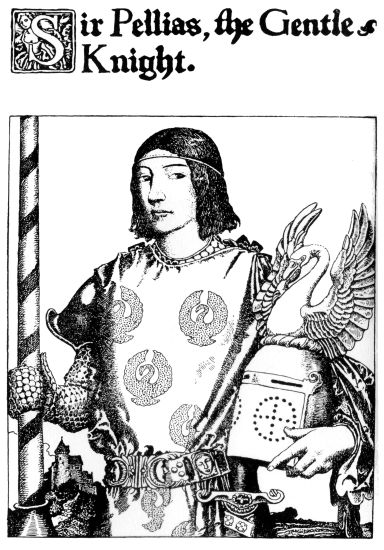
HERE followeth the story of Sir Pellias, surnamed by many the Gentle Knight.
For Sir Pellias was of such a sort that it was said of him that all women loved him without disadvantage to themselves, and that all men loved him to their great good advantage.
Wherefore, when in the end he won for his beloved that beautiful Lady of the Lake, who was one of the chiefest damoiselles of Faëry, and when he went to dwell as lord paramount in that wonderful habitation which no other mortal than he and Sir Launcelot of the Lake had ever beheld, then were all men rejoiced at his great good fortune—albeit all the Court of King Arthur grieved that he had departed so far away from them never to return again.
So I believe that you will have pleasure in reading the history of the things concerning Sir Pellias hereinafter written for your edification.
Chapter First.
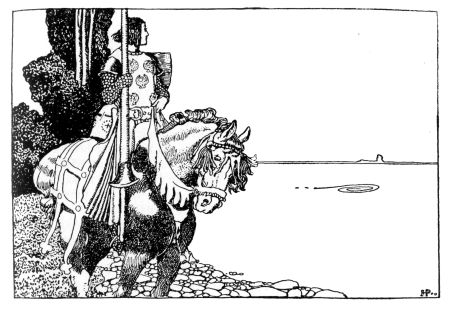
How Queen Guinevere Went a-Maying and of How Sir Pellias Took Upon Him a Quest in Her Behalf.
Queen Guinevere goeth a-Maying.
NOW it befell upon a pleasant day in the spring-time, that Queen Guinevere went a-Maying with a goodly company of Knights and Ladies of her Court. And among those Knights were Sir Pellias, and Sir Geraint, and Sir Dinadan, and Sir Aglaval, and Sir Agravaine, and Sir Constantine of Cornwall, and sundry others, so that the like of that Court was hardly to be found in all of the world, either then or before or since.
The day was exceedingly pleasant with the sunlight all yellow, like to gold, and the breeze both soft and gentle. The small birds they sang with very great joy, and all about there bloomed so many flowers of divers sorts that the entire meadows were carpeted with their tender green. So it seemed to Queen Guinevere that it was very good to be abroad in the field and beneath the sky at such a season.
There cometh a damsel to the May party.
Now as the Queen and her Court walked in great joy among the blossoms, one of the damsels attendant upon the Lady Guinevere cried out of a sudden, “Look! Look! Who is that cometh yonder?” Thereupon Queen Guinevere lifted up her eyes, and she beheld that there came across the meadows a damsel riding upon a milk-white palfrey, accompanied by three pages clad in sky-blue raiment. That damsel was also clad entirely in azure, and she wore a finely wrought chain of gold about her neck and a fillet of gold about her brows, and her hair, which was as yellow as gold, was wrapped all about with bands of blue ribbon embroidered with gold. And one of the pages that followed the damsel bare a square frame of no very great size, and that the frame was enveloped and covered with a curtain of crimson satin.
Now when the Queen beheld that goodly company approaching, she bade one of the knights attendant upon her for to go forth to meet the damsel. And the knight who went forth in obedience to her command was Sir Pellias.
Sir Pellias talketh with the damsel.
So when Sir Pellias met the damsel and her three pages, he spake to her in this wise: “Fair damsel, I am commanded by yonder lady for to greet you and to crave of you the favor of your name and purpose.”
“Sir Knight,” said the damsel, “I do perceive from your countenance and address that you are some lord of very high estate and of great nobility, wherefore I will gladly tell to you that my name is Parcenet, and that I am a damsel belonging to the Court of a certain very high dame who dwelleth at a considerable distance from here, and who is called the Lady Ettard of Grantmesnle. Now I come hitherward desiring to be admitted into the presence of Queen Guinevere. Accordingly, if you can tell me whereabout I may find that noble lady, I shall assuredly be very greatly beholden unto you.”
“Ha, Lady!” quoth Sir Pellias, “thou shalt not have very far to go to find Queen Guinevere; for, behold! yonder she walketh, surrounded by her Court of Lords and Ladies.” Then the damsel said, “I prithee bring me unto her.”
So Sir Pellias led Parcenet unto the Queen, and Queen Guinevere received her with great graciousness of demeanor, saying, “Damsel, what is it that ye seek of us?”
The damsel telleth Queen Guinevere of the Lady Ettard.
“Lady,” quoth the damsel, “I will tell you that very readily. The Lady Ettard, my mistress, is considered by all in those parts where she dwelleth to be the most beautiful lady in the world. Now, of late, there hath come such a report of your exceeding beauty that the Lady Ettard hath seen fit for to send me hitherward to see with mine own eyes if that which is recorded of you is soothly true. And indeed, Lady, now that I stand before you, I may not say but that you are the fairest dame that ever mine eyes beheld unless it be the Lady Ettard aforesaid.”
Then Queen Guinevere laughed with very great mirth. And she said, “It appears to me to be a very droll affair that thou shouldst have travelled so great a distance for so small a matter.” Then she said, “Tell me, damsel, what is that thy page beareth so carefully wrapped up in that curtain of crimson satin?”
“Lady,” quoth the damsel, “it is a true and perfect likeness of the Lady Ettard, who is my mistress.”
Then Queen Guinevere said, “Show it to me.”
The damsel showeth the Lady Ettard’s picture to the Queen and her Court.
Upon this the page who bore the picture dismounted from his palfrey and, coming to Queen Guinevere, he kneeled down upon one knee and uncovered the picture so that the Queen and her Court might look upon it. Thereupon they all beheld that that picture was painted very cunningly upon a panel of ivory framed with gold and inset with many jewels of divers colors. And they saw that it was the picture of a lady of such extraordinary beauty that all they who beheld it marvelled thereat. “Hey, damsel!” quoth Queen Guinevere, “thy lady is, indeed, graced with wonderful beauty. Now if she doth in sooth resemble that picture, then I believe that her like to loveliness is not to be found anywhere in the world.”
Upon this Sir Pellias spake out and said, “Not so, Lady; for I do protest, and am willing to maintain my words with the peril of my body, that thou thyself art much more beautiful than that picture.”
“Hey day, Sir Knight!” quoth the damsel Parcenet, “it is well that thou dost maintain that saying so far away from Grantmesnle; for at that place is a certain knight, hight Sir Engamore of Malverat, who is a very strong knight indeed, and who maintaineth the contrary to thy saying in favor of the Lady Ettard against all comers who dare to encounter him.”
Sir Pellias assumes the adventure in honor of the Queen.
Then Sir Pellias kneeled down before Queen Guinevere, and set his palms together. “Lady,” he said, “I do pray thee of thy grace that thou wilt so far honor me as to accept me for thy true knight in this matter. For I would fain assay an adventure in thy behalf if I have thy permission for to do so. Wherefore, if thou grantest me leave, I will straightway go forth to meet this knight of whom the damsel speaketh, and I greatly hope that when I find him I shall cause his overthrow to the increasing of thy glory and honor.”
Then Queen Guinevere laughed again with pure merriment. “Sir,” quoth she, “it pleases me beyond measure that thou shouldst take so small a quarrel as this upon thee in my behalf. For if, so be, thou dost assume so small a quarrel, then how much more wouldst thou take a serious quarrel of mine upon thee? Wherefore I do accept thee very joyfully for my champion in this affair. So go thou presently and arm thyself in such a way as may be fitting for this adventure.”
“Lady,” said Sir Pellias, “if I have thy leave, I will enter into this affair clad as I am. For I entertain hopes that I shall succeed in winning armor and accoutrements upon the way, in the which case this adventure will be still more to thy credit than it would otherwise be.”
At this the Queen was very much pleased, that her knight should undertake so serious an adventure clad only in holiday attire; wherefore she said, “Let it be as thou wouldst have it.” Thereupon she bade her page, Florian, for to go fetch the best horse that he might obtain for Sir Pellias; and Florian, running with all speed, presently returned with a noble steed, so black of hue that I believe there was not a single white hair upon him.
Then Sir Pellias gave adieu to Queen Guinevere, and her merry May-court, and they gave him adieu and great acclaim, and thereupon he mounted his horse and rode away with the damsel Parcenet and the three pages clad in blue.
Now when these had gone some distance the damsel Parcenet said, “Sir, I know not thy name or thy condition, or who thou art?”
Unto this Sir Pellias said, “Damsel, my name is Pellias and I am a knight of King Arthur’s Round Table.”
Sir Pellias and Parcenet discourse together.
At that Parcenet was very much astonished, for Sir Pellias was held by many to be the best knight-at-arms alive, saving only King Arthur and King Pellinore. Wherefore she cried out, “Messire, it will assuredly be a very great honor for Sir Engamore to have to do with so famous a knight as thou.” Unto this Sir Pellias said, “Damsel, I think there are several knights of King Arthur’s Round Table who are better knights than I.” But Parcenet said, “I cannot believe that to be the case.”
Then after awhile Parcenet said to Sir Pellias, “Messire, how wilt thou get thyself armor for to fight Sir Engamore?” “Maiden,” said Sir Pellias, “I do not know at these present where I shall provide me armor; but before the time cometh for me to have to do with Sir Engamore, I have faith that I shall find armor fit for my purpose. For thou must know that it is not always the defence that a man weareth upon his body that bringeth him success, but more often it is the spirit that uplifteth him unto his undertakings.”
Then Parcenet said, “Sir Pellias, I do not believe that it is often the case that a lady hath so good a knight as thou for to do battle in her behalf.” To which Sir Pellias said very cheerfully, “Damsel, when thy time cometh I wish that thou mayst have a very much better knight to serve thee than I.” “Sir,” quoth Parcenet, “such a thing as that is not likely to befall me.” At the which Sir Pellias laughed with great lightness of heart. Then Parcenet said, “Heigh ho! I would that I had a good knight for to serve me.”
To this Sir Pellias made very sober reply, “Maiden, the first one that I catch I will give unto thee for thy very own. Now wouldst thou have him fair or dark, or short or tall? For if thou wouldst rather have him short and fair I will let the tall, dark one go; but if thou wouldst have him tall and dark, I will let go the other sort.”
Then Parcenet looked very steadily at Sir Pellias, and she said, “I would have him about as tall as thou art, and with the same color of hair and eyes, and with a straight nose like unto thine, and with a good wit such as thou hast.”
“Alas!” said Sir Pellias, “I would that thou hadst told me this before we had come so far from Camelot; for I could easily have got thee such a knight at that place. For they have them there in such plenty that they keep them in wicker cages, and sell them two for a farthing.” Whereat Parcenet laughed very cheerfully, and said, “Then Camelot must be a very wonderful place, Sir Pellias.”
So, with very merry discourse they journeyed upon their way with great joy and good content, taking much pleasure in the spring-time and the pleasant meadows whereon they travelled, being without care of any sort, and heart-full of cheerfulness and good-will.
That night they abided at a very quaint, pleasant hostelry that stood at the outskirts of the Forest of Usk, and the next morning they departed betimes in the freshness of the early day, quitting that place and entering into the forest shadows.
Sir Pellias and Parcenet come to the Forest of Adventure.
Now, after they had travelled a considerable distance in that forest, the damsel Parcenet said to Sir Pellias, “Sir, do you know what part of the woods this is?” “Nay,” said Sir Pellias. “Well,” said Parcenet, “this part of the woodland is sometimes called Arroy, and is sometimes called the Forest of Adventure. For I must tell you it is a very wonderful place, full of magic of sundry sorts. For it is said that no knight may enter into this forest but some adventure shall befall him.”
“Damsel,” said Sir Pellias, “that which thou tellest me is very good news. For, maybe, if we should fall in with some adventure at this place I may then be able to obtain armor suitable for my purpose.”
So they entered the Forest of Adventure forthwith, and then travelled therein for a long way, marvelling greatly at the aspect of that place into which they were come. For the Forest was very dark and silent and wonderfully strange and altogether different from any other place that they had ever seen. Wherefore it appeared to them that it would not be at all singular if some extraordinary adventure should befall them.
They find an old woman beside the fountain.
So after they had travelled in this wise for a considerable pass they came of a sudden out of those thicker parts of the woodland to where was an opening of considerable extent. And there they beheld before them a violent stream of water that flowed very turbulently and with great uproar of many noises. And they saw that by the side of the stream of water there was a thorn-tree, and that underneath the thorn-tree was a bank of green moss, and that upon the bank of moss there sat an aged woman of a very woful appearance. For that old woman was extraordinarily withered with age, and her eyes were all red as though with a continual weeping of rheum, and many bristles grew upon her cheeks and her chin, and her face was covered with such a multitude of wrinkles that there was not any place that was free from wrinkles.
Now when that old woman beheld Sir Pellias and Parcenet and the three pages approaching where she sat, she cried out in a loud voice, “Sir, wilt thou not bear me over this water upon thy horse? For, lo! I am very old and feeble and may not cross this river by myself.”
Then Parcenet rebuked the old woman, saying, “Peace, be still! Who art thou to ask this noble knight for to do thee such a service as that?”
Sir Pellias carries the old woman across the water.
Then Sir Pellias was not pleased with Parcenet, wherefore he said, “Damsel, thou dost not speak properly in this matter, for that which beseemeth a true knight is to give succor unto anyone soever who needeth his aid. For King Arthur is the perfect looking-glass of knighthood, and he hath taught his knights to give succor unto all who ask succor of them, without regarding their condition.” So saying Sir Pellias dismounted from his horse and lifted the old woman up upon the saddle thereof. Then he himself mounted once more and straightway rode into the ford of the river and so came across the torrent with the old woman in safety to the other side. And Parcenet followed him, marvelling very greatly at his knightliness, and the three pages followed her.
Of the wonderful Lady of the Lake.
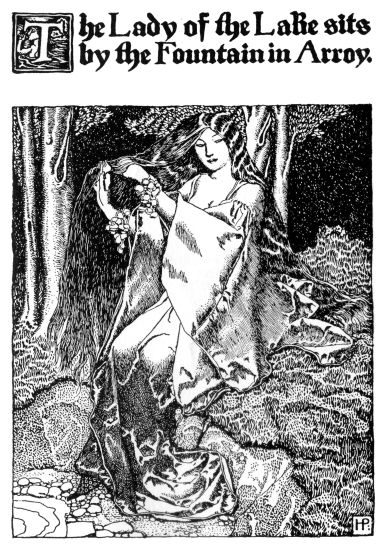
Now when they had reached the other side of the water, Sir Pellias dismounted with intent to aid the old woman to alight from the horse. But she waited not for his aid, but immediately leaped down very lightly from where she was. And, lo! Sir Pellias beheld that she whom he had thought to be only an aged and withered beldame was, in truth, a very strange, wonderful lady of extraordinary beauty. And, greatly marvelling, he beheld that she was clad in apparel of such a sort as neither he nor any who were there had ever beheld before. And because of her appearance he was aware that she was not like any ordinary mortal, but that she was doubtless of enchantment. For he perceived that her face was of a wonderful clearness, like to ivory for whiteness, and that her eyes were very black and extraordinarily bright, like unto two jewels set into ivory; and he perceived that she was clad all in green from head to foot and that her hair was long and perfectly black and like to fine silk for softness and for glossiness; and he perceived that she had about her neck a collar of opal stones and emeralds inset into gold, and that about her wrists were bracelets of finely wrought gold inset with opal stones and emeralds. Wherefore from all these circumstances he knew that she must be fay.
(For thus was the Lady Nymue of the Lake; and so had she appeared unto King Arthur, and so did she appear unto Sir Pellias and those who were with him.)
So, beholding the wonderful magical quality of that lady, Sir Pellias kneeled down before her and set his hands together, palm to palm. But the Lady of the Lake said, “Sir, why dost thou kneel to me?” “Lady,” quoth Sir Pellias, “because thou art so wonderfully strange and beautiful.” “Messire,” said the Lady of the Lake, “thou hast done a very good service to me and art, assuredly, a very excellent knight. Wherefore, arise and kneel no longer!” So Sir Pellias arose from his knees and stood before her, and he said, “Lady, who art thou?” To the which she made reply, “I am one who holdeth an exceedingly kind regard toward King Arthur and all his knights. My name is Nymue and I am the chiefest of those Ladies of the Lake of whom thou mayst have heard tell. I took upon me that form of a sorry old woman for to test thy knightliness, and, lo! I have not found thee amiss in worthy service.” Then Sir Pellias said, “Lady, thou hast assuredly done me great favor in these.” Upon that the Lady of the Lake smiled upon Sir Pellias very kindly, and she said, “Sir, I have a mind to do thee a greater favor than that.”
The Lady of the Lake giveth Sir Pellias the collar of gold and jewels.
Therewith, so saying, she immediately took from about her neck that collar of opal stones, of emeralds and gold, and hung it about the shoulders of Sir Pellias, so that it hung down upon his breast with a very wonderful glory of variegated colors.
“Keep this,” she said, “for it is of very potent magic.”
Upon that she vanished instantly from the sight of those who were there, leaving them astonished and amazed beyond measure at what had befallen.
And Sir Pellias was like one who was in a dream, for he wist not whether that which he had beheld was a vision, or whether he had seen it with his waking eyes. Wherefore he mounted upon his horse in entire silence, as though he knew not what he did. And likewise in entire silence he led the way from that place. Nor did any of those others speak at that time; only after they had gone a considerable distance Parcenet said, speaking in a manner of fear, “Messire, that was a very wonderful thing that befell us.” To which Sir Pellias said, “Yea, maiden.”
Now that necklace which the Lady of the Lake had hung about the neck of Sir Pellias possessed such a virtue that whosoever wore it was beloved of all those who looked upon him. For the collar was enchanted with that peculiar virtue; but Sir Pellias was altogether unaware of that circumstance, wherefore he only took joy to himself because of the singular beauty of the jewel which the Lady of the Lake had given him.

Chapter Second.

How Sir Pellias Overcame a Red Knight, Hight Sir Adresack, and of How He Liberated XXII Captives From That Knight’s Castle.
NOW, after that wonderful happening, they journeyed continuously for a great while. Nor did they pause at any place until they came, about an hour after the prime of the day, to a certain part of the forest where charcoal-burners were plying their trade. Here Sir Pellias commanded that they should draw rein and rest for a while, and so they dismounted for to rest and to refresh themselves, as he had ordained that they should do.
There cometh a sorrowful lady and an esquire into the forest.
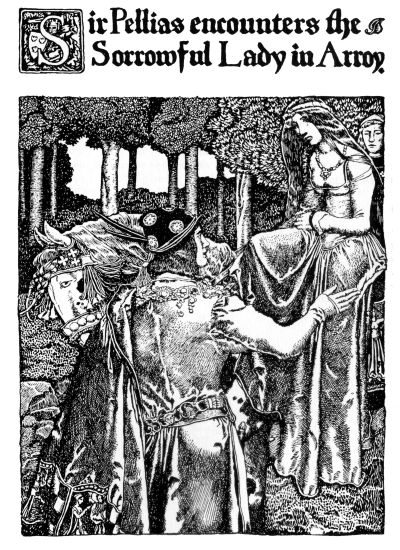
Now as they sat there refreshing themselves with meat and drink, there came of a sudden from out of the forest a sound of great lamentation and of loud outcry, and almost immediately there appeared from the thickets, coming into that open place, a lady in woful array, riding upon a pied palfrey. And behind her rode a young esquire, clad in colors of green and white and seated upon a sorrel horse. And he also appeared to be possessed of great sorrow, being in much disarray and very downcast of countenance. And the lady’s face was all beswollen and inflamed with weeping, and her hair hung down upon her shoulders with neither net nor band for to stay it in place, and her raiment was greatly torn by the brambles and much stained with forest travel. And the young esquire who rode behind her came with a drooping head and a like woful disarray of apparel, his cloak dragging behind him and made fast to his shoulder by only a single point.
Now when Sir Pellias beheld the lady and the esquire in such sad estate, he immediately arose from where he sat and went straightway to the lady and took her horse by the bridle and stayed it where it was. And the lady looked at him, yet saw him not, being altogether blinded by her grief and distraction. Then Sir Pellias said to her, “Lady, what ails thee that thou sorrowest so greatly?” Whereunto she made reply, “Sir, it matters not, for thou canst not help me.” “How know ye that?” said Sir Pellias, “I have a very good intention for to aid thee if it be possible for me to do so.”
Then the lady looked more narrowly at Sir Pellias, and she perceived him as though through a mist of sorrow. And she beheld that he was not clad in armor, but only in a holiday attire of fine crimson cloth. Wherefore she began sorrowing afresh, and that in great measure, for she deemed that here was one who could give her no aid in her trouble. Wherefore she said, “Sir, thy intentions are kind, but how canst thou look to give me aid when thou hast neither arms nor defences for to help thee in taking upon thee such a quarrel?” But Sir Pellias said, “Lady, I know not how I may aid thee until that thou tellest me of thy sorrow. Yet I have good hope that I may serve thee when I shall know what it is that causes thee such disorder of mind.” Thereupon, still holding the horse by the bridle, he brought the lady forward to that place where Parcenet still sat beside the napkin spread with food with which they had been refreshing themselves. And when he had come to that place, he, with all gentleness, constrained the lady for to dismount from her horse. Then, with equal gentleness, he compelled her to sit down upon the grass and to partake of the food. And when she had done so, and had drunk some of the wine, she found herself to be greatly refreshed and began to take to herself more heart of grace. Thereupon, beholding her so far recovered, Sir Pellias again demanded of her what was her trouble and besought her that she would open her heart unto him.
So, being encouraged by his cheerful words, she told to Sir Pellias the trouble that had brought her to that pass.
The sorrowful lady telleth her story.
“Sir Knight,” she said, “the place where I dwell is a considerable distance from this. Thence I came this morning with a very good knight, hight Sir Brandemere, who is my husband. We have been married but for a little over four weeks, so that our happiness until this morning was as yet altogether fresh with us. Now this morning Sir Brandemere would take me out a-hunting at the break of day, and so we went forth with a brachet of which my knight was wonderfully fond. So, coming to a certain place in the forest, there started up of a sudden from before us a doe, which same the brachet immediately pursued with great vehemence of outcry. Thereupon, I and my lord and this esquire followed thereafter with very great spirit and enjoyment of the chase. Now, when we had followed the doe and the hound for a great distance—the hound pursuing the doe with a great passion of eagerness—we came to a certain place where we beheld before us a violent stream of water which was crossed by a long and narrow bridge. And we beheld that upon the other side of the stream there stood a strong castle with seven towers, and that the castle was built up upon the rocks in such a way that the rocks and the castle appeared to be altogether like one rock.
“Now, as we approached the bridge aforesaid, lo! the portcullis of the castle was lifted up and the drawbridge was let fall very suddenly and with a great noise, and there immediately issued forth from out of the castle a knight clad altogether in red. And all the trappings and the furniture of his horse were likewise of red; and the spear which he bore in his hand was of ash-wood painted red. And he came forth very terribly, and rode forward so that he presently stood at the other end of that narrow bridge. Thereupon he called out aloud to Sir Brandemere, my husband, saying: ‘Whither wouldst thou go, Sir Knight?’ And unto him Sir Brandemere made reply: ‘Sir, I would cross this bridge, for my hound, which I love exceedingly, hath crossed here in pursuit of a doe.’ Then that Red Knight cried out in a loud voice, ‘Sir Knight, thou comest not upon this bridge but at thy peril; for this bridge belongeth unto me, and whosoever would cross it must first overthrow me or else he may not cross.’
“Now, my husband, Sir Brandemere, was clad at that time only in a light raiment such as one might wear for hunting or for hawking; only that he wore upon his head a light bascinet enwrapped with a scarf which I had given him. Ne’theless, he was so great of heart that he would not abide any challenge such as that Red Knight had given unto him; wherefore, bidding me and this esquire (whose name is Ponteferet) to remain upon the farther side of the bridge, he drew his sword and rode forward to the middle of the bridge with intent to force a way across if he was able so to do. Whereupon, seeing that to be his intent, that Red Knight, clad all in complete armor, cast aside his spear and drew his sword and rode forward to meet my knight. So they met in the middle of the bridge, and when they had thus met that Red Knight lifted himself in his stirrup and smote my husband, Sir Brandemere, upon the crown of his bascinet with his sword. And I beheld the blade of the Red Knight’s sword that it cut through the bascinet of Sir Brandemere and deep into his brain-pan, so that the blood ran down upon the knight’s face in great abundance. Then Sir Brandemere straightway fell down from his horse and lay as though he were gone dead.
“Having thus overthrown him, that Red Knight dismounted from his horse and lifted up Sir Brandemere upon the horse whence he had fallen so that he lay across the saddle. Then taking both horses by the bridles the Red Knight led them straight back across the bridge and so into his castle. And as soon as he had entered into the castle the portcullis thereof was immediately closed behind him and the drawbridge was raised. Nor did he pay any heed whatever either to me or to the esquire Ponteferet, but he departed leaving us without any word of cheer; nor do I now know whether my husband, Sir Brandemere, is living or dead, or what hath befallen him.”
And as the lady spake these words, lo! the tears again fell down her face in great abundance.
Sir Pellias assumes an adventure upon relief of the sorrowful lady.
Then Sir Pellias was very much moved with compassion, wherefore he said, “Lady, thy case is, indeed, one of exceeding sorrowfulness, and I am greatly grieved for thee. And, indeed, I would fain aid thee to all the extent that is in my power. So, if thou wilt lead me to where is this bridge and that grimly castle of which thou speakest, I make thee my vow that I will assay to the best of my endeavor to learn of the whereabouts of thy good knight, and as to what hath befallen him.”
“Sir,” said the lady, “I am much beholden unto thee for thy good will. Yet thou mayst not hope for success shouldst thou venture to undertake so grave an adventure as that without either arms or armor for to defend thyself. For consider how grievously that Red Knight hath served my husband, Sir Brandemere, taking no consideration as to his lack of arms or defence. Wherefore, it is not likely that he will serve thee any more courteously.” And to the lady’s words Parcenet also lifted up a great voice, bidding Sir Pellias not to be so unwise as to do this thing that he was minded to do. And so did Ponteferet, the esquire, also call out upon Sir Pellias, that he should not do this thing, but that he should at least take arms to himself ere he entered upon this adventure.
But to all that they said Sir Pellias replied, “Stay me not in that which I would do, for I do tell you all that I have several times undertaken adventures even more perilous than this and yet I have ’scaped with no great harm to myself.” Nor would he listen to anything that the lady and the damsel might say, but, arising from that place, he aided the lady and the damsel to mount their palfreys. Then mounting his own steed, and the esquire and the pages having mounted their steeds, the whole party immediately departed from that place.
They come to the castle of the Red Knight.
So they journeyed for a great distance through the forest, the esquire, Ponteferet, directing them how to proceed in such a way as should bring them by and by to the castle of the Red Knight. So, at last they came to a more open place in that wilderness where was a steep and naked hill before them. And when they had reached to the top of that hill they perceived beneath them a river, very turbulent and violent. Likewise they saw that the river was spanned by a bridge, exceedingly straight and narrow, and that upon the farther side of the bridge and of the river there stood a very strong castle with seven tall towers. Moreover the castle and the towers were built up upon the rocks, very lofty and high, so that it was hard to tell where the rocks ceased and the walls began, wherefore the towers and the walls appeared to be altogether one rock of stone.
Then the esquire, Ponteferet, pointed with his finger, and said, “Sir Knight, yonder is the castle of the Red Knight, and into it he bare Sir Brandemere after he had been so grievously wounded.” Then Sir Pellias said unto the lady, “Lady, I will presently inquire as to thy husband’s welfare.”
Therewith he set spurs to his horse and rode down the hill toward the bridge with great boldness. And when he had come nigher to the bridge, lo! the portcullis of the castle was lifted and the drawbridge was let fall with a great noise and tumult, and straightway there issued forth from out of the castle a knight clad all in armor and accoutrements of red, and this knight came forward with great speed toward the bridge’s head. Then, when Sir Pellias saw him approaching so threateningly, he said unto those who had followed him down the hill: “Stand fast where ye are and I will go forth to bespeak this knight, and inquire into the matter of that injury which he hath done unto Sir Brandemere.” Upon this the esquire, Ponteferet, said unto him, “Stay, Sir Knight, thou wilt be hurt.” But Sir Pellias said, “Not so, I shall not be hurt.”
So he went forth very boldly upon the bridge, and when the Red Knight saw him approach, he said, “Ha! who art thou who darest to come thus upon my bridge?”
Unto him Sir Pellias made reply, “It matters not who I am, but thou art to know, thou discourteous knight, that I am come to inquire of thee where thou hast disposed of that good knight Sir Brandemere, and to ask of thee why thou didst entreat him so grievously a short time since.”
At this the Red Knight fell very full of wrath. “Ha! ha!” he cried vehemently, “that thou shalt presently learn to thy great sorrow, for as I have served him, so shall I quickly serve thee, so that in a little while I shall bring thee unto him; then thou mayst ask him whatsoever thou dost list. But seeing that thou art unarmed and without defence, I would not do thee any bodily ill, wherefore I demand of thee that thou shalt presently surrender thyself unto me, otherwise it will be very greatly to thy pain and sorrow if thou compellest me to use force for to constrain thy surrender.”
Then Sir Pellias said, “What! what! Wouldst thou thus assail a knight who is altogether without arms or defence as I am?” And the Red Knight said, “Assuredly shall I do so if thou dost not immediately yield thyself unto me.”
“Then,” quoth Pellias, “thou art not fit for to be dealt with as beseemeth a tried knight. Wherefore, should I encounter thee, thy overthrow must be of such a sort as may shame any belted knight who weareth golden spurs.”
Sir Pellias overthroweth the Red Knight with a great stone.
Thereupon he cast about his eyes for a weapon to fit his purpose, and he beheld how that a certain huge stone was loose upon the coping of the bridge. Now this stone was of such a size that five men of usual strength could hardly lift it. But Sir Pellias lifted it forth from its place with great ease, and, raising it with both hands, he ran quickly toward that Red Knight and flung the rock at him with much force. And the stone smote the Red Knight upon the middle of the shield and drave it back upon his breast, with great violence. And the force of the blow drave the knight backward from his saddle, so that he fell down to the earth from his horse with a terrible tumult and lay upon the bridgeway like one who was altogether dead.
And when they within the castle who looked forth therefrom, saw that blow, and when they beheld the overthrow of the Red Knight, they lifted up their voices in great lamentation so that the outcry thereof was terrible to hear.
But Sir Pellias ran with all speed to the fallen knight and set his knee upon his breast. And he unlaced his helmet and lifted it. And he beheld that the face of the knight was strong and comely and that he was not altogether dead.
So when Sir Pellias saw that the Red Knight was not dead, and when he perceived that he was about to recover his breath from the blow that he had suffered, he drew that knight’s misericordia from its sheath and set the point to his throat, so that when the Red Knight awoke from his swoon he beheld death, in the countenance of Sir Pellias and in the point of the dagger.
So when the Red Knight perceived how near death was to him he besought Sir Pellias for mercy, saying, “Spare my life unto me!” Whereunto Sir Pellias said, “Who art thou?” And the knight said, “I am hight Sir Adresack, surnamed of the Seven Towers.” Then Sir Pellias said to him, “What hast thou done unto Sir Brandemere and how doth it fare with that good knight?” And the Red Knight replied, “He is not so seriously wounded as you suppose.”
Now when Sir Brandemere’s lady heard this speech she was greatly exalted with joy, so that she smote her hands together, making great cry of thanksgiving.
But Sir Pellias said, “Now tell me, Sir Adresack, hast thou other captives beside that knight, Sir Brandemere, at thy castle?” To which Sir Adresack replied, “Sir Knight, I will tell thee truly; there are in my castle one and twenty other captives besides him: to wit, eighteen knights and esquires of degree and three ladies. For I have defended this bridge for a long time and all who have undertaken to cross it, those have I taken captive and held for ransom. Wherefore I have taken great wealth and gained great estate thereby.”
Sir Pellias layeth his injunctions upon the Red Knight.
Then Sir Pellias said, “Thou art soothly a wicked and discourteous knight so to serve travellers that come thy way, and I would do well for to slay thee where thou liest. But since thou hast besought mercy of me I will grant it unto thee, though I will do so only with great shame unto thy knighthood. Moreover, if I spare to thee thy life there are several things which thou must perform. First thou must go unto Queen Guinevere at Camelot, and there must thou say unto her that the knight who left her unarmed hath taken thine armor from thee and hath armed himself therewith for to defend her honor. Secondly, thou must confess thy faults unto King Arthur as thou hast confessed them unto me and thou must beg his pardon for the same, craving that he, in his mercy, shall spare thy life unto thee. These are the things that thou must perform.”
To this Sir Adresack said, “Very well, these things do I promise to perform if thou wilt spare my life.”
Sir Pellias assumes the armor of Sir Adresack.
Then Sir Pellias permitted him to arise and he came and stood before Sir Pellias. And Sir Pellias summoned the esquire, Ponteferet, unto him, and he said, “Take thou this knight’s armor from off of his body and put it upon my body as thou knowest how to do.” And Ponteferet did as Sir Pellias bade him. For he unarmed Sir Adresack and he clothed Sir Pellias in Sir Adresack’s armor, and Sir Adresack stood ashamed before them all. Then Sir Pellias said unto him, “Now take me into thy castle that I may there liberate those captives that thou so wickedly holdest as prisoners.” And Sir Adresack said, “It shall be done as thou dost command.”
Thereupon they all went together unto the castle and into the castle, which was an exceedingly stately place. And there they beheld a great many servants and attendants, and these came at the command of Sir Adresack and bowed themselves down before Sir Pellias. Then Sir Pellias bade Sir Adresack for to summon the keeper of the dungeon, and Sir Adresack did so. And Sir Pellias commanded the keeper that he should conduct them unto the dungeon, and the keeper bowed down before him in obedience.
Now when they had come to that dungeon they beheld it to be a very lofty place and exceedingly strong. And there they found Sir Brandemere and those others of whom Sir Adresack had spoken.
Sir Pellias liberates the captives.
But when that sorrowful lady perceived Sir Brandemere, she ran unto him with great voice of rejoicing and embraced him and wept over him. And he embraced her and wept and altogether forgot his hurt in the joy of beholding her again.
And in the several apartments of that part of the castle, there were in all eighteen knights and esquires, and three ladies besides Sir Brandemere. Moreover, amongst those knights were two from King Arthur’s Court: to wit, Sir Brandiles and Sir Mador de la Porte. Whereupon these beholding that it was Sir Pellias who had liberated them, came to him and embraced him with great joy and kissed him upon either cheek.
And all those who were liberated made great rejoicing and gave Sir Pellias such praise and acclaim that he was greatly contented therewith.
Then when Sir Pellias beheld all those captives who were in the dungeon he was very wroth with Sir Adresack, wherefore he turned unto him and said, “Begone, Sir Knight, for to do that penance which I imposed upon thee to perform, for I am very greatly displeased with thee, and fear me lest I should repent me of my mercy to thee.”
Thereupon Sir Adresack turned him away and he immediately departed from that place. And he called to him his esquire and he took him and rode away to Camelot for to do that penance which he had promised Sir Pellias to do.
Then, after he was gone, Sir Pellias and those captives whom he had liberated, went through the divers parts of the castle. And there they found thirteen chests of gold and silver money and four caskets of jewels—very fine and of great brilliancy—all of which treasure had been paid in ransom by those captives who had aforetime been violently held prisoners at that place.
And Sir Pellias ordained that all those chests and caskets should be opened, and when those who were there looked therein, the hearts of all were wonderfully exalted with joy at the sight of that great treasure.
Sir Pellias divideth the treasures of Sir Adresack among the captives.
Then Sir Pellias commanded that all that treasure of gold and silver should be divided into nineteen equal parts, and when it had been so divided, he said, “Now let each of you who have been held captive in this place, take for his own one part of that treasure as a recompense for those sorrows which he hath endured.” Moreover, to each of the ladies who had been held as captives in that place, he gave a casket of jewels, saying unto her, “Take thou this casket of jewels as a recompense for that sorrow which thou hast suffered. And unto Sir Brandemere’s lady he gave a casket of the jewels for that which she had endured.
But then those who were there beheld that Sir Pellias reserved no part of that great treasure for himself, they all cried out upon him: “Sir Knight! Sir Knight! How is this? Behold, thou hast set aside no part of this treasure for thyself.”
Then Sir Pellias made answer: “You are right, I have not so. For it needs not that I take any of this gold and silver, or any of these jewels, for myself. For, behold! ye have suffered much at the hands of Sir Adresack, wherefore ye should receive recompense therefore, but I have suffered naught at his hands, wherefore I need no such recompense.”
Then were they all astonished at his generosity and gave him great praise for his largeness of heart. And all those knights vowed unto him fidelity unto death.
They abide at the castle of Sir Brandemere.
Then, when all these things were accomplished, Sir Brandemere implored all who were there that they would come with him unto his castle, so that they might refresh themselves with a season of mirth and good faring. And they all said that they would go with him, and they did go. And at the castle of Sir Brandemere there was great rejoicing with feasting and jousting for three days.
And all who were there loved Sir Pellias with an astonishing love because of that collar of emeralds and opals and of gold. Yet no one knew of the virtue of that collar, nor did Sir Pellias know of it.
So Sir Pellias abided at that place for three days. And when the fourth day was come he arose betimes in the morning and bade saddle his horse, and the palfrey of the damsel Parcenet, and the horses of their pages.
Then when all those who were there saw that he was minded to depart, they besought him not to go, but Sir Pellias said, “Stay me not, for I must go.”
Then came to him those two knights of Arthur’s Court, Sir Brandiles and Sir Mador de la Porte, and they besought him that he would let them go with him upon that adventure. And at first Sir Pellias forbade them but they besought him the more, so that at last he was fain to say, “Ye shall go with me.”
So he departed from that place with his company, and all those who remained gave great sorrow that he had gone away.
Chapter Third.

How Sir Pellias Did Battle With Sir Engamore, Otherwise the Knight of the Green Sleeves, and of What Befell the Lady Ettard.
NOW Sir Pellias and his party and the damsel Parcenet and her party travelled onward until after awhile in the afternoon they came unto the utmost boundaries of the forest, where the woodlands ceased altogether and many fields and meadows, with farms and crofts and plantations of trees all a-bloom with tender leaves and fragrant blossoms, lay spread out beneath the sky.
And Sir Pellias said, “This is indeed a very beautiful land into which we have come.” Whereat the damsel Parcenet was right well pleased, for she said, “Sir, I am very glad that that which thou seest belikes thee; for all this region belongeth unto the Lady Ettard, and it is my home. Moreover, from the top of yonder hill one mayst behold the castle of Grantmesnle which lieth in the valley beneath.” Then Sir Pellias said, “Let us make haste! For I am wonderfully desirous of beholding that place.”
They reach Grantmesnle.
So they set spurs to their horses and rode up that hill at a hand gallop. And when they had reached the top thereof, lo! beneath them lay the Castle of Grantmesnle in such a wise that it was as though upon the palm of a hand. And Sir Pellias beheld that it was an exceedingly fair castle, built altogether without of a red stone, and containing many buildings of red brick within the wall. And behind the walls there lay a little town, and from where they stood they could behold the streets thereof, and the people coming and going upon their businesses. So Sir Pellias, beholding the excellence of that castle, said, “Certes, maiden, yonder is a very fair estate.”
“Yea,” said Parcenet; “we who dwell there do hold it to be a very excellent estate.”
Then Sir Pellias said to Parcenet: “Maiden, yonder glade of young trees nigh unto the castle appeareth to be a very cheerful spot. Wherefore at that place I and my companions in arms will take up our inn. There, likewise, we will cause to be set up three pavilions for to shelter us by day and by night. Meantime, I beseech of thee, that thou wilt go unto the lady, thy mistress, and say unto her that a knight hath come unto this place, who, albeit he knoweth her not, holdeth that the Lady Guinevere of Camelot is the fairest lady in all of the world. And I beseech thee to tell the lady that I am here to maintain that saying against all comers at the peril of my body. Wherefore, if the lady have any champion for to undertake battle in her behalf, him will I meet in yonder field to-morrow at mid-day a little before I eat my mid-day meal. For at that time I do propose for to enter into yonder field, and to make parade therein until my friends bid me for to come in to my dinner; and I shall take my stand in that place in honor of the Lady Guinevere of Camelot.”
“Sir Pellias,” said the damsel, “I will even do as thou desirest of me. And, though I may not wish that thou mayst be the victor in that encounter, yet am I soothly sorry for to depart from thee. For thou art both a very valiant and a very gentle knight, and I find that I have a great friendship for thee.”
Then Sir Pellias laughed, and he said, “Parcenet, thou art minded to give me praise that is far beyond my deserving.” And Parcenet said, “Sir, not so, for thou dost deserve all that I may say to thy credit.”
Thereupon they twain took leave of one another with very good will and much kindness of intention, and the maiden and the three pages went the one way, and Sir Pellias and his two companions and the several attendants they had brought with them went into the glade of young trees as Sir Pellias had ordained.
Sir Pellias and his knights-companion take up their inn in a glade of trees.
And there they set up three pavilions in the shade of the trees; the one pavilion of fair white cloth, the second of green cloth, and the third of scarlet cloth. And over each pavilion they had set a banner emblazoned with the device of that knight unto whom the pavilion appertained: above the white pavilion was the device of Sir Pellias: to wit, three swans displayed upon a field argent; above the red pavilion, which was the pavilion of Sir Brandiles, was a red banner emblazoned with his device: to-wit, a mailed hand holding in its grasp a hammer; above the green pavilion, which was that of Sir Mador de la Porte, was a green banner bearing his device, which was that of a carrion crow holding in one hand a white lily flower and in the other a sword.
Sir Pellias issues challenge to Sir Engamore.
So when the next day had come, and when mid-day was nigh at hand, Sir Pellias went forth into that field before the castle as he had promised to do, and he was clad all from head to foot in the red armor which he had taken from the body of Sir Adresack, so that in that armor he presented a very terrible appearance. So he rode up and down before the castle walls for a considerable while crying in a loud voice, “What ho! What ho! Here stands a knight of King Arthur’s Court and of his Round Table who doth affirm, and is ready to maintain the same with his body, that the Lady Guinevere, King Arthur’s Queen of Camelot, is the most beautiful lady in all of the world, barring none whomsoever. Wherefore, if any knight maintaineth otherwise, let him straightway come forth for to defend his opinion with his body.”
Now after Sir Pellias had thus appeared in that meadow there fell a great commotion within the castle, and many people came upon the walls thereof and gazed down upon Sir Pellias where he paraded that field. And after a time had passed, the drawbridge of the castle was let fall, and there issued forth a knight, very huge of frame and exceedingly haughty of demeanor. This knight was clad altogether from head to foot in green armor, and upon either arm he wore a green sleeve, whence he was sometimes entitled the Knight of the Green Sleeves.
So that Green Knight rode forward toward Sir Pellias, and Sir Pellias rode forward unto the Green Knight, and when they had come together they gave salute with a great deal of civility and knightly courtesy. Then the Green Knight said unto Sir Pellias, “Sir Knight, wilt thou allow unto me the great favor for to know thy name?”
Whereunto Sir Pellias made reply, “That will I so. I am Sir Pellias, a knight of King Arthur’s Court and of his Round Table.”
Then the Green Knight made reply, “Ha, Sir Pellias, it is a great honor for me to have to do with so famous a knight, for who is there in Courts of Chivalry who hath not heard of thee? Now, if I have the good fortune for to overthrow thee, then will all thy honor become my honor. Now, in return for thy courtesy for making proclamation of thy name, I give unto thee my name and title, which is Sir Engamore of Malverat, further known as the Knight of the Green Sleeves. And I may furthermore tell thee that I am the champion unto the Lady Ettard of Grantmesnle, and that I have defended her credit unto peerless beauty for eleven months, and that against all comers, wherefore if I do successfully defend it for one month longer, then do I become lord of her hand and of all this fair estate. So I am prepared to do the uttermost in my power in her honor.”
Then Sir Pellias said, “Sir Knight, I give thee gramercy for thy words of greeting, and I too will do my uttermost in this encounter.” Thereupon each knight saluted each other with his lance, and each rode to his appointed station.
Sir Pellias overthrows Sir Engamore.
Now a great concourse of people had come down to the lower walls of the castle and of the town for to behold the contest of arms that was toward, wherefore it would be hard to imagine a more worthy occasion where knights might meet in a glorious contest of friendly jousting, wherefore each knight prepared himself in all ways, and dressed him his spear and his lance with great care and circumspection. So when all had been prepared for that encounter, an herald, who had come forth from the castle into the field, give the signal for assault. Thereupon in an instant, each knight drave spurs into his horse and rushed the one against the other, with such terrible speed that the ground shook and trembled beneath the beating of their horses’ feet. So they met exactly in the centre of the field of battle, the one knight smiting the other in the midst of his defences with a violence that was very terrible to behold. And the spear of Sir Engamore burst into as many as thirty pieces, but the spear of Sir Pellias held so that the Green Knight was hurtled so violently from out of his saddle that he smote the earth above a spear’s length behind the crupper of his horse.
Now when those who had stood upon the walls beheld how entirely the Green Knight was overthrown in the encounter, they lifted up their voices in great outcry; for there was no other such knight as Sir Engamore in all those parts. And more especially did the Lady Ettard make great outcry; for Sir Engamore was very much beloved by her; wherefore, seeing him so violently flung down upon the ground, she deemed that perhaps he had been slain.
Then three esquires ran to Sir Engamore and lifted him up and unlaced his helm for to give him air. And they beheld that he was not slain, but only in a deep swoon. So by and by he opened his eyes, and at that Sir Pellias was right glad, for it would have grieved him had he slain that knight. Now when Sir Engamore came back unto his senses once more, he demanded with great vehemence that he might continue that contest with Sir Pellias afoot and with swords. But Sir Pellias would not have it so. “Nay, Sir Engamore,” quoth he, “I will not fight thee so serious a quarrel as that, for I have no such despite against thee.” And at that denial Sir Engamore fell a weeping from pure vexation and shame of his entire overthrow.
Then came Sir Brandiles and Sir Mador de la Porte and gave Sir Pellias great acclaim for the excellent manner in which he had borne himself in the encounter, and at the same time they offered consolation unto Sir Engamore and comforted him for the misfortune that had befallen him. But Sir Engamore would take but little comfort in their words.
Now whiles they thus stood all together, there issued out from the castle the Lady Ettard and an exceedingly gay and comely Court of esquires and ladies, and these came across the meadow toward where Sir Pellias and the others stood.
Then when Sir Pellias beheld that lady approach, he drew his misericordia and cut the thongs of his helmet, and took the helmet off of his head, and thus he went forward, bareheaded, for to meet her.
Sir Pellias greets the Lady Ettard in courteous wise.
But when he had come nigh to her he beheld that she was many times more beautiful than that image of her painted upon the ivory panel which he had aforetime beheld, wherefore his heart went forth unto her with a very great strength of liking. So therewith he kneeled down upon the grass and set his hands together palm to palm, before her, and he said: “Lady, I do very greatly crave thy forgiveness that I should thus have done battle against thy credit. For, excepting that I did that endeavor for my Queen, I would rather, in another case, have been thy champion than that of any lady whom I have ever beheld.”
Now at that time Sir Pellias wore about his neck the collar of emeralds and opal stones and gold which the Lady of the Lake had given to him. Wherefore, when the Lady Ettard looked upon him, that necklace drew her heart unto him with very great enchantment. Wherefore she smiled upon Sir Pellias very cheerfully and gave him her hand and caused him to arise from that place where he kneeled. And she said to him, “Sir Knight, thou art a very famous warrior; for I suppose there is not anybody who knoweth aught of chivalry but hath heard of the fame of Sir Pellias, the Gentle Knight. Wherefore, though my champion Sir Engamore of Malverat hath heretofore overthrown all comers, yet he need not feel very much ashamed to have been overthrown by so terribly strong a knight.”
Sir Pellias and his knights-companion go to the castle of Grantmesnle.
Then Sir Pellias was very glad of the kind words which the Lady Ettard spake unto him, and therewith he made her known unto Sir Brandiles and Sir Mador de la Porte. Unto these knights also, the Lady Ettard spake very graciously, being moved thereto by the extraordinary regard she felt toward Sir Pellias. So she besought those knights that they would come into the castle and refresh themselves, with good cheer, and with that, the knights said that they would presently do so. Wherefore they returned each knight unto his pavilion, and there each bedight himself with fine raiment and with ornaments of gold and silver in such a fashion that he was noble company for any Court. Then those three knights betook themselves unto the castle of Grantmesnle, and when they had come thither everybody was astonished at the nobility of their aspect.
But Sir Engamore, who had by now recovered from his fall, was greatly cast down, for he said unto himself, “Who am I in the presence of these noble lords?” So he stood aside and was very downcast of heart and oppressed in his spirits.
Then the Lady Ettard set a very fine feast and Sir Pellias and Sir Brandiles and Sir Mador de la Porte were exceedingly glad thereof. And upon her right hand she placed Sir Pellias, and upon her left hand she placed Sir Engamore. And Sir Engamore was still more cast down, for, until now, he had always sat upon the right hand of the Lady Ettard.
Now because Sir Pellias wore that wonderful collar which the Lady of the Lake had given unto him, the Lady Ettard could not keep her regard from him. So after they had refreshed themselves and had gone forth into the castle pleasaunce for to walk in the warm sunshine, the lady would have Sir Pellias continually beside her. And when it came time for those foreign knights to quit the castle, she besought Sir Pellias that he would stay a while longer. Now Sir Pellias was very glad to do that, for he was pleased beyond measure with the graciousness and the beauty of the Lady Ettard.
So by and by Sir Brandiles and Sir Mador de la Porte went back unto their pavilions, and Sir Pellias remained in the castle of Grantmesnle for a while longer.
Sir Pellias and the Lady Ettard feast together.
Now that night the Lady Ettard let to be made a supper for herself and Sir Pellias, and at that supper she and Sir Pellias alone sat at the table, and the damsel Parcenet waited in attendance upon the lady. Whiles they ate, certain young pages and esquires played very sweetly upon harps, and certain maidens who were attendant upon the Court of the lady sang so sweetly that it expanded the heart of the listener to hear them. And Sir Pellias was so enchanted with the sweetness of the music, and with the beauty of the Lady Ettard, that he wist not whether he were indeed upon the earth or in Paradise, wherefore, because of his great pleasure, he said unto the Lady Ettard, “Lady, I would that I might do somewhat for thee to show unto thee how high is the regard and the honor in which I hold thee.”
Now as Sir Pellias sat beside her, the Lady Ettard had continually held in observation that wonderful collar of gold and of emerald and of opal stones which hung about his neck; and she coveted that collar exceedingly. Wherefore, she now said unto Sir Pellias, “Sir Knight, thou mayst indeed do me great favor if thou hast a mind for to do so.” “What favor may I do thee, Lady?” said Sir Pellias. “Sir,” said the Lady Ettard, “thou mayst give unto me that collar which hangeth about thy neck.”
At this the countenance of Sir Pellias fell, and he said, “Lady, I may not do that; for that collar came unto me in such an extraordinary fashion that I may not part it from me.”
Then the Lady Ettard said, “Why mayst thou not part it from thee, Sir Pellias?”
Thereupon Sir Pellias told her all of that extraordinary adventure with the Lady of the Lake, and of how that fairy lady had given the collar unto him.
At this the Lady Ettard was greatly astonished, and she said, “Sir Pellias, that is a very wonderful story. Ne’theless, though thou mayst not give that collar unto me, yet thou mayst let me wear it for a little while. For indeed I am charmed by the beauty of that collar beyond all manner of liking, wherefore I do beseech thee for to let me wear it for a little.”
Sir Pellias lets the Lady Ettard wear the collar.
Then Sir Pellias could refuse her no longer, so he said, “Lady, thou shalt have it to wear for a while.” Thereupon he took the collar from off of his neck, and he hung it about the neck of the Lady Ettard.
Then, after a little time the virtue of that jewel departed from Sir Pellias and entered into the Lady Ettard, and the Lady Ettard looked upon Sir Pellias with altogether different eyes than those with which she had before regarded him. Wherefore she said unto herself: “Hah! what ailed me that I should have been so enchanted with that knight to the discredit of my champion who hath served me so faithfully? Hath not this knight done me grievous discredit? Hath he not come hitherward for no other reason than for that purpose? Hath he not overthrown mine own true knight in scorn of me? What then hath ailed me that I should have given him such regard as I have bestowed upon him?” But though she thought all this, yet she made no sign thereof unto Sir Pellias, but appeared to laugh and talk very cheerfully. Nevertheless, she immediately began to cast about in her mind for some means whereby she might be revenged upon Sir Pellias; for she said unto herself, “Lo! is he not mine enemy and is not mine enemy now in my power? Wherefore should I not take full measure of revenge upon him for all that which he hath done unto us of Grantmesnle?”
The Lady Ettard layeth plans against Sir Pellias.
So by and by she made an excuse and arose and left Sir Pellias. And she took Parcenet aside, and she said unto the damsel Parcenet, “Go and fetch me hither presently a powerful sleeping-draught.” Then Parcenet said, “Lady, what would you do?” And the Lady Ettard said, “No matter.” And Parcenet said, “Would you give unto that noble knight a sleeping-draught?” And the lady said, “I would.” Then Parcenet said, “Lady, that would surely be an ill thing to do unto one who sitteth in peace at your table and eateth of your salt.” Whereunto the Lady Ettard said, “Take thou no care as to that, girl, but go thou straightway and do as I bid thee.”
Then Parcenet saw that it was not wise for her to disobey the lady. Wherefore she went straightway and did as she was bidden. So she brought the sleeping-draught to the lady in a chalice of pure wine, and the Lady Ettard took the chalice and said to Sir Pellias, “Take thou this chalice of wine, Sir Knight, and drink it unto me according to the measure of that good will thou hast unto me.” Now Parcenet stood behind her lady’s chair, and when Sir Pellias took the chalice she frowned and shook her head at him. But Sir Pellias saw it not, for he was intoxicated with the beauty of the Lady Ettard, and with the enchantment of the collar of emeralds and opal stones and gold which she now wore. Wherefore he said unto her, “Lady, if there were poison in that chalice, yet would I drink of the wine that is in it at thy command.”
At that the Lady Ettard fell a-laughing beyond measure, and she said, “Sir Knight, there is no poison in that cup.”
So Sir Pellias took the chalice and drank the wine, and he said, “Lady, how is this? The wine is bitter.” To which the Lady Ettard made reply, “Sir, that cannot be.”
Sir Pellias sleepeth.
Then in a little while Sir Pellias his head waxed exceedingly heavy as if it were of lead, wherefore he bowed his head upon the table where he sat. That while the Lady Ettard remained watching him very strangely, and by and by she said, “Sir Knight, dost thou sleep?” To the which Sir Pellias replied not, for the fumes of the sleeping-draught had ascended into his brains and he slept.
Then the Lady Ettard arose laughing, and she smote her hands together and summoned her attendants. And she said to them, “Take this knight away, and convey him into an inner apartment, and when ye have brought him thither, strip him of his gay clothes and of his ornaments so that only his undergarments shall remain upon him. And when ye have done that, lay him upon a pallet and convey him out of the castle and into that meadow beneath the walls where he overthrew Sir Engamore, so that when the morning shall arise he shall become a mock and a jest unto all who shall behold him. Thus shall we humiliate him in that same field wherein he overthrew Sir Engamore, and his humiliation shall be greater than the humiliation of Sir Engamore hath been.”
Now when the damsel Parcenet heard this she was greatly afflicted, so that she withdrew herself apart and wept for Sir Pellias. But the others took Sir Pellias and did unto him as the Lady Ettard had commanded.
Now when the next morning had come, Sir Pellias awoke with the sun shining into his face. And he wist not at all where he was, for his brains were befogged by the sleeping-draught which he had taken. So he said unto himself, “Am I dreaming, or am I awake? for certes, the last that I remember was that I sat at supper with the Lady Ettard, yet here I am now in an open field with the sun shining upon me.”
So he raised himself upon his elbow, and behold! he lay beneath the castle walls nigh to the postern gate. And above him, upon the top of the wall, was a great concourse of people, who, when they beheld that he was awake, laughed at him and mocked at him. And the Lady Ettard also gazed down at him from a window and he saw that she laughed at him and made herself merry. And lo! he beheld that he lay there clad only in his linen undervestment, and that he was in his bare feet as though he were prepared to sleep at night. So he sat upon the cot, saying unto himself, “Certainly this must be some shameful dream that oppresses me.” Nor was he at all able to recover from his bewilderment.
The damsel Parcenet bringeth succor to Sir Pellias.
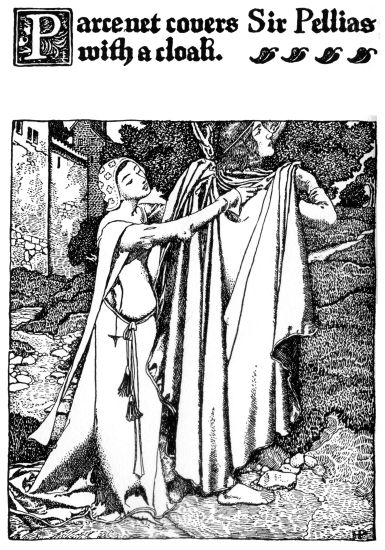
Now, as he sat thus, the postern gate was opened of a sudden, and the damsel Parcenet came out thence. And her face was all be-wet with tears, and she bare in her hand a flame-colored mantle. Straightway she ran to Sir Pellias, and said, “Thou good and gentle knight, take thou this and wrap thyself in it.”
Upon this Sir Pellias wist that this was no dream, but a truth of great shame; wherefore he was possessed with an extreme agony of shame, so that he fell to trembling, whilst his teeth chattered as though with an ague. Then he said to Parcenet, “Maiden, I thank thee.” And he could find no more words to say. So he took the mantle and wrapped himself in it.
Now when the people upon the walls beheld what Parcenet had done, they hooted her and reviled her with many words of ill-regard. So the maiden ran back again into the castle, but Sir Pellias arose and went his way toward his pavilion wrapped in that mantle. And as he went he staggered and tottered like a drunken man, for a great burden of shame lay upon him almost more than he could carry.
Sir Pellias taketh great grief because of his shame.
So when Sir Pellias had reached his pavilion, he entered it and threw himself on his face upon his couch and lay there without saying anything. And by and by Sir Brandiles and Mador de la Porte heard of that plight into which Sir Pellias had fallen, and thereupon they hastened to where he lay and made much sorrow over him. Likewise, they were exceedingly wroth at the shame that had been put upon him; wherefore they said, “We will get us aid from Camelot, and we will burst open yonder castle and we will fetch the Lady Ettard hither to crave thy pardon for this affront. This we will do even if we have to drag her hither by the hair of her head.”
But Sir Pellias lifted not his head, only he groaned and he said, “Let be, Messires; for under no circumstance shall ye do that thing, she being a woman. As it is, I would defend her honor even though I died in that defence. For I know not whether I am bewitched or what it is that ails me, but I love her with a very great passion and I cannot tear my heart away from her.”
At this Sir Brandiles and Sir Mador de la Porte were greatly astonished, wherefore they said the one to the other, “Certes, that lady hath laid some powerful spell upon him.”
Then after a while Sir Pellias bade them go away and leave him, and they did so, though not with any very good will.
So Sir Pellias lay there for all that day until the afternoon had come. Then he aroused himself and bade his esquire for to bring him his armor. Now when Sir Brandiles and Sir Mador de la Porte heard news of this they went to where he was and said, “Sir, what have ye a mind to do?” To this Sir Pellias said, “I am going to try to win me unto the Lady Ettard’s presence.” Then they said, “What madness is this?” “I know not,” said Sir Pellias, “but, meseems, that if I do not behold the Lady Ettard and talk with her I shall surely die of longing to see her.” And they say, “Certes, this is madness.” Whereunto he replied, “I know not whether it is madness or whether I am caught in some enchantment.”
So the esquire fetched unto Sir Pellias his armor as he had commanded, and he clad Sir Pellias in it so that he was altogether armed from head to foot. Thereupon straightway Sir Pellias mounted his horse and rode out toward the castle of Grantmesnle.
Now when the Lady Ettard beheld Sir Pellias again parading the meadow below the castle, she called unto her six of her best knights, and she said unto them, “Behold, Messires, yonder is that knight who brought so much shame upon us yesterday. Now I bid ye for to go forth against him and to punish him as he deserveth.”
So those six knights went and armed themselves, and when they had done so they straightway rode forth against Sir Pellias.
Sir Pellias overcometh six knights.
Now, when Sir Pellias beheld these approach, his heart overflowed with fury and he shouted in a great voice and drave forward against them. And for a while they withstood him, but he was not to be withstood, but fought with surpassing fury, wherefore they presently brake from before him and fled. So he pursued them with great fury about that field and smote four of them down from their horses. Then, when there were but two of those knights remaining, Sir Pellias of a sudden ceased to fight, and he cried out unto those two knights, “Messires, I surrender myself unto ye.”
Sir Pellias yields himself prisoner.
Now at that those two knights were greatly astonished, for they were entirely filled with the fear of his strength, and wist not why he should yield to them. Nevertheless they came and laid hands upon him and took him toward the castle. Upon this Sir Pellias said unto himself, “Now they will bring me unto the Lady Ettard, and I shall have speech with her.” For it was for this that he had suffered himself to be taken by those two knights.
But it was not to be as Sir Pellias willed it. For when they had brought him close under the castle, the Lady Ettard called unto them from a window in the wall. And she said, “What do you with that knight?” They say, “We bring him to you, Lady.” Upon this she cried out very vehemently, “Bring him not to me, but take him and tie his hands behind his back and tie his feet beneath his horse’s belly, and send him back unto his companions.”
Then Sir Pellias lifted up his eyes unto that window and he cried out in a great passion of despair, “Lady, it was unto thee I surrendered, and not unto these unworthy knights.”
But the Lady Ettard cried out all the more vehemently, “Drive him hence, for I do hate the sight of him.”
The Lady Ettard puts shame upon Sir Pellias.
So those two knights did as the Lady Ettard said; they took Sir Pellias and bound him hand and foot upon his horse. And when they had done so they allowed his horse for to bear him back again unto his companions in that wise.
Now when Sir Brandiles and Sir Mador de la Porte beheld how Sir Pellias came unto them with his hands bound behind his back and his feet tied beneath his horse’s belly, they were altogether filled with grief and despair. So they loosed those cords from about his hands and feet, and they cried out upon Sir Pellias, “Sir Knight, Sir Knight, art thou not ashamed to permit such infamy as this?” And Sir Pellias shook and trembled as though with an ague, and he cried out in great despair, “I care not what happens unto me!” They said, “Not unto thyself, Sir Knight; but what shame dost thou bring upon King Arthur and his Round Table!” Upon this Sir Pellias cried aloud, with a great and terrible voice, “I care not for them, either.”
All of this befell because of the powerful enchantment of the collar of emeralds and opal stones and of gold which Sir Pellias had given unto the Lady Ettard, and which she continually wore. For it was beyond the power of any man to withstand the enchantment of that collar. So it was that Sir Pellias was bewitched and brought to that great pass of shame.
Chapter Fourth.

How Queen Guinevere Quarrelled With Sir Gawaine, and How Sir Gawaine Left the Court of King Arthur For a While.
NOW, in the same measure that Queen Guinevere felt high regard for Sir Pellias, in that same degree she felt misliking for Sir Gawaine. For, though Sir Gawaine was said of many to have a silver tongue, and whiles he could upon occasion talk in such a manner as to beguile others unto his will, yet he was of a proud temper and very stern and haughty. Wherefore he would not always brook that the Lady Guinevere should command him unto her will as she did other knights of that Court. Moreover, she could not ever forget how Sir Gawaine did deny her that time at Cameliard when she besought him and his companions for aid, in her time of trouble, nor how discourteous his speech had been to her upon that occasion. So there was no great liking between these two proud souls, for Queen Guinevere held to her way and Sir Gawaine held to his way under all circumstances.
Sir Gawaine and others sit beneath the Queen’s window.
Now it happened upon an occasion that Sir Gawaine and Sir Griflet and Sir Constantine of Cornwall sat talking with five ladies of the Queen’s Court in a pleached garden that lay beneath the tower of the Lady Guinevere, and they made very pleasant discourse together. For some whiles they would talk and make them merry with jests and contes, and other whiles one or another would take a lute that they had with them and would play upon it and would sing.
Now while these lords and ladies sat thus enjoying pleasant discourse and singing in that manner, Queen Guinevere sat at a window that overlooked the garden, and which was not very high from the ground, wherefore she could overhear all that they said. But these lords and ladies were altogether unaware that the Queen could overhear them, so that they talked and laughed very freely, and the Queen greatly enjoyed their discourse and the music that they made.
That day was extraordinarily balmy, and it being well toward the sloping of the afternoon, those lords and ladies were clad in very gay attire. And of all who were there Sir Gawaine was the most gayly clad, for he was dressed in sky-blue silk embroidered with threads of silver. And Sir Gawaine was playing upon the lute and singing a ballad in an exceedingly pleasing voice so that Queen Guinevere, as she sat at the window beside the open casement, was very well content for to listen to him.
Sir Gawaine striketh the Queen’s hound.
Now there was a certain greyhound of which Queen Guinevere was wonderfully fond; so much so that she had adorned its neck with a collar of gold inset with carbuncles. At that moment the hound came running into that garden and his feet were wet and soiled with earth. So, hearing Sir Gawaine singing and playing upon the lute, that hound ran unto him and leaped upon him. At this Sir Gawaine was very wroth, wherefore he clinched his hand and smote the hound upon the head with the knuckles thereof, so that the hound lifted up his voice with great outcry.
But when Queen Guinevere beheld that blow she was greatly offended, wherefore she called out from her window, “Why dost thou smite my dog, Messire?” And those lords and ladies who were below in the garden were very much surprised and were greatly abashed to find that the Queen was so nigh unto them as to overhear all that they had said and to behold all that they did.
But Sir Gawaine spake up very boldly, saying, “Thy dog affronted me, Lady, and whosoever affronteth me, him I strike.”
Then Queen Guinevere grew very angry with Sir Gawaine, wherefore she said, “Thy speech is over-bold, Messire,” and Sir Gawaine said, “Not over-bold, Lady; but only bold enough for to maintain my rights.”
Of the quarrel of the Queen and Sir Gawaine.
At this speech the Lady Guinevere’s face flamed like fire and her eyes shone very bright and she said, “I am sure that thou dost forget unto whom thou speakest, Sir Knight,” at the which Sir Gawaine smiled very bitterly and said, “And thou, Lady, dost not remember that I am the son of a king so powerful that he needs no help from any other king for to maintain his rights.”
At these words all those who were there fell as silent as though they were turned into stones, for that speech was exceedingly bold and haughty. Wherefore all looked upon the ground, for they durst not look either upon Queen Guinevere nor upon Sir Gawaine. And the Lady Guinevere, also, was silent for a long time, endeavoring to recover herself from that speech, and when she spake, it was as though she was half smothered by her anger. And she said, “Sir Knight, thou art proud and arrogant beyond measure, for I did never hear of anyone who dared to give reply unto his Queen as thou hast spoken unto me. But this is my Court, and I may command in it as I choose; wherefore I do now bid thee for to begone and to show thy face no more, either here nor in Hall nor any of the places where I hold my Court. For thou art an offence unto me, wherefore in none of these places shalt thou have leave to show thy face until thou dost ask my pardon for the affront which thou hast put upon me.” Then Sir Gawaine arose and bowed very low to the Queen Guinevere and he said, “Lady, I go. Nor will I return thitherward until thou art willing for to tell me that thou art sorry for the discourteous way in which thou hast entreated me now and at other times before my peers.”
So saying, Sir Gawaine took his leave from that place, nor did he turn his head to look behind him. And Queen Guinevere went into her chamber and wept in secret for anger and for shame. For indeed she was greatly grieved at what had befallen; yet was she so proud that she would in no wise have recalled the words that she had spoken, even had she been able for to have done so.
Now when the news of that quarrel had gone about the castle it came unto the ears of Sir Ewaine, wherefore Sir Ewaine went straightway unto Sir Gawaine, and asked him what was ado, and Sir Gawaine, who was like one distraught and in great despair, told him everything. Then Sir Ewaine said: “Thou wert certainly wrong for to speak unto the Queen as thou didst. Nevertheless, if thou art banished from this Court, I will go with thee, for thou art my cousin-german and my companion, and my heart cleaveth unto thee.” So Sir Ewaine went unto King Arthur, and he said, “Lord, my cousin, Sir Gawaine, hath been banished from this Court by the Queen. And though I may not say that he hath not deserved that punishment, yet I would fain crave thy leave for to go along with him.”
At this King Arthur was very grieved, but he maintained a steadfast countenance, and said, “Messire, I will not stay thee from going where it pleases thee. As for thy kinsman, I daresay he gave the Queen such great offence that she could not do otherwise than as she did.”
Sir Gawaine and Sir Ewaine quit the Court.
So both Sir Ewaine and Sir Gawaine went unto their inns and commanded their esquires for to arm them. Then they, with their esquires, went forth from Camelot, betaking their way toward the forest lands.
There those two knights and their esquires travelled for all that day until the gray of the eventide, what time the birds were singing their last songs ere closing their eyes for the night. So, finding the evening drawing on apace, those knights were afraid that they would not be able to find kindly lodging ere the night should descend upon them, and they talked together a great deal concerning that thing. But as they came to the top of a certain hill, they beheld below them a valley, very fair and well tilled, with many cottages and farm-crofts. And in the midst of that valley was a goodly abbey very fair to look upon; wherefore Sir Gawaine said unto Sir Ewaine: “If yonder abbey is an abbey of monks, I believe we shall find excellent lodging there for to-night.”
They come to an abbey of monks.
So they rode down into that valley and to the abbey, and they found a porter at the wicket of whom they learned that it was indeed an abbey of monks. Wherefore they were very glad and made great rejoicing.
But when the abbot of that abbey learned who they were and of what quality and high estate, he was exceedingly pleased for to welcome them, wherefore he brought them into that part of the abbey where he himself dwelt. There he bade them welcome and had set before them a good supper, whereat they were very much rejoiced. Now the abbot was merry of soul, and took great pleasure in discourse with strangers, so he diligently inquired of those two knights concerning the reason why they were errant. But they told him naught concerning that quarrel at Court, but only that they were in search of adventure. Upon this the abbot said, “Ha, Messires, if ye are in search of adventures, ye may find one not very far from this place.”
The abbot telleth the knights of a good adventure.
So Sir Gawaine said, “What adventure is that?” And the abbot replied, “I will tell ye; if ye will travel to the eastward from this place, ye will come, after a while, to a spot where ye shall find a very fair castle of gray stone. In front of that castle ye will find a good level meadow, and in the midst of the meadow a sycamore-tree, and upon the sycamore-tree a shield to which certain ladies offer affront in a very singular manner. If ye forbid those ladies to affront that shield you will discover a very good adventure.”
Then Sir Gawaine said, “That is a very strange matter. Now, to-morrow morning we will go to that place and will endeavor to discover of what sort that adventure may be.” And the abbot said, “Do so,” and laughed in great measure.
So when the next morning had come, Sir Gawaine and Sir Ewaine gave adieu unto the abbot, and took their leave of that place, riding away unto the eastward, as the abbot had advised. And after they had ridden in that direction for two or three hours or more they beheld before them the borders of a forest all green and shady with foliage, and very cheerful in the warmth of the early summer day. And, lo! immediately at the edge of the woodland there stood a fair, strong castle of gray stone, with windows of glass shining very bright against the sky.
Sir Gawaine and Sir Ewaine behold the damsels assailing the shield.
Then Sir Gawaine and Sir Ewaine beheld that everything was as the abbot had said; for in front of the castle was a smooth, level meadow with a sycamore-tree in the midst thereof. And as they drew near they perceived that a sable shield hung in the branches of the tree, and in a little they could see that it bore the device of three white goshawks displayed. But that which was very extraordinary was that in front of that shield there stood seven young damsels, exceedingly fair of face, and that these seven damsels continually offered a great deal of insult to that shield. For some of those damsels smote it ever and anon with peeled rods of osier, and others flung lumps of clay upon it, so that the shield was greatly defaced therewith. Now nigh to the shield was a very noble-appearing knight clad all in black armor, and seated upon a black war-horse, and it was very plain to be seen that the shield belonged unto that knight, for otherwise he had no shield. Yet, though that was very likely his shield, yet the knight offered no protest either by word or by act to stay those damoiselles from offering affront thereunto.
Then Sir Ewaine said unto Sir Gawaine, “Yonder is a very strange thing that I behold; belike one of us is to encounter yonder knight.” And Sir Gawaine said, “Maybe so.” Then Sir Ewaine said, “If it be so then I will undertake the adventure.” “Not so,” said Sir Gawaine, “for I will undertake it myself, I being the elder of us twain, and the better seasoned in knighthood.” So Sir Ewaine said, “Very well. Let it be that way, for thou art a very much more powerful knight than I, and it would be a pity for one of us to fail in this undertaking.” Thereupon Sir Gawaine said, “Let be, then, and I will undertake it.”
So he set spurs to his horse and he rode rapidly to where those damsels offered affront in that way to the sable shield. And he set his spear in rest and shouted in a loud voice, “Get ye away! Get ye away!” So when those damsels beheld the armed knight riding at them in that wise they fled away shrieking from before him.
Then the Sable Knight, who sat not a great distance away, rode forward in a very stately manner unto Sir Gawaine, and he said, “Sir Knight, why dost thou interfere with those ladies?” Whereunto Sir Gawaine replied, “Because they offered insult unto what appeared to me to be a noble and knightly shield.” At this the Sable Knight spake very haughtily, saying, “Sir Knight, that shield belongeth unto me and I do assure thee that I am very well able for to take care of it without the interference of any other defender.” To which Sir Gawaine said, “It would appear not, Sir Knight.”
Then the Sable Knight said, “Messire, an thou thinkest that thou art better able to take care of that shield than I, I think that thou wouldst do very well to make thy words good with thy body.” To this Sir Gawaine said, “I will do my endeavor to show thee that I am better able to guard that shield than thou art who ownest it.”
Sir Gawaine and the Black Knight engage in battle.
Upon this the Sable Knight, without further ado, rode unto the sycamore-tree, and took down from thence the shield that hung there. And he dressed the shield upon his arm and took his spear in hand and made him ready for defence. And Sir Gawaine likewise made him ready for defence, and then each knight took such station upon the field as appeared unto him to be fitting.
Now, when the people of that castle perceived that a combat of arms was toward, they crowded in great numbers to the walls, so that there were as many as twoscore ladies and esquires and folk of different degrees looking down upon that field of battle from the walls.
So when those knights were altogether prepared, Sir Ewaine gave the signal for encounter and each knight shouted aloud and drave spurs into his charger and rushed forward to the assault with a noise like thunder for loudness.
The Black Knight overthroweth Sir Gawaine.
Now, Sir Gawaine thought that he should easily overcome his adversary in this assault and that he would be able to cast him down from out of his saddle without much pains, for there was hardly any knight in that realm equal to Sir Gawaine for prowess. And, indeed, he had never yet been unhorsed in combat excepting by King Arthur. So when those two rode to the assault, the one against the other, Sir Gawaine thought of a surety that his adversary would fall before him. But it was not so, for in that attack Sir Gawaine’s spear was broken into many pieces, but the spear of the Sable Knight held, so that Sir Gawaine was cast with great violence out of the saddle, smiting the dust with a terrible noise of falling. And so astonished was he at that fall that it appeared unto him not as though he fell from his saddle, but as though the earth rose up and smote him. Wherefore he lay for a while all stunned with the blow and with the astonishment thereof.