LEANDER STILLWELL Late of Co. D, 61st Illinois Infantry (continued 6)
Reading edition
S. P. Ohr Lieut. Colonel, 61st Illinois Infantry.
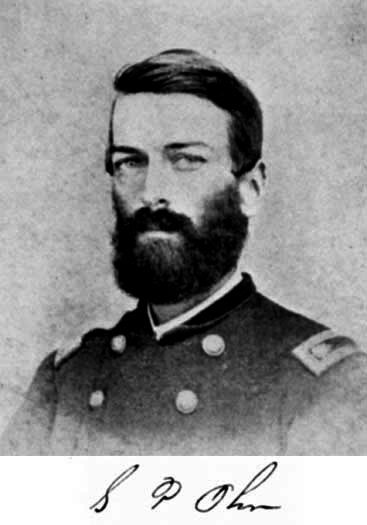
When home on our veteran furlough a sad event occurred which directly affected the regiment, and which it can be truly said every member thereof sincerely deplored. This was the death of Lieut. Col. Simon P. Ohr. He never was a strong man, physically, and the hardships and exposures incident to army life were really the cause of his death. He died at his home, in Carrollton, Illinois, of a bronchial affection, on September 14th, 1864. He was a man of temperate habits, honest and upright, and a sterling patriot. As an officer, he was kind, careful as to the wants and necessities of his men, and in battle, cool, clear-headed, and brave. In due course of time Maj. Daniel Grass was appointed to the office of Lieutenant-Colonel, to fill the vacancy thus created by the lamented death of Col. Ohr.
The regiment rendezvoused at Springfield on September 26th, and left on the next day, on the cars, went to St. Louis, and were quartered in the Hickory Street Barracks, in the city. Another "Price Raid" was now on. Only a few days previously Gen. Sterling Price with a strong force, including, of course, Shelby's cavalry, entered southeast Missouri, and the day we arrived at St. Louis he showed up at Pilot Knob, only about 85 miles south of the city, where some sharp fighting occurred. There was now the biggest kind of a "scare" prevailing in St. Louis, and, judging from all the talk one heard, we were liable to hear the thunder of Price's cannon on the outskirts of St. Louis any day. We had been at Hickory Street Barracks only a day or two, when my company, and companies B and G, were detached from the regiment, embarked on a steamboat, and went down the Mississippi to the town of Chester, Illinois, which is situated on the Mississippi, at the mouth of the Kaskaskia river. We were sent here for the purpose, as we understood at the time, of guarding the crossing of the Mississippi at this place, and to prevent any predatory Confederate raid in that vicinity. We were quartered in some large vacant warehouses near the river, and had no guard duty to perform except a guard at the ferry landing, and a small one over our commissary stores. Altogether, it was the "softest" piece of soldiering that fell to my lot during all my service. We had roofs over our heads and slept at night where it was dry and warm, it was ideal autumn weather, and we just idled around, careless, contented, and happy. One lovely October day Bill Banfield and I in some way got a skiff, and early in the morning rowed over the river to the Missouri side, and spent the day there, strolling about in the woods. The country was wild and rough, and practically in a state of nature. We confined our rambling to the river bottom, which was broad and extensive, and densely covered with a primeval forest. Some of the trees, especially the sycamores and the cottonwoods, were of giant size. And the woods abounded in nuts and wild fruits; hickory nuts, walnuts, pecans, pawpaws, big wild grapes,—and persimmons, but the latter were not yet ripe. This locality was in Perry County, Missouri, and it seemed to be destitute of inhabitants; we saw two or three log cabins, but they were old, decayed, and deserted. We had brought some bacon and hardtack with us in our haversacks, and at noon built a fire and had an army dinner, with nuts and fruit for dessert. We got back to Chester about sundown, having had a most interesting and delightful time.
There was another little incident that happened while we were at Chester, which I have always remembered with pleasure. Between companies D and G of our regiment was a strong bond of friendship. Many of the boys of the two companies had lived in the same neighborhood at home, and were acquainted with each other before enlisting. The first sergeant of G was Pressley T. Rice, a grown man, and some five or six years my senior. He came to me one day soon after our arrival at Chester, and in his peculiar nasal tone said: "Stillwell, some of my boys think that when we are soldiering here in 'God's Country,' they ought to have soft bread to eat. If 'D' feels the same, let's go down to the mill, and buy a barrel of flour for each company, and give the boys a rest on hardtack." I heartily assented, but asked what should we do about paying for it, as the boys were now pretty generally strapped. Press responded that we'd get the flour "on tick," and settle for it at our next pay day. To my inquiry if we should take Company B in on the deal (the other company with us at Chester), Press dryly responded that B could root for themselves; that this was a "cahootnership" of D and G only. Without further ceremony we went to the mill, which was a fair-sized concern, and situated, as I now remember, in the lower part of the town, and near the river bank. We found one of the proprietors, and Press made known to him our business, in words substantially the same as he had used in broaching the matter to me, with some little additional explanation. He told the miller that the only bread we had was hardtack, that the boys accepted that cheerfully when we were down South, but that here in "God's Country," in our home State of Illinois, they thought they were entitled to "soft bread," so we had come to him to buy two barrels of flour; that the boys had not the money now to pay for it, but at our next pay day they would, and we would see to it that the money should be sent him. While thus talking, the miller looked at us with "narrowed eyes," and, as it seemed to me, didn't feel a bit delighted with the proposition. But maybe he thought that if he didn't sell us the flour, we might take it anyhow, so, making a virtue of necessity, he said he would let us have it, the price of the two barrels being, as I now remember, seven dollars. I produced my little memorandum book, and requested him to write the name and address of his firm therein, which he did, in pen and ink, and it is there yet, in that same little old book, now lying open before me, and reads as follows:
"H. C. Cole & Co., Chester, Ill."
Well, he sent us the flour, and D and G had soft bread the balance of the time we were at Chester.
I will now anticipate a few months, in order to finish the account of this incident. The spring of 1865 found the regiment at Franklin, Tennessee, and while there the paymaster made us a welcome visit. I then went to Press Rice, and suggested to him that the time had now come for us to pay the Chester miller for his flour, and he said he thought so too. We sat down at the foot of a tree and made out a list of all the boys of our respective companies who, at Chester, helped eat the bread made from the flour, and who were yet with us, and then assessed each one with the proper sum he should contribute, in order to raise the entire amount required. Of course the boys paid it cheerfully. Press turned over to me the proportionate sum of his company, and requested me to attend to the rest of the business, which I did. I wrote a letter to the firm of H. C. Cole & Co., calling their attention to the fact of our purchase from them of two barrels of flour in October of the previous year, and then went on to say that several of the boys who had taken part in eating the bread made from this flour had since then been killed in battle, or died of diseases incident to a soldier's life, but there were yet enough of us left to pay them for their flour, and that I here inclosed the proper sum. (I have forgotten in just what manner or form it was sent, but think it was by express.) In due course of time I received an answer, acknowledging receipt of the money, written in a very kind and complimentary vein. After heartily thanking us for the payment, the letter went on to state that in all the business dealings of H. C. Cole & Co. with Union soldiers the firm had been treated with fairness and remarkable honesty, and they sincerely appreciated it.
Many years later out in Kansas I met a man who had lived in Chester during the war, and told him the foregoing little story. He said he knew the milling firm of Cole & Co. quite well, and that during the war they were most intense and bitter Copperheads, and had no use whatever for "Lincoln hirelings," as Union soldiers were sometimes called by the "Butternut" element. My informant was a respectable, truthful man, so it is probable that his statement was correct. It served to throw some light on the grim conduct of the miller with whom Press and I dealt. But they treated us well, and if they were of the type above indicated, it is hoped that the little experience with us may have caused them to have a somewhat kindlier feeling for Union soldiers than the one they may have previously entertained.
CHAPTER XIX.
EXPEDITION TO NORTH MISSOURI. BACK IN TENNESSEE ONCE MORE. MURFREESBORO. OCTOBER AND NOVEMBER, 1864.
On October 14th we left Chester on the steamer "A. Jacobs," and went to St. Louis, where we arrived on the 15th, and marched out to Laclede Station, about six miles from St. Louis, on the Pacific railroad, where we found the balance of the regiment. There was a railroad bridge at this place, over a small stream, and I suppose that during the scare at St. Louis it was deemed prudent to have a force here to guard the bridge. On October 19th the regiment left Laclede, and went by rail on the North Missouri railroad, to Mexico, in Audrain county, Missouri, about 110 miles northwest of St. Louis. Here we reported to Col. Samuel A. Holmes, Colonel of the 40th Missouri Infantry. We left Mexico October 21st and marched northward 25 miles to Paris, the county seat of Monroe county. There was a body of irregular Confederate cavalry, supposed to be about 500 strong, under the command of a Col. McDaniel, operating in this region, and carrying on a sort of predatory and uncivilized warfare. We learned that it was our business up here to bring this gang to battle, and destroy them if possible, or, failing in that, to drive them out of the country. Our force consisted of about 700 infantry,—the 40th Missouri and the 61st Illinois, and a detachment of about 300 cavalry, whose state and regimental number I have forgotten. Our cavalry caught up with the Confederates at Paris, and had a little skirmish with them, but before the infantry could get on the ground the enemy lit out as fast as their horses could carry them. We lay that night at Paris, and the next day (the 22nd) marched to the little town of Florida, where we bivouacked for the night. It was a small place, situated on a high, timbered ridge, between the main Salt river and one of its forks. With the exception that it was not a county seat, it was practically a counterpart of the little village of Springfield, Arkansas, hereinbefore mentioned. It had only one street of any consequence, and all up and down this street, in several places right in the middle thereof, were grand, imposing native trees, such as oaks and hickories. But the place was now totally deserted, and looked lonesome and desolate. I ascertained several years later that it was the birthplace of Samuel L. Clemens, the author,—better known under his pen-name, "Mark Twain." It is also an interesting circumstance that the first military operation conducted by Gen. U. S. Grant was a movement in the summer of 1861 on this little village of Florida, with the intention and expectation of giving battle to a Confederate force in camp near the town. (Grant's Memoirs, 1st Edition, Vol. 1, pp. 248 et seq.)
The next day (the 23rd) we turned south, and marched to the little town of Santa Fe, and the next day thereafter back to Paris, where we remained a day. On the 26th we went to Middle Grove, and on the following day again reached the railroad at Allen, some distance northwest of Mexico, where we first started out. It would seem that this little station of Allen has, since the war, disappeared from the map,—at least, I can't find it. On this expedition the infantry never caught a glimpse of an armed Confederate, but the object of the movement was accomplished. We kept after our foes so persistently that they left that locality, crossed the Missouri river, joined Price's army, and with it left the State. At this time the section of country over which we marched in the pursuit of McDaniel's command is now all gridironed by railroads, but in 1864 there were only two, the North Missouri, running north-west from St. Louis to Macon, and the Hannibal and St. Joe, connecting those two places and extending from the Mississippi river on the east to the Missouri river on the west. We always remembered this scout up in north Missouri with feelings of comfort and satisfaction. Compared with some of our Arkansas marches, it was just a pleasure excursion. The roads were in good condition, and the weather was fine;—ideal Indian Summer days. And in the fruit and vegetable line we lived high. The country through which we passed abounded in the finest of winter apples, Little Romanites and Jennetings being the chief varieties. The farmers had gathered and piled them in the orchards in conical heaps and covered them with straw and earth sufficient to keep them from freezing. We soon learned what those little earth mounds signified, and, as a matter of course, confiscated the apples instanter. And the country was full of potatoes, cabbages, and turnips, on which we foraged with great liberality. If any apology for this line of conduct should be thought proper, it may be said that many of the farms were at this time abandoned, the owners having fled to the garrisoned towns to escape the Confederate raiders; further, if we hadn't taken this stuff our adversaries would, if by chance they happened again to infest that locality. Anyhow, a hungry soldier is not troubled, in such matters, by nice ethical distinctions. We remained at Allen on the 28th, and until the evening of the following day, when we left there on the cars for St. Louis. But sometime near midnight the train stopped at Montgomery City, about midway between Allen and St. Louis, we were roused up, and ordered to get off and form in line, which we did. Our officers then proceeded to give us careful instructions, to the effect that a band of Confederate cavalry was believed to be at Danville, out in the country a few miles south, and that we were going there to surprise and capture this party, if possible. We were strictly enjoined to refrain from talking and singing, and to remain absolutely silent in ranks. We then fell into column and marched for Danville, where we arrived an hour or so before dawn. But our birds (if there when we started from Montgomery) had flown—there were no Confederates there. A party of guerrillas had been in the town about two weeks before, who had murdered five or six unarmed citizens, (including one little boy about eight or ten years old,) and it was believed when we started to march out here that this gang, or some of them, had returned. The party that had previously raided Danville were under the command of one Bill Anderson, a blood-thirsty desperado, with no more humanity about him than an Apache Indian. He was finally killed in battle with some Union troops about the last of October, 1864. When killed there was found on his person a commission as Colonel in the Confederate army, signed by Jefferson Davis, and the brow-band of his horse's bridle was decorated with two human scalps. (See "The Civil War on the Border," by Wiley Britton, Vol. 2, p. 546.) He was of that class of men of which Quantrell and the James and the Younger boys were fitting types, and who were a disgrace to mankind.
Sometime during the day (October 30th) we marched back to Montgomery City, got on the cars, and again started for St. Louis, where we arrived the next day, and marched out to old Benton Barracks, where we took up our quarters for the time being. So we were once more "tenting on the old camp ground," after an absence of nearly three years. But the place did not look as it did before. It seemed old and dilapidated and there were only a few troops there. As compared with the active, stirring conditions that obtained there in February and March, 1862, it now looked indescribably dejected and forlorn. But our stay here this time was short. We left on November 5th, marched into St. Louis, and down to the wharf, where we embarked on the steamer "David Tatum," and started up the Mississippi. We were puzzled for a while as to what this meant, but soon found out. We were told that the regiment was being sent home to vote at the ensuing presidential election, which would occur on November 8th, that we would take the cars at Alton and go to Springfield, and from there to our respective homes. We surely were glad that we were going to be granted this favor. The most of the States had enacted laws authorizing their soldiers to vote in the field, but the Illinois legislature since 1862 had been Democratic in politics, and that party at that time in our State was not favorably disposed to such a measure. Consequently the legislature in office had failed to pass any law authorizing their soldier constituents to vote when away from home. We arrived at Alton about 9 o'clock on the evening of the 5th, and found a train waiting us (box cars), which we at once climbed on. We had just got our guns and other things stowed away in corners, and were proceeding to make ourselves comfortable for a night ride to Springfield, when Lt. Wallace came down from the officers' caboose, and stopped at the Co. D car. "Boys," he called, "get out, and fall in line here by the track. The order to go to Springfield has been countermanded by telegraphic dispatch and we are ordered back to St. Louis." "What! What's that?" we exclaimed, in astonishment. "It's so," said Wallace, in a tone of deep regret; "get out." "Well, don't that beat hell!" was the next remark of about a dozen of us. But orders are orders, and there was nothing to do but obey. The curses of the disappointed soldiers in thus having this cup of satisfaction dashed from their lips were "not loud, but deep." But we all swung down from the cars, fell in, and marched back to and on board the "David Tatum," and were back at the wharf in St. Louis by next morning. We stacked arms on the levee, and the next morning, November 7th, left St. Louis on the steamer "Jennie Brown," headed down stream. So here we were again on the broad Mississippi, duplicating our beginning of March, 1862, and once more bound for "Dixie's Land." By this time we had become philosophical and indifferent in regard to the ups and downs of our career. If we had been ordered some night to be ready the next morning to start to California or Maine, the order would have been treated with absolute composure, and after a few careless or sarcastic remarks, we would have turned over and been asleep again in about a minute. We had made up our minds that we were out to see the war through, and were determined in our conviction that we were going to win in the end.
Election day, November 8th, was densely foggy, so much so that the captain of our steamboat thought it not prudent to proceed, so the boat tied up that day and night at the little town of Wittenburg, on the Missouri shore. Mainly to pass away the time, the officers concluded to hold a "mock" regimental presidential election. The most of the line officers were Democrats, and were supporting Gen. McClellan for President in opposition to Mr. Lincoln, and they were quite confident that a majority of the regiment favored McClellan, so they were much in favor of holding an election. An election board was chosen, fairly divided between the supporters of the respective candidates, and the voting began. As our votes wouldn't count in the official result, every soldier, regardless of age, was allowed to vote. But at this time I was a sure-enough legal voter, having attained my twenty-first year on the 16th of the preceding September. You may rest assured that I voted for "Uncle Abe" good and strong. When the votes were counted, to the astonishment of nearly all of us, Mr. Lincoln was found to have sixteen majority. As the regiment was largely Democratic when it left Illinois in February, 1862, this vote showed that the political opinions of the rank and file had, in the meantime, undergone a decided change.
We left Wittenburg on the forenoon of the 9th, but owing to the foggy conditions our progress was very slow. We reached Cairo on the 10th, and from there proceeded up the Ohio, and on the 11th arrived at Paducah, Kentucky, where we debarked, and went into camp. We remained here nearly two weeks, doing nothing but the ordinary routine of camp duty, so life here was quite uneventful. Paducah was then an old, sleepy, dilapidated, and badly decayed river town, with a population at the outbreak of the war of about four thousand. After our brief stay here terminated, I never was at the place again until in October, 1914, when I was there for about a day, which was devoted to rambling about the town. The flight of fifty years had made great changes in Paducah. It now had a population of about twenty-five thousand, four different lines of railroad, street cars, electric lights, and a full supply generally of all the other so-called "modern conveniences." On this occasion I hunted faithfully and persistently for the old camp ground of the regiment in 1864, but couldn't find it, nor even any locality that looked like it.
On the evening of November 24th the regiment left Paducah on the little stern-wheel steamboat "Rosa D," which steamed up the Ohio river as far as the mouth of the Cumberland, there turned to the right, and proceeded to ascend that stream. That move told the story of our probable destination, and indicated to us that we were doubtless on our way to Nashville to join the army of Gen. Thomas. There was another boat that left Paducah the same time we did, the "Masonic Gem," a stern-wheeler about the same size of our boat. It was also transporting a regiment of soldiers, whose State and regimental number I do not now remember. The captains of the two boats, for some reason or other, lashed their vessels together, side by side, and in this manner we made the greater part of the trip. In going up the Cumberland the regiment lost two men by drowning; Henry Miner, of Co. D, and Perry Crochett, of Co. G. There was something of a mystery in regard to the death of Miner. He was last seen about nine o'clock one evening on the lower deck of the boat, close to where the two boats were lashed together. It was supposed that in some manner he missed his footing and fell between the boats, and was at once sucked under by the current and drowned. His cap was discovered next morning on the deck near the place where he was last observed, but no other vestige of him was ever found. The other soldier, Perry Crochett, stumbled and fell into the river in the day time, from the after part of the hurricane deck of the boat. He was perhaps stunned by the fall, for he just sank like a stone. The boats stopped, and a skiff was at once lowered and manned, and rowed out to the spot where he disappeared, and which lingered around there a short time, in the hope that he might come to the surface. His little old wool hat was floating around on the tops of the waves, but poor Perry was never seen again. There was nothing that could be done, so the skiff came back to the boat, was hoisted aboard, the bells rang the signal "go ahead," and we went on. Miner and Crochett were both young men, about my own age, and had been good and brave soldiers. Somehow it looked hard and cruel that after over three years' faithful service they were fated at last to lose their lives by drowning in the cold waters of the Cumberland, and be devoured by catfish and snapping turtles,—but such are among the chances in the life of a soldier.
On our way up the Cumberland we passed the historic Fort Donelson, where Gen. Grant in February, 1862, gained his first great victory. There was, at that time, desperate and bloody fighting at and near the gray earthen walls of the old fort. Now there was only a small garrison of Union troops here, and with that exception, the place looked about as quiet and peaceful as some obscure country graveyard.
We arrived at Nashville after dark on the evening of the 27th, remained on the boat that night, debarked the next morning, and in the course of that day (the 28th) took the cars on what was then known as the Nashville and Chattanooga railroad, and went to Murfreesboro, about thirty miles southeast of Nashville. Here we went into camp inside of Fortress Rosecrans, a strong and extensive earthwork built under the direction of Gen. Rosecrans soon after the battle of Murfreesboro, in January, 1863.
CHAPTER XX.
THE AFFAIR AT OVERALL'S CREEK. MURFREESBORO. DECEMBER, 1864.
The invasion of Tennessee by the Confederate army under the command of Gen. J. B. Hood was now on, and only a day or two after our arrival at Murfreesboro we began to hear the sullen, deep-toned booming of artillery towards the west, and later north-west in the direction of Nashville. And this continued, with more or less frequency, until the termination, on December 16th, of the battle of Nashville, which resulted in the defeat of the Confederates, and their retreat from the State. About December 3rd, the Confederate cavalry, under the command of our old acquaintance, Gen. N. B. Forrest, swung in between Nashville and Murfreesboro, tore up the railroad, and cut us off from Nashville for about two weeks. The Union forces at Murfreesboro at this time consisted of about 6,000 men,—infantry, cavalry, and artillery, (but principally infantry,) under the command of Gen L. H. Rousseau.
December 4th, 1864, was a pleasant, beautiful day at old Murfreesboro. The sun was shining bright and warm, the air was still, and the weather conditions were like those at home during Indian summer in October. Along about the middle of the afternoon, without a single note of preliminary warning, suddenly came the heavy "boom" of cannon close at hand, in a northwesterly direction. We at once ran up on the ramparts, and looking up the railroad towards Nashville, could plainly see the blue rings of powder-smoke curling upwards above the trees. But we didn't look long. Directly after we heard the first report, the bugles in our camp and others began sounding "Fall in!" We hastily formed in line, and in a very short time the 61st Illinois and two other regiments of infantry, the 8th Minnesota and the 174th Ohio, with a section of artillery, all under the command of Gen. R. H. Milroy, filed out of Fortress Rosecrans, and proceeded in the direction of this cannonading. About four miles out from Murfreesboro we came to the scene of the trouble. The Confederates had opened with their artillery on one of our railroad block-houses, and were trying to demolish or capture it. The 13th Indiana Cavalry had preceded us to the spot, and were skirmishing with the enemy. Our regiment formed in line on the right of the pike, the Minnesota regiment to our right, and the Ohio regiment on the left, while our artillery took a position on some higher ground near the pike, and began exchanging shots with that of the enemy. The position of our regiment was on the hither slope of a somewhat high ridge, in the woods, with a small stream called Overall's creek running parallel to our front. We were standing here at ease, doing nothing, and I slipped up on the crest of the ridge, "to see what I could see." The ground on the opposite side of the creek was lower than ours, and was open, except a growth of rank grass and weeds. And I could plainly see the skirmishers of the enemy, in butternut clothing, skulking in the grass and weeds, and occasionally firing in our direction. They looked real tempting, so I hurried back to the regiment, and going to Capt. Keeley, told him that the Confederate skirmishers were just across the creek, in plain sight, and asked him if I couldn't slip down the brow of the ridge and take a few shots at them. He looked at me kind of queerly, and said: "You stay right where you are, and tend to your own business. You'll have plenty of shooting before long." I felt a little bit hurt at his remark, but made no reply, and resumed my place in the ranks. But he afterwards made me a sort of apology for his brusque reproof, saying he had no desire to see me perhaps throw my life away in a performance not within the scope of my proper and necessary duty. And he was right, too, in his prediction, that there would soon be "plenty of shooting." I had just taken my place in the ranks when a mounted staff officer came galloping up, and accosting a little group of our line officers, asked, with a strong German accent, "Iss ziss ze 61st Illinois?" and on being told that it was, next inquired for Col. Grass, who was pointed out to him. He rode to the Colonel, who was near at hand, saluted him, and said, "Col. Grass, ze Sheneral sends his compliments wiss ze order zat you immediately deploy your regiment as skirmishers, and forthwith advance on ze enemy, right in your front!" The recruits and non-veterans of the regiment being yet in Arkansas, its present effective strength hardly exceeded three hundred men, so there was just about enough of us to make a sufficient skirmish line, on this occasion, for the balance of the command. In obedience to the aforesaid order the regiment was promptly deployed as skirmishers, and the line advanced over the crest of the ridge in our front, and down the slope on the opposite side. At the bank of the creek a little incident befell me, which serves to show how a very trifling thing may play an important part in one's fate. I happened to reach the creek at a point opposite a somewhat deep pool. The water was clear and cold, and I disliked the idea of having wet feet on the skirmish line, and looked around for a place where it was possible to cross dry-shod. A rod or two above me the stream was narrow, and where it could be jumped, so I started in a run for that place. The creek bank on my side was of yellow clay, high and perpendicular, while on the other margin the bank was quite low, and the ground adjacent sloped upward gently and gradually. While running along the edge of the stream to the fording place, one of my feet caught on the end of a dead root projecting from the lower edge of the bank, and I pitched forward, and nearly fell. At the very instant of my stumble,—"thud" into the clay bank right opposite where I would have been, if standing, went a bullet fired by a Confederate skirmisher. He probably had taken deliberate aim at me, and on seeing me almost fall headlong, doubtless gave himself credit for another Yankee sent to "the happy hunting grounds." It is quite likely that owing to the existence of that old dead root, and my lucky stumble thereon, I am now here telling the story of this skirmish. By this time it was sunset, and darkness was approaching, but we went on. The Confederate skirmishers retired, but we soon developed their main line on some high ground near the edge of the woods,—and then we had to stop. We lay down, loaded and fired in that position, and nearly all of the enemy's balls passed over our heads. Presently it grew quite dark, and all we had to aim at was the long horizontal sheet of red flame that streamed from the muskets of the Confederates. In the mean time the artillery of both parties was still engaged in their duel, and their balls and shells went screaming over our heads. Occasionally a Confederate shell would explode right over us, and looked interesting, but did no harm. While all this firing was at its liveliest, I heard close by the heavy "thud" that a bullet makes in striking a human body, followed immediately by a sharp cry of "Oh!" which meant that someone had been hit. It proved to be Lieutenant Elijah Corrington, of Co. F. He was struck by the ball in the region of the heart, and expired almost instantly. He was a good man, and a brave soldier, and his death was sincerely mourned.
The affair was terminated by the 174th Ohio on our left getting around on the enemy's right flank, where it poured in a destructive volley, and the Confederates retired. We followed a short distance, but neither saw nor heard anything more of the enemy, so we finally retired also. We recrossed the creek, built some big fires out of dry chestnut rails, which we left burning, in order, I suppose, to make our foes believe we were still there, and then marched to Murfreesboro, where we arrived about midnight.
On the two following days, December 5 and 6, the Confederates showed themselves to the west of us, and demonstrated most ostentatiously against Murfreesboro. From where we stood on the ramparts of Fortress Rosecrans we could plainly see their columns in motion, with flags flying, circling around us as if looking for a good opening. They were beyond the range of musketry, but our big guns in the fortress opened on them and gave them a most noisy cannonading, but what the effect was I don't know,—probably not much. In the battles of the Civil War artillery playing on infantry at short range with grape and canister did frightful execution, of which I saw plenty of evidence at Shiloh; but at a distance, and firing with solid shot or shell, it simply made a big noise, and if it killed anybody, it was more an accident than otherwise.
Beginning about December 5th, and continuing for several days thereafter, we turned out at four o'clock every morning, fully armed, and manned the trenches in the rear of the breastworks, and remained there till after sunrise. It was a cold, chilly business, standing two or three hours in those damp trenches, with an empty stomach, waiting for an apprehended attack, which, however, was never made. For my part, I felt like I did when behind our big works in the rear of Vicksburg, and sincerely hoped that the other fellows would make an attempt to storm our defenses, and I think the other boys felt the same way. We would have shot them down just like pigeons, and the artillery in the corner bastions, charged with grape and canister, would have played its part too. But the Confederates had no intention of making any attempt of this nature. The Official Records of the Rebellion hereinbefore mentioned contain the correspondence between Hood and Forrest concerning this movement on Murfreesboro, and which clearly discloses their schemes. The plan was simply to "scare" Rousseau out of Murfreesboro, and cause him to retreat in a northerly direction towards the town of Lebanon, and then, having gotten him out of his hole, to surround him in the open with their large force of cavalry, well supported by infantry, and capture all his command. But Rousseau didn't "scare" worth a cent, as will appear later.
CHAPTER XXI.
THE BATTLE OF WILKINSON'S PIKE. DECEMBER 7, 1864.
Early in the morning of December 7th, General Rousseau started out General Milroy with seven regiments of infantry, (which included our regiment,) a battery of artillery, and a small detachment of cavalry, to find out what Gen. Forrest wanted. Our entire force consisted of a trifle over thirty-three hundred men. We first marched south from Murfreesboro, on the Salem pike, but gradually executed a right wheel, crossed Stone river, and worked to the northwest. We soon jumped up the Confederate cavalry vedettes, and a portion of the 61st was thrown out as skirmishers, and acted with our cavalry in driving back these scattered outposts of the enemy. Finally, about noon, we ran up against the main line of the Confederates, on the Wilkinson pike, protected by slight and hastily constructed breastworks, made of dirt, rails, and logs. Their artillery opened on us before we came in musket range, and we halted and formed in line of battle in some tall woods, with an open field in front. We were standing here in line when Gen. Milroy with some of his staff rode up right in front of our regiment, and stopped on a little elevated piece of ground. Then the old man took out his field-glass, and proceeded carefully and deliberately to scrutinize the country before him. My place in the line was only two or three rods from him, and I watched his proceedings with the deepest interest. He would look a while at the front, then sweep his glass to the right and scan that locality, then to the left and examine that region. While he was thus engaged, we all remained profoundly silent, his staff sat near him on their horses, also saying nothing. His survey of the country before him could not have lasted more than five minutes, but to me it seemed terribly long. At last he shut up his glass, returned it to its case, gave his horse a sort of a "haw" pull, and said something in a low tone to the different members of his staff, who forthwith dispersed in a gallop up and down our line. "Now," thought I, "something is going to happen." One of the staff stopped and said something to Col. Grass, and then came the command: "Attention, battalion! Shoulder arms! Face to the rear! Battalion, about face! Right shoulder shift arms! Forward, guide center, march!" And that, I thought, told the story. The other fellows were too many for us, and we were going to back out. They probably had someone up a tree, watching us, for we had hardly begun our rearward movement before their artillery opened on us furiously, and the cannon balls went crashing through the tree tops, and bringing down the limbs in profusion. But, as usual, the artillery hurt nobody, and we went on, quietly and in perfect order. After retiring through the woods for some distance, we gradually changed the direction of our march to the left, the result being that we executed an extensive left wheel, and pivoted towards the left flank of the enemy. Here our entire regiment was deployed as skirmishers, and we again advanced. We later learned that the enemy had made all their preparations to meet us at the point where we first encountered their line, so they were not fully prepared for this new movement.
Gen. Milroy, in his official report of the battle, in describing this advance, says:
"The Sixty-first Illinois was deployed as skirmishers in front of the first line, [and the] line advanced upon the enemy through the brush, cedars, rocks, and logs, under a heavy fire of artillery. * * * * Skirmishing with small arms began soon after commencing my advance, but my skirmish line advanced, rapidly, bravely, and in splendid order, considering the nature of the ground, driving the rebels before them for about a mile," [when their main line was struck]. See Serial number 93, Official Records of the War of the Rebellion, p. 618.
As we were advancing in this skirmish line across an old cotton field, the Confederates ran forward a section of artillery, placed it on some rising ground and opened on us a rapid fire. The shot and shell fell all around us, throwing up showers of red dirt, but doing no harm. While these guns were thus engaged, I noticed a large, fine-looking man, mounted on an iron gray horse, near one of the pieces, and who was intently watching our advance across the field. He evidently was a Confederate officer, and I thought possibly of high rank; so, taking careful aim each time, I gave him two shots from "Trimthicket," (the pet name of my old musket,) but without effect, so far as was perceivable. After each shot he remained impassive in his saddle, and soon after galloped away. After the battle I talked about the incident with some of the Confederates we captured, and they told me that this officer was Gen. Forrest himself. He was probably too far away when I fired at him for effective work, but he doubtless heard the bullets and perhaps concluded that he had better not expose himself unnecessarily.
Our skirmish line continued to advance across the cotton field before mentioned. In our front was a dense thicket of small cedars occupied by the Confederate skirmishers, and as we approached these woods our progress was somewhat slow. I happened to notice in the edge of the thicket, and only a few rods in my front, a big, heavy log, which was lying parallel to our line, and would afford splendid protection. Thereupon I made a rush, and dropped behind this log. It was apparently a rail-cut, and had been left lying on the ground. A little fellow of Co. H, named John Fox, a year or two my junior, saw me rush for this log, he followed me, and dropped down behind it also. He had hardly done this when he quickly called to me—"Look out, Stillwell! You'll get shot!" I hardly understood just what caused his remark, but instinctively ducked behind the log, and at that instant "whis-sh" went a bullet from the front through the upper bark of the log, right opposite where my breast was a second or two before, scattering worm-dust and fragments of bark over my neck and shoulders. "I seed him a-takin' aim," dryly remarked little Fox. "Where is he?" I quickly inquired. "Right yander," answered Fox, indicating the place by pointing. I looked and saw the fellow—he was a grown man, in a faded gray uniform, but before I could complete my hasty preparations to return his compliment he disappeared in the jungle of cedar.
An incident will now be described, the result of which was very mortifying to me at the time, and which, to this day, I have never been able to understand, or account for. We had passed through the cedar woods before mentioned, and entered another old cotton field. And right in the hither edge of that field we came plump on a Confederate cavalry vedette, seated on his horse. The man had possibly been on duty all the previous night, and perhaps was now dozing in his saddle, or he never would have stayed for us to slip up on him as we did. But if asleep, he waked up promptly at this stage of the proceedings. All along our line the boys began firing at him, yelling as they did so. The moment I saw him, I said to myself, with an exultant thrill, "You're my game." He was a big fellow, broad across the back, wearing a wool hat, a gray jacket, and butternut trousers. My gun was loaded, I was all ready, and what followed didn't consume much more than two seconds of time. I threw my gun to my shoulder, let the muzzle sink until I saw through the front and rear sights the center of that broad back—and then pulled the trigger. Porting my musket, I looked eagerly to the front, absolutely confident that my vision would rest on the horse flying riderless across the field, and the soldier lying dead upon the ground. But to my utter amazement, there was the fellow yet on his horse, and, like John Gilpin of old, going,
"Like an arrow swift Shot by an archer strong."
He had a small gad, or switch, in his right hand, with which he was belaboring his horse every jump, and the upshot of the matter was, he reached and disappeared in the woods beyond, without a scratch, so far as any of us on our side ever knew. How my shot happened to miss that man is just one of the most unaccountable things that ever happened to me in my life. I was perfectly cool and collected at the time, and my nerves were steady as iron; he was a splendid mark, at close range, and I took a deadly aim. And then to think that all our other fellows missed him too! It was certainly a thing that surpasses all comprehension.
At the time I am now writing these lines, a little over half a century has passed away since this incident occurred, and it will here be recorded that now I am sincerely thankful that I failed to kill that man. Considering his marvelous escape on this occasion, the presumption is strong that he lived through the war, married some good woman, and became the father of a family of interesting children, and likely some one of his boys fought under the old flag in the Spanish-American War,—so it is probably all for the best.
But,—how in the world did I happen to miss him?
Only a few minutes after this incident I experienced the closest call (so far as can be stated with certainty) that befell me during my service. On this day it so happened that Co. D was assigned a position on the extreme right of the skirmish line. This was not the regulation place for the company in the regimental line, and just how this came about I don't know, but so it was. As the first sergeant of D, my position was on the extreme right of the company, consequently I was the right hand man of the whole skirmish line. We were continuing our advance across the field where we came on the vedette just mentioned, and all in high spirits. I had on a broad-brimmed felt hat, my overcoat, and beneath that what we called a "dress-coat," with the ends of my trouser legs tucked in my socks; was carrying my gun at a ready, and eagerly looking for something to shoot at. There was a little bunch of Confederates in the woods on our right that were sort of "pot-shooting" at us as we were moving across the field, but we paid no attention to them, as the main force of the enemy was in our front. Suddenly I was whirled around on my feet like a top, and a sensation went through me similar, I suppose, to that which one feels when he receives an electric shock. I noticed that the breast of my overcoat was torn, but saw no blood nor felt any pain, so it was manifest that I wasn't hurt. It was clear that the ball which struck me had come from the right, so some of us paid attention to those fellows at once, and they soon disappeared. At the first opportunity after the battle was over I examined my clothes to find out what this bullet had done. As stated, it came from the right, and first went through the cape of my overcoat, then through the right-arm sleeves of my overcoat and dress coat, thence through the right breast of both those coats, and then through the left breast thereof, and from thence went on its way. All told, it made nine holes in my clothes, but never touched my flesh. But it was a fine line-shot and had it been two inches further back all would have been over with me.
Just after this episode, as we approached a rise in the field we came in sight of the main line of the enemy, in the edge of the woods on the opposite side of the field. The right wing of our skirmish line then took ground to the right and the other wing to the left in order to uncover our main line. It then marched up, and the action became general. The musketry firing on both sides was heavy and incessant, and, in addition, the enemy had a battery of artillery, which kept roaring most furiously. We also had a battery, but it was not now in evidence, the reason being as we afterwards learned, that it had exhausted its ammunition during the previous course of the day, and had returned to Fortress Rosecrans for a further supply, but before it got back the fight was over. The engagement had lasted only a short time, when the command was given to charge, and our whole line went forward. And thereupon I witnessed the bravest act that I ever saw performed by an officer of the rank of general. The regiment immediately on the left of the right wing of our regiment was the 174th Ohio. It was a new regiment, and had never been under fire but once before, that occasion being the affair at Overall's creek three days previous. So, when we started on this charge, I anxiously watched this big, new Ohio regiment, for it was perfectly plain that if it faltered and went back, our little right wing of the 61st Illinois would have to do likewise. And presently that Ohio regiment stopped!—and then we stopped too. I looked at those Ohio fellows; there was that peculiar trembling, wavy motion along their line which precedes a general going to pieces, and it seemed like the game was up. But just at that supreme moment, old Gen. Milroy appeared, on his horse, right in front of that Ohio regiment, at a point opposite the colors. He was bareheaded, holding his hat in his right hand, his long, heavy, iron-gray hair was streaming in the wind, and he was a most conspicuous mark. The Confederates were blazing away along their whole line, yelling like devils, and I fairly held my breath, expecting to see the old General forthwith pitch headlong from his horse, riddled with bullets. But he gave the enemy very little time to practice on him. I was not close enough to hear what he said, but he called to those Ohio men in a ringing tone, and waved his hat towards the enemy. The effect was instantaneous and sublime. The whole line went forward with a furious yell, and surged over the Confederate works like a big blue wave,—and the day was ours!
The Confederates retreated on a double quick, but in good order. We captured two pieces of their artillery, a stand of colors, and about two hundred prisoners. We followed them a short distance, but saw them no more, and about sundown we marched back to Fortress Rosecrans. But before finally passing from this affair, a few other things connected therewith will be mentioned.
As we went over the Confederate works on our charge, I saw lying on the ground, inside, a dead Confederate lieutenant-colonel. He was on his back, his broad-brimmed hat pulled over his face, and a pair of large gauntlet gloves tucked in his belt. His sword was detached from the belt, in the scabbard, and was lying transversely across his body. As I ran by him I stooped down and with my left hand picked up the sword, and carried it along. I brought it to camp with me, kept it until we were mustered out, and then brought it home. Later a Masonic lodge was organized in Otterville, and some of the officers thereof borrowed from me this sword for the use of the tyler of the lodge, in his official duties. In 1868 I came to Kansas, leaving the sword with the lodge. After the lapse of some years there came a time when I desired to resume possession of this relic of the war, but on taking action to obtain it, it was ascertained that in the meantime the lodge building, with all its furniture and paraphernalia, including the sword in question, had been accidentally destroyed by fire. And thus passed away the only trophy that I ever carried off a battlefield. Many years later I met here in Kansas the late Confederate Gen. John B. Gordon, of Georgia, and had a long and interesting conversation with him. I told him the facts connected with my obtaining this sword, and of its subsequent loss, as above stated. He listened to me with deep attention, and at the close of my story, said he was satisfied from my general description of the dead Confederate officer that the body on which I found the sword was that of W. W. Billopp, lieutenant-colonel of the 29th Georgia, who was killed in this action. Gen. Gordon also said that he was well acquainted with Col. Billopp in his life time, and that he was a splendid gentleman and a brave soldier. It has always been a matter of regret with me that the sword was destroyed, for I intended, at the time I sought to reclaim it from the Masonic lodge, to take steps to restore it to the family of the deceased officer, in the event that it could be done.
When the Confederates retired from this battlefield of December 7th, they left their dead and severely wounded on the field, as it was impossible for them to do otherwise. I walked around among these unfortunates, and looked at them, and saw some things that made me feel sorrowful indeed. I looked in the haversacks of some of the dead to see what they had to eat,—and what do you suppose was found? Nothing but raw, shelled corn! And many of them were barefooted, and judging from appearances, had been so indefinitely. Their feet were almost as black as those of a negro, with the skin wrinkled and corrugated to that extent that it looked like the hide of an alligator. These things inspired in me a respect for the Confederate soldiers that I never had felt before. The political leaders of the Davis and Toombs type who unnecessarily brought about the war are, in my opinion, deserving of the severest condemnation. But there can be no question that the common soldiers of the Confederate army acted from the most deep-seated convictions of the justice and the righteousness of their cause, and the fortitude and bravery they displayed in support of it are worthy of the highest admiration.
After the engagement of December 7th, the Confederates still remained in our vicinity, and showed themselves at intervals, but made no aggressive movement. Cold weather set in about this time, the ground was covered with sleet, and our situation, cooped up in Fortress Rosecrans, was unpleasant and disagreeable. We had long ago turned in our big Sibley tents, and drawn in place of them what we called "pup-tents." They were little, squatty things, composed of different sections of canvas that could be unbuttoned and taken apart, and carried by the men when on a march. They were large enough for only two occupants, and there were no facilities for building fires in them, as in the case of the Sibleys. Owing to the fact that the Confederates were all around us, we were short of fire-wood too. Stone river ran through the fortress, and there were some big logs in the river, which I suppose had been there ever since the work was constructed, and we dragged them out and used them to eke out our fires. They were all water-soaked, and hardly did more than smoulder, but they helped some. At night we would crowd into those little pup-tents, lie down with all our clothes on, wrap up in our blankets and try to sleep, but with poor success. I remember that usually about midnight I would "freeze out," and get up and stand around those sobbing, smouldering logs,—and shiver. To make matters worse, we were put on half rations soon after we came to Murfreesboro, and full rations were not issued again until the Confederates retreated from Nashville after the battle of December 15-16.
CHAPTER XXII.
THE FIGHT ON THE RAILROAD NEAR MURFREESBORO, DECEMBER 15, 1864.
On the afternoon of December 12th the regiment fell in and we marched to the railroad depot at Murfreesboro, climbed on a train of box cars, and started for Stevenson, Alabama, about 80 miles southeast of Murfreesboro. The number of the regiment who participated in this movement, according to the official report of Maj. Nulton, was 150 men, and we were accompanied by a detachment of about forty of the 1st Michigan Engineers. (See Serial No. 93, Official Records of the War of the Rebellion, p. 620.) We soon learned that the train was going to Stevenson to obtain rations for the troops at Murfreesboro, and that our province was to serve as guards for the train, to Stevenson and on its return. We had not gone more than eight or ten miles from Murfreesboro before we ran into the Confederate cavalry vedettes who were scattered along at numerous points of observation near the railroad. However, on our approach they scurried away like quails. But in many places the track had been torn up, and culverts destroyed, and when we came to one of these breaks, the train had to stop until our engineers could repair it, and then we went on. Right here I will say that those Michigan Engineers were splendid fellows. There was a flat car with our train, and on this car was a supply of extra rails, spikes, and other railroad appliances, with all the tools that the engineers used in their work, and it was remarkable to see how quick those men would repair a break in the road. They also were provided with muskets and accouterments the same as ordinary soldiers, and when the necessity arose, (as it did before we got back to Murfreesboro,) they would drop their sledges and crowbars, buckle on their cartridge boxes and grab their muskets, and fight like tigers. It was "all the same to Joe" with them. After getting about thirty-five miles from Murfreesboro we saw no more of the enemy, the railroad from thereon was intact, and we arrived at Stevenson about 10 o'clock on the morning of the 13th. The train was loaded with rations and early on the morning of the 14th we started back to Murfreesboro, having in addition to the force with which we left there, a squad of about thirty dismounted men of the 12th Indiana Cavalry, who joined us at Stevenson. The grade up the eastern slope of the Cumberland Mountains was steep, a drizzling rain had fallen the night before, making the rails wet and slippery, and the train had much difficulty in ascending the grade, and our progress was tedious and slow. This delay probably was the cause of our undoing, as will be revealed later. We didn't get over the mountains until some time in the afternoon, and went along slowly, but all right; and about dark reached Bell Buckle, 32 miles from Murfreesboro. Here trouble began on a small scale. A Confederate cavalry vedette was on the alert, and fired at us the first shot of the night. The bullet went over us near where I was sitting on top of a car, with a sharp "ping," that told it came from a rifle. But we went on, proceeding slowly and cautiously, for the night was pitch dark, and we were liable to find the railroad track destroyed at almost any place. At 2 o'clock in the morning, just after leaving Christiana, about 15 miles from Murfreesboro, our troubles broke loose in good earnest. We encountered the Confederate cavalry in force, and also found the track in front badly torn up. We got off the cars, formed in line on both sides of the road and slowly advanced, halting whenever we came to a break in the road, until our Michigan Engineers could repair it. As above stated, they were bully boys, and understood their business thoroughly, and very soon would patch up the breaks so that the train could proceed. But it went only about as fast as a man could walk, and during the balance of that cold, dark night, we marched along by the side of the track, skirmishing with the enemy. On one occasion we ran right up against their line, they being on their horses, and evidently awaiting our approach. Luckily for us, their guns must have been wet; they nearly all missed fire, with no result save a lively snapping of caps along substantially their entire line. But our guns went off, and we gave the fellows a volley that, at least, waked up all the owls in the neighborhood. It was so intensely dark that accurate shooting was out of the question, and whether we hurt anybody or not I don't know, but our foes galloped off in great haste, and disappeared for a while. Shortly before daylight, when we were within about six miles of Murfreesboro, we came to the worst break in the track we had yet encountered. It was at the end of a short cut in the road that was perhaps four or five feet deep. In front of this cut the track was demolished for several rods, and a deep little culvert was also destroyed. We sat down on the ground near the track, and our engineers went to work. The situation was like this: In our front, towards Murfreesboro, and on our right and left rear were corn fields, with the stalks yet standing, and on our left front was a high rocky ridge, heavily timbered with a dense growth of small cedars, and which ridge sloped abruptly down to the railroad track. A small affluent of Stone river, with a belt of willow along its banks, flowed in a winding course along our right, in the general direction of Murfreesboro. While we were sitting here on the ground, half asleep, waiting for the engineers to call out "All right!"—there came a volley of musketry from the woods of the rocky ridge I have mentioned. We sprang to our feet, formed in the cut facing the ridge, and began returning the fire. After this had continued for some time, a party of the enemy moved to our rear, beyond gunshot, and began tearing up the track there, while another party took up a position on the opposite side of the little stream on our right, and opened fire on us from that direction. A portion of our force was shifted to the right of the train to meet the attack from this quarter, and the firing waxed hot and lively. Our engineers had seized their guns, and were blazing away with the rest of us, and our bunch of dismounted cavalry men were also busy with their carbines. This state of things continued for fully an hour, and I think some longer, when suddenly, coming from our left rear, a cannon ball screamed over our heads, followed by the roar of the gun. The commanding officer of Co. D in this affair (and the only officer of our company present) was Lieut. Wallace, and he was standing near me when the cannon ball went over us. "What's that?" he exclaimed. "It means they have opened on us with artillery," I answered. "Well," he responded, "let 'em bang away with their pop-guns!" and I think we all felt equally indifferent. We had become familiar with artillery and knew that at long range it was not very dangerous. But the enemy's cannon kept pounding away, and pretty soon a shot struck somewhere on the engine with a resounding crash. About this time Col. Grass gave the order to retreat. There was only one way of escape open, and that was down the track towards Murfreesboro. We hastily formed in two ranks, and started down the right side of the track in a double quick. As we passed out of the cut a body of dismounted cavalry came out of the woods on the ridge to our left and gave us a volley of musketry. But, being on higher ground than we were, they overshot us badly, and did but little harm. We answered their fire, and their line halted. The command quickly went along our column to load and fire as we went, and "keep firing!" and we did so. We kept up a rattling, scattering fire on those fellows on our left which had the effect of standing them off, at any rate, and in the meantime we all did some of the fastest running down along the side of the railroad track that I have ever seen. Speaking for myself, I am satisfied that I never before surpassed it, and have never since equaled it. But we had all heard of Andersonville, and wanted no Confederate prison in ours. To add to our troubles, an irregular line of Confederate cavalry charged on us through the corn field in our rear, firing and yelling at the top of their voices, "Halt! Halt! you G—— d—— Yankee sons of ——!"—their remarks closing with an epithet concerning our maternal ancestors which, in the words of Colonel Carter of Cartersville, was "vehy gallin', suh." But, as said by the French soldier, old Peter, in "The Chronicles of the Drum,"
"Cheer up!'tis no use to be glum, boys,— 'Tis written, since fighting begun, That sometimes we fight and we conquer And sometimes we fight and we run."
Occasionally we would send a bullet back at these discourteous pursuers, and possibly on account of that, or maybe some other reason, they refrained from closing in on us.
About half a mile from where we left the train the railroad crossed on a high trestle the little stream I have mentioned, which here turned to the left, and we had to ford it. It was only about knee-deep, but awful cold. The Confederates did not attempt to pursue us further after we crossed the creek, and from there we continued our retirement unmolested. I fired one shot soon after we forded the stream, and I have always claimed, and, in my opinion, rightfully, that it was the last shot fired in action by the regiment during the war. I will briefly state the circumstances connected with the incident. In crossing the creek, in some manner I fell behind, which it may be said was no disgrace, as the rear, right then, was the place of danger. But, to be entirely frank about it, this action was not voluntary on my part, but because I was just about completely played out. Firing had now ceased, and I took my time, and soon was the tail-end man of what was left of us. Presently the creek made a bend to the right, and circled around a small elevated point of land on the opposite side, and on this little rise I saw a group of Confederate cavalrymen, four or five in number, seated on their horses, and quietly looking at us. They maybe thought there was no more fight left in us, and that they could gaze on our retreat with impunity. They probably were officers, as they had no muskets or carbines, and were apparently wearing better clothes than private soldiers. I noted especially that they had on black coats, of which the tails came down to their saddle-skirts. They were in easy shooting distance, and my gun was loaded. I dropped on one knee behind a sapling, rested my gun against the left side of the tree, took aim at the center of the bunch, and pulled the trigger. "Fiz-z-z—kerbang!" roared old Trimthicket with a deafening explosion, and a kick that sent me a-sprawling on my back! There were two loads in my gun! My last preceding charge had missed fire, and in the excitement of the moment and the confusion and uproar around me, I had failed to notice it, and rammed home another load. But I regained my feet instantly, and eagerly looked to see the effect of my shot. Nobody was lying on the ground, but that entire party was leaving the spot, in a gallop, with their heads bent forward and their coat tails flying behind them. Their curiosity was evidently satisfied. There is no mistake that I sent two bullets through the center of that squad, but whether they hit anybody or not I don't know.
At a point about a mile or so from where we left the train, we reached one of our railroad block houses, held by a small garrison. Here we halted, and reformed. As I came slowly trudging up to Co. D, Bill Banfield was talking to Lieut. Wallace, and said: "I guess Stillwell's gone up. Haven't seen him since we crossed that creek." I stepped forward and in a brief remark, containing some language not fitting for a Sunday-school superintendent, informed Bill that he was laboring under a mistake.
Soon after we arrived at the blockhouse a strong force of our troops, having marched out that morning from Murfreesboro, also appeared on the ground. Gen. Rousseau had learned that we were attacked, and had sent these troops to our assistance, but they were too late. He had also sent a detachment to this point the evening before, to meet us, but on account of our being delayed, as before stated, we did not appear, so this party, after waiting till some time after sunset, marched back to Murfreesboro.
In this affair we lost, in killed, wounded, and prisoners, about half the regiment, including Col. Grass, who was captured. He was a heavy-set man, somewhat fleshy, and at this time a little over forty years old. He became completely exhausted on our retreat, (being on foot,) tumbled over, and the Confederates got him. Many years later, when we were both living in Kansas, I had an interesting conversation with him about this affair. He told me that his sole reason for ordering the retreat was that he had ascertained shortly before the artillery opened on us, that our cartridges were almost exhausted. Then, when our assailants brought their artillery into play, he realized, he said, that the train was doomed, that it would soon be knocked to pieces, and also set on fire by the balls and shells of the enemy, and that we were powerless to prevent it. Under these circumstances he deemed it his duty to give up the train, and save his men, if possible. Col. Grass was a good and brave man, and I have no doubt that he acted in this matter according to his sincere convictions of duty.
The Confederate commander in this action was Gen. L. S. Ross of Texas, who, after the war, served two terms as governor of that State. All his men were Texans, (with the possible exception of the artillery,) and, according to the official reports, were more than three times our number. I think it is permissible to here quote a small portion of the official report made by Gen. Ross of this engagement, as found on page 771, Serial No. 93, Official Records of the War of the Rebellion. Speaking of our defense of the train, he says:
"The men guarding it fought desperately for over an hour, having a strong position in a cut of the railroad, but were finally routed by a most gallant charge of the Sixth Texas, supported by the Third Texas."
While the tribute thus paid by Gen. Ross to the manner of our defense is appreciated, nevertheless I will say that he is absolutely wrong in saying that we were "routed" by the charge he mentions. We retreated simply and solely in obedience to the orders of Col. Grass, our commander, and neither the Sixth Texas nor the Third Texas had a thing to do in bringing that about. I don't deny that they followed us pretty closely after we got started.
Among our casualties in this affair was Lt. Lorenzo J. Miner, of Co. B, (originally of Co. C,) a splendid young man, and a most excellent officer. In addition to his other efficient soldierly qualities he deservedly had the reputation of being the best drill-master in the regiment. I happened to see him on our retreat, shortly before we arrived at the blockhouse. He was being helped off the field by Sergt. Amos Davis of Co. C and another soldier, one on each side, supporting him. They were walking slowly. Miner's eyes were fixed on the ground, and he was deathly pale. I saw from his manner that he was badly hurt, but did not learn the extent of it till later. He was shot somewhere through the body. The wound proved mortal and he died a few days after the fight.
And so it was, that after more than three years of brave and faithful service he was fated to lose his life in the last action the regiment was in—a small, obscure affair among the rocks and bushes, and which, when mentioned in the general histories at all, is disposed of in a paragraph of about four lines. But a soldier in time of war has no control over his fate, and no option in the selection of the time when, nor the place where, it may be his lot to "stack arms" forever.
I will now resume the account of what occurred after we reached the blockhouse. It will be brief. We formed in line with the reinforcements that had come from Murfreesboro, and advanced toward the train. We encountered no opposition; the enemy had set fire to the cars, and then had hastily and entirely disappeared.
I have recently discovered in a modern edition of the Reports of the Adjutant-General of Illinois, (the date on the title page being 1901,) that in the revised sketch of our regiment a recital has crept in stating that in our subsequent advance we "recaptured the train in time to prevent its destruction." How that statement got into the sketch I do not know, and I am sorry to be under the necessity of saying that it is not true. When we got back to the scene of the fight the train was a mass of roaring flame, the resulting consequence being that every car was finally consumed. No matter how much it may hurt, it is always best to be fair, and tell the truth.
J. B. Nulton Major, 61st Illinois Infantry (later Colonel).
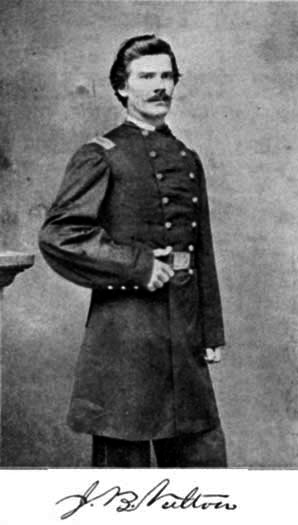
In the course of the day our troops all returned to Murfreesboro. Maj. Nulton, who was now our regimental commander, gave us of the 61st permission to march back "at will." That is, we could start when we got ready, singly or in squads, and not in regimental formation. So Bill Banfield and I started out to get something to eat, as we were very hungry. Since leaving Stevenson on the morning of the 14th, we had had no opportunity to cook anything, and had eaten nothing but some hardtack and raw bacon. Then that night we had left our haversacks on top of the cars when we got off the train to skirmish with the enemy, and never saw them again. And this was a special grievance for Bill and me. We each had a little money, and on the morning we left Stevenson had gone to a sutler's, and made some purchases to insure us an extra good meal when we got back to Murfreesboro. I bought a little can of condensed milk, (having always had a weakness for milk in coffee,) while Bill, with a kind of queer taste, invested in a can of lobsters. One time that night, while sitting on the ground, in the cold and dark, tired, hungry, and sleepy, waiting while our engineers patched a break in the railroad, Bill, with a view, I reckon, to cheering us both up, delivered himself in this wise: "This is a little tough, Stillwell, but just think of that bully dinner we'll have when we get to Murfreesboro! You've your can of condensed milk, and I've mine of lobsters; we'll have coffee with milk in it, and then, with some hardtack, we'll have a spread that will make up for this all right." But, alas!
"The best laid schemes o' mice and men Gang aft a-gley."
My precious condensed milk, and the crustaceans aforesaid of Bill's, doubtless went glimmering down the alimentary canal of some long-haired Texan, to his great satisfaction. My wish at the time was that the darned lobsters might make the fellow sick,—which they probably did. So Bill and I were now at the burning train, looking for something to take the place of our captured Belshazzar banquet. We found a car that was loaded with pickled pork in barrels, and getting a fence rail, we finally succeeded, after some peril and much difficulty, in prying off one of the barrels, and it fell to the ground, bursting open as it did so, and scattering the blazing pieces of pork all around. We each got a portion, and then sat down on a big rock, and proceeded to devour our respective chunks without further ceremony. The outside of the meat was burned to a coal, but we were hungry, all of it tasted mighty sweet, and we gnawed it just like dogs. At the close of the repast, I took a look at Bill. His face was as black as tar from contact with the burnt pork, and in other respects his "tout ensemble" "left much to be desired." I thought if I looked as depraved as Bill certainly did it would be advisable to avoid any pocket looking-glass until after a thorough facial ablution with soft water and plenty of soap. Dinner over, we were soon ready for the march to camp, (there being no dishes to wash,) and started down the railroad track for Murfreesboro. We took our time, and didn't reach camp till about sundown. We were the last arrivals of Co. D, and, as there were all sorts of rumors afloat, we afterwards learned that Capt. Keeley had become quite anxious about us. As we turned down our company street I saw the Captain standing in front of his tent, looking in our direction. After the affairs of the 4th and the 7th, I had taken much satisfaction, in speaking to him of those events, in adopting the phraseology of the old chaplain, and had expressed myself several times in language like this: "And we smote them, hip and thigh, even as Joash smote Boheel!" But it was now necessary to amend my boastful statement, so as I approached Capt. Keeley, and before anything else had been spoken, I made to him this announcement: "And they smote us, hip and thigh, even as Joash smote Boheel!" Keeley laughed, but it was a rather dry laugh, and he answered: "Well, I'm glad they didn't smite you boys, anyhow—but, great God! go wash your faces, and clean up generally. You both look like the very devil himself." We passed on, complied with the Captain's directions, and then I curled up in my dog tent and slept without a break until next morning.
Lorenzo J. Miner 1st Lieutenant Co. B, 61st Illinois Infantry. Died December 19, 1864, of a wound received in a fight on the railroad, near Murfreesboro, Tenn., December 15, 1864.
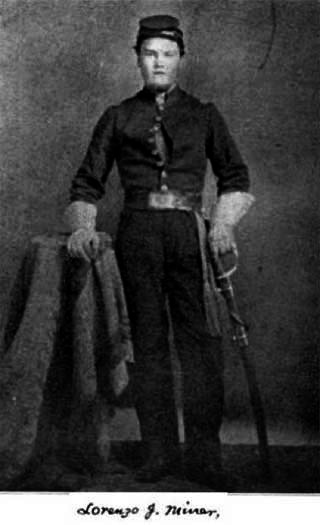
In concluding my account of this affair it will be stated that the most of our boys who were captured in the fight, and (I think) all the line officers who had the same bad luck, made their escape, singly, or in little parties, not long thereafter. Their Confederate captors, on or about the day after our encounter, had hurriedly joined the army of Gen. Hood, taking their prisoners with them. In their retreat from Tennessee on this occasion, the Confederates had a hard and perilous time. The guards of the captured Yankees were probably well-nigh worn out, and it is likely that, on account of their crushing defeat at Nashville, they had also become discouraged and careless. Anyhow, the most of our fellows got away while Hood was yet on the north side of the Tennessee river. He crossed that stream with the wreck of his army on the 26th and 27th of December, and fell back into Mississippi.
CHAPTER XXIII.
MURFREESBORO. WINTER OF 1864-1865. FRANKLIN. SPRING AND SUMMER OF 1865.
After the retreat of Hood from Nashville, matters became very quiet and uneventful with us at Murfreesboro. The regiment shifted its camp from the inside of Fortress Rosecrans out into open ground on the outskirts of the town, and proceeded to build winter quarters. These consisted of log cabins, like those we built at Little Rock the previous winter, only now the logs were cedar instead of pine. There were extensive cedar forests in the immediate vicinity of Murfreesboro, and we had no difficulty whatever in getting the material. And we had plenty of nice, fragrant cedar wood to burn in our fire-places, which was much better than soggy Arkansas pine. And I remember with pleasure a matter connected with the rations we had in the fore part of the winter. For some reason or other the supply of hardtack became practically exhausted, and we had but little in the line of flour bread, even for some weeks after Hood retreated from Nashville. But in the country north of Murfreesboro was an abundance of corn, and there were plenty of water-mills, so Gen. Rousseau sent out foraging parties in that region and appropriated the corn, and set the mills to grinding it, and oh, what fine cornbread we had! We used to make "ash-cakes," and they were splendid. The method of making and cooking an ash-cake was to mix a quantity of meal with proper proportions of water, grease, and salt, wrap the meal dough in some dampened paper, or a clean, wet cloth, then put it in the fire and cover it with hot ashes and coals. By testing with a sharp stick we could tell when the cake was done, then we would yank it from the fire, scrape off the fragments of the covering and the adhering ashes,—and then, with bacon broiled on the cedar coals, and plenty of good strong coffee, we would have a dinner better than any (from my standpoint) that Delmonico's ever served up in its palmiest days.
On February 4th, 1865, the non-veterans and recruits of the regiment came to us from Arkansas, and so we were once more all together, except a few that were in the Confederate prisons down South. We were all glad to see each other once more, and had many tales to "swap," about our respective experiences during our separation.
On February 10th, Lieutenant Wallace resigned, and returned to his home in Illinois. The chief reason for his resignation was on account of some private matter at home, which was giving him much anxiety and trouble. Further, the war in the region where we were was practically over, and there was nothing doing, with no prospect, so far as we knew, of any military activity for the regiment in the future. Wallace's resignation left Co. D without a second lieutenant, as we then did not have enough enlisted men in the company to entitle us to a full complement of commissioned officers, and the place remained vacant for some months.
On March 21st, we left Murfreesboro by rail and went to Nashville, and thence to Franklin, about twenty miles south of Nashville, and on what was then called the Nashville and Decatur railroad. A desperate and bloody battle occurred here between our forces under the command of Gen. Schofield and the Confederates under Gen. Hood, on November 30th, only two days after our arrival at Murfreesboro. I have often wondered why it was that Gen. Thomas, our department commander, did not send our regiment, on our arrival at Nashville, to reinforce Schofield, instead of to Murfreesboro, for Gen. Schofield certainly needed all the help he could get. But it is probable that Gen. Thomas had some good reason for his action.
When we arrived at Franklin we relieved the regiment that was on duty there as a garrison, and it went somewhere else. It was the 75th Pennsylvania, and the officers and men composing it, so far as I saw, were all Germans. And they were fine, soldierly looking fellows, too. From this time until we left Franklin in the following September, our regiment comprised all the Union force that was stationed at the town. Maj. Nulton was in command of the post, and, subject only to higher authorities at a distance, we were "monarchs of all we surveyed." When we came to Franklin the signs of the battle of November 30th were yet fresh and plentiful. As soon as time and opportunity afforded, I walked over the whole field, (in fact, several times,) looking with deep interest at all the evidences of the battle. I remember especially the appearance of a scattered grove of young locust trees which stood at a point opposite the right center of the Union line. For some hours the grove was right between the fire of both the Union and the Confederate lines, and the manner in which the trees had been riddled with musket balls was truly remarkable. It looked as if a snowbird could not have lived in that grove while the firing was in progress.
General William A. Quarles, of Tennessee, was one of the Confederate generals who were wounded in this battle, and after incurring his wound was taken to the house of a Tennessee planter, Col. McGavock, about a mile from Franklin, near the Harpeth river. Two or three other wounded Confederate officers of less rank were taken to the same place. When the Confederates retreated from Nashville, Gen. Quarles and these other wounded officers were unable to accompany the army. They remained at McGavock's, and were taken prisoners by our forces. They were put under a sort of parole of honor, and allowed to remain where they were, without being guarded. They had substantially recovered from their wounds at the time our regiment arrived at Franklin, and not long thereafter Capt. Keeley came to me one day, and handed me an order from Maj. Nulton, which directed me to take a detail of four men, with two ambulances, and go to McGavock's and get Gen. Quarles and the other Confederate officers who were there, and bring them into Franklin, for the purpose of being sent to Nashville, and thence to the north to some military prison. I thereupon detailed Bill Banfield and three other boys, told them what our business was, and instructed them to brush up nicely, and have their arms and accouterments in first class condition, and, in general, to be looking their best. Having obtained the ambulances, with drivers, we climbed aboard, and soon arrived at the fine residence of old Col. McGavock. I went into the house, met the lady of the establishment, and inquired of her for Gen. Quarles, and was informed that he was in an upper room. I requested the lady to give the general my compliments, and tell him that I desired to see him. She disappeared, and soon the general walked into the room where I was awaiting him. He was a man slightly below medium stature, heavy set, black hair, piercing black eyes, and looked to be about thirty years old. He was a splendid looking soldier. I stepped forward and saluted him, and briefly and courteously told him my business. "All right, sergeant," he answered, "we'll be ready in a few minutes." Their preparations were soon completed, and we left the house. I assigned the general and one of the other officers to a seat near the front in one of the ambulances, and Bill Banfield and I occupied the seat behind them, and the remaining guards and prisoners rode in the other conveyance. There was only one remark made on the entire trip back to Franklin, and I'll mention it presently. We emerged from the woods into the Columbia pike at a point about three-quarters of a mile in front of our main line of works that had been charged repeatedly and desperately by the Confederates in the late battle. The ground sloped gently down towards the works, and for fully half a mile was as level as a house floor. I noticed that at the moment we reached the pike Gen. Quarles began to take an intense interest in the surroundings. He would lean forward, and look to the right, to the front, to the left, and occasionally throw a hasty glance backward,—but said nothing. Finally we passed through our works, near the historic "cotton-gin," and the general drew a deep breath, leaned back against his seat, and said: "Well, by God, the next time I fight at Franklin, I want to let the Columbia pike severely alone!" No one made any response, and the remainder of the journey was finished in silence. I duly delivered Gen. Quarles and his fellow-prisoners to Maj. Nulton, and never saw any of them again.
Early in April, decisive military operations took place in Virginia. On the 3rd of that month our forces marched into Richmond, and on the 9th the army of Gen. Lee surrendered to Gen. Grant. At Franklin we were on a telegraph line, and only about twenty miles from department headquarters, so the intelligence of those events was not long in reaching us. I am just unable to tell how profoundly gratified we were to hear of the capture of Richmond, and of Lee's army. We were satisfied that those victories meant the speedy and triumphant end of the war. It had been a long, desperate, and bloody struggle, and frequently the final result looked doubtful and gloomy. But now,—"there were signs in the sky that the darkness was gone; there were tokens in endless array"; and the feeling among the common soldiers was one of heart-felt relief and satisfaction. But suddenly our joy was turned into the most distressing grief and mourning. Only a few days after we heard of Lee's surrender came the awful tidings of the foul murder of Mr. Lincoln. I well remember the manner of the men when the intelligence of the dastardly crime was flashed to us at Franklin. They seemed dazed and stunned, and were reluctant to believe it, until the fact was confirmed beyond question. They sat around in camp under the trees, talking low, and saying but little, as if the matter were one that made mere words utterly useless. But they were in a desperate frame of mind, and had there been the least appearance of exultation over the murder of Mr. Lincoln by any of the people of Franklin, the place would have been laid in ashes instanter. But the citizens seemed to understand the situation. They went into their houses, and closed their doors, and the town looked as if deserted. To one who had been among the soldiers for some years, it was easy to comprehend and understand their feelings on this occasion. For the last two years of the war especially, the men had come to regard Mr. Lincoln with sentiments of veneration and love. To them he really was "Father Abraham," with all that the term implied. And this regard was also entertained by men of high rank in the army. Gen. Sherman, in speaking of Mr. Lincoln, says this:
"Of all the men I ever met, he seemed to possess more of the elements of greatness, combined with goodness, than any other." (Memoirs of Gen. W. T. Sherman, revised edition, Vol. 2, p. 328.)
For my part, I have been of the opinion, for many years, that Abraham Lincoln was the greatest man the world has ever known.
In the latter part of June the recruits of the 83rd, the 98th, and the 123rd Illinois Infantry were transferred to the 61st, making the old regiment about nine hundred strong. Co. D received forty-six of the transferred men, all of these being from the 83rd Illinois. And they were a fine set of boys, too. Their homes were, in the main, in northwestern Illinois, in the counties of Mercer, Rock Island, and Warren. They all had received a good common school education, were intelligent, and prompt and cheerful in the discharge of their duties. They were good soldiers, in every sense of the word. It is a little singular that, since the muster-out of the regiment in the following September, I have never met a single one of these boys.
Daniel S. Keeley Major, 61st Illinois Infantry.
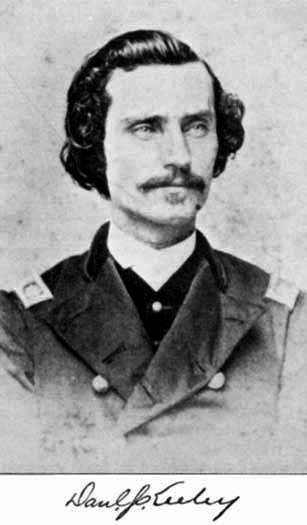
The ranks of the regiment now being filled nearly to the maximum, the most of the vacancies that existed in the line of commissioned officers were filled just as promptly as circumstances would permit. Lieut. Col. Grass had been discharged on May 15th, 1865, and Maj. Nulton, who was now our ranking field officer, was, on July 11th, promoted to the position of Colonel. He was the first, and only, colonel the regiment ever had. The vacancy in the lieutenant-colonelcy of the regiment was never filled, for what reason I do not know. Capt. Keeley was promoted Major, and first Lieutenant Warren to Captain of Co. D in Keeley's stead. And thus it came to pass that on July 11th I received a commission as second lieutenant of our company, and on August 21st was promoted to first lieutenant. Soon after receiving my commission, Capt. Warren was detailed on some special duty which took him away from Franklin for some weeks, and consequently during his absence I was the commanding officer of Co. D. So far as ever came to my knowledge, I got along all right, and very pleasantly. It is a fact, at any rate, that I presented a more respectable appearance than that which was displayed during the brief time I held the position at Austin, Arkansas, in May, 1864.