LEANDER STILLWELL Late of Co. D, 61st Illinois Infantry (continued 5)
Reading edition
But it is time to return to the boy on furlough.
Shortly before leaving Little Rock for home, Capt. Keeley had confidentially informed me that if the military situation in Arkansas continued quiet, it would be all right for me before my furlough expired to procure what would effect a short extension thereof, and he explained to me the modus operandi. Including the unavoidable delays, over a third of my thirty days had been consumed in making the trip home, and the return journey would doubtless require about the same time. I therefore thought it would be justifiable to obtain an extension, if possible. My health was rapidly growing better, the rheumatism was nearly gone—but there was still room for improvement. I had closely read the newspapers in order to keep posted on the military status in the vicinity of Little Rock, and had learned from them that the troops were building winter quarters, and that in general, "All was quiet along the Arkansas." So, on November 9th, I went to Dr. J. H. Hesser, a respectable physician of Otterville, told him my business, and said that if his judgment would warrant it, I would be glad to obtain from him a certificate that would operate to extend my furlough for twenty days. He looked at me, asked a few questions, and then wrote and gave me a brief paper which set forth in substance that, in his opinion as a physician, I would not be able for duty sooner than December 5th, 1863, that being a date twenty days subsequent to the expiration of my furlough. I paid Dr. Hesser nothing for the certificate, for he did not ask it, but said that he gave it to me as a warranted act of kindness to a deserving soldier. (In September of the following year Dr. Hesser enlisted in Co. C of our regiment as a recruit, and about all the time he was with us acted as hospital steward of the regiment, which position he filled ably and satisfactorily.) But I did not avail myself of all my aforesaid extension. I knew it would be better to report at company headquarters before its expiration than after, so my arrangements were made to start back on November 16th. Some hours before sunrise that morning, I bade good-by to mother and the children, and father and I pulled out in the farm wagon for our nearest railroad station, which was Alton, and, as heretofore stated, twenty miles away, where we arrived in ample time for my train. We drove into a back street and unhitched the team—the faithful old mules, Bill and Tom, tied them to the wagon and fed them, and then walked to the depot. The train came in due season, and stopped opposite the depot platform, where father and I were standing. We faced each other, and I said, "Good-bye, father;" he responded, "Good-bye, Leander, take care of yourself." We shook hands, then he instantly turned and walked away, and I boarded the train. That was all there was to it. And yet we both knew more in regard to the dangers and perils that environ the life of a soldier in time of war than we did on the occasion of the parting at Jerseyville nearly two years ago—hence we fully realized that this farewell might be the last. Nor did this manner spring from indifference, or lack of sensibility; it was simply the way of the plain unlettered backwoods people of those days. Nearly thirty-five years later the "whirligig of time" evolved an incident which clearly brought home to me a vivid idea of what must have been my father's feelings on this occasion. The Spanish-American war began in the latter part of April, 1898, and on the 30th of that month, Hubert, my oldest son, then a lad not quite nineteen years old, enlisted in Co. A of the 22nd Kansas Infantry, a regiment raised for service in that war. On May 28th the regiment was sent to Washington, D. C., and was stationed at Camp Alger, near the city. In the early part of August it appeared that there was a strong probability that the regiment, with others at Washington, would soon be sent to Cuba or Porto Rico. I knew that meant fighting, to say nothing of the camp diseases liable to prevail in that latitude at that season of the year. So my wife and I concluded to go to Washington and have a little visit with Hubert before he left for the seat of war. We arrived at the capital on August 5th, and found the regiment then in camp near the little village of Clifton, Virginia, about twenty-six miles southwest of Washington. We had a brief but very enjoyable visit with Hubert, who was given a pass, and stayed a few days with us in the city. But the time soon came for us to separate, and on the day of our departure for home Hubert went with us to the depot of the Baltimore and Ohio railroad, where his mother and I bade him good-by. Then there came to me, so forcibly, the recollection of the parting with my father at the Alton depot in November, 1863, and for the first time I think I fully appreciated what must have been his feelings on that occasion.
But, (referring to the Washington incident,) it so happened that on the day my wife and I left that city for home, or quite soon thereafter, it was officially announced that a suspension of hostilities had been agreed on between Spain and the United States. This ended the war, and consequently Hubert's regiment was not sent to the Spanish islands. I will now resume my own story.
Leander Stillwell Co. D, 61st Illinois Infantry, December, 1863.
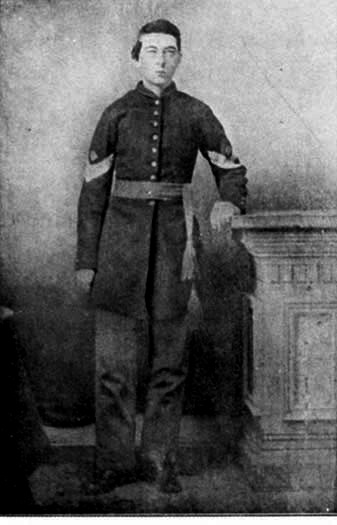
My route from Alton, and method of conveyance, on returning to the regiment, were the same, with one or two slight variations, as those in going home, and the return trip was uneventful. But there were no delays, the boat ran day and night, and the journey was made in remarkably quick time. I arrived at Little Rock on the evening of November 20th, only five days over my furlough,—and with a twenty-day extension to show for that, reported promptly to Capt. Keeley, and delivered to him the certificate given me by Dr. Hesser. Keeley pronounced the paper satisfactory, and further said it would have been all right if I had taken the benefit of the entire twenty days. However, it somehow seemed to me that he really was pleased to see that I had not done so, but hurried back fifteen days ahead of time. After a brief conversation with him about the folks at home, and matters and things there in general, he treated me to a most agreeable surprise. He stepped to the company office desk, and took therefrom a folded paper which he handed to me with the remark: "There, Stillwell, is something I think will please you." I unfolded and glanced at it, and saw that it was a non-commissioned officer's warrant, signed by Major Grass as commanding officer of the regiment, and countersigned by Lieut. A. C. Haskins as adjutant, appointing me First Sergeant of Co. D. The warrant was dated November 4th, but recited that the appointment took effect from September 1st, preceding. As before stated, Enoch Wallace was our original first sergeant, and as he was promoted to second lieutenant on September 3, 1863, his advancement left his old position vacant, and his mantle had now fallen on me. I was deeply gratified with this appointment, and really was not expecting it, as there were two other duty sergeants who outranked me, and in appointing me I was promoted over their heads. However, they took it in good part, and remained my friends, as they always had been. And the plain truth is, too, which may have reconciled these sergeants somewhat, the position of first or orderly sergeant, as we usually called it, was not an enviable one, by any means. His duties were incessant, involving responsibility, and frequently were very trying. He had to be right with his company every hour in the day, and it was not prudent for him to absent himself from camp for even ten minutes without the consent of his company commander, and temporarily appointing a duty sergeant to act in his place while away. Among his multifarious duties may be mentioned the following: Calling the roll of the company morning and evening, and at such other hours as might be required; attending sick calls with the sick, and carefully making a note of those excused from duty by the surgeon; making out and signing the company morning report; procuring the signature of the company commander thereto, and then delivering it to the adjutant; forming the company on its parade ground for dress parade, drills, marches, and the like; making the details of the men required from his company for the various kinds of guard and fatigue duty; drawing rations for the company, and distributing them among the various messes; seeing to it that the company grounds (when in camp) were properly policed every morning;—and just scores of little matters of detail that were occurring all the time. It was a very embarrassing incident when sometimes a boy who was a good soldier was, without permission, absent at roll call. He might have strolled up town, or to a neighboring camp to see an old-time friend, and stayed too long. On such occurrences I would, as a general rule, pass rapidly from his name to the next—and just report the boy present, and later talk to him privately and tell him not to let it happen again. It is true, sometimes an aggravated case occurred when, in order to maintain discipline, a different course had to be pursued, but not often. Speaking generally, I will say that it was bad policy for the orderly to be running to the captain about every little trouble or grievance. The thing for him to do was to take the responsibility and act on his own judgment, and depend on the captain to back him (as he almost invariably would) if the affair came to a "show-down." Beginning as far back as the summer of 1862, I had frequently temporarily acted as orderly sergeant, for weeks at a time, and so possessed a fair amount of experience when I entered on the duties of the position under a permanent appointment. But my long, solitary rambles out in the woods, beyond the lines, were at an end, and that was a matter of more regret to me than anything else connected with the office of orderly sergeant. While on this topic I will remark that it always seemed to me that the men who had the "softest snaps" of any in a regiment of infantry were the lieutenants of the respective companies. The first lieutenant had no company cares or responsibilities whatever, unless the captain was absent, or sick in quarters, and the second lieutenant was likewise exempt, unless the captain and first lieutenant were both absent, or sick. Of course there were duties that devolved on the lieutenants from time to time, such as drilling the men, serving as officer of the guard, and other matters, but when those jobs were done, they could just "go and play," without a particle of care or anxiety about the services of the morrow.
CHAPTER XIV.
LITTLE ROCK. WINTER OF 1863-4. RE-ENLIST FOR THREE YEARS MORE.
When I returned to Little Rock from my absence on furlough, the regiment was found installed in cosy, comfortable quarters of pine log cabins. There were extensive pine forests near Little Rock, the boys were furnished teams and axes to facilitate the work, and cut and shaped the logs for the cabin walls, and roofed them with lumber, boards or shingles, which they procured in various ways. The walls were chinked and daubed with mud, and each cabin was provided with an ample, old-fashioned fire-place, with a rock or stick chimney. As wood was close at hand, and in abundance, there was no difficulty whatever in keeping the cabins warm. But I will remark here that of all the mean wood to burn, a green pine log is about the worst. It is fully as bad as green elm, or sycamore. But there was no lack of dry wood to mix with the green, and the green logs had this virtue: that after the fire had once taken hold of them they would last a whole night. The winter of 1863-4 was remarkably cold, and to this day is remembered by the old soldiers as "the cold winter." On the last day of 1863 a heavy fall of snow occurred at Little Rock, and the first day of the new year, and several days thereafter, were bitterly cold. But the weather did not cause the troops in our immediate locality any special suffering, so far as I know, or ever heard. All of us not on picket were just as comfortable as heart could wish in our tight, well-warmed cabins, and those on guard duty were permitted to build rousing fires and so got along fairly well. Big fires on the picket line would not have been allowed if any enemy had been in our vicinity, but there were none; hence it was only common sense to let the pickets have fires and keep as comfortable as circumstances would permit. It was probably on account of the severe weather that active military operations in our locality were that winter practically suspended. There were a few cavalry affairs at outlying posts, but none of any material importance.
The most painful sight that I saw during the war was here at Little Rock this winter. It was the execution, by hanging, on January 8, 1864, of a Confederate spy, by the name of David O. Dodds. He was a mere boy, seemingly not more than nineteen or twenty years old. There was no question as to his guilt. When arrested there was found on his person a memorandum book containing information, written in telegraphic characters, in regard to all troops, batteries, and other military matters at Little Rock. He was tried by a court martial, and sentenced to the mode of death always inflicted on a spy, namely, by hanging. I suppose that the military authorities desired to render his death as impressive as possible, in order to deter others from engaging in a business so fraught with danger to our armies; therefore, on the day fixed for carrying out the sentence of the court, all our troops in Little Rock turned out under arms and marched to the place of execution. It was in a large field near the town; a gallows had been erected in the center of this open space, and the troops formed around it in the form of an extensive hollow square, and stood at parade rest. The spy rode through the lines to the gallows in an open ambulance, sitting on his coffin. I happened to be not far from the point where he passed through, and saw him plainly. For one so young, he displayed remarkable coolness and courage when in the immediate presence of death. The manner of his execution was wretchedly bungled, in some way, and the whole thing was to me indescribably repulsive. In the crisis of the affair there was a sudden clang of military arms and accouterments in the line not far from me, and looking in that direction I saw that a soldier in the front rank had fainted and fallen headlong to the ground. I didn't faint, but the spectacle, for the time being, well-nigh made me sick. It is true that from time immemorial the punishment of a convicted spy has been death by hanging. The safety of whole armies, even the fate of a nation, may perhaps depend on the prompt and summary extinction of the life of a spy. As long as he is alive he may possibly escape, or, even if closely guarded, may succeed in imparting his dangerous intelligence to others who will transmit it in his stead; hence no mercy can be shown. But in spite of all that, this event impressed me as somehow being unspeakably cruel and cold-blooded. On one side were thousands of men with weapons in their hands, coolly looking on; on the other was one lone, unfortunate boy. My conscience has never troubled me for anything I may have done on the firing line, in time of battle. There were the other fellows in plain sight, shooting, and doing all in their power to kill us. It was my duty to shoot at them, aim low, and kill some of them, if possible, and I did the best I could, and have no remorse whatever. But whenever my memory recalls the choking to death of that boy, (for that is what was done), I feel bad, and don't like to write or think about it. But, for fear of being misunderstood, it will be repeated that the fate of a spy, when caught, is death. It is a military necessity. The other side hanged our spies, with relentless severity, and were justified in so doing by laws and usages of war. Even the great and good Washington approved of the hanging of the British spy, Maj. Andre, and refused to commute the manner of his execution to being shot, although Andre made a personal appeal to him to grant him that favor, in order that he might die the death of a soldier. The point with me is simply this: I don't want personally to have anything to do, in any capacity, with hanging a man, and don't desire even to be in eye-sight of such a gruesome thing, and voluntarily never have. However, it fell to my lot to be an involuntary witness of two more military executions while in the service. I will speak of them now, and then be through with this disagreeable subject. On March 18th, 1864, two guerrillas were hanged in the yard of the penitentiary at Little Rock, by virtue of the sentence of a court martial, and my regiment acted as guard at the execution. We marched into the penitentiary inclosure, and formed around the scaffold in hollow square. As soon as this had been done, a door on the ground floor of the penitentiary was swung open, and the two condemned men marched out, pinioned side by side, and surrounded by a small guard. The culprits were apparently somewhere between forty and fifty years of age. They ascended the scaffold, were placed with their feet on the trap, the nooses were adjusted, the trap was sprung,—and it was all over. The crimes of which these men had been convicted were peculiarly atrocious. They were not members of any organized body of the Confederate army, but guerrillas pure and simple. It was conclusively established on their trial that they, with some associates, had, in cold blood, murdered by hanging several men of that vicinity, private citizens of the State of Arkansas, for no other cause or reason than the fact that the victims were Union men. In some cases the murdered men had been torn from their beds at night, and hanged in their own door-yards, in the presence of their well-nigh distracted wives and children. There can be no question that these two unprincipled assassins richly merited their fate, and hence it was impossible to entertain for them any feeling of sympathy. Nevertheless, I stand by my original proposition, that to see any man strung up like a dog, and hanged in cold blood, is a nauseating and debasing spectacle.
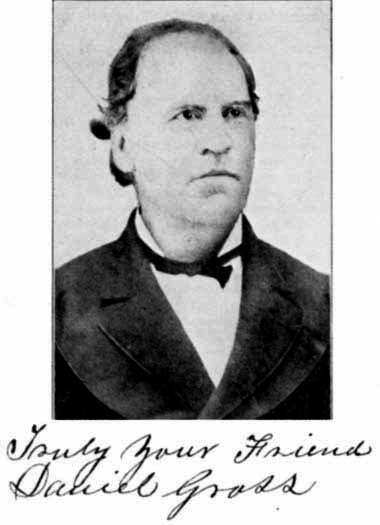
In January, 1864, while we were at Little Rock, the "veteranizing" project, as it was called, was submitted to the men. That is to say, we were asked to enlist for "three years more, or endurin' the war." Sundry inducements for this were held out to the men, but the one which, at the time, had the most weight, was the promise of a thirty-days furlough for each man who re-enlisted. The men in general responded favorably to the proposition, and enough of the 61st re-enlisted to enable the regiment to retain its organization to the end of the war. On the evening of February 1st, with several others of Co. D, I walked down to the adjutant's tent, and "went in" for three years more. I think that no better account of this re-enlistment business can now be given by me than by here inserting a letter I wrote on December 22nd, 1894, as a slight tribute to the memory of our acting regimental commander in February, 1864, Maj. Daniel Grass. He was later promoted to lieutenant-colonel, and after the war, came to Kansas, where, for many years, he was a prominent lawyer and politician. On the evening of December 18th, 1894, while he was crossing a railroad track in the town where he lived, (Coffeyville, Kansas,) he was struck by a railroad engine, and sustained injuries from which he died on December 21st, at the age of a little over seventy years. A few days thereafter the members of the bar of the county held a memorial meeting in his honor, which I was invited to attend. I was then judge of the Kansas 7th Judicial District, and my judicial duties at the time were such that I could not go, and hence was compelled to content myself by writing a letter, which was later published in the local papers of the county, and which reads as follows:
"Erie, Kansas, "December 22, 1894.
"Hon. J. D. McCue, "Independence, Kansas.
"My Dear Judge:
"I received this evening yours of the 20th informing me of the death of my old comrade and regimental commander during the war for the Union, Col. Dan Grass. I was deeply moved by this sad intelligence, and regret that I did not learn of his death in time to attend his funeral. I wish I could be present at the memorial meeting of the bar next Monday that you mention, but I have other engagements for that day that cannot be deferred. It affords me, however, a mournful pleasure to comply with your request suggesting that I write a few words in the nature of a tribute to our departed friend and comrade, to be read at this meeting of the bar. But I am fearful that I shall perform this duty very unsatisfactorily. There are so many kind and good things that I would like to say about him that throng my memory at this moment that I hardly know where to begin.
"I served in the same regiment with Col. Grass from January 7th, 1862, to December 15th, 1864. On the last named day he was taken prisoner by the rebels in an engagement near Murfreesboro, Tenn. He was subsequently exchanged, but by that time the war was drawing to a close, and he did not rejoin us again in the field. In May, 1865, he was mustered out of the service. During his term of service with us, (nearly three years,) I became very well acquainted with him, and learned to admire and love him as a man and a soldier. He was temperate in his habits, courteous and kind to the common soldiers, and as brave a man in action as I ever saw. He was, moreover, imbued with the most fervid and intense patriotism. The war with him was one to preserve the Republic from destruction, and his creed was that the government should draft, if necessary, every available man in the North, and spend every dollar of the wealth of the country, sooner than suffer the rebellion to succeed, and the Nation to be destroyed. I think the most eloquent speech I ever heard in my life was one delivered by Col. Grass to his regiment at Little Rock, Arkansas, in February, 1864. The plan was then in progress to induce the veteran troops in the field to re-enlist for three years more. We boys called it 'veteranizing.' For various reasons it did not take well in our regiment. Nearly all of us had been at the front without a glimpse of our homes and friends for over two years. We had undergone a fair share of severe fighting and toilsome marching and the other hardships of a soldier's life, and we believed we were entitled to a little rest when our present term should expire. Hence, re-enlisting progressed slowly, and it looked as if, so far as the 61st Illinois was concerned, that the undertaking was going to be a failure. While matters were in this shape, one day Col. Grass caused the word to be circulated throughout the regiment that he would make us a speech that evening at dress parade on the subject of 'veteranizing.' At the appointed time we assembled on the parade ground with fuller ranks than usual, everybody being anxious to hear what 'Old Dan,' as the boys called him, would say. After the customary movements of the parade had been performed, the Colonel commanded, 'Parade, Rest!' and without further ceremony commenced his talk. Of course I cannot pretend, after this lapse of time, to recall all that he said. I remember best his manner and some principal statements, and the effect they produced on us. He began talking to us like a father would talk to a lot of dissatisfied sons. He told us that he knew we wanted to go home; that we were tired of war and its hardships; that we wanted to see our fathers and mothers, and 'the girls we left behind'; that he sympathized with us, and appreciated our feelings. 'But, boys,' said he, 'this great Nation is your father, and has a greater claim on you than anybody else in the world. This great father of yours is fighting for his life, and the question for you to determine now is whether you are going to stay and help the old man out, or whether you are going to sneak home and sit down by the chimney corner in ease and comfort while your comrades by thousands and hundreds of thousands are marching, struggling, fighting, and dying on battle fields and in prison pens to put down this wicked rebellion, and save the old Union. Stand by the old flag, boys! Let us stay and see this thing out! We're going to whip 'em in the end just as sure as God Almighty is looking down on us right now, and then we'll all go home together, happy and triumphant. And take my word for it, in after years it will be the proudest memory of your lives, to be able to say, "I stayed with the old regiment and the old flag until the last gun cracked and the war was over, and the Stars and Stripes were floating in triumph over every foot of the land!'"
"I can see him in my mind's eye, as plain as if it were yesterday. He stood firm and erect on his feet in the position of a soldier, and gestured very little, but his strong, sturdy frame fairly quivered with the intensity of his feelings, and we listened in the most profound silence.
"It was a raw, cold evening, and the sun, angry and red, was sinking behind the pine forests that skirted the ridges west of our camp when the Colonel concluded his address. It did not, I think, exceed more than ten minutes. The parade was dismissed, and the companies marched back to their quarters. As I put my musket on its rack and unbuckled my cartridge box, I said to one of my comrades, 'I believe the old Colonel is right; I am going right now down to the adjutant's tent and re-enlist;' and go I did, but not alone. Down to the adjutant's tent that evening streamed the boys by the score and signed the rolls, and the fruit of that timely and patriotic talk that Dan Grass made to us boys was that the great majority of the men re-enlisted, and the regiment retained its organization and remained in the field until the end of the war.
"But my letter is assuming rather lengthy proportions, and I must hasten to a close. I have related just one incident in the life of Col. Grass that illustrates his spirit of patriotism and love of country. I could speak of many more, but the occasion demands brevity. Of his career since the close of the war, in civil life here in Kansas, there are others better qualified to speak than I am. I will only say that my personal relations with him since he came to this State, dating away back in the early seventies, have continued to be, during all these years, what they were in the trying and perilous days of the war—of the most friendly and fraternal character. To me, at least, he was always Col. Dan Grass, my regimental commander; while he, as I am happy to believe, always looked upon and remembered me simply as 'Lee Stillwell, the little sergeant of Company D.'
"I remain very sincerely your friend,
"L. STILLWELL."
Daniel Grass (Late Lieut. Colonel, 61st Illinois Infantry.)
CHAPTER XV.
LITTLE ROCK. EXPEDITIONS TO AUGUSTA AND SPRINGFIELD. MARCH, APRIL AND MAY, 1864.
In the spring of 1864 it was determined by the military authorities to undertake some offensive operations in what was styled the "Red River country," the objective point being Shreveport, Louisiana. Gen. N. P. Banks was to move with an army from New Orleans, and Gen. Steele, in command of the Department of Arkansas, was to co-operate with a force from Little Rock. And here my regiment sustained what I regarded, and still regard, as a piece of bad luck. It was not included in this moving column, but was assigned to the duty of serving as provost guard of the city of Little Rock during the absence of the main army. To be left there in that capacity, while the bulk of the troops in that department would be marching and fighting was, from my standpoint, a most mortifying circumstance. But the duty that devolved on us had to be done by somebody, and soldiers can only obey orders. Our officers said at the time that only efficient and well-disciplined troops were entrusted with the position of provost-guards of a city the size of Little Rock, and hence that our being so designated was a compliment to the regiment. That sounded plausible, and it may have been true, probably was, but I didn't like the job a bit. It may, however, have all been for the best, as this Red River expedition, especially the part undertaken by Gen. Banks, was a disastrous failure. Gen. Steele left Little Rock about March 23rd, with a force, of all arms, of about 12,000 men, but got no further than Camden, Arkansas. Gen. Banks was defeated by the Confederates at the battle of Sabine Cross-Roads, in Louisiana, on April 8th, and was forced to retreat. The enemy then was at liberty to concentrate on General Steele, and so he likewise was under the necessity of retreating, and scuttling back to Little Rock just as rapidly as possible. But on this retreat he and his men did some good, hard fighting, and stood off the Confederates effectively. About the first intimation we in Little Rock had that our fellows were coming back was when nearly every soldier in the city that was able to wield a mattock or a spade was detailed for fatigue duty and set to work throwing up breastworks, and kept at it, both day and night. I happened to see Gen. Steele when he rode into town on May 2nd, at the head of his troops, and he looked tough. He had on a battered felt hat, with a drooping brim, an oil-cloth "slicker," much the worse for wear, the ends of his pantaloons were stuck in his boots, and he was just splashed and splattered with mud from head to foot. But he sat firm and erect in his saddle, (he was a magnificent horseman,) and his eyes were flashing as if he had plenty of fight left in him yet. And the rank and file of our retreating army was just the hardest looking outfit of Federal soldiers that I saw during the war, at any time. The most of them looked as if they had been rolled in the mud, numbers of them were barefoot, and I also saw several with the legs of their trousers all gone, high up, socking through the mud like big blue cranes.
In view of the feverish haste with which Little Rock had been put in a state for defensive operations, and considering also all the reports in circulation, we fully expected that Price's whole army would make an attack on us almost any day. But the Confederates had been so roughly handled in the battle of Jenkins' Ferry, April 30th, on the Saline river, that none of their infantry came east of that river, nor any of their cavalry except a small body, which soon retired. The whole Confederate army, about May 1st, fell back to Camden, and soon all was again quiet along the Arkansas.
I will now go back about two weeks in order to give an account of a little expedition our regiment took part in when Gen. Steele's army was at Camden.
Late on the evening of April 19th, we fell in, marched to the railroad depot, climbed on the cars, and were taken that night to Devall's Bluff. Next morning we embarked on the steamboat "James Raymond," and started up White river. The other troops that took part in the movement were the 3rd Minnesota Infantry and a detachment of the 8th Missouri Cavalry. We arrived at the town of Augusta, (about eighty miles by water from Devall's Bluff,) on the morning of the 21st. It was a little, old, dilapidated river town, largely in a deserted condition, situated on low, bottom land, on the east bank of White river. On arriving we at once debarked from the boat, and all our little force marched out a mile or so east of the town, where we halted, and formed in line of battle in the edge of the woods, with a large open field in our front, on the other side of which were tall, dense woods. As there were no signs or indications of any enemy in the town, and everything around was so quiet and sleepy, I couldn't understand what these ominous preparations meant. Happening to notice the old chaplain a short distance in the rear of our company, I slipped out of ranks, and walked back to him for the purpose of getting a pointer, if possible. He was by himself, and as I approached him, seemed to be looking rather serious. He probably saw inquiry in my eyes, and without waiting for question made a gesture with his hands towards the woods in our front, and said, "O Son of Jeremiah! Here is where we shall give battle to those who trouble Israel!" "What! What is that you say?" said I, in much astonishment. "It is even so," he continued; "the Philistines are abroad in the land, having among them, as they assert, many valiant men who can sling stones at a hair's breadth and not miss. They await us, even now, in the forest beyond. But, Son of Jeremiah," said he, "if the uncircumcised heathen should assail the Lord's anointed, be strong, and quit yourself like a man!" "All right, Chaplain," I responded; "I have forty rounds in the box, and forty on the person, and will give them the best I have in the shop. But, say! Take care of my watch, will you? And, should anything happen, please send it to the folks at home;"—and handing him my little old silver time-piece, I resumed my place in the ranks. After what seemed to me a most tiresome wait, we finally advanced, preceded by a line of skirmishers. I kept my eyes fixed on the woods in our front, expecting every minute to see burst therefrom puffs of white smoke, followed by the whiz of bullets and the crash of musketry, but nothing of the kind happened. Our skirmishers entered the forest, and disappeared, and still everything remained quiet. The main line followed, and after gaining the woods, we discovered plenty of evidence that they had quite recently been occupied by a body of cavalry. The ground was cut up by horses' tracks, and little piles of corn in the ear, only partly eaten, were scattered around. We advanced through the woods and swamps for some miles and scouted around considerably, but found no enemy, except a few stragglers that were picked up by our cavalry. We left Augusta on the 24th, on our steamboat, and arrived at Little Rock on the same day. I met the chaplain on the boat while on our return, and remarked to him that, "Those mighty men who could kill a jaybird with a sling-shot a quarter of a mile off didn't stay to see the show." "No," he answered; "when the sons of Belial beheld our warlike preparation, their hearts melted, and became as water; they gat every man upon his ass, and speedily fled, even beyond the brook which is called Cache." He then went on to tell me that on our arrival at Augusta there was a body of Confederate cavalry near there, supposed to be about a thousand strong, under the command of a General McRae; that they were bivouacked in the woods in front of the line of battle we formed, and that on our approach they had scattered and fled. The enemy's force really exceeded ours, but, as a general proposition, their cavalry was reluctant to attack our infantry, in a broken country, unless they could accomplish something in the nature of a surprise, or otherwise have a decided advantage at the start.
On May 16th we shifted our camp to Huntersville, on the left bank of the Arkansas river, and near our first location. We thus abandoned our log cabins, and never occupied them again. They were now getting too close and warm for comfort, anyhow. But they had been mighty good friends to us in the bitterly cold winter of '63-4, and during that time we spent many a cosy, happy day and night therein.
On May 19th we again received marching orders, and the regiment left camp that night on the cars, and went to Hicks' station, 28 miles from Little Rock. We remained here, bivouacking in the woods, until the 22nd, when, at 3 o'clock in the morning of that day, we took up the line of march, moving in a northerly direction. The troops that composed our force consisted of the 61st, 54th, and 106th Illinois, and 12th Michigan (infantry regiments), a battery of artillery, and some detachments of cavalry; Brig. Gen. J. R. West in command. We arrived at the town of Austin, 18 miles from Hicks' Station, about 2 o'clock on the afternoon of the 22nd. It was a little country village, situated on a rocky, somewhat elevated ridge. As I understand, it is now a station on the Iron Mountain railroad, which has been built since the war. I reckon if in May, 1864, any one had predicted that some day a railroad would be built and in operation through that insignificant settlement among the rocks and trees, he would have been looked on as hardly a safe person to be allowed to run at large.
Co. D started on the march with only one commissioned officer, Second Lieutenant Wallace. I have forgotten the cause of the absence of Capt. Keeley and Lieut. Warren, but there was doubtless some good reason. On the first day's march the weather was hot, and the route was through a very rough and broken country. Wallace was overcome by heat, and had to fall out, and wait for an ambulance. In consequence, it so happened that when we reached Austin, there was no commissioned officer with us, and I, as first sergeant, was in command of the company. And that gave rise to an incident which, at the time, swelled me up immensely. On arriving at the town, the regiment halted on some open ground in the outskirts, fell into line, dressed on the colors, and stood at ordered arms. Thereupon the adjutant commanded, "Commanding officers of companies, to the front and center, march!" I was completely taken by surprise by this command, and for a second or two stood, dazed and uncertain. But two or three of the boys spoke up at once and said, "You're our commanding officer, Stillwell; go!" The situation by this time had also dawned on me, so I promptly obeyed the command. But I must have been a strange looking "commanding officer." I was barefooted, breeches rolled up nearly to the knees, feet and ankles "scratched and tanned," and my face covered with sweat and dirt. The closest scrutiny would have failed to detect in me a single feature of the supposed "pomp and circumstance" of an alleged military hero. But I stalked down the line, bare feet and all, with my musket at a shoulder arms, and looking fully as proud, I imagine, as Henry of Navarre ever did at the battle of Ivry, with "a snow-white plume upon his gallant crest." By the proper and usual commands, the "commanding officers of companies" were brought up and halted within a few paces of Col. Ohr, who thereupon addressed them as follows:
"Gentleman, have your men stack arms where they now are, and at once prepare their dinner. They can disperse to get wood and water, but caution them strictly not to wander far from the gun stacks. We may possibly pass the night here, but we may be called on, at any moment, to fall in and resume the march. That's all, gentlemen."
While the Colonel was giving these instructions, I thought a sort of unusual twinkle sparkled in his eyes, as they rested on me. But, for my part, I was never more serious in my life. Returning to the company, I gave the order to stack arms, which being done, the boys crowded around me, plying me with questions. "What did the Colonel say? What's up, Stillwell?" I assumed a prodigiously fierce and authoritative look and said: "Say, do you fellows suppose that we commanding officers of companies are going to give away to a lot of lousy privates a confidential communication from the Colonel? If you are guilty of any more such impertinent conduct, I'll have every mother's son of you bucked and gagged." The boys all laughed, and after a little more fun of that kind, I repeated to them literally every word the Colonel said, and then we all set about getting dinner. About this time Lieut. Wallace rode up in an ambulance—and my reign was over. We resumed the march at 3 o'clock in the morning of the next day (May 23rd), marched 18 miles, and bivouacked that night at Peach Orchard Gap. This was no town, simply a natural feature of the country. Left here next morning (the 24th) at daylight, marched 18 miles, and bivouacked on a stream called Little Cadron. Left at daylight next morning (the 25th), marched 18 miles, and went into camp near the town of Springfield. By this time the intelligence had filtered down to the common soldiers as to the object of this expedition. It was to intercept, and give battle to, a force of Confederate cavalry, under Gen. J. O. Shelby, operating somewhere in this region, and supposed to have threatening designs on the Little Rock and Devall's Bluff railroad. But so far as encountering the Confederates was concerned, the movement was an entire failure. My experience during the war warrants the assertion, I think, that it is no use to send infantry after cavalry. It is very much like a man on foot trying to run down a jack-rabbit. It may be that infantry can sometimes head off cavalry, and thereby frustrate an intended movement, but men on horses can't be maneuvered into fighting men on foot unless the horsemen are willing to engage. Otherwise they will just keep out of the way.
We remained at Springfield until May 28th. It was a little place and its population when the war began was probably not more than a hundred and fifty, or two hundred. It was the county seat of Conway county, but there was no official business being transacted there now. About all the people had left, except a few old men and some women and small children. The houses were nearly all log cabins. Even the county jail was a log structure of a very simply and unimposing type. It has always been my opinion that this little place was the most interesting and romantic-looking spot (with one possible exception I may speak of later) that I saw in the South during all my army service. The town was situated on rather high ground, and in the heart of the primitive forest. Grand native trees were growing in the door-yards, and even in the middle of the main street,—and all around everywhere. And we were there at a season of the year when Nature was at its best, and all the scenery was most attractive and charming. I sometimes would sit down at the foot of some big tree in the center of the little village, and ponder on what surely must have been the happy, contented condition of its people before the war came along and spoiled all. Judging from the looks of the houses, the occupants doubtless had been poor people and practically all on the same financial footing, so there was no occasion for envy. And there was no railroad, nor telegraph line, nor daily papers, to keep them nervous and excited or cause them to worry. And they were far away from the busy haunts of congregated men,—
"Their best companions, innocence and health, And their best riches, ignorance of wealth."
Their trading point was Lewisburg, about fifteen miles southwest on the Arkansas river, and when that stream was at a proper stage, small steamboats would ply up and down, and bring to Lewisburg groceries and dry goods, and such other things as the country did not produce, which would then be wagoned out to Springfield and into the country generally. And judging from all that could be seen or heard, I think there were hardly any slaves at Springfield, or in the entire north part of Conway county, before the war. What few there may have been were limited to the plantations along the Arkansas river. I have never been at the little town since the occasion now mentioned, so personally I know nothing of its present appearance and condition. However, as a matter of general information, it may be said that after the war a railroad was built running up the Arkansas river valley, through the south part of the county. This road left Springfield out, so in course of time it lost the county seat, which went to a railroad town. And this road also missed Lewisburg, which has now disappeared from the map entirely.
When in camp at Springfield, many of the boys, in accordance with their usual habits, of their own motion at once went to scouting around over the adjacent country, after pigs, or chickens, or anything else that would serve to vary army fare. While so engaged two or three of our fellows discovered a little old whisky still. It was about two miles from Springfield, situated in a deep, timbered hollow, near a big spring. It was fully equipped for active operation, with a supply of "mash" on hands, and all other essentials for turning out whisky. Some of the 10th Illinois Cavalry found it first, and scared away the proprietor, then took charge of the still and proceeded to carry on the business on their own account. The boys of the 61st who stumbled on the place were too few to cope with the cavalrymen; thereupon they hastened back to camp and informed some trusty comrades of the delectable discovery. Forthwith they organized a strong party as an alleged "provost guard," and all armed, and under the command of a daring, reckless duty sergeant, hastened to the still. On arriving there, in their capacity as provost guards, they summarily arrested the cavalrymen, with loud threats of condign punishment, but after scaring them sufficiently, and on their solemn promise to at once return to camp and "be good" in the future, released them, and allowed them to depart. Then our bunch stacked arms, and started in to make whisky. Some of the number had served in the business before, and knew all about it, so that little still there in the hollow was then and there worked to its utmost capacity, day and night, and doubtless as it never had been before. Knowledge of this enterprise spread like wild-fire among the enlisted men,—and oh, "how the whisky went down" at Springfield! Away along some hours after midnight, I would hear some of the boys coming in from the still, letting out keen, piercing whoops that could be heard nearly a mile. Like the festive Tam O'Shanter (with apologies to Burns),—
"The swats sae reamed in every noddle, They cared na rebs nor guards a boddle."
I took just one little taste of the stuff, from Sam Ralston's canteen. It was limpid and colorless as water, and fairly burnt like fire as it went down my throat. That satisfied my curiosity, and after that many similar offers were declined, with thanks. Whether the officers at the time knew of this business or not, I do not know. If they did, they just "winked the other eye," and said nothing, for the boys ran the still, without restriction or interruption, until we left Springfield.
Telling of the foregoing episode causes many other incidents to come flocking to my memory that came under my notice during my army career, and in which whisky figured more or less. The insatiable, inordinate appetite of some of the men for intoxicating liquor, of any kind, was something remarkable, and the ingenious schemes they would devise to get it were worthy of admiration, had they been exerted in a better cause. And they were not a bit fastidious about the kind of liquor, it was the effect that was desired. One afternoon, a day or two after we arrived at Helena, Arkansas, a sudden yell, a sort of "ki-yip!" was heard issuing from one of the company tents, soon followed by others of the same tone. I had heard that peculiar yelp before, and knew what it meant. Presently I sauntered down to the tent from whence the sounds issued, and walked in. Several of the boys were seated around, in an exalted state of vociferous hilarity, and a flat, pint bottle, with the figure of a green leaf on one side, and labeled "Bay Rum" on the other, was promptly handed to me, with the invitation to "drink hearty." I did taste it. It was oily, greasy, and unpleasant, but there was no doubt that it was intoxicating. It was nothing but bay rum, the same stuff that in those days barbers were wont to use in their line of business. It finally came to light that the sutler of some regiment at Helena had induced the post-quartermaster at Cairo to believe that the troops stood in urgent need of bay rum for the purpose of anointing their hair, and thereupon he obtained permission to include several boxes of the stuff in his sutler supplies. When he got it to Helena he proceeded to sell it at a dollar a bottle, and his stock was exhausted in a few hours. What may have been done to this sutler I don't know, but that was the last and only time that I know of bay rum being sold to the soldiers as a toilet article, or otherwise. Of course, all sutlers and civilians were prohibited, under severe penalties, from selling intoxicating liquor to the enlisted men, but the profits were so large that the temptation was great to occasionally transgress, in some fashion. But, as a general rule, I think that the orders were scrupulously obeyed. The risk was too great to do otherwise.
I remember a little personal experience of my own, when once I tried to buy a drink of whisky. It is not a long story, so it will be told. It occurred at Devall's Bluff, in October, 1863, when our little furlough party was there, waiting the arrival of a boat from below on which to resume our homeward journey. One night in particular was quite cold. We slept in our blankets on the ground near the bank of the river, built good fires, and tried to keep as comfortable as possible. But the morning after this cold night I got up feeling wretched, both mentally and physically. I was weak from previous illness, my rheumatic pains were worse, and my condition in general was such as caused me to fear that I was liable to break down and not be able to go home. It occurred to me that a drink of whisky might brace me up some, so I started out to obtain one, if possible. There was a sort of a wharf-boat at the landing, moored to the bank, a stationary, permanent affair, with a saloon appurtenant. I went on the boat, walked up to the bar, and exhibiting a greenback to the bar-keeper, asked him if he would sell me a drink of whisky. "Can't do it," he answered, "the orders are strict against selling whisky to soldiers." I began moving away, and at that instant a big, greasy, colored deck-hand, or laborer of some sort, black as the ace of spades, crowded by me, brushing against me in the narrow passage on his way to the bar. "Boss," he called to the keeper, "want a dram!" A bottle and a glass were pushed towards him, he filled the glass to the brim, and drank the contents at a gulp. Then he smacked his big lips, rolled his eyes around, and with a deep breath exclaimed, "A-h-h! Dat whisky feels des pow'ful good dis cole mawnin'!" I looked at the darkey in bitterness of heart, and couldn't help thinking that it was all-fired mean, when a poor little sick soldier was not allowed to buy a drink of whisky, while a great big buck nigger roustabout had it handed out to him with cheerfulness and alacrity. But the orders forbidding the sale of intoxicating liquors to soldiers were all right, and an imperative military necessity. If the men had been allowed unlimited access to whisky, and the like, that would, in my opinion, simply have been ruinous to the good order, discipline, and efficiency of the army. That statement is based on events I saw myself while in the service, and which occurred when, in spite of the orders, the men managed to obtain liquor without let or hindrance. The scenes that would then ensue are too unpleasant to talk about, so they will be passed over in silence. It is only fair, however, to say that the same men who, when furiously drunk, were a disgrace to themselves and the organization to which they belonged, were, as a general rule, faithful and brave soldiers when sober.
At 4 o'clock on the morning of the 28th we broke camp at Springfield, and started back to Little Rock, marching in a south-easterly direction. We marched all that day, the 29th, 30th, and 31st, and arrived at our old camp at Huntersville at 9 o'clock in the evening of the last mentioned day. According to the official report the entire distance marched on the expedition, going and coming, was 190 miles, and we didn't see an armed Confederate on the whole trip. Our return route was through the wilderness, most of it primeval forest, and we didn't pass through a single town. But now there is a railroad that runs practically over all the course we followed during the last three days we were on this march. I haven't been in that region since we passed through there in May, 1864, but at that time it certainly was a very wild, rough, and broken country. We here had our first experience with scorpions and tarantulas, and soon learned that it was prudent, when bivouacking on the ground, to carefully turn over all loose rocks and logs in order to find and get rid of those ugly customers. The scorpions were about four or five inches long, the fore part of the body something like a crawfish, with a sharp stinger on the end of the tail. When excited or disturbed, they would curl their tails over their backs, and get over the ground quite rapidly. The tarantulas were just big hairy spiders, of a blackish-gray color, about as big as toads, and mighty ugly-looking things. The sting of the tarantula, and the bite of a spider, were very painful, but when that happened to any of us (which was seldom), our remedy was to apply a big, fresh quid of tobacco to the wound, which would promptly neutralize the poison.
CHAPTER XVI.
DEVALL'S BLUFF; THE CLARENDON EXPEDITION. JUNE AND JULY, 1864.
On June 20th we left Huntersville on the cars and went to Hicks' Station, hereinbefore mentioned, and there went into camp. In making this move, we left Little Rock for the last time, and from that day I have never seen the old town again. But our stay at Hicks' Station was brief. Marching orders came on June 24th, and on the next day we left on the cars and went to Devall's Bluff, and on reaching there filed on board the steamer "Kentucky," and started down White river, accompanied by several other boats also loaded with troops, all under the command of Gen. E. A. Carr. The object and purpose of this expedition was soon noised around among the men. The daring and enterprising Confederate General Shelby had on June 24th turned up at Clarendon, on White river, not far below Devall's Bluff, and here, with the aid of his artillery, had surprised and captured one of our so-called "tin-clad" gunboats, and had established a blockade of the river. As all our supplies came by way of that stream, it was necessary to drive Shelby away at once, hence our movement. We arrived at Clarendon on the morning of the 26th. Some of our gunboats were with us, in advance, and as soon as they came within range of the town began shelling it, and the woods beyond. The cannonade elicited no reply, and it was soon ascertained that the enemy had fallen back from the river. The transports thereupon landed, the men marched on shore, formed in line of battle, and advanced. The Confederates were found in force about two miles northeast of town, and some lively skirmishing and artillery practice began. But our regiment was stationed in the supporting line, (darn it!) and didn't get to pull a trigger. Cannon shot went over our heads now and then, but hurt nobody. While the racket was going on we were standing in line of battle, on the hither side of an extensive cotton field, and there was a big, tall cottonwood tree standing about a quarter of a mile in our front by the side of the road. I was looking in that direction when suddenly, as if by magic, a big forked branch of this tree quietly took leave of the trunk, as if it "didn't know how it happened." Before it struck the ground the shot from one of Shelby's guns that had done this pruning went screaming over our heads. It sounded just real good, like old times, with an effect, somehow, like a powerful tonic. But the affair didn't last long. Shelby had no stomach for fighting infantry, well supplied with artillery, and he soon fell back, and rapidly retreated in a northerly direction, leaving two pieces of his artillery in our possession. When the Confederates retired, we followed promptly and vigorously, but of course the infantry couldn't overhaul them, and neither could our cavalry bring them to a determined stand. Our route was largely through a low, swampy country, over a "corduroy" road. In many places there were large gaps in the corduroy, where the logs had rotted and disappeared, and the road was covered with green and slimy water about knee-deep. On encountering the first of these breaks, we took off our shoes and socks, tied them to the ends of the barrels of our muskets, rolled up our trousers, and waded in. As such places were numerous, it was not worth while to resume our foot-gear, so we just trudged on bare-footed. But the weather was warm, and it made no difference, and the boys would splash through the mud and water in great good humor, laughing and joking as they went. We followed hard after Shelby until the evening of the 27th, and it being impossible to catch up with him, we started back to Clarendon on the morning of the 28th. In the matter of rations I reckon "someone had blundered," when we started in pursuit of Shelby. We had left Clarendon with only a meager supply in our haversacks, and no provision train was with the command. So at the time we took the back track we were out of anything to eat. The country bordering on our route was wild, and thinly settled, and what people lived there were manifestly quite poor, hence there was very little in the shape of anything to eat that we could forage. On the first day of our return march our commissary sergeant, Bonfoy, did manage to capture and kill a gaunt, lean old Arkansas steer, and it was divided up among the men with almost as much nicety and exactness as if it was a wedding cake with a prize diamond ring in it; and we hadn't any salt to go with it, but in lieu of that used gun-powder, which was a sort of substitute. With that exception, (and a piece of hardtack, to be presently mentioned,) my bill of fare on the return march until we reached Clarendon consisted, in the main, of a green, knotty apple,—and some sassafras buds. About the middle of the afternoon on the second day the regiment made a temporary halt for some purpose, and we were sitting, or lying down, along the road side. There was a bunch of our cavalry on their horses, in column off the road a short distance, also at a halt, and I saw one of them munching a hardtack. I slipped out of ranks and approached the fellow, and when close to him said, "Partner, won't you give me a hardtack?" He looked at me a second or two without saying anything, and I was fearful that my appeal was going to be denied. But the look of ravenous hunger in my eyes probably gained the case, for at last he reached his hand into his haversack and handed me a tack, one of the big kind about four or five inches square. I was barely in time, for right then the cavalry moved on. I thrust the tack into my shirt bosom, gave a quick, furtive glance towards the company to see if anyone had observed me, and then started to get behind a big tree, where the precious morsel could be devoured without risk of detection. But John Barton had been watching, and was upon me before I could hide. "Hold on, Stillwell," said he, "that don't go! I divided with you as long as I had a crumb!" "That's so, John," I replied, heaving a mournful sigh, "here;" and breaking the hardtack in two, I gave him a fair half, and standing behind the tree we promptly gobbled down our respective portions.
We arrived at Clarendon on the evening of the 29th—having marched, in going and returning, about seventy miles. Here everybody got a square meal, which was heartily appreciated. As bearing on the above mentioned incident about the hardtack, it will be said here, basing my remarks on my experience in the army, and elsewhere, that I think there is nothing that will reduce human beings so much to the level of the brute creation as intense, gnawing hunger. All the selfishness there is in a man will then come to the surface, and to satisfy the well-nigh intolerable craving for something to eat, he will "go back" on his best friend. I could cite several instances in support of this statement that have come under my observation, but it is unnecessary.
Soon after reaching Clarendon, as above stated, fires burst forth, apparently simultaneously, all over the town, and soon every building was in ashes. It was a small place, and its population at the beginning of the war probably did not exceed three hundred. At this time the town had been abandoned by the residents, and so far as I know the houses were all vacant. The buildings were small frame or log structures, composed of cypress and pine lumber or logs, roofed with shingles, and highly combustible, and they made an exceedingly hot fire. I do not know the cause of the burning of the town. The soldiers were tired, mad, and out of sorts generally, and they may have fired it on their own motion, but it is more likely that it was done by order of the military authorities. The empty houses afforded excellent cover whereby the Confederates could slip up to the river bank and annoy our gunboats, even to the extent of capturing one, as they had done quite recently. So as a military measure the burning of the town was fully justified.
We left Clarendon on the evening of the 29th, on the steamer "Lillie Martin," arrived at Devall's Bluff some time during the night, debarked from the boat next morning, and went into camp near the river, where we enjoyed for a time an agreeable rest.
Before taking final leave of the Clarendon expedition I will, in the interest of the truth of history, indulge in a little criticism of the gallant and distinguished officer who was the Confederate commander in this affair. All who are conversant with the military career of General J. O. Shelby will readily concede that he was a brave, skillful, and energetic cavalry commander. He kept us in hot water almost continually in the Trans-Mississippi department, and made us a world of trouble. But I feel constrained to remark that, in reporting his military operations, he was, sometimes, a most monumental——well, I'll scratch out the "short and ugly" word I have written, and substitute "artist," and let it go at that. I have just been reading his reports of this Clarendon episode, as they appear on pages 1050-1053, Serial Number 61, Official Records of the War of the Rebellion, and as he describes it, it is difficult to recognize it as being the same affair we took part in, in June, 1864. In the first place, he says that the loss of the Federals can "safely be put down at 250 killed and wounded," and that 30 will cover his own. On the other hand, our commander, Gen. Carr, says the Confederate loss, killed, wounded and captured, was "about" 74, and gives ours as 1 killed and 16 wounded. (Ib., p. 1047.) And from what I personally saw, I have no doubt that Gen. Carr's statements are correct. Shelby further asserts that "three times" he drove us "back to the river," and that later, while on his retreat, he "charged" us and "drove them (us) back three miles in confusion." Now, those statements are pure moonshine. I was there, and while, as previously stated, not on the firing line, was nevertheless in a position either to see or hear every thing of any material consequence that transpired. The force on each side was comparatively small, the field of active operations was limited, and it was not difficult for even a common soldier to have an intelligent idea of what was going on. And, for my part, with the natural curiosity of a boy, I was constantly on the alert to see or hear everything that was being done in the shape of fighting. In the operations near the town, we were not driven "back to the river," nor towards it, on any occasion. On his retreat, Shelby did make one or two feeble stands, the object being merely to delay us until his main body could get well out of the way, and when that was accomplished, his rear guard galloped after them as fast as they could. That it was mainly a race with him to get away is evident from a statement in his report, in which he says he was then (June 30th) "resting" his "tired and terribly jaded horses." But, in telling of his exploits, he says nothing about losing two pieces of his artillery. The saying of Bonaparte's, "False as a war bulletin," has passed into a proverb, and this bulletin of Gen. Shelby's is no exception.
CHAPTER XVII.
DEVALL'S BLUFF. GRAND REVIEWS AND INSPECTIONS. SURGEON J. P. ANTHONY. PRIVATE PRESS ALLENDER. JUNE AND JULY, 1864.
I have said nothing so far about "grand reviews," or other functions of that sort, and here is as good a place as any to notice them. From some cause or other we had what seemed to us an undue proportion of grand reviews in Arkansas in the summer of 1864. They were not a bit popular with the common soldiers. It became a saying among us, when a grand review was ordered, that the reviewing officer had got a new uniform and wanted to show it—but, of course, that was only soldier talk.
On June 10th, while in camp at Huntersville, all the troops at Little Rock were reviewed by Maj. Gen. Daniel E. Sickles, late of the Army of the Potomac. He lost a leg at the battle of Gettysburg, which incapacitated him for active service, so President Lincoln gave him a sort of roving commission to visit and inspect all the western troops. In conducting the review at Little Rock, on account of his maimed condition he rode along the line in an open carriage. The day was exceedingly hot, the troops on our side of the river were reviewed on low grounds where the air was stifling, we wore our jackets tightly buttoned, and we all suffered fearfully from heat. One man in the line near me went over with a crash, all in a pile, from sunstroke, and I heard that there were several other such cases. Nine days later, (June 19th,) we had division grand review conducted by our division commander, Gen. C. C. Andrews, and on July 11th another grand review by the same officer. And interspersed with the reviews were several brigade inspections of arms. But as those did not involve any marching, they were not as fatiguing as the reviews. I will mention specifically but one of these inspections, and do so for the reason that there were some things connected with it I have always remembered with interest and pleasure. It was held on July 4th, at Devall's Bluff, the inspecting officer being Col. Randolph B. Marcy, Inspector-General U.S. Army. He was a regular army officer, a graduate of West Point, and at this time was about fifty-two years of age. He was over six feet tall, straight as an arrow, and a splendid looking man in general. We had very short notice of this inspection, and having returned only a few days before from the Clarendon expedition, had not yet had time or opportunity to wash our shirts, and were in quite a rough and tough condition. And the fact that this inspection was to be conducted by the Inspector-General of the United States Army, an old regular, and a West Point graduate, made us nervous, and we apprehended all sorts of trouble. So far as I ever knew, the volunteers had not much love for the regular army officers. We regarded them as unreasonably strict and technical, and were of the impression that they were inclined to "look down" on volunteers. Whether this feeling was well founded, or not, I cannot say, but there is no question that it existed. On this occasion we went to work with a will, and soon had our muskets, bayonets, belt-plates, and accouterments in general, bright and shining, and in the very pink of condition. It was to be an inspection of arms only, and did not include knapsacks. About 9 o'clock on the morning of July 4th, we fell in on the regimental parade ground, broke into columns of companies, right in front, in open order, and the greatly feared Inspector-General entered on his duty. As already stated, we looked hard. Many of us were barefoot, and our clothes in general were dirty and ragged. But Col. Marcy knew we had just come off a march, he was a very sensible man, and capable of making some allowances. In accordance with the regulations, he passed in front of us, walking slowly and looking at us critically. As he came opposite each soldier, the latter brought his piece into the prescribed position for examination, but Col. Marcy contented himself with a sweeping glance, and did not take the musket in his hands. Then he passed to the rear of the ranks, and walked slowly along behind us, while we stood immovable, with eyes fixed to the front. It was soon all over. He then approached Col. Ohr, said something I did not hear, but which was evidently pleasant, for the Colonel smiled, then turned round facing us, and with a sweep of his arm in our direction said,—loud enough for many of us to hear, "Good soldiers!" whereupon we all felt much relieved and proud,—and the dreaded inspection was a thing of the past. Several years afterwards, when in civil life out in Kansas, I learned that Col. Marcy was not only a grand old soldier, but also a most interesting writer. I have two of his books in my library now, and have had for many years, one being his official report of the "Exploration of the Red River of Louisiana, in the year 1852;" the other, "Thirty Years of Army Life on the Border." Both are highly interesting, and I frequently take them from the shelf and look them over. And when I do so, there always rises up on about every page the recollection of the tall, imposing figure of Col. Marcy, as he stood beneath the oaks at Devall's Bluff, Arkansas, on the morning of July 4th, 1864, and waved his arm towards us, and said in a kind tone, and with approving look: "Good soldiers!"
There was in Company D an original sort of a character, by the name of Ambrose Pressley Allender,—for short, generally called "Press." He was at this time (1864) about thirty-five years old. He had been a private in a regiment of Kentucky infantry during the Mexican War, but what the length of his service may have been I do not know. But in his Mexican War experience he had at least learned every possible trick and device that could be resorted to in "playing off," as the boys called it; that is, avoiding duty on the plea of sickness or any other excuse that would serve. He was not a bad man, by any means, but a good-hearted old fellow. He had re-enlisted, along with the rest of us, when the regiment "veteranized." But his propensity for shirking duty, especially anything severe or unpleasant, seemed inveterate and incurable. He made me lots of trouble, for some time, after I became first sergeant. I was only a boy, and he was a man of mature age, about fifteen years my senior, and looking back to those days, I can see now where many times he pulled the wool over my eyes completely and induced me to grant him favors in the matter of details that he was not entitled to. But it was not long before I began to understand Press, and then, if he was excused from duty, or passed over for a lighter job, the authority had to come from the regimental surgeon. Dr. Julius P. Anthony, of Brown county, Illinois, was appointed surgeon of the regiment in September, 1863, and remained with us in that capacity until we were mustered out of the service. He was not a handsome man, by any means. He was hawk-nosed, with steel-blue eyes, and had a most peculiar sort of a high-keyed, nasal toned voice. But he was an excellent physician, and a shrewd, accurate judge of men. So, when Press bucked up against Dr. Anthony, he found a foeman worthy of his steel, and the keen-eyed old doctor was a different proposition from a boy orderly sergeant. Press would keep close watch of the details as they progressed down the company roll, and when he was next in turn, and the impending duty was one he did not fancy, would then retire to his tent or shack, and when wanted for picket, or some laborious fatigue duty, would be found curled up in his bunk and groaning dismally. When we were at Devall's Bluff, at a time about the last of July, 1864, I discovered him in this condition one morning before sick-call, when I went to apprise him (out of abundant caution) that he was next for duty, and not to wander from the camp. He forthwith told me he was very sick, hadn't slept a wink all night, and that I must pass over him for the time being. I replied that if he was sick, he must fall in at sick-call, and have the surgeon pass on his case, so he climbed out of his bunk, put on his trousers, and made ready. Sick-call was sounded pretty soon, and I went with Press and two or three of the other boys to the surgeon's tent. Press kept in the background until the other cases were disposed of, and then stepped forward. His breeches were unbuttoned down to nearly the last button, he was holding them up with his hands, and his stomach protruded like the belly of a brood-sow. "Well, Allender," inquired Dr. Anthony, "egad, what's the matter with you?" Press was careful to put on all the military frills at such a time, and he began thus: "Major Anthony, First Sergeant Stillwell has several times putten me on duty when I was not fitten for duty, and so I am now compelled to come to you, and——" "That'll do, Allender," interrupted the doctor, "what are your symptoms?" Press then began the story of his woes. He had racking pains in the stomach, headache, couldn't sleep, "all bloated up," he said, "as you can see for yourself;" with a comprehensive gesture towards his abdominal region,—and numerous other troubles, including "night sweats." Dr. Anthony heard him patiently, and without interruption, but scanned him closely all the time he was talking. Press at last stopped to take breath, and then the doctor, in his rasping voice, spoke as follows: "Allender, the trouble with you is simply exercising too little, and eating too much. And if you don't quit stuffing yourself, and get around more, I shall instruct Sergeant Stillwell to put you on fatigue duty every day until you are rid of that mass of fermenting fecal matter in your bowels, and your stomach is restored to normal condition. That's all." Then addressing me, he said: "Allender's able for duty;" and Press and I walked out. As soon as we were beyond the hearing of Dr. Anthony, Press turned loose. He was a terribly profane fellow when, in his opinion, ordinary language would not do the subject justice, and had accumulated a stock of the most unique and outrageous expressions that could be invented, and all these he now fired at the Doctor. Having no desire to put salt on a green wound, I said nothing. In perhaps an hour or so the first sergeant's call was sounded at the adjutant's tent, which meant a detail. I responded to the call, and the Sergeant-Major, consulting the regimental detail slip he held in his hand, told me he wanted a corporal and five privates from my company, with two days' rations, to help make up a scouting party going up White river on a steamboat, and for them to report in fifteen minutes. That caught old Press, and I went to his shack expecting a scene. He was found lying on his bunk, in his drawers and shirt—as usual in such emergencies. I proceeded to detail him as one of the scouting party, and told him to be all ready within fifteen minutes. In the meantime, the weather had changed, and a disagreeable, drizzling rain was falling. Press heaved a deep sigh when informed of his detail, and began to beg and protest. I told him that the doctor had refused to excuse him, that he was the next man on the roll for duty, that I had no discretion in the matter, and he would have to get ready and go. But, if he was feeling worse, I would go with him again to the doctor, and request him to look further into his case. Press sprang out of his bunk with a bound, and grabbed his trousers. "Before I'll ever go again," he said, "to that hawk-nosed old blankety-blank-blank, to get excused from duty, I'll see him in hell further than a pigeon can fly in a leap year. He hasn't got sense enough, anyhow, to doctor an old dominecker hen that is sick with a sore [anus], much less a civilized human being. You could let me off this detail, if you wanted to, and let me tell you, Stillwell, if this trip kills me, which it probably will, I want you to remember, as long as you live, that the responsibility for my death lies on your head!" This last statement, I will confess, rather staggered me, and had it been delivered in a weak and pitiful tone, there is no telling what I might have done. But he didn't "roar" me "as gently as a sucking dove," by a long shot, for his voice was full and loud, and quivering with energy and power. So I made no response to this dire prediction; Press got ready, and went. The weather cleared up in a few hours, and was bright and pleasant, but nevertheless I became very uneasy about Press. If the old fellow really was sick, and if, by any possibility, this detail should result in his death, why, then, I felt that his last words would haunt me as long as I lived. I waited anxiously for the return of the scouting party, and when the whistle of the boat was heard on its arrival at the Bluff, went at once to the landing to learn the fate of Press, and stood on the bank where the men could be seen as they came ashore. Presently here came Press, very much alive, and looking fine! He bore, transfixed on his bayonet, a home-cured ham of an Arkansas hog; the tail feathers of a chicken were ostentatiously protruding from the mouth of his haversack, and which receptacle was also stuffed well-nigh to bursting with big, toothsome yams. And later the fact was developed that his canteen was full of sorghum molasses. As he trudged up the road cut through the bank, his step was springy and firm, his face was glowing with health, and beaded with perspiration. I felt greatly relieved and happy, and, inspired by the joy of the moment, called to him: "Hello, Press! You seem to be all right!" He glanced up at me, and in a sort of sheepish manner responded: "Ya-a-ss. As luck would have it, the trip 'greed with me." And from this time on, I had no more trouble with old Press. He turned over a new leaf, cut out completely his old-time malingering practices, and thenceforward was a good, faithful soldier. We were in some close places afterwards, and he never flinched, but stood up to the work like a man. He was mustered out with the rest of us in September, 1865, and after some going and coming, settled down in Peoria county, Illinois, where he died March 15, 1914, at the age of nearly eighty-five years.
CHAPTER XVIII.
THE REGIMENT GOES HOME ON VETERAN FURLOUGH. INTERVIEW WITH GEN. W. T. SHERMAN AFTER THE WAR. A SHORT TOUR OF SOLDIERING AT CHESTER, ILLINOIS. AUGUST, SEPTEMBER, OCTOBER, 1864.
After our return from the Clarendon affair, we remained in camp at Devall's Bluff, where nothing more important occurred than drilling, reviews, inspections, and the like. The summer was rapidly passing away, and still the regiment had not received the 30-day furlough promised us when we veteranized. Nearly all the other regiments in the department that had re-enlisted had received theirs, and it looked as if the poor old 61st Illinois had been "lost in the shuffle." The boys began to get a little impatient about this, and somewhat disposed to grumble, which was only natural. But on August 8th the paymaster made us a visit, paid us six months' pay and our veteran bounty, and then the prospect for the furlough began to brighten, and we were assured by our officers that we had not much longer to wait. And sure enough, on August 14th we started home. We left the recruits and non-veterans at Devall's Bluff, to which we expected to return on the expiration of our furlough, but the Fates willed otherwise, as will be seen later. When we filed on board the steamboat that August morning, the old regiment, as an organization, was leaving Arkansas forever.
I will say here that I have always regretted, and shall regret as long as I live, that after the capture of Vicksburg, the regiment happened to get switched off into Arkansas. We thereby were taken away from the big armies, and out of the main currents of the war, where great deeds were being done, and history made. Of course we couldn't help it; we had no choice; and, as I have remarked before, the common soldier can only do what those in authority direct. As connected with this subject, I will here tell the story of a little conversation I had with Gen. W. T. Sherman, at his office in Washington in February, 1883. I had gone to that city on a business matter, and while there met Col. P. B. Plumb, then one of the senators from Kansas. In the course of our conversation he asked if there were any of the "big bugs" in Washington I wanted to see,—if so, he would be glad to take me around and introduce me. I replied that there were only two; that just as a matter of curiosity I would like to see President Arthur, but I really was very desirous of having a little visit with Gen. Sherman. Plumb laughed, said that my desires were modest, and made a date with me when he would take me to see the President and Gen. Sherman. At the time appointed we went, first to the White House, where we met the President. I shook hands with him, and after a few commonplace remarks, retired to the background. The President and Plumb talked a minute or two about some public matter, and then we left. "Now," said Plumb, "we'll go and see 'Uncle Billy'." Sherman was then the General of the Army, and had his office, as I now remember, in the War Department building, near the White House. On entering his office, we found him seated at a desk, writing. I had seen him previously several times, but had no acquaintance with him whatever. Plumb introduced me to him, saying, as he gave my name, that I was one of his "boys." The General dropped his pen, shook hands with me heartily, and at once began talking. I think he was the most interesting talker I ever have known. He had lived a life of incessant activity, had done great things, and had mingled with great men, hence he was never at a loss for an engaging topic. After a while the monologue lulled, and gave me the opportunity for which I had been patiently waiting. "General," I began, "there is an incident connected with your military career during the Civil War that I have wanted for some time to speak to you about, and, if agreeable, will do so now." "Huh," said he, "what is it?" It was interesting, and a little amusing to me at the time, to see the instantaneous change that came over him. His face darkened, his eyes contracted, and a scowl appeared on his brow. His appearance and manner said, almost as plain as words: "Now here's a smart young Aleck, who never had a greater command than a picket post of three men, who is going to tell me how he thinks I should have fought a battle." Resuming, I said: "Some years ago I read Gen. Badeau's 'Life of Grant,' and found published therein a letter from Gen. Grant to you, written some time in the fall of 1863, when you were marching across the country from Memphis to reinforce him at Chattanooga, in which Grant said, in substance, 'Urge on Steele the necessity of sending you Kimball's division of the Sixteenth Corps.'2 General," said I, "that meant us; it meant me; for my regiment was in Kimball's division, with Gen. Steele, in Arkansas. Now my point is, I am afraid that you didn't 'urge' Steele strongly enough, for we never got to you, and," I continued (in a tone of deep and sincere earnestness), "consequently we missed Missionary Ridge, the campaign of Atlanta, the March to the Sea, and the campaign of the Carolinas,—and I shall regret it as long as I live!" I noted with interest the change in the old General's countenance as I made my little speech. His face lighted up, his eyes sparkled, the scowl disappeared, and when I concluded he laughed heartily. "Didn't need you; didn't need you," he said; "had men enough,—and, let me tell you,—Steele needed every d—d man he had." It was quite evident that the General enjoyed the recital of my little alleged grievance, and he launched into a most interesting account of some incidents connected with the campaigns I had mentioned. I became fearful that I was imposing on his good nature, and two or three times started to leave. But with a word or gesture he would detain me, and keep talking. And when I finally did depart, he followed me out into the hall, and laying his hand on my shoulder in a most fatherly way, said, "Say! Whenever you are in Washington, come and see me! Don't be afraid! I like to see and talk with you boys!" and with a hearty shake of the hand he bade me good-by. He was a grand old man, and we common soldiers of the western armies loved him.
In going home on our veteran furlough, the regiment went by steamer down White river, thence up the Mississippi to Cairo, where we debarked and took the cars, and went to Springfield, Illinois, arriving there August 24th. The Mississippi was low, and our progress up the river was very slow. Two or three times our boat grounded on bars, and after trying in vain to "spar off," had to wait until some other boat came along, and pulled us off by main strength. Near Friar's Point, not far below Helena, where there was a long, shallow bar, the captain of the steamer took the precaution to lighten his boat by landing us all on the west bank of the river, and we walked along the river's margin for two or three miles to the head of the bar, where the boat came to the shore, and took us on again. Our officers assured us that our thirty days furlough would not begin until the day we arrived at Springfield, so these delays did not worry us, and we endured them with much composure.
On this entire homeward trip, on account of a matter that was purely personal, I was in a state of nervous uneasiness and anxiety nearly all the time. As heretofore stated, just a few days before starting home we were paid six months' pay, and our veteran bounty, the amount I received being $342.70. Several of the recruits and non-veterans whose homes were in my neighborhood gave me different amounts that had been paid them, with the request that I take this money home and hand it to their fathers, or other persons they designated. So, when we started, I had the most money on my person I ever had had before, and even since. The exact amount is now forgotten, but it was something over fifteen hundred dollars. Of nights I slept on the hurricane deck of the boat, with the other boys, and in the day time was mingling constantly with the enlisted men, and with all that money in my pocket. Of course, I said nothing about it, and had cautioned the boys who trusted me with this business also to say nothing, but whether they had all complied with my request I didn't know. I kept the money (which, except a little postal currency, was all in greenbacks) in my inside jacket pocket during the day time, didn't take off my trousers at night, and then stowed the bills on my person at a place—well, if a prowling hand had invaded the locality, it would have waked me quick! But I finally got home with all the money intact, duly paid the trust funds over to the proper parties, and then felt greatly relieved.
When the regiment arrived at Springfield we stored our muskets and accouterments in a public building, and then dispersed for our respective homes. I arrived at the Stillwell home the following day, August 25th, and received a hearty welcome.
But the admission must be made that I didn't enjoy this furlough near as much as the individual one of the preceding autumn, for reasons I will state. You see, we were all at home now, that is, the veterans, and there were several hundred of us, and it seemed as if the citizens thought that they must do everything in their power to show how much they appreciated us. So there was something going on nearly all the time; parties, oyster suppers, and gatherings of all sorts. There was a big picnic affair held in the woods at the Sansom Spring which was attended by a crowd of people. A lawyer came down from Jerseyville and made us a long speech on this occasion, in which he refreshed our recollection as to our brave deeds and patriotic services in battle, and in camp and field generally, which was doubtless very fine. It is true, I spent several very happy days at home, with my own folks, but they were frequently broken in on by the neighbors, coming and going, who wanted to see and talk with "Leander." And the girls! bless their hearts! They were fairly ready to just fall down and worship us. But I was young, awkward, and exceedingly bashful, and can now see clearly that I didn't respond to their friendly attentions with the same alacrity and heartiness that would have obtained had I been, say, ten years older. The French have a proverb with a world of meaning in it, something like this: "If youth but knew—if old age could!" But probably it is best as it is.