Front matter (continued 3)
Reading edition
After awhile, Booran, the Pelican, came flying up, in a state of great excitement.
"Have you seen them?" he cried. "Waat is there, and little Tonga, the 'Possum, and old Warreen, and a lot of others; and soon they will die of cold and hunger if they are not saved. So I must save them."
"You!" said all the animals.
"There's no need to say it in that tone!" said Booran angrily. "I can make a canoe and sail over quite easily. It will please me very much to save the poor things."
So Booran cut a big bark canoe, which he called Gre. He was very proud of it, and would not let anyone touch it or help him at all; and when it was finished he got in and paddled over to the little islands where the animals shivered and shook, with soaked fur and heavy hearts. They grew excited when they saw Booran coming, and when he arrived, with his canoe, they nearly tipped it over by all trying to get in at once. This was repeated at each island, and at last Booran lost his temper altogether and threatened to leave them all where they were. This dreadful idea made them very meek, and they were quite silent as Booran paddled them towards the shore.
Now, Booran had not a pleasant nature. It did not suit him to find people meek, for it at once made him conceited and inclined to be a bully. He felt very important, to be taking so many animals back in his boat; and so he began to say rude things to them, and in every way to be unpleasant. The animals bore this quietly for a time, for they were too cold to want to dispute with him, and besides, they were really very grateful for being saved. But after a while, he became so overbearing that Waat, the Red Wallaby, answered him back sharply, and others joined in. Before they got to shore, they were all quarrelling violently, and when they had only a few yards to go Booran suddenly stopped paddling, and jumped out so quickly that he upset the canoe, and threw all the animals into the water. He swam off, chuckling, and saying, "That will help to cool your bad tempers!"
The water was not deep, and the animals escaped with only a ducking. They struggled to the dry land, very wet and miserable.
"That was a mean trick to play on us," said little Tonga, his teeth chattering. "I would like to fight Booran, if only he would come ashore. But he will keep out of our way now."
"Ky! Look at him!" said Waat.
They looked, and they saw Booran coming in rapidly, as though he were floating on the water, and had no power to stop himself. His eyes were fixed and glassy, and his great beak wide open. A wave brought him right up on the shore, and blew over him in a cloud of spray. When the spray had gone, Booran had gone, too; and where he had lain on the bank was a big rock, shaped something like a pelican.
That was the story old Conara told me, as we fished for Murray cod together. He said that all his people knew the rock, and called it the Pelican Rock; and it stood on the plain long after Booran and his children's children's children were almost forgotten. To-day the plain is dry, and no water ever lodges there; but when the blacks see the Pelican Rock they think of the time when it was all in flood, when Tat-e-lak, the great Frog, nearly caused all the animals to die of thirst, and when Noy-Yang, the Eel, saved them by dancing on his tail on a mud-flat by the sea.
VIII THE MAIDEN WHO FOUND THE MOON
CHAPTER I
Very long ago, before the white man came to conquer the land, a tribe of black people lived in a great forest. Beyond their country was a range of mountains which separated them from another tribe of fierce and warlike blacks, and on one side they were bounded by the sea. They were a prosperous tribe, for not only was there plenty of game in the forest, to give them food and rugs of skins for clothing, but the sea gave them fish: and fish were useful both to eat and for their bones. The blacks made many things out of fish-bones, and found them very useful for tipping spears and other weapons.
Being so powerful a tribe, they were not much molested by other blacks. The mountains to the north were their chief protection. No wandering parties of fighting men were likely to cross them and surprise the tribe, for they were steep and rugged and full of ravines and deep gullies that were difficult to cross, unless you knew the right tracks. The nearest tribe had come over more than once, and great battles had taken place; but the sea-tribe was always prepared, for the noise of their coming was too great to be hidden. There had been great fights, but the sea-tribe had always won. Now they were too strong to fear any attack. So strong were they, indeed, that they did not trouble about fighting, but only wished to be peaceful. Their life was a very simple and happy one, and they did not want anything better.
The tribe was called the Baringa tribe, and the name of its chief was Wadaro. He was a tall, silent man, very proud of his people and their country, and of his six big sons—all strong fighting-men, like himself—but most of all, he was proud of his daughter, Miraga.
Miraga was just of woman's age, and no girl in all the tribe was so beautiful. She was straight and supple as a young sapling, lissom as the tendrils of the clematis, and beautiful as the dawn striking on the face of the waters. Her deep eyes were full of light, and she was always merry. The little children loved her, and used to bring her blossoms of the red native fuchsia, to twine in her glossy black hair.
Most blacks, men and women, look on everything they meet with one thought. They ask, "Is it good to eat?" But Miraga was different. She had made friends with many of the little animals of the Bush, and they were her playmates: bandicoots, shrew-mice, pouch-mice, kangaroo-rats, and other tiny things. They were quite easy to tame, if anyone tried; even snappy little Yikaura, the native cat, with its spotted body and fierce sharp head, became quite gentle with Miraga, and did not try to touch her other pets. She begged the tribe not to eat the animals she loved, and they consented. Of course, in many tribes it would have been necessary to go on using them for food, and any woman who tried to save them would only have been laughed at. But the Baringa folk had so much food that they could easily afford to spare these little furry things. Besides, it was Miraga who asked, and was she not the chief's daughter?
However, it was not only because she was the chief's daughter that the people loved Miraga and did what she asked them. She was always kind and merry, and went about the camp singing happily, generally with a cluster of children running after her. If anyone were sick she was very good, bringing food and medicines. Being the daughter of Wadaro, the chief, she might have escaped all work; but instead, she did her share, and used to go out digging for yams and other roots with the other girls of the tribe, the happiest of them all.
The tribe beyond the northern hills was called the Burrin. They were very fierce and had many fighting-men; but their country was not so good as that of the Baringa, and they were very jealous of the happy sea-tribe. One time they came to the conclusion that it was long since they had had a fight—and that it would be a very good thing to try and win the Baringa country. They did not want to go over the mountains unprepared. So they sent a picked band of young men, telling them to cross into the land of the Baringas and find out if they were very strong, and if there were still much game in the forest. They were not to fight, but only to prowl in the forest and watch the sea-tribe stealthily. Then they were to return over the mountains with their report, so that the head-men of the Burrin could decide whether it were wise to send all their fighting-men over to try and conquer the Baringa.
The little band of Burrin men set off with great pride. Their leader was the chief's son, Yurong, who was stronger than any man of his tribe, and of a very fierce and cruel nature. He was not yet married, although that was only due to an accident. Once he had been about to take a wife, and had gone to her camp and hit her on the head with a waddy, which was one of the blacks' customs in some tribes, before carrying her to his own wurley. But he hit too hard, and the poor girl died—which caused Yurong a great deal of inconvenience, because her parents wanted to kill him too. It was only because he was the chief's son that he escaped with his life. Now he was still unmarried, because no girl would look at him. It made Yurong more bad-tempered than he was naturally, and that is saying a good deal. He had great hopes from the expedition into the Baringa country. If he came back successful, and won a name for himself as a fighter, he thought that all the maidens of his tribe would admire him, and forget that he had been so ready with his stick when he was betrothed first.
Yurong and his band left the plain where the Burrin tribe roamed, and journeyed over the mountains. They did not find any great difficulties, for they had been told where to find the best tracks, and they had scarcely any loads to hamper them. It was summer-time, and the lightest of rugs served them for covering at night, even in the keener air of the hills. There was no difficulty in finding food or water, and the stars were their guides.
When they came to the country of the Baringas they went very cautiously, for they did not wish to encounter any of Wadaro's men. In the daytime they hid themselves in gullies or in bends of the creek, only coming out when their scouts knew that no enemies were near; but at night they travelled fast, and before long they climbed up a great hill that lay across their path, and from its topmost peak they saw the gleaming line of the sea. Then, watching, they saw camp-fire smoke drifting over the trees; and they knew they had found Wadaro's camp.
They became more careful than ever, knowing that now was their greatest danger. Sometimes they hid in trees, or in caves in the rocks, all the time watching, and noting in their memories the number of the men they saw and the signs of abundance of game. There was no doubt that this was a far better country than their own, and they thirsted to possess it. At the same time they could see how strong the Baringas were. Even their womenfolk were tall and straight and strong, and would help to fight for their land and their freedom. The Burrin men used to see them when they went out to dig in the Bush, a merry, laughing band. Always with them was a beautiful girl with red flowers in her hair. Yurong would watch her closely from his hiding-place, and he made up his mind that when the fighting was over this girl should be the chief part of his share of the spoils. He was so conceited that he never dreamed that his tribe would not win.
But misfortune fell upon Yurong and his little band. They were prowling round the outskirts of Wadaro's camp one night when a woman, hushing her crying baby to sleep, caught a glimpse of the black forms flitting among the trees. She gave the alarm silently, and silently the fighting-men of the Baringas hurled themselves upon the intruders. There was no time to flee: the Burrin men fought fiercely, knowing that escape was hopeless. One by one, they were killed.
Yurong was the last left alive. He turned and ran, when the last of his comrades fell, a dozen Baringas at his heels. The first he slew, turning on him and striking him down; then he ran on wildly, hearing behind him the hard breathing of the pursuing warriors.
Suddenly the ground under his feet gave way. He fell, down, down, into blackness, shouting as he went; then he struck icy water with a great splash. When he came to the surface he could see the moonlight far above him, and hear the voices of the Baringa men, loud and excited. Then he went under once more.
On the river-bank, steep and lofty, the Baringas watched the black pool where Yurong had disappeared. There was no sign of life there.
"He is gone," they said at last. "No man ever came alive out of that place. Well, it is a good thing." They watched awhile longer, and then turned back to the camp, where songs of victory were ringing out among the trees.
CHAPTER II
But Yurong did not die.
When he sank for the second time, he did it on purpose. The fall had not hurt him, and his mind worked quickly, for he knew that only cunning could save him. He swam under water for a few moments, letting himself go with the current. But presently a kind of eddy dragged him down, and he found himself against a wall of rock, which blocked the way, so that there seemed to be no escape. But even in his agony he remembered that so long as the current ran there must be some way out; and he dived deeply into the eddy. It took him through a hole in the rock, far under the water, scraping him cruelly against the edges; but still, he was through, and on the other side he rose, gasping. Here the river was wider and shallower, and not so swift. Yurong let it carry him for awhile; then he scrambled out on one side, and found a hiding-place under a great boulder. He rubbed himself down with rushes, shivering. Then, crouching in his hole, he slept.
When he awoke, he knew that now he should not lose a moment in getting back to his tribe. He had learned the fighting strength of the Baringas, with all else that he had come to find out; but, besides that, he had now the deaths of his comrades to avenge. And yet, three days later, Yurong was still in hiding near the enemy's camp. He had made up his wicked mind that when he went away he would take with him the beautiful girl he had so often seen in the forest with her companions.
Quite unconscious of her danger, Miraga went about her daily work. The sight of her, and the beauty of her, burned into Yurong's brain; often in the forest he dogged her footsteps, but the other girls were always near her, and he dared not try to carry her away. He knew now she was the chief's daughter, and he smiled to think that through her he could deal the cruellest blow to Wadaro, besides gaining for himself the loveliest wife in all the Bush.
But out in the scrub the girls clustered about Miraga, and in the camp the young men were never far from her. There was not one of them who would not have gladly taken her as his bride, but she told her father that she was too young to think of being married, and Wadaro was glad enough to keep her by his side. But Yurong, fiercely jealous, could see that there was one man on whom Miraga's eyes would often turn when he was not looking in her direction—a tall fellow named Konawarr—the Swan—who loved her so dearly that indeed he scarcely gave her a chance to look at him, since he so rarely took his gaze from her! He was the leader of the young fighting-men, and a great hunter; and Yurong thirsted to kill him, as the kangaroos thirst for the creeks in summer, when Drought has laid his withering hand upon the waters.
So five days went by. In the forest Yurong hid, living on very little food—for he dared not often go hunting—and always watching the camp; and Miraga, never dreaming of the danger near her, lived her simple, happy life. The children always thronged round her when she moved about the camp, and she would pause to fondle the little naked black babies that tumbled round the wurleys, tossing them in the air until they shouted with laughter. Yurong saw with amazement how the little animals came to her and played at her feet, and it impressed him greatly with a sense of the wealth of the Baringa tribe. "Ky!" he said to himself, "they are able to use food for playthings!" Never before had he dreamed of such a thing.
One evening the girls went out into the scrub, yam-digging, each carrying her yam-stick and dilly-bag—the netted bag into which the black women put everything, from food to nose-ornaments. Miraga's was woven of red and white rushes, with a quaint pattern on one side, and she was very proud of it, for it had been Konawarr's gift. She was thinking of his kind eyes as she walked through the trees, brushing aside tendrils of starry clematis and wild convolvulus, and finding a way through musk and hazel thickets. He had looked at her very gently when he gave her the bag, and she knew that she could trust him. She was very happy as she wandered on—so happy that she did not notice for a while that she had strayed some distance from the other girls, and that already the shadows were creeping about the forest to make the darkness.
"I am too far from camp," she said aloud. "I must hurry back, or my father will be angry."
She turned to retrace her steps, pausing a moment to make sure of her direction. Then, from the gloom of a tall clump of dogwood, something sprang upon her and seized her. She struggled, sending a stifled cry into the forest—but it died as a heavy blow from a waddy took away her senses. Yurong carried her swiftly away.
Day came, and found them still fleeing, Miraga a helpless burden in her captor's arms. Days and nights passed, and still they travelled northwards, across the rivers, the forest, and the mountains. They went slowly, for at length Yurong could carry the girl no farther, and at first she was too weak to walk much. Even when she grew stronger she still pretended to be weak, doing all in her power to delay their flight—always straining her ears in the wild hope that behind her she might hear the feet of the men coming to save her—led by Wadaro and by Konawarr. Somewhere, she knew, they were searching for her. But as the days went by, and no help came, her heart began to sink hopelessly.
Yurong was not unkind to her. He treated her gently enough, telling her she was to be his wife, but she hated him more and more deeply each hour. Thinking her very weak, he let her travel slowly, and helped her over the rough places, though she shrank from his touch. But he took no risks with her. He kept his weapons carefully out of her reach, and at night, when they slept, he bound her feet and hands with strips of kangaroo-hide, so that she might not try to escape.
Then they came to the topmost crest of the mountains, and below them Yurong could see the country of his people. At that, Miraga gave up all hope. They camped on the ridge that night; and for the first time she sobbed herself to sleep.
She woke up a while later, with a sound of little whispers in her ears. It was quite dark inside the wurley; but she heard a patter of tiny, scurrying feet, and a few faint squeaks. Miraga lay very still, trembling. Then a shrill little voice came, very close to her.
"Mistress—oh, mistress!"
"Who is it?" she whispered.
"We are your Little People," came the faint voice. "Lie very still, and we will set you free!"
On her hand, Miraga felt a patter of tiny feet, like snowflakes falling. They ran all over her body; she felt them down at her bare ankles, and near her face. She knew them now, though it was dark—little Padi-padi, the pouch-mouse, and Punta, the shrew-mouse, and Kanungo, the kangaroo-rat, with the bandicoot, Talka. They were all her friends—her Little People. Dozens of them seemed to be there in the dark, nibbling furiously at the strips of hide on her wrists and ankles.
How long the time seemed as she lay, trembling, in great fear lest Yurong should awaken! The very sound of her own breathing was loud in her ears, and the faint rustlings of the Little People seemed a noise that must surely wake the sleeping warrior. But Yurong was tired, and he slept soundly: and the Little People worked hard. At last the bonds fell apart and she was free.
Gliding like a snake, she crept out of the wurley, and ran swiftly into the forest that clothed the mountains. But scarcely had she gone when Yurong woke and found she was not there.
He sprang to his feet with a shout, grasping his weapons, and rushed outside. There was no sign of Miraga—but his quick ear caught the sound of a breaking twig in the forest, and he raced in pursuit. Again he heard it, this time so close that he knew she could not be more than a few yards away. Then he found himself suddenly on the edge of a great wall of rock, and there was no time to stop. He shouted again, in despair, as he fell—down, down. Then no more sounds came.
But just on the edge of the precipice three bandicoots came out of a heap of dry sticks, laughing.
"That was easily done," said one. "It was only necessary to jump up and down among the sticks and break a few, and the silly fellow made sure it was Miraga."
"Well, he will not make any more foolish mistakes," said his brother. "But is it not surprising to find how simple these humans are!"
"All but our mistress," the first said. "Come—we must make haste to follow her, or else we shall have another long hunt. And nobody knows what mischief she may fall into, if we are not there to look after her!"
CHAPTER III
Miraga ran swiftly into the heart of the forest, glancing back in terror, lest at any moment she should see Yurong. She heard him shout, and the crash of his feet in pursuit as he plunged out of the wurley; and for a moment she gave herself up for lost. He was so swift and so strong: she knew that she could never escape him, once he was on her track.
Another cry reached her presently, not so close. It gave her her first throb of hope that Yurong had taken the wrong turning among the trees. Still she was far too terrified to slacken speed. She fled on, not knowing where she was going.
A great mountain peak loomed before her, and she fled up it. It was hard climbing, but it seemed to her safer than the dark forest, where at any moment Yurong's black face might appear. Here, at least, she might be safe; at least, he would not think of looking for her in this wild and rugged place. Perhaps, if she hid on the mountain for a few days he would grow tired of looking for her, and go away, back to his own people; and then she could try to find her way home. At the very thought of home, poor Miraga sobbed as she ran: it seemed so long since the happy days in the camp by the sea.
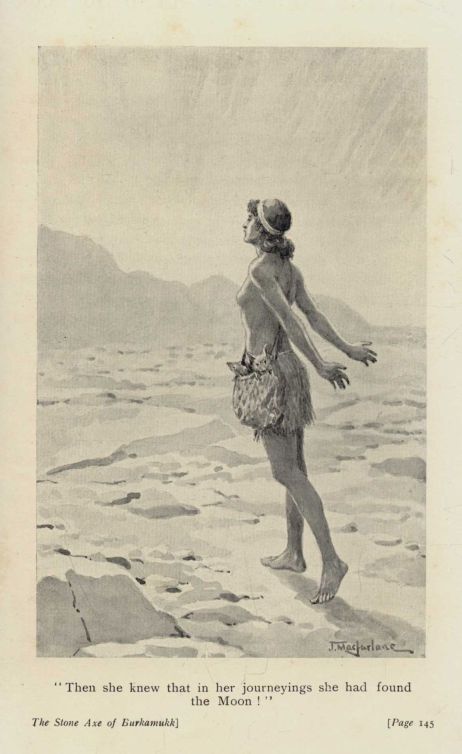
The way was strange. She climbed up, among great boulders and jagged crags of rock. Above her the peaks seemed to pierce the sky. Deep ravines were here and there, and she started away from their edges: somewhere, water fell swiftly, racing down some narrow bed among the rocks. So she went on, and the moonlight grew stronger and stronger, until it flooded all the mountain. She fought her way, step by step, up the last great peak. And, suddenly, in the midnight, she came out upon a great and shining tableland: then she knew that in her journeyings she had found the Moon!
"Then she knew that in her journeyings she had found the Moon!"
She wandered on, in doubt and fear—fear, not of this strange new land, but of the men she dreaded to find there. But for a long time she saw no people. Only in the dim hours, when the earth-world glowed like a star, but all the moon-country was dark, there came about her the Little People that she knew and loved—Padi-padi, and Punta, Talka and Kanungo. And because she was very lonely, and a lonely woman loves the touch of something small and soft, she took some of them up and carried them with her in her dilly-bag.
"How did you know I was lost?" she asked them.
"How did we know?" they said, laughing at her. "Why, all the forest sang of it! The magpie chattered it in the dewy mornings, and Moko-Moko, the Bell-Bird, told all about it to the creeks in the gullies. Moko-Moko would not leave his quiet places to tell the other animals, but he knew the creeks would carry the story. Soon there was no animal in all the Bush that did not know where you had gone. Only we could not tell your own stupid people, for they would not understand."
"And are they looking for me?" Miraga asked.
"They seek for you night and day. Your father has led a party of fighting-men to the east, and Konawarr has gone north with all his friends. They never rest—all the time they seek you. And the women are wailing in the camp, and the little children crying, because you are gone."
That made Miraga cry, too.
"Can you not take me back?" she begged. "I can go if you will show me the way."
But the Little People shook their heads.
"No, we cannot do that," they said. "We can help you, and we can talk to you, but we may not take you back. You must find the way yourself."
So Miraga wandered on through the Moon-Country. It was very desolate and bare, strewn with rocks and craggy boulders, and to walk long upon it was hard for naked feet. There were no rivers, and no creeks, but a range of mountains rose in one place, and were so grim and terrible that Miraga would not try to climb them. She found stunted trees, bearing berries, which she ate, for she was very hungry.
"Perhaps they are poisonous, and will kill me," she said. "I do not think that greatly matters, for I begin to feel that I shall never get home."
But the berries were not poisonous. Indeed, Miraga felt better when she had eaten them. Her strength came back to her, and her limbs grew less weary. She put some of the berries into her dilly-bag for the Little People. Then she set off on her wanderings again.
She did not know how long she had been in the Moon-Country, after a while. It seemed that she had never done anything but find her way across its rugged plains, seeking ever for the track back to the green Earth-World. So silent and strange was it that she began to think there was no living being upon it but herself and the Little People she carried with her.
One day, wandering along a rocky edge, she quite suddenly came upon the camp of the Man-Who-Dwells-In-The-Moon. She cried out in fear, and fled. But he was awake, and when he saw this beautiful girl, he rose and gave chase.
But Miraga was fleet of foot; and the Man-Who-Dwells-In-The-Moon was a fat man, and heavy: for, as the blacks know, he never goes hunting, as men do, but always sits down in the shadow of his mountains. Presently, he saw that the girl was escaping; she drew farther and farther ahead, running like a dingo, and already he was puffing and panting. So he stamped his foot and called to his dogs, and they came out of the holes of the hills—great savage brutes, lean and hungry-looking, of a dark colour. They came, running and growling, and sniffing angrily at the air. Their master waved his hand, and they uttered a long howl and followed swiftly after Miraga.
Now, indeed, she thought that her end had come. Mists swam before her eyes, and her feet stumbled: she, whose limbs were so lithe and strong, tottered like a weary old woman. Behind her, the long howls of the dogs woke terror in her heart. They drew nearer; almost she could feel their hot panting breath. But just as she was about to sink down, exhausted, the Little People in the dilly-bag chattered and called to her. "Mistress! Oh, Mistress!" they cried. "Let us out, that we may save you!"
She heard them, and fumbled with shaking fingers at the fastening of the bag. It slipped from her shoulders, and fell to the ground; and as it fell, the animals burst out and fled in many directions, some here and some there, squeaking and chattering. And when the fierce Dogs of the Moon saw them, they forgot to pursue Miraga, but turned and coursed swiftly after the animals.
Behind them the Man-Who-Dwells-In-The-Moon shouted vainly to them. There are no animals in the Moon-Country, and so the Dogs have no chance of hunting; but the sight of the scampering Little People woke their instincts, and they dashed after them wildly. They caught some, and swiftly slew them; others dodged, and leaped, and twisted, escaping into little rockholes, where the dogs could not follow them. The noise of the hunting and the deep baying of the Dogs echoed round the Moon and made thunder boom among the Stars.
But Miraga ran on, stumbling for weariness. She knew that the Dogs were no longer close upon her, but she dreaded to hear them again at any moment, for she did not see how such feeble Little People could keep them off for long. So she ran, and as she went, her tears fell for the little friends who had given their lives for her. At last, too tired to see where her stumbling feet had led her, she came to the brink of a great precipice, and fell down and down, until her senses left her.
But when she opened her eyes again, it was to meet those of Konawarr; and he was holding her in his arms and calling her name over and over, with his voice full of pity and love; and behind him were his friends—all the band who had been seeking her with him. They were all smiling to her, with welcome and joy on each friendly face. For in her fall she had come back to the dear Earth-World once more, and her sorrows were at an end.
So, when the tribes look up to the sky on moonlit nights and see the great shape that looms across the brightness, they say it is the mighty Man-Who-Dwells-In-The-Moon; who, like themselves, is black, but grown heavy and slothful with much idleness and sitting-down. The parents scare idle children with his name, saying that if they do not bestir themselves they, too, will become fat and useless like him. But Miraga used to tell her children another story, and when she told it her eyes would brim with tears. It was the story of the Little People she loved, who followed her to the Moon-Country, and there gave up their lives for her, saving her first from Yurong, and then from the teeth of the Dogs of the Moon. And the children would shiver a little, clustering more closely—all save little Konawarr, who would grasp his tiny boomerang and declare that he would kill anything that dared to hurt his mother.
The great dogs still crouch around the Man-Who-Dwells-In-The-Moon, waiting to do his bidding. You can see them, if you look closely—dark spots, near the huge figure in the midst of the brightness. They are the fierce Dogs that guard the lonely country in the sky: the Dogs that long ago hunted, howling, after Miraga the Beautiful, across the shining spaces of the Moon.
IX MIRRAN AND WARREEN
Mirran, the Kangaroo, and Warreen, the Wombat, were once men. They did not belong to any tribe, but they lived together, and were quite happy. Nobody wanted them, and they did not want anybody. So that was quite satisfactory.
Warreen was the first. All his tribe had been drowned in a flood, leaving him quite alone. So he found a good camping-place, where there were both shelter and water, and he made himself a camp of bark, which he called, in the language of his tribe, a willum. He was not in a hurry when he was making it, so he did it well, and no rain could possibly come through it. One side of it was a big rock, which made it very strong, so that no wind was likely to blow it away. Overhead a beautiful clump of yellow rock-lilies drooped gracefully. Not that Warreen cared for lilies; and this particular clump annoyed him, for the rock was too steep for him to climb up and eat the lily-roots.
He had been living there for some time, very lazy and contented, when one day Mirran appeared. At first Warreen thought he meant to fight, and that also annoyed him, because he hated fighting. But Mirran soon showed him that he only wanted to be friends; and then Warreen discovered that he was very glad to have some one with whom he could talk. So after the manner of men, they sat down and yarned all day.
Several times during the day Mirran said, "I must be going." But Warreen always answered, "Oh, don't go yet"; and they went on talking harder than ever. Night came, and Mirran said, "It is really time I made a move." Warreen said, "Why not stay the night? I can put you up." They talked it over for a while, and then it was quite too late for Mirran to go. So he stayed all night, and in the morning Warreen said, "Why not spare me a few days, now that you are here?" Mirran willingly agreed to this, for he had nothing to do, and he thought it very nice of Warreen to put the invitation that way.
They became great friends. Mirran was tall and thin and sinewy, while Warreen was very short and dumpy, and exceedingly fat. Also, he was lazy, and he liked having some one to help him get food, at which Mirran was very quick and clever.
Mirran also was the last of his tribe. The others had been killed by warlike blacks, and Mirran would have been killed also, but that he managed to swim across a river and get away into the scrub. He was very active and fleet of foot, and delighted in running, which was an exercise that bored Warreen very badly. Soon they made an arrangement by which Mirran did all the hunting, while Warreen dug for yams and other roots, and prepared the food, just as a woman does. It suited them both very well.
Mirran had one peculiarity that Warreen at first thought exceedingly foolish. He did not like to sleep indoors. It was summer time when he came, and he would not build himself a willum, but slept upon a soft bed of grass under the stars. If a cold night came, or even a rainy one, he rolled himself in his 'possum rug and slept just as happily. Warreen began by thinking he was mad. But as time went on he often slept outside with Mirran, himself, especially on those nights when they were talking very hard and did not want to leave off. Warreen used to grumble at the hardness of the ground, but he was really very much better for staying outside, in the fresh night-air. His little willum was a very stuffy place.
Sometimes he would think about the Winter, and say to Mirran:
"When are you going to build your willum?"
"Oh, there is plenty of time," Mirran would say.
"The cold weather will be here, and then what will you do?"
"Oh, I expect I shall have my camp ready in time. It will not take me long to build it, when the time comes."
"If you are not very careful, you will find yourself caught by the Winter, and you will not like that," said Warreen. But Mirran only laughed and talked about something else. He hated building, and was anxious to put it off as long as possible.
Warreen had a very suspicious mind, and it often made him believe very stupid things. He was the kind of man who was best living alone, because so often he got foolish ideas into his head about other people, and imagined he had cause for offence when there was really none at all. So he began to wonder why Mirran would not build a camp, and the thought came to him that perhaps he did not intend to build at all, but meant to take possession of his own willum. Of course, that was ridiculous, for Mirran was only lazy, and kept saying to himself, "To-morrow I will build"; and when to-morrow came, he would say, "Oh, it is beautiful weather; I need not worry about building for a few days yet." So he went on putting it off, and Warreen went on being suspicious, until sometimes he felt sorry he had ever asked Mirran to live with him. But Mirran sang and joked, and hunted, and had no idea that Warreen was making himself uneasy by such stupid thoughts.
One night, clouds came drifting over the sky, after a hot day, and Warreen said, "I am not going to sleep outside to-night."
"I don't think it will rain," said Mirran. "It is much cooler out here."
"Yes, but one soon forgets that when one is asleep. I hate getting wet," said Warreen.
"Well, just as you like," Mirran answered. "For my part, I am too fond of the stars to leave them." So he spread his 'possum rug in a soft place, and lay down. In a few minutes he was fast asleep, and Warreen went off to bed feeling rather bad-tempered, though he could not have told why.
In the night, heavy rain came, and the air grew rapidly very cold. Mirran woke up, grumbled a little at the weather, rolled himself in his 'possum rug and crept into the most sheltered corner he could find by the rock, not liking to disturb Warreen by going into the willum. It was too cold to sleep, so he soon uncovered the ashes of their camp fire, and put sticks on it; and there he crouched, shivering, and wishing Warreen would wake up and invite him to sleep in the shelter.
But the rain came more and more heavily and a keen wind arose; and a sudden squall put out Mirran's fire. Soon, little channels of water were finding their way in every direction over the hard ground, so that Mirran became very wet and half-frozen. Then he noticed a red glow inside the willum.
"That is good," he said, joyfully, "Warreen is awake, and has made himself a fire. Now he will ask me to go and lie down in his hut."
He crouched close by the rock for a long time, thinking each moment that Warreen would ask him in. But no sound came, and after a while he came to the conclusion that Warreen could not know he was awake. So he got up and went over to the door of the willum and looked in. The little fire was burning redly, and all looked very cosy and inviting to poor, frozen Mirran. Warreen lay near the fire, and looked at him suspiciously.
"Ky! what a night!" said Mirran, his teeth chattering. "You were right about the weather, Warreen, and I was wrong. I have been very sorry for the last hour that my camp is not built. May I come in and sit in that corner?"
There was not much vacant space in Warreen's little willum, but it was quite big enough for two at a pinch. In the corner to which Mirran pointed there was nothing. But Warreen looked at him suspiciously, and grunted under his breath.
"I want that corner for my head," he said, at last. And he turned over and laid his head there.
Mirran looked rather surprised.
"Never mind; this place will do," he said, pointing to another corner.
"I want that place for my feet," Warreen said. And he moved over and laid his feet there.
Still Mirran could not understand that his friend meant to be so churlish.
"Well, this place will suit me famously," he said, pointing to where Warreen's feet had been.
But that did not please Warreen either.
"You can't have that place—I may want it later on," he said, with a snarl. And he turned and lay down between the fire and Mirran, and shut his eyes.
Then Mirran realized that Warreen did not mean him to have any warmth or shelter, and he lost his temper. He rushed outside into the wet darkness, and stumbled over a big stone. That was not a lucky stumble for Warreen, for all that Mirran wanted at the moment was a weapon.
He picked up the stone and ran back into the willum. Warreen lay by the fire and he flung the stone at him as hard as he could. It hit Warreen on the forehead, and immediately his forehead went quite flat.
"That's something for you to remember me by!" said Mirran angrily. "You can keep your dark little hole of a willum and live in it always, just as you can keep your flat forehead. I have done with you!"
He turned and ran out of the hut, for he was afraid that if he stayed he would kill Warreen. Behind him, Warreen staggered to his feet and caught hold of his spear, which leaned against the wall near the doorway. He did not make any reply, but he drove the spear into the darkness after Mirran, and it hit him in the back and hung there. Mirran fell down without a word. The light from the fire shone on him as he lay there in the rain, with the spear behind him.
Warreen laughed a little, holding by his door-post.
"I shall have a flat forehead, shall I?" he said. "Well, you will have more than that. Where that spear sticks, there shall it stick always, and it will be a tail for you. You will never run or jump without it again—and never shall you have a willum." Then he had no more strength left, so he crept back and lay beside his fire, while Mirran lay in the pouring rain.
No one saw Warreen and Mirran again as men. But from that time two new animals came into the Bush, and the Magpie and the Minah, those two inquisitive birds who know everything, soon found out their story and told it to all the black people. So everybody knows that Warreen, the Wombat, and Mirran, the Kangaroo, were once men and lived together. They do not live together now, nor do they like each other. The Wombat is fat and surly and lazy, and he lives in a dark, ill-smelling hole in the ground. His forehead is flat, and he does not go far from his hole; and he is no more fond of working for his living than he was when he lived in a willum as a man. The Kangaroo lives in the free open places, and races through the Bush as swiftly as Mirran used to race long ago. But always behind him he carries Moo-ee-boo, as the blacks call his tail, and it has grown so that he has to use it in running and jumping, and now he could not get on without it. He is just as quick and gentle as ever, but when he is angry he can fight with his forepaws, just as a man fights with his hands.
Other animals of the Bush have holes and hiding-places, but the Kangaroo has none. He does not look for shelter, but sleeps in the open air. It is difficult to see him, for when he is eating young leaves and grass his skin looks just the same colour as the trees, and you are sometimes quite close to him before his bright eyes are seen watching you eagerly. Then he turns and hops away, faster than a horse can gallop, in great bounds that carry him yards at every stride, with Moo-ee-boo, his long tail, thumping the ground behind him. He has learned to use it—to balance on it and make it help him in those immense leaps that no animal in the Bush can equal. So Warreen did not do him so bad a turn as he hoped when he threw his spear at him that rainy night long ago.
X THE DAUGHTERS OF WONKAWALA
The Chief Wonkawala was a powerful man, who ruled over a big tribe. They were a fierce and warlike people, always ready to go out against other tribes; and by fighting they had gained a great quantity of property, and roamed unmolested through a wide tract of country—which meant that all the tribe was well-fed.
Wonkawala had not always been a chief. He had been an ordinary warrior, but he was fiercer and stronger than most men, and he had gradually worked his way up to power and leadership. There were many jealous of him, who would have been glad to see his downfall; but Wonkawala was wary, as well as brave, and once he had gained his position, he kept it, and made himself stronger and stronger. He had several wives, and in his wurleys were fine furs and splendid weapons and abundance of grass mats. Every one feared him, and he had all that the heart of a black chief could desire, except for one thing. He had no son.
Five daughters had Wonkawala, tall and beautiful girls, skilled in all women's work, and full of high courage, as befits the daughters of a chief. Yillin was the eldest, and she was also the bravest and wisest, so that her sisters all looked up to her and obeyed her. Many young warriors had wished to marry her, but she had refused them all. "Time enough," she said to her father. "At present it is enough for me to be the daughter of Wonkawala."
Her father was rather inclined to agree with her. He knew that her position as the eldest daughter of the chief—without brothers—was a fine thing, and that once she married she would live in a wurley much like any other woman's and do much the same hard work, and have much the same hard time. The life of the black women was not a very pleasant one—it was no wonder that they so soon became withered and bent and hideous. Hard work, the care of many babies, little food, and many blows: these were the portion of most women, and might well be that even of the daughter of a chief, when once she left her father's wurley for that of a young warrior. So Wonkawala, who was unlike many blacks in being very fond of his daughters, did not urge that Yillin should get married, and the suitors had to go disconsolately away.
But there came a time when Wonkawala fell ill, and for many weeks he lay in his wurley, shivering under his fur rugs, and becoming weaker and weaker. The medicine-men tried all kinds of treatment for him, but nothing seemed to do him any good. They painted him in strange designs, and cut him with shell knives to make him bleed: and when he complained of pain in the back they turned him on his face and stood on his back. So Wonkawala complained no more; but the back was no better.
After the sorcerers had tried these and many other methods of healing, they declared that some one had bewitched Wonkawala. This was a favourite device of puzzled sorcerers. They had made the tribes believe that if a man's enemy got possession of anything that had belonged to him—even such things as the bones of an animal he had eaten, broken weapons, scraps of furs he had worn, or, in fact, anything he had touched—it could be employed as a charm against him, especially to produce illness. This made the blacks careful to burn up all rubbish before leaving a camping-place; and they were very keen in finding odd scraps of property that had belonged to an unfriendly tribe. Anything of this kind that they found was given to the chief, to be carefully kept as a means of injuring the enemy. A fragment of this description was called a wuulon, and was thought to have great power as a charm for evil. Should one of the tribe wish to be revenged upon an enemy, he borrowed his wuulon from the chief, rubbed it with a mixture of red clay and emu fat, and tied it to the end of a spear-thrower, which he stuck upright in the ground before the camp-fire. Then all the blacks sat round, watching it, but at some distance away, so that their shadows should not fall upon it, and solemnly chanted imprecations until the spear-thrower fell to the ground. They believed that it would fall in the direction of the enemy to whom the wuulon belonged, and immediately they all threw hot ashes in the same direction, with hissing and curses, and prayers that ill-fortune and disease might fall upon the owner.
The sorcerers tried this practice with every wuulon in Wonkawala's possession; but whatever effect might have been produced on the owners of the wuulons, Wonkawala himself was not helped at all. He grew weaker and weaker, and it became plain that he must die.
The knowledge that they were to lose their chief threw all the blacks into mourning and weeping, so that the noise of their cries was heard in the wurley where Wonkawala lay. But besides those who mourned, there were others who plotted, even though they seemed to be crying as loudly as the rest. For, since Wonkawala had no son, some other man must be chosen to succeed him as chief, and there were at least half a dozen who thought they had every right to the position. So they all gathered their followings together, collecting as many supporters as each could muster, and there seemed every chance of a very pretty fight as soon as Wonkawala should breathe his last.
The dying chief was well aware of what was going on. He knew that they must fight it out between themselves, and that the strongest would win; but what he was most concerned about was the safety of his daughters. Their fate would probably be anything but pleasant. Once left without him, they would be no longer the leading girls of the tribe, and much petty spite and jealousy would probably be visited upon them by the other women. Or they might be made tools in the fight for the succession to his position, and mixed up in the feuds and disputes which would ensue: indeed, it might easily happen that they would be killed before the fighting settled down. In any case it seemed to Wonkawala that hardship and danger were ahead of them.
He called them to him one evening, and made them kneel down, so close that they could hear him when he spoke in a whisper.
"Listen," he said. "I am dying. No, do not begin wailing now—there will be time enough for that afterwards. My day is done, and it has been a good day: I have been a strong man and my name will be remembered as a chief. What can a man want more? But you are women, and my heart is uneasy about you."
"Nothing will matter to us, if you die!" said Yillin.
"You may think so now," said the chief, looking at her with affection in his fierce eyes. "But my death may well be the least of the bad things that may happen to you. You will be as slaves where you have been as princesses. Even if I am in the sky with Pund-jel, Maker of Men, I shall be unhappy to see that. Therefore, it seems to me that you must leave the tribe."
"Leave the tribe!" breathed Yillin, who always spoke for her sisters. "But where should we go?"
"I have dreamed that you shall go to the east," said her father. "What is to happen to you I do not know, but you must go. You may fall into the power of another tribe, but I believe they would be kinder to you than your own would be, for there will be much fighting here after I have gone to Pund-jel. I think any other tribe would take you in with the honour that is due to a chief's daughters. In any case, it is better to be slaves among strangers than in the place where you have been rulers."
"I would rather die than be a slave here!" said Yillin proudly.
"Spoken like a son!" said the old chief, nodding approval. "Get weapons and food ready secretly, all that you can carry: and when the men are away burying me, make your escape. They will be so busy in quarrelling that they will not notice soon that you have gone; and then they will be afraid to go after you, lest any should get the upper hand during their absence. Go to the east, and Pund-jel will decide your fate. Now I am weary, and I wish to sleep."
So Yillin and her sisters obeyed, and during the next few days they hid weapons in a secret place outside the camp, and crammed their dilly-bags with food, fire-sticks, charms, and all the things they could carry. Already they could see that there was wisdom in their father's advice. There was much talk that ceased suddenly when they came near, and the women used to whisper together, looking at them, and bursting into rude laughter. Yillin and her sisters held their heads high, but there was fierce anger in their hearts, for but a week back no one would have dared to show them any disrespect.
At last, one evening, Wonkawala died, and the whole tribe mourned for him. For days there was weeping and wailing, and all the time the chief's daughters remained within their wurley, seeing no one but the women who brought them food. As the time went on, the manner of these women became more and more curt, and the food they brought less excellent, until, on the last day of mourning, Yillin and her sisters were given worse meals than they had ever eaten before.
"Our father spoke truth," said Yillin. "It is time we fled."
"Time, indeed," said Peeka, the youngest sister. "Did you see Tar-nar's sneering face as she threw this evil food in to us?"
"I would that Wonkawala, our father, could have come to life again to see it," said Yillin with an angry sob. "He would have withered her with his fury. But our day, like his, is done—in our own tribe. Never mind—we shall find luck elsewhere."
After noon of that day the men of the tribe bore the body of Wonkawala away, to bury it with honour. The women stayed behind, wailing loudly as long as the men were in sight; but as soon as the trees hid them from view they ceased to cry out, and began to laugh and eat and enjoy themselves. They fell silent, presently, as the five daughters of Wonkawala came out of their wurley and walked slowly across the camp. They were muffled in their 'possum-rugs, scarcely showing their faces.
For a moment there was silence, and then one of the women said something to another at which both burst into a cackle of laughter. Then another called to the five sisters, in a familiar and insolent manner.
"Where do you go, girls?"
"We go to mourn for our father in a quiet place," answered Yillin haughtily.
"Oh—then the camp is not good enough for you to mourn in?" cried the woman with a sneer "But do not be away too long—there will be plenty of work to do, for you, now. Remember, you are no longer our mistresses."
"No—it is your turn to serve us, now," cried another. "Bring me back some yams when you come—then perhaps there will not be so many beatings for you!" There was a yell of laughter from all the women, amidst which Yillin and her sisters marched out of the camp, with disdainful glances.
When they drew near their hiding-place they kept careful watch, in case anyone had followed them. As a matter of fact, all the women were by that time busily engaged in ransacking their wurley, and dividing among them the possessions the sisters had not been able to carry away; so that they were quite safe. They collected their weapons and hurried off into the forest.
They had obeyed their father and gone east, and the burial-place was west of the camp, so they met nobody, and their flight was not discovered that night. The men came back to the camp in the evening, hungry and full of eagerness about the fight for the leadership of the tribe, and the women were kept busy in looking after them. The first fight took place that very evening, and though it was not a very big one, it left no time for anyone to wonder what had become of the five sisters. Not until next day did the tribe realize that they had run away; and then, as Wonkawala had foreseen, no one wanted to run after them. Certain young warriors who had thought of marrying them were annoyed, but they could only promise themselves to pursue and capture them when the tribe should again have settled down under new leadership.
The five sisters were very sad when they started on their journey, for the Bush is a wide and lonely place for women, and there seemed nothing ahead of them but difficulty and danger. They wept as they hurried through the forest, nor did they dare to sleep for a long time. Only when they were so weary that they could scarcely drag themselves along, did they fling themselves down in a grassy hollow, where tall ferns made a screen from any prying eyes, and a stream of water gave them refreshment. They slept soundly, and dreamed gentle dreams; and when they awoke in the morning it seemed that a great weight had been lifted from their hearts.
"I feel so happy, sisters," said Yillin, sitting up and rubbing her eyes. "Our father came to me in my sleep, and told me to be of good courage and to smile instead of weeping."
"He came to me, also," said Peeka, "and told me there was good luck ahead."
"After all," said another of the girls, "what have we to fret about? It is a fine thing to go out and see the world. I am certain that we are going to enjoy ourselves."
"It will be interesting, at any rate," said Yillin. "But we must hurry onward, for we are not yet safe from pursuit—though I do not think it will come."
They made as much haste as possible for the next few days, until it seemed certain that no one was tracking them down; and with each dawn they felt happier and more free from care. They were lucky in finding game, so that they were well-fed; and on the fifth day they came upon trees loaded with mulga apples, which gave them a great feast. They roasted many of the apples and carried them with them in their food-bowls. Sometimes they came to little creeks, fringed with maidenhair fern, where they bathed; sometimes they passed over great, rolling plains, where they could see for miles, and where kangaroos were feeding in little mobs, dotted here and there on the kangaroo-grass they loved. Flocks of white cockatoos, sulphur-crested, flew screaming overhead, and sometimes they saw the beautiful pink and grey galahs, wheeling aloft, the sunlight gleaming on their grey backs and rose-pink crests. Then they went across a little range of thickly-wooded hills, where the trees were covered with flocks of many-coloured parrots, and the purple-crowned lorikeets flew, screeching—sometimes alighting, like a flock of great butterflies, on a gum-tree, to hang head downwards among the leaves, licking the sweet eucalyptus honey from the flowers with their brush-like tongues.
Sometimes, when they had lain very quietly through a hot noon-tide hour, they saw the lyre bird, the shyest bird of all the Bush, dancing on the great mound—twenty or thirty feet high—which it builds for its dome-shaped nest; mocking, as it danced, the cries of half the birds in the country, and waving its beautiful lyre-shaped tail. The magpie woke them in the dawn with its rich gurgling notes; the beautiful blue-wren hopped near them, proud of his exquisite plumage of black and bright blue, chirping his happy little song. They passed swamps, where cranes and herons fished, stalking in the shallows, or flew lazily away with dangling legs; and sometimes they heard the booming of the bittern, which made them very much afraid. At evening they would hear a harsh, clanging cry, and, looking up, they would see a long line of black swans, flying into the sunset. There were other birds too, more than any white boy or girl will ever know about: for these were the old days of Australia, long before the white men had come to settle the country and destroy the Bush with their axes. But there were no rabbits, and no thistles, for Australia was free from them until the white men came.
Gradually the daughters of Wonkawala lost all fear. They were perfectly happy, and the Bush no longer seemed lonely to them; they had enough to eat, they were warm at night, and so strong and active, and so skilled in the use of weapons, had their woodland life made them, that they did not seem to mind whether they met enemies or not. They often danced as they went on their way, and made all the echoes of the forest ring with their songs.
At last, one day, they found their way barred by a wide river which flowed from north to south. They could, of course, all swim; but it was not easy to see how to get their furs across. They were talking about it, wondering whether they could make a canoe or a raft, when they heard a friendly hail, and, looking across, they saw five girls standing on the opposite bank.
"Who are you?" shouted the strangers.
"We are the daughters of Wonkawala," they cried. "Who are you?"
"We are girls of the Wapiya tribe, out looking for adventures."
"Why, so are we, and we have found many." They shouted questions and answers backwards and forwards, until they began to feel acquainted. "What do you eat?" "What furs have you?" "What songs do you sing?" That led to singing, and they sang all their favourite songs to each other, beating two boomerangs together as an accompaniment. When they had finished they felt a great desire to travel together.
"It is really a great pity that the river flows between us," cried the daughters of Wonkawala. "How can we join you?"
The Wapiya girls laughed.
"That is quite easy," they answered. "This is a magic river, and when once your feet have touched it you will be Magic too. Dance straight across!"
"You are making fun of us," cried Yillin.
"No, indeed, we are not. We cannot cross to you, for on your side there is no Magic. But if you will trust us, and dance across, you will find that you will not sink."
This was hard to believe, and the sisters looked at each other doubtfully. Then Yillin took off her rug and handed it to Peeka.
"It will be easy enough to try, and at the worst I can only get a wetting," she said. "Follow me if I do not sink."
She went down to the water and danced out upon its surface. It did not yield beneath her; the surface seemed to swing and heave as though it were elastic, but it supported her and she danced across with long, sliding steps. Behind her came her sisters; and so delightful was it to dance on the swinging river-top that they burst into singing, and so came, with music and laughter, to the other side. The Wapiya girls met them with open arms.
"Ky! You are brave enough to join us!" they cried. "Now we can all go in quest of adventure together, and who knows what wonderful things may befall us!"
So they told each other all their histories, and they held a feast; and after they had all eaten, they danced off to the east together, for they were all so happy that their feet refused to walk sedately. Presently they came to an open space where were many tiny hillocks.
"This is Paridi-Kadi, the place of ants," said the Wapiya girls. "Here we have often come before, to gather ants' eggs."
"Dearly do we love ants' eggs," said little Peeka, licking her lips.
"And these are very good eggs," said the eldest of the Wapiya girls, whose name was Nullor. "But the ants defend them well, and those who take them must make up their minds to be bitten."
"Ants' eggs are worth a few bites."
"Certainly they are. Now let us see if you are really as brave as you say."
They attacked the hillocks with their digging-sticks, and unearthed great stores of plump eggs, which they eagerly gathered. But they also unearthed numbers of huge ants of a glossy dark green colour, and these defended their eggs bravely, springing at the girls and biting them whenever they could.
"Ky!" said Yillin, shaking one off her arm. "It is as well that these eggs are so very good, for the bites are certainly very bad. We have no ants like these in our country."
"Have you had enough?" asked Nullor, laughing.
"Enough bites, yes; but not enough eggs," said Yillin, laughing as well. "The eggs are worth the pain." She thrust her digging-stick into a hillock so energetically that she scattered earth and eggs and ants in all directions, and one ant landed on Nullor's nose and bit it severely—whereat Nullor uttered a startled yell of pain, and the daughters of Wonkawala laughed very much.
"Who is brave now?" cried little Peeka.
Nullor rubbed her nose with a lump of wet earth, which, as she was black, did not have such a curious effect as it would have had on you.
"I was taken by surprise," she said, somewhat shamefacedly. "And indeed, my nose is not used to such treatment, for I do not usually poke it into ants' nests!"
They ate all the eggs, and rubbed their bites with chewed leaves, which soon took away the stings; and then they danced away together. After a time, Yillin saw an eagle flying low, carrying something in its talons. She flung a boomerang at it, and so well did she aim that she broke its neck, and the great bird came fluttering down. It fell into a pool of water and Yillin jumped in to rescue its prey, for she could see that it was alive. It turned out to be a half-grown dingo, a fine young dog, which was too bewildered, between flying and drowning, to make any objection to being captured. Yillin secured it with a string which she plaited of her own hair and as much of Peeka's as Peeka was willing to part with, and fed it with bits of wallaby; and the dog soon became friendly and licked her hand.
"He is a lovely dog," she said, "and I will always keep him. I will call him Dulderana."
"I think he will be rather a nuisance," said Nullor. "Anyway, he will soon leave you and go back into the Bush."
"I do not think he will," Yillin said.
"Well, you cannot teach him to dance or sing," said Nullor, laughing, "so he will have to run behind us."
"Of course he will; and he will be very useful in hunting," said Yillin. "We should not have lost that 'possum yesterday if we had had a dog."
Dulderana very soon made himself at home, and became great friends with all the girls. It amused him very much when they danced, and though he could not dance himself, he used to caper wildly round them, uttering short, sharp barks of delight. But their singing he did not like at all, and when they began, he used to sit down with his nose pointing skywards, and howl most dismally, until the girls could not sing for laughing. Then they would pelt bits of stick at him until he was sorry. By degrees he learned to endure the singing in silence, but he never pretended to enjoy it.
One day, as they went along, they saw in the far distance a silvery gleam.
"What is that?" asked Yillin.
"It looks like the duntyi, or silver bush," said the Wapiya girls, doubtfully.
"That does not grow in our country," said Yillin. "Let us go and look at it."
But when they drew near, they saw that it was not a bush at all. Instead, it was a man, a very old man. He had no hair on his head, but his great silver beard hung straggling to his knees, and when the breeze blew it about it was so large that it was no wonder they had mistaken it for a bush. No word did he speak, but he sat and looked at them in silence, and when they greeted him respectfully he only nodded. Something about him made them feel afraid. They clustered together, looking at him. At last he spoke.
"I have come too soon," he said. "You are not ready for me yet. Go on."
At that Dulderana howled very dismally indeed, and rushed away with his tail between his legs. The girls quite understood how he felt, and they also ran away, never stopping until they were far from the strange old man.
"Now, who was that?" Yillin said.
Nullor looked uneasy.
"I do not know," she said. "This is a strange country, and there is much Magic in it. We will hurry on, or he may perhaps come after us."
So they hastened on into the forest, forgetting, for a while, to dance; but then their fear left them, and again their songs rang through the Bush. They passed a clump of black wattle, the trunks of which were covered with gum, in great shining masses, so that they had a splendid feast; for the gum was both food and drink, and what they could not eat they mixed with water and drank, enjoying its sweet flavour. With their bags filled with gum they went on, and one evening they camped among a grove of banksia trees, near a pool of quiet water. It was not very good water to drink, but the Wapiya girls showed the five sisters how to suck it up through banksia cones, which strained out any impurities and gave it a very pleasant taste. They were tired, and lay down early.
In the night a great wind sprang up, and with it came a curious booming noise. It woke the daughters of Wonkawala, and they sat up in alarm.
"Ky! that must be a huge bittern," said Peeka.
"It is not like a bittern," Yillin said. "I have never heard any sound like it. Perhaps it is the Bunyip, of whom our mother used to tell us when we were little—a terrible beast who lives in swamps, and whose voice fills every one with terror."
The Wapiya girls woke up, and they also listened. Then they laughed among themselves, but they did not let the sisters see that they were laughing. They seemed to think little of the noise.
"It is only the wind howling," they said. "Lie down and sleep, you five inlanders!"
"What do you mean by that?" demanded Yillin. But the Wapiya girls only giggled again, and lay down, declaring that no Bunyip was going to spoil their sleep. And as they were so cheerful, the sisters came to the conclusion that they might as well do the same.
When they awoke it was day, and the booming was still going on, and the wind felt fresh and wet. The Wapiya girls were already up, and they greeted them with laughter.
"We have a surprise for you," said they. "Shut your eyes, and let us lead you."
The sisters did so, and felt themselves led forward. Presently the earth became soft and yielding under their feet, and they cried out in alarm, but the others laughed again, and said, "Never mind, you are quite safe."
In a moment more they said, "Now, open your eyes!" The sisters did so, and lo! they stood before a great sheet of water with high, tumbling waves. Blue and sparkling was the water, and the big waves came rolling in, gathering themselves up slowly with their tops a mass of foam, which slowly rose and curled over until it plunged down, crashing in a smother of breaking bubbles. The daughters of Wonkawala had never seen anything like it before, and they gasped in amazement.
"Ky! what a river!" they cried. "Where is the other side?"
The Wapiya girls shouted with laughter.
"The other side!" they gasped, when they could speak. "Why, there is no other side. This is the Sea, and it is the end of all things. Have you never heard of it?"
"Is that the Sea?" The five sisters stared. "We have heard stories of it from the old men and women, but we never imagined that it was like this. No one could imagine it without seeing it. Have you known it before?"
"Oh, yes. We have often camped here with our tribe. Come nearer."
They took the sisters down to the edge of the water, and presently a great wave rolled in, broke in a thunderous roar, and came dashing up the sand. The sisters stared at it in amazed admiration at first, and then, as it came nearer, Fear fell upon them, and they screamed and turned to fly. They ran as fast as they could in the yielding sand, but the wave came faster and the water caught them, at first round their ankles and then swiftly mounting to their knees. Then it went back, and the sisters thought that they were slipping back with it, and screamed louder than ever. The Wapiya girls, themselves weak with laughter, caught hold of them.
"The Sea!" screamed the sisters. "The Sea is carrying us away!"
The others led them up on higher sand and laughed at them until they began to laugh at themselves.
"Never before have I seen water that runs backwards and forwards, as though a great giant were shaking it in a bowl," said Yillin. "We are sorry to have been afraid, but it is all very peculiar and unexpected. Are you sure it is not Magic?"
"I do not think anyone can be sure of that about the Sea," said Nullor. "It is strange water, and indeed I often think that it is very great Magic indeed. But if it is, it is a good Magic, and we are not afraid of it."
"And this queer yellow earth, that slips away under the feet—is that Magic too?"
"Oh—the sand. Perhaps it is—who knows. But it will not hurt you. Come on, let us bathe in the Sea, for that is one of the most beautiful things in the world."
The daughters of Wonkawala hung back at first, for they were very doubtful of trusting themselves to the magic water. But the others laughed and persuaded them, and they ventured in, paddling at first, until they became used to the rushing breakers. But soon they gained confidence, and before long not even the Wapiya were bolder than they, and they would dive into a breaker and be carried in on its curling top, laughing and playing like so many mermaids: so that the Wapiya girls soon lost any feeling of superiority, and only regained it once, when Peeka, feeling thirsty, scooped up some of a passing wave in her cupped hands and took a deep draught. For the next two minutes Peeka was coughing and spluttering and spitting, while the other girls yelled with laughter.
"That is certainly very bad Magic," said Peeka angrily, when she could speak. "What has made the water turn bad?"
That set the Wapiya girls off into fresh peals of mirth, and it was some time before they could explain that the water was always salt. Peeka was annoyed, but presently she laughed too.
"Oh, well, if that is the worst of its Magic, there is not much to grumble at," she said. "Come on, girls, let us dive into this next one!" And the next moment Peeka's merry black face was half hidden in the flying spray as the breaker bore her ashore.
They stayed by the Sea for some days, for the inland girls were too fascinated to leave it, and when they were not bathing in it, they were wandering along the shore, wildly excited over finding shells and seaweed and all the other treasures of the sands. Then one day a great black cloud came up, obscuring all the sky, and instead of being sparkling blue and silver, the water turned to a dull grey and looked dead and oily. The other girls were afraid of it, and would not go into the cold, dark breakers: but Yillin, who loved bathing more than any of them, would not be persuaded, and plunged in for a swim. She did not stay long, for the water felt more and more uncomfortable each moment; so she let a big, sullen breaker carry her in, and, wading out, ran up the beach to the other girls.
They started back when they saw her, looking at her with amazement and fear.
"What have you done to yourself?" cried Nullor.
"I? Nothing. What are you looking at?"
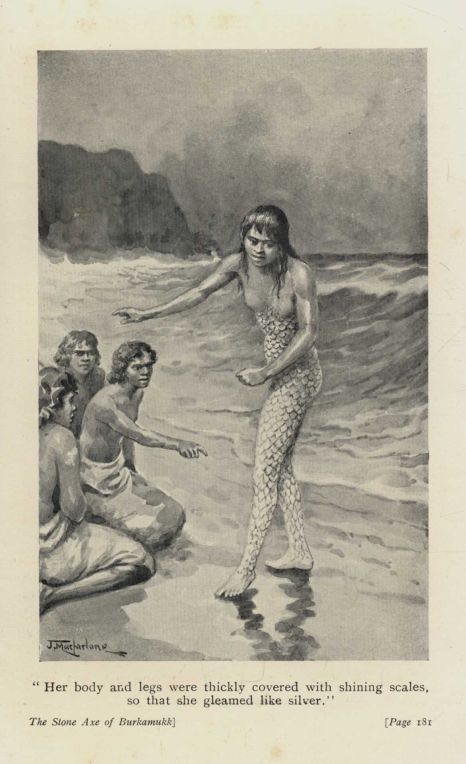
Nullor pointed a shaking forefinger at her body, and looking down, Yillin uttered a bewildered cry. No longer was she smooth-skinned and black. Her body and legs were thickly covered with shining scales, so that she gleamed like silver.
"Her body and legs were thickly covered with shining scales, so that she gleamed like silver."
"It is the water!" she stammered. "It must be!"
"Does it feel pleasant?" inquired Nullor. "It looks quite beautiful."
"I do not feel anything at all," Yillin answered. "But it certainly does look well." She gazed at her shining self with interest, and turned round so that the others might see if her back were similarly ornamented. It was, and the other girls grew a little jealous.
"Jump in, and see if the Magic will come upon you, too," cried Yillin.
They did not lose a moment. Flinging their fur aprons from them, they rushed down the beach and plunged into the dark waves. And lo! when they emerged, they too were covered with silver scales. They stood together on the sand, a shining company.
"Let us walk along the shore, and see what else will befall us," said Yillin.
They gathered up their property and set off eastwards again. The shore curved out after a time, forming a rocky cape. They rounded this, and found themselves on the coast of a little bay, round which they hurried, anxious to explore some great rocks at the farther point. But when they reached them, they found their way barred. The rocks were a solid wall: a great black cliff that rose sheer from the water, running far out beyond even the farthest line of the breakers. Nowhere was there any way of advancing: the bay was ringed with the dark, smooth cliffs. The little dog Dulderana whimpered as if in fear.
"Let us go back!" said the Wapiya girls. "This is not a good place."
For a moment the daughters of Wonkawala were inclined to agree. Then there came to them suddenly the vision of their father, who had said, "Go to the east," and they knew they must obey.
"We are not afraid," they said. "Go you back, if you wish."
"We do not wish to leave you," the Wapiya said sadly.
"Nor do we wish to lose you, for we have loved you very much," said the sisters. "But we must go forward. Will you not come?"
The Wapiya girls shook their heads.
"No," they said. "Something tells us that we must return, and never see you more. But we will always watch for you, and perhaps some day we may hear you coming, singing our old songs, and we will run to meet you."
They embraced each other, weeping, and slowly the Wapiya girls went back until the rocky promontory hid them from sight. Then Yillin dashed her tears away.
"Come, my sisters!" she cried.
They took hands and danced together towards the wall of rock that loomed before them, black, unbroken, forbidding. Yillin was at the end, and as she reached the rock she raised her Wona, or digging-stick, and struck the rock. It split open, and they danced through the cleft. Before them was no more the Sea, but a green country dotted with trees, and covered with thick grass. A little way from them was a low mound, towards which they danced. As they drew near, they saw that some one was sitting on it—a very old man, whose silver beard swept below his feet. He sat motionless, save that his hands were always busy, pulling the long silver hairs from his beard and twisting them into a cord.
"It is the old man we met long ago!" whispered the sisters.
Somehow, the fear that they had felt when they met him with the Wapiya girls was upon them no longer: and the little dog Dulderana, who had fled from him howling, now ran up to him gaily, frisking round him. The old man put out his hand and fondled him, and Dulderana snuggled against him; then, nestling down with his head on his fore-paws, he looked at Yillin as if to say, "This is my master."
Yillin understood the look in his eyes.
"Do you like him, Master?" she asked. "We bring him to you as a gift."
"That is a good gift," said the old man, looking much pleased. "And you are welcome, my children. I think that this time I have not met you too soon. Are you weary with all your wanderings?"
"No, we are never weary," said Yillin. "We have danced, and hunted, and bathed, and sung; and we have forgotten all our sorrows. Our father, Wonkawala, bade us come east, and we obeyed him."
"And so you found friends and happiness," said the old man. "Sit down, and tell me of all that you have seen."
They sat down in a semi-circle before him, and, speaking one after another, they told him the story of their long journey. He heard them in silence, nodding now and then: and all the time his fingers moved ceaselessly, plaiting the silver hairs into a long cord. It lay in great shining coils at his feet. The little dog nestled beside him, and sometimes, when he paused to adjust a fresh coil, his fingers rested for a moment on its head.
He smiled at the sisters when they had finished their story.
"It was indeed a great journey; and the Sea has clothed you in silver, so that you are more glorious than any chief's daughters have ever been before," he said. "And now comes the greatest adventure of all."
He rose, as he spoke, pointing to the sky. The sisters looked up, and cried out in awe. For as they looked, the clouds parted, and they saw behind them Arawotya, who lives in the sky: a great and gentle Being whose face seemed to have light behind it. He looked down at them kindly, and beckoned. Then he began to lower a long cord, made, like that of the old man, of plaited hair. It reached almost to the top of the mound where they stood.
"You are to go up," said the old man. "You first, I last of all. But first we will send up the little dog, that you may see how safe it is."
He took his silver cord and tied it round the body of Dulderana, then joining it to the magic cord from the sky. Then Arawotya pulled it up, so gently that the little dog never seemed frightened, and he disappeared behind a cloud. Presently the cord came back again, and one after another the old man tied the girls with it, and Arawotya drew them up to himself. Yillin was the last of the sisters to go, but as she was being pulled up she cut her hand with her digging-stick, and her Pirha, or food-bowl, fell. It was a very beautiful carved Pirha, and, because it had been her father's, Yillin felt very sad. Even when Arawotya had gently received her, and, untying the cord, placed her by her sisters, she peered over the edge of the cloud, trying to see where it had fallen.
The old man was being drawn up, and just as he reached the clouds Yillin caught sight of her Pirha, lying on the mound.
"See!" she whispered to Peeka. "My Pirha—it lies below. I will just slide down the cord and get it, for it belonged to our father, Wonkawala. Arawotya will forgive me and pull me up again."
She slid hurriedly down the cord and joyfully seized the bowl. But when she turned to climb up again she uttered a cry of despair, for the cord was out of her reach. Arawotya had drawn it up. As she looked, it disappeared, and then the cloud-masses swept together, blotting out everything above. She was alone.
All that day and night Yillin lay on the mound, weeping, and begging Arawotya to forgive her and take her up to her sisters. But all the clouds had gone, and there was only a clear blue sky, bright with moonlight and dotted with a million stars: and there was no sign of those whom she had lost. She gave herself up to despair.
"Yakai!" she moaned. "Better that I had remained a slave in the camp of Wonkawala than have come to this lonely land to die!"
Towards morning, exhausted, she fell into a troubled sleep. And in her sleep her father came to her, and his face was grave and kind.
"Alas, my daughter!" he said. "You have lost your chance of happiness for the sake of a worthless Pirha. What! did you imagine that you would need a Pirha in the sky?"
"No—but because it was yours, my father," she sobbed in her sleep.
Wonkawala's face shone with a great light.
"Always you were my dear and faithful daughter," he said. "Because of that, there is yet happiness for you. Go forward, and no matter what shall befall you, be of good courage."
Then the vision faded, and after that Yillin's sleep was no longer troubled. She woke refreshed in the morning, and although she was lonely for her sisters, there was hope in her heart. She took her weapons and went forward.
It was a quiet country. There seemed no men and women in it, nor even any animals; and even the birds were strange to her. She passed over a great rocky plain, making for a green line of trees that seemed to mark the windings of a creek, for she was very thirsty. She found it, a clear wide stream, and drank deeply: then she wandered along its banks. And here at length there was a touch of home, for there were many crimson parrots in the trees, and the noise of their harsh crying to each other was as music in her ears. They had their mates, and to see them made her feel less lonely.
She found some roots and berries, which she ate, hoping they were good for food: and when night came, she curled into a hollow under a rock and slept deeply, waking refreshed, eager to go on her way. Then for many days she wandered, following the course of the creek, for she was afraid to go far from water. She was a strange figure in her silvery scales. Whenever she caught sight of herself, mirrored in the water as she bent to drink, it gave her a new throb of amazement.
She was wandering along one day when a rustling in the bushes made her glance aside. To her surprise, a dog was looking at her, and she could see that it was a tame one. Yillin had always loved dogs, and she whistled to this one, trying to coax it to play with her. But the dog was suspicious, and backed away from her, growling: then it uttered a few short barks and raced off into the scrub.
Two black hunters, who were ranging through the Bush a little way off, stopped, hearing the barking.
"My dog has started game of some kind," said one. "He does not bark for nothing."
"Let us go and look," said the other. They turned aside in the direction of the sound, and presently came upon the dog, who bounded to his master and licked his hand.
"What have you been barking for?" demanded his master, patting him. The dog wagged his tail vigorously and ran a few paces into the bushes.
"I believe there is something in that direction," the hunter said. "We might as well go and see, Chukeroo."
They moved noiselessly through the scrub, and presently Chukeroo caught his friend's arm.
"See, Wonga," he whispered. "There is a demon! Let us fly!"
Wonga looked, and saw a strange, glittering figure standing by a tree. He was just as afraid as his friend, but he was also full of curiosity.
"It seems to be a woman-demon," he whispered back. "See! it has long hair, and the face is the face of a woman." He pondered, watching the strange apparition. "And it carries weapons—strange, that a demon should go armed, Chukeroo. I should like to get hold of those weapons. They would be worth having in a fight."
"You may try, if you like, but I have no fancy for fighting demons," said Chukeroo.
"I do not know that I have, either," said Wonga. "Perhaps, though, a woman-demon would not be so terrible to fight. Look how she glitters when she moves! She would be a startling wife for a man to take home to his wurley, Chukeroo."
"Every one to his fancy," returned his friend. "Personally I prefer mine black."
"You are used to yours, but I have none yet," said Wonga, laughing, for he was a cheerful youth. "Come, I am going to get a nearer look at the demon. Are you afraid?"
"Very much, but I suppose I had better come," said Chukeroo grumblingly. "You are a mad-headed fellow, Wonga, and you will get into trouble if you do not take care. I only hope that this is not the sort of demon that the sorcerers tell us about, who can blast men to cinders with a wave of the hand."
He followed his friend, and they crept through the bushes until they found a place where they could see the strange being more closely. In their excitement they had forgotten the dog, and suddenly it gave a loud bark. The shining figure turned sharply and ran towards them.
"Save yourself!" uttered Chukeroo. "It has seen us!"
They turned to run, but in crossing a clear space Chukeroo caught his foot in a trail of clematis and fell headlong, scattering his weapons. Wonga pulled himself up, and raced back to help his friend. Before they could gather all the fallen spears the strange being was upon them.
Yillin was as astonished as the black hunters—and as afraid. But she had learned to defend herself, and so she flung her digging-stick at Wonga. It grazed his leg, and made him so angry that he forgot all about being afraid of this demon, and hurled his spears at her. But his fear returned when he saw them glance off her shining scales as though she were covered with glass, and then fall harmlessly to the ground. Chukeroo joined in the fight: but though the aim of both hunters was true, nothing seemed to pierce those magic scales. Moreover, the strange being, having lost her digging-stick, picked up the fallen spears and flung them at their owners so rapidly that they thought themselves lucky in being able to dodge behind trees with whole skins.
"She is indeed a demon!" gasped Chukeroo.
"She may be, but she is very like a woman," said Wonga. "And I am not going home to tell the other warriors that a woman has stolen my spears, even if she does happen to be a demon. Besides, you know as well as I do that they will not believe us. Even your own wife will laugh at you, and she will not believe."