Front matter (continued 2)
Reading edition
Kari's cloud drifted away presently, and she could no longer see the queer grey company of long-legged birds prancing on the green spot in the forest. But nothing that now came within her sight interested her at all. She saw the lyre-birds building their mounds in the Bush, and making them gay with all sorts of odd things: bright stones, bits of quartz, gay feathers; and they also danced on their mounds, but it did not please Kari as much as the dance of the Puralkas. The moon showed her the animals that come out at night—wombat, wallaby, wild dogs, and opossums; native bears climbing up the highest trees, and flying-foxes that trailed like clouds between her and the tree-tops. She saw the lizards that live in rocks and on the ground, and the hideous iguanas that run up the trees. Great flocks of screaming cockatoos made the air white, as they flew, the sun gleaming on their yellow crests. There were snakes, too, in the Bush: great carpet-snakes, evil-looking brown and black fellows, and the wicked tiger-snake, with its yellow-patterned back and its quick cruel movements. Once it had amused Kari very much to see the jackass, Merkein, swoop down upon a snake and carry it, struggling, back into a tree. The jackass was a silent bird then, and never made any fuss over his captures: still, it was exciting to see him catch snakes. But now Kari found that none of these things interested or amused her any more. All she wanted to see again was the Puralkas come out of their swamp and dance upon the grass.
She watched for a long time, hoping always to catch sight of them again; but though her cloud drifted over all kinds of country, she could not find the Puralkas until at last, one day, as she leaned out, to her great joy the little green space came below her again; and there were the long-legged birds, dancing backwards and forwards as they had done before.
She watched them breathlessly, until her cloud began to float away; and then she decided in her mind that she could not bear to let them go again. Indeed, she knew now that unless she could do as they did, she would never feel happy any more. "I have seen all there is in the world," she said, "and nothing is half so beautiful as dancing. I know I could dance far better than the Puralkas, if I only knew the way. I will go down and get them to teach me how to dance. Then I can fly back to my cloud, and for ever after I shall not need to look at the world, for I shall be too happy dancing on the clouds."
So Kari spread her great wings and floated down the sky until she came over the little green space among the trees. Then she dropped gently, and finally landed in the swamp, which she did not like at all, because she had never before had her feet wet, nor were they made for wading in the soft mud of a swamp. She scrambled out as quickly as she could, folding her wings over her back.
The Puralkas had run back to the edge of their little dancing-ground when they saw the great brown bird coming down from the sky. At first they were inclined to fly away, but they were inquisitive birds, and they waited to see what she would do, though they were quite prepared for flight if she proved to be alarming. But the Emu looked so simple and meek, and she was so comically upset at getting her feet wet, that the Puralkas saw at once that there was no cause for fear. As they were not afraid, they became rather angry, for they did not like strangers to see them dancing. So they clustered together and watched her with unfriendly eyes as she struggled out of the mud and wiped her feet upon the grass.
"How are you?" she said, rather breathlessly. "I have been watching you all from my home in the clouds, and I think you are nice little birds!"
Now, this made the Puralkas exactly seventeen times more angry than before. They believed that they were quite the most beautiful birds that ever wore feathers, and it made them furious to be addressed in this patronizing manner. Who was this awkward brown monster of a bird, to drop out of nowhere and talk to them as if she were a Queen? They chattered among themselves in a whisper.
"She is as ugly as a Jew-lizard," said one.
"Did ever anyone see such great coarse feet?" another whispered. "And her legs!—he-he! Why, they are as thick as the trunk of a tree-fern!"
"And what a great silly head!"
"She is larger than a big rock, but she is more foolish than a coot," said another. "One look at her will tell you that she has no sense."
"And what is that ridiculous thing she said about a home in the clouds?" one asked. "As if we did not know that there is nothing in the clouds except rain!"
"Why, the big Eagle flew up nearly to the sun the other day; and yet he saw nothing of nests in the clouds," said another. "She must think we are very simple, to come to us with such a tale."
"No one could possibly think us simple, unless she were mad," said another. "Every one knows that we are the wisest birds in all the Bush. She means to insult us!" And they all glared at the Emu, much as if she were a tiger-snake.
Poor Kari felt very puzzled and unhappy. She felt that she had done a kind and condescending thing in coming down to earth and talking so sweetly to these smaller birds; and she could not make out why they should look at her with such angry eyes. She rubbed her muddy feet on the grass, and began to wish that she had never left her nest in the cloud.
"Do you not speak my language?" she asked at last. "Why do you not answer me?"
The Puralkas put their heads together again, and whispered. Finally an old Puralka stepped forward with mincing steps and looked her up and down, so that Kari actually blushed.
"We know what you say, but we do not know why you say it," said the old Puralka. "Why should you want to know how we are? and how dare you call us nice little birds? We do not know what you are—you are something like a bird, to be sure, but in most ways you are a kind of freak. At any rate, we have no love for strangers."
The unfortunate Kari moved her big head from side to side, and looked at the bad-tempered old Puralka in amazement. Her beak opened slowly, but she was too surprised to speak. Nothing like this had ever occurred to her when she lived in the sky.
"As for your extraordinary remark about a home in the clouds, we would like to remind you that we were not hatched yesterday," went on the old Puralka. "Not even the swallows nest in the clouds. You are only wasting your time, and we have none to waste on you. Would you mind going away? We want to get on with our dancing."
Kari did not know what to say. Her bewildered eyes glanced from one Puralka to another, and, finding no friendly face, came back to the old bird who stood waiting for her to answer or go away. She had never dreamed of anything like this, among her drifting clouds, and her first instinct was to spread her wings and fly back until she found her own peaceful nest. But the Puralka's mention of dancing reminded her of what had brought her to earth, and she felt again all the old longing to watch the grey birds dance. So she summoned up her courage, of which she possessed surprisingly little, considering her size.
"I'm sure I don't know why you should be so annoyed," she said meekly. "I mean well, and it grieves me that I have offended you. It was because I thought you were nice little birds that I called you so, but of course I do not think so now—that is, I mean, I——" She broke off, for the old Puralka had uttered something like a snort, and was regarding her with a fixed expression of wrath, and all the other Puralkas had bristled alarmingly. "Oh, I don't know what I really do mean!" said poor Kari helplessly. "You all look at me so unpleasantly. And it is quite true that I have a nest in the clouds—if you will come up, I will show it to you. I live there always, and I have only come down because I hoped that you would teach me to dance!"
There was silence for a moment, and then all the Puralkas began to laugh. They laughed so much that they could not stand—they went reeling round the little green patch, and at last they sat down, with their legs sticking out straight in front of them, and laughed more and more. Meanwhile, Kari stood looking at them stupidly. She felt that it was not pleasant laughter.
At last they ceased to laugh, and, putting all their heads together, began to whisper. This went on so long that after a while Kari grew tired of standing, and so she sat down and watched them, feeling very unhappy. Overhead a jackass perched on a big gum-tree, and looked at the group, with his wise old head on one side.
When they had whispered for a long time, the Puralkas got up and stood in a row, with their wings tightly folded over their backs. The old Puralka came forward.
"You must excuse us for laughing," she said. Her voice was not rude now, but there was something in it that made Kari feel as uncomfortable as she had felt when she had been rude before. "We did not mean to hurt your feelings—but we all thought of something funny we saw last month, and so we had to laugh."
If Kari had been less simple, she would have known that this was only said out of politeness, but she was very anxious to make friends, so she looked gratefully at the old Puralka and said, timidly, that she was glad they were so merry.
"Quite so," said the Puralka. "It is a poor heart that never rejoices. But about dancing—that is a different matter. You see, you have wings."
"Eh?" said the Emu stupidly. "Why, of course, I have wings. Why not?"
"Well, that is the difficulty," said the Puralka. "Dancing like ours is the most beautiful thing in the world, of course. But no one with wings can learn it. You see, we have none ourselves."
The Emu gave a quick look at the Puralkas, standing in a row. They had folded their wings so tightly over their neat bodies that it looked as though they had really none at all; and she looked so hard at their bodies that she did not notice how cunning their eyes were.
"Why, I never noticed that yours were gone," she said. "Dear me! how sad! Do you not find it very uncomfortable and awkward?"
"No; why should we?" snapped the Puralka. "Wings are really not much use when you once get accustomed to doing without them. Dancing is much better."
"But why cannot one have both?" asked Kari.
"Simply because," said the old Puralka crossly. "We do not know why these things are, and we never ask foolish questions about them. But if you wish to learn our beautiful dancing, you must give up your wings first."
"Give up my wings! I could never do that," cried Kari.
"Well, dancing is better. But it is for you to say," said the old Puralka.
As she spoke, she made a sign to the others, and they began to dance, swaying forward until they almost touched Kari, and then backwards again. Then the line broke up into circles and figures, and they danced round the Emu until her head grew dizzy with their movements, and she felt that to dance so well was even better than to have wings. To and fro they went, faster and faster, until she could scarcely distinguish one from another, and their long thin legs she could hardly see at all. Then, quite suddenly, they all stopped; and Kari blinked at them, and could not speak.
"Well?" asked the old Puralka, watching her closely. "Do you not think that wings are only a small price to pay for such dancing?"
"Could you teach me?" Kari asked.
"Easily, if you give up your wings."
Kari gave a great sigh.
"Very well," she said. "I cannot live without knowing how to dance as you do."
"Then, spread your wings out on this stone," said the Puralka.
So Kari spread her great wings across the stone, and the Puralkas cut them off quite close to her body with their sharp beaks.
Then they said,
"Stand up."
Kari stood up, feeling very naked and queer without her wings. Then the Puralkas began to dance again, faster and faster; and they danced upon her wing-feathers that had been cut off, scattering them with their feet until there were not two left together, and the wind came and took the feathers, so that they floated away over the tops of the trees and mounted out of sight. Then the Puralkas laughed again, just as they had laughed before, until Kari's head rang with the noise of it.
"When will you teach me?" she asked timidly.
"Teach you!" cried the Puralkas. "What a joke! What a joke!" They burst out laughing again. Then, to Kari's amazement, they unfolded their wings and shook them in her face. The whole green patch of grass was full of the fluttering of the long grey wings.
"You said you had none!" she cried.
"What a joke! What a joke!" screamed the Puralkas, flapping her with their wings. They spun round and round her, their long legs dancing madly, and their wings quivering and fluttering. Then they suddenly mounted into the air, circled about her once or twice, and flew away through the trees. The sound of their wicked laughter grew fainter and fainter until it died away.
Kari sat down and put her head down on the ground. After a while she got up and tried to fly, but the little stumps of her wings would not raise her an inch from the earth, and very soon she ceased to try. She sat down again.
Later on, she stood up and began to try to dance as the Puralkas had done. She moved her great feet in the same way, and tried to sway about; but it was useless. She looked so comical, hopping round on her thick legs, that the Jackass, which had all the time sat in the gum-tree overhead, broke into a great shout of laughter, and all the Bush rang with the sound. "Ha-ha-ha-ha!—ho-ho-ho-ho!" screamed the Jackass. "Kari is trying to dance—look at her! There never was anything half so funny—ha-ha-ha! ho-ho-ho!"
Then Kari knew that she had lost her wings for nothing; that she could never dance like the Puralkas, and that—worst of all—she could never go back to her nest in the clouds. She could not bear the harsh laughter of the Jackass, and so she ran away, her long legs taking great strides, crashing into the undergrowth of the Bush. Then the Jackass flew away, still chuckling to himself that anyone could be so stupid. Soon the little green patch of grass was quite deserted; until the sun set, when the cruel Puralkas came flying back to it and danced again. But Kari never came to it.
So the Emu lives on earth, and has forgotten all about the nest she once had in the drifting clouds. She has no friends among the birds, for though she is a bird herself, she has no wings, and cannot fly. She has taught herself to run very fast, and to kick with her big feet, so that it is not wise to make her angry. Because she used to live in the clouds and had no proper training, she will eat the most extraordinary things—stones, and nails, and pieces of iron and glass, which the blacks have brought into the Bush—but they never seem to disagree with her. She is not a very happy bird, for all the time she keeps hoping that her wings will grow long again and that she will be able to fly back to find her cloud-nest. But they never grow.
Always since then, Merkein, the Jackass, has been able to laugh. He is called the Laughing Jackass, because of this. He has been a merry fellow ever since he sat on the gum-tree and watched Kari trying to dance, after the cruel Puralkas had robbed her of her wings and left her far away from her nest in the white clouds.
IV BOORAN, THE PELICAN
CHAPTER I
Long ago, black people were scattered all over the earth, and the forests and plains were full of them. But a great flood came. For weeks it rained all day and all night, until nearly all the plains were great swamps. Then the snow was washed from the hills, and the rivers and creeks overflowed their banks, and swept over the country. There was scarcely anything to be seen except the tops of the tallest trees sticking out of the waters that covered the land. All the camps were washed away, and nearly all the people were drowned.
In one tribe, the only people left alive were a man and three women. Their camp was near a river; and when the flood came and the river rose and washed away the wurleys, they clung to a great log that lay upon the bank. It was so huge a log that they did not think any flood would ever move it. But they had seen only little floods, and they did not know what the river could do when it rose in its wrath.
The water crept higher and higher as they clung to the log, and at length they felt its great length give a little shiver beneath them. Presently it shifted a little, and the water slipped below it; and soon it swung right round until one end pointed over the bank. Still the flood came rising and rising, and presently a wave flowed right over the log and washed off some of the people who were clinging to it. But the man and the three women dug their fingers into knot-holes and cracks, and held on desperately.
Then a fresh rush of water took the log, and it bumped heavily three times on the bank and slid off into the water. At first, its weight took it under the surface, and the four blacks, feeling the cold dark water close over their heads, made sure that Death had come for them. Still they gripped the log, and presently it rose, and the current whirled it round and sent it off downstream. It bumped heavily on a snag, and one of the women fell off, crying for help as she went. The man leaned over quickly and by good chance gripped her by the hair. Somehow, half pulled, half climbing, she managed to scramble back, and got another grip upon the sodden wood. Then the flood carried them into the darkness.
All through the cold blackness of the night they held to their rocking place of refuge. Sometimes it went aground, with a jar that shook it through its great length, and hung awhile before a fresh spurt of water washed it off again, to float away into the storm-riven night once more. Then there would come bends in the river, when the current would fail to take the log round quickly enough, because it was so long; and it would sail on and ram its nose into the bank, running so far into the soft mud that perhaps an hour would creep past before the washing of the water worked it loose again. Then the log would swing right round, shaking in the eddies, until it seemed that numbed fingers could hold no longer. But still the terrified blacks held on, while their raft spun down the stream once more, with the cold waves splashing over their shivering bodies.
Dawn broke slowly, in the mist of driving rain, and showed them a country covered as far as they could see with water. On either side of the river, the topmost ridge of the high banks still could be seen: but soon these were almost submerged and the log floated in the midst of a great brown sea.
About two hours after sunrise a sudden swirl of water took the log and floated it out upon the top of the left-hand bank. It came to rest with a shock, and one of the women loosened her grip and fell off, with a mournful little cry that she could hold on no more. But to her surprise, the water was only up to her knees, and the log lay at rest beside her, its voyage over.
The man, whose name was Karwin, grunted as he straightened his stiffened limbs, slipping down into the water beside the woman.
"That was good luck for you, Murla," he said. "If the water had been any deeper you would have gone for ever, for there is no strength left in me to pull you out."
"I thought it was the end," said Murla, her teeth chattering with cold. "And, as far as I can see, it might as well have been the end, for it is better to die quickly than slowly, and we shall never get out of this dreary place."
"That is very likely," said Karwin. "But still I am glad to be able to let go of that shaking log and stand upright once more."
The other women had scrambled to a sitting position on the log, and were rubbing their stiffened limbs.
"I think those who stayed in camp will have died more comfortably than we shall," said one. "How are we to get any food?"
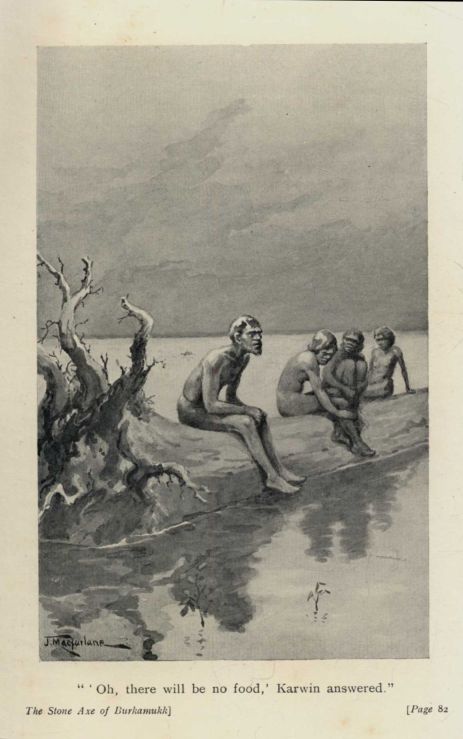
"Oh, there will be no food," Karwin answered. "Unless the flood goes down very quickly, we shall certainly starve. I do not even know where we are, and I have no weapons. Ky! none of our forefathers ever knew such a flood! It is something to have seen it!"
"'Oh, there will be no food,' Karwin answered."
"That will not do us much good when we are lying dead in the mud," said Murla shortly. "I would rather have a piece of kangaroo now than see the biggest flood that ever was in the world. I have had enough of floods! Do you think the water will come any higher?"
"How can I tell?" answered Karwin shortly. Then, because they were all tired, and frozen, and hungry, they quarrelled about it, and became almost warm in the discussion. After awhile, Karwin laughed.
"If I had a waddy I would give all three of you something to argue over," he said. "What is the use of becoming angry when there is nothing to be gained by it? It will not take us off this bank, that is certain."
"No, but it keeps us from thinking," Murla said. "When I was angry just now I quite forgot that I was hungry."
"All women are a little mad," said Karwin scornfully. "No amount of talking could ever make me forget that I was hungry. It is the most important thing in the world."
He looked about him. Behind the ridge of the river bank, on which their log lay, the current of the flooded stream swept by, deep and swift. Before, the sea of brown water stretched as far as he could see, broken only by clusters of storm-washed leaves, that were the tops of submerged trees. There, no current ran; but the wind fled along the surface of the water and blew it into ripples and little waves.
"I wonder how deep that is," said Karwin thoughtfully. "I will go and see."
He took a few careful steps forward. Then his foot slipped, and he slid off the mud of the crest of the bank, and immediately disappeared with a loud splash. The women set up a dreadful screaming, crying "Come back!"—which, under the circumstances, was a very stupid thing to say. For a long moment the world seemed empty before them.
Then Karwin's head suddenly popped up out of the water, with his face very wet and angry. He swam to the ridge, but it was not easy to get upon it, for the crest was sharp, and very slippery, as Karwin already knew to his cost. Several times he clawed at it, only to slide back into the deep water, spluttering and wrathful.
"Hold on to the log," said Murla, quickly, to one of the women. "Then give your sister your other hand, and she can hold mine."
The three formed a chain and found that, by stretching as far as they could reach, Murla could just touch Karwin with her hand. He made a great effort and caught it in a firm grip, and then they pulled all together, and so managed to tug him over the edge of the ridge.
Karwin was very angry, and not at all grateful to them.
"You might have thought of that sooner," he growled. "Ky! the water is cold, and I sank down into a clump of prickly bushes, so that I am stuck with prickles all over. There is no getting away from this bank, that is certain."
"We had suspected that," said Murla, laughing. At this Karwin became worse-tempered than ever, for a blackfellow does not like to be laughed at by a woman, any more than a white man likes it. He threatened to beat them all, and even struck out at one of the women who was grinning, but Murla spoke to him severely.
"Don't do that!" she said boldly. "We are all in the same fix together, and we will not be beaten by you. If you strike one of us we will all push you off into the deep water—and this time we will not pull you back. Therefore, you had better be warned."
Murla looked so fierce as she spoke that Karwin stopped the hand he was lifting to strike the woman, and scratched his head with it instead. It was quite a new experience for a blackfellow to be ordered about by a lubra, and you can fancy that he did not like it. Still, the other women were clearly prepared to back up Murla; and he did not forget how he had struggled in the water at the edge of the bank before they pulled him in. So, instead of hitting the woman, he growled unpleasantly and waded to one end of the log, where he sat down and gave himself up to very bad temper. This time, however, he kept it inside him, and so it did not hurt anyone.
The sisters looked at Murla with great respect, but Murla only laughed at them. She was a pretty woman, for a lubra. Her hair was long and very black and curly, and she was much fairer than most of her tribe, with a fine flat nose and a merry smile. None of her teeth had been knocked out, which happens to many lubras, and so there were no holes in her smile. She was little more than a girl, but she was tall and strong, and very clever. And she was not at all afraid of Karwin.
For two days the four castaways sat on their log and watched the flood. Once it rose higher, when a fresh mass of snow was washed from the distant hill-tops, and came down to swell the river; and they thought their log was again about to be carried down-stream, and gave themselves up for lost, for they knew that now they were too weak to hold on for very long. But the log held firm upon the bank, and the danger passed. It was very cold. They plastered themselves all over with a thick coating of mud, hoping that when it dried it would keep them warmer; and this helped them against the cold wind, though it was not at all comfortable in other ways.
But worst of all was hunger. On the second day they began to break pieces off the log and chew them, and that, as you can imagine, did very little good. Karwin became more and more bad-tempered, and looked at the women as if it was their fault. Also, he was very sore from the prickles, and the two sisters and Murla spent quite a long time in picking them out of his back, though he was only a little grateful to them.
On the second day, the water began to go down. The river still roared and raced past them, bearing on its breast all kinds of things: trees, logs, bushes, interlaced fragments of ruined wurleys, drowned animals, and even dead blacks; but its water slipped back from the bank where their log lay, until it left them on a little mud island, with the brown sea still rippling about them in every direction. The tops of the trees came farther and farther out of the water, and new tree-tops came into view, with their boughs laden with mud. Often they saw little living animals in the brushwood that went drifting by them in the river; and nearly all the floating rubbish was alive with snakes that had taken refuge from the flood. Sometimes the brushwood would break up in the current, and they would see the snakes swimming wildly until the river carried them out of sight. Two came ashore on their island, and Karwin killed them with a stick he had taken out of the river. They ate them, and felt a little better. But they knew that they must soon die if they did not get more food. They watched the river anxiously, hoping that it might bring them something else.
Towards evening, they were gazing up-stream, when Murla cried out suddenly.
"What is that?" she said, pointing to a dark spot on the water.
"It is a bush," said one of the women, in a dull voice.
"No, I am certain it is an animal," Murla said. "It is floating towards us. Let us try to get it."
So they held hands, as they had done when Karwin fell in, and Karwin slipped into the current, holding Murla's hand tightly. He had found a stick with a sharp hook on one end, where a branch had broken off, and when the dark object came bobbing down-stream he thrust at it fiercely, savage with hunger. The hook caught in it, and very carefully they drew it ashore, and managed to get it on their island. It was a harder matter to get Karwin back, but they managed that too, and then they all lay on the mud and panted, and, except for Murla's fair face, they looked as if they were part of the mud.
Their find was a plump young wombat, and it probably saved their lives. Of course they had no way of cooking it, but at the moment that scarcely troubled them; neither did they at all object to the fact that it had been dead for a good while. They ate it all, and long after the moon had come out to cast her white light into the flood it showed them sitting on the log, happily crunching the bones.
CHAPTER II
Booran was a very clever bird. He was bigger than most of the water-fowl, and very strong. He was also very proud, partly because of his great wings, which would carry his heavy body skimming over the lakes and swamps, and partly because of his beautiful white plumage. All his feathers were perfectly white, and he was so vain about it that he scorned every bird that had coloured or dark plumage. He used to look at his reflection in deep pools, and murmur, "How beautiful I am!" If by any mischance he got a mud-stain on his feathers he was quite unhappy until he had managed to wash it off. Some people might not think a pelican a very lovely bird, but Booran was completely satisfied with himself.
Besides being beautiful and white, Booran at that time owned a bark canoe. It made him prouder than ever. It was not a very big canoe, but it was as much as a pelican could comfortably manage. He used to sit in it and paddle it along with his strong wings. There was really no reason why he should have had a canoe at all, for he was quite able to swim about in the water with far less labour than it needed to paddle his boat with his wings. It was only part of his great pride.
Still, no other bird had ever thought of having a canoe, so it pleased Booran to think himself superior to them all. No other bird wanted one at all, but he forgot that. The Emu laughed at him openly, and when Booran offered him a trip in his canoe he asked rudely what Booran thought he could do with his long legs in such a cockle shell? That made Booran more indignant than he had ever been since two black swans had risen suddenly under the canoe one day and upset both it and Booran in a very muddy part of a lake. He vowed that no other bird should ever enter it. Sometimes a meek little bird, such as a honey-eater or a bell-bird, would perch on the edge of the canoe and ask to be ferried about; but Booran never would allow it. He used to catch fish, and when he had stored all he could in his pouch he would put the rest in the canoe, so that soon it became all one dreadful smell. Not that any people in the country of the blacks were likely to object to that. They were brought up on smells.
When the big flood came, Booran enjoyed himself thoroughly. The river was too swift for him to attempt in his canoe at first, but he paddled about in the water that covered the plains, and poked into a great many things that did not concern him in the least. Sometimes he ran aground, when it was always an easy matter for him to jump overboard and push the canoe off with his great beak. He found all kinds of new things to eat, floating round in the flood-water; and some of them gave him indigestion rather badly. But on the whole it was a very interesting time, and he was very glad that he had a canoe so that he could go about in a stylish manner.
It was on the afternoon of the third day after the water had begun to go down, that Booran was first able to try the canoe on the river. The current was still swift, but he kept in the quieter water near each bank, and did not find much difficulty in getting about. He saw a number of strange blacks on a rise near the water, busily building wurleys; but they did not see him, for he dodged under cover of the wattle-trees fringing the bank. Then he pulled down-stream for a little while, until he came to where the banks were lower, and not many trees were to be seen out of the water. He rounded a bend, and came upon Karwin and his companions.
Booran's first instinct was to get out of sight. He was afraid of all blackfellows, especially when they had spears and throwing-sticks. But before he could go, the woman Murla saw him, and uttered a great cry of astonishment. At once they believed that it was Magic—so many strange things could be explained that way. They watched the big white bird in his bark canoe, and waited to see what would happen, hoping that he was not an evil spirit who would do them any harm.
Seeing them so quiet, and realizing that they were unarmed, Booran allowed his natural curiosity to get the better of him. He paddled across the river, swept down a little by the current, and stopped his canoe in a quiet pool near the mud island, where the castaways sat miserably on their log. They looked so forlorn and unhappy that even his cold and fishy heart was stirred.
"Good day," he said.
"Good day," Karwin answered.
"This is a big flood," Booran remarked.
"Yes, it is a very big one. All the land has gone away."
"Yes, but it will come back. Fish are scarce, now that the river is high."
"That is very likely," said Karwin.
Then, having made all these stupid remarks, as all men do before they come to business, they stopped, and looked at the sky, and Booran said, "I wonder if more rain will come!"
Murla struck in suddenly.
"Men are very strange," she said. "They are always ready to jabber. How is it that you go about in that little boat?"
"Because I like it," said Booran shortly, for he did not approve of women talking so freely, neither did he like the question about his canoe.
Murla laughed. "You look very funny when you are cross," she said. "I never saw such a dignified pelican." The other women shuddered, for they thought that Booran might be an evil spirit, in which case he would certainly object to such free-and-easy remarks. But Booran looked at Murla, and saw how pretty she was, and suddenly he did not wish to be angry. Instead, he smiled at her; and no one who has not seen it can imagine how peculiar a pelican looks when he smiles.
"It is a very useful canoe," he said. "I have been all over the flood-waters in it, and have seen many wonderful things."
"Have you any food?" asked Murla eagerly.
"No, for I have eaten it all. But I may come across some at any time. Would you like it?"
"Like it!" said Murla. "Why, we have only had two snakes and a wombat between us for four days—and the wombat was only a little one. I could eat the quills of a porcupine!"
"Dear me," said Booran, looking at her with his foolish little eyes very wide. "That would be very unpleasant, would it not? I quite regret that I ate an old fish that I found in the stern of my canoe this morning. Not that it would have made much of a meal for four people."
"It would have given me a breakfast," said Karwin rudely. "But as there is no food, there is no use in talking about it. Tell me, Pelican, have you seen any of our people? We do not know if there are any left alive."
"I have seen some blacks, but I do not know if they are your people," Booran answered. "They are across the river, where they are building themselves new huts."
"Can't you go and see if they belong to our tribe?"
Booran shook his big head decidedly.
"Not I," he said. "Most blacks are very uncivil to pelicans, and these had weapons close at hand. I have no wish to be found with a spear sticking in my heart, or in any other part of me."
"Did you notice what they were like?" Murla asked eagerly.
"I saw a fat woman, and a thin man," said Booran stupidly. "How should I know what they were like? They are not beautiful like pelicans. Oh, and I saw a very tall man, with a red bone through his nose. He was sitting idly on a stump while the others worked."
"That was my husband!" said Murla with a faint shriek. "Alas, I thought he was drowned! And the fat woman may be your wife, Goomah," she said to Karwin.
"Very likely," said Karwin. "Did you notice if they had food?"
"I do not know. But it is likely, for they had fire, and there was a pleasant smell."
"If my wife Goomah has food and fire, while I have nothing, there will be trouble," said Karwin wrathfully.
"That may be, but we will die here without ever knowing," Murla said. "Long before the water goes down we will have starved to death, and then nothing will matter." She broke off a bit of wood and flung it into the swirling river. "I wish we had never tried to save ourselves, or seen that hateful log!"
Now, Booran had been watching Murla, and he thought she looked very capable, and he thought that she could be very useful to him if he could get her away to some place where she could catch fish for him, so that he might spend all his time admiring himself and paddling about in his canoe.
But he did not quite know how to manage it.
Karwin and the woman went on wrangling. They had not been happy before Booran came with his tidings; but now they could only think of their fellow-blacks feasting and making a warm and comfortable camp, and it made them feel very much worse than they had felt before. They shouted long and loudly in the hope of making the others hear; but no answer came, and the river rushed by them without pity, and they hated their little mud island.
All the time, Booran gazed at Murla, and at last he made up his mind that he could not possibly do without her. Whatever happened, he must get her away, and sail with her in his bark canoe to an island where the blacks could never find her. The others were talking so fast that he had time to think out a plan, and when they stopped for lack of breath, he spoke.
"I think, if you sat very still and got in and out very carefully, that I could take you across the river, one at a time," he said, speaking in a great hurry.
"That thing would sink," said Karwin sulkily, looking at the little canoe with eyes of scorn.
"No, it does not sink easily. You would have to be very careful, but it would be safe."
Karwin looked at the canoe, and then he looked at the trees that showed round the bend, when the high banks were quite clear of water. It was very tempting to think of getting there—such a little way! He thought hard. Then he said:
"You can take Kari first—she is the lightest, and if the canoe does not sink with her, perhaps I will go."
Booran did not care which he took first, so long as it was not Murla. But the woman Kari objected very strongly, and made a great outcry, for she thought she would be drowned. However, the others were all agreed that she should go, so there was no use in objecting, and she had to give in. Crying and trembling, she stepped into the canoe, which Booran brought close to the bank.
The canoe went down a good deal, but it did not sink, and Booran paddled gently up the stream, keeping very close to the bank, so that the current did not sweep him down. He disappeared round the bend, and for awhile Karwin and the two women who were left watched anxiously, fearing to see the upturned canoe float back empty. But in about ten minutes they saw Booran turn the corner and paddle swiftly down, evidently very pleased with himself. When he got near the mud island he called out, "All is well! I landed her easily on the bank, and she has run to the camp."
That made the others eager, and Murla stepped forward to get into the canoe. But Booran stopped her, saying, "Not now—next time!"—and before she could argue, Karwin twisted her out of his way, and stepped into the canoe so hurriedly that it nearly sank, and Booran called out very angrily to him to mind what he was doing. However, the canoe righted itself, and presently Booran had paddled it out of sight again.
Murla began to feel a little uneasy, though she scarcely knew why. There was something wrong about the way that Booran looked at her, with his cold eyes that were so like a fish's. She felt she would be glad when she was out of his canoe, and safely on the same side as her people. She did not want to get into the canoe at all; but as it was necessary to do so, she decided to get it over as soon as possible. So she said to the other black woman, "I will go next, Meri."
"All right," said Meri, shivering under her little 'possum rug and her coat of mud. "But tell the Pelican to hurry back, or I shall certainly die of cold."
Murla waited impatiently until Booran appeared, and when the canoe came alongside the bank she was ready. But Booran looked at her queerly, and said, "Not now—next time!
"Why?" asked Murla angrily. "This is my turn."
"Not now—next time!" was all Booran would say; and he beckoned to Meri, who was not slow to obey, for she was very tired of waiting. She stepped in, and the canoe moved away from the mud island.
Suddenly Murla was very much afraid, although as a rule she did not know what fear meant. She felt that she must not get into Booran's canoe—that there was danger coming very close to her. In a few minutes he would be back for her. A quick resolve came to her mind. Whatever happened, Booran must not find her there when he came back.
She slipped off her 'possum rug and wrapped it round a log that had come ashore on their island. It was just as long as she was, and when the rug was wrapped about it, it looked as if she were lying asleep. Then she slipped into the river, and began to swim across.
Booran and Meri were out of sight round the bend, and what she wanted to do was to get to the other side before the canoe came back. But it was not an easy matter. The current was swift, and though she was a very strong swimmer, it took her down-stream; and once she thought that she must be drowned. However, just as she was on the point of giving up, she felt the ground under her feet, and scrambled out upon a bank that was nearly all under water. Then she waded along it until she got near the bend.
Just then she heard the noise of Booran's wings brushing in the water. She flung herself down on her face—just in time, for the canoe came round the bend, and passed quite close to her. Booran heard the swirl in the water, and glanced round, seeing the ripples; but just then he caught sight of what looked like Murla, lying on the mud island, and he said, "Oh, it was only a water rat!" and paddled on.
Murla lay still in the water, holding her breath, until he had floated down the stream. Then she got up very quietly and waded, sinking in the soft mud of the bank until it grew higher, and trees and dry land could be seen. She ran then, casting her eyes wildly about until she saw ahead a little drift of smoke; and presently, toiling up a steep rise in the bank, she came upon the blacks, where already Karwin and Meri and Kari were jabbering loudly, telling all their experiences and hearing those of the others at the same time. They cried out with astonishment when they saw Murla coming along the bank, and asked her why Booran had not brought her in his canoe.
When she told them she had been afraid of him, they all laughed at her. But her husband, the tall man with the red bone through his nose, was very angry because she had left her 'possum rug behind, and asked her if she thought rugs like that grew on wild cherry-trees. He went off at once to see if he could get it back, telling her as he went that if he failed, she need not think she was going to have his. Of course, Murla had known that already.
Meanwhile, Booran had paddled down to the mud island, and, seeing the form in the 'possum rug, lying under the shelter of the great log, he called to it several times, saying, "Come on, now. It is your turn." But no movement came, and at last he grew angry, and hopped out of the canoe and went on to the island, still calling. There was no answer, and he lost his temper and kicked the figure very hard—with the result that he hurt his foot very much. Then he pulled the rug off roughly, and found only a log underneath.
Booran became furious. He had been made to look a fool. For awhile he stamped about the island, screaming in his rage, and when the blacks got to the opposite bank that is how they saw him. Then Booran made up his mind that he would "look out fight," as the blacks do, and kill the husband of the woman.
So he took some mud and smeared it on himself in long lines, so that he might be striped as the blacks are when they go fighting: for a blackfellow does not consider himself dressed for battle until he has painted himself in long white streaks with pipeclay. He was so busy painting, and planning how he would slay Murla's husband, that he did not see a black shadow in the sky. It was another pelican, and he came nearer, puzzled to know what could be this strange thing, so like a pelican and yet striped like a fighting man. He could not make it out, but he decided it could not be right; and so he drove at Booran and struck him in the throat with his great beak, killing him. Then he flew away.
Now the blacks say, there are no black pelicans any more. They are all black and white, just as Booran was when his Death came to him suddenly out of the sky.
The blacks across the river were very much amazed. But when the great black Pelican had sailed away, Murla's husband swam across and got her 'possum rug, which he brought back, tied on top of his head. He gave it back to Murla, and then beat her with his waddy for having been so careless as to leave it behind. So they lived happily ever after.
But the river took Booran's little canoe and whisked it away. It bobbed upon the brown water like a walnut shell, spinning in the eddies, and sailing proudly where the water was clear and free. At each mile the river grew wider and fuller, and the little canoe sped onwards on its breast. Then ahead came a long line of gleaming silver, and the river sang that it had nearly reached the sea. The light canoe rocked over the waters of the bar, but came safely through them; and then it floated away westward, into the sunset.
But the tide brought it back to shore, and the breakers took it and flung it on the rocks, pounding it on their sharp edges until it was no longer a canoe, but only a twisted bit of bark. The waves went back and left it lying on the beach; and some blacks who came along, hungry and cold, were very glad to find it and use it to start their fire, when it was dry. So Booran's canoe was useful to the blacks until the very end.
V THE STORY OF THE STARS
Pund-jel, who was Maker of Men, sat in his high place one day and looked at the world. The blacks believed that in the very long ago he had made the first men and women out of clay; and from there they had spread over all the earth. Pund-jel had made them to be good and happy, and for a long while he had been satisfied with them. But now it was different, and he was angry.
All over the world he could see his black people. They had grown tall and strong, and he thought them beautiful. They were skilled in hunting, and fierce in battle: the women were clever at making rugs of skins, at cooking, at weaving curious mats and baskets of pliant rushes. The forests were full of game for them—-birds, beasts and reptiles, all good to eat: there were fish in the lakes and rivers, fat mud-eels in the creeks and swamps, and gum and manna to be found on every hill-side. The world was a good, green world, and there should have been only happiness. But the people themselves had grown wicked.
Pund-jel bent his brows with anger as he looked down upon them. Instead of being peaceful and content, his people had grown fierce and savage. They thought only of fighting and conquest, and were too lazy to work. The laws that he had made for them were as naught in their eyes. They said, "Oh, Pund-jel is very far away. He will never come down into our world to see what we do. Why should we obey him?" So they did just as they pleased, and all the world was evil because of their wickedness.
Pund-jel thought gravely as he looked down into his world, and all the sky was dark with the blackness of his frown.
"My people have grown too many," he said. "When they were few, each helped the other: there was no time for feuds or fighting, for all had to work together in order to live. Now all is changed. They are many and powerful, and they over-run the world, and each man hates his brother. It were better if I made them fewer, and scattered them far and wide. I will send my whirlwinds upon the earth."
So Pund-jel caused storms and fierce winds to arise often, and they swept across the world. In the flat lands there came suddenly whirlwinds of great force, that twisted and eddied through the plains, carrying men aloft in their choking embrace, and letting them fall, broken and dead, miles away from the places where they had lived. On the mountains great hurricanes blew shrieking from peak to peak, tearing up the largest trees by their roots, and tossing them down into the fern-strewn gullies far below. Huge boulders were loosened and went crashing down; and often a landslip followed them, when all the soil would be stripped from a hill-side and fall, thundering, carrying with it hundreds of people and leaving the bare rock behind it, like a scar upon the side of the mountain. Thunder and lightning came and shook the world with terror: mighty trees were riven and shattered, and fires swept through forest and plain, leaving blackness and desolation behind. Then came floods, that covered the low-lying parts of the earth, and made of the rivers roaring torrents, that ran madly to the sea. The world trembled in the terror of the wrath of Pund-jel.
And yet, men had grown so wise and cunning that not very many died. When the whirlwinds and hurricanes came, they crept into holes in the hill-sides, or sheltered themselves in deep gullies. They strengthened their houses, so that the wind should not blow them away. Sometimes they floated down the rivers in bark canoes; and a great number found refuge in caves. Those who were killed were the careless ones, who would not take the trouble to protect themselves against the fury of the storms, thinking that they would only be ordinary gales; but though they died, innumerable people were left.
Just for a little while, they were afraid. They knew they were wicked, and that Pund-jel must be angry with them; and the thought that possibly the storms were the message of his wrath made them careful for awhile. But as time passed they forgot the storms and whirlwinds, and the fate of their brothers and sisters who had been killed; and they went back to their wickedness, becoming worse than they had been before.
And then there came a day when Pund-jel's anger broke anew.
One morning a blackness came out of the sky, and in the blackness a flame of gleaming fire. The people clustered together, in terror, and there were cries of "Pund-jel! Pund-jel is coming!" Then the magic-men began to chatter and make Magic, hoping to turn the wrath of the Maker of Men; and the people flung themselves upon the ground, crying aloud, and calling upon the good Spirits to save them.
The blackness swooped down upon the earth. In the air were strange whisperings and mutterings, as if even the rustling leaves and the boughs of the trees were crying, "Pund-jel is coming!" And then, out of the glowing heart of the cloud came Pund-jel himself, that he might see these men and women that he had made. He spoke no word. His glance was like lightnings, playing about the stricken eyes of those that gazed. But he trod among the black multitudes, and the noise of the trampling of his feet shook the earth.
In his hand he carried his great stone knife, and the sight of it was very terrible. Those who looked upon it fell back blindly. But as he walked on he cut his way among the people, with great sweeps of the cruel weapon, sparing none that came in his way, and cutting them into small fragments. And then the blackness of the cloud received him again, and hid him from the people of the world.
But the pieces of the slain were not dead. Each fragment moved, as Tur-ror, the worm, moves; and from them rose a cry. It came from the fragments of those who had been good men and good women, yet who had met Death at the knife of Pund-jel with the guilty ones.
Then a great and terrible storm came out of the sky, sweeping over the places where Pund-jel had trod; and with it a whirlwind, that gathered up the pieces of those who had been men, women and children, and they became like flakes of snow, white and whirling in the blackness of the air. They were carried away into the clouds.
And when they came to where Pund-jel sat, once more looking down upon the world, he took the flakes that had been bad men and women, and with his hand scattered them so far over the earth that no man could say where they fell. So they passed for ever from the sight of man, and now they lie in the waste places of the world, where there is neither light nor day.
But Pund-jel took the snowflakes that had been good men and women, and he made them into stars. Right up into the blue sky he flung them; and the sky caught them and held them fast, and the light of the sun fell upon them so that they caught some of his brightness. There they stay for ever, and you would not know that they are in any way different from the other stars that twinkle at you on a frosty night when the sky is all blue and silver. Only the magic-men, who know everything, can tell you which among the stars were once good men, women and children, before Pund-jel left his high seat to punish the wickedness of the world.
VI HOW LIGHT CAME
The blacks believed that the earth was quite flat, with the sky arched above it. They had an idea that if anyone could get beyond the edge of the sky he would come to another country, with rivers and trees, where live the ghosts of all the people who have died. Some thought that there was water all round the edge of the earth. They were taught that at first the sky had lain flat on the ground, so that neither sun, moon, nor stars could move, but the magpies came along and propped it up with long sticks, resting some parts on the mountains near the edge. And sometimes word was sent from tribe to tribe, saying that the props were growing rotten, and unless the people sent up tomahawks to cut new props, the sky would fall. In its falling it would burst, and all the people would be drowned. This used to alarm the blacks greatly, and they would make the magic-men weave charms so that the sky should not fall.
At first, all the earth was in darkness; and at that time there lived among the blacks a man called Dityi. In his tribe was a very beautiful woman whose name was Mitjen; and she became Dityi's wife.
At first Dityi and Mitjen were very happy. They had plenty to eat, and the camp was warm and comfortable, and they loved each other very much. There were no white men, at that time: the blacks ruled all their country, which they thought was the whole world. The forests were full of game, and the rivers of fish: every one had enough, so there was no fighting. And Dityi thought he was the luckiest man in the world, because he had won the love of Mitjen.
But a stranger came to the camp: a tall dark-eyed man named Bunjil. He told stories of far-away forests and wonderful things to be found there. The other blacks used to listen to him, greatly interested; and no one listened more attentively than Mitjen, for she had a great longing to see the wonderful places of which Bunjil spoke. When she heard him tell stories of these strange lands of the Bush, she burned to leave her quiet home and go exploring. Dityi could not understand this feeling at all. It interested him to hear Bunjil's tales, but he had no wish to do more than hear them. He was very well satisfied with his life, and thought that his own home was better than any other place could possibly be.
But Bunjil soon noticed the dark-eyed girl who never lost a word of his stories. It amused him to see her face light up and her eyes sparkle at his talk; and so he told more and more stories, and did not always trouble to make them true, so long as he could make Mitjen look interested. Sometimes he would meet her wandering alone outside the camp, and then he would tell her, as if he were sorry for her, that this quiet camp was no place for her at all. "You are so beautiful," he would say, "that you should be far away in my wonderful country, where you would see many great men and lovely women; but none more lovely than Mitjen. In this dull hole you are buried alive."
None of this was true, but Bunjil spoke exactly as if it were, and after a time Mitjen began to be very discontented. The simple happy life in the Bush pleased her no longer; she only wanted the exciting things of which Bunjil told. At home, everybody was good to her and liked her, but she was only a girl who had to obey other people all the time, and no one but Dityi had ever troubled about telling her that she was beautiful. Moreover, she could see that Bunjil did not think much of Dityi. He called him one day to Mitjen, "an ignorant black fellow," and though Mitjen could not imagine any people who were not black, it sounded very uncomplimentary, and she could not forget it. As soon as he had said it, Bunjil apologized, saying that it was only a slip of the tongue—but in her heart Mitjen knew this was not true. It made her look down on Dityi a little, and wonder if he were really worthy of her.
One day she asked him if he would take her to Bunjil's country, and his surprise prevented him from speaking for some time. He could only look at her, with his mouth open.
"Go away from home!" he said at last. "Why? What is there to go for?"
"To see the world," said Mitjen, tossing her head. "I do not want to stay for ever in this weary place."
"But it is the world—or most of it," returned Dityi. "I do not know where Bunjil's country is—but the men there cannot be up to much if they are like him, for he is more useless than anyone I ever saw. He cannot throw a boomerang better than a girl, and with a spear I could beat him with my left hand!"
"You are boastful," said Mitjen coldly. "Throwing weapons is not everything."
"Well, I don't know how things are managed in Bunjil's country, but it is very important in ours that a man should know how to throw," said Dityi. "Perhaps Bunjil's game comes close to him to be killed, but here a man has to hunt it. Did Bunjil mention if it came ready cooked too? I don't suppose you would want to do any work in that country of his!"
This made Mitjen very angry, and she quarrelled fiercely with Dityi for making fun of her; and then Dityi lost his temper and beat her a little, which was quite a usual thing to happen to a woman among the blacks. But Mitjen had been told by Bunjil that in his country a man never raised his hand against a woman. So it made her furious to be beaten by Dityi, though he cared for her too much really to hurt her, and she broke away from him and ran to the camp, sobbing that she hated him and did not want to see him any more.
Near the camp she met Bunjil, who asked her why she was crying; and when she told him, he was kind to her, patting her gently, and pretending to be very angry with Dityi. He was safe in doing this, for Dityi had gone off whistling into the Bush—not sorry that he had beaten Mitjen, if it should make her sensible again, but sorry that she was unhappy, and resolved to bring her back a snake or something equally nice for supper. So Bunjil ran no risk in abusing him, and he did it heartily. When they had finished talking, Mitjen walked away from him into the camp with a very determined face. She went straight to her wurley, and though Dityi brought her home a beautiful young snake and a lace-lizard, she would eat nothing and refused to come out of the wurley to speak to him. So Dityi went back to the young men's huts, angry and offended, and Mitjen lay down, turning her face to the wall. She was just as determined; but only her own heart knew how much she was afraid.
When the people of the camp awoke, she was gone. Nowhere was there any trace of her. And when the blacks went to look for Bunjil, in his wurley, he was gone, too. Then they fell into a great rage, and the young men painted themselves in white stripes with pipeclay, and went forth in pursuit, carrying all their arms, and led by Dityi. But though they looked for many days, they could never come upon a track; and so at last the other young men gave up the search, and went back to the camp. But Dityi did not go back. There was nothing for him at home now that he had lost Mitjen; and so he went on, hunting through the dark forests for his lost love.
Bunjil and Mitjen had fled far into the Bush. For a long time they walked in the creek, so that they would leave no tracks, and if they came to deep holes, they swam them. They were far away from Mitjen's country before they dared to leave the water, and already the girl was tired. But Bunjil would not let her stop to rest, for he knew that they would be pursued. He hurried her on, forgetting now to be gentle when he spoke to her.
It was not many days before Mitjen realized the terrible mistake she had made. They fled deeper and deeper into the Bush, but no wonderful country came in sight. She was often cold and hungry, and Bunjil made her work harder than she had ever worked before, doing not only the woman's work, but a large share of the man's. She found out that he was almost too lazy to get food, and if she had not hunted for game herself, she would never have had enough to eat. Bunjil had told her that he loved her, but very soon she knew that this was not true, and that all he had wanted was a woman to cook for him and help him procure food.
At first she used to ask him when they would come to his own country, and he would put her off, saying, "Presently—pretty soon." But before long she found that it made him angry to be asked about it; and at last, if she spoke of it, he beat her cruelly. So Mitjen did not ask any more.
Then all the memories of Dityi and his love came crowding upon her, and her heart quite broke. She did not want to live any more. She lay down under a big log, and when Bunjil spoke to her there was no answer. So he kicked her, and left her. But after he had slept, he went to see why she lay so still; and he found that she was dead.
As he looked at her, a great storm came out of the Bush and whirled him away. It flung him far up in the sky, where you may see him now, if you look closely: a lonely, wandering star, finding no rest anywhere, and no mate. Always he must wander on and on, and never stop, no matter how tired he may be; and the other stars shrink from him, hurrying away if they cross his path.
The storm took Mitjen also, and carried her gently into the sky; and there she saw Dityi, who lit it all up, for he had been turned into the Sun, and was giving light to the earth. But always, the blacks say, he is seeking Mitjen. Like a great fire, he leaps through the sky, mourning for his love and going back and forth in ceaseless quest of her. His wurley is in Nganat, just over the edge of the earth; and the bright colour of sunset is caused by the spirits of the dead going in and out of Nganat, while Dityi looks among them for his lost love. But he never finds her; and so next day he begins to hunt again, and goes tramping across the sky. Sometimes he shouts her name—"Mitjen! Mitjen!"—and it is then that we hear Thunder go rolling round the world. But Mitjen never answers.
She has been made the Moon, and always she mourns far away and alone. When she sees the glory of the Sun, and hears his trampling feet, she hides herself, for now she is ashamed to let him find her. She only comes from her hiding-place when he sleeps; and then she hurries through the sky, so that she may have the comfort of going in his footsteps, though she knows now that she can never hope to overtake him. Sometimes she sighs, and then a soft breeze flutters over the earth; and the big rain is the tears that relieve her grief.
VII THE FROG THAT LAUGHED
Before Pund-jel, Maker of Men, peopled the earth with the black tribes, and very long before the first white man came to Australia, the animals which inhabited the land fell into a great trouble. And this is how it happened. Old Conara, the black chief, told it to me while we were fishing for cod in the Murray one hot night; and he had it from his father, whose mother had told him about it; while to her the story had come from her grandfather, who said he was a little boy when his grandfather had told him, saying he had had the story from Conara, the magpie, after whom he was named. And the magpies learn everything, so you see he ought to know.
Conara said that once in the long-ago time, all the animals were living very cheerfully together, when suddenly all the water disappeared. They went to sleep with the creeks and swamps full, and the rivers running; and when they woke up, everything was dry. Of course, this was the most terrible thing that could happen to the animals, for though they can manage with very little food in Australia, at a pinch, they must always have plenty of water. They searched everywhere for it, through the scrub and over the plains; and the birds flew great distances, always seeking with their eyes for a gleam of water. But it had quite gone.
So the animals held a council of war, and Mirran, the Kangaroo, spoke to them. At a council, some one must always speak first, to tell those present what they know already; and Mirran did this very thoroughly, so that little Kur-bo-roo, the Native Bear, went to sleep and began to climb up the legs of the Emu in his sleep, thinking she was a tree. This led to a disturbance, and it was some time before Mirran could go on again with his speech. Then he found he had forgotten the rest of what he meant to say, so he contented himself by asking them all what they meant to do about it, and remarking that the matter was now open for discussion. This is a remark often made at meetings.
Then Mirran sat down thankfully, but in his relief at finishing his speech he sat on Kowern, the Porcupine; and Kowern is the most uncomfortable seat in the Bush. Mirran got up more quickly than he had sat down, and again there was disorder in the meeting, especially as the Jackass was unfeeling enough to laugh.
When matters were more quiet, Kellelek, the Cockatoo, made a long speech, but it was hard to understand what he said, because all his brothers would persist in speaking at the same time. Every one knew that he wanted water, but as every one was in the same fix, it did not seem to help along matters to have him say so. Booran, the Pelican, was even more troubled about it than Kellelek, for of course he lived on the water, and he wanted fish badly. All the fish had disappeared, and the eels had buried themselves deep in the soft mud of the beds of the rivers and creeks, and none of the water-fowl had any food. The Red Wallaby, Waat, and old Warreen, the bad-tempered Wombat, made speeches, and so did Meri, the black Dingo, and Tonga, the 'Possum, and a great many other animals. But not one could suggest any means of getting water back, or form an idea as to how it had gone away.
They were all talking together, getting rather hot and excited, and very thirsty, when they heard a sudden whirr of wings overhead, and a bird came dropping down into their midst. It was Tarook, the Sea Gull, and though at first they were inclined to be angry at his sudden appearance, they soon saw that he had news to communicate, and so they crowded round him and begged him to speak. Tarook was a proud bird, and did not often leave his beloved sea; so they knew that something important must have brought him so far inshore.
He stood in their midst, dainty and handsome, with his snowy feathers and scarlet legs, and carefully brushed a fragment of grass from his wing before replying.
"Waga, the Fish-Hawk, came along this morning—in a shocking temper, too—and told me of your difficulties," he said. "Well, we of the sea know what has caused them!"
There was an instant hubbub. All the animals and birds cried out at once, saying, "What is it?" Tarook looked at them all calmly.
"If you make such a clatter, how can I tell you?" he asked crossly. "I have not much time either, because my mate and I have youngsters to look after, and it is nearly time I got back to find their dinner."
The animals became silent at once, and looked at him anxiously.
"Three nights ago," said Tarook, "Tat-e-lak, the big Frog, came out of the sea. Every one knows he lives there, but none of us had ever seen him—and he is as large as many wurleys. All the sea was troubled at his coming, and big waves rolled in and beat upon the shore, so that we could scarcely see the rocks for spray. A hollow booming sound came from under the sea, and all our young ones were very much alarmed. Then a wave larger than all the rest put together crashed into the beach, and when it began to roll back we saw Tat-e-lak waddling up the shore. Most frogs hop, but he is so huge that he gets along in a kind of shuffle."
"But where did he go?" cried Kadin, the Inguana-lizard.
"He waddled away into the plains beyond, and when I flew in to look for him, for awhile I could not find him. Then I heard a strange noise of water sucking, and I flew to where it came from. There was a hollow in the creek bank, and Tat-e-lak was sitting there, with his head in the water, sucking it all up; and as he sucked, he swelled. It was not a nice sight, and soon I flew away."
"But where is he now? And what did he do?" asked the animals anxiously.
"I did not watch him any more. But the West Wind knows all about him, and he told me when I was out fishing last night. It seems that Tat-e-lak lives under the sea, because of his former sins, and that is why he has grown so huge. But he always wants to come back to land, and sometimes he breaks away from his prison under the sea and gets up to the surface—and a great stir his coming makes: it's very annoying if you're fishing, for it scares all the fish away into the farthest corners of the rocks. But the salt water he has drunk for so long makes him terribly thirsty, and unless he can get fresh water to drink he has to go back to his sea-prison."
"Then that is why he has drunk all of ours!" cried the animals.
Tarook nodded very hard.
"Yes," he said. "It is very seldom that he gets a chance of coming up; and his last three landings have been made in the desert, where he has had no water at all, and has been forced to hurry back meekly to the sea. So he is now more thirsty than he ever was before. The West Wind says he did not stop drinking until this morning—and now there is no water anywhere, as you know."
"Then how shall we ever get any more? Are we to die of thirst?"
"Well, that I do not know. I have told you all that I know," said Tarook. "Tat-e-lak is somewhere on shore, and so far as I can tell, all the water is inside him. But I do not know where he is, nor if you can do anything. Now I must go back to my young ones, for they will certainly be hungry, and my mate will be cross." He bowed to the Kangaroo, and flew up into the air. Then he went skimming over the forest to the sea.
When he had gone, the animals talked again, but there was great grief among them, and they did not know what to do. At last it was agreed that Malian, the Eaglehawk, should fly to the shore and find out anything he could about Tat-e-lak. So huge a Frog, they thought, could not hide himself from the eyes of an Eaglehawk, which can see even a little shrew-mouse in the grass as he flies. So Mirran, the Kangaroo, bade Malian be as quick as possible, and he flew off, while all the people awaited his return as patiently as they could. But they were too thirsty to be very patient.
It was evening when Malian returned. The day had seemed very long, and he was tired, for it is not easy to fly for a long while without water.
"Tat-e-lak is the most terrible Frog you could imagine," he said. "He is squatting on a rise not far from the sea, and he has drunk so much that he cannot move. His body is swelled up so that he is bigger than anything that ever existed: bigger than the little hill on which he sits. Nothing could possibly be so large as he is. He does not speak at all."
"But what is to be done?" cried the other animals.
"I asked every one I met, but they could not tell me. So at last I found old Blook, the Bullfrog, for it struck me that he would know more of the ways of other Frogs than anyone else. I found him with great difficulty, and for a long time he was too angry to speak, for he has now no water to remain in, and none to drink. But he knows all about Tat-e-lak. He says that now he has inside him all the waters that should cover the waste places of the earth, but that we shall never have water unless he can be made to laugh!"
"To laugh!" cried the animals. "Who can make a Frog laugh?"
"Blook knows he cannot, so that is why he is angry," answered Malian. "But that is the only way. If Tat-e-lak laughs, all the water will run out of his mouth, and there will once more be plenty for every one. But unless he laughs he will sit there for ever, unable to move; and soon we shall all die of thirst."
The animals talked over this bad news for a long time, and at last they agreed that every one who could be at all funny must go and try to make Tat-e-lak laugh. A great many at once said that they could be funny; but when they were tried, their performances were so dull that most of those who looked on were quite annoyed, and refused to let them go near the Frog, for fear he should lose his temper instead of laughing. However, every one was too thirsty to wait to try all those willing to undertake to make him merry: and they set off through the Bush in a queer company, the animals running, hopping or walking, the snakes and reptiles crawling, and the birds flying overhead. "The water will run back to you before we do!" they cried to the wives and young ones they were leaving behind. But that was just a piece of brave talk, for in reality they did not feel at all sure about it. They hurried through the scrub, getting more and more scattered as they went along, for the swift ones would not wait for those who were slower. In the early morning the leaders came out of the trees, and found themselves on a swampy plain leading to the sea. All the water had dried up, and a creek that had its course through it was also dry. It was a very dreary-looking place.
Not far from the beach there was a little hill; and, sitting on it, they saw the monster Frog. He was a terrible creature in appearance, for he was so immense that the hill was lost under him, just like a hugely fat man sitting on a button mushroom. He was so swelled up that it seemed that if anything pricked him he would burst like a balloon; but when they came near him they saw how thick his skin was, and knew that no prick would go through it. His beady eyes were bulging out, and though they tried to attract his attention, he only gazed out to sea and took no notice of them at all.
"Well, he has certainly had a great drink, but he does not look as if he had enjoyed it," remarked Mirran, hopping round him.
"I should think he would find himself more comfortable under the sea than sitting on that poor little hill!" said Merkein, the Jackass.
"He will probably go back to the sea," the Native Companion answered. "Let us hope he will not take all the water with him."
"How uncomfortable he must be!—why, he is like a mountain!" hissed Mumung, the Black Snake. "May I not go and bite him?"
"Certainly not!" said Mirran hastily. "It might make him angry; or he might die, and we do not want the water poisoned. Unless you can make him laugh, you had better get into your hole!" So Mumung subsided, muttering angrily to himself.
Then the animals began to try to make the Frog laugh. It was the first circus that ever was in Australia. They danced and capered and pranced before him, and the birds sang him the most ridiculous songs they could think of, and the insects sat on his head and told him the funniest stories they had gathered in flying round the world: but he did not take the smallest notice of any of them. His bulging eyes saw them all, but not a word did he say.
It is very hard to be funny when nobody laughs, and the animals soon became rather disheartened. But Mirran would not let them stop. He himself did most wonderful jumps before the Frog, and once hopped right over the Emu, who looked so comical when she saw the great body sailing over her that all the animals burst out laughing; but the Frog merely looked as though he would like to go to sleep. Then Menak, the Bandicoot, brought his brothers, and performed all kinds of antics; and the 'Possums climbed up a little tree and hung from its boughs, and were very funny in their gymnastics; and the Dingo and his tribe held a coursing match round the hill on which the Frog sat, going so fast that no one could see where one yellow dog ended and the next began; but none of these things amused the Frog at all. He stared straight in front of him, and, if possible, he looked a little more bulgy. But that was all.
The animals held another council, and tried to think of other funny things. Mirran remembered how the Jackass had laughed when he had sat down on Kowern, the Porcupine, and though that had been a most unpleasant experience for him, he bravely offered to do it again. Kowern, however, did not like the idea, and scuttled away into a hole, and they had great difficulty in finding him—and when they did find him, it was quite another matter to make him come out. At last they induced him to appear, and to let Mirran sit on him. But it was not a successful experiment. Perhaps Mirran was nervous, for he knew how it felt to sit on Kowern's quills; and so he let himself down gently, and Kowern gave a heavy groan, but no one even smiled. As for the Frog, he was heard to snore. It was all rather hard on Mirran, for the experiment hurt him just as much as if it had been quite successful.
So the day went on, and when it was nearly evening, the animals could do no more: and still Tat-e-lak sat and stared stupidly before him, and looked more and more huge and bulgy in the gathering darkness; and Waat, the Red Wallaby, declared that the little hill he sat on was beginning to flatten under his weight. They were quite hopeless, at last. All were so tired and thirsty that they could not have attempted more antics, even had they known any, but, indeed, they had done everything they knew. They sat in a half-circle round the great Frog and looked at him sadly; and the Frog sat on his hill and did not look at anything at all.
Just about this time, Noy-Yang, the great Eel, woke up. He was lying in a deep crack in the muddy bed of the creek, and when the mud dried and hardened it pinched him, and he squirmed and woke. To his surprise, there was no water anywhere. Noy-Yang wriggled out of his crack, very astonished and indignant.
He found all the creek-bed dry, as you know; so he wriggled across it and up the bank, and came out on a little mud-flat by the sea. There he looked about him. On one side the sea rippled, but Noy-Yang knew that its water was no good for him. On the other was only dry land—the swampy ground he knew and loved, but now there was no water in it. It was very puzzling to a sleepy Eel.
He looked a little farther and saw the great Frog sitting on his hill. But he looked so huge that Noy-Yang thought the hill had simply grown bigger while he slept; and though that was surprising, it was not nearly so surprising as finding no water. Then he saw all the animals sitting about him, but he took no notice of them. All he cared for was to get away from this hot, dry mud, and find a cool creek running over its soft bed.
So he wriggled on, making very good time across the flat. Nobody saw him, for all the animals were looking miserably at the Frog.
Kowern, the Porcupine, had felt very sore and bruised after Mirran had sat on him for the second time. He was a sulky fellow, and he did not want to be sat on any more, even if it were for the good of all the people. "Mirran will be making a habit of this soon," he said crossly; "I will get out of the way." So he hurried off, and got into the nearest hole, which happened to be near the edge of the mud-flat. There he went to sleep.
Noy-Yang came wriggling along, hating the hard ground, and only wanting to get to a decent creek. He was in such a hurry that he did not see Kowern, and he wiggled right across him—and it seemed to him that each of Kowern's spines found a different place in his soft body.
Noy-Yang cried out very loudly and threw himself backwards to get off those dreadful spikes. He was too sore to creep at all: the only part of him that was not hurt was the very point of his tail, and he stood up on that and danced about in his wrath and pain, with his body wriggling in the air, and his mouth wide open. And when the monster Frog caught sight of the Eel dancing on his tail on the mud-flat, he opened his mouth and let out such a great shout of laughter as had never been heard before in the world or will ever be heard again.
Then all the waters came rushing out of the Frog's mouth, and in a moment the dry swamp was filled with it, and a sheet of water rushed over the mud-flat where Noy-Yang was dancing, and carried him away—which was exactly what Noy-Yang liked, and made him forget all his sores. It was not so nice for Kowern, the Porcupine, for he was swept away, too, and as he could not swim, he was drowned. But he was so bad-tempered that nobody cared very much.
Tat-e-lak went on laughing, and the water kept pouring out of his open mouth; and as he laughed he shrank and shrank, and his skin became flabby and hung in folds about him. He shrank until he was only as large as a few ordinary frogs put together: and then he gave a loud croak, and dived off into the water. He swam away, and none of the animals ever saw him again.
At that moment the animals were much too busy with their own affairs to think much about Tat-e-lak. When the water first appeared they rushed at it eagerly, and each drank as much as he could. Then they felt better, and looked about them. Mirran, the Kangaroo, was the first to make a discovery.
"Ky! It will be a flood!" said he.
"A flood—nonsense!" said Warreen, the Wombat. "Why, ten minutes ago it was a drought!"
"Yes, and now it will be a flood," said Mirran, watching keenly. "Look!"
The water had run all over the plain, filling up the swamp, and already the creek showed like a line of silver where but a few moments ago there had been only dry mud. But it was plain that the water could not get away quickly enough. All the plain was like a sea, and there were big waves washing round the little hills.
"Save yourselves!" cried Mirran, to the people. "Soon there will be no dry land at all!"
He set off with great bounds, thinking of his mate and the little ones he had left in the forest. Behind him came all the people, running, jumping and crawling; and behind them came the water, in one great wave. Some reached the high ground of the forest first, and found safety, and others took refuge on hills, while those that could climb fled up trees. But many could not get away quickly, and the waters caught them, and they were drowned.
Next morning the animals who were saved gathered at the edge of the forest and looked over the flood. It stretched quite across the plain, and between it and the sea was only the yellow line of the sand-hummocks. Nearer to the forest were a few little hills, and on these could be seen forlorn figures, huddling together for warmth—for the air had become very cold.
"There are some of our people!" cried Mirran in a loud voice. "How are we to rescue them?"
No one could answer this question. None of the animals could swim, and if they had been able to do so, they had still no way of getting the castaways to dry land. They could only look at them and weep because they were so helpless.