THE STICKIT MINISTER'S WOOING (continued 4)
Reading edition
This it was to love a minister, and one who was not even a "regular." Why had not Elspeth, if she must fall in love, chosen a sailor?
In those days there was no regular postal delivery on the remoter country districts. The mails came in an amateurish sort of way by coach to Cairn Edward, and thereafter distributed themselves, as it were, automatically. When the postage was paid, the authorities had no more care in the matter. Yet there was a kind of system in the thing, too.
It was understood that any one being in Cairn Edward on business should "give a look in" at the Post Office, and if there were any letters for his neighbourhood, and he happened to have in his pocket the necessary spare "siller" at the moment, he would pay the postage and bring them to the "Weedow Barr's" shop in the village of Crosspatrick.
It may be observed that there were elements of uncertainty inseparable from such an arrangement. And these told hard on our poor prisoner of fate during these great endless midsummer days. She pined and grew pale, like a woodland bird shut suddenly in a close cage at that season when mate begins to call to mate through all the copses of birch and alder.
"He does not love me—oh, he cannot love me!" she moaned. But again, as she thought of the stile on the way to Lowe's Seat—"But he does love me!" she said.
Then, sudden as a falling star, Fear fell on that green summer world. There came a weird sough through all the valley, a crying of folk to each other across level holms, shrill answerings of herd to herd on the utmost hills. The scourge of God had come again! The Cholera—the Cholera! Dread word, which we in these times have almost forgot the thrill of in our flesh. Mysteriously and inevitably the curse swept on. It was at Leith at Glasgow—at Dumfries—at Cairn Edward. It was coming! coming! coming! Nearer, nearer ever nearer!
And men at the long scythe, sweeping the lush meadow hay aside with that most prideful of all rustic gestures, fell suddenly chill and shuddered to their marrows. The sweat of endeavour dried on them, and left them chill, as if the night wind had stricken them. Women with child swarfed with fear at their own door cheeks, and there was a crying within long ere the posset-cup could be made ready. Neighbour looked with sudden suspicion at neighbour, and men at friendly talk upon the leas manoeuvred to get to windward of each other.
Death was coming—had come! And in his study, grim and unmoved, Dr. Murdo Stuart sat preparing his Sabbath's sermon on the text, "Therefore ... because I will do this unto thee, prepare to meet thy God, O Israel!"
But in the shut chamber above Elspeth waited and watched, the hope that is deferred making her young heart sicker and ever sicker. Still she had not heard. No answering word had reached her, and it was now the second week. He did not love her—he could not.
But still!
They had told her nothing, and, indeed, during that first time of fear and uncertainty, they knew nothing for certain, away up by themselves in the wide wild moor parish of Dullarg. There were no market days in Cairn Edward any more. So much the farmers knew. The men of the landward parishes set guards with loaded guns upon every outgoing road. There was no local authority in those days, and men in such cases had to look to themselves. The infected place, be it city, town, or village, farm-steading or cottage, was completely and bitterly isolated. None might come out or go in. Provisions, indeed, were left in a convenient spot; but secretly and by night. And the bearer shot away again, bent half to the ground with eagerness, fear, and speed, a cloth to his mouth, for the very wind that passed over him was Death. It was not so much a disease as a certain Fate. Whoso was smitten was taken. In fact, to all that rustic world it was the Visitation of Very God.
In the main street of Cairn Edward grass grew; yet the place was not unpopulous. With the revival of trade and industry during the later years of the great war a cotton mill had been erected in a side street. The houses of the work folk were strung out from it. Then parallel with this there was a more ancient main street of low beetle-browed houses, many of them entering by a step down off the uneven causeway. At the upper end, near the Cross, were some better-class houses, some of them of two stories, a change-house or two, and down on the damp marshy land towards the loch, the cluster of huts which had formed the original nucleus of the village—now fallen into disrepute and disrepair, and nominated, from the nationality of many of its inhabitants, "Little Dublin."
In ten days a third of the inhabitants of this suburb had died. There was but one minister within the strait bounds of the straggling village. The parish church and manse lay two miles away out on a braeface overlooking yellowing widths of corn-land. And the minister thereof abode in his breaches, every day giving God thank that he was not shut up within those distant white streets, from which, day by day, the housewifely reek rose in fewer and fewer columns.
But Allan Syme was within, and could not pause to marry or to give in marriage, to preach or to pray, so full of his Master's business was he. For he must nurse and succour by day and bury by night, week day and Holy Day. He it was who upheld the dying head. He swathed the corpse while it was yet warm. He tolled the death-bell in the steeple. He harnessed the horse to the rude farm-cart. Sometimes all alone he dug the grave in the soft marshy flow, and laid the dead in the brown peat-mould. For it was no time to stand upon trifles this second time that the Scourge of God had come to Cairn Edward.
To the outer limit of the cordon of watchers came the carriers and the farmers, the country lairds' servants, and less frequently the bien well-stomached meal millers. In silence they deposited their goods, for the most part with no niggard hand. In silence they took the fumigated pound notes, smelling of sulphur, or the silver coin of the realm, with the crumbles of quick-lime still sticking to the milling of the edges.
So across a kind of neutral zone, fearful country and infected town stood glowering at each other like embattled enemies, musket laid ready in the crook of elbow.
And when one mad with the Fear tried to cross, he was hunted like a wild beast, or shot at like a rabbit running for its burrow. And the townsmen did in like manner. For ill as it might fare with them, there was deadlier yet to fear. In Cairn Edward they had the White Cholera, as it was called. The Black was at Dumfries—so, at least, the tale ran.
And as he went about his work, Allan Syme called upon his God, and thought of Elspeth. But her letter never reached him, and he knew nothing of her vigils. The day before he might have known the Fear fell, and the door was shut.
* * * * *
It was on Saturday afternoon that the tidings came to Elspeth Stuart, lonely watcher and loving heart. It was her brother Sandy who brought them. He knew nothing of Elspeth's matters, being young and by nature unworthy of trust. He had been down to Crosspatrick on some errand, and now, having arrived back within hailing distance, he was retailing his experiences to his brother Frank.
"I got yon letter back frae the Weedow—an', as I wasna gangin' hame, I gied it to my faither."
"What letter?"
Elspeth could hear the sudden angry alarm in Frank's voice; but she herself had no premonition of danger.
"The letter ye took doon to Crosspatrick for Elspeth ten days syne. Ye'll catch it, my man!"
The girl's heart sank, and then leapt again within her.
Her father had her letter—he would read it. It was plainly addressed in her handwriting to Allan Syme. What should she do?
But wait—there was something else. With a quick back-spang came the countering joy.
"But then he has never got my letter. He knows nothing of my unhappiness. He has not forgotten me. He loves me still. What care I for aught else but that?"
There came up from the courtyard a sound of blows, and then Sandy's wail.
"I'll tell my faither on ye, that I will. How was I to ken aboot Elspeth's letter? And they say the minister-man it was wrote to is dead, at ony rate!"
Elspeth heard unbelievingly. Dead—Allan dead! And she not know. Absurd! It was only one of Sandy's lies to irritate his brother because he had been thrashed. She knew Sandy. Nevertheless she threw up the window. Sandy was again at his parable.
"They buried twenty-five yesterday in the moss. The minister was there wi' the last coffin, and fell senseless across it. He never spoke again. He is to be buried the morn if they can get the coffin made!"
Then, so soon as she was convinced that Sandy was not inventing, and that he had only repeated the gossip of the village, a kind of cold calmness took hold of Elspeth. She called Frank in to her, and when he came, lo! his face was far whiter than hers.
She made him tell her all they had kept from her—of the dread plague that had fallen so sudden and swift upon the townlet to which Allan had carried her heart. Then she thought awhile fiercely, not wavering in her purpose, but only trying this way and that, like one who thrusts with his staff for the safest passage over a dangerous bog. Frank watched her keenly, but could make nothing of her intent. At last she spoke:
"Go and get me the key of your box."
"What do ye want with the key of my box?" queried her brother, astonished.
"Never heed that," said Elspeth, clipping her words imperiously, as, in seasons of stress, she had a way of doing; "do as I bid you!"
And being accustomed to such obediences, and albeit sorry for her, Frank went out, only remarking ominously that he would have a job, for that Aunt Mary carried it on her bunch.
He came back in exactly ten minutes, and threw the key on the floor.
"Easier than I expected," he said, triumphantly; "the old buzzer was asleep!"
"Give me the key," said Elspeth, still in a brown study by the window.
But this was too much for Frank.
"Pick it up for yourself, Els," he said, "and mind you are to swear you found it on the floor!"
Frank knew very well that if one is going to lie back and forth (as he intended to do when questioned), it is well to be prepared with occasional little scraps of truth. They cheer one up so.
Elspeth took the key, and hid it in her pocket.
"Now you can go," she said, and sat down on the bed, staring out at the broad river quietly slipping by.
"Well, you might at least have said 'thank you——'" began Frank. But catching the expression of her face, he suddenly desisted, and went out without another word.
* * * * *
No, Allan Syme was not dead. But he staggered home that night certainly more dead than alive. All day long he had moved in an atmosphere of the most appalling pestilence. The reek of mortality seemed to solidify in his nostrils, and his heart for the first time fainted within him.
He knew that there would be no welcome for him in the dark and lonely manse; no meal, no comfort, no living voice; not so much as a dog to lick his hand. His housekeeper, a mere hireling, had fled at the first alarm.
It was dusk as he thrust the key into the latch, as he did so staggering against the lintel from sheer weariness. He stood a little while in the passage, shuddering with the oncomings of mortal sickness. Then with flint, steel, and laborious tinder box he coaxed a light for the solitary taper on the hall table. This done, he turned aside into the little sitting-room on the right hand, where he kept his divinity books.
A slight figure came forward to meet him, with upturned face and clasped petitionary hands. The action was a girl's, but the dress and figure were those of a boy. Upon the threshold the minister stopped dead. He thought that this was the first symptom of delirium—he had seen it in so many, and had watched for it in himself.
But the lad still came forward, and laid a hand on his arm. He wore a suit of bottle green with silver buttons, a world too wide for his slim form. Knee breeches and buckled shoes completed his attire. Allan Syme stared wide-eyed, uncomprehending, his hand pressed to his aching brow in the effort to see truly.
"You are not dead. Thank God!" said the boy, in a voice that took him by the throat.
"Who—who are you?" The words came dry and gasping from the minister's parched lips.
"I am Elspeth—do you not know me?"
"Elspeth—Elspeth—why did you come here—and thus?"
"They told me you were dead—and my father locked me up! And—what chance had a girl to pass the guards? They fired at me—see!"
And lifting a wet curl from her brow, she showed a wound.
"Elspeth—Elspeth—what is all this? What have they done to you?"
"Nothing—nothing—it is but a scratch. The man almost missed me altogether."
"Beloved, what have you done with your hair?"
"I cut it off, that I might the better deceive them!"
"Elspeth—you must go back! This is no place for you!"
"I will not go back home. I will die first!"
"But, Elspeth, think if any one saw you—what would they say?"
"That I came to help you—to nurse you! I do not care what they would say."
"My dear—my dear, you cannot bide here. I would to God you could; but you cannot. I must think how to get you away. I must think—I must think!"
The minister, sick unto death, stood with his hand still pressed to his brow. At sight of him, and because, after all she had gone through for him, he had given her neither welcome nor kiss, a swift spasm of anger flashed up into Elspeth's eyes.
"You are ashamed of me, Allan Syme—let me go. I will never see you more. You do not love me! I will not trouble you. Open the door!"
"God knows I love you better than my soul!" said Allan; "but let me think. Father in heaven—I cannot think! My brain runs round."
He gave a slight lurch like a felled ox, and swayed forward.
Instantly, as a lamp that the wind blows out, all the anger went out of Elspeth Stuart's eyes. She caught Allan in her strong young arms and laid him on the worn couch, displacing with a sweep of her hand a whole score of volumes as she laid him down.
He lay a moment stiff and still. Then a spasm of pain contorted his features. He opened his eyes, and looked into his sweetheart's eyes. Then, with the swift astonishing clearness of the mortally stricken, he saw what must be done.
"Allan, Allan, what is the matter—what shall I do for you?" she mourned over him.
"Do this," answered the minister. "Take the cloak out of that cupboard there. I have never worn it. Go straight to John Allanson. He is my Ruling Elder. He bides at his daughter's house close by the cotton mill. Tell him all, and bid him come to me."
"The dreadful man who was so angry—that day at Lowe's Seat!" she objected, not fearing for herself, but for him.
"He is not a dreadful man. Do as I bid you, childie; I am sick, but I judge not unto death!"
"But you may die before I return!"
"Do as I bid you, Elspeth," said the minister, waving her away; "not a hundred choleras can deprive me of one minute God has appointed mine!"
She bent over quickly, and kissed him on lips and brow.
"There—and there! Now if you die, I will die too. Remember that! And I do not care now. I will go!"
Saying this, she rushed from the room.
* * * * *
It was a strange visitor who came to the house of the Elder's daughter that evening, as the gloaming fell darker, her feet making no sound on the deserted and grass-grown streets.
"A young laddie wants to see you, father," said John Allanson's married daughter, with whom he had been lodging for a night when the plague came, in a single hour putting a great gulf between town and country. Then, finding his minister alone, he was not the man to leave him to fight the battle single-handed.
Shamefacedly Elspeth crept in. The old man and his daughter were by themselves, the husband not yet home from the joiner's shop, where the hammers went tap-tap at the plain deal coffins all day and all night.
"The minister is dying—come and help him or he will die!" she cried, as they sat looking curiously at her in the clear, leaping red of the firelight.
"Who are you, laddie?" said the elder.
"I am no laddie," said Elspeth, redder than the peat ashes. "Oh, I am shamed—I am shamed! But I could not help it. And I am not sorry! They told me he was dead. I am Elspeth Stuart, of the Dullarg Manse."
The elder sat gazing at her, open-mouthed, leaning forward, his hands on his knees. But his daughter, with the quick sympathy of woman, held out her arms.
"My puir lassie!" she said. She had once lost a bairn, her only one.
And Elspeth wept on her bosom.
The daughter waved her father to the door with one hand.
"She will tell me easier!" she said.
And straightway the old man went out into the dark.
* * * * *
It did not take long to tell, with Allan Syme lying so near to the gates of death. Almost in less time than it needs to write it, Elspeth was arrayed, so far at least as outer seeming went, in the garments of her sex. A basket was filled with the necessities which were kept ready for such an emergency in every house.
"Come, father," the loving wife cried at the door; "I will tell you as we gang!"
And before she had won third way through her story, John Allanson had taken Elspeth's hand in his.
"My bairn! my bairn!" he said.
In this manner Elspeth came the second time to the Manse of Allan Syme.
* * * * *
But the third time was as the mistress thereof. For she and the elder's daughter nursed Allan Syme through into safety. For the very day that Allan was stricken, a great rain fell and a great wind blew. The birds came back to the gardens of Cairn Edward, and the plague lifted. In time, too, Dr. Stuart submitted with severe grace to that which he could not help.
"Indeed, it was all my fault, father," Elspeth said; "I made Allan come back by the stile. I had made up my mind that he should. I knew he would kiss me there!"
"Then I can only hope," answered her father, severely, lifting up his gold-knobbed cane and shaking it at her to emphasise his point, "that by this time your husband has learned the secret of making you obey him. It is more than ever your father did!"
A SCIENTIFIC SYMPOSIUM
(Being some Hitherto Unobserved Phenomena of Feminine Psychology from the notebook of A. McQuhirr, M.D. Edin.)
These papers of mine have been getting out of hand of late. I am informed from various quarters that they are becoming so exceedingly popular and discursive in their character, that they are enough to ruin the reputation of any professing man of science. I will therefore be severe with myself (and, incidentally, with my readers), and occupy one or two papers with a consideration of some of the minor characteristics common to the female sex. Indeed, upon a future occasion I may even devote an entire work to this subject.
I have mentioned before that my wife's younger sister was called the "Hempie,"[#] which, being interpreted, signifies a wild girl. This had certainly been her character at one time; and though she deserves the name less now than of yore, all her actions are still marked by conspicuous decision and independence.
[#] Some of the earlier and less reputable of the "Hempie's" adventures may be found in a certain unscientific work entitled "Lad's Love."
For instance, the year after Nance and I were married, the Hempie abruptly claimed her share of her mother's money, and departed to Edinburgh "to get learning."
Now it was a common thing enough in our part of the country for boys to go out on such a quest. It was unheard of in a girl. And the parish would have been shocked if the emigrant had been any other than the Hempie. But Miss Elizabeth Chrystie, daughter of Peter of Nether Neuk, was a young woman not accustomed to be bound by ordinary rules. In person she had grown up handsome rather than pretty, and was so athletic that she stood in small need of the ordinary courtesies which girls love—hands over stiles, and so forth. Eyes and hair of glossy jet, the latter crisping naturally close to her head, a healthy colour in her cheeks, an ironic curl to her firm fine lips,—that is how our Hempie came back to us.
Of her career in the metropolis, of the boarding-school dames, strait-laced and awful, whom she scandalised, the shut ways of learning which somehow were opened before her, I have no room here to tell. It is sufficient to say that out of all this the Hempie came home to Nether Neuk, and at once established herself as the wonder of the neighbourhood.
Nance was gone, Grace going; Clemmy Kilpatrick, the unobtrusive little woman whom Peter Chrystie had married as a kind of foot-warmer, had been laid aside for six weeks with an "income" on her knee. The maidservants naturally took advantage. Every individual pot and pan in the house cumbered the back kitchen unwashed and begrimed. In the byres you did not walk—you waded. The ploughmen hung about the house half the morning, gossiping with the half-idle maidens. The very herds on the hill eluded Peter's feeble judicature, and lay asleep behind dyke-backs, while the week-weaned lambs, with many tail-wagglings, rejoined their mothers on the pastures far below.
Upon this confusion enter the New Hempie. And with her gown pinned up and a white apron on that met behind her shapely figure, she set to and helped the servants.
In six days she had the farm town of Nether Neuk in such a state of perfection as it had not known since my own Nance left it. For Grace, though a good girl enough, cared not a jot for house work. Her sphere was the dairy and cheese-room, where in an atmosphere of simmering curds and bandaged cheddars she reigned supreme.
So much to indicate to those who are not acquainted with Miss Elizabeth Chrystie the kind of girl she was.
For the rest, she despised love and held wooers in contempt, as much as she had done in the old days when she ascended the roofs of the pigstyes, and climbed into the beech-tree tops in the courtyard of Nether Neuk, rather than meet me face to face as I went to pay my court to her eldest sister.
"Love——" she said, scornfully, when I questioned her on the subject the first time she came to see us at Cairn Edward, "love—have Nance and you no got ower sic nonsense yet? Love——" (still more scornfully); "as if I hadna seen as much of that as will serve me for my lifetime, wi' twa sisters like Grace and Nance there!"
It did not take us much by surprise, therefore, when one morning, while we sat at breakfast, the Hempie dropped in with the announcement that she could not stand her father any longer, and that she had engaged herself to be governess in the house of a certain Major Randolph Fergus of Craignesslin.
To a young lady so determined there was no more to be said. Besides which, the Hempie was of full age, perfectly independent as far as money went, and more than independent in character.
"Now," she said, "I have just fifteen minutes to catch my train: how am I to get my bag up to the station?"
"If you wait," I said, "the gig will be round at the door in seven minutes. I have a case, or I should go up with you myself."
"Who is driving the gig?"
"Tad Anderson," said I.
The Hempie picked up a pair of tan gloves and straightened her tall lithe figure.
"Good-morning," she said; "give me a lift with my box and wraps to the door. I would not trust Tad Anderson to get to the station in time if he had seven hours to do it in!"
At the door a boy was passing with a grocer's barrow. The Hempie swung her box upon it with a deft strong movement.
"Take that to the station, boy," she commanded, "and tell Muckle Aleck that Elizabeth Chrystie of the Nether Neuk will be up in ten minutes."
"But—but," stammered the boy, astonished, "I hae thae parcels to deliver."
"Then deliver them on your road down!" said the Hempie. And her right hand touched the boy's left for an instant.
"A' richt, mem!" he nodded, and was off.
"Don't trouble, Alec. Nance, bide where you are—I have three calls to make on the way up. Good-morning!"
And the Hempie was off. We watched her through the little oriel window, Nance nestling against my coat sleeve pleasantly, and, in the shadow of the red stuff curtain, even surreptitiously kissing my shoulder—a thing I had often warned her against doing in public. So I reproved her.
"Nance, mind what you are about, for heaven's sake! Suppose anyone were to see you. It is enough to ruin my professional reputation to have you do that on a market day in your own front window."
"Well, please may I hold your hand?" (Then, piteously, and, if I might call it so, "Nancefully") "You know I shall not see you all day."
"The Hempie would not do a thing like that!" I answer, severely.
Nance watches the supple swing of her sister's figure, from the stout-soled practical boots to the small erect head, with its short black curls and smart brown felt hat with the silver buckle at the side.
"No," she said, "she wouldn't." Then, after a sigh, she added, "Poor Hempie!"
That was the last we saw of our sister for more than a year. Elizabeth Chrystie did not come back even for Grace's marriage to the laird of Butterhole.
"I am of more use where I am," she wrote. "Tell Grace I am sending her an alarm clock!"
Whether this was sarcasm on the Hempie's part, I am not in a position to say. Grace had always been the sleepy-head of the family. If, however, it was meant ironically, the sarcasm was wasted, for Grace was delighted with the present.
"It is so useful, you know," the Mistress of Butterhole told Nance. "I set it every morning for four o'clock. It is so nice to turn over and know that you do not need to get up till eight!"
* * * * *
As suddenly as she had gone away, so suddenly the Hempie returned, giving reasons to no man. I am obliged to say that even I would never have known the true story of the adventures which follows had I not shamefully played the eavesdropper.
It happened this way.
My study, where I try upon occasion to do a little original work and keep myself from dropping into the rut of the pill-and-potion practitioner so common in rural districts, is next the little room where Nance sits reading, or sewing at the garmentry, white and mysterious, which some women seem never to be able to let out of their reach. Here I have a small wall-press, in which I keep my microscopes and preparations. It is divided by a single board from a similar one belonging to Nance on the other side. When both doors are open you can hear as well in one room as in the other. I often converse with Nance without rising, chiefly as to how long it will be till dinner-time, together with similar important and soul-elevating subjects. But it never seems to strike her that I can hear as easily what is said in her room when I am not expected to hear.
Now, if you are an observant man, you have noticed, I daresay, that so soon as women are alone together, they begin to talk quite differently from what they have done when they had reason to know of your masculine presence. Yes, it is true—especially true of your nearest and dearest. Men do something of the same kind when women go out after dinner. But quite otherwise. A man becomes at once broader and louder, more unrestrained in quotation, allusion, illustration, more direct in application. His vocabulary expands. In anecdote he is more abounding and in voice altogether more natural. But with women it is not so. They do not look blankly at the tablecloth or toy with the stem of a wineglass, as men do when the other sex vanishes. They glance at each other. A gentle smile glimmers from face to face, in which is a world of irony and comprehension. It says, "They are gone—the poor creatures. We can't quite do without them; but oh, are they not funny things?" Then they exchange sighs equally gentle. If you listen closely you can hear a little subdued rustle. That is the chairs being moved gently forward nearer each other—not dragged, mark you, as a man would do. A man has no proper respect for a carpet.
"Well, dear——?"
"Well?"
And then they begin really to talk. They have only "conversed" so far. How do I know all this? Well, that's telling. As I say, I eavesdropped part of it—in the interests of science. But the facts are true, in every case.
The Hempie came in one Saturday morning. It was in August, and a glorious day. There was nothing pressing. I had been out early at the only case which needed to be seen to till I went on my afternoon round.
Nance was upstairs giving a wholly supererogatory attention to a certain young gentleman who had already one statutory slave to anticipate his wants. He was getting ready to be carried into the garden. I could detect signs from the basement that cook also was tending nursery-wards. The shrine would have its full complement of devout worshippers shortly.
It was thus that I came to be the first to welcome the Hempie upon her return. She opened the glass door and walked in without ceremony, putting her umbrella in the rack and hanging her hat on a peg like a man, not bringing them in to cumber a bedroom as a woman does. These minor differences of habit in the sexes have never been properly collated and worked out. As I said before, I think I must write a book on the subject.
At any rate, the Hempie's action was the exception which proved the rule.
Then she strolled nonchalantly into my study and flung herself into a chair without shaking hands. I leaped to my feet.
"Hempie," I cried, "I am dreadfully glad to see you." And I stooped to kiss her.
To my utter astonishment she took the salute as a matter of course, a thing she had never done before. Yes, somehow the Hempie was startlingly different.
"What," she said, "are you as glad as all that? What a loving brother!"
But I think she was pleased all the same.
"Where's Nance?" The question was shot out rather than asked.
I indicated the upper regions of the house with my thumb, and inclined my ear to direct her attention.
A high voice of wonderful tone and compass (if a little thin) was lifted up in a decimating howl. Ensued a gentle confused murmur: "Didums, then? Was it, then?" together with various lucid observations of that kind.
A change passed over the Hempie's face.
"Now we are in for it," I thought. "She will leave the house and never enter it again. The Hempie hates babies. She has always been particularly clear on that point."
"Why did you never tell me, Alec?"
"Because—because—we thought you would not care to hear. I understood you didn't like——"
"Is it a boy or a girl?"
"Boy."
There was a sudden uprising from the depths of the easy-chair, a rustle of skirts, the clang of a door, hasty footsteps on the stairs, a clamour of voices from which, after a kind of confused climax as the hope of the house blared his woes like a young bull of Bashan, there finally emerged the following remarkable sentiments:—
"Oh, the darling! Isn't he a pet? Give him to me. Was they bad to him? Then—well then! They shan't—no, indeed they shan't! Now, then! Didums, then!"
And da capo.
I could not believe my ears. The words were the words of Nance, but the voice was undoubtedly the voice of the Hempie. It was half an hour and more before they descended the stairs, the Hempie still carrying young "Bull of Bashan," now pacifically sucking his thumb and gazing serenely through and behind his nurse in the disconcerting way which is common to infants of the human species—and cats.
The Hempie passed out across the little strip of garden we had at the back. The sunlight checkered the grass, and the new nurse carried her charge as if she had never done anything else all her life. Every moment she would stop to coo at him. Then she would duck her head like a turtle-dove bowing to his mate; and finally, as if taken by some strange contortive disease, she would bend her neck suddenly and nuzzle her whole face into the child's, as a pet pony does into your hand—a hot, fatiguing, and wholly unscientific proceeding on an August day.
I called Nance back on pretext of matters domestic.
"What's the matter with the Hempie?" I said.
"Matter with the Hempie?" repeated Nance, trying vainly to look blank. "Why, what should be the matter with the Hempie?"
"Don't try that on with me, you little fraud. There is something! What is it?"
"I have not the least idea."
"Have you kissed her?"
"No, she never looked at me—only at the baby, of course."
"Then go and kiss her."
Nance went off obediently, and the sisters walked a while together. Presently the baby took the red thumb out of his mouth, and through the orifice thus created issued a bellow. The nurse came running. Nance took him in her arms, replaced the thumb, and all was well. Then she handed him back to the Hempie and kissed her as she did so. The Hempie raised her head into position naturally, like one well accustomed to the operation.
Nance came slowly back and rejoined me. She was unusually thoughtful.
"Well?" I said.
She nodded gravely and shook her head.
"It is true," she murmured, as if convinced against her will; "there is something. She is different."
"Nance," said I, triumphantly, for I was pleased with myself, "the Hempie is in love at last. You must find out all about it and tell me."
She looked at me scornfully.
"I will do no such thing——" she began.
"It is not curiosity—as you seem to think," I remarked with dignity. "It is entirely in the interests of science," I said.
"Rats!" cried Nance, rudely.
As I have had occasion to remark more than once before, she does not show that deference to her husband to which his sterling worth and many merits entitle him. Indeed, few wives do—if any.
"Well, I will find out for myself," I said, carelessly.
"You!"
Scorn, derision, challenge were never more briefly expressed.
"Yes, I."
"I'll wager you a new riding-whip out of my house money that you don't find out anything about it!"
"Done!" said I.
For I remembered about the little wall-press where I kept my microscope. Not that I am by nature an eavesdropper; but, after all, a scientific purpose—and a new riding-whip, make some difference.
I was busy mounting my slides when I heard them come in. Instantly I needed some Canada balsam out of the wall-press—in the interests of science. I heard Nance go to the door to listen "if baby was asleep." I have often represented to her that she does not require to do this, because the instant baby is awake he advertises the fact to the whole neighbourhood, as effectually as if he had been specially designed with a steam whistle attachment for the purpose. But I have never succeeded.
"You think you are a doctor, Alec," is the answer, "but you know nothing about babies! You know you don't!"
Which shows that I must have spent a considerable part of my medical curriculum in vain.
There ensued the soft muffled hush of chairs being pushed into the window. Then came the first click-click, jiggity-click of a rocking-chair, which Nance had bought for me "when you are tired, dear"—and has used ever since herself. I did not regret this, for it left the deep-seated chintz-covered one free. They are useless things, anyway: a man cannot go to sleep on a rocking-chair, or strike a match under the seat, or stand on it to put up a picture—or, in fact, do any of the things for which chairs are really designed.
Now when a woman goes to sleep in a chair, she always wakes up cross. All that stuff in romances about kissing the beloved awake in the dear old rose-scented parlour, and about the lids rising sweetly from off loving and happy eyes, is, scientifically considered, pure nonsense. Believe me, if she greets you that way the lady has not been asleep at all, and was waiting for you to do it.
But when she, on the other hand, wakes with a start and opens her eyes so promptly that you step back quickly (having had experience); when she speaks words like these, "Alec, I have a great mind to give you a sound box on the ear—coming waking me up like that, when you know I didn't have more than an hour's good sleep last night!"—this is the genuine article. The lady was asleep that time. The other kind may be pretty enough to read about, but that is its only merit.
It was Nance who spoke first. I heard her drop the scissors and stoop to pick them up. I also gathered from the tone of her first words that she had a pin in her mouth. Yet she goes into a fit if baby tries to imitate her, and wonders where he can learn such habits. This also is incomprehensible.
"Have you left Craignesslin for good?" said Nance, using a foolish expression for which I have often reproved her.
"I am going back," said the Hempie. I am not so well acquainted with the nuances of the Hempie's voice and habit as I am with those of her sister, but I should say that she was leaning back in her chair with her hands clasped behind her head, and staring contentedly out at the window.
"I thought perhaps the death of the old major would make a difference to you," said Nance. I knew by the mumbling sound that she was biting a thread.
"It does make a difference," said the Hempie, dreamily, "and it will make a greater difference before all be done!"
Nance was silent for a while. I knew she was hurt at her sister's lack of communicativeness. The rocking-chair was suddenly hitched sideways, and the stroking rose from fifty in the minute to about sixty or sixty-five, according, as it were, to the pressure on the boiler.
Still the Hempie did not speak a word.
The rocking-chair was doing a good seventy now—but it was a spurt, and could not last.
"Elizabeth," said Nance, suddenly, "I did not think you could be so mean. I never behaved like this to you."
"No?" said the Hempie, with serene interrogation, but did not move, so far as I could make out. The rocking-chair ceased. There was a pause, painful even to me in my little den. The strain on the other side of the wall must have been enormous.
When Nance spoke it was in a curiously altered voice. It sounded even pleading. I wish the Hempie would teach me her secret.
"Who is it?—tell me, Hempie," said Nance, softly.
I did not catch the answer, though obviously one was given. But the next moment I heard the unbalanced clatter of the abandoned rocker, and then Nance's voice saying: "No, it is impossible!"
Apparently it was not, however, for presently I heard the sound of more than one kiss, and I knew that my dear Mistress Impulsive had her sister in her arms.
"Then you know all about it now, Hempie?"
"All about what?"
"Don't pretend,—about love. You do love him very much, don't you?"
"I don't know. I have never told him so!"
"Hempie!"
"It is true, Nance!"
"Then why have you come home?"
"To get married!" said the Hempie, calmly.
THE HEMPIE'S LOVE STORY
This is the somewhat remarkable story the Hempie told my wife as she sat sewing in the little parlour overlooking the garden, the day Master Alexander McQuhirr, Tertius, cut his first tooth.[#]
[#] This, however, was not discovered till afterwards, and was then acclaimed as the reason why he cried so much on the arrival of his aunt Elizabeth. To his nearest relative on the father's side, however, the young gentleman's performances seemed entirely normal.—A. McQ.
Elizabeth Chrystie was a free-spoken young woman, and she told her tale generally in the English of the schools, but sometimes in the plain countryside talk she had spoken when, a barefoot bare-legged lass, she had scrieved the hills, the companion of every questing collie and scapegrace herd lad, 'twixt the Bennan and the Butt o' Benerick.
"When I first got to Craignesslin," said the Hempie, "I thought I had better turn me about and come right back again. And if it had not been for pride, that is just what I should have done."
"Were they not kind to you?" asked Nance.
"Kind? Oh, kind enough—it was not that. I could easily have put an end to any unkindness by walking over the hill. But I could not. To tell the truth, the place took hold of me from the first hour.
"Craignesslin, you know, is a great house, with many of the rooms unoccupied, sitting high up on the hills, a place where all the winds blow, and where the trees are mostly scrubby scrunts of thorn, turning up their branches like skeleton hands asking for alms, or shrivelled birches and cowering firs all bent away from the west.
"When first I saw the place I thought that I could never bide there a day—and now it looks as if I were going to live there all my life.
"The hired man from the livery stables in Drumfern set my box down on the step of the front door, and drove off as fast as he could. He had a long way before him, he said, the first five miles with not so much as a cottage by the wayside. He meant a public-house.
"He was a rude boor. And when I told him so he only laughed and said: 'For a' that ye'll maybe be glad to see me the next time I come—even if I bring a hearse for ye to ride to the kirkyaird in!'
"And with that he cracked his whip and drove out of sight. I was left alone on the doorstep of the old House of Craignesslin. I looked up at the small windows set deep in the walls. Above one of them I made out the date 1658, and over the door were carven the letters W.F.
"Then I minded the tales my father used to tell in the winter forenights, of Wicked Wat Fergus of Craignesslin, how he used to rise from his bed and blow his horn and ride off to the Whig-hunting with Lag and Heughan, how he kept a tally on his bed-post of the men he had slain on the moors, making a bigger notch all the way round for such as were preachers.
"And while I was thinking all this, I stood knocking for admission. I could not hear a living thing move about the place. The bell would not ring. At the first touch the brass pull came away in my hands, and hung by the wire almost to the ground.
"Yet there was something pleasant about the place too, and if it had not been for the uncanny silence, I would have liked it well enough. The hills ran steeply up on both sides, brown with heather on the dryer knolls, and the bogs yellow and green with bracken and moss. The sheep wandered everywhere, creeping white against the hill-breast or standing black against the skyline. The whaups cried far and near. Snipe whinnied up in the lift. Magpies shot from thorn-bush to thorn-bush, and in the rose-bush by the door-cheek a goldfinch had built her nest.
"Still no one answered my knocking, and at last I opened the door and went in. The door closed of its own accord behind me, and I found myself in a great hall with tapestries all round, dim and rough, the bright colours tarnished with age and damp. There were suits of armour on the wall, old leathern coats, broad-swords basket-hiked and tasselled, not made into trophies, but depending from nails as if they might be needed the next moment. Two ancient saddles hung on huge pins, one on either side of the antique eight-day clock, which ticked on and on with a solemn sound in that still place.
"I did not see a single thing of modern sort anywhere except an empty tin which had held McDowall's Sheep Dip.
"Nance, you cannot think how that simple thing reassured me. I opened the door again and pulled my box within. Then I turned into the first room on the right. I could see the doors of several other rooms, but they were all dark and looked cavernous and threatening as the mouths of cannon.
"But the room to the right was bright and filled with the sunshine from end to end, though the furniture was old, the huge chairs uncovered and polished only by use, and the great oak table in the centre hacked and chipped. From the window I could see an oblong of hillside with sheep coming and going upon it. I opened the lattice and looked out. There came from somewhere far underneath, the scent of bees and honeycombs. I began to grow lonesome and eerie. Yet somehow I dared not for the life of me explore further.
"It was a strange feeling to have in the daytime, and you know, Nance, I used to go up to the muir or down past the kirkyaird at any hour of the night.
"I did not take off my things. I did not sit down, though there were many chairs, all of plain oak, massive and ancient, standing about at all sorts of angles. One had been overturned by the great empty fireplace, and a man's worn riding-glove lay beside it.
"So I stood by the mantelpiece, wondering idly if this could be Major Fergus's glove, and what scuffle there had been in this strange place to overturn that heavy chair, when I heard a stirring somewhere in the house. It was a curious shuffling tread, halting and slow. A faint tinkling sound accompanied it, like nothing in the world so much as the old glass chandelier in the room at Nether Neuk, when we danced in the parlour above.
"The sound of that shuffling tread came nearer, and I grew so terrified, that I think if I had been sure that the way to the door was clear, I should have bolted there and then. But just at that moment I heard the foot trip. There was a muffled sound as of someone falling forward. The jingling sound became momentarily louder than ever, to which succeeded a rasping and a fumbling. Something or someone had tripped over my box, and was now examining it in a blind way.
"I stood turned to stone, with one hand on the cold mantelpiece and the other on my heart to still the painful beating.
"Then I heard the shuffling coming nearer again, and presently the door lurched forward violently. It did not open as an intelligent being would have opened a door. The passage was gloomy without, and at first I saw nothing. But in a moment, out of the darkness, there emerged the face and figure of an old woman. She wore a white cap or 'mutch,' and had a broad and perfectly dead-white face. Her eyes also were white—or rather the colour of china ware—as though she had turned them up in agony and had never been able to get them back again. At her waist dangled a bundle of keys; and that was the reason of the faint musical tinkling I had heard. She was muttering rapidly to herself in an undertone as she shuffled forward. She felt with her hands till she touched the great oaken table in the centre.
"As soon as she had done so, she turned towards the window, and with a much brisker step she went towards it. I think she felt the fresh breeze blow in from the heather. Her groping hand went through the little hinged lattice I had opened. She started back.
"'Who has opened the window?' she said. 'Surely he has not been here! Perhaps he has escaped! Walter—Walter Fergus—come oot!' she cried. 'Ah, I see you, you are under the table!'
"And with surprising activity the blind old woman bent down and scrambled under the table. She ran hither and thither like a cat after a mouse, beating the floor with her hands and colliding with the legs of the table as she did so.
"Once as she passed she rolled a wall-white eye up at me. Nance, I declare it was as if the week-old dead had looked at you!
"Then she darted back to the door, opened it, and with her fingers to her mouth, whistled shrilly. A great surly-looking dog of a brown colour lumbered in.
"'Here, Lagwine, he's lost. Seek him, Lagwine! Seek him, Lagwine!'
"And now, indeed, I thought, 'Bess Chrystie, your last hour is come.' But though the dog must have scented me—nay, though he passed me within a foot, his nose down as if on a hot trail—he never so much as glanced in my direction, but took round the room over the tumbled chairs, and with a dreadful bay, ran out at the door. The old woman followed him, but most unfortunately (or, as it might be, fortunately) at that moment my foot slipped from the fender, and she turned upon me with a sharp cry.
"'Lagwine, Lagwine, he is here! He is here!' she cried.
"And still on all fours, like a beast, she rushed across the floor straight at me. She laid her hand on my shoe, and, as it were, ran up me like a cat, till her skinny hands fastened themselves about my throat. Then I gave a great cry and fainted.
* * * * *
"At least, I must have done so, for when I came to myself a young man was bending over me, with a white and anxious face. He had on velveteen knickerbockers, and a jacket with a strap round the waist.
"'Where is that dreadful old woman?' I cried, for I was still in mortal terror."
"I should have died," said Nance. And from the sound of her voice I judged that she had given up the attempt to continue her seam in order to listen to the Hempie's tale, which not the most remarkable exposition of scientific truth on my part could induce her to do for a moment.
"'It's all my fault—all my fault for not being at home to meet the trap,' I heard him murmur, as I sank vaguely back again into semi-unconsciousness. When I opened my eyes I found myself in a pleasant room, with modern furniture and engravings on the wall of the 'Death of Nelson' and 'Washington crossing the Delaware.'
"As soon as I could speak I asked where I was, and if the horrible old woman with the white eyes would come back. The young man did not answer me directly, but called out over his shoulder, 'Mother, she is coming to.'
"And the next moment a placid, comfortable-looking lady entered, with the air of one who has just left the room for a moment.
"'My poor lassie,' she said, bending over me, 'this is a rough home-coming you have got to the house of Craignesslin. But when you are better I will tell you all. You are not fit to hear it now.'
"But I sat up and protested that I was—that I must hear it all at once, and be done with it."
"Of course," cried Nance, "you felt that you could not stay unless you knew. And I would not have stopped another minute—not if they had brought down the Angel Gabriel to explain."
"Not if Alec had been there?" queried the Hempie, smiling.
"Alec!" cried Nance, in great contempt. "Indeed, if Alec had been in such a place, I would have made Alec come away inside of three minutes—yes, and take me with him if he had to carry me out on his back! Stop there for Alec's sake? No fear!"
That is the way my married wife speaks of me behind my back. But, so far as I can see, there is no legal remedy.
"Go on, Hempie; you are dreadfully slow."
"So," continued the Hempie, placidly, "the nice matronly woman bade me lie down on a sofa, and put lavender-water on my head. She petted me as if I had been a baby, and I lay there curiously content—me, Elizabeth Chrystie, that never before let man or woman lay a hand on me——"
"Exactly," said Nance; "was he very nice-looking?"
"Who?"
"The young man in the velveteen suit, of course."
"I don't know what you mean."
"I mean, was he better-looking than Alec?"
"Better-looking than Alec? Why, of course, Alec isn't a bit——"
"Hempie!"
There was a pause, and then, to relieve the strain, the Hempie laughed. "Are you never going to get over it, Nance?"
"Get on with your story, and be sensible." I could hear a thread bitten through.
"So the lady began to talk to me in a quiet hushed tone, like a minister beside a sick bed. She told me how some years ago her poor husband, Major Fergus, had hart a dreadful accident. He was not only disfigured, but the shock had affected his brain.
"'At first,' she said, 'we thought of sending him to an asylum, but we could not find one exactly suited to his case. Besides which, his old nurse, Betty Hearseman, who had always had great influence with him, was wild to be allowed to look after him. She is not quite right in the head herself, but most faithful and kind. She cried out night and day that they were abusing him in the asylum. So at last he was brought here and placed in the old wing of the house, into which you penetrated by misadventure to-day.'
"'But the dog?' I asked; 'do they hunt the patient with a fierce dog like that?'
"'Ah, poor Lagwine,' she sighed, 'he is devoted to his old master. He would not hurt a hair of his head or of anybody's head. Only sometimes, when he finds the door open, my poor Roger will slip out, and then nobody else can find him on these weariful hills.'
"Then I asked her of the younger children whom I had been engaged to teach.
"'They are my grandchildren,' she said; 'you can hear them upstairs.'
"And through the clamour of voices, that of the young man I had seen rang loudest of all.
"'They are playing with their father?' I said.
"She shook her head. 'They are the children of my daughter Isobel,' she said. 'She married Captain Fergus, of the Engineers, her own cousin, and died on her way out to the West Indies. So Algernon brought them home, and here they are settled on us. And what with my husband's wastefulness before he was laid aside, and the poor rents of the hill farms nowadays, I know not what we shall do. Indeed, if it were not for my dear son Harry we could not live. He takes care of everything, and is most scrupulous and saving.'
"So when she had told me all this, I lay still and thought. And the lady's hand went slower and slower across my head till it ceased altogether.
"'I cannot expect you to remain with us after this, Miss Chrystie,' she said, 'and yet I know not what I shall do without you. I think we should have loved one another.'
"I told her that I was not going away—that I was not afraid at all.
"'But, to tell you the truth, my dear,' she said, 'I do not rightly see where your wages are to come from.'
"'That does not matter in the least, if I like the place in other ways,' I said to her."
"He must be very good-looking!" interjected Nance.
"So I told her I would like to see the children. She went up to call them, and presently down they came—a girl of six and a little boy of four. They had been having a rough-and-tumble, and their hair was all about their faces. So in a little we were great friends. They went up to the nursery with their grandmother, and I was following more slowly, when all at once, Harry—I mean the young man—came hurrying in, carrying a tray. He had an apron tied about him, and the bottom hem of it was tucked into the string at the waist. As soon as he saw me he blushed, and nearly dropped the tray he was carrying. I think he expected me to laugh, but I did not——"
"Of course not," coincided Nance, with decision.
"I just opened the top drawer in the sideboard and took out the cloth and spread it, while he stood with the tray still in his arms, not knowing, in his surprise, what to do with it.
"'I thought you had gone upstairs with my mother,' he said. 'Old John Hearseman is out on the hill with the lambs, and we have no other servants except the children's little nurse.'
"And so—and so," said the Hempie, falteringly, "that is how it began."
I could hear a little scuffle—which, being interpreted, meant that Nance had dropped her workbasket and sewing on the floor in a heap and had clasped her sister in her arms.
"Darling, cry all you want to!" My heart would know that tone through six feet of kirkyard mould—aye, and leap to answer it.
"I am not crying—I don't want to cry." It was the Hempie's voice, but I had never heard it sound like that before. Then it took a stronger tone, with little pauses where the tears were wiped away.
"And I found out that night from the children how good he was—how helpful and strong. He had to be out before break of day on the hills after the sheep. Often, with a game-bag over his shoulder, he would bring in all that there was for next day's dinner. Then when Betsy, the small maid, was busy with his mother, he would bath Algie and Madge, and put them to bed. For Mrs. Fergus, though a kind woman in her way, had been accustomed all her life to be waited on, and accepted everything from her son's hands without so much as 'Thank you.'
"So I did not say a word, but got up early next morning and went downstairs. And what do you think I found that blessed Harry doing—blacking my boots!"
There was again a sound like kissing and quiet crying, though I cannot for the life of me tell why there should have been. Perhaps the women who read this will know. And then the Hempie's voice began again, striving after its kind to be master of itself.
"So, of course, what could I do when his father died? He and I were with him night and day. For Betty Hearseman being blind could not handle him at all, and Harry's mother was of no use. Indeed, we did not say anything to alarm her till the very last morning. No, I cannot tell even you, Nance what it was like. But we came through it together. That is all."
Nance had not gone back to her sewing. So I could not make out what was her next question. It was spoken too near the Hempie's ear. But I heard the answer plainly enough.
"A month next Wednesday was what we thought of. It ought to be soon, for the children's sake, poor little things."
"Oh, yes," echoed Nance, meaningly, "for the children's sake, of course."
The Hempie ignored the tone of this remark.
"Harry is having the house done up. The old part is to be made into a kitchen. Old John and Betty Hearseman are to have a cottage down the glen."
"And you are to be all alone," cried Nance, clapping her hands, "with only the old lady to look after. That will be like playing at house."
"Yes," said the Hempie, ironically, "it would—without the playing. Oh no, I am going to have a pair of decent moorland lasses to train to my ways, and Harry will have a first-rate herd to help him on the hill."
Then she laughed a little, very low, to herself.
"The best of it is that he still thinks I am poor," she said. "I have never told him about mother's money, and I mean to ask father to give me as much as he gave you and Grace."
"Of course," said Nance, promptly. "I'll come up and help you to make him."
There was a cheerful prospect in front of Mr. Peter Chrystie, of Nether Neuk, if he did not put his hand in his breeches' pocket to some purpose.
"Will Alec let you come?" queried the Hempie, doubtfully. "He will miss you."
"Oh, I'll tell him it is for the sake of baby's health," said Nance; "and, besides, husbands are all the better for being left alone occasionally. They are so nice when they get you back again."
"What!" cried the Hempie, "you don't mean to say that Alec has fits of temper? I never would have believed it of him."
"Hush!" said Nance. There was again that irritating whispered converse, from which emerged the Hempie's clear voice:
"Oh, but my Harry will never be like that."
"Wait—only wait," said Nance. "Hempie, they are all alike. And besides, they write you such nice letters when they are away. I suppose you get one every day? Yes, of course. What, he walks six miles over the hill to post it? That is nice of him. Alec once came all the way from Edinburgh, and went back the next day, just because he thought I was cross with him——"
"Oh, but my Harry never, never——"
(Left speaking.)
THE LITTLE FAIR MAN.
I.—SEED SOWN BY THE WAYSIDE
Notable among my father's papers was one bundle quite by itself which he had always looked upon with peculiar veneration. The manuscripts which composed it were written in crabbed handwriting on ancient paper, very much creased at the folds, and bearing the marks of diligent perusal in days past. My father could not read these, but had much reverence for them because of the great names which could be deciphered here and there, such as "Mr. D. Dickson," "Mr. G. Gillespie," and in especial "Mr. Samuel Rutherfurd."
How these came into the possession of my father's forbears, I have no information. They were always known in the family as "Peden's Papers," though so far as I can now make out, that celebrated Covenanter had nothing to do with them—or, at least, is never mentioned in them by name. On the other hand I find from the family Bible, written as a note over against the entry of my great-grandmother's death, "Aprile the seventeene, 1731," the words, "Cozin to Mr. Patrick Walker, chapman, of Bristo Port, Edinburgh."
The letters and narratives are in many hands and vary considerably in date, some being as early as the high days of Presbytery, about 1638, whilst others in a plainer hand have manifestly been copied or rewritten in the first decade of last century.
Now after I came from college and before my marriage, I had sometimes long forenights with little to do. So having got some insight into ancient handwriting from my friend Mr. James Robb, of the College of Saint Mary, an expert in the same—a good golfer also, and a better fellow—I set me to work to decipher these manuscripts both for my own satisfaction and for the further pleasure of reading them to my father on Saturday nights, when I was in the habit of driving over to see my mother at Drumquhat on my way from visiting my patients in the Glen of Kells.
That which follows is from the first of these documents which I read to my father. He was so much taken by it that he begged me to publish it, as he said, "as a corrective to the sinful compliances and shameless defections of the times." And though I am little sanguine of any good it may do from a high ecclesiastic point of view, the facts narrated are interesting enough in themselves. The manuscript is clearly written out in a tall copy-book of stout bluish paper, without ruled lines, and is bound in a kind of grey sheepskin. The name "Harry Wedderburn" is upon the cover here and there, and within is a definitive title in floreated capitals, very ornately inscribed:
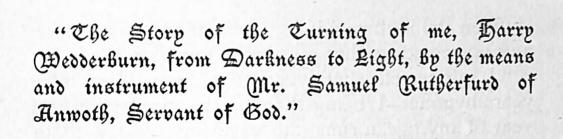
Inscription
"The Story of the Turning of me, Harry Wedderburn, from Darkness to Light, by the means and instrument of Mr. Samuel Rutherfurd of Anwoth, Servant of God."
Then the manuscript proceeds:—
"The Lord hath spared me, Harry Wedderburn, these many years, delaying the setting of my sun till once more the grass grows green where I saw the blood lie red, and I wait in patience to lay my old head beneath the sod of a quiet land.
"This is my story writ at the instance of good Mr. Patrick Walker, and to be ready at his next coming into our parts. The slack between hay and harvest of the Year of Deliverance, 1689, is the time of writing.
"I, Harry Wedderburn, of Black Craig of Dee, in the country of Galloway, acknowledging the mercies of God, and repenting of my sins, set these things down in my own hand of write. Sorrow and shame are in my heart that my sun was so high in the heavens before I turned me from evil to seek after good.
"We were a wild and froward set in those days in the backlands of the Kells. It was not long, indeed, since the coming of a law stronger than that of the Strong Hand. Our fathers had driven the cattle from the English border—yea, even out of the fat fields of Niddisdale, and over the flowe of Solway. And if a man were offended with another, he went his straightest way home and took gun and whinger to lie in wait for his enemy. Or he met him foot to foot with staff on the highway, if he were of ungentle heart and possessed neither pistol nor musketoon.
"I mind well that year 1636, more than fifty years bygone—I being then in the twenty-second year of my age, a runagate castaway loon, without God and without hope in the world. My father had been in his day a douce sober man, yet he could do little to restrain myself or my brother John, who was, they said, 'ten waurs' than I. For there was a wild set in the Glen of Kells in those days, Lidderdale of Slogarie and Roaring Raif Pringle of Kirkchrist being enough to poison a parish. We four used to forgather to drink the dark out and the light in, two or three times in the week at the change house of the Clachan. Elspeth Vogie keeped it, and no good name it got among those well-affected to religion—aye, or Elspeth herself either.
"But these are vain thoughts, and I have had of a long season no pleasure in them. Yet will I not deny that Elspeth Vogie, though in some things sore left to herself, was a heartsome quean and well-favoured of her person.
"So at Elspeth's some half-dozen of us were drinking down the short dark hours of an August night. It was now the lull between the hay-winning and the corn-shearing. For hairst was late that year, and the weather mostly backward and dour. There had come, however, with the advent of the new month, a warm drowsy spell of windless days, the sun shining from morn to even through a kind of unwholesome mist, and the corn standing on the knowes with as little motion as the grey whinstane tourocks and granite cairns on the hilltaps. The farmers and cottiers looked at their scanty roods of ploughland, and prayed for a rousing wind from the Lord to winnow away the still dead easterly mist, and gar the corn reestle ear against ear so that it might fill and ripen for the ingathering.
"But we that were hand-fasted to sin and bonded to iniquity, young plants of wrath, ill-doers and forlorn of grace, cared as little for the backward year as we did for the sad state of Scotland and the strifes that were quickly coming upon that land. So long as our pint-stoup was filled, and plack rattled on plack in the pouch, sorrow the crack of the thumb we cared for harvest or sheep-shearing, king or bishop, Bible or incense-pot.
"To us sitting thus on the Sabbath morning (when it had better set us to have been sleeping in our naked beds) there came in one Rab Aitkin of Auchengask, likeminded with us. Rab was seeking his 'morning' or eye-opening draught of French brandy, and to us bleared and leaden-eyed roisterers, he seemed to come fresh as the dew on the white thorn in the front of May. For he had a clean sark upon him, a lace ruffle about his neck, and his hair was still wet with the good well water in which he had lately washen himself.
"'Whither away, Rab?' we cried; 'is it to visit fair Meg o' the Glen so early i' the mornin'?'
"'He is on his way to holy kirk!' cried another, daffingly.
"'If so—'tis to stand all day on the stool of repentance!' declared another. Then in the precentors whining voice he added: 'Robert Aitkin, deleted and discerned to compear at both diets of worship for the heinous crime of—and so forth!' This was an excellent imitation of the official method of summoning a culprit to stand his rebuke. It was Patie Robb of Ironmannoch who said this. And this same Patie had had the best opportunities for perfecting himself in the exercise, having stood the session and received the open rebuke on three several occasions—two of them in one twelve-month, which is counted a shame even among shameless men.
"'No, Patie,' said Rab in answer, 'I am indeed heading for the kirk, but on no siccan gowk's errand as takes you there twice in the year, my man. I go to hear the Gospel preached. For there is to be a stranger frae the south shore at the Kirk of Kells this day, and they say he has a mighty power of words; and though ye scoff and make light o' me, I care not. I am neither kirk-goer nor kirk-lover, ye say. True, but there is a whisper in my heart that sends me there this day. I thank ye, bonny mistress!'
"He took the pint-stoup, and with a bow of his head and an inclination of his body, he did his service to Mistress Elspeth. For that lady, looking fresh as himself, had just come forth from her chamber to relieve Jean McCalmont, who, poor thing, had been going to sleep on her feet for many weary hours.
"Then Roaring Raif Pringle cried out, 'Lads, we will a' gang. I had news yestreen of this ploy. The new Bishop, good luck to him, has outed another of the high-flying prating cushion-threshers. This man goes to Edinburgh to be tried before his betters. He is to preach in Kells this very morn on the bygoing, for the minister thereof is likeminded with himself. We will all gang, and if he gets a hearin' for his rebel's cant—why, lads, you are not the men I tak you for!'
"So they cried out, 'Weel said, Roaring Raif!' and got them ready to go as best they could. For some were red of face and some were ringed of eye, and all were touched with a kind of disgust for the roysterous spirit of the night. But a dabble in the chill water of the spring and a rub of the rough-spun towel brought us mostly to some decent presentableness. For youth easily recovers itself while it lasts, though in the latter end it pays for such things twice over.
"We partook of as mickle breakfast as we could manage, and that was no great thing after such a night. But we each drank down a stirrup-cup and with various good-speeds to Elspeth Vogie and Jean her maid, we wan to horseback and so down the strath to the Kirk of Kells. It sits on the summit of a little knowe with the whin golden about it at all times of the year, and the loch like a painted sheet spread below.
"We could see the folk come flocking from far and near, from their mailings and forty-shilling lands, their farm-towns and cot-houses in half-a-dozen parishes.
"'We are in luck's way, lads,' cried Lidderdale, called Ten-tass Lidderdale because he could drink that number of stoups of brandy neat; 'it is a great gathering of the godly. Lads, the shutting of this man's mouth will make such a din as will be heard of through all Galloway!'
"And so to our shame and my sorrow we made it up. We were to go the rounds of the meeting, and gather together all the likely lads who would stand with us. There were sure to be plenty such who had no goodwill to preachings. And with these in one place we could easily shut the mouth of this fanatic railer against law and order. For so in our ignorance and folly we called him. Because all this sort (such as I myself was then) hated the very name of religion, and hoped to find things easier and better for them when the king should have his way, and when the bishops would present none to parishes but what we called 'good fellows'—by which we meant men as careless of principle as ourselves—loose-livers and oath-swearers, such as in truth they mostly were themselves.
"But when we arrived that August morning at the Kirk of Kells, lo! there before us was outspread such a sight as my eyes never beheld. The Kirk Knowe was fairly black with folk. A little way off you could see them pouring inward in bands like the spokes of a wheel. Further off yet, black dots straggled down hill sides, or up through glens, disentangling themselves from clumps of birches and scurry thorns for all the world like the ants of the wise king gathering home from their travels.
"Then we were very well content and made it our business to go among the gay young blades who had come for the excitement, or, as it might be, because all the pretty lasses of the countryside were sure to be there in their best. And with them we arranged that we should keep silence till the fanatic minister was well under way with his treasonable paries. Then we would rush in with our swords drawn, carry him off down the steep and duck him for a traitorous loon in the loch beneath.
"To this we all assented and shook hands upon the pact. For we knew right sickerly what would be our fate, if in the battle which was coming on the land, the Covenant men won the day. Perforce we must subscribe to deeds and religious engagements, attend kirks twice a day, lay aside gay colours, forswear all pleasant daffing with such as Elspeth Vogie and Jean her maid (not that there was anything wrong in my own practice with such—I speak only of others). The merry clatter of dice would be heard no more. The cartes themselves, the knowledge of which then made the gentleman, would be looked upon as the 'deil's picture-books.' A good broad oath would mean a fine as broad. Instead of chanting loose catches we should have to listen to sermons five hours long, and be whipt for all the little pleasing transgressions that made life worth living.
"So 'Hush,' we said—'we will salt this preacher's kail for him. We will drill him, wand-hand and working-hand, so that he cannot stir. We will make him drink his fill of Kells Loch this day!'
"All this while we knew not so much as the name of the preacher—nor, indeed, cared. He came from the south, so much we knew, and he had a great repute for godliness and what the broad-bonnets called 'faithfulness,' which, being interpreted, signified that he condemned the king and the bishops, and held to the old dull figments about doctrine, free grace, and the authority of Holy Kirk.
"The man had not arrived when we reached the Kirk of Kells. Indeed, it was not long before the hour of service when up the lochside we saw a cavalcade approach. Then we were angry. For, as we said, 'This spoils our sport. These are doubtless soldiers of the king who have been sent to put a stop to the meeting. We shall have no chance this day. Our coin is spun and fallen edgewise between the stones. Let us go home!'
"But I said: 'There may be some spirity work for all that, lads. Better bide and see!'
"So they abode according to my word.
"But when they came near we could see that these were no soldiers of the king, nor, indeed, any soldiers at all, though the men were armed with whingers and pistolets, and rode upon strong slow-footed horses like farmers going to market. There was a gentleman at the head of them, very tall and stout, whom Roaring Raif, in an undertone, pointed out as Gordon of Earlstoun, and in the midst, the centre of the company, rode a little fair man, shilpit and delicate, whom all deferred to, clad in black like a minister. He rode a long-tailed sheltie like one well accustomed to the exercise and bore about with him the die-stamp of a gentleman.
"This was the preacher, and these other riders were mostly his parishioners, come to convoy him through the dangerous and ill-affected districts to the great Popish and Prelatic city of Aberdeen, where for the time being he was to be interned.
"Then Roaring Raif whispered amongst us that we had better have our swords easy in the sheath and our pistols primed, for that these men in the hodden grey would certainly fight briskly for their minister.
"'Gordon of Cardoness is there also,' he said, 'a stout angry carle. Him in the drab is Muckle Ninian Mure of Cassencarry. Beyond is Ugly Peter of Rusco, and that's Bailie Fullerton o' Kirkcudbright, the man wi' the wame swaggin' and the bell-mouthed musket across his saddle-bow. There will be a rare tulzie, lads. This is indeed worth leavin' Elspeth's fireside for. We will let oot some true blue Covenant bluid this holy day!'
"And when the Little Fair Man dismounted there was a rush of the folk and some deray. But we of the other faction kept in the back part and bided our time.
"Then the Little Fair Man went up into the pulpit, which was a box on great broad, creaking, ungreased wheels, which they had brought out from the burial tool-house as soon as they saw that the mighty concourse could in no wise be contained in the kirk—no, not so much as a tenth part of them!
"After that there was a great hush which lasted at least a minute as the minister kneeled down with his head in his hands. Then at last he rose up and gave out the psalm to be sung. It was the one about the Israelites hanging their harps on the trees of Babylon. And I mind that he prefaced it with several pithy sayings which I remembered long afterwards, though I paid little heed to them at the time. 'This tree of Babylon is a strange plant,' he said; 'it grows only in those backsides of deserts where Moses found it, or by Babel streams where men walk in sorrow and exile. It is an ever-burning bush, yet no man hath seen the ashes of it.'
"Then the people sang with a great voice, far-swelling, triumphant, and the Little Fair Man led them in a kind of ecstasy. I do not mind much about his prayer. I was no judge of prayers in those days. All I cared about them was that they should not be too long and so keep me standing in one position. But I can recall of him that he inclined his face all the time he was speaking towards the sky, as if Someone Up There had been looking down upon him. At that I looked also, following the direction of his eyes. And so did several others, but could see nothing. But I think it was not so with the Little Fair Man.
"Now it was not till the sermon was well begun that we were to break in and 'skail' the conventicle with our swords in our hands. I could hear Lidderdale behind me murmuring, 'How much longer are we to listen to this treason-monger?'
"'Let us give him five minutes by the watch lads!' I said, 'the same as a man that is to be hanged hath before the topsman turns him off. And after that I am with you.'
"Then Roaring Raif said in my ear, 'We have them in the hollow of our hand. This will be a great day in the Kells. We will put the broad bonnets to rout, so that no one of them after this shall be able to show face upon the causeway of Dumfries. There are at least fifty staunch lads, good honest swearing blades, in and about the kirkyard of Kells this day!'
"For even so we delighted to call ourselves in our ignorance and headstrong folly—as the Buik sayeth, glorying in our shame.
"And according to my word we waited five minutes on the minister. He had that day a text that I will always mind, 'God is our refuge and our strength,' from the 46th Psalm—one that was ever afterwards a great favourite with me. And when at first he began, I thought not muckle about what he said, but only of the great ploy and bloody fray that was before me. For we rejoiced in suchlike, and called it among ourselves a 'bloodletting of the whey-faced knaves!'
"Then the Little Fair Man began to warm to his work, and just when the five minutes drew on to their end, he was telling of a certain Friend that he had, One that loved him, and had been constantly with him for years—so that his married wife was not so near and dear. This Friend had delivered him, he said, from perils of great waters, and from the edge of the sword. He had also put up with all the evil things he had done to Him. Ofttimes he had cast this Friend off and buffeted Him, but even then He would not go away from him or leave him desolate.
"So, as I had never heard of such strange friendship, I was in a great sweat to find out who this Friend might be, so different from the comrades I knew, who drew their swords at a word and gave buffet for buffet as quick as drawing a breath.
"So I whispered again, 'Give him another five minutes!'
"And I could hear them growl behind me, Tam Morra of the Shields, called Partan-face Tam, Glaikit Gib Morrison, and the others—'What for are ye waitin'? Let the grey-breeks hae it noo!'
"But since I was by much the strongest there, and in a manner the leader, they did not dare to counter me, fearing that I might give them 'strength-o'-airm' as I did once in the vennel of Dumfries to Mathew Aird when he withstood me in the matter of Bonny Betty Coupland—a rencontre which was little to my credit from any point of view.
"And then the Little Fair Man threw himself into a rapture like a man going out of the body, and his voice sounded somehow uncanny and of the other world. For there was a 'scraich' in it like the snow-wind among the naked trees of the wood at midnight. Yet for all it was not unpleasant, but only eery and very affecting to the heart.
"He told us how that he had shamed and grieved his Friend, how he had oftentimes wounded Him sore, and once even crucified Him——
"Then when he said that I knew what the man was driving at, and if I had been left to myself I would have fallen away and thought no more of the matter. But at that moment, with a sudden calm, there fell a hush over the people. They seemed to be waiting for something. Then the Little Fair Man leaned out of the pulpit and stretched his arm toward me, where I stood like Saul, taller by a head than any about me.
"'There is a great strong young man there,' he said, 'standing by the pillar, that hitherto has used his strength for the service of the devil, but from this forward he shall use it for the Lord. Even now he is plotting mischief. He, too, hath wounded my Friend, even Jesus Christ, and smitten Him on the cheekbone. But to-day he shall stand in the breach and fight for Him. Young man, I bid you come forward!'
"And with that he continued, pointing at me with his finger a little crooked. At first I was angry, and could have made his chafts ring with my neive had I been near enough. But presently something uprose in my heart—great, and terrible, and melting all at once. I took a step forward. But my companions held me back. I could feel Lidderdale and Roaring Raif with each a hand on a coat tail.
"'Harry,' they said, 'do not mind him—cry the word and we will fall on and pull the wizard down by the heels!'
"'Come hither!' said the Little Fair Man again, in a stronger voice of command. 'Come up hither, friend. Thou didst come to this place to do evil; but the Spirit hath thee now by the head, though well do I see that a pair of black deils have thee yet by the tail. Come hither, friend, resist not the Spirit!'
"Then there arose a mighty flame in my heart, the like of which I never felt before. It was a very gale of the Spirit—a breaking down of dams that imprisoned waters might flow free. And before I knew what I did I took my hand and dealt a buffet right and left, so that Roaring Raif roared amain. And as for Jock Lidderdale, I know not what became of him, for they carried him over the heads of the crowd and laid him under a tree to come to himself again.
"'Thou shalt know a Friend to-day, young man,' the minister said, when, being thus enlarged, I came near. 'Thou shall be the firstfruits to the Lord in the Kells this day. There is to be a great ingathering of sheaves here, though some of them shall yet have bloody shocks. But thou, young sir, shalt be the first of all and shalt stand the longest!'
"Then on the outskirts of the crowd there arose a mighty turmoil. For all those that had been of my party made a rush forward, that they might rescue me from what they thought was rank witchcraft.
"'Overturn! Overturn!' they cried, 'ding doon the wizard! He hath bewitched "Harry Strength-o'-Airm"! Fight, Harry—for thine own hand, and we will rescue thee!'
"And so ardent was their onset that they had well-nigh opened a way to where the Little Fair Man stood, as unmoved and smiling as if he had been sitting in his own manse. So great became the crowd that the very preaching-box rocked. The men of the cavalcade drew their swords and met the assailants hand to hand. In another minute there had been bloodshed.
"But by some strange providence there came into my hand the pole of a burying bier, whereon men bear coffins to the kirkyard. I know not how it came there, unless, peradventure, they had used it to roll out the preaching-box. But, in any case, it made a goodly and a gruesome weapon.
"Then the Spirit of the Lord came upon me, and I shouted aloud: 'I am on the Little Fair Man's side—and on the side of his Friend! Peace! Peace!'
"And with that I laid about me as the Lord gave me strength, and I heard more than one sword snap, and more than one head crack.
"Then, again, I cried louder than before: 'Let there be peace—and God help ye if ye come in Harry Wedderburn's road this day—all ye that are set on mischief!'
"And lo! by means of the bier-pole, a way was opened, a large and an effectual, before me; and, like Samson, I smote and smote, and stayed not, till I was weary. For none could stand against me, and such as could, ran out to their horses. But the most part of them, I, with my grave-pole, caused to remain—that they, too, might be turned to the Lord by the Word of the preacher.
"So they came back, and I bade the Little Fair Man preach to them, while I kept guard. And at that he smiled and said: 'Did I not say that thou also shouldst be a soldier of God? Thine arm this day hath been indeed an arm of flesh. But thou shalt yet wield in thy time the sword of the Spirit, which is the word of God!' And of a truth, there was a great work and an effectual that day in the Kells. For they say that more than four score turned them from their evil way, and many of these blessed me thereafter for the breaking of their heads—yes, even upon their dying beds.
"Now I have myself backslidden since that, but have not altogether fallen away or shamed my first love. And when the cavalcade rode away up the muir road, I heard them tell that the Little Fair Man, who had called me out of my heady folly, was no other than the famous Mr. Samuel Rutherfurd, minister of Anwoth, on his way to his place of exile in Aberdeen, for conscience sake.
"That these things are verity I vouch for with my soul. The truth is thus, neither less nor more. Which is the testimony of me, Harry Wedderburn, written in this year of Grace and a freed Israel, 1689."
THE LITTLE FAIR MAN
II.—THE HUMBLING OF STRENGTH-O'-AIRM
The continuation of the Adventure of Mr. Harry Wedderburn, called "Strength-o'-Airm" written by himself, and transcribed by Alexander McQuhirr, M.D.
"All this fell out exceeding well, and the fact was much bruited abroad throughout all the southland of Galloway, how that with the tram of a bier I convertit thirty-three men, in and about the kirkyaird of Kells, in one day. But (what was not so good) the first man that I brak the head of was Roaring Raif Pringle of Kirkchrist—and, I was engaged in the bands of affection with his sister Rachel, expecting indeed to wed her with the first falling of the leaf.
"Now Roaring Raif was so worshipfully smitten on the pate, that before he could sit up to hearken to the voice of the Little Fair Man, Mr. Rutherfurd had ridden northwards on his way and all his folk with him. Now when at last Raif sat up and drew his hand across his brow he asked who had done this, and when they told him that it was his friend Harry Wedderburn of the Black Craig who had broke his own familiar head with the tram of the dead bier, who but Raif Pringle was a wild man, and swore in his unhallowed wrath to shoot me if ever I came anigh the house of Kirkchrist, either to see his sister or for any other purpose!
"Now I was not anxious about Rachel herself. I knew that when it came to the point, she cared not a doit either for Roaring Raif or for Slee Todd Pringle, her cunning father. She was a fell clever lass, and had always been a great toast among us—though continually urging me to forswear sitting drinking at the wine with wild runagates in public places and change houses, if I hoped to stand well in her favour. But once, having been with her and Roaring Raif at Dumfries, it was my good fortune to carry her across the ford at Holywood when Nith Water was rising fast, and since that day somehow she had always thought better than well of me. For we left the Roaring One on the Dumfries shore.