Chapter III · ENGINES OF SAVERY AND NEWCOMEN.
Reading edition
Savery's Engine. — Boilers and their appendages. — Working apparatus. — Mode of Operation. — Defects of the Engine. — Newcomen and Cawley. — Atmospheric Engine. — Accidental Discovery of Condensation by Jet. — Potter's Discovery of the Method of Working the Valves.
(31.) The steam engine contrived by Savery, like every other which has since been constructed, consists of two parts essentially distinct. The first is that which is employed to generate the steam, which is called the boiler, and the second, that in which the steam is applied as a moving power.
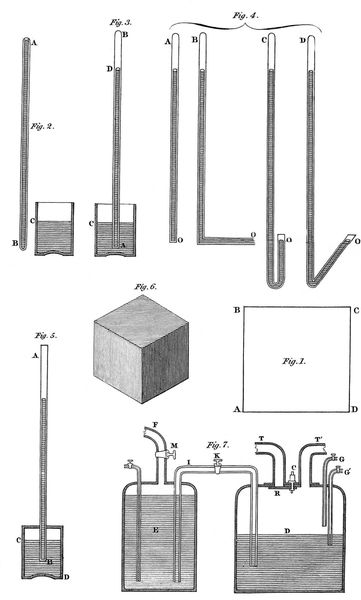
The former apparatus in Savery's engine consists of two strong boilers, sections of which are represented at D and E in fig. 7.; D the greater boiler, and E the less. The tubes T and T´ communicate with the working apparatus which we shall presently describe. A thin plate of metal R is applied closely to the top of the greater boiler D turning on a centre C, so that by moving a lever applied to the axis C on the outside of the top, the sliding plate R can be brought from the mouth of the one tube to the mouth of the other alternately. This sliding valve is called the regulator, since it is by it that the communications between the boiler and two steam vessels (hereafter described,) are alternately opened and closed, the lever which effects this being constantly wrought by the hand of the attendant.
Two gauge-pipes are represented at G, G´, the use of which is to determine the depth of water in the boiler. One G has its lower aperture a little above the proper depth, and the other G´ a little below it. Cocks are attached to the upper ends G, G´, which can be opened or closed at pleasure. The steam collected in the top of the boiler pressing on the surface of the water forces it up in the tubes G, G´, if their lower ends be immersed. Upon opening the cocks G, G´, if water be forced from them, there is too much water in the boiler, since the mouth of G is below its level. If steam issue from both there is too little water in the boiler, since the mouth of G´ is above its level. But if steam issue from G and water from G´ the water in the boiler is at its proper level. This ingenious contrivance for determining the level of the water in the boiler is the invention of Savery, and is used in many instances at the present day.
The mouth of G should be at a level of a little less than one-third of the whole depth, and the mouth of G´ at a level a little lower than one-third; for it is requisite that about two-thirds of the boiler should be kept filled with water. The tube I forms a communication between the greater boiler D and the lesser or feeding boiler E, descending nearly to the bottom of it. This communication can be opened and closed at pleasure by the cock K. A gauge pipe is inserted similar to G, G´, but extending nearly to the bottom. From this boiler a tube F extends which is continued to a cistern C (fig. 8.) and a cock is placed at M which, when opened, allows the water from the cistern to flow into the feeding boiler E, and which is closed when that boiler is filled. The manner in which this cistern is supplied will be described hereafter.
Let us now suppose that the principal boiler is filled to the level between the gauge-pipes, and that the subsidiary boiler is nearly full of water, the cock K and the gauge cocks G, G´ being all closed. The fire being lighted beneath D and the water boiled, steam is produced and is transmitted through one or other of the tubes T T´, to the working apparatus. When evaporation has reduced the water in D below the level of G´ it will be necessary to replenish the boiler D. This is effected thus. A fire being lighted beneath the feeding boiler E, steam is produced in it above the surface of the water, which having no escape presses on the surface so as to force it up in the pipe I. The cock K being then opened, the boiling water is forced into the principal boiler D, into which it is allowed to flow until water issues from the gauge cock G´. When this takes place, the cock K is closed, and the fire removed from E until the great boiler again wants replenishing. When the feeding boiler E has been exhausted, it is replenished from the cistern C (fig. 8.) through the pipe F by opening the cock M.
(32.) We shall now describe the working apparatus in which the steam is used as a moving power.
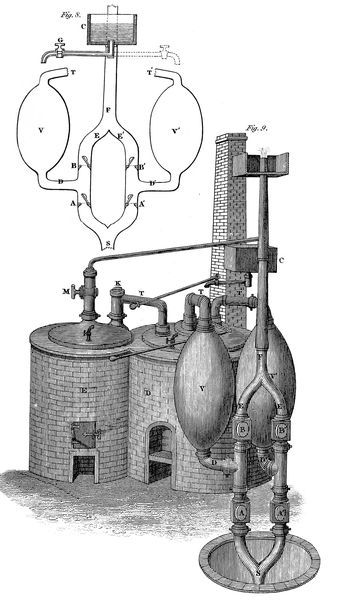
Let V V´ (fig. 8.) be two steam vessels communicating by the tubes T T´ (marked by the same letters in fig. 7.) with the greater boiler D.
The communication of the pipes T T´ with the boiler can be opened and closed, alternately, by the regulator R, (fig. 7.) already described.
Now suppose the steam vessels and tubes to be all filled with common atmospheric air, and that the regulator be placed so that the communication between the tube T and the boiler be opened, the communication between the other tube T´ and the boiler being closed, steam will flow into V through T. At first, while the vessel V is cold, the steam will be condensed and will fall in drops of water on the bottom and sides of the vessel. The continued supply of steam from the boiler will at length impart such a degree of heat to the vessel V that it will cease to condense it. Mixed with the heated air contained in the vessel V, it will have an elastic force greater than the atmospheric pressure, and will therefore force open the valve B, through which a mixture of air and steam will be driven until all the air in the vessel V will have passed out, and it will contain nothing but the pure vapour of water.
Let us now suppose that, by shifting the regulator, the communication is opened between T and the boiler, so that steam flows again into V. The condensing cock G being removed, the vessel will be again heated as before, the air expelled, and its place filled by the steam. The condensing pipe being again allowed to play upon the vessel V, and the further supply of steam being stopped, a vacuum will be produced in V, and the atmospheric pressure on L will force the water through the valve A into the vessel V, which it will nearly fill, a small quantity of air, however, remaining above it.
The further admission of steam through T is once more stopped by moving the regulator; and the condensing pipe being again allowed to play on V, so as to condense the steam which fills it, produces a vacuum. Into this vacuum, as before, the atmospheric pressure on L will force the water, and fill the vessel V. The condensing pipe being then closed and steam admitted through T, the water in V will be forced by its pressure through the valve B and tube E into F, and so the process is continued.
We have not yet noticed the other steam vessel V´, which as far as we have described, would have remained filled with common atmospheric air, the pressure of which, on the valve A´, would have prevented the water raised in the suction pipe S from passing through it. However, this is not the case; for, during the entire process which has been described in V, similar effects have been produced in V´, which we have only omitted to notice, to avoid the confusion which the two processes might produce. It will be remembered, that after the steam, in the first instance, having flowed from the boiler through T, has blown the air out of V through B, the communication between T and the boiler is closed. Now the same motion of the regulator which closes this opens the communication between T´ and the boiler; for the sliding plate R (fig. 7.) is moved from the one tube to the other, and at the same time, as we have already stated, the condensing pipe is brought to play on V. While, therefore, a vacuum is being formed in V by condensation, the steam, flowing through T´, blows out the air through B´, as already described in the other vessel V; and, while the air in S is rushing up through A into V followed by the water raised in S by the atmospheric pressure on L, the vessel V´ is being filled with steam, and the air is completely expelled from it.
The communication between T and the boiler is now again opened, and the communication between T´ and the boiler closed by moving the regulator R (fig. 7.) from the tube T to T´; at the same time the condensing pipe is removed from over V and brought to play upon V´. While the steam once more expels the air from V through B, a vacuum is formed by condensation in V´, into which the water in S rushes through the valve A´. In the mean time V is again filled with steam. The communication between T and the boiler is now closed, and that between T´ and the boiler is opened, and the condensing pipe removed from V´ and brought to play on V. While the steam from the boiler forces the water in V´ through B´ into the force-pipe F, a vacuum is being produced in V into which water is raised by the atmospheric pressure at L.
Thus each of the vessels V V´ is alternately filled from S and the water thence forced into F. The same steam which forces the water from the vessels into F, having done its duty, is condensed, and brings up the water from S by giving effect to the atmospheric pressure.
During this process, two alternate motions or adjustments must be constantly made; the communication between T and the boiler must be opened, and that between T´ and the boiler closed, which is done by one motion of the regulator. The condensing pipe at the same time must be brought from V to play on V´ which is done by the lever placed upon it. Again the communication between T´ and the boiler is to be opened, and that between T and the boiler closed; this is done by moving back the regulator. The condensing pipe is brought from V´ to V by moving back the other lever, and so on alternately.
(33.) In order duly to appreciate the value of improvements, it is necessary first to perceive the defects which these improvements are designed to remove. Savery's steam engine, considering how little was known of the value and properties of steam, and how low the general standard of mechanical knowledge was in his day, is certainly highly creditable to his genius. Nevertheless it had very considerable defects, and was finally found to be inefficient for the most important purposes to which he proposed applying it.
At the time of this invention, the mines in England had greatly increased in depth, and the process of draining them had become both expensive and difficult; so much so, that it was found in many instances that their produce did not cover the cost of working them. The drainage of these mines was the most important purpose to which Savery proposed to apply his steam engine.
It has been already stated, that the pressure of the atmosphere amounts to about 15 lbs. (3.) on every square inch. Now, a column of water, whose base is one square inch, and whose height is 34 feet, weighs about 15lbs. If we suppose that a perfect vacuum were produced in the steam-vessels V V´ (fig. 8.) by condensation, the atmospheric pressure on L would fail to force up the water, if the height of the top of these vessels exceeded 34 feet. It is plain, therefore, that the engine cannot be more than 34 feet above the water which it is intended to elevate. But in fact it cannot be so much; for the vacuum produced in the steam-vessels V V´ is never perfect. Water, when not submitted to the pressure of the atmosphere, will vaporise at a very low temperature (17.); and it was found that a vapour possessing a considerable elasticity would, notwithstanding the condensation, remain in the vessels V V´ and the pipe S, and would oppose the ascent of the water. In consequence of this, it was found that the engine could never be placed with practical advantage at a greater height than 26 feet above the level of the water to be raised.
(34.) When the water is elevated to the engine, and the steam-vessels filled, if steam be introduced above the water in V, it must first balance the atmospheric pressure, before it can force the water through the valve B. Here, then, is a mechanical pressure of 15lbs. per square inch expended, without any water being raised by it. If steam of twice that elastic force be used, it will elevate a column in F of 34 feet in height; and if steam of triple the force be used, it will raise a column of 68 feet high, which, added to 26 feet raised by the atmosphere, gives a total lift of 94 feet.
In effecting this, steam of a pressure equal to three times that of the atmosphere acts on the inner surface of the vessels V V´. One third of this bursting of the pressure is balanced by the pressure of the atmosphere on the external surface of the vessels; but an effective pressure of 30lbs. per square inch still remains, tending to burst the vessels. It was found, that the apparatus could not be constructed to bear more than this with safety; and, therefore, in practice the lift of such an engine was limited to about 90 perpendicular feet. In order to raise the water from the bottom of the mine by these engines, therefore, it was necessary to place one at every 90 feet of the depth; so that the water raised by one through the first 90 feet should be received in a reservoir, from which it was to be elevated the next 90 feet by another, and so on.
Besides this, it was found that sufficient strength could not be given to those engines, if constructed upon a large scale. They were, therefore, necessarily very limited in their dimensions, and were incapable of raising the water with sufficient speed. Hence arose a necessity for several engines at each level, which greatly enhanced the expense.
(35.) These, however, were not the only defects of Savery's engines. The consumption of fuel was enormous, the proportion of heat wasted being much more than what was used in either forcing up the water, or producing a vacuum. This will be very easily understood by attending to the process of working the engine already described.
When the steam is first introduced from the boiler into the steam-vessels V V´, preparatory to the formation of a vacuum, it is necessary that it should heat these vessels up to the temperature of the steam itself; for until then the steam will be condensed the moment it enters the vessel by the cool surface. All this heat, therefore, spent in raising the temperature of the steam vessels is wasted. Again, when the water has ascended and filled the vessels V V´, and steam is introduced to force this water through B B´ into F, it is immediately condensed by the cold surface in V V´, and does not begin to act until a quantity of hot water, formed by condensed steam, is collected on the surface of the cold water which fills the vessel V V´. Hence another source of the waste of heat arises.
When the steam begins to act upon the surface of the water in V V´, and to force it down, the cold surface of the vessel is gradually exposed to the steam, and must be heated while the steam continues its action; and when the water has been forced out of the vessel, the vessel itself has been heated to the temperature of the steam which fills it, all which heat is dissipated by the subsequent process of condensation. It must thus be evident that the steam used in forcing up the water in F, and in producing a vacuum, bears a very small proportion indeed to what is consumed in heating the apparatus after condensation.
Pl. I.
(36.) There is also another circumstance which increases the consumption of fuel. The water must be forced through b, not only against the atmospheric pressure, but also against a column of 68 feet of water. Steam is therefore required of a pressure of 45lbs. on the square inch. Consequently the water in the boiler must be boiled under this pressure. That this should take place, it is necessary that the water should be raised to a temperature considerably above 212° (17.), even so high as 267°; and thus an increased heat must be given to the boiler. Independently of the other defects, this intense heat weakened and gradually destroyed the apparatus.
Besides the drainage of mines, Savery proposed to apply his steam engine to a variety of other purposes; such as supplying cities with water, forming ornamental waterworks in pleasure grounds, turning mills, &c.
Savery was the first who suggested the method of expressing the power of an engine with reference to that of horses. In this comparison, however, he supposed each horse to work but 8 hours a day, while the engine works for 24 hours. This method of expressing the power of steam engines will be explained hereafter.
(37.) The failure of the engines proposed by Captain Savery in the great work of drainage, from the causes which have been just mentioned and the increasing necessity for effecting this object arising from the circumstance of the large property in mines, which became every year unproductive by it, stimulated the ingenuity of mechanics to contrive some means of rendering those powers of steam exhibited in Savery's engine practically available. Among others, Thomas Newcomen, a blacksmith of Dartmouth, and John Cawley, a plumber of the same place, turned their attention to this inquiry.
Newcomen appears to have resumed the old method of raising the water from the mines by ordinary pumps, but conceived the idea of working these pumps by some moving power less expensive than that of horses. The means whereby he proposed effecting this was by connecting the end of a pump rod D (fig. 10.), by a chain, with the arch-head A of a working beam A B, playing on an axis C. The other arch-head B of this beam was connected by a chain with the rod E of a solid piston P, which moved air-tight in a cylinder F. If a vacuum be created beneath the piston P, the atmospheric pressure acting upon it will press it down with a force of 15 lbs. per square inch; and the end A of the beam being thus raised, the pump-rod D will be drawn up. If a pressure equivalent to the atmosphere be then introduced below the piston, so as to neutralize the downward pressure, the piston will be in a state of indifference as to rising or falling; and if in this case the rod D be made heavier than the piston and its rod, so as to overcome the friction, &c. it will descend, and elevate the piston again to the top of the cylinder. The vacuum being again produced, another descent of the piston, and consequent elevation of the pump-rod, will take place; and so the process may be continued.
Pl. II. SAVERY'S STEAM ENGINE
(38.) In order to accomplish this design, two things were necessary: 1. To make a speedy and effectual vacuum below the piston in the descent; and 2. To contrive a counterpoise for the atmosphere in the ascent.
The condensation of steam immediately presented itself as the most effectual means of accomplishing the former; and the elastic force of the same steam previous to condensation an obvious method of effecting the latter. Nothing now remained to carry the design into execution, but the contrivance of means for the alternate introduction and condensation of the steam; and Newcomen and Cawley were accordingly granted a patent in 1707, in which Savery was united, in consequence of the principle of condensation for which he had previously received a patent being necessary to the projected machine. We shall now describe the atmospheric engine, as first constructed by Newcomen:—
The boiler K is placed over a furnace I, the flue of which winds round it, so as to communicate heat to every part of the bottom of it. In the top, which is hemispherical, two gauge-pipes G G´ are placed, as in Savery's engine, and a puppet valve V, which opens upward, and is loaded at one pound per square inch; so that when the steam produced in the boiler exceeds the pressure of the atmosphere by more than one pound on the square inch, the valve V is lifted, and the steam escapes through it, and continues to escape until its pressure is sufficiently diminished, when the valve V again falls into its seat.
The great steam-tube is represented at S, which conducts steam from the boiler to the cylinder; and a feeding pipe T furnished with a cock, which is opened and closed at pleasure, proceeds from a cistern L to the boiler. By this pipe the boiler may be replenished from the cistern, when the gauge cock G´ indicates that the level has fallen below it. The cistern L is supplied with hot water by means which we shall presently explain.
The cold water supplied from M, having filled the space between the two cylinders, abstracts the heat from the inner one; and condensing the steam, produces a vacuum, into which the piston is immediately forced by the atmospheric pressure. Preparatory to the next descent, the water which thus fills the space between the cylinders, and which is warmed by the heat it has abstracted from the steam, must be discharged, in order to give room for a fresh supply of cold water from M. An aperture, furnished with a cock, is accordingly provided in the bottom of the cylinder, through which the water is discharged into the cistern L; and being warm, is adapted for the supply of the boiler through T, as already mentioned.
The cock R being now again opened, steam is admitted below the piston, which, as before, ascends, and the descent is again accomplished by opening the cock M, admitting cold water between the cylinders, and thereby condensing the steam below the piston.
The condensed steam, thus reduced to water, will collect in the bottom of the cylinder, and resist the descent of the piston. It is, therefore, necessary to provide an exit for it, which is done by a valve opening outwards into a tube which leads to the feeding cistern L, into which the condensed steam is driven.
That the piston should continue to be air-tight, it was necessary to keep a constant supply of water over it; this was done by a cock similar to M, which allowed water to flow from the pipe M on the piston.
(40.) Soon after the first construction of these engines, an accidental circumstance suggested to Newcomen a much better method of condensation than the effusion of cold water on the external surface of the cylinder. An engine was observed to work several strokes with unusual rapidity, and without the regular supply of the condensing water. Upon examining the piston, a hole was found in it, through which the water, which was poured on to keep it air-tight, flowed, and instantly condensed the steam under it.
On this suggestion Newcomen abandoned the external cylinder, and introduced a pipe H furnished with a cock Q into the bottom of the cylinder, so that on turning the cock the pressure of the water in the pipe H, from the level of the water in the cistern N, would force the water to rise as a jet into the cylinder, and would instantly condense the steam. This method of condensing by a jet formed a very important improvement in the engine, and is the method still used.
(41.) Having taken a general view of the parts of the atmospheric engine, let us now consider more particularly its operation.
When the steam admitted through R ceases to be condensed, it balances the atmospheric pressure above the piston, and thus permits it to be drawn to the top of the cylinder by the weight of the rod D. This ascent of the piston is also assisted by the circumstance of the steam being somewhat stronger than the atmosphere.
When the piston has reached the top, the regulating valve r is closed, and the condensing valve H opened, and another descent produced as before, and so the process is continued.
The manipulation necessary in working this engine was, therefore, the alternate opening and closing of two valves; the regulating and condensing valves. When the piston reached the top of the cylinder, the former was to be closed, and the latter opened; and, on reaching the bottom, the former was to be opened, and the latter closed.
(42.) From the imperfect attention which even an assiduous attendant could give to the management of these valves, the performance of the engines was very irregular, and the waste of fuel very great, until a boy named Humphrey Potter contrived means of making the engine work its own valves. This contrivance, although made with no other design than the indulgence of an idle disposition, nevertheless constituted a most important step in the progressive improvement of the steam-engine; for by its means, not only the irregularity arising from the negligence of attendants was avoided, but the speed of the engine was doubled.
Potter attached strings to the levers which worked the valves, and carrying these strings to the working beam, fastened them upon it in such a manner that as the beam ascended and descended, it pulled the strings so as to open and close the proper valves with the most perfect regularity and certainty. This contrivance was afterwards much improved by an engineer named Beighton, who attached to the working beam a straight beam called a plug frame, carrying pins which, in the ascent and descent of the beam, struck the levers attached to the valves, and opened and closed them exactly at the proper moment.
The engine thus improved required no other attendance except to feed the boiler occasionally by the cock T, and to attend the furnace.