Front matter
Reading edition
Cover
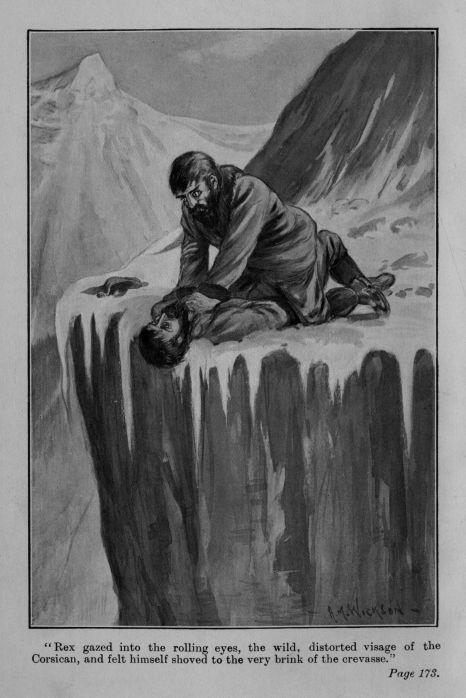
"Rex gazed into the rolling eyes, the wild, distorted visage of the Corsican, and felt himself shoved to the very brink of the crevasse." Page 173.]
THE
STAMPEDER
BY
S. A. WHITE
ILLUSTRATED
TORONTO WILLIAM BRIGGS 1910
Copyright, Canada, 1910 by William Briggs
ILLUSTRATIONS
"Rex gazed into the rolling eyes, the wild, distorted visage of the Corsican, and felt himself shoved to the very brink of the crevasse" . . . . . . . . . Frontispiece
"The two teams raced side by side, the leaders snapping at each other"
"From the Indian's extended palm the yellow flash of native gold filled Britton's startled eyes"
THE STAMPEDER
CHAPTER I.
Britton's steam-yacht tore out its lungs in protest at the black smudge of a coasting vessel reeling straight across its bows.
The siren bellowed thrice in a choking fury of warning and denunciation till the echoes boomed over the Algerian harbor and floated high up to the Mustapha Supérieure, where English lords slept at peace in luxurious hotels.
Disconcerted by this tremendous volume of sound, the coaster vacillated, veered and yawed as if under some drunken steering-hand, to leap forward unwarily and bury her weather-beaten prow in the white side of the Mottisfont.
The terrific impact swept the yacht's forecastle clear of snoring sailors, and, after shooting the temporary owner headlong from his berth, commenced to polish the companionway passage with his features, an operation which he instinctively though not wholly wakefully resented by a frantic grasping for something substantial.
The effort was rewarded when his fingers clutched the lower stairs, and Rex Britton staggered to his feet. Every light below was out, and the man so roughly aroused stood dazedly wondering if a horribly real nightmare held him in its grip.
Then, like a flash, intelligence permeated his shaken brain, and all the faculties stirred again. He remembered the grinding crash and clambered on deck in his pyjamas!
Upon the bridge loomed the figure of the captain, frantically banging at the engine-room signals, but the bell refused to sound. A medley of curses vibrated in the humid night air, emanating partly from the lower deck, and partly from the bows of the coaster as the Berber sailors gave free vent to their displeasure.
"Daniels–Captain Daniels!" roared Britton, "what the deuce is this turmoil?"
"An accident, sir," was the reply. "A coasting vessel has rammed us. I'm afraid we're badly hit; and the signals are out of business. We'll reverse in a moment if the engines are not disabled."
He waved a sailor down with the order to the engine-room. The big yacht trembled under the mighty strain and began to creep backward, inches at a time, since the nose of the other craft was tightly wedged in its vitals.
Britton was beside the captain in a moment, with a perfect stream of questions as to details and responsibility.
"The coasting steamer was entirely at fault, sir." Daniels gravely assured him. "She cut across our bow in spite of three warnings. Judging by her careening, the wheelsman was very drunk!"
An increased throbbing of the Mottisfont's engines made the whole hull shiver, and the yacht scuttled backward from the coaster like an immense crab.
"She sinks! she sinks!" rose the cry from the sailors on the poop.
"What is sinking?" cried Britton, excitedly; "not the yacht!"
"No, the coaster," said Captain Daniels. "She has no water-tight compartments."
The terrified wail of the Arab crew proclaimed the inrush of the water as the steamer listed at an alarming rate to starboard. The officers shouted orders which were smothered in the tumult, for an uncontrollable panic seized passengers and sailors. Pandemonium in its wild, selfish authority ruled on the coaster's decks, and Britton, from the bridge of the Mottisfont, could view the mad, strenuous struggle for safety. A feminine cry startled him in its piercing shrillness.
"Good heavens!" he exclaimed, "there are women there, and those brutes of Berbers will trample them to death. Quick, man! Drive the yacht in close and throw out the ropes."
Daniels instantly obeyed, observing: "It's dangerous work, sir, and she's liable to drag us down when she founders, which may be any moment now!"
"Doesn't matter," said Britton, curtly. "We're bound to help them even if this was their own doing. Have you lowered the launch?"
"Mr. Ainsworth and Mr. Trascott have it, sir."
"The smaller boats?"
"They're out, sir, trying to take some of the passengers off. Why in the name of Neptune don't they lower their own?"
The Mottisfont was larger than the steamer, and overtopped it as they drew in again. Britton leaned forward and listened to the tumult on the smaller vessel.
"I'm afraid they're fighting for their own boats," he said, quickly. "The panic's getting worse."
The hubbub was redoubled. A woman's scream, sharp and piteous, was cast despairingly on the night. Britton muttered something like an oath, and swinging down from the bridge he ran forward with all speed.
"Anyone in the turret?" he yelled to the group of sailors straining on the ropes.
"No, sir," answered the first mate. "The lookout was thrown to the deck when we struck. His shoulder is broken."
"Go up yourself," ordered Britton. "See if the searchlight works, and turn it on the coaster. We are only groping like blind men in the dark."
Turning to the second mate, he added: "Fire that brass cannon at intervals to call out the harbor boats. I see the usefulness of it after all!"
Leaving the mates to execute his orders, Britton sprang to the taffrail and vaulted at hazard down into the struggling mass of humanity that surged over the steamer's forehold. He landed squarely upon an Arab's back, knocking that swarthy individual into the lee scuppers, but without pausing to unravel the puzzling Algerian profanity which was thus elicited, Britton pushed his way aft.
He could feel the vessel rock to the roll of the water in the hold as the weight above was continually and suddenly shifted, and he knew that with one of those evolutions she would roll a little too far. There would be no recovery, and the steamer would turn turtle.
About the stern-davits a struggle raged. The forward boats were stove in with the force of the collision, and only four were left intact. The brown-skinned Berber sailors endeavored to lower them, and blue-coated officers vainly attempted to keep them back and to preserve order among the demented people.
One boat got away as Britton came up. The yacht's searchlight, pricking out of the gloom, showed the craft to be full of Arabs, while women and children were wailing in supreme terror upon the foundering vessel.
The crowd swayed to the rail as another boat was slung from the davits. Rex grasped the arm of a man in marine uniform.
"Where's your captain?" he demanded, harshly.
"I am the captain," said the man, helplessly; "but what can I do? The passengers have gone mad! The Berbers are beasts!"
Britton flung aside the arm he had seized with a gesture of repulsion.
"Do?" he cried, in fine scorn. "You might at least try! You act like a baby. This rush must be stopped–"
Boom! rang the Mottisfont's cannon. Its message reverberated like hollow thunder over the great bay. Two score whistles rose in answer from the inner reaches of the harbor.
Boom! The whistles shrieked anew, and the riding lights of the vessels plunged into activity.
"You hear!" exclaimed Britton. "If that rush isn't stopped half of those on board will be drowned by the swamping of the boats, with a hundred harbor craft coming to the rescue. Come on, sir–be a man!"
Rex took hold of a heavy piece of broken stanchion and made a flying leap into the knot of Berbers stamping about the stern davits.
"Back, men!" he shouted in a voice that soared above every other noise. "Be calm! There'll be a hundred boats here in a minute, with room for all of you. Let the women forward at once!"
A female figure sprang to the davits at his words, but the Arabs roared their dissent and charged in a body. Britton had a vision of a girlish form with an ethereal face and pale-gold hair, tossed rudely in the rush of men. She lost her footing suddenly and went down with a suppressed scream.
Snarling like an enraged animal, Rex leaped in front of them.
Crack! sounded his stanchion on the foremost head. Crack! crack! He pierced their ranks and dragged out the luckless woman. Shielding her with one arm, he was carried back against the ship's side by the pressure of the frantic throng.
"Are you hurt?" he found time to whisper.
"No–only frightened," she sobbed. The nervous strain was too much for her.
Britton made her kneel down under the rail behind him, and, with his legs protecting her from the trampling, he faced the angry Arabs again.
They had hesitated a little, daunted by the impetuosity of his attack. The Englishman's blood was now thoroughly aroused. Away back in his line of ancestors there had been knights of the old regime; there were soldiers of the empire among the later generations; and his grandfather had fallen at Waterloo. The fighting, bulldog strain was in him, and only sufficient baiting was required to bring it into evidence!
Boom! sounded the Mottisfont's cannon for the third time. Across the mysterious stretch of bay the shout of rowers answered.
"They're coming!" exclaimed Britton, triumphantly. "You pack of fools, have you no sense?"
A growl was the reply. Whether fear had driven out their understanding, or whether the rough fellows were actuated by a desire of revenge for the blows inflicted by the Englishman, they rushed upon him once more.
"Ah! you will have it, will you?" he cried, exulting in the mere thrill of battle. "Then lay on, you rabble!"
He stood in the central focus of the steam-yacht's searchlight, with muscle action unhampered and with bare feet gripping the deck firmly, while his enemies strove to reach him. His stanchion rose and fell like a flash as he circled in and out, avoiding the blows of his adversaries, and every time he struck a man went down. Once a sinewed Moroccan locked with him, and he felt the sting of steel in his shoulder, but a jolt on the fellow's neck from Britton's other arm stretched him senseless, while the knife clattered over the rail into the sea.
Crack! crack! The sound of his club grew monotonous; the soft, warm trickle of something down his left shoulder filled him with a strange disgust for the combat; he felt ashamed of himself standing in pyjamas on the lighted deck of another ship and striking down Berbers with a stanchion.
Since it was wholly necessary, the Englishman wondered at the sense of shame. Perhaps it was an odd trick which the wounded nerves in his arm were playing him.
Only three or four Arabs opposed Britton now. He ran at them with hands placed wide on his stanchion, like a wand, and swept them aside. The captain of the steamer stepped through into the cleared space on the after-deck.
"Give your orders," said Britton, with a sigh of relief.
He turned to the woman by the rail and raised her up as the feminine contingent was passed to the side and lowered into the harbor boats which were already alongside.
"You may enter one of them now," he said, marvelling vaguely at her perfect face. She touched his arm with a movement of gratitude, but her fingers came away wet and sticky.
"Someone slashed you!" she exclaimed in concern. "Let me see. Oh, let me bandage it. And I was the cause of your wound!"
"It is only a flesh wound–" began Britton.
"Madam, the boat!" interrupted the anxious captain.
"I'll wait," answered the woman. "This man is wounded–the man who saved all of us. Can't you do something? See! he's weak!"
She gave an alarmed cry as the Englishman staggered. He saved himself by clutching the rail.
"It must–have been those–those circles I cut among the rascals," he laughed unsteadily. "They make me dizzy."
"You're evading," she said quickly; "it's the Berber's knife."
With a strong effort Britton summoned his will-power to control his weakened nerves, and roughly dashed a hand across his eyes. It was with a great sensation of relief that he felt his returning steadiness of muscle, and he glanced at the rope ladders which filled the waiting boats with fleeing people.
"We had better be getting down," he advised. "The steamer will not float long."
Even as he spoke, the coaster lurched alarmingly. Rex grasped the woman's arm and drew her quickly to the rail.
A thrown rope whipped his cheek, and he caught it skilfully, peering below at a small boat which swayed to the roll of the steamer.
"For God's sake, Britton, come off that old hulk," shouted someone. "She's sinking fast!"
Rex looked downward with the pleased expression on his own face contrasting strangely with the anxious countenances of the two occupants of the launch.
"It's my friends, Ainsworth and Trascott, from the yacht," he explained to the woman at his side.
"I was beginning to wonder why they hadn't showed up. You see they must have been out before I awakened, for they had taken the launch to the rescue."
"Come off!" commanded Ainsworth, peremptorily. "Can't you see you're last, you two mooning fools? The old coffin will drop in a minute."
They could hear Trascott's mild protest at Ainsworth's trenchant phrasing of the situation, and Britton laughed.
"Trascott's a curate," he said, disengaging a rope ladder for their own use, "a very orthodox, English curate! Sometimes he doesn't approve of his friend's strenuous speech. You'll have to overlook it, though. Ainsworth is a lawyer, and he thinks he has us in the witness-box."
They were descending the rope-ladder as he spoke, the lady going first, and Cyril Ainsworth heard the last part of his host's comment.
"It's no witness-box you're in, Britton," he growled. "It's a bally old tub, and you needn't think because you're dressed in beautiful, silk pyjamas that you must stay there till you have to swim. If I were the lady, I would vigorously object to getting wet."
Ainsworth emphasized his tirade with a swift revolution of the engine-crank. The curate cast off the rope, and they puffed away from the water-logged vessel. Gleaming white against the inky color of her side was the nameplate–Constantine.
Britton pulled an overcoat and a pair of sea-boots from a locker and put them on.
"That's better," grunted the lawyer. "You don't look so much like a posing matinee idol in crimson jersey and biceps!"
Britton apparently did not hear him, being intent upon the dénouement of this harbor tragedy. Under the Mottisfont's powerful search-light everything stood out nakedly clear for rods around. The stricken vessel rolled in a last, pitiful struggle, listed too far for the recovery of her equilibrium, turned turtle and sank like a stone.
"There's the end of incompetence," rasped Ainsworth, while the lady beside Britton gave a sympathetic cry, and the fleet of boats flying from the vortex peril with their human cargoes echoed in choruses of dismay.
"Had you friends?" Britton asked of the woman.
"No,–only my maid and baggage," she answered. "My name is Morris, Maud Morris–and I was travelling alone."
"To Algiers?"
"Yes, to Algiers–at least temporarily."
"Then the inconvenience is not considerable," Britton said. "We will go on board the yacht, and I can find your maid in the morning."
"Ah! you are too generous," murmured the lady. "You have already done more than a woman can repay, and I have not even attended to your wound. Does it pain much?"
"Very little," replied Britton, lightly. "I believe I shall hold you to your promise to bandage it, and I believe it will get well very soon."
She laughed a low, sweet laugh which harmonized with her pale beauty, and Britton felt some unexplained fascination as her green-blue eyes held his.
The launch bumped the Mottisfont's side abaft of the great hole which the Constantine's prow had torn. The occupants surveyed the black, yawning break somewhat ruefully before they stepped on deck.
"What the deuce will the Honorable Oliver Britton say when he finds his nephew has smashed up his floating palace?" asked Ainsworth, meditatively.
"My honorable uncle will never see it till it is restored to its original state," Rex answered. "And the Moroccan Steamship Company, owners of the Constantine, will pay for the restoration."
"What a legal beacon you might have been!" sighed Cyril, generously. "But this pin-scratch they gave you in the arm!––who pays the doctor-bill?"
"That is my affair," said the lady of the adventure, very sweetly, "and it is time it was given attention." She took Britton's sleeve and drew him to the companionway. There Rex paused and hailed the bridge.
"Daniels, get us in close to the eastern jetty at once and anchor there. We don't know how badly we're damaged, so moor right under it."
"Aye, aye, sir," the captain answered.
"And send me the steward," Britton added.
"Here he is, sir! Bannon, go forward."
The portly form of the steward joined the two by the stairs.
"Bannon, have your wife prepare a stateroom for Miss Morris at once," said Britton, "and bring us some linen strips for bandages."
"You're hurt, sir?" said the steward.
"Only scratched! Water and linen is all I want."
Bannon brought it as directed, and having given the simple necessaries to the lady, Britton dived below to reappear some minutes later in yachting trousers, shirt and shoes, with his left sleeve rolled up to the shoulder and his duck coat on his other arm. He had washed the knife-wound while in his bath-room, but it bled afresh, and the lady hastened to staunch it.
Trascott assisted her by the use of much cold water. When the flow of blood was stopped, she called into requisition some healing ointment which Bannon had brought on his own authority and then bound the limb neatly with linen. There was something exquisite in the sensation for Britton. The soft touch of her fingers, the near fragrance of her person and the electric glow of awakened sympathy combined to influence him and awake strange thrills to which he was not at all subject.
She felt the throb of his pulse as she held his wrist down to straighten the bandage, and the knowledge of its origin flushed her cheek. An instant she looked up at him inquiringly, almost with the spirit of challenge, but her lashes drooped under the tensity of his glance.
Virility was Britton's most salient attribute. When the man in him was stirred, it moved strongly, and the proximity of so fair a vision would have excited a less impressionable person, one with less of Britton's youthful and unbounded faith in women!
The steward disappeared about his business. Trascott and Ainsworth loitered away. Britton and the woman were left alone with that magnetic bond of touch binding them. With the man, the impression lasted for many a day! A new, uncurbed power was loosed within him, and the woman felt the trend of its might. It thrilled and awed at the same time. She shifted her hands to a final arrangement of the bandage.
"I think it will do," she murmured in a confused way.
Britton shook himself out of a wild dream, slowly fastened his shirt-sleeve and donned his coat.
"We will go below," he said, taking her arm and guiding her down the companionway. The stewardess met them in the passage and led the way to the stateroom she had prepared, disappearing therein.
"Good-night," she said, extending both hands. "I haven't found much opportunity to thank you. To-morrow I shall tell you more."
Britton took her fingers, and the mad blood leaped in his veins again.
"To-morrow," he cried gladly. "Ah! yes, there are many to-morrows, for you stay at Algiers."
"Many to-morrows!" she exclaimed with a happy laugh, as she turned into the stateroom. "That is a sweet way of putting it. Many to-morrows!–I like that idea."
CHAPTER II.
"It's hell,–isn't it, Trascott?" asked Ainsworth, dismally.
"My dear fellow," protested the shocked curate, "such liberty of expression, to put it mildly–"
"Fudge!" interrupted his friend. "You divines all agree as to the existence of an infernal region. Why shouldn't I introduce a comparison if I choose? If you don't like its rugged exterior you can at least appreciate the sentiment. It's hell–isn't it?"
"Well, well, it's decidedly unpleasant," grumbled Trascott.
"It's a bally shame!" said the lawyer, tritely. "Britton takes us away on his uncle's yacht for a cruise of the African shore of the Mediterranean. Witness our cruise! We get as far as Algiers and there his two long-suffering comrades have to stagnate while he plays the gallant to a blonde will-o'-the-wisp whom he made a show of rescuing. He found her maid, installed her at the Hotel de ––, attended to her remittances from England in her stranded position and played the modern hero role to a triple curtain call–which he is certainly getting!"
"Of course the yacht had to be repaired," put in Trascott, as if it was his kindly duty to find some extenuation.
"Of course!" echoed Ainsworth sarcastically, waving a hand to where the Mottisfont, quite intact, rode proudly at anchor.
The two men were standing on the harbor piers above the landing-stages, and they had a good view of the vessel. Behind them the capital of Algeria rose precipitously up the sides of an immense hill a mile in length at the base by five hundred feet in height. The foot of the picturesque city was the sprawling sea; the head was the Casbah, the ancient fortress of the Deys. Up on the hill reposed the old or high town with its quaint Moorish edifices, while sloping below to the rim of the port lay the lower, new, or French town filled with government buildings, squares and streets, together with lines of warehouses and wharves, dotted here and there by mosques that looked strangely out of place amid the European architecture.
Blocked out against the harbor water from their conspicuous stand, the two friends were very dissimilar in appearance. Ainsworth's was the short, squat figure, Trascott's the tall, lanky one. The lawyer, in spite of the disadvantage of height, probably weighed more than the curate. His stockily-built body filled out his gray tweeds, while the black garments of Trascott hung loosely on his hollow frame. A gray cap of the same material as his suit was jauntily perched on the lawyer's head, but his companion wore the familiar and inevitable round, dark hat.
Still, if Trascott's form lost dignity beside Ainsworth's, that dignity was more than regained when it came to a comparison of faces. The lawyer had a gray-eyed, regular countenance, smooth and unmarked by any dissipation, but it lacked the shading that beautified his friend's. The curate's features, though more rugged in casting, had the high lights of earnestness glowing in his brown eyes, the deeper tones of endeavor blending in the moulding of the chin, while the shadows of responsibility rested in the firm curve of his lips.
Cyril Ainsworth, with his unchanging mask of precision, was the keen, well-oiled machine which cut straight to the core of things in the performance of its work. Bertrand Trascott was the living actor of a great belief, the exponent of a mighty drama calculated to uplift and regenerate his fellow-beings. Each had his part in the work of the present-day world, and, strange to say, men loved the machine-like precision of Ainsworth almost as well as the generous heart of Trascott.
The lawyer again called the curate's attention to the yacht with another motion of his hand.
"The yacht had to be repaired," he snapped. "It took three days to splice the timbers and rivet the plates. We should then have proceeded with our cruise. There was no impediment, for the steamship company settled the damages in full. Yet here we have been for two weeks–and so has the woman! At this rate we may be here for two months–and so may the woman!"
They sat down upon the piers for their after-supper smoke, having fared sumptuously on board the Mottisfont, in an effort to reconcile themselves to the inertia under which they chafed. The soft dusk began to glide in from the sea and enfold the dark wharves in misty wreaths. One by one the riding lanterns of the harbor vessels shone out like stars in a fog, and the rhythm of an Arab sailor song came swelling over the broad bay.
The two friends smoked in silence as the dusk grew deeper. Presently the beacon light flashed up on Matifou ten miles away, sending out its nightly warning to the ships at sea. A thousand lamps flared in the lower town, and far up the hill the boulevard lanterns starred the gloom with their fiery eyes.
"Can you tell me the space of time an Algerian romance requires?" asked Ainsworth, finally.
Trascott's cheery laugh was the only answer.
"In England," the lawyer mused, "I would give them six weeks. In this southern climate, where the blood runs hot, the climax must come in less time, but just how long only Britton knows."
Trascott tapped his pipe upon the pier, refilled it and settled back with a sigh.
"Do you think this affair is really serious?" he asked, with a certain earnestness and anxiety.
"Serious!" Ainsworth snorted, "it's the most serious thing that ever happened him. Do you understand Britton's disposition? He's a whole-hearted fellow full of generous and chivalric impulses, with a belief in the goodness of all the feminine sex. He has run against nothing to knock those notions into chaos. Do you think he can view that fine-looking woman unmoved? Do you think that she is going to pass by Reginald Britton, the heir to Britton Hall and old Oliver's estates? Not if I know anything, Trascott! And mark me, I don't like the woman. She's fair enough for a lord–but I don't like her. Please remember that, Trascott."
The curate started, for he had earlier confessed to himself a similar dislike of the blonde beauty who had taken the yacht and Britton and the port itself, as well as the great English hotels, by storm. However, he was too fair-minded not to combat such an antipathy so far unwarranted.
"Why do you not like her?" he asked, seeking perhaps in Ainsworth's attitude a solution of his own state of mind.
"Intuition, I suppose," the lawyer answered gruffly. "When I see a lady travelling alone, except for her maid, coming apparently from nowhere and heading for a destination wholly indefinite, I always regard her with suspicion. What has Britton learned about this woman? He knows her name is Maud Morris. He knows she can madden him with those eyes and lips. That is the extent of his knowledge. Does he know her home, her county, her family, her support? No! I have questioned Britton, not to mention warning him–"
"You have!" exclaimed the curate, "and what did he say?"
"Told me to go to that infernal region I mentioned. He can't listen to sound reason. They never can!"
"Ah, well," sighed Trascott, "I intended dropping a hint, but since you've anticipated me without result–"
"Might as well talk to a log!" Ainsworth cut in. "I shall be glad when the thing has run its course and we get out of here. This Algerian scenery palls on me! If something would only happen to hasten the climax, it might cheer my heart. I believe I shall hire some dogs of Arabs to abduct the fair princess and let Britton play the rescuer somewhere out on the Djujuras."
"It may not be necessary," said Trascott. "He's going to that dance to-night."
"Yes," muttered the lawyer, "he's been dressing and fussing ever since supper. There's the launch now!"
The gasoline craft spluttered and danced over the waves to the pier where Ainsworth and the curate were smoking.
"You lazy duffers," Britton cried, "aren't you going up?"
He stepped out of the launch, a tall, handsome figure in his evening clothes and top-hat. His paletot hung on his left arm, which was now entirely well, and as he faced his friends they both thought how singularly powerful he looked. Broad of shoulder and deep of chest, it seemed as if the frames of the other two men together would have been required to equal his bulk. His straight, finely-cut features and blue eyes held an expression unmistakably aristocratic.
"Aren't you going up?" he repeated.
"We'll look into the reading-room later on," replied Ainsworth. "I don't care to dance, and it disagrees with Trascott's digestion."
"See you there, then," was his farewell. "Don't forget you can get all you want to eat in the dining-room for the sum of six francs."
A fiacre pulled up near the wharf at his hail.
"Hotel de ––," he said, jumping in with an object-lesson of alacrity.
The driver accepted the hint and dashed away at a swift pace through the lower town till the long ascent which led up to Mustapha Supérieure compelled him to walk his animal.
The last two weeks had passed for Rex Britton as a single day. Not a minute of the whole time dragged, for the reason that he had spent every available minute with Maud Morris. He considered the sojourn, which he had lengthened day by day, as Paradise–the direct antithesis, in fact, of Ainsworth's view! He had pursued the wild dream of that first night on the harbor with all his passionate persistence till it suddenly ensnared him in its tangible and compelling reality.
The lawyer back on the pier was wishing for something to hasten the climax. In spite of his faculty of shrewd observation, Ainsworth did not dream of how deeply Britton was already involved with the woman whom he, Ainsworth, mistrusted.
It would take a wise man indeed to time and trace the development of a romance when the setting lies between the pagan Djujuras and the legend-steeped Mediterranean. Britton would have been filled with dismay had he stopped to inspect, analyze and adjudge his actions during those two weeks. His impulses were at riot under the sway of a heavenly elixir which the woman held to his lips; he never looked back; his mind was centred on the days ahead, planning a wonderful permanency for the exotic, filmy atmosphere of present experiences.
As the fiacre climbed the Mustapha Supérieure Britton could possess in vision the whole expanse of the port, the wharves dimly lighted and busy with the night-labor that the volume of trade enforced, the illuminated vessels in the wide anchorage and the mingling gleams that marked the Mustapha Inférieure.
Britton knew every nook of the climbing city, old, by almost a thousand years, in story and conflict. With the lady of pale-gold beauty he had explored all the charming retreats of both towns. They had loitered in the Place Royale amid the orange and lime trees, finding pleasure in watching the cosmopolitan crowds which thronged that oblong space in the centre of the city. The traits of character disclosed by representatives of so many different nations–Moors, Jews and Arabs, Germans, Spaniards, French, Corsicans, Italians and Maltese, and scores of other races–proved very interesting to the English observers.
The mild, balmy Algerian evenings seemed temptations to roam abroad, and the two had grown accustomed to promenade the Bab-el-Ouad and the Bab-azoun, which ran north and south in a parallel direction for half a mile. Those walks down the dim vista of flanking colonnades beneath an ivory moon, the same that lighted the Sahara caravans through the desert tracts, intoxicated senses and blood alike.
They had delved into the djamas, or superior mosques, the mesjids, or inferior ones, and the marabouts, which were the tombs or sanctuaries of the ancient Moorish saints; they had plunged into the market rabbles on the Squares de Chartres, d'Isly and Mahon, lolled in the Parisian-like boulevards and arcades of the new town, sat upon the flat-roofed, prison-windowed houses at sunset to catch the tang of the sweeping sea-wind on their faces, journeyed in the yacht as far as the lighthouse on Cape Matifou and the forbidding brow of Cape Caxine, or stretched their land-legs in the ascent of the narrow, jagged street called the Casbah that led up to the old Moorish fortress of the same name perched high on the steep, and commanding all Algiers.
Standing on the height of the Mustapha Supérieure where the fiacre had left him in front of the hotel piazza, Britton felt as if under some binding spell which the land of the sheik had cast upon him, a spell from which he would not willingly escape, for the delicious, cobwebby fetters only thrilled instead of chafing.
Dismissing his driver with a liberal fee, Britton ran lightly up the steps of the magnificent hostelry, resplendent with blazing lights and ornate structural patterns designed to rival the architectural beauties of the other fashionable resorts that contested for the patronage of the most select people who came to stay at Algiers.
The obsequious concierge, stationed in the hall to look after new-comers, directed a servant to appropriate Britton's coat and hat and bowed the Englishman toward the reception-room with a flood of welcoming French.
The reception-room–which some took the liberty of calling the morning-room–was a cosy, oak-panelled, damask-hung chamber where hotel inmates and visitors could meet or wait for friends. It gave one the impression of being very well appointed with rugs, round tables, leather-covered chairs, cushioned divans, pictures, mantels and window-seats.
At Britton's entrance the solitary occupant of the reception-room rose from a divan. She came forward with a glad, excited light beautifying her face, the filmy, silver-colored gown she wore sweeping gracefully about her slim, exquisite figure.
Quite close to Britton she paused and took hold of the lapels of his coat, smoothing them with her soft white fingers.
Had the lawyer been there to see, this action would have settled once for all the question of Britton's relation to Maud Morris. In her movement was the suggestion of intimate possession never to be mistaken for anything else. It told more than could be expressed in whole chapters of explanation.
"The dance has begun," she murmured, looking up, her eyes soft and shining beneath the burnished gold of her hair, "and everybody has gone either to take part or to watch. You are somewhat late, aren't you?"
"Yes, I am late," Britton said softly–"later than I thought, but I am glad, for my tardiness lets me meet you like this!" He nodded around the empty room.
She smiled into Britton's dancing eyes. He laid his hands gently upon hers, and the touch brought the delicate rose to her cheek, but the concierge's rapid French jabber warned them. Someone was approaching the reception-room. She slipped a hand in Britton's arm and turned to the door.
"Let us go to the concert-room," she said simply.
Britton bowed courteously as an attaché from the British Consulate entered with a party of ladies, and they went out amid the customary admiring stares.
They passed the rooms whence came the rattle of ping-pong, the whirr of billiards or the almost noiseless shuffle of bridge, and finally came to the ballroom. A ravishing Hungarian waltz swelled up from the palm screens which hid the orchestra; a hundred couples tripped the glassy floor-space, the conventional black-and-white attire of the gentlemen lending an effective contrast to the wonderful, daring toilettes of the ladies.
Everybody portrayed supreme happiness as well as a nice consciousness of what was correct, and everybody seemed to be trying to outdo everyone else in the ardor of enjoyment.
Not least by any means among the joy-seekers was Rex Britton.
His arm encircled his companion's waist and they stepped out, the handsomest couple in the room, swaying a second to the time of the orchestra. Then they glided away, captivated by the pulsating strains of the waltz, and lost themselves in the maze.
CHAPTER III.
Ainsworth shook his billiard-cue with unmistakable emphasis in the stranger's face.
"Get out," he cried irascibly. "You're drunk, and I don't want to talk to you!" He pushed his annoyer rudely away, but the latter returned to the attack, whereupon Bertrand Trascott intervened.
"Have patience, Cyril," he begged. "The man evidently has a reason for his persistence. Now, sir, what is it? We would like to go on with our game."
The stranger who had circled in to the corner-table in the billiard-room of the great hotel and stopped their play presented an uninviting and ludicrous appearance.
His head and shoulders reminded Trascott of those of a dissipated Austrian virtuoso whom he knew well and whose brilliance had become very spasmodic on account of relapses to the same vice which apparently ruled the stranger. The resemblance was quite close, embodying the uncontrolled, tremulous chin and lips surmounted by a fiercely-curled wisp of moustache, the hawked nose, narrowed eyes and prominent, bony cheeks, with a pair of puttied ears sprouting from his hair like old mushrooms in the grass, while a pinched, sunken neck failed to fill his peaked shoulders.
Trascott thought that if both the Austrian virtuoso and the portly butler who had come to be looked on as an institution at Britton Hall were cut in two, and the upper half of the virtuoso pieced to the lower, corpulent section of the Honorable Oliver's servant the result would be the prototype of the stranger who had undertaken to tack among the billiard-tables.
"What do you want?" he asked the man, with more severity.
The questioned one surveyed Trascott for a space, recognized his curate's cloth and decided he had no business with him, for his eyes flashed aggressively upon the lawyer, who was again preparing for the execution of the stroke that the man had spoiled.
Ainsworth's back was turned, so the intruder jogged his right elbow for attention with the result that the lawyer's ball, deflected at right angles, leaped across the next table and spread confusion among a group of Frenchmen playing there.
This second interruption of the stringing of a long break and the titter of idle observers, combined with the French stares of contempt, was not at all conducive to the regaining of Ainsworth's equanimity.
"By gad, sir, get out of here," he admonished, "or I'll very soon have the concierge throw you out!"
"You?" asked the stranger, with a belligerent glare.
"Exactly!" Ainsworth answered emphatically. He looked as if he would quite gladly exempt the concierge from consideration and perform the operation himself.
Trascott had been roaming the room in search of an hotel servant who could lead this obstinate fellow away; there being none about, however, he compromised on a marker and returned to the intruder.
He still concentrated his attention on the lawyer with that same belligerent glare, though in his eyes a rising flicker of apprehension betrayed the inward reflection that he had somehow caught a Tartar in this smooth-faced, perfectly-fed man with coat off and billiard-cue in hand.
"You're Britton?" he inquired in a thick, heavy voice.
"I'm nothing of the sort," the irate lawyer returned.
The stranger took a step nearer and leaned his hip against the billiard-table.
"You deny it?" he snarled vindictively. "The assistant concierge informed me that you were Britton."
Ainsworth flourished the cue in his hand suggestively.
"Then the assistant concierge is an ass, like yourself," he said. "There are two of you, and this hotel is no place for such a team."
Trascott pushed forward the marker he had procured.
"Come, monsieur," said the marker. "I think there are better places than this for you."
The stranger whirled and savagely struck away the persuading fingers with which the polite Frenchman had grasped his arm.
"Look out for yourself," he stormed, "or I'll have the manager pack you off to-morrow, my fine fellow. Let me tell you that you can't turn men of my standing into the street. I have engaged rooms and paid for them in advance, and I'll go where I d–d please in this hotel–and do what I please also!"
"No, you won't, my friend," warned Ainsworth, tapping him on the shoulder with quiet determination. "You won't come in here twice to insult me and interrupt my play. Just keep that in your muddled mind!"
"I was informed that you were a certain Britton I was searching for," said the other bluntly, in the spirit of rude apology.
"Do I look like Britton?" cried the lawyer, testily. "I stand five feet six, while Britton stands six feet one. I weigh one hundred and fifty pounds; Britton weighs two hundred and ten. Britton dances in the ballroom with the ladies and brings them ices, but I play billiards with a curate. I ask you again, do I resemble him? No, you say. And I'll tell you something else, too! Britton wouldn't have suffered your impudence for this length of time. He's a quick-blooded beggar, and he'd have jolly well twisted your neck by now."
"Will you come out, sir?" begged the marker, making a second attempt, at the importunations of Trascott.
The stranger eyed him and raised a hand as if to strike, then diverted the hand to his waistcoat pocket and threw his card on the table.
"Take that card to the manager as my complaint, and tell him to dismiss you," he said, somewhat haughtily. "I'm Christopher Morris, promoter of the Yukon Dredging Company."
The servant took the pasteboard, a little awed. Ainsworth had not caught the stranger's surname, but he snapped at the mention of his especial enterprise.
"The Yukon Dredging Company!" he exclaimed suspiciously. "If you are the promoter of that scheme, I warn you to watch out for me. I'm Ainsworth, the law-machine, and I'm convinced that the Dredging Company is a mere swindle. Be careful! I'll put the Crown after you at the very first opportunity."
The object of his censure sniffed in scorn, but Ainsworth continued:
"You invited my antagonism. Now perhaps you'll regret it. If anything angers me, it is the loss of my self-respect, and those Frenchmen took me for an idiot. But you sound decidedly out of place next the Sahara, my friend. You should be at the Arctic end of a different continent. What are you hunting in Algiers–floating capital?"
"No," was the answer. "I am hunting my wife. I arrived but an hour ago from Tangier, where the cursed doctors quarantined me for a chill which they insisted on calling fever. When after twenty days' hammering at their thick heads I convinced them of their mistake, they let me out, and I found my wife had hurried away to escape infection." He laughed, and with a cold, indignant significance intensifying his words, repeated: "Hurried away to escape infection!"
"Your wife," echoed the puzzled lawyer. "What has that to do with your offensive attitude? What has that to do with Rex Britton?"
"They tell me that in finding Britton I shall find my wife!"
Understanding rushed upon Ainsworth, and he, as well as Trascott, was stirred to fiery excitement. He shook the man roughly by the shoulder. "Your name?" he breathlessly demanded. "What did you say was your name?"
"Morris–Christopher Morris," was the answer. "My wife's name is Maud, and the devil gave her the prettiest face in England."
Ainsworth passed his hand across his forehead. His face held the first expression of dismay that the curate had ever seen there. To Trascott it was evident that the lawyer's unconcealed mistrust of the woman concerned had not extended to such an unforeseen contingency as now existed upon the statement of Morris.
The barrister was not looking at the curate and could not see the accompanying signs of extreme agitation in the latter's countenance. The former seemed to be weighing a doubtful point in his mind, and when he spoke it was as to himself in a musing, philosophical manner.
"This is either a drunken hallucination, insanity, or the truth," he said, softly. "Let us have a test!" He dropped a vesta match upon the green baize of the table.
"Pick that up," he said to Morris.
The man stared an instant and obeyed. Ainsworth watched him closely. His fingers went down with disconcerting steadiness, closed unerringly over the match and returned it to the barrister. The latter raised appealing eyes to his friend and said:
"He drinks, but he is not overly drunk now. I'm afraid it is the truth."
Trascott, his earnest face all troubled and his lips compressed in a grim line, shook his head.
"This is something like what I feared," he groaned.
CHAPTER IV.
Morris mumbled something of repeated apology and made a movement to leave the room.
Ainsworth stopped him.
"I'll find Britton," he said. "This mess has to be straightened out, and it wouldn't do for you to wander round till you meet him and raise Cain before a lot of women. I'll bring him here in a minute."
"You're kind," grunted the other, sarcastically, "but I'll wait for you."
The lawyer hastened out, peering into the different rooms in search of the man he wanted. He suspected that he would find the woman with Britton, and as he sought, unheeding acquaintances or greetings, he came upon the couple in the dining-room.
They were standing at the buffet, chatting and laughing and partaking of the six-franc supper which Britton had mentioned to his friends. The dining-hall was full, and Ainsworth hesitated at the door. He had a peculiar and intense hatred of scenes, and he knew that this company, consisting partly of bored aristocracy and partly of different gradings of the vulgar rich, was ready to stare and laugh at an unconventional act, as, for instance, the interruption of someone's luncheon.
Britton espied him at the door, and cut short his vacillation by beckoning him over, making room for him at the same time. Ainsworth approached them grimly.
"Have you not had lunch?" Britton inquired cheerily. "Come, there's room here. We'll wait for you."
"I couldn't eat a bite," said the lawyer, truthfully. "I wanted to speak to you for a moment, if you're through. That's all."
He avoided the eyes of Maud Morris and did not attempt to address her directly.
"There's the after-lunch dance, you know," objected Britton. "It's a matter of etiquette with these people."
"Can't you let it go?" asked the lawyer, sharply.
His tone awakened his friend's scrutiny. "What's the matter?" he asked. "How long do you want me?"
"It may be some time," answered Ainsworth. "I wish you would come immediately."
Maud Morris smiled full upon the lawyer and forced him to meet her glorious eyes.
"Just one round," she pleaded prettily, with a nod towards the ballroom.
At that moment Ainsworth was transformed, in his own mind, into the grim master of life. The other two were the trifling, wayward children to whom chastisement would presently come. It did not matter if, in their ignorance, they coveted those few turns together; they could have their gambols just on the eve of disillusionment! It might help the cure of Britton's malady when Ainsworth would afterwards remind him of the incident.
"By all means," he said sarcastically. "It will satisfy these sticklers."
They swept merrily into the adjacent ballroom, and Ainsworth followed as far as the entrance. The occasion struck him with a certain grim humor, and he chuckled silently as he stood in the alcove watching the couple circling to the orchestra's music.
They floated slowly, as in a delightful dream, round the immense and gorgeously-decorated salon, the woman looking upward ecstatically, with her face aquiver with light, and whispering with both lips and eyes. Britton, oblivious to the irony of the situation, had forgotten even Ainsworth. He was plunged in the joy of the moment, and the watching lawyer could imagine what words he was murmuring in the meshes of her hair.
Then, in the midst of his ironical judgment, a pang of something nearly akin to pity moved Ainsworth. For an instant he debated with himself the issue if this amour should prove genuine on both sides, but the thought was immediately dismissed by his cynical reasoning as improbable. The man was in earnest, but the woman was a siren, in Ainsworth's critical view.
One round of the ballroom floor was all the enjoyment they allowed themselves, for the lawyer significantly stepped out when they reached the entrance curtains. Britton looked at him vaguely and contracted his brows in a half-frown when he remembered.
He led the lady to a settee and bent over her for a moment.
"You will come back soon?" she whispered with a shade of wistfulness.
Britton pressed her fingers on her fan under pretence of examining it.
"Yes," he promised, glorying in the depths of her eyes, "I'll come back, not soon, but at once. Our dance isn't finished, you know."
He strode across the room, tall and elegant, and smiling over his shoulder so that the woman's heart leaped oddly as she watched him.
"Now, Ainsworth," he said, laying a hand on his comrade's arm, "what do you want with me? You'll please hurry, won't you?"
The lawyer drew Britton's arm tightly through his own and turned across the main promenade.
"That woman's married," he said with brutal directness, "and I'm taking you to her husband."
Britton whipped out his arm from Ainsworth's grasp and held it upraised, as if to deliver a blow, while a red wave of denunciation flamed over his fine features.
"You–" he began, and halted, for the grim, set look in his companion's eyes carried undeniable conviction.
"Strike me if you like," Ainsworth observed harshly, "but come this way with me."
Britton's fist fell to his side, and he drew his whole frame rigidly erect in a sort of convulsive movement. In spite of his great strength he staggered a little, and his face was ashy-white.
He turned irresolutely back towards the entrance of the dancing salon, but Ainsworth took his arm again.
"No, this way," he urged, and led him as he would a boy.
People marked his rigid muscles and pallid skin, and murmured compassionately at the apparent stroke of illness.
"Hello, old chap!" cried one of his numerous acquaintances, shouldering up, "what's wrong? Heat too much for you? By Jove, you're in a beastly funk, and I don't wonder, for it's deuced close in here."
The lawyer waved him aside, and they went on, while all the guests began to complain of heat, and the assiduous concierge ran to open wider the French casements on the lawns.
Once or twice Ainsworth looked up at his companion. Britton's pallor and tremendous calm, so suggestive of the latent volcanic powers, alarmed the lawyer.
"How do you feel?" he whispered sympathetically.
"I feel nothing–absolutely nothing," responded Britton, in a dull, passionless tone, and Ainsworth did not doubt him for a moment.
"Where is your man?" he asked after a second, in the same listless and unimpassioned voice.
"Here, in this room," Ainsworth answered, entering the billiard parlors. They skirted the tables and came where Morris stood with Trascott.
"Here is the man Morris," he announced in a measured manner. "Morris, this is Britton."
As Ainsworth spoke, he braced himself to guard against a hundred ugly possibilities which this meeting presented. He scanned the lineaments of the two men, alert to catch the nerve purpose dependent upon each one's expression, and in thus studying the features of Morris he lost sight of the latter's hands, which were thrust loosely in the pockets of his coat.
The husband's narrow eyes glittered; his lips were drawn back over his teeth in a wolfish snarl; all his capability for extreme hate seemed to be given free scope as he centred ferocious glances on the stony countenance of Rex Britton.
The other occupants of the room instinctively felt that the atmosphere held some vital and dramatic portent. They stopped their play and gazed wonderingly on the group over by the corner table.
There the two principal figures glared at each other without uttering a word, the one standing upright with set face and folded arms, the other crouching like a beast ready to spring in rage.
Ainsworth had never felt such a tense moment, even in his pleadings before tightly-packed courts of law. He was involuntarily forced to hold his breath in suspense, and a band of steel seemed to rim his chest. Trascott, with his habitual, comforting sanity, offered no speech. He recognized arbitration to be as futile as it was inconceivable. Things must run their course. Only he was ready, like Ainsworth, to guard against deadly violence following the outbreak.
For some moments Morris crouched and glared, a malicious quiver running through him. Then if any of the men had watched where his right hand was hidden they might have seen the cloth of the pocket poked forward by something cylindrical inside.
A stunning report, coming apparently from nowhere, shook the windows. Britton reeled, as a tuft of hair floated off from above his temple, and jumped like the recoil of a spring upon his would-be murderer. He dealt two sharp, quick blows before the weapon could be pulled again, and the thing was all over.
Morris lay in a quiet heap, with threads of white smoke drifting up from the powder-blackened hole in his pocket.
Britton rubbed the red welt along his scalp and nodded gravely to Ainsworth.
"You're my counsel in this matter, of course," he said. "Attend to whatever explanations are needed! Trascott, will you come with me?"
They elbowed out through the motley, clamorous, ever-increasing crowd that the pistol-shot had gathered.
"What do you mean to do?" asked the curate, anxiously.
"The hardest thing I ever did," Britton answered pitifully. "I want you, because I doubt if I can do it alone. I'm afraid of myself, Trascott!"
CHAPTER V.
They sought the concierge and met him, all flustered, coming out of the office by the side entrance on his way to the room of tumult which they had just quitted. Britton added to his cares by despatching him with a message to Maud Morris in the ballroom.
"Tell Mrs. Morris that I am waiting in her drawing-room," he said. "Ask her if she will take the elevator at once and see me on an important matter."
The concierge made expressive gestures with his hands.
"Not Madame Morris," he suggested, somewhat puzzled. "Monsieur means Mademoiselle!"
"Ah! yes, of course," returned the Englishman, quickly, "A mere slip of the tongue! My message is for Mademoiselle, for Miss Morris. You will find her on that large settee just at the entrance of the salon."
He smiled grimly at the precise classification which to-morrow would be of a different value. The ghost of the smile lingered on his lips, as, disdaining the lift, he pulled Trascott towards the stairs.
"Let us walk up," he begged. "It will give me time to think."
Trascott moved beside him automatically and left Britton to his own reflections. That, he thought, was undoubtedly the surest way to victory.
Their ascent was slow and silent, their footfalls deadening to an odd, mysterious void on the thickly-padded steps. The mounting sensation, the absence of noise from his movements, seemed to lift Britton away from himself. His personality was effaced, in the physical sense, and the basic impulses which influenced his course of existence lay bared before an inner tribunal.
The vaster issue remained with him; the moral measure applied to his strength alone; the portentous effects of the next few minutes would be essentially moulded at the dictum of his emotional tendencies. The present exigency could be neither flouted nor shunned. This difficulty of another's evolving, augmented in no small measure by his own unseeing folly, demanded immediate and decisive solution. Apology was cowardice and parley an affront to Britton's frank fibre, and both of them smacked of guilt.
The suite of rooms taken by Maud Morris was situated on the first floor just to the right of the public hall, near the landing. She had at her disposal a luxurious drawing-room, a more luxurious boudoir, and bath and sleeping apartments.
Trascott stopped at the stair-head and folded his arms, signifying his exclusion from the approaching developments.
"I don't think you will have any need of me," he ventured reassuringly.
Britton vouchsafed no reply. The swift momentary reaction he experienced did not disturb the hard, emotionless mask of his features, and the sudden, peculiarly human revolt stirred by his unsatisfied heart-hunger was crushed with a tremendous summoning of will-power.
He swiftly traversed the corridor and entered the drawing-room.
It was empty, and a poignant chagrin struck Britton, inflicting pain scarcely definable from that of humiliation and disgrace, as he realized that perhaps Maud Morris, detecting impending exposure, had suddenly clutched seclusion as a safeguard with that wanton spirit and careless indifference of the time-hardened trifler.
But Britton was wrong in this thought!
While he paced a few steps in indecision, the boudoir curtains parted, and through the soft, shaded illumination of the room Maud Morris looked out at him.
"I am waiting for you," she called, with a tremulous smile which indicated the fluttering state of her feelings, yet left the origin of that uncertainty in doubt.
If it was a bait, Britton snapped like a deluded fish. The sudden presentation of the less disagreeable side of the situation weakened his guard. He acted before he reflected, and stepped forward into the boudoir.
The tapestry fell in place behind him, and with its silken swish Britton felt the error he had unthinkingly committed. This boudoir, which enthralled with its essentially feminine appointments, was the worst place in the world for rallying stern resolutions and formulating all-embracing decisions such as Britton proposed to make. The place could only shake his sincere purpose. The drawing-room, in graver setting, would have been far safer for him!
He put a rigid curb upon his impulses, and attempted to shut out the powerful charm of low-burning rose lights, Bohemian color, and lavish decoration, but a stronger influence than these laid its hold upon him, that delicate, indefinable, alluring fragrance which is found only within woman's precincts, and which attracts mightily, like woman's love, because of its tender, subtle elusiveness.
Then, more compelling than the sense-conquering color-effect, more entrancing than the pervading perfume, was the magic of Maud Morris herself. To Britton's mind, in moments wholly calm and lucid, he thought he had never seen perfections of face and form which approached hers. Such beauty as she possessed was technically matchless, but, in general, there are intervals when fascination flags and any existing flaws in the object of admiration force attention.
When Britton was cursed with these critical flashes, as he was accustomed to inwardly express it, he could detect a lack of something–it might have been soul–behind the level splendor of her blue eyes, but if he tried to fathom these depths and define this missing attribute, the mere outward splendor, like the crystal sheen of deep, clear water, was dazzling enough to make him dizzy and engulf him, and the effort at introspection went unrewarded.
So Britton stood wrestling with the spell of environment, hurling mental refusals upon the suggestive enticement of the boudoir atmosphere and battling against the magical allurement of the woman who was the climax in the dainty sphere of exotic loveliness.
She seemed framed in the shell of the room as if it had been especially designed to harmonize with her charms. Her pale, silver-colored gown swept about her feet, leaving her figure in a contour of marvellous grace; the arms and bosom, full and rounded, came out from it, white as ivory; her face, beautiful as a rare orchid, with the crowning glory of her hair above, was one to weaken a strong man.
Harassed by a flood of doubts and regrets, Britton gazed at her with wide, darkened eyes, the shame of his position vying in torture with the pang of his loss. He had come to judge, to condemn and to scorn, but his capacity for this was submerged in painful realization of the black void of the future through which he must walk.
Maud Morris recognized the facing of a crisis in his attitude, and she nervously clasped her slim fingers as she read something of what was passing in his mind.
"Rex, you know!" she cried, with a sort of of awed inspiration tinged by an inflection of fear.
"Yes, I know," he answered despairingly. "I know everything! God help me–and you!"
There was no reproach in his words, rather a prayer. The thing before him was too beautiful to curse. He had plainly misjudged his strength and underrated his task. The animated presence of her he loved filled both his physical and mental vision with impressionistic power. The passion which he thought had died at the instant of Ainsworth's announcement grew in magnitude as a spring torrent grows with a rush of sorrowful rain. It mastered him, crushed his scorn and turned condemnation upon his own head. To the great credit of Britton's manlier qualities a phase of unconscious heroism ruled as the foremost factor in his new solution of the problem.
"Good-bye," he said with a near approach to kindness, "and forgive me if you can. I think I am the one to blame."
He held out his hand before turning to leave the boudoir. Maud Morris snatched it rather than took it, apprehension in her eyes.
"Good-bye, Rex?" she whispered. "You can't go from me. Think of how we've cared. Think of the invisible ties."
Britton's mouth hardened, showing his disgust. Her speech came nearer rousing him to voluble contempt than any inherent feeling.
"Ties!" he exclaimed severely. "Ignominy upon a marriage bond is no tie. It is rather a matter of expiation!"
His words had the intonation of farewell, and he laid one hand on the portières, but Maud Morris rushed forward with a cry, holding him with a passionate caress which was either the height of consummate acting or the essence of mad desire.
Her touch thrilled Britton for one vivid, insane moment, and he stood like a man in a dream listening to her vociferous pleading.
"Take me with you!" she cried. "Biskra is two days by rail, Sidi Okba two hours more by carriage–then the desert! The Sahara, Rex, do you hear? No one shall ever find us!"
Britton's brain swung slowly back through bewilderment at the mention of detail, and he stared at her with a gradual horror growing in his eyes as his idol ground itself to dust.
"The desert, dear,–and oblivion," she murmured again.
A hundred scenes flashed before his sight. One stood out–the picture of Trascott waiting for him, his fine face plunged in anxiety and a strong prayer in his generous heart. This psychic vision completed Britton's revulsion, and he violently pushed the woman away.
"The desert–and hell for us both!" he fiercely cried. "Let me get out of this!"
In that moment of repulse Maud Morris assumed her true character, and Britton read behind her eyes for the first time. She did not lack a soul; the soul leaped out at him, but it was as the advance of a serpent, malignant and revengeful. Her beauty lost itself in a hard, bright mask of undistinctive flesh and eyes.
"If you go, I'll ruin you!" she warned, in a voice hoarse with jealous fury. "I'll spoil you for the dear eligibles from one end of England to the other!"
Britton gazed at her transformation before answering, and wondered why he had loved her.
"Your husband will do that," he said at last. "I hardly expect to keep out of court."
"Reflect!" she said harshly. "He cannot do it as I can."
The knots of the portière cords would not yield to Britton's pull, and he tore the silken curtains down in a heap upon the floor. Their clinging folds seemed symbolic of their siren-like owner, and the man shuddered as he dropped them from his fingers.
"You will not reflect?"
"The enormity of your proposal precludes reflection," said Britton, witheringly.
"It's war then?" Her tone was steely.
"It's war, if you put it that way," he wearily responded; "but hadn't you better spare your own name?"
She laughed shortly.
"Mine will not count," she said mockingly. "The public will sympathize with the deluded wife. While holding me blameless, English society will haul your reputation over the cobblestones till there isn't a shred of it left."
Britton regarded her silently for a long, comprehensive minute, and went swiftly out of the boudoir. She followed, still reluctant to give up the battle.
"There is another consideration–the attitude of the Honorable Oliver Britton in this disgrace," she said, using the last and most cruel weapon of all. "Do you know what your uncle will do? If you don't, I can tell you!"
Britton paled perceptibly, as he met the battery of her eyes, upon the drawing-room threshold. He made a denunciatory wave of his hand and closed the door sharply.
Trascott had no words. He gave Britton a fervent finger-clasp and a bright smile of relief and thankfulness. No elation he had ever felt at the rescuing of some poor wretch from the English slums compared with his joy at Britton's personal victory.
They used the elevator. At the bottom of the lift, Ainsworth waited beside a servant who held their coats and hats.
"Well, what is it?" questioned Britton, earnestly.
"He says it's law, as soon as they reach home," replied Ainsworth, grimly. "Have you any thought of cruising in other parts?"
Retreat was repugnant to a strong man like Britton. He shook his head decidedly.
In fifteen minutes they had reached the wharf and boarded the Mottisfont. She rode at a single anchor chain, and twin coils of grayish smoke issued from her double funnels.
It was the second watch, and the mate held the bridge. Britton called to him.
"Have you a head of steam?"
"Plenty, sir," the mate replied.
"Then weigh your anchor!"
"Aye, aye, sir. Where away?"
"Home to New Shoreham!"
CHAPTER VI.
The case of Morris versus Britton, as developed in the judicial courts, was one of those neurotic society flurries that never fail to arouse interest and promote discussion from highland to sea-down.
Complete details of all legal proceedings, together with copious comment on the demeanor of complainant and defendant, as well as irrelevant addenda concerning such things as dress and facial expression, can be found in the back files of a certain aristocratic journal, but nothing edifying is to be gained by perusal of this voluminous report. The circulation of the sheet in question was given sudden and tremendous impetus, yet this proved merely temporary, for the revengeful note obtruded, the personal animosity broke forth, overstepping all limits of honor and fair play, so that those who had not heretofore followed public topics over-closely wondered what was the editor's quarrel with the defendant. But his quarrel was not with the nephew; although through the nephew he hoped to reach the uncle, the Honorable Oliver Britton, who was abroad, representing England in a consular capacity.
The name of Britton, of Britton Hall, was high enough and proud enough and old enough to afford a splendid target for the batteries of ignominy which were masked within the publishing offices of the warring journal, and the fact that the Honorable Oliver Britton had once humbled by personal opposition the political aspirations of the editor was what made the reputation-shelling process so destructive. Still, in spite of the deliberate use of his heaviest artillery, the man behind the fire of words did not foresee the startling result of such drastic measures.
When, after months of fighting through successive law-courts, the celebrated action came to an end, the journal's editor had to announce, much to his chagrin, that the final verdict was dismissal with a division of costs. This decision, the report intimated, was due entirely to that matchless legal machine, Ainsworth.
However, the enemy of the Britton name enjoyed the satisfaction of knowing that his vitriolic pen had done more than he dared to hope, for he soon had the supreme delight of stating that, owing to the disgrace involving the family name, the Honorable Oliver Britton had resigned his post as Consul at a foreign court. Furthermore, the powers that appoint had placed another in the post in the diplomatic service which, it was understood, was being reserved for Rex Britton till his return from the holiday cruise that his honor-graduation at Oxford had earned.
And, later, the journal announced what it had not foreseen, the news that the Honorable Oliver Britton had returned from the Continent, violently quarrelled with his nephew and disinherited him. It gloated over the cruel truth that of all the Brittons, who had for generations counted thousands of pounds upon their rent-rolls, a Britton now stood penniless, except for a paltry three hundred guineas left out of his patrimony, nearly exhausted by the long legal battle; gloated over him because the gentleman's hand must turn to labor, the ambitious trusts of educational and diplomatic posts being denied him on account of the name-smudge.
There the journal's report and comment ends, except for an item telling that Christopher Morris and his wife had gone to America.
The night Rex Britton quarrelled with his uncle, he went out from Britton Hall, down white gravel walks between clipped hedges, under the massed oaks in the familiar grove, and along green Sussex lanes to the depot. There he telegraphed Ainsworth to get Trascott to meet him at the former's rooms, as new developments had arisen which occasioned his departure from what he had considered home since his boyhood days. The night express took him up and whirled him away to London.
Trascott was with a dying woman in the slums, so it was evening of the next day before the three friends could get together in Cyril Ainsworth's rooms. The curate came in, weary and depressed, and with a gravity of bearing caused by association with the near presence of death.
"The uncle has cut the nephew out of the will and kicked him off the estate," Ainsworth plunged, giving Trascott a terse summing-up of Rex Britton's explanations. "He has left three hundred pounds of money, three mountains of pride, and the strength of three bulls. He's off to Canada and the Yukon!"
Trascott stilled his surprise and bent earnestly over the table.
"I'd stay," he advised pointedly. "You can live down the disinheritment and open the barricaded doors of position. I'd stay in England and live it down."
Britton was sullen and decided. "No," he returned, "I'm out of England till I can buy back everything I've lost. Understand? I'm disappearing from the dearly beloved public which takes such an interest in my misfortune and in my future. Isn't that what victims of circumstance try? I'll be welcomed as the prodigal nephew when I return–if I ever do!"
"Don't be cynical," Trascott warned. "It's dangerous in your case."
"What would you have me do?" Rex exclaimed warmly. "Shall I turn gamekeeper or valet? And don't think I'm priggish! I dare be menial, but, by Jove, I won't be a slave! Independency is my obsession. That's why I'm for this new gold-trail."
And the gold-trail held its persistent lure in spite of any arguments.
Two weeks later he sighted Newfoundland from the decks of an Allan Liner, passed through the waters of Belle Isle, chafing on Labrador's iron coast, caught up Heath Point on bleak Anticosti, and won the river-stretch of four hundred and thirty-eight miles to Quebec. Twelve hours more and the liner anchored in the port of Montreal.
Rex Britton had hunted for three seasons in the Laurentians, and at Montreal he hastened to find two comrades of the chase who had always been members of his party. One was the voyageur, Pierre Giraud, and the other a plainsman, Jim Laurance, who had drifted up from some place in the Southern States. Britton inquired for them in their old haunts.
"Pierre?" cried a French riverman, at his question; "Pierre an' Jim Laurance? Dey bot' gon' on de Yukon. Beeg strik' dere–ver' beeg strik'."
Further enquiry elicited the information that Jim Laurance was keeping a road-house at Indian River, on the Dawson Trail, while Pierre Giraud was some place in the land of gold without his whereabouts being definitely known.
On hearing this news Britton dallied no further, but crossed the continent alone, caught a Puget Sound boat and steamed north. All the way up people talked insane things of a new strike east of Juneau, and, like a fool, he listened. Like a fool, also, he rushed in hot haste with the van of the stampede which followed the boat's touching at Juneau. The lure of gold faded somewhat for him when they reached the much-touted valley and found that not a hundredth part of what had been reported was true.
Though hope was lessened in immense proportion, still Britton staked with his fellows, only to have his ardor dampened still more. The bedrock of his claim was as clean of yellow grains as a well-swept floor, and while his neighbors struck pay-gravel of moderate richness, a curse of bad luck blanked his own efforts.
Twice more he did the same thing, once on Admiralty Island and again at Glacier Bay below Mount Crillon. Each time he reported his ill-success to Jim Laurance by letters which he sent with in-going steamers to Dyea, whence they were borne onward over Chilcoot by the Dawson mail-carriers. And Laurance, deprived of the satisfaction of replying on account of Britton's itinerancy, sat in his road-house at Indian River and waited for the Englishman to come to him. He held as a truism his own saying that the Dawson Trail knew every leg in the Yukon at some time or other, and he did not doubt for an instant that Britton's legs would presently appear, straining through the weary miles like the countless pairs of limbs he had seen stamping over the route which led to the Mecca of the gold-lands.
Having wasted the summer months and a great part of his money in three futile stampedes, Britton found himself upon the Dyea beach at the approach of winter, with another ignis fatuus luring him on the inward trail. A tremendous rush was on to Forty Forks, east of Lake Marsh, where, it was said, a prospector had kicked over glistening nuggets with the soles of his hobnailed cruisers. The wildest reports of wealth were circulating, as usual, and men went forward in mad haste to locate on the creek before the white breath of winter should blot out the face of the land.
Britton, grown wary through bitter experience, cut the reports down to a sounder basis of common sense, sifted out apparent exaggerations and discrepancies, and decided that Forty Forks was at least worth trying for, although, when he remembered three successive defeats, he misdoubted the issue.
Dyea was in a ferment. Boat-loads of passengers and baggage crowded the beach and camp, and this tangled rabble resolved itself into a perpetual stream of in-going Klondikers heading over the pass to take advantage of the yet open waterway from Linderman.
The tang of first frost was in the gray morning air as Britton pushed along the rough, bouldered wagon-road which runs up the Dyea Valley. Hundreds went, like him, on foot, while those blessed with a full money-belt procured what teamsters' wagons were to be had and lashed ahead in frantic haste that soon brought Canyon City in sight. From there to Sheep Camp the travel was more congested; the weaker men already began to lag; the first strain of the race told on the physically unfit.
All the way on to the Scales Britton passed faltering fellows, singly or in groups of twos and threes. They cursed him in a despairing way for his stalwart legs and sturdy back, and he came to recognize that here at last was a country where they measured a man according to his manliness, uninfluenced by extraneous attributes.
Where the trail ascended Chilcoot, the footing grew worse, and a mighty climb confronted those who would cross the pass. Britton's strength here stood him in good stead, for in addition to the arduous toil of the ascent there arose the handicap of a bitterly cold wind which began to filter through the mountains, carrying ominous snow-flurries. The icy blast numbed the climbers' muscles and sapped their energies, and as if conscious of its power, the northland loosed its lungs and blew a brawling storm down from the higher plateaus.
Minute by minute the shrieking wind increased in velocity, whirling sleet and snow in the faces of the toiling men, till their persons were encrusted, and the mountain path grew white and obscure. A gold-seeker slipped upon a rock ahead of Britton and rolled back against his legs. Rex pulled him up and turned him round. "Say, old friend, what do you call this?" he gasped.
"Holy road to Nome!" blasphemed the other, rubbing his bruised limbs. "Don't you know a blizzard when you meet one? Keep your mouth shut in this cold, or you won't make the pass."
It was indeed a blizzard of the roaring, ramping type that only the Yukon knows, and it increased to diabolical fury as the toilers reached the steepest pitch of the mountain. Men went down beside the trail in sheer exhaustion, and the agony of their position appealed more strongly to Britton on account of his inability to render any lasting aid. This, of all the northern trails, was the Iron Trail where none but the strong could survive.
Seeing old-timers and hardened sourdoughs fall behind filled Britton with a glow of pride in his own capabilities. He understood that he was one of the fit to whom reward must finally come, and the thought instilled new hope.
Over towering Chilcoot he climbed, in the teeth of that memorable blizzard which froze a score of gold-seekers between the Scales and the divide from Crater Lake. Nothing but his magnificent physique and indomitable purpose carried him on, and when he staggered across the little glacier which sloped to Crater Lake he had won his way to the front, and was once more in the van of a stampede. As Britton thawed himself in the camp there beside a grizzled Alaskan who had followed every strike from Nome to Klondike City, the old-timer regarded him admiringly.
"You're the hot stuff, mate," he averred, "when you can heel old Larry Marsh over Chilcoot in that there hell-warmer. You're some stampeder, too! Wasn't you in the front 'long of me at Juneau and Glacier Bay?"
"I believe I remember you," Britton said, "although it did us precious little good to be in the front."
The old man warmed his hairy paws for the tenth time and shook his gray locks.
"Don't whine! Never whine, friend," he remarked. "You get experience, grantin' nothin' else. You're sure some stampeder, and I reckon they'll be namin' you 'long of Larry Marsh–him that named Marsh Lake!"
And forthwith Britton's name travelled widely in fulfilment of the old-timer's prophecy; they began to designate him as one of their stampeders, that much-respected minority of men who have the grit and the power to stay in the lead of the maddest of all mad races–the gold-rush.
The halt at Crater Lake Camp was, of necessity, very short. The stragglers were limping in, frost-bitten and exhausted, telling of some who would never come in, when Marsh and Britton again hit the trail. Dead men nor mountains, frosts nor blizzards, sufficed to stay the stampede.
The lower levels were strangely quiet after the bellowings of the windy pass, and the cold did not bite so keenly.
The rush passed on by Deep Lake and Long Lake, where fat purses could buy the assistance of pack-trains of mules as far as Linderman. When they reached the shore of this lake, they were twenty-eight miles from Dyea, with the giant bulk of Chilcoot looming between, its rugged head still wrapped in the swirling white blizzard.
From the head of Lake Linderman the boats, bought or built for different individuals, plied on the water-route which led by Lake Marsh and the Forty Forks onward to Dawson. There were small barges, but their sailings were very uncertain and could not be depended on in a rush. Each man who dared the waterway before the very maw of winter had to buy or make his craft at Linderman.
Here on the shore a motley throng congregated, with Marsh and Britton in the front ranks. Some Nevada capitalists who had lost their horses along the trail and hired Indian packers to carry their goods over the pass at sixty cents a pound, clamored for boats to a stocky Dane, who appeared to be a perfect genius at turning out freshly sawn planks as the finished product, ready seamed and caulked, with mast stepped, and altogether seaworthy. However, something else beside clamor and a profligate show of money was necessary for the securing of the vessels, and that was time. Work as they might, the boat-builders could not supply the demand, and any with skill in carpentering fell to toiling of their own will in order to get boat after boat away and thus hasten their own turn. They were pitting human celerity and skill against the unceasing advance of winter. The freeze-up was approaching with chill, unpitying certainty to snuff out delayed hopes by the close of navigation, and through superhuman effort the gold-seekers thought to forestall the frost's advent.
Every day the march of Arctic feet could be defined more clearly; every night the snow-line slid a little farther down the hills; north-east squalls blew up at unexpected hours; and the rivers strained their waters through arrays of icy teeth stuck along the margins.
Amidst the turmoil of Linderman, when others had done with exhortations, expostulations, and entreaties, through the universal desire for speed, Larry Marsh drew one Danish boat-builder aside and conferred with him.
Whatever magic he used or whatever service of old needed repayment, Britton did not know, but he saw the Dane hand over a newly launched skiff to the gray Alaskan.
"Hey! you," the latter called to him, "come and steer this boat. You're the man for me!"
Britton threw in his outfit with glad promptitude, and they shoved off through the seething shore ice, which was ground to fragments as quickly as it formed.
"Keep her head straight," warned Larry Marsh. "I'll 'tend to this here sail."
He busied himself with the squaresail, a large sheet that caught the sweeping wind and whirled them down Lake Linderman like a flash.
A mile portage connected Linderman with the next lake, Bennett. The swift water was not navigable for large boats in the ordinary way, so Britton brought the skiff to in a manner which showed he was a skilful sailor and which Marsh did not fail to note.
"You've held a tiller before now, I'll warrant," he said. "Most greenies would have piled the boat up on them boulders in the rapid. Let's pack the outfits across and line her down to Bennett!"
Accordingly, having first portaged their goods, they lined the skiff carefully through foaming white-water down to Lake Bennett, where they again embarked. From the Police post at the head of the lake the sergeant was watching a Government courier struggling in with a Peterborough through the gale that raged. Britton and Marsh saw him also as they staggered under their press of sail.
"He's in trouble," Rex cried. "Hadn't I better run closer?"
The courier was paddling mightily, but the squall which had caught him half way up Bennett proved too strong. It was gradually defeating him in spite of his desperate efforts.
"It'll swamp him in a minute," Marsh declared, eyeing the helpless man. "I guess you'd better run past."
The skiff bore in toward the canoe just as a huge, white-capped wave threatened to bury it. The stout fellow met it bravely with a sweeping stroke. The spray hid the Peterborough's nose for an instant, and it seemed as if the craft would never rise.
"She's under!" shouted Britton.
"No, she lifts," cried his companion. "See, on the wave-top! By heavens, it's mountain-high! Snap!–there goes his paddle."
The blade had broken clean in two under the tremendous strain. The Peterborough spun round like a cork on the crest of the surf; the courier grasped for his spare paddle, knotted to the thwarts, but another wave capsized him before he could dip it.
Britton brought the boat's head round, and the skiff drifted past the spot. The drenched man clung desperately to the careening, upturned Peterborough. Britton jammed the tiller hard to windward, and Marsh cast a rope. It missed.
"Here," said Rex, "keep the helm down, and I'll catch him as we drift."
Old Larry took his place. Britton stretched himself on the gunwale, like a cat, and grabbed the drowning courier's collar as they rocked alongside. A powerful jerk, and the soaked fellow lay shivering in the bottom of the skiff!
He was a Corsican and spoke bad English. While they reeled down the thirty miles of Bennett before the screaming gale, he patted Britton's shoulder in gratitude.
"I must ask thanks–much thanks for you," he kept reiterating.
They beached the courier at an Indian camp by Cariboo Crossing and drove on through Tagish Lake. The wind veered and baffled them, and the seas gave them hours of icy baling. Britton did not count the tacks they made, but it must have been a hundred before they reached Tagish Post, where the boat was put in for good. The Englishman was not at all sorry to see it permanently tied up and to be free of its cramped quarters, although the skiff had served them such a good turn.
He stretched his toil-stiffened muscles and stamped about on the ice-piled beach, the Alaskan following suit. Rex thought the latter's face had a wan, tired look, and he realized how wearing were these desperate drives in the teeth of overwhelming hardships.
"I reckon we've got the rest beat by a long shot," Marsh observed. "Nevada coin-slingers ain't in it with us! I know a short trail to Forty Forks by skirtin' Lake Marsh, so we can snooze at the Post to-night and hit it in the mornin'."
They slept in comfort for once, sheltered at Mounted Police headquarters, but before sunrise they were afoot and circling the first headland of Lake Marsh. Some hours after, the other boats began to arrive, and the land-rush was renewed with fresh vigor.
"What do you think of my namesake?" asked the Alaskan, as they turned east from Lake Marsh's shore.
Britton looked at the sullen sweep of white-crested water with the rubble of ice rattling on every wave, at the thickening films over the inlets, and at the ever-descending snow-line on the bleak ridges.
"I think it will be closed before thirty-six hours," he said.
It was a tyro's guess, and for the only time within the knowledge of Larry Marsh the tyro's guess came true. The next evening he saw the freeze-up and the death of many a man's hopes. The death of their own hopes crept round in a different way.
A mile below Forty Forks they met Jack McDonald, or "Scotty," as he was generally termed, a famous dog-musher of the Yukon, a skilled prospector, and a friend of Marsh.
"Headin' for the strike?" he asked in his broad Scotch accent. "Then ye maun turn aroun'. 'Tisna worth a dang."
Britton's eager look faded. Larry Marsh glanced up with sharp disgust.
"'Scotty'," he said, "you're not joking?"
"Joke, mon!" exclaimed McDonald. "I cam' frae Le Barge tae look ower the groun', an' yon dinna seem like a joke. I tell ye 'tisna worth a dang."
Marsh believed the announcement because it was uttered by the Scotchman. He relied on McDonald's judgment as he would on his own, and he turned about on the trail.
"That's gospel if 'Scotty' says so," he observed to Rex. "It's no use of us wastin' time. Back-trail's the word!"
Britton was loath to give up so near the goal when his expectations were so summarily scattered.
"It's only a mile to the new camp," he said. "I think I'll go on and have a look. One never can tell what may turn up."
Larry Marsh shouldered his pack-sack again.
"All right," he grunted. "Where you goin', McDonald?"
"South o' Le Barge," the Scotchman answered. "I had a trace there before I cam' awa' on this fool trip."
"I'm with you," cried Marsh, "and we'll follow it to the end." To Britton he added: "Come with us, and we'll put you in right if anything goes!"
The idea seemed vague and forlorn, and Rex shook his head.
"I'll glance over the Forks anyway," he decided.
They took the back-trail, and he tramped on. A week at Forty Forks was convincing enough! He returned to Tagish Post, a very downhearted man, and the first person he saw was the Government courier, Franco Lessari, whom he had pulled out of Lake Bennett.
"I ask much thanks–for you, much thanks," the Corsican greeted with a new show of gratitude. "For your kind heart I repay–so little. Listen! Far up Samson Creek, I tell you for go on the north branch. Look there for gold!"
Britton smiled indulgently. It was only another of the five hundred kindly hints which had been given him by well-disposed people; for well-disposed people never think that these vague pieces of information, very often acquired simply by hearsay, waste a man's time, by sending him off on false and useless scents. Britton had had plenty of such news, and he thought no more of it till he heard it whispered about the Post that there was something big on Samson Creek.
He learned, too, that Franco Lessari had quitted the Government service to go prospecting, and that lent more significance to what the Corsican had told him. When he went to bed that night, he counted the contents of his slack money-belt. There remained about enough to purchase a team of dogs, with some dollars left over for supplies. With his present means he could go on one more stampede. If he failed to strike anything, he would be stranded. Success or failure depended upon which direction he took. There was another rumor in the air, the tale of riches in the Logan Valley, and he did not know which way to turn. In his strait he remembered the fatalistic beliefs of the Arabs in Algiers, and flipped a coin to decide whether he should go on or turn back.
It fell heads–to go on–and Britton accepted the decision. Larry Marsh and McDonald had gone south of Lake Le Barge, so he purchased his dogs from another musher and set forth next day. The frost held lakes and rivers with two-foot ice, and the snow had fallen heavily for a week.
He worked across the frozen lakes; ranged the jammed curves of Thirty Mile River; and reached the ice bridges of the White Horse. The travelling was tedious, and he saved his dogs, going into camp every night at six.
At the Mounted Police post on the Big Salmon, Britton rested half a day, and then mushed along, undeterred by a filled trail, to the Little Salmon, Pelly, and Selkirk, making halts where he must.
Between Selkirk and Stewart River, when Britton pulled out at dawn, he could discern another team travelling behind him at a considerable distance. He watched it with interest because it was the first company he had seen on the trail since leaving Big Salmon, but the sled did not appear to come any nearer no matter how slowly he himself mushed.
"Who's behind?" asked the keeper of the roadhouse at Stewart River, when Britton passed through.
"Don't know," Rex answered. "He will not come close enough for examination."
"A shirker!" was the man's judgment on the laggard team, as he watched the Englishman's sturdy figure breaking the way to Sixty Mile.
CHAPTER VII.
Where the heavy trail from Sixty Mile forged toward Indian River, Rex Britton halted his dog-train and eyed with an odd glance, half relief, half reproach, the dog-sled which was now rapidly approaching from the rear.
"Humph!" he growled through his fur hood, "the gentleman of the rear-guard has a conscience after all. He apparently knows the unwritten law of the Yukon that travellers take turns in breaking the trail."
A fresh fall of snow had buried the Dawson route, and, unlucky as usual, Britton had found it his task to pack the loose stuff all the way from the Big Salmon. The other dog-train that had mushed behind him since morning had not offered to do its duty till now. The four o'clock gray was showing in the sky. Night lurked in the river shadows. Britton breathed his dogs a little longer and waited.
The sled behind was drawn by a five-dog team like his own, but the huskies appeared far fresher.
"Been nursing them while I've done the work!" was his exclamation–"mighty good driver, too. By George, it's a woman!"
Britton's wide eyes strained to catch the detail of the figure. As the distance lessened, his supposition was proven true. He saw the novel sight of a five-dog team being urged at full speed over that lonely trail by a mere slip of a girl.
"Gaucho, you lean beggar!" he cried to his leader. With a jump the animal tautened the traces to the shrill menace of the lash. The runners coughed a little in the sagging snow, and Britton was off down the slope.
"You see it's a girl, you old wolf," he whimsically explained. "We can't let her break a trail. No–not if we were dropping!"
Nevertheless his team travelled in a surly fashion. The skin on the backs of their necks crinkled at the shriek of his whip. They snarled and fought in their harness despite the punishment which followed. The rear sled gained steadily. Soon a voice like a clear silver bell hailed Britton.
"Wait!" she commanded. "I'll take my turn. Your dogs are weakening. I should have come to the front sooner, only I must travel all night and need to spare my team."
"I'm all right," Britton shouted back. "Laurance's cabin is my stop. The huskies will last."
"I insist," the girl cried, urging her animals so that they nosed the packs on Britton's sleigh.
"And I refuse," he called over his shoulder. "You shouldn't be on this trail anyway. It's not safe to travel alone. You're surely not mad enough to attempt a night trip?"
The girl straightened her shoulders haughtily, and the face, framed in a white-furred hood, took on a dignity which would have been lost on the man had not the physical beauty of the countenance forced its impression.
"Let me pass!" she tersely commanded, pulling her dogs into the powdery snow at one side of Britton's packed trail.
"Pass me, then," he said, a little nettled, and forced his team to topmost speed.