Front matter (continued 2)
Reading edition
Invited into a race, the girl soon showed the mettle of herself and of her animals. Before Britton reached the river-arm, she drew abreast. The trail sloped downward, and the dogs had but little to stay their lope. The two teams raced side by side, the leaders snapping at each other.
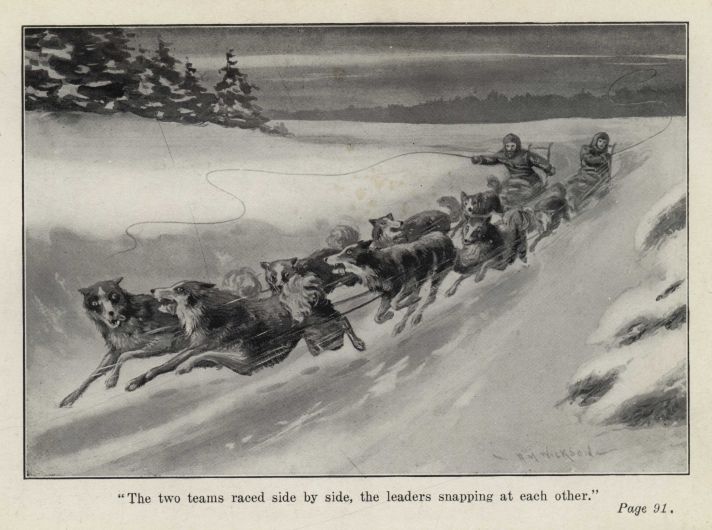
"The two teams raced side by side, the leaders snapping at each other."
"They'll fight in a minute and pile us both up," the girl cried excitedly.
Britton, gazing on her face, was struck with an old, poignant pain. For a second, he thought it was Maud Morris. The features were there; the same teeth, the same rose-hued cheeks, the same sunny hair about the temples! The resemblance was remarkable, and, forgetting the swift descent, Britton stared.
Gaucho, over-zealous to maim the rival leader, stumbled, and a spill seemed imminent, but Britton's skilful lash sorted him out, thereby increasing the momentum of the train till the teams rushed neck and neck again.
"It's a dead heat," he said grimly. "We had better slacken speed before we cross the ice or neither sleigh will go any farther."
"Agreed," smiled the hooded beauty, reining in. Her color was heightened by the ride, and, as she pushed the furry fringes from her mouth to admit of freer breathing, Britton could have sworn it was the face of Maud Morris. Only, the eyes had a serene depth of expression which bespoke soul and purity. Therein lay the difference!
"Say," he began, confusedly, "you're like–you're the perfect mould of someone I know. Her name is Morris. Ah! I have it now! Such likeness can't exist without sisterhood. You're a sister of Maud Morris!" His voice was intense in its eagerness.
"I am not!" came the decidedly staccato answer, tinged with contempt. "Be careful," she added warningly. "There's a jam on this arm." They were sweeping the frozen river-bed, bumping over the jutting ice-boulders piled chaotically in a bend of the stream.
Britton took the lead, swinging briskly across the jam. The girl shouted a warning at his evident carelessness.
"Do be cautious," she begged. "The fresh snow masks the water-holes in treacherous bridges, and the current here is very swift."
Britton loped on without heed. The girl screamed, a second later. Without warning one runner of the foremost sled cut across a snow-arched slush-hole. Britton pitched backwards, splashing through the sloppy mask as a stone drops through scummy ooze.
The girl was at the place in three dog-leaps. A dull blotch of open water showed where the man had disappeared. She jerked her sled sidewise, as an anchor for her weight, grasped a runner with one hand, and lowered her body as far as possible, searching with despairing glances for a reappearing head. She gave a low cry of agony when nothing showed, and began probing wildly with her whip. Its butt-end fell across the taut ropes of Britten's sled, and, looking up, the girl saw the dogs in a heap, well-nigh strangled with the tension on the collars. There was something on the other end!
She grasped the ropes and pulled with all the strength of one arm. After what seemed an age of straining, Britton's black gauntlet pierced the slush. The lines were twisted tightly round his wrist, and the girl frantically seized it. However, the effort was useless. By the passiveness of the limb she knew him to be either stunned or drowned, and past helping himself, while her strength could not stir him.
Relaxing her grip, she pulled herself up the side of the hole, ran to Britton's team, and lashed it into activity in spite of the cramping collars. In terror the huskies responded with their supreme efforts, but they could not draw out their master.
In hysterical sobbing now the girl brought her own dogs, hitched them ahead, and slashed the double team till the cruel whip flayed their hides. To her blows she added prayers breathed between terrified sobs.
At last the string of tortured dogs broke out the sagging, anchoring thing, and Britton's senseless body rolled into view with startling suddenness. The animals, at the quick release, dragged it clear of the river before the girl could stop them.
Laurance's cabin showed just around the bend. In a new lease of strength the feminine rescuer rolled the man's body on his sleigh. Calling to her own team to follow, she made a dash for the shelter of the cabin.
The headland reeled away; the ice-gaps ran past till she drew up with a swirl in front of Laurance's. A group of suspicious huskies, guarding the door, howled dubiously and charged on the strange teams. The girl cracked skulls here and there in a frantic fashion. The fear that they might spring on the inert man possessed her, but in a second the clamor reached Laurance by his fire.
The door clanged back. Several oaths, puncturing the icy air like pistol-cracks, were swallowed in a ridiculous gurgle when the old Klondiker recognized the strange form as that of a woman.
"He's drowned!" she screamed. "Help him, for God's sake!"
"Who?" bellowed Laurance, rushing out and kicking dogs right and left. "By me oath, it's Britton, Rex Britton! Where'd you come on him, eh?"
"He fell in the river-jam!" she cried in unsuppressed irritation. "Don't talk–don't question! Do something! It's time that counts. You're losing time, man!" Her voice filed off in an upper break which told of racked nerves.
Laurance gripped Britton in his arms and made the house with some little difficulty. Rex was a heavy man, and a bulky fellow seems twice his own weight when the muscles are so lax.
"I don't think he's drowned near so much as stunned," Laurance observed, as he laid the body in a bunk behind the stove. "Something's hit him a hefty blow there." He touched Britton's forehead where a dark bruise showed.
"Nary a drown," he continued triumphantly, as he ran a hand under thick Arctic clothing to feel the breast. "His heart's a-beatin'. His ribs heave some, too. Nary a drown, I tell you. The crack on the coco done the job, miss. I'll bring him round all up-to-date in a minnit or two."
The girl's convulsive sobbing made Laurance look up in surprise.
"Don't you go for to take on so," he begged. "You go quiet your nerves and make summat hot in the kitchen room, for the cook's away. I'll dry-fix Britton, and he'll drink pints of scaldin' tea when he wakes."
The girl obeyed, eager to do anything that would help. She busied herself over the tea-making, and warmed some soup, made from moose shoulder, which she found in the rough cupboard. At intervals, however, her anxiety overcame her, and she called to Laurance in the next room with questions as to Britton's condition. Reassuring replies came back in the Klondiker's quaint vocabulary, replies that made her smile when she could take her mind off Britton's danger, since Laurance declared there was no need to fear.
By the time she had the tea and soup ready, Laurance came into the kitchen.
"He's come to–sort of dazed, though," was his announcement. "Got them things hot?"
"Steaming!" she answered, turning from the stove. The action brought her face in close range of Laurance's eyes. The tears were dried, disfiguring sobs gone. The sparkle of the eye and the fire-tinged cheek made a rare sight. The old Klondiker gazed for a speechless minute, while the girl's color deepened.
"Say, now," he stammered at last, "if I'd never set eyes on the Rose of the Yukon, I'd take me oath as you was her. Blast me if you don't resemble her like a twin. Where're you from?"
"Dawson!–don't bother me," the girl replied quickly. "You are sure he will be perfectly safe? I wouldn't like to think–you see, I believe it was my fault. I tempted him to race. He will take no harm?"
"Nary a bit," said Laurance, promptly. "He'll be as right as a trivet when he gets outside a good hot meal."
"Then give him these as soon as you like!" She indicated the tea and soup, and added: "I'll thank you to tell him I'm sorry I was the cause of his accident. Just tell him I'm sorry."
Laurance caught up the boiling liquids in their respective vessels and darted into the next room. Rex Britton's senses were gradually steadying themselves. The hollow, rocky feeling was passing away. In a dry suit of Laurance's he half reclined on the Alaska bunk, while the Klondiker proceeded to administer to his needs by dipping out the necessary nourishment.
"Where's the girl?" asked Britton, awkwardly.
"Out in the kitchen! Say, isn't she a Jim-Cracker from Jim-Crackerville, eh? What's her name?"
"Don't know!" said Rex. "Why didn't you ask her?"
"Bless me,–I–forgot," admitted Laurance. "However, son, seein' as you're summat interested, I'll attend to this here enquiry–"
A jingle of bells and the movement of a dog-train outside clattered an interruption.
"Hello!" exclaimed Laurance, jumping up. "Someone else blew in, eh? Must be me day at home." He crossed quickly to the door and flung it open.
"Who's arrived?" demanded Britton.
"H–l!" cried Laurance, in a non-committal fashion, and dashed into the yard.
Vociferous shouting drifted in to Britton, and when the Klondiker reappeared, he asked with a shade of anxiety: "Anything wrong out there?"
"She's gone," spluttered Laurance. "She's hiked with that bloody fast team of hers."
Britton leaped from the bunk to the doorway. Around the bend of the trail the girl's outfit was disappearing. Full of a strange thrill of disappointment and sense of indignity, he turned the blame on Laurance.
"You blasted fool!" he roared, angrily.
"'Tain't my fault," the Klondiker threw back. "How'd I know she was goin' to vamoose? Must ha' thought we wasn't respectable inhabitants."
"She said she intended to travel by night," explained Britton. "I told her it wasn't safe, but she laughed. I'm going after her!"
Jim Laurance put his back to the door with a certain grim determination.
"No, you ain't," he said, quietly. "Sift some sense into your cracked head. Them dogs are gee-whiners. Yours wouldn't catch 'em in a year. No, siree! That girl knows what she's a-doin'. She's been on trails afore this, and don't you forgit it."
Britton sat down upon his bunk again, convinced of the futility of trying to overtake the splendid team of the unknown beauty. Laurance came back from the door and replenished the fire. His friend drank the rest of the soup and tea in an absent manner.
"How do you shape?" asked Jim.
"Better," Rex grunted.
"Feel like a square meal? It'll skeer off the cold better'n slops. They're all right to prick your blood up, but they don't last like a stomachful of bull moose. Heh?"
"Hardly," Britton agreed. "Bring out your solid grub."
Laurance dived into the kitchen, returning with a big platter of moosemeat and a tremendous slab of pilot bread. He put on a fresh pot of tea, and they fell to, munching in silence while dark crept under the door and into the cabin corners.
CHAPTER VIII.
When the meal was finished, the cabin was wrapped in gloom. Laurance opened the stove door in order to save the expense of lighting a candle. In the Yukon smaller things than candles count for much. The firelight blocked out the two men's figures in a ruddy smudge of color. Britton's massive frame showed larger by a half than the wiry figure of Jim Laurance. But though not bulky, the latter's muscles were of steel. His grizzled face was surmounted by stubby, iron-gray hair which met the up-creep of a disreputable beard in front of his rat ears. The stolid monochrome of a countenance was relieved only by the flash of two piercing blue eyes and the cherry-red hue of a snub nose. His lips were seldom seen; they clung incessantly to his pipe-stem under cover of the ragged whisker-growth.
Britton's face, on the other hand, was a finely moulded one; the harrying conditions and bitter routines of the North appeared to have only conserved and augmented its strength. A broad forehead, dark, fine hair above, regular features, with chin and cheeks clean-shaven, and white, even teeth showing when he smiled, made a pleasant picture in the flame reflection. His muscle-corded shoulders, sturdy neck, and square chin gave evidence of combined physical and mental strength.
For a time the men smoked in silence, staring into the coals, each busy with his own thoughts. Presently Britton spoke.
"Perhaps she'll stay at Ainslie's camp for the night," he said, more to himself than to his companion.
"Got the girl on your brain yet?" chirped Laurance, mockingly. "Kind of heroine of a fair romance, ain't she? Sort of angelic saviour sent for your special benefit, heh? 'Spose you'd a-dropped into that hole if she hadn't been around? Own up, now–honest Injun!"
"Can't say," evaded Britton. "I was thinking only of her safety. We're all pretty rough characters up here, but there are some d–d rough ones on this trail. At Stewart River they told me that someone was robbing caches by night between there and Dawson."
"The bloody cache-thief, or thieves," Laurance broke out–"they'll swing if we catch them! Anderson's cache, near Ainslie's camp, was sandpapered clean two nights ago–not a speck of anything left. It's jumping-off time for the man who did that–when they spot him!"
"Suppose now–well, I'd hate to think of the girl meeting one of that breed," Britton ventured.
"Don't you fear," laughed Laurance. "The man as puts hand on her will catch a whole-fledged, fire-spittin' Tartar. What did I see in her neat little belt when she loosed her coat in front of me fire? An ivory-heeled shootin'-iron, if you ast me. Don't worry, son. Wimmen as carries them things can use 'em. If you met her on the trail and was on evil bent she'd plug you quicker'n scat. You're d–d right. She can go through–if she wants to."
Something like a sigh heaved from Britton's wide chest. Laurance thought there was relief in it.
"On course," he bantered, "you was thinkin' of her safety. You certain had nary a thought of them red cheeks, them eyes, them lips–whoo!"
"Drop that!" Britton curtly ordered. "You know women aren't in my line."
"Where've you been these last weeks?" Laurance asked, suddenly changing the subject.
"Following a fool stampede up Forty Forks, beyond Lake Marsh."
"Hard luck again?"
"The worst." Britton's disconsolate tone told more than his brief answer.
"What's your latest idea?" his friend asked after a doubtful pause.
"I've word of something on Samson Creek. I'll outfit at Dawson and try for it. The Government courier gave me the hint at Tagish Post. I pulled him out of a cold bath he was taking in Lake Bennett once. He didn't forget it."
"Humph!" Laurance growled, reaching for more wood and stoking up after the old-timer's fashion.
"It's my last stampede," Britton continued in an odd, tense voice. "I'm nearly down and out, and I'm staking all. If I fail this time, it's back over this cursed trail to Dyea on beans and horsehide. I'll wash dishes in the scullery of a Puget Sound boat or do something of the like. If I fail, Laurance, I'll have seen the last of the Yukon."
"What brought you here, son?" asked Laurance, kindly. He leaned forward and put a hand on the younger man's shoulder. "What brought you to this God-forsaken Yukon?" he repeated. "I've heard of you playin' a hard-luck game on four stampedes. You've took the bumps right along like a vet'ran, but summat's agin you. You wasn't bred to this here. Your hands is too fine-shaped. Your head's too keen. Your speech is high-flown. Rex Britton, you turned your back on a better place in England than you'll light on here. I'm certainly certain of that. Tell me why you come, son?"
A new light gleamed in Britton's eyes. His stern countenance softened as under the influence of some far-away dream. He got up and paced the floor for a little. Finally, he flung himself back in the chair with an air of resignation.
"I've never told anyone here," he said, "but I'll tell you, Jim. Perhaps I don't need to say it; of course, it was a woman. The old, old story! I'm a strong man, Laurance, and I'd scorn to hold the feminine sex responsible for my vicissitudes. Still, as the philosophers have it, 'In the beginning it was a woman.' We'll go to the starting line. Listen!
"My family was one of the best in the old land. It consisted of three members, parents and myself. Both parents are dead–as you know. After graduating from college, I commenced a tour of the Orient, for recreation mostly. The patrimony left me was small, but I was heir to my uncle, who owns Britton Hall, the Sussex estate, and a post in the foreign diplomatic service was waiting for me when I should come back.
"Getting quickly to the point, I rescued a wonderfully attractive woman on a sinking vessel in the harbor of Algiers. I believe I cracked some Berber skulls in the process, and got a knife-thrust through the shoulder muscles in return.
"She bound the wound, Laurance, and nursed it, lingering in Algiers for that purpose. Our meetings were hourly, you might say! I had my uncle's yacht at my disposal, and all the delights of the capital invited our participation, so you may judge that the days and nights passed very pleasantly.
"I had friends there whom I should have considered, but I neglected them in the other fascination; for it was fascination, Jim–the kind of beautiful web that the spider spins." Britton paused with a snappy intake of breath while Laurance, unwilling to interrupt, swung the stove door to and fro with a moccasined foot.
"You know the atmosphere of romance surrounding any such happening," Britton finally went on. "The lady was beautiful, marvellously so, in fact, and well versed in worldly artifice. I was still young enough to have the rainbow focus on life. The days went quickly in the picturesque port. The girl–she told me she was twenty-four and unmarried–remained in the place, recuperating from the shock of her accident. What's the use of elaborating, though! You know how a love dream grows, Jim Laurance. You must have had one somewhere in your own old, grizzled existence. Algiers is sunny. The flowers are fragrant there. Love feeds on sun and flowers, moon and mountains, starry nights, and all that. I was young, Laurance, and she was old in the craft. Could you blame me for being such a fool? Sometimes I hardly blame myself.
"For nearly a mouth things developed. We were engaged. That city by the Mediterranean became a Paradise for me. Then–then–" Britton's voice broke away in bitterness.
"Then what?" his friend prompted.
"Her husband came hunting for her!"
"H–l!" Laurance gritted. His feet fell to the floor with a bang. "She duped you!" he added, softly.
"Sheared the lamb," Britton, said, with severe, self-directed irony. "The whole affair came out. Her husband tried to shoot me. Instead, I laid him up for weeks. Then they came at me for damages, and the she-devil framed a charge of seduction. I was the sensation of courts and yellow journals for half a year. When I got clear at last, the attendant circumstances worked their effect. The thing smirched my name and killed my diplomatic chances. It ruined my life when it was brightest with promise. It caused my uncle to disinherit and wash his hands of me. That's why I cut the Isles, Laurance. That's why I'm here."
Britton rose to his towering height, with clenched hands, as if he were beginning the fight with the North, as if he were storming the Yukon's iron fastness for the first time. Laurance could picture him thus, setting foot on bleak Dyea beach. The old Klondiker took his pipe out of his mouth and forgot to replace it. In lieu of that he reached a knotted fist to Britton's palm.
"Son, I'm sorry," he said. This from a hardened Alaskan was much, for in that country, as a rule, no one is sorry for any person but himself. There, in a running fight, it is every man for his own interests, and the devil take the laggards and the weak!
"Do you love her?" Laurance ventured, a second later.
"I'm cured," Britton laughed, bitterly. "Hasn't the draught been strong enough?"
The old man returned his pipe-stem to his lips. "Better a good burn-out," he mumbled, "the rubbish won't catch sparks agin. What was her name?"
"Maud Morris, wife of Christopher Morris," his friend answered. "I saw a man who knew them when I came through Winnipeg. He told me that Morris had gone all to pieces through drink and fast living. At that time they had come direct to Seattle. I don't know where they are now–and don't care to know!"
Britton settled back in his seat and refilled his pipe. The recounting of his story had been in some measure a relief, although the old taste of rancid memory remained.
"You're well out of it, son," Laurance observed, after another vigorous stoking of the stove. "You're bloody well clear, though you've stumped through such a hard-luck siege. I hope your last deal pans out some better. I'd hate to see you fall down. You're too good a man."
"Have you met Pierre Giraud lately?" Britton inquired. "I wonder if he'd join me. We've tramped many a trail together."
"Pierre's due here to-night," Laurance said quickly. "He won't join you, though. He has a fine thing toting the goods of some Dawson big gun out to Thirty Mile River. His royal nibs is going out–bound for the States–and he has Giraud under contract to pack him along."
"Too bad," Britton mused. "Pierre's worth three ordinary men en route. Many's the mile we've paddled, and many's the moose we've missed. Bon camarade is Giraud, if there was ever one."
"I saw him beat two blaggards on the stampede into Nome," Laurance began reminiscently. "The guys started in to argue the right of way with Pierre. Weighty beggars they was, too, but Giraud put 'em both out of action in ten seconds. Shiftiest man on the route, less it's yourself, Britton."
Rex shook his head as disclaiming the honor. Outside a shrill howl broke the night silence and started a hundred echoes. Rex lifted his head sharply.
"What's the matter with the husky?" he asked. "The moon's not up."
"Someone's coming," Laurance answered, listening intently to a musical sound.
The faint tinkle of bells grew clearer. The rushing sound of a laden dog-train made the cabin walls vibrate.
"Arrêtes!" commanded a leonine voice in the yard, and the noise died suddenly.
"It's Pierre," cried Laurance, jumping to his feet.
CHAPTER IX.
The door was kicked open without ceremony, and Pierre's head popped in.
"Hello, you young cheechako!" yelled Britton, gaily.
"Holá! mon camarade, you tam ole stampeder!" cried Giraud, rushing in with outstretched hands. "By de gar, Ah nevaire t'ink Ah find you here. Ah s'pose you seex hondred mile back–saprie, yes." He pulled off his Arctic hood, disclosing a veritable voyageur's head, handsome, debonair, crowned with coal-black curls and lightened by the ever-changing play of his fine eyes, sombre-hued as his hair. Pierre's face was full of a certain reckless beauty, and riveted attention by his daring, wilderness-bred fascination. Camaraderie spilled out of his infectious laugh and his habitant speech.
Thus the two friends remained, the one sitting, the other standing, raking each other with volleys of cross-questions. They talked like a pair of chattering jays, trying to gather in the threads of the more recent incidents that had befallen each, till Laurance interrupted them.
"Sit down and eat," he said to Pierre, "I'll unhitch your team."
It was then the current of excitement, which Giraud appeared to have difficulty in suppressing, burst to the surface. He sprang to Laurance's side and caught his arm.
"Non, non!" he exclaimed. "Wait wan leetle w'ile. Ah breeng news. We want dat sled sure t'ing. De cache-thief–you hear of heem?"
Laurance's keen blue eyes flashed. "Is he pinched?" he cried, eagerly. "Have you seen him?"
Britton rose from his chair in vague alarm. He was thinking of the girl travelling alone over the trail. "Speak, Pierre," was his tart order, "you know something. Out with it!"
"You leesten den," Giraud began, excitedly. "Ah come by de cache on Silver Hollow après de dark she fall. Wat t'ink Ah find? De cache broken open. De stuff all gone to diable. Dat thief not ver' far away–Ah know dat for sure t'ing by de tracks. Ah t'ink we get fresh dogs here an' catch heem–catch heem!" Pierre jumped about and flourished his brawny arms in emphasis.
"Anderson he geeve reward," he continued.
"How much?" Britton broke in, a new incentive gripping him.
"Wan t'ousand tollars to de mans w'at catch dis canaille–"
"Come on," roared his friend, jumping into his travelling-gear. "Come on, Pierre; we'll pull down that thousand."
He was at the door in a second, calling to his huskies. Giraud ran after, boiling with impatience.
"Hold on!" called Laurance. "Though I'd like to be in on this job, I can't leave my cabin–not with Mister Feather-Fingers dabbling about, and the cook's over at Stewart for grub."
"Jove! I forgot that," said Britton, hooking up his team. "It's rather a shame, Jim. We'd like to have you come."
"Can't," Laurance grunted, dismally. "Still, you can have my dogs. Snap 'em on ahead. If it comes to speedin', you'll catch a runaway easier." He ordered the big animals out, and Rex prepared to harness them ahead of his own.
"It's a long string," he said, dubiously. "They'll take some managing."
"Wait," commanded Pierre. "Ah feex dat. Ah have de double yoke."
He pulled a double pack outfit from his sled and selected the harness, tracing the dogs up in pairs. Three minutes more and they were gliding over the trail, leaving Laurance watching from the mellow blur of his firelit doorway.
"Did you meet a sled drawn by five dogs?" Britton asked, as they sped over the smooth plateau beyond Laurauce's.
"Oui," answered Pierre. "Ah meet wan an' pass heem on de Grand Reedge."
"Stop?"
"Non. De mans nevaire speak. He hurry, mebbe."
"It was a girl!" said Britton, abruptly.
"Ciel!" gasped Pierre, in surprise. "Wat tell moi? She drive lak diable."
"Yes," Britton assented, "the dogs were very fast. She had mine beaten before we came to Laurance's. Of course, that was my stop."
Giraud's elbow gave a warning prod to his companion's ribs as they slid down Silver Hollow to the place which the voyageur had mentioned.
It was a cache built after the manner of the North for storing purposes or for preserving baggage for future freighting. Anderson had used it for years and had never before experienced any trouble with pillagers. Indeed, the inexorable law of Yukon miners was sufficient to make any of the light-handed gentry think twice before opening a cache. This was one of the crimes for which swift justice was meted.
Britton and the voyageur examined the snow-bound hummock carefully, lighting a torch to scrutinize the tell-tale tracks in the wind-screened valley. The imprints were very fresh, and had evidently been made by one man with a dog-train.
During the momentary investigation Britton's thoughts revolved swiftly. From the amount of goods stolen, he judged that the robber did not intend travelling far. Probably he had in view some secret cache where he could hide the plunder till an opportunity of getting rid of portions of it should be presented.
"Did you notice the little cache by the stream when you came over Grand Ridge?" Britton asked.
"Certainement!" Pierre answered. "She be not touched. Ah look for dat."
"Then the fellow must be working on the in-trail. He never passed Laurance's. He never passed you. You're sure the fast five-dog team was the only one you met?"
"Tam sure," Pierre vigorously asserted. "Ah have de sharp eyes!"
"In that case he must have left the route somewhere between Laurance's and Grand Ridge. He wouldn't go far with such a bulk of stuff. We have to find his track where he left the main trail. The moon's just up. In ten minutes it will be as clear as day. This is our chance for five hundred apiece. We earn it between here and Grand Ridge. Whip up those dogs!"
Britton's tone was exultant. To the spice of adventure in running down a contemptible thief was added the lure of the reward which Anderson had offered. He needed that five hundred! In fact, it would be like money from home just at the critical juncture of his last stampede. His funds were barely sufficient to provide a proper outfit for the arduous trip up Samson Creek. This wind-fall–if the breeze held his way–would remedy the deficit in the budget.
Pierre, with all the craft of the old musher, had his dogs well in hand, and the long walrus-hide whip sang out with a final snap at the ears of the leaders that sent them loping like a whirlwind. The voyageur scanned one side of their route for any signs of a dog-train having turned off the beaten path. Britton watched the other side closely. The brilliance of the moon turned the whole frozen expanse of country into a white blanket, with here and there a soiled spot, which was the dark-green of scrubby thickets.
The rush of frosty air bit the men's cheeks. Odd little cadences, torn out of fleeting space, whined shrilly in their ears. White smoke of dog-breath blew back in cloud patches to mingle with the hoar of their own lungs. The exhilarating, electrifying flight through the Arctic atmosphere made the blood rush with all its virility through their lusty veins.
"We must be nearing Grand Ridge," Britton said at last, in a low tone. "Nothing has left the trail on my side so far."
"Non," muttered Giraud, "she be de same on dis side."
Britton was lying out as far as possible, watching past the dogs as they swung down by the little cache near the Ridge. Suddenly he uttered a half-suppressed exclamation.
"The rascal's left the trail here," he confided to Pierre. "Hold on; we're past it. Rein in your dogs. There, off to the left! That's his track. It leads down to the little cache. I can see something moving. Maybe the beggar's looting it, too." He stood up, balancing himself deftly in order to see the better. Acting on a swift impulse, he threw his hands up to his mouth in trumpet-fashion and gave a loud hail.
"Hello!–the cache," he bawled. "Who's down there?"
An oath came back in answer. There was a scuttering through the snow, the frantic cracking of a whip, whining of punished dogs, and the desperate rush of a loaded sled.
"Caught red-handed!" roared Britton. "Cut him off, Pierre. He's trying to make the beaten trail."
Giraud whipped his dogs up, running at an angle to the fugitive dog-train. The plunderer had reckoned badly in trying this mode of escape. His one team and laden sleigh struck only a snail's pace compared with the speed of Pierre's double team and empty sled. The voyageur's mad driving caught him before he reached the main trail. Whooping aloud, Pierre drove his galloping animals right on top of the other's dogs, anchoring them there in the loose side-snow to snarl and battle in the traces.
Britton and the voyageur leaped off and made for the piled-up packs on which the strange driver was seated. Realizing that he was thus suddenly brought to bay, the fellow rose to his feet and whirled the butt-end of his whip aloft. "Stay back, curse you!" he cried.
"Better give in," Britton warned him. "It's best for you." He jumped upon the rear bundles of the sled.
A vicious blow of the whip was the answer, but Rex was watchful. He caught the descending wrist, back-tripped the ruffian with a swift leg movement, and choked resistance out of him.
"I think he'll be quiet now," he said to Pierre. "Strap his limbs. That will do. Let's have a look at him." The moonlight failed to reveal much of the man's appearance except that his face looked more like that of a beaten dog than anything else.
"Smells like a distillery," Rex commented, turning his nose away. "He's been well primed for this job."
"Were we tak' heem?" asked Pierre, more material in thought.
Britton considered the matter for a short moment.
"We'll have to take him back to Laurance's and watch him by turns," he finally said. "I can pack the rascal on to Ainslie's Camp to-morrow and collect my half of the reward from Charlie Anderson. He can pay you a like amount on your return trip from Thirty Mile. How does that suit?"
"Bon, for sure t'ing," Pierre returned. "Ah t'ink dat suit me bully. Mak' de five hondred ver' easy."
"Anderson will think it's well worth it for the return of his goods with the gentleman on top," observed Britton. "Turn your outfit, and I'll load this Whiskey-John into the empty sleigh. Whoa! Easy–that's correct, bon camarade! Go ahead now. I'll follow with the contraband."
There was no jingle of bells, nothing but the sober plunging of the sleds as the two dog-trains filed back to Laurance's cabin on Indian River.
CHAPTER X.
"So you've captured the condemned parasite!" cried Jim Laurance, as the returning ones reached his yard.
"Certainement! tam sure t'ing," Pierre assured him, with a burst of good humor. "Wat Ah tell you?–we catch heem! Saprie, yes–on de leetle cache par le Grand Reedge–n'est-ce-pas, Rex, mon camarade?"
"That's correct," laughed Britton, "we hit it just right! A little later and we should have had a stern chase. Make a jail, Laurance, to hold the rascal."
"Roll him in by the stove," ordered Jim. "He won't give us any ha-ha. I'll bet me best mukluks on that." Presently, as the man was taken inside and the bonds loosed, he added: "Don't calculate for a minnit you can vamoose–for you truly can't. Me Winchester'll stop such tom-fool notions." Laurance pointed to the sinister-outlined rifle above the door.
When the light fell upon the captive's features, the two men who had brought him in recoiled involuntarily.
"Le diable!" hissed Giraud, as if some hideously unpleasant truth were forcing its utterance in spite of him.
"The devil!" echoed Britton; "that's it, Pierre. No more fitting description could be given. Look at the high cheekbones, vulture-shaped features, and hellish eyes. Good Lord, Jim, did you ever see such an ugly man?"
Rex backed to a seat and began to divest himself of his outer garments, all the while regarding the cache-thief with critical eyes in which a light of discovery was dawning.
"Looks like a cross 'tween a 'Frisco wharf-rat and a Nome claim-jumper," Laurance averred. "Say, mister, was you ever forty-second cook round a scullery?–'cause you smells it!"
The captive vouchsafed no reply. He sat with his Satanic-shaped head buried between narrow shoulders. The firelight licked his face at intervals, strengthening its horrible grotesqueness.
"W'iskey mak' heem talk," Pierre declared. "Got de fire-wataire, M'sieu Laurance?"
"Yes," said Jim, "but it's too blasted dear to waste on that trash. I wouldn't give him Seattle sas'priller. Don't matter a crow-bait whether he talks or not. He'll get his own at Ainslie's to-morrer."
Britton came to the stove and gazed earnestly at the huddled heap on the floor.
"Look up, man," he said roughly, but the bloodshot eyes refused to meet his own.
"It's no use," Rex continued, with a cynical laugh. "I know you–Morris!"
The sudden revelation had its effect. The man sprang up with a snarl of rage. His eyes glittered malevolently–-straight into Britton's now. He appeared about to fly at his captor's throat.
Pierre, ignorant of the cause of the thief's sudden activity, likened him to a gaunt wolf at bay before a big bull moose. So the pair seemed.
"I think he will talk," Britton said slowly. "He knows who I am now. Yes–I think he will talk."
"D–d if I do," came from the thief. The first words he had spoken sounded like a husky's gurgle when the collar nearly chokes him.
"Don't be so fast with denial," urged Britton, smoothly. "When you have heard the option, perhaps your opinion will suddenly change." He looked at Laurance for an instant, debating with himself. The Klondiker was in a deep and apparently uninterested silence.
"It's Morris, Jim! Christopher Morris–the man I spoke of, you remember? His attitude just now is suspicious. I don't know how long he has been in the Yukon, or what he is doing here, but I cannot understand his present escapade. There's something behind it." Britton paused and allowed his keen, searching glance to wander back to the repulsive figure of Morris.
"I was about to give you an option," he resumed. "I think Laurance will second my guarantee of a lightening of the punishment the miners will hand out. My proposition, in brief, is this: Tell us what you know, what your game is, who is behind you, and what is their object–tell us this, I say, and you'll only be flogged instead of hanged."
Britton's meaning came out clear and sharp to the victim of drink. He shivered a little and pulled himself to his knees. There was a hint of supplication in the position, but this his captor ignored.
Laurance coughed apologetically, in expiation of his silence.
"You want to make sure of that?" he questioned.
"Yes," answered Rex. "I know Morris through and through. In my long battle in the courts I came to read the man like a book. I can sense his subtleties and under-purposes. I learned to do that, Jim, in the hardest school of the world–the law-courts. I am almost certain that he is in league, or worse–in bondage. Shall we guarantee him this?"
Laurance consulted his pipe for a long minute. Then he flashed up his eyes in acquiescence.
"Go ahead!" he grunted. "I guess we can make it even with Anderson."
Britton confronted Morris once more, and drove his words home with sledgehammer effect.
"Take your choice!" he said. "Keep silent and hang–you know they'll do it at Ainslie's–or speak and get off with a flogging. Which? And be quick! We want to sleep here. Half the night has already gone."
Morris, the derelict, instinctively felt himself on the edge of things. His wits were not yet so liquor-dulled but that he could see the fate awaiting him at the camp. He knew the stern code of the North–rough but effective. Fortune had played him a miserable turn, and, if he did not catch at the proffered hope, she would sing his death-knell, rollicking heartlessly.
He collapsed suddenly from his kneeling posture and half lay on the rough floor within the stove's circle of warmth.
"What do you want to know?" he asked doggedly.
"Are you prepared to speak plainly and truthfully? No lies, remember!"
"Yes, that is–"
"No parleying," roared Britton. "I want some sleep for the trail to-morrow. You have to tell all I want to know in five minutes or not at all. Ready?" His words dropped bullet-like.
"Go on," Morris cried, with an assumption of recklessness; "d–d if I care. And hell take the other fellow. It's a case of life or death. Open up, Britton!"
"When'd you come?"
"By boat last summer to Dyea and thence to Dawson."
"Wife with you?" Britton's teeth ground over the sentence.
"Yes," was the sneering answer.
"For what did you come?"
"Gold!"
Rex Britton laughed harshly. "To be picked up anywhere, anyhow!" was his comment. "By man and wife–mostly by the wife!"
His tone, however, changed to a cold, metallic timbre when he asked:
"Who planned this cache game?"
"Simpson."
"Good heavens!–he's here, eh? Still," with another harsh laugh, "I might have known that when your wife was in the vicinity."
Turning to Laurance, he explained: "Simpson is a lawyer–counsel for Morris in the case against me–and an especial friend of Mrs. Morris."
"What does Simpson want?" was his next question to the tool.
"Money," said Morris.
"That's a lie," cried Britton, advancing fiercely. "He wanted the goods and supplies for a purpose. Money's procured by him in an easier way. But stampeders' supplies have no pecuniary equivalent in Dawson now. You see there hasn't been a steamer up-river for long enough. They tell me Dawson has been lately iron-bound. Now let us know what Simpson was going to do with the goods. You'll swing if you don't."
"He's going to prospect."
"Where?"
"On–on Samson Creek, where the rest are going."
"Big outfit for one man, isn't it? The contents of three caches!" Britton's casual remark held a taunt and a hidden meaning.
"He's taking men with him–to stake other claims for him. That's why–"
"Ah! I see," Britton interrupted. "When does he leave?"
"Right away."
"Funny act, that," put in Laurance, with a smile and wink.
"Yes," Rex agreed, the smile reflecting itself on his wholesome face. "Morris, you're only a fool in this country, and you can't see much significance in your statements. I take the liberty of telling you that there is a great significance in those few words. Old-timers have no difficulty in seeing far. Simpson, by the way, must have become more rapidly acclimatized–or else he has been at the game in other mining territories. Pierre, what motive has the man who organizes a toughs' stampede ahead of the spring rush to ground which is partially staked?"
"He t'ink he joomp de claims," asserted Pierre, promptly. "Dat tam sure t'ing!"
Laurance laughed at the sudden start and guilty shrinking of Morris.
"Why, a kid could spot that," the old Klondiker assured him. "Simpson, this law-juggler as Britton speaks of, gets the nerve to jump likely claims on Samson Creek. It's just as well he's found out. If he had per-sum-veered he'd surely got jumped hisself–at the jumpin'-off station. I'm certainly certain of that! How-sum-do-ever, as me friend here goes vamoosin' into Dawson shortly, he'll put a handspike in Mr. Simpson's choo-choo gear."
Britton got up and shook himself as a great, shaggy bear stretches its muscles.
"That's all for to-night," he yawned. "The saggy trail made me sleepy. But take my advice, Morris, and cut away from Simpson. You're not bound by ties unbreakable–yet you soon will be. And that's saying a good deal if you stop to analyze it. Let's roll up, Pierre!"
"Oui," cried Giraud, slinging out the blankets. "Ah dream w'at Ah get wit' dat five hondred." In the height of his buoyancy he broke forth in song, and, while Britton dropped to sleep, Pierre's voice rang up to the ceiling in the tune:
"En roulant ma boule roulante,
En roulant ma boule–
Derrièr' chez-nous y-a-t-un 'ètang
En roulant ma boule!"
CHAPTER XI.
A great commotion stirred Ainslie's camp on the following afternoon. The narrow passages, called streets, between ugly log and canvas buildings were thronged with heterogeneous concourses of miners and others. They moved back and forth along the pounded trail from restaurants and stores to the bunk-houses, from bunk-houses to dance-halls or riotous saloons, and an air of expectancy pervaded the movements of everyone within the camp's confines.
Outside Anderson's cabin the crowd began to concentrate, talking in incessant murmurs, while all eyes were fixed upon the closed door. A trial was going on inside. The news had spread through Ainslie's that the cache-thief had been taken and was now up before a miners' meeting. Word passed from man to man, and the throng continually grew in volume.
Presently Anderson's door swung open. Those who had sat in tribunal poured out with the prisoner in their midst.
Jim Laurance inhaled a deep breath and drew the fur cap down over his damp brow as he slouched along beside Rex Britton.
"That was a close thing," he growled. "Don't ast me no more to stick in me chin for a slim-finger! I don't much fancy these free-for-all fights."
It was evident that the discussion inside had waxed hot and that only a slender margin saved the neck of Chris Morris.
The latter walked, with bent head, inside the solid phalanx of grim miners, among whom burly Charlie Anderson was chief. The face of Morris showed ashy gray in fear, and his eyes rolled back like a negro's as he shambled along, gazing at the ground, because the thought of looking for an avenue of escape was worse than futile.
The waiting mass of people gave vent to long-suppressed expectancy when Morris appeared. A loud shout rose up, and everybody rushed after the cordon which surrounded the cache-thief. It moved to the centre of the camp, where a large hitching-post, bearing a red cloth sign advertising Laggan's dance-hall, stood up at the side of the winding trail that served for Main Street.
The impatient spectators ranged themselves in lines that broke and shifted as they strove for better vantage-ground. Some, to obtain a clearer view, ran and climbed upon the low roofs of the log cabins, upon the verandah of the dance-hall, and the porch of a store just opposite. Women were mixed in with the male gathering, some with knee-length skirts and fringed leggings, and others dressed outright in men's garments.
On every hand was unpitying condemnation for the thief. He was scowled at and spat upon, for pillaging is considered the most contemptible thing in the North.
When the cordon halted at the hitching-post, Morris received a rude jostling from the crowd till Charlie Anderson forced the encroachers aside.
"Lynch him! Lynch him!" was the cry, vociferated in a deep, guttural roar which made Morris tremble.
Anderson shook his head and bellowed at the bystanders.
"No, boys," he shouted, "we're going to do as Laurance says and give him a chance. Make room, there!"
The sullen onlookers obeyed, leaving an open spot at the post which held Morris and another man, a thick-set fellow with a walrus-hide whip in his hand. Tense silence oppressed the spectators, contrasting strikingly with their former growls of impatience.
"Strip!" commanded the hard voice of Anderson.
Morris removed his outer coat, or parka, and a woolen vest.
"Go on," was the curt order.
The buckskin shirt came off, and the thick Arctic undergarment. He stood, bare to the middle against the cutting breeze, shaking from both cold and fright.
"Now," said Anderson, nodding to the stout man with the whip, before he stepped back among the gaping people.
The man tied Morris to the post by his wrists, took up a position four feet from the prisoner, and applied the whining lash.
Half a dozen times it descended, flaying the flesh, while not a sound arose from the crowd. At the seventh stroke, Morris groaned, pitched forward, and hung limply in his fetters.
"That's enough," cried Britton, vehemently. "Can't you see he has fainted?"
A team of horses pulled up with a jangle of bells in the trail. Some woman's gauntlet, flying through the frosty air, struck Rex a stinging blow upon the cheek.
"Ho! ho!" laughed a coarse fellow at his elbow, "so the Rose of the Yukon's down on you, eh? Or maybe it's a love-tap."
Rex looked between the disordered ranks of roughly-clad miners straight into the flaming eyes of Maud Morris, where she sat behind Simpson's spanking grays, in Simpson's luxuriously robed sleigh, beside the fur-coated, well-groomed Simpson himself.
Her furious glance transfixed Britton and then darted off, tangent-like, to the clamorous group on his left, where three miners had revived Morris with a stimulant and assisted him to an erect posture.
The bare back of Chris Morris was a raw, red patch, and he quivered convulsively as the sifting hill-wind bit into the bleeding stripes, while his custodians replaced shirts, vest, and parka upon his body.
Maud Morris's second glove followed the first, striking Britton rudely in the mouth.
"You beast!" she screamed impotently. "This is your doing, I hear!"
Rex ground the gauntlets into the beaten, tobacco-stained snow under his feet.
"Be thankful that Morris lives," was his heated answer. "They swore he must swing and fought against the commuting of his sentence. It was a tight pinch, but Laurance and I managed to pull it off at last."
The miners led Morris past and bade him take the trail.
"Hit it fur the high places," they said, "an' don't never show yer mug in this camp agin, or, s'help us, we'll shoot ye like a dawg!"
It was justice, the stern, unsmoothed judgment of the North, and Morris, the derelict who had reached the lowest limit of his downward tendencies, stumbled along the trail in the direction of Dawson, a marked man in the eyes of all.
His wife by law looked to Britton as he had last seen her in her boudoir at the big English hotel on the Mustapha Supérieure in Algiers. Her face was the same bright, hard mask of hatred, and her soulless eyes burned. He noted that she was looking older, her stamp becoming more brazen, her beauty lessening, because the dust of fascination no longer blinded his vision. The presence of the girl he had met by Indian River dwelt in Britton's mind, a presence moulded in a confusingly exact counterpart of Maud Morris. He remembered her fresh, childish innocence and pretty modesty, and he knew that in outward perfections alone the counterpart equalled the original. While he surveyed the woman before him, he was certain that the straightforward character of his unknown was as different from Maud Morris's deceptive disposition as chastity is different from shame.
The knowledge was very consoling to a heart still void, and Britton wondered, with an involuntary throb, if he would ever find the nameless girl who had saved his life on the Indian River ice-bridge.
"You look as if I were someone else with whom you are genuinely pleased," Maud Morris said savagely, shrewdly reading his expression.
Britton's whole countenance lighted as he smiled.
"Do I?" he asked pleasantly. "That is because I have found your superior!"
She bit her lip to check an unwomanly expletive, and the mantling red in her cheeks gave Britton full satisfaction. He strode to Grant Simpson's side of the sleigh and tapped the sleeve of his rich, fur-lined overcoat.
"By the way, Simpson," he warned, "don't try that game on Samson Creek. It was quite a frame-up you planned for those who have already staked in, but Morris gave it all away."
Grant Simpson squirmed among the bear robes in a startled fashion, and his thin, effeminate face lost color.
"What do you mean?" he demanded, scanning Britton narrowly.
"Only this–if you dare show your nose on the Creek for any reason whatever, I'll tell the miners things that will make them swing you higher than Moosehide Mountain. Of course, Morris can't go in on any strike now. They wouldn't countenance it for a moment!"
Simpson's awe gave way to blind anger. He struck at Britton with his silver-mounted whip, to find it promptly torn from his grasp. Rex touched the grays on the flanks with it, and the team dashed down the Dawson trail with Simpson sawing on their heads. Britton laughed harshly as they went, and slowly broke the whip to bits.
"Simpson and Miss Vanderhart have given the chump a lift," said a miner, watching in the roadway.
Rex saw that the occupants of the sleigh had taken up Morris and concealed him among the fur robes.
"Who did you say?" he asked the miner.
"Simpson and Miss Vanderhart," the man repeated. "They're big guns at Dawson. Know them?"
Britton laughed again at the alias, as he scattered the whip fragments with his toe.
"Yes," he said meditatively, "I know something of them."
Just then Laurance swung out with his dog-train, starting back to Indian River.
"I'm off, son," he cried to Britton. "Are you goin' to bolt for Dawson? It's five hours from here!"
Rex nodded at the sleigh, gliding leisurely along the trail in the distance, and observed:
"I'll wait! I'm not anxious for their company on the route, and morning will suit me as well. So she's the Rose of the Yukon!"
"Sure!" said Laurance, putting his dog-whip in his armpit in order to light the inevitable pipe. "Kind of romantic fiction, ain't it, to find she's your angelic ideal? Haw, haw!"
"She's not, for there's no bandage over my eyes now," Britton declared, with conviction. "But, by heaven, there is an ideal," he continued in strange triumph evoked without volition, "and I feel in my bones as if I'll meet that ideal some time again."
"Um!" puffed Jim Laurance. "Again? Yes, I may say again! But take an old-timer's advice, son, and see that you stick to one search at a time. You understand?"
"I couldn't forget that if I wished to," Britton replied, smiling rather bitterly. "I'm going up Samson Creek at once. If that search doesn't prove worth while, there won't be any necessity for the other."
Laurance gripped Britton's palm tightly, saying: "You know where to come if stranded, son."
The negative motion of Britton's head showed the pride that prompted his refusal; and Laurance shook out his leader.
"Best luck!" he cried cheerily.
"For what?" Britton whimsically asked.
"For the gold and for–the–the other," Jim Laurance called over his shoulder. "Why, d–n me, you deserve 'em both."
CHAPTER XII.
Loping out of Ainslie's through the cold Arctic dawn, Britton made Dawson under five hours. Thanks to the recommendation of Charlie Anderson, he was able to secure from an outfitter a portion of the provisions that were being so scrupulously reserved because famine threatened in the distance with empty claws closing over the golden city.
He did not run across Morris, his wife, or Simpson, but he had the pleasure of eating dinner in a restaurant run by Pierre Giraud's wife, Aline. The place was a neat, clean eating-house, called the Half Moon, situated near the North American Transportation & Trading Company's store, and Pierre's wife proved to be a bright-eyed, buxom woman, young and attractive after the type of the French-Canadian maids. Rex thought it was the best meal he had had in a long time, with the additional virtue of having a dainty server, and he told Aline Giraud so.
"Vraiment," she cried, laughing gaily at his praise, "M'sieu' ees reech in w'at you call–compleement!"
"Yes, but that is about the extent of my riches," Rex chuckled, as he took his departure.
News of the Samson Creek find was freely circulating in Dawson City. Some claims had been staked in the fall, and hazy descriptions of the valley's wealth were in the air. The Arctic temperature of the Yukon winter kept many from going out to locate, but a mysterious rumor arose that there was a claim-jumping scheme afoot, and Britton found that it had already travelled ahead of him. The rumor, quite indefinite in itself, startled the people of Dawson from their apathetic state. Miners who had, at the approach of frost, forsaken the valuable auriferous workings for the city's beer-saloons drew on their meagre stores of supplies and stampeded to their holdings, ready to prove, even in gun-fights as a last resort, that possession was not nine points but the whole of the law.
Learning that so many prospectors had rushed out the night before, Britton loaded his camp stove, sleeping-bag, and tent upon his sled, securely lashed on the provisions, consisting mainly of bacon, beans, flour, and dried apples, and made all haste away.
Samson Creek was a tributary of the famous Eldorado, and on account of its proximity to fully exploited fields offered great promise of pay dirt.
Britton took the ice-trail up the frozen Klondike, veered off to the right, and rounded the great, cone-shaped, snow-laden mountain in whose chasms the most noted gold streams, including the Bonanza, have their origin. He travelled fast, unimpeded by snow-crust on the white, glistening surface of the river, and on nearing the south branch of the Samson, overtook many who had started out before him.
"Got anything staked?" panted a miner, as Britton went by.
"Not yet," Rex answered.
"Then you can't get in," the man said.
"Why?" Britton cried impatiently.
"Why?" echoed his informant. "Ge-mima!–why? Look there!"
They had topped the glacial slope of the watershed and paused for breath upon the crest, overlooking the creek's bed. Britton beheld the valley, freshly staked as far as his eye could reach, with endless processions of men moving upstream.
"Get in?" said the miner. "Not much! I must hike down and see nobody squats on the claims I took last fall."
The man moved off, and Britton, angry disappointment raging within him, stood and watched the burden-bearing lines below.
Over on the west where the mountains bulked up so huge and taciturn, the ruby sunset was coloring the summits. Dull, spotless snow-cornices and shining ice-fields gleamed with rosy hues that gradually deepened to rich crimson, as if some Titan hand had poured over them a flood of ancient wine. The glacier tips scintillated like the steel sabre-wall of a cavalry column, and the scraggy hemlocks on the peaks quickened with sapphire glints against their sober green.
Britton watched the magnificent panorama hold its glory for some moments; then all turned shaded and blue in a trice as a sheer rock precipice capped the lens of the sun.
He turned away, dejectedly, toward the north branch, remembering the hint of Franco Lessari, the courier. He crossed South Samson, intercepting scores of men who mushed dog-teams, dragged Yukon sleighs, or bore great loads on their wet backs. They strained in single file up the beaten river-path–low-browed, cruel-looking fellows who might have been thugs and who cursed those that delayed them; eager-faced, unbroken fools who had come in by steamer in the heat of summer, housed themselves warmly in Dawson when the frost fell, and had yet to learn the smiting wrath of a Klondike blizzard; luckless gamesters whom a winning turn never blessed; and shrewd old pioneers, suspicious of everyone, noting everything with keen, wilderness-trained eyes, and pushing on indefatigably to conserve their fall stakings. Along the sinuous river course heaps of boxes and sacks and caches of food marked the journey; overweighting baggage, thrown down to await more convenient handling, blotched the ice with unsightly disorder; discarded trifles, pack rubbish, and the snarl of sleigh and tent ropes littered all the route.
By dark Britton camped on North Samson, four miles away. There, for three days, he burned holes in doubtful-looking gravel, enduring uncomplainingly the manifold discomforts of tent life with the mercury fifty below.
Meanwhile, the influx to the south continued, and, all the explored stream being taken, the overflow reached the northerly branch. Rex watched them come, more motley and dishevelled than ever, unwilling to back-trail to Dawson and yet with a secret dread gnawing at their hearts, the fear of winter's lash whose torment the ache of hunger might assist. He saw them arrive, as bitter and despairing as himself, and with them staggered Franco Lessari, dragging the most meagre of meagre outfits.
Lessari had no sleeping-bag, only blankets. and thin ones at that; he did not carry a tent, depending upon the snow hut dug in the river drifts, and his food was a bag of coarse beans and dried salmon.
"Ah," he cried delightedly, on seeing Britton, sitting between his tent flaps, "you listened at me? But come to-morrow after me. Where I say, you dig!"
He was moving farther up-stream, but Rex called him back.
"Look here," he began, full of commiseration for the pathetic figure plainly in worse circumstances than himself, "you might as well bunk in beside me. There's plenty of room in the tent, and we'll prospect together wherever you say. If you're going to share a good thing with me, I must make some return. Come along! Throw in your packs."
Gratitude showed in the Corsican's brown, harrowed face as he wrestled with his limited English vocabulary in the attempt to thank Britton for the generous offer, of which he reluctantly took advantage.
"You are so much kindness," he sighed repeatedly.
In the morning they shifted their camp another mile up North Samson to a certain bend near an icy ravine, called Grizzly Gulch, where, Lessari said, a trapper had declared he had found good gold-signs. For three days more they burned out the beach and excavated the frozen gravel without success. The trapper must have been mistaken, or they had struck the wrong spot. They branched out with their operations and covered the dip of the ravine in all directions, but their ill success proved unvarying.
The bed of the gulley lay pock-marked with burned holes, and the dump outside the tent grew large. It was after weeks of this trying toil that Rex Britton discovered Lessari's one vice.
Rex came in one night from a late probing in Grizzly Gulch to find an Indian of the Thron-Diucks keeping company with the Corsican by his camp stove. Both men were joyously drunk, and they hailed Britton as a welcome returned prodigal.
The Thron-Diuck held up an empty bottle which had, no doubt, been dearly bought from some trafficking miner, and lamented the absence of whiskey in woeful Indian jargon. Lessari jumped to his unsteady feet, attempting to embrace Britton and dinning in his ears a hopelessly mixed tale of gold.
"Gold, gold, gold!" he would cry, dancing aside to pat the Indian on the back. "Him tell where gold for give him whiskey."
"Yes, Mis'r," the Thron-Diuck volunteered, ingratiatingly. "Give whiskey! Me tell where big gold come from–heap much gold."
Britton laughed mockingly.
"That tale's too old," he said. "I've heard of the combination of the drunken Indian, the bottle of whiskey, and the golden valley ever since I started on these cursed northern trails. Now, if you want to sleep by our fire, you'll have to stop shouting. I wouldn't turn a dog out upon a night like this, but you must be quiet. Understand?"
He made Lessari sit down, and kicked the Indian's emptied bottle out of the tent.
"You'd sell your big gold pretty cheap," he commented drily.
"Think me lie?" the vagrant cried aggressively.
Rex could see that he was at that stage peculiar to red men's intoxication when they will sell their bodies or souls to satisfy the abnormal craving of their unbridled natures. The whiskey's flame licked through his veins, and there was no checking the thirst for fire-water which only drunken insensibility could satiate.
"I think you are imagining things," Rex replied, "and I have no whiskey to spare in barter. A mouthful of what you two wasted might have been useful some time in saving a life in this deadly cold."
"Me no lie," the muddled Indian persisted.
"You do," said Britton, with pointed sternness.
The Thron-Diuck's fingers fumbled in his rags for an instant and came forth closed.
"Think me lie!" he shouted dramatically. "Heap big gold–like that!"
From the Indian's extended palm, the yellow flash of native gold filled Britton's startled eyes.
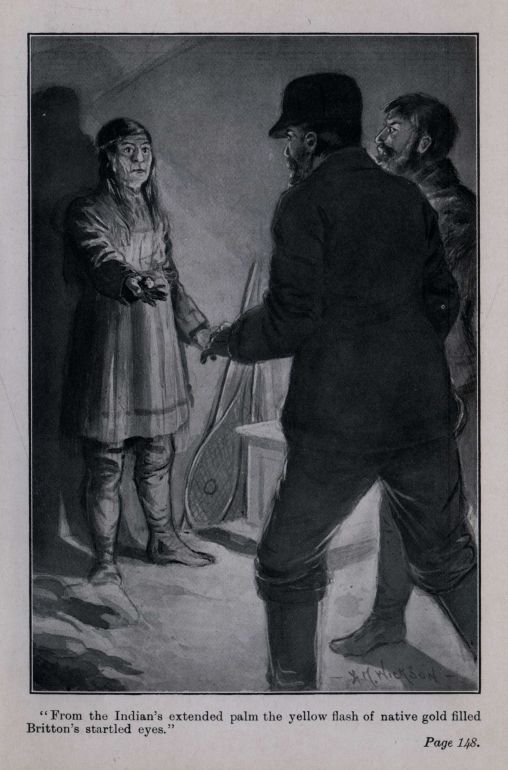
"From the Indian's extended palm the yellow flash of native gold filled Britton's startled eyes."
CHAPTER XIII.
"Gold! Gold! Gold!" screamed the excitable and drunken Corsican, as he danced about the tent.
At the bright gleam of the yellow metal, Rex had sprung forward and grasped the precious specimen from the Thron-Diuck's hand.
"Where did you get this?" he demanded, breathlessly.
A look of cunning overspread the Indian's coppery features, and discolored teeth were displayed in his gaping grin.
"Give fire-water," he said, fawningly, "then me tell."
Britton examined the piece of ore from every angle in the candle-light and recognized a wonderful sample of alluvial gold. It weighed probably eight ounces, and Rex trembled in excitement not to be repressed. There was no doubt of its origin, and he knew that the carousing rascal must be speaking the truth. The glacier-worn edges of the specimen told that it had come from a heavy deposit, a place of "big gold."
"Where did you get this?" Rex hoarsely repeated, his hands shaking as if weighted down with golden pounds instead of ounces.
"Bring whiskey, then me tell where heap much gold come from," was the Indian's laconic response.
"No, you won't," said Britton. "You'll tell first, and then you may have the fire-water."
He dived into a small kitty-bag wherein he kept some few medicinal mixtures, whipped out the solitary flask, which he was accustomed to carry against a possible dire emergency of the rigorous trails, and held it enticingly before the candle flame.
The liquor sparkled in the light, and the poor red wretch smacked his lips and clawed at it. Rex held him off.
"Afterwards–afterwards," he said with decision.
"Ha!" exclaimed the tantalized Indian, "go heap long way up the White River–"
"The Klondike?" interrupted Rex.
"Yes, as you call, Mis'r," answered the Thron-Diuck, gesticulating frantically with lean, bony fingers like talons. "Go heap way up Klondike; find ice-hills with much frozen springs; there big gold where him be!" His claws pointed at the sample in Britton's fist.
"You mean the headwaters of the Klondike–its source?" questioned Rex, earnestly. "You're sure of that? For heaven's sake don't make any mistake!"
The Indian shook his whole body and stamped in anger.
"Me no mistake," he declared. "Me no lie. Go heap way up where you say, Mis'r, to–to–"
"To the headwaters," prompted Britton.
"Yes, to big chief waters! There five hills like heap big beaver houses all by one dam. White River run through. There place of heap big gold!"
Rex wiped the beads of perspiration from his forehead.
"This is the way I understand you," he said. "Listen and tell me if I'm right! The place lies straight up the Klondike at its headwaters, right in the middle of five beaver-house hills which the stream cuts through. Is that correct?"
"Right, heap right," replied the Thron-Diuck, overjoyed at being properly understood. He reached for the whiskey again, but Britton was not yet done.
"Wait till I draw a sketch," he said quickly, "and you shall mark these hills in the exact spot."
Rex found his map of the Klondike River in his breast pocket and drew the stream on a larger scale upon a sheet from a notebook. At the river's mouth was a deserted Indian village, lately occupied by Thron-Diucks who had moved back into the fastnesses of the snowy mountains, and no other trace of habitation marked the frozen waterway, which lost itself in bleak heights away to the north, unexplored except by Indians and a few venturesome white trappers.
"Now," said Britton, when he had outlined the sketch, "show me exactly where these hills stand from the source or headwaters of the river."
The Indian touched his talons to the drawing just below a group of low mountains, named on the map the Klondike Hills.
"How far below?" Rex questioned very earnestly.
"Half day, as you call, Mis'r," the Thron-Diuck answered. "Half day with heap good dogs!"
"So?" cried Britton, warming to the scent of the treasure. "How many hills on this side of the stream?"
The Indian located three with as many dabs of his skinny forefinger and showed where the other two hills lay across the river. Rex marked them with small circles, mentally calculating by the scale their distance from the source and thus knowing their position at least approximately.
The Thron-Diuck regarded his handiwork with satisfaction.
"Heap right," he said triumphantly, "Mis'r heap smart man! Give fire-water, Mis'r; you got much big gold!"
Rex passed over the flask without further parley.
"Yes, it's yours," was his final word, "but heaven help you if you have deceived me as to the position of this stuff!"
Lessari lurched forward to share the Indian's draught, but Britton pushed him rudely back upon his bed.
"You go right to sleep," he ordered, "and get fit for the trail in the morning."
Rex sat beside him to enforce the obeyance of the order till the Corsican dropped into slumber, while over beside the camp stove the Thron-Diuck lay in stupefaction.
The thermometer registered forty-eight below when Britton and Lessari mushed out of the North Samson valley at sunrise. The Indian, now partly sobered and conscious that he had sold a well-guarded secret of his tribe, promptly proceeded to efface himself despite the inducements Britton offered him to act in the capacity of guide, so that the two travelled alone.
As they advanced upon the lonely trail which snaked northward to where the Klondike's source was somewhere hidden in unknown hills, the atmosphere grew keener with intense cold. A merciless, cutting frost fell in fine showers till the two men were covered with a hoary coating which scintillated like glaring tinsel. The icy powder stopped their ears and choked their nostrils, chilling every breath they took.
Lessari unfitted by his natural temperament for such a climate as the Yukon, had always found his respiration labored in winter, and, since he had contracted a severe cold from his soaking in Lake Bennett, his plight was now worse than ever.
Owing to the pressure on his chest he was forced to breathe through the open mouth. Britton pleaded with him not to do this, but the finer fibred Corsican could not endure the strain on his nasal passages and relapsed into breathing between parted lips. As a result, he soon chilled his lungs and began to cough with a dry, hacking sound which Rex heard with foreboding dread.
The mercury dropped lower with every mile they mushed. Icicles formed on their eyebrows, noses and chins, while thin films of ice encased their cheeks, prohibiting any speech.
A thickness of hoar-frost decorated the loaded sled, and the hairy backs of the five dogs were white with it. At intervals they shook themselves roughly in the harness, sending ice particles flying in all directions.
Mingled with this rattle and the grinding song of the sleigh was the leader's "gruff! gruff!" as he blew the congealed snow from his nose.
Camp was made at noon outside an immense ravine which Rex knew by hearsay to be the great cañon of the Klondike. After an hour's rest and a good meal they entered it, finding a precipitous-sided gorge of stupendous size and beauty.
The gigantic gray walls, seamed and full of wide cracks, sloped upward, forming an almost complete arch overhead that admitted a dull glow of light to mingle with the white sheen of the ice below. Great icicles hung by thousands from the rock-crevices, while eternal drippings through the cavern-like roof had formed immense ice columns resembling unsmoothed marble pillars.
The scene before Britton and Lessari looked like a weird, uncanny ice forest full of frozen trunks and clammy, oozy nooks where underworld spirits and grotesque goblins might be expected to reside. The hollow booming of the mighty river, straining in its imprisonment, filled the whole place with a resounding roar, and the force of the fettered torrent shook the coated cave walls till the icicles fell and scattered their rainbow hues upon the floor.
Rex thought this cañon was the most potent symbol of a potent land that could be imagined. It impressed him vividly with the awesome magnitude, the salient ruggedness, the terrible power of the country of which it was an emblem.
His dog-train swayed with shrieking runners among the massed ice-pillars and emerged from the gorge into a wider valley where the hills rose naturally bright in the sunshine with the welcome blue sky resting upon their peaks.
Britton could see that the Klondike River was the main recipient of the long trains of ice which slid with snail-like motion from the crests of the glaciers. Frozen gullies full of these moving, mile-long torrents broke in upon the larger river and piled the junction points full of massive, chaotic ice-bridges which were painfully difficult to cross.
Lessari stumbled upon one huge jam and went down among the sharp, crystal fragments. He gasped when he regained his feet, and the dry, hacking cough became more convulsive. Seeing that he was nearly spent, Rex beckoned for a few minutes' halt, though having hopes of reaching mountainous shelter before nightfall, he did not wish to delay very long.
While they rested on a high ice-bridge quite a distance above the Klondike Cañon, they heard a thin, hissing wail far back in its depths.
"Sled!" exclaimed the listening Corsican, breaking into speech without thinking of the consequence.
At his effort the icy casing which covered his cheeks snapped in showering splinters, gashing the skin in a dozen places. He groaned in pain while the blood trickled down his face.
Britton thawed his mouth free by the warm pressure of his fur gauntlets.
"You're right, Lessari," he said. "It sounds like a dog-train coming through the cañon. Surely that cursed Indian hasn't been spreading the news! Or perhaps someone has trailed us from Samson because they think we know of a find up this way."
Britton's tone was angry as well as disappointed. He had not undertaken the dangerous and arduous trip up the Klondike for the purpose of showing the way to some trailers who might contest the ground with him. If any rough characters were following because they suspected he had knowledge of a gold deposit, Rex knew he would have to fight for what he found, and fight, no doubt, with the odds against him.
"We'll wait and see who is tracking us," he grimly observed to Lessari.
The whining sound of a dog-train continued, borne through the cold void with clear persistence. Rex strained his eyes on the distant mouth of the cañon to mark who came out, but he watched in vain. The noise ceased as suddenly as it arose, and though they dallied another fifteen minutes, nothing could be seen.
"That's odd," commented Britton. "Wasn't it a dog-sled, Lessari?"
"Sound like him much!" answered the Corsican, in an awed voice. He was somewhat superstitious, and he nursed his cut face apprehensively, as if it were responsible for the strange incident.
"I could have sworn to that as the shriek of runners," Rex declared, "but it may have been ice. In any event we can't stop longer. Ho! there–mush, mush!"
They forged on, climbing to a still higher altitude and meeting with a frigid air that reached to the very marrow of their bones. Lessari weakened, and Britton made him take to the sled for the rest of the afternoon while he himself continued his heart-breaking tramp beside the dogs, surmounting all obstacles, no matter how formidable, with that intrepid grit and unbroken muscle-strength which was his heritage.
The short, sub-Arctic day closed in swiftly, shrouding everything with a heavy fog, and night caught the two travellers among the black river boulders.
It was a desolate place of incomparable bleakness in which they were forced to camp, but when the stove was set going inside the pitched tent and they had infused some heat into their frost-tried bodies, the outlook seemed more cheerful.
The next day saw a repetition of their hardships and trials. Lessari declared himself strong enough to keep his feet, but Britton forced him to ride behind the dogs. The Corsican lay wrapped in robes, and the spasms of coughing that wrenched his frame told about how fit he was to travel the trail afoot. There were places so rough and so hard to scale that he could not stay upon the loaded sled while the dogs dragged it over. At such points he was compelled to walk, and Rex had to assist him.
They had penetrated into the timbered regions which flanked the Klondike, and the way grew wilder although there was some solace of shelter. According to Britton's estimate of the Thron-Diuck's directions the place of the five mountains could not be many miles distant, and, even in that soul-chilling waste, his blood warmed every inch of his body when he thought success might soon reward his strenuous stampedes.
With the reaching of the forested stretches, grizzly tracks were seen in profusion, indicating that these hungry prowlers were finding the severe weather very hard, for they had covered vast distances in search of food.
As they traversed mile after mile, making rapid progress without hindrance of blistered ice, Britton began to think that his hopes of camping that night among the five beaver-house hills would be realized. Every time they rested for a moment to give the dogs a breathing spell, he eagerly scanned the sketch which he had made. From the contour of the river and the position of the mountains he tried to judge exactly how far he had advanced. Each scrutiny, thus indulged in, gave fresh hope and assurance, and he would dash on with greater speed than was generally attained on the Fields.
The steep granite headlands gave place to more sloping bluffs, and when Britton's dog-train swept round the river's curve past the first long belt of pine forest, there loomed at a probable distance of six miles the tops of five hills set in a circle.
"It's the place," he shouted joyfully. "By heaven, it's the place–Lessari!"
But Lessari, his endurance worn out by the continual jolting, had rolled from the sled in a dead faint. He could not be revived easily, so Britton had to pitch the tent, light a fire, and attend to him.
The Corsican came to, weak and trembling, and when Rex had given some nourishment, Lessari looked at him with dazed, troubled eyes.
"I am much sorrow," he said confusedly. "Your journey I spoil! Put me on the sled, and it somehow we can reach."
Britton felt a twinge of conscience for a selfish wish as he heard these words from a man who was courageous to the core though obviously unable to continue.
"No," he gravely replied, "you haven't spoiled the journey. We can well rest here and go on to-morrow. Make your mind easy, Lessari!"
The Corsican, still lamenting the check to their advance, fell into an exhausted sleep, while Britton, the selfish desire recurring involuntarily within him, chafed silently as he watched from a distance the peaks of his far-sought gold Mecca.
CHAPTER XIV.
Five dead dogs, their stark bodies clearly outlined on the snow by a sparkling aurora, met Britton's startled gaze when he stumbled sleepily out of the cramped quarters of the tent. A cry of something like despair escaped him as he ran to examine them, turning the gaunt carcasses over and over.
Lessari heard the shout of perturbation and shuffled forth from under the flaps.
"What wrong have you?" he asked anxiously.
Rex stood aside and showed the corpses of their faithful animals.
"They're killed," he said briefly, "and you know what that means for us!"
White horror grew in the Corsican's brown face till it was blanched to a sickly hue. He fully realized that the loss of the dog-team had buried them alive in a frozen wilderness whose relentless cruelty would slowly crush their lives. In a dazed way, he fingered the bodies.
"Not any marks–not any marks," was his vacant observation.
"No," agreed Britton, who controlled himself with difficulty, "they have been neither knifed nor shot, yet some man's hand has done it. Gaucho and the rest of the huskies appeared as well last night as they ever did. No, Lessari, it wasn't an epidemic or even the bitter frost."
"How they are killed, then?" the Corsican inquired petulantly.
"That's the mystery," Rex woefully ruminated, aloud. "I wonder if that snake of a Thron-Diuck followed us and perpetrated this deed! You remember we heard what we thought was a dog-train coming behind us through the Klondike Cañon?"
"Ah! yes," responded his companion, "that I recall–curse him!" Lessari's eyes were vindictive and full of a strange wildness as he stared at Britton.
"Of course that is only a supposition," said Rex, judicially, "but I know how jealous the Indian tribes are of gold-laden creeks. The Thron-Diucks know a good many secrets, but they will not divulge them, and fearing the wrath of his fellows if we located on this deposit, the red wretch may have repented his bargain and taken steps to prevent our profiting by it."
"Look for tracks!" exclaimed the Corsican, on sudden inspiration, but Britton shook his head.
"No use," he lamented, pointing to the pine-banked curve of the river, shining like glass, "the ice is too clean!"
"Curse him! Curse him!" exploded Lessari, again, growing more violent of speech.
"There's no use in cursing, either," Britton said seriously. "We're facing death, Lessari, but we must keep alive as long as possible. We have a tent and some food, and we'll make a strong fight."
The Corsican studied his dubious expression. "Go back?" he asked.
"It can't be done," said Rex. "Our provisions will not last half the time required to make the journey on foot, and there is nothing to shoot over those barren stretches."
"Go on where gold is, then?" Lessari inquired dismally.
"Yes," Britton answered, "our path lies over those five hills. We have only two chances, Lessari, and they are mighty slim! There is the chance of stumbling on the encampment of these Thron-Diuck Indians–they have retired somewhere in these mountains–and the possibility of finding game in the pine forests. The way lies yonder, and, if we find gold there, we'll stake it in case a miracle should bring us out of this trap."
Rex stirred the nose of his dead leader with the toe of his shoepack as he finished speaking, and Lessari saw him bend quickly.
"See that!" Britton exclaimed in quivering anger. He held out something between his fingers, and the Corsican recognized a piece of frozen whitefish covered with reddish powder.
"Poisoned!" he ejaculated with renewed horror.
"Yes, someone has fed them poisoned whitefish," said Rex, vehemently. "Gaucho had this in his teeth!"
Lessari broke out in a flood of denunciation. Britton quelled his own indignation and began untying the tent-ropes.
They thawed their canvas shelter from the banked ice and snow by means of several brush fires and loaded the sled. Any articles which could be dispensed with and which unnecessarily impeded them were cast away. The outfit was reduced to a minimum, and Rex packed all the remaining provisions carefully in one large sack. He preserved, too, the food intended for the dogs, for he thought they might easily find themselves in such straits as to be glad of it.
When all was securely lashed on the heavy Yukon sleigh, the two men harnessed themselves in the traces and started laboriously toward the circle of hills six miles away. For Lessari, they were six long and excruciating miles. He was weak and unfit, and though Britton took the heavier portion of the toil, the tramp told rapidly on his companion.
The river curved with such a sweep that they struck overland to shorten the distance. They bridged wide gullies full of blistered ice and swerved erratically with the loaded sled among rugged rocks and slippery hummocks that barred their path. Lessari continued to mutter and complain during the whole six miles, his mumblings toward the end becoming somewhat incoherent.
When they slipped down a long ravine which opened on the river right in the middle of the circling hills, the Corsican was staggering along with protruding tongue.
"You're fagged!" Rex exclaimed, noticing his plight. "Better rest here a minute!"
Lessari's answer was a vicious pull on the sleigh rope that nearly took Britton off his feet. They moved on because the Corsican would accept no delay, and Rex saw that the other's motive power was a sort of delirium which instilled unlimited feverish energy.
The pair of toilers emerged at last from the black rift and climbed an ice-capped ridge which fell like a sloping watershed in a southward direction. Around them the five beaver-house mountains rose strangely dome-like, the great river apparently losing itself in the bowels of the thousand ice chasms which furrowed the base of the valley-beds.
"This is the Klondike's source," Rex murmured as he contemplated the scene, "and it looks cold enough to kill you."
"Yes," sighed Lessari, "you have it right. But the gold–the gold is warm. Here I feel it!" He put his hand to his breast, and smiled contentedly.
"It's all that's keeping you warm," Rex gruffly commented. The observation quickly altered Lessari's expression, and he glared with a wild impenetrable look as they proceeded to skirt the fringing line of gravelled granite which was the shore of the now glacier-like stream.
Here the detached ice lay scattered about in huge blocks, an impediment to their feet, where it had glided with the shining rubble from the farther plateaus. In the shallow cup that the five hills formed, they met with a long, treacherous crevasse whose yawning depth of three hundred feet effectually cut off any further progress in a direct line. The great abyss seemed to possess a fascination for Lessari, and he trod dangerously near the edge to peer over.
"Don't do that!" Britton sharply cautioned, pulling him back. "A slip of your moccasin would put you at the bottom. We'll have to leave the sled here and see if there is any way round!"
The immense crevasse dipped from an overhanging glacier on one of the five mountains and slanted across the granite ridge they had been skirting. The two men left the Yukon sleigh standing, blocked, above the deep split and followed along the edge, searching for a place to cross. The slant of the ravine became more, acute, and, where the sides were jagged and shelved, they clambered down lower and lower till the whole formation suddenly broke upon a vast cavern that nosed into the river-bed and opened on the other side where the way was passable though extremely hard.
"It's rough going, but we must get across," Rex said, turning round to Lessari.
The latter was handling some rusty-looking pebbles which he had kicked out of the black cavern floorway.
"Ironstone!" he grunted scornfully, gazing at the cave side where similar fragments with glacier-worn edges stuck out.
"Let me see," cried Britton, hastily jumping forward. Lessari dropped the stones in his hand, and Britton's heart leaped at the weight of them.
"Ironstone!" he exclaimed, his voice all trembling. "My God, Lessari, it's gold!"
"Santa Virgin!" the Corsican screamed–"Gold!" He snatched frantically at the precious pebbles, chattering madly.
"I'm positive it is," Rex said excitedly, "but the flame-test will soon tell."
He produced a bit of candle from his coat and lit it with unsteady fingers. While Lessari held the specimens, he applied the flame to them. The heat singed the Corsican's hands, but he did not seem to feel any pain. Presently the rusty red covering of the pebbles disappeared as fine dust in the blaze, and Lessari gripped pure alluvial gold.
"Santa Virgin!" he screamed again. "We're rich! We're rich!"
Rex was off immediately, running about the cavern walls, making a hasty survey with his candle end. The walls, like the floor, were studded here and there with peeping corners of the precious ore for which he had endured two thousand miles of pitiless Yukon trails. Unbounded wealth lay within his grasp, and, with the triumph of the moment, he forgot that he was a millionaire in a death-trap.
"Go up for a spade, Lessari," he cried. "It is a mighty deposit–'big gold,' as the Thron-Diuck said."
The Corsican started up as a faint, rushing noise sounded above, like ice sliding upon ice.
"What's that?" asked Britton anxiously.
They listened, but heard no further echo. Rex appeared ill at ease.
"We're among glaciers, Lessari," he said, "and we must be careful. An avalanche might easily bury us in a hole like this. Get that shovel quickly!"
Lessari climbed up the lip of the ravine and disappeared, while Britton pottered about, speculating, as well as exulting, over the magnificent find. It was a showing that gave promise of surpassing such far-famed creeks as the Eldorado and Bonanza, and Rex gloated over his prospects. Standing in that deep cavern under the Klondike's bed, his thoughts went back to the green Sussex lands, Hyde Park in the London season, and the foaming Channel swells under the Mottisfont's bows. He thought of the estates this buried gold would buy, the power it would bring, the restoration to public favor it would effect, and he laughed mirthlessly at the idea of purchasing his way into quarters of society and diplomacy which had closed their doors to him after his Algerian escapade.
A shrill cry from Lessari above interrupted his cogitations. He scrambled out of the cavern and clawed his way up the slippery side of the rift.
The Corsican was staring down into the abyss where they had left the sled. On his face there rested a look of terrified bewilderment, and he pointed into the gloomy depths.
"Gone!" he wailed–"gone down!"
Britton looked around for the sleigh, but it had vanished. A sharp fear assailed him as he dashed to Lessari's side and saw the mark of the runners on the powdered edge of the ravine where the laden sled had taken the leap.
"That's what we heard slide," Rex groaned, "and it has all our food!"
He went mechanically to the exact spot where the Yukon sleigh had stood. There lay the piece of granite which had blocked the runners, with the print of a husky's foot-pad in a minute snow-pocket at its side. Rex showed it to the Corsican, a swift, ominous wrath mantling his countenance.
"By heaven, Lessari, this is too much!" he cried. "It has been done purposely like–like the poison! There's a hand in the dark somewhere, and it means murder!"
The Corsican's harrowed senses appeared incapable of comprehending the statement.
"Starving–and rich!" he muttered wildly. "Rich–and starving!" He walked without fear to the brink of the chasm and began to lower himself over the rock with his hands.
"Here!" Rex roared in terror, rushing up. "What do you mean?"
"Stay back!" snarled the Corsican. "I go down to eat."
"The gold has turned your head!" Britton exclaimed. "You couldn't get down there for all the food on earth. Why, man, it's three hundred feet!" He sprang with a lithe movement and dragged the Corsican from his perilous position.
Lessari gave an inhuman cry and closed with Britton. Rex saw his eyes as they struggled and knew, with a feeling of chill horror, that they were the eyes of a madman.
"Ha!" gasped the demented fellow. "This time you go!"
He strove to throw Britton into the gulf, for resistance had resulted in giving his mania a different trend. The delirium gave him the strength of six men, and Rex found himself being gradually pushed into the crevasse. He strained and tugged with all the mighty power of his shoulders and corded arms, but it was of no avail against the frenzied Lessari. He tried another tack!
"Cool yourself, Lessari," he said soothingly, "and we'll get this sled." They could never get it, but he hoped the artifice might serve! Even that attempt at reason proved useless, for the Corsican redoubled his efforts. The eternal cold, his illness, the death of the dogs, the fever of the gold-finding, and the loss of their provisions had all combined to drive him mad.
"Devil!" he screamed, "you threw the food down!" And Rex knew he was indeed demented.
Fighting every inch of the way, Britton was forced toward the abyss. Three feet from it, he felt the necessity for desperate action. Watching his opportunity, he tripped Lessari on the iced rock, and they both fell heavily. Rex wound his arms about the Corsican, putting forth the last ounce of strength; that grip of steel would have held a giant, but it could not hold a madman. Lessari tore himself free and gained the uppermost position, with hands on Britton's throat.
Rex gazed into the rolling eyes, the wild, distorted visage of the Corsican, and felt himself shoved to the very brink of the crevasse. He wrenched violently at Lessari's wrists and arms, but they were as iron rods, and the movement brought his head out over the rim of the rock.
In one fleeting vision he saw the white, rising ice-fields cutting into the blue sky, with glacier-capped peaks banking up behind; he saw three of the five circling hills, their frozen gorges shining emerald in the sun; then, as Lessari's wolfish face came closer to his own and his arms were pressed down, the fingers felt the revolver butt in his belt.
In sheer despair he grasped it as a drowning man snatches at an oar. Its report cracked out and rattled in a hundred blatant echoes down the gorge. Lessari uttered a gasping groan and lurched to one side, his fingers lax and weak.
Britton wormed his shoulders back from the edge of the abyss, shifting the Corsican's weight with his legs, and arose in safety. His lungs were heaving with the tremendous strain like those of a spent Channel-swimmer, and the cords of his throat were taut.
When he turned over the limp form at his feet, he looked into Lessari's dead face.
CHAPTER XV.
Back in Dawson, on the evening of the same day when Britton stood alone with the awful Klondike solitude at the edge of Five Mountain Gulch–as it came to be named afterwards–when he faced at once the icy phantom Cold, the grisly skeleton Starvation, and the devil-faced thing Remorse, when he halted with death at his feet and its dread power pervading the desolate snows about him, there occurred, in the golden city, a strikingly different scene, a scene palpitating with warmth and life.
A group of men, present at Grant Simpson's invitation, occupied one of the ground-floor rooms of the Half Moon restaurant, engaged ostensibly in doing justice to a very elegant and costly supper, but really killing time in a luxurious way and waiting anxiously for the bell-note of business which they knew their host intended to ring in on them.
Simpson, with his accustomed lavish expenditure, had engaged the room to the utter exclusion of other guests who might have dined at two of the three tables which the chamber held; he had ordered that the trio of tables be lined up and converted into one long feasting board which could be covered with fine viands and drinks–principally drinks! The catering was let to the hostess of the Half Moon, Aline Giraud, who was a genius of management, all the more so since Pierre's absence on the trails left every responsibility in her hands. That night she expected him back from the completion of his baggage-freighting contract with Laverdale, the big American mine-owner who was bound for Dyea and the States, and Aline wished to have everything right. She wished the supper that this well-dressed, money-burning lawyer was giving to be a thing beyond criticism, and her every effort was devoted to making it so.
And the bill! She told herself the bill would be the best of it all. It would be a thing to cheer Pierre's heart and cause him to dance, with his cap thrown among the ceiling festoons.