THE SQUAW MAN (continued 4)
Reading edition
Across the river, towards the west, the same desolation met the eye. Even the sage-brush and scrub-oak seemed to have abandoned life in despair, and the Bad Lands stretched lifeless to the foot-hills of the snow-capped Uinta peaks. Even more poignant than the cruel ugliness of the place was the feeling that the great gaunt bird of failure brooded over the entire ranch.
As Bill clumsily twisted the braid the child eagerly watched him.
"Is it for me, sure, Bill?" he asked, as he slid close to the big fellow.
"Yes, old man," Bill answered, as he stooped to pat the dark head. "This is going to be for you, and there ain't any old cow-puncher can beat Bill making a quirt. No, sirree."
While he talked lightly to the child his mind was busy with unpleasant thoughts. The boys were about to strike for their money. Their wages had been overdue for some time, and the boss, finally driven to the wall by disease among the cattle, had been unable to satisfy them. So far there had been no outbreak, but Bill expected it every moment.
For days Jim had hardly spoken. That there was some important decision about to be made by him, Bill guessed. He sat and played with the child, but in reality this was only a ruse by which he might keep close to the place and await developments. From down the road he could hear the men coming and calling to him, but he gave no sign. He went on knotting the strands, and steadied little Hal's hands when the child grew tired of holding the quirt.
Shorty was the first to arrive, carrying his Mexican saddle and lariat. On his diminutive face was stamped an aggressive pugnacity. He was followed by Andy; Grouchy slouched in last, whittling at a piece of wood. As Bill surveyed them he knew that they had been talking things over and had arrived at some conclusion. They had been good workers in their time with him, and he knew even now, at heart, that they were not bad, but that life had tried them severely with its failures and disappointments. He waited for them to speak. There was a moment's silence, then Shorty, as he flung himself down on the bench, said:
"Say, Bill, I s'pose you know the boys is gettin' nervous 'bout their money, don't you?"
Bill just looked up, and then went on with his work as he answered, "To-morrow's pay-day." He would not anticipate them in their rebellion; he would make it hard for them to declare themselves.
"That's what," Shorty went on.
"Well, it's time to get nervous day after to-morrow." And still Bill braided the leather.
"They're goin' to make trouble if they don't git it." Shorty acted as spokesman. Grouchy and Andy only nodded their heads in approval of their leader's words.
Bill stopped his work as he picked Hal up in his arms. "Are they?" he said. "Well, I reckon Jim Carston and me can handle that bunch." He spoke as though the others were not present.
"Maybe you kin; maybe you kin," Shorty retorted, as he flung the saddle against the walls of the cabin.
"Und say, Bill—und say—to-morrow's pay-day." Andy's voice trembled as he spoke. He was a gentle-mannered German, and the sight of Hal was not a good incentive for him to fight against the boss.
Hal began to listen and to look from one to the other. Bill noticed the child's look of inquiry and set him on the ground.
"Son, you run in and help your mother with the milking." He slapped his hands together as though a great joy were in store for the child, who laughed with glee as he hurried across to the stable.
The men waited for Bill to say something, but he only stood twisting a straw about in his mouth and pulling his hat-brim.
Again Andy's courage rose and he walked close to Bill. "To-morrow's pay-day, Bill—eh?"
"Is it? Do tell! Ain't you a discoverer! Say, Andy, you're neglectin' the north pole a little."
This time it was Grouchy who answered, "Well, I want mine," and he viciously dug his knife into the hitching-post.
Bill looked from one to the other. Surely they would be reasonable; he would try them.
"Boys, it's seven years since the boss bought this ranch, and he's had an up-hill fight. Every one's done him. He bought when cattle was higher than they've ever been since, and you know what last winter did for us; but he 'ain't ever hollered, and the top wages he paid you at the start he's been a-payin' you ever since."
"Oh, what's the use!" Shorty interrupted. "The money is owed us. The only question is, do we git it?"
Backed up by Shorty, Grouchy began again, "Well, I want mine."
Only gentle Andy was silent. He could hear little Hal laughing as he played in the cow-shed.
Bill dropped his persuasive tone as he wheeled around on the men and in a sudden blaze said:
"Well, you know Carston and you know me. If you're lookin' for trouble, we won't see you go away disappointed." He squared his shoulders as he spoke. "Oh, shucks!" He looked at the boys again. "It's no use," he began, more good-naturedly. "It's the business that's no good. Nothin' in it. The packers has got us skinned to death. They pay us what they like for cattle, and charge the public what they like for beef. Hell!" he grunted, as he turned on his heel. "I'm goin' into the ministry."
This time Grouchy's "Well, I want mine" was extremely faint.
Before the others could speak again Bill quickly called, "Here's the boss now," and signalled the men to be silent.
They were touched by Jim's haggard face. They had not seen the boss for several days; he had been busy with accounts, Bill had told them. They began shuffling their feet as though about to leave. Each one thought perhaps it would be as well to wait until the next day. Shorty signalled them to come on, but Jim stopped them.
"Boys, I hear you're getting anxious about your pay. I don't blame you. My affairs are in a bad way, but I don't expect any one to share my bad luck. You've earned your money. I'll see that you get it."
As Jim spoke he drew from his pocket several small boxes and from his belt an old wallet. "I have some useless old trinkets here that have been knocking around in my trunk for years. If you will take them to town, where people wear such things, you will get enough for them to wipe out my account and something to boot for long service and good-will." Andy's sniffles were the only answer that followed. Jim turned to him, "Andy—"
But Andy refused the package. "Und say, boss. Und say, I ain't kickin'. Und say, I can trust you."
Jim only tossed the box into his hands. "Shorty," he said, as he slapped the wallet across the little fellow's shoulder.
"Oh, I'd rather not," Shorty shamefacedly answered. "Gee, but this is tough work," he muttered to himself.
Jim smiled. "You must take it, please. The man who refuses throws suspicion on the value of my junk. You won't do that, I'm sure." And the wallet slid into Shorty's hand.
"Grouchy, you can have my repeating rifle," he added. "And now, good-night. I'll see you to-morrow for the last time."
So this was to be the end of their association with the boss. Would he try to shoulder the work of the place without them? A second's reflection told them that this would be impossible. It was to be really the end of Carston's ranch. The three men stood staring at Jim. Bill, at the back of the hut, as he heard the words, sank down on a rough bench. This was what had come of the days of silence on Jim's part; in each man's heart there was an unspeakable emotion at the dissolution of their companionship.
Suddenly down the road they heard the clatter of horses. Then the whoop-la of a crowd of men, and a stentorian voice called:
"Hello, any one to home at Carston's ranch?"
Shorty and Andy hurried to meet the new-comers. It was Bud Hardy, the Sheriff, with a posse of men. In they rushed, swarming all over the place, and carrying with them the smell of alkali and the heat of the plains. Dripping with perspiration, stained and worn with their travel, they seemed like part of the desert, so covered were they with a heavy caking of dust. One felt the parched fever of their thirst as they stood asking hospitality of the ranch. Jim advanced to meet them.
"Hello, folks," Bud called, as the men of the ranch welcomed his men. Then he came towards Jim, who shook hands with him.
"Why, how are you, Sheriff?"
Since the day at Maverick, when the Sheriff had tried to arrest him, Jim had often seen Bud. He was never sure of the honesty of the man's intentions, ne and Big Bill had often discussed Bud's unfitness for the power he held in the place, but he gave no sign of this in his greeting.
Bud's great frame towered above the others. He seemed more effusive and excited than the occasion warranted, and Big Bill's brows rose questioningly as he saw the demonstrative way in which he greeted Jim.
"Howdy, Mr. Carston—howdy? Knowin' the hospitality of this here outfit, we most killed ourselves to git here, to say nothin' of the horses. We left them leanin' up against the corral, the worst done up cayuses." Then directly in appeal to Jim, he said, "We simply got to stay here to-night, Mr. Carston."
With a cordial gesture of invitation, Jim said, "You and the boys are welcome, Sheriff, and what we lack in grub and accommodations we'll hope to make up to you in good-will."
As Jim spoke, Bud quickly glanced in triumph at Clarke, a prominent worker in his posse. The pale face of Clarke gave back a glance of comprehension as he lowered his white-lashed eyelids over his bulging eyes. All this was observed by Bill, who sauntered towards the Sheriff as Bud answered Jim.
"What's good enough for you all is good enough for us, you bet," and he wrung Jim's hand again. "Why, hello!" he finished, as he saw Bill and turned to greet him.
"Any news?" Bill laconically asked, as he studied Bud and his men.
"Nothin' of any consequence," said Bud. "We just had a little fracas down at the agency. Total result, one Injin killed."
A shout of approval rose from the boys, but Clarke broke in with another guffaw. "And the joke of it is, Bud killed the wrong man."
"But nothin' to it. All in a day's work," Bud laughingly explained.
"You look tired, Sheriff," Jim said. "The boys will take you to their quarters. Shorty, you and the others make the Sheriff and his people feel at home."
There was a murmur of approval. "Come on," said Shorty, and the men started for their quarters. Shorty, who loved bossing an affair almost better than teasing, swept them all on before him. Then he linked his arm through Bud's.
"Say, Bud, I'll bet you a saddle to a shoe-string you never roped the man who killed Cash Hawkins at Maverick."
Clarke, who seemed deliberately to keep near Bud, gave an involuntary look of surprise at the Sheriff, but the flash of anger on Bud's blowsed, crimson face quickly cowed him.
"Oh," Bud said, lightly, "that was years and years ago, Shorty," and with his arm about him he followed the men towards their quarters.
Clarke lingered to cast a furtive glance at the hut and stables, but only for a moment, for he quickly realized that Bill was intently watching him.
Jim turned to go to the house—then paused. He could see Bill against the hitching-post tearing a straw into wisps that fluttered and fell lifeless to the ground. There was not enough breeze to carry even a strand away. He must speak to Bill, but how could he express anything of the desolation he felt at this parting of their ways.
"Bill," he began, in a low voice—and Bill, who divined the words that were about to follow, made no answer; he only held tighter to the post. He could hardly see the boss; a blur swept before his eyes. He made no effort to move; he felt he could not.
"Bill," said Jim again, as he came to him, "you must get out and look for another job." Jim clinched his hands tight as he added, "I'll be sorry to lose you, old man."
"I know you will," Bill huskily answered, as he kept his eyes lowered to the ground. Then, almost in a growl, he questioned, "And what are you going to do, boss?"
The despair of a broken man's life answered Bill as Jim said, in a level, flat tone, "Sell out—move on—begin all over again—somewhere." Then with the indomitable will that was ever a part of him, he added, more hopefully, "There must be a place for me somewhere." Mastering himself, he added, as he took Bill's knotted hand in his, "I won't offer to pay you, Bill."
And Bill, who knew by this fineness of perception on Jim's part why he loved the boss, answered, "You better not," and wrung Jim's hand in both of his.
"Not now," Jim said, with the old hope again rising to encourage him, that later he might be able to help Bill. "In my life I've had one friend and only one." He laid his hands on Bill's shoulders and looked straight in his eyes.
But Bill could not stand the strain of it any longer. "You make me tired," he gulped, and Jim smiled.
"Why did you pay those cayotes three or four times what you owe 'em?" Bill scolded, gruffly, but kindly. "It's wicked, Jim. You're a sentimental fool."
As though bestowing a final benediction, Jim answered, "And you're another—God bless you," and then dropped on to the log and seemed to forget Bill and all about him.
Bill stood a moment, then tiptoed away while Jim sat watching the afternoon shadows beginning to creep up towards the hut.
CHAPTER XX
Towards noon the next day, Bud sought Jim to ask further hospitality. The horses were still in bad condition, he explained, and he would esteem it an invaluable service if he would allow them to remain another night on the ranch. Jim readily acquiesced. Now that he had taken the final step to sever himself from the ranch, there were many details to be personally directed and settled. Bill and he were often in conference, and the sale could be accomplished within a few days. While Bill worked, he watched Bud and Clarke. Of his suspicion that they were trying to take some unfair advantage, he did not speak. Only his ferret-like glances constantly followed them. And his instinctive distrust was further aroused by a visit from Tabywana.
As he and Jim sat before the house, with a list that Jim was explaining to Bill, Baco, the half-breed who worked about the place, suddenly called in greeting to Tabywana. With his bonnet of gorgeous feathers trailing down his back, his body draped in a blanket, and in his hand the peace-pipe, the Chief entered. "How!" he answered, as he passed Baco. Both Bill and Jim arose.
"Why, hello Chief! Where'd you blow in from?" Bill called.
Again Tabywana answered, "How!"
Jim advanced. "How!" he said. "The peace chief never comes except to do us a favor. Baco, ask him what we can do for him."
As Tabywana pointed to his pipe he spoke to Baco. "He says, 'Let us sit down and smoke,'" interpreted Baco.
"Certainly," Jim answered. His years of living among the Indians had accustomed him to their ceremonies, and the four men crossed their legs and seated themselves on the ground, forming a half-circle. Tabywana began filling and lighting his pipe.
"Baco," Jim commanded, "tell Tabywana that we are always glad to meet him and see him face to face. He is our friend."
Baco quickly translated the message. Tabywana began passing the pipe from Jim to Bill. As Bill puffed at it he said to Jim, "Say, when the old Chief gets as formal as this it means business."
The men, although eager to begin the proposed conversation, did nothing to urge the Indian to declare himself. Both courteously awaited the Chief's information, although both chafed at this delay in their work. When the pipe had been returned to Tabywana he deliberately extinguished the flame, and, holding the pipe under his blanket, began monotonously to speak in his own tongue.
Jim and Bill both tried to follow the words, but their knowledge of the language was exceedingly limited, so Baco translated for them. "He says a stranger has been asking for you in the settlement."
"What kind of a stranger?" Jim asked, his mind turning at once to the sale that was about to be effected. The Indian agent again interpreted the Chief's reply. "One who jumps up and down in his saddle."
Bill smiled as Jim answered: "Oh, an Englishman. What's his business?"
"The Chief says he does not know, but be on your guard."
Bill and Jim exchanged glances. Surely it was not for this that Tabywana had paid this formal visit. But Jim, who knew the wary, slow methods of the Indians, and who felt that something of more importance was coming, looked straight at Tabywana, as he asked, "Is that all?"
Tabywana understood more of the language of his conquerors than he admitted, and quickly answered the question through Baco. "No, something else—very important." Then Tabywana himself added, "Bud Hardy is here."
At these words Bill, who had been listening listlessly, turned sharply to watch the Indian's face. In the crafty, restrained expression he could read the effort at control that the Chief was exercising as he emitted the sentences Baco translated for him to Jim. "That is bad—very bad. Trouble will follow. He says Hardy has been talking and drinking a great deal, and has begun to talk about the death of Cash Hawkins, and Hardy will, he is afraid, soon arrest some one."
Jim did not answer. Tabywana moved a little so that he could watch Jim. His face wore an expression of great curiosity as to how his words would be received by Jim. The Chief had never known the exact truth concerning the killing of Cash Hawkins, but he had often guessed that Nat-u-ritch and Jim did. Jim did not answer. Bill spoke to him as Baco, having performed his duty, sank back and began playing with some straws.
"Jim, the old Chief is trying to tell you that Hardy has been bragging that he was going to arrest the fellow that killed Cash Hawkins." Jim gave no sign that the news in the least disturbed him.
"Tell the old Chief it's the fire-water that's talking."
Bill sank deep into a reverie. So Bud was up to some devilment—but what? Then he heard the words:
"The Chief says that Hardy is no friend of yours," and Jim's quick reply, "Tell the Chief I didn't kill Cash Hawkins, so I'm not afraid of arrest." Jim smiled reassuringly at the Chief, who constantly watched him. After all, what could Bud do to Jim? "He's a blow-hard, anyway," Bill muttered.
Jim was about to rise and end the interview when, looking cautiously about him, Tabywana began speaking in a lower tone. Baco translated without pause the thoughts that were troubling the Indian. "The Chief thinks that Hardy thinks that maybe Nat-u-ritch killed Cash Hawkins."
Jim only let slip the word "Nat-u-ritch," but his eyes quickly sought the Indian's, and in them he saw there was fear for the woman. To Bill this seemed nonsense. There had never been an atom of suspicion attached to Nat-u-ritch, so he lightly dismissed the idea with a laugh as he said, "Bud must have been unusual drunk." Bill had never understood the affair. He now began to feel the old suspicion creeping back. Had the boss, in self-defence, done the deed? If so, he must keep his watch all the closer on Bud and his men to see that they left the ranch as quickly as possible.
Jim quietly and calmly gave this answer to the Chief:
"So Bud thinks Nat-u-ritch killed Cash. Why, there isn't a scrap of evidence pointing towards Nat-u-ritch. Ask him what makes Bud think so." This time Jim listened intently for the answer.
"He says he doesn't know. But that Bud Hardy is bad medicine, and he wants you to make Bud Hardy move on to the next ranch."
Bill grunted his approval at this.
"That is impossible. The Chief knows that we cannot refuse shelter to the white man."
Bill this time upheld Jim's attitude in maintaining the laws of the place as he added, "Even though he is a bad man."
Tabywana looked from one to the other. There was a piteous look of baffled hope on his face. In his heart he was wishing that they would not take his words of wisdom so lightly, but it was difficult to explain more to them. Despairingly he offered further advice, and Baco repeated it for him, but Jim answered:
"The Chief knows that the rights of hospitality are sacred. Besides, I do not anticipate any trouble."
He rose to his feet. He would be extremely wary of Bud Hardy, but he felt no great concern. The affair had passed for five years, and it was simply some drunken bravado on the Sheriff's part that had frightened the old Chief. He laid his hands on Tabywana's shoulders. For Nat-u-ritch's father he had a tender regard, and the generous tolerance he had for, and the defence he constantly made of, the red man's rights, caused Tabywana to lay aside all cunning in his dealings with Jim, and to completely surrender his affections to him and the tiny child.
"Baco, tell Tabywana that no harm shall come to Nat-u-ritch while I live, and say to the Chief he is a good friend and I thank him for coming, and I would like him to accept this tobacco."
The eternal child in the Indian answered the last words, as Jim handed him the gayly embroidered pouch, with a quick smile and nod of appreciation. He was about to protest further, however, when Shorty interrupted them as he came running in. "A stranger out here wants to see the boss."
Ah, this was about the ranch, no doubt, so Jim said, "All right, Shorty, bring him to me."
"All right, boss."
"Bill, show Tabywana on his way," Jim directed, as the Indian seemed loath to leave him. "Adios amigo," he called to Tabywana, as Bill gently pushed him away. Baco followed him.
"I beg your pardon. I am looking for Mr. Carston."
Bill amusedly surveyed the new-comer as he answered, "There's Mr. Carston," and as he disappeared behind the house he muttered to himself, with a backward glance at the visitor, "Looks as though he blew off a comic paper."
CHAPTER XXI
And it was to this that James Wynnegate had come, was the first thought of Malcolm Petrie as he surveyed the crude place with its marks of poverty and failure. Like all those intimate with the Wynnegate family, he knew of the mysterious disappearance of Jim Wynnegate at the time of the embezzlement from the Relief Fund. Although his brother, Johnston Petrie, had been the active adviser of the family, he had personally known Jim's father, and as he watched Jim now he began to feel a new interest in him. Since the death of his brother Johnston he had assumed control of the Kerhill estate. As he studied the worn man who stood in the strong light of the afternoon, dressed in faded and patched riding-breeches, with a flannel shirt, and careless kerchief knotted about his throat, and with roughened hands that showed their service in manual labor, he thought of him as the soldier he had often seen in the London world. But could those be the eyes of a man who was hiding from justice? Again he looked at the slip of paper which was marked, "Jim Carston, of Carston's Ranch."
Instinctively Jim placed the man who stood before him. Even though he had never seen him before, the resemblance to his brother, Johnston Petrie, was unmistakable. The light began to deepen into crimson shadows, and a stillness hung over the ranch. All the men were away in their quarters, with Big Bill guarding them so that the boss should not be disturbed in what he supposed was a possible chance to sell the place.
Diplomatically, Malcolm Petrie began, "This is Mr. Carston?"
"And you?" Jim questioned.
Petrie handed him a card as he said, "Malcolm Petrie, of the firm of Crooks, Petrie & Petrie, solicitors, London, and at your lordship's service."
Before Jim could speak, Petrie continued: "Pardon my abruptness in coming on you unawares. Most of the time I allowed myself has been given to locating you."
"Well, Mr. Petrie, go on," was all Jim said, as he turned the card in his hand. He hardly knew what course to pursue. Should he deny or acknowledge to this trustworthy man, who was regarding him with such sympathetic interest, that he was Jim Wynnegate? A hunger to learn something of the world he had left, to be allowed to listen longer to the cultivated speech that fell with such beauty on his starved ears, assailed him.
"Crooks, Petrie & Petrie have been your family solicitors for so many years that I had hoped to be remembered by your lordship." Petrie was determined not to allow this man to escape for a moment from acknowledging his identity, so he pressed him close with his knowledge.
"Mr. Petrie," Jim said, "we are plain people out here, where every man is as good as every other man—and a good deal better," he added, as he remembered the democratic status of the boys. "So please address me as Mr. Carston. Won't you be seated?" As he spoke he pointed to the bench near the hut.
Petrie adjusted his glasses, the better to observe the man, as he said: "Since you desire it. Only I have come a very long way to inform you that you have a right to the title."
The cause of Mr. Petrie's presence flashed through Jim's mind. "Then my cousin—"
"Is dead, my lord—Mr. Carston."
Monotonously Jim repeated: "Dead. Henry should have outlived me."
"I am sorry to be the bearer of distressing news, your lordship—"
But Jim interrupted. "Don't humbug, Petrie. There was no love lost between Henry and me, as you know, though I've tried to forget that."
When he had recovered from the first surprise of this meeting, and had more fully grasped the significance of Petrie's news, he inquired, "I suppose Henry left a statement at his death."
"Statement?" the lawyer inquired.
Jim further explained. "Something in the nature of a confession."
"Confession?"
"By Jove! he might have done that."
"His late lordship died very suddenly."
But Jim waited for no further details. "So he died without a word. He died leaving me a fugitive from justice. So they still think me—" Then quickly the real facts of the case began to straighten themselves in Jim's mind. If Henry had not spoken—had left no confession—how and why had Petrie sought him? Then he asked:
"Why have you come here?"
Petrie, who was constantly watching the effect of his every word on the man who more and more confused and interested him, slowly answered, "I am here because your cousin, Lady Kerhill—"
"Diana?" Jim softly breathed the name, but said no more.
Petrie continued: "Believes that if you will speak—if you will break the silence of years, you can return to England and assume your proper place at the head of your house, and in the world."
So it was to Diana he owed this. "Then there is one who still believes in me. God bless her!" All restraint fell from Jim as he sat himself beside the solicitor and said, simply, "I did it for her sake, Petrie." Then, as though unconscious of the other man's presence, he sat staring ahead of him.
His surmise had been right, Petrie thought. This man was not guilty. The case began to assume new interest and new complications. He must hear more. Jim roused himself. From an inside pocket of his shirt he drew a small bag which held a sheet of faded paper.
"You are familiar with the late Kerhill's writing. You are also familiar with his character and life. I have never allowed this paper to leave my body." As he spoke he handed the paper to Petrie. "But death has cancelled this agreement."
Petrie read the document. Jim sat motionless. As the sun dropped lower and lower towards the west, bolts of scarlet and purple seemed to be hurled from its blazing brilliance down on the cabin and the yard. Petrie broke the silence.
"So you took upon your shoulders his guilt?" In his tone there was no great surprise.
"Not for him, Petrie—for her. It was too late for her to find out—well, what he was." The rebellion against the dead man seemed to choke him. Then he added, "I did it for her sake, Petrie."
A restlessness took possession of Jim. All the old memories and sorrows began to lay their withering hands upon him. He crossed to the hitching-post and leaned against it as he watched with unseeing eyes the purple-and-red rays tipping the Uinta peaks.
Petrie read the document again, and as he did so he wondered how much of this Lady Elizabeth had known—how much Diana suspected. He could see now why she had decided to come with him to America. He thought of her as he had seen her a few days ago at Fort Duchesne, of her eyes as she had asked him not to fail in his search, and of her disappointment when her cousin, Sir John Applegate, who accompanied her, had protested against her riding out with Petrie on a venture which might take days, to end only in disappointment.
He went to Jim's side. "Lady Kerhill," he said, "will be more grateful than you know, for I am here as her ambassador to beg you to come back home."
Into the face of Jim came a wistful longing, so tender and yet so tragic that Petrie turned away from this glimpse into a hurt soul. He only dimly saw the man as he heard Jim's whispered words:
"Home, eh? Go back home! By Jove! what that would mean!" Then, as though a panorama were passing before him of his life on the ranch, he went on: "And I've been away all those awful years in this God-forsaken place." There was a break in the low voice and the echo of a sob as Jim turned his back on Petrie.
Again the unlovely surroundings, with their evidences of pinched means, their stamp of neglect through want, impressed the solicitor. Very quietly he said, "It does look a bit desolate, Mr. Carston."
Jim, now master of himself, turned, and as he looked at the dusty plains, the sun-baked cabin, the parched, feverish land about him, cried: "Desolate! It doesn't look much like Maudsley Towers, with its parks and turrets, and oaks that go back to William the Conqueror, does it?" Before his eyes there came a picture of the home of his youth, of the place of his manhood's joy. The word seemed to burn and tear at him with its possibilities. "Home, eh? I love old England as only an exile can—"
He forgot the West, with its disappointments, its scars, and its days of pain, when memories of the past would not be stilled. He came over to Petrie, and in a burst of almost boyish confidence poured out his inmost feelings. "I love the English ways of doing things"—laughingly he looked at Petrie, and added—"even when they're wrong. The little ceremonies—the respectful servants—the hundred little customs that pad your comfort and nurse your self-respect. Home, eh?" The word was like a minor chord that he wished to dwell upon, so lovingly did he repeat it. "Home, eh? And I love old London. I think I am even prepared to like the fogs."
Amazed at the change in the man before him, Petrie sat spellbound as Jim jumped to his feet.
"Do you know what I'll do when I get back? I'll ride a week at a time on top of the 'buses, up and down the Strand, Piccadilly Circus, Regent Street, Oxford Street. And the crowds!" Before his excited eyes came the rush, the very smell of the smoky city with its out-pouring of humanity. "How I love the crowds—the endless crowds! And, Petrie, I'll go every night to the music-halls, and what's left of the nights to the clubs—and, by Jove, I'll come into my own at last!"
Carried away with the enthusiasm that was inspiring Jim, Petrie entered into the spirit of his joy as he cried, "The king is dead—long live the king!"
"Into my own at last! And I'm still young enough to enjoy life—life—life!" Into Jim's slender figure, with its arms out-stretched to the past, which was to be his future, there leaped the fire of immortal youth. It was his moment of supreme exaltation.
Suddenly from the stable door opposite came a glad cry of "Daddy! daddy!" as Hal, attracted by the loud voice of Jim, peered from behind the door. Then the child darted across to his father, who still stood with his arms out-stretched to his dream, and clasped his knees. Frightened at the stranger's presence, Hal quickly buried his face against his father's body.
The ecstasy faded from Jim's eyes as the cry of the child brought him back from his dreams to the affairs of earth. Slowly and with infinite tenderness his eyes rested on the bent head of the child. The twilight, which is short in the Green River country, had slipped away, and the angry sun disappeared behind the mountains. Petrie noticed the chill in the air that comes at evening on the plains.
The cry of the child revealed a new phase of the situation. Silently he watched Jim, whose glance went towards the stable. He saw the figure of a beautiful Indian girl emerge, carrying a pail of milk. He saw the shudder that passed over Jim as Nat-u-ritch, unconscious that she was the central figure in a tragic moment, moved slowly before them to the cabin opposite. Her master was busy with the white man, so her eyes were lowered; she did not even call to the child to follow her. Jim's glance never left her until the door had closed. Then his eyes rested again tenderly on the little head which nestled against him, and a sigh broke from his lips. He stooped and drew the little hand in his as he turned the child towards Malcolm Petrie. The words of his glad dream seemed still filling the air as Jim said: "Petrie, you've come too late. That's what would have happened; it can never happen now."
Gently he urged the child forward as he said; "Hal, shake hands with Mr. Petrie. This is my son, Petrie."
CHAPTER XXII
The news was not so very surprising to Malcolm Petrie. In his years of practice as a solicitor many similar cases had come to his notice. He had often remonstrated at the folly of sending the younger son of a great family to these lands, and at the unwisdom of parents who found the problem of guiding a wayward boy too hard, and so let him go to the West, to be left to the mercy of its desolation and to the temptation of such entanglements. But that it would be a new difficulty he foresaw, and as he took the child's out-stretched hand he remembered the proud woman waiting at Fort Duchesne. To him, as a man of the world, the affair was understandable, but to Diana! He began to regret that she had come. There was no suggestion of these thoughts in his manner as he kindly said:
"How do you do, my little man?"
"How do you do, Mr. Petrie?" the child answered, and then ran back to his father's side.
The dark head with its faint trace of the Indian blood was extremely beautiful, but Malcolm Petrie noticed a much stronger predominance of the Wynnegate features.
With his hand on the child's head, Jim said, "You see, Petrie, we have to-day and to-morrow—but never yesterday." In the man's voice was so much despair that Petrie found it impossible to understand it.
"I don't quite follow you," he said.
Turning in the direction in which the Indian girl had disappeared, Jim answered, "That was Hal's mother."
"Indeed!" And still Petrie was puzzled at Jim's attitude.
"There isn't any place in England for Nat-u-ritch." Then, as Jim bent over the boy, he held him close and said, "Kiss me, dear, and now run in and help your mother." Jim followed the boy to the cabin door.
Malcolm Petrie said, tentatively, "And that Indian squaw—woman, I mean—is your—"
But Jim stopped the word that he felt Petrie was about to speak.
"My wife," he said. Petrie dropped his glasses and turned sharply to Jim. "My wife," Jim said again. "You don't suppose I'd let my boy come into the world branded with illegitimacy, do you?"
To this Petrie gave no answer. Under Jim almost defiant gaze he found it impossible to argue, but there must be a solution to this problem. He moved away as he almost lightly said, "An awkward situation, Mr. Carston—quite an awkward situation," but the words conveyed no idea that he felt there was a finality about the matter. His lawyer's brain would unravel the knot. Jim could still have his freedom. Then he said, "But these matters can be arranged. You will be in a position to settle an income on her which will make her comfortable for life, and some good man will eventually marry her."
Jim almost smiled. There was so much of the conventional standard in Petrie's speech.
"Wait a bit. You don't understand." He motioned Petrie to be seated again. He hesitated, then determined to tell his story. It might as well be done now; it would save further discussion.
"I first saw Nat-u-ritch at a bear-dance at the agency. The Indians reverse our custom, and the women ask the men to dance. Nat-u-ritch chose me for her partner. We met again at Maverick, where she killed a desperado to save my life." These words Jim almost whispered to Petrie, who leaned forward to catch every syllable. "The next time I saw her—Oh, well, why tell of the months that followed? One day I found myself lying in her wickyup. I had been at death's door fighting a fever. Searching for strayed cattle, I had tumbled into Jackson's Hole and had been abandoned for dead. Nat-u-ritch went in alone, on snow-shoes, and dragged me back to her village. It was a deed no man, red or white, would have attempted to do. When I grew well enough she brought me here to my own ranch, where I had a relapse. Again she nursed me back to life."
He paused. How should he tell this man of the days of blinding temptation the loneliness of his life had brought with it? Petrie waited. Jim moved a little closer to him as he went on:
"When I grew stronger, I tried my best to induce her to leave the ranch, but she would not go. She loved me with a devotion not to be reasoned with. I almost tried to ill-treat her. It made no difference." Again the despair that Petrie had noticed before crept into Jim's voice. "I was a man—a lonely man—and she loved me. The inevitable happened. You see, I cannot go back home."
No, this was not the usual case, Malcolm Petrie told himself. Even he had been impressed by Jim's recital of the story. It was this man's attitude towards the woman that gave him more cause for anxiety than the squaw's position in the case, so he said:
"Don't you think you take rather too serious a view of the case? You can explain the situation to her and she will be open to reason."
But Jim interrupted him. "I wouldn't desert a dog that had been faithful to me. That wouldn't be English, would it? The man who tries to sneak out of the consequences of his own folly—"
"Believe me," the lawyer protested, "I would advise nothing unbecoming a gentleman. But aren't you idealizing Nat-u-ritch a little?"
Jim's answer was not reassuring. "On the contrary, we never do these primitive races justice. I know the grief of the ordinary woman. It doesn't prevent her from looking into the mirror to see if her bonnet is on straight; but Nat-u-ritch would throw herself into the river out there, and I should be her murderer as much as if I pushed her in."
Then Petrie devised a new scheme to test Jim's resolution.
"Why not take her with you to England?" he asked.
"Impossible!" Jim answered. "We'd both be much happier here. Even here I am a squaw man—that means socially ostracized." A bitter laugh broke from him. "You see, we have social distinctions out here."
"How absurd!"
"Social distinctions usually are," and Jim laid his arm on Petrie's. He was growing tired of the discussion. Petrie felt that Jim wished to dismiss it, so he determined to play his trump card. This sacrifice of a splendid fellow was madness. Years from now, Jim would thank him that he had urged him to abandon this life to which he clung with his mistaken sense of right.
"I think I am justified in violating my instructions," Petrie began. "You were not to know that Lady Kerhill accompanied me to this country."
Jim's hands tightened on Petrie. "Diana here?" Furtively he looked about him, as though fearful of seeing her. "In America?" He waited to be quickly reassured that there was no danger of her coming to the ranch.
"I left them at Fort Duchesne—her ladyship and her cousin, Sir John Applegate. I was to bring you there and give you what was intended to be an agreeable surprise—but—"
"Thank God you did not bring her here."
Jim moved away, with his hands clinched behind him. Petrie followed as he urged. "She will be disappointed, deeply disappointed; she is still a young and beautiful woman."
If there was temptation in the words, Jim did not betray it. Quite simply he said, "She must be."
"With many admirers, it is only natural that she should marry again."
And Jim answered, fully aware of the torturing methods used by the man who wished to conquer him, "It is inevitable."
This time Petrie's quiet voice rose in an almost impatient intolerance as he questioned, "And yet you feel—"
But Jim stopped him. There was agony in his voice. "Petrie, don't tempt me. I cannot go. My decision is made and nothing on earth can change it." He walked towards the house as he felt the sudden need of comfort. He wanted to feel his boy's arms about him; that would be his solace. At the window he saw Hal, and a nod brought the child to him.
As he watched him, Petrie said, more to himself than to Jim, "The sentimental man occasions more misery in this world than your downright brutally selfish one." To Jim he put the direct question, "Your decision is final?"
"Final."
"Too bad. Too bad. You are condemning yourself to a living death."
"Oh no; I have my boy. Thank God, I have my boy."
And in those words Petrie knew that the child meant more than all the rest of life to Jim. He knew the type—a type that prevails more especially among Englishmen, perhaps, in whom the need of fatherhood is strongly dominant. Almost prophetically the lawyer laid his hand on the head of the boy, who was standing on the bench playing with his father's kerchief. "The future Earl of Kerhill."
Jim answered, defiantly, "My boy is my boy."
If Jim persisted in refusing to accept the position as the head of his house, then this child was the stake to play for, Petrie decided.
"Well, think of him—of his future. He has the right to the education of a gentleman, to the surroundings of culture and refinement."
As Petrie spoke, his glances took in the shabby little chaps, the feet in their worn moccasins, the coarse flannel shirt; and Jim saw the look and understood. He almost hurt the boy, so tight was his grasp as he lifted him down and held him in his arms.
"One moment, Mr. Petrie. I see your drift," he savagely answered. "But you sha'n't do it, sir. You sha'n't. I won't listen."
But Petrie now knew that he had touched Jim's vulnerable point, and that he was capable of making the sacrifice for the boy.
"I speak as the trusted friend of your family, as the advocate of your child." He told himself he was justified in asking what he did.
"Before you came," Jim said, "I was a ruined man—stone broke, as we say out here. I had to begin my life all over again. But I had Hal, his love and his life to live in day by day, and now you want that, too. I can't do it. I know it's selfish, but life owes me something, and that's all I ask. I can't let him go. I can't—I can't!"
But Malcolm Petrie persisted. "You're responsible for that child's future. You don't want him to grow up to blame you—to look back to his youth and his father with bitterness, perhaps hate."
Jim, as he held the boy from him and studied the tiny face, cried, "You'll never do that, will you, Hal, my boy?"
"What, daddy?"
"Think badly of your father?"
"No, daddy, no," and the child's arms were thrown about Jim's shaking body.
Petrie touched Jim's arm quietly. "You're robbing your child of his manifest destiny."
"What do you want?"
"Send the little man home with me."
With eyes almost blinded with emotion, Jim looked into Petrie's face. "Have you any children, Petrie?"
The solicitor shook his head, and in Jim's words, "I knew it—I knew it," he understood what he meant.
Like a father who sympathizes, yet must be firm in his efforts to convince his son of his wisdom, Petrie spoke.
"I am thinking of Hal's future, as the friend and adviser of your family. I am thinking coldly, perhaps, but, believe me, kindly."
Jim could not doubt his sincerity. He buried his head against the child. "You don't know what a lonely life I led until Hal was born, and how lonely I'll be when he is gone."
Gone! Could he agree to this separation? The word frightened him. "Gone! Oh, my God, no!" He could not.
Then Petrie appealed to Jim's conscience. "You know the trite old saying, 'England expects that every man this day shall do his duty.'" So simply, so seriously did Petrie quote the well-worn phrase, that its shaft went home.
Duty! Duty! Ah, one might squander control of one's own destiny, but for another, for the child whom the parent has brought into life—how answer that? It was the duty of the parent to the child—in that lay the whole definition of the word. He held the tiny face in his hands as he whispered: "Well, Hal, old chap, it's a tough proposition they've put up to your daddy, son. But what must be must be. You'll be braver than I am, I hope." He forgot that the child could not understand him. Sobs shook him as he held the boy tight against his breast. Hal sought to comfort his father with soft, loving pats.
Jim raised his head. "Petrie, you've nailed me to the cross. He goes back with you."
"You'll never regret this," and Petrie laid his hand on Jim's shoulder.
"Ask them to teach him that I did this for his sake; but he'll forget me—you'll see. Some one else will take my place, and he will learn to love them better than he loves me."
Petrie tried to comfort him. "No, he shall hold you in his memory always—always."
Suddenly Jim remembered. "What about his mother?"
"If you can make the sacrifice, she must. They say Indians are stoics."
"I can understand the reason for it, Petrie, man. It will seem a needless cruelty to her. She's almost as much of a child as Hal. I'll try—I'll try."
Holding Hal by the hand, he walked to the cabin and called: "Nat-u-ritch, Nat-u-ritch, come here, little woman. I want you."
CHAPTER XXIII
Nat-u-ritch, with slow impassiveness, obeyed. She came from the house with hardly a glance at the stranger. She had changed but little; still slender and childish in form, motherhood and the past five years seemed to have left no mark upon her save, perhaps, for a more marked wistfulness of expression, especially when she looked at Jim and the boy. Her life was complete; physical deprivations or disappointments mattered little to her. Taught by Jim the ways of civilization, she tried to apply them to her surroundings, but it seemed to her a waste of the golden hours when she might be following her master instead across the plains or playing with her child. It was almost piteous to see how she controlled the instincts of her savage desire for freedom, and in her primitive way cared for the little cabin so as to please Jim.
Malcolm Petrie noticed at once the difference between Nat-u-ritch and the other Indian women whom he had seen during the past days, and was impressed by it.
Hal, at sight of his mother, quickly responded to her out-stretched hand.
"Nat-u-ritch, this is my te-guin—my friend," and Jim indicated Petrie. She inclined her head to the solicitor and said, "How?" As her eyes met Petrie's shrewd glance an instinctive apprehension caused her to tighten her arm about the child.
"Te-guin—big chief from out yonder—over the big water," Jim explained, but her unflinching gaze made it difficult for him to go on. He whispered to Petrie: "I don't know how to do it—-I don't know how to do it." Then he summoned all his courage, and with a forced smile said, pleasantly, as though humoring a child, "Nat-u-ritch, te-guin—big chief—come for little Hal."
She flung her arms about the sturdy little fellow, and a sharp exclamation was her only answer.
"Pretty soon make Hal big chief. Touge wayno—te-guin—good friend—take Hal long way off." A shudder ran through her. She began to grasp what the stranger's presence meant. He was of her boy's father's race, and for too long she had forgotten, what in the beginning had so often troubled her, that Jim would some day want to return to his own people. This had been her great fear, but his kindness all these years had lulled to rest that ache of the early days.
While these thoughts tormented her, she could hear Jim still explaining. "Long trail, heap long trail—over mountains, heap big mountains—Washington."
She slipped the child to the other side of her, that he might be farther away from the silent man who was bringing this woe to her, and her clutch grew tighter at the word "Washington." Jim explained to Petrie, "Washington means a lot to them." Then he came closer to Nat-u-ritch as he said, impressively:
"Big Father—send for little Hal. Say make him big chief—te-guin cross wide water—heap big boat—Hal see the rising sun. Pretty soon, some day, Hal heap wickyup—heap cattle—heap ponies—pretty soon heap big chief."
He waited the result of his words. He thought to appeal to her pride and ambition for the boy; but she only shook her head and gazed at him like an affrighted animal whose young is about to be torn from her.
Jim's fortitude began to desert him. "She doesn't understand. She can't—she can't," he almost moaned, as he turned away, while his clinched hands and the stiffening of his body showed the strain that was proving almost too great for him. "This is a hard business, Mr. Petrie," and Petrie could feel the vibrant emotion of these two victims of fate. As Jim moved a step away, Nat-u-ritch, still holding the boy, started forward and caught his arm as though to hold him back. Her mind was in a daze—she could utter no word; but Jim understood the pantomime.
"She thinks I'm going, too," he said, and hastened to explain away her anxiety.
"No, Nat-u-ritch—Jim stay here always with you." Something of her agony was relieved and she loosed her hold on him. "Always with you," Jim repeated tenderly, looking into the tragic eyes as she eagerly followed every word. "Only little Hal."
As Nat-u-ritch fully grasped the meaning of the words, there broke from her lips the one English word "No!" which rang out on the evening air with a wild, dry sob of protest. It was the anguished cry of universal motherhood. The Indian woman sank on her knees, with her arms about the boy, her face buried on his breast. The crouching figure betrayed the old savage instinct of the female covering her young from the ruthless hand that would snatch it from her.
This time both men turned away. A purple gray light fell over the yard, the last traces of the sun's glory disappeared, and the air grew chilly.
Jim was the first to speak. Kindly, but as a master who must have obedience, he said; "Nat-u-ritch, I have taken counsel. My heart is good. My word is wise. I have spoken. Go." He gently disengaged the boy from her grasp. Nat-u-ritch looked long into Jim's eyes, and as she met his immovable determination, without a struggle, and with a calmness terrible to see, she released the child.
Jim lifted her to her feet. With her big, stricken eyes still fastened on him, she stood silent for a moment; then the bent, half-stumbling figure slunk past him. Jim dared not watch Nat-u-ritch, though he could hear her heavy breathing and the flapping of her beaded robe against the ground as she crossed to the stable. Once Petrie saw her sway, but she had steadied herself before he could reach her. As she reached the corral she stopped, and, turning, flung out her arms in appeal to Jim; but his back was towards her, the child hidden in his embrace. Then he heard the quick patter of her feet as she fled out into the night—away from these aliens, back to the hills to abandon herself to her grief.
As Jim rose he resolved that when the boy had gone he would try to make her understand that this sacrifice was forced upon them, that for the child's sake they must both bear it, and in the future she should receive even greater care and comfort from him.
"This is harder on her than on me, Petrie," he said, as he lifted Hal up on the bench and knelt beside him.
"Where is she going?" Petrie asked, as he walked towards the corral behind which she had disappeared.
"Out into the hills to fight it out alone. Mr. Petrie, this is going to be hard on the boy, too. He is a shy little prairie bird and has been a great pet."
He was thinking that perhaps he could arrange to let Nat-u-ritch have the boy a little longer and keep Petrie with them awhile. "It would be rough on him to leave us all so suddenly and go away with a perfect stranger. Can't you stay here a week or two to let him get used to you?" Jim proposed. "By that time you will have won his confidence."
Petrie answered, "I am sorry, but that is impossible. I have overstayed my time some weeks. I left important business interests in London to undertake this mission, and I must return at once."
"But," Jim pleaded, "It can't be as bad as that. Well, then, only a week."
"I am sorry, but I have already used up all the time I can spare, in finding you. If the boy goes with me it must be now." Petrie knew that Diana was waiting for Jim's arrival; he must reach her with the news as soon as possible. Every hour was of moment to them. She had been persistent in her desire to accompany him, and two days had passed since he left her at Fort Duchesne. He feared some complication might arise from her woman's impatience, and as it was, he would not be able to leave the ranch before daybreak. Night was already beginning to close in on them.
Jim began to realize the wisdom of Petrie's decision. It would only prolong the agony. He must make it easy for the boy; afterwards—well, afterwards— But he dared not picture the desolation which would be his.
"Hal, my boy, my darling, I must tell you something. You know you want to be a soldier like the ones you saw at Fort Duchesne. Remember? With the yellow plumes and tassels and swords and things?"
The boy was growing sleepy, but at these words roused himself and delightedly exclaimed, "Yes, yes!"
"Well, Mr. Petrie is going to make you one." Hal looked over in approval at their visitor who was to make his dream come true. "Only," Jim continued, "you'll wear a fine red coat instead of a blue one, and Mr. Petrie's going to make you a big, fine soldier man. So daddy's going to let you go. Isn't that fine?"
"You, too, daddy?" the child questioned.
"No, dear; I can't go. When you go away there'll be nobody but me to take care of little momie."
"I won't go alone," Hal protested.
"Yes, dear, if father wants you to," Jim persuaded.
But the child only cried, "I won't—I won't—I won't!" as he flung his arms about his father's neck.
Jim felt it would be useless to argue further now. It was past the boy's bedtime, so he only said, coaxingly, "Yes, yes, you will." A scheme to help the boy to bear the separation began to formulate in his mind. They should take him away while he was asleep, and he would send Big Bill along with him for a few days if necessary.
"Now, old man, tell Mr. Petrie good-night."
The child did as he was bid.
Quite hopefully Jim went on talking to him as they crossed to the cabin. "All right. And now daddy will undress you and hear your prayers, and we'll have our usual romp, and then the sandman will come." Then, as the sleepy child, yawning, drooped his head, Jim lifted him in his arms and cried: "Kiss me, dear. Oh, don't ever forget your daddy!"
So engrossed was he that he failed to hear in the distance sounds that told that visitors were arriving at the ranch. But Petrie, who was ever alert, had been aware of the first clatter of the horses' hoofs, and now turned in the direction from which came Big Bill's voice, high above all the others, saying:
"Well, I guess not. Ain't none of us ever forgot that day at Maverick. My, he'll be glad to see you!—Mr. Carston," he called.
But it was the triumphant call of "Jim, Jim!" that made him turn to see Diana. In it was all the hope that had been buried so long—all the loving joy which she meant to lavish on the man whose starved life had been one long sacrifice for her She had imagined this moment—lived it again and again, and now it was hers.
Gracious and beautiful she stood in the dim light, holding out her hands in welcome. Behind her stood Sir John, while Petrie's face betrayed the surprise that he felt, although he knew he had been fearing such an occurrence. Jim saw them all. One hand still kept its hold on the child, who at the voices had hidden behind his father; he raised the other to his head. He simply spoke the name "Diana."
"Why, Jim, I don't believe you're glad to see us!" Diana cried, as he made no attempt to take her hand.
"Oh yes," he answered. "I'm dazed, Diana—dazed." Then he turned in appeal to Malcolm Petrie. "Petrie?" he questioned. It would have been too cruel if this had taken place with Petrie's knowledge, but he could not doubt the truth of the solicitor's words.
"This is as much of a surprise to me as it is to you, Mr. Carston."
Diana smiled at Petrie. She had taken her own way in spite of his and Sir John's remonstrance. But they could not understand her—Jim would. What did they know of the Fairies' Corner—of the long torment she and Jim had shared?
"We simply couldn't wait any longer, Jim. We've come to take you home—you'll come home now, Jim, won't you? Come home?" And as she spoke she meant all that the word implied in its completeness. She was suing Jim to let her give him all that he had desired in the long ago.
"Home—home," Jim repeated. Was he always to be tortured by what he never could have? His eyes fell on Hal, who was peering out from behind him. As Diana saw the tiny figure in its strange garments, she involuntarily exclaimed:
"Oh, what a dear boy!"
The child stared at her.
Smiling, she knelt before him. "Whose little boy are you, dear?" she asked.
Hal glanced at his father and his look said, "Shall I go to the strange lady?" Jim nodded his head. Shyly the child advanced towards her. "Jim's boy," he said.
Diana was holding the child's hands in hers. At the words she lifted her face to Jim and mechanically repeated, "Jim's boy?" Then she looked from the dark head, with its curious foreign beauty, up to the man who stood there with blanched face and sorrow-stricken eyes. Gradually she began to comprehend the meaning of the boy's words. Again she mutely questioned Jim.
He came to the boy and laid his hands on the little fellow's head. "Yes, Diana. My boy—my son."
She had dropped the child's hands at his first word. She looked about her, but everything was dim and ghostly in the dim light. She felt the child's hand on her sleeve. She could see only Jim's eyes in the boy's face inquiringly regarding her. Above him, Jim still stood, silent and constrained. Petrie and Sir John, with Big Bill, had left them. Only a moment did she waver, then with a quick, impetuous cry she caught the boy to her heart, and in that cry was expressed all the starved maternity of her barren life.
CHAPTER XXIV
Jim and Diana sat late into the night while she listened to the story of his life in the West. Urged by Sir John, it was arranged that she should leave the ranch the following day. Bitter as was her disappointment, Diana accepted it without comment. Now her concern was chiefly for the boy, and she eagerly awaited Nat-u-ritch's return, hoping she might help the little woman to see the wisdom of making this sacrifice for her child's advantage.
Down the hills towards midnight Nat-u-ritch stole, an elf-like creature, with her clinking, beaded robe gleaming in the moonlight. Past the men's dwelling she went, and on to the cabin for a last sight of her sleeping boy. From his spying-ground Bill saw her, but made no effort to detain her. He knew that the arrival of Jim's kinsmen had caused a strange turmoil in his life, and made him forget that Bud Hardy might still prove a menace to him. So Bill kept his faithful vigil; but once fatigue caught him and he closed his tired eyes for a brief space. It was just the moment that Kid Clarke, the Sheriff's watcher, had been waiting for. Unobserved, he slipped away to follow the trail that Nat-u-ritch had taken when she fled from the house in the afternoon. Bud Hardy had cautioned him not to lose sight of the squaw, and to report to him in the early dawn at the cabin. Like Bill, he saw Nat-u-ritch make her way to the cabin and saw her return; then, as he felt secure that she was safely out of the way, he lay in the loft near the cabin and waited for Bud.
But Nat-u-ritch had not succeeded in seeing her child. As she peered into the windows of the cabin she saw a beautiful woman and another stranger seated near Jim. For a long time she watched him as he talked to the woman, who now and then went to the door of the room in which the child lay, and listened as though afraid that their voices might disturb the boy. The woman's presence became an added complication in the impending tragedy that engulfed Nat-u-ritch. She longed to creep into the room and kneel beside Jim, to beg to be allowed just to be near him; but she was afraid—afraid of the curious glances of the strangers. Intently she watched the woman and saw the look on Jim's face as he talked long and earnestly to her. How he had changed! She remembered him as the young, strong, handsome buck whom she had met at the bear-dance. For the first time she seemed to see the whitened hair, the tired, patient eyes, and the marks of sorrow on his face. Once she saw him lean forward and gently argue with the white woman. She dimly understood the difference between his attitude towards this woman of his own race and to her. Gradually a new pain was added to the hurt that tried her endurance; she could not explain it, but Jim had never looked at her like that. He treated her as he did little Hal, while he regarded the woman with him as his equal. She began to sob piteously, like a child who is suddenly asked to face something it cannot understand. It was useless to remain there longer. Back she hurried to the hills, more desolate than when she started to see her child. Through the long hours that followed she made no effort to reason or to control her emotions, but abandoned herself to her grief.
Just before daylight Tabywana crept silently along the road and hid behind the wagon that stood near the house. He had been following Bud Hardy, whose early visit to the cabin had aroused his suspicions. Although Jim had dismissed his advice yesterday, the Chief was determined to see him again as soon as daylight should come. He was impatient to disclose to Jim the fear that tormented him for Nat-u-ritch's safety. As he watched for the first faint streaks of dawn, from his hiding-place Tabywana saw Bud Hardy emerge from the men's quarters and steal towards the cabin. Bud tiptoed about the place, then crossed to the loft and gave three short whistles. Almost immediately Kid Clarke appeared and leaned out of the loft door.
"Well?" Bud called, as Clarke, dazed, rubbed his sleepy eyes.
"Nat-u-ritch has disappeared—her trail leads to the hills. Carston hasn't been to bed at all. He went away about half an hour ago."
Bud glanced quickly about the place. "No one in the room, then?"
Kid nodded.
"All right—come down," Bud said.
Kid disappeared from the aperture in the loft and Bud went softly into the house.
Silently the Chief slid down under the porch of the cabin. As Bud came out of the house he saw in the Sheriff's hand a small thirty-two-caliber revolver which he was smilingly examining. Before he could pocket the weapon Tabywana leaped upon him and clutched the hand that held the gun, but Bud, with a muttered imprecation, deftly threw the hand with the revolver over Tabywana's shoulder, but only to feel an iron fist beat his knuckles. Involuntarily he loosened his hold and heard Bill's voice say:
"Put up your gun, Clarke."
Kid had reached there just at the end of the struggle, and had started to pull his revolver to assist Bud.
Holding the captured revolver in his hand, Bill said: "Why, what's the matter, boys? I don't allow no gun-play on this ranch—not while I'm foreman of it."
In the first faint light of the rising sun the three figures were like ghostly silhouettes against the gray background.
"I want that gun," Bud replied.
"How did you come by it?" Bill demanded.
Before Bud Hardy could speak, Tabywana grasped Bill by the arm and by pantomime indicated that Bud had crept into the house and stolen it.
Bill turned sternly to Bud. "What do you mean by sneakin' into other peoples' houses at night an' takin' their property? Why"—as he examined the revolver—-"this gun belongs to Nat-u-ritch."
Almost savagely Bud interposed: "Oh, it does, does it? You heard that, Clarke? Well, that's all I want to know."
Bill saw that Bud had gained evidence against the little woman. "Well, it ain't all I want to know. You'll have to show me, Bud—you'll have to show me why you're combinin' the trades of burglar an' sheriff." Then, with a change in his voice, he said, "Better sit down and we'll discuss this amicable."
Bud seated himself near Clarke and Bill; Tabywana remained standing near them, eagerly trying to grasp all that was being said. Bud was not averse to taking Bill into his confidence. He felt that with Clarke as a witness to Bill's statement he had gained the essential point his case needed.
"You fellers have guyed me for years about Cash Hawkins's death, 'ain't you? Now it's my turn."
So Bud was going to try to make a sensational arrest through Bill, and thus win the county over to him and secure another election to the office of sheriff! Should he call Jim at once, Bill wondered. He determined to wait and see if Bud meant to declare his intentions.
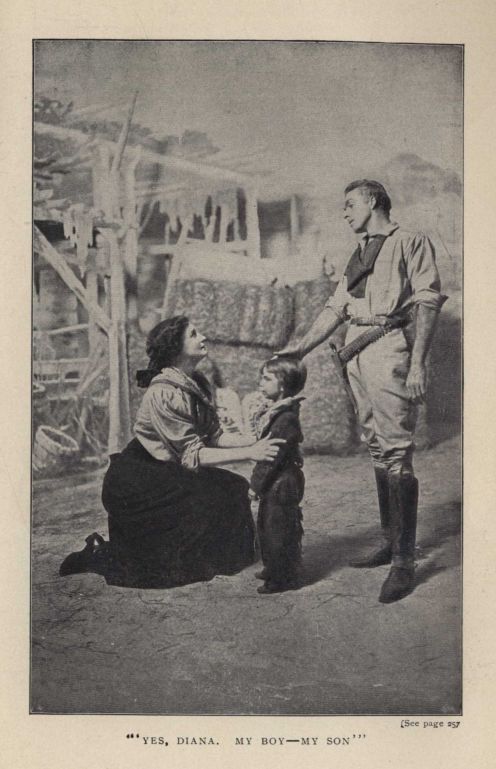
"'YES, DIANA. MY BOY——MY SON'" See page 257
"Ancient history that, Bud," he said, "Forgotten long ago."
But Bud answered, "Not by his friends and relatives about Jansen."
"Oh, they're still looking for somebody to scalp, eh? Better let sleeping dogs lie, Bud." Perhaps he could reason the Sheriff out of this scheme; perhaps convince him that it was not a profitable move on his part, and that he would in such case have the other party against him if he ever attempted to use these unfair means.
His thoughts were interrupted by Bud, who said, with a knowing look at Clarke, "You'll have to hand that gun over to me, Bill."
"Will I?"
Bud rose, and with a certain amount of assumed dignity said, "I demand it in my official capacity." As he moved towards Bill he felt Tabywana creeping behind him. Irritated, he turned and faced the Indian as he said, "Say, we 'ain't got to take Indians into our confidence, have we?"
Bill, who saw that he might accomplish more if left alone with Bud, said, kindly: "Tabywana, get Baco up, will you? I want him."
Tabywana knew that he was dismissed, but he trusted Bill, so he only muttered a warning as he started to do his bidding.
"All right, I can take care of myself, Chief."
Then the Indian left him.
"Come on, Bud, I call you. You got to show me your hand."
"Well, if I want an election it's up to me to make good with Cash's outfit, ain't it?"
"So you're due for a grandstand play, eh?" was Bill's comment. The way events were shaping themselves worried him. These rough-shod political aspirations often led men like Hardy to play to the gallery in order to win a high-handed election.
Bud went on, sure that Bill would see the reason of his adventure, "I have always had the bullet that killed Cash, and that's been the only clew I've ever had."
Dryly, Bill interrupted. "It hasn't led you very far, Bud."
But Bud did not notice Bill's remark. Impressively he said: "It was a thirty-two. Now no man in this country ever carried a toy like that. That's a woman's weapon." Then slowly pointing to the revolver in Bill's hand, he said, "That gun of Nat-u-ritch's is a thirty-two."
If this was all the evidence that Bud had, the case was not so serious after all, so, much relieved, Bill said, lightly: "Bud, you're a joke. Because Nat-u-ritch happens to own a thirty-two—"
Bud maliciously interposed: "Don't be in such a hurry. The last time I was over to Maverick I happens to ask Nick, the barkeep, for a light, and he lets me help myself from a squaw's beaded match-safe." Bud cautiously drew a tiny blue-and-green embroidered bag from his pocket. "'Hello,' says I. 'Where did you get that?' 'Oh,' says he, 'I've had that for years—ever since the day that Cash Hawkins was killed. Found it in front of the side door down there.' And I bought it of him then and there"—Bud looked straight into Bill's eyes as he finished—"cause I recognized it as one I had tried to buy of Nat-u-ritch."
But even this statement apparently did not startle Bill, who met Bud's glance squarely as he said, "And so you jump at the conclusion that—"
"Nat-u-ritch killed Cash Hawkins." Bud took him up. "There ain't a doubt about it. You see that thirty-two is minus just the shot which she done it with."
Bill paled a little. So Bud had noticed the missing bullet. He knew that since her marriage Nat-u-ritch had never carried the revolver. It had been put away on a shelf to be out of the child's way.
Bud reached his hand towards Bill. "I've shown you my hand fair and square—man to man—now I'll thank you for that gun."
But Bill, who caught sight of Jim coming through the corral, said, "That's up to Mr. Carston, and here he is."
Bud turned sharply. He would have preferred to meet Jim some other time, but it was too late to retreat now.
Bill went to Jim. "Hello," he said. He decided to blurt out the whole affair to Jim at once. He knew then that the squaw would be safe; the boss would see to that. "Mr. Carston," he began, "our amusin' little friend over there is a-contemplatin' of arrestin' Nat-u-ritch for the killin' of Cash Hawkins."
"Oh no; you must be joking," Jim said to Bud, too worn out to give vent to the anger that began to surge through him.
Bill was relieved at the light manner in which Jim seemed to take the news. "Well, that's what I thought, but he takes himself kind of serious."
Furiously came Bud's next words. "Anyway, I've got evidence to arrest her."
Showing the revolver to Jim, Bill contemptuously added, "And which said Sheriff steals out of the house of said trustin' and confidin' friend."
Jim stared in amazement at the revolver. Yes, it was Nat-u-ritch's. He had never looked at it since that day at Maverick when her hand had saved him from the cowardly attack of Cash Hawkins. He did not speak.
Bud moved closer to him. He pointed to Bill. "And which he said belonged to Nat-u-ritch." Triumphantly he pointed also to Clarke to indicate that he had him as a witness.
Jim motioned Bill to the house. "Put that revolver back where it belongs," he said, and Bill obeyed.
Bud darted forward as though to stop Bill. "I demand the custody of that myself, Mr. Carston."
"Let's understand each other, Sheriff." As he spoke, Jim deliberately blocked Bud's way. "Nat-u-ritch is as innocent of wrong as a bird that flies. It wouldn't do to confine her in that dirty little jail in Jansen. It would be murder."
"You're a law-abiding citizen, Mr. Carston. You ain't agoin' to resist the law?"
But Jim stood firm in front of the cabin door. "There are cases, Sheriff, where justice is superior to the law, and the white man's court is a bad place for justice to the Indian. Fortunately for all of us, Nat-u-ritch has disappeared."
As Jim spoke, Bud realized that if the Indian woman were there Carston would not be so calm.
"But you couldn't arrest her, Sheriff—not while I live. Bill"—he turned to the foreman, who came out of the house—"I'm not in a mood to discuss this with Sheriff Hardy, and I don't want to violate the laws of hospitality. But just one word, Sheriff—you've eaten my bread, slept under my roof, and now you sneak into my house to get evidence against the mother of my boy." Jim hesitated, and then as he left them he quietly finished, "Bill, I think you'd better see the Sheriff safely on his way."
And Bud knew that for the time being he had lost his game.
CHAPTER XXV
"Carston's locoed. He's plumb crazy. There can't be a jail for whites and a palace for Injins. He don't suppose he can stop me, does he?" Bud began, excitedly.
Bill, encouraged by Jim's mastery of the situation, chaffingly answered: "After you arrest Nat-u-ritch you'll never hold office, Bud. You may hold a harp or a coal-shovel." Then he laughed.
"My! You're making a fuss over a squaw," said Bud, who could see no humor in Bill's words.
But Bill replied, "Arrestin' the mother of innocent kids will not be considered a popular form of amusement around here, Bud."
"Kids? What's that got to do with it?"
"Well," said Bill. "The kid's an influential citizen hereabouts. He's our long suit, and there ain't a live thing on the ranch that would let you arrest his rag doll. You couldn't get away with it, Bud." And as though it were his final word on the subject, Bill said, conclusively, "Better get elected some easier way."
A new idea fermented in Bud's brain. If he failed in his scheme to bring to trial the murderer of Cash Hawkins, hundreds of men to whom he had blustered and sworn that he would accomplish the deed would no longer believe in him and he would probably lose the election. Why not try to gain some compensation if this must be the case?
"Git our horses ready, Clarke," he said and watched his assistant leave the yard. Slowly Bud hitched his foot on a log, and, as though he were about to confer a favor upon Jim, spoke with condescension. "Mr. Carston takes this too much to heart, Bill. Perhaps we can come to some understanding."
"What do you mean?"
"Well, he's come into some money, ain't he? Of course I might lose this match-safe crossing Red River." He lovingly fingered the little bag. Bill drew nearer. "And I might"—Bud continued—"be made independent of the job of sheriff, if it's worth the boss's while." There was no mistaking the intention of his words.
"Bud!" For a moment Bill could say no more. In the past he and Bud had been friends—bar-room friends, it was true—but lately he had begun to suspect much about the Sheriff's career that was unsavory. Until to-day, however, he had had no proof that Bud could behave like a blackguard. "Bud," he rejoined, "you're goin' to make me lose my temper, and I 'ain't done that for twenty years." As he spoke he raised his foot on the log beside Bud's and in deliberate imitation of him leaned his elbow on his knee while he stared straight into the Sheriff's face.
"Don't be foolish," Bud began. "I can put you to a lot of trouble, and I will. I'll arrest these English people and put 'em under bond to appear as witnesses. They were at Maverick that day, and I got my posse ready and waitin' to obey orders." This, he thought, was the final shot to bring Bill to his senses. He waited.
With a tolerance that did not hide his contempt, Bill spoke. "Except for Jim's orders, I'd throw you off the place. Get agoin', Bud—get agoin'—and don't stop to pick flowers."
Bud knew that Bill was conveying a threat which, he felt, as he watched his face, it were wiser not to disregard. He walked towards the barn, stopped, ground his teeth, and looked back at Bill; but the big fellow stood motionless and in supreme disgust watched the Sheriff. Bud uttered a low oath, then hurried down to the corral.
Still, Bill did not move. He did not hear Diana as she opened the cabin door and, drinking in the fresh morning air, said, "I feel as though I should suffocate in there." Her looks told that something more than the close air of the cabin room was stifling her. As she came from under the porch she saw the immovable figure of the foreman leaning over the log with his head on his hands, watching several men down the road who were mounting horses and preparing to make a start.
"Oh, Mr.—" She paused.
Bill turned. He saw she had forgotten his name. "Bill, miss," he said.
"Mr. Bill—"
But Bill interrupted as he raised his hat. "Just plain Bill, if you don't mind—and there ain't anything too good for you at Red Butte ranch, lady."
Impulsively Diana held out her hand to Bill, who took it. "Thank you, Bill. It's good to feel that I'm among friends, because I feel so strange, so bewildered." She had learned of the foreman's devotion to Jim and knew that she could trust him. "Bill," she asked, "what do they mean by 'squaw-man'?" There was so much she could not say to Jim, so much that had puzzled her, and she longed to unburden her heart to some one. This faithful soul would understand her, and would, perhaps, help her to learn more about Jim and the Indian woman, concerning whose fate she was now growing anxious.
Bill seated himself. "Well, it's the name some people give a white man who marries an Indian squaw." Then quickly he added: "But I want you to understand, miss, Jim's respected in spite of the fact he's a squaw man. He's lived that down."
"Of course it was a great surprise to us all at first."
"Natural it would be, miss. Of course no ordinary white man would have done it. But you mustn't think any the less of Jim for that, miss."
Quickly Diana answered, in sympathetic accord with Bill's loyalty to his master: "I think all the more of him, Bill. It's only another of Jim's glorious mistakes." Then again she thought of the woman. "I wish I could see her. What is she like?"
Bill could not understand this interest in Nat-u-ritch. "Just a squaw," he said, indifferently. "She's got two ideas, and I guess only two—Hal and Jim."
He liked the little woman, but he could see where she had been a great disadvantage to Jim.
But Diana's voice as she said, "A mother and a wife—that's a good deal, Bill," made him realize that perhaps he was not doing the Indian girl justice. He could see the tears in Diana's eyes as she spoke. "And her boy goes back home with us."
Bill rose. "Kind of tough on yours truly, lady, bein' as Hal and me are kind of side-partners, but then I got to recollect it's the best for the kid. That's about the size of it, ain't it?" This time it was Bill who solicited comfort from Diana. The thought of the child's leaving them had been a difficult proposition for the boys, and they had discussed it long and excitedly when Jim told them the plan the night before.
Diana understood. "It involves a lot of suffering all around, doesn't it, Bill? But it seems to me Nat-u-ritch gets the worst of it."
True to his opinion of the red race, Bill answered, "She's an Injin—used to takin' things as they come," and he hardly heard Diana's words:
"Poor little savage!"
This lady had appealed to him—why shouldn't he ask her advice? It was all very well for him to have frightened the Sheriff into leaving the place, all very well to appear sanguine and hopeful while the boss stood near him, but in his heart he knew he was afraid. Something in the shifting, malicious look of Bud Hardy's eyes as he left the place told Bill that there might still be trouble. Twisting the rim of his big hat nervously, he said:
"Say, miss, you got a lawyer in your party, 'ain't you?" Diana turned to listen to him. "Oh, but pshaw!" he went on, trying to reassure himself even while he spoke the disquieting words. "It 'll never get to the lawyer, cause Jim 'll never let him arrest her—never!"
"Arrest her!" Diana exclaimed, in surprise.
Bill explained. "Nat-u-ritch. The Sheriff thinks he can prove she killed Cash Hawkins—that day you were at Maverick."
Jim had not recalled that incident to Diana last night. He had told her he owed his life to the Indian girl—how and why he had not explained. Eagerly she leaned towards Bill as she cautiously said, "Why did she kill him?"
"Well, if"—and Bill dwelled on the word—"if she killed him, she did it to save Jim's life, and it stands to reason Jim ain't goin' to see her suffer for it." Then as he saw a troubled look on Diana's face he regretted the admission of his worries. "Say, miss, I'm awful glad that you an' Hal are goin' to pull your freight, for there's goin' to be merry hell around here."
He quickly begged her pardon for his involuntary slip, but Diana had hardly noticed it. This would mean new worry for Jim. Then she comforted herself with the thought that perhaps this kind-hearted soul was exaggerating things. Surely, if there were cause for anxiety, Jim would have spoken to her about it.
"Is there nothing that can be done, Bill?"
He shook his head.
"Well, is there anything that I can do?"
"Don't see how, except to git away as soon's you can." And then he told her of Bud's proposition to obtain money from Jim, and that the Sheriff was willing to sell his evidence against the Indian girl. "Why," he added, "I 'most kicked him off the place; and Bud will fight, you know."
But Diana was only concerned to know whether the Sheriff was safely out of the way. "You say the Sheriff's gone?"
"Thank Heaven!" Bill answered. "And, by-the-bye, just to be more cantankerous, he threatened to hold up you and your party as witnesses; but that wouldn't be legal, would it?" As he remembered the boys he added, chuckling, "It certainly wouldn't be popular."
Before Diana could reply, Jim interrupted them. Like a restless spirit he had been wandering over the place, from barn to cabin, from Hal's sleeping-room to the boys' quarters; accomplishing little and vainly trying to accept the events that had crowded into his life during the last hours. The Sheriff, he felt sure, could easily be managed, but Nat-u-ritch's disappearance was causing him anxiety. He knew it was a trait in the Indian character to hide away and stoically endure its grief in silence. Every moment he expected her to return. Stronger than all these thoughts was the desire that Diana should go at once, and little Hal with her. This speedy termination would make it easier for them all, he told himself, and then there were matters enough to claim his attention. So he reasoned as he came from the back of the house, where he had been brooding over a valise containing the child's belongings. As he saw Diana sitting there deep in conversation with Bill, he stood amazed at the simple adaptability that made it possible for her to adjust herself to these primitive belongings and people. Bill was already regarding her as a friend. Then he remembered that he must see Tabywana to tell him of Nat-u-ritch's disappearance, and arrange a plan with him to help her to evade Bud for several days.
"Bill, I wish you would get Baco. I have sent for Tabywana, and want Baco to interpret for me."
Bill's heavy boots creaked down the corral.
"I hope you've rested well, Diana," Jim said.
"I haven't been to bed, Jim. I've been trying to think it all out." She rose and came to him. "Would she be quite impossible at Maudsley Towers?"
Jim knew she wanted to take up their conversation where it had stopped last night. They had discussed the subject already, and he felt the futility of going over the same arguments. It only tormented him, so he answered, "Quite."
Diana persisted. "Couldn't she be sent to school for a few years?"
"It's too late. That might have been done when she was a child, but now she's a woman."
"And a mother." Then hurriedly, as though fearful that she would not have the courage to express to Jim all her concern for Nat-u-ritch, she said, "Jim, I wonder if we are treating her quite fairly?"
"I hope so." And in Jim's voice there was a prayer.
During the night many thoughts had haunted Diana. The soft little arms that had clung to her the night before troubled her. What would their loss mean to this child-woman of the woods? She decided to make one more appeal to Jim and frankly lay before him the conflicting emotions that had torn her since her arrival at the ranch.
"At first, Jim, I hated everybody, then I pitied you. Now I am thinking of her." Jim listened intently. She laid her hand on his arm. "Civilization has bred in people like you and me many needs and interests. But this helpless child-mother has just her child and you, and we are taking the child away. Oh, have you the right to sacrifice her even for the child?"
Jim could not argue. He had made his decision when Petrie wrested from him the concession to let the child go to be prepared for the life he had no right to deny him.
"I have done the best I know how, Diana," he said, simply. "We must leave the rest to God," and Diana knew that the words were the result of his own bitter struggle and she could no longer doubt their wisdom.
She stood silent. Jim looked at her. Of their own love that had endured all these years, neither spoke. It was Jim's moment of greatest temptation. He longed to say something to her that might express what he felt; but again he conquered himself.
"Will you take Hal?" was all he said. "I want you to get away before the heat of the day."
And Diana left him.
CHAPTER XXVI
Jim waited anxiously for Tabywana, to enlist his services in protecting Nat-u-ritch. Impatient of delay, he started towards the bunk-house. On his way he met Bill, who informed him that Bud and his men had gone. Tactfully, Bill avoided any reference to Bud's last threats, and Jim was comforted with the news of the Sheriff's departure. It only remained now for him to send Tabywana in search of Nat-u-ritch. He found the Chief and Baco, and in a few words told Tabywana that Nat-u-ritch had gone into the hills because he had decided to send the child away, that she was very unhappy, and that he wished him to go to her. Unmoved, the Indian listened, and only at the end of the words that Baco was translating for him made answer that Jim had spoiled Nat-u-ritch, that she must obey her master, and that he would insist upon her returning at once. But Jim explained that he wished her to remain hidden a little longer, until he was sure that the Sheriff had really left the neighboring country, as he was fearful that Bud Hardy meant mischief. Through Baco and Tabywana he would send her food and clothing, he added. Gradually he made the Chief see that this way was the wisest, and Tabywana left, breathing vengeance on Bud, and swearing that a war should follow if the Sheriff dared to arrest Nat-u-ritch.
Jim found the boys assembled before the cabin on his return, while Bill was directing the hitching of the horses to a wagon that was to carry Diana and Hal to Fort Duchesne.
"Everything ready, Bill?" he said, bravely.
"Yes, sir, everything ready."
Jim called to Hal and Diana, who came from the house. He picked the boy up in his arms and a sudden terror overcame him. He must be alone a moment, to gain the courage necessary to face this last ordeal.
"Take him, Bill," he said, "while I go and get his bag," and he went into the cabin.
The foreman nodded. He held the boy high up in his strong arms while the men crowded around him. He must try to make it easy for the boss; there must be no tears. Diana and Sir John, from under the porch where they were standing, watched the men with the child, and during the years that followed it was a memory that often recurred to them.
"Fellers," Bill began, as he enthroned Hal on his shoulder—"fellers, he's agoin' to Duchesne—savvy? Gee whiz, don't I wish I was goin' to see the soldiers and flags and drums and brass bands and everything! Ain't he goin' for a fine time!"
The child answered with glee, "Sure," and the men's laughter rang out at the child's use of their own mode of expression.
Carrying the bag, Jim came from the house. "It won't hurt anybody to carry his belongings; it's almost empty."
Shorty sniffed as he peered into it. "'Tain't very full." Then he threw into it the old jewel-box with the trinket which Jim had given him. Jim saw and understood. The men had come for their final leave-taking of the boy; they wished to prove that their animosity was over, that they recognized that misfortune had come to them through no fault of his.
"Hold on, Shorty." Jim tried to prevent the little fellow from getting the valise, but Shorty took the bag out of his hand as he snapped:
"That's Hal's trunk, ain't it?"
"Yes, but—"
"It ain't yourn." Ever aggressive, Shorty finished, "You don't want to fight the outfit the day your boy's agoin' away." And he pushed Jim aside as he carried the valise over to Grouchy, who was holding up a villainous-looking jack-knife to the child.
"Say, old man," the slow, lumbering ranchman labored, "you wanted this for a long time. I wouldn't give it to you, 'cause I was afraid you might cut yourself, but I've been a-savin' it for you. When you get bigger, you can make things with it."