THE SQUAW MAN (continued 3)
Reading edition
For a long time she lay flat on her animal, the hot sun sizzling down on her clinging figure. She only drew her hair as a veil over her face, while her wistful eyes watched the stranger across the plains as she sped close on his track. She was glad that she was gaining ground, too long had she lingered after her father's departure. She soon reached the short cut, and a wise smile lighted up her face. She would be in Maverick ahead of the man riding across the plains, and she wondered whether she would see him at the Long Horn saloon. Then the smile died away; she was not going to Maverick for that purpose. First she must find and guard her father from Cash Hawkins's machinations; and then—
She tightened her hold on her pony. She gave a curious low cry to the animal. His ears stood erect in answer as Nat-u-ritch flashed across the sand track.
The man on the horse only vaguely saw Nat-u-ritch. His thoughts were busy with the wearying business of the day's shipping of cattle. It was Jim's second year at his ranch. When he left England he did not arrest his journey until he reached the Far West—that Mecca of all Englishmen. With the small sum of money that he had lifted from his bank, he had purchased a ranch near Green River, and under the name of Carston had begun forming the ties that now made up his life.
As he rode his face and body showed the beneficial results of his work in the open. The cow-boy clothes seemed to have become almost part of him. A certain neatness and precision in his mode of wearing the picturesque garments of the plains alone differentiated him from the hundreds of wearers of flapping leather chaps, flannel shirt, sombrero, and loosely knotted kerchief.
Jim was wondering if his men had reached Maverick. He had sent Big Bill, his foreman, on ahead of him with a message from him cautioning them to beware of being drawn into a quarrel with Cash Hawkins, who he had learned would be there. For days the "boys'" anger had been incited by the discovery made by Jim and Big Bill that Cash Hawkins had been mixing his cattle with theirs, for Hawkins's gain. This complaint of "rustling" he found was not uncommon. Its penalty when proven was not a pleasant one; the law was not consulted—punishment was meted out by the cow-boys themselves. But for the present Jim preferred to avert a fight with Hawkins. In the future he meant to take greater precautions to protect his property.
As Jim rode he planned out many details of his new life's work. Thus often for days all other thoughts would be blotted out. It was a big game to fight and win in this barren land. It absorbed all his time and vitality, and memories of dew-drenched England were burned out in this dry, brilliant land where the tender half-light was unknown and where often his English eyes yearned in vain, when he abandoned himself to the past, for a touch of the soft gray of his own country in protest against the hard brilliance of the sun and unending sand plains.
CHAPTER XIV
The Overland Limited swayed, creaked, and then with a grunting of many chains drew to a sudden stop before the Long Horn saloon at Maverick. From the window the passengers peered at the desolate cow town and wondered how long they were to be delayed.
In their private car at the rear Diana, Henry Kerhill, and Diana's cousin, Sir John Applegate, rose from their seats to study the shipping-point for cattle, so novel in its environment, as indeed their entire journey in America had been for the past months. The death of a distant relative on Diana's side, who had left her an unexpected legacy, had enabled her to retrieve to a great extent their cramped fortunes.
Lady Elizabeth had lived only a short time to enjoy the new improved condition of affairs. She died in the year following Jim's departure and vicarious disgrace. During the months previous to her death she had grown grimmer and held herself more aloof. A stroke of paralysis one morning made her bedridden and speechless; a merciful third stroke caused her death within a month after her first attack. She never spoke, and seemed to find no consolation save in Diana's presence. The trip to America for a much-needed change was principally taken, however, on account of Henry, whose nervous condition the medical attendants declared most serious. The two years had made scarcely a perceptible change in Diana; in Sir John none at all. But in Henry an oppressive melancholy was rarely broken by the old flashes. Towards Diana he had faithfully kept his word to Jim. A truce was accepted, and he never ceased in his pathetic endeavors to try to make her happy. If neither could honestly lay claim to a real joy of life, still they had peace and dignity. As he stood near the window, the strong light showed how much thinner and lined was his face. A touch of gray was distinctly visible along his temples and was beginning perceptibly to streak his dark hair.
"My, but it's a corker!" Sir John gasped, as he put his head out of the window and the blinding heat beat down on him. There was a smile from Diana at Sir John's acquired Americanism. More British than the Union-Jack itself, yet he was keen to gain knowledge of the new country, and long conversations with the servile black Sam were enlarging his vocabulary. All three watched with curiosity the ramshackle hostelry, which they could plainly descry from one end of the car.
Diana turned to the men: "Do let us see the place. I've always longed to have a real adventure at a way-place off the beaten tourist track. I'm so tired of the sights that are arranged for one to be shocked at—at so much a head."
They moved to the door, but the intense heat of the day for a moment seemed to dampen their ardor. Then, at Henry's solicitations, Diana was persuaded to wait until he found out from an official the possible length of their stop.
Within the Long Horn saloon the afternoon's heat was apparently not felt by its inmates. It was a roughly hewn, wooden, three-cornered room with an oak beam stretching across it. Over this were thrown saddles and blankets. A bar extended along one side of the room. On the walls were grotesque and crude pictures done in chalk, while other spaces were covered with cheap, highly colored illustrations cut from the papers that reached Maverick. Tables for roulette and faro were placed at set intervals. The floor was covered with a mixture of sand and sawdust, while mounds of wood-dust were heaped near the bar, to be used by the men as cuspidors. It was clean in a certain primitive fashion. The glasses and bar fixtures were not unpleasant. The bartender, Nick, an ex-prize-fighter, took a pride in his "emporium," as he called the saloon, and lavished a loving though crude care on his possessions.
But the place was stained and soiled by the marks of the tragic remnants of humanity that were housed within its walls. Around the gambling-tables on this afternoon were groups of tattered specimens of the various races. Cow-boys at certain tables gave a wholesome, virile note to the place, but the drift-wood of a broken civilization was at this hour in larger proportion than the ranchmen. Among the battered denizens from the world beyond that had strayed into the saloon life was a parson in a frayed frock-coat, who leaned in a neighborly way against the blue shirt of a Chinaman, while a large negro with a face like a black Botticelli angel grinned and gleamed his white teeth in sport with a dago from Monterey. In a chair in a farther corner a tenderfoot lay in a drunken sleep in his soiled evening clothes, which he had donned three nights before to prove to the tormenting habitués of the place, who since then had not allowed him to grow sober, that he was a gentleman.
A half-breed at a faro-table watched with tolerant amusement the antics of those in his game to outwit him. The smell of the sawdust and the human mass of unpleasantness grew stronger as the men played, changed money, and Nick's corks flew and glasses clinked. Over the entire place there hung a curious sense of respectability. Low-muttered oaths were not uncommon, but Nick, sturdy and grim, with his watch-dogs—two large six-shooters—lying on the shelf behind the bar, had a certain straightness of purpose and a crude sense of right and wrong that won respect from the heterogeneous mass of his followers.
The passing of the Limited would have caused a sufficient amount of interest, but its stopping was a momentous occasion. The rude platform outside was only a shipping-point for cattle, not a stopping-place for through or passenger trains. There was a rush of some of the inmates from the room, but to a number of them the game was at its vital point, and Pete's lazy call of "jacks up" quickly chained the attention of the more eager of the players.
But to Nick it meant new trade, and his battered and scarred face grew into one ebullient smile as McSorley, the engineer, in his jumpers, with begrimed face and hands, and Dan, the dapper Pullman conductor of the Overland Limited, entered the saloon. McSorley was mopping his sweating face.
"Say, Dan, who's the English swells in the private?" he asked, as he looked back at the luxuriously fitted car.
"The Earl of Kerhill," Dan answered, as they veered towards the bar. "Been out to the Yellowstone. The old man lets 'em have his private car. Must be the real thing, eh?"
McSorley grunted his approval of the noble freight that he was carrying. "Let's have a drink. What's yours, Dan?"
They reached the solicitous Nick.
"What 'll you have, gents?"
"A bottle of beer for me, Mac," Dan answered his companion's question. Then, with English tips still a pleasant memory, he added, "But this is on me."
Nick began opening a bottle of beer, and its foaming contents were soon filling the glasses. As he served he inquired: "What's up gents? 'Tain't often the Overland Limited honors Maverick with a call!"
"Washout down the road," was McSorley's laconic reply, as the cool liquid slid down his parched throat.
"Staying long?" Nick again asked, with visions of many strangers visiting his bar.
Dan was surveying the place with an unsympathetic eye.
"Not longer than we can help, you bet," he answered. "Expecting orders to move every minute."
But Nick was determined to be affable. "Pity; Maverick's worth seein'. Who's in the parlor-car?"
"English people—Earl of Kerhill and party," Dan replied. Then he moved down the bar with McSorley, both carrying their half-consumed beer.
A Southern cow-puncher, Pete, who had gone from ranch to ranch, finding life too hard at each, leaned back on his stool until he rested against one end of the bar. Through the windows he could see Shorty, one of Jim Carston's men, coming along in animated conversation with several other men of the Englishman's ranch.
"In my opinion the calm serenity of this here metropolis is about to be tore wide open." A nudge from Punk, the Chinaman, made him go on with the shuffling.
"How many, Parson?" Pete queried.
The cadaverous face of the Parson, with its highly colored nose, showing the cause of his cloth's disgrace, turned to him. Frayed and seedy as he was, he bore the imprint of a gentleman.
"Dearly beloved brethren, three."
Again Punk nudged the others, who were inclined to become too talkative. They began indicating the number of cards desired with their fingers while the conversation continued. Nick leaned over the bar and watched Pete's hand.
"Cash Hawkins is in town!" Pete gave the news as though it were of moment. They all knew what Cash's visits usually meant. An ominous whistle followed. They all looked at Nick.
"Bad medicine is this same Mr. Hawkins, particular when he has his gun wid him. Bedad, the kummunity could spare him a whole lot without missing him," Nick volunteered.
"If they provoke unto wrath Brother Carston's outfit, my Christian friend, there will be some useful citizens removed from our midst." The Parson approved of Jim as a remnant of his earlier days. He recognized in him one of his own class.
"And who the devil is Jim Carston?" Nick asked.
"Jim Carston? Never seen Jim? Oh yes, you must have, although Jim don't frequent emporiums much. Why Jim's the English cow-boy. First he had a place about a hundred miles from here. But he's bought Bull Cowan's herd. Bull stuck him—stuck him good," Pete lazily informed the crowd.
"Sure!" said Nick. "That's why Englishmen was invented. More power to 'em."
"Amen," hiccoughed the Parson, whose drinks by this time had been numerous. "The prosperity of our beloved country would go plumb to Gehenna if an all-wise Providence did not enable us to sell an Englishman a mine or a ranch or two now and again."
"Say," Nick asked, seriously, "the Englishman ain't a-goin' up agin Cash, is he now?"
"I call you, Parson," Pete calmly commanded, and then raked in the pot. "When the smoke has cleared away I will venture an opinion as to who has gone agin who," he resumed, as he pocketed the money. "Jim and his outfit is here to ship some cattle to Chicago. I seed them all through the window, and they ain't the kind to run away much."
There was a finality about Pete's words. He might be lazy and slow, but he was anxious to open another pot, so he turned his back on Nick and began shuffling the cards. As he did so, three of Jim's boys—Andy, Shorty, and Grouchy—entered.
"Come on boys and have a drink," Shorty yelled.
Andy was a wiry, slender German with tender, romantic proclivities. Grouchy, who seldom spoke, and then only in a husky, low growl, was a massive fellow and looked like a Samoan native, but was in reality a product of a Hebrew father and an Irish mother, while Shorty gained his name from his low stature. Brave as a lion and honest, with a face from which twinkled the smallest and merriest of blue eyes, he was the live wire of any ranch.
"What's your nose-paint, gents?" Nick asked, as he greeted the new-comers.
"A little of that redeye," Shorty replied, and soon he and his comrades were clinking glasses. Several cow-punchers joined them, and the place began to resound to lively disputes concerning the rates on cattle.
Dan and McSorley had finished their beer.
"How much?" Dan said. His look plainly showed his contempt for the saloon. It was Nick's opportunity to pay back the insult that had been quietly levelled at him by the Pullman conductor's attitude for the past quarter of an hour.
"One dollar," was Nick's quick reply.
"One dollar!" Dan repeated. "For two glasses of beer?" He stepped back and his voice rose in angry protest. It attracted the attention of the others, who were only too eager for a row.
"Why," Dan continued, "it was all collar, anyway."
Nick leaned over the bar and quietly said, "I didn't charge nothin' for the collar, gent, I throwed that in." There was a laugh from the hangers-on at Nick's witticism. Nick flushed with approval and went on, "Beer's our most expensive drink—comes all the way from Cheyenne."
Dan, furious at being done, as he knew he was, struck the bar with his fist. "I won't pay it," he said.
There was a hush about the room. They didn't often see any one venture to buck against Nick's authority.
"Oh yes, you'll pay it, gent." Nick's voice was lower and calmer than Dan's. He had turned while Dan was speaking and was lovingly fingering his six-shooter. He lifted it from the shelf and laid it carefully on the bar, keeping his hand well over the trigger.
McSorley nervously edged to Dan. "Better pay it; better pay it," he whispered.
Nick heard him. "Yes," he added, "better pay it. Saves funeral expenses."
Dan knew enough of the country to know he was at Nick's mercy. He drew a silver dollar from his pocket, and slapped it down on the bar.
"Well, I'll be ——!" Dan started for the door, followed by McSorley, who thought his companion's rage ill-timed. He wished he were back in his caboose. As they reached the door Nick's voice rang out in stentorian tones.
"Wait a minute!" There was no gainsaying his command. Dan halted. Nick, leaning far over the bar, held in each hand a watch-dog. "I don't allow no tenderfoot to use bad language in my emporium. We do strictly family trade and caters particular to ladies and children."
Dan and McSorley stood under the levelled guns. A shriek of mirth shook the crowd. All had stopped playing and were watching the situation. Finally, when there was no doubt as to the ridiculous position of the train officials and the laugh had subsided, Nick dropped the guns, and with a low bow turned from the bar, leaving them free to go. Dan and McSorley quickly disappeared, Dan wildly expostulating while McSorley vainly tried to calm him.
Nick went back to the players.
"Pete," he asked, "what has Cash got agin the Englishman?"
Pete, nothing loath to tell his yarn, especially as he had been winning all the afternoon, drawled the information so that all at his table could hear.
"Well, Jim's outfit has been heard to openly express the opinion that Cash can't tell the difference between his cattle and Jim's."
"Rustling, eh?" the Parson interrupted.
Pete nodded.
"Serious business."
"Yes," said Pete. "Serious—quite—in these here parts. I see the Englishman stand off a greaser down at the agency, and I've got a wad of the long-green to lay even money that Cash can't twist the British lion's tail a whole lot—not a whole lot. Any takers?"
Pete's eye was always keen to take up a "sure thing." The men with him fell into a dispute concerning the respective merits of Jim versus Cash Hawkins.
Meanwhile, seated at a table in the centre of the room were Shorty, Andy, and Grouchy. They had heard nothing of Pete's and the Parson's conversation. They were intent on a mild game and were awaiting Big Bill, who was to meet them at the saloon. None of them saw Big Bill coming towards them until they heard the slow, deep voice saying: "Boys, Cash Hawkins is in town. The boss asks as a special favor to him that you will avoid Cash and his gang and try to get out of town without a collision."
Bill was a giant, over six feet tall, with a great, leonine head. He had a strong face with piercing eyes. The mouth, "a large gash," as Shorty described it, could at times give vent to loud guffaws of laughter, and at others frighten one as it straightened into two lines of grim determination. For two years he had been Jim's right-hand man, and his devotion to the boss was the most beautiful side of Bill's life. Forty years ago he had been born in a prairie saloon; the woman who bore him died the night of his birth. He never knew who his father was, and the upbringing he received was from a handful of miners who had adopted him. As soon as he could toddle he began to try to do for himself. Little errands he volunteered, and long before most boys even on a ranch were anything but a nuisance, Bill was contributing gravely his share to the big game of life. Save once, to Jim, he never spoke of the past. He had drifted to Maverick twenty years ago, and except at intervals, when he took a notion to better himself, he was usually at the cow town.
On one of these occasions when he was trailing the country he met Jim, who was looking for a man to direct the practical side of his affairs. Bill had never met a gentleman who treated him as Jim did, and in return he gave his body's strength and all the scheming devotion of his brain in his endeavor to benefit Jim's complicated affairs.
The three men looked up at Bill, who slid into a chair at their table and started a new game with them.
"Say, Bill," Shorty began, "if Cash has his war-paint on there ain't no use distributin' tracts on love one another."
"Und, Bill," Andy added, "und say for peace—dot's me, Andy. But say, Bill, rustlin'—cattle stealing—you know. Particular when it's our cattle, Cash has got a lot wit' a circle-star brand which original is a big C for Carston. Say," he wildly went on, becoming more incoherent as his temper rose, "und if we stand for it—you know—und say—we got to git out of de business."
Grouchy leaned over to Bill and shook his head. "Say, I wouldn't work for a man that would stand for it."
Still Bill said nothing, but listened gravely to the storm of protests that the message from Jim to the boys had provoked.
"If the peace of a kummunity is worth a damn, you got to shoot him up a whole lot. It's this delicate consideration for the finer feelings of bad men which encourages 'em." Shorty, in his nervous, jerky manner, fairly shook the table with his vibrations of rebellion.
Then Bill spoke. He was in sympathy with the boys, but he had his orders from the boss—that was enough for him.
"Well, you know Jim. It ain't likely he'd ask you to show the white-feather nor to stand no nonsense. Only"—here Bill paused and said, impressively, "don't drink mor'n you can help, and avoid trouble if possible. Them's the boss's orders."
As Bill was laying down the law for the men, the saloon began to fill with curiosity-seekers from the train. The delay was evidently to be longer than had at first been anticipated. Shorty was the first to see the humor of some of the new-comers.
"Gee, get on to the effete East. Say," he called to the rest of them, "get on to the tenderfeet."
They looked with childish glee at a quaint-looking couple who were entering the saloon. Mrs. Doolittle was a prim, mild-mannered little woman with a saintly smile. She evidently was travelling in the West for the first time. Her husband, Hiram, was one of the prosperous New England farmer class. Pleased with the entire condition of affairs, he beamed on the cow-boys with great condescension.
Shorty, who scented some fun, whispered to Bill: "D.C. brand. Day Coach, savvy?" As he watched the odd pair he made his way towards them. They were quietly studying the place. The pictures of prize-fighters and ballet-girls that lined the walls really shocked them, but it also tickled their sense of the wickedness of their adventure. They reached a roulette-table with the game in progress.
"Why, Hiram!" Mrs. Doolittle ejaculated, as she watched the players and surveyed the saloon, "this is a gambling-hell."
Shorty, who with the others was closely watching the strange adventurers and planning to tease them, mocked them in an aside—"Well, I want to know."
But Hiram was too intent on Faith's observations to notice that they were becoming the centre of interest in the place.
"Durned if it ain't," he affirmed, in a pleased tone. Then, ashamed of his laxity, he added, "Want to git out?"
"Why, Hiram, what a question!" Faith Doolittle answered, severely, as she drew away from her husband's out-stretched hand. "'Tain't often one gets a chance to see life. I've read about Montey Carlo, and here it is."
The boys were now all attention. Andy whispered, "Three card, eh; Montey Carlo here, eh!" The laugh began to be noticed by Hiram.
"Dear me," Faith Doolittle gravely remarked, "and over there is rouletty, I suppose."
Shorty came forward. He took off his large sombrero and bowed low to the ground, in mock cavalier fashion as he good-humoredly said, "No lady, that's where they're voting for the most popular lady in the Sabbath-school." His sally was greeted with applause. Faith hardly noticed it; she had taken Hiram by the arm and was trying to drag him to the table.
Pete called to them, "That's not rouletty, that's faro, lady."
The parson added, "So called after Pharaoh's daughter."
"Who found a little prophet in the rushes on the bank," Shorty further explained.
But Faith was eagerly whispering to Hiram, "You know, Hiram, frequently people by just putting down fifty cents, or a dollar, walk out with millions." Then timidly she added, "I'd like to try it once."
"Faith Doolittle!" was all Hiram could exclaim, so great was his surprise at his wife's request. Truly, he thought, women were strange cattle. To think of Faith, so quiet, so serene all these years, and then—to see her now with flushed cheeks, hat awry, and an eager, feverish look in her mild eyes as she tried to draw him to the table.
"Oh," she pleaded, "only fifty cents' worth, Hiram. There couldn't be any harm in fifty cents' worth."
Behind his great hand Shorty convulsed the others by observing, "Mother's a sport, but father's near."
Hiram now realized that he must be firm and leave this place that was affecting so strangely his wife's conduct.
"You couldn't keep money got in that nefarious way, even if you won it," he explained; "you're a churchwoman."
"We could give some of it to the church," quickly reasoned Faith; "and, Hiram, we could do such a lot of good with a million. Just try fifty cents' worth." She made a further attempt to reach the table.
"Come out of here, Faith Doolittle," stormed Hiram, as he saw his protests were of no avail, "or you'll have me going it in a minute." He, too, began to feel the tempting influence of the green cloth, the glittering money-heaps, and the feverish gayety of the ribald crowd.
As Hiram started to lead Faith to the door they were stopped by Shorty.
"Nick," he called to the bartender, "my friends, Mr. and Mrs. Hill—Bunkco Hill—of Boston." The slang name for the innocence of the couple caught the crowd's fancy. They quickly formed a circle around them.
"Pleased to know you," Nick observed from the bar. "What's your drink?" He began filling glasses with whiskey.
This time Hiram's indignation was effectual. Grasping his now-frightened spouse by the arm, he fiercely drew her away, the cow-boys laughingly letting them go, with polite bows, and bits of advice called good-naturedly after them.
It was the sport of children, as indeed these men were to a great extent—crude, rough, but with a sweetness not to be denied and a decency that it might seem strange to find in such a place. So far their fun might go, but they knew where to stop, and Faith Doolittle's gentle face was its own protection. They watched Hiram nervously leading his wife along the platform down the line. Then they turned back to the saloon and amused themselves by giving imitations of the quaint visitors, until the place rang with their boisterous merriment.
Suddenly there was a rattle of spurs and a noise from without as a tall cow-puncher lurched through the door.
In a moment there was silence. Every one knew the man.
"Hello, here's Cash now," observed Shorty.
The innocent gayety was forgotten. A different expression began to appear on the men's faces. In Jim's crowd it was one of sullen rebellion and suppressed indignation, in the other an expectant desire for real mischief. With Cash Hawkins's entrance that afternoon, history was made in Maverick.
CHAPTER XV
Cash Hawkins leaned against the bar and maliciously took in the silence that followed his entrance into the saloon. He knew he was feared; he had made more than one man there feel his power. Malignity was marked in his demeanor and in the physiognomy of his face. He was lithe and straight, with wiry, steel-like muscles. He had a small head with a shock of tawny hair that he wore much longer than is usual with ranchmen. The rawhide strap of his hat hung under his chin, and his face, with its long, pointed wolf jaw, suggested that animal in its expression of ferocious keenness. When he grew excited his mouth moved convulsively, like an ugly trap ready to devour its prey. His hands were curiously beautiful—long and slender, with almond-shaped nails. The care he bestowed on them to keep their beauty in the midst of his rough life, the gorgeousness of his leather chaps with their mounting of silver, and the embroidery on his waistcoat betrayed his salient weakness—inordinate vanity. He was handsome in a cruel, hard fashion. Of his power as an athlete there was no question. In the saloon many could testify to the devilish cunning of those supple hands.
"Got a bottle of ink handy, Nick?" he said, when he had insolently surveyed the assemblage, who, after a pause, were beginning to talk and settle down to new games.
Nick, who wished to be friendly with all who patronized him, answered:
"Ink? Ink is a powerful depressing drink, Cash."
"Drink!" Cash's face grew livid with rage. "You see here, Nick, don't you joke with me; I ain't in the humor for it. People has to know me intimate to joke with me—savvy? You get me a pen and a bottle of ink P.D.Q. I'm buying some cattle of Tabywana, the Ute chief—savvy? And he's got to put his mark to the contract."
With swaggering gestures Cash announced his business so that all could hear him. Bill whispered to the boys, who, going on with their game, were still listening and watching Cash intently:
"You know what that skunk's up to now. He's got Tabywana drunk—been at it for days—in order to swindle him out of his cattle."
Shorty, with all of the cow-boy's intolerance of the red man's rights, snapped, "Well, it don't make much difference about Injins."
"No," growled Grouchy, "guv'ment supports 'em anyway."
Nick had unearthed a bottle of ink.
"Well," he said, as he handed it across the bar, "that was ink once, Cash. 'Ain't had no use for it sense my gal throwed me. Gits more people into trouble. Often wisht I was illiterate." Nick's dry humor betrayed his descent from the Emerald Isle.
Cash paid no attention to Nick's attempts at conversation. He was filling his glass and surveying the crowds at the various tables. It annoyed him that no one had greeted him with any particular show of enthusiasm. Save for a "How d'ye," or a nod from some of the hangers-on, no one had particularly noticed him. He stood against the bar, and without turning his body directed his words towards Big Bill and Jim's men at a table near him. With a truculent swagger he blew his cigarette smoke through his nostrils.
"There's just one thing I can't stand for," he began, "and that's an Englishman." There was a movement from Jim's men, but it was quickly controlled. Cash went on: "He's a blot on any landscape, and wherever I see him I shall wipe him off the map. He is distinctly no good. We whipped 'em once, and we kin do it again. They 'ain't never whipped nuthin' but niggers and savages. The Englishman is a coward and any American who works for him is a cur."
With one movement Andy, Shorty, and Grouchy rose and their hands went to their guns, but almost before they had clutched them Bill was towering over them. With one hand he pushed Grouchy, and with the other gripped the shoulders of Shorty and Andy, until he forced them down into their chairs.
"Leave him to me," was all he said, and the men sullenly subsided under their foreman's orders.
Bill stood looking at Cash. He wanted to gain time and not take any notice of insults from him until it was so directly levelled that they could no longer endure it. He wished Jim would come; it was time for him. He wanted to finish some details of the shipping and then get their men to leave Maverick.
Cash saw Bill's command of the men; he ground his jaw with ugly grating sounds from his big white teeth. Looking directly at Bill, he said, "There is a certain outfit been a circilatin' reports derogitory to my standin' in this here kummunity, and before the day is over I will round up said outfit and put my brand on 'em." As he spoke he touched his gun.
"Same as you been a-puttin' it on their cattle?" Bill remarked, coldly.
This was what Cash wanted; but he saw Tabywana coming along the platform, and there was too much at stake to allow him to gratify his feeling of anger against Bill then. He gave a low, chuckling laugh.
"A remark I overlook for the time bein', as I ain't agoin' to take advantage of the absence of the furrin gent that owns you."
He came towards Tabywana, who, halting and stumbling, was trying to cross the room. Cash laughed malevolently as he noticed his helpless condition. The Indian was trailing his blanket along the ground, his feathers were broken, and all intelligence—even cunning—was blotted from his face. The unconquerable dignity of a fallen aristocrat alone remained, and even handicapped as he was by his inebriated condition, he stood out against the others in the saloon as the one true claimant of America's royal race.
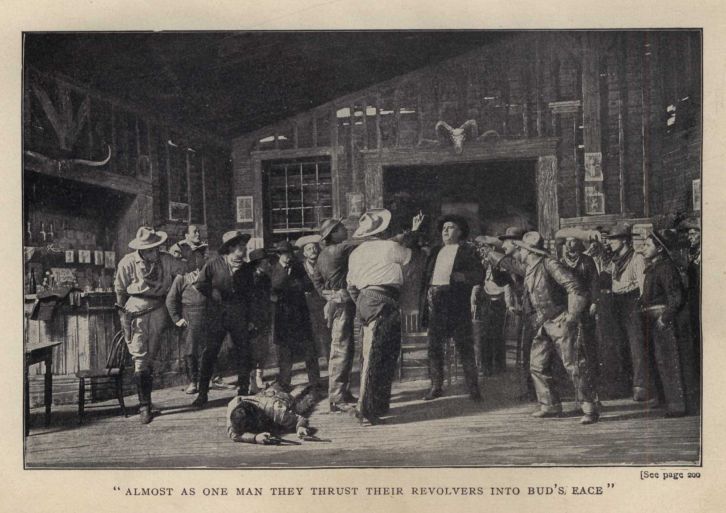
"ALMOST AS ONE MAN THEY THRUST THEIR REVOLVERS INTO BUD'S FACE" See page 200
Cash caught him by the arm and steered him to the bar. "Hello, Chief," he began, most affably; "come over here and we'll close our trade in a jiffy."
He spoke lightly, but his mouth began its rapacious twitching—Cash was really a little nervous over the deal. The government once in a while remembered its people, and took up the claim of the red man. He drew from his belt a paper.
"Ther's the big treaty, Chief," he hurriedly began to explain. "Now all you got to do is to make your mark to it." He spoke aloud so that all could hear as he said, "Heap good trade." Cash was clever enough to know that if the deal took place in the saloon in the presence of Nick it would seem, if inquiry were made later, a fair deal.
But Tabywana's mind had been tortured by one desire—more drink from the bottle that the white man controlled.
He mumbled helplessly as he leaned against the bar and began soliciting Nick for a drink.
"What's that? You don't want to trade?" Cash burst forth. "Why, damn you—" Then he paused; to lose his temper would accomplish nothing. A little patience and he could force Tabywana to make his mark. He glanced about the saloon. The others were paying little attention to him—a drunken Indian was of no moment to them. He signalled Nick that he would take the responsibility of giving the Indian liquor. Both knew it was against the law, but both also knew that it was a law daily broken.
"Touge-wayno fire-water," wailed Tabywana.
Cash took hold of him. "What's the matter, you—"
Tabywana turned to him. Yes, for days this Cash Hawkins had given him his drink; why shouldn't he do so now? Nick was watching them from over his shoulder as he took down a bottle of rye. Tabywana pointed to him.
"No give 'em, me—heap like 'em—big medicine, sick. Me all time heap sick." By his gestures he indicated that his body was suffering for the medicine. "Wayno medicine," he continued. "Pretty soon, more fire-water, catch 'em. Pretty soon—maybe so—no sick." Incoherently he tried to explain that the drink would cure him at once. If not, then pretty soon he would be very ill.
Even at a moment like this Nick could not resist the temptation to tease the Chief. He poured out some whiskey, Tabywana tried to reach it, but Nick lifted the glass and drank it. The sight of it maddened Tabywana: with his two fists he struck the bar and gave vent to his rage in a loud voice.
Cash saw it was time to finish the business. He put his arm about Tabywana, while he directed Nick to give the Indian the bottle.
"It's agin the law to give you whiskey, Chief. 'Tain't every one's got the nerve to treat you like a white man." By this time he was holding the bottle high up in the air. "But there ain't no one hereabouts goin' to question any trade I make. Every man has an inalienable right—say, 'inalienable's' great, Chief—that's good medicine," he translated—"inalienable right to git drunk if he wants to, and I'm agoin' to protect you in your rights."
He held the paper close to Tabywana; he lowered his voice.
"Now just put your mark to that paper and you get this bottleful and the time of your life." The words were accompanied with explanatory gestures so that Tabywana could understand.
The Indian tried to reach the bottle. Then he saw the paper; he took hold of the pen and bent over it. As he did so a girl's figure slid in between him and Cash, and the bottle went smashing out of Cash Hawkins's hand up against the bottles and glasses on the shelf at the back of the bar. There was a crash of breaking glass and a snarling curse from Hawkins.
Tabywana stood dazed for a moment at the sight of Nat-u-ritch, who silently faced him and Hawkins. He made a sweeping gesture of fury, and attempted to strike Nat-u-ritch, but she cleverly dodged him. The force of the unarrested blow carried Tabywana against a table, he stumbled into a chair, made an attempt to rise, but, after a desperate effort, fell back in a drunken stupor, oblivious to his surroundings. The sudden burst of anger was the natural climax to days of dissipation.
The crash of the glasses and the sudden entrance of the girl attracted the attention of the gamblers. Some of them, scenting a fracas, stopped playing; others merely looked up, and then went on with the game. What did an Indian, male or female, matter to them?
Cash propped himself up against the bar. For the first time he really was brought within close range of Nat-u-ritch. Silent and immovable she stood, guarding the sunken form of her father. Her head was erect and she looked her contempt and scorn full in Hawkins's face. In her hands she held the fallen blanket of her father.
"Well, what d'ye think of it, eh?" Cash finally ejaculated. His eyes took note of the girl's physical perfection. "Say, fer spunk and grit dam'f I ever see her equal. Say, she can have me, kin Tabywana's squaw."
Nick interposed sullenly as he straightened up the disordered bar.
"She ain't Tabywana's squaw—that's Nat-u-ritch, his gal—his daughter."
"Daughter or squaw, don't make no difference to me." Cash slouched up to Nat-u-ritch and insolently surveyed her. "She's puty, she is, and I'll include her in the deal. Say, sis, I like your looks. You please me a whole lot, and I'll buy you along with your father's cattle—savvy?"
Still she made no answer—she knew what the white man was suggesting. That she had accomplished what she had dared to save her father now frightened her. She wanted to get him away and escape with him. But how? She could not leave him. She only clutched the blanket tighter.
Cash caught sight of the half-breed Baco, who was often called in to act as interpreter by the white men. "Baco," he called, "what's her name mean?" He designated Nat-u-ritch with his thumb.
Baco grinned: "Purty little gal." He had cast his own eyes unsuccessfully on Nat-u-ritch.
"Well, she lives up to the name all right. Ain't she hell?" Cash drooped lower against the bar. "Say, Nat-u-ritch, you take chances with me when you interfere that way like you did jest now."
Along the platform Jim swung, the gray dust whitening his leather chaps and dusting his shirt and hat with a heavy powder. He had ridden hard to keep his appointment with Bill and his men. As he entered the centre door of the saloon he watched Hawkins and the little Indian girl with curiosity. He took in the situation at a glance. The drunken Chief, the tigerish Hawkins bending over the girl like an animal about to crunch a ewe lamb, and the contents of the smashed bottle that Nick was wiping away told him what had occurred. Cash was saying:
"Nat-u-ritch, you spoiled a very puty deal, and I ain't complaisant a whole lot with people as do that, but I'm goin' to pass that up, 'cause you please me, and I'm goin' to annex you. You're comin' to my wickyup—savvy? And to seal the bargain, and to show you that I ain't proud like the ordinary white man, I'm goin' to give you a kiss."
Before Hawkins could catch the resisting girl in his arms, Jim quietly stepped between them.
"Drop that, Hawkins." The voice of the Englishman was electrical. Jim's men jumped to their feet. At a move of Cash's hand to his belt they grasped their guns. "Don't pull your gun, Cash," Jim said. "You want to get your gang together before you do that. My boys would shoot you into ribbons." Jim was smoking a long cigar. He coolly took it from his lips, knocked off the ashes, then bent over Nat-u-ritch and whispered to her. Her eyes alone answered him. He was about to join his men when Cash Hawkins swaggered up to him.
"Say, son, ain't you courtin' disaster interferin' in my private business?" he threatened. He knew he dare not fight alone against Jim and his men, so he played for time. If only he had his gang!
Jim replied: "Do you call it 'business' robbing Indians when they're drunk, and insulting women?"
The cow-boy honor—for Cash had a crude drilling in the laws of the West—flamed at the last words, and in all sincerity, true to his American point of view, he answered, hotly:
"Don't you accuse me of insultin' women. She ain't a woman—she's a squaw."
Jim turned away. Why argue?
"Bill," he said, "you and Grouchy put Tabywana on his pony. Nat-u-ritch, pike way, and take your father with you." He knew she could manage the ponies and arrive at her wickyup in safety; in fact, the pony would take the Chief home as he would a dead weight, if Tabywana was once strapped on his back.
The men struggled with the heavy body of Tabywana, and they finally succeeded in dragging him across the room, followed by Nat-u-ritch carrying the blanket. Cash could only watch—he was helpless—so he snarled:
"You've spoiled my trade, eh?"
Jim turned to him. "The bar is closed to Indians in Maverick." He meant Cash to infer that he could make it unpleasant for him if he called the government's attention to the matter.
But Cash only sneeringly asked, "By whose orders?"
"Uncle Sam's orders, and they're backed up by the big 'C' brand."
At these words Shorty and Andy both pulled their guns, and stood ready to defend Jim's statement. Cash gave a loud shout, then threw himself against the bar as he screamed to attract the people in the room.
"Gents," he called, "the Young Men's Christian Association is in the saddle. Say," he wildly went on, "it's goin' to be perfectly sweet in Maverick. Nick,"—he turned to the bartender, who now wished that Hawkins would go—"I'll be back for a glass of lemonade." Then he came to Jim, and, bowing low, he said, with all the venom and malice of his nature, "And say, angel-face, when I come back you better be prepared to lead in prayer."
He made a lunge at Jim, but the sharp eyes of his men never left his hands. Cash gave a wild roar of derisive laughter, flung himself across the room, turned at the door, pointed to Jim, again laughed wildly, and then disappeared. Shorty and Andy followed him to the door. Jim, indifferent, with his back to him, walked to a table at the farther end of the room.
The place was silent now. Jim knew he had received a direct challenge. According to the laws of the West, Cash was entitled to get his men together to meet Jim and his men. Every one in the saloon was on the alert. The Englishman was not well known there, but from what they had heard they knew he was courageous. Would he prove it now? If so, it meant that he would be there when Cash returned. Shorty turned from the door.
"He'll be back," he said, without looking at Jim.
Jim went on smoking. "Of course," he answered. He deliberately seated himself at the table and began shuffling the cards.
Then Shorty and the crowd knew that he meant to see the thing through. It was a quiet way, but, they all agreed, a good way of accepting it. Shorty exchanged glances with Andy. The boss was of the right sort. A little more dash would have pleased them better, still—
"Und say," Andy said, "und with his gang." He didn't want the boss to make too light of the proposition.
But Shorty, who now was sure of Jim, answered for him, "So much the better, eh? We can clean 'em all up together. Say, boss, what did you let him make it a matter of Injins fer? You got the sentiment of the kummunity agin you right from the start. Looks like fightin' for trifles."
Grouchy, who had the news from Andy, who was now explaining it to Bill, straddled into a chair as he said, "Yes, it's some dignified to fight over cattle, but Injins—pshaw!"
Jim knew it was useless to try to explain. Their opinions on these matters were as separate as the poles; but they were a good sort, and served him well and faithfully. Personally he did not care for this proposed fight with Hawkins. He wanted peace—some days when he might dream and drift and watch the sand plains, when the work was done. The broils of the saloons, the point of view of the crowd, the honor of the West really mattered little to him, but for the sake of the boys, and that their pride in him might not suffer, he often accepted their definition of the code of life that was followed in Maverick. He knew how to win them, so he began:
"Well, boys, I don't want to drag you into my quarrel. If you feel that way about Indians—" He was about to add that he did not, but Shorty interrupted:
"Pull up, boss; 'tain't fair to make us look as if we were trying to sneak out of a scrap. It was only the cause of it. You ain't got a quitter in your gang, and you know it."
"I know it, Shorty." Jim was obliged to laugh at the eager faces of the three men who stood close to him, like excited children waiting to be understood.
"Well, don't say anything more about it, will you? Let's—" Shorty put out his hand.
Jim grasped it. "Let it go at that," Jim finished. "You understand that you are to leave Cash to me unless more get into the game."
Bill, who had been listening to it all, drew Jim aside. He preferred peace, but knew that they and Carston's ranch stood marked for the crowd to jeer at for all time unless they did what was expected of them by the laws of the cow town, made by its men, not by the government that they abused.
"Jim"—Bill spoke over his shoulder—"Bud Hardy, the County Sheriff, is standing just behind you at the bar, and he's particular thick with Cash. Got to take him into account."
Jim nodded; with his arm through Bill's he crossed to a side entrance and stood under the porch. He wanted to discuss with Bill what was best to do. Shorty and Andy stood up against the bar and treated their particular friends to drinks. They felt it was going to be a red-letter day for Carston's ranch.
Outside the Overland Limited tooted at intervals, and sent up shrill whistles, but made no attempt to leave Maverick. One official's information was denied by the next one. Passengers had come in and had gone again—some of them frightened, some disgusted by the life of the saloon. A little farther down the line others of the passengers were being amused by some Indians who, at the news of the train's stopping, had hurried to the railroad.
Cash's departure had allowed the place to grow quiet. Even Nick hoped he would not find his men and return. There was a sudden shunting of the train, and the rear car moved back in to more direct view of the saloon. Diana, tired of the wait, had finally persuaded Sir John and Henry to alight and see the place. They all entered together.
"By Jove, what a rum hole!" Sir John exclaimed.
"Hello, there's a faro-table!" exclaimed Henry.
All that Diana said was, "I thought you had given up play, Henry."
He shrugged his shoulders.
"Of course, my dear, but a little sport to kill the tedium of this infernal wait—the monotony of the thing is getting on my nerves. John, will you look after Di while I at least watch the game?"
"Delighted," Sir John replied, but his anxious face showed that he thoroughly disapproved of the proceedings. "Really, Diana," he began, "let me prevail upon you to leave here. Any one who remains in a place of this kind is taking chances—oh, believe me—"
"Nonsense; it all looks deadly dull to me."
The men, recognizing a quietly gowned gentle-woman, paid no attention to them.
"Why, I'm not afraid, John. What's liable to happen?"
Sir John Applegate's mind was filled with stories of the West he had heard and read in his boyhood days.
"Why, these desperadoes are liable to come in here and request you to dance—dance for their amusement, by Jove!"
"Well, what of that? We don't do it," Diana teasingly interrupted.
"Oh yes, my dear Diana, we do do it. The request is an order, you know—obligatory—oh, quite? Because, believe me, if we do not accede to their absurd request, they playfully shoot your toes off, by Jove! They are shockingly rude, by Jove! these chaps, believe me—oh, shockingly!"
Diana looked about the room.
"I've read of such things, but I don't believe they happen—do you?"
Henry was lost to them in the crowd around the faro-table. Several other passengers from the train had joined him. Sir John really did not like the look of the place; at the moment he caught Pete's eyes fastened in amusement on him. He drew Diana to one corner, and as he did so they came within range of Jim's sight. He was coming in to join Shorty and explain what he and Bill had decided to do when Cash returned. As he saw Diana he involuntarily drew back. It was only one of the old tormenting visions that had returned, he thought. He drew his hands over his eyes—but no, he saw her again! Impossible! He leaned forward—it was Di, and in Maverick! In spite of the sudden pain and bewilderment he smiled as he realized how the unexpected played its part in life. Di in Maverick!
There was no time to reason it out. He could not see Henry, only Sir John. He saw Diana watching with curiosity the place and its occupants. He mingled quickly with the crowd at the bar, hoping they would leave shortly.
Sir John was continuing his tirade against the ranchmen, and vainly trying to persuade Diana to return to the car. She was examining some crude pictures on the walls.
"When they wish," Sir John said, "these fellows shoot out the lights, the windows, and the bar furnishings. They are very whimsical—that's the American humor that they talk so much about. I don't care for whimsies myself." Diana began to laugh. Really, she was thinking, she had never known how absurd and old-womanish Sir John could be. But he continued: "Then, if you don't see fit to respond to their silly gayety, they kill you, by Jove! that's all. I can't see the joke of it, you know. For example, one of them comes in here and invites us all, believe me, to drink with him. It's not the proper thing to reply, 'Thanks awfully, old chap, but I'm not thirsty,' or 'I've just had a drink,' or 'Excuse me, won't you,' because if you say that, he's very angry, don't you know. You have offered him a deadly insult; he does not know you, never saw you before, hopes never to see you again, and yet if you do not drink something which you do not want he kills you. That's deliciously whimsical now, isn't it?"
"Cousin John, if I didn't know your reputation as a soldier, I'd think you were afraid." Diana, followed by Sir John, moved nearer the corner where Jim was standing.
Jim could see the sweet beauty of her face. He felt a sudden dizziness. It was more than he could endure. He started to leave, when he felt Bill's hand on his shoulder.
"This place is too stuffy for me; I must get out into the air," he explained.
"Leave the saloon now, Jim!" Bill exclaimed, in amazement. Surely Jim was not weakening. "If you ain't here to face Cash Hawkins when he comes back you lose your standing among the people with whom you live. You ain't agoin' to do that, are you, boy?"
"Oh yes—Cash." With the remembrance of Hawkins came the resolve to remain in the saloon until Diana left. He must be there to protect her if necessary. "I'd forgotten Cash; I was thinking of something else, Bill." Then, as he encountered Bill's searching eyes, he added, "Oh yes; remember, if Cash returns, each of you pick your man and leave him to me."
He drew closer to the crowd at the bar; Diana was not likely to venture there. She had joined Henry, and, with Sir John, they were about to leave the place.
Suddenly there was the sound of the clattering of a troop outside. At every entrance to the saloon—and there were four—a man entered flourishing a gun, while through the centre door rushed Cash, who by this time had worked himself up into a frenzy of passion. Straight into the ceiling he shot his revolver, and said:
"Nick, every one in the Long Horn drinks with me."
Every means of egress was barred by Hawkins's men. Jim drew behind Bill's burly figure. If only Cash would allow the strangers to go, was his one thought. Henry looked at Sir John; Diana, half frightened, grasped a chair. The men in the place made a hurried rush towards the bar; deep in rows they stood there. Then Cash noticed the three figures; but it only added to the zest of the situation for him. Diana, watching his cruel face, realized that Sir John's yarn of adventure might prove a true one.
The saloon waited in silence.
CHAPTER XVI
Cash had been drinking heavily all day, but there was no sign that it had weakened his faculties. On the contrary, the exhilaration of the liquor served to strengthen his dogged humor as he compelled the inmates of the saloon, strangers and all, to do his bidding.
"By Jove, Di, we are in for it," Sir John muttered. Then he turned irritably to Henry, who was close to him, "You have let us get in for a nice mess up." He was not afraid, but more than anything in the world he disliked a scene. He had travelled enough to know that they were at the mercy of the rough humor of these men. When occasion warranted he could match others in decision and courage, but he also knew that the consequences of the present situation were apt to be needlessly unpleasant. From the beginning he had been averse to Henry's allowing Diana to come with them; however, they must find a way out of it. He began to survey the crowd of men critically.
Jim, who was watching Diana, spoke, though still hidden among the crowd at the bar.
"There are some outsiders, Hawkins, from the train. You don't care to mix them up in our festivities, I suppose." By humoring Cash he also hoped to find a way out for Diana and the others. His voice attracted Sir John's attention.
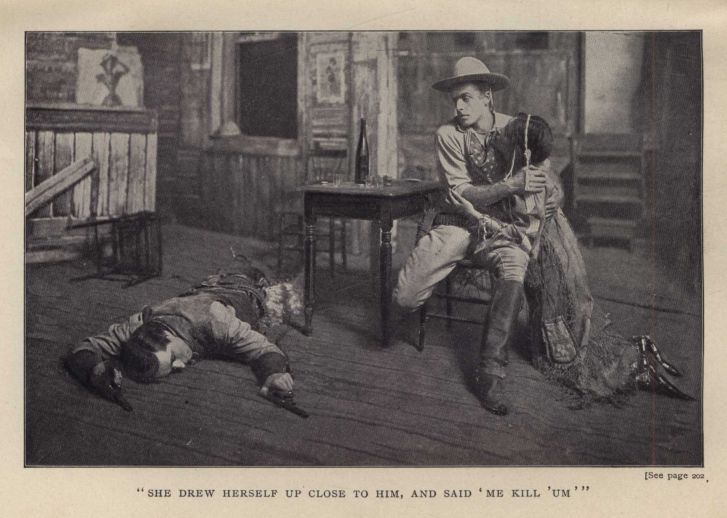
"SHE DREW HERSELF UP CLOSE TO HIM, AND SAID 'ME KILL 'UM'" See page 202
"Quite so," he rejoined. "We have had a delightful time, don't you know." Then he turned to the desperado, who, with the smoking pistol still in his hand, was leaning against the centre-table and laughing at the strangers' discomfiture. "Awfully jolly of you to invite us, but circumstances over which we have no control, don't you know—" He grew painfully muddled.
"That's right, pane in the face," said Cash.
Sir John dropped his eye-glass in disgust.
"Circumstances over which you have no control," sneered Cash. "You describe the situation accurate. I'm a-runnin' this here garden-party, and I ain't agoin' to let anybody miss the fun—savvy?"
Jim's intervention had only hurt their chances of escaping from the saloon. Cash motioned his men, with their drawn guns, to stand close at the entrances. Jim saw Diana turn pale. He forgot everything; he only knew that she stood there—that at this moment Henry and Sir John were powerless to help her. He must get her away from the place; he would agree promise Cash whatever he wished in return—only Diana must be allowed to leave.
"But the lady—you won't detain the lady against her will?" He knew the weakness of Cash's nature; to appeal to him as a gallant might be efficacious. In his earnestness to carry his point Jim stepped out from among the men around the bar.
Almost simultaneously a low cry of "Jim" broke from Henry and Diana. It was followed by an ejaculation from Sir John. It passed unremarked, and Jim determined to ignore what his impetuous folly had brought upon him. Cash was oblivious of everything save his revenge. He bowed low to Diana—he would be polite to the lady, even if the request came from Jim.
"I am going to give the lady the chance to see how an Englishman looks when he has to take his medicine." He looked at Diana. "She's sure a thoroughbred—she ain't batted an eye nor turned a hair. I'll bet a hundred to one she stays."
Diana could at that moment have passed out of the saloon, leaving Henry and Sir John there, but she saw only Jim. It was Jim—Jim in those strange clothes—Jim so bronzed, so strong, so masterful. What a contrast to Henry!
Cash waited for her answer. He adored playing to the gallery—this was heightening the situation beyond all expectation.
"She stays," he finally said. "Good! Gents, this is to be a nice, quiet, sociable affair—ladies are present. Any effort to create trouble will be nipped in the bud. Gents, to the bar."
He turned to Henry and Sir John as he spoke. He had a contempt for the men, but there was something about this quiet, dignified woman that embarrassed him, though he would have been the last to admit it. A few more drinks and he might be dangerous, but at present he was still master of himself. His game was to make Jim and his gang ridiculous before the strangers. Afterwards—well, then the serious settling of their score should come. He took a glass that was handed him across the bar and gulped down its contents.
Henry was whispering to Diana, "For God's sake, go—you can, and later we will follow you. This will be over in a minute." But Diana only held tighter the rail of the chair.
"We can't drink with this confounded bounder, Henry," Sir John expostulated. "It's too absurd, you know. Her Majesty's officers can't do a thing like that, now can they?"
"We must humor the drunken brute, Sir John, that's the only way out of it."
That Jim was there none of them acknowledged to each other. Events were assuming a strange unreality. What had been meant for a half-hours diversion was involving them in a highly dangerous situation. The saloon grew hotter—little air reached them through the barred doorway. Still Diana did not go. The old imperative cry, stifled for the last two years, awoke again. She forgot the dust, the hot saloon, the swaggering crowd of ranchmen. The noise and wild excitement fell on her unheeding ears. Jim was there, and his presence held her rooted to the spot.
Jim had moved into a corner at the lower end of the bar, and furtively watched Cash and his men.
"Step up lively, sonny," Cash called to Sir John and Henry, "or you may have to dance the Highland fling."
Sir John stole a look of self-justification at Diana, but she did not see it. It was turning out just as he had told her.
"And shoot our toes off, by Jove," he whispered to Henry. "And he'll do it, too, confounded bounder!" he muttered, as both men went towards the bar and were met by Pete, who handed them each a glass of evil-looking whiskey.
Cash began to direct the scene. "Hand out the nose-paint, gents."
Every one took a drink, Jim too; for her sake he would do as Hawkins wished. It would be the quickest way to end this part of the business. The serious end of it would follow when they were alone.
Suddenly Cash, whose last two drinks were rendering him more offensive, and who was determined to annoy Sir John as well as Jim, said, "Gents, to the success of the Boers."
To the crowd it was a foolish toast; it meant nothing to them. But they had hardly begun to toss off their drinks when there came a crack of glass, as Sir John Applegate threw his tumbler on the floor and said, "No, I'll be damned."
Cash turned on him with an imprecation, and started to cover him with his gun. This unexpected diversion was the chance that Jim had been looking for. In an instant he had thrown his untasted liquor into Cash Hawkins's face. It blinded Cash. Involuntarily he fumbled with his guns, and in an instant Jim had thrust his revolver into Cash's side. There was a moment of pandemonium as Cash's imprecations filled the air. The men at the door started forward, but they had to pay for the moment's lowering of their guns. Big Bill and Jim's men had been eagerly watching their opportunity, and speedily covered Cash's gang.
"Put your hands up quick," Jim ordered.
Cash, with visible reluctance, complied. There was a suppressed madness of excitement in Jim's voice as he said to Sir John Applegate: "Oblige me by relieving the gentleman of his guns; it will tire him to hold it up there too long." Sir John obeyed. It was a critical moment—one never knew which way a crowd in a saloon would veer, and there might have been a riot if Cash had been more popular. As it happened there was a laugh at Jim's words. Sir John reached for the guns. Cash, gaunt and terrible to look at, stood still while they were taken from him. The pressure of the muzzle at his side caused him to loosen his final reluctant finger.
"Delighted, charmed, I'm sure," Sir John agreed.
Jim, still covering Cash with his gun, drove him up against the bar. Those of the crowd who knew him realized that they were seeing a new man in the Englishman. He was conscious of Diana's luminous face back of him, of Henry's gray countenance close to her as he quietly expostulated with her. The crowd swung close to the new boss. This was what they wanted. They believed he would prove the new leader for Maverick.
"Every man's hands on the bar," the Englishman called, and he and his men covered the crowd at these words. "I ask you," Jim quietly said, "to drink with me to the President of the United States."
Men who had cursed their President, defied the laws of the country that had elected him, and who were fugitives from the justice of their land were touched by the simple and tactful toast. All glasses were raised. They were about to drink, but the first sentence was followed by the words:
"And to her Gracious Majesty, the Queen."
This time Jim stood ready to shoot; but it was unnecessary—the crowd echoed the toast. Why not? The Englishman was right. Their country—then his. Not a bad sort. So the murmurs went around.
Suddenly Hawkins said, as he watched Sir John:
"Your little glass-eyed friend don't drink."
Sir John's glass was still untouched.
"Oh yes, he's goin' to drink," Shorty cut in, as he crossed to the group near the table.
"Ain't nobody excused on a formal show-down like this!" Bill called.
But Sir John, carried away by indignation at Jim's daring to propose that toast to the country and the sovereign he believed Jim had so dishonored, vehemently answered:
"I'm an officer in her Majesty's service, and, by Jove! I won't drink with a man who fled from England after robbing the widows and orphans of the Queen's soldiers, and you can do what you jolly well like about it."
All eyes were turned on Jim. Would he kill the stranger? Henry held Diana by the arm. Jim grew pale under the strain of the moment's intensity.
Cash was the first to speak. "What do you say to that?" he drawled, after a prolonged whistle.
But Jim kept his eyes fastened on Sir John. "If I were the man you think me," he said, "you would never have finished that sentence. You have evidently mistaken me for some one else. My name is Jim Carston, and I never took a penny that did not belong to me."
Even to Sir John the words rang true, but he had lost all control—he was determined to avenge the old score of dishonor against his regiment.
"Why, confound your impudence, there stands your cousin, Henry Kerhill!"
The crowd swung around. This was the moment—it had been a day for Maverick. What were they now to learn of Cash's "angel-face"?
Henry crossed to Jim and faced him. There was a pause. "Yes," he answered, with as much nonchalance as he could assume, "I believe the gentleman does bear a certain bald resemblance to the man you mean, but it is evidently a case of mistaken identity." Diana's eyes were following him with their mute appeal. He continued: "You will observe, Sir John, that I drank the toast. I trust you will not refuse to drink to our Queen with these gentlemen in a foreign country."
The ranchmen liked these Englishmen. They were being treated with great consideration; the little one was amusing but he was all right. So ran the verdict of the Long Horn saloon.
Sir John Applegate stood unconvinced. Henry's eyes were fastened on him, and he read there something that held a reason for his denial. At all events he had been most unwise—he knew that now—and he must, for Diana's sake, undo his hasty words.
"Well, of course," he began, as he realized that further comment would be futile, "I was under the impression that I hadn't had a drink—not one, by Jove! Well, I must be squiffy." The cow-punchers laughed. "Here's," he finished, "to her Gracious Majesty the Queen—God bless her!"
Big Bill, who would have been an arch-diplomat in another sphere of life, said:
"Not forgettin' his Gracious Majesty the President, you know."
Sir John rose to the occasion. "Oh, quite so—his Royal Highness the President—God bless him!"
The men slapped one another in appreciation of the joke. Sir John tried to drink the whiskey of the country, but with a sigh he said, after the first taste, "Say, as I must drink, please make it Scotch."
During the scene in the saloon the car had drawn down the line and was shunting up and down the rails in a way comprehensible only to the powers that control an engine. Henry apprehensively looked towards the car, and went to meet Dan, whom he could see at the farther end of the platform. The meeting with Jim had been painful, and he was almost at his wits' end. As he could not force Diana's prompt withdrawal, he would fetch Dan to insist upon the passengers' return to the car.
Jim had seen Henry slip away unobserved. Would Diana and Sir John never go? He could see that the excitement was beginning to tell on Diana. Suddenly she swayed—yet he dared not go near her.
"Bill," he called, "the lady looks as though she were going to faint."
Sir John and Bill started towards Diana, but Bill was the first to reach her. He quickly grasped her by the arm and steadied her.
Diana smiled at him. "Thank you, I was dizzy for a moment."
"On behalf of the genuine cow-boys present, I must apologize to this lady for being forced to remain in a place like this. You may go, madam." Jim spoke without looking at her.
"Thank you," Diana answered. "I am a bit shaken, but I'm glad I stayed."
Bill was still holding her hand as he drew a chair towards her. "You're tremblin', lady. Nick"—he turned to the bar—"ain't you got nothin' in the way of a ladies' drink?"
"Right off the bat." Nick took a bottle from the pyramid behind the bar. "Here's a bottle of Rhine wine as has been an ornament here for fifteen years." As he spoke he dusted the slender-throated flagon. "It's unsalable. I never tasted it but once, and I hardly knowed I had had a drink. It was just like weak tea; but it's a regulation ladies' drink, and if the lady will honor me, it's sure on the house."
Diana had sunk into the chair—she was too dazed to know what to do. Sir John was near her.
"That's very kind of you, I'm sure," Diana said. She took the glass from Bill's hand. "I feel better already."
"It 'ain't got no real substance to it, lady, but it's the best Nick's got, and we'd like to have you accept it, jest to show that you know that all Western men ain't bad men and all cow-boys ain't loafers."
As he spoke, Bill bowed low. Like a gallant of old, he trailed his sombrero on the ground. Some of the men began to feel sentimental—they were like weather-cocks, responding readily with their susceptible natures to the swaying influence of the moment.
Hardly knowing what she was doing, Diana sprang to her feet. Jim would not look towards her—well, then, she must send him some message. "I think I understand," she said to Bill. "If you will let me, I would like to propose a toast—will you let me?"
The room echoed the assent of the men. They were all cavaliers—all sombreros were off and all bowed low before Diana. The cow-boy has much of the player in him. Hardly able to steady her sweet, tremulous voice, Diana turned directly to Jim and moved nearer to him, while she lifted her glass high in the air.
"To the Queen's champion, Mr.—" She paused, her eyes were blinded, her brain clouded. What was the name he had called himself? "Mr.—" she again repeated.
Bill's voice answered, "Jim Carston's his name, lady."
Higher she held the glass. Jim had turned in amazement. Her eyes met his.
"Mr. Jim Carston." Her voice rang clear and vibrant this time.
"And every son of a gun in this hole drinks to that, or we'll know the reason why—eh, boys?" Bill jubilantly cried. Their boss had brought glory to them that day.
"Jim Carston! Jim Carston!" The name rang through the place, and the toast was drunk with enthusiasm. In the midst of it all the centre door was thrown open and the conductor's big voice bawled:
"All passengers for the Overland Limited—all aboard!"
CHAPTER XVII
The tooting and whistling of the train began. The men filed outside. In the crush Cash Hawkins, who had been drinking steadily until he was now in a decided state of inebriation, slunk down to the other end of the platform. Henry and Sir John assisted Diana to the car. The cow-boys swarmed along the platform—Jim alone stood in the deserted saloon.
Before he was aware of what was happening—that the train was about to carry away this tie of his former life—he heard Diana's voice call "Jim." She slipped from the lower step on which she stood and ran towards him.
"Diana!" He seized her out-stretched hands—he must say something to her, but she would not let him speak.
"I shall always thank God for this day, Jim, I couldn't believe you were—I never have. Now I know the sacrifices you have made for me—now I know I have the right to ask God to bless you and keep you and make you happy." Her voice broke; tears were falling on his hand.
Lady Elizabeth or Henry would never discuss the cause of Jim's departure. She had always persistently defended him to the world, and to-day her intuition had told her that for her sake Jim had shielded his cousin—her husband! How could she accept it?
"And you, Diana—tell me you are happy."
"Happy?" Her eyes told him that it was only possible for her to be happy now that she knew the truth. "I sha'n't mind the future now so terribly, because I can respect somebody."
Dan passed the open door. "All aboard, lady," he briskly called.
"Good-bye, Jim. God bless you!" She felt herself being helped aboard by Dan; she tried to wave her hand to Jim. The car moved, the whistling and ringing of the bell told of their departure.
It was Henry who led her to a chair and left her there. That day he paid in full for his life's misdeeds.
Jim never attempted to see the receding car; he could hear the noise of the departing train and the cries of the boys as they hooted their good-byes.
"Kiss the baby for me." It was big Bill's voice.
"What a baby Bill is himself!" Jim found himself saying.
"Tell Sadie to write," called Shorty.
"Und say—say for me too, you bet." The voice of the German was drowned in the roar from the rest of the boys. Only Grouchy, in silence, looked on contemptuously.
From down the platform came the yells of the men. Even Nick had deserted his bar. Still, Jim did not move. He could hear it all; he knew what was happening—that the train was steaming away. He found himself watching flies settle on a beer-glass. Then he fell into a chair, let his head slip on to his arms that lay across the table, his back to the big entrance and to the smaller one at the other side of the room. There was no movement from him that told of the agonies he was enduring. The flies buzzed at will about the place.
The door at the side swung silently open and Nat-u-ritch slipped into the room. In her soft moccasins her steps made no sound. She crept towards Jim, amazed to see him lying thus. She shook her head—she could not understand this mystery. She was about to move closer to Jim when she heard some one coming.
Through the door at the back she could see the crowds returning from the departed train, while from the other direction came Cash Hawkins—she could see him clearly. Closer came his steps. Quickly she slid behind the door, and from without peered into the saloon. Cash, aflame with passion and liquor, entered and saw that Jim was alone.
He drew both his guns. With an evil smile he advanced upon Jim. "Damn you, I've got you!" he hissed; but before he could pull the trigger there was a flash, a report, and Cash's hands were thrown up in a convulsive movement while he pitched forward on his face. Dazed, bewildered, Jim got to his feet and mechanically pulled his gun; then, before he was aware of what had happened, he was bending over the body of Hawkins.
The report was followed by an excitable rush of the crowd into the saloon. The gamblers and cattlemen were headed by Bud Hardy, the County Sheriff. Big Bill, Andy, Grouchy, and Shorty went at once to Jim, who still stood close to the prostrate figure cf Cash Hawkins. Pete quickly knelt beside the body, and turned Cash over to examine him. Bud Hardy stood in the centre of the room.
"Hold on there! Nobody leaves without my permission." Then to Pete, "How is he?"
"He's cashed in, Sheriff. Plumb through the heart. Don't think I ever see neater work." He laid the body on its back and crossed the arms over the breast.
Hardy walked direct to Jim. "Jim Carston, hand over your gun."
"And who are you?" Jim asked, as he looked at the tall, bulky figure of Bud Hardy. He had forgotten that Bill, earlier in the afternoon, had pointed out this man to him, and warned him of his friendship with Cash Hawkins.
Gathered about Bud were Hawkins's faction, who resented the Englishman's presence among them, and with them several who, only a few hours ago, had been cheering Jim. Bud Hardy answered his question with tolerant amusement.
"The County Sheriff," he said.
To the surprise of all, Jim advanced and handed his gun to Bud.
"Come on, you're my prisoner." Even Bud felt that this was extremely difficult. No resistance from the prisoner—no denial! It was unusual. But as he stepped towards Jim he was stopped by Bill.
"Wait a minute, Bud; don't be in such a ferocious hurry. Where you goin' to take him to?"
Bill's heart beat fast, but he gave no sign of the fear that filled him. He knew what this might mean for the boss. The faces of the other men of Jim's ranch grew gray—they too realized, far more than Jim did, that it was not the justice of the law that was to be his, but—well, the crowds grew blood-thirsty sometimes in Maverick. They had seen sights that the boss had not—an ugly swinging vision passed before their eyes, but no hint was given of this by the men. Each one knew that it would be the most unwise move they could make for the boss's sake.
Bill's big, slow voice was heard again in its careless drawl. "Wait a minute, Bud; don't be in such a ferocious hurry. Where you goin' to take him to?"
"County jail, of course, at Jansen," was Hardy's answer.
Bill then asked, as he surveyed Hawkins's gang, who were whispering together with several of the hangers-on of the place, "How do you know the friends of the deceased won't take him away from you and hang him to the nearest telegraph-pole, eh?"
It was lightly said, and as he said it Bill laid his big hand on Bud's shoulder. He must conciliate the Sheriff, gain time—anything.
But Bud shook Bill off. "Are you goin' to interfere with me in the discharge of my duty?" he blustered.
"Not a bit, Bud, not a bit," Bill said; then, with sudden resolve—it would mean his life, and the lives of others against them, perhaps, but he meant to fight if necessary—he added: "But we're goin' to see that you do it. We ain't afraid of a trial and a jury." He took the crowd into his confidence. "There isn't a jury in the State that wouldn't present the prisoner with a vote of thanks and a silver service for gettin' rid of Cash Hawkins."
He turned to Bud with his men about him. "Who's goin' to help you take him seventy-five miles to jail?" he demanded. "Will you swear us in?"
But Bud only answered, "You can't intimidate me, Bill."
"As defunct has a gun in each hand it's a plain case of self-defence, anyway." Bill pointed to the two revolvers still clutched in the dead man's stiffening hands.
"I don't stand for this," thundered Bud. "Clear the room."
He had been rather a friend of Big Bill's—most of them were in Maverick—so he had listened to him longer than he would have to any of the other men, but now he was through with his arguments, he must assert his authority.
"Clear the room; this prisoner goes with me."
There was a movement from the crowd. Bill looked appealingly at Jim. Why would not the boss speak? Just as the crowds had reached the doors Jim said to Bud, who was advancing to formally arrest him:
"Wait a minute. Take the trouble to examine my gun."
Bud lifted Jim's gun and looked at it closely. "Well?" he asked.
"You see it hasn't been discharged."
Bud quickly verified the fact that the gun was completely loaded. He paused a moment irresolute. Then, with a sudden suspicion, he said:
"You've had time to reload it."
The men were eagerly watching the scene between the two men.
"Smell it," Jim said, quietly. "I haven't had time to clean it."
"Ah!" Bill breathed. It was like Jim to play the trump card.
Bud Hardy lifted the revolver to his nose. It was as clean and fresh-smelling as a bit of cold steel. There could be no doubt that it had not been used, and Jim had all these men as witnesses to prove it. It would be useless to try to make a case of this. Bud knew when he was beaten. He took the revolver and handed it to Jim.
"Well, who did it, then?" He glanced at Jim's men. "Would you's all oblige me by giving me a sniff of your guns?"
The relief was so great that the men hysterically crowded Bud, and almost as one man they thrust their revolvers into Bud's face.
"Here's my smoke," said one.
Bud drew back. "One at a time—one at a time," he gasped—"if you please."
Then one by one the men filed past him as each held his revolver to Bud's nose.
"Here's my smoke-machine," Bill said. It was passed by Bud without a word.
"Und mine," said Andy.
Grouchy jerked his into Bud's face with the words, "Here's mine, and not a notch on it." And Bud could not deny the truth of the assertion.
All that Shorty nervously demanded was, "How's that?" as he jerked the revolver into Bud's face.
In Maverick this was evidence enough for Bud—evidence that so far all were free to go.
"Why didn't you's all say so before?" he growled, annoyed at the turn affairs had taken. Then he saw the expression on their faces, laughter and glee as they crowded around Jim; when they looked at him, tolerant amusement. The smelling of the smoke-machines they regarded as a fine new move on their part.
"Damn it," Bud thundered. "You've been astringin' me while the guilty man's escaped; but I'll git him—I'll git him yet."
Jim saved! It was all that the boys wanted. With a whoop-la, they tore after Bud. Down the platform they fled, all in excitement with the new sensation of the moment—the hunt with Bud for the guilty man.
Near the table lay a gray glove. Jim stooped and picked it up, and put it quietly to his lips. Bill, who had lingered near the door, suddenly turned and came back to Jim and put his arm about him.
"You just escaped lynchin', Jim." And Jim knew that Bill spoke the truth.
He held the glove folded close in his hand as he answered, "Yes, I'm almost sorry."
Bill's face became grave. What did the boss mean? Was the game too hard for him? Was he afraid he would lose on the ranch deal? He patted him tenderly, almost like a mother humoring a wayward child, without saying a word. Jim sank into a chair. Bill understood—the boss would like to be alone, so he sauntered up to the back and joined Nick. In his heart there was but one thought: Jim should see how well they would all serve him. He swore a mighty oath that he would see the others did so, too.
Left alone, Jim sat staring straight ahead of him. Suddenly he realized that the body of Cash Hawkins was still lying there. He shuddered at the cruel forgetfulness of the men. He leaned forward and spoke his thoughts aloud:
"Who killed Cash Hawkins?"
He felt a sudden touch on his hand; he turned; there, kneeling at his feet, was Nat-u-ritch, who had entered unobserved and crept beside him. As he looked at her she drew herself up nearer to him, and, leaning her chin on her hand, said:
"Me kill um."
Jim's only answer was to place his hand over her face while he hurriedly looked about the saloon. No one could have heard her. He drew her to her feet and motioned her to go, saying that he would follow shortly.
That night Jim learned the truth, and his friendship with Nat-u-ritch began.
CHAPTER XVIII
After this Jim often met Nat-u-ritch. On his trail across the country he would see her on her little pony galloping after him. Sometimes she would join him and silently accompany him on his search for the cattle that had strayed beyond the range.
Nat-u-ritch's life with her father, Tabywana, was passed in days of uneventful placidness. Since the death of Cash Hawkins the Chief had given her no cause for anxiety. Concerning the murder, neither she nor her father spoke. Tabywana admired Jim Carston; he seemed to realize instinctively what Jim had saved him from that day at the saloon, and his unspoken devotion, sincere and steadfast, often caused him to serve Jim without any one's knowledge.
Sometimes when Nat-u-ritch returned from a long day's ride her father would scrutinize her, and as he read in her the call of her nature for the Englishman, a curious smile would light up his face in sympathy with her. He saw the unmoved impassiveness that she showed to all the young bucks that sought her, and without protest let her go her way, and her trail always led towards Carston's ranch.
Winter came with its treacherous winds, and Carston's ranch was more desolate. Of Nat-u-ritch's unspoken devotion to him there was no doubt in Jim's mind, and the temptation to take her proffered companionship into his lonely life rose strong within him. After Cash Hawkins's death, Jim, had he cared for the life, might have been a leader in the Long Horn saloon, but a bar-room hero was not the role that he wished to play. His own men—Grouchy, Andy, and Shorty—openly expressed their disappointment to Big Bill at the boss's indifference to the position he might exert as a power in Maverick, and even Big Bill only vaguely understood Jim's unappreciative attitude. He often watched Jim smoking his pipe and peering into the heart of the embers that glowed on the hearth, and as he saw the careworn face Bill's great heart ached with sympathy for him. But Jim, as he realized the difficulties of the fight in which he was involved, only clinched his fists the tighter and accomplished the work of three men in his day's toil.
At these times the physical drain on him was so great that there was no opportunity left in which to realize the biting ache of his loneliness. So one bleak day succeeded another, with the slim, mute figure of the Indian girl ever crossing his path.
The early spring brought with it a sudden melting of the snow-capped hills and the ice-covered pools. The cattle grew more troublesome. They seemed harder to control, or else the boys were more indifferent to their disappearance. Big Bill had gone away on a deal for new cattle, so Jim's energies were redoubled.
One day as he rode across the plains searching for a lost herd that had wandered towards Jackson's Hole, the longing that the awakening spring had brought with it grew more insistent. Life surely held for him possibilities greater than this, he told himself. He resolved, on Bill's return, to arrange with him to sell the place. He could not conquer the craving for the old haunts of civilization that took possession of him. He closed his eyes to shut out the endless stretch of prairie. Lost in his dream to escape from his lonely life and to take part again in the affairs of men of his own class, he failed to notice the small pony that followed him carrying Nat-u-ritch.
On he went, so absorbed in his thoughts that he did not notice how close he was to Jackson's Hole. Big Bill long ago had warned him of the treacherous ridge that lay near the gulley, but Jim had forgotten Bill's words. Unconscious of the danger ahead, he galloped towards the edge of the broken precipice. In the distance he espied the marks of a herd of cattle that had passed around to the other side of the ridge. Jim urged his horse forward and started to jump the small, deceptive span that covered the hole. A sharp cry came from Nat-u-ritch, who had quickly gained ground on him as she saw his intention. But Jim, unheeding, gave a sharp command to his horse and urged him over. There was a sudden breaking of ground; then a whirling, dazed moment through which flashed an eternity of thought, and Nat-u-ritch stood alone, clinging to her pony as she peered over into the dark pool of broken ice around which stretched chasms of impenetrable blackness.
Two weeks later Jim opened his eyes to consciousness in Nat-u-ritch's wickyup. No man of those summoned by Nat-u-ritch to help had dared venture into the dreaded abyss, so Jim had been abandoned as dead. But the depth of her love gave the Indian girl the strength to accomplish his rescue. Jealous of her treasure, she dragged the unconscious body to her own village, which was nearer than Jim's ranch.
Then followed an illness from the long exposure in the gulley. Big Bill returned, only to find the ranch without its master, while Jim lay in the squaw's wickyup, with the Indian girl fighting to save his life, her love and loyalty making her his abject slave.
Weeks followed, and one day Big Bill and the boys brought the boss home. Then came a relapse, and again Nat-u-ritch's devotion and courage gave him back his life. This time Bill watched a double fight: the fight on the part of the woman to save the man so that she might win him for herself, and on Jim's part an effort to resist the mute surrender of the woman.
Without the boss's supervision the ranch had deteriorated, and Jim's affairs had become so involved that he recovered only to find that all thought of abandoning the place was now impossible. His dream of escape was now a hope of the past. And so life began afresh for him on the plains.
Jim stood outside of the window of an adobe hut. From within he could hear the low moans of a woman and now and then the wail of a child. He was alone, save for the missionary who had married him a few months before to Nat-u-ritch, and who was now inside helping the sick woman. Big Bill had gone to fetch an old squaw who had promised to come to the ranch. As Jim leaned against the post of the porch he was stirred by a multitude of emotions. The wails from within grew louder and more fretful. As he watched the heavens, ablaze with a thousand eyes, he wondered why the old woman had failed to come in time. He hardly realized what the past hour had meant to him. A child had been given to him! Something of the wonder of the eternal mystery was numbing his spirit. The sick woman's moans grew fainter, only the cry of the babe persistently reached him.
At last the missionary came to him: Nat-u-ritch was asleep; he would go, he explained, and hurry along the Indian woman who was coming with Big Bill to the ranch. The cry of the child seemed to become more pitiful. Jim tiptoed to the door of the inner room. On the cot lay Nat-u-ritch. He softly crossed to the small bundle of life rolled in the blanket and lifted it in his arms. The warm, appealing little body lay limp against him. He began swaying to and fro until the cry grew fainter. Soon the babe slept; but Jim still stood rocking his son in his strong arms.
CHAPTER XIX
One year slipped into another, until five had passed since the birth of Jim's son Hal. The cattle did well and ill by turns, but mostly ill. The trusts were making their iron paws felt by the grasp in which they held the ranchmen—absolutely dictating their terms. A dry season often further augmented the disaster of Jim's ventures. Without repining he fought on, with only great-hearted Bill's advice and confidence to help him through the wearing time.
Green River, which had been the excuse for Carston's ranch, was in low spirits this sizzling summer afternoon. Throughout the long day the alkali plains had crackled under the withering sun, until the entire place lay covered with a heavy powder of dust. Even the straggling scrub-oak and green sage-brush seemed to be only nature's imitation of asbestos, so persistently were they radiating the heat of the past week. The adobe stable glared at the low adobe dwelling opposite. Neither gave evidence of any life within. A decrepit wagon with its tongue lolling out lay like a tired dog before the stable; beside it was heaped the dusty double harness with its primitive mending of rope and buckskin, while near the house a disordered hummock of pack-saddles and camp outfits further increased the disorder of the place. An unsteady bench, holding a tin basin, a dipper, and a bucket of water, and a solitary towel on a nail near by, were the sole tributes to civilization.
Big Bill, whose eyes were accustomed to the place, seemed indifferent to the unspeakable desolation of the ranch. He sat on a log that lay before the door of the hut and was used for social intercourse or wood-splitting. He was intent on braiding strands of buckskin, the ends of which were held by little Hal, who had grown into a winsome little lad and was the pet of all the men and his father's constant companion.