S.
Reading edition
SADDLE
—is the well-known mechanical construction formed for the mutual accommodation and safety of both the HORSE and the RIDER. Although historical records prove them to have been in use with the ancients, there is no demonstrative reason to believe they were established in England till the reign of Henry the Seventh, when they were adopted under a compulsory law, that the nobility should not ride without them. Saddles are of different sorts, according to the distinct services for which they are designed; and, in fact, are so universally known, not only in the aggregate, but in all their component parts, that any elucidation upon so common a subject; must be evidently superfluous and unnecessary.
SADDLE-BACKED
.—A horse is so termed, when the RUMP-BONE rises so high behind, in conformity with the WITHERS before, that a hollow (or rather a complete curve) is formed in the middle, as a natural receptacle for the Saddle. Horses of this description are mostly, in action, easy and pleasant to the rider; but they are invariably weaker in the loins than those of an opposite description.
SADDLE-GALLED
.—This is an injury frequently sustained by horses either in the FIELD with HOUNDS, or in JOURNIES upon the ROAD; and can only happen by the inattention, neglect, or penury, of the OWNER, in not affording occasional precaution and inspection to the state of the pad, as well as to the first and safe FITTING of the SADDLE. It cannot but be known to the most superficial observer, that the padding of every saddle becomes progressively harder, in proportion to the perspirative matter it absorbs; and, in direct proportion with the hardness it acquires, the greater is the chance of its being injurious to the parts with which it comes into constant contact, and with a burning heat, produced by a long and repeated friction. Injuries of this kind, although originating in the same cause, vary a little in their effects: with one but slightly affected, a WARBLE may be produced; this happens on the side, and if attended to upon its first appearance, is easily obliterated by applications of vinegar, or other mild repellents; but unattended to, and a frequent repetition of the cause being permitted to take place, they soon become SITFASTS, and can only be got rid of by instrumental extirpation. Where any part of the saddle-tree (in the centrical cleft between the saddle-pads) is inconsiderately suffered to come into contact with the wither, or vertebræ of the back, and so continues in friction and pressure, during a CHASE or JOURNEY, certain mischief inevitably ensues: in the first a swelling, formation of matter, and FISTULA, may be the consequence; in the latter, an excoriation, followed by a tedious wound, or ulcer, may take place. Circumstances which so constantly occur (and that so often, from an unthinking stupidity in those who ultimately suffer by trouble and vexation in the event) are only brought to recollection, for the interested inculcation of those, who, inexperienced at present, will be taught, by time and prudence, that PREVENTION is at all seasons preferable to CURE, as it will be the means of shielding the body from trouble, and the mind from repentance.
SALLENDERS
—are at the bend of the hock (or hough) behind, exactly what the MALLENDERS are at the back of the knee; for which the modes of treatment and means of cure are precisely the same. See Mallenders.
SALTRAM
,—the name of a horse who acquired considerable celebrity by his performances upon the TURF, since which he has stood as a STALLION in a proportional degree of estimation. He was foaled in 1780; got by Eclipse, dam (Virago) by Snap grand-dam by Regulus, out of a sister to Black and all Black. He was sire of his Royal Highness the Prince of Wales's St. David, the Duke of York's Laurustina, and the Duke of Bedford's Sprightly, Lord Grosvenor's Brown Filly (out of Sting,) who won five prizes in 1790, at two years old, amounting to 1100 guineas; Caroline, and Tiffany; Queen of Sheba, (who won 900 guineas, at Newmarket, in 1792;) Rose, Spankaway, Sweeper, and the Prince of Wales's Whiskey, who won in the same year 1000 guineas, 2000 guineas, the 1400 guineas, 100 guineas, and 100 guineas, at Newmarket, and 50l. at Bedford; Royalist, General, Henrietta, Clytus, Coal Merchant, Tear-Coat, Peeping Tom, Septem, Coiner, Whip, and Oscar; exclusive of many Colts and Fillies, who were winners at Newmarket, and elsewhere, but never were named.
SANDCRACK
—is a crack or cleft in the HOOF of a HORSE, which originates in a preternatural brittleness, brought on by standing too constantly upon hot dry litter, without stopping to the bottom, or a proper and occasional oiling of the hoof, to keep it in a healthy state. It generally runs in a straight line downwards; and when it extends from the junction of hair and hoof to the bottom, with the bloody lymph oozing from the membranous mass at the top, it then becomes a serious concern, affording no expectation of speedy consolation. There is, in fact, but one direct mode of cure, which is to reduce the projecting and ragged edges to a level, with the finest side of the rasp. Then with the fine edge of a small firing-iron, of moderate heat, run two lines parallel to each other on each side the crack longitudinally; this done, draw two in the same manner transversely above, and the same below the centrical part of the cleft, by which it will be enclosed in a small square of double lines, calculated to restore the union which has been destroyed. A little compound tincture of myrrh, or friar's balsam, should be poured into the crack so soon as it is observed, particularly if blood should be perceived to transude from the opening. In slight cases, horses may be continued in moderate use; but where they bear the complexion previously described, turning out to grass in a pasture moist, but not wet, and that for a length of time, is the only foundation upon which the expectation of permanent cure can be entertained.
SCAB
.—The disorder in horses so called, is the species of mange become inveterately dry and scabby by its long duration.
SCENT
—is the leading principle from which the great and inexpressible enjoyment of all FIELD SPORTS is derived. It is the sublime and inexplicable mystery upon which so many have contemplated, without being enabled to define. That every information may be collected upon a subject so rich, and so desirable of attainment to the SPORTING WORLD, a rotational but concise review shall be introduced from those who have given their thoughts in print to the public.
We are told by one, that "Scent is an effluvium continually arising from the corpuscles that issue out of all bodies; and being impregnated with the peculiar state and quality of the blood and juices of that particular animal from which they flow, occasions the vast variety of smells or scents cognizable by the olfactory nerves, or organs of smelling." This writer proceeds in confirmation thus: "Hence the reason why one person differs from another in scent, and why a dog will trace the footsteps of his master for a hundred miles together, following him into any house, church, or other building, though surrounded by ten thousand: and when the faithful animal has thus diligently sought out and recognized his master, he is seldom willing even to trust the evidence of his own eyes, until, with erected crest, he has taken a few cordial sniffs, to convince himself he is right. Hence also we perceive how a pack of hounds are enabled to pursue HARE, FOX, STAG, or any other animal they are trained to hunt, across the scent, and amidst the society of others of the same species, without being diverted from the pursuit of that self same animal they had first on foot; and hence too we discover how it is possible for birds and beasts of prey to be directed to their food at such vast distances; for these corpuscles issuing from putrid bodies, and floating in the air, are carried by the wind to different quarters; where striking the olfactory nerves of whatever animals they meet in their way, immediately conduct them to the spot: and it is by this means the small-pox, measles, putrid fevers, and all epidemic complaints, are communicated, and the plague and pestilence conveyed from one place to another.
"It matters not how much the effluvia may be gone off, so as enough remains to irritate the olfactory organ: for whether it be bird or beast, they try the scent in all directions, till at length they discover that which is stronger and stronger, in proportion as they proceed; and this Nature has taught them to know is the direct and obvious road to their prey, and prevents them from following a contrary course, which is naturally weaker and weaker, and what in hunting is called heel. This observation is confirmed by the encreasing eagerness we perceive in all animals, the nearer they approach the object of pursuit; as we see hounds and spaniels in HUNTING and SHOOTING, are the most earnest, in proportion as the scent is recent, and they draw nearer to the GAME. The same thing amongst quadrupeds, whether wild or domestic, directs the male to the female that is in season for love; and hence we see the DOG, the BOAR, the BULL, and the STALLION, when turned loose, apply their nostrils to the ambient air, and proceed accordingly. By the same medium the vermin which infest our dwellings know how to direct their operations; whether to undermine walls, eat through solid boards, cross rivers, or climb spouts; which shows how much stronger the faculty of smelling is possessed by the brute than the HUMAN species; wisely ordained by Nature, to enable them to seek their food, and propagate their species; but for which they would often perish, or have long since become extinct."
Somervile, seemingly anxious to explore this hidden source of instinct, conceives the SCENT (divested of the dignity of blank verse) to arise from the peculiar property of the blood; which, when the game is on foot, is so encreased in its circulation, that the "ferous particles" are propelled through the skin in perspiration, and
"Leaves a long-steaming trail behind; which, by The cooler air condens'd, remains, unless By some rude storm dispers'd, or rarefy'd By the meridian sun's intenser heat: To every shrub the warm effluvia cling, Hang on the grass, impregnate earth and skies. With nostrils opening wide, o'er hill, o'er dale, The vig'rous hounds pursue, with ev'ry breath, Inhale the grateful steam, quick pleasures sting Their tingling nerves, while their thanks repay, And in triumphant melody confess The titillating joy. Thus on the air Depends the hunter's hopes."
Mr. Beckford, equally energetic in his endeavours to discover and ascertain the origin and property of SCENT, very modestly confesses his state of uncertainty, in a few lines preparatory to his remarks made in a letter to his friend, where he observes, "As you ask me my opinion of SCENT, I think I had better give it you before we begin upon the subject of HUNTING. I must, at the same time, take the liberty of telling you, that you have puzzled me exceedingly; for scent is, I believe, what we SPORTSMEN know least about. Somervile, the only one I know of who has thrown any light upon the subject of HUNTING, says, I think, but little about scent; I send you his words: I shall afterwards add a few of my own." Adverting then to the conclusion of the above quotation, he most judiciously proceeds:
"I cannot agree with Mr. Somervile, in thinking that SCENT depends on the AIR only; it depends also on the soil. Without doubt, the best scent is that which is occasioned by the effluvia, as he calls it, or particles of scent, which are constantly perspiring from GAME as it runs, and are strongest and most favourable to the hound, when kept by the gravity of the air to the height of his breast: for then it neither is above his reach, nor is it necessary he should stoop for it. At such times scent is said to lie breast high. Experience tells us, that difference of soil occasions difference of SCENT; and on the richness and moderate moistness of the soil does it also depend, I think, as well as on the AIR. At the time leaves begin to fall, and before they are rotted, we know that the scent lies ill in covert. This alone would be a sufficient proof, that scent does not depend on the air only. A difference of scent is also occasioned by a difference of motion; the faster the game goes, the less scent it leaves. When game has been ridden after, and hurried on by imprudent sportsmen, the scent is less favourable to hounds; one reason of which may be, that the particles of scent are then more dissipated. But if the game should have been run by a dog not belonging to the pack, seldom will any scent remain.
"I believe it is very difficult to ascertain what SCENT exactly is: I have known it alter very often in the same day. I believe, however, that it depends chiefly on two things; the condition the ground is in, and the temperature of the air; both of which, I apprehend, should be moist, without being wet: when both are in this condition, the scent is then perfect; and vice versa, when the ground is hard, and the air dry, there seldom will be any scent. It scarce ever lies with a north or an east wind; a southerly wind, without rain, and a westerly wind, that is not rough, are the most favourable. Storms in the air are great enemies to scent, and seldom fail to take it entirely away. A fine sun-shiny day is not often a good hunting day; but what the French call jour des dames, warm without sun, is generally a perfect one: there are not many such in a whole season. In some fogs, I have known the scent lie high; in others, not at all; depending, I believe, on the quarter the WIND is then in. I have known it lie very high in a mist, when not too wet; but if the wet should hang on the boughs and bushes, it will fall upon the scent, and deaden it. When the dogs roll, the scent, I have frequently observed, seldom lies; for what reason, I know not; but, with permission, if they smell strong when first they come out of the kennel, the proverb is in their favour; and that smell is a prognostic of good luck.
"When cobwebs hang on the bushes, there is seldom much scent. During a white frost, the scent lies high; as it also does when the frost is quite gone: at the time of its going off, scent never lies: it is a critical minute for hounds, in which their game is frequently lost. In a great dew, the scent is the same. In heathy countries, where the game brushes as it goes along, scent seldom fails. Where the ground carries, the scent is bad, for a very evident reason, which hare-hunters, who pursue their game over greasy fallows, and through dirty roads, have great reason to complain of. A wet night frequently produces good chases, as then the game neither like to run the COVERT, nor the ROADS. It has been often remarked, that scent lies best in the richest soils; and countries which are favourable to horses, are seldom so to hounds. I have also observed, that in some particular places, let the temperature of the air be as it may, scent never lies."
Amidst the various opinions upon the origin and property of scent, the most opposite join issue upon the simple question of doubt; whether the particles of effluvia which constitute what is termed scent, and by which hounds are excited to follow the game, are proper identical parts of the animal's body emitted in exhalations of respiration from the lungs, or by the transpiration of perspirative matter through the skin. This, perhaps, is of too abstruse a depth for the utmost extent of human wisdom to explore with success. The opinion of Somervile seems founded upon the very basis of experimental observation, bettered by the sound judgment, and practical remarks, upon the promoting, or retarding, effects of both the atmosphere and soil; to which one circumstance alone seems to convey additional rays of elucidation. It must be recollected by every sportsman, who has occasionally taken the field with HARRIERS, that, although they have picked the trail for a mile, into the very stubble, fallow, or covert, where the hare is sitting in her form; although they are trying round her in every direction, and even within a very few yards; there is then no more palpable perceptible scent, than when they trailed at half a mile from her form; and when she lays close, it is evident the dog, or dogs, derive no additional advantage from being nearer to her, (in respect to finding,) unless by stealing away, or jumping up, she gets into motion, when the scent is then afloat, and continued as already described.
Whether this enquiry will ever be traced to the source of certainty, is almost immaterial; it is a large field for the speculation of philosophy, and well worthy investigation. From a contemplative review of the operations of nature, it is evidently demonstrated, that there is a secret instinctive principle infused into the whole race of animals, whereby they are impulsively propelled to the propagation of their species, the preservation of their offspring, or an implicit pursuit of their propensities; so that no one shall become too numerous and destructive for the existence of another upon whom they prey, or with which they live in a perpetual state of warfare. It is likewise to be remarked, that the greater likeness we discover in the form of the animal creation, the more we perceive their friendly disposition to each other; because the scent of their bodies afford a pleasing gratification to the sensitive faculty, without exciting the appetite; if it was not for which all-wise dispensation of a superior and invisible Power, the same species would devour each other, and the purposes of the creation would be annihilated by the operation of its own works.
SCHIRROUS
.—The substance or enlargement so called, is an accumulation of obstructed or extravasated lymph, becoming more and more indurated by its stagnant retention. All tumours of this description, either in MAN or beast, should be attended to in their infancy; when warm stimulants, and powerful repellents, may be expected to have a proper effect, previous to their having acquired induration; after which no hope of obliteration can be indulged, but by instrumental extirpation. From the reflection naturally arising upon which, will appear the prudent necessity of paying early attention to swellings and enlargements of every description; that nature may be assisted in her own efforts, and her indications promoted without delay. Those tumours which are hard, and seemingly insensible, not feeling pain upon pressure, are of the indurated and schirrous kind; all swellings, and enlargements, in which there is palpable heat, constant pain, and a shrinking from the touch, denote SUPPURATION, which should be promoted by means of FOMENTATIONS and POULTICES applicable to the purpose; for where there is a well encouraged formation of matter, and a good discharge, there is seldom any disappointment in the expectation of a speedy cure.
SCIATICA
—is a species of RHEUMATISM attacking a horse in one or both hind quarters, which is sometimes so severe, as to render him nearly or quite immoveable in his stall. It will be found enlarged on under the head Rheumatism, where the means of relief are properly pointed out.
SCOURING
.—A horse is said to have a scouring, when the body labours under a continued LOOSENESS, similar to a course of purgation, without any perceptible cause. Some, called fluey carcased horses, are liable to this disorder from a variety of trifling causes, explained more largely under the head Looseness, which see.
SCRATCHES
—are cracks in the heels of horses, which are originally produced by the changes of weather, and their being left with wet heels in the winter season. These, when long neglected, assume a degree of virulence, and, from small, and almost imperceptible cracks, become clefts with ragged edges, acquiring, by degrees, a kind of fungous callosity. From these a fœtid oily ichor is discharged, attended with an inflamed tension of the fetlock-joints, and so much constant pain, that the horse is unwilling to move in his stall, unless compelled so to do; and when a leg is lifted from the ground, he suspends it for some time, in a seeming state of misery, from the fear of putting it again to the ground. The cure consists solely in daily fomentations of warm, well-boiled, gelatinous gruel, with a sponge; followed by linseed poultices; dressings of digestive ointment; a few DIURETIC BALLS, given three days apart; and, lastly, a course of ALTERATIVE POWDERS, to obtund and correct the acrimony in the blood. If they have been permitted, by neglect and inattention, to reach their most inveterate state, displaying prominent fungous warts, or small tetters, mild escharotics, or instrumental scarifications, must be brought into use; without one or both of which, an early or certain cure will not be obtained.
SCUT
.—The tail of either HARE or RABBIT is so called.
SEAMS
—was a term formerly in use to signify the re-union of divided parts in the hoof of a horse, as a cured SANDCRACK; or the cleft at the junction of a FALSE QUARTER, with the uninjured part of the foot.
SEAT
,—the position on horseback. A person once mounted, and sitting at his ease, free from every seeming constraint, with his body pliably erect, his thighs and knees adhering closely to the skirts of the saddle, an easy freedom in his legs, and a personal motion corresponding with the action of the horse, is said to have a GOOD SEAT. Those who are always changing their position, throwing about their arms, swinging their legs, looking every way but the right, with stirrups too long, too short, or probably one shorter than the other, are horsemen of a very different description, having a very bad seat, or rather no seat at all.
SETONS
—are artificial drains (or minor kind of rowels) in horses, corresponding in effect with the issues inserted in the arms or thighs of the human species. They are generally made upon the cheek, or under the jaws of a horse, for some defect in, or inflammation of the eyes. A writer of much celebrity admits "their utility to be very great, because they facilitate the discharge of matter from abscesses, without the necessity of admitting much air; the influence of which upon an ulcer, produces pain and symptomatic fever." Another observes, that, "when tumours are taken in time, whether on the POLL, WITHERS, or BACK, not having been injudiciously retarded by common farriers, (whose management in this case is always worse than the DISEASE,) they may be carried off, and brought to heal by the discharge from SETONS, without any of the usual butchery, or cauterization, or the least blemish or loss of parts. Farriers (he continues) are always very much disposed to proceed with the knife, before the matter of the TUMOUR is fully concocted, by which error they treble the difficulty, protract the period of cure, and probably leave an indurated enlargement, which is never effaced."
The operation is in itself exceedingly simple, and is thus performed: the practitioner being provided with a seton needle, of a size and length proper for the tumour to be discussed, and having armed it with a sufficient number of cotton threads, in proportion to the effect required, and dipped in digestive ointment warm, the needle is to be introduced (if possible) at the upper part of the swelling, and the point conducted through the whole, and brought out at the bottom, as a depending orifice is of considerable advantage in assisting the discharge. The seton having been passed through the ABSCESS or TUMOUR, is then separated from the needle, and the two ends tied together: or if the length will not admit of that, a knot may be formed, or a wooden button may be affixed to each end, by which it may be occasionally pulled up or down, as when the two ends are tied together, it may be moved in a circle. When the swelling is perfectly reduced, and the offending matter entirely run off, the seton may be withdrawn, and the orifice will soon unite, and form a cicatrix, without any farther application.
SETTING DOG
—is perhaps, in respect to natural formation and effect, the most beautiful and attracting of the canine species: there is an elegance of figure, an uniformity of shape, make, and speed; a pleasing variegation in colour, (being generally yellow, or brown pied;) an inexpressibly anxious solicitation of notice, and an aspect of affability and anticipating gratitude, beyond the power of the PENCIL to depict, or the PEN to describe. The sporting business of the SETTING-DOG (commonly called the English setter) is precisely the same with the POINTER, but with this difference, that, admitting their olfactory sensations to be equally exquisite, and that ONE can discover and receive the particles of SCENT (alias the effluvia of the game) as readily, and at an equal distance, with the OTHER, the difference of the sport, in which they are separately engaged, renders it necessary that one should do upon his legs, what the other does by prostration upon the ground; and they are neither more or less than the effect of education; for as in the sport of SHOOTING (with the pointer) the GAME is expected to rise, so in drawing (with a setting-dog and net) the BIRDS are required to lie.
Naturalists seem to have assumed a greater degree of latitude in respect to the CANINE SPECIES, than in any other part of the creation, where they have been less at a loss. Great musical teachers inculcate strongly, one forcible precept upon the minds and memories of their PUPILS, which is, "when they happen to err in execution, never to stop; because it will inevitably serve to convince the auditors, such are inadequate to the task they have undertaken; when by keeping on, not one in fifty may know an accidental mis-movement has taken place." Just so it seems to have been with speculative delineators of the CANINE RACE; where the pedigree could not be ascertained, the peculiar kind of any distinct class appears to have been accidentally forgotten. It does not seem that the origin of the POINTER is any where described, or by any writer attempted; but by the most respected authority we have, from whence information, instruction, and entertainment, can and may be derived, we are told, "the HOUND, the SETTING-DOG, and the TERRIER, are only one and the same race of DOGS; for it has been remarked, that the same birth has produced setting-dogs, terriers, and hounds, though the hound bitch has only had access to one of the three dogs." The true state of the case is precisely this, that although Nature, in her outlines, has furnished the canine race with powerful instinctive properties, by which their propensities, their pleasures, their dislikes, and attachments, may be disclosed; and notwithstanding it must be admitted, their olfactory sensations are refined in an extreme degree beyond the human species; yet much depends upon the means, mode and manner of education. This has been demonstrated a few years since beyond all manner of controversy, when a gamekeeper absolutely brought a full-grown PIG to hunt and point to the BIRDS; and procured a considerable emolument from displaying repeated proofs of his ingenuity, patience, and perseverance.
SETTER
,—in the game of HAZARD, is the person who sets the CASTER; or, in other words, the player, who makes stakes with the person holding the box and dice, who, if he THROWS IN, draws the money; on the contrary, if he throws out, the setter is the winner.
SETTER-TO
—is a term in cocking. The setter-to is the person who in a cock-pit receives the cock (going to fight) from the feeder, and hands him upon the SOD during the battle, according to the laws of the pit, and the conditions of the match. See Cocking, Cock-pit, and Main of Cocks.
SHANK-BONE
,—in a horse, is the bone extending from the knee to the fetlock-joint. This bone should be uniform, firm and compact, well proportioned to the length of the fore-arm above, and the pastern below; if too long for either, or both, the symmetry is totally lost; and hence a general objection to horses whose legs are too long for the CARCASE, which is a defect readily observed; and indifferent judges are always prepared to say, such a horse has "too much day-light under him."
SHAPE and MAKE
.—The "shape and make" of horses offered for sale, is such an eternal echo, whether at the public hammer, or by private contract, from one end of the kingdom to the other, that it is natural to conceive, no sporting subject can be more completely understood; but as there are eternally younger branches coming forward, and monied noviciates paying for practical experience in the art of DEALING, such extensive rules are introduced, to inculcate the absolute necessity for circumspection in BUYING, under the head Horse, that not a single line of utility can be added upon the subject.
SHARK
—was the most capital horse of his time; bred by Mr. Pigott, foaled in 1771, got by Marsk, dam by Snap, out of the dam of Warwickshire Wag. This horse was proved, next to Childers and Eclipse, to have been possessed of more speed than any horse ever bred or produced in the kingdom. He beat all his cotemporaries at every distance, (long or short,) clearly demonstrating his superiority, whether they run for speed, or run for bottom. His distinct winnings are too remote from the present time to enumerate individually, but they amounted in the aggregate to a GOLD CUP value 123 guineas, eleven hogsheads of claret, and the astonishing sum of 20,000 guineas, in plates, matches, sweepstakes, forfeits, and bets. When no horse in England could be found to start against him, he was taken to America as a STALLION, although it was publicly affirmed, 10,000 guineas were offered for him before his departure; admitting which to be the fact, it could have been done with no other motive than to render him a private STALLION for the mares of those only who subscribed to the aggregate.
SHOEING of HORSES
,—which for time immemorial remained in its almost original state, has for the last fourteen years become an object of importance and general investigation. What for a century before was never thought worthy a moment's consideration, but by those whose professional province it was to FORM the SHOES, and set them on, is at length found worthy the fashionable and condescending inspection of NOBLEMEN, GENTLEMEN, the polished groom, and the illiterate stable-boy. This change is well known to have originated in the publication of "Taplin's Stable Directory" 1789; which, from its unprecedented popularity, passed through TWELVE editions in the short space of four years. To the appearance of this work, upon a subject so long neglected, are the public indebted for the much-wanted veterinarian improvement which has since taken place; as well as for the constantly increasing influx of veterinary writers, who, speculating upon the success of the original reformer, have obtruded upon the world such an infinity of imitations, and such a profusion of what they have thought improvements, that the discerning part of the public (plainly perceiving the deceptive imbecility of such attempts) rendered them abortive; a multiplicity of books having been announced upon veterinary subjects within the last seven years, which have been immediately buried in oblivion, without a sale sufficient to pay even for the paper upon which the works were printed.
The rage for an improvement in the system of farriery which Taplin's books had induced, extended to almost every part of the kingdom, and necessitous adventurers became vulcanian speculators in every direction. Various new, important and infallible plans of SHOEING were hypothetically introduced amongst the infant crop of newly-sown veterinarians; one avowed himself an advocate for long shoes; another, for short shoes; a third, for high shoes; a fourth, for low shoes, and thin heels; a fifth, for half shoes; and a still more sagacious groupe of THEORETICIANS, for no shoes at all!!! To the great credit of the nation, and the strenuous endeavours of investigating individuals, this fashionable thirst of folly, this infatuating furor, seems now in a great degree to have subsided, and affords reason to believe, as well as to hope, the veterinary mania has (at least in this respect) attained its CRISIS; and that the only rational, safe, and judicious mode now in general use, will be no more attacked by the wild and chimerical speculations of those, whose want of professional skill and scientific information must ever render their schemes abortive.
That gentlemen will dedicate part of their time to examine the internal structure of the foot, the anatomical formation and junction of the bones, muscles, tendons, ligaments, cartilages, and membranes, is not to be expected; but that they will, upon the principle of self-defence, be careful to understand enough of the EXTERIOR, to check occasionally the rude hand of the injudicious or inconsiderate operator, is readily to be believed. The operative act of shoeing, in its general sense, as appertaining to the making of the shoe, the insertion of the nails, and the external finish of the foot, are too well known, and publicly performed, to require the most trifling description. Although one general data, or fixed rule, is laid down, by which all good and sound-footed horses should be shod without an exception, (proportioning the form, size, substance and weight of the shoe to the use of the horse,) yet there are occasional deviations, which cannot consistently be avoided, but must be prudently submitted to, when diseases of the foot, or injuries to the hoof, render them truly necessary. Hoofs, it is well known, are not all alike, nor are the same hoofs always in the same state; some are preserved so by unremitting care, and strict attention; others are permitted to get into decay, and to become diseased by a want of both. The OPERATIVE FARRIER has his different distinctions and denominations for the various kinds of hoof which come under his hand; as the sound, strong, firm, black hoof, which is generally perfect, and seldom either defective or diseased; the rough and brittle hoof, which is mostly wide and weak, requiring nightly stopping at the bottom, and oiling round the top; the long, flat and shelly hoof, which runs all to toe, and leaves nothing at the heel; the crooked or rather horny hoof, which, from a defect in radical moisture, grows into a wrinkled rigidity, that almost sets both the RASP and BUTTERIS at defiance. There are also others so thin, wide, and expanded above, and the outer sole so prominent on each side the frog below, that such are called fleshy-footed, and require a shoe of peculiar formation, as well as much extra care in setting it on. Some hoofs are so contracted with heat, and narrowed at the heel, (particularly if the frogs are wasted by thrush and corrosion,) that when turned, the vacuum bears the appearance of intentional excavation.
Under this accumulation of considerations, some conditional variations must be admitted, from the fixed and proper rules to be laid down, although the fundamental principle should still be the same; and, notwithstanding the superfluous and destructive freedom of the drawing-knife and butteris, are frequently, and with great justice, condemned; yet they must sometimes be brought into moderate use: but those who render them subservient to the purposes required, should invariably retain it in memory, that more may be injudiciously destroyed in five minutes, than can possibly be restored in TEN months. The entire ART of SHOEING may be reduced to a very concise description, and consists in paring the foot (when it is necessary) with judgment, tenderness, and safety; to form the shoe with good, substantial, sound, Swedish iron, of a shape and make hereafter to be described; in selecting nails of a proper size, length, or strength, equally adapted to the shape of the foot, and the weight of the shoe; and, lastly, to the very critical task of driving them properly, clinching them firmly, and finishing the foot neatly.
The act itself being thus publicly seen in practice, and generally comprehended, it becomes only necessary (amidst the variety of speculative opinions lately obtruded upon public notice) to introduce such comparative reasoning, and practical proof, of the superior excellence and rational propriety of the execution, as may enable every reader to take an impartial survey of the different modes recommended, in doing which, he is then at liberty to adopt which ever he may be induced to think approaches the nearest to perfection.
Amidst the great variety of attracting novelties which issued from the press, after the publication of Taplin's Pattern Shoes, was "a concave shoe," most zealously recommended by the PROFESSOR of a public institution, since deceased; who, had he lived only a few weeks longer, would have received the most unequivocal proofs of the fallacy of the theory, when put into competition with the UNERRING criterion of PRACTICE: but happily for him, and luckily for his great and opulent friends, (who were daily and shamefully forsaking him,) he died just in time to save his reputation. Suffice it, therefore, in delicacy to his error, as well as to his memory, only to observe, that the SHOE passing under that denomination (having a smooth or flat inside to cover the foot, and a concave surface, to come in contact with the ground or pavement) was the very reverse of what it should be, and only calculated to render tender, if not cripple, any horse, if obstinately persevered in; as will be candidly admitted by every reader of rationality, when the representation of the FOOT, the form of the SHOE, and the setting on of that shoe, are taken into distinct and separate consideration.
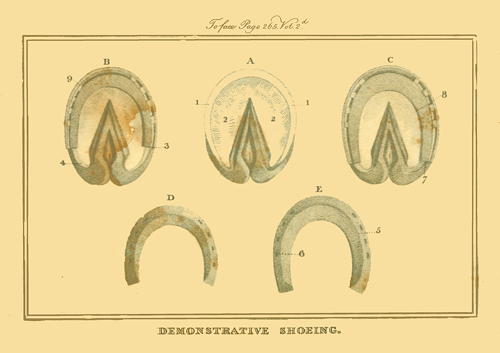
To face Page 265. Vol. 2ᵈ. DEMONSTRATIVE SHOEING.
That this may be done with a more comprehensive and general effect, divested of SCIENTIFIC disquisition, or ANATOMICAL ambiguity, a Plate is annexed; which, with very little explanatory matter, will afford the most perfect and satisfactory elucidation. A is the representation of a sound, firm, well-formed HOOF, in a slate of unembellished nature: here is evidently no devastation required—no paring off at the heel—no slicing off from the sole—no cutting-knife at the toe; nor does it, with an eye of the strictest judgment and circumspection, seem to claim or solicit from the art of man, any other assistance, than protection against the injury it must inevitably sustain from harder bodies, when brought into use by constant collision. That this fair and candid investigation may be the less liable to miscontruction, and that cynical misrepresentation, or envious opposition, may not (even in the weakest minds) warp the effect of truth, let it be observed, that the circular line marked 1 is the line of articulation, or, in other words, the distinct line of separation; around which is the wall or crust of the HOOF, (in itself insensible,) where the bearing only should be, and where the figure 5 of E will be found accurately formed for its reception.
That part of the foot extending from the line of separation on one side, to the corresponding line of separation on the other, having the FROG in the center, and marked 2 on each side, is called the outer sole, covering a membranous mass, or substance, called the inner sole, which is of exquisite sensibility, requiring PROTECTION without pressure upon the external part; which it will be seen (by referring to the Plate) is sufficiently afforded by the concave formation at Fig. 6 of letter E, which, upon the accurate inspection of the best informed and most experienced investigators, must be admitted a shoe of the first perfection for the promotion of every good, and the prevention of every ill.
Having thus produced both foot and shoe, as unsullied representations of NATURE and ART, and adapted the make of one to the formation of the other, with a consistency no man of common comprehension will presume to dispute, we proceed to an impartial examination of the letter B, which represents the mode of SHOEING adopted, and some time persevered in, at a place of veterinary celebrity, upon the discontinuance of the very short-lived concave shoe.
As it is a remark of long standing, that the exterior strikes first, so we shall find here, that, upon a superficial survey of the letter B, there is a neatness in the execution, that seems to excite attention, and command respect; but when it is critically examined with the eye of precision, and its deficiencies pointed out, it then loses all power of permanent attraction, and will advance no well-founded claim to approbation or imitation. Admitting (as it is presumed no opposition whatever arises to the fact) that the wall of the FOOT represented by Fig. 1, should have its bearing upon the properly-adapted part of the shoe, ascertained by referring to Fig. 5 of E, and continued home to the extreme point of the heel accurately terminated by the Fig. 7 of C; let us see what would be the inevitable consequence of having the shoes an inch and a half too short at each heel, as represented by Fig. 3 of B, where NATURE, REASON, OBSERVATION, and EXPERIENCE, concentrate their whole force to demonstrate the consistency, the safety, in fact, the indispensible necessity, of its being continued to Fig. 4 of B, as is already explained by previous reference to Fig. 7 of C.
Convinced, therefore, beyond the shadow of doubt, (as every reader may by another reference to No. 1,) that the wall of the HOOF holds forth its own proof, that the shoe should be continued home to the extreme point of the heel, or that it requires no shoe at all; and this alternative being first understood, and then acceded to, by every comprehension, it will be equally clear, that as much as art falls short in the support which NATURE requires, proportional must the injury be, by the inevitable indentation; invariably productive of bruises, and tenderness upon the edge of the sole, thereby laying the foundation of preternatural stricture, corns, callosities, and other ills, which would be more perfectly understood by an examination of any such subject, after a shoe one third too short had been eight or ten days in constant wear.
By way of concluding observations upon the Plate, and its purpose, it becomes only necessary to remark, that the letter C is the hoof of a large saddle or carriage horse, well covered for the pavement of the METROPOLIS, or travelling upon the turnpike-road. That the letter B is a perfect model of good shoeing for HUNTER or HACKNEY, provided the heel of the shoe was continued to Fig. 4, instead of terminating at 3. That Fig. 8 is called the web of the SHOE, which is, in fact, no more than the whole breadth of the iron, and may be widened, or narrowed, entirely by the judgment of the SMITH, or the discretion of the OWNER. That Fig. 9 is the cavity called the groove, or fullering, to receive the heads of the nails, above which (in SHOEING of EXCELLENCE, and superiority) they should never constitute a prominence; and that the letter D is no more than a back view of the short shoe, for some time so powerfully recommended, which has already most deservedly fallen into disrepute.
Having considered it necessary to introduce such minute references as will sufficiently demonstrate the difference between good shoeing and bad, it remains only to add a single deficiency of SHOEING SMITHS in general, who, from indolence, inattention, or inability, entirely lose sight of, or never form at all, the proper line of distinction between the bearing of Fig. 5 for the crust (or wall) Fig. 1; and the protection afforded the outer sole, Fig. 2, by the internal concave example in Fig. 6. Considering this remissness in the operator, and shoeing too short at the heels, to constitute the prevalent and principal errors requiring rectification, it is anxiously to be hoped, that those whose minds are open to conviction, will contribute their assistance to inculcate the necessity of adopting one invariable standard as a leading step to general reformation.
SHOEING SMITH
.—The shoeing smith, more frequently known by the denomination of BLACKSMITH or FARRIER, is, unluckily for those who profess it, a business of much greater bodily labour than professional emolument; hence it is, that few, except the very lowest classes of society, can ever be prevailed upon to engage in it. Here then has always been the deficiency so much complained of, and so universally known, with all the practitioners of the old school, acting as SMITHS and FARRIERS, whether in town or country; and it is much to be regretted, that their original want of education, the means of instruction, and their total ignorance of the properties of MEDICINE, should have hitherto secluded them from every chance of mental improvement, and personal emulation. If we advert to their manners, we find them in direct uniformity with their intellectual capacity: rude by nature, they become cunning by art; unfortunately untaught, it is their greatest pride to become proportionally untractable, and know so little themselves, they confidently affect to believe but little is known by others: shielded by which ideal sagacity, they obstinately persist in an opinion of their own, in opposition to every other, or individually determine to abide by no rational opinion at all.
When a candid comparison is made between their dangerous and laborious employment and their disproportioned emoluments, it must be admitted by every mind of liberality, they are the worst paid for their drudgery of any set of men in the universe. Hence arises that sterile apathy in the business, which is so much the subject of general indignation and universal contempt; and is the only well-founded reason, why there are so few men of education, or intellectual ability, to be found amidst the daily increasing number who profess the practice. Custom, too, has excluded them from any respectable weight in the scale of society; thereby rendering the obstacles to worldly elevation too numerous, and too uncertain, for even the most laudable and spirited emulation to encounter, with even a distant probability of success. These considerations readily reconcile it to reason, why (upon the most moderate calculation, taking the kingdom in general from one extremity to another) there are not more than one in every hundred, who exists by the practice of SHOEING and FARRIERY, that can speak with precision upon the property of the MEDICINE he prescribes; or elucidate, with propriety, the probable process, or ultimate effect, of the OPERATION he recommends.
In such predicament, probably anxious to do good, without the personal power to EFFECT it, they may be impartially considered "men more sinned against than sinning;" and, in many instances, much more entitled to the commiseration of the enlightened, than the contemptuous indifference they so frequently receive. Happily, however, for the vocation itself, much more happily for the community at large, improvement in the PRACTICE of FARRIERY has at length become an object of national consideration; and the institution has been repeatedly honored with PARLIAMENTARY CONTRIBUTIONS; under which predictive ray of reformation, part of the present generation may probably not only derive future advantage, but live to see the former system rescued from the ignorance and barbarity by which it has been for so many centuries disgraced. The great hazard arising from the practice of the injudicious or ill informed, is their possessing an unrestrained power of plunging into a bold and inconsiderate use of the most dangerous medicines, the present operation and ultimate effect of which they so little understand, and are so absolutely unable to explain.
It is no uncommon thing to hear of bleeding, rowelling, purging, glystering, and blistering, nearly all taking place (with the same subject) within the space of twenty-four hours; and could a thousandth part of the poor unfortunate animals so rashly annihilated, but rise, and recite, the load of medical combustibles and contrarieties by which they were destined to their long and last sleep, what a complicated history of the MATERIA MEDICA would be brought to light, and what a scene of professional knowledge displayed, to form the basis of REFORMATION, with that long list of sublime disquisitionists, who, waving the disgraceful appellations of smith and farrier, are becoming VETERINARY SURGEONS in almost every remote corner of the kingdom! One great and almost invincible error amongst the veterinarian fraternity (of whom there are many juveniles now to be seen) is their superficial survey, and hasty decision, in cases of the utmost magnitude; anticipating the prognostics, without even descending to examine the predominant symptoms of DISEASE. Passionately fond of affecting infallibility, they rashly promise more than they find themselves able to perform; and thus by their own weakness, voluntarily exposed, are frequently compelled to retract to-morrow, what they have most inconsiderately asserted to-day; thereby overwhelming themselves with a load of professional disgrace, from which there seems no sanguine prospect of speedy extrication.
Smiths and FARRIERS in general, being unfortunately ignorant in the peculiar property of each particular medicine, is not a greater misfortune, than their being absolute strangers to the medicines themselves, thereby becoming the standing dupes of adulteration. The warehouses and shops of inferior druggists, it is well known by men of experience, are by no means remarkable for professional purity; in some obscure corner of which is generally a reservoir of rubbish, admirably adapted to the prise and practice of FARRIERS, with whom a custom so laudable has been established for time immemorial, and from the palpable pecuniary effects upon both parties is not likely to be abolished.
SHOOTING
—is become a sport of so much pleasure and universality, that the legislature has found it expedient to extract an annual contribution of THREE GUINEAS from every individual who enjoys it. In fact, it is so perfectly congenial to the dispositions of the people, and so truly conducive to the greatest blessing in life, HEALTH, that it should seem its votaries have annually increased in proportion to the conditional restraints of parliamentary prohibition. Shooting, in its most extensive signification, may be supposed to imply the act of shooting with a fowling-piece, at any object in general, without a specific determination; but, narrowed into a less diffuse, and more expressive compass, it is then reduced to the more particular points thus defined. Pheasant shooting, PARTRIDGE shooting, GROUSE shooting, COCK shooting, RABBIT shooting, SNIPE shooting, DUCK, WILD FOWL, &c. These are pleasures varying a little in the difference of pursuit and enjoyment, but have, according to the season, their various degrees of attraction. Pheasant shooting begins (under certain penalties and restrictions, if killed before or after the days mentioned) on the first of October in every year, and ends on the first of February following. Partridge shooting begins on the first of September, and extends to the first of February next ensuing. The season (under similar restrictions, but heavier penalties) for killing HEATH-FOWL, or black game, commences on the 20th of August, and terminates on the 10th of December; and for grouse, or red game, on the 12th of August, and ends on the 10th of December. Woodcocks and Snipes being birds of passage, and not included in any act for the preservation of game, the time for killing is unlimited; being entirely dependent upon the season, the country they appear in, and the flights as they arrive.
Pheasant shooting may be considered the most laborious, and least entertaining, of the whole, unless in Norfolk, Suffolk, Essex, Hampshire, and some other counties, where the large tracts of lofty woodlands, and corresponding underwood, contribute so materially to their annual increase and preservation. This sport is mostly pursued with the small springing spaniel, whose eager tongue, the moment he touches scent of the foot, or winds the bird, gives "early note of earnest preparation." Pointers of great strength, and high courage, hunted with a bell, are frequently instrumental to good sport, and great success; but they must be fast goers, and once knowing their business, not readily disposed to stop, or draw slowly; if so, the bird will frequently rise in the highest part of the covert, or at such a distance, that an open shot will but seldom be obtained, particularly in a country thin of game. Those who wish to preserve well-bred and well-broke pointers in a state of unsullied excellence, will not accustom them to covert hunting, but invariably use their spaniels in one of the sports for which they were so evidently intended.
Partridge shooting is, to a contemplative mind, of a much more entertaining description; for the objects of pursuit being found in the open fields, every part of the sport is seen and enjoyed. Partridges are not in equal abundance every year, but depend in a great degree upon the state of the weather during the time of laying the eggs, as well as the time of HATCHING; which is almost invariably between the middle and the end of June. When the months of May and June are dry, birds are in general exceedingly numerous, and proportionally strong upon wing by the commencement of the SHOOTING SEASON; but when heavy and dreadful rains fall, as they frequently do during the HAY HARVEST, the destruction is incredible. Such continued rains not only chill the eggs during incubation, but drown numbers of the young almost so soon as they are out of their shells. Wet seasons also are destructive to ANTS, upon which, and their eggs, young partridges and pheasants principally subsist. Partridges so soon as the corn is cut down, and they are in a great degree deprived of the shelter and protection under which they were bred, display a most wonderful timidity and dread of danger; to which the whole covey are induced by the unceasing anxiety of the HEN for the safety of her young.
Thus incessantly alive to perpetual fear, they change their situation repeatedly in the course of the day; as well to insure security from all probable danger, as to supply the calls of nature. In the first part of the shooting season, while the stubbles of WHEAT and BARLEY are fresh, and not rendered too bare, or too much beaten by cattle, they are to be found in either one or the other, both late at night, and early in the morning: after feeding in which, (if not disturbed by the approach of those in pursuit of them,) by a signal from the hen, they rise gently, as it were, in a cluster, and glide or skim along with as little flutter as possible to the nearest turnips, standing clover, rushy moors, or grassy low coverts, in some of which, during the middle of the day, they are always to be found; and not unfrequently near a watry ditch, or running stream; as it is at this time, and only once a day, they take this part of their sustenance: but as there are many hilly countries in which water is but rarely to be found, it is natural to conclude, their wants in this respect may be amply supplied by the morning dewdrops with which vegetation so plentifully abounds.
The dogs peculiarly appropriate to and used in this sport, are principally POINTERS, at least with those who rank as SPORTSMEN, and have too high a respect for its character to degrade the order; and it is never pursued with greater consistency, or enjoyed with greater ecstasy, (or more success,) than when too many guns, or too many dogs, are not seen in the field together. Any number above two of the former, and two brace of the latter, in one company, evidently denote much more of poaching rapacity, and an intentional annihilation of GAME, than of SPORTING equity. Double-barrelled guns partake a little of the same impression, being admirably calculated to promote the very scarcity so much and so constantly complained of. The art of SHOOTING FLYING, in which numbers are so exceedingly expert, and which, in fact, may be so easily attained, is not, in general, acquired with that facility by young sportsmen, which might naturally be expected. This is entirely owing to the timidity, volatility, anxiety, and impatience, of the mind, at the very critical moment when all should be quiet and calm within; but at the impressive crisis, when the point takes place, and the animal is fixed seemingly immoveable, under an instinctive impulse, which instantaneously excites in the human frame a most aweful sensation, (the heart palpitating with HOPE, FEAR, and SUSPENSE,) the birds rise, and with so much noisy rapidity, that the mind and body being equally agitated, no particular bird is singled for the AIM, at the instant of pulling the trigger, and the whole escape.
There is no pursuit, game, or amusement, in which a proficiency is to be obtained, can require a nicer eye, a steadier hand, a cooler head, or a more philosophic patience, than the SPORT before us. Sportsmen of experience waste neither their time nor their labour; they well know, according to the description not long since given, where to find the game, according to the time of the day; and are seldom seen hunting their dogs in unlikely places. They cover the ground slowly and deliberately, that none should remain unbeaten, or birds be left behind: when a dog stands (or makes his point) the master should for a moment stand still also; the general stillness settles the dog more firmly to his point, and the birds are more likely to lie. If the gunner hurries up, (as many frequently do,) it hurries the dog also, and not only makes him impatient, but the game probably gets up out of shot; or, what is equally productive of mortification, he himself gets up to the point so flurried, and out of breath, that he finds it impracticable to take regular aim; and when he fancies he does, the bodily tremor he is in renders the shot ineffectual. To become a steady and good shot, some few short rules are unavoidably necessary, the principal of which is cool deliberation: those of too warm, hasty and impetuous a disposition, should retain in memory a single line from the immortal bard;
"Wisely and slow; they STUMBLE who run fast."
When the dog has enjoyed his point sufficiently, whether the birds are walked up, or rise spontaneously, the gun should never be raised to the shoulder till the whole covey are patiently surveyed, and the very bird fixed upon, at which the aim is intended to be taken; this once done, and the eye not removed from the devoted victim till the instrument of death is brought to bear, the sight once caught, and the motion with the trigger made in the critical and corresponding twinkling, success in most instances must eventually ensue. It may not be inapplicable to remark, that the progress to perfection is greatly retarded, amongst the juvenile branches of SPORTING SOCIETY (when shooting in company) by invariably and emulatively (but very inconsiderately and imprudently) endeavouring to obtain the FIRST shot: the error being mutual, so is the disappointment; probably both, or all, miss; to which nothing ensues but a vacant stare of mortification, not to add disgrace: but if a bird happens to fall, it is productive of clamour, and general jealousy: it is claimed by all: and personal acidities, from such trifling circumstances, have sometimes arisen about a paltry partridge, that have continued during the lives of the parties. The prudent and patient who shoot in company, will be circumspect in every motion; they will not take aim at the first bird which happens to rise, (to be confused by those who are rising,) or fix upon a bird on the left hand when a companion is on that side, and the bird going off directly across him. The right hand man and the left should take invariably birds on their own distinct sides; but when they go off in a direct line, circumstances and proceedings must be regulated accordingly.
Grouse shooting differs but little from the preceding, excepting its being more laborious, and taking place in the hotter months, and in the more hilly or mountainous countries. This species of game is not universally dispersed, like the partridge, over the face of the kingdom, but a native inhabitant of some particular district in wild, remote, or peculiar situations. They were some few years since to be plentifully seen in many parts of Wales, and in the New Forest of Hampshire; but they are now very much reduced, and rarely to be found; at least not in sufficient numbers to render it a sport worth pursuing. In the northern counties bordering upon the Tweed, and in various parts of Scotland, they are so numerous, that many of the most opulent and eager sportsmen make very long and expensive journies, to satiate themselves, and weary their dogs, with an unrestrained and unlimited profusion of sport. The grouse is larger than the partridge, and, when full grown, weighs from twenty to two-and-twenty ounces. The plumage is variegated, and beautifully composed of black, red, and white; the tail being similar to that of the partridge, but a little larger when extended in flight.
The GROUSE perseveringly adhere to those mountains and moors which are covered with heath, seldom or ever descending into the lower grounds. They fly in packs, consisting of four or five brace; and indulge upon intervening tracts of soft mossy ground, particularly in the hotter months of the year. The cackling noise of the cock may be heard at a considerable distance; and when once the dog makes his point, he is commonly the first bird upon wing. Upon the POINTER'S being first observed to stand, it is instantly necessary to keep the eye forward; for if the birds are perceived to erect their heads, and run, it is considered an infallible sign they will not lie well during that day; in which case there is no alternative, but to head the dog, and, if possible, keep pace with them, so as to be within shot when they rise; if which advantage is not taken, many a long and laborious day may be undertaken without the consolation of a single bird. As the time for this sport commences in the sultry season, and generally in parts of the country remote from expeditious means of conveyance, they do not very frequently reach the Metropolis; at least in such a recent state as to be perfectly attracting: they are (particularly if not killed remarkably clean) very soon disposed to putridity; and if required or intended to be sent to any great distance, they should be drawn as soon as convenient after they are shot, and the vacuum filled up with fine heath or herbage for the journey.
Cock (or Woodcock) SHOOTING is of a different and most entertaining description, when and wherever a plenty for the sport can be found. The woodcock is a bird of passage, and found frequently in a greater or less degree about the second, third, or last week of October. Their annual arrival in this country is more or less protracted by the uncertainty of the wind and weather at that particular season; the east and north-east winds (with a foggy heavy atmosphere) bring them over in the greatest plenty. Upon their first arrival, they have the appearance of being nearly exhausted, and drop under the nearest offered protection to the sea-shore; high trees, hedge-rows, small copses, heath, tufts of bushes and brambles, are equally acceptable. After rest, and such refreshment as the situations where they fall afford, they separate, and almost singly explore their way into the country more in-land, and fall in such woods, coverts, copses, or shaws, as are most applicably attracting or convenient to the length of their flight; varying the situation in future according to the accommodation they find, or the country they are in. No one part of the coast is more remarkable for their arrival in immense flights than another; Wales, Sussex, Norfolk, and to the extreme points of the north of Scotland, are, at different periods, supplied with equal plenty: in all or either of which, eight or ten brace (immediately after a flight arrives) have been killed out of one covert in a morning by a single gun.
The dogs used for this sport are the small COCKING SPANIEL; though they are frequently found by pointers, who make their point upon winding the bird, but not quite so staunch as to the more confirmed species; of which game the cock in a certain degree seems to partake. The woodcock, when flushed, rises heavily from the ground; and in an open glade, is so easily brought down, that even a moderate shot must be ashamed to miss; but when sprung in a lofty oaken or beechen wood, he is obliged to tower almost perpendicular above their tops, before he can attain sufficient height to take his flight in a horizontal direction; and this kind of vermicular flight he makes with such rapidity, (turning and twisting to avoid the trees,) that it is almost impossible to seize a moment for shooting with any tolerable prospect of success. As partridge shooting requires an almost systematic silence for the production of sport, so cock shooting admits of the reverse: for the greater the noise, the greater probability of success. Well-bred spaniels immediately quest so soon as they come upon haunt, as well as the moment a cock unexpectedly springs; this is the distinguishing trait of their utility, as it gives timely notice to every one of the party, and each individual has sufficient opportunity to be upon the watch.
Those who enter into the true spirit of this sport, and where cocks are likely to be found, seldom set out for a complete day's adventure, without being previously provided with a MARKER excellently qualified for the purpose in which he is engaged. And an assistant of this description becomes the more necessary, as a cock will very frequently suffer himself to be found, and shot at, four or five times in the same covert; and when absolutely driven out, will sink beyond the outer fence, and gliding a short distance almost close to the ground, will drop in some adjoining ditch.
Woodcocks are seen in this country till about the first, and sometimes the second, week in March: this, however, depends entirely upon the openness or severity of the season: if the winter has been accompanied with long and sharp frosts, they suddenly disappear within a few hours, (as by a kind of magical mystery,) and none to be found, with occasionally (and that but seldom) an exception of a disconsolate individual at or near some warm or sheltered SPRING which has not frozen. They are fullest of flesh during the months of December and January to the middle of February, from which time, as the spring sun gets warmer, they decline in weight to the time of their departure.
Snipe shooting is a sport the best calculated to try the persevering fag and bottom of a SPORTSMAN of any yet recounted; if he is not possessed of all the fortitude, patience, and indefatigable exertion of a WATER SPANIEL, he had better never be induced to make the embarkation, at least with any sanguine expectation of success. To wet, dirt, and difficulty, he must be habitually inured: in body he must be invulnerable; with a constitution impregnable to the united attacks of morbidity, and a mind most perfectly at ease. Thus armed at all points for land or water, moor or mire, swamps or bogs, SNIPE SHOOTING (where they are to be found in plenty) is a most excellent diversion; and some spots, particularly in a heath country, intersected by moors, swamps, and bogs, (as a celebrated scope called Eel Moor, near Hartford Bridge, upon the western road,) the sport is so incessant, that those who visit the place in open hazy weather, may shoot so often in succession, as to have frequent occasions in the same day to wait till the barrel cools. Snipes are of two kinds, one being full double the size of the other, and is called a WHOLE SNIPE; the smaller is called a jack, and of course somewhat more difficult to kill. Both sorts are found upon the same ground, and sometimes close to each other. They are birds of passage, and vary but little with the flights of WOODCOCKS in the time of their arrival, which is generally about the first plentiful rains in Autumn. They are said to breed mostly in the low and swampiest parts of Germany and Switzerland; although it is certain numbers do not return with the greater bodies in the spring, but remain here during the summer, and breed in the marshes and fens, where their nests are often found in the month of June with four and five eggs in each. Pointers only are made use of in this sport; and it is rather remarkable, that, notwithstanding this species of bird is so diminutive in proportion to the game that a dog is constantly accustomed to, he stands equally staunch to even the jack, (the least of the two) as to either PHEASANT, HARE, or PARTRIDGE. Snipes, the moment they are upon wing, fly against the wind, encountering which, they go off in such a twisting and twirling direction, that they are then a very difficult object to aim at; but by waiting with patience till they take their intended line, the shot may be made with a much greater probability of success. They cannot be said to be in season before November, or after February; for killed at any other time of the year, they mostly appear with a branny scurf upon their bodies, as if diseased, or in a state of emaciation.
These are the different kinds of shooting only which comprize the pleasure of the gentleman sportsman, and in which the better kind of sporting dogs (POINTERS, SPANIELS, and SETTERS) are used. Shooting of wild-fowl, rabbits, &c. are principally the amusement of those who are not particular in their objects of pursuit; but equally prepared for whatever may come in their way, from a PHEASANT to a tom-tit, or from a SOLAN GOOSE to a dab-chick. The scientific and systematic rules of shooting in the field are so generally known, and universally comprehended, in respect to the length of the gun, the mode of charging, the distance for firing, and some other trifling minutia, dependent upon contingencies, that a single line must be unnecessary in elucidation; except a salutary hint to the young and inexperienced, never to let others do for them with the gun, what they can do for themselves. It should be the particular province of the person who shoots, to charge his own gun, and to be punctually precise in drawing the charge at his return: a retrospective survey of the most melancholy and shocking accidents which the last few years have produced, will demonstrate to any humane and reflecting mind, the danger of letting either GUN or PISTOL remain loaded in a dwelling-house, where, by the single inadvertency alone, any individual of the family is perpetually liable to instantaneous destruction.
SHOULDER-LAMENESS
,—in a horse, is a defect in the scapularian muscles, or at the ligamentary junction of the fore thigh-bone with the concave point of the shoulder blade, upon which many, and some opposite opinions have been obstinately maintained: and there are not wanting at the present moment, those who affect to believe, and presume to affirm, "there is no such thing as a shoulder lameness in any horse." The absurdity of this ridiculous and contemptible assertion, can only be equalled by the unparalleled ignorance and illiteracy of those who make it: strangers to the anatomical structure of parts, they are inadequate to the comprehension of their uses, and the purposes to which they become intentionally appropriate. In direct confutation of such futile opinion, it is most indisputably ascertained, that injuries are frequently sustained in the shoulders, from which incurable lameness often ensues. Such accidents and misfortunes happen to horses in different ways: some by unforeseen circumstances, which no human prudence can prevent; others (equal, if not superior in number) by carelessness, inhumanity, inattention, or neglect. Lameness in the shoulder may be occasioned by the horse's being too suddenly stopped and turned upon uneven ground; sliding, stumbling, or flipping down, in a distorted position of either fore leg; turning too rapidly in a narrow stall, or too quick, sudden and short into a stable. That all which may be the better understood, by those who are anxious for information, and open to conviction, it is necessary, for the accommodation of every comprehension, to observe, that the blade or shoulder-bone not being fixed to the body by articulation, but by apposition adhering to the ribs, and firmly fastened thereto by corresponding muscles above and below, the animal, in undergoing any of the casualties before recited, sustains the injury described; in which the tendons or coats of those muscles are strained and relaxed; and as the extension has been more or less violent, so will the case be more or less dangerous and perplexing.
Cases constantly occur, where, by a slip, a cavity in the road or pavement, a rolling-stone, or any other cause, the leg of a horse is unavoidably thrown into a distorted and unnatural position, from whence ills ensue; the ligamentary junction, and muscular support, may be singly or conjunctively injured, in proportion to the magnitude of the cause by which the accident was sustained. In most occurrences of this description, some difficulty arises in the endeavour to discover the precise seat of injury, which is not, by the most judicious and observant investigator, always to be decisively ascertained: amidst such doubts, strict examination should be made to discriminate with certainty between a LAMENESS in the SHOULDER, and a defect in the foot; and this investigation is the more indispensibly necessary to be made, because, in strict verification of the ancient adage, "Doctors differ," instances are numerous, where one practitioner vehemently affirms the lameness to be in one part, and his veterinarian opponent as violently pronounces it to be in another. There is, however, one kind of clue, if properly attended to, which will generally lead to a ready distinction between a lameness in the foot and an injury in the shoulder; by getting twenty yards before the horse, so as to face him, and having him brought forward with increased action, fixing the eye at the foot, and bringing it gradually up to the chest, the imbecile effort at the point of the SHOULDER attended with pain, and the consequent bow or drop of the head, (as if going to fall,) will evidently demonstrate whether the seat of injury is there. On the contrary, in most lamenesses of the FOOT, the subject makes an attempt rather to hop, or to touch the earth lightly with the joint affected, than to give it equal support with the rest upon the ground: a horse lame in the foot, displays it most, the more he is ridden or driven; but a horse who has received an injury in the shoulder, demonstrates it less and less, the more he gets into a perspiration.
SIDE-SADDLE
.—The saddle upon which women ride is so called. The injuries horses sustain by the use of these saddles, when not properly attended to, exceed conception. It is well known by those who are much in public, and make their occasional observations as they ride, that most of the women about the Metropolis (who, it may be presumed, are taught in the schools) ride exceedingly ill, and to a spectator, most mortifyingly ungraceful; or, in words more expressive and explanatory, they bear near their whole weight upon the swivel-clog stirrup of the SADDLE, and little or none upon the back of the horse. The evident effect of this is, that the saddle, which should preserve a due and consistent equilibrium, compulsively preponderates with the weight of the injudicious RIDER, and has a constant bearing friction upon the WITHER on the off side, from whence originates inflammation, bruise, tumor, formation of matter, and not infrequently FISTULA, as a finishing consolation to the concern. When a comparison is made between the equestrian ability of the FINE LADIES in the environs of London, and the bounce-about self-taught damsels of the country, the former sink extremely in comparative estimation. The best and most certain means of insuring safety with a saddle of this description, is to have a hollow on the inside the pad which comes in contact with the off side the wither, so formed, as to admit of no bearing on that side at all. This is readily accomplished, by ordering a vacuum of the size of an inverted tea-cup, with elastic quilting to surround the edge, which taking a regular, equal and circular bearing, so completely protects the wither, that it is impossible an injury can be sustained.
SIGNS of DISEASE
—are various in horses, as influenced by the different sensations originating in the peculiar disorder of which they are the prognostics. One leading sign of internal pain or disquietude in a horse is, the refusal of his FOOD, a drooping of the head, a dulness of the eyes, a general bodily lassitude, and a seeming dislike to action. These are evident signs of indisposition, and should always prove an immediate stimulus to necessary examination, which cannot be made too soon, as many horses are totally lost for want of proper attention at the commencement of disease. Those just mentioned, are not considered symptoms of severity, or such as hold forth indications of SPEEDY DANGER; but they are of consequence to justify such early counteraction, as the nature of each particular case may render a matter of prudence and precaution. Much information may be collected from the state of the pulse, the warmth or coldness of the ears, the parching heat, clammy viscidity, or fleshy smell of the mouth, the heaving of the flank, the white or inflamed state of the eye-lids, and the glassy appearance of the eyes themselves; all which appertain to cold, fever, pleurisy, inflammation of the lungs, or affections of the liver. A horse's being in excruciating pain, looking back to his flank incessantly on either one side or the other, laying, or rather dropping, down suddenly, extending his extremities to the utmost, groaning at the same time, then raising his head as he lays, and pointing the nose to his flank, rolling over in his stall, and hastily rising, are all symptoms of cholic, and of that kind termed inflammatory, occasioned by indurated excrements in the intestinal canal, which, if not properly and expeditiously removed, produce MORTIFICATION, and, of course, death.
If the body is greatly distended, having the same symptoms, it is then called the flatulent cholic, and proceeds from the confined collection and retention of wind; to the immediate relief of which, flank and belly rubbing by two good strong men (one on each side) will greatly contribute. Constantly striding, and endeavouring to stale without success, denotes defect in the sphincter or neck of the bladder: discharging the urine by dribblings, in small quantities, and often, may be considered some injury sustained in the KIDNIES, particularly if the urine is in any degree tinged with blood. Glandular tumefactions under the jaws, with a soreness of the throat, if the horse is young, may be supposed an attack of the strangles; if an aged horse, who is known to have had that disorder, GLANDERS may probably ensue. A dry parched tongue, wrinkled at the sides with constant heat, is a palpable proof of fever; a raw and fleshy smell from the same, confirms it: a putrid fœtid smell from the nostrils, attended with a slimy discharge, equally glutinous and offensive, denotes a consumption of the lungs. A horse constantly dejected, with a gradually declining appetite, and inattention to those about him, bearing his head constantly to his right side, may be suspected of an inflammation of, or a tumefaction in, the LIVER, affording an additional and strongly corroborating symptom, if there is a palpable yellowness upon the original white of the eyes. This latter is also a distinguishing trait of jaundice.
Horses, when first attacked with fever, or an inflammation of the lungs, are observed to have alternate fits of shivering for the first two or three hours. Although a horse's coat may be rough and hollow from a cold stable, neglect, and ill looking after, it is sometimes a proof that all is not right within. If a horse is observed to strike his foot petulantly, and repeatedly, against his belly, threatenings of CHOLIC may be apprehended: but if at the same time he frisks his tail, and draws it in close to his quarters, irritation in the rectum is the cause; and the pain in the body, and itching at the anus, are produced by WORMS. In addition to the signs of disease, a few words may be applicable upon the signs of health; and although the horse's VIGOUR, STRENGTH, and SPIRITS, will, upon nearly all occasions, unerringly demonstrate this, yet some few shades of instruction and precaution may be acquired from a little attention to the secretions of, and discharges from, the body.
A HORSE or MARE in high health, seldom varies much in the colors or quantities of what are termed the excrementitious discharges from the body; as they are in general a tolerable criterion of the real state it is in. The dung from a horse in good condition for work, free from a viscid or diseased affection of the blood, and the various disorders and humours dependent thereupon, will be mostly observed of a pale yellow, moderately united in firm bright globules, rather brittle than adhesive, with a shining slippery surface, but perfectly free from a glutinous viscid slime. If the dung is hard, black, and offensive, when it falls, the body is overloaded, the habit is costive, and it has been too long retained; if covered with the gluey slime before described, it is a sufficient proof of internal foulness, and most probably of impending disease. When a horse is labouring under a dangerous disease, some occasional assisting information may be derived from the URINE as it falls, and much more if caught, and set by to subside. If it comes away limpid and colourless, remaining in that state after being set by, it is not considered a symptom of a very favourable complexion; but if it comes away red, or of a turbid yellow, with an oily skin upon its surface, and afterwards deposits a kind of brickdust sediment, with a kind of strong or terebinthinate effluvia, it may be considered a good sign, and is very frequently the harbinger of a speedy recovery.
If, during the progress and various changes of disease, it should assume different appearances, first of the healthy, and then the opposite aspect, the case is doubtful, and danger may be apprehended; as it affords sufficient demonstration, there is a powerful struggle in the system, and the morbid miasma is not subdued. The best state of a horse's urine, when in HEALTH and CONDITION, is of a yellowish tinge, moderate consistence, a strong smell, rather grateful than offensive, and a penetrating property: these, in the aggregate, may be concluded indications of spirits, strength, and vigour; the reverse, (in any serious degree,) slight symptoms of disquietude, or impending disease. After all the inculcations that can possibly be introduced under this head, the most judicious and experienced practitioner will sometimes find it extremely difficult to distinguish, with certainty, between one internal disease and another; having nothing to assist him in the discovery but his own judgment, and the most predominant symptoms at the moment, many of which are common to other diseases. Notwithstanding these uncertainties, and the doubts which may arise between one and the other, it is the duty of every Veterinarian to acquire as perfect a knowledge as possible of DIAGNOSTICS; for although his incessant inquiries may not render him an infallible guide in every case without exception, it will afford him the gratification of a distinguished superiority over those who have neglected to avail themselves of the same advantages.
SINEWS
—is the fashionable and common term for the tendinous coat of the muscles extending from the back of a horse's knee to the fetlock joint, when which is in any degree elongated by strain, twist, or any other accident, the horse is then said to be broken down in the BACK SINEWS. The sinews or tendons are liable at all times to violent spasmodic contractions (see Cramp) not only in any one of the extremities, but throughout the whole body; the immediate and remote causes of which are hitherto undiscovered, and will most probably remain so, in respect to certainty; although there are not wanting speculators of mental fertility, who attribute them to various causes, without having, perhaps, in the whole number, fixed upon the right. One class of these suppose, convulsive contractions of the tendons are occasioned by surfeits, or the want of proper evacuation; another, from too plentiful and repeated bleedings, too violent purgings, or too hard labour; assigning for a reason, "that these fill the hollowness of the SINEWS with cold windy vapours, which are the only great causes of convulsions." Where they occur from accidental causes, and casual injuries, as in wounds, perforations, or instrumental incisions, the origin is obvious, and in a certain degree points out the immediate road to local relief. When a tendon has been in part divided, or only punctured, a succession of painful and most alarming symptoms invariably ensue, and relief can only be obtained by early application to the best opinion, and most experienced judgment, that can be produced; with the very slender and mortifying consolation, that not one in twenty (if severely injured) ever after proves of any permanent utility.
SIR PETER TEAZLE
,—the name of the most celebrated STALLION at present in the kingdom; his blood, performances, and progeny, being reckoned inferior to none, and superior to most of those who have ever appeared upon the turf. He was foaled in 1784; bred by the Earl of Derby, got by Highflyer, dam (Papillon) by Snap, grand-dam by Regulus, who was got by the Godolphin Arabian. At three and four years old he was the best of his time, beating every opponent, and winning stakes to a great amount. The second day of the Craven Meeting at Newmarket in 1789, when four years old, he won a subscription of 50 guineas each; beating Meteor, Pegasus, and Gunpowder; and received forfeit from Bustler, Rockingham, Poker, Patrick, Schoolboy, Harlot, and three others. In the first October meeting of the same year, he broke down, when running against Cardock, Driver, Schoolboy, and Gunpowder, with the odds in his favour; immediately after which he was announced as a stallion for the ensuing year at 10 guineas a mare, and half a guinea the groom. In 1794 his get began to appear. A bay filly of Mr. Clifton's won 120 guineas at Catterick, and 140 guineas at Knutsford. Another of Mr. Tarleton's won 100 guineas at Preston, and 40l. 10s. at Nottingham; and the afterwards celebrated Hermione won 80 guineas at Newmarket, the Oaks stakes of 50 guineas each (31 subscribers) at Epsom, 50l. at Lewes, and 50l. at Reading.
In 1795, nine winners appeared, amongst whom Hermione (then Mr. Durand's) won 100 guineas at Epsom; the gold cup, 40 guineas, and 100 guineas at Oxford; 45 guineas at Egham, and the Queen's 100 guineas at Chelmsford.
In 1796 twelve winners started. Ambrosio (three years old) won 150 guineas, and 50l. at York; 275 guineas at the same place; and the St. Leger stakes of 25 guineas each (15 subscribers) at Doncaster. Brass won 300 guineas, and 50 guineas, at Newmarket. A brown colt of Sir F. Standish's won 200 guineas, and the Prince's stakes of 500 guineas, at the same. Hermione won the two King's plates at Newmarket, and 50l. at Guildford. Parisot won the Oaks stakes at Epsom, 50 guineas each, 42 subscribers.
In 1797 his reputation as a stallion continued increasing; eleven of his produce obtained 33 stakes, plates, &c. Ambrosio won the first class of the Oatland stakes of 50 guineas each, (12 subscribers,) beating Stickler, Gabriel, Play or Pay, Frederick, Trumpeter, Parrot, and Cannons; 100 guineas, and 200 guineas, at Newmarket. Hermione won the third class of the Oatlands, 50 guineas each, (12 subscribers,) beating five others; and the King's plate at Newmarket, and 50l. at Epsom; the King's plate, and 60 guineas, at Lewes; and the King's 100 guineas at Canterbury and at Warwick. Honest John, 100 guineas at York, and 100 guineas at Richmond. Petrina won three fifties at Newcastle, Knutsford, and Northampton. Shepherd, two fifties at Durham. Stamford (3 years old) 200 guineas, and 150 guineas, at Newmarket, 200 guineas at Epsom, 280 guineas at Stamford, and the gold cup at Doncaster. Welshman won 100 guineas at Chester, 50l. and 50 guineas, at Knutsford, and a sweepstakes at Tarporley.
In 1798, Ambrosio won eight stakes and plates, amounting to 1625 guineas. Black George won 180 guineas, and 150 guineas, at Chester, 45 guineas at Newcastle, and 50l. at Knutsford. Demon, 100 guineas at Chester, and 60 guineas at Tarporley. Honest John, 200 guineas at York, and 134l. at Richmond. Pentacrue, 50l. at Dumfries, and 50l. at Ayr. Petrina, the gold cup at Chesterfield, and the King's 100 guineas at Lincoln. Sir Harry (three years old) the Derby stakes at Epsom, 50 guineas each, 37 subscribers. Stamford, 233l. 15s. and the Ladies' Plate at York; the gold cup, and 100l. at Doncaster.
In 1799 seventeen started, who were the winners of 37 subscriptions, sweepstakes, and plates. Ambrosio won 50l. at Newmarket, 225l. at York, and 200 guineas at Doncaster. Archduke (three years old) won 400 guineas at Newmarket, and the Derby stakes, 50 guineas each, 33 subscribers, at Epsom. Black George, 50 guineas at Newcastle, and 70 guineas at Litchfield. Expectation (three years old) 100 guineas and a handicap plate at Newmarket. Fanny, 140 guineas at Doncaster. Knowsley, 60 guineas at Catterick; 120 guineas, and the stand plate, at York. Lady Jane, 25 guineas at Preston, two fifties at Cardiff, 50l. at Hereford, and 50l. at Abingdon. Parisot, 800 guineas at Newmarket. Petrina, 50l. at Warwick, and 50l. at Shrewsbury. Polyphemus, 50l. at Shawbury, and 50l. at Northampton. Princess, 50l. at Epsom, 50l. at Brighton, and 50l. at Reading. Push-forward, 50l. at Penrith, and 50l. at Carlisle. Roxana, 100 guineas at Catterick, 300 guineas, and 100 guineas, at York, and 80 guineas at Beverley. Sir Harry, the Claret stakes of 1100 guineas at Newmarket. Stamford, the King's 100 guineas and the Ladies' Plate at York.
His constantly increasing reputation as a stallion produced an annual increase of winners. In 1800 fifteen of his get started, and were the winners of thirty-nine sweepstakes, subscriptions, matches, and plates; the principal of which were, Agonistes, (three years old) 140 guineas at York, 220 guineas at Newcastle, the produce stakes of 100 guineas each at Preston, and 160 guineas at Malton. Expectation (then four years old) won ten prizes, 150 guineas, 35 guineas, 32½ guineas, and 25 guineas, at Newmarket; 50 guineas, and the Jockey Club Plate, at the same; the Pavilion stakes of 25 guineas each (6 subscribers) at Brighton; 200 guineas, and 60 guineas, at Lewes, and the Gold Cup at Oxford. Fanny, the great produce sweepstakes of 100 guineas each at York, (22 subscribers;) seven she beat, and fourteen paid half forfeit, so that she won 1400 guineas in less than eight minutes. Knowsley (the Prince of Wales's) won the King's 100 guineas at Guildford, Winchester, Lewes, and Litchfield, with 80 guineas also at Lewes. Robin Red-breast, 50l. at Bridgenorth, 50l. at Newcastle, 50l. at Nantwich, the King's 100 guineas at Warwick, and 50l. at Litchfield. Sir Harry, 200 guineas, and 550 guineas. Sir Solomon made a very conspicuous figure, as will be seen under that distinct head.
In 1801 and 1802 he seems to have attained, in his progeny, the very summit of all possible celebrity: during the former there appeared fifteen of his produce, who were the winners of 44 sweepstakes, subscriptions, and plates, of which the most eminent were Agonistes, who won 100 guineas at Newcastle, the King's Plate, 216l. 5s. and the Ladies Plate, at York; the Gold Cup, of 170 guineas value, at Richmond; 120 guineas at Malton, and the King's 100 guineas at Carlisle. Haphazard, 90 guineas at Catterick, 50l. at Preston, 60l. at Knutsford, 50l. at Pontefract, 100l. at Doncaster, and 50l. at Carlisle. Lancaster, 50 guineas at York, two fifties and 100 guineas at Morpeth. Lucan, 100 guineas at Newmarket. Sir Harry, 400 guineas, and 50 guineas, at Newmarket, 235 guineas at Ascot, and the King's Plate at Winchester. Telegraph, 100 guineas, and 50l. at Newmarket, and 45 guineas at Bibury.
In the last year, 1802, sixteen of his get were the winners of 41 prizes; of which Agonistes won 1000 guineas at Newcastle. Attainment, 50l. at Newcastle, and 45l. at Nantwich. Duxbury, 250 guineas, and 100 guineas, at Newmarket. Haphazard, 50 guineas at Catterick, 250 guineas, and 268l. 15s. at York, 92l. at Richmond, the Doncaster stakes of 10 guineas each (13 subscribers) with 20 guineas added by the Corporation of Doncaster, and the King's Plate of 100 guineas at Carlisle. Lancaster, 50l. at Middleham, 50l. at Manchester, 150 guineas at York, 50l. and 50 guineas at Preston. Lethe, 1000 guineas, and 50l. at York, 1000 guineas at Edinburgh, and 100l. at Montrose. Lucan, 50l. at Newmarket, 130 guineas at Bibury, 50l. at Oxford, 50l. at Bedford, and 50l. at Newmarket. Pipylin, 150 guineas at Newmarket, and 65l. 15s. at Nottingham. Ransom, 50l. at Stamford, and 50l. at Canterbury. Robin Red-Breast, 100 guineas at Newmarket. Sir Simon, 50 guineas, and 25 guineas, at Goodwood: and Wilkes, 50 guineas at Newmarket.
Thus the united blood of Herod, Blank, Snap, and Regulus, are proved equal, if not superior, to every other junction or cross ever introduced. Sir Peter Teazle is now only nine years old, in high health, and just announced to cover the present season (1803) forty-five mares at Knowsley, near Prescot, Lancashire, at FIFTEEN GUINEAS each mare, and fifteen shillings the groom.
SIR SOLOMON
,—the name of a horse of much recent racing reputation: he was got by Sir Peter Teazle, dam (Matron) by Florizel, who was got by Herod. Sir Solomon was bred by Earl Fitzwilliam, foaled in 1796, and started for six different three year old stakes, (in the name of Tankersley,) always running in a capital form, and in a good place, but without winning once in that year. He was then purchased by Mr. Johnson, and started 1800 for the King's Plate at Nottingham (with his new name) which he won easy, beating Welter, Honeycomb, and Coniac; and the next day a 50l. plate. At York he won the King's hundred, beating Applegarth, and Honeycomb. In 1801, he won five times out of the six stakes and plates he started for. He won the Stand Plate at York, beating those famous horses Chance, Cockboat, and Timothy; the King's Plate at Newcastle, with the gold cup and 130 guineas at the same; the gold cup at Nottingham, and 500 guineas at Doncaster. In 1802 he won the gold cup, value 100 guineas, and 60 guineas in specie, at Newcastle. A subscription of 25 guineas each, nine subscribers, and 268l. 15s. at York, (beating the famous Cockfighter,) 50l. and 70 guineas, at Lincoln. He was since purchased by Mr. Lumley Saville, and is announced to cover the present season, 1803, (10 guineas a mare, and 10s. 6d. the groom,) at Rufford, in Nottinghamshire.