The Ideal Compass
Reading edition
F you were to conceive of a compass which would be free from all the troubles and errors found in most compasses, which would relieve you of all the worry and care the present compass requires, a compass which would be accurate and reliable, a compass which would be the Ideal Compass under all conditions, you would undoubtedly conceive of a compass that had the following characteristics:
1.It must point True North.
2.It must free you from the necessity of making calculations and corrections.
3.It must free you from compensating the compass for errors.
4.It must free you from the burden of swinging the ship, or otherwise taking the deviation of your compass.
5.It must not be influenced by inherent magnetism of the ship.
6.It must not be influenced by any change in the character or disposition of the cargo.
7.It must not be influenced directly or indirectly by any temperature changes.
8.It must not be influenced by the roll or pitch of the ship.
9.It must not be influenced by any weather conditions.
10.In the event of failure, or error, it should give instant warning.
Comparison of the Magnetic Compass with the Sperry Gyro-Compass
Let us compare the Magnetic Compass with the Sperry Gyro-Compass and determine which more nearly approaches the Ideal Compass.
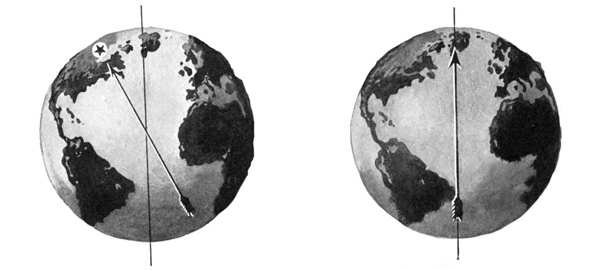
True North
The Magnetic Compass
The Magnetic Compass does not point to True North, it points to Magnetic North, which is about 800 miles from the True North Pole.
The Sperry Gyro-Compass
The Sperry Gyro-Compass, which is not a Magnetic Compass, and is not affected by a magnetism of any sort, and derives its directive force from the earth’s rotation, points True North. It does not point to the Magnetic North Pole.
A Galleon, the treasure ship of the Spanish Main.
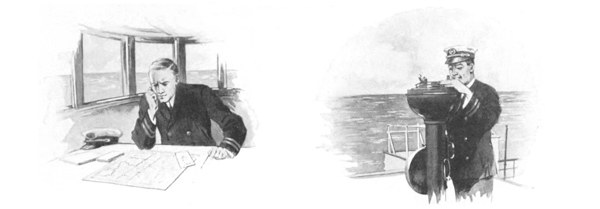
Freedom From Calculation
Every time a ship’s course is laid or changed, or its position noted, the navigator must make and apply calculations to correct the errors caused by variation of the earth’s magnetic fields, and deviation due to local conditions about the ship. Mistakes are frequently made in applying the correction factors by applying them to the wrong side. An error is thus introduced, which in magnitude is twice the correction factor. Instances are reported of ships being 200 miles out of their courses as a result.
The Gyro-Compass requires no corrections since it is undisturbed by variations or any local magnetic conditions. The reading indicated by the Sperry Gyro-Compass is not approximate—it is absolutely and immediately correct. It is not necessary to correct the course every few hours for variation—the navigator is freed from the necessity of making calculations.
Freedom From Compensation
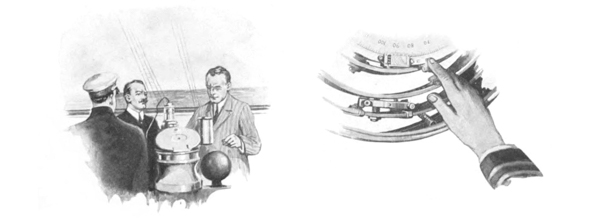
After the navigator has made calculations for the deviation errors of the Magnetic Compass, they must be applied by means of manipulating the soft iron globes and compensating magnets. This is an operation requiring such a high degree of skill that only trained men called Compass Adjusters are qualified for the work.
The occasional turning of a thumb nut is the only compensation necessary in the use of a Sperry Gyro-Compass. No tables or curves are required. The ship’s Navigating Officer makes this adjustment with ease.
A Ship of the Line, the dreadnought of former days.
Freedom From Checking Deviation
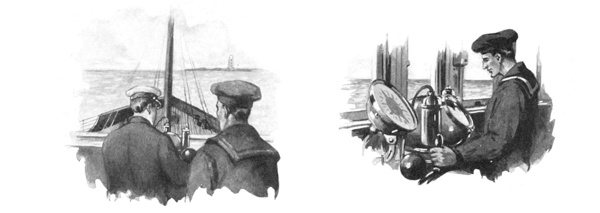
Each time a compass is compensated it is necessary to check the compensation by checking the deviation on various headings. This may be done by the use of deflector magnets. A more exact method is to swing the ship in a circle while bearings are taken of a known object on land and the deviation noted on various headings. The sun is often taken as a reference point for this purpose.
It is never necessary to swing ship or to correct the Gyro-Compass for either variation or deviation of any kind. Where a Gyro-Compass and a magnetic compass are both used on a ship, the ship may be swung to correct the magnetic compass—the Gyro-Compass furnishing true headings. The time required is thereby materially shortened.
Influences Due to Magnetism of the Ship
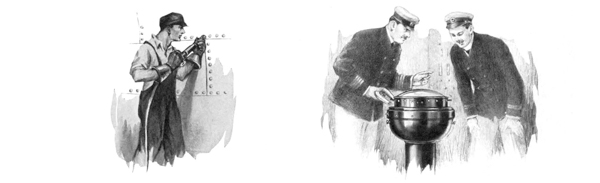
When a steel ship is building a subpermanent magnetism is induced in its keel, hull, and plates. It causes a compass deviation classed as “semicircular.” This deviation must be compensated for.
As a ship moves through the earth’s magnetic fields in its varying quantities and directions, a temporary and varying magnetism is induced in the soft iron of the ship. The resultant deviation is classed as “quadrantal,” and must be compensated for.
The Sperry is not a Magnetic Compass. Hammering, riveting, and moving through magnetic fields may induce magnetism in the ship, but will have no effect upon the Sperry Gyro-Compass.
There is no condition of the ship or cargo for which the Gyro-Compass must be corrected.
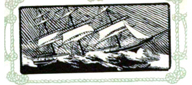
An American Clipper, highest type of sailing ships.
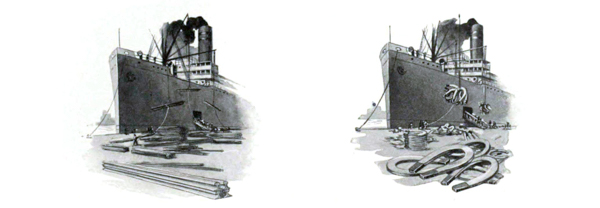
Influences Due to Cargo
Change in the character or disposition of the cargo of the ship causes a change in the magnetic fields surrounding the compass. These changes must be compensated for.
The Sperry Gyro-Compass is not affected by any cargo. A cargo of iron ore has no more effect upon it than a cargo of cotton. You could even carry a load of strong magnets without causing the slightest deviation.
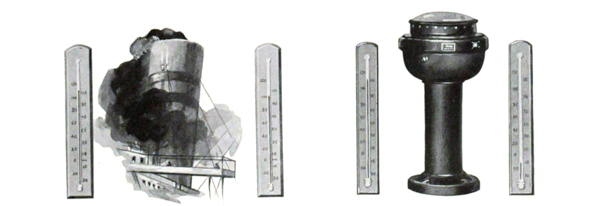
Influences Due to Temperature Changes
Changes in the temperature of the stack, due to shifting of the wind and force of draft, vary its magnetic characteristics. Consequently the Magnetic Compass is affected.
Temperature changes do not influence the Sperry Gyro-Compass.
No matter what the conditions are that change the magnetic characteristics of the stack, ship or cargo, they cannot affect the Gyro-Compass, as it has nothing whatever to do with magnetism.
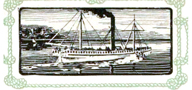
Fulton’s Clermont ushered in the age of steam.
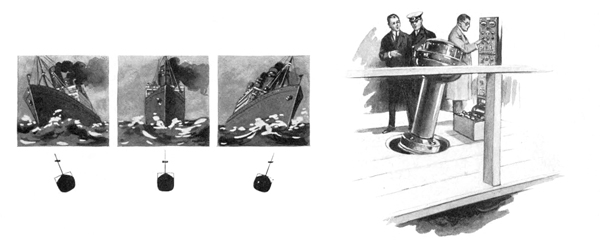
Influences Due to Roll and Pitch of the Ship
The Magnetic Compass
Another error, called heeling error, is caused by the change in the disposition of the material of the ship with reference to the compass. It is brought about when the ship rolls. For example, a ship heading on a northerly course would, if rolled to port, place all magnetic material of the ship to the eastward of the compass. This pulls the north end of the compass to the eastward. The action and effect would be just opposite to this on a roll to the starboard. The result is that the needle is caused to oscillate in either direction. The helmsman in his attempt to keep “on” will cause the ship to traverse a sinuous course.
The card and needle of the magnetic compass are placed in a bowl filled with a liquid. The purpose in so doing is to make the action of the card somewhat sluggish, so that it will not follow very slight magnetic distractions or ship movements. Every time the course of the ship is changed the sluggish action, due to adhesion between the bowl, liquid and card, pulls the compass off the meridian. Official test has shown that from three to four minutes are required for the compass to overcome this “lag.” The “lag” is somewhat less in the dry card compass.
The Sperry Gyro-Compass
Not only is the Sperry Gyro-Compass unaffected by magnetic conditions, resulting from the heeling error, but before being placed upon the ship it is tested for days under conditions simulating the motion of the ship in the most severe storm.
A ship steered by the Gyro-Compass traverses a straight line course; the Gyro-Compass does not oscillate with the rolling of the ship. It is not necessary for the helmsman to use as much helm to keep the ship on her course. A great saving is made in the use of the steering engine.
There is no “lag” in the Sperry Gyro-Compass, because it does not leave the meridian, no matter which way or how quickly the ship may turn or zig-zag. Exhaustive tests have been conducted on compasses installed on torpedo boat destroyers. Even when zig-zagging at top speed in heavy seas the Gyro-Compass shows no “lag.”
Traveling the straight line course instead of the sinuous course, ships equipped with the Sperry Gyro-Compass have saved from one to ten per cent in time over the average schedule time required to cover their courses when steering by the magnetic compass.
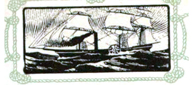
The Savannah, first steamship to cross the ocean.
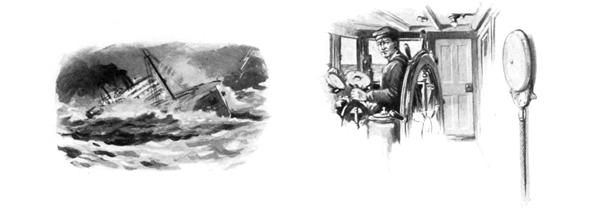
Warning of Unreliability
Due to magnetic storms and any number of other causes the magnetic compass may at any time be distracted so that it does not indicate correctly. Disturbances are extraneous and their direction and magnitude cannot be determined. The navigator is constantly subject to the feeling that his compass may not be accurate—that he cannot depend on it.
About the only thing that will cause an error in the Gyro-Compass is the failure of the electrical power supply. Should this contingency occur an electric bell warns the navigator. Any disturbances must originate with the master compass and can be quickly and accurately located.
The Sperry Gyro-Compass unfailingly points True North under all conditions of weather, ship or cargo. It relieves the navigator of calculation of errors, and tiresome compass compensations. It makes a great saving in time required to “swing ship.” The Sperry Gyro-Compass is, therefore, the Ideal Compass.
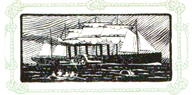
The Great Eastern laid the first Atlantic cable.