Sperry Service
Reading edition

HEN a Gyro-Compass is sold the interest of The Sperry Gyroscope Company does not cease. Our interest in our customer is only beginning. An experienced service engineer installs every Sperry Gyro-Compass. This engineer is also available to make the first trip with the compass in order to assure its proper operation. After installation the Sperry Service Engineers are available in every large port in the world to come aboard and inspect, clean, repair and overhaul the Gyro-Compass equipment so as to keep it in first class operating condition. A radiogram sent to any of the Sperry Service Stations will bring a Service Engineer to meet your ship. During the first year there is no charge. After this period a reasonable charge is made for the service. Such a charge is similar to that at present made by compass-adjusters.
A list of the Sperry Representatives is given on the title page of this book.
Workmanship
The Sperry Gyro-Compass is an instrument of precision. From the work done by the Gyro-Compass and the objects accomplished it would be natural to class it as a scientific instrument. It is, however, more than that for the reason that it has been made strong and sturdy for operation under the most severe conditions at sea. The most expert and skilled workmanship is required to combine strength and precision, such as found in the Gyro-Compass. The Sperry organization prides itself upon having the best workmen that can be obtained for their respective vocations.
The materials used are the very best obtainable. The rigid and inflexible set of purchasing specifications insures receiving the best materials.
A well organized inspection force passes upon all material upon its receipt, and through the various manufacturing stages to the final product.
The Sampan shoots the rapids of Japanese rivers.
Testing
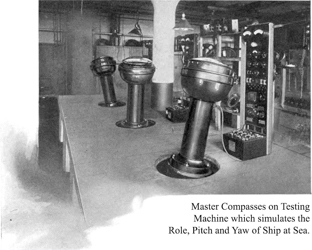
Each Sperry Gyro-Compass is on test for several days. During this time it is put through every devisable test to simulate the conditions under which it will have to operate. Figures 38 and 39 show a compass mounted on a stand which is operated by means of motor driven gears, cams, etc., so as to reproduce the roll, pitch and yaw of a ship at sea. Absolute accuracy of the Master Compass and all repeaters while operating under this condition is required.
The purchaser is thereby assured that the compass to be installed upon his ship will have had all manufacturing inaccuracies or so-called “kinks” worked out. A record of the test accompanies each compass.
Packing
Special care is taken in packing the Gyro-Compass for shipment. Experience gained from the shipment of hundreds of compasses has devised means whereby to insure the safe arrival of all parts so that installation will not be delayed.
In order that no injury may result to any parts, the Gyro-Compass is unpacked under the supervision of the Sperry Service Engineer.
The Sperry Service Organization
The Sperry Service Organization is one which serves in all parts of the world. A corps of Service Engineers, having special training at the factory in all departments relating to the Gyro-Compass, are available in nearly every large port of the world. These engineers are ready to come aboard your ship, to clean, adjust and overhaul the Gyro-Compass, thus relieving the navigator of all care other than the actual use of the Gyro-Compass.
During the war we had Service Engineers in every port where the ships of the Navy were likely to call. Our men have been in many of the naval actions and have been able to render very considerable service on many unusual occasions. For example, it was desired to place an equipment on a British ship which was on her way to the Dardanelles. The Admiralty instructed us by telegram to have an equipment and a Service Engineer meet the ship at the British Naval Station at Malta in the Mediterranean. By sending the equipment with our Service Engineer via a passenger train to the south of Italy and via destroyer to Malta we were able to meet the ship there on the day she arrived. The ship was able to stay only twenty-four hours, and as it took about four days to install the equipment, our engineer remained on board and finished the work while the ship was enroute from Malta to the Dardanelles.
The Whale-back, steadiest of all in rough weather.
This ship, the Inflexible, arrived at the Dardanelles just in time to join in the first naval action directed against the land batteries. During the first part of the engagement our engineer remained with the Master Compass which was installed near the dynamo room. When he saw that it was functioning properly he left it to go on deck and view the action, the effects of which he had become aware of, as a number of shells from the land batteries had hit the ship. Almost immediately after he arrived on deck a torpedo struck the ship directly under the compartment where the Gyro-Compass was located, killing every man in that compartment. Although badly damaged the ship was able to get out of range of the land batteries and reach the naval base near the Dardanelles.
The Gyro-Compass was, of course, almost totally destroyed. Shortly after the action ended our engineer was enabled to get ashore on a Greek island via one of the British destroyers. This island had a telegraph station which he used to cable us that “Equipment No. 286 is under four feet of water,” and that we should have another equipment ready to replace it. We took this telegram to the Admiralty who authorized us to have another equipment prepared to meet this ship at Gibraltar. This we did, again sending a Service Engineer who met the ship at Gibraltar, on her way back to England to be repaired and refitted.
The Sperry Service Organization stands ready to help all ships equipped with a Gyro-Compass at all times, even in emergencies such as those experienced by naval vessels.
Service Given to the World’s Navies by the Gyro-Compass
At the time of the battle of Coronel on the west coast of South America, H. M. S. Invincible was being overhauled at the Portsmouth Dockyard in England. She was immediately ordered with one other large British ship to South American waters under the command of Admiral Sturdee, to re-enforce the British fleet, and then to find and destroy the German ships which had defeated the British at the battle of Coronel. When the overhaul of the Invincible was completed and she was ready to leave the docks, it was at first planned to delay sailing until the ship could be swung and the magnetic compasses compensated. It was decided, however, that although the compasses were badly in need of adjustment it was necessary to save every minute in order to reach South American waters before the German ships could find and destroy the British ships remaining in those waters. The Invincible therefore sailed without adjusting her magnetic compasses and navigated entirely by the Sperry Gyro-Compass from Portsmouth to the Falkland Islands. When an azimuth was finally taken the magnetic compass was found to be out about 22 degrees. The Invincible arrived at the Falkland Islands just in time to coal before the German fleet appeared. If H. M. S. Invincible had not had a Gyro-Compass the probabilities are that she would not have reached the Falkland Islands in time to win the battle which took place almost immediately upon her arrival.
The Coracle of ancient Britain, still used in Wales.
Figure 49 shows a British submarine, a sister ship of the E-11, that entered the Sea of Marmora through the Dardanelles for the purpose of destroying Turkish and German shipping. The E-11 put a torpedo right into Constantinople harbor. The Second Officer of the E-11 in relating this exploit, stated that they steered by the “Sperry” all the way in and out. His remark was that, “It never let me down.”
In this exploit, and many others of a similar nature, the Gyro-Compass was used for all navigation. These extremely daring and hazardous operations would not have been possible without this instrument.
A similar British submarine left Harwich on the east coast of England, and during a period of three weeks made seven patrol trips, and without once seeing the sun, finally returned to Harwich and picked up the buoy at the mouth of the harbor without the least difficulty. The navigation in this case was carried out entirely by the Gyro-Compass.
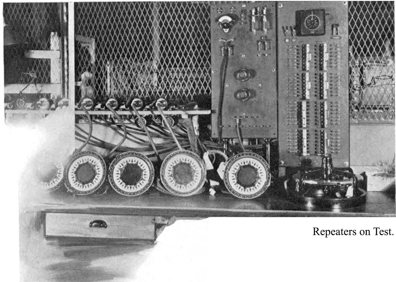
Figure 54 is a photograph of H. M. S. Lion, the flagship of Admiral Beatty in the battle of Jutland. This ship was provided with the Sperry Gyro-Compass equipment early in the war. During the Jutland engagement a fire broke out in a magazine of the Lion immediately below the two Master Compasses which were located in one compartment. It became so hot that the lead sheathing was melted off the electric cables and one of the Gyro-Compasses was heated until its parts fused. Notwithstanding this same heat the other compass functioned throughout the entire action. Of the ships engaged in the battle of Jutland practically all except the destroyers were equipped with the Gyro-Compass. Every one of them performed perfectly throughout the action except in the case of the Lion on which one was destroyed by fire.
Hundreds of Sperry Gyro-Compasses are veterans of many battles and encounters under heavy gunfire and adverse conditions.
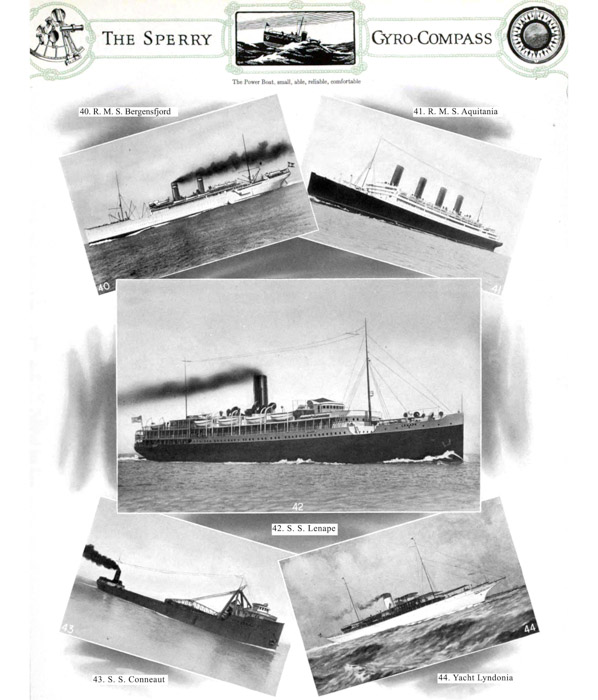
40. R. M. S Bergensfjord. 41. R. M. S. Aquitania. 42. S. S. Lenape. 43. S. S. Conneaut. 44. Yacht Lyndonia.
Ships Equipped with Sperry Gyro-Compass.
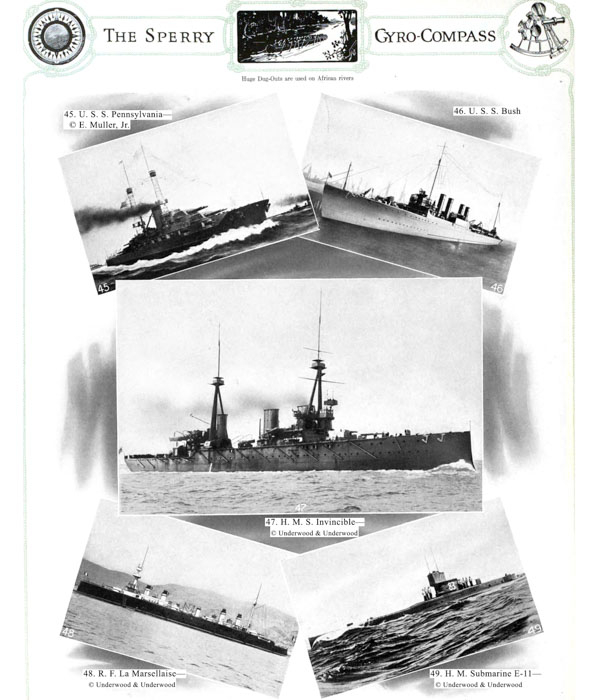
45. U.S.S. Pennsylvania—© E. Muller, Jr. 46. U.S.S. Bush. 47. H.M.S. Invincible—© Underwood & Underwood. 48. R. F. La Marsellaise—© Underwood & Underwood. 49. H.M. Submarine E-11—© Underwood & Underwood.
Ships Equipped with Sperry Gyro-Compass.
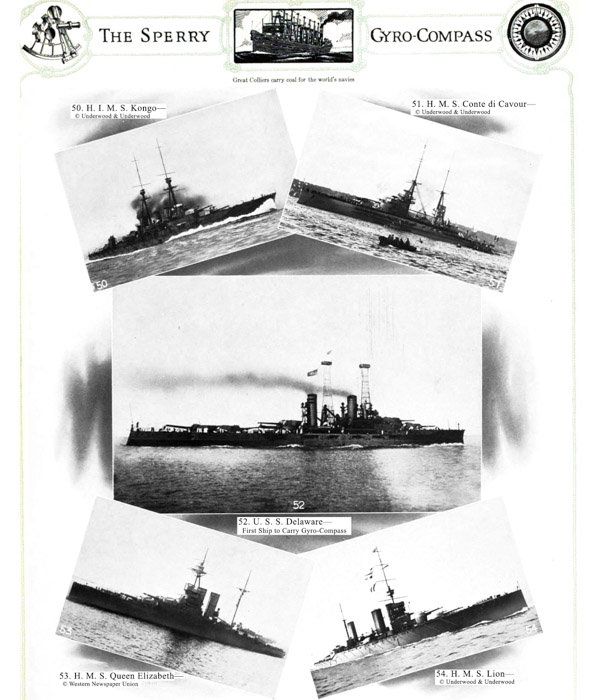
50. H. I. M. S. Kongo—© Underwood & Underwood. 51. H. M. S. Conte di Cavour—© Underwood & Underwood. 52. U. S. S. Delaware—First Ship to Carry Gyro-Compass. 53. H. M. S. Queen Elizabeth—© Western Newspaper Union. 54. H. M. S. Lion—© Underwood & Underwood.
Ships Equipped with Sperry Gyro-Compass.
Speedy Ice-boats provide thrilling winter sport.
Telegrams Inland: SPERIGYCO, Vic, London. Foreign: SPERIGYCO, London.
Telephone, 7398 VICTORIA.
THE SPERRY GYROSCOPE COMPANY, LTD.
NEW YORK ‐ LONDON ‐ MILAN ‐ PARIS ‐ PETROGRAD ‐ TOKIO ‐ COPENHAGEN STOCKHOLM ‐ LA HAGUE
15, VICTORIA STREET,
LONDON, S. W.
August 1st. 1916.
B-3909.
The Sperry Gyroscope Company,
NEW YORK.
Gentlemen,
It gives me very great pleasure to inform you that my Company has received from Their Lords Commissioners of the Admiralty, under date 20th July, the following words of commendation:―
“I am to add an expression of Their Lordships’ appreciation of the valuable assistance rendered to the Admiralty by your Company since the outbreak of War, in your very prompt and efficient execution of the important work entrusted to you”.
I might mention that this was the first recommendation given to a private Firm by the British Admiralty for fifteen years, and had to be concurred in by no less than thirty-seven Government Officials.
Very truly yours,
THE SPERRY GYROSCOPE COMPANY LTD.

Managing Director.