THE SOUL OF THE SOLDIER
Reading edition
Cover art
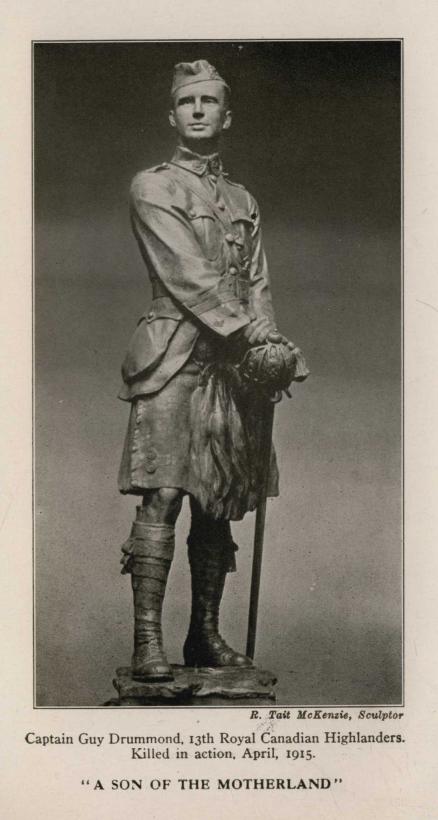
Captain Guy Drummond, 13th Royal Canadian Highlanders. Killed in action, April, 1915. "A SON OF THE MOTHERLAND"
The Soul of The Soldier
Sketches from the Western Battle-Front
BY
THOMAS TIPLADY
Chaplain to the Forces
Author of "THE CROSS AT THE FRONT," etc.
NEW YORK CHICAGO TORONTO Fleming H. Revell Company LONDON AND EDINBURGH
Copyright, 1918, by FLEMING H. REVELL COMPANY
New York: 158 Fifth Avenue Chicago: 17 North Wabash Ave. London: 21 Paternoster Square Edinburgh: 75 Princes Street
TO THE MEMORY OF THE MANY "WHITE MEN"
I have known and loved in the London Territorials, who, being dedicate to their Country and the cause of Liberty, went over the parapet and did not return.
"These laid the world away; poured out the red
Sweet wine of youth: gave up the years to be
Of work and joy, and that unhoped serene
That men call age; and those who would have been
Their sons they gave--their immortality."
THE MOTHER'S ANSWER
God gave my son in trust to me.
Christ died for him. He should be
A man for Christ. He is his own
And God's and man's, not mine alone.
He was not mine to give. He gave
Himself, that he might help to save
All that a Christian should revere
All that enlightened men hold dear.
"To feed the guns." Ah! torpid soul,
Awake, and see life as a whole.
When freedom, honor, justice, right,
Were threatened by the despot's might,
He bravely went for God, to fight
Against base savages, whose pride
The laws of God and man defied;
Who slew the mother and the child;
Who maidens, pure and sweet, defiled;
He did not go to feed the guns,
He went to save from ruthless Huns
His home and country, and to be
A guardian of democracy.
"What if he does not come?" you say;
Well, then, my sky will be more gray,
But through the clouds the sun will shine
And vital memories be mine.
God's test of manhood is, I know
Not, will he come--but did he go?
JAMES L. HUGHES.
PREFACE
The sketches in this book and in my previous one, "The Cross at the Front," are attempts to show the soul of the soldier serving in France as I have seen it during the year and a half that I have been with him. It is a padre's privilege and duty to be the voice with which, in public worship, the soldiers speak to God; and through which their last thoughts are borne to their friends at home. He is their voice both when they are sick or wounded, and when they lie silent in the grave. He speaks of their hopes and fears, hardships and heroisms, laughter and tears. As best he may he tries to tell, to those who have a right and a longing to know, how they thought, and how they bore themselves in the great day of trial when all risked their lives and many laid them down.
Soldiers, as a rule, are either inarticulate or do not care to speak of themselves; and the padre has to be their spokesman if ever their deeper thoughts and finer actions are to be known to their friends. To do this he may have to bring himself into the picture, or even illustrate a common thing in their lives by a personal experience of his own. To reveal life and thought at the Front in the third person, and without sacrificing truth and vividness, requires a degree of literary power and art which cannot be expected of a padre to whom writing is but a by-product, and not his main work.
I have written but little of military operations--these things are not in my province. Moreover, they are not the things which are most revealing. The presence of Spring is first and most surely revealed by the flowers in our gardens and lanes; and the soldier is most clearly seen in the little things that happen on the march--in his billet or in the Dressing Station. Some things are not seen at all. They are only felt, and my opinion about them must be taken for what it is worth. One knows what the men are by their influence on one's own mind and life. I do not judge the morality and spirituality of our soldiers entirely by their habits and speech, for these are but outward and clumsy expressions of the inner life and are largely conventional. There is something else to put in the reckoning, and to find out what the soldiers are worth to us we must somehow get behind their words and actions and find out what they are worth to God, whose terrible wheel of war is shaping their characters.
I appraise them mostly by the total effect of the impact of their souls on mine. I know their thoughts and feelings by the thoughts and feelings they inspire in me. "Do men gather grapes of thorns or figs of thistles?" There are certain thoughts and emotions that only come to me strongly when I am with the soldiers or when I am living again with them in memory, and so, I take these as their gift to me and judge the men by their influence on my character. Character is, in its influence, subtle as Spring. Words and actions by themselves are too coarse and conventional to do anything but mislead us in judging the quality of our men. "By their fruits ye shall know them." Not by their leaves. Fruit is seed. In the seed the tree reproduces itself. And reproduction, whether in physical, moral or spiritual life, is the test of vitality.
I have not unduly loaded my pages with ghastly details of war, because their effect on the mind of the reader who has not been at the Front would be false and distorting. The reader would be more horrified in imagining them than our soldiers are in seeing them. I have tried rather to show life at the Front, with its mingling of red and gold, horror and happiness, as it affects the soldier; so that his friends at home may see it as he sees it, and with his sense of proportion. If I could only do it, as well as I intend it, my pictures would create a truer sympathy between the home and the trench. Some would find comfort for their hearts, and others would awake to a new and noble seriousness. Soldiers have suffered much through imperfect sympathies. They have been pitied for the wrong things, and left to freeze when they needed warmth. Only when we realize their dignity and greatness and the true nature of their experiences can we be their comrades and helpers. Life at the Front is brutal and terrifying, and yet our soldiers are neither brutalized nor terrorized, for there is something great and noble at the Front which keeps life pure and sweet and the men gentle and chivalrous. When "the boys" come home their friends will, in almost every case, find them just as bright, affectionate and good as when they went out. The only change will be a subtle one--a deepening in character and manly quality, a broadening in mind and creed, and an impatience with cant and make-believe whether in politics or business, Christianity or Rationalism. There will be an air of indefinable greatness about them as of men who have been at grips with the realities of life and death.
In a footnote to one of his songs, Edward Teschemacher says that the gypsies, as they wander through the country, leave a sprinkling of grass or wild flowers at the cross-roads to indicate, to those who come after them, the road they have taken. These flowers are known as the "Patterain."
These essays are my Patterain--wild flowers plucked in France, and left to mark the red path trod during the months I have been with my comrades at the Front.
I would the flowers were worthier, but such as I have, I give; and they are taken out of my heart.
"Where my caravan has rested
Flowers I leave you on the grass;
All the flowers of love and memory;
You will find them when you pass."
THOMAS TIPLADY.
BRITISH EXPEDITIONARY FORCE, FRANCE.
CONTENTS
CHAP.
The Swan at Ypres
The Roadmakers
The Glamour of the Front
A White Handkerchief
The Songs Our Soldiers Sing
Easter Sunday
"Now the Day is Over"
Sons of the Motherland
The Terror by Night
"Eton Boys Never Duck!"
"Missing"
"It Must be Sunday"
Our Tommies Never Fail Us
The Cross at Neuve Chapelle
The Children of Our Dead
A Funeral under Fire
A Soldier's Calvary
The Hospital Train
After Winter, Spring
I
THE SWAN AT YPRES
For three years the storm center of the British battle front has been at Ypres. Every day and night it has been the standing target of thousands of guns. Yet, amid all the havoc and thunder of the artillery, the graceful white form of a swan had been seen gliding over the water of the moat. It never lacked food, and was always welcome to a share of Tommy's rations. In the Battle of Messines--I had the story first-hand from a lieutenant of artillery whose battery was hidden close by, and who was an eye-witness of the incident--a shell burst near the swan, and it was mortally wounded. For three long years it had spread its white wings as gallantly as the white sails of Drake's flagship when he sailed out of Plymouth Sound to pluck the beard of the Spaniard. But now its adventurous voyaging was over. Another beautiful and innocent thing had been destroyed by the war and had passed beyond recall. There was no dying swan-song heard on the waters, but all who saw its passing felt that the war had taken on a deeper shade of tragedy.
Many a "white man" had been slain near the spot but somehow the swan seemed a mystical being, and invulnerable. It was a relic of the days of peace, and a sign of the survival of purity and grace amid the horrors and cruelties of war. It spoke of the sacred things that yet remain--the beautiful things of the soul upon which war can lay no defiling finger. Now it had gone from the water and Ypres seems more charred than ever, and the war more terrible. The death of the swan revealed against its white wings the peculiar inhumanity of the present war. It is a war in which the enemy spares nothing and no one. He is more blind and merciless than the Angel of Death which swept over Egypt, for the angel had regard to the blood which the Israelites had sprinkled over the lintels of their doors and he passed by in mercy. To the German Eagle every living creature is legitimate prey. No blood upon the lintel can save the inmate; not even the cross of blood on the hospital tent or ship. Wounded or whole, combatant or non-combatant, its beak and talons tear the tender flesh of all and its lust is not sated.
In Belgium and Serbia it is believed that more women and children perished than men. Things too hideous for words were done publicly in the market-squares. Neither age nor sex escaped fire and sword. The innocent babe was left to suck the breast of its dead mother or was dandled on the point of the bayonet. What resistance can the Belgian swan make to the German eagle? It needs must lie torn and bleeding beneath its talons. The German Emperor has waded deeper in blood than Macbeth, and has slain the innocent in their sleep. Even the sea is full of the women, children, and non-combatant men he has drowned. His crown is cemented together with innocent blood and its jewels are the eyes of murdered men and women. The wretched man has made rivers of blood to flow yet not a drop in them is from his own veins or the veins of his many sons. Napoleon risked his life with his men in every battle but this man never once. While sending millions to their death he yet consents to live, and protects his life with the anxious care a miser bestows on his gold. Alone among large families in Germany his household is without a casualty. Though a nation be white and innocent as the Belgian swan it will not escape his sword, and he will swoop upon it the more readily because it is unarmed. The swan cannot live where the eagle flies, and one or the other must die.
But the stricken swan of Ypres is not merely the symbol of Belgium and her fate. There are other innocents who have perished or been sorely wounded. The whole creation is groaning and travailing in pain. The neutral nations are suffering with the belligerent, and the lower creatures are suffering with mankind.
Next to seeing wounded men on the roads at the front, I think the saddest sight is that of dying horses and mules. Last winter they had to stand, with little cover, exposed to the bitter blasts. It was impossible to keep them clean or dry, for the roads were churned into liquid mud and both mules and drivers were plastered with it from head to foot. To make things worse there was a shortage of fodder; and horses waste away rapidly under ill-feeding. Before the fine weather had given them a chance to recover weight and strength, the Battle of Arras began, and every living beast of burden, as well as every motor-engine, was strained to its utmost. The mule is magnificent for war, and our battles have been won as much by mules as men. Haig could rely on one as much as on the other. The mule will eat anything, endure anything, and, when understood and humored by its driver, will do anything. It works until it falls dead by the roadside. In the spring, hundreds died in harness. In fact, few die except in harness. They die facing the foe, dragging rations along shell-swept roads to the men in the trenches.
On two miles of road I have counted a dozen dead mules; and burial parties are sent out to put them out of sight. One night, alone, I got three dying mules shot. The road was crowded with traffic, yet it was difficult to find either an officer with a revolver or a transport-driver with a rifle. I had to approach scores before I could find a man who had the means to put a mule out of its misery; and we were within two miles of our Front. So rigid is our line of defense that those behind it do not trouble to take arms. Even when I found a rifleman he hesitated to shoot a mule. There is a rule that no horse or mule must be shot without proper authority, and when you consider the enormous cost of one the necessity for the rule is obvious. I had therefore to assure a rifleman that I would take full responsibility for his action. He then loaded up, put the nozzle against the mule's forehead and pulled the trigger. A tremor passed through the poor thing's body and its troubles were over. It had come all the way from South America to wear itself out carrying food to fighting men, and it died by the road when its last ounce of strength was spent.
The mule knows neither love nor offspring. Apart from a few gambols in the field, or while tethered to the horse-lines, it knows nothing but work. It is the supreme type of the drudge. It is one of the greatest factors in the war, and yet it receives scarcely any recognition and more of whipping than of praise. Only too often I have seen their poor shell-mangled bodies lying by the roadside waiting till the battle allowed time for their burial. Yet what could be more innocent of any responsibility for the war? They are as innocent as the swan on the moat at Ypres.
Yet the greatest suffering among innocents is not found at the Front at all. It is found at home. At the Front there is suffering of body and mind, but at home there is the suffering of the heart. Every soldier knows that his mother and wife suffer more than he does, and he pities them from his soul. War is a cross on which Woman is crucified. The soldier dies of his wounds in the morning of life, but his wife lingers on in pain through the long garish day until the evening shadows fall. There is no laughter at home such as you hear at the Front, or even in the hospitals. One finds a gayety among the regiments in France such as is unknown among the people left at home. It is the sunshine of the street as compared with the light in a shaded room. There is a youth and buoyancy at the Front that one misses sadly in the homeland.
To a true woman with a son or husband at the Front, life becomes a nightmare. To her distorted imagination the most important man in the country is not the Prime Minister but the postman. She cannot get on with her breakfast for listening for his footsteps. There is no need for him to knock at the door, she has heard him open the gate and walk up the gravel path. Her heart is tossed like a bubble on the winds of hope and fear. She finds herself behind the door without knowing how she got there, and her hand trembles as she picks up the letter to see if the address is in "his" handwriting or an official's. The words, "On His Majesty's Service," she dreads like a witch's incantation. They may be innocent enough, and cover nothing more than belated Commission Papers, but she trembles lest they should be but the fair face of a dark-hearted messenger, who is to blot out the light of her life forever. If she goes out shopping and sees a telegraph-boy go in the direction of her home she forgets her purchases and hurries back to see if he is going to knock at her door. The rosy-faced messenger has become a sinister figure, an imp from the nether world. He may be bringing news of her loved one's arrival "on leave," but so many evil faces of fear and doubt peer through the windows of her heart that she cannot believe in the innocence and good-will of the whistling boy. Her whole world is wrapped up in his little orange-colored envelope.
The boys at the Front know of the anxiety and suspense that darken their homes, and they do all they can to lighten them. There were times on the Somme when the men were utterly exhausted with fighting and long vigils in the trenches. Water was scarce, and a mild dysentery came into evidence. No fire could be lighted to cook food or make hot tea. The ranks had been thinned, and only two officers were left to each company. The weather was bad and the captured trench uncomfortable. Any moment word might come for another attack. The campaign was near its close, and the work must be completed despite the prevalent exhaustion. The officers were too tired, depressed and preoccupied to censor hundreds of letters. In front of him each could see a gaping grave. The sun was rapidly "going west" and leaving them to the cold and dark. Nothing seemed to matter in comparison with that. To hold services were impossible and I felt that the best I could do was to walk through the trench, chat with the officers and men, gather up the men's letters and take them back and censor in my tent. This gave the officers times to write their own, and an opportunity to post them.
But note, I pray you, the nobility of these gallant fellows. All of them were exhausted and depressed. The shadows of death were thick about them, yet when I opened their letters, I found myself--with two exceptions out of three or four hundred--in an entirely different atmosphere. It was a sunny atmosphere in which birds were singing. The men said nothing of their suffering, their depression, their fears for the future. The black wings of death cast no shadow over their pages. They said they were "all right," "merry and bright" and "soon going back for a long rest." They told their mothers what kind of cigarettes to send, and gave them details how to make up the next parcel. They talked as if death were out of sight--a sinister fellow with whom they had nothing to do.
The officers, of course, censor their own letters, so I did not see how they wrote. But I know. They wrote as the men wrote, and probably with a still lighter touch. Their homes were dark enough with anxiety, yet not by any word of theirs would the shadows be deepened. They could not shield themselves from war's horrors but they would do their best to shield their white swans at home. They could not keep their women folk out of the war, but they would deliver them from its worst horrors. Not till they had fallen would they let the shafts pass them to their mothers and wives; rather would they gather them in their own breasts. In the hour of the world's supreme tragedy there was a woman standing by the cross, and the august Sufferer, with dying breath, bade His closest friend take her, when the last beam faded, to his own home and be in His place, a son to her. I know no scene that better represents the feelings of our soldiers towards their loved ones at home.
Their women gave them inspiration and joy in the days of peace, and they still float before their vision amid the blackened ruins of war, as beautiful and stainless in their purity as the white swan on the moat of Ypres.
II
THE ROADMAKERS
We had just marched from one part of the Front to another and by a round-about way. Each morning the Quartermaster and "the billeting party" went on before, and each evening we slept in a village that was strange to us. Each of the men carried on his back a pack and equipment weighing about eighty or ninety pounds. Through sleet and blizzard and, for the most part, through open, exposed country, we continued our march without a day of rest. By the fifth evening we reached the village where we were to have three or four weeks of rest and training before entering the trenches for the spring offensive. We had unpacked and were sitting at dinner when a telegram came announcing that all previous plans were canceled, and that at dawn we must take to the road again. Something unexpected had happened, good or ill, we knew not which, and we had to enter the line in front of Arras. For three days more we marched. Daily the sound of the guns came nearer, and the men were tired and footsore. They were also deeply disappointed of the long rest to which they had been looking forward after a winter in the trenches at Neuve Chapelle. Yet they marched cheerily enough. "It's the War!" they said one to another and, true to their own philosophy, "packed up their troubles in their old kit bags and smiled." When any man faltered a bit, as if about to fall out by the way, the others cheered him on by singing "Old Soldiers never die" to the tune of the old Sunday school hymn, "Kind words can never die." Sometimes an officer would shoulder a man's rifle to the end of the march, or until he felt better. In eight unbroken days of marching we covered ninety-eight miles and finally arrived at a camp of huts within a day's march of the trenches we are to occupy. Here, where our huts stand like islands in a sea of mud, we are, unless suddenly needed, to take a few days' rest.
On the ninety-eight miles of road over which we tramped, we passed company after company of British roadmakers. In some parts they were widening the road, in other parts repairing it. The roads of Northeastern France are handed over to our care as completely as if they were in England. Our road-makers are everywhere, and as we pass they stand, pick or shovel in hand, to salute the colonel and shout some humorous remark to the laughing riflemen--only to get back as much as they give.
This morning I visited the neighboring village to arrange for a Sunday service. The roads are hopeless for bicycles at this time of the year, so I fell back on Adam's method of getting about. The road to the village was torn and broken, and "thaw precautions" were being observed. Everywhere it was ankle-deep in mud and, in the holes, knee-deep. Innumerable motor-wagons had crushed it beneath their ponderous weight, and my feet had need of my eyes to guide them. In skirting the holes and rough places, I added quite a mile to the journey.
It was annoying to get along so slowly, and I called the road "rotten" and blamed the War for its destructive work. Then I saw that I had been unjust in judgment. The War had constructed more than it had destroyed. The road had been a little muddy country lane, but the soldiers had made it wide as Fleet Street, and it was bearing a mightier traffic than that famous thoroughfare night and day. The little road with its mean perfections and imperfections had gone, and the large road with big faults and big virtues had come. This soldiers' road has faults the farmers' road knew not, but then it has burdens and duties unknown before, and it has had no time to prepare for them. Like our boy-officers who are bearing grown men's burdens of responsibility and bearing them well, the road has had no time to harden. To strengthen itself for its duties, it eats up stones as a giant eats up food. I had no right to look for the smoothness of Oxford Street or the Strand. Such avenues represent the work of centuries, this of days. They have grown with their burdens, but this has had vast burdens thrown upon it suddenly, and while it was immature. Oxford Street and Fleet Street are the roads of peace, and laden with wealth and luxury, law and literature--things that can wait. But on this road of the soldiers' making, nothing is allowed except it be concerned with matters of life and death. It is the road of war, and there is a terrible urgency about it. Over it pass ammunition to the guns, rations to the soldiers in the trenches, ambulances bearing back the wounded to the hospital. Whatever its conditions the work must be done, and there is no room for a halting prudence or the pride of appearance. Rough though it is and muddy, over it is passing, for all who have eyes to see, a new and better civilization and a wider liberty. I had grumbled at the worn-out road when I ought to have praised it. I was as an ingrate who finds fault with his father's hands because they are rough and horny.
It was a group of soldier-roadmakers who brought me to my senses. They were making a new road through the fields, and it branched off from the one I was on. I saw its crude beginning and considered the burdens it would soon have to bear. As I stood watching these English roadmakers my mind wandered down the avenues of time, and I saw the Roman soldiers building their immortal roads through England. They were joining town to town and country to country. They were introducing the people of the North to those of the South, and bringing the East into fellowship with the West. I saw come along their roads the union of all England followed at, some distance, by that of England, Scotland and Wales; and I regretted that there was no foundation on which they could build a road to Ireland. I saw on those soldier-built roads, also, Christianity and Civilization marching, and in the villages and towns by the wayside they found a home whence they have sent out missionaries and teachers to the ends of the earth.
"The captains and the kings depart." The Roman Empire is no more, but the Roman roads remain. They direct our modern life and business with an inevitability the Roman soldiers never exercised. In two thousand years the Empire may have fallen apart and become a thing of the past; but the roads her sons have built in France, these two-and-a-half years, will abide forever and be a perpetual blessing; for, of things made by hands, there is, after the church and the home, nothing more sacred than the road. The roadmaker does more for the brotherhood of man and the federation of the world than the most eloquent orator. The roadmaker has his dreams and visions as well as the poet, and he expresses them in broken stones. He uses stones as artists use colors, and orators words. He touches them--transient as they are--with immortality. A little of his soul sticks to each stone he uses, and though the stone perishes the road remains. His body may perish more quickly than the stones and be laid in some quiet churchyard by the wayside, but his soul will never utterly forsake the road he helped to make. In man's nature, and in all his works, there is a strange blending of the temporal and the eternal, and in nothing is it more marked than in the roads he builds.
The roadmaker is the pioneer among men and without him there would be neither artist nor orator. He goes before civilization as John the Baptist went before Christ, and he is as rough and elemental. Hard as his own stones, without him mankind would have remained savage and suspicious as beasts of prey; and art, science and literature would have had no beginning. His road may begin in war, but it ends in peace.
The pioneers I saw roadmaking were, for the greater part, over military age, and such as I had often seen leaning heavily on the bar of some miserable beer-house. In those days they seemed of the earth, earthy, and the stars that lure to high thoughts and noble endeavors seemed to shine on them in vain. But one never knows what is passing in the heart of another. Of all things human nature is the most mysterious and deceptive. God seems to play at hide-and-seek with men. He hides pearls in oysters lying in the ooze of the sea; and gold under the everlasting snows of the Arctic regions. Diamonds he buries deep down in the dirt beneath the African veldt. He places Christ in a carpenter's shop, Joan of Arc in a peasant's dwelling, Lincoln in a settler's cabin, and Burns in a crude cottage built by his father's own hands. He hides generous impulses and heroic traits in types of men that in our mean imaginations we can only associate with the saw-dust sprinkled bar-room. Only when war or pestilence have kindled their fierce and lurid flames do we find the hidden nobility that God has stored away in strange places--places often as foul and unlikely as those where a miser stores his gold.
When Diogenes went about with a candle in search of an honest man did he think to look in the taverns and slums? I fancy not. Not Diogenes' candle but the "Light of the World" was needed to reveal the treasure God has hidden in men. Christ alone knew where His Father had hidden His wealth and could guide us to it. In this time of peril when every man with any nobility in him is needed to stand in the deadly breach, and with body and soul hold back the brutality and tyranny that would enslave the world we have, like the woman in the parable, lit a candle and searched every corner of our kingdom diligently. In the dust of unswept corners we have found many a coin of value that, but for our exceeding need, would have remained hidden. To me, the wealth and wonder of the war have been found in its sweepings. Time and again we have found those who were lost, and a new happiness has come into life. To the end of my days I shall walk the earth with reverent feet. I did not know men were so great. I have looked at life without seeing the gold through the dust, and have been no better than a Kaffir child playing marbles with diamonds, unaware of their value. I have gone among my fellows with proud step where I ought to have walked humbly, and have rushed in where angels feared to tread.
Life at the Front has made me feel mean among mankind. My comrades have been so great. In days long past, I have trodden on the hem of Christ's garment without knowing it. I have not seen its jewels because I, and others, have so often trodden it in the mire. Yet, through the mire of slum and tavern, the jewels have emerged pearl-white and ruby-red. And I feel that I owe to a large part of mankind an apology for having been before the war so blind, callous and superficial. But for the agony and bloody sweat in which I have seen my fellows, I should never have known them for what they are, and the darkness of death would have covered me before I had realized what made the death of Christ and the sufferings of all the martyrs well worth while. Now there is a new light upon my path and I shall see the features of an angel through the dirt on a slum-child's face. Words of Christ that once lay in the shadow now stand out clearly, for whenever we get below the surface of life we come to Him. He is there before us, and awaiting our coming.
I also understand, now, something of the meaning of the words which the Unemployed scrawled upon their banner before the war--"Damn your charity. Give us work." It was a deep and true saying, and taught them by a stern teacher. When the war came we did "damn our charity" and gave them "work." Many a man got his first chance of doing "a man's job," and rose to the full height of his manhood. Many hitherto idle and drunken, were touched in their finer parts. They saw their country's need, and though their country had done little to merit their gratitude, they responded to her call before some of the more prudent and sober. Those who were young went out to fight, and every officer can tell stories about their behavior in the hours of danger and suffering which bring tears to the eyes and penitence to the heart. Those above military age went out to make roads over which their younger brothers and sons could march, and get food, ammunition, or an ambulance according to their needs. Among the group of middle-aged roadmakers that I saw there were, I doubt not, some who had been counted wastrels and who had made but a poor show of life. Now they had got work that made them feel that they were men and not mendicants, and they were "making good."
While I watched them a lark rose from a neighboring field and sang over them a song of the coming spring. It was the first lark I had heard this year, and I was glad it mingled its notes with the sounds of the roadmakers' shovels. Nature is not so indifferent to human struggles as it sometimes seems. The man who stands steadfastly by the right and true and bids tyranny and wrong give place will find, at last, that he is in league with the stones of the field and the birds of the air, and that the stars in their courses fight for him. The roadmaker and the lark are born friends. Both are heralds of coming gladness, and while one works, the other sings. True work and pure song are never far apart. They are both born of hope and seek to body forth the immortal. A man works while he has faith. Would he sow if he did not believe the promise, made under the rainbow, that seed-time and harvest shall never fail? Or could he sing with despair choking his heart? Yet he can sing with death choking it. In the very act of dying Wesley sang the hymn, "I'll praise my Maker while I've breath." He sang because of the hope of immortality. He was not turning his face to the blank wall of death and oblivion but to the opening gate of a fuller life. He was soaring sunwards like the lark, and soaring sang,
"And when my voice is lost in death
Praise shall employ my nobler powers;
My days of praise shall ne'er be past."
Joy can sing and Sorrow can sing, but Despair is dumb. It has not even a cry, for a cry is a call for help as every mother knows, and Despair knows no helper. Even the saddest song has hope in it, as the dreariest desert has a well. The loved one is dead but Love lives on and whispers of a trysting place beyond this bourne of time, where loved and lover meet again. The patriot's life may be pouring from a dozen wounds on the muddy field of battle, but his fast-emptying heart is singing with each heavy beat, "Who dies, if my country live?"
Roadmakers have prepared the way for missionaries in every land. Trail-blazers are not always religious men--often they are wild, reckless fellows whom few would allow a place in the Kingdom of God--but is not their work religious in its final upshot? Do they not, however unconsciously, "prepare the way of the Lord, make straight in the desert a highway for our God?" Close on their heels go the missionaries, urged on faster by the pure love of souls than the trader by love of lucre. The greatest among the roadmakers was a missionary himself--David Livingstone. And for such an one the name Living-stone is perfect. It has the touch of destiny. Through swamp and forest he went where white feet had never trod, and blazed a trail for the messengers of Christ, until, worn out with fever and hardship, he fell asleep at his prayers, to wake no more to toil and suffering.
But while the roadmaker bestows benefits on us he also lays obligations, for there can be no enlargement of privilege without a corresponding increase of responsibility. The roads the men are making here in France will be good for trade. They will open up the country as did the military roads of Caesar and Napoleon; and along them soldiers are marching who, at tremendous cost to themselves, are buying for posterity great benefits, and laying upon posterity great obligations. Posterity must hold and enlarge the liberties won for them, and prove worthy of their citizenship by resisting tyranny "even unto blood." We are here because our fathers were heroes and lovers of liberty. Had they been cowards and slaves there would have been no war for us. As we follow our fathers our sons must be ready to follow us. The present springs out of the past, and the future will spring out of the present. Inheritance implies defense on the part of the inheritors.
The very names they give to their roads show that our soldiers have grasped this fact. The cold canvas hut in which I am writing is officially described as No. 1 Hut, Oxford Street. A little farther off, and running parallel with it, is Cambridge Road. There is also an Eton Road, Harrow Road, and Marlborough Road. Students of the universities and schools after which these roads are named are out here to defend what these institutions have stood for through the hoary centuries. They are out to preserve the true conception of Liberty and Fair-play, and to build roads along which all peoples who desire it can travel unmolested by attacks from either tyrants or anarchists.
Right from the beginning of the war, the idea of a Road has taken hold of the imagination of our soldiers. The first divisions came out singing, "It's a long, long way to Tipperary, but my heart's right there." Nowadays the popular song is "There's a long, long trail awinding into the Land of my dreams."
They are making a Road of Liberty along which all nations may pass to universal peace and brotherhood, and where the weak will be as safe from oppression as the strong. "It's a long, long way to go," but they have seen their goal on the horizon, and will either reach it or die on the way to it. They have made up their minds that never again shall the shadow of the Kaiser's mailed fist, or that any other tyrant fall across their path. These men never sing of war. They hate war. It is a brutal necessity forced on them by the ambition of a tyrant. Their songs are all of peace and none of war. Of the future and not the present they sing:
"Tiddley-iddley-ighty,
Hurry me home to Blighty;
Blighty is the place for me."
Whether they sing with levity or seriousness (and levity of manner often veils their seriousness of feeling), it is of a future of peace and goodwill they sing. To them the war is a hard road leading to a better life for mankind. It is to them what the desert was to the Israelites, when they left the bondage of Egypt for the liberty of the Land of Promise. Therefore they must tread it without faltering even as Christ trod the way of the Cross. "There's a long, long trail awinding into the Land of their dreams" and they will not lose faith in their dreams however wearisome the way. Elderly navvies and laborers have come to smooth the roads for them, and nurses are tending those who have fallen broken by the way; while across the sundering sea are mothers and wives whose prayers make flowers spring up at their feet and blossoms break out on every tree that fringes the side of the road.
III
THE GLAMOUR OF THE FRONT
There is an undoubted glamour about the Front, which when at home, in England, cannot be explained. In the army or out of it, the wine of life is white and still, but at the Front it runs red and sparkling. One day I got a lift in a motor-wagon and sat on a box by the side of one of the servants of the officer's mess at the Aerodrome near by. He was going into Doullens, a market town, to buy food and some little luxuries. Captain Ball, V.C., the prince of English flyers, was, up to the time of his death in the air, a member of the mess, and the servant was telling me how comfortable all the officers make their quarters. In a phrase he defined the glamour of the Front.
"One day," he said, "when we were helping him to make his room comfortable, Captain Ball burst out into a merry laugh and chuckled, 'We haven't long to live, but we live well while we do live.'"
There you have it. Life is concentrated. Death is near--just round the corner--so the men make the most of their time and "live well." It has the same quality as "leave" at home. Leave is short and uncertain, so we "live well." Our friends know it may be the last sight of us, and we know it may be our last sight of them. They are kind and generous to us, as we are to them; and so, the ten days of "leave" are just glorious. Ruskin says that the full splendor of the sunset lasts but a second, and that Turner went out early in the evening and watched with rapt attention for that one second of supreme splendor and delight. He lived for sunsets and while others were balancing their accounts, or taking tea, he went out to see the daily miracle. The one second in which he saw God pass by in the glory of the sunset was to him worth all the twenty-four hours. For one second in each day he caught the glamour of earth and heaven, and went back to his untidy studios blind to all but the splendor he had seen.
That second each day was life, indeed, and the glamour of the Front is like unto it. It is the place where life sets, and the darkness of death draws on. The commonest soldier feels it and with true instinct, not less true because unconscious, he describes death at the Front as "going West." It is the presence of death that gives the Front its glamour, and life its concentrated joy and fascination. Captain Ball saw it with the intuition of genius when he said: "We haven't long to live, but we live well while we do live."
The immediate presence of death at the Front gives tone to every expression of life, and makes it the kindest place in the world. No one feels he can do too much for you, and there is nothing you would not do for another. Whether you are an officer or a private, you can get a lift on any road, in any vehicle, that has an inch of room in it. How often have I seen a dozen tired Tommies clambering up the back of an empty motor-lorry which has stopped, or slowed down, to let them get in. It is one of the merriest sights of the war and redounds to the credit of human nature. Cigarettes are passed round by those who have, to those who have not, with a generosity that reminds one of nothing so much as that of the early Christians who "had all things common; and sold their possessions and goods, and parted them to all men, as every man had need." You need never go hungry while others have food. Officers are welcome at every mess they go near, and privates will get food in the servants' kitchen or may go shares with the men in any billet. It may be a man's own fault that he took no food on the march, and his comrades may tell him so in plain strong language, but they will compel him to share what they have just the same.
One wet night on the Somme I got lost in "Happy Valley" and could not find my regiment. Seeing a light in a tent, I made for it. It was a pioneers' tent, but they invited me to come in out of the storm and stay the night. They were at supper and had only a small supply of bully-beef, biscuits and strong tea; but they insisted on me sharing what they had. I was dripping with rain, and they gave me one of their blankets. One of them gave me a box to sleep on, while he shared his chum's. Some lost privates came in later wet to the skin, and the pioneers gave them all the eatables left over from supper, and shared out their blankets and clothes. It was pure Christianity--whatever creeds they may think they believe. And it is the glamour of the Front. England feels cold and dull after it. Kindness and comradeship pervade the air in France. You feel that everyone is a friend and brother. It will be pretty hard for chaplains to go back to their churches. They have been spoiled by too much kindness. How can they go back to the cold atmosphere of criticism and narrow judgments which prevail in so many churches--that is, unless the war has brought changes there also? And after preaching to dying men who listen as it their destiny depended upon their hearing, how can they go back to pulpits where large numbers in the congregations regard their messages as of less importance than dinner, and as merely supplying material for an exercise in more or less kindly criticism during the discussion of that meal?
The glamour of the services at the Front! How the scenes are photographed on my heart! As a congregation sits in a church at home how stolid its features often are--how dull its eyes! One glance around and the preacher's heart sinks within him and his inspiration flies away. Nothing is expected of him, and nothing particularly desired. People have come by force of habit, and not of need. But how the eyes of the soldiers in France glow and burn; how their features speak, and make the preacher speak in reply! Who could help being eloquent there! Such faces would make the dumb speak. One can see the effect of his words as plainly in their expressions as he can see the effect of wind on a cornfield. Every emotion from humor to concern leaps from the heart to the face as the subject touches them at, first this point of their life, then at that. The men's eyes are unforgettable. Months afterwards they come vividly to mind, and one is back again answering the questions they silently ask, and seeing the look of content or gratitude that takes the place of the perplexed or troubled expression. Eyes are said to be the windows of the soul, and as I have spoken I have seen men's souls looking out. At home the windows are darkened and there seemed to be no souls behind the panes. The dwellers within the houses are busy with other matters, and will not come to the windows. The preacher feels like an organ-grinder in the street--those who hear do not heed nor come to the windows of the soul. In France there is a soul looking out at every window; and the preacher sings--for his words grow rhythmic--to his listeners of the love of God and of the love of women and children which make sweet this vale of tears and light man on his lone way beyond the grave.
One Sunday in hospital, when we heard the singing of a hymn in the ward below, a young officer, in the next bed, turned to me and said: "Why doesn't the chaplain hold a service for us? Why does he only hold them for the Tommies? We need them and want them, just as much as the Tommies. We are officers but we are also men." I passed the word to the chaplain, and he was a joyful man when in the evening he gave us a service and the officers of the next ward asked the orderlies to carry them in.
There is the same naturalness and spirit of fellowship between members of various churches. Many lasting friendships have been formed between chaplains of differing communions. There has been no change of creed but something greater, a change of spirit. They have been touched by the common spirit, and have lived and worked in free and happy fellowship. On my last Sunday in a hospital in France, the chaplain, a canon of the Church of England, invited me to read the lesson at the morning parade service, and to administer the wine at Holy Communion. This I did; and a colonel who was present stayed behind to express to us both the pleasure which had been given to him by the sight of Anglican and Methodist churchmen serving together at the Lord's Table.
To a chaplain not a little of the glamour of the Front is found in this warm fellowship between men of differing creeds and varying religious communions. We have not knocked down our garden walls but we have taken off the cut glass that had been cemented on them by our fathers; and now we can lean over and talk to our neighbors. We have already found that our neighbors are human beings, and quite normal. The chief difference between us seems to be that while one has an obsession for roses the other has an obsession for dahlias. On pansies, sweet peas and chrysanthemums we seem equally keen and exchange plants. A Roman Catholic officer who had been appointed to the Ulster Division told me that though he was received coldly at first, he had not been with the Division more than a few weeks when every officer in his regiment, and every soldier in his company, accepted him as cordially as if he were a Protestant. He was from Dublin and they from Belfast, but they did not allow it to make any difference, and feelings of the warmest loyalty and friendship sprang up. His Tommies would fight to the death by his side, as readily as around any Ulsterman; and he was just as popular in the officers' mess. When, he said, it passed the Irish Guards or any other Roman Catholic regiment, his regiment would sing some provoking song about "hanging the Pope with a good strong rope," and the Dublin regiment would reply with some song equally obnoxious and defiant; but whereas, in peace time, the songs would have caused a free fight to the accompaniment of bloodshed, now it caused nothing worse than laughter. The songs were just a bit of teasing such as every regiment likes to regale another with--perhaps, too, a common memory of the dear country they have left behind. The men of Belfast and the men of Dublin have learned to respect and value one another. They know that in a scrap with the enemy they can count on one another to the last drop of blood, for, whether from North or South, the Irish are "bonnie fighters." Of such are the miracles at the Front.
Most of all, perhaps, the glamour of the Front is found in the nobility to which common men rise. An artillery officer told me that he had in his battery a soldier who seemed utterly worthless. He was dirty in all his ways, and unreliable in character. In despair they made him sanitary orderly, that is, the scavenger whose duty it was to remove all refuse. One night the officer wanted a man to go on a perilous errand and there were few men available. Instantly this lad volunteered. The officer looked at him in amazement, and with a reverence born on the instant. "No," he thought, "I will not let him go and get killed. I'll go myself." He told the lad so, and disappointment was plainly written on his features.
"But, you'll let me come with you, sir?" he replied.
"Why should two risk their lives," asked the officer, "when one can do the job?"
"But you might get wounded, sir," was the quick response; and they went together.
An Irish officer told me of one man who seemed bad from top to toe. All the others had some redeeming feature but this man appeared not to possess any. He used the filthiest language and was dirty in his habits and dress. He was drunken and stole the officers' whisky out of the mess. He was unchaste and had been in the hospital with venereal disease; and neither as man nor soldier was there anything good to say of him. The regiment was sent to France, and in due time took its place in the trenches; and then appeared in this man something that had never risen to the surface before. Wherever there were wounded and dying men he proved himself to be the noblest man in the regiment. When a man fell in No Man's Land, he was over the parapet in the twinkling of an eye to bring him in. No barrage could keep him away from the wounded. It was a sort of passion with him that nothing could restrain. To save others he risked his life scores of times. In rest-billets he would revert to some of his evil ways, but in the trenches he was the Greatheart of the regiment and, though he did not receive it, he earned the Victoria Cross over and over again. There is a glamour at the Front that holds the heart with an irresistible grip. In the light of War's deathly fires the hearts of men are revealed and the black sheep often get their chance. Life is intense and deep and men are drawn together by a common peril. They find the things that unite and forget the things that separate.
"We haven't long to live," said Captain Ball joyfully, "but we live well while we do live," and in those words he expressed the glamour of the Front. Ball found, as thousands of his comrades-in-arms had found, that
"One crowded hour of glorious life
Is worth an age without a name."
IV
A WHITE HANDKERCHIEF
In his History of the Somme Campaign John Buchan quotes, from an official report, an incident which, though I have tried, I cannot get my imagination to believe. Probably the incident is a true one but, unfortunately for me, my mind will not let it in. I cannot visualize it and the report is turned from the door as an impostor. The report states that in a certain attack our aeroplanes fired on the Germans in their trenches and that the enemy waved white handkerchiefs in token of surrender. Without the slightest difficulty I can imagine all except the white handkerchiefs. Where did they get them to wave? Men in the firing trenches don't carry anything so conspicuous as white handkerchiefs. To draw one out in a thoughtless moment might bring a sniper's bullet, and there are risks enough without inviting more. I doubt if in any English regiment two white handkerchiefs could be found: and I have little expectation that more could be found among the enemy. Furthermore, it is questionable, at this stage of the war, if a white handkerchief would be regarded as a sign, of surrender. It might be taken as a taunt.
There is nothing more remarkable in the war than the psychological change that has been wrought in white. A white feather used to be the badge of cowardice and a white flag the token of surrender. It is not so now. White has taken on a peculiar sacredness. If a new medal were to be struck of the same high value as the Victoria Cross it would probably be given a white ribbon, as the other has a red or (for the navy) blue. This change in the moral significance of white was brought home to me by an incident in a billet. I had gone to a barn to give the men some shirts and socks that had been sent to me. I stood on the steps, and like an auctioneer, offered my goods for acceptance. "Who wants a shirt? Who a scarf? Who wants this pair of mittens? Who a pair of socks?" Hands shot up at each question, and the fun grew fast and furious. Then I drew out and held up a white handkerchief. "A-ah! A-ah!" they cried wistfully in chorus. For a moment they stood gazing at it and forgot to raise their hands towards it; then, with a single movement, every hand shot up. Unwittingly I had stirred them to the depths; and I felt sorry for them.
The Magic Carpet of Baghdad is not a fiction after all. In the twinkling of an eye my white handkerchief had carried every boy and man to his home, and placed him by the fireside. I saw it in their eyes and heard it in the sadness and wistfulness of their voices as they ejaculated "A-ah!" They had not seen a white handkerchief for months. The last they saw was at home. A vision of home flashed before their minds and they were back in the dear old days of peace when they used white handkerchiefs and khaki ones were unknown to them. If in battle they were to see Germans waving white handkerchiefs, I think it would make them savage and unwilling to give quarter. They would think the enemy was taunting them with all they had lost. And they would be maddened by the thought that here were the very men who, by their war-lust, had caused them to lose it. For a German to wave a white handkerchief before a British soldier would be as dangerous as flaunting a red flag before a bull. It would bring death rather than pity. Anything of pure white is rare at the front, and it has gradually taken on a meaning it never held before. About the only white thing we have is the paper we write home on, and that use of the color helps to sanctify it in the shrine of the heart.
In the army it is a term of supreme praise to call a man white. When you say a comrade is a "white man" there is no more to be said. It is worth more than the Victoria Cross with its red ribbon, for it includes gallantry, and adds to it goodness. A man must be brave to be called white and he must be generous, noble and good. To reach whiteness is a great achievement. To be dubbed white is, in the army, like being dubbed knight at King Arthur's Court or canonized saint in the Church. He stands out among a soldier's comrades distinct as a white handkerchief among khaki ones.
I don't know where the term came from, but, wherever it may have tarried on the way, I think its footprints could be traced back to the Book of Revelation for its starting place. In the first chapter we have a picture of Christ as the first "White Man"--"His Head and His Hairs were white like wool, as white as snow." In the second chapter His faithful followers are given "a white stone, and in the stone a new name written." Is not the new name "White man"? In the third chapter we read of "a few names even in Sardis which have not defiled their garments; and they shall walk with Me in white; for they are worthy." There, too, the Laodiceans are counseled to buy "white raiment." In the fourth chapter we see the four and twenty elders, sitting around the throne under the rainbow arch, "clothed in white raiment." In the sixth chapter we have the crowned King going "forth conquering, and to conquer" and He is sitting on "a white horse," that is, He uses "white" instruments to carry out His conquests. Death, in the same chapter, rides on a "pale" horse, but not a "white" one. Under the altar were the souls of the martyrs, "And white robes were given unto every one of them." And surely the climax is reached when we read in the seventh chapter that "a great multitude, which no man could number, of all nations, and kindreds, and people and tongues, stood before the throne, and before the Lamb, clothed with white robes." So striking was the scene that one of the elders asked, "What are these which are arrayed in white robes? and whence came they?" And the answer is given, "These are they which came out of great tribulation, and have washed their robes, and made them white in the blood of the Lamb. Therefore are they before the throne of God." In the army white has come back to its ancient significance. The brave and noble martyrs of the early Church were given "white robes" and in the army to-day the brave and pure wear "white robes" in the eyes of their comrades. When Clifford Reed was killed by a shell at his Regimental Aid Post his colonel wrote of him that he was the "whitest man" he had ever known. He had done more than wear "the white flower of a blameless life." His virtues were positive, not merely negative. He wore a "white robe"; not a mere speck of white such as a white flower in a buttonhole would appear. White is a positive color, not a negative. Reed was more than "blameless," he was "white and all white." To our soldiers a white handkerchief speaks of home, and a "white man" speaks of honor and heroism and heaven.
V
THE SONGS OUR SOLDIERS SING
The necessity for poetry and song is fully and officially recognized by the military authorities at the Front. Every Division has its own concert party. These men are chosen out of the ranks because they can sing, and their one task is to furnish nightly concerts for the men. They are provided with a good hall, or tent, or open-air position; and they are given enough money to buy stage scenery and appropriate dress. Everybody attends the concerts from the general to the private; and while the entertainments last, the war is forgotten. A charge is made at the door but the balance sheet is published for all ranks to see; and the profits are distributed among the Divisional charities.
Among the many Divisional Concert Parties may be named "The Bow Bells," "The Duds," "The Follies," "The Whizz-bangs," "The Fancies" and, "The Giddigoats." But, after all, the singing in the concert rooms is but a small fraction of the singing one hears in the Army. On every march, in every billet and mess, there is the sound of singing. Nor must the singing at our religious services and in the Y.M.C.A. huts be forgotten. Song seems to be the great renewer of hope and courage. It is the joy bringer. Moreover, it is an expression of emotions that can find no other voice.
There is no real difference between the songs sung by the officers, and those sung by the men. All attend the concerts and all sing on the march. The same songs do for both commanders and commanded, and I have heard the same songs in the men's billets as in the officers' mess-rooms. How real these songs are to the soldiers is indicated by one striking omission. There are no patriotic songs at the Front. Except the National Anthem rendered on formal occasions, I have never, in eighteen months, heard a single patriotic song. The reason is not far to seek. The soldiers' patriotism calls for no expression in song. They are expressing it night and day in the endurance of hardship and wounds--in the risking of their lives. Their hearts are satisfied with their deeds, and songs of such a character become superfluous. In peace-time they sing their love of the homeland, but in war-time they suffer for her and are content. They would never think of singing a patriotic song as they march into battle. It would be painting the lily and gilding refined gold. Are not their deathless deeds, songs for which they make a foil by singing some inconsequential and evanescent song such as, "There's something in the sea-side air."
On analysis I should say that there are five subjects on which our soldiers sing. First, there are Nonsense Songs or, if you prefer it, songs of soldier-philosophy. They know that no theory will explain the war; it is too big a thing for any sheet of philosophy to cover. It has burst in on our little hum-drum life like a colliding planet. The thing to do is not to evolve a theory as to how the planet got astray but to clear up the mess it has made. Our soldiers show this sense of the vastness of war-happenings, by singing of things having no real importance at all, and keeping steadily at their duties. The path of duty is, they find, the only path of sanity. The would-be war philosopher they put on one side. The war is too big for him. Let him leave his explanation of the war and lend a hand to bring it to an end. So they sing, with laughing irony,
"We're here because we're here, because
We're here, because we're here."
Or,
"While you've got a lucifer to light your fag,
Smile, boys, that's the style.
What's the use of worrying?
It never was worth while,
So pack up your troubles in your old kit-bag
And smile, smile, smile."
Another favorite is,
"Oh, there was a little hen and she had a wooden leg,
The best little hen that ever laid an egg,
And she laid more eggs than any hen on the farm,
And another little drink wouldn't do us any harm."
I have seen them dancing round some old piano singing,
"Oh, that fascinating Bow Bells' glide,
It's a captivating Bow Bells' slide.
There's a rumor that the puma does it now,
Monkeys have taken to it,
Leopards and lions do it.
All the elephants wear dancing shoes,
They keep hopping with the kangaroos;
Hear them chatter, it's a matter for some talk;
Now the Jungle's got the Bow Bells' walk."
The second class of song is the Love Song, of a more or less serious character. The Tommies came out of England singing "Tipperary," but they dropped it in France, and the only one on whose lips I have heard it was a little French boy sitting on the tail of a cart. The chorus alone gave it popularity for it was the expression, ready to hand, of a long farewell; and with its "long long way to go" showed that, like Kitchener, the soldiers were not deceived by hopes of an early peace.
Now another song with verses more expressive of their sentiments has taken its place. The chorus runs:
"There's a long, long trail a-winding
Into the land of my dreams,
Where the nightingales are singing
And a white moon beams;
There's a long, long night of waiting
Until my dreams all come true;
Till the day when I'll be going down
That long, long trail with you."
Then the mood changes, and we hear the lads piping out,
"Taffy's got his Jennie in Glamorgan,
Sandy's got his Maggie in Dundee,
While Michael O'Leary thinks of his dearie
Far across the Irish Sea.
Billy's got his Lily up in London,
So the boys march on with smiles;
For every Tommy's got a girl somewhere
In the dear old British Isles."
Again the mood veers round, and we hear,
"Every little while I feel so lonely,
Every little while I feel so blue,
I'm always dreaming, I'm always scheming,
Because I want you, and only you.
Every little while my heart is aching,
Every little while I miss your smile,
And all the time I seem to miss you;
I want to, want to kiss you,
Every, every, every little while."
Here is part of a song I have heard sung, many and many a time, by young officers and men whose voices are now silent in death:
"If you were the only girl in the world,
And I were the only boy,
Nothing else would matter in the world to-day,
We could go on loving in the same old way;
A Garden of Eden just made for two,
With nothing to mar our joy;
I would say such wonderful things to you,
There would be such wonderful things to do,
If you were the only girl in the world,
And I were the only boy."
Sometimes the imagination will wander into the days that are to be--for some--and they sing,
"We don't want a lot of flags flying,
We don't want your big brass bands;
We don't want a lot of speechifying,
And we don't want a lot of waving hands;
We don't want a lot of interfering,
When we've safely crossed the foam;
But we do want to find the girls we left behind,
When we all come marching home."
Will the girls remember! The words are not without tragedy. How deeply some of the men love may perhaps never be realized by those at home. The longing of their hearts is, at times, almost unbearable. A captain, past middle life, took my arm one day and led me aside. He was, he said, a little anxious about himself, for he was getting into the habit of taking more drink than he was wont to take. He had been taking it when he felt lonely and depressed to ease the longing of his heart.
"I never touch it at home," he said, "the society of my dear little wife is all the stimulant I need. I would give the world to be with her now--just to sit in my chair and watch her at her sewing or knitting. The separation is too much for me and, you know, it has lasted nearly three years now."
I have caught this yearning in more than one of the songs our soldiers sing, but especially in the following, which is called "Absent":
"Sometimes, between long shadows on the grass,
The little truant waves of sunlight pass;
My eyes grow dim with tenderness, the while
Thinking I see thee, thinking I see thee smile.
"And sometimes in the twilight gloom, apart,
The tall trees whisper, whisper heart to heart;
From my fond lips the eager answers fall,
Thinking I hear thee, thinking I hear thee call."
The men's thoughts pass easily from the sweetheart to the mother who bore them, and we have a third class, the Home Song. I have been awakened in the night by men, going up to the line, singing "Keep the Home Fires Burning." It is very thrilling to hear in the dead of night, when every singer is within range of the enemy's guns.
Another great favorite is,
"They built a little garden for the rose,
And they called it Dixie-land;
They built a summer breeze to keep the snows
Far away from Dixie-land;
They built the finest place I've known,
When they built my home sweet home;
Nothing was forgotten in the land of cotton,
From the clover to the honey-comb,
And then they took an angel from the skies
And they gave her heart to me.
She had a bit of heaven in her eyes
Just as blue as blue can be;
They put some fine spring chickens in the land,
And taught my Mammy how to use a frying pan.
They made it twice as nice as paradise,
And they called it Dixie-land."
Being Londoners, the following song called "Leave" never fails in its appeal to our Division:
"I'm so delighted, I'm so excited,
With my folks I'm going to be united.
The train's departing, 'twill soon be starting;
I'll see my mother, my dad and my baby brother.
My! How I'll meet them, My! how I'll greet them.
What a happy happy day.
Just see that bustle, I'd better hustle,
Good-bye--so long--can't stay--
Chorus
"I'm on my way back to dear old Shepherd's Bush,
That's the spot where I was born,
Can't you hear the porter calling,
Queen's Road, Piccadilly, Marble Arch and Bond Street?
Oh, I'll not hesitate, I'll reach the gate;
Through the crowd I mean to push,
Find me a seat anywhere--please anywhere,
Tram, train, tube, 'bus I don't care--
For mother and daddy are waiting there--
In dear old Shepherd's Bush."
On the eve of one big battle, a soldier handed me a letter in which he gave me the addresses of his father and his sweetheart, so that I could write to them if he fell.
"In the last battle," he said, "one of my brothers was killed and another wounded. If I fall I shall die without regrets and with a heart content; but it will go hard with those at home; and I want you to break the news gently. These are terrible times for those at home." "These are terrible times for those at home." That is their constant refrain, and it finds an echo in a song often sung by them.
"It's a long long way to my home in Kentucky,
Where the blue-bells grow 'round the old cabin door;
It's a long, long way and I'll be mighty lucky
When I see my dear old mammy once more.
So weep no more, my lady,
Just brush those tears away;
It's a long long way to my home in Kentucky,
But I'm bound to get there some day."
But the chief favorite of all Home Songs is, I think, the following:
"There's an old-fashioned house in an old-fashioned street;
In a quaint little old-fashioned town;
There's a street where the cobble stones harass the feet,
As it straggles up hill and then down;
And, though to and fro through the world I must go,
My heart while it beats in my breast,
Where e'er I may roam, to that old-fashioned home
Will fly like a bird to its nest.
"In that old-fashioned house in that old-fashioned street,
Dwell a dear little old-fashioned pair;
I can see their two faces so tender and sweet,
And I love every wrinkle that's there.
I love ev'ry mouse in that old-fashioned house
In the street that runs up hill and down;
Each stone and each stick, ev'ry cobble and brick,
In that quaint little old-fashioned town."
The charm of the Army is its comradeship. Our soldiers have left their homes and friends but they have found new friends, and some of the friendships have become very precious. Men slept side by side in barn and trench, cooked their rations at the same little wood fire, and stood together in the hour of danger and imminent death. Many of them owe their lives to their comrades. There are few songs that express this wonderful comradeship, but there is one that is known and sung through the army. It represents the Songs of Comradeship:
"When you come to the end of a perfect day,
And you sit alone with your thought,
While the chimes ring out with a carol gay,
For the joy that the day has brought;
Do you think what the end of a perfect day
Can mean to a tired heart,
When the sun goes down with a flaming ray,
And the dear friends have to part?
"Well, this is the end of a perfect day,
Near the end of a journey too;
But it leaves a thought that is big and strong,
With a wish that is kind and true.
For mem'ry has painted this perfect day
With colors that never fade;
And we find at the end of a perfect day
The soul of a friend we've made."
The fifth class of song is that of the inner life. It is the Religious Hymn. The soldiers are extremely fond of hymns in their services. You cannot give them too many. "Rock of Ages," "Jesus lover of my soul," "Fight the good fight," "There is a green hill," "At even ere the sun was set," "O God our help in ages past," and "Eternal Father strong to save" cannot be chosen too often. But there are two hymns which have stood out above all others; they are "Abide with me," and "When I survey the wondrous Cross."
There is nothing written by the hand of man which can compete with these two in the blessing and strength which they have brought to our soldiers, especially during an offensive when death has cast his shadow over the hearts of all. During the bitterest weeks in the Somme fighting there was scarcely a service in which we did not sing "When I survey the wondrous Cross." With its assurance of redemption it gave comfort in the face of death. It also gave, for an example, the Supreme Sacrifice.
Some of the songs I have quoted look bare and ungainly as trees in winter, but when the musician has clothed them with music and the singer added to them a touch of his own personality they are fair as trees in summer. Still the fact remains that none of these songs will live on their own merits. They are not born to immortality. Like the daisies they have their day and pass away to make room for others. It is best so. There is not room in the world for everything to be immortal, and the transient has a work of its own to do. The charm and rare beauty of the English countryside are due to the transience of its flowers and foliage and little of the evergreen is enough. We tire of the eternal. The transient songs I have quoted here have been meat and drink to our soldiers in the most terrible war ever waged. They may be poor stuff in comparison with our classic songs but a good appetite can get nourishment out of plain food and grow strong on it. For the purpose in hand these songs have been better than the classics; otherwise they would not have been chosen. There is a time and place for all things. The robin may not be compared with the nightingale but it is not the less welcome, for it sings when the nightingale is silent. Our soldiers' songs will die, some are already dead, but they have done their work and justified their existence. They have given pleasure and strength to men as they went out to do immortal deeds. No wounded soldier, or parched traveler, thinks lightly of a cup of water because it perished in the using; and so it is with the songs our soldiers sing.
VI
EASTER SUNDAY
Night and day for a week, the fearful bombardment continued. Our guns were everywhere, and belching forth without intermission. Dumps of shells were almost as common as sheaves in a corn-field, and processions of ammunition-wagons piled the shells up faster than the gorging guns could take them. The noise was something beyond imagination. It was as though all the devils in hell had come out to demoniacally celebrate the end of the world. We were living--two transport officers and I--in an empty farm-house that, some time before we came in, had been a target for direct hits. One shell had gone through the roof, and another through the gable wall. The windows had been shattered, and the garden and fields were pitted with shell-holes. Our first care had been to look at the cellar, but we had decided, if things became too hot, to make for the open fields. We all slept in the same room, and were at times wakened up by "an arrival" and passed an opinion as to its distance. If, for a time, none came nearer, we turned over and went to sleep again, for a man must sleep even though it be on the edge of a volcano.
One morning the servants found a shell nose-cap beneath the window--just that, and nothing more. The week was wearing on. Another morning some of the 7th Middlesex Regiment were in the baths in the village over the way, and a company of the London Scottish was passing by. Two shells fell in the road. The bathers scampered out of the bath and ran naked, here and there, for shelter; the Scottish "scattered"; but some forty-five soldiers, mostly kilted, lay in the road dead or wounded. In the dead of night a party of machine gunners, just returned from the firing-trench, stood outside their billet in our village square debating if they should make a cup of tea before turning in to sleep. A shell decided the matter, and, next morning, I laid two of them to rest in the little cemetery, and the others stood by as mourners.
The week of terror reached its crisis on the Sunday--an Easter Sunday never to be forgotten. The infantry of the Brigade had been away to a camp, beyond range, for a week's rest. They had now returned ready for the battle. Three of the regiments had taken up their positions in the reserve trenches, but my own regiment was quartered in the fatal village. The day dawned bright and fair, but its smiles were the smiles of a deceiver. The Germans had decided on the destruction of the village, a sort of devil's "hail-and-farewell" before being driven back at the points of bayonets. We were awakened by the firing of machine-guns over our heads, and rushed to the door to see a fight in the air. High up in the blue, two aeroplanes circled about for positions of vantage, and then rushed at one another like hawks in mortal combat. A silence followed. Then one rose and made off towards the battle-line but fell to a shot of our gunners before it could reach safety. The other, with its petrol-tank on fire, was planing down to earth. Down and down an invisible spiral staircase it seemed to rush, while the golden fire burnt at its vitals, and a trailing cloud of smoke marked its path of doom. Breathlessly we watched its descent. It was under perfect control, but its path to the ground was too long and spiral, and the faster it rushed through the air the greater the draught became and the more madly the flames leapt up. Every second was precious and the certainty of its doom made us sick. We saw the body of the observer fall out, and still the flaming machine pursued its course. Then the wings fell away and twirled to the ground like feathers, while the engine and the pilot dropped like a stone. When the bodies were picked up, it was found that the observer had been shot through the head, and that the pilot, with his dead comrade behind him, had worked the wheel until the furious encroaching flame had swept over him, and robbed him of mortal life.
Shells were now dropping in the village every few minutes. Our farm-house was on the right wing, and we stood watching the bombardment. With each burst there rose a cloud of black smoke and red brick-dust, and we knew that another cottage has been destroyed. Then the shells began to creep round to the right as if the enemy was feeling for the bridge over which the ammunition wagons were passing. On one side of the little bridge was a white bell-tent, and we watched the shells dropping within a few feet of it without destroying it. Between the tent and our street lay a stagnant pool, and we saw about a dozen shells fall in its water. The range was lengthening and it seemed as if some invisible octopus were stretching out its feelers towards us. A shell smashed against the farm-house at the bottom of our street. The deadly thing was coming nearer. Some of our sergeants were in a farm-house a few doors away, and, hearing a shell fall in the field between them and the pool, they came to the decision that the moment had come "to scatter," but they were too late. It would have been better had they stayed indoors. As they rushed out a shell burst over the yard three of them fell to the ground dead, and three more were blown back into the house by the force of the explosion. The coping stone of the outhouse where the shell burst was blown away and three ragged seams were scored on the green doorway of the yard outside which the three lads lay dead. One of them had, ten days before, shown me to my billet thirty yards farther up. He acted as interpreter to the regiment and as he had not to go into the line, we thought that he was one of those who would see the end of the war. Yet there he lay.
But the worst calamity of the day was yet to befall. Some fifteen or sixteen ammunition wagons, unable to get through the village, had halted in the Square--"Wipers Square" it had been named. Each wagon was loaded with nine-point-two shells. An enemy-shot fell on a wagon and set it on fire; then the village became like unto Sodom and Gomorrah on their day of doom. One or two drivers bravely stuck to their wagons, and got them out but the rest of the wagons were lost. The scene that followed was indescribable. Doré could never have pictured such horrors. The wagons all caught fire and their loads of shells began to explode. We stood out in the fields and watched the conflagration, while all the time the Germans continued to shell the village. The large village-hall and the houses on each side of the square were utterly destroyed. Great explosions sent fragments of wagons and houses sky-high, and showers of missiles fell even where we stood. The fore part of one wagon was blown on to the roof of a house. Houses caught fire and blazed all afternoon. Some machine-gunners joined us and told how, when choking smoke began to penetrate into their cellar they had to rush through the square and its bursting shells to preserve their lives. A German shell burst in a billet where a platoon of our men were sheltering in the cellar, and those who were not killed by the shell were crushed to death by the fall of the house. Another shell hit the roof of the house in the cellar of which was our Advanced Dressing Station for the morrow's battle. Two orderlies who happened to be in the street were killed, and the colonel was knocked down. In the cellars of almost every house were soldiers or civilians, and all day the ammunition wagons continued burning; shell after shell getting red hot and exploding.
All day the German bombardment continued and, amid a terrific din, our own gunners returned a score or more for every one received. By the bridge another long line of loaded ammunition wagons stood for two hours, and though shells were bursting close by, not one hit the wagons. The drivers stood by them and, as soon as the road was cleared, got them away to the guns. Yet, while the Square was burning and the German shells falling, hundreds of men from the London regiments entered the village from the right, and crossed the bridge to stack their packs so as to be ready for the coming battle. They walked in single file and with wide gaps between, but not a man ran or quickened his pace. My blood tingled with pride at their courage and anger at their carelessness. What would make a British soldier run? An officer was walking near the pool. A shell fell near enough for fragments to kill him, but he merely looked round, stopped to light a cigarette and walked leisurely on as if nothing had happened. Three men stood with their backs against a small building near the bridge as if sheltering from the rain. Several shells fell uncomfortably near, so, concluding that the rain had changed its direction, they moved round the corner. And it was not till more shells had fallen near them that they condescended to move away altogether.
Yet this was not bravado for, so far as they knew, no one was watching them. It was due to a certain dignity peculiar to our fighting man. He is too proud to acknowledge defeat. He is a man, and whether any one is watching or not, he is not going to run away from a shell. Hundreds of lives must have been lost through this stubborn pride but, on the other hand, thousands of lives must have been saved by it, for it makes the Army absolutely proof against panic, than which, nothing is so fatal in war. In eighteen months on the Front I have never seen or heard of a single case of panic either with many or few. Our soldiers are always masters of themselves. They have the coolness to judge what is the wisest thing to do in the circumstances, and they have the nerve to carry it out. They run unnecessary risks through pride but never through panic. All that day on the bridge, a military policeman stood at his post of duty. Like Vesuvius of old the exploding shells in the Square sent up their deadly eruption, and like the Roman sentry at Pompeii, he stood at his post. As he stood there I saw a young French woman leave her house and pass him on the bridge. She was leaving the village for a safer place but she seemed quite composed and carried a basket on her left arm.
While our village was being destroyed we were startled by a tremendous explosion a few miles away; and looking to our left we saw a huge tongue of flame leap up to the sky, followed by a wonderful pillar of smoke which stood rigid for some moments like a monster tower of Babel reaching up to the heavens. Evidently a dump of cordite had been fired by an enemy shell. Farther off still, another dump was on fire. Time and again, bright flames leapt from the ground only to be smothered again by dense curling masses of smoke. It seemed as if our whole front was on fire, and news came to us that our main road of communication had been heavily shelled, and was now strewn with dead horses and men. Before the battle of the Somme there were no signs and portents so terrible as these: It was evident that the enemy knew what was in store for him on the morrow, and was preparing against it, but if the prelude was so magnificent in its terror, what would the battle be? Imagination staggered under the contemplation. By four o'clock the bombardment was almost at an end, and nearly all the shells in the Square had exploded. The soldiers began to creep out of the cellars. On passing through the Square we were amazed at the sight. In fact the Transport Officer passed through at my side without recognizing the place. At the entrance was a team of six dead mules lying prone on the ground and terribly torn. Two rows of houses had disappeared, leaving mere heaps of stones in their places. The pavement was torn up, and the wrecks of the ammunition wagons lay scattered about. Two houses were still burning. Our colonel and adjutant we found by the side of the stream. They had been in a cellar near the Square all day but, fortunately, they were little the worse for the experience. They were giving orders for the assembling of the scattered regiment.
By this time, civilians were leaving the cellars, and with armfuls of household goods hastening from the village. To them it seemed the end of all things--the day of doom. Some of them had slight wounds and as they passed us they cried mournfully, "Finis, Messieurs, Finis." All was lost. This exodus of the despairing civilians was the saddest sight of the day. By sunset the regiment had been gathered together--all except the wounded who had been sent to the Main Dressing Station and the dead who had been placed side by side and covered with blankets. Most of our officers and men had lost all their belongings, but in the twilight they marched out of the village and took their places in the reserve trenches near the other battalions. These had suffered no losses. They had been saved the long day's agony. Early in the morning the battle was to begin but the Westminsters knew that no worse experience could await them than that through which they had already passed.