THE SOUL OF THE SOLDIER (continued 2)
Reading edition
Next morning I buried, near the ruined church, the bodies of the sergeants who had been killed a few doors from us; and on the following day I laid to rest, side by side, in one long grave, two drivers who had died at their posts in the Square, together with an officer and twenty men belonging to the 1st Queen's Westminster Rifles.
VII
"NOW THE DAY IS OVER"
Achicourt is a little village about a mile out of Arras. It has two churches, one Roman Catholic, the other, Lutheran. The former church has been utterly destroyed by German shells, and will have to be rebuilt from the foundations. The Lutheran church was less prominently placed, and its four walls are still standing. Its humility has saved it, but, as by fire. All its windows are gone, and its walls are torn and scarred by fragments of shells. Most of its slates have been destroyed and the rain pours through the roof. But, on dry days, and until the Battle of Arras, it was a beloved little place for services. It stood, however, at a corner of the village Square, and the Square was destroyed by hundreds of exploding shells on Easter Sunday. As I passed it in the afternoon of that day, and saw how it had suffered, my heart grew sad within me.
Often it had sheltered us at worship, and many of our most sacred memories will, for ever, cling like ivy to its walls. The door was smashed in, the vestibule torn into strips as by lightning. The pews were strewn on the floor with their backs broken; even the frames of the windows had been blown out. There was a little portable organ that we had used with our hymns, and it lay mutilated on the floor like a slaughtered child. The floor was white with plaster, as when a sharp frost has brought low the cherry blossom. Never again, I thought, should I gather my men for worship within its humble, hospitable walls. One more of the beautiful and sacred things of life had perished in this all-devouring war. Only the fields remained, and there all my future services must be held.
But "fears may be liars" and so mine proved. I had reckoned without the man in khaki--that master of fate whose head "beneath the bludgeonings of chance, is bloody but unbowed." In a week he had cleared the Square of its dead--mules and men--filled in its craters, and cleared away the debris that blocked the roads. He was even removing the fallen houses in order to mend the roads with their bricks and stones; and he had thrown together all the scraps of iron for salvage. There I found, lying side by side, the burned tin-soldiers of the children; officers' revolvers which, being loaded, had exploded in the heat; bayonets and rifle-barrels of the men; broken sewing machines of the women. He had taken in hand, too, the little church. Sacking was spread across the windows; the remnants of the little organ were carefully placed under the pulpit where they lay like the body of a saint beneath an altar; the floor was swept of its fallen plaster. The pews were repaired and placed in order again, and a new door was made. Even timber was brought for a new vestibule. The wood was rough and unpainted--Tommy had to use what he could get--but it served. The twisted railings were drawn away from the entrance, and, on the following Sunday, we were back in our old sanctuary. We felt that it was more sacred than ever. These are the deeds of our fighting-man that make us love him so much, and these are the acts of kindness and common sense that make us admire our commanders. Both officers and men have the heart of a lion in the hour of battle, the gentleness of a lamb when it is over. Whatever their circumstances, they cannot cease to be gentlemen, nor forget the fathers that begat them.
Let him who doubts the future of England come hither. He will see the past through the present, and the future through both. Tommy's eyes are the crystal gazing-glasses in which he will discern the future. Tommy is living history and the prophecy of the future made flesh. The pessimists have not seen Tommy here, and that is why they are what they are. "Age cannot wither nor custom stale" his infinite freshness and resource. He is a sword that the rust of time cannot corrode, nor the might of an enemy break, and he will be found flashing wherever there are wrongs to right and weak to be defended. On Easter Sunday he was calmly enduring the horror of the German bombardment and the explosions of his own dump of shells. On Easter Monday he was driving the Germans at the point of his bayonet, or accepting their surrender at the doors of their dug-outs! On Easter Tuesday and Wednesday he was repairing a little French chapel for worship. Take him which day you will, and you will find him mighty hard to match. To me he is the king of men, and his genius, cheerfulness and resourcefulness beyond the range of explanations.
After some weeks of fighting we had come to our last Sunday in Achicourt, and were gathered for the evening service. The chapel was jammed with officers and men, but not all my flock was there. There was Rifleman Gibson absent. He was carrying his beloved Lewis gun in an attack when a bullet struck him, and he died, as his comrades report, with a smile upon his face. Before going into the battle he had given me his father's address and thanked me for the spiritual help he had received at the services. It was his farewell to me, and his father now has the penciled words. And Rifleman Stone was absent, too. He was but a boy, and beautiful with youth and goodness. His comrades loved him as David loved Jonathan, with a love passing the love of women. Every day, they told me in their grief, he knelt in the trench to say his prayers and to read his Bible. One night after praying he laid him down and slept. He had often sung the evening hymn:
"Jesus protects; my fears, be gone!
What can the Rock of Ages move?
Safe in Thy arm I lay me down,
Thy everlasting arms of love.
"While Thou art intimately nigh,
Who, then, shall violate my rest?
Sin, earth, and hell I now defy;
I lean upon my Saviour's breast.
"Me for Thine own Thou lov'st to take,
In time and in eternity,
Thou never, never wilt forsake
A helpless soul that trusts in Thee."
And as he slept, God took him from the misery of this world--took him without waking him. His broken-hearted comrades gathered together his broken body, and a friend, a Congregational preacher, who, though over military age, was serving in the ranks, read the burial service over him. Lance-corporal Gilbert James was missing, too--he whom I had known to lose his breakfast to attend a service in a cold, dirty, old barn. And many others were absent whose departure to the Land beyond our mortal reach was to us like the putting out of stars.
We were leaving the Arras front and we sang a hymn for those who had taken our places:
"O Lord of Hosts, Whose mighty arm
In safety keeps 'mid war's alarm,
Protect our comrades at the Front
Who bear of war the bitter brunt.
And in the hour of danger spread
Thy sheltering wings above each head,
"In battle's harsh and dreadful hour,
Make bare Thine arm of sovereign power,
And fight for them who fight for Thee,
And give to justice, victory.
O in the hour of danger spread
Thy sheltering wings above each head.
"If by the way they wounded lie,
O listen to their plaintive cry;
And rest them on Thy loving breast,
O Thou on Whom the cross was pressed;
And in the hour of danger shed
Thy glorious radiance o'er each head.
"When pestilence at noonday wastes,
And death in triumph onward hastes,
O Saviour Christ, remember Nain,
And give us our beloved again.
In every ward of sickness tread,
And lay Thy hand upon each head.
"O Friend and Comforter divine,
Who makest light at midnight shine,
Give consolation to the sad
Who in the days of peace were glad.
And in the hour of sorrow spread
Thy wings above each drooping head.
Amen."
I had to find a new voice to start it, for our little organ had been destroyed by a shell, and our precentor was lying in a grave beside his Medical Aid Post at Guemappe. When, on Good Friday, we had sung the hymn before, the regiment returned from rest billets to the line, he had started the tune. His love for music was second only to that of risking his life for the wounded. In one of his letters given me to censor, he had written, "How nice it will be to be back in my old place in the choir." But he was destined not to go back. His path was onward and upward, and his place was in the heavenly choir. I had seen it in his large, tender blue eyes. There was in them an expression as if he had seen "the land that is very far off." I felt that he was chosen as a sacrifice--that the seal of God was on his forehead.
Still, we had to sing, though his voice was silent. So we sang--several tunes, for hymns seemed all our spirits needed. What need was there for a sermon when we had hymns? We left the rag-time type of hymn and sang the real deep things that come from men's hearts, and ever after are taken up by their fellows to express their deepest aspirations and experiences. The ruined chapel vibrated with music, and men, I am told, stood in the street to listen while "Jesus, Lover of my Soul," "Rock of Ages," "When I Survey the Wondrous Cross" and "The Sands of Time are Sinking" told of the faith and love that lift up the heart. We also sang "Abide with Me." After hearing us sing it one night, a Roman Catholic officer in the regiment, a Canadian and one of the bravest, most beloved men that ever walked, told me that he was a great-grandson of the author. He is in hospital now with severe wounds, but his men were present.
"Couldn't we take up a collection for the repair of the chapel when peace comes?" whispered a rifleman; "it would be a sort of thanksgiving for the good times we have had in it, and for the kindness of the congregation in giving us the use of it so freely."
I put the suggestion to the men and they voted for it with enthusiasm. Two of them went round with their caps and out of their shallow purses the big-hearted fellows gave over 100 francs. In the name of the men I presented the full caps to a lady of the congregation who was present, and she was moved to tears. The time was quickly passing, so I mounted the pulpit and told them of words spoken after the earth's first great trouble, when the black wings of death had cast their shadow over every home: "And God said, I do set my bow in the cloud, and it shall be for a token of a covenant between me and the earth. And it shall come to pass, when I bring a cloud over the earth, that the bow shall be seen in the cloud."
"God," I said, "has made a covenant with man, for man is His neighbor and subject; and there must be an understanding between them, if there is to be peace and happiness. Man must know God's will or he will grieve Him and there will be discord and pain. Also, man must know God's intentions concerning him, and something of His ways, or else he will live in fear and dread of the Almighty One in whose power he lies. There were no books and parchment in the first days, so God took the sky for His parchment, and dipping His fingers in the most lovely of colors, wrote out His covenant with man. He spread it out between earth and heaven so that man might look up and see it without obstruction, and so that He Himself might look down on it and remember His agreement. 'The bow,' He said, 'shall be in the cloud; and I will look upon it, that I may remember the everlasting covenant.'"
"When you draw up a covenant with a neighbor, you look well at it and then give it to your attorney, who puts it away in the darkness of the safe. But it is taken out at intervals for fresh examination. And the rainbow-covenant was put away behind the clouds, to be brought out again from time to time to bring comfort and strength to man by its appearance. The rainbow is only half seen by man. The lower half of its circle is lost in the earth. It exists, but unseen. And the full circle of God's beautiful covenant with man has never appeared to our eyes. A full half is lost in the unapprehending darkness of man's mind. The full purpose of God is not realized. His plans are too vast and glorious for the intellect or imagination to span; but half the rainbow is seen and it is enough. Seeing half we can take the rest on trust. In the covenant we are assured that we shall never be given darkness without light, winter without summer, seedtime without harvest, death without birth, sorrow without joy, or a thick cloud without a rainbow. He binds Himself not to give evil without good, or to bring tears without laughter. "I do set My bow in the cloud; and it shall come to pass when I bring a cloud over the earth, that the bow shall be seen in the cloud."
"A rainbow is made up of rain and sunshine and life is woven of the same stuff--tears and laughter. The most glorious sunshine is incapable of a rainbow without the co-operation of the dark trailing clouds; and it is impossible for the human character to reach its ripest maturity and beauty on joy alone. Sorrow is as beneficent and necessary as joy. There are untutored natives who dread the rainbow. They believe that it is a serpent that rises out of the pools to devour men; and there are unbelieving men in cultured lands who dread adversity no less. They do not believe that God 'brings the cloud.' The rainbow is their refutation and it is written across the sky for all to see. On the other hand, there are unbelieving men who see only the cloud and are blind to the sunshine. To them life is one long tragedy. It is an immense futility. They regard man as a mere cork in the sea, thrown about by blind, deaf, unintelligible natural forces void of purpose; active indeed but ungoverned. Human life to them is a black cloud driven through immensity by the winds of unintelligent fate. It has no meaning and its darkness is the deeper because they cannot call a halt and disperse it into nothingness. Like Job's wife they would say 'Curse God and die,' yet they cannot die. But Job, as he sits on the dunghill, looks up at the rainbow and finds a truer philosophy. 'What?' says he, 'shall we receive good at the hand of God, and shall we not receive evil?' Under the rainbow's arch there are fruitful fields and beautiful gardens for where the rainbow hangs in air there is sunshine and there is rain--the parents of fruitfulness. And to whom God gives in equal measure joy and sorrow there is beauty and fruitfulness of heart and life. His promise to 'every living creature' is that He will never send the cloud without the sunshine and, what is not less gracious, He will never send the sunshine without the cloud. When by day the Israelites tramped the fiery desert He led them by a pillar of cloud, and they marched in its shade; and in the blackness of night He threw in the sky a pillar of sunshine; and they walked through the gloom in its light.
"In these terrible days of war when our hearts begin to fail us and dark doubts cloud the mind, let us look at the Covenant God has made with us. He has set it in rainbow colors across the sky, that 'he who runs may read' and 'the wayfaring man though a fool may not err.' God has flung his rainbow over the trench and the grave; over the Garden of Gethsemane; over the Cross on Calvary. It is over the tomb in the Arimathean's Garden; and over Olivet, as Christ ascends to heaven. We are born under the rainbow, live under it, die under it. At the last we shall find it over the throne of Judgment. Water and blood flowed from Christ's side; and life and death, joy and pain, light and darkness, summer and winter, peace and war come forth from God.
"Let us take life as it comes with obedient wills and grateful hearts. The bee finds honey in the thistle as well as in the rose, and 'where the bee sucks there suck I,' for He who guides the bee guides me. Only in loving obedience to God shall we find true wisdom. It is not so much what we are given as how we take it that matters. To be humble nothing may be so sweet as sorrow; and to the proud nothing may be so bitter as pleasure. Let us leave God to mix the ingredients of our life, for 'all things work together for good to them that love God.' It is all in the covenant written by God's fingers in the colors of the rainbow, and whenever He brings it from beyond the clouds, let us look at it with reverent eyes, and ponder its promise. Then shall we be able to say, with Wordsworth,
'My heart leaps up when I behold
A rainbow in the sky.'"
After I had finished speaking we sang, at the request of one of the sergeants, the hymn commencing
"The Day Thou gavest Lord is ended,
The darkness falls at Thy behest."
And beautiful indeed was the singing of it.
The Benediction followed. Just as I was ending it an impulse came to me, and I yielded to its importunity. "Before we part and before we leave Achicourt which has meant so much to us of joy and sorrow," I said, "let us sing a kiddies' hymn. We still shelter in our hearts a little child. Though we have grown moustaches and some of us gray hairs, the child that we once were, never quite dies. Let us have a hymn for the boy within us who never grows up and never dies." Then I read out verse by verse, for it was not in their books:
"Now the day is over,
Night is drawing nigh,
Shadows of the evening
Steal across the sky.
"Jesus, give the weary
Calm and sweet repose;
With Thy tenderest blessing
May their eyelids close.
"Grant to little children
Visions bright of Thee;
Guarding the sailors tossing
On the angry sea.
"Comfort every sufferer
Watching late in pain;
Those who plan some evil
From their sin restrain.
"When the morning wakens,
Then may I arise
Pure and fresh, and sinless
In Thy holy eyes."
I have witnessed many moving sights in my time and heard much deep and thrilling music; but I have never been so deeply moved by anything as by the rich, deep voices of these gallant men and boys who, after winning the Battle of Arras, had come into this ruined church and were singing this beautiful kiddies' hymn as their last farewell.
The collection the boys had taken up had been so heavy that we carried it to the French lady's house for her. As we entered her home she said in her simple way, as her eyes grew radiant with gratitude, "I like the English soldiers." It was the voice of France. And she was worthy to speak for France. For two-and-a-half years her house had stood within a mile of the German trenches, and but a few hundred yards from our own firing line. Yet she and her mother had never left it. She introduced me to her mother, who had lived in London, and spoke English. Then she brought in coffee. I had noticed a most remarkable thing about the house. There was not a piece of glass broken, nor a mark of war on the walls. It was the only house I have seen, either in Achicourt or Arras, upon which the war has not laid its monstrous and bloody finger. "How is it," I asked the mother, "that your house has not been touched?" Her eyes shone and a sweet smile lit up her face. "It is the will of God," she said simply. "Shells have fallen a little short of us and a little beyond us. They have passed within a yard of the house, and we have heard the rushing of the wind as they passed, but they have not touched us. When the village has been bombarded we have gone down into the cellar as was but discretion and duty, but we have had the conviction all along that we should be spared, and we refused to leave the house. We do not know God's purpose but we believe that it is God's will to spare us." I leave the fact to speak for itself and offer no explanation. Skeptics will say the house was spared by accident; but they would not have stayed there two-and-a-half years trusting to such an accident. These two women, without a man in the house, stayed on the very confines of hell with its hourly suspense and danger for nearly three years, because they believed it was God's will and that, though they walked through the fiery furnace heated seven times hotter than it was wont to be heated, He would not allow so much as a hair of their heads to be singed. And not a hair was singed. They were women in whom faith burned like a bright pillar of fire. One caught its light, and felt its heat. I have met patriots and heroes and know their quality when I see them and come near them. These were "the real thing." Faith in God and faith in their country were interwoven in their spirits like sun and shower in a rainbow. They were of the same breed as the Maid of France, and like her, with their white banner bearing the device of the Cross, they withstood and defied the might and terror of the invader. They believed it was God's will they should stay, to "Be still and know that I am God." Their experience was expressed by the Psalmist centuries ago: "God is our refuge and strength, a very present help in trouble. Therefore will not we fear, though the earth be removed, and though the mountains be carried into the midst of the sea. Though the waters thereof roar and be troubled, though the mountains shake with the swellings thereof ... Come behold the works of the Lord, what desolations He hath made in the earth. He maketh wars to cease unto the end of the earth; He breaketh the bow, and cutteth the spear in sunder; He burneth the chariot in the fire.... The Lord of Hosts is with us; the God of Jacob is our refuge."
Such was the faith of these two women, and their courage few men have approached. It is a practical matter, and after comparing it with the skeptic's theory of accident and coincidence and remembering his probable haste in seeking a place not so liable to untoward accidents, I accept the explanation of the women. Their house was spared and not a hair of their heads injured because "it was God's will." If it is not the correct theory, it ought to be. Otherwise falsehood is more sustaining than truth, and inspires nobler conduct.
The day was now over. A new chapter of life had been written, and in the morning, we left behind us this village of precious memories, and marched out again into the unknown.
VIII
SONS OF THE MOTHERLAND
It is said that the eel is born in the deepest part of the ocean, thousands of miles from any country, and that, urged by an overpowering instinct it begins almost at once to rise towards the light and to head for the land. After slowly swimming thousands of miles it reaches our rivers, and pushes its way up to their sources, and even crawls through the grass out of one stream into another. Here, if uncaught by man, it lives for years gorging an appetite which only developed on reaching the fresh water. Then, the overmastering instinct that brought it out, takes it back. It returns through the illimitable waters until it finds the place where it was born. There the female lays her eggs and there male and female die. The eggs hatch, and the young do as their parents did before them.
I do not think I could kill or eat an eel. I have too much reverence for it now that I have learned its story. When in the fish market I see an eel struggling, I feel that I want to take it and drop it into the sea that it may go to its long home "far from the madding crowd's ignoble strife." How passionate and wild must be its desire to get back to its own ocean depths where it may perpetuate its kind and die in peace. Its appetite is voracious, but then, what but the mightiest and most elemental instincts and appetites could carry it through achievements so sublime and tragic. Picture it on its lone way through the deep, urged on by it knows not what. Scientists say that man has evolved from a tiny form of life that passed through the fish stage. If so, it explains a lot and I, for one, shall not be ashamed to acknowledge relationship to a fish with a life story as sublime as that of the eel. I know that Genesis speaks truly when it says that God made us out of the dust of the earth and breathed into our souls the breath of His own being thus animating dust with divinity. And if from the other inspired book, the book of Nature, scientists can teach how God mixed the clay when He fashioned man I will accept the teaching with gratitude, for it will help me to understand things that are dark in me and in my fellows. It will throw light on the wild longings, and instincts immature, that baffle the mind, and come into the clear shallow streams of life like eels out of the dark unfathomable depths of the ocean.
Since I went to France I have been amazed at the homing instinct as revealed in the coming together of the sons of the British Motherland. People at home do not quite realize what has happened. Britain's sons have come back to her--have come back to die that their race may be saved and perpetuated. The British are a roving race. A large number of them yield to an overpowering desire to go out into the world. The South Pole and the North Pole have known the tread of their feet. Their ships have anchored in every creek of every sea. There is no town or country however remote where their voices have not been heard. Even Mecca could not keep the Briton out. He must look upon its Black Stone. All lands call him to come, and see, and conquer. He colonizes and absorbs but cannot be absorbed. He is a Briton still. A friend of mine told me that when visiting Australia strangers who had never seen England, except in and through their fathers, would come to him in railway carriage or 'bus, and ask "How is everything at Home?" And Dr. Fitchett, Australia's splendid author, confesses that when he first saw the land of his fathers he knelt down and kissed its shore.
Loving the homeland with a passion stronger than death the Briton leaves it, for he hears the call of the world borne on the winds and waves from afar, and cannot refuse it. In foreign lands he lives and labors. He roams their fields and swims in their streams, but always with an ear listening for the voice of the Motherland; for he is hers, and at her service if she calls.
The Declaration of War on Aug. 4, 1914, was the Mother's call to her children. Swifter than lightning it passed through the waves and on the wings of the wind. The settler left his lonely cabin, the gold-digger his shovel, the prospector his surveying instruments, the rancher his herds, the missionary his church, the teacher his school, the clerk his office, and all made for the nearest port. Within a month there was not a ship on the wide seas but was bearing loyal sons back to their Motherland's defense. I have met, in France, British soldiers from every country under heaven. I bent over a dying soldier near Arras who was a clerk in Riga, Russia, when the call came. And one night on the Somme a fine young fellow from Africa entered my tent, and slept by my side. He was one of the most charming and handsome men I have ever met, and had come from Durban. He had fought with Botha in Southwest Africa, and at the conclusion of that campaign had shipped for home. Next day I took him to Delville Wood for he wanted to see the place where his brother had died. I found that he was of my own communion and we talked about some of my college friends who had gone out to Natal. Two days later, he died of wounds in a dressing station. Most of the transport officers in our Division have come home from abroad, and have been given their posts because they are accustomed to horses. One was prospecting in Nigeria, another salmon-canning in Siberia, a third on a plantation in South America.
In addition to Canadians, South Africans, Australians, and New Zealanders, who have come by the hundred thousand at the call of the Motherland, there are hundreds of thousands who have come singly, or in small parties, from remote corners of the earth. For five weeks I was a patient in a Canadian hospital in France. The entire staff was Canadian. Some were Canadian born; others had gone out to that country years ago. All were of British blood. The colonel was a magnificent specimen of manhood from London, Ontario, in which city he had been born. He would sit on the bed and tell us tales of the great snow-land. Sometimes he would scold us for being so blind to the greatness of the Empire and tell us what Canada thought of the Motherland. One of the night orderlies would, on occasion, recite to us some poem such as "Jim Bludso," before the lights went out. Then he would come to my locker and take "Palgrave's Treasury of Songs and Lyrics" with which to regale his soul during the long watches of the night. He was of the full stature of men and straight as a pine. He had gone out from Ireland as a boy, and settled on a cattle ranch in the United States. One day there was trouble and one of the other cowboys sent a bullet clean through his chest. The moment war was declared he left his roving herds of cattle, crossed the frontier into Canada and traveled hundreds of miles to Winnipeg to enlist. The doctor looked at him. "What is this scar on your chest?" he asked. "Oh," replied the cowboy, "I fell off a wagon and knocked the skin off." The doctor turned him round and put his finger in the scar on his back where the bullet had passed out. "And what is this scar at the back? Did you fall off another wagon?" And the two men understood one another and laughed. The doctor could not find it in his heart to send the cowboy back to his ranch, so he was passed into the Canadian contingent.
One of the nurses we called "the Little Mother." She had gone to Canada five years before, but the war had brought her back, and well was it for us that it had. Among the patients was a doctor in the American A.M.C. His ancestors had left England generations ago and settled in New England, but he had come back at the call of war--a grandson of the Motherland. Then there was a lieutenant of British stock who had been born and brought up at Antwerp, but as the German guns were destroying his native city he took ship to enlist in the British army. "Anzac" was, as his nickname denotes, an Australian. He was in the Flying Corps. He had heard the call at school and had come "home" to the land of his fathers.
In one regiment I found a bunch of lads who had been born in China. But, out there in Hong Kong, they heard the call of a Motherland they had never seen, and came post haste to her help. Sitting near me as I write, is an officer back from the Argentine, and already, on his arm, is a gold wound-stripe. Another in the mess had been pearl-fishing in Australia, but stored his boats to come and fight. Another at our table was born in Australia. He was with Captain Falcon Scott on his last expedition, and saw him go out to the South Pole and death. He has already been wounded. When the war broke out its tumult seemed to wake our fathers and we felt them stir in our blood; for ancestors are not put into graves but are buried alive in their sons. We felt the call to defend our race as our fathers did in their day. It was a master instinct, and the millions of men who voluntarily left home and business to fight show how deeply nationality is rooted in human nature. Returning from a far land to die--if needs be--that their kind may live, the scattered sons of our Motherland have come by all the seas to defend her, in her hour of need.
"They came as the winds come
When forests are rended;
They came as the waves come
When navies are stranded."
IX
THE TERROR BY NIGHT
June was a flaming month on the high ground we had captured beyond Arras. The Quartermaster and Transport Officer with whom I was messing were both "on leave" so, as I was the only officer left in the camp, a Baptist padre, whose regiment was near, came to live with me. I had a little brown tent five feet wide and six feet long which a rifleman had lent to me because the bell-tent I was expecting had not arrived. The rifleman did not need his tent, for he and his chums had built themselves a little dug-out. Next day the bell-tent arrived, and the other padre took possession of it, while I held on to the little brown shelter. Next to it was the kitchen where the servants slept and cooked. It was a truly wonderful contrivance of wood, corrugated iron and ground-sheets. The Baptist chaplain's tent was round, my shelter oblong, but what shape the kitchen was, would pass the wit of man to say. It was a shape never seen on earth before. It had no ancestor and it could have no descendant. Such a design could not occur twice. Beyond the kitchen were the horse-lines of the regiment and close by them the regimental stores. It was so hot that we all wore our lightest clothing; and when the servants got lemons from Arras, the lemonade they made lasted about five minutes only, for what was left by us was quickly drunk up by the servants with the assistance of those who like to frequent such happy places as mess kitchens.
All our meals were served out of doors, under the blue sky. We had guests most days, for officers coming out from the homeland stayed with us for a night or a day before going up with the rations to join the regiment in the trench. Other officers had come down to stay with us on their way to a course at some military school; and one, at least, came to wait for the day on which he was to take his "leave." We were, therefore, a very merry party. It was almost like camping on the Yorkshire moors, for we had an uninterrupted view of many miles. To those who love vast stretches of wild barren country as I do, the scene under the flaming June sun was exceedingly impressive. There were no houses, streams, hedges, or trees, but the whole area was scored with trenches cut into the white chalk, and showing clearly at great distances. The ground, with but short spaces between, was covered with encampments. These consisted of the stores and horse-lines of the regiments and batteries in the line. The circle of the horizon was bounded by the charred ruins of French villages--Beaurains, Neuville, Vitasse, Wancourt, Monchy and Tilloy. We could see the flashing of our own guns, and the black bursts of shells from those of the enemy.
All day the sky was thick with aeroplanes, and many were too high to be seen except through strong field glasses. We watched a German aeroplane circling over Arras and directing the fire of the long guns. Soon the streets were strewn with dead and wounded, for the town was full of troops. The firing only lasted a few minutes, however. One of our aeroplanes quickly challenged the enemy to single combat; and we soon saw the German machine falling from an immense height, wing over wing and head over tail, utterly out of control.
Dinner, in the cool of the evening, was a most pleasant meal. As we drank our coffee we watched the aeroplanes returning from the line like birds to their nests. Sometimes we counted as many as twenty, all heading for home at the same time. The sun set in red and golden splendor, and we wondered what darkness would bring. On the night before our arrival, the regiment which made way for us had one of its storemen killed by a shell; and on most nights a few shells fell in some part or other of the vast camp. One evening shells fell a little beyond us and the transport-sergeant moved his horse-lines. After that, he moved them every evening at dark, so that the ground where the enemy had observed the horses in the day-time was left vacant when he opened fire at night. It was a game of chess with horses and men for pawns, and life and death for the stakes.
On the evening before, our guest--a young lieutenant--was to go on leave, he got very uneasy. As gulls scent the approach of stormy weather and come inland, or blackbirds and larks feel the approach of winter and migrate to summer lands, so men can sometimes scent danger and coming death. He had with him a bottle of whisky, and he kept it on the table outside my tent--a safe place for it.
"I don't mind telling you, Padre," he said, as he poured out a glass, "I've got the 'wind-up' badly to-night. I don't like the feel of things. I would rather be in the trenches than here, because I know what is likely to happen there, but here in the open I feel strange and unprotected. I shall be glad when it is morning."
His feeling was quite natural. We always feel another man's dangers more than our own because they are new to us and we don't know what to expect or how to meet them. A man will choose a big danger that he is used to, sooner than a lesser danger that is new to him. Besides, the lieutenant had his "leave-warrant" in his breast pocket and that will sap any man's courage. He has a feeling that the shells are after his "leave-warrant" and that the gunners know where it is. He suspects that fate is malignant and takes a special delight in killing a man when he is on the way to "Blighty." Many a man has been killed with a "leave-warrant" in his pocket, or "commission papers" in it which were taking him home.
Our doctor told me how one night he and the chaplain who preceded me were riding on the front of an ambulance car when a shell burst and with a fragment killed the chaplain. In the padre's pocket was his warrant, and he was taking his last ride before going home; but instead of going home in "Blighty" he went to his long home, and the warrant lies in the grave with him. A man feels particularly vulnerable when the long-looked-for "leave-warrant" is in his pocket. He does not fear death after "leave," but he does on the eve of "leave." He wants one more look at his home and loved ones before going on the long and lone journey which, despite all the comfort which the Christian religion gives, still retains much of its terror to the human spirit. There have been few better Christians than Samuel Johnson and John Bunyan, but neither of them could contemplate fording the river of death without misgivings. When they came to it they found it much less formidable than they had expected. Had they been at the Front with "leave-warrants" in their pockets to "Fleet Street, London," or "Elstow, Bedford," I fancy neither of them would have taken undue risks.
I could sympathize with the young lieutenant for, a few months before, a "leave-warrant" had made a bit of a coward of myself. I was in two minds whether or not to go up to the firing line to see the men again before shipping for home. The "leave-warrant" was in my pocket, and I was to go next morning; but the doctor's story of my predecessor came to my mind, and the "leave-warrant" spread itself out before the eyes of my imagination. I saw the faces of my wife, and mother, and dog, and the faces of my friends. The old home and the green fields stretched out before me; and I decided to see them first and the "boys" after. I had just been with my men, but it was a long time since I had been with those at home. If there was a shell with my name and address on it, I thought I would make the Hun wait till I had been home, before I let him deliver it into my hands. I think a "leave-warrant" would make a coward of any man. At any rate, the feeling is quite understood and recognized by everyone at the Front; and this young officer had been sent down from the trenches to us, three days before his train was due to start, so that he might have a better chance of using his "warrant," and at the same time, feel more at ease in mind.
I undressed and got into bed, and lay reading by the light of a candle when the lieutenant came to the tent door again. "It's no use, Padre," he said, "I can't go to bed yet. I feel too uneasy. I wish I were on the train." He went back to the bell-tent he was sharing with the other chaplain, and I put out my light.
There was the silence of a summer evening broken only by the distant bursting of shells. Then, suddenly, there was a crash about seventy yards from our tents, and two more near the horse-lines. "To run or not run?" that was the question; and my answer was in the negative. If I ran, it was just as likely that I should run into a shell, as out of the way of one. On Easter Sunday I had seen three of our non-commissioned officers killed in that way. Besides, I like my bed, once I have taken the trouble to get into it. I therefore put on my steel helmet which I had placed by the bed-side, and waited to see what would happen. (A steel helmet is a wonderful comfort when men are under fire. We may not have much in our heads but we feel more anxious about them than about all the rest of the body. The helmets are heavy and uncomfortable and we don't like wearing them, but, nevertheless, may blessings ever rest on the head of the man who invented them. I have seen scores of lives saved by them, and they have given infinite comfort and assurance in trying moments.)
A long silence elapsed, then the lieutenant appeared at the door of the tent again.
"You haven't been here all the time, have you?" he asked. "We went down to the old trenches at the bottom of the camp; but it is rather cold and wearisome there, and I think the worst is over now. I'm just going to take another sip of the 'Scotch wine' and then turn in for the night; but I'm not going to undress."
Ten minutes later there was a tremendous crash as if a star had fallen on top of us. There came a blinding flash of light, a strong smell of powder, and a spluttering of bullets on the ground. That was enough to get the laziest man living out of bed, and to answer the question, "to run or not to run?" in the affirmative. I slipped on my boots without fastening them, put on my trench coat and bade my little tent a fond farewell. There were some old German gun-pits close by, and I sought refuge there. "Come in here, sir," cried a voice, and I found myself by the side of a sergeant. Then the cook ran in bare-foot and laughing. No one seemed to have been hit, and all had now sought shelter. We waited for some time and nothing further happened. The night was cold and I began to shiver in my pajamas. So I started to look about for a place to sleep in, for a feeling of estrangement had grown up between me and the little brown tent. There was a path across a shallow bit of trench, and underneath it I found the barber, lying comfortably on his bed. He invited me in, and said that I could have the bed, and he would sleep at the side of it on his ground-sheet. He could, he said, sleep as soundly on the ground as on the bed of stretched sacking. I therefore returned to my tent to get blankets. The time-fuse of a shell had gone through the kitchen and rebounded from a beam on to my servant, but without doing him any injury and he proposed sleeping there for the night. He only agreed to move to some safer place, when I ordered him to do so. There was no one in the bell-tent so I knew the occupants were quite safe somewhere. On striking a light to get my blankets, I noticed three small holes in the top of the tent, and knew that shrapnel bullets had missed me only by inches. It had been a close shave and it was not inappropriate that I was now going to be the guest of a barber.
The psychological effect was not one I should have expected. The incident caused no shell-shock, and but little immediate excitement; so I was soon asleep. All the others were in a like case. The excitement came with the morning when we examined the tents and the ground. In the bell-tent there were ten shrapnel bullet holes. One had gone through the piece of wood on which the officers' clothing had been hung, and must have passed immediately over the body of the Baptist chaplain as he lay in bed. Others must have passed equally near the lieutenant who was not in bed, but, standing up at the time, fully dressed. In my own little tent I found eleven holes and they were in all parts of the canvas. Some of the bullets must have gone in at one side and out at the other, for only five were found embedded in the hard, chalky ground. A sixth had passed through the box at the bed-head and entered deeply into the book I had been reading. Outside the kitchen, the servants picked up a lump of shell a foot long and three or four inches wide. Well was it for them that the fragment fell outside the kitchen and not inside. The ground around the tents was sprinkled with shrapnel bullets and bits of shell. The shells which fell near the horses had burst on touching the ground, and not like ours, in the air. They had dug deep holes in the earth, and as the horses were within a few yards of them, it seemed miraculous that none was hurt. The transport had just returned from taking up the rations, and, as one of the drivers leapt off his horse, a bullet hit the saddle where his leg had been a second before. Not a man or horse received a scratch, although the shells had made a direct hit on our camp. On other occasions one shell has laid out scores of men and horses.
They say that sailors don't like padres on board ship, because they think the latter bring them bad luck. And most people are a little afraid of the figure thirteen, but though it was the thirteenth of June and there were two padres in the tents, we had the best of what is called "luck." So I think we may say it was one up for the padres. After breakfast we gathered together some of the fragments lying around the tents, and found the nose-cap of a shell which had burst seventy yards away. With these, and the time-fuse which hit my servant, the other chaplain and I went to a battery and asked the officers to tell us something about the gun, just as one might take a bone of some extinct creature to a scientist, and ask him to draw an outline of the whole animal. They told us that the gun was a long-range, high-velocity, naval gun with a possible range of fifteen miles. They knew where it was, but could not hit it. The shot was a large high-explosive, shrapnel shell, and the time-fuse indicated that it had come to us from about eleven miles away.
On our return we built ourselves dug-outs for the nights, and only lived in the tents by day. Sometimes we were shelled in the day-time, but by taking cover took no hurt, though a lad in the transport next to us was seriously wounded. When they were shelling us by day, we could distinctly hear the report of the gun, a second or two later, see the shell burst in the air; and a second later still, we could hear it. We saw the burst before we heard it.
I have given this personal incident not, I hope, out of any impulse of egotism, but because it furnishes those who have not been at the Front with an idea of the terror which assails our men by night, both in the trenches and in the "back areas." There can be but few who, having been any length of time at the Front, have not had similar experiences and equally narrow escapes. They are so common that men get used to them and do not take nearly enough care to protect themselves. Loss by such stray shells is expected, and the soldiers regard it much as a tradesman regards the deterioration of his stock. One gets used to the frequent occurrence of death as he does to anything else. At home there are thousands of preventable deaths--deaths through street accidents, diseases and underfeeding. The number could be enormously reduced if the nation would rouse itself. And human nature is much the same at the Front. Men prefer ease and comfort to safety. Also, men grow fatalistic. They have seen men sought out by shells after they have taken every precaution to escape them; and they have seen others go untouched when they seemed to be inviting shells to destroy them. Men are conscious of a Power that is not themselves directing their lives. They feel that in life which the Greek tragedians called Fate. They do not know quite what to call it. Most of them would call it Providence if they spoke frankly and gave it a name at all. One of the finest Christian officers I know told me that he believed that God's finger had already written what his fate should be. If he had to die nothing could save him, and if he had to live, nothing could kill him. All he was concerned with was to be able to do his duty, and take whatever God sent him. This, he said, was the only suitable working philosophy for a man at the Front.
There is a widespread fatalism at the Front, but it is the fatalism of Christ rather than of old Omar Khayyam: "Take no thought for your life ... for your heavenly Father knoweth that ye have need of all these things, but seek ye first the kingdom of God, and his righteousness. Take therefore no thought for the morrow; for the morrow shall take thought for the things of itself. Sufficient unto the day is the evil thereof." And this works. It enables men to "put a cheerful courage on" and do their duty. There is none of the paralysis of will and cessation of effort which follows the fatalistic philosophy of the East. All that Omar Khayyam's fatalism leaves a man to strive after is "Red, Red Wine," in which he drowns memory, honor and reputation and character. When he has passed from among his peers, there is nothing left to remember him by but a "turned-down empty glass." The Christian fatalism at the Front destroys no man's initiative, but keeps him merry and bright, and helps him to "do his bit." When he shall pass from the banqueting-house of life, into the Great Unexplored, he will leave as his memorial, not a turned-down glass, but a world redeemed from tyranny and wrong.
X
"ETON BOYS NEVER DUCK!"
An army is more courageous than the individuals who compose it. The coward finds sufficient courage for his job while doing it with his regiment, and the brave is at his bravest. He has a courage which is not his own but which, somehow, he puts on with his uniform. He does deeds of daring he could not have done as a civilian. The army has a corporate courage and each soldier receives a portion of it just as he receives a ration of the army's food. It is added to what he has of his own.
The badge of the army is courage. When a recruit joins the army he knows that he is putting away the civilian standard of courage with his derby hat, and is putting on the soldier's standard of courage with his uniform. His great fear is that he will not be able to live up to it. He wonders if he is made of the stuff that produces heroes. He is a mystery to himself and has a haunting fear that there may be a strain of the coward in his make-up. He wishes it were possible to have a rehearsal for he would rather die than fail on the appointed day.
The chaplain fears that he will faint and become a hindrance instead of a help when he first sees blood and torn limbs in the dressing station; and the recruit is afraid of being afraid in the hour of battle and of bringing dishonor and weakness upon his regiment. He will be glad when the trial is over--when he knows the stuff of which nature has made him. A friend of mine told me one day that he was walking over a heavily shelled field with a young aristocrat of a highly strung temperament. The man was afraid, but would not yield to his fear. His lips twitched and his face became drawn and white. His movements were jerky but he made no other sign. He talked about paltry things in which, at the moment, he had not the slightest interest, and passed jocular or sardonic remarks about the things that were happening around them. My friend ducked his head when a shell burst near as we all have done often enough, but the young aristocrat kept his head as high and stiff as if he were being crowned. He held it up defiantly; was it not filled with the bluest blood of England? The shells might blow it off if they liked. That was their concern, not his, but they should never make him bow. His fathers had fought on British battlefields for centuries, and had never bowed their heads to a foe, and he would not break the great tradition. Shells might break his neck but they should never bend it. He would face the enemy with as stiff an upper-lip and as stiff a neck as ever his fathers did. He knew his personal weakness and reinforced his strength with that of his fathers'. He was not afraid of death. He was afraid of being afraid.
My friend was a coachman's son who by courage and capacity of the highest order had won a commission. He had no traditions either to haunt or help him, and he had often been tried in the fire and knew his strength. He was not afraid of being afraid. It was natural to duck when a shell burst near and it did him no harm and made no difference to the performance of his duties; so he ducked as he felt inclined, and then laughed at his nerves for the tricks they were allowing the shells to play on them. But, knowing his companion's more sensitive nature and temperamental weakness, he was immensely impressed by his stiff neck and proudly erect head. He showed a self-control which only centuries of breeding could give. Here was a hero indeed. The shells he was defying were as nothing to the fears which haunted his imaginative nature and which, with his back to the wall of his family traditions, he was fighting and keeping at bay. My friend could not refrain from complimenting him on resisting the natural tendency to duck the head when a shell screamed above them.
"Eton boys never duck," replied the young aristocrat.
He was an Eton boy and would die rather than fall short of the Eton standard. In this war hundreds of them have died rather than save themselves by something which did not measure up to the Eton standard. The ranks of young British aristocrats have been terribly thinned in this war and I have heard their deeds spoken of with a reverence such as is only given to legendary heroes. They have gone sauntering over the crater-fields to their deaths with the same self-mastery and outward calm which the French aristocracy manifested as they mounted the steps of the guillotine in the Reign of Terror. To their own personal courage was added the courage of their race, and the accumulation of the centuries.
We speak of our new armies. There can be no "new" armies of Britons. The tradition of our newest army goes back to Boadicea. Its forerunners, without shields or armor, and almost without weapons, dared the Romans--the proud conquerors of the world--to battle; and gave them the longest odds warriors ever gave. They knew they could not win but they knew they could die. Dead warriors they might become but never living slaves. They ran up Boadicea's proud banner because they knew that while the Romans might soak it in British blood, no power on earth could drag it through the mire.
Our forefathers crossed swords with Cæsar and his Roman legions, and our newest army goes into battle with the prestige born of two thousand years of war. They have a morale that belongs to the race in addition to the morale they possess as individuals. It is said that "the British do not know when they are beaten." How should they know? They have had no teachers. All they know is that if they have not gained the victory the battle is not ended and must go on until they pitch their tents on the undisputed field. The German Emperor spreads out his War Map but it is as undecipherable as the mountains in the moon to our soldiers. Tyrants have never found them apt scholars at geography. They prefer to make their own maps even though they have no paint to color them with except the red blood in their veins. The Kaiser may roll up his War Map of Europe; our soldiers have no use for it, and will not commit to memory its new boundaries. They feel in their souls the capacity to make a new one more in line with their ideas of fair play.
"Eton boys never duck." If the muscles of their necks show a tendency to relax they call to mind how inflexible their fathers have stood in bygone days, and their necks become stiff and taut once more. Wellington said that Waterloo was won on the playing fields of Eton. It is still true that "Eton boys never duck" to the foe; nor do the soldiers they lead.
XI
"MISSING"
The word "Missing" has come to exercise an even more terrible power over the human heart than the word "Death." The latter kills the heart's joy and hope with a sharp clean cut, but "Missing" is a clumsy stroke from the executioner's axe. In a few cases the wounded victim is spared and allowed to recover, but in the majority of cases there is no reprieve and a second blow is struck after a period of suspense and suffering. A chaplain dreads the word. As he opens his correspondence after a battle, it fixes him as the glittering eye of the Ancient Mariner fastened the wedding guest. It leaps from the page at him with the malignant suddenness of a serpent. Wounds and death he can explain to relatives, but "missing" is beyond explanation. No one who has not been at the Front can conceive how a lad can disappear and no one see what becomes him. A man may read graphic accounts of conditions of life in the battle-line, but it is beyond his imagination to visualize it with any real approach to truth.
After the first day of the Somme Campaign we had hundreds of casualties and most of them were classed as "Missing." The soldiers went "over the top" and did not return, and no one knew why. They were simply "missing." Why did no one know their fate? It came about in this way. The men scrambled over the parapet and, forming in line, charged across No Man's Land in extended order. Some fell immediately. The wounded among them got back to the dressing station, and the bodies of the dead were found within a few days, at least. So far, there are no "Missing." The rest of the men press on, some falling at every step; the line thins, and the men get separated. When a man falls his neighbor cannot stay with him. He must press on to the objective, otherwise, if the unwounded stayed to succor the wounded, there would be none to continue the attack; and under the hail of shells and bullets sweeping the open ground, everyone would perish. The only way to succor the wounded is to press on, capture the enemy trench, and stop the rifle and machine-gun fire. Consequently, the man who presses on does not, as a rule, know whether his comrade fell dead, was wounded, or merely took cover in a shell hole. And even though he were to know, he may be killed himself later, and his knowledge die with him.
If the attack succeeds, and the German trench is held by us, No Man's Land can be searched. The wounded and dead are found, and but few are reported "missing." But if the attack fail, and the regiment has to retire to its own line, it becomes impossible for us to search that part of No Man's Land, adjoining the German trench (for there is rarely any truce after a battle in this war), and so, it is impossible to find out whether those who have failed to return were killed, wounded, or taken prisoners. The comrades who saw them fall are probably killed, for the return is as fatal as the attack. If they come back wounded they are taken straight to the hospitals and so have no chance of reporting to their officers the fate of those whom they saw fall. Only the unwounded return to the regiment and, in a lost battle, these are few and know but little of what happened to those around them. They were excited and were fighting for their lives. They had no leisure to observe the fate of others.
On one occasion our men took some German trenches opposite them and held them for some hours by desperate fighting, but before dusk had to retire. Many were left dead or wounded in the captured trenches, and many fell on the return journey. The few who got back to us unwounded could give very little information about individuals who were missing. They had been separated one from another and fighting hour after hour with desperation. All therefore who did not return to the regiment or dressing station, and whose bodies were not recovered, were reported as "Missing" unless declared dead by reliable eye-witnesses. The evidence of eye-witnesses must be carefully examined before a regiment dare report a soldier dead on the strength of it. During an attack a man is in an abnormal state of excitement and the observations of his senses are not entirely reliable. Men imagine they see things, and frequently make mistakes in identity. I have known many cases in which a man has sworn that he saw another being carried to the dressing station, yet the missing man's body has afterwards been found near the German lines. The eye-witness simply mistook one man for another. No end of pain to relatives has been caused by these mistakes and a regiment rightly declines on such evidence to report a soldier as killed.
Some weeks after the attack just referred to, we received letters from some of the officers and men who had been taken prisoners; information about others came through The Geneva Red Cross Society. Those of whom we heard nothing for six months we knew to be, in all probability, dead. Nine months later, the Germans retired from the position, and many of our dead were found still lying out in No Man's Land. Some were identified. Others could not be, their discs having perished by reason of the long exposure. Many of the dead had been left in the German trenches. These had been buried by the enemy and he had left no crosses to mark the graves. After more than a year there is no direct evidence of the death of many who fought on that day. They are "Missing," and we can only conclude that they were killed.
In other cases, men are reported missing for several weeks, and then reported dead. A typical case may be cited to show how it comes about. We attacked one morning at dawn. The enemy were on the run, and in a state of exhaustion. An immediate attack would, it was believed, carry the position without much loss of life, even though our big guns had not had time to come up in support. Unfortunately the Germans were, unknown to us, reinforced during the night. Their new troops met our men with a hail of rifle and machine-gun fire, and the regiment was ordered to retire. Several failed to return. We knew that some of the men had been forced to surrender, especially the wounded. Others had been killed. Those who returned unwounded were not able, however, to give us the names of those who had been killed or of those who had been taken prisoners. The attack had been made in the half-light of dawn so that our men could not be seen distinctly. They had also advanced in extended order so as to avoid making themselves an easy target. The half-light and the distance of one man from another made it difficult, therefore, for anyone to see either who fell or why they fell. Most of those who were killed or taken prisoners were therefore reported as "missing."
A few days later the whole Division was moved to another part of the Front. A fresh regiment took our place, and, a few weeks later, with adequate artillery support, carried the German trenches. After the battle, burial parties were sent out by the regiment to bury both its own dead and ours who had been left in the German half of No Man's Land. Each grave was marked with the soldier's name, and his disc and paybook were sent to our regiment as proof of his death. The War Office was then informed that such and such a man "previously reported missing, is now reported killed."
There are, however, cases of missing men which cannot be explained. The facts never come to light, and we can only guess what happened. They may have been buried by the enemy, or they may have been buried in the dark by some regimental burial party which could not find their discs. They may even have been buried by a shell or blown to fragments by a direct hit. We have no evidence.
After the attack on Gommécourt a youth I knew had his wound dressed at the Regimental Aid post and was seen, by more than one of his chums, passing down the communication trench to the Advanced Dressing Station where I happened to be. Yet he never arrived, slight though his wound was. It was impossible for him to have got lost. His brother and I made every possible enquiry about him, but nothing ever came to light, and we both came to the conclusion that on his way down the trench he had been buried by a shell. In another case an officer was wounded and four stretcher bearers went out to bring him in. None were ever seen again, and later, when we came into possession of the ground, the body of none of them were found. It was scarcely possible for them to have been taken prisoners, and they were never reported as having been captured. We concluded, therefore, that a shell had both killed and buried them.
One day a rifleman reported sick to the Doctor and was sent down the line to the Dressing Station whence he would be sent on to a Rest Camp. He was not seriously ill, and needed no escort. It was impossible for him to have wandered into the German lines, yet he never reported at the Dressing Station or anywhere else. Loss of memory is very rare, but even if that had happened to him, he could not have wandered about behind our lines without being found and arrested. No report of his burial ever reached us and we were led to the conclusion that he was killed by a shell on the way down, and in such a way that all means of identification were lost. In another case a private, wounded in the arm, was sent down the line in company with a party of stretcher bearers who were carrying a "lying case." Evidently he got separated from them in the dark, and was hit by a shell, for he never reached any dressing station, and his fate was never known.
Conditions at the front are such that these mysterious disappearances must inevitably occur. Every possible arrangement which circumstances will allow is made to prevent them; but they cannot be altogether eliminated. People at home may sometimes think that more might have been done, but it is because they have no conception of the amazing conditions under which the war is carried on. Every officer and private knows that he may disappear without leaving a trace. That being so, they, if only from common prudence and the instinct of self-preservation, combine to reduce the danger to its lowest limits; but, when all has been done, war is war; and nothing can rob it of its horrors.
Every day, officers and men die in trying to save their comrades, and nothing could be more unjust than to blame those who survive for not having done more to prevent others from being lost; for those who are surviving, to-day, may become missing to-morrow, and leave no trace behind. Officers have sometimes shown me letters from poor distracted relatives which could never have been written if they could have imagined the deadly peril in which the officers stood and the manifold distractions that wore them down. Sometimes an officer's letter is short and business-like in reply to an enquiry, but it must be remembered that his first duty is to the living. He must hold the line and save his men; and he has, despite the tragedy of his position, to answer not one enquiry but scores. And before he has finished answering all the enquiries, his own parents, perhaps, will be making enquiries about his own fate. Our officers are the bravest and kindest-hearted men that ever had the lives of others in their keeping; and when the chaplain asks them for details about any missing or slain soldier, they will go to endless trouble for him. They know what their own death will mean to their parents; and the knowledge makes their hearts go out in sympathy to the parents of their men, and it makes them do all that is possible to prevent lives being lost.
When Moses died no man knew the place of his burial. It has not been found to this day. We know nothing of his last thoughts or of the manner of his death. His end is a perfect mystery. But we know that he died in the presence of God; that God strengthened him in the dread hour; and that with His own fingers He closed the lids over the prophet's brave, tender eyes. God buried Moses in a grave dug by His own hands and He will know where to find the poor worn-out body of the great patriot at the resurrection of the just. And God was with every one of our missing lads to the last, and He knows the narrow bed in which each lies sleeping. The grave may have no cross above it, but it will often know the tread of an angel's feet as he comes to plant poppies, primroses and daffodils above the resting-place of the brave.
XII
"IT MUST BE SUNDAY"
The Psalmist of Israel tells us that God has "ordained" the moon and the stars. These "flaming fires" are "ministers of His that do His pleasure." Nor are they the only ones chosen from Nature. Mungo Park, having laid down in the desert to die, notices beside him a tiny flower, and it awakens hope in him. The winter of his despair is ended. He rises again, and pushes on until he finds a human habitation where he is cared for by native women as though he were their brother. The little flower had been "ordained" to minister hope to a lost and despairing traveler.
At the Front such ministering by Nature is of common occurrence. No Man's Land is desolate enough to look upon, but there is life there, and music. Larks have chosen it for their nests, and amid its desolation they rear their young. Even the pheasants have taken to some parts of it. If we could but know the thoughts of the wounded who have lain out there waiting for death, we should find that the moon and the stars, the birds and the field mice, had not allowed them die without some comforting of the spirit.
One Sunday our regiment was resting in reserve trenches after a period in the firing line. It was a beautiful evening, and as the sun sank westward I administered the Sacrament of the Lord's Supper. The day was far spent but, as the bread was broken, there came to us a vision of the Face which the two disciples saw on another such evening in the far-off village of Emmaus. On the way back to my billet I met a platoon of Royal Engineers returning from the baths. One of them had been a member of my church in London, and he dropped out to talk with me. Those who have not been in the Expeditionary Force can hardly understand the pleasure a man feels when he meets someone he knew in the days of peace, or even someone who knows the street or town out of which he came. He was full of talk, and as I listened his excitement and pleasure bubbled over like a spring.
"Last night," he said, "was the night of my life. I never expected to see daylight again. Talk about a 'tight corner,' there was never one to match it, and as you know, my chums and I have been in many. The Huns simply plastered us with shells. The bombardment was terrific. It was like being in a hailstorm and we expected every moment to be our last.
"You know the trench which the infantry took yesterday? Well, we were there. We went up at dark to fix barbed wire in front of it ready for the counter-attack. We were out in No Man's Land for about two hours, working as swiftly and silently as we could. Whenever the enemy sent his lights up, we laid down, and so far we had escaped notice and were congratulating ourselves that the work was nearly done, and that our skins were still whole. Then, somehow, the Germans spotted us, and let fly. It was like hell let loose. We ran to the trench for shelter, but it seemed as if nothing could save us from such a deluge of shells. It was just like being naked in a driving snow-storm. We felt as if there was no trench at all, and as if the gunners could see us in the dark. After that experience I can pity a hare with a pack of hounds after it. But we just sat tight with such cover as we had and made the best of it. There was nothing else to do. If we were to be killed, we should be killed. Nothing that we could do would have made any difference. Yet, though there didn't seem shelter for even a mouse, only one of us was hit, and that was the sergeant. He was rather badly 'done in,' and we could only save his life by getting him quickly to the dressing station.
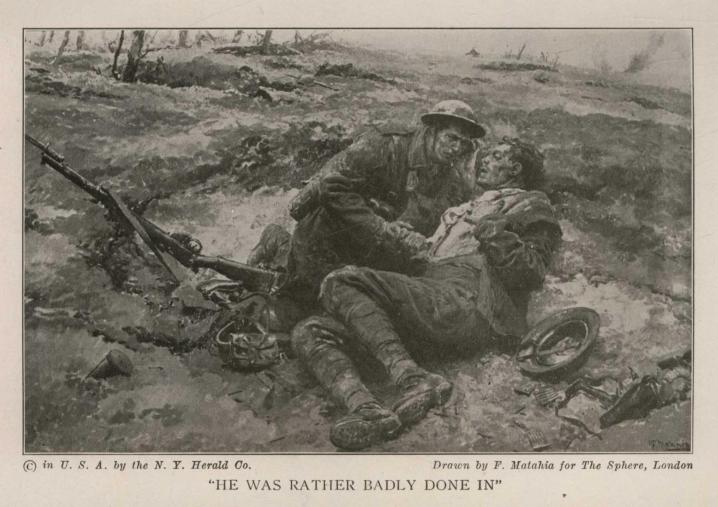
"HE WAS RATHER BADLY DONE IN" Drawn by F. Matahia for The Sphere, London
"I am one of the taller and stronger men of my platoon so, of course, I volunteered as a stretcher-bearer. There was no communication trench, so we had no choice but to lift him up and make a dash across the open. They were shelling us like blazes, but we dare not delay because, if we were overtaken by daylight, it would be impossible to get him away till the next night, and by that time he would be dead. So we decided to try our luck. We had just lifted him up when a shell burst right on top of us, and knocked us all down. For a minute or two I was unconscious, and when I came round I thought I must surely be wounded, so I ran my fingers over my body but found neither blood nor a rent in my clothes. I was covered with chalk but that didn't matter. Except for a touch of concussion in the brain I was none the worse, and soon pulled myself together. The sergeant was a sight! He was half-buried, and we could scarce see him for chalk; but we dug him out and got him on the stretcher again. After that we sat down in the bottom of the trench till the effect of the shock had worn off a bit, for we all felt like rats that had been shaken by a terrier.
"Then, as suddenly as it had started, the shelling stopped. The calm that followed was wonderful. I never felt anything so restful before. It was like the delicious restfulness that, sometimes, immediately follows hours of fever. Then, as if to make it perfect, a lark rose out of No Man's Land and began to sing. The effect on us was magical. It was the sweetest music I have ever heard, and I shall remember it to my dying day. The countryside was dark and silent, and, as I listened to the lark, old days came back to mind. You remember that Saturday midnight in the June before the war when you took us into Epping Forest to see the dawn break over it? Well, as I listened to the lark, I was back there in the forest. Then some impulse seized me and, hardly knowing what I did, I cried aloud, 'Why bless me, it must be Sunday,' and so it was, although I had forgotten.
"Then we jumped up for we saw that the dawn was breaking and, lifting the sergeant out of the trench, we rushed across the open ground in the direction of the dressing station. Talk about 'feeling protected!' Why, I felt that God was all around us--that no harm could touch us. A great calm stole over me, and I felt utterly devoid of fear. We had, as you know, to bring the sergeant some two miles to the dressing station, just down the road there, but we got him safely in, and I think he will get better."
While we were talking, a shell burst near the trench where my men had been taking of the Sacrament, and another burst by the roadside close to the Engineers. With a laugh and a hearty "Good-night" he shook hands, saluted, and ran on to rejoin his comrades. The shells were part of the game. In London we had been in the same football team. He had kept goal and I had played full back, and he regarded the shells that had fallen as bad shots at goal made by the opposing team. They might have been serious but, as it happened, the ball had each time gone out of play.
I waited a minute or two in the hope of getting a lift. A motor car came along; I stopped it and got in; for at the Front everything is Government property and more or less at one's service. I found myself sitting by the side of a private, who had been wounded in the face and right hand by the shell that had just fallen near the platoon of Engineers.
He had left his horse with a comrade, and was being driven to the Advanced Dressing Station by a driver who, happening to pass at the moment, had kindly offered him a lift. After a little wait at the Dressing Station I got on the front of an ambulance car. There were only two cases inside, and they were being taken to the Main Dressing Station in Arras. One of them had his feet and arms tied to the stretcher, for he was suffering from shell-shock; and three orderlies were in charge of him. The poor fellow laughed and cried alternately and struggled to break loose. "I'm a British soldier," he cried, "and I will not be tied up. I've done my bit, and this is the way you pay me out. I'll not have it." And time and again he struggled desperately to break away.
The orderlies in charge of him were wise and tactful as women. They asked him questions about the fight, and he fought his battle over again. They praised his regiment and told him it had done magnificently, and he laughed and chuckled like a young mother, dandling her first baby on her knee. And so, without mishap, we reached the ruined town of Arras where nightly the shells fall among the forsaken houses in which our soldiers are billeted. The wounded private was carried into the hospital, and I walked away to my room in an adjoining street.
So ended the day which, in the hour of dawn, the dark had told the young engineer "must be Sunday."
XIII
OUR TOMMIES NEVER FAIL US
On Easter Monday, in the Battle of Arras, I saw two sights such as I shall never forget. One revealed the kind and forgiving spirit of our men, the other their unflinching courage. After burying three non-commissioned officers who had been killed the day before, I reached the Advanced Dressing Station near which our regiment was "standing to" in a support trench. Other regiments of our Division were carrying out the attack and, with small loss, had taken the enemy lines. The German trenches had been blotted out by our shells but their deep dug-outs, with machine-guns at their mouths, remained untouched, and it was almost impossible for our soldiers to discover them until they got within a few yards of the entrances.
The German commander's idea was to keep his men in the shelter of the dug-outs until our barrage lifted. They were then to rush out with machine-guns and rifles to destroy our men who were following it up. If the idea had been carried out, the German line would have been impregnable for our men would have been mown down like corn before the reaper. It failed because German human nature could not rise to the occasion. The German soldiers had been demoralized by the safety of the dug-outs and by the thunder of our shells above them. They cowered in the dug-outs when they should have rushed out. The critical moment passed, and with its passing our soldiers leapt to the entrances and threw down hand grenades. There was a wild cry of pain and fear from below. Arms went up and the cry of "Kamerad." The surrender was accepted and the beaten soldiers crawled out. From some dug-outs as many as two hundred prisoners were taken. In other parts of the line there was a stiff fight, but, on the whole, our casualties were very light. From my own observation I should say that we took more prisoners than we suffered casualties. Some companies could boast a prisoner for each man engaged in the attack.
The Advanced Dressing Station was at the corner of Cross Roads and the sight around it was wonderful to behold. A crowd of prisoners was assembling ready to be marched to the cages, and wounded officers and men, British and German, were being bandaged. The prisoners were hungry. For some days our artillery had cut off their rations. A platoon of our soldiers came marching by, and, to save time, eating their breakfasts as they passed along. The prisoners looked at them with hungry eyes. Our men saw the look and stopped. Breaking rank for a moment they passed in and out among the prisoners and shared out their rations. "Here, Fritzy, old boy, take this," I heard all around me, and Fritz did not need asking twice. He took the biscuits and cheese gratefully and eagerly. The look of trouble passed out of his eyes and he felt that he had found friends where he had only expected to find enemies. He began to hope for kindness in his captivity. The scene was one of pure goodwill.
Scarcely ever have I seen a crowd so happy. Our Tommies laughed and cracked jokes which no German could understand, but I heard not a single taunt or bitter word. In fact, Fritz was treated more like a pet than a prisoner. One who had worked in London, and who spoke English, asked me for a cup of tea for a comrade who was slightly wounded, and I got one in the dressing station. The platoon of Tommies re-formed and marched away to the battle and the prisoners were led off to the cages. There were still large numbers of prisoners on the road, and they were moving about without guards. Many of them were being used as stretcher-bearers and they seemed to do their work out of goodwill and not of constraint.
Their assistance was of great help to the wounded. The battle was going well with us. Everyone felt in good heart and kindly disposed. An officer who lay seriously wounded and waiting for a car told me of the splendid work which his regiment had done. His eyes shone with suppressed excitement and pride as he told the story. While he was speaking two soldiers came limping down the road and their appearance was greeted with a burst of laughter. One was English, the other German. Tommy had his arm round the German's neck and was leaning on him while Fritz, with his arm round the lad's waist, helped him along. They came along very slowly for both were wounded, but they laughed and talked together like long-lost brothers. Yet neither could understand a word the other said.
I passed down the road towards the line. Gunners of the Territorials were hurriedly hitching their guns to the horses ready to advance to new positions. In the ruined village a party of engineers was already unloading a wagon of rails with which to build a light railway. I continued along the road towards the next village. It had just fallen into our hands and not one stone was left on another. There were scores of wounded men hobbling back from it and I gave my arm to such as needed it most. A badly wounded Tommy was being brought along on a wheeler by two orderlies and as I helped them through the traffic we heard the heavy rumble of the advancing field-guns.
The road was cleared with the quickness of lightning. Out of the village the batteries burst at a mad gallop and down the road they came at break-neck speed. With the swiftness of a fire engine in a city street the rocking guns swept past. The gunners clung to the ammunition limbers with both hands and the drivers whipped and spurred the excited foam-flecked horses as though they were fiery beings leaping through the air and incapable of fatigue or weakness. Suddenly the drivers raised their whips as a sign to those behind, and the trembling horses and bounding guns came to a dead halt. The leading gun had overturned at a nasty place where the road dipped down into the hollow. The rest of the batteries stood exposed on the crest of the ridge. Before retiring the Germans had felled all the trees that grew by the roadside so that nothing might obstruct their line of vision. Such a catastrophe as this was what the enemy had been hoping for. The sun shone brilliantly, and our batteries were a direct target for the German gunners such as seldom occurs. Our boys were caught like rats in a trap. By the side of the road ran a shallow trench and near us two broad steps into it. We laid the wounded lad in the bottom of the trench and sat down by his side. Shells were falling all around and fountains of dirt and debris rose into the air and, on five or six occasions, covered us with their spray.
I covered the lad's face. He was barely conscious and uttered no word. It seemed as if nothing could live in such a bombardment. A shell burst near, and the cry of dying horses rent the air. The traces were cut and the horses and gun-carriage drawn off the road. Every second I expected to see the horses and drivers in front of me blown into the air and I watched them with fascinated eyes. Not a man stirred. They sat on their horses and gun-carriages as though they were figures in bronze. Not a man sought the trench and not a man relieved the tension by going forward to see what was wrong or to lend a hand. Each knew his place, and if death sought him it would know where to find him. The horses felt that they had brave men on their backs and, in that mysterious way peculiar to horses, caught the spirit of their riders. Every shell covered men and horses with chalk and soil, but they remained an immobile as statuary. It was magnificent and it was war. A driver in the battery beside us got wounded in the leg and hand. He jumped off his horse and came to us to be bandaged. Then he leapt back into the saddle. It seemed an age, but I suppose it was only a few minutes, before the obstruction was removed. The whips flashed in the air and the horses sprang forward. The guns rocked and swayed as they swept past us and within a few minutes they were in their new positions under the hill upon which lay the ruins of Neuville Vitasse.
The shelling ceased as suddenly as it had started and we lifted out our wounded soldier and went in the direction of the dressing station. Some distance up the road my attention was called to one of the drivers whom the artillery had left in the care of some privates. He was living, but his skull was broken, and he would never wake again to consciousness. He was fast "going West." His day was over and his work was done. I got him lifted on to a stretcher and taken to the dressing station so that he might die in peace and be buried in the little soldiers' cemetery behind it.
When I returned in the evening to our billet I told the transport officer of the magnificent bravery of the artillery drivers.