Introductory material (continued 4)
Reading edition
"I'll go with you to Happy Valley, Tip," I said, rising and turning to the door. "You hitch the gray colt in the buggy and——"
"We are goin' to ride," cried Tip. He had always made his flights afoot before that, and the prospect of an easy journey caused him to smile.
"Do you think I'll walk?" I growled. "Get the gray colt and I'll give you a lift over the mountain, but I'll bring you back on Monday, too." Tip shook his head sullenly at this threat. "While you hitch, I'll drop a line to Perry Thomas to take the school. Now hurry."
Tip shuffled away to the barn, and I went into the house, and, after making a hasty breakfast and getting together a few clothes, sat down at the table, where Tim had rested his drowsy head all night. I wrote two notes. One was to Perry and was very brief. The other was brief, but it was to Mary. When I took up the pen it was to tell her all I knew and felt. When at last I sealed the envelope it was on a single sheet of paper, bearing a few formal words, while the scuttle by the fireplace held all my fine sentiments in the torn slips of paper I had tossed there. I told Mary that I knew that she did not care for me and had found herself out. If it was her wish, we would begin again where we were that night when I saw her first, and I would guide myself into the future all alone, half happy anyway in the knowledge that it was best for her and best for Tim. Was I wrong, a single word would bring me back. I was to be away for three days, and when I returned I should look by the door-sill for her answer. If none was there, it was all I had a right to expect. If one was there—I quit writing then—it seemed so hopeless.
Tip and I crossed Thunder Knob at noon. As we turned the crest of the hill and began the descent into the wooded gut, my companion looked back and waved his hand.
"Good-by to Black Log," he cried. "It's the last I'll ever see of you."
He turned to me and tried to smile, but a deep-set frown took possession of his face, and he hung his head in silence, watching the wheels as we jolted on and on.
We wound down the steep way into the gut, following a road that at times seemed to disappear altogether, and leave us to break our way through the underbrush. Then it reappeared in a broken corduroy that bridged a bog for a mile, and lifted itself plainly into view again with a stony back where we began to climb the second mountain. The sun was ahead of us when we reached the crest of that long hill. Behind us, Thunder Knob lifted its rocky head, hiding from us the valley of our troubles. Before us, miles away, all capped with clouds of gold and red was the sunset country, but still beyond the mountains. The gray colt halted to catch his breath, and with the whip I pointed to the west, glowing with the warm evening fires.
"Yonder's Happy Valley, Tip," I said, "miles away still. It will take us another day to reach it."
"It will take you forever to reach it," was the half-growled retort. "I ain't chasin' sunsets. Here's Happy Walley—my Happy Walley, right below us, and the smoke you see curlin' up th'oo the trees is from the John Shadrack clearin'."
A great wall, hardly a mile away, as the crow flies, the third mountain rose, bare and forbidding. Below us, a narrow strip of evergreen wound away to the south as far as our eyes could reach, and at wide intervals thin columns of smoke sifting through the trees marked the abodes of the dwellers of Tip's Elysium. Peace must be there, if peace dwells in a land where all that breaks the stillness seems the drifting of the smoke through the pine boughs. The mountain's shadow was over it and deepening fast, warning us to hurry before the road was lost in blackness. But away off there in the west, where a half score of peaks lifted their summits above the nearer ranges, all purple and gold and red, a heap of cloud coals glowed warm and beautiful over the sunset land. My heart yearned for that land, but I had to turn from the contemplation of its distant joys to the cold, gloomy reality below me.
The whip fell sharply across the gray colt's back, and he jumped ahead. Down the steep slope, over rocks and ruts we clattered, the buggy swinging to and fro, and Tip holding fast with both hands, muttering warnings. The gray colt broke into a run. All my strength failed to check him. Faster and faster we went, and now Tip was swearing. I prayed for a level stretch or a bit of a hill, for the wagon had run away too, and where the wagon and the horse join in a mad flight there must come a sudden ending to their career. The mountain-road offered me no hope. Steeper and steeper it was as we dashed on. Tip became very quiet. Once I glanced from the fleeing horse to him, and I saw that his face was white and set.
"Get out, Tip," I cried. "Jump back, over the seat."
"Not me," said he, grimly. "We come to Happy Walley together, me and you, and together we'll finish the trip."
He lent a hand on the reins, but it was useless, for the wagon and the horse were running away together, and there was nothing to do but to try to guide them.
"Pull closer to the bank at the bend ahead," Tip cried.
Almost before the warning passed his lips we had shot around the projecting rock, where the road had been cut from the mountain-side. We were near our journey's end then, for at the foot of the embankment that sheered down at our left we heard the swish of a mountain-stream. The horse went down. There was a cry from Tip—a sound of splintering wood—something seemed to strike me a brutal blow. Then I lay back, careless, fearless, and was rocked to sleep.
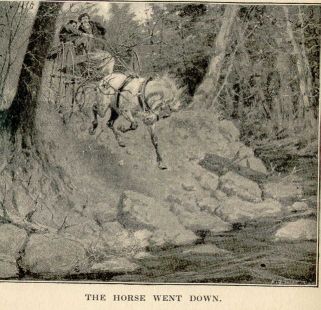
[Illustration: The horse went down.]
XVIII
She sat smoking.
Had I never heard of her before, had I opened my eyes as I did that day to see her sitting before me, I should have exclaimed, "It's John Shadrack's widder!"
So, with the crayon portrait, gilt-framed, that hung on the wall behind her, I should have cried, "And that is John Shadrack!"
This crayon "enlargement" presented John with very black skin and spotless white hair. His head was tilted back in a manner that made the great bushy beard seem to stick right out from the frame, and gave the impression that the old man was choking down a fit of uproarious laughter. I knew, of course, that he had been posed that way to better show his collar and cravat. Though Tip had described him to me as a rather gloomy, taciturn person, the impression gained in the long contemplation of his picture as I lay helpless on the bed never changed. To me he was the ideal citizen of Happy Valley, and the acquaintance I formed then and there with his wife served only to endear him to me.
She sat smoking. I contemplated her a very long while and she gazed calmly back. A score of times I tried to speak, but something failed me, and when I attempted to wave my hand in greeting to her I could not lift it from the bed.
At last strength came.
"This is John Shadrack's house?" I said.
"Yes," said she, "and I'm his widder."
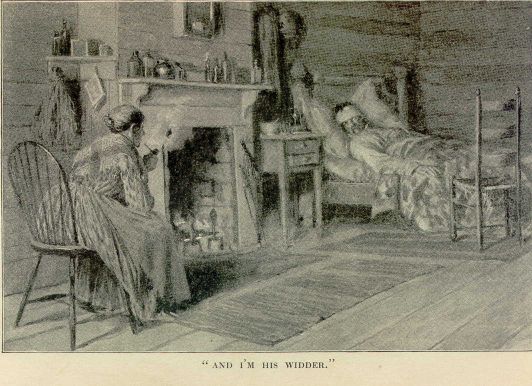
[Illustration: "And I'm his widder."]
She came to my side and stood looking down at me very hard. I saw a woman in the indefinable seasons past fifty. In my vague mental condition, the impression of her came slowly. First it was as though I saw three cubes, one above the other, the largest in the middle. Then these took on clothing, blue calico with large polka dots, and the topmost one crowned itself with thin wisps of hair, parted in the middle and plastered down at the side. So, little by little, John Shadrack's widow grew on me, till I saw her a square little old woman, with a wrinkled, brown face, a perpetual smile and a pipe that snuffled in a homely, comfortable way.
I smiled. You couldn't help smiling when Mrs. John Shadrack looked down at you.
"It's been such a treat to have you," she cried. "I've been enjoyin' every minute of your visit."
This was puzzling. How long Mrs. John Shadrack had been entertaining me, or I had been entertaining her, I had not the remotest idea. A very long while ago I had seen a spire of smoke curling through the trees in Happy Valley, and I had been told that it was from her hearth. Then we had gone plunging madly down the hill to it, Tip, the gray colt and I. We had turned a sharp bend, we had heard the swish of a mountain-stream. There my memory failed me. I had awakened to find myself helpless on a bed, strangely hard, but, oh, so restful! Then she had appeared, sitting there smoking.
"You are the first stranger as has been here since the tax collector last month," she said, beginning to clear away the mystery. "I love strangers."
"How long have I been here?" I asked.
"Since last Wednesday," she answered.
"And this is what?"
"The next Saturday. I've had you three days. You was a bit wrong here sometimes." She tapped her head solemnly. "But I powwowed."
"You powwowed me," I cried with all the spirit I could muster, for such treatment was not to my liking. I never had any faith in charms.
"Of course," she replied. "Does you think I'd let you die? Why, when me and Tip pulled you out of the creek you was a sight, you was, and you was wrong here." Again she tapped her head. "You needn't complain. Ain't you gittin' well agin? Didn't the powwow do it?"
Hardly, I thought. I must have recovered in spite of it. But the old woman spoke with pride of her skill, and if she had not saved me by her occult powers, she had at least helped to drag me from the creek. For that I was grateful, so I smiled to show my thanks.
"What did you powwow for?" I asked, after a long while.
She had seated herself on the edge of the bed and was contemplating me gravely.
"Everything," she answered. "I never had a case like yours. I never had a patient who was run away with, and kicked on the head, and drownded. So I says to Tip, I says, 'I'll do everything. I'll treat for asthmy, erysipelas and pneumony, rheumatism and snake-bite, for the yallers and——'"
"Hold on," I pleaded. "I haven't had all that."
"You mought have had any one of 'em," she said firmly. "You should 'a' seen yourself when we found you down there in the creek. Can't you feel that bandage?" She lifted my hand to my head gently. I seemed to have a great turban crowning me. "That's where you was kicked," she went on. "You otter 'a' seen that spot. I used my Modern Miracle Salve there. It's worked wonderful, it has. I was sorry you had no bones broken so I could 'a' tried it for them, too."
"I'm satisfied with what I have," said I quietly. "It was pretty lucky I got off as well as I did after a runaway, and the creek and the kick." Then, to myself, I added, "And the powwowing and the salve."
I tried to lift my head, but could not. At first I thought it was the turban, but a sharp pain told me that there was a spot there that might be well worth seeing. For a long time I lay with my eyes closed, trying not to care, and when I opened them again, John Shadrack's widow was still on the edge of the bed, smoking.
"Feel better now?" she asked calmly.
"Yes," I answered. "The ache has gone some."
"I was powwowin' agin!" she said. "Couldn't you hear me saying Dutch words? Them was the charm."
"I guess I was sleeping," I returned a bit irritably.
How the store would have smiled could it have seen me there on the bed, in that bare little room in John Shadrack's widow's clutches! Many a night, around the stove, Isaac Bolum, and Henry Holmes and I had had it tooth and nail over the power of the powwow. In the store there was not always an outspoken belief in the efficacy of the charm, but there was an undercurrent of sentiment in favor of the supernatural. Against this I had fought. Perhaps it was merely for the joy of the argument that so often I had turned a fire of ridicule on the dearest traditions of the valley. Time and again, when some credulous one had lifted his voice in honest support of a silly superstition, I had jeered him into a grumbled, shamefaced disavowal. Once I sat in the graveyard at midnight, in the full of the moon, just to convince Ira Spoonholler that his grandfather was keeping close to his proper plot. And here I was, prone and helpless, being powwowed not for one ailment, but for all the diseases known in Happy Valley. How I blessed Tip! When we started he should have told me of the powers of our hostess. I would rather have undergone a hundred runaways than one week with that old woman muttering her Dutch over my senseless form. But I liked the good soul. Her intentions were so excellent. She was so cheery. Even now she was offering me a piece of gingerbread.
I ate it ravenously.
Then I asked, "Where is Tip?"
"He's gone down the walley to my brother-in-law, Harmon Shadrack's. He's tryin' to borry a me-yule."
"A what?"
"A me-yule. The colt was dead beside you in the creek. Him and me fixed up the buggy agin, and he's gone to borry Harmon's me-yule so as you uns can git back to Black Log."
"Tip's left Black Log forever," I said firmly.
Then John Shadrack's widow laughed. She laughed so hard that she blew the ashes out of her pipe, and they showered down over my face, and made me wink and sputter.
"There—there," she said solicitously, dusting them away with her hand. "But it tickled me so to hear you say Tip wasn't goin' back. Why, he's been most crazy since you come. He's afraid his wife'll marry agin before he gits home. I've been tellin' him how nice it was to have you both, and that jest makes him roar. He's never been away so long before."
"He thinks maybe Nanny will give him up this time?"
"Exact."
The old woman smoked in silence a long while. Then she said suddenly, "She must be a lovely woman."
"Who?" I asked.
"Tip's wife."
"Who told you?" I demanded.
"Tip."
This was strange in a fugitive husband, one who had fled across the mountains to escape a perpetual yammering.
"Tip!" I said.
"Yes, Tip," she answered. "Him and me was settin' there in the kitchen last night, and you was sleepin' away in here, and he told me all about Black Log. It must be a lovely place—Black Log—so different from Happy Walley. There's no folks here, that's the trouble. There's Harmonses a mile down the walley, and below him there's the Spinks a mile, and up the walley across the run there's my brother, Joe Smith, and his family—but we don't often have strangers here. The tax collector, he was up last month, and then you come. You have been a treat. I ain't enjoyed anything so much for a long time. There's nothin' like company."
"Even when it can't talk?" I said.
"But I could powwow," she answered cheerily. "Between fixin' up the buggy, and cookin' and makin' you and Tip comfortable and powwowin' you, I ain't had a minute's time to think—it's lovely."
"What has Tip been doing all this while?"
"Talkin' about his wife. She must be nice. Did you ever hear her sing?"
"I should say I had," I answered.
The whining strains of "Jordan's Strand" came wandering out of the past, out of the kitchen, joining with the sizzle of the cooking and the clatter of the pans.
"I should say I had," I said again.
"She must be a splendid singer," John Shadrack's widow exclaimed with much enthusiasm. "Tip says she has one of the best tenor voices they is. He says sometimes he can hear her clean from his clearin' down to your barn."
"Farther," said I. "All the way to the school-house."
"Indeed! Now that's nice. I allow she must be very handsome."
"Handsome?" said I, a bit incredulous.
"Why, Tip says she's the best-lookin' woman in the walley, and that she's a terrible tasty dresser."
"Terrible," I muttered.
"Indeed! Now that's nice. And is she spare or fleshy?"
"Medium," I said. "Just right."
"That's nice. But what'll she run to? It makes a heap of difference to a woman what she runs to. Now I naterally take on."
"I should say Nanny Pulsifer would naturally lose weight," I answered.
"That's nice. It's so much better to run to that—it's easier gittin' around. Tip says she has a be-yutiful figger. There's nothin' like figger. If there's anythin' I hate to see it's a first-class gingham fittin' a woman like it was hung there to air. But about Tip's wife agin—she must have a lovely disposition?"
"Splendid," I said.
"That's what Tip says. He told me that oncet in a while when he was kind of low-down she'd git het-up and spited like, but ordinarily, he says, she's jest a-singin' and a-singin' and makin' him comf'table and helpin' the children. And them children! I'm jest longin' to see 'em. They must be lovely."
"From what Tip says," I interjected.
"From what Tip says," she went on. "He was tellin' me about Earl and Alice Eliza, and Pearl and Cevery and the rest of 'em. He says it's jest a pickter to see 'em all in bed together—a perfect pickter."
"A perfect picture," said I sleepily.
"Tip must have a lovely home. Why, he tells me they have a sewin'-machine."
"Lovely," said I. "And a spring-bed."
"And a double-heater stove," said she.
"And an accordion," said I.
"And a washin'-machine," said she.
"And two hogs."
"And he tells me he's going to git her a melodium."
"Indeed," said I. "Why, I thought he was never going back."
"To sech a lovely home?" The old woman held up her hands. "He's goin' jest as soon as he gets that me-yule and you're able." She laid her hand on my forehead. "There," she cried, "it's painin' you again, poor thing—that terrible spot."
It was hurting, despite the Modern Miracle, and I closed my eyes to bear it better. Over me, away off, as if from the heavens, I heard a sonorous rumble of mystery words. I felt a hand softly stroking my brow. But I didn't care. It was only Dutch, a foolish charm, a heritage of barbarity and ignorance, but I was too weary to protest. It entertained John Shadrack's widow, and I was going to sleep.
Tip was waiting for me to awake.
"I've got the mule," he said, when I opened my eyes, "and I thought you was never goin' to quit sleepin'; I thought the widder was joshin' me when she said you was all right; I thought mebbe she had drumpt it, she sees so much in dreams."
"What day is this?" I asked.
"Sunday," Tip answered. "I 'low we'll start at daybreak to-morrow, and by sundown we'll be in Six Stars."
"In Six Stars!" said I. "I thought you'd left Six Stars forever."
"That ain't here nor there," he snapped. "I've got to git you back."
"Then you won't go to-morrow," said I. "Look here—I can just lift my hands to my head—that's all. It'll take a whole week's powwowing to get me to sit up even."
"What did I tell you, Tip?" cried John Shadrack's widow. She handed me a piece of gingerbread just to chew on till she got some breakfast for me, and while I munched it, Tip and I argued it out.
"Nanny'll think I've left her," Tip said.
"You did, Tip," said I. "You ran away forever."
"She'll be gittin' married agin," pleaded Tip.
"Serves you right," said I. Then, to myself, "Not unless the other man's an utter stranger."
"She hasn't enough wood chopped to last a week," said Tip.
"She chopped the last wood-pile herself," said I.
"There's Cevery," pleaded Tip. "Cevery never done me no harm, and who'll dandle him?"
"The same good soul that dandled him the day you rode over the mountain," I answered.
"But it's a good half mile from our house to the spring," Tip said, "and who'll carry the water?"
"Earl and Pearl and Alice Eliza," I replied. "They've always done it; why worry now?"
"Well, I don't care nohow," Tip cried, stamping the floor. "I want to go back to Black Log."
"So do I, Tip," I said; "but—there's that bad spot on my head again."
"Now see what you've done with your argyin', Tip Pulsifer," cried the old woman, running to me. "Poor thing—ain't the Miracle workin'?"
"I guess it is, but that's an awful bad spot—that's right, Widow, powwow it."
For ten long days more Mrs. Tip Pulsifer chopped her own wood, Cevery went undandled, and Earl and Pearl and Alice Eliza carried the water that half mile from the spring. For nine long days more John Shadrack's widow entertained the two strangers who had sought a refuge in Happy Valley, and found it. Rare pleasure did John Shadrack's widow have from our visit. There seemed no way she could repay us. It did her old heart good to have someone to whom she could recount the manifold virtues of her John—and a wonderful man John was, I judge. Had I not come, she might have lost the Heaven-given gift of powwowing, for there is no sickness in Happy Valley—the people die without it. It was a pleasure to have Mark settin' around the kitchen; it was elevatin' to hear Tip tell of his home and his wife and children; and as for cooking, it was no pleasure to cook for just one.
"You must come agin," she cried, on the morning of that ninth day, as she stood in the doorway of her little log-house and waved her apron at us. "It's been a treat to have you."
So we went away, Tip and I, with Harmon Shadrack's mule and the battered buggy. Our backs were turned to the Sunset Land. Our faces were toward the East and the red glow of the early morning. When we saw Thunder Knob again, Happy Valley was far below us, and only the thin spire of smoke drifting through the pines marked the Shadrack clearing. I kissed my hand in farewell salute to it. Perhaps John's widow saw me—she sees so much in her dreams.
"There's no place like Black Log," said Tip, as we turned the crest of Thunder Knob. "Mind how pretty it is—mind the shadders on the ridge yon—and them white barns. Mind the big creek—there by the kivered bridge—ain't it gleamin' cheerful? There's no place like our walley."
XIX
It was dark when I reached home. Opening the door, I groped my way across the room till I found the lamp and lighted it. Then I sat down a minute to think. Two weeks is a very short time, but when you have been over the mountains and back, when you have hovered for days close to the banks of the Styx, when you have huddled for days close to the Shadrack stove, listening to the widow's stories of her John and Tip's praise of his wife, then a fortnight seems an age. But everything was as I had left it. Even the pen leaned against the inkwell and the scraps of paper littered the floor where I had tossed them that morning, when Tip and I started over the mountain. Those scraps were part of the letter I did not send to Mary. They flashed to me the thought of the one I had sent, and of the answer I never expected. It was foolish to look, but I had told her to slip her note under the door, if she did send it, and I was taking no chances. Seizing the lamp, I hobbled to the kitchen, and laughing to myself at the whole absurd proceeding, leaned over and swept the floor with the light.
Right on the sill it lay, a small white envelope! I did not waste time hobbling back to my chair and the table. I sat right down on the floor with the lamp at my side, and tore open the note and read it.
"Dear Mark. Please come to me."
That was all she said. It was enough. It was all I wanted in the world.
Once I had been disappointed, but now there was no mistaking it. Upside down, backward and forward I read it, right side up and criss-cross, rubbing my eyes a half a hundred times, but there was her appeal—no question of it. After all, all was well. And when Mary calls I must go, even if I have crossed two mountains and am supperless. All the bitterness had gone. All those days of brooding were forgotten, for I could go again up the road, my white road, to the hill, and the light there would burn for me.
Then Tim came!
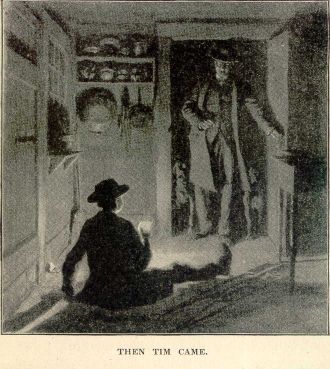
[Illustration: Then Tim came.]
I was still sitting on the floor when he came, reading the note over and over, with the lamp beside me.
With Captain and Colonel at his heels he burst in upon me.
"Well, Mark, you scoundrel," he cried, laughing, as he caught me by the arm and lifted me up. "Where have you been?"
"Travelling," I answered grimly. "And you—what are you doing here?"
"I came to find you," he said. "Do you suppose you can disappear off the face of the earth for two weeks and that I will not be worried? Why, I came from New York to hunt you up—just got here this afternoon and was over at Bolum's when we saw the light. Now give an account of yourself."
"It isn't necessary," said I, smiling complacently. I put the lamp on the table and picked up my hat. "I'll be back in a while," I said. "I'm going up to see Mary."
"To see Mary?" Tim cried.
"Yes, to see Mary," I answered.
Then, with a little flourish of triumph, I handed him her note.
Tim read it. His face became very grave, and he looked from it to me, and then turned and, with an elbow resting on the mantel, stood gazing down into the empty fireplace.
"Well?" I exclaimed, angered by his mood.
"This is two weeks old, Mark," he said, handing me the paper.
"What of it?" I cried querulously, putting on my hat and moving to the door.
My hand was on the knob turning it, when Tim said, "Mary has left the valley."
It did not bother me much when he said that. I was getting so used to being knocked about that a blow or two more made little difference. The knob was not turned though. It shot back with a click, and I leaned against the door, staring at my brother.
"And when did she go?" I asked. "And where—back to Kansas?"
"To New York," Tim answered, "and with Weston—she has married Weston."
I was glad the door was there, for that trip over the mountain, with the creek, and the powwowing and all that, had left me still a little wobbly. Tim's announcement was not adding to my spirit. Long I gazed at his quiet face; and I knew well enough that he was speaking the truth. And, perhaps, after all, the truth was best. It was all over, anyway, and we were just where we started before she came to the valley.
I was just where I was before I found that note lying on the door-sill. I had been foolish, sitting there on the floor reading that message of hers that she had belied. But that was only for a minute, and I would never be foolish again. Trust me for that.
"She has married Weston," I said. "Well, the little flirt!"
Tim got down on the hearth and began piling paper and kindling and logs in the fireplace. He started the blaze, and when it was going cheerily he looked up to find me in my old chair by the table, with Captain beside me, his head on my knee as I stroked it.
"The little flirt!" I said again, bound that he should hear me.
He heard. He took his old chair, and resting his elbows on the table, resting his chin in his hands, a favorite attitude of his, he sat there eying me quietly.
"The little what, Mark?" he said at last.
"Flirt," I snapped.
It was simply a braggart's way. I knew it. Tim knew it, too. He seemed to look right through me. I was angry with him, I was jealous of him, because she had cared for him. I knew she had. I knew why she had. Tim and I were far apart. But he had made the breach. All the wrong wrought was his, and yet he sat there, calmly eying me, as though he were a righteous judge and I the culprit.
"Why did you say flirt?" he asked quietly.
"She promised to marry me," I said.
"Yes."
"She loved you, Tim."
"Yes—and how did you know it?"
"Perry Thomas saw you that night when you went to stay a minute."
The color left Tim's face and he leaned back in his chair, away from the light into the shadow, and whistled softly.
"You knew it, then," he said, after a long while. "I didn't intend you should, Mark. I didn't intend you ever should."
"Naturally," said I in an icy tone.
"Naturally," said he. His face came into the light again, and he leaned there on the table, watching me as earnestly as ever.
"Naturally," he said again. "I was going away, Mark, never to bother you nor her. Did I know then that you loved her? Had you ever told me? Was I to blame for that moment when I knew I loved the girl and that she loved me?"
"No. I never told you—that's true," I said.
"And yet I knew you cared for her, Mark. I could see that. I saw it all those nights when you would leave me to go plodding up the hill. That's why I went away."
"Why did you go away?" I cried. "You went to see the world and make money——"
"I went because I loved the girl and you did, too," said Tim. And looking into those quiet eyes, I knew that he spoke the truth and I had been blind all this time. "Weston knew it," he went on. "He saw it from the first. That's why he helped me."
"You are not at all an egotist," I sneered, trying to bear up against him.
"Entirely so," he said calmly. "I even thought that I might win, Mark. But then I had so much and you so little chance, I went away to forget. Weston knew that. He knew, too, that there was no Edith Parker."
"And what has Edith Parker to do with all this?" I asked more gently, for he was breaking down my barriers.
"She might have done much for you had I not come back when Weston was shot. Couldn't you see, Mark, how angry Mary was with me for forgetting her? But Weston knew it. And that night—that minute—I only wanted to explain to Mary, and she saw it all, Mark, and I saw it all—and we forgot. Then she told me of you."
"She told you rather late," said I.
"But she would have kept her promise. Couldn't you forgive her, Mark, for that one moment of forgetting? It was just one moment, and I left her then forever. We thought you'd never know."
"And thinking that, you came whistling down the road that night," I sneered. "You came whistling like a man mightily pleased with his conquest—or, perhaps you sang so gayly from sheer joy in your own goodness. It seems to me at times like that a man would——"
"A man would whistle a bit for courage," Tim interrupted. "Couldn't he do that, Mark? Couldn't he go away with his head up and face set, or must he totter along and wail simply because he is doing a fair thing that any man would do?"
"Why, in Heaven's name, couldn't you keep her for yourself?" I cried, pounding the floor with my crutch.
Then, in my anger I arose and went stamping up and down the room, while Tim sat there staring at me blankly. At last I halted by the fireplace and stood there looking down at him very hard. I looked right into his heart and read it. He winced and turned his face from me. I was the righteous judge now and he the culprit.
"You left her, Tim," I said hotly. "You might have known the girl could never marry me after that minute. You might have known she was not the girl to deceive me—she would have told me; and then, Tim, do you think that I would have kept her to her promise? Why didn't you come to me and tell me?"
"For your sake, Mark, I didn't," Tim answered, looking up.
"And for my sake you left the girl there—you turned your back on her and went away. Then in her perplexity she looked to me again, and I had gone. I didn't know. I went away for her sake, and when she sent for me I had forsaken her, too. That's a shabby way to treat a woman. Do you wonder she turned to Weston?"
"No," Tim said, "for Weston is a man of men, he is—and he cared for her—that's why he stayed in the valley."
"I knew that," said I, "for I saw it that day when he went away from me to the charcoal clearing."
"Then think of the lonely girl up there on the hill, Mark," Tim said. He joined me at the fireplace, and we stood side by side, as often we had stood in the old days, warming our hands, and watching the crackling flames. "Do you blame her? I had gone, vowing never to come back again till she kept her promise to you; you had fled from her—she wrote, and no word came. And Weston is a wise man and a kind man, and when she turned to him she found comfort. Do you blame her?"
"No," I said, half hesitating.
"After all, it's better, too," Tim went on. "What could you have given her, Mark—or I, compared to what his wealth means to a woman like Mary?"
Wealth was not happiness. Money was not peace. Etches were a delusion. Now she had them. That was what Weston would give her, and I wished her joy. True, he loved the girl. True, he offered her just what I did, and with it he gave those fleeting joys that wealth brings. She should be happy—just as much so as if she had made herself a fellow-prisoner with me here in the little valley. For what had I to offer her? The love of a crippled veteran; the wealth of a petty farmer; the companionship of a crotchety pedagogue. What joy it would give her ambitious soul as the years went on to watch her husband develop; to see him growing in the learning of the store; to have him ranking first among the worthies of the bench; to greet him as he hobbled home at night after a busy day at nothing! It was better as it was—aye—a thousand times.
But there was Tim. What a man Tim was, and how blind I had been and selfish! He stood before me tall and strong, watching me with his quiet eyes, and as I looked at him I thought of Weston, the lanky cynic, with his thin, homely face and loose-jointed, shambling walk. Then I wondered at it all. Then I said to myself, "Is it best?"
"What makes you so quiet, Mark?" asked Tim.
"I was wishing, Tim," I answered, laying a hand on each of his broad shoulders, "I was wishing you had kept her when you had her."
Tim laughed. It was his clear, honest laugh.
"It is best as it is," he said. "It's best for her and best for us, for she'll be happy. But supposing one of us had won—would it have been the same—the same as it was before she came—the same as it is now?"
"No," I answered.
"No," he cried. "Now for supper—then our pipes—all of us together—you in your chair and I in mine—and Captain and Colonel—just as it used to be."
XX
Tim has gone back to the city after his first long vacation and here I am alone again. He wants me to be with him and live down there in a brick and mortar gulch where the sun rises from a maze of tall chimneys and sets on oil refineries. I said no. Some day I may, but that day is a long way off. In the fall I am to go for a week and we are to have a fine time, Tim and I, but Captain and Colonel will have to be content to hear about it when I get back. Surely it will give us much to talk of in the winter nights, when we three sit by the fire again—Captain and Colonel and I.
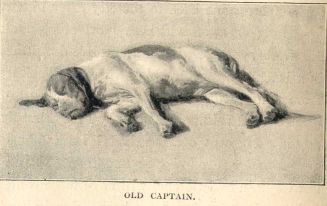
[Illustration: Old Captain.]
Tim says it is lonely for me here. Lonely? Pshaw! I know the ways of the valley, and there is not a lonely spot in it from the bald top of Thunder Knob to the tall pine on the Gander's head. I would have Tim stay here with me, but he says no. He wants to win a marble mausoleum. I shall be content to lie beneath a tree. Tim is ambitious.
Just a few nights ago, we sat smoking in the evening, warming our hearts at the great hearth-stone. Thunder Knob was all aglow, and the cloud coals were piled heaven-high above it, burning gold and red. Down in the meadow Captain and Colonel raced from shock to shock on the trail of a rabbit, and a flock of sheep, barnward bound, came bleating along the road.
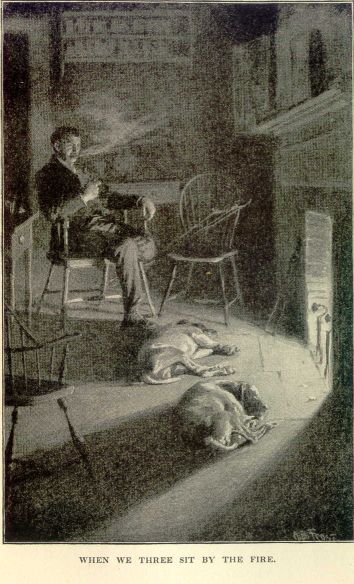
[Illustration: When we three sit by the fire.]
Tim began to suppose. He was supposing me a great lawyer and himself a great merchant and all that. I lost all patience with him.
Suppose it all, Tim, I said. Suppose that you, the great tea-king, and I, the statesman, sat here smoking. Would the cloud coals over there on Thunder Knob blaze up higher in our honor? And the quail, perched on the fence-stake, would she address herself to us or to Mr. Robert White down in the meadow? Would the night-hawk, circling in the clouds, strike one note to our glory? Could the bleating of the sheep swing in sweeter to the music of the valley as she is rocked to sleep?