Introductory material (continued 3)
Reading edition
"It certainly sounds more interestin'," exclaimed Isaac Bolum.
Old Mr. Holmes started to protest, but Aaron Kallaberger quieted him with an offering of tobacco. By the time his pipe was going, Josiah was well into his story.
"Of all the teachers that ever tot in Six Stars this here Leander was the most fe-rocious. He was six foot two inches tall in his stockin's, and weighed no more than one hundred and thirty pound, stripped, but he was wiry. His arms was like long bands of iron. His legs was like hickory saplin's, and when he wasn't usin' them he allus kept them wound round the chair, so as to unspring 'em at a moment's notice and send himself flyin' at the darin' scholar. His face was white and all hung with hanks of black hair; his eyes was one minute like still intellectual pools and the next like burnin' coals of fire—that was my pap's way of puttin' it. Ernest was just his opposite. He was a chunky boy with white hair and pale eyes. He was a nice boy when let alone, but in the whole fifteen years of his life he'd never had no call to bound Kansas or tell the capital of Californy outside of school hours, so he regarded Leander with a fierce and childlike hatred. But Ernest had a noble streak in him, too. For himself he would 'a' suffered in silence. It was the constant oppression of the helpless little ones that saddened him. It was maddenin' to have to sit silent every day while tiny girls, no older than ten, was being hounded from one end of the g'ography to the other. He seen small boys, shavers under eight, scratchin' holes in their heads with slate-pencils, tryin' to make out why two and two was four; he seen girls, be-yutiful young girls of his own age, drove almost to distraction by black-boards full of diagrams from the grammar-book. And allus before him, the inspirin' note of the whole systematic system of torturin' the young, was the rod; broodin' over it all, like a black cloud, was Leander's repytation, was the memory of the boys as had gone before. For years Ernest bore all this. Then come a time when he was called to a position of responsibility in the school. One after another, the biggest boys had fallen. A few had gradyeated. Others had argyed with the teacher and become as broken reeds, was stedyin' regular and bein' polite like. In them years, whether he wanted it or not, Ernest had rose up. His repytation was spotless. His age entitled him to the Fifth Reader class, but he was still spellin' out words in the Third; fractions was only a dream to him, and he couldn't 'a' told you the difference between a noun and a wild carrot. But through it all he'd been so humble and polite that Leander looked on him as a kind of half-witted lamb."
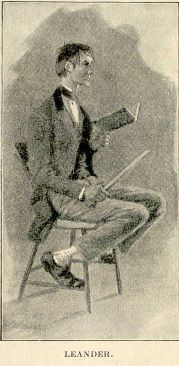
[Illustration: Leander.]
"This here is the longest fairy story I ever heard tell of," said Elmer Spiker, "We haven't even had a sign of the prin-cess."
"And there is a prin-cess in this here le-gend," returned Josiah. "She was a be-yutiful one, too. Her name was Pinky Binn, a dotter of the house of Binn, the Binns of Turkey Walley. She had the reddish hair of the Binns and the pearl-blue eyes of the Rummelsbergers from over the mountains. Her ma was a Rummelsberger. She wasn't too spare, nor was she too fleshy; she was just rounded right; and when she smiled—ah, boys, when Pinky Binn smiled at Ernest from behind her g'ography his heart went like its spring had broke. Yet he never showed it. It would have been ruination for him to let it be known by sign or act that Pinky Binn was other than the general class of weemen; for is there anything worse than weemen in general? It's the exceptions, allus the exceptions, raises trouble with a man. Pinky Binn was Ernest's exception. But the time of his great trial come, and he was true. He stepped forth in his right light before all the school; he showed himself what he was—the gentle lover, the masterful fighter, the heroic-est scholar Six Stars school had ever seen."
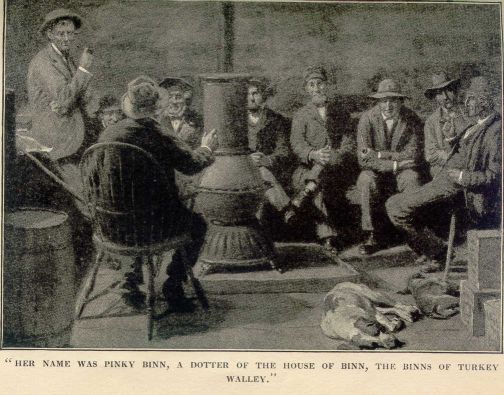
[Illustration: "Her name was Pinky Binn, a dotter of the house of Binn, the Binns of Turkey Walley."]
"He whipped the teacher, I know," cried Henry Holmes. "I told you, Ike—he licked the teacher."
"This here is a fairy story, Henery," returned Isaac reprovingly.
"Even in a fairy story it 'ud be ridiculous to let a boy of fifteen beat a trained teacher," said Josiah Nummler. "He didn't quite, and it come this way. Leander asked Pinky Binn if he had eleven apples and multiplied them by five how many was they left. She says sixty-five. 'Figure it out agin,' he says, wery stern. So she works her fingers and her lips a-while, like she was deef and dumb. 'Five-timsone is five,' she says, 'and five-timsone agin is five and one to carry is six—sixty-five,' she says. 'Well, I'll be Scotch-Irished,' says Leander gittin' wery angry. 'Sech obtusety' (Leander allus used fancy words) 'is worthy of Ernest yander.' He pinted his long finger at Ernest and says, 'How much is five times eleven apples? Ernest gits up and faces the teacher, wery ca'am and wery quiet. 'Sixty-five,' says he. 'It's fifty-five,' Leander shouts. Then says Ernest, wery cool, 'Pinky Binn says it's sixty-five, and Pinky Binn ain't no storyteller, and you hadn't otter call her one.' That takes all the talk out of the teacher. He just sets there wrappin' his legs round the chair and glarin'. Ernest's voice rings clear above the school now, like the Declaration of Independence. 'In Turkey Walley, teacher,' he says, 'five times eleven apples is sixty-five. They raises bigger apples there.'
"Leander's legs unsprung. He ketched Ernest by the hair and lifted him to the platform. Boys, you otter 'a' seen it. It was David and Goliath all over agin, only fightin' fair. Havin' Leander holdin' his hair give the boy an advantage—it was two hands agin one. Leander had but the one to operate his stick with, while Ernest was drivin' both fists right into the darkness in front of him. The stick was making no impression, and some of the small boys that didn't know no better begin to cheer. Boys, you otter 'a' been there. You'd have enjoyed it, Henery. Leander seen what he needed was tactics, and his regular tactics was to hold the scholar at arm's length by the hair. He tried it and it didn't work. Ernest was usin' tactics too. He wasn't wastin' strength and beatin' his arms around. He just smiled. That smile aroused the teacher in Leander agin. He couldn't stand it. He had never had a boy do that before; he forgot himself and sailed in. Boys, that was fightin' then. You'd have enjoyed it, Henery. Still, I guess it couldn't have been much to watch, for there was nothin' to see but dust—a rollin', roarin' cloud of it, backward and forward over the platform. I don't know just what happened. Pap couldn't tell. Leander couldn't 'a' told you. Ernest couldn't 'a' told you. There was war—real war, and after it come peace."
"Ernest whipped, I know," cried Henry Holmes.
"The teacher was licked—good—good!" shouted Isaac Bolum.
"No, boys," said Josiah solemnly, "that couldn't have been. Even in fairy stories sech things couldn't happen. But when the dust cleared away, Leander's body lay along the floor, and towerin' over him, one foot on his boosom, stood the darin' scholar. I guess the teacher had been took ill."
"Mebbe it was appleplexy," suggested Elmer Spiker.
"Mebbe it was," said Josiah. "It must have been somethin' like that; but whatever it was, there stood the boy. 'You is free,' he says, addressin' the scholars. And the children broke from the seats and started for'a'd to worship him. And Pinky Binn was almost on her knees at his feet, when a strange thing happened.
"There was music. It come soft first, and hushed the school, and froze the scholars like statutes. Louder it come and louder—a heavenly choir—the melodium, the cordine, and the fiddle. Then a great white light flooded the school-room. It blinded the boys, and it blinded the girls. The music played softer and softer—the melodium, the cordine, and the fiddle—and with it, keepin' time with it, the light come softer, too; so lookin' up the scholars seen there in the celestial glow, a solemn company gethered round the boy—the he-roes of old—Hercules and General Grant, Joshuay and Washington—all the mighty fighters of history. Just one glimpse the scholars had, for the music struck up louder, and the light glowed brighter and brighter till it blinded them. Softer and softer the music come—the melodium, the cordine, and the fiddle. It sounded like marchin', they said, and they heard the tramp, tramp, tramp of the sperrit soldiers. Then there was quiet—only the roarin' of the stove and the snuffin' of the little ones. And when they looked up Leander was alone—settin' there on the platform, kind of rubbin' his eyes—alone."
There was silence in the store. Josiah Nummler's pipe was going full blast, and while the white cloud hid him from the others, I could see a gentle smile on his fat face.
"Mighty son's!" cried Henry Holmes, "that there's unpossible."
Josiah planted his pole on the floor and lifted himself to his feet.
"It's only a fairy story, Henery," he said.
"What does it illustrate?" cried Aaron Kallaberger. "Nothin', I says. We was talkin' about Mark and William Bellus, and you switches off on Leander and Ernest. To a certain pint your story agrees with what my boy told me of the doin's in the school this afternoon."
"What doing's?" I exclaimed. This talk puzzled me, and I was determined to get to the bottom of the mystery.
"Why, wasn't you there?" cried Isaac Bolum. "Wasn't it you and William?"
"No," I fairly shouted. "Perry Thomas had the school."
Josiah Nummler's pole clattered to the floor, and he sank into a chair.
"I see—I see," he gasped. "Poor William!"
"I see—I see," said I. "Poor William!"
For William had felt the hand of "Doogulus!"
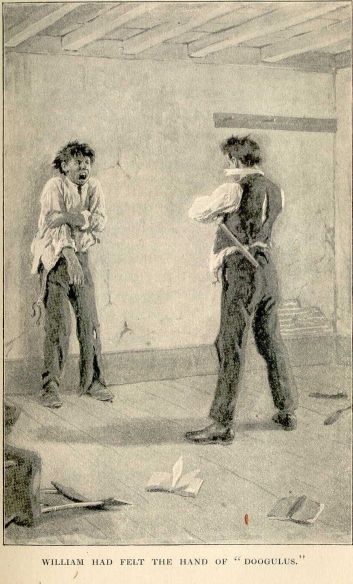
[Illustration: William had felt the hand of "Doogulus."]
XII
It was young Colonel's first day of life. He had been born six months before, but for him that had been simply the beginning of existence. Now he was to live. He was to go with Captain, and with Betsy his mother, with Arnold Arker's Mike and Major, the best of his breed, to learn to take the trail and follow it, singing as he ran.
It was young Colonel's first day of life. He was out in the great dog world, and about him were the mighty hunters of the valley. Arnold Arker was there with his father's rifle, once a flint-lock, always a piece of marvellous accuracy, and a hero as guns go, and the old man patted the puppy and pulled his silky ears. Tip Pulsifer approved of him. Tip shut one eye and gazed at him long and earnestly; he ran his bony fingers down the slender back to the very end of the agitated tail. One by one he took the heavy paws in his hands and stroked them. Then Tip smiled. Murphy Kallaberger smiled too, and declared that the young un took after his pa; clarifying this explanation he pointed his fat thumb over his shoulder to old Captain, beating around the underbrush.
It was young Colonel's first day of life. And what a day to live, I thought, as I stroked his head and wished him luck! He could not get it into his puppy brain that I was to wait there while the others went racing down the slope into the wooded basin below, so he lingered, to sit before me on his haunches, his head cocked to one side, eyeing me inquisitively. There was a tang in the air. The wind was sweeping along the ridge-top and the woods were shivering. All about us rattled Nature's bones, in the stirring leaves, in the falling pig-nuts, in the crash of the belated birds through the leafless branches. The sun was over us, and as I looked up to drink with my eyes of the warm light, I was taking a draught of God's best wine from off yonder in the north, of the wine that quickens the blood and drives away the brain-clouds. A day of days this was to race over the ridges while the music of the hounds rang through them; a day of days to dash from thicket to thicket, over the hills and through the hollows, leaping logs and vaulting fences, with every sense keyed to the highest; for the fox is a clever general. So young Colonel was puzzled, for there I was on a log, at the crest of the ridge, with my crutches at one side and my gun at the other, when I should be away after old Captain, the real leader of the sport, after Arnold and Tip and Betsy. This was the best I could do, to sit here and listen and hope—listen as the chase went swinging along the ridges; hope that a kind fate and an unwise Reynard would bring them where I could add the bark of my rifle to the song of the hounds. You can't explain everything to a dog. With a puppy it is still harder. So Colonel was restless. He looked anxiously down the hill; then he lifted those soft, slantwise eyes to mine very wistfully.
"Go, Colonel," I commanded, pointing to the hollow.
Instead, he came to me and lifted to my knee one of those ponderous feet of his, and tried to pull me from my log.
"Aren't you coming?" he seemed to say.
"No, old chap," I answered, pulling the long ears gently till he smiled. "I prefer it here where I can look over the valley, and from here I can see where Mary lives—down yonder on the hillside; that's the house by the clump of oaks, where the smoke is curling up so thick."
The slantwise eyes became grave, and the long tail paused. The second ponderous paw came crashing on my knee.
"Aren't you coming?" young Colonel seemed to say.
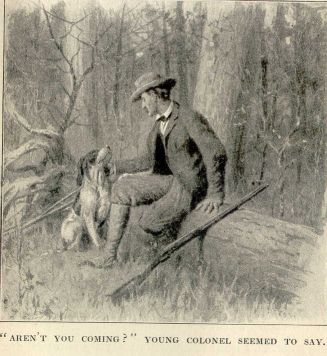
[Illustration: "Aren't you coming?" young Colonel seemed to say.]
I was flattering myself that the puppy was choosing my company to the hunt, for I always value the approval of a dog. Now I found myself hoping that with a little coddling the young hound would forget the great doings down in the hollow and would stay with me on the ridge-top. But I should have known better. There is an end even to a dog's patience. The place for the strong-limbed is in the thick of the chase. You can't interest a puppy in scenery when his fellows are running a fox.
"Look, Colonel," said I, pointing over the valley, "yonder's where Mary lives, and I suspect that at this very minute she is looking out of the window to this very spot, and——"
The call of a hound floated up from the hollow. Old Captain was on a trail. With a shrill cry young Colonel answered. This was no time to loaf with a crippled soldier. With a long-drawn yelp, a childish imitation of his father's bay, he was off through the bushes. Young Colonel was living. And I was left alone on my log.
But this was my first day of life, too. Some twenty-four years before I had been born, but those years were simply existence. Now I was living. I had a secret. I had hinted at it to young Colonel. Had he stayed, I would have told him more, but like a fool he had gone jabbering off through the bushes, cutting a ludicrous figure, too, I thought, for his body had not yet grown up to his feet and ears, and he carried them off a bit clumsily. Had he stayed I might have told him all, and there never was a bit of news quite so important as that the foolish puppy missed; never a story so romantic as that he might have heard; never in the valley's history an event of such interest. He had scorned it. Now he was with the dog mob down there in the gulch. I could hear them giving tongue, and I knew they were on an old trail. Soon they would be in full cry, but I did not care. It was fine to be in full cry, of course, but from my post on the ridge-top, I could at least keep in sight of the house by the clump of oaks on the hillside. Last week I should have moped and fumed here, and cursed my luck in being bound to a log on a day like this. Now I turned my face to the sunlight and drank in the keen air. Now I whistled as merry a tune as I knew.
"You seem to take well with solitude," came a voice behind me.
Looking about, I saw Robert Weston fighting his way through the thicket.
"I take better to company," I said. "Why have you deserted the others?"
Weston sat down at my side with his gun across his knees.
"Arnold Arker says there is a fox in that hollow," he answered. "You can hear the dogs now, and he thinks if they start him, this is as good a place as any, as he is likely to run over on Buzzard ridge, and double back this way, or he'll give us a sight of him as he breaks from the gully. Then as we went away, I looked back and saw you sitting here and I envied you, for yours is the most comfortable post in all the ridges."
"When you could be somewhere else, yes," said I. "Having to sit here, I should prefer running closer to the dogs."
"As you have to stay here, I'd rather sit with you, and after all what could be better?" Weston laughed. "You know, Mark, in all the valley you are the man I get along with best."
"Because I've never tried to find out why you were here."
"For that reason I told you," said he. "How simple it was, too. There was no cause for mystery."
"It would still be a mystery to Elmer Spiker, say. He can't conceive a man living in the country by choice."
"To Elmer Spiker—indeed, to most of the folks around here, the city is man's natural environment. It's just bad luck to be country-born."
"Exactly," said I.
Weston is a keen fellow. There was a quiet, cynical smile on his face as he sat there beating a tattoo on his leggings with a hickory twig.
"Look at your brother," he exclaimed after a while. "I always told Tim that if he knew what was best he'd stay right here and——"
"If you told him that now, he would laugh at you," I interrupted.
Weston looked surprised.
"Does he like work?" he exclaimed.
"The boy is in love," I answered.
Weston dropped the hickory twig, and turning, gazed at me.
"I knew that," he said. "I knew that long ago."
"With Edith Parker," I hastened to explain. "You know her?"
"Oh—oh," he muttered.
He pulled out a cigar-case and a box of matches and spent a long time getting a light.
Then with a glance of inquiry, he said, "Edith Parker?"
"Why, don't you know her?" I asked.
"I know a half a hundred Parkers," he replied. "I may know Edith Parker, but I can't recall her."
"This one is your book-keeper's daughter," I said with considerable heat.
"Indeed," said he calmly. "Parker—Parker—I thought our book-keeper's name was Smyth. Yes—I'm quite sure it's Smyth."
"But Tim says it's Parker," said I. "Tim ought to know."
"Tim should know," laughed Weston. "I guess he does know better than I. A minute ago I would have sworn it was Smyth; but to tell the truth, I never gave any attention to such details of business. Well, Edith is my book-keeper's daughter."
"She lives in Brooklyn," said I, "and she is very beautiful. Every letter I get from Tim, the more beautiful she becomes, for in all my life I never heard of a fellow as frank as he is. Usually men hide what sentiment they have except from a few women, but his letters make me blush when I read them."
"They are so full of gush," said Weston, calmly smoking.
He seemed very indifferent, and to be more listening to the cries of the dogs working around the hollow than to the affairs of the Hope family.
"Gush is the word for it," I answered. "Tim never gives me a line about himself. It's all Edith—Edith—Edith."
"And he is engaged to Miss Smyth?" Weston struck his legging a sharp blow with his stick. "Confound it!" he cried, "I can't get it out of my head that our book-keeper's name is Smyth."
"But Tim knows, surely," said I.
"Yes—he must," answered Weston. "Of course I'm wrong. But this Miss Parker—are they engaged?"
"I can't tell from his last letter," I replied. "It seems that they must be pretty near it—that's what Mary says, too."
Weston started. Then he rose to his feet very slowly, and wheeling about looked down on me and smoked.
"Mary says so too," he repeated. "How in the world does Mary know?"
"I read her the letter," said I, apologetically. It did seem wrong to read Tim's letter that way. From my standpoint it was all right now, but Weston did not know that, so he whistled softly to himself.
From the hollow came the long-drawn cry of the hound. It was old Captain. Betsy joined in, then Mike; and now the ridges rang with the music of the chase. They were on a fresh trail; they were away over hill and hollow, singing full-throated as they ran.
"They've found him," I cried, rising to hear the song of the hounds.
Weston sat down on the log.
"They are making for the other ridge," said I, pointing over the narrow gully. "Hark! There's young Colonel."
But Weston went on smoking. "Poor Tim!" I heard him say.
Full and strong rang the music of the dogs, as they swung out of the hollow, up the ridge-side. For a moment, in the clearing, I had a glimpse of them, Captain leading, with Betsy at his haunches, and Mike and Major nose and nose behind them. Far in the rear, but in the chase, was little Colonel. A grand puppy, he! All ears and feet. But he runs bravely through the tangled brush. Many a stouter dog comes from it with flanks all torn and bloody. I waved my hat wildly, cheering him on. I called to him loudly, in the vain hope he might look back, as though at a time like this a hound would turn from the trail. On he went into the woods—nose to the ground and body low—all feet and ears—and a stout heart!
"Now we must wait," I said, "and watch, and hope."
Already they had turned the crest of the hill, and fainter and fainter came the sound of the chase.
"Mark," Weston began, "I hope this affair of Tim's turns out all right. What little I can do shall be done, and to-night I'm going to write to the office that they must help him along. He deserves it."
"But the poorer men are, the greater their love," I laughed. "With money to marry, Tim might think that after all he'd better look around more—take a choice."
"But Tim is the most serious person that ever was," returned Weston. "I have found that out. Once he makes up his mind, there is no changing it. He is full of ideas. He actually thinks that a man who is in business is doing something praiseworthy; that a man who has bought and sold merchandise at a profit all his life can fold his hands when he dies and say; 'I have not lived in vain.' He does not know yet that the larger estate a man leaves to his relatives the more useful his life has been. Now I suppose he hopes some day to be a tea-king. Perhaps he will. I hope so. I don't want the job. But once he has picked out his queen, you can't change him by making marriage a financial impossibility."
"Well, I'm certainly not protesting against your raising his salary," said I.
"You needn't. To tell the truth, it's too late. I wrote to the office about that yesterday."
It was of no use to thank Weston for anything. I tried to, but he brushed it aside airily and told me to attend to my own affairs and light one of his cigars. When we were smoking together, his mood became more serious, and as he spoke of Tim and Tim's ambition, and of his interest in the boy, he was carried back to his own earlier life. So for the first time I came to understand his prolonged stay in the valley.
Like Elmer Spiker, in my heart Weston's conduct puzzled me. When he told me that he had come here simply because he liked the country I believed him that far, but I suspected some deeper reason to keep a man of his stamp dawdling in a remote valley. Now it was so simple. The foundation of Weston's fortunes had been laid in one small saloon; its bulk had been built on a chain stretching from end to end of the city. Its founder had been a coarse, uneducated man, but his success in the liquor trade had been too great to be forgotten, even years after he had abandoned it and built up the great commercial house that bore his name. His ambition for his son had been boundless. He had spared nothing to make him a better man in the world's eye than his father. He had succeeded. But the world had persisted in remembering the parental bar. Robert Weston had never seen that bar, for he had entered on the scene when there was a chain of them, and his father had brought him up almost in ignorance of their very existence. Even at the university he had little reason to be ashamed of them. It was after he had spent years in rounding out his education abroad, and had returned to take his place in those circles which he believed he was entitled to enter, that he found that the world persisted in pointing to the large revenue stamp that seemed to cling to him. A stronger man would have fought against odds like those and won for himself a place that would suffer no denial. But Weston was physically a delicate man. By nature he was retiring, rather than aggressive. If those who were his equals would have none of him because of his father's faults, then he would not seek them. Equally distasteful were those who equalled him in wealth alone, for by a strange contradiction, the very fact that the rumshop did not jar on their sensibilities, marked them for him as coarse and uncongenial. Weston had turned to himself. It is the study of oneself that makes cynics. The study of others makes egotists. Then a woman had come. Of her Weston did not say much, except that she had made him turn from himself for a time to study her. He had become an egotist and so had dared to love her. She had loved him, he thought, for she said so, and promised to become his wife. Things were growing brighter. But they met an officious friend. They were in Venice at the time, he having joined her there with her family. The officious friend joined the family too, and he held up his hands in horror when he heard of it. Didn't the family know? Oh, yes, Bob was himself a fine fellow; but he was Whiskey Weston!
"Of course, no good woman wants to be Mrs. Whiskey Weston," said my friend grimly. "Still, I think she did care a bit for me; but it was all up. Back I came, and here I am, Mark, just kind of stopping to stretch my legs and rest a little and breathe. I came on a wheel, for I had ridden for miles and miles trying to get my mind back on myself the way it used to be."
Then he smoked.
"Is that the dogs again?" I said, to break the oppressive silence.
Weston did not heed me, but pointed down the valley to the house by the clump of oaks.
"Do you know sometimes I think that Mary there, with all her bringing up, would edge away from me if she knew that my father had kept saloons and gambling places and all that." Weston spoke carelessly, puffing at his cigar, for he had recovered his easy demeanor. "I think a world of Mary, Mark. She is beautiful, and good, and honest. Sometimes I suspect that I've stayed here just for her. Sometimes I think I will not leave till she goes—" Weston sprang to his feet. "It's the dogs! Hear them!" he cried.
I was up too. Away down the ridge we heard the bay of the hounds again.
"I want to tell you something," I said, pointing to the house by the clump of oaks. "I wish for your sake that there were two Marys, Weston. But there is only one, and she is good and beautiful, and for some reason—Heaven only knows why—she is going to be my wife."
Weston stepped hack and gazed at me. I did not blame him. He seemed to study me from head to foot, and I knew that he was trying to find some reason why the girl should care for me. It was natural. I had puzzled over the same problem and I had not solved it. Now I did not care.
"Stare on," I cried, laughing. "You can't think it queerer than I do. It's hard for me to convince myself that it is true."
"I am glad," he said, taking my hand in a warm grasp. "It isn't strange at all, Mark, for Mary is a wise woman."
"There are the dogs," said I; "they are getting nearer."
"They are coming our way at last," he returned quietly. "But what's that to us when you are to be married? I wish you joy and I shall be at the wedding, and it must be soon, too, and Tim shall be here." He was speaking very rapidly; his face was pale and his hand trembled in mine. "I'll send for him. Tim must have a holiday, and perhaps he'll bring Miss—Miss Smyth." Weston laughed. "Parker," he corrected. "He'll bring Miss Parker or Mrs. Tim."
Full and strong the bay of the hounds was ringing along the ridges. Nearer and nearer they were coming. Now I could hear old Captain's deep tones, and the shorter, sharper tongue of Betsy, Mike, and Major. The fox was keeping to the ridge-top and in a few moments he would be sweeping by us. I pointed through the woods to a bit of clearing made by a charcoal burner. If he kept his course the fox would cross it, and that meant a clear shot. Weston knew the place, and without a word he picked up his gun and hurried through the woods.
Nearer and nearer came the hounds. The woods were ringing with their music, and the sound of the chase swung to and fro, from ridge to ridge. Now I could hear the crashing of the underbrush.
Weston fired. The report rattled from hill to hill.
My own gun sprang to the shoulder, but it was too late. The fox, seeing me, veered down the slope, and swept on to safety or to death, for six more anxious hunters were watching for him somewhere in those woods.
The dogs swept by, old Captain as ever leading, with Betsy at his haunches and Mike and Major neck and neck behind.
I watched for little Colonel. A minute passed and he did not come. Poor puppy! He had learned that to live was to suffer. Somewhere in these woods he must be lying, resting those ponderous paws and licking his bloody flanks.
The hollow was alive with the bay of dogs; the ridges were ringing with the echoes of a gunshot; but above them all I heard a plaintive wail over there in the charcoal clearing. I called for Weston and I got no answer, only the cry of the little hound. I called again and I got no answer. Through the hushes I tore as fast as my crutches would take me, calling as I ran and hearing only the wail of the puppy, till I broke from the cover into the open.
On his haunches, his slantwise eyes half closed, his head lifted high in the bright sunlight, sat little Colonel, wailing. He heard me call. He saw me. And when I reached him he was licking the white face of Whiskey Weston.
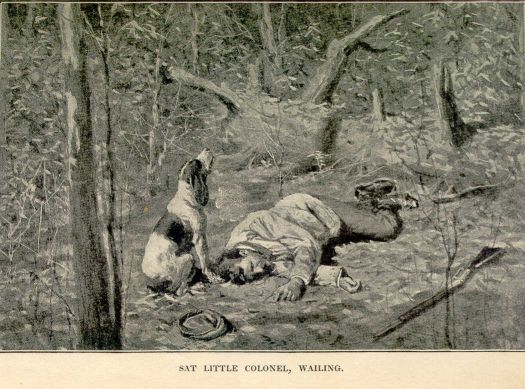
[Illustration: Sat little Colonel, wailing.]
XIII
Hindsight is better than foresight. A foolish saying. By foresight we do God's will. By hindsight we would seek to better His handiwork. Things are right as they are, I say, as I sit quietly of an evening smoking my pipe on my porch, watching the mountains in the west bathe in the gold and purple of the descending sun. What might have been, might also have been all wrong. A foolish saying, says Tim, for if what might have been should actually be, then we should have the realization of our fondest dreams. And with that realization might come a dreadful awakening from our dreams, say I. You might have become a tea-king, Tim, and measure your fortune in millions. I might have turned lawyer instead of soldier; I might have made a great name for myself in Congress by long speeches full of dry facts and figures, or short ones puffed up with pompous phrases. The fact that Six Stars existed might have gone beyond our valley because here you and I were born, and for a time we honored the place with our presence. Suppose all that had been, and you the tea-king and I the great lawyer sat here together as we sit now, smoking, could you add one note to the evening peace; would the night-hawk pay us homage by a single added ring as he circles among the clouds; would the bull-frogs in the creek sing louder to our glory; would the bleating of the sheep swing in sweeter to the music of the valley? And look at God's fireplace, I cry, pointing to the west, where the sun is heaping the glowing cloud coals among the mountains. God's fireplace? says Tim, with a queer look in his eyes. Yes, say I, and the valley is the hearthstone. The mountains are the andirons. Over them, piled sky high, the cloud-logs are glowing, and never logs burned like those, all gold and red. Night after night I can sit here and warm my heart at that fireside. Could you, tea-king, buy for my eyes a picture more wonderful? The fire is dying. The cloud coals grow fainter—now purple; and now in ashes they float away into the chill blue. But they will come again. Could your millions, tea-king, buy for me a sweeter music than the valley's heart throb as it rocks itself to sleep?
"No," Tim answers, "but suppose——"
"And could I have better company to watch and listen with?" I exclaim. "For with you a tea-king, Tim, and I a lawyer, it would be just the same, would it not?"
"That's just what I was trying to get at," says Tim. "Suppose that day of the fox-hunt you had not carried Weston——"
I hold up my hand to check him.
"Were it to happen a hundred times over, I would take him to Mary's," I cry. "Else he would have died."
"You are right, Mark," Tim says.
I took Weston to Mary's house that day when I found him lying in the charcoal clearing, with little Colonel standing over him wailing. Tearing open his coat and shirt, I stanched his wound as best I could. Then I called the others to me. Tip and Arnold picked him up and carried him, while Murphy Kallaberger and I broke a path through the bushes, and Aaron ran on to Warden's to tell them of the accident and have them prepare for the wounded man. Warden's was the nearest house, but that was a mile from the clearing, and in the woods our progress was slow. Once free of the ridges and in the open fields the way was easy, and Murphy could lend a hand to the others.
"He's monstrous light," Tip said. "He doesn't seem no more than skin and bones in fancy rags."
It is strange how even our clothes go back on us when we are down. Weston I had always known as a lanky man, but about his loosely fitting garments there had been an air of careless distinction. Now that he was broken, they hung with such an odd perversion as to bring from its hiding-place every sharp angle in the thin frame. The best nine tailors living could not have clothed him better for that little journey, nor lessened a whit the pathos of the thin arms that lay limply across the shoulders of Tip and Arnold.
"He's a livin' skelington," old Arker whispered, as I plodded along at his side. "Poor devil!"
"Poor devil!" said I. For looking at the almost lifeless man I thought of my own good fortune. This morning I had envied him. Now he had nothing but his wealth, and his hold on that was weakening fast. I had everything—life and health, home and friends—I had Mary. As we parted a few minutes before, up there in the woods, I had pitied him. He had seemed so lonely, so bitter in his loneliness, and yet at heart so good. Now his eyes half opened as they carried him on, his glance met mine in recognition, and it seemed to me that he smiled faintly. But it was the same bitter smile. "Poor devil!" I said to myself.
And we carried him into Mary's house.
She was waiting for us, and without a word led us upstairs to a room where we laid him on a bed.
"I stumbled, Mark, I stumbled," he whispered, as I leaned over him. "The fox came and I ran for it—then I fell—and then the little hound came, and then——"
Mary was bathing his forehead, and for the first time he saw her.
"I stumbled, Mary," he whispered. "I swear it."
It was nearly ten o'clock when I left Weston's room. The doctor was with him and was preparing to bivouac at the patient's side. He was a young man from the big valley. Luther Warden had driven to the county town and brought him back to us. The first misgivings I had when I caught sight of his youthful, beardless face were dispelled by the business-like way in which he went about his work. He had been in a volunteer regiment, he told me, as an assistant surgeon, but had never gone past the fever camps, as this was his first case of a gunshot wound. He had made a study of gunshot wounds, and deemed himself fortunate to be in when Mr. Warden called. Truly, said I to myself, one man's death is another man's practice. But it was best that he was so confident, and I found my faith in him growing as he worked. The wound was a bad one, he said, and the ball had narrowly missed the heart, but with care the man would come around all right. The main thing was proper nursing. The young doctor smiled as he spoke, for standing before him in a solemn row were half the women of Six Stars. Mrs. Bolum was there with a tumbler of jelly; Mrs. Tip Pulsifer had brought her "paytent gradeated medicent glass," hoping it would be useful; Mrs. Henry Holmes had no idea what was needed, but just grabbed a hot-water bottle as she ran. Elmer Spiker's better half was there to demand her injured boarder at once; he paid for his room at the tavern; it was but right that he should occupy it and that she should care for him. When she found that she could not have him entirely, she compromised on the promise that she would be allowed to watch over him the whole of the next day. In spite of the jar of jelly, the doctor chose Mrs. Bolum to help him that night, and when I left them the old woman was sitting in a rocker at the bedside, her eyes watching every movement of the sleeping patient's drawn face.
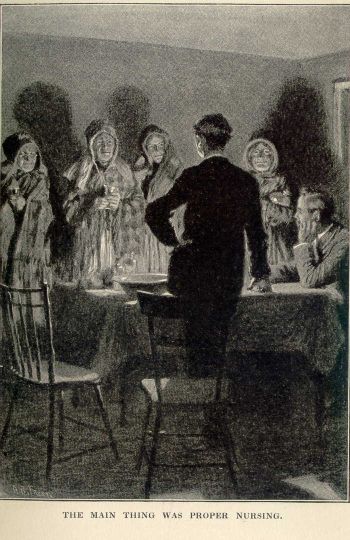
[Illustration: The main thing was proper nursing.]
Outside, the wind was whistling. The steady heating of an oak branch on the porch roof told me it was blowing hard. It sounded cold. Mary stood tiptoe to reach my collar and turn it up. Then she buttoned me snug around the neck. It was the first time a woman had ever done that for me. How good it was! I absently turned the collar down again and tore my coat open. Then I smiled.
Again she raised herself tiptoe before me, and with a hand on each shoulder, she stood looking from her eyes into mine.
"You fraud!" she cried.
Then I laughed. Lord, how I laughed! Twenty-four years I had lived, and until now I had never known a real joke, one that made the heart beat quicker, and sent the blood singing through the veins; that made the fingers tingle, the ears burn, and brought tears to the eyes. I don't suppose that other people would have thought this one so amusing. The young doctor upstairs might not have feigned a smile, for instance. That was what made it all the better for me, for it was my own joke and Mary's, and in all the world I was the only man who could see the fun of it.
"When you turn that collar up again I am going," said I.
So she sprang away from me, laughing, and quick as I reached out to seize her, she avoided me.
"You know I can't catch you," I cried, taunting her, "so I must wait."
As she stood there before me quietly, her hands clasped, her eyes looking up into mine, I saw how fair she was, and I wondered. The picture of Weston in the woods, standing off there gazing at me, came back then, and with it a vague feeling of fear and distrust. I saw myself as Weston saw me, and I marvelled.
"Mary," I said, "this morning up there in the woods I told Robert Weston everything, and he stood off just as you are standing now. It seemed to me he wondered how it could be true, and now I wonder too. Maybe it's all a mistake."
"It's not a mistake, Mark," the girl said, and she came to me again and put a hand on each shoulder and looked up. "If I did not care for you I'd never have given you the promise I did last night. But I do care for you, Mark, more than for anyone else in the world. You are big and strong and good—that's why—it's all any woman can ask. You are true, Mark—and that's more than most men——"
"But, Mary, there's Tim," I protested, for I did not care to usurp to myself the sum of all the virtues allotted to my sex.
"Tim?" said she lightly, as though she had never heard of him.
"Yes, Tim," I said shortly. "Why did you choose me instead of a lad like Tim?"
"Mark, I care for you more than anyone else in the world," said Mary.
"But do you love me?" I asked quickly.
"I think I do," she said. But reaching up, she turned my collar again and buttoned my coat against the storm.
XIV
Tim was home in three days. His few months of town life had wrought many changes in him, and they were for the better. I was forced to admit that, but I could not help being just a little in awe of him. He was not as heavy as of old, but there was more firmness in his face and figure. Perhaps it was his clothes that had given him a strange new grace, for in the old days he was a ponderous, slow-moving fellow. Now there was a lightness in his step and quickness in his every motion. Had I not known him, I should have seen in the scrupulous part in his hair a suggestion of the foppish. But I knew him, and while I liked him best with his old tousled head, and tanned face, and homely hickory shirt, I felt a certain pride that he had taken so well with the world and was learning the ways of the town as well as those of the field and wood. His gloves did seem foolish, for it was a bitter December day when the blood had best had full swing in the veins, but he held out to me a hand pinched in a few square inches of yellow kid. The grasp was just as warm though, and I forgave that. When he threw aside his silly little overcoat and stood before me, so tall and strong, so clean-cut and faultless, from the part in his hair to the shine on his boot-tips, I cried, "Heigh-ho, my fine gentleman!"
Then he blushed. I suspected that it pleased him vastly.
"Do you think it an improvement?" he faltered, standing with his back to the fireplace and lifting himself to his full height.
Before I could reply, the door flew open without the formality of a knock, and old Mrs. Bolum ran in. When she saw him, she stopped and stared.
"Well, ain't he tasty!" she cried.
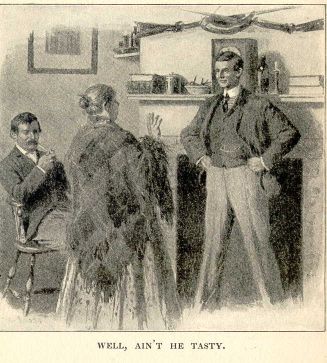
[Illustration: Well, ain't he tasty.]
Then she courtesied most formally. "How do you do, Mr. Hope?" she said.
"And how is Mrs. Bolum?" returned Tim gravely, advancing toward her with his hand outstretched.
The old woman rubbed her own hand on her apron, an honor usually accorded only to the preacher, and held it out. Tim seized it, but he brought his other arm around her waist and lifted her from the floor in one mighty embrace.
"You'll spoil your Sunday clothes," panted Mrs. Bolum, when she reached the floor again. Stepping back, she eyed him critically. "You look handsomer than a drummer," she cried admiringly.
"Thank you, ma'am," said Tim very meekly.
"I'm so sorry I left my spectacles at home," she went on. "My eyes ain't as good as they used to be and I can't see you plain as I'd like. Mebbe it's my sight as is the trouble, but it seems to me, as I see you now without my glasses, you're just about the prettiest man that ever come to Six Stars."
"Lord, ma'am," protested Tim. "And how is Mr. Bolum?"
"And such a lovely suit," continued the old woman, cautiously approaching and moving her hand across my brother's chest. "Why, Tim, you must have on complete store clothes—dear, oh, dear—to think of Tim Hope gittin' so fine and dressy! Now had it 'a' been Mark I wouldn't 'a' been so took back, for he allus was uppy and big feelin'. But Tim!"
Mrs. Bolum shook her head and held her hands up in astonishment.
"And how is Mr. Bolum?" shouted Tim.
"Never was better, 'ceptin' for his rheumatism and asphmy," was the answer, but the good woman was not to be turned aside that way. "And a cady," she cried, for her eyes had caught Tim's hat and the silly yellow overcoat on the chair where I had thrown them. "A cady, too! Now just put it on and let me see how you look."
Tim obeyed. Mrs. Bolum stepped hack to get a better effect.
"It ain't as pretty as your coon-skin," she said critically; "you'd look lovely in that suit with your coon-skin cap—but hold on—don't take it off—I want Bolum to see you."
She ran from the room and we heard her calling from the porch: "Bo-lum—Bo-lum—Isaac Bo-oh-lum."
Isaac was at the store. It seemed to me that his wife should have known that without much research. The little pile of sticks by the kitchen-door showed that his day's work was done, for when he had split the wood for the morrow it was the old man's custom to put aside all worldly care and start on a tour of the village, which generally ended on the bench at Henry Holmes's side.
It was almost dusk. Tim had come on a mission to Robert Weston. I had sent word to him of the accident, that Weston's friends might know, and the first thought of the injured man's partner was to hurry to Six Stars, but my second despatch, announcing that our friend was well on the road to recovery, led to the change in plans that brought Tim to us. Mrs. Bolum did not succeed in alarming the village before he and I were well up the road, past the school-house and climbing the hill to Warden's.
Tim had a great deal to tell me in that short walk. I had much to tell him, but I was silent and let him chatter on, giving but little attention to what he said, for I was planning a great surprise. The simplest thing would have been to tell him my secret then, but I had pictured something more dramatic. I wanted Mary to witness his dumfounding when he heard the news. I wanted her to be there when its full import broke upon him; then the three of us, Mary and Tim and I, would do a wild jig. What boon companions we should be—we three—to go through life together! And Edith? Four of us—so much the better! I had never seen this Edith, but Tim is a wonderful judge of women.
So I let him talk, on and on about the city and his life there, until we reached the house. We found that Mrs. Spiker had secured her rights, and was on duty that day as nurse. The young doctor was there, too, as were Mrs. Tip Pulsifer and a half dozen others, a goodly company to greet us.
"Hello, Mary!" Tim cried, breaking through the others, when he caught sight of her, standing at the foot of the stairs with a lighted candle in her hand.
"Hello, Tim!" cried Mary. "And where is Edith?"
"Edith?" Tim exclaimed, stopping as if to collect the thoughts her sudden taunting question had scattered. "I left her behind this time, but when I come again you shall see her." Tim, with arms akimbo, stood there laughing.
"We country girls, I understand, cannot compare with her," said Mary, tilting her chin.
She had started up the stairs, and now paused, looking down on us. And I looked up at her face showing out of the darkness in the half light, and I laughed, wondering what Tim thought, wondering if he was blind, or was this Edith really bewildering.
"Did I say that?" cried Tim. "Then I must have meant it when I said it. To-night I have learned better, Mary, but you know I never saw you standing that way before—on the stairs above me—kind of like an angel with a halo——"
"Indeed!" retorted Mary; "but we women of Black Log deck ourselves out in gaudy finery, Mr. Tim, I believe. We women of Black Log do not inspire a man, like your Edith."
"Confound my Edith!" Tim exclaimed hotly. "Why, Mary, can't you see I was joking? The idea of comparing Edith with you—why, Mary——"
Tim in his protest started to mount the stairs, and there was an earnestness in his tone that made me think it high time he knew our secret, for his own sake and for Edith's. It seemed to me unfair of him to desert her so basely in the presence of an enemy. He should have stood by her to the very end, and had he boldly declared that as compared to her Mary was a mummy I should have admired him the more; I should have understood; I should have known he was mistaken, but endured it. Now I seized him by the coat and pulled him back.
"Tim," I said solemnly, "I have something to tell you."
My brother turned and gave me a startled look.
"Mary and I have something to tell you," I went on.
That should have given him a clew. I had expected that at this point he would embrace me. But he didn't.
"I suppose you think I've been a fool about Edith?" he muttered ruefully.
"No, it isn't that," I laughed. "Mary, will you tell him?"
But we were in darkness! She had dropped the candle, and down the stairs the stick came clattering. It landed on the floor and went rolling across the room. Tim made a dive for it. He groped his way to the corner where its career had ended. Then he lighted it again.
Behind us stood the doctor, and Mrs. Tip Pulsifer, and Elmer Spiker's much better half. Mary was at the head of the stairs.
"Come, Tim," she called. "Mr. Weston wants to see you."
"Weston does want to see you very much, Tim," the wounded man said smiling, lifting a thin hand from the bed for my brother; "I heard you chattering downstairs, and I thought you were never coming."
"It was Mary's fault," Tim said. "I came back as soon as I could, sir. Mr. Mills sent me up on the night train—out this afternoon in a livery rig—here afoot just as fast as Mark would let me—then Mary blocked the way. Mark was going to tell me something when she dropped the candle."
"Why, don't you know—" began Weston.
But over my brother's shoulders I shook my head sternly at him and he stopped and broke into a laugh.
Mrs. Elmer Spiker was standing by him; the young doctor was moving about the room, apparently very busy; Mrs. Tip Pulsifer was peeping in at the door.
"Didn't you know," said Weston, "how I'd shot myself all to pieces, and how there's a live fox in the hollows across the ridge?"
"Mark told me of it," answered the innocent Tim, "and I'm glad to find it is not serious. They were worried at the store. Mr. Mills was for coming right away, but we got word you were better, and he thought I should run up anyway for a day to see if we could do anything. I'm to go back to-morrow."
"It was good of you to come," Weston said, "but there is nothing to be done. Just tell Mills the whole valley is nursing me; tell him that I've one nurse alone who is worth a score." Mrs. Spiker looked very conscious, but Weston smiled at Mary. Then he quickly added: "Tell him that Mrs. Bolum and Mrs. Spiker and Mrs. Pulsifer—" he paused to make sure that none was missed—"and Mark here are a hospital corps, taken singly or in a body."
"I've told him that already," said Tim. "He knows everybody in Six Stars, I guess, and he says as soon as you get well and come back to the office, he will take a holiday himself, fox hunting."
"Poor little Colonel!" murmured Weston. "He'll have a melancholy career. And Mary, too, she'll——"
"But it was when I told him about Mary that he made up his mind to come," Tim said.
"Indeed." The girl spoke very quietly. "And, perhaps, Tim, you'll send Edith along to help us. We women of Black Log are so clumsy."
"A good idea," said Weston. "Capital. You must bring Miss Smyth up, too, Tim."
"Parker," I corrected, "Edith Parker."
"But is it Parker?" Weston appealed to my brother. "Mark tells me she's the book-keeper's daughter. Has old Smyth gone?"
"No," Tim stammered, very much confused. "I guess you don't know Parker. He's come lately."
"That explains it, then," said Weston.
But he turned and looked away from us, his brow knitted. Something seemed to puzzle him, for he was frowning, but by and by the old cynical smile came back.
He said suddenly: "Tim, I wish you luck. I'm glad anyway it isn't Smyth's daughter. That was what I couldn't understand. Ever see Smyth's daughter? No. Well, you needn't bemoan it. I dare say Miss Parker is all you picture her, and I hope you'll win."
"Don't you think you'd better rest now?" asked Tim, with sudden solicitation. Though he addressed himself to Weston, his eyes were appealing to the doctor.
"I think I had," Weston answered, not waiting for the physician to interpose any order. "I get tuckered out pretty easily these days, with this confounded bullet-hole in me—but stay a moment, Tim. They've got a letter from me at the office by this time. It may surprise them; it may surprise you, but I wanted you to know I'd fixed it all right for you, my boy. I did it for Edith's sake."
Tim, with face flushed and hands outstretched in protest, arose from his chair and went to the bedside.
"But don't you see it's all a joke," he cried. "I can't take it. Won't you believe me this time? There isn't any Edith!"
"I knew that long ago, Tim," Weston answered quietly. "But there may be some day."
He turned his back to us.
"Please go," he said brusquely. "I want to rest. Don't stand over me that way, Tim. Why, you look like little Colonel!"
At the school-house door Tim halted suddenly.
"I'm going back, Mark," he whispered, "just for a minute. Weston will think I'm a fraud and I want to tell him something. Now that the others have left I may have a chance. Confound these kind-hearted women that overrun the house! Why, a fellow couldn't say a word without a dozen ears to hear it."
"I'll go back with you," said I.
We had fallen a few steps behind the others, but somehow they divined our purpose and stopped, too.
"You needn't," said Tim. "I'll only be a minute."
"But I've something to tell you—a secret—and Mary——"
He was gone.
"I'll be back in a minute," he called. "Go on home."
He was lost in the darkness, and I started after him.
"Ain't you comin'?" cried Nanny Pulsifer.
"I must go back to Warden's," I answered.
"Then we'll go with you," said Mrs. Spiker firmly.
"Can't you go on home?" I said testily. "There's no use of your troubling yourself further."
"Does you think we'll walk by that graveyard alone?" demanded the tavern-keeper's wife.
"But there are no ghosts," I argued.
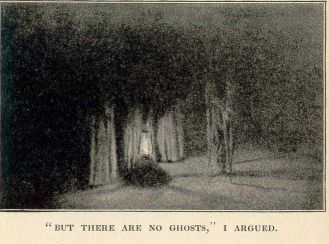
[Illustration: "But there are no ghosts," I argued.]
"We know that," returned Mrs. Pulsifer. "Everybody knows that, but it's never made any difference."
"A graveyard is a graveyard even if there is no bodies in it," said Mrs. Spiker, planting herself behind me so as to cut off further retreat.
Tim must have caught some echoes of the argument on the spirit world, for down the hill, through the darkness, came his call.
"Go on home, Mark—I'll be back in a minute."
I believed him, and I obeyed.
XV
Tim's minute? God keep me from another as long!
I had my pipe in my chair by the fire, and knocking the ashes out, I went to the door, and with a hand to my ear listened for his footsteps. Tim's minutes are long! Another pipe, and the clock on the mantel marked nine. Still I smoked on. He had had a long talk with Weston, perhaps, and had stopped downstairs for a minute with Mary. She had told him all. How astounded the boy must be! Why, it would take her a half hour at least to convince him that she spoke the truth when she told him she was to marry his wreck of a brother; then when he believed it, another half hour would hardly be enough for him to welcome her into the family of Hope, and to talk over the wonderful fortunes of its sons. Doubtless he had felt it incumbent on himself to sing my praises, for he had always been blind to my faults. In this possibility of his tarrying to display my virtues there was some compensation for my sitting alone, with old Captain and young Colonel, both sleeping, and only my pipe for company. Of course, I should really be there with Tim, but Nanny Pulsifer and Mrs. Spiker had decreed otherwise. Who knows how great may be my reward for bringing them safely past the graveyard!
The third pipe snuffled out. I opened the door and listened. Tim's minutes are long, for the last light in the village is out now. I went to the gate and stood there till I caught the sound of foot-falls. Then I whistled softly. There was no reply, but in a moment Perry Thomas stepped into the light of our window.
"Good-evening," he said cheerfully. "It's rather chilly to be swinging on the gate."
"I was waiting for Tim," I answered.
Perry gave a little dry cackle. "Let's go in," he said. "It's too cold out here to discuss these great events."
I did not know what he meant, neither did I much care, for Perry always treated the most trivial affairs in the most elegant language he knew. But now that he stood there with his back to the fire, warming his hands, he made himself more clear.
"Well, Mark," he said, "I congratulate you most heartily."
I divined his meaning. It did not seem odd that he had learned my secret, for I was lost in admiration of his having once weighed an event at its proper value. So I thanked him and returned to my chair and my pipe.
"Of course it hurts me a bit here," said he, laying his hand on his watch-pocket. "I had hopes at one time myself, but I fear I depended too much on music and elocution. Do you know I'm beginnin' to think that a man shouldn't depend so much on art with weemen. I notice them gets along best who doesn't keep their arms entirely occupied with gestures and workin' the fiddle."
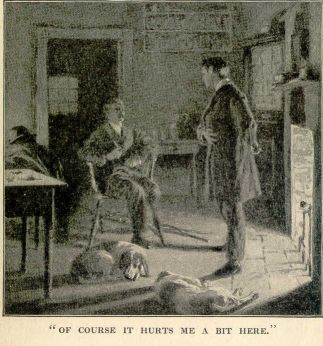
[Illustration: "Of course it hurts me a bit here."]
Perry winked sagely at this and cackled. He rocked violently to and fro on his feet, from heel to toe and toe to heel.
"Yet it ain't a bit onreasonable," he went on. "The artist thinks he is amusin' others, when, as a matter of fact, he is gettin' about ninety per cent. of the fun himself. We allus enjoys our own singin' best. I see that now. I thought it up as I was comin' down the road and I concided that the next time I seen a likely lookin' Mrs. Perry Thomas, she could do the singin' and the fiddlin' and the elocution, and I'd set by and look on and say, 'Ain't it lovely?'"
"You bear your disappointments bravely," said I.
"Not at all," Perry responded. "I'm used to 'em. Why, I don't know what I'd do if I wasn't disappointed. Some day a girl will happen along who won't disappoint me, and then I'll be so set back, I allow I won't have courage to get outen the walley. Had I knowd yesterday how as all the courtin' I've done since the first of last June was to come tumblin' down on my head to-night like ceilin' plaster, not a wink of sleep would I 'a' had. Now I know it. Does I look like I was goin' to jump down the well? No, sir. 'Perry,' I says, 'you've had a nice time settin' a-dreamin' of her; you've sung love-songs to her as you followed the plough; you've pictured her at your side as you've strayed th'oo fields of daisies and looked at the moon. Now in the natural course of events she's goin' to marry another. When she's gettin' peekit like trying to keep the house goin' and at the same time prevent her seven little ones from steppin' into the cistern or fallin' down the hay-hole, you can make up another pretty pickter with one of the nine hundred million other weemen on this globe as the central figger!'"
At the conclusion of this philosophic speech my visitor adjusted his thumbs in his waistcoat pockets, brought himself to rest with a click of his heels and smiled his defiance.
"But I congratulate you truly, heartily," he added.
"Thank you, Perry," I answered. "In spite of your trifling way of regarding women, I hope that some day you may find another as good as Mary Warden."
"The same to you, Mark," said he.
"The same to me?" I cried, with a touch of resentment.
"Of course," he replied. "I says to myself to-night, 'I hope Mark is as fortunate,' I says, when I saw them two a——"
"What two?" I exclaimed, lifting myself half out of my chair in my eagerness.
"Why, Tim and her," Perry answered. "Ain't you heard it yet, Mark? Am I the first to know?"
"Tim and her," I cried. "Tim and Mary?"
"Yes," said Perry.
He saw now that he was imparting strange news to me. In my sudden agitation he divined that that news had struck hard home, and that I was not blessed with his own philosophic nature. The smile left his face. He stepped to me, as I sat there in the chair staring vacantly into the fire, and laid a hand on my shoulder.
"I thought of course you knowd it," he said gently. "I thought of course you knowd all about it, and when I seen them up there to-night, her a-holdin' to him so lovin', says I to myself, 'How pleased Mark will be—he thinks so much of Tim and Mary.'"
Tim's minute! I knew now why it was so long. I should have known it long ago. I feared to ask Perry what he had seen. I divined it. I had debated with myself too much the strangeness of Mary's promise, and often in the last few days there had come over me a vague fear that I was treading in the clouds. She had told me again and again that she cared for me more than for anyone else in the world. But that night when I had asked her if she loved me, she had turned my collar up. I believed that when she spoke then it was what she thought the truth. She had pledged herself to me and I had not demanded more. I had been selfish enough to ask that she link herself to my narrow life, and she had looked at me clear in the eye. "You are strong, Mark, and good, and true," she had said, "and in all the world there is none I trust more. I'll love you, too. I promise."
On that promise I had built all my hopes and happiness, and it had failed me. It was not strange. I had been a fool, a silly dreamer, and now I had found it out. A soldier? Paugh! Away back somewhere in the past, I had gone mad at a bugle-call. A hero? For a day. For a day I had puffed myself up with pride at my deeds. And now those deeds were forgotten. I was a veteran, a crippled pensioner, an humble pedagogue, a petty farmer. This was the lot I had asked her to share. She had made her promise, and that promise made and broken was more than I deserved. From a heaven she had smiled down on me, and I had climbed to the clouds, reaching out for her. Then her face was turned from me, and down I had come, clattering to common earth, cursing because I had hurt myself.
I turned to my pipe and lighted it again. Old Captain came and rested his head on my knee and looked up at me, as I stroked it slowly.
"Poor dog," I said. It was such a relief, and Perry misunderstood.
"Has he been hurt?" he asked sympathetically.
"Yes," I answered, still stroking the old hound's head. "Very badly. But he'll be all right in a few days—and we'll go on watching the mountains—and thinking—and chasing foxes—to the end—the end that comes to all poor dogs."
"It's curious how attached one gets to a dog," said Perry sagely, resuming his rocking from heel to toe and toe to heel.
"It is curious," I said, smoking calmly. I even forced a grim smile.
Now that I could smile, I was prepared to hear what Perry had to tell me, for after all I had been drawing conclusions from what might prove to be but inferences of his. But he had been so positive that in my inmost heart I knew the import of all he had to say.
"Well, Perry," I said, "you did give me a surprise. I didn't know it, and, to tell the truth, was taken back a bit, for it hurt me here." I imitated his effective waistcoat-pocket gesture, which caused him much amusement. "I had hopes myself—you know that, and as I neither fiddled nor recited poetry your own conclusions may be wrong."
"But Tim didn't do nothin'," Perry cackled. "He just goes away and lets her pine. When he comes back she falls right into his arms and gazes up into his eyes, and—" Perry stopped rocking and looked into the fire. "You know, Mark," he said after a pause, "it must be nice not to be disappointed."
"It must be very nice," said I, smoking harder than ever.
"That's what I said to myself as I looked in the window and seen them."
"You looked in the window—you peeped!" I fairly shouted, making a hostile demonstration with a crutch.
"Why, yes" said Perry, looking hurt that I should question his action in the least. "I didn't mean to. Comin' from over the ridge I passed Warden's and thought I'd stop in and warm up and see how Weston was. So I stepped light along the porch, not wantin' to disturb him, and seein' a light in the room, I looked in before I knocked. But I never knocked, for I says to myself, 'I'll hurry down and tell Mark; it'll please him.'"
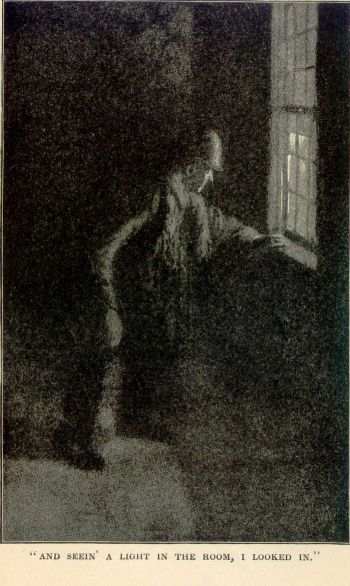
[Illustration: "And seein' a light in the room, I looked in."]
"And you saw Tim and Mary," said I.
"I should say I did," said Perry, "till I slipped away. But says I to myself, 'It must be nice not to be disappointed.'"
"You said you saw Tim and Mary," said I, a trifle angrily.
"I should say I did," Perry answered, chuckling and rocking again on his feet. "The two of 'em, standin' there in the lamplight by the table, him a-lookin' down like he was dyin', her a-lookin' up like she was dyin' and holdin' on to him like he was all there was left for her in the world. It made me swaller, Mark, it made me swaller."
There was a lump in Perry's throat at that moment, and he stopped his rocking and turned to the fire, so his back was toward me.
"Of course you knocked," said I, after a silence.
"Of course I didn't," he snapped. "Do you suppose I was wanted then? 'No, sir,' I says, 'for them there is only two people in all the world—there's Tim and there's Mary.'"
Perry was putting on his overcoat, winding his long comforter about his neck and drawing on his mittens.
"To tell the truth," he said, with a forced laugh, "I don't feel as chipper as I usually do under such like circumstances. It seems to me you ain't so chipper as you might be, either, Mark."
"Good-night, Perry," I said, smoking very hard.
"Good-night," he answered. At the door he paused and gazed at me.
"Say, Mark," he said, "them two was just intended for one another—you know it—I see you know it. God picked 'em out for one another. I know it. You know it, too. But it's hard not to be picked yourself—ain't it?"
Tim's minute! God keep me from such another!
It was all so plain now. The fire was dying away. The hands of the clock were crawling off another hour, and still he did not come. But what did I care? All in the world that I loved I had lost—Mary and my brother—and Tim had taken both. He who had so much had come in his strength and robbed me, left me to sit alone night after night, with my pipe and my dogs and my crutches. Had he told me that night when I came back to the valley that he loved the girl in all truth, I should have stood aside and cheered him on in his struggle against her, but I had not measured the depth of his mind nor given him credit for cunning. Perry Thomas saw it. He had gone away from her and wounded her by his neglect. In the fabrication of the other girl, the beautiful Edith, whose charms so outshone all other women, he had hit at the heart of her vanity; and now he had come back so gayly and easily to take from me what I might not have won in a lifetime. Losing her, I cared little that what he had done had been in ignorance that I loved her and that she was plighted to me. Losing her, I had no thought of blame for the girl, for when she told me that in all the world she cared for none so much as me, she meant it, for she believed that he had passed out of her life.
By the fireplace, so close that I could put my hand upon the arm, was the rocking-chair I had placed for her, and many a night had I sat there watching it and smiling, and picturing it as it was to be when she came. There would Mary be, sewing beneath the lamplight; there the fire burning, with old Captain and young Colonel, snuggling along the hearthstone; here I should be with my pipe and my book, unread, in my lap, for we should have many things to talk of, Mary and I. We should have Tim. As he played the great game, we should be watching his every move. And when he won, how she and I would smile over it and say "I told you so!" When he lost—Tim was never to lose, for Tim was invincible! Tim was a man of brain and brawn. His arm was the strongest in the valley; in all our country there was no face so fine as his; in all the world few men so good and true.
Now he had come! The chair there was empty. So it would always be. But here I should always be with my pipe and my crutches, and the dogs snuggling by the fire.
Tim had come! The clock hands were crawling on and on. His minute had better end. I hurled my pipe into the smouldering coals; I tossed a crutch at little Colonel, and the dog ran howling from the room. Old Captain sat up on his haunches, his slantwise eyes wide open with wonder.
Aye, Captain, men are strange creatures. Their moods will change with every clock-tick. One moment your master sits smoking and watching the flames—the next he is tearing hatless from the house; and it is cold outside and the wind in the chimney is tumbling down the soot. When the wind sings like that in the chimney, it is sweeping full and sharp down the village street, and across the flats by the graveyard, whither he goes hobbling.
Little Colonel comes cautiously into the room, hugging the wall till he is back at the fireside. With his head between his fore-paws and one eye closed, he watches the tiny tongue of flame licking up the last coal. There are worse lives than a dog's.
XVI
Tim came whistling down the road. He whistled full and clear, and while he was still at the turn of the hill the wind brought me a bit of his rollicking tune as I huddled on the school-house steps, waiting. The world was going well with him. He had all that the wise count good; he was winning what the foolish count better. With head high and swinging arms he came on, the beat of his feet on the hard road keeping time to his gay whistling. Tim was winning in the game. While his brother was droning over the reader and the spelling-book with two-score leather-headed children, he was fighting his way upward in the world of commerce. While his brother was wringing a living from a few acres of niggardly soil and a little school, he was on the road to riches; while his brother was wrangling with the worthies of the store over the momentous problems of the day, he was where those problems were being worked out and standing by the men who were solving them. All in this world worth having was Tim's, and now even what was his brother's he had taken. To him that hath! From him that hath not! He had all. I had nothing. Now as he came swinging on so carelessly, I knew that I had lost even him.
Never once had there come to my mind the thought of doing my brother any bodily harm. My emotions were too conflicting for me to know just why I had come at all into the night to meet him. Now it was against him that the violence of my anger would vent itself. Now it was against myself, and I cursed myself for an idle, dreaming fool. Then came over me, overwhelming me, a sense of my own utter loneliness, and against it Tim stood out so bold and clear-cut and strong; that I felt myself crying out to him not to desert me and let a woman take him from me. I thought of the old days when he and I had been all in all to each other, and I hated the woman who had come between us, who had lured me from him, who had lured him from me. Then as against my misery, she stood out so bold and good, so wholly fair, that I cursed Tim for taking her from me. I wanted to see him in the full heat of my anger to tell him to his face how he had served me; to stand before him an accuser till he slunk from me and left me alone, as I would be alone from now to the end.
So I had quickened my pace, hobbling up the starlit road to the school-house. There I was driven by sheer exhaustion to the shelter of the doorway, and in the narrow refuge I huddled, waiting and listening. The keen wind found me out and seemed to take joy in rushing in on me in biting gusts and then whirling away over the flat. By and by it brought me the rollicking air my brother whistled, and then came the sound of foot-falls. In a moment he would be passing, and I arose, intending to hail him. It was easy enough when I heard only his whistling to picture myself confrating him in anger, but now that in the starlight I could see his dark form coming nearer and nearer; now that he had broken into a snatch of a song we had often sung together, my courage failed me and I slunk farther into my retreat.
So Tim passed me. He went on toward the village, singing cheerfully for company's sake, and I stood alone, in the shadow of the school-house woods, listening. His song died away. I fancied I heard the beat of his stick on the bridge; then there was silence.
I turned. Through the pines on the eastward ridge the moon was climbing, and now the white road stretched away before me. It was the road to her house. The light that gleamed at the head of the hill was her light, and many a night in this same spot I had stopped to take a last look at it. It used to wink so softly to me as I waved a hand in good-night. Now it seemed to leer. The friendly beacon on the hill had become a wrecker's lantern. A battered hulk of a man, here I was, stranded by the school-house. As the ship on the beach pounds helplessly to and fro, now trying to drive itself farther into its prison, now struggling to break the chains that hold it, so tossed about my love and anger, I turned my face now toward the hill, now toward the village. The same impulse that caused me to draw into the darkness of the doorway instead of facing Tim made it impossible for me to follow him home. Angry though I was, I wanted no quarrel, yet I feared to meet him lest my temper should burst its bounds. But I had a bitter wind to deal with, too, and if I could not go home, neither could I stand longer in the road, turning in my quandary from the beacon on the hill, where she was, to the light that gleamed in our window in the village, where he was.
The school-house gave me shelter. I groped my way to my desk and there sank into my chair, leaned my head on my hands, and closed my eyes. I wanted to shut out all the world. Here in the friendly darkness, in the quiet of the night, I could think it all out. I could place myself on trial, and starting at the beginning, retracing my life step by step, I would find again the course my best self had laid down for me to follow. For the moment I had lost that clear way. Blinded by my seeming woes, I had been groping for it, and I had searched in vain. But now the dizziness was going, and as I sat there in the darkness, my eyes closed to shut out even the blackness about me, the light came.
After a long while I looked up to see the moon high over the pines on the eastward ridge, and its yellow light poured into the room, casting dim shadows over the white walls, and bringing up before me row on row of spectre desks. The chair I sat in, the table on which I leaned were real enough. They were part of my to-day, but that dim-lighted room was the school-house of my boyhood. The fourth of those spectre desks measuring back from the stove, was where Tim and I sat day after day together, with heads bowed over open books and eyes aslant. That was not the same Tim who had passed me a while before, swaggering and singing in the joy of his conquest; that was not the same Tim who had stood before me that very afternoon in all the pomp of well-cut clothes, drawing on his whitened hands a pair of woman's gloves; that was not the same Tim who by his artful lies had won what had been denied my stupid, blundering devotion. My Tim was a sturdy little fellow whose booted legs scarce touched the floor, whose tousled black head hardly showed above the desk-top. His cheeks would turn crimson at the thought of woman's gloves on those brown hands. His tongue would cleave to his mouth in a woman's presence, let alone his lying to her. That was the real Tim—the rare Tim. To my eyes he was but a small boy; to my mind he was a mighty man. The first reader that presented such knotty problems to his intellectual side was but part of the impedimenta of his youth, and was no fair measure of his real size. That very day he had fought with me and for me; not because I was in the right, but because I was his brother.
A lean, cadaverous boy from along the mountain, a born enemy of the lads of the village, had dared me. I endured his insults until the time came when further forbearance would have been a disgrace, and then I closed with him. In the front of the little circle drawn about us, right outside there in the school-yard, Tim stood. As we pitched to and fro, the cadaverous boy and I, Tim's shrill cry came to me, and time and again I caught sight of his white face and small clinched hands waving wildly. I believe I should have whipped the cadaverous boy. I had suffered his foul kicks and borne him to the ground; in a second I should have planted him fairly on his back, but his brother, like him a lank, wiry lad and singly more than my match, ran at me. My head swam beneath his blows, and I released my almost vanquished enemy to face the new foe with upraised fists. Then Tim came. A black head shot between me and my towering assailant. It caught him full in the middle; he doubled like a staple and with a cry of pain toppled into the snow. This gave me a brief respite to compel my fallen enemy to capitulate, and when I turned from him, his brother was still staggering about in drunken fashion, gasping and crying, "Foul!" Tim did not know what he meant, but was standing alert, with head lowered, ready to charge again at the first sign of renewed attack. He knew neither "fight foul" nor "fight fair"; he knew only a brother in trouble, and he had come to him in his best might.
That was the real Tim!
"I guess me and you can whip most anybody, Mark," he said, as he looked up at me from his silly spelling-book that day.
"As long as we stick together, Tim," I whispered in return.
He laughed. Of course we would always stand together.
That was long ago. Life is an everlasting waking up. We leave behind us an endless trail of dreams. The real life is but a waking moment. After all, it was the real Tim who had gone singing by as I crouched in the shadow of the school-house. The comrade of my school-days, who had fought for me with eyes closed and with the fury of a child, the companion of the hunt, racing with me over the ridges with Captain singing on before us, the brother at the fireside at night, poring over some rare novel—he was only a phantom. Between me and the real man there was no bond. He had grown above the valley; I was becoming more and more a part of it, like the lone pine on Gander Knob, or the piebald horse that drew the stage. His clothes alone had made wider the breach between us. At first I had admired him. I was proud of my brother. But Solomon in all his glory was dressed in his best; from Dives to Lazarus is largely a matter of garments. Tim had made himself just a bit better than I, when he donned his well-fitting suit and pulled on his silly gloves. Beside him I was a coarse fellow, and to me he was not the old Tim.
This fine man had come back to the valley to take from me all that made life good. He had struck me over the heart and stunned me and then gone singing by. In Mary's eyes he was the better man of the two. To my eyes he was, and I hated him for it. He could go his way and I should go mine, for we must stand alone. In the morning he would go away and leave me with the Tim I loved, with the boy who sat with me at yonder desk, who raced with me over the ridges, who read with me at the fireside.
The shadows deepened in the school-room, for a curtain of clouds was sweeping across the moon. Peering through the window, over the flats, I saw a light gleaming steadily at the head of the village street. It was my light burning in the window, and I knew that Tim was there, waiting for me. All the past rose up to tell me that he was still the comrade of my school-days, my companion of the hunt, my brother of the fireside.
My head sank to the table and my hands clasped my eyes to shut out the blackness. But the blackness came again.
XVII
Tip Pulsifer leaned on my gate. Crowning the post at his side was his travelling bandanna, into which he had securely clasped by one great knot all his portable possessions. It was very early in the morning, in that half-dark and half-dawn time, when the muffled crowing begins to sound from the village barns and the dogs crawl forth from their barrels and survey the deserted street and yawn. Tip was not usually abroad so early, but in his travelling bandanna and solemn face, as he leaned on his elbows and smoked and smoked, I saw his reason for getting out with the sun. He was taking flight. The annual Pulsifer tragedy had occurred; the head of the house had tied together his few goods, and, vowing never to trouble his wife again, had set his face toward the mountain. But on my part I had every reason to believe that Tip would show surprise when I hobbled forth from the misty gloom.
[Illustration: Tip Pulsifer leaned on my gate.]
Just a few minutes before I had awakened. I had lifted my head from my desk, half-dazed, and gazed around the school-room. I had rubbed my eyes to drive away the veils that hid my scholars from me. I had pounded the floor with a crutch and cried: "It's books." The silence answered me. I had not been napping in school, nor was I dreaming. The long, miserable night flashed back to me, and I stamped into the misty morning. Weary and dishevelled, I was crawling home, purposeless as ever, now vowing I would break with my brother, now quickening my steps that I might sooner wish him all the joy a brother should. A few dogs greeted me and then Tip, calmly smoking as though it were my usual time to be about of a morning.
"You are going over the mountain, Tip?" said I.
"Yes," he answered, throwing open the gate. "This is the last Six Stars will see of me. I'm done. The missus was a-yammerin' and a-yammerin' all day yesterday. If it wasn't this, it was that she was yammerin' about. Says I, 'I'm done. I'm sorry,' says I, 'but I'm done.' At the first peek of day I starts over the mountain. This is as fur as I've got. You've kep' me waitin'."
"Me—I've kept you waiting?" I cried. "Do you think I'm going over the mountain, too?"
"No," said Tip, with a grim chuckle. "You ain't married. You've nothin' to run from, 'less you've been yammerin' at yourself; then the mountain won't do you no good. I didn't figure on your company, but Tim kep' me."
"Is Tim out at this hour?" I asked.
"At this hour?" Tip retorted. "You'll have to get up earlier to catch him. He's gone—up and gone—he is."
I sat down very abruptly on the door-step. "Tim gone?" I said.
"Gone—and he told me to wait and say good-by to you—to tell you he'd set late last night for you, till he fell asleep. He was sleepin' when I come, Mark. I peeped in the window and there he was, in that chair of yours, fast asleep. I rapped on the window and he woke up with a jump. He was off on the early train, he said, and had just time to cover the twelve mile with that three-legged livery horse that brought him out. He was awful put out at not findin' you. He thought you was in bed, but you wasn't, and I told him mebbe you'd gone up to the Warden's to lend a hand with Weston."
For the first time Tip eyed me inquisitively.
"I was up the road," I said evasively. "But tell me about Tim—did he leave no word?"
"He left me," said Tip, grinning. "He hadn't time to leave nothin' else. We figgered he'd just cover that twelve mile and make the train. That's why I'm here. As we was hitchin' he told me particular to wait till you come; to tell you good-by; to tell you he'd watched all night—waited and waited till he fell asleep."
"And overslept in the morning so he had no time to drop me even a line—I understand," said I. "And now, Tip, having performed your duty, you are going over the mountain?"
"To Happy Walley," Tip cried, lifting the stick he always carried in these nights and pointing away toward Thunder Knob. "I'm done with Black Log. I'm goin' where there is peace and quiet."
"You lead the life of a hermit?" I suggested.
"A what?" Tip exclaimed.
"You live in a cave in the woods and eat roots and nuts and meditate," I explained.
"You think I'm a squirrel," snapped the fugitive. "No, sir, I live with my cousin John Shadrack's widder."
"Ah!" I cried. "It's plain now, Tip, you deceiver. So there's the attraction."
"The attraction?" Tip's brow was furrowed.
"Mrs. John Shadrack," I said.
The fugitive broke into a loud guffaw. He leaned over the gate and let his pipe fall on the other side and beat the post violently with his hands.
"I allow you've never seen John Shadrack's widder," said he.
"I'd like to, Tip. Will you take me with you to Happy Valley?"
The smile left Tip's face, and he gazed at me, open-mouthed with astonishment.
"You would go over the mountain?" he said, drawling every word.
Over the mountain there is peace! It is cold and gray there in the early morning, and the hills are bleak and black, but I remember days when from this same spot I've watched the deep, soft blue and green; I've sat here as the hills were glowing in the changing evening lights and our valley grew dark and cold. What a fair country that must be where the sun sets! And we stay here in our dim light, in our dull monotones, when, to the westward, there's a land all capped with clouds of red and gold. There is Tip's Valley of Peace. John Shadrack's widow may not be a celestial being, but that is my sunset country. In journeying to it, I shall leave myself behind; in the joy of the road, in the changing landscape and skyscape, in the swing of the buggy and the rattle of the wheels, I shall forget myself and Mary and Tim for a time, and when I come back it will be with wound unhealed, but the throbbing pain will have passed, and I can face them with eyes clear and speech unfaltering.