Front matter (continued 3)
Reading edition
For improving the colour of silver and electro-plated wares, the following mixture has been strongly recommended:—Nitrate of silver 4 pennyweights, cyanide of potassium 5 ounces, and water 1 quart; the ingredients should be well mixed together, and applied by means of a soft brush or sponge to the surface of the work. In using this cyanide solution, the operator should be careful to guard against a too frequent contact with it, as it is decidedly injurious to the hands, especially if there be any abrasion of the skin; it being one of the deadliest poisons known. Sufficient details of the process of silver whitening and cleansing having now been given to assist the workman who manipulates in this particular metal, and to enable him to select a form of recipe in every way adapted to the kind of work in hand, we shall now proceed to the modern process of electro-plating, and give a practical description of it in its applicability to the trade of the silversmith.
This art is decidedly of modern origin, as far as concerns its employment for commercial purposes. The invention is supposed to be due to the electrical and chemical researches of Mr. Spencer, of this country, and Professor Jacobi, of Russia, both of whom claim to have found out the art of depositing one metal upon another, somewhere about the same period. Of course it was left to others to apply the invention to the industrial arts, and it was not until after the discovery of the Constant Battery, by Professor Daniell, about half a century ago, that the art began gradually to extend in the direction of commercial pursuits. The Messrs. Elkington, of Birmingham, were the first to employ it in their manufactures, with a success which their enterprise thoroughly merited. This took place about the year 1840, and since that time the art of electro-plating and gilding has wonderfully developed, in its application to the various manufactures of the country. Its progress would be a subject highly interesting, were we to trace the general details of it, but the part of it we are considering being the practical mode of its employment in manufactures, we shall at once direct our attention to it, by giving a complete description of the process; so that the ordinary silversmith may be enabled to employ it in his business with safety and advantage.
The first thing to be considered in electro-plating is what Battery to employ, which will be the most simple, inexpensive, and effective one. When the battery is only occasionally required for use we prefer the Smee before any other. It is a small portable apparatus, and consists of a high, but narrow, glass or stoneware jar, in the form of a cylinder, capable of holding about two quarts; inside this jar is fitted a thin plate of platinized silver fitted to a frame with two zinc plates, one on each side of it, the zinc plates being held to the frame by means of a binding screw. Strong copper wires are firmly secured to these screws, which serve as the positive and negative poles of the battery. Those parts of the plates which are not exposed to the action of the acid solution may be advantageously coated with sealing-wax varnish or melted paraffin wax, to protect them from the destructive influences of the battery acid, and to prevent it from creeping upwards, which destroys the connections. The jar is filled with water acidulated with sulphuric acid, in the proportion of 1 of acid to 20 of water; the frame containing the plates is then lowered into the solution, and the battery is ready for use. In the above form of battery for occasional use we have one simple in construction, easy of management, of fair constancy, and when once prepared very inexpensive, merely requiring a little free acid at times to keep up the strength of the current. Two cells of this form of battery, each holding two quarts of mixture, will be found sufficient for all ordinary purposes. The zincs should be well amalgamated, and not touch the bottom of the cells. The connections should be regularly examined, and kept perfectly free from corrosion, which would stop the passage of the current. For plating small delicate articles of jewellery one cell of the above form will be found powerful enough for the purpose.
The battery that we prefer and have of late years employed, for regular continuous working, is the Bunsen, consisting as before of a cylindrical glass or stoneware jar of the same size and dimensions, fitted with a well amalgamated cylinder of zinc and a copper wire secured to it; a porous cell is placed in the centre, and a bar or rod of carbon is put into this cell with a copper wire also secured to it. The porous cell is filled with a mixture of equal parts of nitric and sulphuric acids, or sulphuric acid alone; we prefer the latter, as it does not give off such fumes as does the other acid; a little of the more powerful acid, however, is sometimes required to be added in order to increase the action, as with this acid alone it sometimes becomes slow. The outer cell is filled with a mixture of 1 part of sulphuric acid to 20 parts of water, and the connections being in proper order the battery is then ready for use. In action this form of battery is regular and continuous, it lasts a long time upon one charge, and is therefore inexpensive in use; if the two cells are coupled for power or intensity, an unusual quantity of work may be got through in a given time. This cell is admirably suited to the work of the manufacturing silversmith, and to those who prefer doing their own plating.
The amalgamation of the zinc is effected as follows:—The cylinders are best treated by putting some mercury into a coarse flannel bag, dipped repeatedly into muriatic acid and applied to the surface of the zinc, both inside and out; and when they present the bright characteristic appearance of mercury they are sufficiently operated upon, and may be rinsed and set aside to drain. The zinc plates may be advantageously amalgamated by placing some mercury in a shallow dish with a little muriatic or sulphuric acid, a hare’s foot or a piece of cloth tied to the end of a stick is then dipped into the mercury and acid, and rubbed over the plates until they are sufficiently protected with mercury, when they should be rinsed in clean water and set aside to drain. If possible the process of amalgamation should always be conducted in the open air, as the fumes which are given off, if breathed, are highly injurious. The best possible way to amalgamate rods of zinc is by pouring mercury into the melted metal just before casting it into rods, in the proportion of 1½ oz. of mercury to the pound of zinc. This makes the rods exceedingly brittle, and they should therefore be handled with care. The mercury should not be added to the zinc when the latter is at too high a temperature, and the best manner of testing this is by the application of a piece of paper to the molten metal, when if it takes fire, the temperature is still too high; it should be allowed to cool until the paper refuses to ignite, then and not till then is the proper time for the addition of the mercury.
The copper conducting wires and binding screws must be cleaned when they become much corroded; if not they add resistance to the current, and it will become considerably diminished, or cease altogether. The cleaning may be effected by simply annealing and then plunging them while still hot into dilute sulphuric acid pickle, or dipping them into nitric acid for about an instant.
The zincs should be taken from the battery liquids when not required for use; and the porous cells should be removed every night and their contents poured into a large jug kept for the purpose. The porous cells should be placed in clean water to prevent the salts of the battery liquid from crystallizing in the pores, which would crack and spoil them for future use; the carbons should also be placed in water; and when required for use again these arrangements should be reversed, when the battery will work as well as ever.
The solution for electro-plating articles of jewellery is the next part of the subject we have to consider, of which there are many, containing various proportions of the metal employed in silver depositing. The following is one of the best we have employed: take pure silver and dissolve it in a mixture of nitric acid and water:—
Fine silver 5 dwts.
Nitric acid 4 drms.
Water 2 drms.
The silver should be put into a small Florence flask, so as to allow the mixture of acid and water to cover it thoroughly; this mixture on being added to the metal soon promotes a chemical action, and the silver becomes gradually dissolved. If the acid employed has been weak, it will necessitate a further addition of it to complete the dissolution of the silver, or the removal of the flask to some other and warmer place, such as a sand-bath, but care should be taken not to apply too much heat. As the chemical action proceeds, red fumes are formed in the flask; and the action should be allowed to go on until these cease to rise, when the silver should by that time have become dissolved. The mixture then consists of a solution of nitrate of silver, and should be carefully poured into a suitable porcelain or Wedgwood capsule; this is then heated upon a sand-bath until a scum or pellicle appears upon the surface, when it should at once be transferred from the sand-bath to a suitable place for cooling. During the last operation the mixture begins to form itself into crystals, and the liquid which appears reluctant to crystallize should be poured away from those already formed, into another capsule, and again heated until it has sufficiently evaporated to crystallize. When the whole of the liquor has finally undergone this process, the crystals of nitrate of silver must be removed to another vessel, and about one pint of cold water added, the whole being then well stirred until they have become thoroughly dissolved. A solution of cyanide of potassium is next prepared in water, in the proportion of about one ounce of cyanide to the pint of water; some of this solution is then added to the one containing the nitrate of silver. It must, however, be added very cautiously, for precipitation soon takes place, and if too much be used, the precipitate becomes again dissolved. For this reason it is advisable to take a little of the solution from the vessel, in a wine-glass or test tube, and to add a few drops of the prepared solution of cyanide, in order to ascertain its exact state. If the application of this solution produces no effect upon the nitrate of silver, the operation of precipitation is complete.
The liquid above the sediment should next be carefully poured away to avoid any waste of silver; when this is done fresh water should be added, well stirred with the sediment, and allowed to settle; it is then again poured off, and the process repeated until the precipitate has become thoroughly washed. Now add sufficient cyanide of potassium to dissolve the precipitate and a little more, and make up two quarts of solution with fresh clean water. It is better to filter the solution before using it.
The solution may be made by means of the battery, and, if preferred, the above mode of chemically preparing it may be dispensed with. The following is the most simple method by the battery process:—Dissolve in two quarts of water about half an ounce, and no more, of best black cyanide; this should be done in an oval, or still better, oblong stoneware vessel, placed in an iron one of the same shape containing water. The stone jar should not be allowed to touch the bottom or sides of the iron one, a space being left for holding the water. When the cyanide has become dissolved, fill a porous cell with some of the solution, place this cell in the other vessel containing the cyanide; the solution should be about the same height in both vessels. Now put a piece of sheet copper, secured to the end of the wire issuing from the zinc of the battery, into the porous cell, and place in the larger vessel containing the cyanide solution about one ounce of sheet silver, properly secured to the wire issuing from the carbon of the battery. In a short time the solution in the larger vessel will have acquired the right proportion of silver (5 dwts. to the two quarts) for use; when this has been effected, the porous cell should be removed and its contents thrown away. These solutions are both worked hot, at a temperature of not exceeding 120° Fahr. with the battery we have described.
The solutions are heated by means of gas-jets, and the articles are plated by being suspended to the wire proceeding from the zinc of the battery. To the wire proceeding from the carbon is to be attached the piece of sheet silver which dissolves and keeps up the strength of the solution. The piece of silver or anode being lowered into the solution, upon the immersion of the work, an almost instantaneous deposit of fine silver takes place, the thickness of which depends entirely upon the period of immersion.
When a solution begins to plate of an inferior kind through the acquisition of organic matter, it will be better to abandon it altogether and make a new one, rather than to waste valuable time in repeated attempts at improvement, which seldom can be effected in solutions that have been employed for all kinds of work. The silver may be recovered from such solutions by means of the battery, by precipitation, and by evaporation; the first process, however, we have not always found successful, the solution in some cases refusing to give up its silver to the action of the battery. It is put into operation as follows:—The anode which supplies the solution with silver is replaced by one of platinum, on which the cyanide solution has no action whatever; a piece of clean sheet copper should be hung upon the zinc wire of the battery, and the battery kept in action until the whole of the silver held in the solution has become deposited upon it; at which stage it may be removed, and the exhausted solution thrown into the waste water tub. The piece of copper containing the silver may be used again in the place of the silver anode until it has become dissolved, or it may be removed by any other means, if preferred. In the event of the above plan failing, the process of precipitation or evaporation should be resorted to. If the former one be adopted, the solution should be poured into a large open vessel, and considerably diluted with water; sulphuric acid should then be carefully poured in, a little at a time, until it produces no effervescence. The sulphuric acid precipitates the silver, and the fumes which it creates are highly deleterious to health, therefore the process ought to be performed in the open air, and not in ill-ventilated workshops. When the sulphuric acid produces no effect upon the solution, it should be allowed to stand for a while for the precipitate to subside, when the water above (which should be clear) may be drawn off, the precipitate well washed, to free it from the acid, dried, and fused in a crucible with a little potash or soda. If the latter plan be adopted, the solution may be placed in a cast-iron kettle or saucepan, and then heated upon a gas-jet or stove, until evaporation takes place, after which the sediment should be removed and fused in a crucible, as before.
Fig. 40. Scratch-brush Lathe.
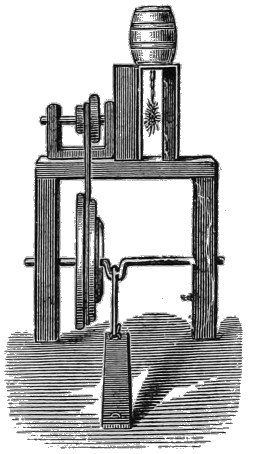
The finishing of silver work requires some little knowledge and skill to perform it properly; and we think that a few observations bearing upon it will be of service to those for whom this manual is written. After either of the processes of whitening or plating, the work has to be scratched, unless required to be left a dead white, then this process does not take place; the scratching removes from the surface the dull white colour produced by the above processes, and effects a characteristic bright and uniform colour to the work of the silversmith. Scratching is done at the lathe (Fig. 40) by the application of a very fine brass-wire brush of circular form running upon the spindle; a solution of weak ale runs from a barrel with a tap to it, placed upon the framework of the lathe so as to enable the beer running from it to fall upon the brush during the whole time of its rotary action, and this assists the brush the more easily to glide over the surface of the work submitted to it. A large quantity of silversmith’s work receives no other treatment than this, after the whitening processes have taken place. Silver chains are burnished by means of a polished steel jack chain, and the application of a little soft soap and hot water, or otherwise scratch-brushed. The beautiful frosted surfaces to be seen upon silver lockets, and other work of a similar nature, are all produced by means of the scratch-brush.
Burnishing is another mode of finishing silver work. It produces a polished surface, which reflects like a mirror, and gives the greatest lustre: it removes marks left by the polishing mixtures, and produces a darker surface than the other modes of finishing. The tools employed for this process are extremely variable, and well adapted to the different kinds of work to which they are applied; they are of two kinds, one being formed of hard stone, and the other of polished hardened steel; they vary with regard to shape, some being straight with rounded points, or with curved and blunted edges, others with large rounded surfaces, &c. Stone burnishers are made of blood-stone, which is mounted in a wooden handle with a brass ferrule, which firmly secures the stone to it, in which state it is used. Steel burnishers are likewise fixed in wooden handles, which enable them to be firmly grasped by the operator. Throughout the whole process of burnishing, the tool should be repeatedly moistened with a solution of soap and water; which causes it to glide more easily over the surface of the work, prevents it from becoming too much heated, and generally facilitates its action. In consequence of the great friction which the burnishing tool undergoes, it soon loses its bite, when it slips over the work as if it were greasy; its effectiveness must therefore be restored from time to time by rubbing it upon the leather which the workman has beside him for the purpose. It generally consists of a piece of buff leather, impregnated with a little crocus. In very small articles only steel burnishers are used, as they are finer in make, and by their greater variety of form, are exceedingly well adapted to all kinds of work; in this class of work, if any soap-suds should adhere to the article they may be removed by the application of a little tissue paper. Large pieces of work are rubbed with a piece of old linen, or washed in a warm solution of soap and water, rinsed, and dried in boxwood sawdust, which finally completes the process.
Silver work may be oxidized by any of the following processes:—
I.
Sal-ammoniac 2 parts.
Sulphate of Copper 2 "
Saltpetre 1 part.
Reduce the above ingredients to a fine powder, and dissolve it in a little acetic acid. If the article is to be entirely oxidized, it may be dipped for a short time into the boiling mixture; if only in parts, it may be applied with a camel-hair pencil, the article and the mixture both being warmed before using.
II.
Platinum 1 part.
Hydrochloric acid 2 parts.
Nitric acid 1 part.
Dissolve the platinum in the mixture of acid, evaporate to crystallization, and when cold, dissolve again in a little sulphuric ether. Apply the mixture with a camel-hair pencil to the parts required to be blackened.
III.
Saltpetre 2 parts.
Common Salt 1 part.
Spirits of Salts 1 "
Reduce the salts to powder, and place it in a black-lead crucible along with the acid, boil up, and then dip the articles into the mixture for a short time, or otherwise apply it to the parts required to be oxidized.
These mixtures will give the various tints of oxidation to silver work if properly treated; but if other tints be desired, the following chemical substances may be employed according to taste:—For slate-coloured surface, dip the articles into a boiling solution of sulphuret of potassium. Strong hydrosulphate of ammonia produces a dark tint of oxidation, and if diluted with much water a light tint is produced. Nitric acid produces a light surface. The fumes of sulphur produce a beautiful blue-coloured surface. This operation should be conducted in a closed box, and all parts not to be blackened should be coated with a suitable resist varnish. After any of these processes the articles may either be scratched, or otherwise burnished.
CHAPTER XI.
Imitation Silver Alloys.
The undermentioned white alloys have their various uses in the industrial and mechanical arts, some being employed as common silver, whilst others are manufactured as near as possible in imitation of it, and used as a substitute, for many purposes. In melting the alloys in which nickel and several other compounds enter into combination, unless very great care be exercised, it is a difficult matter to maintain the true and definite proportion of each metal of which the alloy proper is composed, owing to the loss of the more fusible metals by volatilization, if allowed to remain too long in the furnace. The best method of preparing the compound for the crucible, is to mix the copper and nickel together. The latter is produced from the pure oxide of nickel; therefore it is taken in this form and placed in the crucible with the copper at the commencement of the operation. When these ingredients are well melted, and incorporated by stirring, add the zinc or other fusible metal required to make up the compound, previously heating it thoroughly over the mouth of the crucible, to prevent the chilling of the already molten metal which it contains. When silver forms a component part in any of these alloys it should be added at the beginning of the process along with those of a high degree of fusibility, and reduced under the protection of a suitable flux; charcoal being the best for the purpose. This flux also tends to preserve the fusible metals, upon their addition to the melted compound in the pot, from too suddenly flying away in the shape of fumes. The best zinc of commerce should be employed in these alloys, which is sold under the name of spelter.
Common silver alloy alloy—
oz. dwts. grs.
Fine silver 1 0 0
Shot copper 0 17 0
Nickel 0 13 0
2 10 0
Another—
oz. dwts. grs.
Fine silver 1 0 0
Shot copper 1 0 0
Nickel 0 15 0
2 15 0
Common silver alloy—
oz. dwts. grs.
Fine silver 1 0 0
Shot copper 1 3 0
Nickel 0 17 0
3 0 0
Another—
oz. dwts. grs.
Fine silver 1 0 0
Shot copper 1 6 0
Nickel 0 19 0
3 5 0
Another—
oz. dwts. grs.
Fine silver 1 0 0
Shot copper 1 9 0
Nickel 1 1 0
3 10 0
Another—
oz. dwts. grs.
Fine silver 1 0 0
Shot copper 1 12 0
Nickel 1 3 0
3 15 0
Common silver alloy—
oz. dwts. grs.
Fine silver 1 0 0
Shot copper 1 15 0
Nickel 1 5 0
4 0 0
Another—
oz. dwts. grs.
Fine silver 1 0 0
Shot copper 2 2 12
Nickel 1 7 12
4 10 0
Another—
oz. dwts. grs.
Fine silver 1 0 0
Shot copper 3 10 0
Nickel 1 10 0
5 0 0
Another—
oz. dwts. grs.
Fine silver 1 0 0
Shot copper 0 16 0
Nickel 0 10 12
Spelter 0 3 12
2 10 0
Common silver alloy—
oz. dwts. grs.
Fine silver 1 0 0
Shot copper 0 19 0
Nickel 0 12 0
Spelter 0 4 0
2 15 0
Another—
oz. dwts. grs.
Fine silver 1 0 0
Shot copper 1 2 0
Nickel 0 15 0
Spelter 0 3 0
3 0 0
Chinese silver—
oz. dwts. grs.
Shot copper 1 0 0
Spelter 0 6 0
Nickel 0 4 0
Cobalt 0 3 18
Silver 0 0 18
1 14 12
Imitation silver—
oz. dwts. grs.
Shot copper 1 0 0
Nickel 0 6 12
Spelter 0 4 18
1 11 6
Imitation silver—
oz. dwts. grs.
Shot copper 1 0 0
Spelter 0 12 0
Nickel 0 8 0
2 0 0
Another—
oz. dwts. grs.
Shot copper 1 0 0
Spelter 0 8 0
Nickel 0 4 0
1 12 0
Another—
oz. dwts. grs.
Shot copper 1 0 0
Spelter 0 10 0
Nickel 0 10 0
2 0 0
Another—
oz. dwts. grs.
Shot copper 1 0 0
Nickel 0 8 8
Spelter 0 6 16
1 15 0
White alloy—
oz. dwts. grs.
Shot copper 1 0 0
Tin 0 10 6
Brass 0 2 12
Arsenic 0 0 18
1 13 12
Clark’s patent alloy—
oz. dwts. grs.
Shot copper 1 0 0
Nickel 0 3 18
Spelter 0 1 22
Tin 0 0 12
Cobalt 0 0 12
1 6 16
White alloy—
oz. dwts. grs.
Shot copper 1 0 0
Tin 0 10 0
Arsenic 0 1 0
1 11 0
Alloy with platinum—
oz. dwts. grs.
Fine silver 1 0 0
Platinum 0 5 0
1 5 0
Alloy with palladium—
oz. dwts. grs.
Fine silver 1 0 0
Palladium 0 5 0
1 5 0
The platinum and palladium of which the last two alloys are composed, although very difficult to use in combination with any other metal, readily unite in any proportions with silver; and it has been found that such alloys are not so easily tarnished as the ordinary ones, or even as fine silver itself. These various alloys serve to effect the several purposes for which they are employed in manufactures; wires prepared from any of them will supply the place of silver, as brooch tongs, stems for pins, catches and joints, &c. for articles of common quality and cheap workmanship. They are also employed for preparing the ground for “electro-plate,” for which they are very serviceable. When, however, these alloys are employed by the regular silversmith, care should be taken not to get the scraps of metal in any way mixed with those of the better material, otherwise difficulties will soon begin to present themselves, which will materially interfere with the regular and proper working of the best silver alloys; and in fact, with all qualities that have originally been prepared free from nickel. Those prepared from nickel are much more infusible than those made without it; consequently, if a piece of the nickel alloy, either by accident or design, gets intermixed with the other quality, in a subsequent melting, it will be found to float upon the surface of the molten metal for some considerable time, and thus retard the process. Alloys prepared in imitation of silver are harder and much more difficult to work than those of the true metal; therefore it can easily be imagined what alteration the latter undergo upon the addition of some of the former compounds. The hardness and toughness which these alloys possess admirably adapt them for such purposes as we have described.
CHAPTER XII.
Economical Processes.
In all silversmiths' establishments, the economical or waste-saving processes, as they are termed, require special and careful attention, so that the actual working loss, or that portion of it which is entirely irrecoverable by the manufacturer, may be reduced to the lowest possible degree. It may not be known to the general reader, or to the beginner in the precious metal trades, that there always takes place in the working up of the metal a loss of material, a portion of which the manufacturer is unable to recover, however cautious may be the means employed for that purpose. In the best regulated workshops, this loss will amount at the lowest estimate to about 2½ per cent. of the whole quantity worked up in the establishment. If the actual loss can be reduced to within the above limit it is considered very low, and highly satisfactory. Taking into consideration the loss that is occasioned in precious metal working, and from calculations that we have made from experience, we have long since arrived at the conclusion, that it cannot possibly be estimated under 10 per cent. of the total work daily performed; and this opinion is based upon experiments, the raw material being weighed before the process of melting and after the articles were completed, a fair calculation of course being made for unfinished work. This was including every description of manufacture; in some branches of the trade the working loss is not quite so great, but then there are others in which it is exceedingly heavy, so that the estimated loss in the jewellery trades cannot be safely put at a lower percentage than we have quoted.
It will thus be seen that the real loss, such as manufacturers are unable to recover by the means already known to them, amounts to one-fourth part of the total working loss of the establishment. This is easily accounted for: in the first place, a little takes place in the melting of the various alloys, the re-melting of scrap metal, the reduction of lemel, &c.; then there are the sundry manipulations of working; the passage of the metal through various acids, and the processes of finishing, each of which detaches small particles of metal, too small to be visible to the naked eye, but all of which go to form a portion of the loss which the manufacturer never recovers. The unrecovered metal may be judiciously proportioned as follows:—A portion of it works itself into the wood-work of the flooring of the shops, lathes, boards, and other parts of workshop appliances; then there is the refiner’s profit—as purchases of the sweep, polishings, and other refuse of precious metal workers. Instances can be recorded in which shrewd business-men have actually taken up the floors of their workshops and recovered a vast quantity of metal which was supposed to be lost for ever; and instances are well remembered in which two jewellers, upon removing into more extensive premises, availed themselves of the opportunity, not only of removing the boards which formed the flooring of the premises they were about to leave, but also those of the tenants they were about to succeed. In one case, metal of the value of £80 was recovered, and in the other it reached the large amount of £150. The two jewellers referred to, of course, were too un-English to refund the proceeds to the late tenants, who, when they became aware of it, if ever they did, would be, no doubt, wiser if sadder men.
To prevent the precious metal from finding its way into such places as these, it is advisable to have the floors well protected with sheet zinc or iron, in which case not the least particle could be lost in this manner. The extra cost of laying the floors would soon be amply repaid, by an extra quantity of the working loss being recovered; and if other equally effective precautions were adopted in the waste-saving processes by precious metal workers, the real loss, which they cannot avoid suffering, might even yet be reduced to the lowest possible point. Iron or zinc covered floors may be protected from wear, by laying over the surface small square grates of perforated iron, and these, being removable, may be readily taken up at stated periods, for sweeping the refuse from the floors; once a month will be found often enough to do this. The gratings should, however, be swept over lightly every day in order to remove the dust and particles of metal that may accumulate upon the surface into the perforations, and also for the removal of waste paper and other rubbish, continually accumulating in workshops.
Floors containing no such waste-saving precautions, are commonly swept over once, and sometimes twice each day, the refuse arising therefrom being carefully passed through a very fine sieve, all extraneous matter removed, and the residue remaining in the sieve being well sorted for the detection of all the precious metal visible to the naked eye. The whole refuse matter is then thoroughly burned in a muffle provided specially for the purpose, and finally reduced to a fine powder in a cast-iron mortar. When it has reached this stage of the process, it is quite ready for the particular kind of treatment it next receives at the hands of the refiner. Grinding by large stone rollers is now fast superseding this mode of pulverising jewellers' waste and refuse. When the latter plan is adopted, the refuse should be swept from the floors every morning, carefully looked through, and then transferred to a barrel (having the top removed, which may be used as a lid), where it can be well kept together, and hidden from view until the time arrives for its further treatment.
The waste which accumulates in the processes of polishing, lapping, &c., is greater than that already referred to, consequently, it cannot be too carefully looked after, in every stage, where a large manufacturing trade is being carried on in various branches. It is advisable in the practice of true economy, for the polishing, lapping, and scratching boxes to be repeatedly cleaned out, and the contents removed out of the temptation of every one, by being placed in a box, well lined with either sheet lead or zinc, which ensures the perfect safety of the material placed therein from all irregularities in the workshop. This kind of waste on being prepared for sale is again placed in a very strong wrought-iron box, made of a suitable size to fit the muffle, and having a thick close lid to it. After the work of the day has been completed, the fire in the furnace or muffle is made up, the dampers are closed, and then the iron box containing the refuse is at once passed in and allowed to remain there till morning, when every particle of matter will have become thoroughly burned; a slight pulverization after this process readily reduces it to a fine powder; further operations then cease, and the product is in all probability in a fine state of division, and fit for the subsequent operations of the refiner and assayer, whose special business it is to attend to these arrangements of precious metal workers.
The next process we have to consider is one which includes the whole of the liquid substances variously employed in silver-working establishments, such as the pickling solutions, washing-out waters, whitening mixtures, and waste or spent solutions of every kind. The whitening solutions or mixtures, when in use, should be kept apart from the ordinary cleansing liquids, as after they have been in use for a time, they become saturated with copper taken off the work during the whitening processes; if the solution is then set aside for some time the copper eventually crystallizes out from the liquor, which may be poured into the waste-water tub, and the remaining crystals of sulphate of copper, for such it then is, may be removed and preserved.
In small establishments one large tub, to form the receptacle for all spent or used-up liquids, will be found sufficient; but in large places several will be required. In the former case the water is only drawn off at the beginning of every fresh week, which allows plenty of time for the precipitation of the silver without any disturbance taking place in the mixture between the close of one week and the commencement of another; whereas in large concerns it requires to be drawn off continually unless other vessels are provided for its reception during a long period. Attempts have been made to recover the silver from these solutions by simply filtering the liquid through a coarse piece of felt or flannel; or by providing a false bottom in the tub or other vessel containing the waste waters, arranged in the following manner:—A tolerably large tub would be employed, being about one-fourth filled with coarse deal sawdust, next would be placed the false bottom perforated with numerous small holes, and upon this would be firmly secured a piece of felt, so as to exactly fill up the space in that part of the tub, which then serves to act as the filterer of all solutions poured in above. The liquid after passing through the piece of felt proceeds through the perforations in the false bottom into the sawdust beneath, where it is allowed to run away by means of a small hole or tap at the bottom. But the use of either of these processes, if adopted on a large scale, where the waste products amounted to some hundreds per annum, would be wretchedly bad economy and tend to a serious loss of valuable metal; the boiling sulphuric acid, used in cleansing the work and for other purposes, has the power of dissolving minute particles of silver as well as those of the baser metal which always enters into the composition used in the production of the work of the silversmith; therefore, that portion of the metal which has become dissolved and entered into the chemical state, requires to be brought back to its original form before it can be saved by such means as those just described. To illustrate this more clearly, we will take the process of gold-colouring. If workmen were to notice the rinsing waters employed in this process, subsequently allowing the vessels containing the rinsing to stand for a very short time, upon pouring away the surplus water, a white curdy precipitate will at once be observed at the bottom. This is the silver removed from the surface of the gold alloy, which has been precipitated by the muriatic acid and the common salt employed in the colouring mixture, into the form of chloride of silver. Now in this proceeding there is no gold to be seen in any of the vessels, but it is a well-known fact that a portion has been removed during the process from the surface of the gold articles. Where is it? Why, it has become dissolved, and is therefore held invisible in the solution, in consequence of the colouring mixture forming the well-known solvent for gold, aqua-regia. This is exactly the case with a portion of silver in the silversmith’s solutions; small particles are continually being dissolved by the mixtures employed, and are thus held in solution past the power of filtering, unless some chemical ingredient be added to it, which acts as a re-agent upon the metal sought to be recovered. From what we have seen in the colour water, which always contains a little silver, it is evident that both muriatic acid and common salt will do this work for us. We prefer common salt, on account of its cheapness, besides being easily procurable.
The best mode of treatment for the silversmith’s waste waters, after being collected together by pouring into the receptacle specially provided for that purpose, is to prepare a saline solution for the precipitation of the silver. This may be made by mixing together common salt and tepid water, in the following proportions:—
Common salt 3 oz. Tepid water 1 pt.
The water need only be sufficiently warm to dissolve the salt, and the proportions given do not require to be strictly adhered to; in fact any quantity, if properly mixed, will do to effect the purpose required, and we merely give these as a guide for the process. In small establishments where only one tub is employed, the above proportion of saline solution may be added (every Saturday after the completion of the day’s work) to the waste-water; the whole should then be stirred slowly in a circular direction, and allowed to settle until Monday morning, when all the surplus water may be drawn off and poured away. In larger establishments the accumulation of waste-water is greater, therefore several collecting vessels should be employed, and the mixture for precipitation may be added to them at other times than those stated, if required, and in accordance with workshop regulations. The sediment produced in the collecting vessels after the supernatant water has all been drawn off, may be removed, dried by heat in a strong iron pan, and subsequently sold to the refiner.
CHAPTER XIII.
Licences and Duties.
Manufacturing silversmiths, and all persons trading in silver wares of more than five pennyweights each, are compelled to take out a licence; articles under that weight being exempt. The licence has to be taken out annually, and costs £2 6s. for manufacturing or trading in articles under thirty ounces in weight, and £5 15s. for articles of thirty ounces and upwards. It should be taken out on the 6th day of July in each year at the Excise Office. This Act of the Legislature was passed in the year 1803, 43 George III. c. 69, and is not the only one which refers to the subject we are now considering. There are other conditions besides the compulsory Plate Licence, as it is called, to which manufacturing silversmiths are subject, such as the supervision of the assay offices, in the case of certain descriptions of goods; and the payment of duty on all such goods. At the present time all hall-marked silver articles have to pay a duty of 1s. 6d. per ounce, calculated not on their gross weight, but on five-sixths of the weight, the other sixth being allowed for waste in finishing the articles, as they are sent to the Hall in a half-finished state. The duty is paid at the Assay Office at the time the goods are sent to be marked. Some dissatisfaction just now exists in a portion of the trade with regard to the above duty, as it is considered excessive, besides having a tendency to discourage the manufacture of silver wares; be this as it may with respect to a certain description of goods, on the bulk of the trade it can have no injurious effect whatever. The duty is paid only on manufactured plate and such other articles as are requested to be hall-marked; besides which the trade in this particular department of manufacture has never been very extensive, being confined to a few firms of eminence only.
Before going into the general details of this question, it will be as well, perhaps, if we give a short history of the imposts that have existed in the silver trade for some time back. The first impost that we can find recorded took the shape of a duty, and was levied as far back as the year 1720, by 6 George I. c. 11, which placed a tax of 6d. per ounce on all silver plate manufactured in Great Britain, which, should be assayed or marked. The officers of the Excise were to collect the tax, but the great difficulty of ascertaining the number of ounces worked up, which the provisions of the Act did not clearly set forth, soon rendered it ineffectual, and it was consequently repealed by the statute 31 George II. c. 32, and a licence then substituted had to be taken out by manufacturers and dealers in plate. The licence at this period amounted to forty shillings, and had to be renewed annually. In 1759, 32 George II. c. 14, it was increased to £5 per annum, for every person trading in silver wares of thirty ounces and upwards; wares in one piece not exceeding five pennyweights in weight being exempted.
The next change that took place was in the year 1784, 24 George III. c. 53, when a duty was again imposed of 6d. per ounce on silver plate. It was also enacted that the assay masters should stamp the work with the additional mark of the “King’s head,” as well as the others already ordered by the various Acts of the Legislature. The mark of the King’s head represented that of the reigning sovereign, and showed that the duty had been paid on the work. The present mark, therefore, is the Queen’s head.
By an Act passed in the year 1797, 37 George III. c. 90, the duty on silver ware was increased to one shilling per ounce, but the Act which subjected silver wares to a duty of 6d. per ounce (24 George III. c. 53) has not been repealed, and is therefore in existence to this very day; by its provisions, however, the duty has been increased from time to time, until it has reached the amount at which it now stands.
The present annual licences of £2 6s. and £5 15s. respectively, were enacted in the year 1803 by an Act of 43 George III. c. 69, and by these regulations every person making or trading in silver wares, or otherwise dealing in the raw material, is compelled to take out an annual licence, or render himself liable to a penalty of £50.
Another Act was passed in reference to the duty on silver goods in the year following, 1804, 44 George III. c. 98, whereby it was increased to 1s. 3d. per ounce. And in the year 1815, 55 George III. c. 185, the Act was further extended to 1s. 6d. per oz. calculated in the manner we have described at the beginning of this chapter. To sum up, therefore, the silver duties in their several forms, bearing upon the trade at the present time, we find them as follows:—
Manufacturers of silver wares under 5 dwts. in weights.—Exempted from all duties.
Vendors and dealers in silver wares under 5 dwts. in weight.—Exempted from all duties.
Manufacturers of silver wares under 30 oz. in weight.—A plate licence of £2 6s. annually.
Vendors and dealers in silver wares under 30 oz. in weight.—A plate licence of £2 6s. annually.
Manufacturers of silver wares of more than 30 oz. in weight.—A plate licence of £5 15s. annually.
Vendors and dealers in silver wares of more than 30 oz. in weight.—A plate licence of £5 15s. annually.
Bullion dealers, refiners, and assayers.—A plate licence of £5 15s. annually.
Manufacturers of plate.—A duty of 1s. 6d. per ounce.
Hall-marked goods.—A duty of 1s. 6d. per ounce.
Manufactured plate includes silver wares, such as spoons, forks, snuff-boxes, tea-sets, &c., and other articles used by the rich, and upon which the duty is compulsory; the duty on hall-marked goods, refers to all articles—with the exception of watch-cases, which are free—marked at the request of intended purchasers, which then pay duty on the manufacture of them. It will be observed from these remarks, that the silver trade generally is not at all affected by the duty tax; the wares manufactured by the trade at large not coming directly under the compulsory provisions of the law bearing upon this subject. It has been said that the silver trade ministers to luxury, and no doubt that portion of it which manufactures costly articles of plate for the wealthy does so; but we fail to see exactly, that the same remark applies to that vast and increasing commercial industry which has sprung up of late years, and which bids fair to become one of the staple trades of the country. The duty-bearing articles are generally purchased by the classes of society who can well afford to pay the little extra which the duty imposes, and as the tax affects only that section of the silver trade which manufactures the article of luxury, it is not at all likely that the general trade would be increased by its entire removal. The duty, no doubt to most persons, may seem excessive, when calculated upon the percentage system; such for instance, as a tax of 20 per cent. upon spoons and forks; or one of 15 per cent. upon chains; or of 12½ per cent. upon tea-sets, &c.; this appears unjustly oppressive, and undoubtedly affects the silver-plate manufacturer more vitally than any one else.
To the ordinary silversmith this question of duty is not likely to be of much importance; the agitation therefore commenced against it, may be expected to confine itself to those persons more directly affected, and whose interests would be advanced by its abolition.
The question of licences is one of far greater importance to the trade generally than that of duties, every manufacturer and dealer being compelled to procure a licence before he can carry on his business. If more direct action were taken in regard to this particular question, we believe that the whole trade would enter into it; for it resolves itself into this:—Why should the silversmith or goldsmith pay for a licence for the purpose of manufacturing and dealing, any more than the coppersmith, or the manufacturer of electro-plate, both of whom escape scot-free? We believe this to be an unjust tax, and that it ought not to be levied upon one particular trade any more than another. We have also distinctions made in the general class of silversmiths: we have those who may trade without any licence at all; those who may trade with a 46s. licence; and those who may trade with 115s. licence, that is, those who work or sell under 5 dwts., those who work or sell under 30 oz., and those who work or sell at any weight. Now this way of arranging the matter is very unsatisfactory to the trade generally; and any one of the first two traders to whom we have referred, is liable at any moment to be summoned before a criminal court for an infringement of the law, if he should happen to sell an article slightly over the weight for which he is duly licensed. At the present time a raid is being made upon the goldsmiths with reference to this particular question, and a number have already been summoned for infringing their licences in this manner. However, there appears to be some doubt with respect to the Act of Parliament bearing upon the subject, as in most of the cases the defendants have gained a verdict, the line of defence on their behalf being, that the clause of the act which bore upon the cases referred to, meant the weight in fine metal, i.e. “pure gold,” of which the article was composed, and not that of the gross weight of the article sold. It was urged by those engaged in the various cases on the side of the defendants, that, for a 46s. licence, the vendor could sell an article in which the gold did not exceed two ounces, without any regard to the quality and weight made by alloy, and on this plea the magistrates granted them a verdict. In the higher courts we believe such verdicts would be reversed, for we firmly believe that the framers of the act meant no such thing, however defective may have been the legality of the points raised. The clause of the act to which we have alluded is No. 5, and runs as follows:—"All articles sold, or offered for sale, or taken in pawn, or delivered out of pawn, and alleged to be composed wholly, or in part, of gold or silver, are for the purposes of the above act to be deemed to be composed of gold or silver respectively; and if upon the hearing of any information for any offence against this act, any question shall arise touching the quantity of gold or silver contained in any article, the proof of such quantity shall be upon the defendant." The Excise authorities argue that this clause means that the absolute or gross weight of an article sold as gold must not exceed two ounces, and one sold as silver must not exceed thirty ounces, gross weight. If this view of the meaning of the act be eventually taken, and we believe it will, it will certainly operate to a greater extent against makers and vendors of gold articles than it will against silversmiths.
That part of the clause referring to the quantity of gold or silver contained in a given article, we believe has reference to articles containing jewels, &c., in their construction, which renders it exceedingly difficult to get at their exact weight, when the work is finally completed with these jewels properly affixed upon it, and not to the amount of fine material any article may contain by assay. The last part of the clause we have marked in italics, “proof of such quantity shall be upon the defendant,” fully bears out these observations, because he is supposed to know the gross weight of any special article before the addition to it of any jewels.
We have been led to make these few remarks, in order to point out the gross anomalies which exist in the trade with respect to these licences, and to show the necessity of a reform taking place in a trade singled out from all the others, and made to pay a tax for the privilege of being allowed to make, or sell, articles in which gold or silver forms a component part. Therefore, if any action is to be taken in the matter, it must not be confined (if it is to be successful) to one particular branch of this important trade, but all must unite, and every influence should be brought to bear upon it in as forcible a manner as possible. The electro-plate manufacturer, and the dealer in his wares, ought in all common fairness to the trade, to be put upon the same footing as the silversmith, if this licence is to be still continued. In electro-plating establishments, thousands of ounces of silver are being annually used on the surface of such wares as are manufactured there; and if such decisions as those lately given at the Thames and other police courts, with reference to the Act of Parliament on the subject of gold and silver wares are upheld, we fail to see how the manufacturers of silver-plated articles, who are continually making and selling them, containing as they do, more silver than the general public would suppose, are to escape much longer these new interpretations of the Act of Parliament, and avoid being called upon to take out a licence in the same manner as the silversmiths. This is a tax in which the holder gets no direct return, and is levied in an unfair manner by the establishment of various grades of silversmiths, so that it gives a just cause for grievance. If the tax is to be upheld at all, why not make it equal by the establishment of one uniform rate for all trades alike?
CHAPTER XIV.
Useful Information for the Trade.
Silversmith’s Alloy.
Copper, 1 oz.; nickel, 3 dwts. 12 grs; bismuth, 6 grs.; zinc, 2 dwts. 12 grs.; soft iron, 12 grs.; tin, 12 grs. This compound is said to form a fusible and malleable metal, that can be easily worked by the silversmith; it is also said to resist oxidation through atmospheric influences.
Silver Wares.
Never scratch-brush silver ware with a solution of soap and water; neither should it be washed with the solution if it can be avoided, as it gives it the colour of pewter; better to scratch in weak ale, or if plain, rub it with a piece of wash-leather and prepared chalk.
Cleaning Plate.
Carbonate of ammonia, 1 oz.; water, 4 oz.; Paris white, 16 oz.; well mix the ingredients together, and apply to the surface of the plate by means of a piece of soft leather or sponge.
Imitation Silver.
Fine silver, 6 dwts.; nickel, 6 dwts.; copper, 8 dwts. This alloy will cost about 1s. 9d. per ounce.
Another Recipe.
Fine silver, 5 dwts.; nickel, 6 dwts.; copper, 9 dwts. Cost about 1s. 6d. per ounce.
Removing Gold from Silver Articles.
Silver articles which have been gilt, may be brought back to their original colour, by simply covering them with a thick solution of borax, and then well annealing them. After this process if the articles are boiled for a short time in one of the whitening mixtures and scratched, they will present a beautiful white and uniform surface.
Oxidizing Silver.
A beautiful deep black colour, possessing great lustre, may be given to finished silver work by boiling it in the following preparation for some time:—Bromine, 5 grs.; bromide of potassium, 5 dwts.; water, 10 oz. The boiling should be effected in a stoneware pipkin, and generally from two to five minutes will suffice for the purpose. The work is finished after the proper colour has been attained, by well rubbing with a soft piece of wash-leather and a little best jeweller’s rouge. It is better to make the work as bright as possible before submitting it to this mixture; for this reason it is preferable to thoroughly buff all plain surfaces on a piece of felt by the application of the lathe, as by that means a characteristic brightness is imparted.
Dipping Mixture.
Brass or metal goods may be cleaned and their oxides removed by dipping into the undermentioned liquid for a few seconds only:—Oil of vitriol, five parts; water, five parts; nitric acid, two and a half parts; spirits of salts, two drachms. Well mix the several ingredients together, and immerse the work in the solution cold. The mixture improves after a quantity of work has been dipped into it.
Silver Powder for Copper.
Chloride of silver, two parts; cream-of-tartar, two parts; alum, one part. Mix with water to the consistence of a paste, and apply with a soft leather or sponge; when sufficiently whitened, well polish.
Powder for Silver.
Chloride of silver, 1 oz.; sal ammoniac, 2 oz.; sandiver, 2 oz.; white vitriol, 2 oz.; bichloride of mercury, 5 dwts. Make into a paste with water and rub the articles over with it; then expose them to a good heat upon a clear fire, in order to run the silver and evaporate the mercury, after which process dip in very weak sulphuric acid to clean.
To Protect the Polish of Metals.
Melt one part by weight of best wax paraffin and when sufficiently cooled, add three parts of petroleum. Well mix together, and apply to the polished articles by means of a soft brush. The protecting film is required to be only very thin, therefore too much should not be put on.
Silver Stripping Mixture.
Sulphuric acid, six parts; nitric acid, one part. Take a large black-lead crucible or pipkin, and heat the mixture in it; when this is done, put in the work required to be stripped, occasionally withdrawing it to ascertain the progress made. The large proportion of sulphuric acid allows of the dissolution of the silver, and does not sensibly corrode or interfere with copper, or any of its alloys, if kept quite free from water; therefore be careful not to introduce wet articles into the mixture. After finally withdrawing the work, it should be well rinsed, annealed, and then boiled out.
Stripping Silver.
Put some strong oil of vitriol in a similar vessel to those above described, apply heat, and during the process add a few crystals of saltpetre. When the solution has become hot enough the work should be immersed in it, and be moved about or agitated until the silver is dissolved from the surface. The articles should not be allowed to remain too long in the solution, and if it does not remove the silver quickly, more saltpetre should be added from time to time until the desired end be attained.
Soft Solder.
Pure tin, two parts; lead, one part. Melt and well incorporate together; when this is done pour into strips for use.
Soldering Fluid.
Muriatic acid (spirits of salts), three parts; metallic zinc, one part; or as much as the acid will take up. When dissolved and all effervescence ceases, allow it to settle, then decant the clear solution from the sediment at the bottom of the vessel in which it has been made, and it is ready for use. If a small quantity of water be added to the mixture at this stage, say one-sixth, it will answer quite as well for some purposes. For soldering iron and steel, a very small portion of sal ammoniac is of great advantage to the mixture for promoting toughness.
Dissolving fine silver.—Nitric acid, two parts; water, one part.
Dissolving silver alloys.—Nitric acid, one part; water, two parts.
Dissolving copper.—Nitric acid, one part; water, four parts.
Dissolving soft solder.—Perchloride of iron, one part; water, four parts.
Dissolving silver solder.—Nitric acid one part; water four parts.
Dissolving sealing-wax.—Place for a time in a solution of spirits of wine.
Resist Varnish.
Dissolve resin, or copal, in essence of turpentine, or boiled linseed oil; to give it different shades of colour, add red lead, chrome yellow, or Prussian blue.
Plate Powder.
Whitening, two parts, white oxide of tin, one part, calcined hartshorn, one part. Reduce to a powder and well mix together; apply as usual.
Electro-plating Soft Solder.
Take nitric acid, 1 oz.; water, 2 oz.; copper about 1 oz. in small flat pieces; when the copper has all dissolved and effervescence has ceased, the solution is ready for use. To apply it, take up a few drops by means of a camel-hair pencil and apply it to the desired part, then touch it with a bright piece of steel, and there will be instantaneously a film of copper deposited. If the copper has not spread all over the desired part, the process should be repeated, when deposition in the plating bath will take place with perfect success.
Another Recipe.
Take sulphate of copper (that which accumulates in the whitening mixture), one ounce; water, six ounces. Reduce the sulphate of copper to a fine powder and dissolve it in the water. Treat according to the directions given in the previous one. A good mixture for effecting the same result may be made by dissolving verdigris in vinegar.
Testing Silver Wares.
Take nitric acid, six ounces; water, two ounces; bichromate of potash, one ounce. Reduce the salt of potash to a powder and well mix it with the acid and water. The solution is used cold, and should be placed in a stoppered glass bottle, the stopper having a long dropper extending into the mixture, which acts as the agent for conveying the liquid from the bottle to the article to be tested. The surface of the article should be perfectly clean, and to make certain what kind of metallic substance you are testing, it is advisable to rub a file over some obscure part of the surface and to apply the liquid to that part. The test liquid should be used, by means of the glass stopper, to the filed part, and immediately removed by a sponge damped with cold water. If the article consists of pure silver, there will appear a clean blood-red mark, which is less deep and lively in proportion to the quality of the metal. Upon platinum the test liquid has no action whatever; on German silver at first a brown mark appears, but this is removed by the sponge and cold water; on Britannia metal a black mark is produced; and on all the various metals an entirely different result takes place to that on silver; therefore the test is a simple one, and may be advantageously employed for the detection of any fraud in relation to the precious metal.
Another Test.
Water, 2 oz.; sulphuric acid, 2 drs.; chromate of potash, 4 dwts. This mixture is applied in the same way as before and produces a purple colour of various depths, according to the quality of the silver. No other metallic element exhibits the same colour with this preparation.
Perchloride of Iron.
Take spirits of salts, 8 oz.; crocus powder (jeweller’s polishing material), 1 oz.; well mix them together and keep in solution. In preparing the mixture for the dissolution of soft solder, &c., take 1 oz. of it, and add to it 4 ozs. of boiling water.
Aluminium Alloy.
Copper, 18 dwts; aluminium, 2 dwts.
New Alloy.
Zinc, 19 dwts; soft iron, 1 dwt. This alloy is said by the inventor to be remarkable for its whiteness and tenacity.
Removing Gold from Silver Wares.
Sometimes the process of annealing and boiling-out fails to effect the removal of the gold from articles which have been thickly gilt, in which case the work should be submitted to the action of the following chemical preparation:—Sulphuric acid, 6 ozs.; muriatic acid, 1 oz.; nitric acid, ½ oz. This mixture should be heated in a black-lead crucible or earthen vessel, and the work immersed until the dissolution of the gold takes place, carefully watching it during the progress of the operation. The gold may also be removed by using a strong solution of oil of vitriol, to which has been added a fair proportion of common salt.
Silver Plating Fluid.
Nitrate of silver, 1 oz.; cyanide of potassium, 2 ozs.; water, 12 ozs. Put the cyanide and the nitrate of silver into the water; shake them well together until they become thoroughly dissolved, then let the mixture stand till it becomes thoroughly clear. It is then ready for use. If preferred, a little prepared chalk may be used as an additional ingredient.
Plate-cleaning Powder.
Take of the finest rouge, and prepared chalk, equal parts, well mix and use dry by means of soft leather.
Solder for Aluminium.
Spelter, 18 dwts.; aluminium, 1 dwt. 6 grs.; copper, 18 grs. To be employed for soldering the pure white metal, and not the so-called aluminum bronze, that being commonly soldered with bath-metal solder.
CHAPTER XV.
Foreign Silver Standards—Pre-War.
Table showing the various standards of the silver work manufactured in the principal countries previous to the European War, 1914-1918:—
Countries. Silver per oz. Thousandth parts. Remarks.
oz. dwts. grs.
France 0 18 23 948-1000 Old Standard.
” 0 19 0 950-1000 1st ”
” 0 18 0 900-1000 Coinage.
” 0 16 0 800-1000 2nd Standard.
Germany 0 19 0 950-1000 1st ”
” 0 18 0 900-1000 2nd ”
” 0 16 0 800-1000 3rd ”
” 0 15 0 750-1000 4th ”
Austria 0 19 0 950-1000 1st ”
” 0 18 0 900-1000 2nd ”
” 0 16 0 800-1000 3rd ”
” 0 15 0 750-1000 4th ”
Geneva 0 19 0 950-1000 1st ”
” 0 17 12 875-1000 2nd ”
” 0 16 0 800-1000 3rd ”
Holland 0 17 12 875-1000 Old Standard.
” 0 18 16 933-1000 1st ”
” 0 16 16 833-1000 2nd ”
Belgium 0 19 0 950-1000 1st ”
” 0 18 0 900-1000 2nd ”
” 0 16 0 800-1000 3rd ”
Spain 0 14 18 738-1000 Lowest ”
Portugal 0 16 21 844-1000 One only.
Neuchatel 0 16 0 800-1000 One only.
Russia 0 16 19 840-1000 1st Standard.
” 0 15 0 750-1000 2nd ”
Italy 0 19 0 950-1000 1st ”
” 0 18 0 900-1000 2nd ”
” 0 16 0 800-1000 3rd ”
China 0 19 14½ 980-1000 About.
Norway 0 16 19 840-1000 One only.
Sweden 0 16 19 840-1000 ”
Denmark 0 16 19 840-1000 ”
In France, all articles manufactured as silver are subject to Government control and pay duty, but this is very slight compared with the English duty, amounting only to one franc per hectogramme, which is equal to about threepence per ounce. This is exclusive of the charge for testing and marking; the state of the articles sent for this purpose with regard to the state of manufacture is, moreover, very different from the custom in this country. Here they are sent in their rough or half-manufactured state, and this seems better suited to the particular processes through which they have to pass; whereas in France they may be tested and marked in their whole or finished state; and, if thought requisite, this operation may be performed while the goods are on their way to their final destination, by calling at the Control Office for that purpose.
The Continental silversmiths, especially the French workmen, exhibit much ingenuity, original thought, and refined taste, in the execution of their work; and the natural capacity for design which they possess enables them to produce articles of a very high order and artistic character. The construction of some of their productions is exceedingly ornamental and decorative, and in some instances this is even carried to excess, as may be seen from some very elaborate articles which they manufacture.
To them belongs the credit of being producers of the most artistic and best decorative work in the whole world. They set the fashions and work them out with a will to be only found in a people so enthusiastic as the French. Their jewellery is very elegant, light, and showy; some of which is prepared so thin as regards material, that it has to be supported underneath by a wax composition, which, however, gives increased strength to all articles so manipulated. With regard to articles of vertu, the French workmen certainly far excel those of any other country: they are more original, and bring into play greater ingenuity in the various processes which they employ in their manufactures. Still with all this ingenuity and skill, their works of art in this department are not durable, being very tinselfied; in wear their shape and form soon undergo a change, and eventually they soon get destroyed. In this branch of art the French workman might learn something to his advantage from the English style of work, which is the most durable of any nation in the world. French silver plate and jewellery of the best manufacture partake of the first standard; all other kinds are of the lowest standard.
In Germany all silver manufactures are placed under Imperative control, and lower standards than those given in the table, under their respective heads, cannot be worked. The German style is similar to that of the French, but the former manufacture an unusually large quantity of filigree articles, very light in construction, tasteful, and cheap; and the possession of these advantages enables them to export to England and other countries their wares at a cheap rate. They are commonly sold by weight, and not so much per article; in many cases the charge does not exceed 12s. 6d. per ounce. In filigree work the Germans cannot equal the taste and variety displayed in Indian workmanship. In India the natives have definite designs, but the Germans are too fond of a variety of colours in their wares, which do not always harmonize with their particular kind of work.
In Austria silver manufactures are commonly ornamented by enamel, niello, &c., which gives them a very pleasing appearance. They are usually light and showy, and something after the style of French work. The laws affecting the Austrian silver workers are the same as those of Germany.
The English style of work is strong and solid; and is undoubtedly superior to that of all Continental manufacturers as regards substantial workmanship, careful manipulation, and durability. It is, moreover, capable of a higher finish, and possesses more evenness of surface, together with a combination of strength, that admirably suits it for articles and utensils for daily use, and which causes it to be preferred before that of any other nation; and while France, Germany, and other countries may exhibit greater ingenuity, to England belongs the credit of producing the best finished and the most durable work of any nation in the world.
INDEX.
Acids, vegetable, 10 Action of acids on copper, 44 of silver under heat, 8 Acts of the Legislature, 189 on licences, 186 clause on, 193, 194 Advantages of scorification, 20 Air in furnace, 33 Alkalies, caustic, 10 Allowed, remedy in fineness, 72 Alloy, 41 Clark’s patent, 172 commonly used, 63 for cupel quantity, 35 for hall-marking, 62 for plate, 71 for silver-wares, 72 French, for coinage, 69 French, for plate, 69 French, for silver-ware, 69 German, for coinage, 71 instructions in preparing, 70 new, 205 Nos. 1 to 8, 64-67 of the highest quality, 62 silver dissolving, 202 standard, 61 white, 172 Alloy, with copper, 68 with palladium, 173 with platinum, 172 Alloys of common silver, 167-170 characteristics of, 173, 174 imitation, 166-173 imitation, uses of, 173 of nickel, 46 of silver, 42 of tin with gold, 49 of tin with silver, 49 silversmith’s, 40, 197 Aluminium alloy, 205 solder, 206 Amalgam, 41 Amalgamation of zinc, 153 America, 11 American supply of silver, 12 Ancient method of assaying, 37 workers in tin, 48 Ancients, 6 Annealing silver, 109 Anthracite, 21 Art in soldering, 90 in the silver trade, 122 Articles, hand-made, 54 of silver common, 147 Art of soldering, 74 Arts, metals employed in, 41 Assay crucible, 16 charge for, 17 English system, 39 fluxes, 16 of silver ores, 16 scorification, 19 weighing of, 30 Assayer’s muffle, 28 Assaying, borax, use of, in, 22 Dr. Lamborn on, 38 of silver ores, 16 Austrian style of work, 211 Battery, Bunsen’s, 152 constant, 150 exciting mixture, 151 for plating, 150 solution, 151 Bean-shot copper, 44 Best crucibles, 95 Birmingham, 52 Black cyanide, 157 Blowpipes, 89 Boiling-out mixture, 144 pan, 143 pickle, 93 Bone-ash, 32 cupel, 33 Borax, 22 sprinkle, 92 Breaking-down rollers, 112 Brightening, 29 British Isles, 11 Brown colour on silver goods, 146 Burning of lemel, 104 of polishings, 179, 180 Burnished silver work, 124 Burnishing silver work, 161, 162 Calculated alloys, various, 80 Calculating the qualities of silver, 64 Carbonate of soda, 16, 102 Casting-mould, 18 Cause of inferior work, 74 Caustic alkalies, 10 Cement for chasers, 121 Chain bracelets, 128 Chain solder, 85 Characteristics of imitation alloys, 173, 174 of metals, 41 Charcoal, 99 Charge and flux for crucible, 23 for assay, 17 for scorification assay, 20 Chief places for filigree, 53 of filigree manufacture, 8 uses of silver, 9 Chinese filigree, 56 silver, 170 Chloride of silver, 183 Christianity and tin, 48 Clark’s alloy, 172 Cleaning plate, 198 powder for plate, 206 Coinage, 69 alloys for, 71 English, 61 French, 69 German, 71 Collecting-vessels, 184 Colour-improving, 149 Common articles of silver, 147 easy solder, 85 silver alloy, 167-173 silver solder, 84 solder, 85 solders, 81 Composition for solder, 81 Conducting-wires, 154 Connections for soldering, 77 Constant battery, 150 Continental cheap labour, 54 method of assaying, 22 silversmiths, 208 Copper, 42 action of acids on, 44 bean-shot, 44 characteristics of, 43 chemical name, 44 dissolving, 202 for alloying, 68 powder for, 199 protoxide of, 44 solder with, 76 Cost of silver alloys, 64, 67 of silver-rolling, 112 Cronstedt, 45 Crucible, dimensions, 16 for lemel, 106 mixture for, 104 pouring lemel from, 107 weighing metal for, 95 Crucible assay, 16 fluxes for, 16 process of, 19 Crucibles, 95 best to employ, 95 action with fluxes, 96 testing soundness, 97 Cupel, defects in, 33 mode of manufacture, 26 mould, 27 quantity of alloy for, 35 tongs, 28 withdrawal of silver, 34 Cupellation, 26 of silver ores, 31 purity of silver, 37 Cup-fusing, 19 Currents of air to furnace, 33 Cyanide solution, 156 black, 157 Defects in bone-ash cupel, 33 Density of nickel, 45 of silver, 7 of tin, 48 Dimensions of crucible, 16 Dipping-mixture, 199 Directions on melting, 94 in preparing solders, 88 Discoverer of electro-plating, 149 Dissolving silver, 202 copper, 202 impurities, 103 soft solder, 202 silver solder, 202 sealing-wax, 202 tin, 48 Dissolution of silver, 9 Dr. Lamborn, 38 Drawbacks to hall-marking, 63 Draw-bench, 114, 115 Drawing fine wire, 116 Draw-plate, 114 Draw-tongs, 115 Drossy solders, 88 Drum for wire-drawing, 115 Ductility of nickel, 45 of silver, 6 of tin, 49 of zinc, 48 East Indian silversmiths, 141 Easy solders, 79 for chains, 85 silver solder, 80 solder, 81 solder, for filigree work, 84 solder, common, 85 Economical processes, 175 Economy, 1 Education, technical, 2 Electro-plate, 46 Electro-plating, 147 discoverer of, 149 soft solder, 202 Elements, metallic, table of, 50 Employed metals, 41 Enamelling, 131 England, alloy commonly used, 63 English and foreign workmen, 2 coinage, 61 filigree workers, 91 silversmiths, 63 standard for silver, 60 style of work, 211 system of assay, 39 Enriching the surfaces of silver, 139 Exciting mixture for battery, 151 Experts, Government, 73 Filigree manufacture, 8 method of making, 57 of China and Japan, 56 of Norway and Sweden, 56 silver work, 127 wire, new, 59 work, 5, 40, 52 working, 56 Filed solders, 76 Flatting of twisted wire, 59 Flux and charge for crucible, 23 for soldering, 77 in pouring, 101 Fluxes for assay, 16 their action on crucibles, 96 employed in melting, 96 Foreign silver currency, 13 silver standards, 207, 8 workmen, 2 French alloy for silver ware, 69 alloy for coinage, 69 alloy for plate, 70 French duty, 208 standards, 69 style of work, 209 Fusibility of nickel, 45 of tin, 48 of silver solders, 80 Fusing-cup, 19 Galvanic ring, 129 German coinage, 71 standards, 72 style of work, 210 Gold alloyed with tin, 49 mode of soldering, 88 removing, from silver, 198, 205 Goods, silver, brown colour of, 146 Government experts, 73 Gravity, specific, of zinc, 47 Great Britain, 11 Guarantee mark, 73 Hall-marking, alloy for, 62 drawbacks, 63 Hand-made articles, 54 Hard silver solders, 79 solder, best, 81 Hardest silver solder, 78 silver solder, 79 Hardness of silver, 8 Hawk-sparrow, 119 Heating power of silver, 7 Hollow silver work, 131 Imitation silver alloys, 166, 173 alloys, characteristics of, 173 alloys, uses of, 173 silver, 166, 197 Improving colour of electro-plate, 149 Impurities, dissolving, 105 Indian filigree workers, 5 Indian filigree silversmiths, 141 mode of whitening, 142 Industrial arts, 41 Inferior plating solution, 159 Ingot-mould, 100 Instructions in preparing alloys, 68 Irregularities in rolling-mills, 110 Japanese filigree, 56 Jewellery trade, state of, 12 Law on silver wares, 73 Lead, 103 Legislature, Acts of, 186 Lemaille solder, 91 Lemel, 104 burning, 104 crucible, 106 melting, 104-106 pot for, 104 pouring from crucible, 107 Licence question, 191 Licences, 190 Litharge, 17 Loss, working, 175 real, 175 total working, 176 Making filigree, 56 Malleability of nickel, 45 of silver, 6 of tin, 49 of zinc, 48 Maltese filigree, 55 Manner of removing litharge, 35 Manufacture of cupels, 26 inferior, 73 of filigree, 53 of silver wares, 72 Mark, guarantee, 72 Marking, hall, 62 Marking, hall, drawbacks of, 63 Material, bad working, 98 Mechanical uses of silver, 52 Medium solders, 82 silver solder, 79 Melting, crucible for, 99 directions on, 94 fluxes employed, 96 imitation alloys, 166 points of metals, 51 solders, 86 tongs for, 100 Mercury, 15 Metal, fusible, 98 pure, 56 Metallic elements, table of, 50 Metals, 41 their characteristics, 41 Method of assaying, 22 for whitening, 139 of calculating qualities, 64 of preparing filigree, 59 Mills, rolling, 110 Kemp’s, 111 Mine, richest, 12 Mining, 11 Mixing metals for melting, 97 Mixture, boiling-out, 144 dipping, 199 for washing-out, 138 stripping, 200 Mixtures for whitening, 147 for battery, 152 nitrate of silver, 148 Modes of melting lemel, 105 of preparing ring, 130 of whitening, Indian, 142 of whitening, our, 145 Molten metal, 99 lemel, 103 Mould-casting, 18 Mould cupel, 27 Mould ingot, 100 Muffle assayers, 28 Native silver, 11 Necessity for pure metal, 56 New alloy, 205 method for filigree, 59 Nickel, 45 Nitrate of silver, 8 of silver, mixture, 148 Nitre, 10 Norway filigree, 56 Old method of filigree, 57 Oldest method of whitening, 140 On the melting of silver, 94 working of silver, 108 Ores of silver, 9 Our mode of whitening, 145 Oxidizing silver work, 163 Palladium alloy, 173 Pallion solder, 89 Parliament, Acts of, 190 Perchloride of iron, 205 Physical properties of metals, 51 Plain solid work, 127 Plate, 4 alloy for, 70 cleaning powder, 206 electro, 46, 150 French, 70 manufacture, 190 powder, 202 Plating, battery for, 150 discoverer of, 149 electro, 150 fluid silver, 206 soft solder, 201 solution, 157 Plating solutions, recovery of silver, 160 Platinum alloy, 172 Plumbago, crucible for melting, 99 Polished silver, 7 Polishing, 135 lathe, 137 Polishings, burning of, 179 Pouring off lemel, 107 Powder for silver, 200 Precious metal, 1 Precipitation of silver, 183 Preparation for assay, 17 of bone-ash, 32 of plating solution, 155 of solders, 87 Present state of silver trade, 128 Press, 127 stamping, 132 Price of silver, 9 Principal alloys of silver, 42 metals, 51 Process, scorification, 18 advantages of, 20 details of, 23 of silver recovery, 180-183 Producing various shades, 165 Production of surface, 135 Protect polish of metals, 200 Protoxide of copper, 44 of zinc, 102 Pure silver, 3 Purity of silver, 37 Qualities used by silversmiths, 64 Quantity of alloy for cupel, 35 Quick-running solder, 85 Raised work, 120 Raising, 122 Recovery of silver from waste, 160 of silver from waste waters, 183, 185 Refining surface of silver, 146 Remarks on silver solders, 80 Remedy in fineness, 72 Removal of litharge, 35 Removing gold from silver, 198 gold from silver-wares, 205 Resist varnish, 202 Ring, galvanic, 129 preparing wire for, 130 Rollers, slitting, 112 breaking-down, 112 Rolling, silver, 108 mills, 110 silver, 112 wire, 113 Sal-ammoniac, 103 Saving waste, 177 Scientific name for tin, 49 Scorification process, 18 assay, 20 Scorifier, 19 special form, 19 Scrap silver, 102 Scratch-brushing, 161 brush lathe, 161 Scriptural testimony, 37, 38 Sealing-wax, dissolving, 202 Sediment, 185 Separation of silver, 21 Shades, 165 Shop floors, 177 Shot copper for alloying, 44 Silver a precious metal, 1 action under heat, 8 alloy, dissolving, 202 alloy for coinage, 72 alloy, standard, 61 alloyed with tin, 49 alloys, Chinese, 170 alloys, common, 167, 172 alloys, imitation, 167, 172 Silver alloys, No. 1, 64 No. 2, 64 No. 3, 65 No. 4, 65 No. 5, 66 No. 6, 66 No. 7, 67 No. 8, 67 American supply, 12 and aqua-regia, 8 and mercury, 15 annealing, 109 articles, 194 articles, common, 147 assay, 14 British, chief sources, 13 British yield, 11 burnishing, 162 characteristics of, 5 chief alloy of, 30 chloride, 183 commercial, 9 currency, 6 currency, foreign, 13 density of, 7 dissolution of, 9 dissolving, 202 ductility of, 6 easily tarnished, 129 European supplies, 12 filigree work, 125 for filigree work, 5 fusibility of, 7 goods, brown colour, 146 hardness of, 8 heating power of, 7 imitation, 198 known to the ancients, 6 law on, 73 lead and tin in, 103 malleability of, 6 mechanical uses of, 52 Silver, method of calculating, 63 mining, 11 native, 11 nitrate of, 8, 148 ores, 9 ores, assay of, 16 oxidizing, 163, 198 plating fluid, 206 polished, 7 powder, 199, 200 powder for copper, 199 precipitating, 183 principal alloys, 42 pure, 3 purity of, after cupellation, 37 recovery of, 160 recovery, 177, 178 rolling, 109 rolling, table of cost, 112 solders, 81 solder, dissolving, 202 solder, easy, 82 solder, hardest, 79 solder, medium, 82 solder, zinc in, 46 solders, fusibility of, 80 standards, foreign, 207 stripping mixture, 200 surface, improving, 139 tarnished, 7 test for, 6 trade, art in, 123 uses of, 9 various qualities, 52 ware, 69, 195 ware, French, 69 ware, German, 71 wares, alloys for, 72 wares, removing gold, 205 wares, testing, 203 weighing, 30 whitening of, 140 Silver work, burnished, 124 work, hollow, 131 yield of, 13 Silversmiths, 63 alloys, 40, 197 continental, 209 East Indian, 141 working, 2 Skittle-pot, 25 for lemel, 104 Slitting-rollers, 112 Snarling-tools, 122 Soda, carbonate of, 16, 102 Soft solder, 90, 202 dissolving, 202 plating, 202 Solder, composition for, 81, 98 best hard, 81 common, 83, 85 common easy, 86 dish, 89 easy, 79, 82, 86 filed, 76 for aluminium, 206 for chains, 85 for filigree, 84, 91 hard, 77 Lemaille, 91 medium, 76, 82 pallion, 88 quick running, 85 very common, 87 with arsenic, 86 with copper and silver, 76 with zinc, 76 Soldering, art of, 74, 90 alloy, dissolving, 202 connections, 77 mode of, 88 fluid, 201 flux, 77 Solders containing tin, 75 Solders, drossy, 88 for enamelling, 84 melting of, 83 preparations of, 87 remarks on, 80 tin in, 49 Solid plain work, 127 Solution for battery, 151 cyanide, 156 for plating, 157, 158 for precipitation, 184 inferior, 159 No. 1, 163 No. 2, 164 No. 3, 164 Soundness of crucibles, 97 Spain, 11 Sparrow-hawk, 119 Special soldering flux, 92 Specific gravity of zinc, 47 Spelter, 46 used by jewellers, 47 Spinning, 134, 135 Sprouting, 29 Stamped work, 126 Stamping-press, 132 Standard alloy for hall-marking, 62 alloys of the highest quality, 62 Standards, English, 60 French, 70 German, 71 State in which silver is found, 14 State of silver trade, 128 State of the jewellery trade, 12 Stone, Water-of-Ayr, 136 Strength of solution, 152 Stripping silver, 201 Style of work, Austrian, 211 English, 211 French, 209 Style of work, German, 210 Indian, 210 Surface, refining of silver, 145 Swedish filigree, 56 System of assaying, 39 Table of cost of silver-rolling, 112 of metallic elements, 50 of various duties, 90 Tarnishing of silver, 7 of zinc, 47 Tax or licence, 196 Technical education, 2 Test for pure silver, 6 Testing crucible, 97 silver wares, 203 Testimony, Scriptural, 37, 38 Test-ring, 31 Tin, 48 alloyed with gold, 49 alloyed with silver, 49 ancient workers, 48 and Christianity, 48 density of, 48 dissolving, 48 ductility of, 49 fusibility of, 48 in solders, 49, 76 malleability of, 49 scientific name, 50 tenacity of, 49 vapours, 49 Tongs, draw, 115 Tongs for melting, 100 Total working loss, 176 Trade, silver, state of, 128 useful information for, 197 Treatment, economical, 1 in furnace, 18 of waste, 179 Treatment of waste liquids, 180 Twisting wires, 58 Unjustly assessed tax, 195 Uses of silver, 9 borax, 22 for imitation alloys, 173 of lathe, 58 silver, mechanical, 52 Vapours of tin, 49 Various qualities of silver, 52 duties, table of, 190 metals, mixing, 95 Varnish, resist, 1 Wares, ornamental, 4 law on, 73 removing gold from, 205 silver alloy for, 72 silver, 197 testing purity, 203 Washing-out mixture, 138 Waste, saving, 178 liquids, treatment of, 180 treatment of, 181 waters, 182-185 water, precipitation in, 184 Water-of-Ayr stone, 139 Weighing of silver assay, 30 Whitening, old method, 140 Indian mode of, 142 our mode of, 145 powder, 147 Wire for filigree, 59 rolling, 112 drawer’s drum, 115 drawer’s punch, &c., 117 drawing, fine, 117 Wires, conducting, 154 Withdrawal from cupel, 34 Work, Austrian style, 211 burnishing, 162 English, style, 211 filigree, 5, 40, 125 French duty on, 208 French style, 209 German style, 210 hollow, 131 Indian style, 210 silver, burnishing, 124 solid, 127 stamped, 132 Workers, Indian, 5 Working filigree, 56 loss, 175 material, bad, 98 silversmiths, 2 total, 176 Workmen, English and Foreign, 2 Workmanship, process of, 55 Wrought work, 118 Yield of silver, 11, 13 Zinc, 46 a fusible metal, 98 amalgamation, 153 annealing, 47 ductility of, 48 gravity of, 47 in silver solder, 46, 76 malleability of, 48 on floors, 178 tarnishing of, 47 tenacity of, 48
PRINTED BY WILLIAM CLOWES AND SONS, LIMITED, LONDON AND BECCLES.
LOCKWOOD’S MANUALS
Trade
Clock Repairing Garrard Net 6/-
Watch Repairing Garrard ” 6/-
Mechanical Dentistry Hunter ” 6/-
Electro-Plating Watt ” 5/-
House Painting Davidson ” 7/6
Carpentry and Joinery Tredgold ” 6/-
Gas-Fitting Briggs ” 6/-
Bricks and Tiles Dobson ” 7/6
Metal Plate Work Barrett ” 3/6
Technical
Engineers' Screw Cutting Pull ” 2/6
Engineering Measuring Tools Pull ” 4/6
Slide Rule Hoare ” 4/-
Craft-Work
Modern Fretcutting Makinson ” 2/6
Art-Work
Illuminating Whithard ” 6/-
Educational
Portuguese Dictionary Elwes ” 8/6
Business
Foreign Commercial Correspondent Baker ” 7/6
Complete List on Application.
LONDON:
CROSBY LOCKWOOD & SON
Transcriber Note
The following changes were made:
p. 47 “Fahr.” moved from after “6·8 and 7·2” => to after “773°”
p. 93 “week pickle” => “weak pickle”
p. 175 “regulated workships” => “regulated workshops”