Front matter (continued 2)
Reading edition
The alloys of silver are not calculated on the carat system, like gold, but by certain numbers, or other distinctive features, well understood by the particular firms which trade in silver wares. For our present purpose it will be sufficient to distinguish them by using the numerals, 1, 2, 3, 4, &c.; the alloy nearest approaching sterling or standard we shall call No. 1, and so on downwards until the lowest quality has been reached. We may state that silver does not lose its whiteness if not alloyed below equal quantities of the two metals; however, the alloys used in manufactures seldom reach so low a limit.
Silver alloy No. 1, cost 4s. 2d. per oz.
oz. dwts. grs.
Fine Silver 0 18 0
Shot Copper 0 2 0
1 0 0
Silver alloy No. 1, same as above.
oz. dwts. grs.
Fine Silver 1 0 0
Shot Copper 0 2 6
1 2 6
Silver alloy No. 2, cost 3s. 9d. per oz.
oz. dwts. grs.
Fine Silver 0 16 0
Shot Copper 0 4 0
1 0 0
Silver alloy No. 2, same as above.
oz. dwts. grs.
Fine Silver 1 0 0
Shot Copper 0 5 0
1 5 0
Silver alloy No. 3, cost 3s. 6d. per oz.
oz. dwts. grs.
Fine silver 0 15 0
Shot copper 0 5 0
1 0 0
Silver alloy No. 3, same as above.
oz. dwts. grs.
Fine silver 1 0 0
Shot copper 0 6 16
1 6 16
Silver alloy No. 4, cost 3s. 3d. per oz.
oz. dwts. grs.
Fine silver 0 14 0
Shot copper 0 6 0
1 0 0
Silver alloy No. 4, same as above.
oz. dwts. grs.
Fine silver 1 0 0
Shot copper 0 8 12
1 8 12
Silver alloy No. 5, cost 3s. 2d. per oz.
oz. dwts. grs.
Fine silver 0 13 12
Shot copper 0 6 12
1 0 0
Silver alloy No. 5, same as above.
oz. dwts. grs.
Fine silver 1 0 0
Shot copper 0 9 18
1 9 18
Silver alloy No. 6, cost 3s. 1d. per oz.
oz. dwts. grs.
Fine silver 0 13 0
Shot copper 0 7 0
1 0 0
Silver alloy No. 6, same as above.
oz. dwts. grs.
Fine silver 1 0 0
Shot copper 0 11 0
1 11 0
Silver alloy No. 7, cost 3s. per oz.
oz. dwts. grs.
Fine silver 0 12 12
Shot copper 0 7 12
1 0 0
Silver alloy No. 7, same as above.
oz. dwts. grs.
Fine silver 1 0 0
Shot copper 0 12 0
1 12 0
Silver alloy No. 8, cost 2s. 10d. per oz.
oz. dwts. grs.
Fine silver 0 12 0
Shot copper 0 8 0
1 0 0
Silver alloy No. 8, same as before.
oz. dwts. grs.
Fine silver 1 0 0
Shot copper 0 13 12
1 13 12
The qualities of the silver alloys have been reduced in this list to various values, and the latter ones are as common as it is possible to make them, without a great and perceptible change of colour taking place in the prepared material. But if it be desired to work a still more inferior metal, then another ingredient must enter into its composition, in order to keep up the whiteness of the silver; and this other metal employed is nickel, the alloys with which we shall have occasion to refer to hereafter. Suffice it to say, however, that these inferior alloys of silver, prepared with nickel, are not now much employed by silversmiths in their art-manufactures. It will be observed that we have recommended the employment of shot copper in the manufacture of silver alloys: we do so for two reasons—first, because it can be purchased at a considerably cheaper rate than can the ordinary forms of copper, costing only one shilling per lb., whilst the ordinary prepared copper for alloying will cost double that amount; and, secondly, if proper attention has been given to the melting and casting process, the workable qualities of the metal will be found everything that could be desired. Therefore an excellent material in all respects can be produced by the means suggested at half the cost of alloy. A considerable saving to a large firm might thus be easily effected by its employment.
In France there are three silver standards—two to be employed by silversmiths, and one for the coinage, as follows:—
Fine silver per lb. troy.
Silver ware, 11 oz. 8 dwts. = 950 millims.
Coinage, 10 oz. 16 dwts. = 900 millims.
Silver ware, 9 oz. 12 dwts. = 800 millims.
It will be seen from the above table that pre-war coinage in France did not represent the highest standard, and also that their principal one was inferior to our highest standard. French coinage contained 36-40ths of fine silver and 4-40ths of copper alloy, or millesimal fineness 900 parts of fine silver and 100 parts of copper per 1,000 parts of metal; the highest standard for silver wares contains 38-40ths of fine silver and 2-40ths of copper alloy, or millesimal fineness 950 parts of fine silver and 50 parts of copper per 1,000 parts of metal; the lowest French standard for silver wares contains 32-40ths of fine silver and 8-40ths of copper alloy, or millesimal fineness 800 parts of fine silver and 200 parts of copper per 1,000 parts of metal. The remedy is millesimal fineness 0·005.
French alloy for coinage, 4s. 2d. per oz.
oz. dwts. grs.
Fine silver 0 18 0
Copper 0 2 0
1 0 0
French alloy for plate, 4s. 5d. per oz.
oz. dwts. grs.
Fine silver 0 19 0
Copper 0 1 0
1 0 0
French alloy, lowest standard, 3s. 9d. per oz.
oz. dwts. grs.
Fine silver 0 16 0
Copper 0 4 0
1 0 0
In the preparation of these alloys with French silver it is undesirable to make any addition of fine silver, in order to enable goods manufactured from them to pass the Hall in safety, because the former is assayed before it leaves the bullion dealers, and the bars of metal are marked with their various standards. Such is not the case in England, and refiners' fine metal is sometimes two or three grams under what it is supposed to be; hence the necessity for the further addition of some fine metal as we have already pointed out, when the object in view is to have goods Hall-marked; without which addition it cannot be effected.
In Germany there are four silver standards—one for the coinage, and three to be employed in the manufacture of silversmiths' wares; and in that country the various standards are severally applied in the production of fine filigree and other artistic work. The fineness of the standards is as follows:—
Fine silver per lb. troy.
Silver ware, 11 oz. 8 dwts. = 950 millims.
Coinage, 10 oz. 16 dwts. = 900 millims.
Silver ware, 9 oz. 12 dwts. = 800 millims.
Silver ware, 9 oz. 0 dwts. = 750 millims.
As regards the alloy to be employed in the manufacture of these various qualities, copper only must be used, all other metals being forbidden. These standards represent all home manufactured articles of silver having reference to the standards of that country, as lately appointed by law.
German pre-war coinage was the same as French and contained 36-40ths of fine silver and 4-40ths of copper, or millesimal fineness 900 parts of fine silver and 100 parts of copper per 1,000 parts of metal. The highest standard of all is used for silver wares, and contains 38-40ths of fine silver and 2-40ths of copper, or millesimal fineness 950 parts of fine silver and 50 parts of copper per 1,000 parts of metal. The next German standard for silver wares contains 32-40ths of fine silver and 8-40ths of copper, or millesimal fineness 800 parts of fine silver and 200 parts of copper per 1,000 parts of metal. The commonest German standard employed by the silversmiths of that country contains 30-40ths of fine silver and 10-40ths of copper, or millesimal fineness 750 parts of fine silver and 250 parts of copper per 1,000 parts of metal indicated. Remedy 0·003.
Silver alloy for the German coinage.
oz. dwts. grs.
Fine silver 0 18 0
Copper 0 2 0
1 0 0
Alloy for silver wares of the first standard.
oz. dwts. grs.
Fine silver 0 19 0
Copper 0 1 0
1 0 0
Alloy for silver wares of the second standard.
oz. dwts. grs.
Fine silver 0 16 0
Copper 0 4 0
1 0 0
Alloy for silver wares of the third standard.
oz. dwts. grs.
Fine silver 0 15 0
Copper 0 5 0
1 0 0
Silver goods manufactured according to these standards in Germany, which have recently become law, may be alloyed only with copper, and any foreign substance is not allowed to enter into their composition. The remedy permitted in the actual fineness of the silver must not be under three thousandths of the standard specified. The goods to be stamped with the number of thousandths and the name of the manufacturer of them, and the correctness to be certified by the firm named. Experts are appointed by the Government to test this correctness, and if the provisions of the law have been justly observed a government guarantee mark is applied to them.
CHAPTER VII.[A]
Silver Solders: their Uses and Applications.
Soldering as applied to silversmith’s work is an art which requires great care and practice to perform it neatly and properly. It consists in uniting the various pieces of an article together at their junctions, edges, or surfaces, by fusing an alloy specially prepared for the purpose, and which is more fusible than the metal to be soldered. The solder should in every way be well suited to the particular metal to which it is to be applied, and should possess a powerful chemical affinity to it; if this be not the case, strong, clean, and invisible connections cannot be effected, whilst the progress of the work would be considerably retarded. This is partly the cause of inferior manufactures, and not, as frequently supposed, the want of skill in the workman.
The best connections are made when the metal and solder agree as nearly as possible in uniformity, that is, as regards fusibility, hardness, and malleability. Experience has proved, more especially in the case of plain and strong work (or work that has to bear a strain in the course of manufacture), that the soldering is more perfect and more tenacious as the point of fusion of the two metals approaches each other; the solder having a greater tendency to form a more perfect alloy with the metal to which it is applied than under any other conditions. The silver or other metal to be operated upon by soldering being partly of a porous nature, the greater the heat required in the fusion of the solder the more closely are the atoms of the two metals brought into direct relationship; thus greater solidity is given to the parts united, and which are then capable of forming the maximum of resistance. It is thus obvious that tin should not be employed in forming solders possessing the characteristics we have just described, for being a very fusible metal it greatly increases the fusibility of its alloys; but when very easy solder is required, and this is sometimes the case, especially when zinc has been employed in the preparation of the silver alloy, its addition is a great advantage when it comes to be applied to the work in hand. Solders made with tin are not so malleable and tenacious as those prepared without it, as it imparts a brittleness not usually to be found in those regularly employed by silversmiths; for this reason it is advisable to file it into dust, and apply it in that state to the articles in course of manufacture.
The best solders we have found to be those mixed with a little zinc. These may be laminated, rolled or filed into dust; if the latter, it should be finely done, and this is better for every purpose. Too much zinc, however, should not be added under any conditions, as it has a tendency to eat itself away during wear, thus rendering the articles partly useless either for ornamental or domestic purposes earlier than might be anticipated. Solders thus prepared also act with some disadvantage to the workman using them, for they possess the property of evaporating or eating away during the process of soldering, leaving behind scarcely anything to indicate their presence; consequently the workman has to keep on repeating the process until the connection is made perfect, which is always done at the expense of a quantity of solder as well as loss to the workman as regards time.
Solders made from copper and silver only are, generally speaking, too infusible to be applied to all classes of silversmith’s work.
Solders are manufactured of all degrees of hardness; the hardest of all being a preparation of silver and copper in various proportions; the next being a composition of silver, copper, and zinc; and the easiest or most fusible being prepared from silver, copper, and tin, or silver, brass, and tin. Arsenic sometimes enters into the composition of silver solders, for promoting a greater degree of fusion; and we have heard of workmen actually refusing to work with any other solder. The employment of arsenic has, however, a tendency to slightly endanger the health of those persons using it in large quantities; and of late its employment has not been persevered in.
In applying solder of whatever composition it is of the utmost importance that the edges or parts to be united should be chemically clean; and for the purpose of protecting these parts from the action of the air, and oxidation during the soldering process, they are covered by a suitable flux, which not only prevents oxidation, but has also a tendency to remove any portion of it left on the parts of the metal to be united. The flux employed is always borax, and it not only effects the objects just pointed out, but greatly facilitates the flow of the solder into the required places. Silver solder should be silver of a little inferior quality to that about to be worked up. The various degrees of fusibility of the several solders are occasioned by the different proportions of the component parts of the elements which enter into their existence. For instance, a solder in which tin forms a component part will flow or fuse much sooner than one in which copper and silver alone enter into composition, or of one wholly composed of copper, silver, and zinc, or of silver and brass; therefore it must be understood that tin is the best metal for increasing the fusibility of silver solders, and for keeping up their whiteness. Nevertheless it should always be used sparingly, and even then drawbacks will present themselves such as we have already alluded to.
It is our intention to give a list of the various solders which have been usually employed with more or less success, so that the silversmith and the art workman will be enabled to select the one most suitable to the particular branch of his trade; and we contend, from experience in the craft, that success of workmanship mainly depends upon this point.
Hardest silver solder, cost 3s. 9d. per oz.
oz. dwts. grs.
Fine silver 0 16 0
Shot copper 0 4 0
1 0 0
Hardest silver solder, same as above.
oz. dwts. grs.
Fine silver 1 0 0
Shot copper 0 5 0
1 5 0
Hard silver solder, cost 3s. 6d. per oz.
oz. dwts. grs.
Fine silver 0 15 0
Brass 0 5 0
1 0 0
Hard silver solder, same as above.
oz. dwts. grs.
Fine silver 1 0 0
Brass 0 6 16
1 6 16
Easy silver solder, cost 3s. 2d. per oz.
oz. dwts. grs.
Fine silver 0 13 8
Brass 0 6 16
1 0 0
Easy silver solder, same as above.
oz. dwts. grs.
Fine silver 1 0 0
Brass 0 10 0
1 10 0
The silver solders here given are not such as we can confidently recommend to the general silversmith, having proved them to be very unsatisfactory in certain classes of work. For example, the first solder, except in the case of plain strong work, would be far too infusible to be generally used by the silversmith; the second, although much more fusible, cannot safely be applied to very fine and delicate wire-work, because the brass in its composition is so uncertain: unless specially prepared by the silversmith, it probably, if purchased from the metal warehouses, contains lead; the latter is injurious, and in process of soldering it burns and eats away, much resembling the application of burnt sawdust to the work. No really effective work can be produced when the above symptoms present themselves. The same remarks apply to No. 3, which is the most fusible, and when free from lead or other base metal it may be classed as a tolerably fair common solder. In the preparation of the solders to which we are alluding, it is preferable to employ, instead of the brass, a composition consisting of a mixture of copper and zinc, in the proportion of two parts of copper to one part of zinc; the operator then knows of what the solder is composed, and if it should turn out bad he will partly know the cause, and be able to supply a remedy.
The solders that we have found to answer our purpose best are composed of the following elements. The first is described again as hard solder, but it is not nearly so hard as the one previously described.
Best hard silver solder, 3s. 9d. per oz.
oz. dwts. grs.
Fine silver 0 16 0
Shot copper 0 3 12
Spelter 0 0 12
1 0 0
Best hard silver solder, same as above.
oz. dwts. grs.
Fine silver 1 0 0
Shot copper 0 4 9
Spelter 0 0 15
1 5 0
Medium silver solder, 3s. 6d. per oz.
oz. dwts. grs.
Fine silver 0 15 0
Shot copper 0 4 0
Spelter 0 1 0
1 0 0
Medium silver solder, same as above.
oz. dwts. grs.
Fine silver 1 0 0
Shot copper 0 5 8
Spelter 0 1 8
1 6 16
Easy silver solder, 3s. 3d. per oz.
oz. dwts. grs.
Fine silver 0 14 0
Shot copper 0 4 12
Spelter 0 1 12
1 0 0
Easy silver solder, same as above.
oz. dwts. grs.
Fine silver 1 0 0
Shot copper 0 6 12
Spelter 0 2 4
1 8 16
Common silver solder, 3s. per oz.
oz. dwts. grs.
Fine silver 0 12 12
Shot copper 0 6 0
Spelter 0 1 12
1 0 0
Common silver solder, same as above.
oz. dwts. grs.
Fine silver 1 0 0
Shot copper 0 9 15
Spelter 0 2 9
1 12 0
The whole of the above-named solders will bleach or whiten properly if applied to silver of the suitable quality for such purposes. We have used copper and spelter in our silver solders, because we have found from experience that the fewer number of times a solder is melted the better it is for all purposes. This result of our experience is in direct opposition to those authors who have professed to treat upon this subject, and who can have had but a small amount of real practical knowledge, for it is argued by them that the oftener a solder is melted the more properly does it become mixed, and, consequently, the more fit is it for the workman’s use. To such arguments we are prepared to give a blank denial, and our reasons for so doing we will state further on in this treatise.
There are various other silver solders used by silversmiths; some few of which it will be as well perhaps, while we are on the point, to enumerate:—
Silver solder for enamelling, cost 3s. 9d. per oz.
oz. dwts. grs.
Fine silver 1 0 0
Shot copper 0 5 0
1 5 0
Silver solder for enamelling, cost 3s. 2d. per oz.
oz. dwts. grs.
Fine silver 1 0 0
Shot copper 0 10 0
1 10 0
Easy silver solder for filigree work, cost 3s. 9d. per oz.
oz. dwts. grs.
Fine silver 0 16 0
Shot copper 0 0 12
Composition 0 3 12
1 0 0
Quick-running silver solder, cost 3s. per oz.
oz. dwts. grs.
Fine silver 1 0 0
Composition 0 10 0
Pure tin 0 2 0
1 12 0
Silver solder for chains, cost 3s. per oz.
oz. dwts. grs.
Fine silver 1 0 0
Shot copper 0 10 0
Pure spelter 0 2 0
1 12 0
Easy solder for chains, cost 3s. per oz.
oz. dwts. grs.
Fine silver 1 0 0
Composition 0 10 0
Pure spelter 0 2 0
1 12 0
Common silver solder, cost 2s. 9d. per oz.
oz. dwts. grs.
Fine silver 1 0 0
Shot copper 0 12 0
Pure spelter 0 3 0
1 15 0
Common easy solder, cost 2s. 9d. per oz.
oz. dwts. grs.
Fine silver 1 0 0
Composition 0 12 0
Pure spelter 0 3 0
1 15 0
Silver solder with arsenic, cost 3s. 9d. per oz.
oz. dwts. grs.
Fine silver 1 0 0
Shot copper 0 3 0
Yellow Arsenic 0 2 0
1 5 0
Silver solder with arsenic, cost 3s. 6d. per oz.
oz. dwts. grs.
Fine silver 1 0 0
Composition 0 6 0
Yellow Arsenic 0 1 0
1 7 0
Easy silver solder, cost 3s. 2d. per oz.
oz. dwts. grs.
Fine silver 1 0 0
Composition 0 5 0
Tinsel 0 5 0
1 10 0
Common easy solder, cost 2s. 9d. per oz.
oz. dwts. grs.
Fine silver 1 0 0
Tinsel 0 10 0
Arsenic 0 5 0
1 15 0
Another common silver solder.
oz. dwts. grs.
Fine silver 1 0 0
Composition 0 15 0
Arsenic 0 1 6
1 16 6
A very common solder.
oz. dwts. grs.
Fine silver 1 0 0
Composition 1 0 0
White arsenic 1 0 0
3 0 0
The solders here given will be found amply sufficient to select from, for every operation of the silversmith, and will answer the several purposes for which they have been described. When tin and arsenic are employed in the composition of solder, either together or separately, they should be withheld until the more infusible metals with which they are to be united have become melted; the tin or tinsel should then be added, and when this is well melted with the mass, fling on the top the arsenic, let it melt, stir it well together, and pour it out quickly into an ingot mould already prepared for its reception.
When silver and brass, or silver and composition, alone form the component parts of the solder, these metals may be put into the melting-pot together, well fused, stirred, and poured out as before.
Solders into which volatile metals enter, upon repeated meltings, become hard, brittle, and drossy, and are therefore not so good as when the metal has received only one melting; it is for this reason that we have always preferred to manufacture our solders from metals which have not been melted before, or from those which have gone through the process as few a number of times as possible.
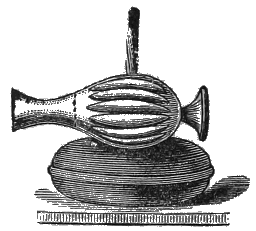
The mode of soldering gold and silver is as follows: Take the solder and roll it out thin between the flattening rollers, or file it into dust, according to the kind of work in hand. If filed into dust, it is all the better if done very fine; and if reduced to a flat state, which should be tolerably thin, cut it into little bits, or pallions, which may easily be performed with a pair of hand-shears, length-ways and afterwards cross-ways. When this is done, take the work which is to be soldered, join it together by means of fine binding-wire (very thin iron wire), or lay it upon the pumice so that the joinings can come close together, and will not be liable to move during the process; wet the joinings with a solution of borax and water, mixed into a thick paste, applying it with a small camel-hair pencil; then lay the bits or pallions of solder upon the parts to be united, and having placed the article upon some suitable object, take your blowing instrument (Fig. 16) and blow with it, through a gas-jet, a keen flame upon the solder in order to melt it; this will render the unification of the parts complete and compact.
Fig. 16. Blowpipes.
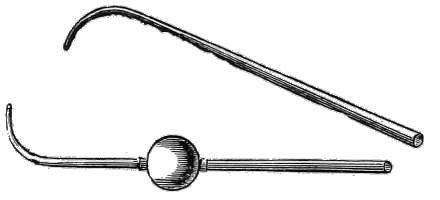
Fig. 17. Solder-dish.
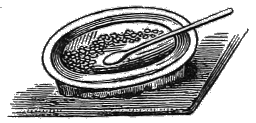
When filed solder is used, the process of charging the article is rather different from the above. In the latter case the filings are commonly put into a small cup-shaped vessel (Fig. 17), in most cases the bottom of a tea-cup, or some other similar vessel, being used for the purpose; a lump of borax is then taken and rubbed upon a piece of slate, to which a little water is occasionally added during the rubbing; when this solution attains the consistency of cream, it is put into the solder-dish and well mixed with the solder. This is then applied to the article to be soldered, by means of a charger, consisting of a piece of round metal wire, flattened at one end, and shaped for the purpose it has to serve. The joinings, when this kind is employed, require no boraxing with the pencil, as described under pallion solder; the borax being intermixed with the solder flushes with it through the joinings to be united, thus rendering any further application unnecessary. The process to which we are alluding is called “hard soldering,” and cannot be applied to metals of a fusible nature; neither must it be attempted in the case of goods bearing the name of plated, which are put together with soft or pewter solder, similar to that used by tinsmiths and gasfitters. If there should be any soft solder about the article, to be soldered by the means we are describing, it would be almost certain to destroy it, the soft solder having such an affinity for entering into combination with metals more infusible than itself when overheated.
There is an art in soldering greater than some people would believe. The heat required is of various degrees, some articles requiring a broad rough flame, others a smooth one, and others again a fine pointed one. All these circumstances connected with the process, together with others which we could detail, proving that it is an art only to be acquired by practice, must be considered enough; and we proceed to observe that the skilful jeweller in soldering a large piece of work will direct the flame of the gas jet to all parts of it, until it is tolerably hot, and then return to the spot to be soldered, and by a very dexterous movement of the flame, produced by the blow-pipe, increase the heat at that spot until the solder has flushed and the parts are rendered thoroughly secure. So far as some of the work of the silversmith is concerned, the process of soldering is a very delicate operation, and ought not to be undertaken by an unpractised hand.
The method of preparing solder for filigree work is worthy of a passing notice. It is called by the Germans Lemaille solder. In the first place it is reduced to very fine filings, mixed with burnt borax powdered fine, and in this state it is sprinkled from a spouted grater over the work to be soldered. The English filigree workers commonly use clean filed solder, and by means of the camel-hair pencil apply a solution of borax to the work, and then sprinkle the dry solder upon it from the grater.
In Vienna a kind of powdered borax is employed, called Streu borax, or sprinkle borax. It is composed of the following ingredients, which should be gently annealed to expel their water of crystallization, the whole well pounded and mixed together, and sprinkled over the parts to be joined from the spouted grater as before:—
oz. dwts. grs.
Calcined borax 0 17 12
Carbonate of soda 0 1 12
Common salt 0 1 0
1 0 0
The object of this mixture is to prevent the rising of the solder, and to facilitate its flushing. Too much of it should not, however, be put with solder in the grater at one time, as it is as objectionable as too much borax applied in the ordinary way, but every workman will learn from experience concerning these matters. We have tried this mixture, prepared with filed solder in the ordinary way, and found it advantageous at first; but its greatest drawback is the turning of the solder yellow if not quickly used upon the work after mixing, thus rendering the solder permanently injured. For this reason we have had to abandon its employment in the wet state. But, in its dry state, to the silversmith for filigree purposes it is likely to be of advantage. It may be remarked that this preparation encumbers the work with a great deal more flux than borax does, and consequently it requires to be more often boiled out during the period of soldering together the component parts. This is effected by boiling in a weak pickle of sulphuric acid and water, composed of the following proportions: one part of acid to thirty parts of water.
CHAPTER VIII.
On the Melting of Silver.
The processes of melting and properly mixing silver with its alloys in a crucible are among the first operations of the silversmith, and are, moreover, of great importance in the production of intimate and homogeneous alloys. In order to effect these, however simple they may appear, various precautions are necessary, and certain principles require carrying out to arrive at the best possible results, otherwise a great loss or waste of material may take place. To direct attention to those principles, which from very careful attention to the subject we have found to answer best, will first be our aim, and if we succeed in rendering some little service to our fellow-workers in the craft to which our toil and leisure have been devoted we shall feel highly gratified.
The weighing of the component metals, the selection of the crucible, the charging of it, and the attention it requires whilst in the furnace are considerations to which we cannot too strongly call attention. The regulations with regard to weighing should be strictly and accurately carried out. The best and safest plan is, after the various metals have been separately weighed, to re-weigh them, this time collectively, in order to ascertain whether the total weight corresponds with the previous calculation; if it does, the mixture has been properly prepared. We have known both time and trouble saved by the adoption of this precaution, after mistakes had occurred which could not have been detected until the weighing of the bar of metal had taken place after melting. There are various kinds of crucibles manufactured for the use of the precious metal workers. Crucibles were so-called from originally being impressed by the alchemists with the sign of the cross. They are calculated to bear very high temperatures, and consist of English, Hessian, Cornish, Black-lead, and Plumbago. The last two are by far the best; the plumbago, however, being the hardest, and capable of standing the highest temperature, is to be preferred before all others. It will also stand more frequent meltings than any of the rest. Such crucibles have been known to withstand the heat of the furnace for upwards of fifty times without giving way. The wear of them is very strong and resisting, as they only gradually become reduced in thickness, so that it is easy to distinguish their unfitness for use. Fluxes act on earthern crucibles, particularly English at a high temperature, whilst nitre and carbonate of soda soon destroy them.
Fluxes are necessary in most cases of metallic reductions: they protect the metal from the air, and dissolve impurities. They are of several kinds, as follows:—
Vegetable charcoal. Carbonate of potash. Carbonate of soda. Common salt. Sal-ammoniac. Sal-enixum. Saltpetre. Borax. Sandiver. Yellow soap. Black flux. White flux. Crude tartar. Brown potash. Sub-carbonate of potash.
All these fluxes have occasional duties to perform, and are therefore of great service to the metallurgist.
To prevent the cracking or flying of the crucible, when newly employed, it should, before being charged with the precious metal, be well annealed; that is, heated to redness upon a very slow fire—one that is gradually going down, and in which there is no blaze is to be preferred, because the flame has a tendency, on the introduction of a new crucible, to make it fly to pieces. When it has become red hot, if a cold bar of iron be introduced it will soon show whether there are any cracks, and if so the crucible should be rejected; on the contrary, if it withstands this test it may be placed aside until required for use, when it may be employed with perfect safety in the melting of silver and its alloys.
When copper and silver only form the alloys of the silversmith, they should both be added to the crucible at the commencement of the operation; and it is the best plan to put the copper at the bottom, because it is the most infusible metal. By doing so, it will receive the greatest degree of heat, which in jewellers' furnaces always comes upwards and the higher specific gravity of the silver has a tendency to force that metal downwards; consequently, when the two metals have become fused, upon well stirring—which should be done with an iron stirrer tapered at the point, and previously heated to redness—a perfectly homogeneous mass will be the result. When the more fusible metals of which we have spoken are to form the component parts of the mixture, different treatment with regard to them will be required. They should not be added at the commencement of the operation, but should be dealt with afterwards, in the following manner:—
Zinc is one of the more fusible metals, and is sometimes employed by the silversmith in his alloys, for the purpose of imparting a greater degree of whiteness to them, as well as rendering inferior silver more easily bleached or whitened; thus assisting to bring back the natural colour of fine silver to manufactured articles, which have partially lost it by the addition of alloy of some other colour. Zinc, when employed in silver alloys, should be cautiously used, and care should be taken not to add too much to a given quantity of material. The solder used with silver-zinc alloys should be far more fusible than that employed with the other alloys. If too much zinc be added in the preparation of these alloys, in the course of the work, particularly in the process of soldering, they have a tendency to sweat, and sometimes to eat the metals into holes around the parts to be united; such alloys, therefore, render this process very difficult to perform, besides entailing more labour in the production of a clean and smooth finish.
Fig. 18. Plumbago Crucible for melting.
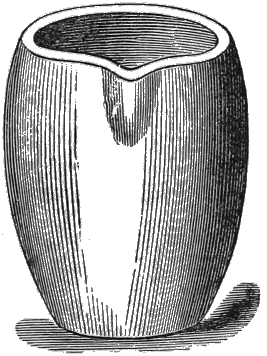
In melting an alloy of silver, copper, and zinc, the silver and copper should first be melted in a plumbago crucible of the form shown in Fig. 18, and well stirred together in order that they may become properly mixed. The zinc is sold in flat cakes under the name of spelter, and, when required, is usually cut up with a chisel into pieces of various weights suitable for the object in view. When the copper and silver have become well incorporated, the mixture should be protected from the air by a suitable flux, charcoal being the best for this purpose. The most suitable time to add it to the crucible in the furnace is when the metals are just beginning to fuse. This flux covers the whole of the surface of the molten mass, and so prevents the action of the air from destroying some of the baser metal. The charcoal should be perfectly pure and in a finely divided state, for if adulterated with any gritty matter (and sometimes such is the case) a very indifferent working material is produced, the evil results of which show themselves in every stage of manufacture. These instructions with regard to melting the more infusible metals having been carried out, the zinc is taken with a long pair of tongs (Fig. 19), and held within the furnace, over the mouth of the crucible, until the temperature has almost reached the melting point, when it should be carefully dropped into the fused mass below, quickly stirred, so that it may become intimately mixed with the other metals, and at once withdrawn from the furnace and poured into a suitable ingot mould (Fig. 20). The ingot mould should be clean and smooth inside, slightly greased, and dusted over with fine vegetable charcoal; this latter substance prevents the metal from adhering to the sides of the mould. It is, perhaps, almost unnecessary to state that the ingot mould requires heating to a certain temperature before the melted composition is poured in, otherwise serious spouting takes place, resulting in a great loss of metal. On the other hand, the operator should be cautious not to over-heat it, as the same evil consequences may result.
Fig. 19. Tongs for Melting.
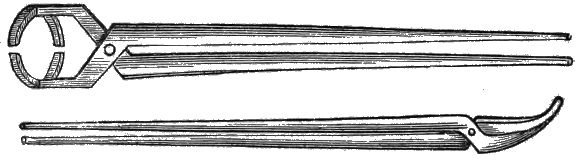
Fig. 20. Ingot Mould.
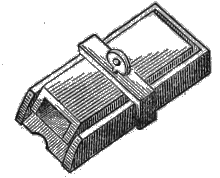
The bar of metal upon cooling should be weighed, and the difference—as most meltings show a little—noted. This is loss, but it will be very little, if the above instructions have been strictly adhered to from the beginning of the operation. With the charcoal flux we have referred to, very nice and clean bars of metal can be produced. This flux is always floating upon the surface of the mixture, and, with a little dexterity in the pouring, it can be prevented from coming out of the crucible with the metal; its proper place is at the end of the pouring. When tin is employed, either in alloys or solders, its treatment is similar to that described for zinc; such alloys should not be kept too long in the furnace after they have become fused, as they rapidly become oxidized, especially if brought into contact with the air.
The waste in silver, and in fact of all alloys, is entirely dependent on the duration of the time of fusion. If it is prolonged after the addition of the fusible metals, the loss is greater in every case, than when once melted. The metals should be subjected to the beat of the furnace for the shortest possible period. The alloys of silver with zinc would lose more than the alloys of silver with tin, because zinc rapidly volatilises when heated above the temperature of its fusion, and this is especially the case when it enters into combination with silver and copper in the fused state; its vapours can be seen to rise and burn in the air, producing light and white flaky fumes, and, chemically speaking, forming the protoxide of zinc. With care and manipulative skill during the process of fusion, the proportion of waste can be reduced to a minimum; and when this is exactly ascertained an allowance can be made in the preparation of the mixture for the crucible. From the above remarks it will be apparent that when both tin and zinc form component parts of a mixture, either to be used as an alloy or as solder, the tin should be added to the other metals, and well stirred, so as to obtain an intimate mixture, before the addition is made of the zinc.
Scrap silver should be carefully sorted before undergoing the process of re-melting, and if possible all foreign substances removed. It may, if preferred to work it in that way, be melted into a separate bar, or otherwise used as an addition to a new mixture. When, however, it is separately melted, a flux, such as carbonate of soda, may be employed, on account of its cheapness, in small proportions to the charcoal flux already alluded to. In brittle and troublesome alloys we have found charcoal and a small quantity of borax extremely effective. Saltpetre is a very useful flux in dissolving impurities, but in some alloys its presence is injurious. Sandiver will remove iron or steel from the mixture. Corrosive sublimate destroys lead and tin. We have found the sub-carbonate of potash one of the best fluxes for silver, when matters have not been quite so straight as they should be in the working of the metal; it is used in melting the difficult alloy of 18-carat gold, and is considered a secret not generally known to the trade. Sal-ammoniac is an excellent flux for producing clean and bright ingots and tough alloys. We invariably use it with all our alloys, mixed in small quantities with charcoal, and prefer it to all others.
Lemel, that is the filings and turnings produced during the process of manufacture, should have quite a separate method of treatment. It is best prepared for the crucible by passing it through a fine sieve, afterwards thoroughly burning it in an iron ladle, and then intimately mixing it with a flux of the following nature and proportions:—
Silver dust 24 parts
Carbonate of soda 4 ”
Common salt 2 ”
Sal-enixum 1 ”
31 parts.
Fig. 21. Fire-clay Crucible for Lemel.
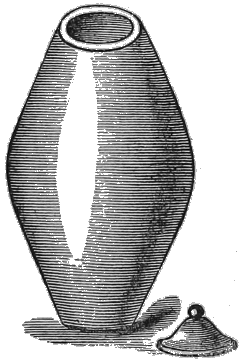
The sal-enixum prevents the rising of the mixture in the crucible—which should be of the skittle shape (Fig. 21)—and keeps it from overflowing; it also possesses a refining capacity the same as saltpetre, and is much cheaper. The burning of the lemel has a great tendency to destroy all organic matter that would be likely to cause the mixture to overflow during the period of fusion; but if such a thing should be at all likely to take place, the addition of a little dried common salt would remedy the evil, a small quantity of which ought always to be provided for the purpose. The common carbonate of soda is also a cheap and useful flux to the silversmith. Five-sixths of the above flux should be well mixed with the stated proportion of lemel, then placed in the pot, and the one-sixth remaining placed upon the top of the mixture, when it may at once be transferred to the furnace. Great heat is required in this operation, and it also requires careful supervision to prevent, if possible, waste of material. When the mixture has become perfectly liquid, the heat of the furnace should not be allowed to decrease, but continued for half an hour longer, and if the use of it be not further required, the fire may then be allowed gradually to die out. The mixture will require repeated stirrings during the period of fusion, in order to dissolve such portions as might otherwise not come immediately under the action of the flux. When the operation of fusion has been completed, the crucible is withdrawn and allowed to cool, the solidification of the metal is then perfect, and it may be recovered by breaking the pot at the base, when it will fall out in a lump corresponding with the shape of the crucible. The lump of metal should then be carefully weighed, the loss ascertained—which always varies in proportion to the amount of organic matter contained therein; it may then be sold to the refiner, or exchanged for new metal.
In this process it will be observed that the crucible is broken every time a fusion takes place, consequently some little expense is incurred in providing crucibles for the purpose. To obviate which the following plan may be economically and successfully employed; and especially when the metal is sold to the refiner by assay, the method about to be described will be found most advantageous, for it should be borne in mind that the lump of metal from the previous fusion has to be again run down in another crucible and poured into an ingot mould before the refiner will consent to take his assay from it. In this latter process the whole work is performed in one fusion, and the expense of a new crucible thereby saved. The flux employed in the reduction of the metal is also considerably reduced. The plan is performed after the following manner:—
Fig. 22. Plumbago Crucible for Lemel.
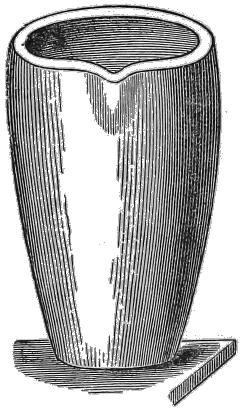
Take a plumbago crucible of the shape shown in Fig. 22, and capable of holding the required mixture; put the lemel into it, and then place on the top one ounce of finely powdered carbonate of soda; this is all the flux the mixture requires, and it is then quite ready for the furnace. When the lemel has become properly fused, for facilitating which it is repeatedly stirred with a thin iron rod, it is withdrawn and poured into an ingot mould prepared for it as previously described. The flux and other organic matter, which always accumulates upon mixtures of this kind, is held back by the timely application of a thin piece of flat wood to the mouth of the crucible. After the withdrawal of the bar of metal from the ingot mould, it is cooled and weighed, and then it is quite ready for the operations of the refiner.
CHAPTER IX.
On the Working of Silver.
Having reached a most important and very interesting part of our subject, viz. the working of silver, and being desirous of making this treatise useful to the silver-worker in all the branches of his art, it is our intention to enlarge upon these processes—which are purely mechanical—and somewhat minutely to describe the various manipulations and arrangements required in the production of the wares of the silversmith.
After the removal of the bar of metal from the ingot mould, it should be plunged into a vessel of cold water, dried, and then carefully weighed. At this stage of the process it is ready for the operation of rolling. This process, so far as it concerns large ingots of the metal, is a distinct branch of the trade, and is carried on in separate premises established by certain firms for the purpose. These establishments are called “rolling-mills,” the machinery used in them (which is powerful and costly) being moved by steam-power, the reduction of the bars of metal to their various sizes is soon effected. The very thin ribbon-shaped metal is produced by submitting it to the action of rollers of smaller dimensions, one after the other, until the desired thinness is obtained. The bars of metal are taken to these mills by a man whose special duty it is to watch over them during the processes of rolling and annealing, otherwise it would be very easy to have an ingot of gold or silver exchanged for one of base metal, the mill companies not being responsible for the material intrusted to their care for rolling; hence the necessity for the porter’s services, to watch over his employer’s interests. To prevent accidentally exchanging the bars of metal, through their great similarity to each other, it is the usual thing for the men in charge of them to put a special mark upon the property of each person, previous to the process of annealing. This mark is applied by means of a piece of chalk or soap, and is not removable by heat. The annealing is performed in large iron muffles, heated to redness and kept in that condition by flues; the bars which require annealing being placed upon a piece of sheet-iron which slides into the muffle, and there they remain with the doors closed until they have become red hot. It is more particularly during this operation that each person’s property requires marking and watching, because of the number of bars admitted at one time into the muffle; and unless the greatest care be exercised at such a time some mistake is almost sure to occur.
A register is kept of the weight of the metal sent to the mill for the purpose of being rolled into the required shapes and sizes by the manufacturer, who afterwards works it up into different wares and utensils. The metal is also weighed on its admittance to the mill, by the clerk of the works, and again on its passage out, and a comparison of the weights registered; but in Birmingham, in some cases, this has been so irregularly performed that great discrepancies have actually taken place in the weights at times, and it has led to the establishment of another rolling-mill for gold and silver, in which the proprietors take upon themselves the whole responsibility and care of metals intrusted to their charge for the above purpose. The method pursued by them in respect to their business is as follows: A manufacturer sends a bar of metal to be rolled, carefully noting the exact weight and size to which it is to be reduced upon a proper order head. This weight is carefully tested at the mill, and if found correct, an invoice is given in exchange, upon which is entered the cost of rolling and the time when the work will be completed. The messenger then goes away, returning at the time stated to bring away the rolled metal.
The advantages this system presents over the others are obvious; the return of the full weight of the metal is guaranteed by responsible persons, the messenger is at liberty during the time occupied in rolling to follow his other duties, the weighing of the respective metals is far more accurately performed both in and out of the mill, besides greater satisfaction being given both to the manufacturer and the roller, the reciprocation of confidence between each, being among some of the additional advantages which might be enumerated. Messrs. Kemp, of Birmingham, deserve the thanks of the jewellery community for their enterprising efforts in the establishment of a system so admirably suited to the requirements of the trade.
The following table gives the charges at the present time for rolling bars of silver:—
Table of the Cost of Silver Rolling.
oz. oz. £. s. d.
Under 6 0 0 6
Above 6 and under 12 0 0 9
” 12 ” 18 0 0 10
” 18 ” 25 0 1 0
” 25 ” 35 0 1 3
” 35 ” 45 0 1 6
” 45 ” 55 0 1 9
” 55 ” 70 0 2 0
” 70 ” 85 0 2 3
” 85 ” 100 0 2 6
” 100 ” 115 0 2 9
” 115 ” 130 0 3 0
Above this 2s. 6d. per 100 ozs.
It is a usual thing at all rolling establishments to provide slitting-rolls for those who choose to avail themselves of that mode of cutting up their metal. These rolls are used for the purpose of cutting stout bars of metal into strips suitable for wire-drawing, thus dispensing with the older process of cutting with a pair of vice shears, which method was slow and somewhat uncertain in the production of good work. The slitting-rolls consist of circular barrels, after the manner of the “breaking-down” rolls, only of course much smaller in diameter, and with this exception, the slitting-rolls have square grooves cut into each barrel, the projecting portion of each corresponding with the hollow of the other, whereas the breaking-down rolls are perfectly smooth and plain. Rollers something similar to those we have described are used by wire-drawers to facilitate the speedy reduction of the metal, the difference being in the construction and action of the grooves. In the grooves of the latter, which are inserted farther apart, the hollows take a half-round shape, and unlike the slitting-rollers, during the revolution of the barrels, the grooves in this case directly meet each other, and thus produce a strip of wire almost round. It is almost needless to remark that wire-rolling requires some amount of practical knowledge to perform it properly. The manipulations indispensable to the art of silver working are so varied and so numerous that we are at a comparative loss which part of the process to consider first; however, if we follow the course of the workman with regard to the production of the various manufactures of his art, we shall perhaps not be far wrong in our desire to effect the purpose we have in view.
In commencing to enlarge upon these mechanical processes we may at once state that it is our intention to refrain from going into the whole art of wire-drawing, because that process has been somewhat minutely alluded to in our other work recently published in the interests of the goldsmiths; the details of which are there fully described.
Fig. 23. Draw-plate.
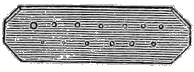
The draw-plate, Fig. 23, which is the principal tool of the modern wire-drawer, was unknown in this country until the middle of the sixteenth century, when it was introduced by Christopher Schultz, a Saxon, from France. It was supposed to have been the invention of a native of that country named Archal. The draw-plate had been in use some years on the Continent previous to its introduction into England. The old method of making wire was upon the anvil, by means of the hammer; and those who manipulated in this art were termed wiresmiths at that period. The best form of draw-plate consists of a piece of steel about nine or ten inches long, one and a quarter to one and a half inch broad, and about half an inch thick, each containing a number of conical holes of various sizes, becoming smaller in succession until the last hole in the plate is reached, when another plate, corresponding in size, having smaller graduated holes, is employed, and the wire drawn through it; and so on, until the proper size has been obtained.
Fig. 24. Draw-bench for Wire.
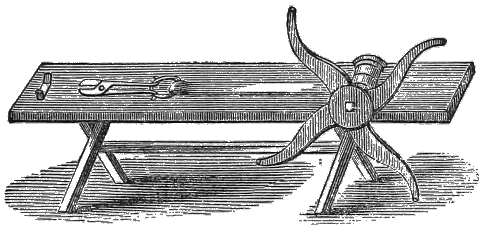
Fig. 25. Draw-tongs.
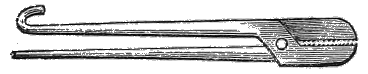
Fig. 26. Drum used by wire-drawers.
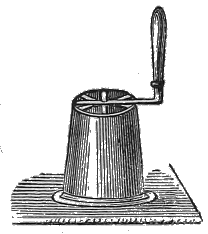
Fig. 27. Skeleton Frame or Swift used by wire-drawers.
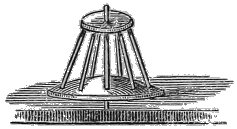
The drawing of stout pieces of wire is effected very readily by means of the draw-bench (Fig. 24), and the thinner pieces, by the application of draw-tongs (Fig. 25), held in the hands of the operator, and made to do service by swinging the body backwards. Very fine wire is now drawn by means of an apparatus called a drum (Fig. 26), revolving upon a perpendicular pin, the exterior of which receives the wire and prevents it from becoming entangled. When the end of the wire has finally passed through the draw-plate, the whole coil is carefully removed from the drum (which is made slightly conical in form for facilitating the process) and placed upon a skeleton frame made to receive it (Fig. 27); it is then in proper form for its passage through the next hole of the draw-plate.
In the production of very fine wire, the metal, after passing a few times through the draw-plate, requires annealing, as its fibres become so condensed and hardened that it is impossible to repeat the operation without some risk of the wire breaking. For fine wire the annealing is repeated five or six times during its passage through the draw-plate; for stouter kinds the annealing need not be so frequent. This process produces a scale or oxide upon the surface of the wire, which should be removed before the continuation of the drawing takes place, which is generally done by an immersion for a time in very dilute sulphuric acid pickle; or its passage may be assisted through the draw-plate by the application of some lubricating substance, such as beeswax, or a mixture of beeswax and oil, which enables it the more readily to pass through it. In the progress of the wire-drawing the holes have a tendency to become enlarged; these are made smaller again, by repeated blows upon the front of the plate with a somewhat pointed hammer (Fig. 28), and then opened from the back with a tapered steel punch, such as is shown in the woodcut (Fig. 29). The hardening and tempering of the punch is of importance. A gauge-plate is used in all establishments for the purpose of determining the size of the wire. The hammering should not take place upon a hardened draw-plate, as it would fly to pieces: it is only those known as soft which should receive such treatment; and those, by a continual alteration of the holes, gradually become hard and require annealing at intervals.
Fig. 28. Knocking-up Hammer.
Draw-plates for wire-drawing purposes are mostly cylindrical in form, but they are employed in various degrees of fineness and in different shapes; such as oval, oblong, half-round, square, fluted, star, sexagon, triangular, and other complex sections, for the production of corresponding wires, all of which receive similar treatment to that above described.
Fig. 29. Round Steel Punch.

The process of wire-drawing, in connection with the art of the silversmith, is more particularly employed in the manufacture of chains, in which branch a very large quantity of silver is consumed. This branch of the craft is almost a purely mechanical one, but, nevertheless, there are some designs in chains which require a considerable knowledge of art for the proper execution of them. It is, however, in “wrought” or hand-made work that true art is made to play so conspicuous a part; for it is here that perfect workmanship, together with great skill and taste, are required in the manufacture of an article. “Wrought” work was one of the earliest productions of the goldsmith and silversmith, and it still remains the true artistic method, although it has been superseded by others of a less expensive character; such as stamping, chasing, engraving, enamelling, casting, &c., to which the older processes of ornamentation and decoration by means of hammering have given place.
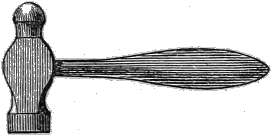
Fig. 30. Hammer for Wrought Work.
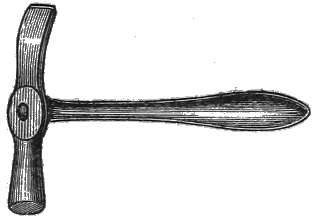
Fig. 31. Sparrow-hawk.
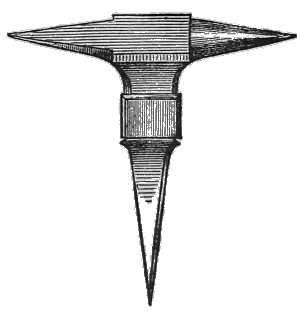
Wrought work is produced by hammering and soldering the various pieces or ornaments together; and one of the very first things to be attended to in the production of this kind of work is proportion, a knowledge of which is indispensable to true art-workmanship; for the piece of metal which is to be operated upon by the hammer should be of the proper size, so as to require none to be cut off afterwards. Every portion of a design should be wrought out of the piece of metal separately, and soldered in its proper place upon the article in process of manufacture. When circular forms have to be raised or flanged by the employment of the hammer, as in the case of a raised or flanged brooch “bezil,” the modus operandi is as follows:—Take a piece of metal of the exact size and shape, turn the two ends together from the longitudinal direction, and unite them by soldering; when this is done, the circular band of metal is taken and flanged by means of the hammer and a miniature anvil, placed upon a stout piece of wood which the workman renders secure by placing between his knees, the pressure of which retains it steadily in its place during the various manipulations performed upon it; this kind of tool is termed a “sparrow-hawk”—a representation of it is given in Fig. 31. The work is effected by a series of blows dealt with the hammer in regular concentric circles, the bezil all the time gradually working round the pointed end of the sparrow-hawk. It requires great skill and practice to produce the proper shape, and to keep all parts of the metal of equal thickness. The bezils may be produced in this manner round or oval, as well as other complex shapes; the hammering taking place according to the shape required. When raised or ornamental brooch bezils, such as concave or convex patterns, are to be made, the means adopted in their execution are somewhat more complicated than the mode of flanging above alluded to. A tool called a “swage” is employed, which partakes of many forms, the pattern or ornamental device which the metal is required to take being the shape of the swage, or otherwise cut upon it. The metal is easily raised to take the proper design, by a very careful application of the hammering process.
Sometimes in silver-working the form of the object to be manufactured is of such a nature as not to allow of the use of the swage tool, and this is more particularly the case in the manufacture of plate. Such things, for instance, as cups or tankards which have raised ornamental surfaces, and which have to be executed after the vessel is roughly finished, require altogether a different tool for the effecting of such purposes. The one commonly employed in operations of this description consists of a bent piece of steel, upon one end of which is cut the device required; this end being turned up to the required height for raising the design, and the other end being bent in an opposite direction, which, when required for use, is secured in a vice. The workman, in executing the design upon the object in hand, places it upon the “snarling-iron” (for such the tool is called) at the part to be raised, and there holds it securely while another man strikes the piece of steel at the top of the angle, or just above where it is secured in the vice, the reaction of the steel wire then throws out the metal, in accordance with the device or pattern cut on the end of it. Designs are only roughly raised in this manner, the perfecting of them being performed by the application of various kinds of chasing tools. To prevent a change in the form of the object undergoing this operation, it is filled with a composition formed of pitch, resin, and brick-dust, in the following proportions:—
Pitch 4 parts.
Resin 4 ”
Brick-dust 2 ”
10 parts.
The preparation of the cement is as follows:—Reduce the brick-dust to a very fine powder, and pass it through a fine sieve; then take the other ingredients and melt them in an iron ladle or other suitable vessel over a slow fire, stirring them well together; when this has taken place, the mixture will present a thin liquid appearance, which is the time for using the brick-dust. This should be added in small quantities at a time, and well stirred together, until the mass has become tolerably thick. It is then poured out either upon the floor, or into some suitable vessel provided for its reception. While undergoing the operation of chasing, the lower part of the object is preserved from injury, by being laid on a sand-bag. The illustrations, Figs. 32 and 33, represent the snarling-tool, and its mode of application to the work of the silversmith.
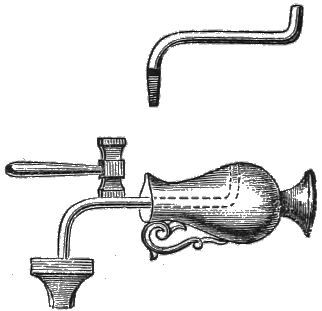
Figs. 32, 33. Snarling-tool, and its mode of application for raising.
The progress of the silversmith’s art, in conjunction with the researches and discoveries in the mode of working the precious metal during the past century, have wrought a great change both in the style and manner of workmanship. Before the period referred to, the gold and silversmiths' trade was in its lowest possible condition; partly, no doubt, on account of the war then raging on the continent of Europe, and partly because the silversmith at that time was not allowed to manufacture articles of any standard inferior to that of the coinage of 11 ozs. 2 dwts. Until the peace of Waterloo, few people were busy but the gun-maker, and other smiths who were able to work at similar occupations; but with respect to most other trades, the men did all they were capable of, in order to earn their daily bread. If at that time the silver trade had been specially cultivated, the art, as regards its progress, would have met with many drawbacks, as compared with the present time; the knowledge of the workmen in the production of finished work was not equal to that to be found upon the best articles now manufactured. And although forbidden by law to work in inferior metal, they would have been incapable of effecting the beautiful surfaces which modern articles of inferior quality are made to present. The recent scientific discoveries, both chemical and mechanical, that have taken place during the last sixty or seventy years, have wrought a great change in the general conditions, as well as in the mode of the manufacture of silver wares.
We have said that previous to the year 1815 all was dark and obscure with the precious metal worker, but from that period the work gradually rose in artistic excellence, and the trade very slowly improved; the cause of this no doubt being due, in a great measure, to the security afforded as the result of peace, and with it a revival of the industrial occupations. With the increased industries of the nation arose the pleasures and pastimes of the people, and racing became a national sport. This kind of pleasure soon led to an increase in the work of the silversmith, in consequence of the demand for racing cups, which gave opportunities for the artistic excellence of design in their manufacture; and the silversmiths who made them soon acquired a prestige as Art-manufacturers. The demand for work of that and a similar kind led to the employment of regular designers and modellers, who gradually improved both the designs and the work in different parts of the country.
At the period of which we are speaking, polished or burnished silver goods were most in demand, the modern processes of surface finishing not being then understood. The introduction of the French style of work in filigree soon afterwards caused a demand for that class of work; and the attention of those in the trade was then turned in that direction for a time, and others springing up, the silversmith’s and goldsmith’s trade generally began to assume a position of importance. This kind of work required no polishing and very little artificial finish; besides being exceedingly light in weight and graceful in appearance. It required fine material for its manufacture. In England filigree work has been superseded by other processes, but in India, and in other parts of the East, it is still cultivated to perfection.
Silver and gold filigree is also manufactured in the Ionian Islands, in Switzerland, and in some parts of Germany and France, where labour is cheap. In the two latter countries it is made from a very inferior material to that used in India. Silver filigree work in this country was soon found not to answer all the requirements of modern society, so far as regarded its utility, durability, and cheapness; fashion therefore demanded something different. It is worthy of remark that while this class of jewellery in both gold and silver was so much in vogue for ladies' wear, the old-fashioned seals and keys had undergone a change, and the chasing of them in representation of filigree ornamentation had become the fashion for gentlemen’s wear. The processes of the manufacture of filigree wire and its mode of application to the work of the artist, have been considered in a previous chapter, further detailed information is therefore rendered unnecessary.
Fig. 34. Die.

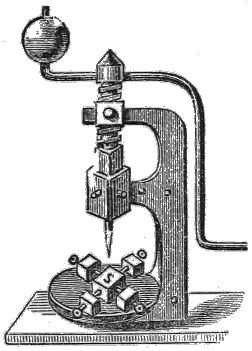
When filigree work was no longer used, the fashion changed into “stamped” or “struck-up” ornament. Small pieces of metal were struck-up by means of the hammer and punch, or by the use of the hand-press or stamp; in the former case a lead cake would be prepared, composed of a mixture of lead and tin, and upon it the various ornaments would be produced from the flat metal, corresponding with the pattern of the punch employed for the purpose; in the latter a small die (Fig. 34) would be employed with the pattern sunk upon it; this would have an aperture through it, the dimensions of the off-side being generally rather large, gradually becoming smaller towards the front surface, which takes the form, in general outline, of the desired pattern. When the necessary blanks have been cut out, another die and punch are used, by which they are raised to their proper shape. These tools should be firmly secured in the press (Fig. 35), otherwise they are likely to be soon destroyed.
Fig. 35. Press.
The small ornaments thus raised were variously arranged one upon another, until a design or pattern was formed, which in every way appeared very showy. Such articles suited the tastes of the people at that time, and still suits those who require good weight for their money. The same kind of thing existed at that period in chains, and being heavy-looking, and costly in appearance, they attracted attention and caused a demand. Thus with the continual changing of the fashions a new era for the goldsmiths and silversmiths of England began. They were beginning to work in all sorts of qualities, with the manipulations and finish of which they were becoming now thoroughly conversant, and a demand springing up for goods for purposes of exportation, encouragement was given to the trade, which soon assumed the position of a thriving industry.
The style of work that followed the “struck-up” patterns was that of plain and solid silver-work, well polished and whitened. This sprung up about the period when coloured gold became the fashion, and the mode of finishing it being somewhat similar, no doubt the demand arose as much from the introduction of colouring as from any other assignable cause. In the chain-maker’s branch of the art, a great variety of new patterns came into existence at this period; chain bracelets also began to be introduced; and altogether the trade made rapid strides, and fast rose into a great commercial industry. This kind of work has remained more or less in fashion up to the present time, and vast quantities of silver chains of the plain and solid patterns are now being made in Birmingham.
The silver trade seems to be an exception to the general depression which now prevails in all the other branches of the jewellery trade; the fashion just now is for silver, which causes a greater demand than is usual for goods manufactured of that material. In a short time we believe this fashion will undergo a change, and then no doubt manufacturers who have taken advantage of it to make large stocks will have goods remaining upon their hands which they will not be able readily to dispose of, unless at a sacrifice; for it should be borne in mind, that to keep a large stock of silver goods in a saleable condition, and without a quick sale, considerable expense is entailed above the cost of making, to keep them in that condition, through their great liability to become tarnished.
Fig. 36. Hammer for dooming.
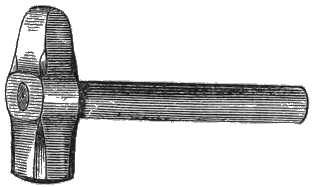
After the introduction of plain and solid-looking work, it next became the fashion to have it chased over its entire surface. Following this, about the year 1825, came the beautiful process of enamelling, which added artistic beauty to the work, and brought out the harmonies of colour. About this time, too, there sprung up a great demand for the so-called “galvanic ring,” which consisted of a lining of zinc and one of silver. The ring represented, in appearance, those large, plain, half-round rings which are now made in 18-carat gold, and which weigh from 7 to 10 dwts. each. It was then as now made of half-round shape, and sometimes with the addition of a buckle upon it. The silver was so drawn upon the zinc that the outer surface appeared entirely of silver, and a portion of the inner surface was made to show the zinc only, which was quite sufficient for the purpose required. When the ring was put on the finger the zinc, in conjunction with the silver, touched the flesh of the wearer, and was thus supposed to create a galvanic action, which it was alleged had a tendency to remove or prevent rheumatism. This kind of work had a good run at the time of its introduction, but like all the rest, the fashion lasted only for a while, when something else had to be brought to the front in the silver trade. The mode of the preparation of the wire was as follows:—A bar of silver would be rolled out until a certain thinness was attained, occasionally annealing it during the process; it was then cut into strips wide enough for the purpose required, again annealed, and subsequently doomed. The latter process was effected in this manner:—A block of hard wood, such as boxwood, would be made use of, having a round groove in one side of it, the metal to be doomed would be laid along the groove and a round piece of iron or steel held upon the upper surface with the left hand; a wooden mallet is then taken with the right hand, and by a skilful application of it to the piece of iron or steel, the metal is soon forced down in the groove and made to take the proper form for drawing. The flat strip of metal should be pointed; this may either be done before or after the dooming process, though it commonly takes place before. It is performed by taking away a small portion in a conical form, from one of the ends with a pair of hand-shears. A piece of zinc wire should be provided, corresponding in shape with that the ring is to take; this is placed in the hollow of the silver to be drawn, with the flat side outwards, so as to correspond with the aperture in the plate through which it has to be drawn. A draw-plate is then taken, with holes of the half-round shape, and the two metals carefully drawn through them. The drawing through a succession of holes produces an edge upon the silver coming against the flat side of the aperture in the draw-plate which overlaps the zinc and thus holds it securely in its place.
A change in the style of work gradually took place in the course of every few years, and thus it was that hollow-work became the fashion. This kind could be made in a variety of ways, and being very light and showy, it appeared much more expensive than it really was. It is therefore very easy to account for the changes which have taken place in the manufacture of articles of adornment and luxury, and for the encouragement which the art has received. With the present styles of the “plain,” the “solid,” the “filigree,” the “stamped,” the “mosaic,” the “cameo,” the “repoussé,” the “inlaid,” the “enamelled,” and a variety of others, we can fearlessly say that silver-working has of late years made rapid progress, and attained to a higher standard than it ever before possessed.
Fig. 37. Steel Die.
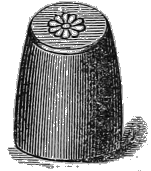
Fig. 38. Stamping Press.
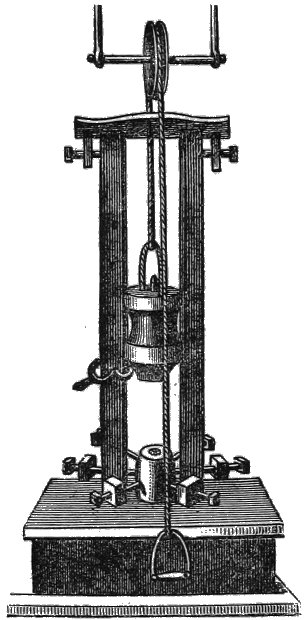
The art of stamping and shaping articles of jewellery from sheets of the various metals came into general use just previous to the first Exhibition in 1851. These, which are made in considerable numbers, are produced by means of dies, having the shape of the pattern upon them, both at the top and bottom, made of hardened steel. Fig. 37 represents a bottom die for the use of the stamping press, and Fig. 38 represents the press. In raising the metal by stamping, the material undergoes the same bendings and extensions between the dies as if it were being manipulated by the hammer, and consequently it requires to be repeatedly annealed, otherwise it would crack and fall to pieces in a subsequent operation. The raising should be brought about gradually, and this is done by placing a number of sheets of metal between the dies, which prevents the top die from falling with too sudden an action upon the metal, which it would do, as it falls with a succession of forces if the process be repeated, and if its action be not arrested by the means we have pointed out. After every blow of the stamp one of these pieces is removed from the bottom, and a fresh one added at the top; the continual falling of the stamp gradually forces these plates, if placed in the manner we have indicated, to take the shape of the die. The exact form of the figure is effected by striking the plates singly between dies which exactly correspond. A very large quantity of work is now produced by the means we have stated, such as brooches, studs, locket-backs, earrings, rings, and an endless variety of other things; moreover, by the cultivation of this art a considerable amount of the labour formerly bestowed by hand upon the work is now saved, as the stamping in many instances is so complete, almost taking the form of a finished article after that process has been performed, that the workman has only to arrange the parts and supply the ornamentation when required, to render the article complete.
Works of art are also produced by other methods; as an example, we will take the process of “spinning or burnishing into form,” which consists in spinning the metal to the desired shape in a lathe, by means of burnishing tools, specially made for the purpose. This process is employed in the production of large bangle bracelets with plain surfaces and other similar works. The metal to be operated upon should be soft and malleable, otherwise the process is very difficult to perform. The disc, or other form of metal, is taken and fixed in the lathe with the aid of holdfasts, a chuck or mould of the desired pattern being provided, upon which the disc is turned by the tools referred to. The metal, as in the other processes, is gradually spun into the required form. In most cases the mould is exactly the shape of the interior of the article required to be made, and under these circumstances it would be made up in several pieces together with a key-piece; so that when this latter is taken away, there is no difficulty in removing the rest, and leaving the article free. It is of importance, during the spinning, to keep the edges free from notches, but should these occur, it would be better to touch them a little with a turning tool. The metal for spinning into a bangle bracelet should be of the form of a flat circular band, soldered of course; it would then be secured upon a properly shaped mould, composed of several pieces, in the manner above described; this would then be placed in the lathe, and the application of the spinning tools would soon bring about the desired form. After the removal of the spun piece of metal, the workman trims the edges up a little, then saws it into two pieces, and at once proceeds to the operations of snapping and jointing, which are delicate processes to perform properly in work of this kind, and require the services of a skilled and competent workman.
Having now described some of the processes in the working of silver, and alluded to the various articles which are produced by wire-drawing; raising with the hammer; stamping; spinning; chasing, &c.; we shall next direct attention to those processes which immediately come after the putting together and soldering the article; and foremost of these is polishing. We trust that the foregoing details in reference to this part of the subject will convey some idea of the art of silver-working.
Polishing is an important process With all precious metal workers. It is applied for the production of surface to their wares, and in proportion to the smoothness required upon the work, so should be the fineness of the material employed in effecting it. The polishing powders are emery, powdered pumice, crocus, rottenstone, putty of tin, and rouge. In the best work, scratches are removed with a smooth and rather soft dark grey stone (Water-of-Ayr stone); it is then polished in the lathe with a stiff brush, and the application of a little fine polishing mixture. We have placed the materials for polishing in their respective order of smoothness or fineness, beginning with emery, which is the coarsest. A very good mixture for ordinary work consists of equal portions of emery, pumice, and crocus, with oil added to the consistence of a thick paste. Good work does not want much polishing, for the beauty of it depends more on its being executed by a well-trained workman; whereas rough and badly executed work requires much polishing, and for this the coarser powders are preferable, or a mixture of them; but for the smoother work the finer powders should be employed.
The Water-of-Ayr stone employed for polishing is usually obtained in the form of small square sticks, and is used with a small quantity of water to the surface of the work, in a similar manner to filing. The stone is softer than the material upon which it operates (and, in fact, so are all the materials for polishing), and therefore wears away, producing a mud-like substance upon the article, which should be repeatedly removed in order to ascertain the progress made. This may be done with a piece of clean rag, or tissue-paper. When the work is polished at the lathe it will gradually become enveloped in grease, &c., which should be removed occasionally, to show when the process has been carried far enough. The polishing of silver work is a branch of the trade commonly performed by girls. It is hard work for them, as the metal possesses a very soft nature; it therefore pulls hard against the brush which holds the polishing mixture. The lathe employed is the ordinary polishing lathe with a horizontal spindle, and is worked with a common foot-treadle; steam-power is used by some firms for moving these lathes, but it is by no means the usual custom at present.
After the completion of the polishing process, the work is well washed out in a prepared solution, to remove the mixture which adheres to it; a solution of soda is found to answer the purpose best, both from its cheapness and effectiveness. It should be used hot, with the addition of a little soap, and with a stiff brush the dirt is soon removed. The quantity of soda used to a given proportion of water differs in the trade, and there is no set rule to go by; it depends, more or less, upon the adhesiveness of the polishing mixture. We have found about two ounces of it to a quart of water amply sufficient for the purpose.
CHAPTER X.
Enriching the Surfaces of Silver.
By the application of the processes about to be described, the finishing touches in their relation to articles or wares of silver manufacture are effected. These processes, as adopted by the trade, are various, almost every firm having a specially prepared mixture and mode of employing it. We shall refer only to those which, from their practical utility, are likely to be of service to those workmen who have to do with this particular metal. The branch of the art of which we are now treating comes only into operation when every other process of workmanship has been completed; and some of these processes must be executed in a perfect manner in order to arrive at the highest possible results in this one. The best and richest surface is produced when the metal to be operated upon is good in quality, and the workmanship of a fair order, so far as regards smoothness, and freedom from surplus solder-marks.
One of the oldest methods for producing a pure snowy whiteness upon articles of silver was as follows:—Take an iron or copper annealing pan (the latter is much to be preferred), place the work upon it in proper order, so that it may be heated all over alike. It should, previous to this, be immersed in a thick solution of borax, or otherwise brushed over with it. After the work has been properly arranged upon the pan for annealing, it must be sprinkled over with fine charcoal dust; the pan is then placed in the muffle upon a bright clear fire without blaze, and when the work has assumed a degree of heat approaching to cherry redness, it is withdrawn and allowed to cool. When this has taken place, it is removed and boiled out in a very weak solution of sulphuric acid, commonly called oil of vitriol. If the right colour was not then produced, the process was repeated as many times as circumstances permitted, though usually two or three times was found to be amply sufficient. The annealing process required great attention, for the work being in contact with borax, if slightly overheated, it was liable to become melted, therefore the operation was a delicate one to perform, and was only intrusted to such workmen as were experienced in the art. Small delicate articles were commonly treated with the mouth blow-pipe and gas-jet, and were placed upon a pumice-stone, or some other suitable substance capable of withstanding the power of burning. According to the inferiority of the silver alloy, is the difficulty of producing a good white surface on wares of such standards. Fine silver requires very little whitening, generally one process suffices to effect a good colour; but inferior standards require half a dozen or more to bring up the proper degree of whiteness; and those ranging below 9 oz. 12 dwts. to the lb. Troy cannot be whitened at all by the means we have described, but require the application of the modern chemical process, known as electro-plating.
The East Indian silversmiths never touch their manufactures with any kind of abrasive substance, from the most delicate, to the more strongly made article. But then it should be remembered, that in India the natives work from the pure material, a point which they rigidly adhere to; whereas we are compelled in this country to manipulate in all sorts of qualities; and some of these require no little trouble and difficulty to bring back to the surface the snow-white appearance of the pure metal. In the former case it is effected without any difficulty whatever—in fact, the metal scarcely undergoes any change throughout the whole of the manipulations to which it is subjected in the various processes of manufacture. The Indian mode of procedure is as follows:—Some juicy lemons are cut into slices; the silver articles are briskly rubbed with these for a short time, and subsequently covered with them, being placed in a suitable vessel for a few hours for the completion of the process. For very delicate articles of jewellery the natives cut a large lime nearly in two halves, into which they insert the work; the halves are then tightly closed up again, and placed aside for a few hours; when the article is removed, it is well rinsed in clean water, and consigned to a vessel of nearly boiling soap-suds, where it is well brushed, again rinsed in fresh hot water, and finally dried on a metal plate placed over hot water; the process is rendered complete by a little gentle rubbing with wash-leather if the work be of a plain nature. Green tamarind pods are also employed by them for the purpose of whitening silver, in the same manner as just described; they are great detergents both of gold and silver manufactures, and are largely employed by artisans in the East for the removal of oxides and fire-marks.
Another process for the whitening of silver goods is performed in the following manner:—Take the work, which must be cleanly prepared, and give it a coating of the following mixture:—Finely powdered vegetable charcoal four parts, saltpetre one part; the ingredients should be well mixed with a little water, and may be applied to the surface of the metal either by brushing over with a soft brush, or by dipping the work into it. The work is then placed upon the annealing pan and submitted to the heat of the muffle, until the wet powder has become perfectly dry and ceased to fly about; it is then withdrawn from the muffle, allowed to cool, and afterwards boiled out in a solution of potash prepared for the purpose, in the proportion of about one ounce of bi-sulphate of potash to twenty ounces of water. The boiling out is done in a copper pan (Fig. 39), and if the work be put through the above process two or three times a beautiful dead-white colour is the result. It is then washed in a hot solution of soda, soap, and water, or if preferred bright, scratched, or burnished, and the process is finally completed by drying it in fine boxwood sawdust, which should be made hot, but not allowed to char or burn in any way, as it would produce a stain upon the work very difficult to remove, and thus the finish would be considerably impaired.
Fig. 39. Boiling-out Pan.
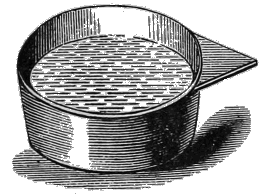
In large manufactories the process of whitening silver goods is repeatedly required to be performed, and where such is the case, the above methods are found not only tedious and expensive, but occupy much unnecessary time and labour; to dispense with a portion of which, the custom of covering the work with a chemical preparation was accordingly departed from, and yet it was made to show its former brilliancy. To effect this object the liquid for boiling it in was differently prepared, which only required to be made of a proper strength to do all that the surface mixture had done before. The following is the method adopted in preparing the cleansing liquid. Boiling-out mixture:—To one pound of smoking salts, add two ounces of cream of tartar; well shake the ingredients together, so that they may be thoroughly incorporated. The smoking salts employed for this purpose are not the ordinary spirits of salts of commerce, but a preparation of the common oil of vitriol; therefore the one should not be taken for the other; the spirits of salts would turn the work black, whereas, if the proper ingredient were procured, a fine dead matte or blanched surface would be the result of its application. The mixture employed for boiling the work in consists of the proportion of one ounce of the above preparation to about thirty ounces of water. The silver articles simply require to be annealed, allowed to cool, and then boiled for a minute or so in this solution, when the desired result will be attained; if, however, the exact colour be not obtained the first time, the process should be repeated a second, and if necessary, a third time; the right colour will then be produced, if the articles are not made of a too inferior standard.
The mode we have ourselves adopted for the colouring or whitening of silver goods is somewhat different, and still more simple than even the above. We will proceed to give the details of the process. A mixture of very dilute sulphuric acid is first provided, in the proportion of one ounce to forty ounces of water, and well mixed together; the work, after being heated to a good red heat, is boiled in this, which soon removes the oxide from the surface, and shows the fine white colour of the pure silver. For fine silver work, such as Indian filigree, one process will generally suffice, for English standard quality two, and for low qualities three, but these latter must not by any means be too low; if so, no colouring can take place by the method just described. Objects of delicate workmanship are usually annealed by the gas; being placed on a pumice-stone of light material, the flame of the gas is blown with the mouth blow-pipe, in such a manner that the object gradually becomes heated all over alike; and the work should be well heated, as this facilitates the process of oxidation, and subsequently that of whitening. The oxidation takes place at the expense of the copper in the silver alloy, and this is only effected by raising the articles to a very high temperature, which produces the oxidation of the copper coming in contact with the air, and which necessarily exists upon the surface of the alloyed goods. Whitening silver goods then is nothing more than the removal of the base alloy from the surface, leaving the pure metal behind with its full rich colour. Therefore to be clear, the process of annealing in contact with cold air oxidizes the copper upon the surface, and the pickling mixture so dissolves and removes it, that it gradually undergoes a process of refining, and is ultimately made to represent the finest material in all its purity.
Sometimes silver work is to be seen having a brown colour upon it; this is produced when the acid employed for cleansing has been too strong; it can only be remedied by another annealing and boiling-out in a much more diluted mixture. There are various other methods employed in the trade for the purpose of whitening silver work of the best quality; and although annealing is always a part of the process, other ingredients, such as salt and tartar, permanganate of potash, cyanide of potassium, alum, &c., have been severally used for the cleansing or whitening mixture. They may be useful in their application to plated work (articles that have received a coating of pure metal by means of the electro-metallurgical process), for cleansing purposes only, but for all practical purposes the process to which we have called special attention is to be much preferred.
Common articles of silver cannot be whitened by annealing and boiling-out in a diluted acid; a thin film of pure silver must be deposited upon their surface by the process of electro-deposition, or by the action of some chemical preparation in which fine silver forms the principal ingredient. Such preparation, however, as the latter can be used only to plain surfaces, therefore they are not applicable to all kinds of work. They are composed of the following chemical ingredients:—1st, chloride of silver 1 part, cream of tartar 1 part; 2nd, chloride of silver 1 part, common salt 1½ parts; 3rd, chloride of silver 1 part, prepared chalk 1 part, pearl-ash 1 part; 4th, chloride of silver 1 part, alum 1 part, common salt 2 parts. The chloride of silver is easily prepared by precipitating it from the nitrate with a solution of common salt or hydrochloric acid. The various mixtures should be worked up with water into a thin paste, and applied to the work by rubbing with a soft cork or piece of wash-leather, or by thoroughly stirring it about in the mixture until it has acquired the requisite degree of whiteness. For the purpose of silvering watch and clock faces, &c. these mixtures may be used with advantage and entire success.
Other solutions are sometimes employed for similar purposes and are very useful; being simple in their preparation and easy of management. We have selected the following as being the most practical:—Take one ounce of the nitrate of silver and dissolve it in one quart of pure distilled water, or if this cannot be procured, water which has been boiled, by which it loses some of its impurity. When the nitrate of silver has become thoroughly dissolved, throw into the mixture a little powdered hyposulphite of soda, this will precipitate the silver, and when it has taken place, a further addition of hyposulphite of soda should be made, which will eventually re-dissolve the precipitate, and the solution is then ready for use. To produce a good mixture, the salt of soda should be added slightly in excess. The solution is used by simply dipping a sponge in it and rubbing it over the surface of the articles to be coated, and this is continued until they have assumed the desired colour.