TOOLS AND TECHNIQUES OF THE COLONIAL SILVERSMITH
Reading edition
From the founding of Jamestown to the time of the Revolution some 300 silversmiths practiced in the three cities of Boston, New York, and Philadelphia alone. Another 200 worked in the smaller centers of New England and the middle colonies and in such southern places as Charleston, Annapolis, and Williamsburg. Unfortunately, if any of these 500 colonial silversmiths left a written account of his shop practices and methods of work, it has not been found.
Accordingly, our knowledge of the ways in which colonial smiths worked is derived from other sources. Most of it comes from a few technical handbooks and illustrated encyclopedias published in Europe at about the same time. Inasmuch as many colonial silversmiths gained their knowledge of the craft and of its standards of good practice as apprentices in the old country, it is probable that silversmithing practices in America were similar.
Not identical, though. The environment of the new country altered in some manner or to some degree almost every single attitude, habit, and craft practice. For example, in eighteenth-century England the silversmith whose shop was located within the purview of an assay office could sell the articles he made (with certain exceptions) only after the pieces had been assayed and stamped with the appropriate hallmarks, including one denoting the fineness of the metal. Since the colonies had neither assay offices nor regulations governing the work of silversmiths, each smith was responsible for the quality of his own work.
22
Because most re-used plate came originally from England and because coins were generally minted at or near sterling fineness (925/1000ths fine, or 92.5% pure silver, the rest of the alloy being copper), most American silversmiths presumably turned out work that was not too far from sterling purity. They could not afford to slip much below that level, after all, since they competed for favor and sales with the much esteemed plate imported from England. In many advertisements in the colonial press, smiths explicitly warranted their work to be of sterling quality. However, among the pieces of early American silver that have actually been assayed in recent years, only a portion have met the test; quite a number have not.
While American smiths no doubt resented the general preference of their customers for articles of English manufacture, they could not overlook the fact that English fashions in design dominated colonial life. Accordingly, silver of colonial make imitated the London styles in plate, being usually some years behind them.
But the American designers were neither unimaginative nor slavish imitators. Their designs modified the English originals rather freely—usually in the direction of simplicity and utility. American silver, dispensing with the heavy ornamentation for ornament’s sake that often characterized the work of London silversmiths, tended to be substantial, serviceable, and vigorous in form, befitting the environment in which it was to be used.
Acquiring a complete set of Silversmith tools, or at least a reasonably adequate set, must have been something of a task in itself. When John Coney, a leading Boston silversmith, died in 1722 at the age of 67, the inventory of his goods reflected his many years at the craft. Among the articles listed were 116 hammers, 127 nests of crucibles, 80 anvils of different shapes and sizes (some called “stakes” and “teasts”), and unnumbered punches; plus chisels, swages, stamps, vises, files, and an almost endless variety of other tools.
23
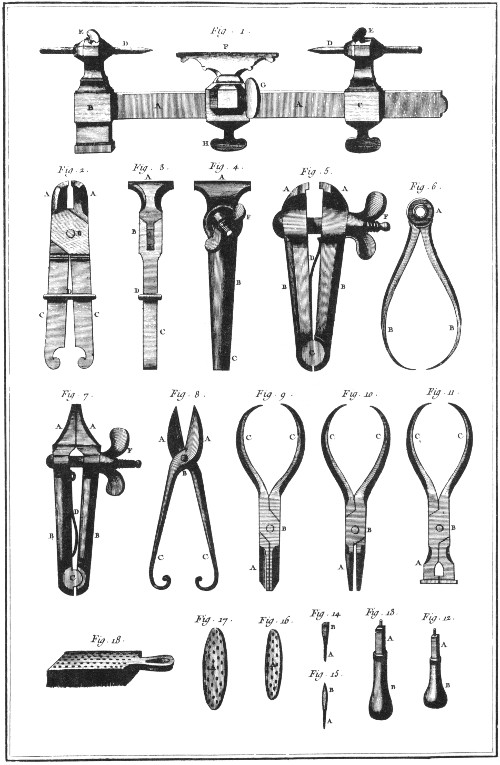
Various hand tools used by the silversmith, including a small lathe, vises, clamps, caliper, shears, and pliers. DIDEROT.
24
John Burt, another Boston silversmith of the eighteenth century, got along with only 40 hammers, 15 pairs of tongs and pliers, 37 “bottom stakes,” 155 punches, and other tools in like sparsity. A glance at the illustration on pages 27 and 28 from Diderot’s Encyclopedia (published in France, 1751-1772) indicates the infinite diversity of anvils that would be needed to produce every possible shape and size of hollow ware.
Even with all these tools—plus forge, ingot molds, drawing bench, binding wire, and many other essentials of the craft—the silversmith was limited to six basic methods of working silver. These were casting, forging, raising, hollowing, seaming, and creasing—the principal methods still employed by hand craftsmen today.
But forging, raising, hollowing, and creasing are all hammering processes, though they differ significantly in the manipulation of the metal under the hammer. In essence, thus, there are only three techniques of forming silver into an article of desired shape: casting the molten metal in a properly shaped mold; hammering an ingot into the shape desired; and building the desired shape from smaller pieces soldered together. Wire produced on the drawing bench might be one of these smaller elements. Filing is considered to be a finishing rather than a forming process.
These forming and working processes, as they would have been used by an eighteenth-century silversmith, will be described in more detail in a moment. But the smith, before he could do any work, had to acquire a supply of refined metal, probably from his customers. He then charged them only for his services in fashioning the new pieces, either a set amount for the type and size of article or a fixed fee per ounce of silver in the finished article.
Early in the Revolution, for example, General George Washington ordered a set of 12 silver “camp cups” from the Philadelphia Silversmith Edmond Milne. He supplied Milne with “16 silvr Dolls” to make the cups out of. Possibly these were Portuguese or Brazilian crusadoes 25 or “cross dollars.” As it turned out, there were 1¾ ounces more silver in the 16 dollars than Milne needed for the 12 cups. He retained the excess for his own use and credited its value against his charge for workmanship.
Coins went directly into the smith’s “black lead” or graphite crucible. Old plate had to be broken up first into pieces of suitable size. Then the crucible was set down into—not on—the charcoal fire in the forge. Charcoal on top of the melting silver kept it from absorbing too much oxygen.
Pure silver is a highly ductile and malleable metal with the relatively low melting point of 1761 degrees Fahrenheit. Sterling silver melts at an even lower temperature, so only 15 or 20 minutes in the forge, with constant use of the bellows, would be enough to melt the crucible’s charge. Most impurities in the metal would be sopped up by the porous graphite of the crucible itself. The molten metal was then poured out into a two-piece cast iron ingot mold or into an open mold called a “skillet.” In either case, the cooling metal released any oxygen it might have absorbed in the form of spitting bubbles that left the surface of the ingot pitted with tiny holes.
If the piece of work to be made was a small ornament, it would be cast directly in a sand mold formed by the smith around a pattern of his own making. The acorn-like finials atop teapots or on the covers of tankards were normally made by casting, often a dozen at a time.
Perhaps, however, some customer ordered a simple, straight-sided silver cup, too large to be cast. Our smith could have made it by any one of three methods and the result would be the same in size, shape, weight, and appearance. Generally only another silversmith could hope to tell which was made by which process: forging, raising, or seaming.
To forge such a cup the silversmith would have taken a billet of silver perhaps 3/16 inches thick and from it cut a disk of the same diameter as the lip of the finished cup. 26 Then by careful and repeated hammer blows, using shaped anvils of the proper size and curvature, he would pound the metal into the form he required.
To raise a cup, the smith would start with silver in the form of a flat sheet as thick (or thin) as he wanted the cup to be. He would have made the sheet himself, of course, by beating an ingot to the required thinness. From the sheet he would cut a disk whose diameter equalled the average diameter plus the average height of the finished cup. By carefully hammering the silver just beyond the edge of the anvil, he would force the metal around the outer part of the disk to rise and “shrink” until the cup was shaped.
To make a seamed cup the smith would again use thin sheet, cutting from it a small round piece for the bottom of the cup and a slightly curved oblong piece to form its side. He would roll the latter into a somewhat cone-shaped cylinder and solder together the edges. Then he would solder the small disk into the lower end of the cylinder so that the cup was formed. This was by far the quickest and easiest method of making hollow ware. The silversmith’s solder is itself composed predominantly of silver.
Whatever method the smith used to form the cup, he would finish it by a process known as planishing. In this procedure the small irregularities in the surface of the piece are carefully hammered smooth by repeated, deft blows of a flat, polished hammer. The face of the planishing anvil is likewise polished to mirror-like smoothness. After planishing would come the filing off of burrs in crevices of the design, and then an all-over polishing with pumice, tripoli, and rouge. At this point the piece would have been ready for surface ornamentation—by engraving, chasing, or repoussé.
Engraving means the cutting of a design into the surface of the work; some metal is removed in the process. Chasing is the impression of a design on the surface by the use of appropriately shaped punches. Repoussé consists of raising a design, somewhat like bas relief, by hammering from the back or inside of the work. In the second and third techniques the metal is displaced but not removed.
27
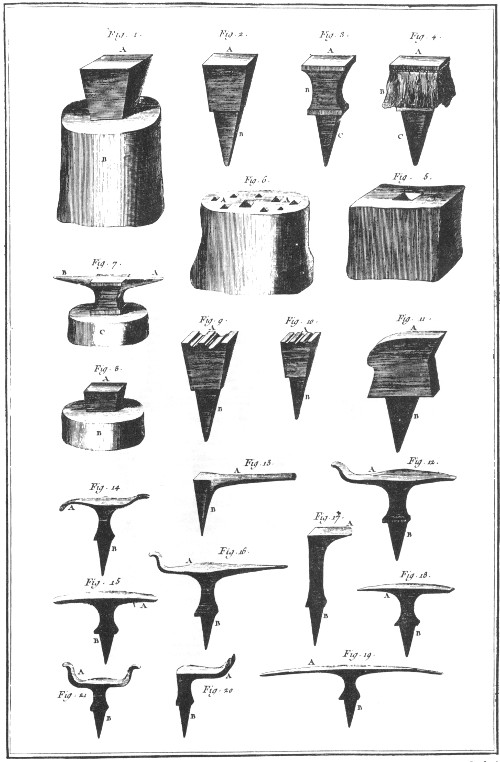
Shown here are a few of the larger anvils and stakes on which the silversmiths shaped their silver into the finished articles. Since the silversmith had no tool the exact shape of the articles he made, he had to employ many different shaped tools in the process of manufacture. DIDEROT.
28
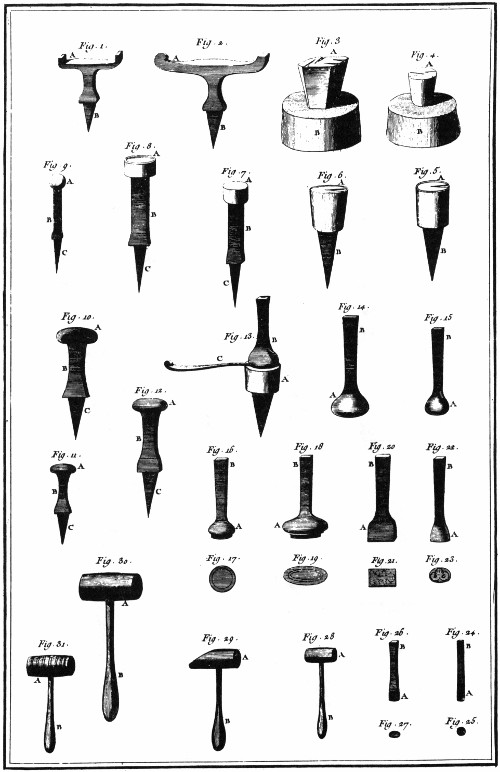
The silversmith often used small anvils, stakes, and dies. Figure 13, for instance, is a spoon mold used to make the final shape of the spoon. Figures 16, 18, 20, and 22 are button punches used to impress a design on smaller pieces. DIDEROT.
29
Stamping was normally used only in the forming of such small articles as the bowls of teaspoons. In this procedure a piece of silver was forged to the desired thickness and outline, and placed between a hollowed-out lower die and a rounded upper one. When the smith forced the two dies together by a blow of his heaviest hammer, the bowl of the spoon was formed. By filing, planishing, and polishing—and possibly some engraving—the one-piece spoon was quickly finished.
A soup ladle, having a much larger and deeper bowl, would have been formed by the raising process, with the handle made as a separate piece and soldered to the bowl. In fact, only the simplest articles and the smallest ones could be formed by one process alone. The accomplished colonial silversmith had to be able not only to refine and assay his own silver, but to work it up in any combination of techniques that the design made most appropriate.
As an example, the body and spout of a teapot might each have been formed by the seaming process, the base by forging, the top by raising, the finial by casting, and parts of the hinges by drawing. Then all the parts would have been soldered together and the piece planished, polished, and finished off with engraved, chased, or repoussé decoration—or a combination of these. Finally, the smith would have attached a wooden handle, which he might have obtained from a cabinetmaker—or made himself.
Among the silversmith’s final procedures would have been the stamping of his mark, his initials, or his name on the piece. This practice of identifying the maker of an article of gold or silver ware is of long standing, though perhaps not so ancient as the custom by which a painter or sculptor signs his work.
Since the year 1300 the Worshipful Company of Goldsmiths of the City of London has been charged by the British government with assaying gold and silver wares 30 and coins, and certifying that the metals are of required fineness. Throughout most of this long period the hallmarking of English silver articles has retained a basic continuity of tradition. Disregarding certain modifications and accretions (some noted in the caption above), every piece of sterling silver made in England since 1544 has borne four marks stamped on the back, bottom, or side.
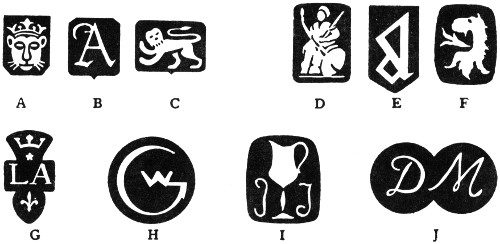
The hallmarks in the first line above and the maker’s marks in the second line illustrate the variety of markings used on English silver. The leopard’s head crowned (A) became the mark of the City of London; B and E are date letters; C is the lion passant denoting silver of sterling fineness. During the Britannia standard period (1697-1719), the lion’s head erased (F) replaced the leopard’s head crowned, Britannia (D), still optional, replaced the lion passant on London silver, and the standard of fineness was raised from 92.50% to 95.83%. Also, the law required the maker to use the first two letters of his last name, for example (G), the mark of Paul de Lamerie. It was the custom before and after this period for silversmiths to use initials. The marks of George Wickes, John Tuite, and Dorothy Mills are shown (H, I, and J) and examples of their work are in Colonial Williamsburg’s collection of English and American silver. Some of George Wickes’s tools may be among those currently used at the Golden Ball and the Geddy Shop.
One is the true hallmark, the symbol of the guildhall where it was assayed. That of the guild of London goldsmiths is the head of a leopard and has been in use for the nearly seven centuries since 1300. Assay offices established later in a few other cities use other symbols.
Another is the maker’s mark, which has been required since 1363. This mark is now always the maker’s initials, but once was more often his trade symbol.
In 1478 a system was adopted of dating each piece assayed by stamping it with one letter of the alphabet. For this 31 purpose a twenty-letter alphabet is used, the design of the letter or of the surrounding panel being changed every twenty years.
Finally, the mark of English sterling standard fineness—a lion passant—has been used (with one twenty-three-year interruption) since 1544 to certify that the metal is 92.5 per cent pure silver. English silver rarely bears the word “sterling,” which is commonly found on modern American silver and on that made in some other countries for sale to Americans. Hallmarking of British goldware is somewhat different.
Colonial American silversmiths did not adopt the elaborate marking tradition of the Old World. In the English colonies no legal requirements existed for marking of any kind, the guild system was not transplanted, and until 1814 there was not even an assay office. So colonial smiths put only their own mark on their work. At first this was composed of the maker’s initials only, but later became more often his surname, with or without initial. Some smiths also used a symbol—John Coney the figure of a rabbit, for example—but this was comparatively rare. Of the Williamsburg silversmiths we have positive or presumed maker’s marks of only two—James Geddy and Alexander Kerr.