THE GEDDY SHOP AND THE GOLDEN BALL TODAY
Reading edition
Two reconstructed silversmithing shops in Williamsburg once more stand in the same spots occupied by similar establishments in the eighteenth century. Both are operating craft shops where skilled workers in costume produce articles of gold and silver using methods and tools like those employed by James Craig, James Geddy, Jr., and other Williamsburg silversmiths two centuries ago. For reasons important to twentieth-century visitors, a partial division of functions has been established: The making of jewelry and smaller silver items and engraving are emphasized at the Golden Ball; the casting of silver (done at the Geddy 32 Foundry along with founding in other metals) and the making of larger pieces, particularly hollow ware, are more prominent at the Geddy Shop.
The original structure at the site of the Golden Ball, possibly built in 1724, remained standing until 1907, undergoing repairs and alterations from time to time. Craig had his shop in the western portion for a period before 1765, renting the space from James Carter, surgeon. In that year he bought the western fifteen feet of the house and lot, and the next year acquired the rest of it. After Craig’s death the building served its succeeding owners as a residence. The recollections of several old inhabitants of Williamsburg, a faded photograph, deeds, tax records, insurance policies, and excavated colonial brick foundations have all provided clues in reconstructing the building to its original outward appearance and inward room arrangement.
As for the shop itself, it has been designed and equipped—insofar as careful research and discerning imagination can make it—as it might have been in James Craig’s day. Lacking any descriptive material on the contents of the Golden Ball, the architects and curators have had to draw on other sources. The forge, for example, was designed and built in the image of forges described by Benvenuto Cellini and pictured in Diderot’s Encyclopedia. Some of the wall cabinets were made in imitation of those on display in European craft museums.
Much the same may be said of the Geddy Shop. Whereas the two-story, ell-shaped house dates to about 1750, the two shops of one and a half storys extending to the east of the house are reconstructed on original foundations still in the ground. James Geddy, Jr., probably worked on the premises before 1760, when he bought the house and lot from his mother. He rented out the easternmost shop but continued to practice silversmithing—presumably in the middle shop—until 1777 when he moved away and sold the property.
Since no records survive as to the interior arrangement 33 or contents of the shop, the architects and curators have again had to use their best judgment and the most appropriate precedents and parallels in designing and furnishing the shop. While none of the silversmithing tools now used in either of the two shops are those of James Craig or James Geddy, Jr., some of them may have belonged to an English silversmith of the eighteenth century by the name of George Wickes. One particular tool, a square “stake” or anvil, displayed in the Geddy Shop, once belonged to Paul Revere. It was given to Colonial Williamsburg by Mrs. Francis P. Garvan, whose husband’s outstanding collection of American silver is housed at Yale University.
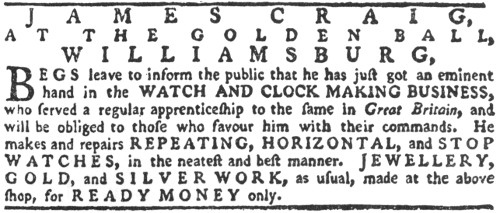
Advertisement appearing in Purdie and Dixon’s VIRGINIA GAZETTE on July 14, 1774.
JAMES CRAIG, AT THE GOLDEN BALL, WILLIAMSBURG,
BEGS leave to inform the public that he has just got an eminent hand in the WATCH AND CLOCK MAKING BUSINESS, who served a regular apprenticeship to the same in Great Britain, and will be obliged to those who favour him with their commands. He makes and repairs REPEATING, HORIZONTAL, and STOP WATCHES, in the neatest and best manner. JEWELLERY, GOLD, and SILVERWORK, as usual, made at the above shop, for READY MONEY only.
James Geddy repaired watches, advertising that “he still continues to clean and repair Watches, and repairs his own work that fails in a reasonable time, without any expense to the purchaser.” Rough castings in brass for spandrels to decorate the faces of clocks and many fragments of watch crystals have been found in the course of archaeological excavation of the Geddy property. On several occasions James Craig advertised that his customers could have “All Kinds of CLOCKS and WATCHES cleaned and repaired” in his shop, and twice announced that he had “just got an eminent Hand, in the WATCH and CLOCK MAKING BUSINESS, who served a regular Apprenticeship to the same in Great Britain.”
In cabinets of rooms adjoining both shops the visitor may examine a collection of silver, cutlery, jewelry, and 34 similar articles made in England and in the colonies during the eighteenth century. Of particular interest are the black enameled “mourning rings” so popular at that time. It was the custom for a man of wealth to provide in his will for the purchase of rings to be worn by members of his family and close friends. All Williamsburg silversmiths and jewelers advertised that they made mourning rings “on the shortest Notice.”
The contemporary silversmiths at the Geddy Shop and the Golden Ball do not make mourning rings—there is not much call for them these days. They do, however, make and sell a number of other articles of silver of true eighteenth-century design. For obvious reasons their supply of raw material comes from commercial refineries rather than from melted coins or plate. But they cast the silver, forge it, raise, seam, and solder it, and decorate the finished products just as did their predecessors.
Above all, today’s silversmith and his co-workers still hammer the lustrous metal with the same love of beauty that a sculptor might have. Indeed, the hammer is the silversmith’s most useful and in many ways his most delicate tool. With it he can produce effects in the metal that cannot be achieved in any other way. In fact, a fine silversmith must be able to wield a hammer much as an artist uses his brush—as if it were a natural extension of his arm.
35