WHAT THE EARLIEST MEN DID FOR US
Reading edition
You are now going to read a chapter of history. It will help you to see how our ancestors learned some things that are very common to us today, but which had to be learned before the wonderful comforts we enjoy were possible.
You will like to study history if you keep in mind that it does not just tell of something that happened a long time ago, but that it shows how our civilization with its homes and schools and churches and government and our great railroads and steamships and factories came into existence. The thing we call civilization has grown and changed in thousands of years much as you have grown and changed in the few years that you can remember.
You will need to read this selection very carefully. Your teacher will ask you the questions at the end and probably a good many more. See if you can read it the first time so thoroughly that you can answer all the questions. It will help you very much if you will write topics as you go along. In the fourth paragraph you will find a list of things that man has always needed. If you use each of these things as a heading and under it make a list of the steps of man's progress, you will probably find that you have mastered the selection.
History is the story of what men have done in the past. It was not until men had learned how to write that they could keep a record of what they did. But men lived upon the earth for many thousand years before they knew how to write. In that early time they learned how to do many things which we are still doing and to make many things which we are still making and using. In these ways they did much to make life what it is for us.
How is it possible for us to know anything about what life was like in those ancient times when men could not write? Did you ever find an Indian arrow-head? Perhaps you have seen a collection of stone arrow-heads and axes. These relics and others like them tell us many things about the people who made them. Then there are people now living, like the natives of Australia or some of the tribes of American Indians, who still use, or used until very recently, these crude stone implements, and who live very much as our own ancestors lived many thousand years ago.
The earliest men lived but little better than the animals in the forest about them. They were without shelter or clothing and had only such food as they could find from day to day. Men have either found or made everything that we now have. Early man possessed a great advantage over all the animals because he had a better brain and a wonderful pair of hands with which he could make the weapons, tools, and other things that he needed.
Men have always needed food, shelter, clothing, and the means of protection against the dangers around them. It took our early ancestors many thousand years to learn how to provide themselves with these simple necessities of life.
At first men lived upon the roots, herbs, wild berries, and fruits in the forest. Sometimes they found birds' nests in the trees and ate the eggs or the young birds. Occasionally they found a dead bird or animal and thus learned to like the taste of flesh. They hunted for shellfish by the seashore and caught fish in the streams and lakes. Then they began to kill the smaller animals with stones or clubs and in this way they became meat eaters. When men had learned how to make knives, spears, and bows and arrows, they could kill the larger animals and get a better supply of food.
For a long time all food was eaten raw, because the use of fire was unknown. We do not know how man discovered fire. He may have kindled it first from a tree set aflame by the lightning. By and by he found that a spark could be produced by striking two stones together in the right way or that he could make a fire by rubbing two pieces of wood together.
The making of fire was one of the most wonderful inventions in the world. Men could now cook their food. At first they roasted bits of meat before the blaze or in the hot ashes. Later, when they had learned how to make vessels that would hold water, they began to boil all kinds of food over the fire.
For a long time men procured their food by hunting, trapping, and fishing. During this time they began to capture and tame the young of some of the wild animals. Probably the dog was the first domestic animal. The cow was also domesticated at a very early period. Man used her meat and milk for food and her skin for clothing. He made tools and implements out of her bones and horns. No other animal has been more useful to him. The goat and the sheep, the hog and the ass, and later the horse, were tamed by early men long before real history began. After these animals had been domesticated by the hunters and trappers, some men became shepherds and herdsmen and wandered from place to place with their flocks and herds in search of the best pastures.
Presently another step was taken toward civilized life. Men had long known that the seeds of some of the wild grasses and plants were good to eat. Now some one noticed that if these seeds were sown they sprang up and brought forth many more seeds. Then it was discovered that the seeds grew better and yielded a more abundant crop if the ground were broken up and made soft before the seed was sown. Because of these discoveries some men began to be farmers. By cultivation, the wild grasses which grew in the fields or beside the rivers were developed into wheat, oats, barley, and rice, the great cereals of the world.
When men began to procure their food by cultivating the soil it became necessary for them to remain in the same place in order to gather the harvest when it ripened. They could no longer wander from place to place as they had done when they were only hunters or shepherds. They now began to live in permanent villages and to cultivate the land lying near by. In this way the beginning of farming led to a settled life and the making of permanent homes.
Probably the earliest men had only such shelter from the rain and protection from wild animals as the trees gave them. After a time men began to live in dens and caves in the earth. These people are called the "cave dwellers". Still later men built huts by bending young trees together, weaving branches between them, and covering the whole structure with leaves and bark. When the hut was built of poles covered with the skins of animals it became a tent. Many of the people who wandered from place to place with their flocks and herds dwelt in tents.
When men settled near the fields that they were beginning to cultivate, they built permanent homes of stone plastered with mud or of bricks made of clay and dried in the sun. The roofs were covered with brush or timber. Then fire places and rude chimneys were added to these simple houses, and in other ways man's dwelling place was gradually improved.
The first clothing was probably made from the leaves of trees or from grasses matted together. When man became a good hunter he wore the skins of the animals that he killed. The ancestors of all of us were once clad in skins. The women of those early days used to cure the skins of small animals by drying them. They then made garments of them by sewing them together with needles of bone and the sinews of animals for thread.
The women scraped and worked the large skins until they were soft and pliable. These they used for clothing, or for blankets, or for the covering of their tents. Still later, the women learned to spin yarn from wool sheared from the sheep and from the thread of the flax which they were beginning to raise. The next step was to weave the yarn and the thread into woolen and linen cloth.
It was because early man had the mind to invent and the hands to make the weapons, tools, and utensils which he needed that he was able to make such progress in procuring food, shelter, and clothing.
Man's first weapon was a club. A stone which he used to crack nuts with probably was his earliest tool. At first he simply found stones of the right shape for his purpose. Then he began to chip a piece of flint until it had a rough edge. Now he had a hatchet as well as a hammer. Because he held this hatchet in his hand it has been called a fist-hatchet. A great many of these fist-hatchets have been found. In the course of time man learned how to use thongs of rawhide to bind handles to his fist-hatchets. Now he had axes and spears.
It was a great day in the long climb toward civilized ways of living when some unknown inventor made the first bow. With arrows tipped with sharp bits of stone, man could now kill the larger animals. Stone knives were used to skin the game. Flint scrapers and other implements were very useful in scraping and softening the skins to fit them for use.
By using pieces of flint with rough edges as saws and files, men began to make tools of horn, bones, and shells. They now possessed daggers and hammers of horn and awls and needles of bone.
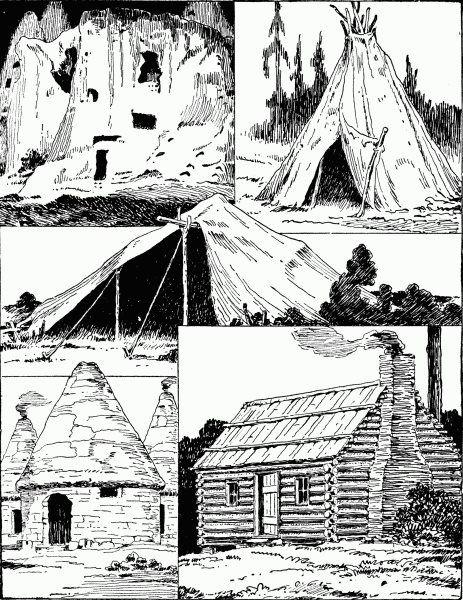
The Evolution of the House
For many thousand years, stone arrow-heads, knives, and axes were made with rough, chipped edges. This time is sometimes called the Old Stone Age. When men had learned to make better tools of their stone knives and axes by grinding and polishing them to a smooth, sharp edge, they had entered upon the New Stone Age.
The next great forward step in human progress was taken when men discovered metals and began to use them. Copper was the first metal used, but it was soon found that it was too soft for making many articles.
Presently it was discovered that if a little tin were mixed with the copper it made a harder metal called bronze. So many weapons, tools, and ornaments were made of bronze that the time when it was used is called the Bronze Age.
Iron is the most useful of all the metals. It is much harder than bronze and better suited in every way for making tools and implements. It took man a long time to learn how to use it, because it is not so easy to work as copper and bronze. When man made this "king of metals" his servant, he traveled a long, long way on the road which leads to civilization.
The men invented the weapons and some of the tools of the earliest ages. But it is probable that the women first made many useful tools and utensils. Women wove the first baskets to use in gathering and carrying berries, nuts, and other articles of food. They used to cover fish with clay in order to bake them in the coals and they noticed how the fires hardened the clay. Then by molding clay over baskets so that they could be hung over the fire, women gradually learned how to make earthenware pots and bowls. Afterwards they cut spoons, ladles, and drinking cups from shells, gourds, and the horns of animals. In these ways our foremothers made their first cooking utensils and their first dishes for holding and serving food and drink.
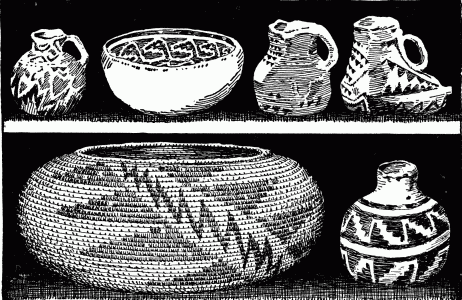
Clay Bowls and Woven Baskets
Women were not only the first basket-makers and potters. They were also the first spinners and weavers. They ground the first grain into flour with mortars and pestles of stone. Later they made simple mills for this purpose. In fact, women who lived before the dawn of history, began nearly all the household arts and crafts and in this way helped all the people who have lived since then.
Our earliest ancestors, like ourselves, found it necessary to carry things from place to place. But they lived long before the days of the railroad and the steamship. The first burdens were borne by the women. They followed the men who hunted, and carried the meat and the hides of the slain animals back to the camp. After the dog, the donkey, and the horse had been tamed, articles to be transported were packed upon their backs or dragged upon the ground behind them. Sleds were made in the northern lands. Canoes and boats were built by the dwellers by the rivers and the sea. Last of all, the wheeled cart was invented. All these things are older than history.
We often call our own time the age of invention. The steam engine, the telegraph, and the many uses of electricity are all modern. They have made wonderful changes in our ways of living. But these changes in our lives are not as remarkable as were those made in the lives of our earliest ancestors so long ago by such inventions as the fishhook and the bow and arrow, and such discoveries as how to make fire, how to make pottery, how to domesticate animals and plants, and how to smelt and work the metals.
Nowadays children have homes and are cared for by their parents. Among the very earliest men there was nothing like our homes or our families. Each person found his own food and took care of himself. Of course, mothers cared for their babies, but nobody took care of a child after he was large enough to find his own food. Then he had to shift for himself. When he wanted his breakfast or his dinner he dug roots or hunted for berries, nuts, or acorns. Sometimes he feasted upon birds' eggs or upon a rabbit or a squirrel which he had caught. The honey which he found in the nests of the wild bees was his only candy and he was apt to get well stung in taking it. He lived in constant fear of the wild animals around him and usually slept in a tree for safety. He spent his entire life in this way.
There are many things that people can do better by working together. It took many years for early men to learn to help one another. When they became cave dwellers and learned how to make fire, the first family group began to be formed. This group was called the clan. The clan simply means those who were kin to each other; that is, a number of men and women who believed that they were descended from a common ancestor. At first the common ancestor was a woman, the clan mother. In those days, relationship was always counted on the mother's side. When a man married he went to live with the clan of his wife. In the course of time groups of clans came to be called tribes.
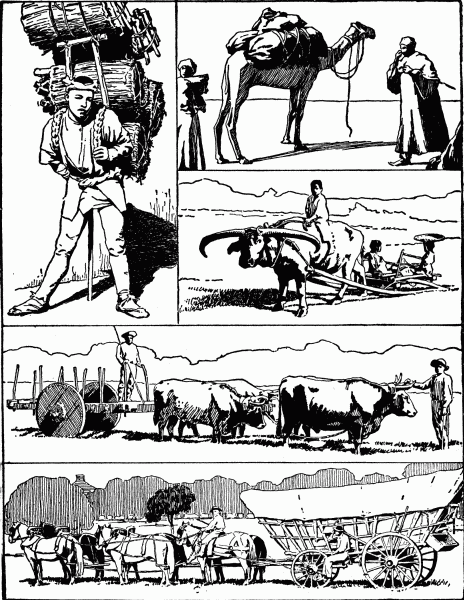
The Development of Transportation
A long time later, after the animals had been domesticated and men had come to own flocks and herds and other things that we call property, the father became the head of the family, as we know it today. Our kind of a family with the father as its head existed before history began.
Words had to be invented, just as tools were. At first men had no language. Very slowly they gave names to the things about them and learned to talk to each other. Mothers sang jingles and lullabies to their babies. Around the campfire at night men told how they had hunted the wild beasts. Women talked as they gathered and prepared food or dressed the skins of the wild animals. Mothers wanted their children to be brave and wise, so they told them stories about the bravest and wisest of their clan in the olden time. Perhaps this is why children, and older people too for that matter, have always been fond of stories. In these ways languages grew and the simple beginnings of literature were made.
People have always been fond of ornaments. The earliest men wore necklaces of teeth and claws. Later they made beads of bronze or of gold. The women tried to make their baskets and their clothes as beautiful as possible by coloring them with natural dyes. Some of the men liked to draw pictures of wild animals upon pieces of bone or upon the walls of their homes in the caves. People learned to count upon their fingers, and to use various parts of their bodies, like the finger, the hand, and the arm, as measures of length. For example, the cubit of which we read in the Bible was the distance from the elbow to the end of the middle finger. Our arts and sciences have grown from such crude and simple beginnings.
Our early ancestors lived in fear of many things about them. They thought that fire, the rivers, the sea, the sun, and many other natural objects were alive and could harm them or help them. So they offered gifts to all these things and prayed to them for help. Early men also believed that the souls of their ancestors lived after death, and that these ancestors could help them or harm them. They thought that if they offered gifts of food, and drink at the graves of their dead, the spirits of the departed would be pleased and would protect the living members of their families. If, on the other hand, the dead were neglected or forgotten they would become evil spirits who might bring great misfortune upon the living. They also thought that if the dead were not properly buried they would become ghosts, haunting the places they had known when they were alive. Because of these ideas early men were very careful to worship their ancestors. The first religions of the world grew out of these beliefs and practices of primitive men with reference to nature and to their own ancestors.
—From "Our Beginnings in Europe and America", by Smith Burnham. Courtesy of The John C. Winston Co.
Questions
1. Make a list of the things in everyday life which we take for granted as necessities which the earliest men had to learn how to make.
2. What was the earliest important discovery made by man? Do you think this was as important as the discovery of electricity? Why? Name any inventions that have come into common use within your own or your parents' lifetime.
3. Before man discovered fire, what did he eat? Mention two steps by which he came to have better food to eat.
4. Mention in order five kinds of dwellings which the early men lived in, and three kinds of clothing which they wore.
5. What useful things did women do in these early days?
6. Why is your hand more useful than the paw of an animal?
7. From what source did each article of food on your dinner table to-day come? How many people had something to do with this food before it reached you?
8. Compare the clothing of people to-day with that of primitive man. Are we more or less dependent on others for food and clothing than primitive man?
9. We are still making new words. Make a list of words that have come into use since the World War began.