Front matter (continued 5)
Reading edition
Sir Gordon rose from the upholstered rail in front of the fireplace where he had been sitting, put down his empty coffee-cup, then stood up with the air of taking charge personally of Hal's tangled affairs.
"Well, Hal, my boy, you have come back prepared I presume to settle down, settle down to some career befitting an English gentleman." Sir Gordon paused to draw Hal's fire. As the young man did not dispute this assumption, he continued with patronizing pomposity.
"We must place you. We must place you, my boy. It won't be an easy matter, will it? Of course you can't go into trade. The Army is the only gentleman's game, but—we must not speak of that. We must not speak of that," and he hastened to get away from a subject so painful. "Now, how about the church?"
"The church?" asked Hal with a laugh.
"Oh, your father could get you a living." Then he added hastily: "It's respectable at least."
"For me? The church?"
"Oh, you don't have to go in for religion; oh, no; oh, my, no! None of that bally rot."
Seeing that her amiable husband was in very deep water, Winifred reached out her hand and encouraged him to go deeper.
"Hal, how stupid of you," she said. "You have assistants, curates, and that sort of thing who do the religion for you. You ride to hounds, play cricket for your county, and enjoy similar spiritual diversions."
"Well, you must do something," said Sir Gordon petulantly, annoyed with the young man's levity. "Of course whatever you decide to try, it is going to be a long hard struggle to live down the Army record; still with time and pluck it may be done. You are an earl's son and you have influential relatives. Well, then, how about politics?"
"Sit in the House and listen to the gabble on the Old Age Pensions and The Licensing Bill? I'd rather be a suffragette and go to jail."
Sir Gordon had exhausted the careers. It wasn't a career exactly, but people went in for it and it was a devilish nice thing to go in for.
"Well," he suggested, "there's the life of a country gentleman."
"The country would be all right," said Hal, "if the people would only stay away. They spoil everything. Even the gardens are as formal as the odious people, and the flowers, even the flowers, are made to look stiff and stuck-up and well-behaved, as if they felt they, too, were on exhibition and might be talked about. The country is only another setting for teas, tennis, and top hats, bridge, scandal, and flirting with each other's wives."
"Well, there's shooting," said Sir Gordon in desperation. "You used to like shooting."
"Yes, before people shot in mobs, and made it a function. Now they go into the solitudes, the cosey solitudes, with footmen, a French cook, vintage wines, and a Hungarian band."
Sir Gordon did not realize that his wife and Hal were having fun with his prejudices. He was on the edge of losing his patience.
"Well, if you stay here—" He was annoyed to observe that he had raised his voice almost to a vulgar scream. He repeated the phrase in a more temperate key. "If you stay here——"
"But I'm not going to stay here, Gordon. It's the West for me. It's in my blood. When I've visited with father and arranged one or two important matters, I'm goin' back to God's country."
"Bravo, Hal," exclaimed Lady Winifred. "If you stay here you'll end by becoming a conventional little snob, and I should hate you. No; go back to your shirt-sleeve crowd."
"Well, my dear boy," exclaimed Gordon completely nonplussed; "I can't make you out," and he made up his mind to beat a hasty retreat to the United Service Club, where anarchy was not petted and spoiled and fed on chocolate bonbons. Then he thought of something and came back.
"Winifred, speak to Hal about that."
"About what?" inquired Hal.
Again he lost some of his habitual poise in the fervor of his convictions.
"You must put your foot down, Hal; you really must—'er—for our sakes as well as for your own. You ought—er—Winifred will tell you," and the old soldier scrambled out of the trench and effected a most disorderly retreat.
His cousin Winifred was about six years older than Hal, and in all the memories of his childhood and boyhood she was the one bright spot. His step-mother had died when he was but a lad. His father was much occupied with public affairs. No one else seemed to care to understand the queer little chap except this tall, queer girl. She stood by and encouraged him to whip the first little brat that called him an insulting name, a name suggested by his color. Then she washed and wiped his resulting wounds, and encouraged him to believe that he was in the path of duty and on the road to glory. Thus encouraged, the shy, timid lad had quickly developed into a fierce little warrior, and it was Winifred who somehow realized and foresaw that if he were ever to enjoy the blessings of peace he would have to fight for them, and she got the head gardener's son who had a distinguished reputation as an amateur pugilist, to teach him how to box, an accomplishment in which he soon distanced his teacher, and one which was destined to be of the greatest service to him in his subsequent career. His readiness to meet all comers and his demonstrated ability to do so was his passport through life.
He had fought every step of the way from childhood to manhood. A battle or series of battles marked every change in environment, in school, in college, in his preparations for a military career. Soon it came as a routine. He knew he would have to "lick somebody" in order to be let alone. It didn't worry him, and he didn't seek these encounters, but he didn't mind them. In fact, it was one of the things he did exceptionally well. When he joined a swell regiment he had a terrific struggle to stay. He was "ragged" unmercifully, but he took his medicine, and before he was forced out, the regiment was ordered into the field, went through a campaign in which he had opportunities, which he eagerly accepted and with brilliant results, results which he took modestly. Eventually he compelled respect from his brother officers, but it was earned. Oh, it was earned! In all this bitter struggle with environment Cousin Winifred, this woman "with the serpent's tongue," was the only soul who knew and understood. He came over to her and put his hands affectionately on her shoulders.
"What is it you're to tell me?" he asked her.
"Dear, simple soul, he expects you to change Edith."
"Change Edith, eh?" Hal walked away with a queer look on his face. She continued: "One can dam a river and change its course. You can't do that with a woman. Edith will go on being Edith, I fancy, to the end of the chapter."
"She seems to be still rather careless of appearances," he said.
"She never was discreet, but there are many safely on the inside who are quite as careless. At all events, she's kept out of the papers. That's something. See here."
She showed him a London society journal whose leaves she had been turning and glancing at in a desultory fashion, one of those hybrid products of modern life which make a specialty of social garbage and elevate blackmail to the point of high art; a journal which every one calls "a rag" and which all smart people read religiously. Hal took it and glanced through the article hastily.
It was an account of a "well-known society woman," "name withheld out of consideration for her distinguished relatives and friends," who was found by a police officer wandering aimlessly in Hyde Park and utterly unable to give a lucid account of herself. Sir George Blank, a well-known specialist in nervous diseases, happens to be driving by, recognizes the unhappy lady, who is apparently under the influence of a powerful drug, and takes her to her home, etc., etc., etc.
"How awful!" he said. "Do you suppose it's true?"
"My dear boy, these things are becoming so common we're no longer shocked by them. Society has its favorites, and it has a broad mantle of charity for its favorites, but obviously one mustn't parade one's sins in Hyde Park. Edith hasn't been a huge social success, but she has kept out of the papers; she is still possible and she never gives up. She is still at it—climbing, climbing."
"And Lord Yester is the latest ladder, eh?"
"Why, you haven't been in England more than a few minutes. How did you find that out?"
"Why, my friend Grafton laid one of these illustrated papers down on the seat beside me as we came up in the train. I saw a picture of Edith and Lord Yester, and I had the pleasure of reading 'an open letter' to my wife. It was very instructive. I thought you said she had kept out of the papers."
"Oh, that's a small matter. That isn't publicity. That 'open letter' attention is merely an acknowledgment of her social prominence. That is a trifle. Lady Lucretia Burk-Owsley is dancing in one of our music halls. Now, you might object to that, though her husband, I understand, rather enjoys its democracy. It sort of takes the whole of London into the bosom of the family. She can't dance, of course, but she's a revelation. You must see it. Oh, we're not standing still."
"And Lord Yester?" suggested Hal. "What is his raison d'être?"
"Lord Yester's vocation is Edith, his avocation is being next in succession to the old Duke of Uxminster, and the Duke is feeble enough to satisfy even the most impatient heir."
"A duchess, eh?"
"Nothing short of that."
"But Yester," objected Hal in dreamy retrospection; "Yester's a boy. His father, though he was old enough to be my father, was a pal of mine. We served together in South Africa. Why you remember, Winifred? He was forced into retirement because he justified my disobedience and refused to be silenced—God bless him! One of the few friends I've had in the world! His son, eh? Why, the youngster must be just out of his perambulator."
"Some women as they grow older suddenly display a fondness for children. When a woman has escaped being a mother, she sometimes meets her fate in the grandmother class."
"He's rather a nice child, if I remember correctly," said Hal.
"Well, not a 'double-first,' not an intellectual giant, but a nicely brought-up child; a credit to his nurse, and, incidentally, just at the age to be madly in love with a married woman, married, of course, to a clod who cannot possibly understand her."
Hal laughed.
"Yes, the clod understands that. They have already made their plans, I suppose?"
"Oh, yes; and you're just in time to give the bride away. Now there's a novelty, and they're rare these days—a wedding in which the ex-husband is the new husband's best man. No? Well, Edith pays you the compliment of believing that you will behave very well under the circumstances. I was expected to prepare you for the inevitable and, if possible, soften the blow."
"And Lord Yester—is he willing?"
"Willing? Strenuously, madly willing. Personally, I think you are in tremendous luck. I congratulate you upon your prospective deliverance with all my heart."
Lady Winifred continued to play with the situation, turning it inside and outside, holding it up to fantastic derision, until she saw that he was not listening. The strain was off. He had resigned himself to pleasant dreams. He had been pulling against wind and tide, every muscle, every nerve stretched to cracking, his head bursting, his heart breaking, and making no progress, barely holding his own. Now the tide had turned. The storm had passed. He could take in his oars, sit in the stern, and just keep her in the current, the current that was bearing him on to his desires. He could rest in delicious lethargy and see the flowers and gardens on the bank, and see at the end of the beautiful journey Wah-na-gi standing on the rock, holding out her arms to him.
"How do you do, Harold? Welcome home."
Edith stood holding out her hand to him.
CHAPTER XIX
Instead of the little bronze figure in the buckskin dress with its straight, simple lines, as straight and simple as the soul within it, he saw a white woman, preternaturally white, the complex product of nature and art, where the dressmaker, the hair-dresser, and the jeweller had done their latest and best, with the soft, warm, dark colors of the library as a noble background, a chromatic frame. Her Paquin gown of canary yellow, cut very low, was bordered and outlined with dark-brown marabou feathers. On her dazzling neck rested a string of emeralds, the gift of Lord Yester. Her red hair was dressed, buttressed and supplemented by braids, coils and puffs, and surmounted by a diamond tiara. Her white hands were covered with rings, many of them with a history. This ornate combination was concealing and exposing an individuality more complex still, its barbaric impulses crossed and seamed and twisted by generations of acquired stress and strain. She was a radiant creature, conscious of her charms, but about her agate eyes were gathering little signals of distress, grave, insistent warnings, destined not to be heeded, saying that she had lived too fast, that she was at the zenith, the climax, that the descent would be quick and rapid. The wonderful mechanism wasn't working smoothly. "How do you do, Harold? Welcome home." And an extended hand. And this was her husband, returned from a long journey.
"Thank you, Edith," and he took her hand. She did not offer to kiss him and she gave him only one hand. He might have been a stranger to whom she had just been introduced. Indeed, she would have had more interest in a stranger. They had gone past even the forms of domestic procedure.
"Winifred," said her cousin, "Lord Yester is in the drawing-room. You get on so well together. Would you mind?"
"Not at all."
"I just want a moment's chat with Harold."
Winifred glanced at them with a cynical smile as she went out of the room. The situation appealed to her supreme love of contrast.
"You'll pardon my running off to-night, Harold; won't you? You see I didn't know in time, and I couldn't very well break a previous engagement. I asked Winifred to take my place and make you feel at home." And she undulated over to the railing before the fireplace and sat down in the genial glow in an indolent cat-like way. The fog had penetrated into the house and there was a chill in the dampness. She knew, too, that the fire shot strange lights into her hair and over her jewels and neck, and the desire to excite admiration was instinctive and ever present.
"Winifred is good company and she did her best," said Hal simply.
"And I knew that after a little chat with Winifred—well—that you would know all there was to know, and that there wouldn't be anything left for me to tell."
It was evident that neither woman had any illusions about the other. The attitude of rest and repose was only momentary. She got up restlessly and came forward, her eyes bent with fierce concentration upon his.
"Of course you haven't come back with the idea of changing anything?"
"Your attitude would seem to make that hopeless, Edith."
She was relieved. It was not to be open war, then. She turned half away, let her eyelids droop, and surveyed and measured him from underneath them. It gave her an oriental look.
"My dear Harold, it is too late for pretence between us. You will welcome a release quite as eagerly as I shall; and so we ought to be able to arrange matters. We have investigated your movements since you have been away and the name of the Indian woman will serve our purposes."
This produced a most disagreeable impression upon Hal.
"No," he said with a slow drawl that had menace in it. "No, I think not."
Edith turned and looked at him in amazement. It was a formality, one of those unpleasant formalities the silly law made necessary. The woman in view would never know of it, wouldn't care if she did. It seemed much the easier way. To her look of genteel astonishment he said in explanation:
"You see she is nothing but a savage. She wouldn't understand our refinements."
She laughed at his irony. Then he was in love, romantically in love. She laughed joyously. It seemed to make his acquiescence very certain.
"I won't oppose your application," she heard him say.
Of course he would not. Why should he? He loved this Indian woman. Her fears of a moment ago seemed childish, silly. She felt the situation pliant in her soft, cruel hand. Her heart leaped up within her. Her barque, too, was floating with the stream. It was a pleasure barge smothered in flowers but crowned with a coronet, and as it spread its silken sails to the perfumed breeze, everywhere in the crowded roadway shipping gave way and place, salutes were fired, and everywhere the air was thick with adulation and acclaim. And no small part of the anticipated triumph were the scowls of the envious and the evening of old scores.
"I make two stipulations," she heard him say.
She held her breath. Had he led her on only to tell her at last that he would fight her application—refuse her freedom? She knew she was at his mercy. He could exact bitter terms. He could in fact prevent the consummation of her crowning ambitions; could wreck the whole elaborate structure of her life. Her assured happiness seemed suddenly threatened. In a hysterical moment she saw it in ruins. Instantly her plans and prospects assumed an importance and insistence they had never had before. At the thought that he might stand in her way she was filled with an insane fury. Still she waited. What would he demand?
"You must not bring the Indian woman's name into the affair."
Heavens! Was that all? Willing victims and accomplices were to be found. What else?
"And you must take no steps while my father lives."
She passed in a second from death unto life. The Earl was clinging to existence by a thread. Hal hadn't even bargained for the return of the jewels he had given her. She felt that she must make some show of resistance or the terms would be changed. It was too ridiculously simple.
"Of course Lord Yester's wishes must not be ignored."
"I cannot allow you or Lord Yester to decide that for me."
He turned away as he spoke and so was not aware that Lord Yester had entered the room in time to hear this reference to himself. It is universally conceded that it requires courage to interfere between husband and wife; but then Lord Yester was a brave little man. He could wait no longer. His fate, too, was being decided in the library. He felt he must have a voice in deciding it. More than that, she needed him, this soft, plaintive soul that had come through time and space, through sin and suffering, to meet him, her complement, her supplement. Small, slender, with a delicate, sensitive face, distinguished by regular but small features, he had a fine, fresh, unspoiled capacity for suffering, which she teased and worried and played with for her infinite amusement. Quite apart from his coming coronet, she was in love with him; that is, she was a pyromaniac, and she got sensations from seeing his emotions burn, the fresh, beautiful emotions of a poet and a child.
"Harold, I don't think you have met Lord Norman Yester?"
She was the only one of the three who was without embarrassment.
"Yes, I think I met Lord Yester when he was at Eton."
Hal had no intention of making the other uncomfortable.
The clod! thought Yester; the clumsy clod! Eton, indeed! Everything about the boy was small except his spirit. He was like a child who says: "I'm six, going on seven."
"Yes?" he said with a supercilious elevation of the brows. "That was such a long time ago, I had quite forgotten it."
Having put the unpleasant husband in his place, he turned to her with the utmost deference, to the wronged and neglected wife.
"Edith," he said gently—"Lady Effington," he corrected himself and bowed formally to her husband. It was a delightfully ingenuous thing to do. Hal smiled, but not in derision. In fact, he liked the boy. What a funny little mediaeval gentleman!
"Lady Effington," continued Sir Launcelot (pocket edition), "if you can feel that I am worthy of your confidence, perhaps you will leave your interests in my hands—er—in our hands!"
Again he forgot the unpleasant husband and again he bowed an apology for his breach of etiquette.
"Thank you, Lord Yester," she said with a gravity and dignity equal to his own. To Hal it was like a play—this elaborate formality, this adroit indirectness, this dexterity in handling high explosives in a perfectly safe and genteel way, this modern capacity to bring everything down to a common denominator. He could play the game too, but what a long way it seemed from Red Butte Ranch, Big Bill, John McCloud, McShay, and Wah-na-gi, 'the soul without a body'!
"Lord Effington and I are both men of the world," Hal heard the youngster say. "It ought not to be difficult for us to—to—arrive at an understanding."
Lord Yester had his thumbs in the armholes of his waistcoat, his chest was thrown out, and he was balancing himself on the ball of his foot. It was an acquired mannerism that seemed to add to his height. Like all small men, he was fond of referring to the fact that Napoleon was not a giant.
Edith inclined her beautiful head forward at an angle of supreme deference.
"I leave my happiness in your hands, with the utmost confidence in you both," she said gracefully as she swept out of the room. Lord Yester met her as she moved and gave her the homage of his protection to the door! The movement left the husband in the position of a rank outsider.
What fun Edith must have had, Hal thought, in playing up to these ideals! Edith, who had no ideals of her own.
When Yester returned the two men looked at each other; there was an awkward pause, each man cleared his throat, and each waited for the other to begin.
"Will you smoke?" asked Hal with a motion to the cigars. The youngster made a nervous start toward the table, then it occurred to him that he could not meet on such a friendly basis the man who had treated with inhuman cruelty the woman who had thrown herself upon his protection; so he stopped short and very awkwardly said:
"No! thank you; no, no!"
Again an awkward pause.
"Will you sit down?"
That seemed consistent with dignity and he started to do so, but again recoiled.
"I—eh—I feel more comfortable standing, if you don't mind."
Hal bowed. Yester's awkwardness was catching. He lounged across the room, sat down on the rail before the fire, and lit a cigarette. He could wait. Yester fiddled with his collar, stroked his cheek, and fidgeted.
"This is—this is rather a delicate situation, isn't it?" he said at last with a little deprecatory, nervous smile.
"Nothing seems unusual or impossible these days," said Hal easily.
"Well, you see," said the other, "I was intended for the diplomatic service, but I'm afraid I'm rather direct."
What a kid it was, thought Hal.
"An engaging frankness is sometimes the highest form of diplomacy," he said encouragingly.
"Well, you see," said the other gathering courage, "she has come to rely on me so completely, on my judgment as it were——"
"She? Oh, yes, my wife."
"Yes, yes," eagerly assented the lover, so absorbed in his own romance as to be beautifully oblivious to any other point of view. Hal smoked and kept an inscrutable face, while his heart sang within him, going with the wind and tide, going out of these eddies, these twists and turns, out into the broad ocean and on to a new world.
Yester walked over to the writing-table and began to play nervously with its furnishings.
"I wanted to say certain things to you, and I—I—I find I hardly know how." Then he pulled himself together as his mind went back over their acquaintance. "You see, as she had no other friends, as she was in trouble and in bad health, my sympathies were naturally enlisted, and almost before either of us realized it—well, you see, while I think you have behaved very badly, I—eh—now that we have met, I—will you let me say, I feel very sorry for you?"
The ingenuousness of this was completely disarming. Hal loved the child. But he continued to treat the situation with becoming gravity, bowed formally, and said:
"That's very generous of you."
"At the same time," exclaimed the little man returning to his purpose, "it is her happiness that must concern us both, isn't it? And I can only say that if you can accept the inevitable—well and good! If not," and again he balanced himself on his toes and expanded his chest; "if not, I stand ready to face the alternative."
Alternative sounded ominous. What did it mean?
"Alternative?" said Hal puzzled.
"I'll meet you under any terms and conditions you may name."
"'Meet me?' Oh, yes," and he smiled in spite of himself. "Why, duelling is illegal, isn't it? It's worse than illegal; it's unfashionable." He rose and went over to the boy and looked down at him with a protecting air. "I shouldn't want to take the life of such a gallant little gentleman, and I should care even less to have you take mine. I'm afraid I'm hopelessly commonplace."
Hal's attitude in spite of himself was too obvious.
"I'm afraid that is too evident, Lord Effington," said Yester sharply, resenting the overlordship of the other. "And may I suggest," he added with growing irritation, "that I am not so much younger and smaller than yourself that you need persist in patronizing me?"
"I beg your pardon. I had no intention of doing that." Then he looked at him very seriously and added: "I hope for the sake of my middle-class conscience you know what you are doing."
"I feel quite capable of deciding that," replied the boy easily. "I know something of the world—something, I fancy, of women!"
"And you are almost of age," added Hal.
"I am about to attain my majority," said Yester stiffly. "And when I do——"
"You hope to celebrate it by your marriage to my wife?"
The other bowed with an engaging smile.
"Quite so. Well, I shall not stand in the way of your happiness, Lord Yester."
"That is very noble of you."
"I'm afraid it's rather selfish of me. Your happiness happens to correspond with mine. And I hope in the future you will never have cause to think bitterly of me."
In Hal's eyes lurked an embryo twinkle. What a ripping farce civilization was!
"On the contrary," said Yester, happy beyond words, "I think you have behaved exceedingly well. You conceal your sufferings like a soldier and you join me in protecting the good name of the woman we have both loved. I can only say that you have acted like a gentleman, Lord Effington."
Both men bowed formally.
"Lord Yester," said Hal; "your father once did me a great service. I hope we shall always be friends?"
And they shook hands.
"Oh, Sir George, you know Lord Yester, I think?"
Hal spoke to the physician who had entered from the hall.
Both men bowed slightly. Hal turned to the heir of the Duke of Uxminster.
"Lady Effington will explain to you the only conditions I make. They are very slight and I am sure will meet with your approval."
"Thank you," and the little fellow bowed elaborately to each man and left the room with his arms folded behind him, an attitude very much affected by Napoleon, if we may trust the pictures.
It was with difficulty that Hal refrained from laughter. What a farce, but what a joyous farce! Already he was mentally speculating on the time when he could turn his back on these attitudinizing people with their picture-poster lives, on all this hollow, artificial make-believe, and return to the shirtsleeve crowd. What joy he would bring to one soul! He saw her face as he said to her:
"I'm coming back, Wah-na-gi; I'm coming back." He had forgotten Sir George.
"I beg your pardon, Sir George. Delightful little chap, Yester! Eh? I wonder if I was ever as young as that."
It was evident that Yester's attentions to the wife of another man had not been a recommendation to the sedate scientist. He said dryly: "I don't know whether he's a fool or a knave."
"Well, he isn't either," said Hal. "He's been reading 'Ivanhoe'! You wanted to speak to me of father, Sir George."
"No, my boy; it's in regard to your wife."
Sir George had not only been the Earl's medical adviser as far back as Hal could remember but he had also been his intimate friend as well. Hal was thinking of other things, planning his escape, picturing the welcome the West was keeping for her child, or he would have noticed an extra consideration in the doctor's tone, an added solicitude in his manner.
"Edith?" he queried indifferently and with polite surprise.
"Yes; sit down." The doctor motioned to the little sofa which had its back against the writing-table. Hal sat down carelessly and picked up from the seat the society journal Lady Winifred had put into his hands a few moments before and began to turn its leaves and glance at its pictures, but in a cursory way and with an inclination of the head toward the physician to indicate that he was listening. Of course Sir George did not know—how could he?—that he and Edith had passed into different worlds.
Sir George himself was a study as he stood for a second regarding the other. How was it this custodian of other people's secrets and sorrows, forever intimate with sickness and pain, could look so sufficient, so impeccable, so serene? Well groomed, smooth, and polished to his finger tips, there seemed no surface where trouble or anxiety might stick.
Was it an armor or was it his integument?
"It's quite time you came home," the doctor said, glancing absent-mindedly at his polished finger nails. "You must give some thought to Edith. The life she is leading is exhausting, abnormal. She requires a change. You ought to take her away from London and this fast set."
"She has always lived this life, Sir George. It isn't any different, is it?"
"You have a ranch in America. It's just the thing. Why don't you take her there?"
"She wouldn't go. She is joined to her idols and I'm not one of them, Sir George."
The doctor was standing at the corner of the table. He satisfied himself that they were alone before speaking, then he bent toward the young man and said quietly:
"Of course no one knows it as yet but me; but you ought to know it; in fact, you will know it eventually, when perhaps it is too late, so——"
Hal looked up from his periodical.
"You alarm me, Sir George. What is it?"
The physician's eye fell upon the paper in Hal's hands.
"Allow me," he said and held out his hand for it.
Hal watched him deliberately turn the pages. He seemed to take a painfully long time to do it. Meantime the fog seemed to have penetrated the walls and to have taken possession of the place; the lights grew dim and the fire loomed ghostly in the dim distance. The air was thick and Hal seemed to breathe with difficulty. Ah, at last the doctor found what he was looking for. He handed it back and pointed to the article. There must be some mistake. He had already glanced through that article. It concerned an unfortunate woman who was found in Hyde Park under the influence of——
He glanced up. Sir George was still standing there. He must have been waiting a long time. Hal spoke at last, very slowly.
"And that was—Edith?"
The physician nodded his head gravely.
Hal glanced back at the paper but he did not see it. He sat still as if everything was just as it had been before, but he knew that the earth was rocking in a convulsion, that the house of his building was tumbling about him, that he was choking with the circumambient dust, and that he could not move or escape, only sit still until it was all over.
CHAPTER XX
The doctor waited patiently while the other readjusted his disordered faculties and groped his way toward the light.
"Good Lord, how terrible!" said Hal, distrait. "Why, Edith is the last woman in the world—strong willed, self-willed, ambitious! Why, I can't grasp it. It doesn't seem possible. I—I can't realize it."
"Oh, it's common enough these days," said the doctor, sitting down beside the boy and putting his hand on his knee in suggested sympathy. "The pace that kills! No rest, no respite! Teas, dinners, receptions, theatres, balls, races, motors, yachts; bridge, morning, noon and night; excitement, fatigue, reaction, depression; then stimulants, small at first, then more stimulants for greater depression, then over-stimulants; then sleeplessness and all the horrors of neurasthenia; then narcotics for rest and quiet, to keep from going mad; then, all of a sudden as it seems, but really by the most logical process, a habit is formed—a fixed, implacable, relentless habit."
"Poor old girl," said Hal, trying to follow the professional exegesis. "How awful. How awful! But of course people are cured of such things, Sir George. You haven't let this go on?"
"Unfortunately it had been going on for some time before I discovered it, and of course I have done all I can, all I know. I'm afraid it's now beyond me. She has one chance in a thousand, and that chance is in your hands: the fresh air, out-door life, simple living, rest, peace, quiet! Then, if she will help you, if she will help herself, why, who knows?"
Again he put his hand on the boy's knee as much as to say: Don't take it too much to heart. We all have some affliction. If it isn't one thing, it's another, and fortunately we have work to do, and that saves us—work. All he said was:
"Well, I must be going."
"I want to see you a moment before you go, Sir George."
It was Edith speaking. She had entered the room as usual—noiselessly.
The doctor gave her a quick look. She was radiant. She had heard nothing, suspected nothing. He gave a sigh of relief.
"At your service, Lady Effington; I'll be in the billiard-room."
She made sure he had left the room, then she came toward Hal, her head up, her face beaming, her eyes dancing, glorious, transcendent! Magnificent to look upon was this wayward woman in the first glow of triumph, but Hal did not see her. He was gazing dumbly into space.
"It's very splendid of you, Harold," she said as she came over and sat down beside him, just where the doctor had sat a moment ago.
"I have come to thank you. You and I were never meant for each other, but it has been no fault of yours, and though I shall be compelled legally to complain of your cruelty, I shall, as a matter of fact, always remember gratefully your generous and considerate treatment. Fortunately it is not too late to remedy our mistakes. Lord Yester tells me you have definitely agreed not to interfere with our plans."
At the conclusion of her rhapsody she leaned forward and put her hand on his. It was almost a caress, the nearest approach to it she had bestowed on him in years. He withdrew his hand and took hers, giving it a little sympathetic pat, then he rose and walked away, the lines of his face drawn. She looked at him in wonder. Was it possible he cared for her a little bit after all?
"One moment, Edith," he said. "You see I didn't know. I couldn't know. And now—well, for the moment I'm bowled over. We'll have to think this thing over, won't we? Hang it all, it isn't fair, is it? It doesn't seem quite fair."
"Fair?" she echoed with a dubious smile. She saw that he was laboring under great excitement. "Fair?"
"To him—to the boy—to Yester."
"What are you talking about?" she said with patient incredulity. He paid no attention to her. He only half heard her questions and answers. He was reasoning it out, laboring with himself.
"He's a mere boy, and not a bad sort either; in fact, he's really quite all right. I don't see how we can go on with it; you and I."
She was like one who is suddenly and violently awakened from a halcyon dream to gaze into the glare of a dark lantern in the hands of a thief who may at any moment become an assassin. At the first glimmer of what he meant terror gripped her. She rose and came toward him.
"You gave me your word. You gave Lord Yester your word."
"I didn't know the—the situation, did I? You see I thought I could just put my hands in my pockets and stand off and let it go on, but if I see a blind man walking over a precipice and I don't stop him, why, I might just as well push him over. It's murder either way. I can't do it. I don't see how I can do it. I've changed my mind."
He tried to walk away as if it were settled. She followed him softly, like a cat, then confronted him.
"I won't let you change your mind." She spoke slowly and quietly, but it was a brave or a stupid man who could ignore the threat.
"It's no use, Edith. Sir George has told me, told me for your own sake." Again he turned away, as if he were looking for a way of escape from himself, from her, from the situation. She felt a wild impulse to scream, to leap upon him and tear him to pieces, and then it came to her that that would lend color to his veiled accusations. She must go softly, cunningly, and—wait.
He walked away, over to the fireplace. Was there no way out of it? Oh, if Sir George had not spoken! If he had not known! Was there no other way? Was no compromise possible? Why should the burden of all these lives fall upon him? Why should he be handed the cross to bear? The flames, like little red demons, little fire sprites, danced here and there, threw up their hands, squirmed, writhed, trying to get away, trying to leap into the air, trying to seize an unattainable something, falling back like whipped dogs to lick and bite the smoking log! Gazing into the fantastic fire depths—he saw Wah-na-gi, and beside her John McCloud, just as they stood that fateful day he left the Red Butte Ranch. "If you do come back, you must bring this Indian woman clean hands and a pure heart, promise me that." And he had promised. And Wah-na-gi, the soul without a body, heard him promise. He had come thousands of miles that he might keep the spirit of that promise. And now all he had to do would be to let things alone, let them go on as they were going. Why should he interfere? Why should he meddle? Would any one thank him? Every one, even Yester himself, would hate him. What possible good would it do? It was too late to interfere. His own happiness was at stake too. What of that? Why should he ruin his own happiness with theirs? He would go home a free man and who would know the difference? There would be no one to blame him except his own conscience. Oh, subterfuge, subterfuge! The lying little devil flames laughed. John McCloud would know. In fact, by some clairvoyant mystery, he already knew! Even now he was saying: "And this boy is the son of your benefactor, the son of your friend."
At last he said, as if to the fire:
"I couldn't do this and then go back and face Wah-na-gi and John McCloud. I promised if I came back to come with clean hands."
"You are talking like a wild man," Edith said. "But you see I am not excited. You're not going to betray me into a scene and then accuse me of being as crazy as you are. I sit down and I am calm."
She sat down deliberately in the high-backed chair and clutched its arms, and clung to it desperately like a drowning sailor. "I have perfect self-possession, complete control of myself, and I listen, listen to a madman. Go on."
She was sincere. He was irresponsible. Nothing else would explain it.
Indeed, to most of us, those who act from altruistic motives are quite as incomprehensible as those whose acts suggest diabolical and abnormal instigation. The boy was mad. He had always been "queer." He was the son of his father.
By a supreme effort of the will she brought all her faculties to bear. She would first understand this and then she would know how to meet it. She was a resourceful woman and used to bending others to her will. He was the son of his father. Swiftly her mind climbed the stairs and bent over the invalid. Relentlessly she seized his life and dragged it out of the sick bed, and submitted it to a searching examination. All his life the Earl had been a sentimentalist. All his life he had made mistakes. The woman who loved him had once called them "glorious mistakes." Everybody else called them just mistakes. Out of quixotic love for the Countess Diana he had left England under a cloud, bearing the inevitable implication of another's guilt. Another man would have stayed in London and have been her lover. That was his first mistake. An exile, branded as a thief, he had tried to hide himself away from civilization, became a cattle-man, in a country where white women were a curiosity, was thrown by circumstances into relations with a pretty little Indian woman, had a child by her, and married the woman that he might not be the father of an illegitimate child. That was his second mistake. Any other man would have married her by tribal rites and, when he got ready, made her a present or made it worth while for some one else to marry her. When the death of Diana's husband, the real embezzler, called him back to a title and to the life and the land and the woman he loved, he chose to stay with the little savage who was the mother of his child. Another mistake! And so he continued. Sentimental again with regard to his duty to the child, he had driven the Indian mother to suicide. Free at last to marry the woman for whom he had made such fantastic sacrifices, they were both middle-aged people, the bloom to life, the blush of love was gone. Then, in the first glow of their new-found happiness, Diana died, and he was alone. What had the idealist to show for all his glorious "mistakes"? for his unselfish adhesion to a self-conscious conception of duty? It was ridiculous. We live in a practical world. That world has two standards—a theoretical one, that no one uses, and the practical one, the actual one. To try to live outside the actual is to try to reverse the law of gravitation. We have invented the theoretical standard to fool others into a course we would not take ourselves. It's a trap for the simple-minded. It was madness. Yes, this boy was the mad son of a mad sentimentalist. And these sentimentalists drag other people to ruin with them. But why should she, a practical woman, a woman of the world, the real world, be made the victim of these madmen? Her will, seldom thwarted and never tamed, rose up for battle and said, no, NO!
"I won't be a party to this, Edith," he said, looking into the fire, and the moment he had said it he began to realize what such a decision would involve.
One step forward or backward wasn't enough. One couldn't stand still. One couldn't stop. My God, where would it end? He couldn't take everything away from her and then leave her to herself. Lord Yester would gladly assume the burden and accept the consequences. If he thwarted her, if he stood between her and her desires—what? He became the nurse of an irresponsible sick woman. The love that might have made that possible was gone, never really existed. She had stolen this boy's love and was stealing his life. To make her drop it, he would have to resort to force—then what? Where would it end? Who made him a policeman or a jailer? He wouldn't do it. He couldn't do it. No one would do it. He was a fool to think of it. He wasn't doing this willingly. He was hypnotized, led, driven by some force outside himself.
"But I won't leave you to fight it out alone," he said. His voice sounded strange to himself. What was that he was saying? He would rebel, deny it, take it all back in the next breath.
"I'll give up all my own plans and I'll stand by you."
He recoiled, frightened, appalled at what he had said, but one thing involved another. There it was; it was his decision, his; he had announced it. Could he become a party to this conspiracy against this innocent boy, the son of his friend, and then could he go back and tell Wah-na-gi and John McCloud exactly what he had done, and then be happy? If not, then he must go the other way, and accept the consequences, and meet them. If they were to be met, it must be boldly. Cowardice encouraged the enemy.
"Yes, there is no other way," he said. "I'll give up all my own plans." And for one cruel moment he stopped to think what that meant to him. "I'll stand by you, give you my hand, and we'll beat it out together." Then he pulled himself together, put a torch to his bridges, and went on, his face lit up with the light of their burning.
"Come now," he said with a show of spirit, going to her as she held herself with supreme self-control in the big chair. "Be a sport, old girl! Chuck it all, this rotten, artificial life, and come with me out into the open. We'll leave this man-made world, and go out into God's world, and then when you have mastered this thing, when you are free——"
He was about to add that then she could marry the Duke of Uxminster or whomsoever she pleased, but Edith did not let him finish. What would become of this romantic boy in the meantime? and marriageable dukes were scarce. Besides, she had no intention of postponing indefinitely her happiness or her plans. Like all habit-victims, she refused to acknowledge even to herself her slavery. Even, supposing she had to admit it, she would reform herself! Indeed, she had made up her mind to it already and was about to begin. Her marriage to Lord Yester would help her, furnish her an irresistible motive for reformation. To keep him from eventually finding out, she would have to reform, and she had grown very fond of the boy. His romantic idealization of her was very beautiful. Hal could safely leave all this in her hands. In fact, he would have to leave it in her hands. She began to tear at her lace handkerchief in spasmodic jerks.
"I don't know whether to laugh or to scream," she said with a scared smile, "but you see I am calm, and I am listening to you."
"I used to be a drunkard," he said. "Look at me now. You shall choose. We'll go wherever you like. We'll hunt big game in Africa, or fish for tarpon in Florida, or go after the musk-ox in the Barren Grounds. You don't know what it means to sleep under the sky, to bathe your soul in the solitude, to rest in the friendly silences, and live face to face with the Infinite."
He spoke with the enthusiasm of the devotee, of what he knew and had felt. He had in his soul to be the priest, the Poet of the Open, and now, in the white heat of this tense moment, he found expression.
"Don't hang hack," he urged. "Don't despair, and don't discourage me."
The last was almost plaintive. He knew that he needed help.
She rose and looked at him through the slits of her eyes.
"You have never influenced one act of my life. What makes you think you can do so now?"
"Sir George says it's your only chance."
She backed away, on guard. She began to laugh, a little hollow, false laugh. She would admit nothing.
"My only chance? Sir George says that?"
She laughed again, the laugh of derision, of defiance. They have an expression in the courts, "the burden of proof," and sometimes it's a heavy load to carry. Flagrant sin cries out: Prove it! The habitual criminal, caught, the stolen goods taken from his pocket, says: "I never saw it before. Some one put it there." Prove it, her laugh cried.
"Now, don't try that," he said gently. He did not love her, but it was piteous to see this gorgeous creature, with the world at her feet and destiny in her hand, with possibilities unlimited; it was piteous to see her throw it all away in her lust for something—God knows what—something she called "pleasure!" "life," in the mad race for sensation, for excitement, in the fatuous ambition for place in the shallow mob that called itself Society, sacrificing herself on the Altar of Self, pouring out her own blood before her own image. It was piteous! One can't stand idly by and see a maddened horse rush back into a burning stable. It was impossible not to feel sorry for her, not to want to help her.
"Sir George felt it was his duty to you, his duty to me," he added. She straightened up and her eyes blazed.
"It isn't true. I don't do it. It's a lie—a wicked, devilish lie! Who will believe him? Who will believe a man sworn not to betray his patient's secrets? He has no professional honor. Who will believe him? I don't do it. I don't do it!"
He hadn't mentioned it. She had forgotten that she was admitting that she knew what he had in mind, and that the admission was fatal.
"I've suffered, suffered horribly from headaches and insomnia, and sometimes I've taken it, sometimes for that, but I call God to witness——"
She was screaming in a fierce whisper.
"Hush," he said, trying to quiet her. "The doctor says you must get away from here. It's your only chance. Sir George says, if you will help me, if you will help yourself, you can win out. Come, you must let me help you. Let me try. Won't you let me try?"
What was the matter with the man?
"Can't you grasp it?" she said, regaining some poise by a great effort. "Don't you see that what you call silence and solitude would put me in a madhouse? Leave London? Why, London is my heaven!" And she sat down on the sofa, or rather crouched down, as if the statement was an argument and the argument unanswerable.
"London, Heaven, eh?"
Her words broke through the wall of his prejudices and the stored-up waters of bitterness gushed forth.
"London that is growing sterile in Mayfair and breeding monsters in Whitechapel! London, with one man in every four a pauper; with its thousands of starving school children! With its multitudes who have nothing trying to sell it to those who have everything! With its terrible women and its hopeless men; hollow-eyed vice cheek by jowl with hollow-eyed want; luxury, overdressed, sweeping past wretches who are dying standing up, without the decency of a bed on which to throw the rotten remnants of their tortured lives! London, Heaven, eh? My God!"
He had forgotten her, himself, in his indictment of the city, not London alone, but the city everywhere, the city that reversed the order and the law of nature!
How far removed they were! She had relaxed, and the curl and sag of her body, the sensuous somnolent droop of the eye-lid, the voluptuous lips apart, she might have posed for a statue of lazy luxury. "London is my soul," she said softly, dreamily. "I'd rather be a stray cat crawling among its chimneys than live in splendor anywhere else. The crowds, the excitement, the strife, I love it! People amuse me, their passions, their cruelty, even their meanness, yes, even their dulness, their satiety! It all fascinates me. I'm drunk with it. I wouldn't give it up, and I couldn't if I would." She rose and came to him, and scrutinized him narrowly with soft cunning.
"Don't be foolish! What's your object? Why do you want to play the hypocrite with me? You don't care for me any more than I care for you. And when I am Duchess of Uxminster——"
"I think you'd better give that up," he said coldly.
"Why give it up?" she said with fierce challenge.
"You and I must answer for our own mistakes and sins," he said. "We mustn't unload them onto others. Lord Yester doesn't know."
"Who will tell him? Who will tell him?" she cried with bravado.
"You will," he said.
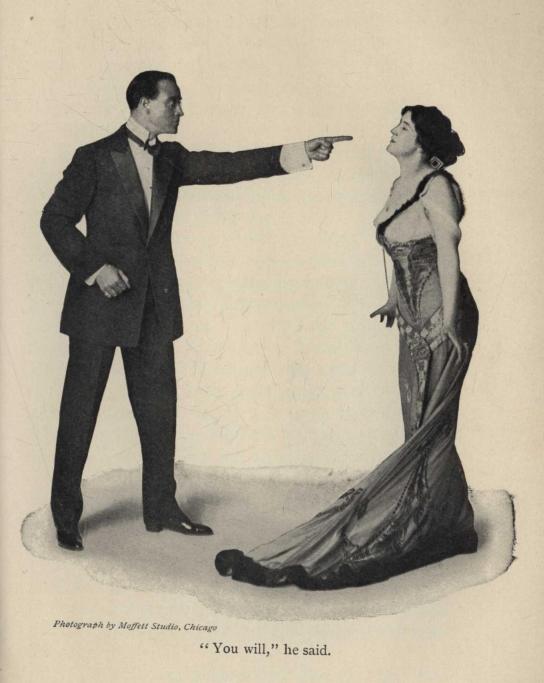
"You will," he said.
"Never! Never! I wouldn't; I couldn't!"
Her voice rose to a hysterical scream, then she stopped, struggled for control of herself, and shook like one in a chill, reaching out her hands toward him in mute appeal, unable to speak, to form coherent words. Finally she said in a hoarse whisper:
"Wait a moment. Wait! Let us be calm. Let us be calm. You haven't spared me. I'm not going to spare you."
She crouched and advanced toward him like a tiger.
"I'll never leave London! That's as fixed as death. You can't remain in London, and you know that too. You were forced out of the Army; that's enough. You're impossible! You always were impossible. You always will be. You're not a gentleman; you're a misfit, an outcast, a half-breed!"
His bronze sinewy hands looked very dark against the white, the dazzling white of her throat, as he lifted her in the air for one terrible instant, an instant when she was near to death and he to murder.
"Edith," he whispered, "if you were a man I'd kill you!"
Then he took his hands away, caught her when she would have fallen, and stammered out brokenly, almost in tears:
"No, no, I mustn't say that. You're not responsible. You're not responsible."
And he dragged himself away as though he might be tempted to put hands on her again, went over to the sofa, threw himself down in terror and abasement, and held his hands as though they were the offenders, not his will. On her part the leash was slipped. There was no longer any effort or desire to control herself. She quivered in an infuriate passion of hate. All other considerations were swept away. She followed him like a wild animal that has tasted blood. She wanted to hurt, to tear and rend, and she had a vague insane idea that if she could induce him to violence, that if she could goad him to maim her, his will, his inflexible purpose would break down under pity and remorse. She crouched over him while she screamed:
"You're a half-breed, and everything you do, everything you don't do, shows it. My God, what I've had to endure as the wife of a half-caste who had to leave the Army. You, too. It hasn't been easy for you. You've suffered. This is our chance: our chance to escape from each other. You want your freedom. You want it—you want it—you want it. I've seen it in your face. That's why you've come back. You don't want to go through life chained to a woman who hates you, because if you drive me to desperation I'll make you wish you'd never been born. You'll buy your freedom."
It was to be war. He rose, white with passion. She moved away as if it were settled, as if the victory were already hers, repeating hysterically:
"You'll buy it. You'll buy it."
It was a mistake. It made him inflexible.
"But not at that price," he said fiercely. "You will tell Lord Yester or I must."
The noise of the colloquy had penetrated to the drawing-room.
Lord Yester, unseen to either of them, had quietly entered the library.
"Will you or shall I?" was Hal's relentless demand.
She turned and saw him—Lord Yester. The fierce mounting flames of her fury died down into ashes. She seemed to shrink and draw within herself, grow smaller and whiter. Hal followed her intense fixed look to its object. Yester, too, looked older and smaller and paler. It seemed a long time ago when they were agreed and each saw Happiness standing by an open door. Now the door was shut and hung with crape. Lord Yester knew that he had entered a death chamber. He gazed at her in silence. He saw the proud queenly woman cowed, looking haggard and wan with fear and despair. Love and tenderness shone from his eyes and begged her to tell him all, to trust to him—that years of devotion would make amends for all her suffering. He saw that it was not in her thought that he could help her. She looked to the other—to the man she had turned to stone. Her eyes swept him with a plea for mercy. She crept to him, kneeled to him, took his hand, abased herself, drew herself up to a level with his face, searched it for one ray of hope, one sign of relenting pity, then, with a low heart-rending moan such as neither man would ever forget, she crept like a piteous wounded thing out of the room.
Lord Yester did not attempt to help her or to follow her. He knew in some instinctive way that she was past help. He looked at Hal. He saw him stricken, spent, seared by suffering. It wasn't the same man he had talked to a few moments ago. Then he had been a splendid animal, lithe, vibrant, instinct with life and the joy of living. Here was a sad, disillusioned, heart-broken, middle-aged man without hope in the world. It had been a drawn battle—a duel in which both combatants had been wounded unto death.
Lord Yester came down slowly.
What was it this terrible man had said to her as he came in?—"Will you tell him or shall I?"
What was there to tell? What could he tell? Women, and men too, with a past generally tell it before any one else has the chance—their version of it. Edith had her history and she had been the first to tell him her version in which she was always the injured and suffering heroine.
"If it is anything discreditable to her, to Lady Effington, I would not believe you," he said with quivering intensity.
"That is for you to decide," said Hal. What a game little chap it was! he thought, as he looked at his sensitive, delicate face, made for suffering. And he'll hate me to his dying day.
"Perhaps it won't make any difference," he added, and at the thought a gleam of hope came into his own life. Suppose it didn't make any difference? Suppose this reckless little Knight-errant threw all caution, all considerations to the winds; suppose that, knowing the truth, all the truth, he still held out his arms to Edith and demanded the right to assume her burdens? Ah, then Hal's hands were clean and would be free to—He glanced up to see Sir George Rundall. Oh, if Rundall hadn't known or had kept silent. It was too late for regret now.
"Sir George," he said to the doctor, "Edith has refused to leave London, to go with me. If Lord Yester would help us—perhaps——"
"Lord Effington," said the physician sternly, interrupting Hal, "I am not in the habit of discussing my patients before strangers."
"Lord Yester is not a stranger," said Hal without irony. "He enjoys my wife's confidence and friendship and if——"
"I am proud to believe that that is true," said Yester with equal sincerity. "And if it concerns the health or happiness of Lady Effington, you may rely on me, Sir George Rundall."
The polished man of the world restrained his irritation, his exasperation, with obvious difficulty.
"Lord Effington has placed me in a most embarrassing position," he said with increasing resentment. "I have expressed the opinion that Lady Effington,—that she should—that it was in fact her only chance——"
"Her only chance?" echoed Lord Yester. "What do you mean?"
"Perhaps that is too strong," said the doctor, floundering, sensitive, over-sensitive as to his professional amour propre.
"Perhaps that is too strong. Let me say her best chance. Other scenes, other countries, an out-door life? Unfortunately in cases like this, the will-force is enslaved. Unfortunately most victims of—let me say—" he broke off impatiently. "I cannot see what right Lord Yester——"
"I will relieve you of all doubt on that point, Sir George. I have quite as much right to hear what you have to say as Lord Effington, and I insist on your speaking plainly."
The physician looked to Hal, whose refusal to contradict this was an affirmation of it, and then, with undisguised amazement and under protest, he said: "Well, so be it. What I had in mind was that most victims of the morphine habit—"
Lord Yester leaned forward slightly as if he did not think he heard aright, then he half repeated the dread word, swayed slightly, put his hand across his forehead, like a man bewildered, and groped with his other hand until he found the back of a chair. Then very quietly he found his way into it. The expression on his face was tragic. If the boy had been his son or a brother Hal could not have felt more for him or suffered more with him.
"It's a great shock to Lord Yester, as it was to me," he said after a moment's pause. "My wife trusts him, and I am sure he will join us in our efforts to save her."
Lord Yester did not reply. He raised his head as if he had some difficulty in breathing.
Then there was a painful pause. Not one of the three men spoke.
Finally Yester said: "Sir George, if you are going home——"
"Certainly," said the physician, seeing his distress and anticipating his wish. "I will set you down at your door if you like."
"Thank you," the boy said, struggling to his feet. "This room suffocates me."
"The fresh air will put you quite all right," said the doctor, walking beside him but not offering him physical help. "Quite all right."
And they went out and Hal was alone.
"Poor boy," he said. "Poor boy!"
He put his two hands to his head, and pressed the temples. Was it real or was it a dream? He drifted into the chair at the writing-table, and put his elbows on the desk and rested his chin in his hands, looking into space, trying to understand. Some one had left a current magazine open on the table. His vacant gaze wandered across a dull level of meaningless words to a hill which stood up alone and seemed to call to him, to have a message for him:
"These are my people, and this my land,
I hear the pulse of her secret soul;
This is the life that I understand,
Savage and simple, and sane and whole."[1]
[1] Lawrence Hope.
Yes, that was a long time ago. And they were a long way off—his people and his land. Why had he allowed John McCloud to drive him away from his people and his land? Could he have foreseen this never would he have come, never would he have had the courage to put aside that which was within his grasp. It was a dark, desperate moment. He regretted his lost happiness; he regretted that he had not sinned. What were these abstract things which people called "good" and "right"? Where did they lead one? Malicious shadows! What was his reward? For the rest of his life he was to be the custodian of a rancorous mad woman. His only release was death, his death or hers, and these neurasthenics live forever. His own? The only thing to his credit at this moment was that he pushed aside the thought of self-destruction. He was down in the ring, only semi-conscious, and he heard the referee counting the fatal seconds, but he had the instinct of the fighter and he knew that before ten was called he would try to get up. His land and his people! They were calling to him, in many voices, many ways. Never had they called to him as now. And it was too late. All that was past. Wah-na-gi called to him. Oh, she called to him. Again he saw her as he looked back to get a last glimpse of the Red Butte Ranch, standing outlined against the eternal sky, standing on the eternal rock that marked the lonely grave. How simple and elemental she seemed to him sitting in the roar and smash of this huge factory where they were turning out lives by machinery! She called to him, to all that was best in him. Her soul, how clear and clean it was, like a mountain stream. Yes, he was glad he had not soiled it. Yes, he must live up to her faith in him. Perhaps there was another life, another world, where all these crooked things were made straight. He took paper and pen and wrote briefly and simply:
WAH-NA-GI:
I cannot come back. Don't wait for me. Don't expect me. I can't ask you to forget me, because I love you, never so much as now when I am saying good-by. HAL.
He could only see dimly the address as he wrote it. Then he held it before him and whispered: "'I hear the pulse of her secret soul!'"
"I beg your lordship's pardon——"
"Lordship? Lordship?" Who was that? And who was speaking? He was out in the shadow of the Moquitch. Ah, no, he was in London, in his father's house.
"Come in, Andrews; what is it?"
It was his father's butler, a slender little old man, with a deferential face and a refined cultivated voice like the gentle-folk with whom he had always lived. Even Andrews felt that there was something unusual in the air.
"I hope I'm not intruding on your lordship."
"Not at all, Andrews."
"Is there anything I can do for you before you retire?"
"No; put out the lights and go to bed. Oh, and mail this letter for me, please."
He and the letter were a long time in parting. He looked at it, passed it from one hand to the other, held it out in view for a moment, then entrusted it to Andrews, his eye following it in the butler's hand and his body straining across the table as if he would go after it and bring it back. As the old man got over to the electric switch he turned and, with old-world deference, said: "Will your lordship permit me to say how glad your father's old servants are to see you at home once more, and we hope you are home to stay."
Hal caught his breath. The judge was putting on the black cap.
"Home to stay?—Yes, thank you, Andrews; thank you. Good night."
"Good night, my lord."
And the representative of that which was and would be turned out the lights, and left him to himself, left him in the shadows of the big room.
As soon as the door closed behind the form of Andrews, Hal clutched at his collar, tore it open, threw off his coat, rushed to the windows that formed one side of the room, threw them open, and stood for a moment with his breast and face bared to the sluggish, clammy breeze that was struggling with the burden of the fog. It was the act of a man used to the open.
The light from the street lamp outside struggled feebly through the precious stones that glowed in the windows on the stair. The fire light crept out timidly into the room with a sinister glint. Hal found his way back to the chair before the library table, and fell into it. The light from the jewelled lamp on the table threw a white nimbus about his face that made him look eerie and spectral, like a ghost that had stolen out of the night and the fog.
"Home to stay!" he gasped. "To stay!"
Unknown to him, another apparition evolved from the gloom of the stairs, floated in soft lacy clouds down into the room, stood for a moment looking off into the hall where Lord Yester had disappeared, then drifted noiselessly down and stood beside him. It was Edith.
"Well, he has gone," she said softly. "You have sent him away. You have locked the door and thrown away the key, and now we have the rest of our awful lives to spend with each other."
He did not move or seem to hear, and she slid serpent-like onto the table, and brought her mocking face close to his.
"We shall have many, many glorious years to look forward to, each day of each year a crucifixion. We shall hate each other over our coffee; we shall loathe each other over the luncheon; we shall despise each other through the long, long dinner. With murder in our thoughts and the itch to strangle each other in our fingers, we'll have to be polite and even affectionate," and she chuckled softly as she crossed to the fire, in whose red glow she looked like a satanic Lamia.
"From now on I shall take an active interest in what interests you and I shall have the satisfaction of knowing that I poison every minute of your life. It's a glorious prospect, isn't it? When I think that for a cheap bit of sentimental rubbish you ruined our lives, your own as well as mine, it seems like a joke—a huge, ghastly, ferocious joke. Why don't you laugh? Why don't you laugh? Why don't you laugh?" and she gave way to a burst of demoniac cachinnation as she threw herself into the big chair before the fire.
He did not reply or look at her or turn toward her, but kept his gaze fixed on that solemn rock so many thousand miles away. When she had exhausted herself, he said softly to himself: "Wah-na-gi! John McCloud! I've kept my promise. My heart is empty, but my hands are clean!"
And so they sat as far apart as two worlds in space until the morning of another day.
CHAPTER XXI
Before leaving New York Hal had arranged for a bank account upon which Big Bill was at liberty to call, but otherwise the folks at Red Butte were left to themselves. With the boy had gone the life of the ranch. After him a cold torpor settled down and took possession. Routine ruled supreme. Twice a week Curley rode over to the Agency, the nearest post-office. His return was an event, not on account of anything that ever happened or followed from it, but because of what might happen. Some one might get a letter. Occasionally this unique experience happened to John McCloud who had a married sister living in Washington with whom he corresponded. Except the preacher, no one at the ranch was much of a correspondent. Hal was not a letter-writer. In fact, the writing of a letter assumed huge, formidable, and forbidding proportions. Outside the necessary business matters, the letters he had written in his life could have been counted on two hands. The newspapers were always old. By the time they knew any event at the ranch the world without had forgotten it or was preparing to forget it. In winter the world without at times disappeared altogether. One day something happened. Curley rode in with a letter for Wah-na-gi. Every one on the ranch knew that an important thing had happened, that Wah-na-gi had received a letter, that it was from London, and consequently from Hal. No one said a word about it; no one asked her in regard to it. She did not read it until it was night and she was alone in the living-room. Then she went to a chest of drawers up under the window, took from them the tiny pair of moccasins which had now become her "medicine," her "sacred bundle," as the Indians call their treasures, their good-luck symbols, brought them down, and sank on her knees before the blazing logs in the big fireplace.
The reading of the letter was a solemn and formal function. She did not tear it open with feverish curiosity. She put it down before her in order to prepare her mind, to calm the beating of her heart. The little moccasins had been a great comfort to her. When she was troubled she went apart and held them next her heart, and had a "long think," and somehow she got the impression that at such times Nat-u-ritch and her son were near. The little shoes had walked into her Holy of Holies, where she dreamed the divine dream of women, and she saw other tiny feet romp about in them, the little feet of him who would call Hal father and call her mother. Then she put down the sacred symbols and in the angry glow of the fire read the bitter message which came to her out of the London fog. There was no mistaking its meaning, its farewell. It slipped from her hands to the floor and in her despair she seized his gift to her and held it to her heart as she had done so often, but this time comfort came slowly; came not at all. It was the end. He had said so; had said good-by. She did not for a moment dispute its inevitableness or question his decision. She remained there a long time, looking into the cruel fire. Then she rose and put the baby shoes away, and this time she knew what the mother feels who gathers up the clothes and playthings her darling will never need again. Then she came back and took up the letter and read it once more. She would never need to read it again. It was burnt into her brain. McCloud came into the room and at a glance saw what had happened. He brought a chair near, sat down in it, and put his hand on her head with a caress.
"Wah-na-gi, my dear little girl," he said after a long pause; "I wish I could bear this for you. You've been a teacher. Try to think of God as a teacher. This life is a plane of consciousness, a kindergarten plane, the primary class, and we may miss no step in the progress to a larger plane, a higher plane, in the search to know God, whom to know is life and peace. This will mean nothing to you now, but perhaps it will when you can see beyond your own tears, and can take up your lesson again. You know what the love of a teacher is; add to that the love of a father, the love of a mother, and know they are only symbols of that love which is divine."
Wah-na-gi did not answer, but she hastily picked up her letter and her life and passed out of the room, and routine resumed its normal sway.
Fortunately for her, she was the busiest person on the ranch, for she had the care of the house and of John McCloud. In the death valley these two found each other. They began to see each other face to face, to know and understand, and a great love took them by the hand and walked with them in holy peace. Each was metaphysical; each had been denied what seemed the one supreme need; each had been through the waters of affliction; each seemed to be God's compensation to the other. The lonely man who had missed the love of children found a child; the lonely child found a father whose love, supreme, benignant, was like the love of God. And so they walked in sad and solemn joy.
"Winter-man" came and went and had come again. "Cold-maker" had ridden down out of the North and a white shroud lay over all the inert desolation.
Even in the busy summer it is a silent land, its wide, vast muteness occasionally relieved by the tumble of a cataract, the sob of a solemn river, the twitter of a lonesome bird, the barking of a dog, the nightly plaint of the coyote, the sound of the voice of some taciturn ranchman or some wandering cowboy. Sometimes the muffled monotony of the untenanted wastes falls over the mind and the soul, and men and women are monotony-mad. When the cowboy goes to town he wants to ride up and down through the streets making a noise, a noise other people can hear, yapping and shooting off his revolver. The summer has activities, the ranch, the crops, the round-up, social amenities, many things to interest and occupy the isolated. In the winter the bear and the snake go to sleep, and man hibernates too, in the solemn hush that broods over the pulseless world.
Winter was upon them before any one realized it, and it came with an angry rush that boded no good. The few books and magazines were soon exhausted. The men looked after the stock, tried to keep in touch with the cattle, made occasional excursions for deer, and played cards, and then cards, and then some more cards. It was a hard winter and its dull level unbroken except for two events. One day McShay came over with a wagon-load of supplies and brought with him a stranger, a man he had picked up on the trail and who was inquiring the way to Red Butte Ranch. It was obvious to the Irishman that the man was a woodsman and used to hardship. He was clean-cut, wiry, seasoned, built for endurance, but evidently an outsider, not of the region. His equipment was too complete, too up-to-date, and yet he wasn't an amateur hunter or a tenderfoot. There was something about him hard to describe unless you call it cosmopolitan, and there was a quiet reserve that covered powers of reflection, contemplation, the dreamer or the student. He didn't fit in to any of the conditions of the Indian country. As he volunteered little information on the way to the ranch, he found McShay equally taciturn. When he reached the ranch, however, the stranger did not leave them long in doubt as to who he was and what he wanted.
"My name is Gifford—Walter Gifford," he volunteered as Mike started to introduce him to McCloud, "This is Doctor McCloud, isn't it? You're a Princeton man—so am I. You studied at Bonn—so did I. You see, I know all about you, and now I'm glad to have the honor of knowing you personally."
He talked now very fast, as if he were in a hurry.
"I've been out to look over the Moquitch Forest Reserve and before I return to Washington I wanted to see Mr. Calthorpe. I hope——"
As he looked from one to the other and divined that his hope was vain, it was manifest that his disappointment was very great.
"Hal has been gone for over a year," said the clergyman.
"Yes," said Gifford; "we knew he went to London about a year ago, but he isn't in London; hasn't been there for some time, and no one knows just where he is. I hoped I might find him here. Too bad—too bad."
Gifford spoke with such earnestness as to almost necessitate further explanation, but every one hesitated to embarrass him with questions. Finally McCloud said:
"Is there anything that we can do?"
Gifford looked from one to the other. McCloud added: "You may speak freely. We are all his friends here."
"Well, we depended on Calthorpe, on his testimony, on his documents—the incriminating documents we supposed he had which came into his possession while he was chief of police on the Agency—and we were led to believe that he would be on hand when he and they were needed. He failed us, signally failed us. It really is too bad."
McShay said: "Mr. Gifford tells me that Ladd is back on his job with a coat of whitewash that would make the driven snow look dissolute. You know I think they ought to call that place Whitewashington."
"Agent Ladd? Back? Is it possible?" ejaculated the clergyman in dismay.
"Maybe they cooked it up," said McShay, "to pull off the investigation when the kid couldn't be present. It's a disappointment to me in a way. I thought when the boy put his hand to the plow he'd stay with it until the plow fell apart. He promised to have Ladd's scalp, and he's Injin. Something's wrong. The boy ain't a quitter. You can stake your life on that. Did you notify him?"
"We wrote to him again and again, first to his London address, then here."
"We have always forwarded all mail that came here for him," said the preacher.
"Then we found that he was not in London, that he and his wife had gone away, without leaving an address, to South America or Africa, no one knew where, but supposedly on a hunting expedition. We expected him in Washington on his way to London; but he didn't turn up."
"Anyway," groaned McShay, "Ladd got away with it and is back with the bells."
"Ladd personally is a small matter. Individually he doesn't count," said Gifford earnestly; "but it was a chance, a fine chance, to drag these big malefactors into the light, make them come into the open, make them show their rapacious hands. Ladd's just a common or garden criminal, but we thought we had the chance to show his connection with the big fellows, and their backers in the cabinet and in congress. The trial of Ladd was a farce. Secretary Walker is discredited. He will be forced out of the cabinet. Whittaker of the Land Office will go in, and the game will go on behind closed doors. Something is at stake, bigger than Ladd and his honesty; bigger than even Walker and his reputation, and his honor and his career; bigger than these asphalt lands; bigger than the coal lands behind them, enormous as they are; bigger than you and me or our immediate interests—the right of the people to preserve the resources God has given them from spoliation, to keep them for the public good instead of for private gain."
It was evident that Mr. Gifford was a man with a purpose, an idea, and that he could glow with it.
"Say," said McShay, "you ain't the Gifford of the Forest Service?"
"Yes; I am."
"Well, gosh-all-hemlocks, you're the most unpopular man in the world in these here parts."
"Of course we're unpopular. It'll be a sad day for this country when no one is willing to be unpopular."
"Mr. Gifford," said the cowman rising, "I'd follow your lead if I thought you'd arrive anywhere, but you can't pull it off. I'm a practical man. These fellers are practical men. They'll beat you to it every time. You appeal to love of country, posterity; they appeal to each man's self-interest, his immediate self-interest. It's me first and then the country. That's human nature. Look at my people. You'll get no support from them. We discovered this asphalt. We located it. You have it withdrawn from entry and the Asphalt Trust helps you do it. When we're frozen out and have surrendered, they'll have it restored again. You hope to prevent that, but you won't do it. They control power in congress and in the cabinet. Whittaker belongs to 'em. We won't get the lands, but we'll force them to buy us out. When the gold mines in the Black Hills were thrown open to entry, the Supreme Court held that the original locators had priority rights, and that's a precedent that will cover our case. You have a noble idea, Mr. Gifford, but what the plain American citizen wants to know is: 'Where do I come in?' He'd rather have two dollars and a half in cash than one thousand dollars for posterity."
"Mike is right," said the preacher, "as to his constituency. Your splendid purpose, Mr. Gifford, would get Wah-na-gi's vote and mine, and Hal's, if he were here."
"If he were here," repeated the forester wistfully. "If he were here," but he let the subject drop and shortly after McShay said good-night and took himself to Big Bill's quarters.
When he was gone Gifford said, drawing in to the comfort of the fire:
"Doctor McCloud, I'm glad we are alone; McShay is not for us."
"You mustn't get a false impression of Mike, Mr. Gifford. He's not a man of imagination or a large horizon, but within his limitations, which are the limitations of most men, he is true and big. You know where he stands. I'd trust him with everything but my soul." The other bowed to this and did not contest it.
"I'm going to be very frank with you, Doctor; and I hope you will be as frank with me. At the superficial investigation of Mr. Ladd certain expressions came out that indicated that his backers were in possession of certain of our letters directed to Calthorpe. You know him intimately. Would Mr. Calthorpe ignore these appeals completely, if he received them?"
"I think not. I can conceive of no reason why he should not answer your letters and either promise to come or say why he could not come. Do you think any of your appeals reached him before he left London?"
"I am sure of it. You say he would not ignore these appeals if he received them. If he did not receive them, who that was near him would have a motive for tampering with his mail or his correspondence? Who in his household would be approachable? Who would want to injure him or us? Or would act from motives of hate or revenge?
"I need not tell you that our opponents would stop at nothing to side-track Calthorpe or get possession of his papers. You know the old saying—find the woman. Well, in this case it leads nowhere. There are only two women in his life apparently—this Indian girl here——"
"She knows no more of him at this moment than you do."
"And his wife."
"It is preposterous," said McCloud, "to think of his wife in connection with a criminal act, and one in which she could have no conceivable interest. As a matter of fact, I have reason to believe that though they once had an estrangement——"
"Ah, there had been trouble between them?"
"A temporary drawing apart apparently, but, as I was saying, I have reason to believe, to know in fact, that they have become reconciled, and been reunited. Their going away together is proof positive of that."
"It's very mysterious, isn't it?" said Gifford. "His papers? Did he take them with him or leave them here?"
"He went away very hurriedly, taking with him nothing, so far as I know, except some of his clothes. He left some papers and documents, not many, which I put carefully in a marked envelope, to await his instructions."
"And of course you know nothing of the contents of those documents?"
"Absolutely nothing. I know he offered to return the certificates of stock to the asphalt company, but they ignored his letter."
"I needn't warn you, Doctor, to take good care of those papers."
"No one here would think of disturbing them any more than I would. If I should die before they are called for by Hal, I have written instructions on the outside of the envelope to have them sent to my sister in Washington, who will hold them until she can put them in possession of the owner."
"Doctor McCloud, we must find Calthorpe and he must come to America and get into this fight. He owes it to himself. He owes it to Secretary Walker who took up his fight in reliance upon him. and whose future is at stake. We have reserved the right to reopen the Ladd case and we have six months in which to do it. Back of all this, back of Walker and Calthorpe, is a big cause which will be set back twenty-five years if we fail. Possibly we can't prove anything against Whittaker, anything illegal, but we can drag these interests into the open and save the resources of the people for the people. If you will write him a personal letter, telling him the facts, asking for instructions, and have it signed also by this Indian woman, I will take it away with me in the morning and eventually put it into the care of a messenger who will have instructions to find Calthorpe, wherever he is in the world, and put that letter into his individual hand. Will you do it?"
CHAPTER XXII
All London knew that the "affair" between Viscountess Effington and Lord Yester was at an end. People in Society are very busy; they work very hard, but they always have time to devote to each other's interests, and they bring to bear on these matters their best abilities, frequently of a high order. If the ingenuity, the penetration, the powers of analysis and deduction focussed upon why Mrs. Smith is not now speaking to Mrs. Jones, or the exact thermometric relations of Mr. White to Mr. Black and Mr. Black's interesting wife, could be concentrated upon, say the subject of unemployment, the world would go forward by leaps and bounds.
The interesting and accomplished thief is frequently told that if he would keep his splendid gifts within legal bounds he would be the same ornament to Society that we are, but this artist has no taste for our dull levels. The noble river refuses to flow in straight lines and at an average depth. It loves the rapids, and the falls, and the crooked way. So probably Society will go on with its minute microscopic study of itself.
Edith, Viscountess Effington, began to think socially at a very early age, and ever since she had come to years of indiscretion the one aim and object of all life, all hope and endeavor, had been the Court Set. Many people pass through life almost ignorant that there is such a thing, but it is of no use to say to one who cannot breathe at an elevation of ten thousand feet: "I am breathing very comfortably."
While we are pleasantly exhilarated the other is bleeding to death. Edith had seen the ambition of her life possible of realization as the Duchess of Uxminster. Every phase of her struggle to this end was familiar to her friends, and every one knew that it now rested in a fashionable London cemetery, where "Here Lies," etc., could be read by any one in the street who would stop long enough to give it a curious glance. This made London somewhat difficult. It furnished her heaven with some of the characteristics of a warmer place. To know that your grief and despair have furnished amusement to your friends, that your thwarted ambition has given them a keen sense of enjoyment; to hear some one throw the switch when you enter a drawing-room, to feel the embarrassed silence, and to know that a damask curtain has been hastily thrown over the remains of your inmost soul under the knives of skilful surgeons who have left no organ unexamined, is an ordeal for the bravest man or woman. Edith tried it. She went everywhere, just as she had done before. She tried to act and look as if nothing had happened. She made a brave show, but she had climbed in a ruthless way and she was finding out that those who live by the sword shall perish by it. She came to know that she had not only not gained ground, but had lost it. Her world had seen her play her cards, knew what she had in her hand, and had already decided that she was inevitable as the Duchess, and it adjusted its deportment accordingly. When they found that she had played and lost, they did not know exactly how or why, they felt the resentment of those who have been cruelly deceived, who have paid something for nothing, or kowtowed to the wrong person, and the gratification of social resentments is a fine art. To a woman of her pride, pertinacity, and ambition this was maddening. She came back from teas, at-homes, week-ends quivering, lacerated, and of course her habits did not improve. Every nerve screamed for rest, for quiet, for forgetfulness, and she drank more and more and more, and then sought relief in the oblivion of the master drug. She had always been an accomplished gambler in the usual social sense, but now it became a passion, an obsession, and she played for stakes that increased rapidly and dangerously, stakes she could not afford to lose. It was the one social diversion that helped her to forget. Her passion for play was leading her into questionable associations, into intimacy with shady people, people she would not have wiped her dainty boots on before. She had used people as steps. They were now using her to walk on, and it was likely to be a muddy process.