Front matter (continued 4)
Reading edition
McCloud's fine eyes flamed and two bright scarlet spots burned in his cheeks.
"Perhaps," said Hal, rising under the torrent of the other's eloquence; "perhaps I can help show the world that mankind is superior to any race."
Swift as the swoop of the eagle came back: "Then you must be willing to be a martyr. Your Indian mother was a victim of this and your own life is shadowed by it. Are you going to repeat her tragedy?" And he pointed to the rock that mutely stood before them and bore its silent witness to the sorrow of the broken heart that lay beneath it.
"God forbid!" ejaculated the boy, tears springing to his eyes as the figure of his mother loomed dimly out of childhood's memories. "God forbid! Poor little mother! I think the secret of her tragedy was that my father did not love his little Indian wife. I love Wah-na-gi."
The boy's sincerity was unmistakable. McCloud hurried on that he might not be swerved from his purpose.
"You love Wah-na-gi; yes, now; but what of the future? Do you dare look into the future? You are heir to a title and estates. You will eventually take up your obligations to an honored name and a glorious civilization."
Hal straightened up and showed fight. Hitherto McCloud had called to the lover, to his chivalry, to the potential father. It was an appeal he could not ignore, that lifted him up and swept him along with it. Now it was to his own interests. It was an anticlimax. The trained controversialist had made a mistake. Titles, estates, an honored name, civilization! The Shepherd of the sheep had put on the garments of the man of the world and they didn't fit. To the youth, in the throes of a mighty passion, they sounded hollow and empty. Hal had never discussed his past, his life, with any one. How was the preacher to know that he was walking among the graves of things already buried? Titles, estates, an honored name, civilization! It probably never occurred to Samson to pause over his duties to Philistine society, and to hesitate over the beauty of the temple where he was on exhibition. Hal started to rise, to throw off this incubus sought to be put upon him, to tear it to pieces; but the hated things had done something for him, taught him restraint, the capacity to measure the other man's point of view, and so he sat down again before he spoke and struggled to keep his voice even, though it vibrated with scorn.
"I hate the whole thing! Why should I be the victim of conditions which are no part of my consent or my will? I don't want the title! I don't want a place in their silly, rotten world. I couldn't live in it or be a part of it. I'll take the ranch and make my own way, and I claim the right to do it. I want my own life and the freedom to live it. I gave the best that was in me to civilization, and civilization kicked me out, robbed me of a career, made my home a hell, and so I say—to hell with civilization."
McCloud was surprised. He was an emotional man too, and he thrilled to the sweep of this violence. He would have liked to take the boy in his arms and cry: "Oh, Absalom, my son, my son!" Instead, he held him away, shifted his own ground, and sought the joints of the other's harness. Hal's allusion to his home seemed to offer an opening.
"This wife in London, this unhappy home—perhaps it is an appointed barrier!"
"Barriers are surmounted—swept away!"
Hal was standing now and he looked audacious and puissant. He looked the master of his own destiny. The man who had passed through the fire, whose proud hopes and ambitions lay in broken heaps where the car of destiny had passed, looked at him in admiration.
"Yes, barriers are swept away; but only by those who humbly and patiently kneel down before them. Perhaps Infinite Wisdom stays your hand, to keep you from bringing sorrow to this helpless Indian woman whom you love, and to her children."
"Never!" was the answer, in the pride and strength of youth, in the consciousness of capacity, in the joy of a child of battle, the offspring of warriors, who had sung their triumph under torture. It was a wide gulf that separated this fierce courage from the white-faced saint who had learned in patience and humility.
"It's a feeble-minded man who keeps picking at the irrevocable," was McCloud's reply, more to himself than to the savage before him. "Suppose some day you grew tired of all this and wanted to go back and be a part of the world of convention, of fashion and culture?"
Hal had no argument to make to this, but it had no appeal, no meaning. He only made a gesture of negation and impatience.
"Oh, my boy," said McCloud helplessly; "you're a rebel."
"Well, America was made by rebels," said the other with a triumphant smile.
The minister put his hands on the boy's shoulders and looked into his eyes as David might have done to his wayward son.
"Well, God bless you for a fine, glorious, dangerous rebel."
The sun was up, a new day was born, all things seemed possible as Big Bill hove into sight.
"Say, Boss," he drawled; "McShay's out here with the toughest looking gang of ruffians——"
"Let 'em in, Bill," cried Hal joyously, his eyes dancing with the excitement of his conflict with McCloud.
"Turn 'em loose on the ranch?" said the foreman doubtfully. "That outfit? Gee whiz!"
"May need 'em, Bill."
"Most worse'n Injins," grumbled the old man as he went away, doubt, hesitation, protest in the stoop and shrug of his huge bulk.
Bill's advent had brought them both back to earth, to the business in hand.
McCloud spoke first.
"If they would let you keep this woman you could not. You are too near to her. You must go away."
"Now?" said the radiant rebel; "when she has come to me? When she is mine? Mine?"
"You must go away," said the other, relentless as Fate.
"She's mine. I'll take her and hold her against the world."
"No, you'll hold her against yourself."
Hal sank feebly down on the bench and clasped his hands in a helpless way.
"I can't. I can't give her up! I can't."
McCloud came to him and put his hand on him.
"Hal, my son," he said affectionately; "I've sometimes wondered why I had to give up my work and come out here to die. Perhaps it was to be your living conscience. To this woman you seem divinely appointed, like the Moquitch Mountains. I've seen her soul go out of herself and stand expectant before you with outstretched arms. Her temperament, her environment, the very strength and weakness of her character put her in your hands. You know that without stopping to question or think she has laid herself at your feet. Are you going to listen to the passion that desires, that demands, that takes, or is your soul going to rise up within you crowned and glorified?"
Hal buried his face in his hands and groaned. He looked about for some way of escape, but there stood the weak sick man, inevitable and unanswerable. He felt bewildered but resentful. Why shouldn't he be happy? Why should he be expected to give up his one chance, the only chance he had ever had, would ever have?
"We'll go away into the mountains," he exclaimed, "away from your artificial rules and regulations! We'll go away."
"You can't go where obligation will not meet you."
"Why should I let you decide for me what my obligations are?" he said rudely, fiercely.
"Now you're a savage, but you've got white blood in your veins, blood that has bowed the knee to duty, bowed the back to burdens, bowed the head to God. Now I thank heaven you're a half-breed. You couldn't go back to the blanket savage if you wanted to. You've got to live up to your higher self. You have assumed obligations to these two women. You can't avoid the consequences. The heart of this Indian woman has gone out to you because you are part of a social order to which she aspires, that represents to her her better self. You can't drag her down and back to the blanket Indian. She would hate you. If you are brutal I must say brutal things to you. You can't force her to apologize to her children, to tell them they have no standing before the law and before society; that they face the inevitable social order with an inevitable stain. You can't flee from obligation. No man liveth to himself nor for himself. And this other woman—you have in the past assumed obligations to her. They have become irksome. You say you have a right to be free. Well, then, you must prove it. I don't believe in divorce, but that is a matter between a man and his Maker. Happiness, permanent happiness, is worth fighting for, worth waiting for. If you stay here you will steal it and pay the penalty of the thief, a penalty that will fall heaviest upon those you love best in the world. Again I say, you couldn't keep this woman if they would let you. She must go away or you must."
McCloud looked at the lad, silent but unconvinced, and then he lifted up his heart in secret prayer that God would keep this soul unspoiled.
CHAPTER XV
"Howd'y, Parson! Hello, boy!"
The diversion made by the appearance of McShay was a most welcome one to the youth who felt "baffled and beaten and blown about by the winds of the wilderness of doubt." Hal felt helpless in the hands of McCloud with his metaphysical verities, so fixed, unalterable, and unanswerable, but McShay carried with him something that was tangible and workable. Shadows fled before him. Subtleties disappeared before the sun of his genial optimism, or materialized in rain or snow or ice, assumed a form that could be reckoned with. The presence of the man of action was an enormous relief to Hal. McShay's intuitions were quick and he no longer spoke to the clergyman of his health, but he swept him with a searching glance and took his hand gently in his iron grip as he would have taken the hand of a woman.
"You sent me word you needed help," he said to Hal.
"Yes."
"Things is awful dull over our way; wouldn't like to miss anything. I brought over a few of the boys. It's Wah-na-gi; ain't it?"
McShay was adaptable. It was perhaps a large part of his success in life. He could be vulgar and common with the vulgar and common, or he could follow those who went up into the mountains and looked into a far country, and whether with those who grovelled or those who stood on the heights, each kind felt he was one of them, and there was no hypocrisy in this. He understood and sympathized with both. There was nothing offensive in the way he said:
"It's Wah-na-gi."
"How did you know it was Wah-na-gi?"
"Why, son," and a broad smile spread over the cowman's face, "everybody on the range knows you're sweet on Wah-na-gi. Presumably, too, you was not unaware that the amiable Ladd had threatened to shoot you on sight, and that the gentle Appah has promised himself your scalp as a Christmas present!"
"I knew I wasn't exactly popular at the Agency just now."
"And so you just went over and took her? Well, it was a fool thing to do; but it's kind of appealin,' Parson, it's appealin'. What was that young feller's name—none of your Eastern tenderfeet—the young feller that come out of the West?"
"Rode out of the West?" corrected McCloud with a twinkle in his eye. "That hero was a Scotchman, Mike."
"Couldn't be, Parson; couldn't be. The Scotchman will risk his neck for religion or a pinch of change, but not for the ladies. No, I'll bet he was on the border, and mostly on our side. But this feller here!" and he put his hand on the shoulder of the boy with unmistakable liking; "an Englishman, too! Beats all, don't it? Anyway he loves a fight. Must have a dash of the Irish in him somewhere, even if it's the damn Protestant variety; savin' your presence, Parson. Sure, I took to him when he put it all over Ladd, and when I count a man my friend, I ain't over-nice as to his failin's. Say, it's too bad he's an Englishman, ain't it? He's saved by the Injin in him, I guess. That's the truth."
"We were just discussing race prejudice," said McCloud.
"Don't believe in it. Nuthin' to it," ejaculated the Irishman warmly.
"'A mon's a mon for a' that,' eh, McShay?" suggested the countryman of Burns with a smile.
"No use for narrer-minded prejudice, but the English—excuse me!" Mike's face and body united in a convulsion that was a three-volume exegesis of the traditional Irish point of view.
"Sure, it's a toss up," he continued. "The English rule Ireland. The Scotch rule England. The Irish rule America, and to hell with the rest of it—it ain't worth rulin'." The preacher laughed heartily. "You know, Hal, me boy," continued Mike, "the parson's human like the rest of us. He don't look like a duck as has swallowed a croquet ball just because a little language slips out now and then. For a gospel-foreman he's aces! Well, as I was sayin' when you interrupted me, we ain't come over to fight, we ain't a-looking fer a fight, but if there's goin' to be one, we'd hate to miss it. Does it look encouragin'?'
"I'm afraid there's going to be trouble over Wah-na-gi," sighed the preacher. "I have made a formal application to the Secretary of the Interior to adopt her, but——"
He did not say it, and Hal was grateful. Having expressed himself without reservation to the boy, he had the wisdom to know when to let the good seed alone. A worldly twinkle lit up McShay's eyes as he said:
"You've made formal application to the Secretary of the Interior. It's a noble move, Parson, and you'll hear from it about the time Wah-na-gi is somebody's great-grandmother, and in the meantime you don't suppose these amiable feller-citizens is goin' to sit down and twirl their thumbs."
"Any news from Washington, Mike?" asked Hal.
"Well, me boy, our fight against Ladd is goin' to precipitate the whole thing. You see, instead of communicatin' in a genteel whisper they're beginnin' to shout in Washington, and when they shout in Washington it makes the God-fearin' business man nervous and hysterical. I guess we ought to let this agitation against Ladd drop."
"Why, we can't do that," protested Hal warmly. "Why let it drop?"
"Well, son, here's the situation. We got a bill before Congress, ain't we? To make good our title if it ain't good already. Well, we're a menace to the Trust. They may queer our bill, but if they do, they got to prove the lands are Government lands, and that shuts them out, except for a lease from the Injins, and that we can make cost 'em a pretty penny, maybe we can queer it altogether. If everything is quiet in Washington our bill has a good chance, because we can make terms with the Trust to let it go through by agreein' to sell them our rights if it does go through. We are bound to git something! How much we can make 'em pay depends on how close we stick together. Now, if we put up a fight against Ladd in Washington, Ladd is the Trust's agent, they're goin' to stand behind him, and we've got a big fight on our hands, and if we get to screamin' at each other in Washington, why, every newsboy in America'll know all about it."
"Suppose he does?" asked the preacher, deeply interested.
"Well, the present Secretary of the Interior has intimated that he might on investigation insist on these lands being held for the benefit of the general public. The 'general public'! What do you think of that? Did you ever hear anything so funny in your life?"
"Why, that doesn't strike me as funny, McShay," said the preacher. "That seems to be a very just and splendid solution of the difficulty."
"And where would we come in?" yelled the Irishman.
"You're part of the general public."
"Hah!" he snorted, then turning to Hal; "ain't parsons the limit?"
"I know Secretary Walker slightly," added McCloud. "He strikes me as a strong man."
"I'll tell you how strong he is," bellowed McShay. now thoroughly aroused. "He can't hold his job. That's how much the 'general public' amounts to. He don't please anybody. He's got to resign."
"Well, you may quit the firing line, Mac," said Hal quietly. "But I promised Ladd to have his scalp, and I'd hate to break a promise I'd made to Ladd."
"You ain't practical, either," shouted McShay. "That's the Injin in you."
And the parson was in a dilemma too. He didn't know whether to praise the boy for being honest or reprove him for being vindictive.
"Boss, Curley's come in with the mail," said Bill as he came to Hal and handed him a telegram. "Nuthin' but this."
Curley completely recovered, but minus a right arm, was now one of Hal's retainers, and like all converts he was a fanatic where the owner of the Red Butte Ranch was concerned.
"I hope it's news from Washington," said Hal. "No, it's from London."
It read: "Your father ill. Come back immediately. Rundall."
"It's from my father's physician," explained Hal, handing the cable to McCloud.
"And say, Boss," said Bill, trying to keep the worst news to the last, "Ladd's out here."
"Ain't a-losin' any time, is he?" commented McShay.
"And he's got quite a few Injins with him," added Bill slowly. "In fact, they got us surrounded, I reckon." And Bill returned to his post.
"Go out and see Ladd, will you?" Hal said to his two friends. "And let me know what he has to propose? It'll give me a moment to think."
"Come on, Parson," said McShay, and he took the preacher affectionately by the arm. "By the way, would you say that Ladd was a Scotch name?"
McCloud shot him a sly glance.
"I shouldn't wonder, McShay; but I don't think the yellow canine mixture is monopolized by the Scotch, do you?"
"Oh, ain't you touchy about your damned old race?"
And the two queer pals walked away arm in arm.
"Wah-na-gi, come here, please."
Hal called gently at the door. She did not hear. It was a shame to wake her. He called again and then again. When she did awaken it was with a start, her heart throbbing violently until she saw him, then she breathed evenly with an assured smile. He thought she had never looked so beautiful as she stood holding to the support of the portico, and then he noticed for the first time that she was dressed like her people, and the brave flash and glitter of the barbaric colors stirred something within him; something strange, mystical. He felt the touch of an unseen hand, heard the sound of a silent voice. He thrilled to vague impulses, to a half-remembered strain that might have been a love song or a lullaby, that had in it the note of the primeval woods and the vastness of the sky and plain. He forgot the exigency of the moment, the dangers that confronted them, and said: "Wah-na-gi, wait here for a moment. I've something I want to give you."
And he disappeared into the house leaving her wondering and alone. She, too, was conscious of some occult force to whose vibration she thrilled. When Hal woke her she was quivering with the ragged remnants of a dream. Nat-u-ritch had come to her and said: "You will be very happy. My son loves you." Then John McCloud had come and led her away to the Land of Shadows. Here were shadow streams and shadow hills, shadow wickiups, shadow horses and cattle, shadow lovers and shadow children. Then Hal had come and called her away, and she woke to see him.
This dream came back to her as she waited. There was the grave of Nat-u-ritch. She walked over to it. The gravestone was very simple like her life, a rough bowlder torn from the bed of a mountain torrent. It displayed no date of birth or death, no line of eulogy, no word of sentiment, just her name in rude lettering cut into the face of the rock, but to any one who knew her tragic story it seemed appropriate and impressive. To Wah-na-gi it made the whole dingy, desolate place sacred. Nat-u-ritch seemed very real as she stood there by her grave. She knew Nat-u-ritch's story and understood it. The resignation of the Indian woman toiling patiently through life knowing that she was unloved, finding consolation in her child; then bewildered, unable to understand why her baby should be taken from her arms and given to a strange white woman to be taken into a far country; then the tall chief bringing his dead daughter in his arms and holding her out to the white man, all that was left of the little savage who was wife and mother, with the weapon of destruction in one hand and her child's little moccasins in the other. Nat-u-ritch was very real to Wah-na-gi just then. Her spirit brooded near.
"Wah-na-gi, I want you to have these as a keepsake."
Hal held something in his hands at which he looked intently. Something glittered and gleamed like her buckskin dress. They were a tiny pair of child's moccasins.
"They were mine," he said, "when I was a little boy running around here on the ranch. Those were happy days," he added dreamily. "My father gave them to me before I left England. He took them from my dead mother's hand. When my father gave them to me I knew I had seen them before, often and often in my dreams. I used to think it was Nat-u-ritch, my little mother, holding them out to me. Then it seemed to me to be you, calling to me, calling me to leave the cities, the limits, the din, the make-believe, the murderous crowds; calling me to the desert, the naked rocks, and the far spaces, the brooding snows, the camp-fires, the songs of the pines, and the angry rapids; calling me to my own, to live my life in the open, and be a man among men."
His eye was fixed on space and he spoke like one hypnotized or in a dream. She knew it was the son of Nat-u-ritch speaking to her, speaking to his own soul.
"Perhaps—you would like them," he added. "I would like you to have them," and he held them toward her. "It's the best I have to give. They are my 'medicine,' my 'sacred bundle.'"
Tears were gathering in her eyes as she took and kissed them.
"And now John McCloud says I must go back to all that—to the land and the life where I was an idler, a drunkard, and a failure."
Her heart stood still.
"Go back! Why?"
"Because I love you, because I want you, because I can't live without you."
She was in his arms and knew the supremest joy of her life.
"And nobody is going to take you from me," he added defiantly.
He was fighting McCloud, doing battle with himself. He had forgotten the agent until McShay entered with a face graver than his wont.
"Well, what does he say, Mike?"
"He insists on talkin' things over with you in person."
"Oh, well, bring him in. Wah-na-gi," he turned to her as the Irishman disappeared, "Ladd is here."
CHAPTER XVI
Wan-na-gi shrank back, her eyes set with terror.
"Don't let him take me away. I couldn't go back there. When I sent to you I had stood all I could. Don't let that man put his hand on me. You thought he was protecting me from Appah. I didn't tell you—I was ashamed. It was because, because——"
"He wanted you for himself."
"Yes."
"He won't take you back; not if I live. Now listen and don't be afraid. My men believe in me, better still, in my luck. McShay's men want nothing better than a chance to even scores with Ladd. We have the position. Ladd isn't a soldier. He doesn't know this game. I do. He couldn't take the ranch if he had twice as many braves, except at a fearful cost——"
"My own people!" she said, as if it just occurred to her for the first time. "We shall kill our own people!" This time she included him.
"You are my people," he said passionately. "You are my country, my all. Nothing else matters. Go in, Wah-na-gi, and don't be afraid."
"We must not kill our own people. They're your people as well as mine."
"A fight's a fight, Wah-na-gi. Leave it to me."
"I didn't think of this when I called to you. I was tortured, mad, desperate, and I cried out for help. It was a mistake. I—I—yes, I will go back."
"No, that would be horrible; I could not let you go back. We don't know what may happen, but I could not do that. Won't you leave it to me? Trust to me?"
She raised her eyes to him with a look of serene abnegation, of exalted self-surrender, that transported him, then sobered him.
He took her in his arms, kissed her as a brother might, and she went within.
"Howd'y, Calthorpe?" said Ladd easily as he entered with McShay and McCloud.
"How are you, Mr. Ladd?"
"I want to talk to Calthorpe alone, if you don't mind," said the agent to the other two.
"Certainly," said Hal; "these gentlemen will step into the house for a moment."
The Irishman drew the preacher toward the upper wing of the house, keeping his eye steadily on the agent who sauntered away. Suddenly he stopped.
"On second thought you may have him," he said sotto voce to McCloud.
"Suppose we divide the responsibility," responded the preacher with a grave face, "and call him—Scotch-Irish?"
And they went within to continue the animated discussion as to the relative contributions of each country to the world's greatness.
As Ladd turned the two men faced each other.
"I understand," said Hal easily, "that you threatened to shoot me on sight. Well, I'm on sight."
"Well," said the other calmly, "it may come to that, and it may not. That's up to you."
"Sit down," and Hal motioned to a seat with a smile.
"Thanks!" and Ladd sat on the harrow and nursed his knee in a careless off-hand way. "The Indians are very mad. Abduction of women is a serious matter, isn't it? Even a mean, dispirited race will fight for its women. Well, her people think you stole Wah-na-gi."
Hal thought for a moment and then as he did not see any advantage in dodging the issue, he said:
"Yes, I took her. She's here."
"Oh, you admit it?" said the agent with elation. "Well, that's something. Then perhaps you'll be good enough to hand her over to me."
"Well, no, not exactly. You see she's claimed my protection."
"Your protection?" responded Ladd with a cynical laugh. "That's rather feeble, isn't it? Well, the Indians claim my protection; protection for their women, for their homes!"
To Hal, who knew the extent of Wah-na-gi's obligations to her own people and their supreme indifference to the girl, this buncombe was peculiarly exasperating, but he did not honor it with a reply.
Ladd rose and came over to him. Hal was seated and the other bent down over him: "Now, you're no fool, Calthorpe; you know that you've done a wild, reckless, impossible thing, and you also know that you can't get away with it," and the smooth, cool, even manner gave place to the aggressive attitude of the bully who felt secure in his position. "Now, after what happened at the powwow over at the Agency, no one State is big enough for you and me."
"Yes," assented Hal complacently, "I've realized that you and I were a bit crowded."
"You're in wrong this time, Calthorpe, and I've got you where I want you," and Ladd chuckled over the prospect.
In the cold light of day and in the scrutiny of second thought and under hostile criticism, Hal had a sickening sense that his act was crazy, quixotic, indefensible, and yet what could he have done otherwise? Could he as a man have left this woman he loved to be hounded into self-destruction or dishonor? She had called to him in her desperation. Could he have turned a deaf ear to that cry? He had as usual acted on impulse. Having at very great risk effected her rescue, was he to face the ultimate and inevitable and hand her back to these wolves? It was inconceivable. One step involved another. He must go on, trusting to chance, a perilous trust.
"What is the idea?" asked Ladd with sarcastic tolerance. "The Government, the Army, and the American nation is behind me."
Hal knew that this was too true.
"I am responsible to the Government and the people for this girl. And you come over and take her away from me by force."
"Because you have betrayed your trust."
"I was in the very act of affording her protection from the man of whom she complained when you stole her. Well, what are you going to do with her now that you've got her?"
Hal did not quail under Ladd's merciless gaze, but inwardly he writhed.
What was he going to do? Oh, if he could take this wretch by the throat and say: "She's mine—my wife, my wife!"
Ladd waited, then added: "Why, if you try to keep her, we'll wipe you out of existence—you and your ranch."
"That sounds like a threat."
"We'll make it good. Now you and McShay and your crowd have been getting busy at Washington! You have been trying to get me removed, haven't you?"
"We have."
"And you haven't done it, have you?"
"Not yet, but we have hopes; we have hopes, Brother Ladd."
"It didn't take you long to discover that I had a few friends in Washington myself, did it?"
"No, we found that you were a patriot who had all his life sacrificed his own interests to the good of his country. We found it was first Washington, then Lincoln, and now Ladd."
"Your only excuse is that you're a kid. You make it hard for me to keep my temper. You make it hard for me to let you out of the hole you've put yourself in."
"Let me out?"
"Yes, I can let you out or I can drown you in it. You want this woman."
"So do you."
The two men stood eye to eye for a tense moment. Then Ladd shrugged his shoulders and returned to the business in hand.
"Cadger has decided that I cannot afford such a luxury under the circumstances, and perhaps I can't. He thinks, and perhaps he's right, that you and I could do a whole lot better than fight each other. If you think so too, I'll meet you half-way."
"What's your game, Mr. Agent?"
"Well, I can arrest Appah and take these Indians home, and—forget it. Now you call off your crowd in Washington and I'll call off mine here. What do you say?"
"Your offer takes me by surprise. I'll have to submit it to McShay."
As Hal walked to the house it went through his brain that this was a very quick solution of a very dangerous situation. It was obvious that it would meet the worldly views of McShay. That astute politician had just expressed the belief that the war on Ladd was bad policy. It also shot through his brain that it would not coincide with the unworldly views of McCloud. Should he call out McShay alone? It is useless to deny that he was tempted. In fact, he was on the Mount of Temptation and was to miss no phase of that ordeal.
Ladd hesitated. "Why, you're not going to—Can't this be settled between you and me?" he suggested nervously.
"You two Macs come out here," called Hal through the door.
"These men are interested with me in this fight. I can't act without them. Gentlemen," said Hal to the Irishman and the Scotchman as they came forward with an air of expectancy; "the agent has made me a proposition. Unless we agree to call off the fight against him in Washington, or I surrender Wah-na-gi, he will turn Appah and his friends loose on us and make the ranch a dust heap. That's about it."
"Now, ain't that nice?" said McShay with the air of a pleased child. "Now, Parson, you have an introduction to practical politics. Well, son," he continued, turning to Hal; "it's up to you to decide. Of course my constituents will say I was bought off, but it wouldn't be the first time they've said unpleasant things about me, and I'll see you through this either way. To me and the parson you're on the square with regards to this girl, but we're only two people and we ain't a workin' majority. Ladd's got a strangle holt on you in a way, so if you want to buy him off—well, I'll stand in."
"Thank you, Mike. What do you say, John?"
"What you have done, you have done. For the protection of this fine Indian girl, well, trust her to God. Omnipotence can care for her."
"Well, Parson," said Mike doubtfully, "just for the sake of argument; why not leave Ladd to Omnipotence? Think the agent's too many for Omnipotence?"
The clergyman ignored the irrepressible Irishman.
"You have asserted," he went on, "that Agent Ladd is unfit for his responsible position, that he has been untrue to his trust. If you go back on that you make yourselves liars and frauds, and continue this man's tyranny, and fasten it on these helpless people. There are those who are looking to you, trusting to you, who have enlisted under you in this fight. You can't betray them. You can't juggle with the right. You can't do it."
"That's the answer, Mr. Agent," said Hal quietly.
"Ain't parsons the limit?" murmured McShay to himself.
"Then of course you've decided to hand Wah-na-gi over to me," said Ladd with menace.
"I'll see you damned first," was Hal's reply.
"Then you'll be responsible for hell cut loose," and the agent started to go.
"See here; wait a minute!" cried McShay intercepting him. "I've got it, and I can fix it so as to satisfy everybody."
He put his hand in his pocket and pulled out a coin. "I'll match you for it—to see whether we give up the fight against you in Washington, or you throw up the sponge here. Now that's fair, Parson. That sort of puts it up to Providence, don't you see?"
"We're wasting time," snapped Ladd, now quivering with rage. "I'll give you ten minutes to produce Wah-na-gi or take the consequences."
The participants in this scene had been so intent on the business in hand that they were oblivious to the noise of horses' hoofs beating the plain and the rattle of accoutrements as a couple of troops of United States cavalry swept through the Indian lines and the cowboy outposts without stopping to say by your leave, and came to a sudden and spectacular halt just back of the grave of Nat-u-ritch.
Captain Baker dismounted and advanced to the group in front of the house.
"What is the meaning of this, gentlemen?" he asked in a clear, ringing voice that had the cut of a sabre in it. His mouth was set, his face firm and four square, determination and authority written in every angle. He looked from one to the other and waited for the answer. Meanwhile Appah, in war bonnet and war-paint, pushed his pony to the background as if determined not to be ignored in the settlement of the dispute. Big Bill followed him.
It was obvious to Hal and McShay that Baker's advent was not just what Ladd had planned.
"I didn't call on you, Captain," said the agent, "because my Indian police are quite sufficient."
"Police?" said Captain Baker, eying the other sternly. "Why, you've got the whole tribe out here. Some one sent me a wire that a fight was on at Red Butte Ranch between the settlers and the Indians."
The Irishman grinned.
"Sure, I took the liberty of invitin' you, Captain! Knew you wouldn't like to miss a little thing like that."
After the asphalt conference Baker's opinion of the agent wasn't printable, and now he looked him over with unmistakable disapproval. That Ladd hadn't appealed to him or notified him of the trouble seemed to him most suspicious.
"Well, there isn't going to be any scrap between the settlers and the Indians. I'll see to that."
Knowing that he could not move without orders, he had telegraphed to head-quarters.
"Mr. Ladd, your Indians are off the Reservation. I've instructions to put them back."
Ladd saw that he could expect no favors from the officer.
"Correct, Captain," he answered, meeting the challenge.
"And I call upon you to see to it that they go back, all of them."
"I'll do that fast enough."
Wah-na-gi could stand the strain no longer. She had crouched within the door of the cabin trying to follow the course of events which were to decide her fate: hearing something, missing much, trying to fill in the gaps, scanning the faces to read there the answer that meant so much to her, every nerve and muscle tense, her heart pounding like an engine carrying too heavy a load. She seemed to be suffocating in the house, and she walked out and faced them. Every eye was turned upon her. She saw the troopers cleared for action, bronzed, clean-cut figures, with no frills or gold braid, their service khaki covered with alkali dust, weather stained, sitting potential on their smoking horses, so much bigger than the Indian ponies or the cowboys' mustangs, waiting for the word of this quiet young man who eyed her sternly. What was all this fuss about? Nothing but an Indian woman! nothing but an Indian woman! That was what she seemed to feel.
Realizing that the Army would cast the deciding vote, the Indians had broken their formation, and the cowboys had come in from the cover of the outbuildings and their hastily constructed intrenchments and were standing about in groups awaiting developments. There was Appah's hawk-like face, the agent's penetrating stare! Big Bill and McShay! So many cruel, hostile eyes! The air seemed filled with poisoned arrows.
She slipped without design between McCloud and Hal, like a hunted animal seeking shelter. Hal felt her fear, her craving for love and shelter, and put his hand on her arm.
The agent advanced toward the officer and pointed at her.
"Calthorpe, here, has kidnapped an Indian woman, and holds her by force against me, the agent, and against her relatives and friends."
Appah cut his pony with a quirt and pushed to the front.
"My squaw—my woman!" he said, pointing too.
So that was it. All this fuss and fury over a woman, an Indian woman at that. The captain was beginning to feel distinctly annoyed. He and his men in a forced march in the broiling sun and the choking dust! A squaw! However, as he took another good look at the Indian Helen, perhaps there were mitigating circumstances—she was pretty; she was damn pretty.
"Your woman?" he said without looking at Appah, and deciding on the spot that she was entirely too good for that copper-colored malefactor.
"Are you Appah's squaw?" he asked Wah-na-gi, but in a kinder tone than he intended and which he felt was unmistakably unofficial. He was a young man and rather careful of his dignity.
"No," she replied with decision.
"Whether she is or is not," said Ladd sharply; "she's the Government's ward—my ward. I'm responsible for her, and I demand her."
The force of this was unanswerable. The captain paused for a moment. Then he addressed Hal, whom he liked.
"I don't see, Calthorpe, on what theory you take and detain this woman, unless," and he paused again, "unless you claim that she is your wife."
It was Hal's turn to feel that the air was filled with poisoned arrows. Every eye was upon him. Every one waited. It was his turn to speak. There was a clergyman standing beside him who in a half-dozen words could make them man and wife. It was perfectly true he had taken her from the care of the representative of the Government for what? The pause was interminable. The silence was maddening. Why didn't some one say something? His position was grotesque, impossible, cowardly. If he shrank from becoming a squaw-man, why didn't he leave the Indian woman to her own life and her own people? He felt as if an armor-piercing shell had burst in his brain, leaving his mind in ruins. He couldn't speak. He hadn't two consecutive words to put together. McCloud, the only one present who knew the truth, had been so conscious of the boy's predicament and so deeply grieved with and for him that he, too, shrank back into silence. The pause was obvious therefore before the clergyman crossed to the officer and began to speak.
"Thank God some one was talking," was Hal's thought, though he did not hear what McCloud was saying.
"Captain Baker," said the clergyman, "it is common report that certain interests are trying to get the asphalt lands belonging to the Indians and that Appah is betraying his people for a price. Wah-na-gi is that price. As you know, I have lived on the Agency, and I know of my own knowledge that this woman has been persecuted by this man with the connivance of the agent, and her honor and perhaps her life threatened. In order to protect her I have made an application to the Secretary of the Interior to adopt her as my ward."
"With her consent?" asked the officer.
"Oh, yes, yes," cried Wah-na-gi.
"Where are the woman's parents?
"Dead," she replied.
"Any near relations?"
"None."
"Captain Baker!" cried the agent, seeing the drift of this; "you haven't any discretionary powers in this case. I am the Indian agent and I call on you in the interests of peace to restore this woman to the Agency, to my care."
The captain paused a moment, shrugged his shoulders, and then said with obvious reluctance: "That is absolutely correct, gentlemen. I have no discretion in this matter. If the agent insists, she must go back to the Agency."
Well, that was finished. There was to be no fight and no reviewing of that ultimatum. Every one except those immediately concerned drew a sigh of relief, and Baker walked back to give some instructions to his orderly.
What was that? His quick ear detected something.
"What is it, Sergeant?" he asked of his non-commissioned officer whose gaze was fixed intently on the road by which they had come.
"Someone from the fort, sir, as I make out."
"She must go back to the Agency."
That was the final word.
So that was the end. The agent had said it. There was the Army to enforce it, and back of these troops the might of millions.
The Indian agent was an autocrat, a combination of king, judge, administrator, chief of police, doctor, engineer; in fact, it was a position requiring powers almost unlimited and corresponding responsibilities, and this impossible combination of inconceivable virtues was supposed to be tempted into the service of the Government by a salary of one thousand five hundred dollars a year or less. That these unique powers sometimes fell into incompetent or unworthy hands was inevitable, that the consequences were sometimes tragic, likewise inevitable.
"She must go back to the Agency."
Hal heard it in a numb way. Wah-na-gi heard it. Hal had a wild mad impulse to kill Ladd where he stood, and his fingers sought the handle of his gun, to feel the restraining touch of John McCloud.
"Trust in the Lord with all thine heart and incline not to thine own understanding," whispered the calm voice of faith in his ear.
"Come on," said Ladd; "we must be moving."
The troopers made way for the new arrival who spurred his tired horse to the side of the young commander.
"Despatches from department head-quarters, sir," he said, touching his hat. "They arrived at the post just after you left."
Few people had been privileged to see Baker hurry. He was a deliberate body. He took his time now. In fact, he took so much time that Ladd, who was nervous and irritable, finally recalled him to the situation by saying:
"We have a long, hard ride, Captain; whenever you're ready."
"Yes—y-e-s," and Baker drew out the little word until it threatened to break. "I haven't forgotten. Thank you for reminding me."
Then he read the papers all over again. By this time the air seemed to become electrical again, and the little group into which the spectators had divided were hypnotized by the soldier's preoccupation. The attention became concentric. Talking stopped. Everybody waited on the captain.
Finally he said with great deliberation:
"Mr. Ladd, you will probably find similar instructions on your return to the Agency. These are orders from General Ruggles, Department Commander at Denver, directing me to relieve you of your office, pending an investigation, and ordering me to assume your duties until further notice."
Ladd was a man of quick and violent temper, and his hand instinctively felt for his gun.
The husky cavalryman looked him in the eye and said very slowly:
"If you pull a gun on the uniform I wear, you'll go back to Washington as damaged goods. You'd better hit the trail," and he turned away.
"I'm not afraid to go to Washington," said the agent, white with anger, "and I'm not afraid of an investigation," and he walked deliberately over to Calthorpe and said: "I owe this to you, Calthorpe."
"I told you," was the affable reply, "that I'd camp on your trail until I had your official head."
"I owe a lot to you, and I've got a damned good memory." And the agent turned on his heel and disappeared.
McCloud was the first to recover from his surprise and turn the situation to account.
"So you are acting agent, Captain Baker. Then you have discretionary powers now. This young woman is like my own daughter. I'm sure the Government will eventually let me adopt her. Will you trust her to me?"
"Dr. McCloud," said the soldier, a bit embarrassed by the strange situation, "we all know you. Everybody round here knows you. I guess I'll take a chance on you."
This disposition of the bone of contention seemed to the captain like a special providence, and he was immensely relieved.
"My squaw—my woman!"
Everybody had forgotten Appah.
"You get out of here. Savey? Go on! Get your people home."
Appah looked at the young officer for a moment. The Indian respects our soldiers. The men who fought the Indians have as a rule been just to them, have kept their promises to them when they could, and the Indian fears our soldiers and also trusts them.
"Go on or I'll have you in the guard-house."
Appah turned his horse's head and rode away, but ugly and surly.
Baker was in the saddle and his men were already on the move when he turned and said to the clergyman:
"When people get to scrappin' over a young and pretty woman, I guess it's about time for Bobby Baker to pass up the job of chaperon. You got your work cut out for you, Doctor, and by the holy smoke I'll hold you accountable."
"Thank you, Captain; thank you. I'll try to be worthy of your confidence," and Baker rode after his men.
McShay's eyes were twinkling as he gazed after the boys in khaki.
"Parson," he said, "the Lord and the little old picayune U.S.A. is a fine workin' combination, ain't it?"
And the Irishman went out to round up his desperadoes, almost consoled for missing the fight by the sight of his adopted country's flag and her fighting men. Perhaps it's an inherited impulse, but even the man of peace stirs to the sound of the bugle, the beat of the drum, and the brave glitter of a fluttering flag.
McCloud turned to see the troopers round up the Indians like a bunch of cattle and start them back to the Agency.
"Wah-na-gi," he said without turning, "after to-day I think you can look on that flag as your flag. For once at least it has stood for protection instead of oppression to the Indian. You will learn to love it too, some day."
As she did not reply he turned to see her in Hal's arms, held close in a fierce embrace, the young man murmuring incoherently: "You are safe, and you are mine—mine—mine!"
They were alone, these three. McCloud regarded the two young people for a moment with sympathy, then he advanced to the side of Hal, touched him on the elbow, and said:
"This is yours."
It was the cable from the London physician about his father's illness.
"Oh, yes," Hal said in a dazed way; "I had forgotten."
"You can't forget; you can't avoid; you can't postpone. You must choose, and you must choose now."
It was hard not to be allowed a moment in which to enjoy the fierce ecstasy of triumph, of possession. Hal's life went out of him. He sank down on the rough bench and buried his face in his hands.
McCloud continued: "I have assumed certain obligations to this child which I consider sacred. I know that I have no power over her, no influence with her, except what you may choose to give me. I leave you together to decide this for yourselves, and I pray that you may deny yourselves the present and trust God for the future," and he went within to lie down to rest, for the strain and the excitement had been a great drain on his small store of energy.
They were alone together, their fate in their own hands. Wah-na-gi came over to him and put her hand on his bowed head with a caress.
"It shall be as you wish."
"No, my girl, it cannot be as I wish. It cannot be."
The acquired powers of review, of analysis, of restraint were forever battling within him with the impulses of the savage. He didn't understand it himself, this tumult, this confusion, this irresolution.
"I'm all wrong somehow," he cried bitterly. "McCloud is right. I'm not fit to be trusted with a love like yours. I'd soil it or crush and destroy it. I want you; I want you like a madman. I hate McCloud because he stands between us. I can't wait and toil and suffer. I don't know how, and yet I know I must."
"Whatever you decide will be right."
"It's that makes it impossible. You trust me."
"Of course," she said with a smile.
"You don't know that I'm a coward or a fool or both. I must live up to your belief in me, and I can't. I haven't the will to go back, to leave everything I want and go back to everything I loathe. McCloud says happiness is worth fighting for, worth waiting for, but I want to take it. How do I know if I let it slip from my grasp now that I'll ever see it again? How do I know that if I do go now I'll ever see you again? Oh, Wah-na-gi, worse than all, I haven't had the courage to destroy your belief in me."
"You couldn't do that."
"You have known for a long time that I loved you. You have wondered, of course you have wondered, why I never asked you to be my wife. You saw me stand here like a helpless imbecile when I ought to have stood out and said proudly: 'She is mine. Touch her if you dare. She is my wife.' And I couldn't, I couldn't, because I am married. My wife is living in England."
Wah-na-gi drew a long breath. Then she sat down on a bench beside him.
"It's always like that," she said with the fatalism of her race. "Happiness goes out like one's breath on a frosty night."
She dropped into the figure of speech of her people.
"There sleeps Nat-u-ritch," she thought. "She, too, loved a white man, and there she lies dreaming. Did God make the Indian woman too? I wonder why?"
She always thought of him as a white man.
"The white woman is waiting for you."
"No, she cares for me less even than I care for her. If I go back it will be to be free."
McCloud appeared at the door of the cabin. He had tried to rest but he carried with him the sense of the conflict which he had left behind. He must know the result. Was it victory or defeat?
"Well, Hal, my son," he said gently; "which is it? Do you stay or do you go?"
Hal rose to his feet, pressed his hands to his head and then there was a long silence. Big Bill appeared at the entrance to the stable.
"Well, Boss," he said, awaiting instructions.
"My horse ready, Bill?"
Hal referred to the fresh horse he had ordered to be ready for the fight.
"As you ordered, sir."
"I'll catch the Overland Limited at Carbon. Send my things after me."
"Yes, sir," and Bill disappeared into the stable.
"You are going," said Wah-na-gi in a scarce audible whisper. "Where?"
"Back to London. Back home—no, not home. This is home to me."
Wah-na-gi crept to McCloud like a timid child.
"Must he go?"
"Yes, I think so."
Then she turned to Hal with a pitiful cry: "And you'll never come back."
"Oh, yes I will, Wah-na-gi; yes I will. I couldn't stay away. It's in my blood. I love this desolate land. It's my land. I love these people. They are my people. McShay is here; Bill is here; John McCloud is here; my mother is here; you are here. I couldn't stay away."
"If you do come back," said John McCloud with his eyes filled with tears, "you must bring this Indian woman clean hands and a pure heart. Promise me that."
"I'll do that or I won't come back; so help me God."
Upon the hands of the two men clasped in solemn pledge rested the small brown hand of Wah-na-gi.
John McCloud turned away to hide the emotion that was mastering him. Hal took the girl in his arms, held her long to his breast, then put her at arms' length and, looking into her eyes, said through his own tears:
"I'm coming back, Wah-na-gi, dear; I'm coming back."
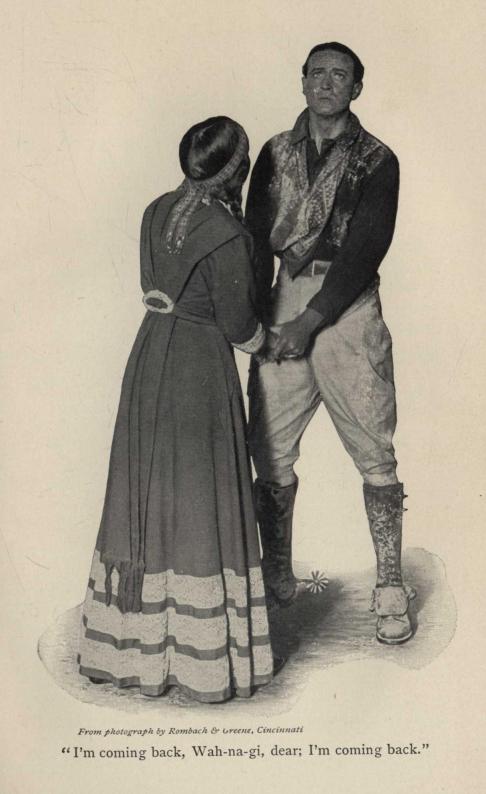
"I'm coming back, Wah-na-gi, dear; I'm coming back."
Bill stood by with the horse. Hal leaped into the saddle.
"Explain it to the boys," he said to McCloud simply. Once more the girl went to him as if she would drag him from the saddle. He leaned down and kissed her and whispered "I'm coming back." Then he put spurs to his horse, and was off.
No one who has not lived on a ranch or in the wilderness apart can ever know what it is—the solemn aching void left by the one who goes away. Hal turned as he reached the hill before descending into the Bad Lands and waved his sombrero to them. Wah-na-gi was standing on the rock, Nat-u-ritch's gravestone, to get the last glimpse of him. Bill and McCloud were standing below. She stood there looking, looking, long after he had disappeared. They had to lift her gently down. Still she stood looking, looking.
"He's gone, Wah-na-gi, child," said John McCloud gently.
"Will he come back?" she said.
CHAPTER XVII
It is a trying moment when we face the wrong answer and realize that we must go back step by step to find the mistake. There is a fascination about the unknown. The future beckons.
Marching always onward, our courage each day finds an uplift in accomplishment. We are farther ahead if only a few inches. Incredible hardships and difficulties are put to flight.
Retracing one's steps, going back, requires more bravery than to go on. Initial enthusiasm looks like a grinning skeleton. It is not the same army in retreat. Doubt, despair hang on its flanks, worry and harass it all the bleeding way.
The moment Hal had decided to go back to England the necessary intermediate processes seemed wholly inadequate. He almost killed a good horse to reach Carbon on the D.&R.G. Railroad, only to find that he had eight hours to wait in that unmitigated by-product of civilization. They were eight heavy, heavy hours. He walked about the station, he gazed at the sage-brush and the water-tank, he went in and out of the "hotel," he attempted unsuccessfully to eat its so-called food, he tried to read its magazines six months old. The only possible object of interest was a very painful object. In the shade of one corner of the veranda on a stretcher lay a coal miner who had been hurt in the company's mines. His breast was heaving as if the life within him was struggling to get out. He was being removed to the company's hospital at Pedro. He had to wait for the train too, and it looked as if his impatient life refused to wait.
The few people in the desolate spot were fortunately busy or they would have gone mad. So no one paid any attention to the sufferer.
"Some people are unlucky, born that way," explained the young company doctor who had the dying man in charge. "Larry's just out of the hospital, and now he's goin' back—to stay this time, I guess."
It seemed to Hal as if he, too, were carrying is maimed life back on a stretcher, but he resisted the suggestion that it was to stay.
At last the train, late as usual, arrived. It was a relief at first. At least it was in motion, and he was going, even if it was backward. He was so preoccupied that it was some time before he was conscious of his fellow-passengers; then he felt rather than saw that he was being elaborately searched, optically swept, marked and staked out; coaxed, petted, and allured. He looked across to see a formidable person of the female sex who was half-pretending to read a book under the solicitous title "Stolen Kisses." This person seemed the last word in modern fixtures. An elaborate baby face peered out from under an elaborate hat of huge dimensions, ornamented with an elaborate mixture of flowers, fruit, and fur. Her face had had elaborate treatment. She wore an elaborate gown with a wholly unnecessary wrap. She had on patent-leather shoes with white cloth tops and exaggerated French heels, and occasionally she unconsciously treated the patient observer to a glimpse of an elaborate silk stocking. Except for the hat, it looked to be a case of tight-fit. Indeed, she seemed a physical and moral protest against restrictions.
"One of the products of John McCloud's 'glorious civilization,'" commented Hal to himself as he got up and retreated to his own car. From which it may be observed that the young man was not in a mood to be altogether fair to civilization or John McCloud. He sat down at the window but he did not see the telegraph poles flying past or the varying monotony of the landscape rushing by. Each revolution of the wheels was taking him farther and farther from Red Butte Ranch. What were they doing there now—Wah-na-gi, John McCloud, Big Bill, and the others? She was no longer at the Agency and the victim of the deviltry of David Ladd and Appah. She was among friends. That was some consolation, much consolation. And the time would pass; then he would be going the other way, going back to pick up his life where he had now dropped it. He wondered at what time of day he would arrive, whether he should notify them or surprise them. Yes, the time would pass. London wouldn't keep him long. Edith would be glad to release him. He felt absolutely confident of that, and yet there was a shadow over all his thoughts. He had a curious unreasonable foreboding of ill. What could happen? Then he became aware that some one was speaking to him. Would the gentleman care to make up a bridge party?
The invitation came to him from one of his fellow-travellers and it seemed a refuge from his thoughts, so Hal was glad to play. It would force him to think of other things. He played and lost quite a tidy sum of money before it came to him that he was being exploited by unfair means.
Having virtuously resolved to do what was right and much against his will, he had a feeling that the way ought to be made smooth and easy. Civilization had never been fair to him, and his return to it was evidently not to be strewn with flowers. He began to grow morose.
He found on picking up a newspaper that he would have two days in New York before his ship sailed, and he determined to spend those days in Washington. He had Ladd on the run. He must see to it that he wasn't allowed to stop short of losing his official head. He had offered to go to Washington at any time to substantiate his charges, and now Ladd was to face an investigation. The papers he had in his possession would go far to establish the agent's connection with the Trust and other papers he possessed would convict him of malfeasance in office. These papers were high explosives and had to be handled with the greatest care, for they involved not only Ladd but officials high in Government circles, and some leaders in Congress and in both of the political parties.
Hal's train arrived at the Grand Central Station in New York at night. He took a cab and ordered the driver to drive to the Hotel Astor. The direct road to the hotel was of course through Forty-second street, which was obviously slow and difficult of negotiation, and the situation seemed to offer an inducement to go a roundabout way with the amiable intention of boosting the fare. It was a trick with which the proposed victim was familiar, and he resolved that while consenting to the extra ride he would resist any effort to collect an extra fare. It was election night, and as soon as the cab hit Broadway it was caught in a whirlpool of humanity. It could neither go on nor go back.
The great city seemed to have resolved itself into a vast lunatic asylum and to have emptied all the patients into the streets. The incoherent maniacs seemed to be enjoying themselves and to be on the whole good-natured. In its gentlest moments New York is a noisy place, but to the ordinary din of traffic, the sag and smash of trucks, the rush and roar of the elevated on its iron bed was added an indescribable cacophony that was fiendish. Election night with its liberty and license—Hooligan's holiday! It seemed to Hal that he had never seen so many unpleasant faces in such a short distance or in so short a time. The sweat-shops seemed to have emptied into the streets, and the Tenderloin, and the submerged wreckage of the Bowery. They were mauling each other, jostling, joking, babbling, hurrahing, hardly knowing for whom or what, blowing fierce blasts on tin horns, ringing clusters of cow-bells, pulling fantastic shrieks out of motor sirens, whirring gigantic rattles—all struggling to see who could make the biggest noise. Women seemed more elated with the spirit of the occasion than men, and they evoked the attentions of strangers without the ceremony of an introduction. The interchange of pleasantries was sometimes marked by freedom and abandon. To Hal just from a country where it was possible to be for days and weeks without the sight of a human being, this seething, writhing mass of humanity, rubbing up against each other, jostling, pulling at each other, handling each other, bawling into each other's faces, was supremely obnoxious. His cab caught in the slow-moving swirl was a fine temptation to horse-play. As he leaned out of one window to try to understand the unusual tumult a vivacious young woman leaned in at the other window and blew a megaphonic tin horn directly into his ear. It seemed as if it would rip the drum of the ear. A greasy-faced urchin blew an expanding and suggestive-looking toy into his face. A buxom Amazon leaned in, gave his necktie a jerk, and screamed through her nose: "Why, sweetheart! I didn't know you was back!"
Other enthusiasts threw confetti over him.
This was civilization's welcome to him! He tried to take it good-naturedly but upon his face was a fixed look of disgust.
The cab got ahead a few feet at a time, then stopped in another block, and he went through the felicitations of these joyous citizens all over again. To his immense relief they at last reached the hotel. Here at last was a haven of refuge. How much was it, he inquired of the cabbie.
"Ten dollars!"
Hal smiled incredulously. He invited the jehu to guess again, to think it over. That worthy reminded him that it was election night, which was put forward as an argument that was in its nature unassailable. Hal patiently explained that he didn't see why he personally should pay five or six times the price because some one had been elected governor of a State which apparently stood in sore need of government. He reminded the obstinate and aggressive person that it was not over half a mile from the station to the hotel and one dollar was ample—two extravagant. He offered to compromise on two. This was received with profuse profanity of a highly inflammable character. In the interstices between expletives were interjected various allusions to the hours it had taken to go the half-mile, to the fact that the cab was scratched, that the horse's life had been endangered, and other more or less irrelevant matters. Hal thought he saw the cab-person signal to a police-person standing a little behind him. Finally the gathering waters of affliction broke and poured forth in righteous wrath. Hal stated with picturesque additions that the man was a crook and a thief.
The burly brute tried to strike the young man with the butt end of his loaded whip. Hal avoided the blow and caught the man square on the jaw, and he went down for the count.
That was all Hal knew until he came back to consciousness in a police cell. It was a very painful consciousness, associated with bandages, a head bursting with pain, and most unpleasant surroundings. Then little by little he came to a vague realization of what had happened. He was practically a stranger in New York. To whom could he turn? He was a British subject. Perhaps he could communicate with the representatives of His Majesty's Government.
In addition to having been very thoroughly beaten, he found that he had been very thoroughly robbed. It was therefore with some difficulty that he could persuade his jailer to communicate with the British Consulate. The promise of a considerable reward finally held out inducements. Fortunately for the prisoner, the British Vice-Consul, Mr. Percy Holmes Tracy, proved to be an old friend of his father's family. Mr. Tracy supplied the prisoner with immediate funds and bestirred himself in his behalf. He found that Hal was accused of being drunk and disorderly, resisting arrest, and striking an officer. Fortunately for the prisoner, Mr. Tracy found that the hotel detective had been a witness of the brutal assault. The detective told the Vice-Consul that the policemen's use of the night-stick was totally unprovoked and unnecessary, that Hal did not resist arrest, that he had no chance to do so, that the policeman and cab-driver were pals who had been suspected of "working together" before, etc., etc. Hal expressed the enthusiastic desire to "make it warm" for all concerned, to have the policeman "broke," etc., etc. All of which Mr. Tracy admitted to be a perfectly natural and justifiable feeling, but he reminded the young man that it would be a somewhat tedious and exacting undertaking. How much time was he willing to devote to it? Could he stay and give it his undivided attention? No, he could not. In fact he was due to sail at once for London. Ah, well, that was another matter, was it not? Under the circumstances it was Mr. Holmes Tracy's advice to pocket his losses, swallow his pride, smother his indignation, and set it down to valuable experience. It would have been cheaper to have paid the ten dollars. These are some of the disadvantages of a highly organized society. And so it happened that the man who had, single-handed, arrested desperadoes in a country where men carry a gun and know how to use it, was made the foolish victim of the polished machinery of "a highly organized society."
Mr. Holmes Tracy's advice was too obviously wise to be ignored. Confronted with the hotel detective the police-grafter was glad to withdraw his charge, with the understanding that no countercharges should be preferred against him. It wasn't altogether satisfying. Community life was a series of compromises; its law expediency.
The two days Hal had intended to spend in Washington had been spent in prison. Perhaps he was safer there. He and civilization had never been friends. Hal welcomed his escape from New York. He was glad to get out of her canyons and pigeon-holes into the light and air. He was glad to reach the boat. When he left London and had turned his face to the West there had seemed a conspiracy to help him on. The winds and waves had romped about him in the sunshine, and hope and joy sang in his heart. He had not felt lonely, but a great content had brooded over him. Now the elements frowned on him. Head winds blew a hurricane the whole way over. Huge waves smote the ship and shook her angrily. Now she rode them down, now shouldered them aside, now cut her way through them, then bowed her head to the blow, shook herself free, throbbing, quivering in every joint, every muscle and nerve and sinew of her crying out against the incessant wear and tear of it. And over all brooded a sky of fleeing gray and black demons. Not a ray of sunlight crept through the clouds. The voyage was a nightmare. Wind and wave were screaming to him to go back; trying to force him back. He was ill and frightfully depressed. He was as eager almost to get out of the ship as if Love's welcome waited for him; as it seemed to do for all but him. But it was scarcely better on shore. He rode up to London in a cold drenching rain. The land looked old, tired, and discouraged. And London!—this Mecca of the exiled Briton. How many hearts turn to it in far off-India, China, Australia, Canada, and the waste places of the earth! How many eager eyes look back to it or look forward to it! What memories it holds for those who know in their souls they can never see it again, and what radiant visions it offers to those who sweat and save and suffer and perhaps lie and steal that one day they may come back to it, and bring it the tribute of their blood and treasure. London is compelling like some great sad song that tells of sorrows and wrongs. But it had no message and no welcome to this returning pilgrim. Before they reached the city they rode out of the rain and into one of those fogs which creeps out of its tombs and graveyards and buried horrors, and tries to materialize itself and once more take possession of the actual life of the city.
Hal took a cab and they began to grope their way toward his father's town house. Even in his thought he didn't call it home. Oh for the land of sunshine, he thought, where one can look into the infinite sky, and beyond and beyond and still beyond. Here he felt as if he were knocking his head against it. One didn't breathe; one swallowed the air in chunks and gulps. They almost rode down a procession of the unemployed, an army with banners, but an army with none of the pride, pomp, and circumstance of glorious war. Hal shrank back in his cab and shivered in his great-coat. Their banners were dirty, but it was evident that each soldier of despair had made some little effort with bad success to make as decent an appearance in the public eye as possible. They were a sad lot with their gaunt faces and soiled and tattered clothes. They were of all ages and states of desperation, from the young mechanic with youth and health still left, to the wretch who had been submerged, who couldn't work if it were given him to do, fit only to fertilize the soil. Hal's cabman lost his way for a moment and they got into Hyde Park. One of its orators was about to dismiss his small audience because he could scarcely see or be seen by them as they huddled close to him and to each other, and the speaker complained that the fog got into his throat and wellnigh choked him. Hal called to his driver to stop and they drew up to the curb. Hal was not unfamiliar with the Hyde Park meetings and their speakers, but never in his life before had he stopped to listen. It was an admirable safety-valve where cranks could talk to cranks. That they had or could have any message to him or for the world had never entered his mind. The unemployed had impressed him painfully. They were wandering hopelessly up and down crying in unison: "Work, work! We want work." This dull cry and their faces peering at him out of clammy shadows and yellow smears had got on his nerves. He was curious to hear what the orator of such people had to say on such a day.
"One moment and I'll close. You think I'm a layin' of it on, that I'm a makin' it up, but I 'old in my 'and a report of Lord George 'amilton, Royal Commissioner, on the condition of the English poor, and these is 'is words, not mine, 'is, moind ye.
"The conditions of life in London and other large cities 'ave produced a degenerate race, morally and physically enfeebled."
Hal drove on. When he reached his father's house there was a new servant at the door and he had to explain who he was. This was the glorious civilization he was coming back to. This was its welcome to him! Oh, John McCloud! Is this your Christian civilization?
CHAPTER XVIII
The Earl of Kerhill's town house was plain and formal on the outside. Within, it was beautiful, but cold and stately. Even the arrangement of its contents was apparently fixed and unalterable. At any rate no one could remember when any one had had the courage to meddle with its established order. Hal remembered that he had early gained the impression that it was not a place for little boys to live in. Thou-shalt and Thou-shalt-not seemed to divide the house between them. And now amid its Boulle and Tudor tables, its Venetian carved chairs, its Chippendales, its tapestries and portraits of knights and ladies, its plate and glass, its marbles and carvings, Hal felt more of an anachronism than ever. Cold and stately and solemn! It was as if it felt superior to its tenants. "Look back," it seemed to say to any one inclined to be familiar with it; "look back and tell me where are the brave and beautiful and gallant lords and ladies who once danced here and feasted here, loved, and made merry here? Gone and forgotten! The present lord, he, too, will soon be with the others. I was before them and I will be after them. I am a house with an individuality. People come and people go, but I remain. Cold, stately, and solemn!" The library was the most livable room and even the library was stately. Perhaps there were people so lost to the eternal fitness of things, so empty and shallow that they might be flippant in it, but it required an effort, and even shallow people were not allowed to forget that Grinling Gibbons had done the carvings about the noble fire-place.
The house seemed to have forgotten Gibbons and to arrogate the carvings to itself. It was a proud house. The library at least looked inhabited. Perhaps the books gave it the human touch that linked up the past and the present and brought people and things into relations, distant relations no doubt, but still relations. It is not surprising that Nat-u-ritch's son had never liked the Earl's town house.
Lady Winifred was writing at a heavy oak table elaborately carved, the light from a jewelled lamp falling over her high-bred face and her abundant hair which had great snow patches lying gently on it. She needed that softening touch of white, for there was a mocking light in her eyes and a cynical play of the lips. Andrews had placed the coffee service and the liqueurs on a small table before a high-backed Charles II chair on the other side of the room.
"Andrews, ask the gentlemen to take their coffee here with me."
"Yes, my lady."
Back of the library was a recess from which sprang a graceful stairway to the floor above. It was lit by panels of jewelled glass. Crowning the newel post was an electric flambeau. As the butler left the room a beautiful woman entered from the main hall and stood by the stairway, looking quietly but nervously about. The light from the flambeau lit up a face so colorless, so bloodless that it seemed almost transparent. Out of the whiteness, crowned with glowing auburn hair, shone lustrous agate eyes, hard, brilliant, with sensuous lights beneath the surface. She had entered the room and looked about before Lady Winifred was aware of her presence. Then she stole down rapidly but softly to the side of the elder woman and said:
"Well, have you seen him?"
"Why, I thought you were dining with Lord Yester at the Carlton."
"So I was," assented the other, pulling nervously at her gloves.
"And going to the theatre afterward?"
"I couldn't sit still in the theatre. Even the thought of it upset me. You have seen him?"
"Hal? Why, of course."
"What does he say?"
"About what?"
"About me."
"He hasn't mentioned you to me as yet."
"No? Oh!" and Edith, Viscountess Effington, Hal's wife, walked slowly over to the coffee service and lit a cigarette. She watched the vagrant smoke with a retrospective air.
"I had a curious sensation at dinner," she said. "I found I wasn't hearing what Lord Yester was saying. All of a sudden I was frightened. I felt as if I were choking. Hal seemed to stand behind and over Lord Yester and I got a queer idea that he had come back to, to—Winifred, you and he have always been pals; you tell him. Tell him all there is to tell, about Lord Yester and myself, so that he will be prepared, and make him understand that if ne has come back to interfere with my plans"—and her lips shut and her eyes glistened ominously—"well, don't let him think of it."
"I think he knows you do as you please."
"Why shouldn't I?" said Edith with a little reckless laugh. "Why shouldn't I? I've only one life to live and that's mine, to live my way. I'm selfish; so is everybody else. Some people get a selfish pleasure out of pretending to be unselfish. Well, let them! I'm not a hypocrite, thank God!"
Edith took from her enormous ermine muff a gold and jewelled bonbon box, extracted from it a tablet, and swallowed it with a drink of brandy which she had poured from a decanter.
"Sir George's prescription for my headaches," she explained in answer to the other's look of disapproval.
"The brandy part of the prescription, Edith?"
"Not having headaches, Winifred, you have a fine superiority to those who have." And she pulled the long opera cloak of emerald green like the breast of the humming-bird about her white shoulders, adjusted her ermine stole as if she were cold, walked slowly toward the stairs. In repose she was very soft, pliant, lambent, but, when moved, quick and violent. She turned and stiffened, threw her head up into the air, and came down swiftly to Lady Winifred's side.
"I must have this settled now—to-night! I can't stand this suspense. If he attempts to upset my plans——"
"You may find him quite as eager to be free as you are."
"Do you think so, Winifred? Do you really think so?" she said, rising at a bound to the extreme of elation. Then she crept softly out of the room, purring to herself: "Oh, I hope so; I hope so."
There was a slight elevation to Lady Winifred's eyebrow and the slightest tilt to one of her shoulders. It seemed to suggest that she had ceased to be impressed with the moods and tenses of the other, that it was a pity that men could not see past the surface of things feminine, that Edith's egotism had the noble simplicity of all big things.
"My dear, wasn't Cousin Hal to take his after-dinner coffee here with us?"
It was Sir Gordon Stuckley who spoke as he came into the room. Sir Gordon was known as Lady Winifred's husband. He was a retired army officer and considerably older than his handsome wife. His mind was the amiable repository of everything conventional and commonplace. He walked over to the writing-table and picked up a cigarette.
"He has gone up to say good-night to his father," said Lady Winifred, blotting and folding her finished letter.
"Well, Hal is back," said Sir Gordon sententiously, "and brings his problem with him still unsolved."
"Whose life isn't a problem—'still unsolved'?" said his wife with an enigmatical smile.
"And it's quite difficult enough to face one's own problem, to face one's own mistakes," she continued. "It's rather hard to have to answer for the mistakes of somebody else; mistakes that can't be remedied; can't in the very nature of things. Hal can't help being a half-caste, can he?"
"What is he back for?" asked her husband shortly.
"To see his father, I presume. Sir George, I believe, cabled him to come."
"The Earl is no worse than he has been or may be for some time to come. I hope, for his own sake, and for our sake Hal has no intention of staying, because you know he is quite impossible here, now isn't he?"
"I suppose so," said Lady Winifred with a note of regret, for she was fond of the boy, "and yet we pride ourselves here on being cosmopolitan, on havin' no race prejudices."
"Officially? No! Socially? Most assuredly yes! Officially we treat these Indian potentates as princes. Actually, my dear, we regard them as niggers. Well, there you are."
"Yes," she admitted. "We are fairly tolerant of aliens because there are not enough of them to annoy us. They don't crowd us off the pavement, or take our places in the tram, or lay hands on the stipends and positions we reserve for ourselves, but, as a matter of fact, we are quite the most intolerant people in the world. Still it isn't his being a half-breed that matters so much, I think. He was living that down—it's his having to leave the Army."
"Quite so; but why did he have to leave the Army? Because he didn't know how to obey; because he couldn't submit to discipline, and why couldn't he submit to discipline? Because he had in his veins the blood of the American Indian. It comes down to race at last."
"But why shouldn't a half-breed inherit the best of each type instead of the worst and so be superior to either?"
"Oh, there is only one best, my dear," said Gordon as he walked to the coffee with a superior smile. "There is only one best."
"And of course we assume that we are the superior type."
Lady Winifred looked after Sir Gordon with toleration. She was a woman of unusual intelligence and it was hardly fair to ask her to maintain any real illusions as to her husband.
"Well," she continued, "this dear boy is a half-breed; his wife is of our best and purest blood. Yet, with all his peculiarities, Hal is adorable, and Edith—well, if she's a type of superiority, God help the British Empire."
"Edith isn't representative; oh, no; oh, my, no!" Sir Gordon's enthusiasm in rejecting Edith on behalf of the British Empire almost upset the coffee urn.
"Oh, my, no!" he kept repeating with comic insistence.
"Isn't she?" objected Lady Winifred coming forward to take the cup offered by her husband. "Isn't she? Is the smoking, drinking, gambling woman with a moral code of her own an exception, or is she getting to be the London type?"
"By the way, where is Edith?"
"Dining with Lord Yester at the Carlton."
"Dining at the Carlton the first night her husband is at home?"
"My dear Gordon, you are hopelessly old-fashioned. Husbands are like the vermiform appendix. They must have served some useful purpose once, but no one knows now what it was. A busy woman has no time for such trifles. Edith is just back from a house party at Groton Court, she had to devote some time in the forenoon to her modiste; she went to the races in the afternoon, had tea at the Austrian Embassy, played a little bridge, and naturally she had to dress for dinner. If Hal is patient they may eventually meet here or at some mutual friend's."
Gordon never tried to follow the intricacies of his wife's raillery.
"Well, I must be hopelessly old-fashioned," he said in the most matter-of-fact way. "Modern matrimony is quite beyond me." Sir Gordon was old-fashioned. He belonged to an epoch when men, by an unwritten law, left the gossip to the women.
"Winifred," he began with much hesitation, and speaking with grave deliberation, "are you aware that Lord Yester's attentions to Edith are beginning to create talk?"
"Beginning?" laughed his wife. "Why, Gordon, that is so old that people have ceased to talk about it."
"Is it really?" he ejaculated in hopeless confusion. "Well, Hal must put his foot down at once, at once," he repeated with feeble over-emphasis.
"My dear, the foot and the hand go together. They are both archaic. Since it is no longer good form to beat one's wife, the putting of the foot down or up is of no importance. Women only respected their husbands when they had to."
One of Gordon's qualifications as a fighter and a husband was that he could take punishment. It is a useful accomplishment, and as rare as it is beautiful. It would have been impossible for Lady Winnifred to live with a man who was over-sensitive. As she explained the situation herself: "Some amiability is essential to contiguity. The bearings must have oil. Well, you mustn't expect it of me or of the cook. One doesn't look for it in one's friends. Well, there you are!"
"I have no doubt something of this has come to Hal's ears," said her husband, "and he has returned to put his house in order, and quite time indeed."
"Well," she answered, "from the woman's point of view the civilized man is a glaring failure. Perhaps the half-savage may succeed."
"Fancy, Rundall, fancy my wife suspecting the superiority of the Anglo-Saxon race!"
This remark was addressed to a polished, imposing person who was descending the stairs, and in the act of returning a thermometer to the pocket of his evening coat. Sir George Rundall had the right but not the time to add a long string of letters to his name. He was a self-made man and was a credit to himself. He had the figure of one who has been an athlete, the head of a scholar who was also a man of the world, a clean-shaven, florid face and perfectly white hair, what there was of it. The doctor was a man of learning, was an authority on all sorts of unpleasant things, and had a prodigious memory. Here was a man who could put Winifred in her proper place, if any one could.
Sir Gordon had ripped out "the Anglo-Saxon race" with something of its sonorous after-dinner effect.
"Haven't you discovered, Stuckley, that our wives are always right?"
"Oh, I say!" groaned Sir Gordon, dismayed at this cowardly going over to the enemy.
"There is no such thing as an Anglo-Saxon race."
"What?"
"And there's no such thing as a pure type of man. He simply doesn't exist. Finot says: 'All human beings are cross-breeds,'" and the doctor sat down at a small desk set into a bookcase, and began to write a prescription.
"Race" was one of Gordon's strong points. He had all the conviction of the profound amateur. He was an example of a little learning and its consequences.
"You mean to say," he asked with pompous incredulity, "that there is nothing in dolichocephalic superiority?" Having delivered this without a sign of distress he looked about, greatly pleased with himself.
"Dolly who?" asked Winifred. "Sir George, is that a real word, or just aggravated assault and battery?"
"Don't be alarmed, Lady Stuckley, it only means fair-haired people with narrow skulls."
"And so blonds are the elect, are they?" she said. "Now I know the scientific explanation for the popularity of peroxide of hydrogen."
"Joking aside," said the military man. It was a stock phrase in his domestic experiences. "Joking aside, I am sure our man of science will admit the importance of the—ah, the cephalic index?"
"Sir George, I look to you for protection."
"Head measurements, Lady Stuckley, that's all," explained Sir George with a smile. "Well, as to that," he went on, rising and coming to the library table, "a fellow by the name of Parchappe, who went in for that sort of thing, found 'the head of an intelligent woman to be perceptibly inferior to the dimensions of the head of an idiot.' Now, Stuckley, justify that to your wife if you can."
Lady Winifred laughed heartily.
"For Lord Kerhill," added the doctor to Winifred as he put a prescription on the corner of the table before her.
"It pleases Sir George to treat facts as jests," said the discomfited Gordon.
"Facts?" queried Winifred. "Facts? Why that is ground for divorce."
"Facts?" echoed the man of science gravely. "I wonder what are facts? The conviction of to-day is the derision of to-morrow. We have long used the skull and the brain to assign hopeless inferiority to various peoples, now comes along Finot and says: 'The skull and the brain furnish no argument in favor of organic inequality.' Lamarck—I think it's Lamarck—puts it better. He affirms that 'Nature has created neither classes nor orders, nor families, nor kinds, nor permanent species, but only individuals!'"
"That's the answer to the problem, Gordon," cried Lady Winifred triumphantly—"the Individual!"
Down the stairs came the Individual and lounged into the room. Hal knew at once from the suggestion of an embarrassed pause that he had been the subject of the conversation.
It is rather trying to one with a problem to have inept hands dipping in, messing it about.
The doctor was the first to regain his poise. He was used to difficult cases, and when he had to announce to the patient that he had only six weeks or six months to live, his manner was perfect. "Ah, Harold," he said with a kindly smile, putting his hand on the boy's arm with a reassuring touch, "splendid for your dear father, this home coming. You mustn't go away again." Then he dropped his voice for Hal's ear alone. "I'll be back. I want to speak with you before you retire," and the busy man passed out. Hal had on the conventional dinner coat. He looked at his relatives with an amused smile and came down to the table and started to help himself to a cigarette, then thought better of it, took some rice-paper from his pocket and made his own, manipulating it with one hand after the miraculous manner of the Mexican. When it was finished, amid the awed and fascinated wonder of the spectators, he lit a match on the leg of his trousers and lit the cigarette with the same hand to the dismay of Gordon and the joy of Winifred.
To Gordon's mind no well-bred person could really care for miracles.
"Well, Cousin Hal, you have been three years an exile! What a joy, eh? What a joy to be back in dear old London!"
The boy smiled as he took up his coffee.
"Do you remember Grafton? Used to be a pal of mine. Met him on the train coming up from Liverpool." The boy bent forward with an air of startled boredom. One could see Grafton. "Well, old chap, missed you awfully! Where have you been keeping yourself for the last fortnight?" He dropped the assumption.
"Cordial place—London! Out our way men and their characters go in their shirt sleeves." And he stretched his arms and the dinner coat popped ominously. For the moment he seemed to fill the library and it dwarfed most people.
"But you don't escape the rotter even out there, do you?" asked Winifred.
"No, but the rotter shouts himself out to all the world, and if you don't like the noise he makes you shoot it full of holes. Here they carry concealed weapons. I'm more at home with the shirt-sleeve crowd," and he sat down in the Charles II chair and threw his leg over one arm of it as he sipped his coffee.