Chapter VII · (continued 3)
Reading edition
It is evident that before armies could look habitually to being transported across the Mesopotamian streams, wherever they might happen to strike them in their expeditions, by boats of these two kinds, either ferries must have been established at convenient intervals upon them, or traffic along their courses by means of boats must have been pretty regular. An Assyrian army did not carry its boats with it, as a modern army does its pontoons. Boats were commonly found in sufficient numbers on the streams themselves when an army needed them, and were impressed, or hired, to convey the troops across. And thus we see that the actual navigation of the streams had another object besides the military one of transport from bank to bank. Rivers are Nature’s roads; and we may be sure that the country had not been long settled before a water communication began to be established between towns upon the river-courses, and commodities began to be transported by means of them. The very position of the chief towns upon time banks of the streams was probably connected with this sort of transport, the rivers furnishing the means by which large quantities of building material could be conveniently concentrated at a given spot, and by which supplies could afterwards be regularly received from a distance. We see in the Assyrian sculptures the conveyance of stones, planks, etc. along the rivers, as well as the passage of chariots, horses, and persons across them. Rafts and round boats were most commonly used for this purpose. When a mass of unusual size, as a huge paving-stone, or a colossal bull or lion, had to be moved, a long, flat-bottomed boat was employed, which the mass sometimes more than covered. In this case, as there was no room for rower’s, trackers were engaged, who dragged the vessel along by means of ropes, which were fastened either to the boat itself or to its burden. [PLATE CXXXIII., Fig. 2.]
During the later period of the monarchy various improvements took place in Assyrian boat-building. The Phoenician and Cyprian expeditions of the later kings made the Assyrians well acquainted with the ships of first-rate nautical nations; and they seem to have immediately profited by this acquaintance, in order to improve the appearance and the quality of their own river boats. The clumsy and inelegant long-boat of the earlier times, as replaced, even for ordinary traffic, by a light and graceful fabric, which was evidently a copy from Phoenician models. Modifications, which would seem trifling if described, changed the whole character of the vessels, in which light and graceful curves took the place of straight lines and angles only just rounded off. The stem and stern were raised high above the body of the boat, and were shaped like fishes’ tails or carved into the heads of animals. [PLATE CXXXIII., Fig. 2.] Oars, shaped nearly like modern ones, came into vogue, and the rowers were placed so as all to look one way, and to pull instead of pushing with their oars. Finally, the principle of the bireme was adopted, and river-galleys were constructed of such a size that they had to be manned by thirty rowers, who sat in two tiers one above the other at the sides of the galley, while the centre part, which seems to have been decked, was occupied by eight or ten other persons.
In galleys of this kind the naval architecture of the Assyrians seems to have culminated. They never, so far as appears, adopted for their boats the inventions with which their intercourse with Phoenicia had rendered them perfectly familiar, of masts, and sails. This is probably to be explained from the extreme rapidity of the Mesopotamian rivers, on which sailing boats are still uncommon. The unfailing strength of rowers was needed in order to meet and stem the force of the currents; and this strength being provided in abundance, it was not thought necessary to husband it or eke it out by the addition of a second motive power. Again, the boats, being intended only for peaceful purposes, were unprovided with beaks, another invention well known to the Assyrians, and frequently introduced into their sculptures in the representations of Phoenician vessels. [PLATE CXXXIII., Fig. 5.]
In the Assyrian biremes the oars of the lower tier were worked through holes in the vessel’s sides. This arrangement would of course at once supply a fulcrum and keep the oars in their places. But it is not so easy to see how the oar of a common row-boat, or the uppermost tier of a bireme, obtained their purchase on the vessel, and were prevented from slipping along its side. Assyrian vessels had no rowlocks, and in general the oars are represented as simply rested without any support on the upper edge of the bulwark. But this can scarcely have been the real practice; and one or two representations, where a support is provided, may be fairly regarded as showing what the practice actually was. In the figure of a kufa, or round boat, already given, it will be seen that one oar is worked by means of a thong, like the [—] or [—] of the Greeks, which is attached to a ring in the bulwark. In another bas-relief, several of the oars of similar boats are represented as kept in place by means of two pegs fixed into the top of the bulwark and inclined at an angle to one another. [PLATE CXXXIII., Fig. 6.] Probably one or other of these two methods of steadying the oar was in reality adopted in every instance.
With regard to Assyrian commerce, it must at the outset be remarked that direct notices in ancient writers of any real authority are scanty in the extreme. The prophet Nahum says indeed, in a broad and general way, of Nineveh, “Thou hast multiplied thy merchants above the stars of heaven;” and Ezekiel tells us, more particularly, that Assyrian merchants, along with others, traded with Tyre “in blue clothes, and broidered work, and in chests of rich apparel.” But, except these two, there seem to be no notices of Assyrian trade in any contemporary or quasi-contemporary author. Herodotus, writing nearly two hundred years after the empire had come to an end, mentions casually that “Assyrian wares” had in very ancient times been conveyed by the Phoenicians to Greece, and there sold to the inhabitants. He speaks also of a river traffic in his own day between Armenia and Babylon along the course of the Euphrates, a fact which indirectly throws light upon the habits of earlier ages. Diodorus, following Ctesias, declares that a number of cities were established from very ancient times on the banks of both the Tigris and the Euphrates, to serve as marts of trade to the merchants who imported into Assyria the commodities of Media and Paraetacene. Among the most important of these marts, as we learn from Strabo, were Tiphsach or Thapsacus on the Euphrates, and Opis upon the Tigris.
It is from notices thus scanty, partial, and incidental, eked out by probability, and further helped by a certain number of important facts with respect to the commodities actually used in the country, whereof evidence has been furnished to us by the recent discoveries, that we have to form our estimate of the ancient commerce of the Assyrians. The Inscriptions throw little or no light upon the subject. They record the march of armies against foreign enemies, and their triumphant return laden with plunder and tribute, sometimes showing incidentally what products of a country were most in request among the Assyrians; but they contain no accounts of the journeys of merchants, or of the commodities which entered or quitted the country in the common course of trade.
The favorable situation of Assyria for trade has often attracted remark. Lying on the middle courses of two great navigable streams, it was readily approached by water both from the north-west and from the south-east. The communication between the Mediterranean and the Southern or Indian Ocean naturally—almost necessarily—followed this route. If Europe wanted the wares and products of India, or if India required the commodities of Europe, by far the shortest and easiest course was the line from the eastern Mediterranean across Northern Syria, and thence by one or other of the two great streams to the innermost recess of the Persian Gulf. The route by the Nile, the canal of Neco, and the Red Sea, was decidedly inferior, more especially on account of the dangerous navigation of that sea, but also because it was circuitous, and involved a voyage in the open ocean of at least twice the length of the other.
Again, Assyria lay almost necessarily on the line of land communication between the north-east and the south-west. The lofty Armenian mountain-chains—Niphates and the other parallel ranges—towards the north, and the great Arabian Desert towards the south, offered difficulties to companies of land-traders which they were unwilling to face, and naturally led them to select routes intermediate between these two obstacles, which could not fail to pass through some part or other of the Mesopotamian region.
The established lines of land trade between Assyria and her neighbors were probably very numerous, but the most important must have been some five or six. One almost certainly led from the Urumiyeh basin over the Keli-shin pass (lat. 37°, long. (45° nearly)), descending on Rowandiz, and thence following the course of the Greater Zab to Herir, whence it crossed the plain to Nineveh. At the summit of the Kell-shin pass is a pillar of dark blue stone, six feet in height, two in breadth, and one in depth, let into a basement block of the same material, and covered with a cuneiform inscription in the Scythic character. At a short distance to the westward on the same route is another similar pillar. The date of the inscriptions falls within the most flourishing time of the Assyrian empire, and their erection is a strong argument in favor of the use of this route (which is one of the very few possible modes of crossing the Zagros range) in the time when that empire was in full vigor.
Another line of land traffic probably passed over the same mountain-range considerably further to the south. It united Assyria with Media, leading from the Northern Ecbatana (Takht-i-Suleiman) by the Banneh pass to Suleimaniyeh, and thence by Kerkuk and Altura-Kiupri to Arbela and Nineveh.
There may have been also a route up the valley of the Lesser Zab, by Koi-Sinjah and over the great Kandil range into Lajihan. There are said to be Assyrian remains near Koi-Sinjah, at a place called the Bihisht and Jehennen (“the Heaven and Hell”) of Nimrud, but no account has been given of them by any European traveller.
Westward there were probably two chief lines of trade with Syria and the adjacent countries. One passed along the foot of the Sinjar range by Sidikan (Arban) on the Khabour to Tiphsach (or Thapsacus) on the Euphrates, where it crossed the Great River. Thence it bent southwards, and, passing through Tadmor, was directed upon Phoenicia most likely by way of Damascus. Another took a more northern line by the Mons Masius to Harran and Seruj, crossing the Euphrates at Bir, and thence communicating both with Upper Syria and with Asia Minor. The former of these two routes is marked as a line of traffic by the foreign objects discovered in such abundance at Arban, by the name Tiphsach, which means “passage,” and by the admitted object of Solomon in building Tadmor. The other rests on less direct evidence; but there are indications of it in the trade of Harran with Tyre which is mentioned by Ezekiel, and in the Assyrian remains near Seruj, which is on the route from Harran to the Bir fordway.
Towards the north, probably, the route most used was that which is thought by many to be the line followed by Xenophon, first up the valley of the Tigris to Til or Tilleh, and then along the Bitlis Chai to the lake of Van and the adjacent country. Another route may have led from Nineveh to Nisibis, thence through the Jebel Tur to Diarbekr, and from Diarbekr up the Western Tigris to Arghana, Kharput, Malatiyeh, and Asia Minor. Assyrian remains have been found at various points along this latter line, while the former is almost certain to have connected the Assyrian with the Armenian capital.
Armenian productions would, however, reach Nineveh and the other great central cities mainly by the Tigris, down which they could easily have been floated from Tilleh. or even from Diarbekr. Similarly, Babylonian and Susianian productions, together with the commodities which either or both of those countries imported by sea, would find their way into Assyria up the courses of the two streams, which were navigated by vessels capable of stemming the force of the current, at least as high as Opis and Thapsacus.
We may now proceed to inquire what were the commodities which Assyria, either certainly or probably, imported by these various lines of land and water communication. Those of which we seem to have some indication in the existing remains are gold, tin, ivory, lead, stones of various kinds, cedar-wood, pearls, and engraved seals.
Many articles in gold have been recovered at the various Assyrian sites where excavations have been made; and indications have been found of the employment of this precious metal in the ornamentation of palaces and of furniture. The actual quantity discovered has, indeed, been small; but this may be accounted for without calling in question the reality of that extraordinary wealth in the precious metals which is ascribed by all antiquity to Assyria. This wealth no doubt flowed in, to a considerable extent, from the plunder of conquered nations and the tribute paid by dependent monarchs. But the quantity obtained in this way would hardly have sufficed to maintain the luxury of the court and at the same time to accumulate, so that when Nineveh was taken there was “none end” of the store. It has been suggested that “mines of gold were probably once worked within the Assyrian dominions,” although no gold is now known to be produced anywhere within her limits. But perhaps it is more probable that, like Judaea and Phoenicia, she obtained her gold in a great measure from commerce, taking it either from the Phoenicians, who derived it both from Arabia and from the West African coast, or else from the Babylonians, who may have imported it by sea from India.
Tin, which has not been found in a pure state in the remains of the Assyrians, but which enters regularly as an element into their bronze, where it forms from one-tenth to one-seventh of the mass, was also, probably, an importation. Tin is a comparatively rare metal. Abundant enough in certain places, it is not diffused at all widely over the earth’s surface. Neither Assyria itself nor any of the neighboring countries are known to have ever produced this mineral. Phoenicia certainly imported it, directly or indirectly, from Cornwall and the Scilly Isles, which therefore became first known in ancient geography as the Cassiterides or “Tin Islands.” It is a reasonable supposition that the tin wherewith the Assyrians hardened their bronze was obtained by their merchants from the Phoenicians in exchange for textile fabrics and (it may be) other commodities. If so, we may believe that in many instances the produce of our own tin mines which left our shores more than twenty-five centuries ago, has, after twice travelling a distance of many thousand miles, returned to seek a final rest in its native country.
Ivory was used by the Assyrians extensively in their furniture, and was probably supplied by them to the Phoenicians and the Greeks. It was no doubt sometimes brought to them by subject nations as tribute; but this source of supply is not sufficient to account, at once, for the consumption in Assyria itself, and for the exports from Assyria to foreign countries. A regular trade for ivory seems to have been carried on from very early times between India and Dedan (Bahrein,?) in the Persian Gulf. The travelling companies of the Dedanim, who conveyed this precious merchandise from their own country to Phoenicia, passed probably along the course of the Euphrates, and left a portion of their wares in the marts upon that stream, which may have been thence conveyed to the great Assyrian cities. Or the same people may have traded directly with Assyria by the route of the Tigris. Again, it is quite conceivable—indeed, it is probable—that there was a land traffic between Assyria and Western India by the way of Cabal, Herat, the Caspian Gates, and Media. Of this route we have a trace in the land animals engraved upon the well-known Black Obelisk, where the combination of the small-eared or Indian elephant and the rhinoceros with the two-humped Bactrian camel, sufficiently marks the line by which the productions of India, occasionally at, any rate, reached Assyria. The animals themselves were, we may be sure, very rarely transported. Indeed, it is not till the very close of the Persian empire that we find elephants possessed—and even then in scanty numbers—by the western Asiatic monarchs. But the more portable products of the Indus region, elephants’ tusks, gold, and perhaps shawls and muslins, are likely to have passed to the west by this route with far greater frequency.
The Assyrians were connoisseurs in hard stones and gems, which they seem to have imported from all quarters. The lapis lazuli, which is found frequently among the remains as the material of seals, combs, rings, jars, and other small objects, probably came from Bactria or the adjacent regions, whence alone it is procurable at the present day. The cornelian used for cylinders may have come from Babylonia, which, according to Pliny furnished it of the best quality in the more ancient times. The agates or onyxes may have been imported from Susiana, where they were found in the bed of the Choaspes (Kerkhah), or they may possibly have been brought from India. Other varieties are likely to have been furnished by Armenia, which is rich in stones; and hence too was probably obtained the shamir, or emery-stone, by means of which the Assyrians were enabled to engrave all the other hard substances known to them.
That cedar-wood was imported into Assyria is sufficiently indicated by the fact that, although no cedars grew in the country, the beams in the palaces were frequently of this material. It may not, however, have been exactly an article of commerce, since the kings appear to have cut it after their successful expeditions into Syria, and to have carried it off from Lebanon and Amanus as part of the plunder of the country.
Pearls, which have been found in Assyrian ear rings, must have been procured from the Persian Gulf, one of the few places frequented by the shell-fish which produces then. The pearl fisheries in these parts were pointed out to Nearchus, the admiral of Alexander, and had no doubt been made to yield their treasures to the natives of the coasts and islands from a remote antiquity. The familiarity of the author of the book of Job with pearls is to be ascribed to the ancient trade in them throughout the regions adjoining the Gulf, which could not fail to bring them at an early date to the knowledge of the Hebrews.
Engraved stones, generally in the shape of scarabs, seem to have been largely imported from Egypt into Assyria, where they were probably used either as amulets or as seals. They have been found in the greatest plenty at Arban on the lower Khabour, the ancient Sidikan or Shadikanni, which lies nearly at the extreme west of the Assyrian territory; but many specimens have likewise been obtained from Nineveh and other of the central Assyrian cities.
If we were to indulge in conjecture, we might add to this list of Assyrian importations at least an equal number of commodities which, though they have not been found in the ancient remains, may be fairly regarded, on grounds of probability, as objects of trade between Assyria and her neighbors. Frankincense, which was burnt in such lavish profusion in the great temple at Babylon, was probably offered in considerable quantities upon Assyrian altars, and could only have been obtained from Arabia. Cinnamon, which was used by the Jews from the time of the Exodus, and which was early imported into Greece by the Phoenicians, who received it from the Arabians can scarcely have been unknown in Assyria when the Hebrews were familiar with it. This precious spice must have reached the Arabians from Ceylon or Malabar, the most accessible of the countries producing it. Mullins, shawls, and other tissues are likely to have come by the same route as the cinnamon; and these may possibly have been among the “blue clothes and broidered work and rich apparel” which the merchants of Asshur carried to Tyre in “chests, bound with cords and made of cedar-wood.” Dyes, such as the Indian lacca, raw cotton, ebony and other woods, may have come by the same line of trade; while horses and mules are likely to have been imported from Armenia, and slaves from the country between Armenia and the Halys River.
If from the imports of Assyria we pass to her exports, we leave a region of uncertain light to enter upon one of almost total darkness. That the “wares of Assyria” were among the commodities which the Phoenicians imported into Greece at a very early period, we have the testimony of Herodotus; but he leaves us wholly without information as to the nature of the wares themselves. No other classical writer of real authority touches the subject; and any conclusions that we may form upon it must be derived from one of two sources, either general probability, or the single passage in a sacred author which gives us a certain amount of authentic information. From the passage in question, which has been already quoted at length, we learn that the chief of the Assyrian exports to Phoenicia were textile fabrics, apparently of great value, since they were most carefully packed in chests of cedar-wood secured by cords. These fabrics may have been “blue cloaks,” or “embroidery,” or “rich dresses” of any kind, for all these are mentioned by Ezekiel; but we cannot say definitely which Assyria traded in, since the merchants of various other countries are joined in the passage with hers. Judging by the monuments, we should conclude that at least a portion of the embroidered work was from her looms and workshops; for, as has been already shown, the embroidery of the Assyrians was of the most delicate and elaborate description. She is also likely to have traded in rich apparel of all kinds, both such as she manufactured at home, and such as she imported from the far East by the lines of traffic which have been pointed out. Some of her own fabrics may possibly have been of silk, which in Roman times was a principal Assyrian export. Whether she exported her other peculiar productions, her transparent and colored glass, her exquisite metal bowls, plates, and dishes, her beautifully carved ivories, we cannot say. They have not hitherto been found in any place beyond her dominion, so that it would rather seem that she produced them only for home consumption. Some ancient notices appear to imply a belief on the part of the Greeks and Romans that she produced and exported various spices. Horace speaks of Assyrian nard Virgil of Assyrian amomuum, Tibullus of Assyrian odors generally. AEschylus has an allusion of the same kind in his Agamemnon. Euripide, and Theocritus, who mention respectively Syrian myrrh and Syrian frankincense, probably use the word “Syrian” for “Assyrian.” The belief thus implied is not, however, borne out by inquiry. Neither the spikenard nor the amonmum, nor the myrrh tree, nor the frankincense tree, nor any other actual spice, is produced within the limits of Assyria, which must always have imported its own spices from abroad, and can only have supplied them to other countries as a carrier. In this capacity she may very probably, even in the time of her early greatness, have conveyed on to the coast of Syria the spicy products of Arabia and India, and thus have created an impression, which afterwards remained as a tradition, that she was a great spice-producer as well as a spice-seller.
In the same way, as a carrier, Assyria may have exported many other commodities. She may have traded with the Phoenicians, not only in her own products, but in the goods which she received from the south and east, from Bactria, India, and the Persian Gulf,—such as lapis lazuli, pearls, cinnamon, muslins, shawls, ivory, ebony, cotton. On the other hand, she may have conveyed to India, or at least to Babylon, the productions which the Phoenicians brought to Tyre and Sidon from the various countries bordering upon the Mediterranean Sea and even the Atlantic Ocean, as tin, hides, pottery, oil, wine, linen. On this point, however, we have at present no evidence at all; and as it is not the proper office of a historian to indulge at any length in mere conjecture, the consideration of the commercial dealings of the Assyrians may be here brought to a close.
On the agriculture of the Assyrians a very few remarks will be offered. It has been already explained that the extent of cultivation depended entirely on the conveyance of water. There is good reason to believe that the Assyrians found a way to spread water over almost the whole of their territory. Either by the system of kanats or subterranean aqueducts, which has prevailed in the East from very early times, or by an elaborate network of canals, the fertilizing fluid was conveyed to nearly every part of Mesopotamia, which shows by its innumerable mounds, in regions which are now deserts, how large a population it was made to sustain under the wise management of the great Assyrians monarchs. Huge dams seem to have been thrown across the Tigris in various places, one of which (the Afrui) still remains, seriously impeding the navigation. It is formed of large masses of squared stones, united together by cramps of iron. Such artificial barriers were intended, not (as Strabo believed) for the protection of the towns upon the river from a hostile fleet, but to raise the level of the stream, in order that its water might flow off into canals on one bank or the other, whence they could be spread by means of minor channels over large tracts of territory. The canals themselves have in most cases been gradually filled up. In one instance, however, owing either to the peculiar nature of the soil or to some unexplained cause, we are still able to trace the course of an Assyrian work of this class and to observe the manner and principles of its construction.
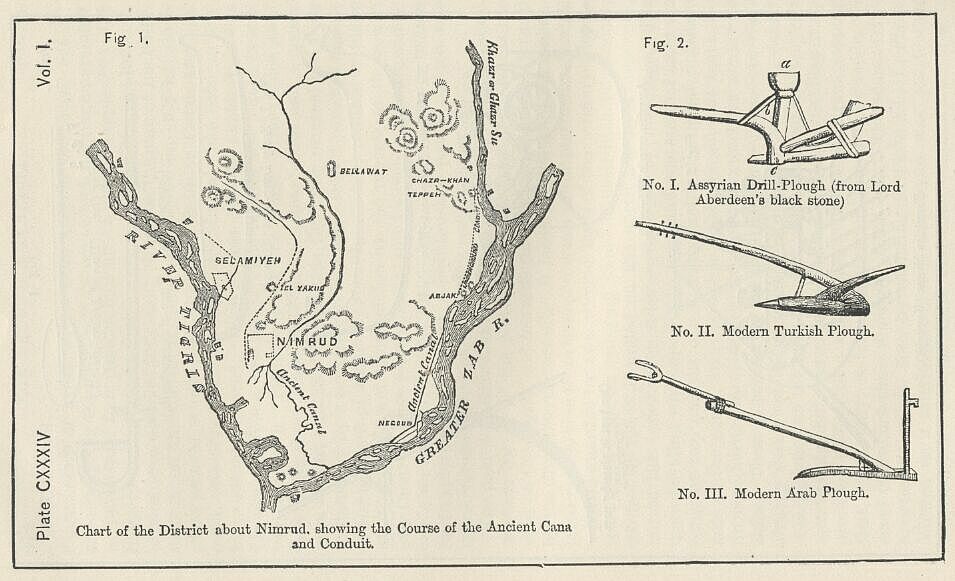
In the tract of land lying between the lower course of the Great Zab River and the Tigris, in which was situated the important town of Calah (now Nimrud), a tract which is partly alluvial, but more generally of secondary formation, hard gravel, sandstone, or conglomerate, are the remains of a canal undoubtedly Assyrian, which was carried for a distance of more than five-and-twenty miles from a point on the Khazr or Ghazr Su, a tributary of the Zab, to the south-eastern corner of the Nimrud ruins. [PLATE CXXXIV., Fig. 1.] Originally the canal seems to have been derived from the Zab itself, the water of which was drawn off, on its northern bank, through a short tunnel—the modern Negoub—and then conducted along a cutting, first by the side of the Zab, and afterwards in a tortuous course across the undulating plain, into the ravine formed by the Shor-Derreh torrent. The Zab, when this part of the work was constructed, ran deep along its northern bank, and, sending a portion of its waters into the tunnel, maintained a constant stream in the canal. But after awhile the river abandoned its north bank for the opposite shore; and, water ceasing to flow through the Negoub tunnel, it became necessary to obtain it in some other way. Accordingly the canal was extended northwards, partly by cutting and partly by tunnelling to the Ghazr Su at about two miles above its mouth, and a permanent supply was thenceforth obtained from that stream. The work may have been intended in part to supply Calah with mountain water; but the remains of dams and sluices along its course sufficiently show that it was a canal for irrigation also. From it water was probably derived to fertilize the whole triangle lying south of Nimrud between the two streams, a tract containing nearly thirty square miles of territory, mostly very fertile, and with careful cultivation well capable of supporting the almost metropolitan city on which it abutted.
In Assyria it must have been seldom that the Babylonian system of irrigation could have been found applicable, and the water simply derived from the rivers by side-cuts, leading it off from the natural channel. There is but little of Assyria which is flat and alluvial; the land generally undulates, and most of it stands at a considerable height above the various streams. The water therefore requires to be raised from the level of the rivers to that of the lands before it can be spread over them, and for this purpose hydraulic machinery of one kind or another is requisite. In cases where the subterranean conduit was employed, the Assyrians probably (like the ancient and the modern Persians) sank wells at intervals, and raised the water from them by means of a bucket and rope, the latter working over a pulley. Where they could obtain a bank of a convenient height overhanging a river, they made use of the hand-swipe, and with its aid lifted the water into a tank or reservoir, whence they could distribute it over their fields. In some instances, it would seem, they brought water to the tops of hills by means of aqueducts, and then, constructing a number of small channels, let the fluid trickle down them among their trees and crops. They may have occasionally, like the modern Arabs, employed the labor of an animal to raise the fluid; but the monuments do not furnish us with any evidence of their use of this method. Neither do we find any trace of water-wheels, such as are employed upon the Orontes and other swift rivers, whereby a stream can itself be made to raise water from the land along its bunks.
According to Herodotus, the kinds of grain cultivated in Assyria in his time were wheat, barley, sesame, and millet. As these still constitute at the present day the principal agricultural products of the county, we may conclude that they were in all probability the chief species cultivated under the Empire. The plough used, if we may judge by the single representation of it which has come down to us, was of a rude and primitive construction—a construction, however, which will bear comparison with that of the implements to this day in use through modern Turkey and Persia. Of other agricultural implements we have no specimens at all, unless the square instrument with a small circle or wheel at each corner, which appears on the same monument as the plough, may be regarded as intended for some farming purpose. [PLATE CXXXIV., Fig. 2.]
Besides grain, it seems certain that the Assyrians cultivated the vine. The vine will grow well in many parts of Assyria; and the monuments represent vines, with a great deal of truth, not merely as growing in the countries to which the Assyrians made their expeditions, but as cultivated along the sides of the rivers near Nineveh, and in the gardens belonging to the palaces of the kings. In the former case they appear to grow without any support, and are seen in orchards intermixed with other fruit-trees, as pomegranates and figs. In the latter they are trained upon tall trees resembling firs, round whose stems they twine themselves, and from which their rich clusters droop. Sometimes the long lithe boughs pass across from tree to tree, forming a canopy under which the monarch and his consort sip their wine.
Before concluding this chapter, a few remarks will be added upon the ordinary private life of the Assyrians, so far as the monuments reveal it to us. Under this head will be included their dress, their food, their houses, furniture, utensils, carriages, etc., their various kinds of labor, and the implements of labor which were known to them.
The ordinary dress of the common people in Assyria was a mere plain tunic, or skirt, reaching from the neck to a little above the knee, with very short sleeves, and confined round the waist by a broad belt or girdle. Nothing was worn either upon the head or upon the feet. The thick hair, carried in large waves from the forehead to the back of the head, and then carefully arranged in three, four, or five rows of stiff curls, was regarded as a sufficient protection both from sun and rain. No head-covering was ever worn, except by soldiers, and by certain officials, as the king, priests, and musicians. Sometimes, if the hair was very luxuriant, it was confined by a band or fillet, which was generally tied behind the back of the head. The beard was worn long, and arranged with great care, the elaboration being pretty nearly the same in the case of the king and of the common laborer. Laborers of a rank a little above the lowest wore sandals, indulged in a fringed tunic, and occasionally in a phillibeg, while a still higher class had a fringed tunic and phillibeg, together with the close-fitting trouser and boot worn by soldiers. These last are frequently eunuchs, who probably belonged to a corps of eunuch laborers in the employ of the king.
Persons of the humbler laboring class wear no ornament, neither armlet, bracelet, nor earrings. Armlets and bracelets mark high rank, and indeed are rarely found unless the wearer is either an officer of the court, or at any rate a personage of some consideration. Earrings seem to have descended lower. They are worn by the attendants on sportsmen, by musicians, by cavalry soldiers, and even occasionally by foot soldiers. In this last case they are seldom more than a simple ring, which may have been of bronze or of bone. In other cases the ring mostly supports a long pendant.
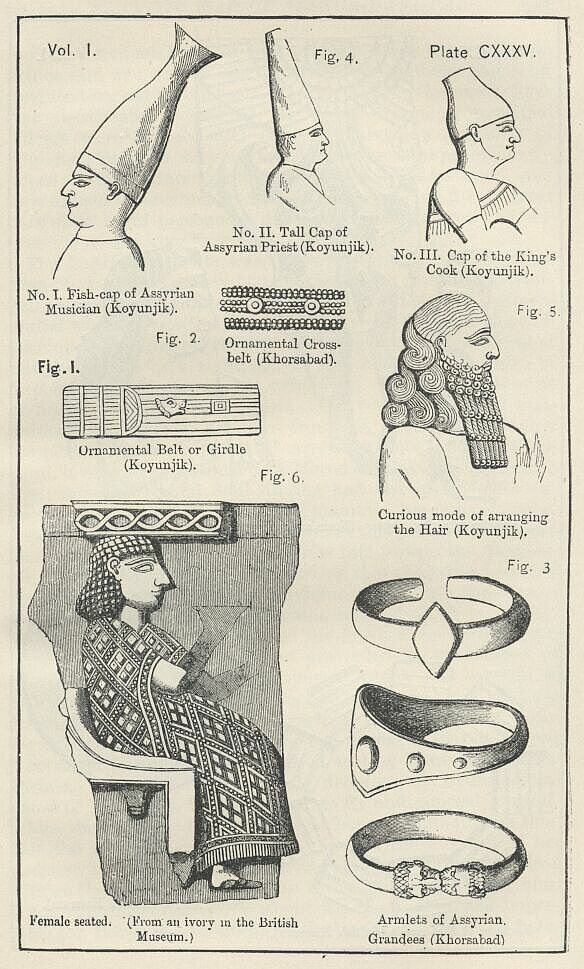
Men of rank appear to have worn commonly a long fringed robe reaching nearly to the feet. The sleeves were short, only just covering the shoulder. Down to the waist, the dress closely fitted the form, resembling, so far, a modern jersey; below this there was a slight expansion, but still the scantiness of the robe is very remarkable. It had no folds, and must have greatly interfered with the free play of the limbs, rendering rapid movements almost impossible. A belt or girdle confined it at the waist, which was always patterned, sometimes elaborately. [PLATE CXXXV., Fig. 1.] If a sword was carried, as was frequently the case, it was suspended, nearly in a horizontal position, by a belt over the left shoulder, to which it was attached by a ring, or rings, in the sheath. There is often great elegance in these cross-belts, which look as if they were embroidered with pearls or beads. [PLATE CXXXV., Fig. 2.] Fillets, earrings, armlets, and (in most instances) bracelets were also worn by Assyrians of the upper classes. The armlets are commonly simple bands, twisted round the arm once or twice, and often overlapping’ at the ends, which are plain, not ornamented. [PLATE CXXXV.] The bracelets are of slighter construction; their ends do not meet; they would seem to have been of thin metal, and sufficiently elastic to be slipped over the hand on to the wrist, which they then fitted closely. Generally they were quite plain; but sometimes, like the royal bracelets, they bore in their centre a rosette. Sandals, or in the later times shoes, completed the ordinary costume of the Assyrian “gentleman.”
Sometimes both the girdle round the waist, and the cross-belt, which was often worn without a sword, were deeply fringed, the two fringes falling one over the other, and covering the whole body from the chest to the knee. Sometimes, but more rarely, the long robe was discarded, and the Assyrian of some rank wore the short tunic, which was then, however, always fringed, and commonly ornamented with a phillibeg.
Certain peculiar head-dresses and peculiar modes of arranging the hair deserve special attention from their singularity. [PLATE CXXXV., Fig. 4.] They belong in general to musicians, priests, and other official personages, and may perhaps have been badges of office. For instance, musicians sometimes wear on their heads a tall stiff cap shaped like a fish’s tail; at other times their head-dress is a sort of tiara of feathers.
Their hair is generally arranged in the ordinary Assyrian fashion; but sometimes it is worn comparatively short, and terminates in a double row of crisp curls. Priests have head-dresses shaped like truncated cones. A cook in one instance, wears a cap not unlike the tiara of the monarch, except that it is plain, and is not surmounted by an apex or peak. A harper has the head covered with a close-fitting cap, encircled with a row of large beads or pearl; from which a lappet depends behind, similarly ornamented. A colossal figure in a doorway, apparently a man, though possibly representing a god, has the hair arranged in six monstrous curls, the lowest three resting upon the shoulder. [PLATE CXXXV., Fig. 6.]
Women of the better sort seem to have been dressed in sleeved gowns, less scanty than those of the men, and either striped or else patterned and fringed. Outside this they sometimes wore a short cloak of the same pattern as the gown, open in front and falling over the arms, which it covered nearly to the elbows. Their hair was either arranged over the whole of the head in short crisp curls, or carried back in waves to the ears, and then in part twisted into long pendent ringlets, in part curled, like that of the men, in three or four rows at the back of the neck. [PLATE CXXXV., Fig. 5.] A girdle was probably worn round the waist, such as we see in the representations of goddesses, while a fringed cross-belt passed diagonally across the breast, being carried under the right arm and over the left shoulder. The feet seem to have been naked, or at best protected by a sandal. The head was sometimes encircled with a fillet.
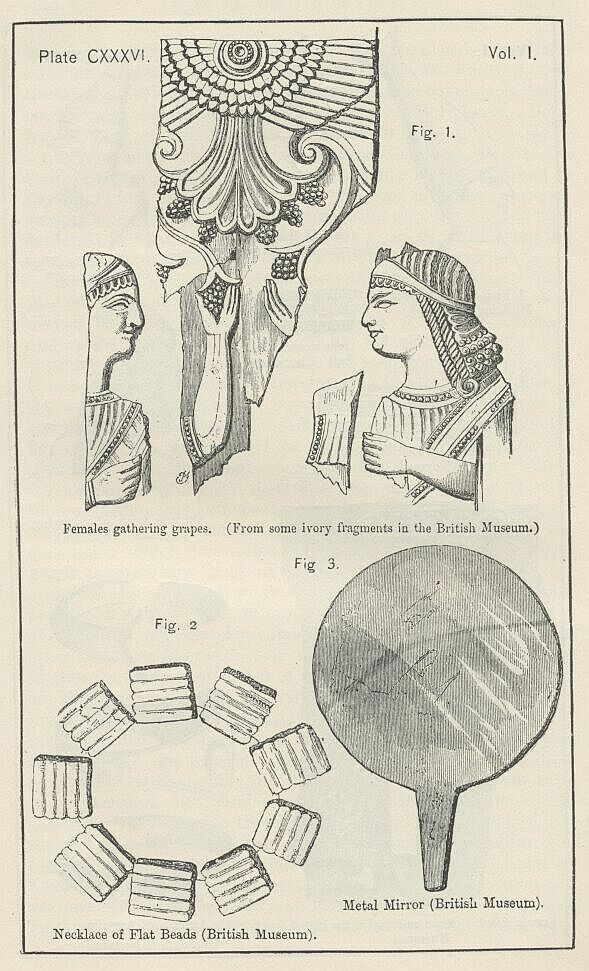
Women thus apparelled are either represented as sitting in chairs and drinking from a shallow cup, or else as gathering grapes, which, instead of growing naturally, hang up on branches that issue from a winged circle. The circle would seem to be emblematic of the divine power which bestows the fruits of the earth upon man. [PLATE CXXXVI., Fig. 1.]
The lower class of Assyrian women are not represented upon the sculptures. We may perhaps presume that they did not dress very differently from the female captives so frequent on the bas-reliefs, whose ordinary costume is a short gown not covering the ankles, and an outer garment somewhat resembling the chasuble of the king. The head of these women is often covered with a hood where the hair appears, it usually descends in a single long curl. The feet are in every case naked.
The ornaments worn by women appear to have been nearly the same as those assumed by men. They consisted principally of earrings, necklaces, and bracelets. Earrings have been found in gold laid in bronze, some with and some without places for jewels. One gold earring still held its adornment of petals. Bracelets were sometimes of glass, and were slipped over the hand. Necklaces seem commonly to have been of beads, strung together. A necklace in the British Museum is composed of glass beads of a light blue color, square in shape and flat, with horizontal flutings. [PLATE CXXXVI., Fig. 2.] Glass finger-rings have also been found, which were probably worn by women.
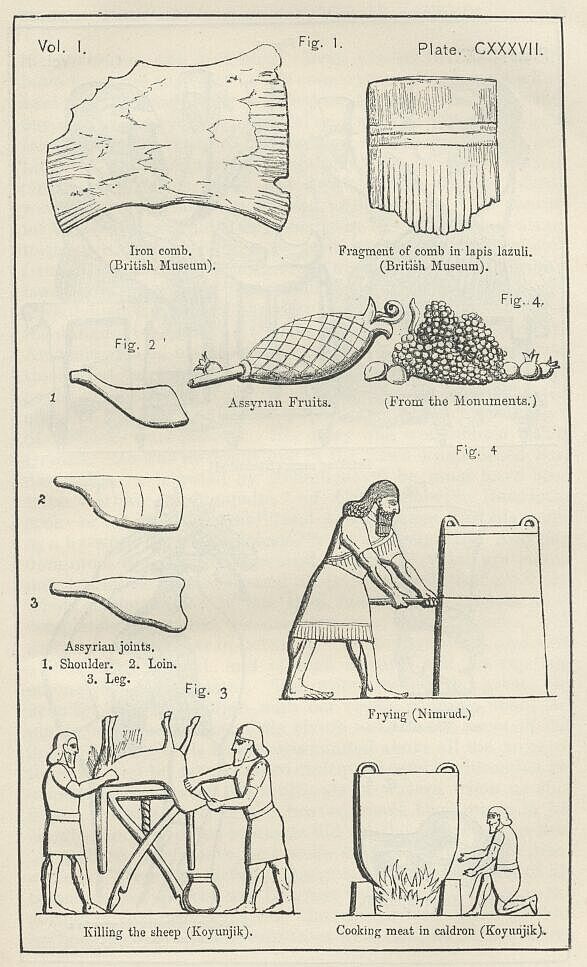
We have a few remains of Assyrian toilet articles. A bronze disk, about nine inches in diameter, with a long handle attached, is thought to have been a mirror. In its general shape it resembles both the Egyptian and the classical mirrors; but, unlike them, it is perfectly plain, even the handle being a mere flat bar. [PLATE CXXXVI., Fig. 3.] We have also a few combs. One of these is of iron, about three and a half inches long, by two inches broad in the middle. It is double, like a modern small-tooth comb, but does not present the feature, common in Egypt, of a difference in the size of the teeth on the two sides. The very ancient use of this toilet article in Mesopotamia is evidenced by the fact, already noticed, that it was one of the original hieroglyphs whence the later letters were derived. Another comb is of lapis lazuli, and has only a single row of teeth. [PLATE CXXXVII., Fig. 1.] The small vases of alabaster or fine clay, and the small glass bottles which have been discovered in tolerable abundance, were also in all probability intended chiefly for the toilet. They would hold the perfumed unguents which the Assyrians, like other Orientals, were doubtless in the habit of using, and the dyes wherewith they sought to increase the beauty of the countenance.
No doubt the luxury of the Assyrian women in these and other respects was great and excessive. They are not likely to have fallen short of their Jewish sisters either in the refinements or in the corruptions of civilization. When then we hear of the “tinkling ornaments” of the Jewish women in Isaiah’s time, “their combs, and round tires like the moon,” their “chains and bracelets and mufflers,” their “bonnets, and ornaments of the legs, and head-bands, and tablets and ear-rings,” their “rings and nose-jewels,” their “changeable suits of apparel, and mantles, and wimples, and crisping-pins,” their “glasses, and fine linen, and hoods, and veils,” their “sweet smells, and girdles, and well-set hair, and stomachers,” we may be sure that in Assyria too these various refinements, or others similar to them, were in use, and consequently that the art of the toilet was tolerably well advanced under the second great Asiatic Empire. That the monuments contain little evidence on the point need not cause any surprise; since it is the natural consequence of the spirit of jealous reserve common to the Oriental nations, which makes them rarely either represent women in their mimetic art or speak of them in their public documents.
If various kinds of grain were cultivated in Assyria, such as wheat, barley, sesame, and millet, we may assume that the food of the inhabitants, like that of other agricultural nations, consisted in part of bread. Sesame was no doubt used, as it is at the present day, principally for making oil; while wheat, barley, and millet were employed for food, and were made into cakes or loaves. The grain used, whatever it was, would be ground between two stones, according to the universal Oriental practice even at the present day. It would then he moistened with water, kneaded in a dish or bowl, and either rolled into thin cakes, or pressed by the hand into smalls balls or loaves. Bread and cakes made in this way still form the chief food of the Arabs of these parts, who retain the habits of antiquity. Wheaten bread is generally eaten by preference; but the poorer sort are compelled to be content with the coarse millet or durra flour, which is made into cakes, and then eaten with milk, butter, oil, or the fat of animals.
Dates, the principal support of the inhabitants of Chaldaea, or Babylonia, both in ancient and in modern times, were no doubt also an article of food in Assyria, though scarcely to any great extent. The date-palm does not bear well above the alluvium, and such fruit as it produces in the upper country is very little esteemed. Olives were certainly cultivated under the Empire, and the oil extracted from them was in great request. Honey was abundant, and wine plentiful. Sennacherib called his land “a land of corn and wine, a land of bread and vineyards, a land of oil olive and of honey;” and the products here enumerated were probably those which formed the chief sustenance of the bulk of the people.
Meat, which is never eaten to any great extent in the East was probably beyond the means of most persons. Soldiers, however, upon an expedition were able to obtain this dainty at the expense of others; and accordingly we find that on such occasions they freely indulged in it. We see them, after their victories, killing and cutting up sheep and. oxen, and then roasting the joints, which are not unlike our own, on the embers of a wood-fires [PLATE CXXXVII., Fig. 2.] In the representations of entrenched camps we are shown the mode in which animals were prepared for the royal dinner. They were placed upon their backs on a high table, with their heads hanging over its edge; one man held them steady in this position, while another, taking hold of the neck, cut the throat a little below the chin. The blood dripped into a bowl or basin placed beneath the head on the ground. [PLATE CXXXVII., Fig. 3.] The animal was then no doubt, paunched, after which it was placed either whole, or in joints—in a huge pot or caldron, and, a fire being lighted underneath, it was boiled to such a point as suited the taste of the king. [PLATE CXXXVII., Fig. 5.] While the boiling progressed, some portions were perhaps fried on the fire below. [PLATE CXXXVII., Fig. 5.] Mutton appears to have been the favorite meat in the camp. At the court there would be a supply of venison, antelope’s flesh, hares, partridges, and other game, varied perhaps occasionally with such delicacies as the flesh of the wild ox and the onager.
Fish must have been an article of food in Assyria, or the monuments would not have presented us; with so many instances of fishermen. Locusts were also eaten, and were accounted a delicacy, as is proved by their occurrence among the choice dainties of a banquet, which the royal attendants are represented in one bas-relief as bringing into the palace of the king. Fruits, as was natural in so hot a climate, were highly prized; among those of most repute were pomegranates, grapes, citrons, and, apparently, pineapples. [PLATE CXXXVII., Fig. 4.]
There is reason to believe that the Assyrians drank wine very freely. The vine was cultivated extensively, in the neighborhood of Nimrud and elsewhere; and though there is no doubt that, grapes were eaten, both raw and dried, still the main purpose of the vineyards was unquestionably the production of wine. Assyria was “a land of corn and wine,” emphatically and before all else. Great banquets seem to have been frequent at the court, as at the courts of Babylon and Persia, in which drinking was practised on a large scale. The Ninevites generally are reproached as drunkards by Nahum. In the banquet-scenes of the sculptures, it is drinking and not eating that is represented. Attendants dip the wine-cups into a huge bowl or vase, which stands on the ground and reaches as high as a man’s chest and carry them full of liquor to the guests, who straightway fall to a carouse. [PLATE CXXXVIII., Fig. 1.]
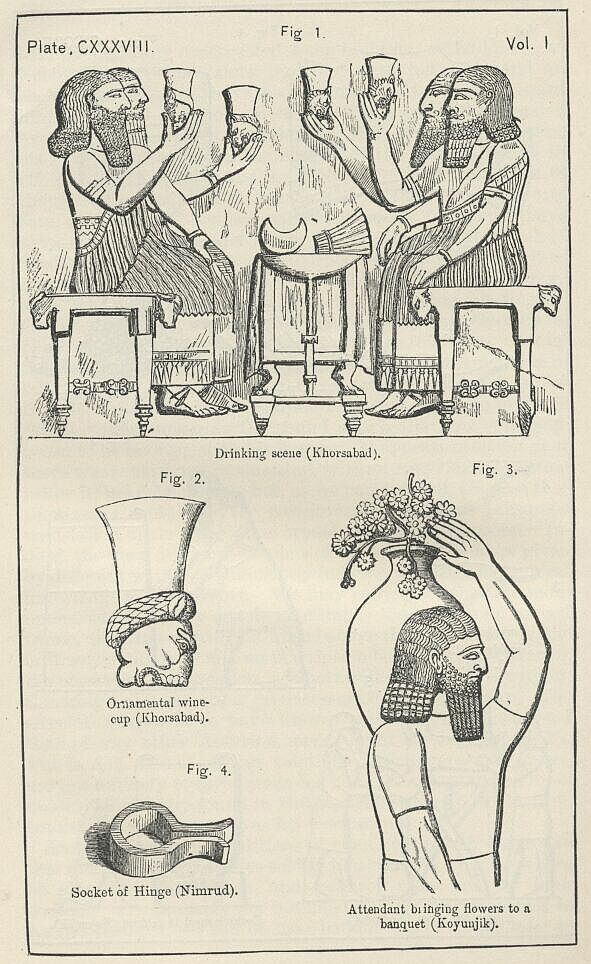
The arrangement of the banquets is curious. The guests, who are in one instance some forty or fifty in number, instead of being received at a common table, are divided into messes of four, who sit together, two and two, facing each other, each mess having its own table and its own attendant. The guests are all clothed in the long tasselled gown, over which they wear the deeply fringed belt and cross-belt. They have sandals on their feet, and on their arias armlets and bracelets. They sit on high stools, from which their legs dangle; but in no case have they footstools, which would apparently have been a great convenience. Most of the guests are bearded men, but intermixed with them we see a few eunuchs. Every guest holds in his right hand a wine-cup of a most elegant shape, the lower part modelled into the form of a lion’s head, from which the cup itself rises in a graceful curve. [PLATE CXXXVIII., Fig. 2.] They all raise their cups to a level with their heads, and look as if they were either pledging each other, or else one and all drinking the same toast. Both the stools and the tables are handsome, and tastefully, though not very richly, ornamented. Each table is overspread with a table-cloth, which hangs down on either side opposite the guests, but does not cover the ends of the table, which are thus fully exposed to view. In their general make the tables exactly resemble that used in a banquet scene by a king of a later date, but their ornamentation is much less elaborate. On each of them appears to have been placed the enigmatical article of which mention has been already made as a strange object generally accompanying the king. Alongside of it we see in most instances a sort of rude crescent. These objects have probably, both of them, a sacred import, the crescent being the emblem of Sin, the Moon-God, while the nameless article had some unknown religious use or meaning.
In the great banqueting scene at Khorsabad, from which the above description is chiefly taken, it is shown that the Assyrians, like the Egyptians and the Greeks in the heroic times, had the entertainment of music at their grand feasts and drinking bouts. At one end of the long series of figures representing guests and attendants was a band of performers, at least three in number, two of whom certainly played upon the lyre. The lyres were ten-stringed, of a square shape, and hung round the player’s neck by a string or ribbon.
The Assyrians also resembled the Greeks and Romans in introducing flowers into their feasts. We have no evidence that they wore garlands, or crowned themselves with chaplets of flowers, or scattered roses over their rooms; but still they appreciated the delightful adornment which flowers furnish. In the long train of attendance represented at Koyunjik as bringing the materials of a banquet into the palace of the king, a considerable number bear vases of flowers. [PLATE CXXXVIII., Fig. 3.] These were probably placed on stands, like those which are often seen supporting jars, and dispersed about the apartment in which the feast was held, but not put upon the tables.
We have no knowledge of the ordinary houses of the Assyrians other than that which we derive from the single representation which the sculptures furnish of a village certainly Assyrian. It appears from this specimen that the houses were small, isolated from one another, and either flat-roofed, or else covered in with a dome or a high cone. They had no windows, but must have been lighted from the top, where, in some of the roofs, an aperture is discernible. The doorway was generally placed towards one end of the house; it was sometimes arched, but more often square-headed.
The doors in Assyrian houses were either single, as commonly with ourselves, or folding (fores or valvoe), as with the Greeks and Romans, and with the modern French and Italians. Folding-doors were the most common in palaces. They were not hung upon hinges, like modern doors, but, like those of the classical nations, turned upon pivots. At Khorsabad the pavement slabs in the doorways showed everywhere the holes in which these pivots had worked, while in no instance did the wall at the side present any trace of the insertion of a hinge. Hinges, however, in the proper sense of the term, were not unknown to the Assyrians; for two massive bronze sockets found at Nimrud, which weighed more than six pounds each, and had a diameter of about five inches, must have been designed to receive the hinges of a door or gate, hung exactly as gates are now hung among ourselves. [PLATE CXXXVIII., Fig. 4.] The folding-doors were fastened by bolts, which were shot into the pavement at the point where the two doors met; but in the case of single doors a lock seems to have been used, which was placed about four feet from the ground, and projected from the door itself, so that a recess had to be made in the wall behind the door to receive the lock when the door stood open. The bolt of the lock was of an oblong square shape and was shot into the wall against which the door closed.
The ordinary character of Assyrian furniture did not greatly differ from the furniture of modern times. That of the poorer classes was for the most part extremely plain, consisting probably of such tables, couches, and low stools as we see in the representations which are so frequent, of the interiors of soldier’s tents. In these the tables are generally of the cross-legged kind; the couches follow the pattern given in a previous page of this volume, except that the legs do not end in pine-shaped ornaments; and the stools are either square blocks, or merely cut en chevron. There are no chairs. The low stools evidently form the ordinary seats of the people, on which they sit to converse or to rest themselves. The couches seem to have been the beds whereon the soldiers slept, and it may be doubted if the Assyrians knew of any other. In the case of the monarch we have seen that the bedding consisted of a mattress, a large round pillow or cushion, and a coverlet; but in these simple couches of the poor we observe only a mattress, the upper part of which is slightly raised and fitted into the curvature of the arm, so as to make a substitute for a pillow. Perhaps, however, the day-laborer may have enjoyed on a couch of this simple character slumbers sounder and more refreshing than Sardanapalus amid his comparative luxury.
The household utensils seen in combination with these simple articles of furniture are few and somewhat rudely shaped. A jug with a long neck, an angular handle, and a pointed bottom, is common: it usually hangs from a nail or hook inserted into the tent-pole. Vases and bowls of a simple form occur, but are less frequent. The men are seen with knives in their hands, and appear sometimes to be preparing food for their meals; but the form of the knife is marked very indistinctly. Some of the household articles represented have a strange and unusual appearance. One is a sort of short ladder, but with semicircular projections at the bottom, the use of which is not apparent; another may be a board at which some game was played; while a third is quite inexplicable. From actual discoveries of the utensils themselves, we know that the Assyrians used dishes of stone, alabaster, and bronze. They had also bronze cups, bowls, and plates, often elaborately patterned. The dishes had commonly a handle at the side, either fixed or movable, by which, when not in use, they could be carried or hung on pegs. Chaldrons of bronze were also common: they varied from five feet to eighteen inches in height, and from two feet and a half to six feet in diameter. Jugs, funnels, ladles, and jars have been found in the same metal; one of the funnels is shaped nearly like a modern wine strainer.
The Assyrians made use of bronze bells with iron tongues, and, to render the sound of these more pleasing, they increased the proportion of the tin to the copper, raising it front ten to fourteen per cent. The bells were always of small size, never (so far as appears) exceeding three inches and a quarter in height and two inches and a quarter in diameter. It is uncertain whether they were used, as modern bells, to summon attendants, or only attached, as we see them on the sculptures, to the collars and headstalls of horses.
Some houses, but probably not very many, had gardens attached to them. The Assyrian taste in gardening was like that of the French. Trees of a similar character, or tall trees alternating with short ones, were planted in straight rows at an equal distance from one another, while straight paths and walks, meeting each other at right angles, traversed the grounds. Water was abundantly supplied by means of canals drawn off from a neighboring river, or was brought by an aqueduct from a distance. A national taste of a peculiar kind, artificial and extravagant to a degree, caused the Assyrians to add to the cultivation of the natural ground the monstrous invention of “Hanging Gardens:” an invention introduced into Babylonia at a comparatively late date, but known in Assyria as early as the time of Sennacherib. A “hanging garden” was sometimes combined with an aqueduct, the banks of the stream which the aqueduct bore being planted with trees of different kinds. At other times it occupied the roof of a building, probably raised for the purpose, and was supported upon a number of pillars.
The employments of the Assyrians, which receive some illustration from the monuments, are, besides war and hunting—subjects already discussed at length—chiefly building, boating, and agriculture. Of agricultural laborers, there occur two or three only, introduced by the artists into a slab of Sennacherib’s which represents the transport of a winged bull. They are dressed in the ordinary short tunic and belt, and are employed in drawing water from a river by the help of hand-swipes for the purpose of irrigating their lands. Boatmen are far more common. They are seen employed in the conveyance of masses of stone, and of other materials for building, ferrying men and horses across a river, guiding their boat while a fisherman plies his craft from it, assisting soldiers to pursue the enemy, and the like. They wear the short tunic and belt, and sometimes have their hair encircled with a fillet. Of laborers, employed in work connected with building, the examples are numerous. In the long series of slabs representing the construction of some of Sennacherib’s great works, although the bulk of those employed as laborers appear to be foreign captives, there are a certain number of the duties—duties less purely mechanical than the others which are devolved on Assyrians. Assyrians load the hand-carts, and sometimes even draw them, convey the implements—pickaxes, saws, shovels, hatchets, beams, forks, coils of rope—place the rollers, arrange the lever and work it, keep the carved masses of stone steady as they are moved along to their proper places, urge on the gangs of forced laborers with sticks, and finally direct the whole of the proceedings by signals, which they give with their voice or with a long horn. Thus, however ample the command of naked human strength enjoyed by the Assyrian king, who had always at his absolute disposal the labor of many thousand captives, still there was in every great work much which could only be intrusted to Assyrians, who appear to have been employed largely in the grand constructions of their monarchs.
The implements of labor have a considerable resemblance to those in present use among ourselves. The saws were two-handed; but as the handle was in the same line with the blade, instead of being set at right angles to it, they must have been somewhat awkward to use. The shovels were heart-shaped, like those which Sir C. Fellows noticed in Asia Minor. The pickaxes had a single instead of a double head, while the hatchets were double-headed, though here probably the second head was a mere knob intended to increase the force of the blow. The hand-carts were small and of very simple construction: they were made open in front and behind, but had a slight framework at the sides. They had a pole rising a little in front, and were generally drawn by two men. The wheels were commonly four-spoked. When the load had been placed on the cart, it seems to have been in general secured by two bands or ropes, which were passed over it diagonally, so as to cross each other at the top.
Carts drawn by animals were no doubt used in the country; but they are not found except in the scenes representing the triumphant returns of armies, where it is more probable that the vehicles are foreign than Assyrian. They have poles—not shafts—and are drawn by two animals, either oxen, mules, or asses. The wheels have generally a large number of spokes—sometimes as many as eleven. Representations of these carts will be found in early pages.
The Assyrians appear to have made occasional use of covered carriages. Several vehicles of this kind are represented on an obelisk in the British Museum. They have a high and clumsy body, which shows no window, and is placed on four disproportionately low wheels, which raise it only about a foot from the ground. In front of this body is a small driving-place, enclosed in trelliswork, inside which the coachman stands to drive. Each of these vehicles is drawn by two horses. It is probable that they were used to convey the ladies of the court; and they were therefore carefully closed, in order that no curious glance of passers-by might rest upon the charming inmates. The carpentum, in which the Roman matrons rode at the great public festivals, was similarly closed, both in front and behind, as is evident from the representations which we have of it on medals and tombs.
Except in the case of these covered vehicles, and of the chariots used in war and hunting, horses (as already observed) were not employed for draught. The Assyrians appear to have regarded them as too noble for this purpose, unless where the monarch and those near to him were concerned, for whose needs nothing was too precious. On the military expeditions the horses were carefully fed and tended. Portable mangers were taken with the army for their convenience; and their food, which was probably barley, was brought to them by grooms in sieves or shallow boxes, whence no doubt it was transferred to the mangers. They appear to have been allowed to go loose in the camp, without being either hobbled or picketed. Care was taken to keep their coats clean and glossy by the use of the curry-comb, which was probably of iron.
Halters of two kinds were employed. Sometimes they consisted of a mere simple noose, which was placed in the horse’s mouth, and then drawn tight round the chin. More often (as in the illustration) the rope was attached to a headstall, not unlike that of an ordinary bridle, but simpler, and probably of a cheaper material. Leading reins, fastened to the bit of an ordinary bridle, were also common.
Such are the principal points connected with the peaceful customs of the Assyrians, on which the monuments recently discovered throw a tolerable amount of light. Much still remains in obscurity. It is not possible as yet, without drawing largely on the imagination, to portray in any completeness the private life even of the Assyrian nobles, much less that of the common people. All that can be done is to gather up the fragments which time has spared; to arrange them in something like order, and present them faithfully to the general reader, who, it is hoped, will feel a certain degree of interest in them severally, as matters of archeology, and who will probably further find that he obtains from them in combination a fair notion of the general character and condition of the race, of its mingled barbarism and civilization, knowledge and ignorance, art and rudeness, luxury and simplicity of habits. The novelist and even the essayist may commendably eke out the scantiness of facts by a free indulgence in the wide field of supposition and conjecture: but the historian is not entitled to stray into this enchanted ground. He must be content to remain within the tame and narrow circle of established fact. Where his materials are abundant. he is entitled to draw graphic sketches of the general condition of the people; but where they are scanty, as in the present instance, he must be content to forego such pleasant pictures, in which the coloring and the filling-up would necessarily be derived, not from authentic data, but from his own fancy.
===============================