Chapter VII · (continued 2)
Reading edition
Various modes of execution seem to have been employed in the case of condemned captives. One of them was empalement. This has always been, and still remains, a common mode of punishment in the East; but the manner of empaling which the Assyrians adopted was peculiar. They pointed a stake at one end, and, having fixed the other end firmly into the ground, placed their criminal with the pit of his stomach upon the point, and made it enter his body just below the breastbone. This method of empaling must have destroyed life tolerably soon, and have thus been a far less cruel punishment than the crucifixion of the Romans. We do not observe it very often in the Assyrian sculptures, nor do we ever see it applied to more than a few individuals. It was probably reserved for those who were considered the worst criminals. Another very common mode of executing captives was by beating in their skulls with a mace. In this case the victim commonly knelt; his two hands were placed before him upon a block or cushion: behind him stood two executioners, one of whom held him by a cord round the neck, while the other, seizing his back hair in one hand, struck him a furious blow upon the head with a mace which he held in the other. [PLATE CXI., Fig. 5.] It must have been rarely, if ever, that a second blow was needed.
Decapitation was less frequently practised. The expression, indeed. “I cut off their heads,” is common in the Inscriptions but in most instances it evidently refers to the practice, already noticed, of collecting the heads of those who had fallen in battle. Still there are instances, both in the Inscriptions and in the sculptures, of what appears to have been a formal execution of captives by beheading. In these cases the criminal, it would seem, stood upright, or bending a little forwards, and the executioner, taking him by a lock of hair with his left hand, struck his head from his shoulders with a short sword, which he held in his right. [PLATE CXII., Fig. 5.]
It is uncertain whether a punishment even more barbarous than these was not occasionally resorted to. In two or three bas-reliefs executioners are represented in the act of flaying prisoners with a knife. The bodies are extended upon the ground or against a wall, to which they are fastened by means of four pegs attached by strings or thongs to the two wrists and the two ankles. The executioner leans over the victim, and with his knife detaches the skin from the flesh. One would trust that this operation was not performed until life was extinct. We know that it was the practice of the Persians, and even of the barbarous Scythians, to flay the corpses, and not the living forms, of criminals and of enemies; we may hope, therefore, that the Assyrians removed the skin from the dead, to use it as a trophy or as a warning, and did not inflict so cruel a torture on the living.
Sometimes the punishment awarded to a prisoner was mutilation instead of death. Cutting off the ears close to the head, blinding the eyes with burning-irons, cutting off the nose, and plucking out the tongue by the roots, have been in all ages favorite Oriental punishments. We have distinct evidence that some at least of these cruelties were practised by the Assyrians. Asshur-izir-pal tells us in his great Inscription that he often cut off the noses and the ears of prisoners; while a slab of Asshur-bani-pal, the son of Esarhaddon, shows a captive in the hands of the torturers, one of whom holds his head firm and fast, while another thrusts his hand into his mouth for the purpose of tearing out the tongue.
The captives carried away by the conquerors consisted of men, women, and children. The men were formed into bands, under the conduct of officers, who urged theme forward on their way by blows, with small regard to their sufferings. Commonly they were conveyed to the capital, where they were employed by the monarchs in the lower or higher departments of labor, according to their capacities. The skilled workmen were in request to assist in the ornamentation of shrines and palaces, while the great mass of the unskilled were made use of to quarry and drag stone, to raise mounds, make bricks, and the like. Sometimes, instead of being thus employed in task-work in or near the capital, the captives were simply settled in new regions, where it was thought that they would maintain the Assyrian power against native malcontents. Thus Esarhaddon planted Babylonians, Susanchites, Dehavites, Elamites, and others in Samaria, while Sargon settled his Samaritan captives in Gauzanitis and in “the cities of the Medes.”
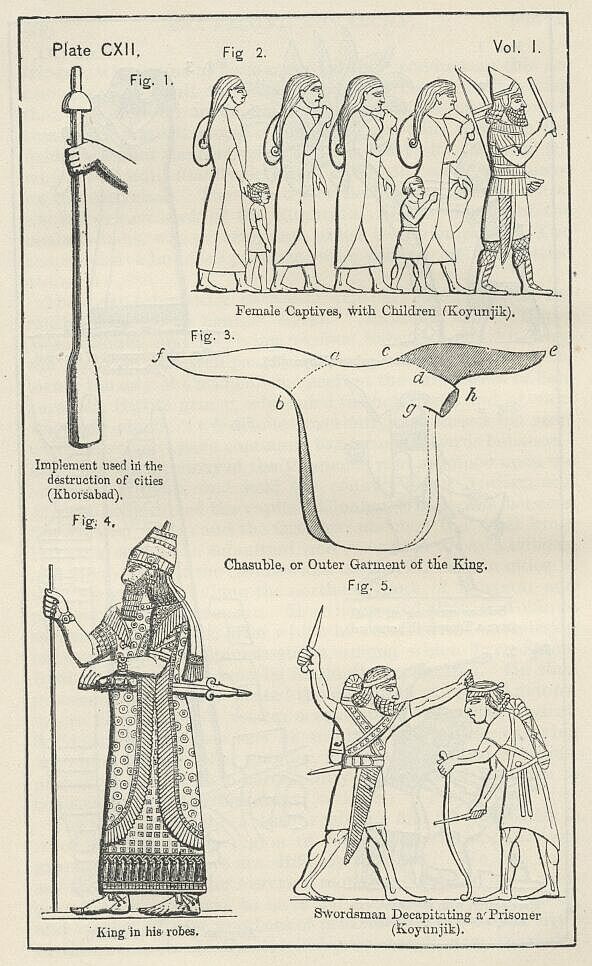
The women and children carried off by the conquerors were treated with more tenderness than the men. [PLATE CXII., Fig. 2.] Sometimes on foot, but often mounted on mules, or seated in carts drawn by bullocks or asses, they followed in the train of their new masters, not always perhaps unwilling to exchange the monotony of domestic life at home for the excitement of a new and unknown condition in a fresh country. We seldom see them exhibiting any signs of grief. The women and children are together, and the mothers lavish on their little ones the usual caresses and kind offices, taking them in their laps, giving then the breast, carrying them upon their shoulders, or else leading them by the hand. At intervals they were allowed to stop and rest; and it was not even the practice to deprive them of such portion of their household stuff as they might have contrived to secure before quitting their homes. This they commonly bore in a bag or sack, which was either held in the hand or thrown over one shoulder, When they reached Assyria, it would seem that they were commonly assigned as wives to the soldiers of the Assyrian army.
Together with their captives, the Assyrians carried off vast quantities of the domesticated animals, such as oxen, sheep, goats, horses, asses, camels, and mules. The numbers mentioned in the Inscriptions are sometimes almost incredible. Sennacherib, for instance, says that in one foray he bore off from the tribes on the Euphrates “7200 horses and mares, 5230 camels, 11,000 mules, 120,000 oxen, and 800,000 sheep”! Other kings omit particulars, but speak of the captured animals which they led away as being “too numerous to be counted,” or “countless as the stars of heaven.” The Assyrian sculptors are limited by the nature of their art to comparatively small numbers, but they show us horses, camels, and mules in the train of a returning army, together with groups of the other animals, indicative of the vast flocks and herds continually mentioned in the Inscriptions.
Occasionally the monarchs were not content with bringing home domesticated animals only, but took the trouble to transport from distant regions into Assyria wild beasts of various kinds. Tiglath-Pileser I. informs us in general terms that, besides carrying off the droves of the horses, cattle, and asses that he obtained from the subjugated countries, he “took away and drove off the herds of the wild goats and the ibexes, the wild sheep and the wild cattle;” and another monarch mentions that in one expedition he carried off from the middle Euphrates a drove of forty wild cattle, and also a flock of twenty ostriches. The object seems to have been to stock Assyria with a variety and an abundance of animals of chase.
The foes of the Assyrians would sometimes, when hard pressed, desert the dry land, and betake themselves to the marshes, or cross the sea to islands where they trusted that they might be secure from attack. Not unfrequently they obtained their object by such a retreat, for the Assyrians were not a maritime people. Sometimes, however, they were pursued. The Assyrians would penetrate into the marshes by means of reed boats, probably not very different from the terradas at present in use among the Arabs of the Mesopotamian marsh districts. Such boats are represented upon the bas-reliefs as capable of holding from three to five armed men. On these the Assyrian foot-soldiers would embark, taking with them a single boatman to each boat, who propelled the vessel much as a Venetian gondolier propels his gondola, i.e., with a single long oar or paddle, which he pushed from him standing at the stern. They would then in these boats attack the vessels of the enemy, which are always represented as smaller than theirs, run them down or board them, kill their crews or force them into the water, or perhaps allow them to surrender. Meanwhile, the Assyrian cavalry was stationed round the marsh among the tall reeds which thickly clothed its edge, ready to seize or slay such of the fugitives as might escape from the foot.
When the refuge sought was an island, if it lay near the shore, the Assyrians would sometimes employ the natives of the adjacent coast to transport beams of wood and other materials by means of their boats, in order to form a sort of bridge or mole reaching from the mainland to the isle whereto their foes had fled. Such a design was entertained, or at least professed, by Xerxes after the destruction of his fleet in the battle of Salamis, and it was successfully executed by Alexander the Great, who took in this way the new or island of Tyre. From a series of reliefs discovered at Khorsabad wo may conclude that more than two hundred years before the earlier of these two occasions, the Assyrians had conceived the idea, and even succeeded in carrying out the plan, of reducing islands near the coast by moles.
Under the Chaldaeans, whose “cry was in their ships,” the Assyrians seem very rarely to have adventured themselves upon the deep. If their enemies fled to islands which could not be reached by moles, or to lands across the sea, in almost every instance they escaped. Such escapes are represented upon the sculptures, where we see the Assyrians taking a maritime town at one end, while at the other the natives are embarking their women and children, and putting to sea, without any pursuit being made after them. In none of the bas-reliefs do we observe any sea-going vessels with Assyrians on board and history tells us of but two or three expeditions by sea in which they took part. One of these was an expedition by Sennacharib against the coast of the Persian Gulf, to which his Chaldaean enemies had fled. On this occasion he brought shipwrights from Phoenicia to Assyria, and made them build him ships there, which were then launched upon the Tigris, and conveyed down to the sea. With a fleet thus constructed, and probably manned, by Phoenicians, Sennacherib crossed to the opposite coast, defeated the refugees, and embarking his prisoners on board, returned in triumph to the mainland. Another expedition was that of Shalmaneser IV. against the island Tyre. Assyrians are said to have been personally engaged in it; but here again we are told that they embarked in ships furnished to then by the Phoenicians, and maimed chiefly by Phoenician sailors.
When a country was regarded as subjugated, the Assyrian monarch commonly marked the establishment of his sovereignty by erecting a memorial in some conspicuous or important situation within the territory conquered, as an enduring sign of his having taken possession. These memorials were either engraved on the natural rock or on solid blocks of stone cut into the form of a broad low stele. They contained a figure of the king, usually enclosed in an arched frame; and an inscription, of greater or less length, setting forth his name, his titles, and some of his exploits. More than thirty such memorials are mentioned in the extant Inscriptions, and the researches of recent times have recovered some ten or twelve of them. They uniformly represent the king in his sacerdotal robes, with the sacred collar round his neck, and the emblems of the gods above his head, raising the right hand in the act of adoration, as if he were giving thanks to Asshur and his guardian deities on account of his successes.
. . . . . . . . . . . . . . . .
It is now time to pass from the military customs of the Assyrians to a consideration of their habits and usages in time of peace, so far as they are made known to us either by historical records or by the pictorial evidence of the has reliefs. And here it may be convenient to treat separately of the public life of the king and court, and of the private life of the people.
In Assyria, as in most Oriental countries, the keystone of the social arch, the central point of the system, round which all else revolved, and on which all else depended, was the monarch. “L’etat, c’est moi” might have been said with more truth by an Assyrian prince than even by the “Grand Monarque,” whose dictum it is reported to have been. Alike in the historical notices, and in the sculptures, we have the person of the king presented to us with consistent prominence, and it is consequently with him that we most naturally commence the present portion of our inquiry.
The ordinary dress of the monarch in time of peace was a long flowing robe, reaching to the ankles, elaborately patterned and fringed, over which was worn, first, a broad belt, and then a species of open mantle, or chasuble, very curiously contrived. [PLATE CXII., Fig. 3.] This consisted mainly of two large flaps, both of which were commonly rounded, though sometimes one of them was square at bottom. These fell over the robe in front and behind, leaving the sides open, and so exposing the under dress to view. The two flaps must have been sewn together at the places marked with the dotted lines a b and c d, the space from a to c being left open, and the mantle passed by that means over the head. At d g there was commonly a short sleeve (h), which covered the upper part of the left arm, but the right arm was left free, the mantle falling of either side of it. Sometimes, besides the flaps, the mantle seems to have had two pointed wings attached to the shoulders (a f b and c e h in the illustration), which were made to fall over in front. Occasionally there was worn above the chasuble a broad diagonal belt ornamented with a deep fringe and sometimes there depended at the back of the dress a species of large hood.
The special royal head-dress was a tall mitre or tiara, which at first took the shape of the head, but rose above it to a certain height in a gracefully curved line, when it was covered in with a top, flat, like that of a hat, but having a projection towards the centre, which rose up into a sort of apex, or peak, not however pointed, but either rounded or squared off. The tiara was generally ornamented with a succession of bands, between which were commonly patterns more or less elaborate. Ordinarily the lowest band, instead of running parallel with the others, rose with a gentle curve towards the front, allowing room for a large rosette over the forehead, and for other similar ornaments. If we may trust the representations on the enamelled bricks, supported as they are to some extent by the tinted reliefs, we may say that the tiara was of three colors, red, yellow, and white. The red and white alternated in broad bands; the ornaments upon them were yellow, being probably either embroidered on the material of the head-dress in threads of gold, or composed of thin gold plates which may have been sown on. The general material of the tiara is likely to have been cloth or felt; it can scarcely have been metal, if the deep crimson tint of the bricks and the reliefs is true. [PLATE CXII., Fig. 4.]
In the early sculptures the tiara is more depressed than in the later, and it is also less richly ornamented. It has seldom more than two bands, viz., a narrow one at top, and at bottom a broader curved one, rising towards the front. To this last are attached two long strings or lappets, which fall behind the monarch’s back to a level with his elbow. [PLATE CXIII., Fig. 1.]
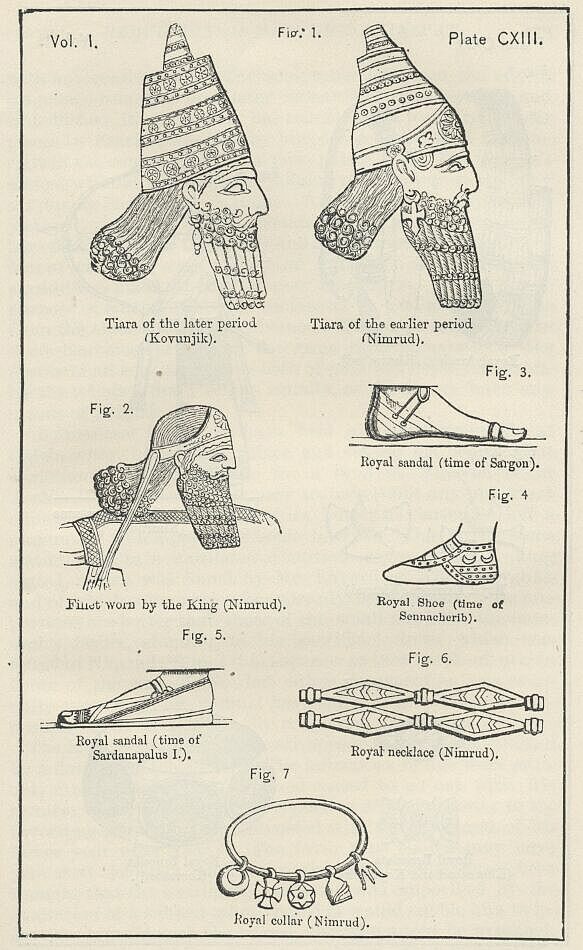
Another head-dress which the monarch sometimes wore was a sort of band or fillet. This was either elevated in front and ornamented with a single rosette, like the lowest band of the tiara, or else of uniform width and patterned along its whole course. In either case there depended from it, on each side of the back hair, a long ribbon or streamer, fringed at the end and sometimes ornamented with a delicate pattern. [PLATE CXIII., Fig 2.]
The monarch’s feet were protected by sandals or shoes. In the early sculptures sandals only appear in use, shoes being unknown (as it would seem) until the time of Sennacherib. The sandals worn were of two kinds. The simplest sort had a very thin sole and a small cap for the heel, made apparently of a number of strips of leather sewn together. It was held in place by a loop over the great-toe, attached to the fore part of the sole, and by a string which was laced backwards and forwards across the instep, and then tied in a bow. [PLATE CXIII., Fig. 4.]
The other kind of sandal had a very different sort of sole; it was of considerable thickness, especially at the heel, from which it gradually tapered to the toe. Attached to this was an upper leather which protected the heel and the whole of the side of the foot, but left the toes and the instep exposed. A loop fastened to the sole received the great-toe, and at the point where the loop was inserted two straps were also made fast, which were then carried on either side the great-toe to the top of the foot, where they crossed each other, and, passing twice through rings attached to the edge of the upper leather, were finally fastened, probably by a buckle, at the top of the instep. [PLATE CXIII., Fig. 6.]
The shoe worn by the later kings was of a coarse and clumsy make, very much rounded at the toe, patterned with rosettes, crescents, and the like, and (apparently) laced in front. In this respect it differed from the shoe of the queen, which will be represented presently, and also from the shoes worn by the tribute-bearers. [PLATE CXIII, Fig. 5.]
The accessory portions of the royal costume were chiefly belts, necklaces, armlets, bracelets, and earrings. Besides the belt round the waist, in which two or three highly ornamented daggers were frequently thrust, and the broad fringed cross-belt, of which mention was made above, the Assyrian monarch wore a narrow cross-belt passing across his right shoulder, from which his sword hung at his left side. This belt was sometimes patterned with rosettes. It was worn over the front flap of the chasuble, but under the back flap, and was crossed at right angles by the broad fringed belt, which was passed over the right arm and head so as to fall across the left shoulder.
The royal necklaces were of two kinds. Some consisted merely of one or more strings of long lozenge-shaped beads slightly chased, and connected by small links, ribbed perpendicularly. [PLATE CXIII., Fig. 7.] The other kind was a band or collar, perhaps of gold, on which were hung a number of sacred emblems: as the crescent or emblem of the Moon-God, Sin; the four-rayed disk, the emblem of the Sun-God, Shamas; the six-rayed or eight-rayed disk, the emblem of Gula, the Sun-Goddess; the horned cap, perhaps the emblem of the king’s guardian genius; and the double or triple bolt, which was the emblem of Vul, the god of the atmosphere. This sacred collar was a part of the king’s civil and not merely of his sacerdotal dress; as appears from the fact that it was sometimes worn when the king was merely receiving prisoners. [PLATE CXIII., Fig. 8.]
The monarch wore a variety of armlets. The most common was a plain bar of a single twist, the ends of which slightly overlapped each other. A more elegant kind was similar to this, except that the bar terminated in animal heads carefully wrought, among which the heads of rams, horses, and ducks were the most common. A third sort has the appearance of being composed of a number of long strings or wires, confined at intervals of less than an inch by cross bands at right angles to the wires. This sort was carried round the arm twice, and even then its ends overlapped considerably. It is probable that all the armlets were of metal, and that the appearance of the last was given to it by the workman in imitation of an earlier and ruder armlet of worsted or leather. [PLATE CXIV., Fig. 1. ]
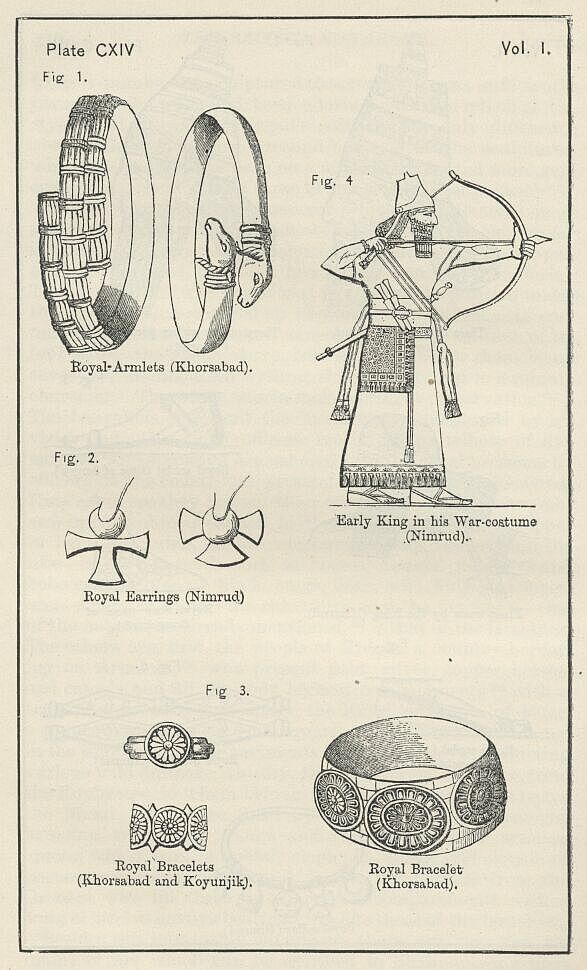
The bracelets of the king, like his armlets, were sometimes mere bars of metal, quite plain and without ornament. More often, however, they were ribbed and adorned with a large rosette at the centre. Sometimes, instead of one simple rosette, we see three double rosettes, between which project small points, shaped like the head of a spear. Occasionally these double rosettes appear to be set on the surface of a broad bar, which is chased so as to represent brickwork. In no case can we see how the bracelets were fastened; perhaps they were elastic, and were slipped over the hand. [PLATE CXIV., Fig. 3.]
Specimens of royal earrings have been already given in an earlier chapter of this volume. The most ordinary form in the more ancient times was a long drop, which was sometimes delicately chased Another common kind was an incomplete Maltese cross, one arm of the four being left out because it would have interfered with the ear. [PLATE CXIV., Fig. 2.] In later times there was a good deal of variety in the details; but the drop and the cross were always favorite features.
When the monarch went out to the hunt or to the battle, he laid aside such ornaments as encumbered him, reserving however his earrings, bracelets, and armlets, and then, stripping off his upper dress or chasuble, appeared in the under robe which has been already described. This robe was confined at the waist by a broad cincture or girdle, outside of which was worn a narrowish belt wherein daggers were often thrust. In early times this cincture seems to have been fastened by a ribbon with long streaming ends, which are very conspicuous in the Nimrud sculptures. At the same period the monarch often wore, when he hunted or went out to battle, a garment which might have been called an apron, if it had not been worn behind instead of in front. This was generally patterned and fringed very richly, besides being ornamented with one or more long pendent tassels. [PLATE CXIV., Fig. 4.]
The sacerdotal dress of the king, or that which he commonly wore when engaged in the rites of his religion, differed considerably from his ordinary costume. His inner garment, indeed, seems to have been the usual long gown with a fringe descending to the ankles; but this was almost entirely concealed under an ample outer robe, which was closely wrapped round the form and kept in place by a girdle. A deep fringe, arranged in two rows, one above the other, and carried round the robe in curved sweeps at an angle with the horizontal line, is the most striking feature of this dress, which is also remarkable for the manner in which it confines and conceals the left arm, while the right is left free and exposed to view. A representation of a king thus apparelled will be found in an earlier part of this work, taken from a statue now in the British Museum. It is peculiar in having the head uncovered, and in the form of the implement borne in the right hand. It is also incomplete as a representation, from the fact that all the front of the breast is occupied by an inscription. Other examples show that the tiara was commonly worn as a part of the sacerdotal costume; that the sacred collar adorned the breast, necklaces the neck, and bracelets the two arms; while in the belt, which was generally to some extent knotted, were borne two or three daggers. The mace seems to have been a necessary appendage to the costume, and was always grasped just below its head by the left hand.
We have but one representation of an Assyrian queen. Despite the well-known stories of Semiramis and her manifold exploits, it would seem that the Assyrians secluded their females with as rigid and watchful a jealousy as modern Turks or Persians. The care taken with respect to the direction of the passages in the royal hareem has been noticed already. It is quite in accordance with the spirit thus indicated, and with the general tenor of Oriental habits, that neither in inscriptions nor in sculptured representations do the Assyrians allow their women to make more than a most rare and occasional appearance. Fortunately for us, their jealousy was sometimes relaxed to a certain extent; and in one scene, recovered from the debris of an Assyrian palace we are enabled to contemplate at once the domestic life of the monarch and the attire and even the features of his consort.
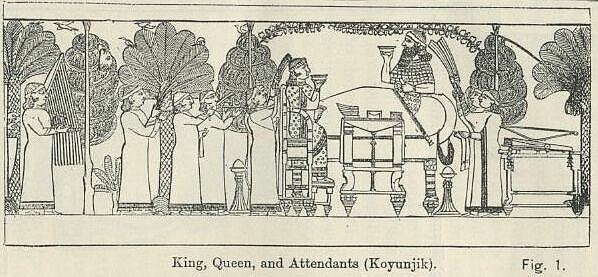
It appears that in the private apartments, while the king, like the Romans and the modern Orientals, reclined upon a couch leaning his weight partly upon his left elbow, and having his right arm free and disposable, her majesty the queen sat in a chair of state by the couch’s side, near its foot, and facing her lord. [PLATE CXV., Fig. 1.] Two eunuchs provided with large fans were in attendance upon the monarch, and the same number waited upon the queen, standing behind her chair. Her majesty, whose hair was arranged nearly like that of her royal consort, wore upon her head a band or fillet having something of the appearance of a crown of towers, such as encircles the brow of Cybele on Greek coins and statues. Her dress was a long-sleeved gown reaching from the neck to the feet, flounced and trimmed at the bottom in an elaborate way, and elsewhere patterned with rosettes, over which she wore a fringed tunic or frock descending half-way between the knees and the feet. [PLATE CXV., Fig. 3.] In addition to these two garments, she wore upon her back and shoulders a light cloak or cape, patterned (like the rest of her dress) with rosettes and edged with a deep fringe. Her feet were encased in shoes of a clumsy make, also patterned. Her ornaments, besides the crown upon her head, were earrings, a necklace, and bracelets. Her hair was cushioned, and adorned with a drapery which hung over the back. Her feet rested on a handsome footstool, also cushioned.
On the slab from which this description is taken the royal pair seem to be refreshing themselves with wine. Each supports on the thumb and fingers of the right hand a saucer or shallow drinking-cup, probably of some precious metal, which they raise to their lips simultaneously, as if they were pledging one another. The scene of the entertainment is the palace garden; for trees grow on either side of the main figures, while over their heads, a vine hangs its festoons and its rich clusters. By the side of the royal couch, and in front of the queen, is a table covered with a table-cloth, on which are a small box or casket, a species of shallow bowl which may have held incense or perfume of some kind, and a third article frequently seen in close proximity to the king, but of whose use it is impossible to form a conjecture. At the couch’s head stands another curious article, a sort of tall vase surmounted by a sugarloaf, which probably represents an altar. The king bears in his left hand the lotus or sacred flower, while the queen holds in hers what looks like a modern fan. All the lower part of the monarch’s person is concealed beneath a coverlet, which is plain, except that it has tassels at the corners and an embroidered border.
The officers in close attendance upon the monarch varied according to his employment. In war he was accompanied by his charioteer, his shield-bearer or shield-bearers, his groom, his quiver-bearer, his mace-bearer, and sometimes by his parasol-bearer. In peace the parasol-bearer is always represented as in attendance, except in hunting expeditions, or where he is replaced by a fan-bearer. The parasol, which exactly resembled that still in use throughout the East, was reserved exclusively for the monarch. [PLATE CXVI., Fig. 1.] It had a tall and thick pole, which the bearer grasped with both his hands, and in the early times a somewhat small circular top. Under the later kings the size of the head was considerably enlarged; and, at the same time, a curtain or flap was attached, which, falling from the edge of the parasol, more effectually protected the monarch from the sun’s rays. The head of the parasol was fringed with tassels, and the upper extremity of the pole commonly terminated in a flower or other ornament. In the later time both the head and the curtain which depended from it were richly patterned. If we may trust the remains of color upon the Khorsabad sculptures, the tints preferred were red and white, which alternated in bands upon the parasol as upon the royal tiara.
There was nothing very remarkable in the dress or quality of the royal attendants. Except the groom, the charioteer, and the shield-bearers, they were in the early times almost invariably eunuchs; but the later kings seem to have preferred eunuchs for the offices of parasol-bearer and fan-bearer only. The dress of the eunuchs is most commonly a long fringed gown, reaching from the neck to the feet, with very short sleeves, and a broad belt or girdle confining the gown at the waist. Sometimes they have a cross-belt also; and occasionally both this and the girdle round the waist are richly fringed. The eunuchs commonly wear earrings, and sometimes armlets and bracelets; in a few instances they have their necks adorned with necklaces, and their long dresses elaborately patterned. Their heads are either bare, or at most encircled with a fillet.
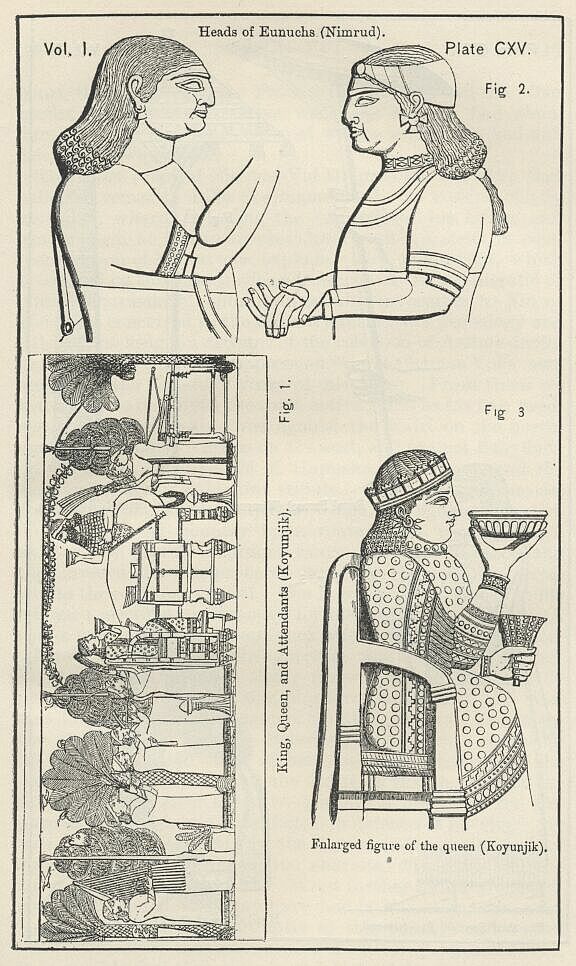
A peculiar physiognomy is assigned to this class of persons—the forehead low, the nose small and rounded, the lips full, the chin large and double, the cheeks bloated. [PLATE CXV., Fig. 2.] They are generally represented as shorter and stouter than the other Assyrians. Though placed in confidential situations about the person of the monarch, they seem not to have held very high or important offices. The royal Vizier is never a eunuch, and eunuchs are rarely seen among the soldiers; they are scribes, cooks, musicians, perhaps priests; as they are grooms-in-waiting, huntsmen, parasol-bearers, and fan-bearers; but it cannot be said with truth that they had the same power in Assyria which they have commonly possessed in the more degraded of the Oriental monarchies. It is perhaps a sound interpretation of the name Rabsaris in Scripture to understand it as titular, not appellative, and to translate it “the Chief Eunuch” or “the Master of the Eunuchs;” and if so, we have an instance of the employment by one Assyrian king of a person of this class on an embassy to a petty sovereign: but the sculptures are far from bearing out the notion that eunuchs held the same high position in the Assyrian court as they have since held generally in the East, where they have not only continually filled the highest offices of state, but have even attained to sovereign power. On the contrary, their special charge seems rather to have been the menial offices about the person of the monarch, which imply confidence in the fidelity of those to whom they are entrusted, but not submission to their influence in the conduct of state affairs. And it is worthy of notice that, instead of becoming more influential as time went on, they appear to have become less so; in the later sculptures the royal attendants are far less generally eunuchs than in the earlier ones; and the difference is most marked in the more important offices.
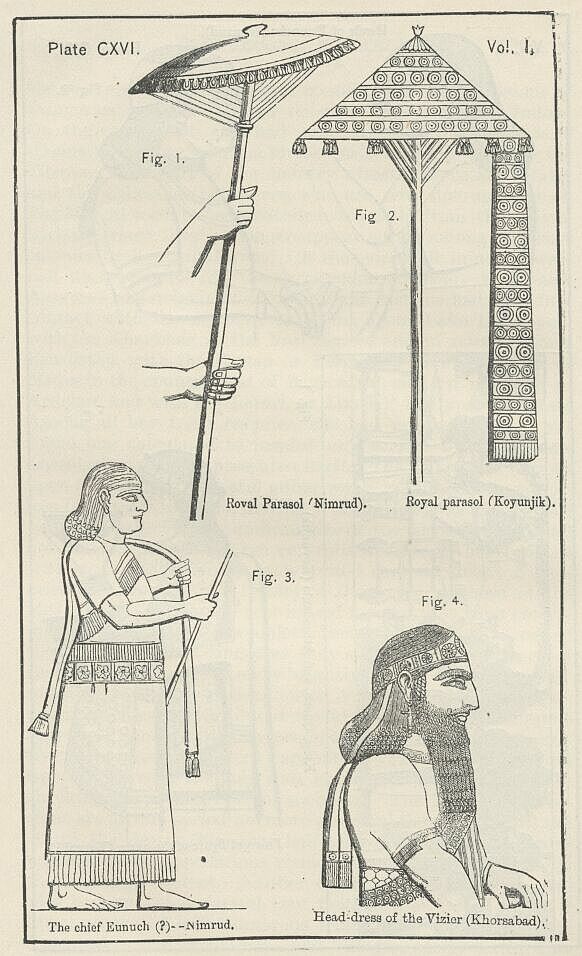
It is not quite certain that the Chief Eunuch is represented upon the sculptures. Perhaps we may recognize him in an attendant, who commonly bears a fan, but whose special badge of office is a long fringed scarf or band, which hangs down below his middle both before him and behind him, being passed over the left shoulder. [PLATE CXVI., Fig. 2.] This officer appears, in one bas-relief, alone in front of the king; in another, he stands on the right hand of the Vizier, level with him, facing the king as he drinks; in a third, he receives prisoners after a battle; while in another part of the same sculpture he is in the king’s camp preparing the table for his master’s supper. There is always a good deal of ornamentation about his dress, which otherwise nearly resembles that of the inferior royal attendants, consisting of a long fringed gown or robe, a girdle fringed or plain, a cross-belt generally fringed, and the scarf already described. His head and feet are generally bare, though sometimes the latter are protected by sandals. He is found only upon the sculptures of the early period.
Among the officers who have free access to the royal person, there is one who stands out with such marked prominence from the rest that he has been properly recognized as the Grand Vizier or prime minister at once the chief counsellor of the monarch, and the man whose special business it was to signify and execute his will. The dress of the Grand Vizier is more rich than that of any other person except the monarch; and there are certain portions of his apparel which he and the king have alone the privilege of wearing. These are, principally, the tasselled apron and the fringed band depending from the fillet, the former of which is found in the early period only, while the latter belongs to no particular time, but throughout the whole series of sculptures is the distinctive mark of royal or quasi-royal authority. To these two may be added the long ribbon or scarf, with double streamers at the ends, which depended from, and perhaps fastened, the belt—a royal ornament worn also by the Vizier in at least one representation. [PLATE CXVI., Fig. 3.]
The chief garment of the Vizier is always a long fringed robe, reaching from the neck to the feet. This is generally trimmed with embroidery at the top, round the sleeves, and round the bottom. It is either seen to be confined by a broad belt round the waist, or else is covered from the waist to the knees by two falls of a heavy and deep fringe. In this latter case, a broad cross-belt is worn over the left shoulder, and the upper fall of fringe hangs from the cross-belt. A fillet is worn upon the head, which is often highly ornamented. The feet are sometimes bare, but more often are protected by sandals, or (as in the accompanying representation) by embroidered shoes. Earrings adorn the ears; bracelets, sometimes accompanied by armlets, the arms. A sword is generally worn at the left side.
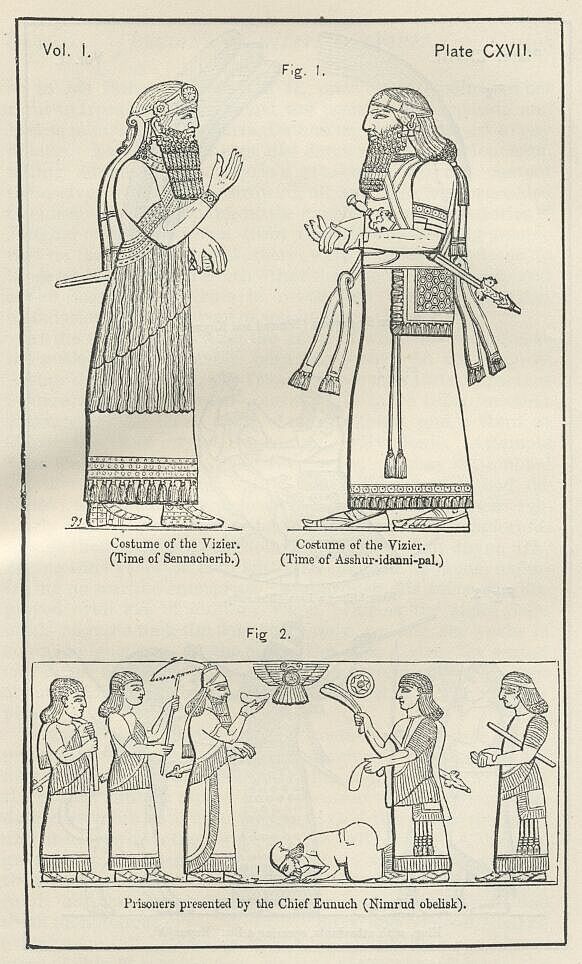
The Vizier is ordinarily represented in one of two attitudes. Either he stands with his two hands joined in front of him, the right hand in the left, and the fingers not clasped, but left loose—the ordinary attitude of passive and respectful attention, in which officers who carry nothing await the orders of the king,—or he has the right arm raised, the elbow bent, and the right hand brought to a level with his month, while the left hand rests upon the hilt of the sword worn at his left side. [PLATE CXVII., Fig. 1.] In this latter case it may be presumed that we have the attitude of conversation, as in the former we have that of attentive listening. When the Vizier assumes this energetic posture he is commonly either introducing prisoners or bringing in spoil to the king. When he is quiescent, he stands before the throne to receive the king’s orders, or witnesses the ceremony with which it was usual to conclude a successful hunting expedition.
The pre-eminent rank and dignity of this officer is shown, not only by his participation in the insignia of royal authority, but also and very clearly by the fact that, when he is present, no one ever intervenes between him and the king. He has the undisputed right of precedence, so that he is evidently the first subject of the crown, and he alone, is seen addressing the monarch. He does not always accompany the king on his military expeditions but when he attends them, he still maintains his position, having a dignity greater than that of any general, and so taking the entire direction of the prisoners and of the spoil.
The royal fan-bearers were two in number. They were invariably eunuchs. Their ordinary position was behind the monarch, on whom they attended alike in the retirement of private life and in religious and civil ceremonies. On some occasions, however, one of the two was privileged to leave his station behind the king’s chair or throne, and, advancing in front, to perform certain functions before the face of his master. He handed his master the sacred cup, and waited to receive it back, at the same time diligently discharging the ordinary duties of his office by keeping up a current of air and chasing away those plagues of the East—the flies. The fan-bearer thus privileged wears always the long tasselled scarf, which seems to have been a badge of office, and may not improbably mark him for the chief Eunuch. In the absence of the Vizier, or sometimes in subordination to him, he introduced the tribute-bearers to the king, reading out their names and titles from a scroll or tablet which he held in his left hand. [PLATE CXVII., Fig. 2.]
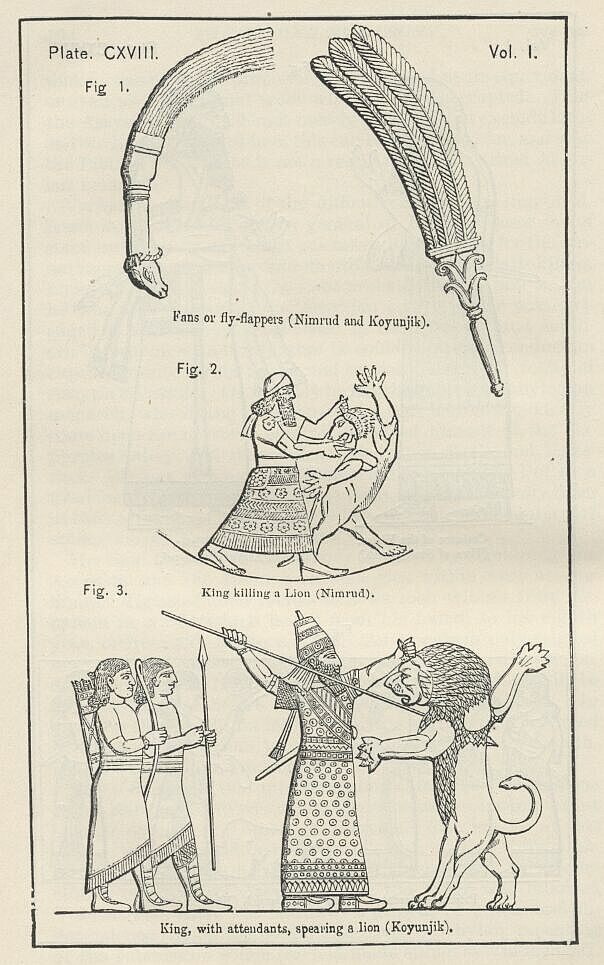
The fan carried by these attendants seems in most instances to have been made of feathers. It had a shortish handle, which was generally mere or less ornamented, and frequently terminated in the head of a ram or other animal. [PLATE CXVIII., Fig. 1.] The feathers were sometimes of great length, and bent gracefully by their own weight, as they were pointed slantingly towards the monarch. Occasionally a comparatively short fan was used, and the feathers were replaced by a sort of brush, which may have been made of horse-hair, or possibly of some vegetable fibre.
The other attendants on the monarch require no special notice. With regard to their number, however, it may be observed that, although the sculptures generally do not represent them as very numerous, there is reason to believe that they amounted to several hundreds. The enormous size of the palaces can scarcely be otherwise accounted for: and in one sculpture of an exceptional character, where the artist seems to have aimed at representing his subject in full, we can count above seventy attendants present with the monarch at one time. Of these less than one-half are eunuch; and these wear the long robe with the fringed belt and cross-belt. The other attendants wear in many cases the same costume; sometimes, however, they are dressed in a tunic and greaves, like the soldiers.
There can be no doubt that the court ceremonial of the Assyrians was stately and imposing. The monarch seems indeed not to have affected that privacy and seclusion which forms a predominant feature of the ceremonial observed in most Oriental monarchies. He showed himself very freely to his subjects on many occasions. He superintended in person the accomplishment of his great works. In war and in the chase he rode in an open chariot, never using a litter, though litters were not unknown to the Assyrians. In his expeditions he would often descend from his chariot, and march or fight on foot like the meanest of his subjects. But though thus familiarizing the multitude with his features and appearance, he was far from allowing familiarity of address. Both in peace and war he was attended by various officers of state, and no one had speech of him except through them. It would even seem as if two persons only were entitled to open a conversation with him—the Vizier and the Chief Eunuch. When he received them, he generally placed himself upon his throne, sitting, while they stood to address him. It is strongly indicative of the haughty pride of these sovereigns that they carried with them in their distant expeditions the cumbrous thrones whereon they were wont to sit when they dispensed justice or received homage. On these thrones they sat, in or near their fortified camps, when the battle or the siege was ended, and thus sitting they received in state the spoil and the prisoners. Behind them on such occasions were the two fan-bearers, while near at hand were guards, scribes, grooms, and other attendants. In their palace halls undoubtedly the ceremonial used was stricter, grander, and more imposing. The sculptures, however, furnish no direct evidence on this point, for there is nothing to mark the scene of the great processional pieces.
In the pseudo-history of Ctesias, the Assyrian kings were represented as voluptuaries of the extremest kind, who passed their whole lives within the palace, in the company of their concubines and their eunuchs, indulging themselves in perpetual ease, pleasure, and luxury. We have already seen how the warlike character of so many monarchs gives the lie to these statements, so far as they tax the Assyrian kings with sloth and idleness. It remains to examine the charge of over-addiction to sensual delights, especially to those of the lowest and grossest description. Now it is at least remarkable that, so far as we have any real evidence, the Assyrian kings appear as monogamists. In the inscription on the god Nebo, the artist dedicates his statue to his “lord Vol-lush (?) and his lady, Sammuramit.” In the solitary sculptured representation of the private life of the king, he is seen in the company of one female only. Even in the very narrative of Ctesias, Ninus has but one wife, Semiramis; and Sardanapalus, notwithstanding his many concubines, has but five children, three sons and two daughters. It is not intended to press these arguments to an extreme, or to assume, on the strength of them, that the Assyrian monarchs were really faithful to one woman. They may have had—nay, it is probable that they had—a certain number of concubines; but there is really not the least ground for believing that they carried concubinage to an excess, or over-stepped in this respect the practice of the best Eastern sovereigns. At any rate they were not the voluptuaries which Ctesias represented them. A considerable portion of their lives was passed in the toils and dangers of war; and their peaceful hours, instead of being devoted to sloth and luxury in the retirement of the palace, were chiefly employed, as we shall presently see, in active and manly exercises in the field, which involved much exertion and no small personal peril.
The favorite occupation of the king in peace was the chase of the lion. In the early times he usually started on a hunting expedition in his chariot, dressed as when he went out to war, and attended by his charioteer, some swordsmen, and a groom holding a led horse. He carried a bow and arrows, a sword, one or two daggers, and a spear, which last stood in a rest made for it at the back of the chariot. Two quivers, each containing an axe and an abundant supply of arrows, hung from the chariot transversely across its right side, while a shield armed with teeth was suspended behind. When a lion was found, the king pursued it in his chariot, letting fly his arrows as he went, and especially seeking to pierce the animal about the heart and head. Sometimes he transfixed the beast with three or four shafts before it succumbed. Occasionally the lion attacked him in his chariot, and was met with spear and shield, or with a fresh arrow, according to the exigencies of the moment, or the monarch’s preference for one or the other weapon. On rare occasions the monarch descended to the ground, and fought on foot. He would then engage the lion in close combat with no other weapon but a short sword, which he strove to plunge, and often plunged, into his heart. [PLATE CXVIII., Fig. 2.]
In the later time, though the chariot was still employed to some extent in the lion-hunts, it appears to have been far more usual for the king to enjoy the sport on foot. He carried a straight sword, which seems to have been a formidable weapon; it was strong, very broad, and two feet or a little more in length. Two attendants waited closely upon the monarch, one of whom carried a bow and arrows, while the other was commonly provided with one or two spears. From these attendants the king took the bow or spear at pleasure, usually commencing the attack with his arrows, and finally despatching the spent animal with sword or spear, as he deemed best. Sometimes, but not very often, the spearman in attendance carried also a shield, and held both spear and shield in advance of his master to protect him from the animal’s spring. Generally the monarch faced the danger with no such protection, and received the brute on his sword, or thrust him through with his pike. [PLATE CXVIII., Fig. 3;] [PLATE CXIX., Fig. 1.] Perhaps the sculptures exaggerate the danger which he affronted at such moments; but we can hardly suppose that there was not a good deal of peril incurred in these hand-to-hand contests.
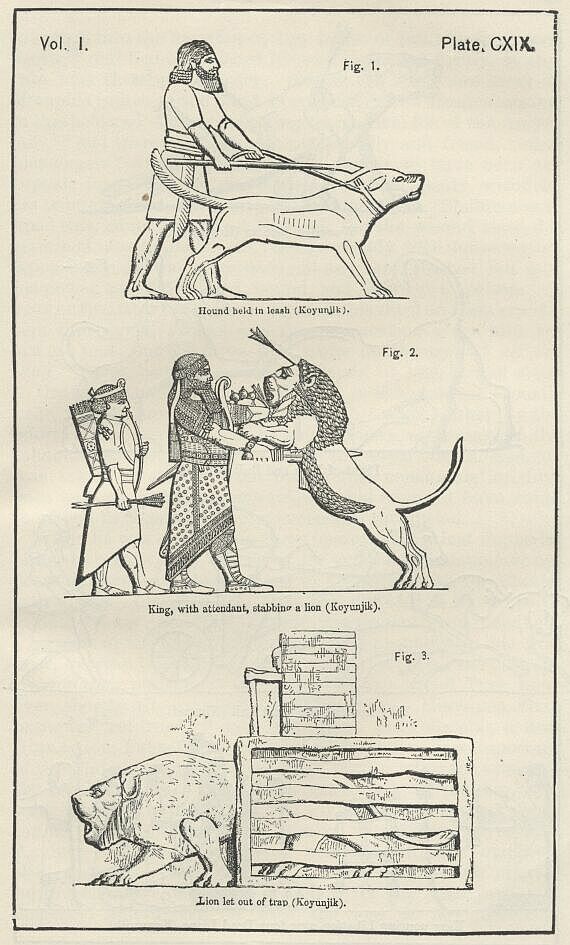
Two modes of hunting the king of beasts were followed at this time. Either he was sought in his native haunts, which were then, as now, the reedy coverts by the side of the canals and great streams; or he was procured beforehand, conveyed to the hunting-ground, and there turned out before the hunters. In the former case the monarch took the field accompanied by his huntsmen and beaters on horse and foot, these last often holding dogs in leash, which, apparently, were used only to discover and arouse the game, but were not slipped at it when started. No doubt the hunt was sometimes entirely on the land, the monarch accompanying his beaters along one or other of the two banks of a canal or stream. But a different plan is known to have been adopted on some occasions. Disposing his beaters to the right and left upon both banks, the monarch with a small band of attendants would take ship, and, while his huntsmen sought to start the game on either side, he would have himself rowed along so as just to keep pace with them, and would find his sport in attacking such lions as took the water. The monarch’s place on these occasions was the middle of the boat. Before him and behind him were guards armed with spears, who were thus ready to protect their master, whether the beast attacked him in front or rear. The monarch used a round bow, like that commonly carried in war, and aimed either at the heart or at the head. The spearmen presented their weapons at the same time, while the sides of the boat were also sufficiently high above the water to afford a considerable protection against the animal’s spring. An attendant immediately behind the monarch held additional arrows ready for him; and after piercing the noble brute with three or four of these weapons, the monarch had commonly the satisfaction of seeing him sink down and expire. The carcass was then taken from the water, the fore and hind legs were lashed together with string, and the beast was suspended from the hinder part of the boat, where he hung over the water just out of the sweep of the oars.
At other times, when it was felt that the natural chase of the animal might afford little or no sport, the Assyrians (as above stated) called art to their assistance, and, having obtained a supply of lions from a distance, brought them in traps or cages to the hunting-ground, and there turned them out before the monarch. The walls of the cage was made of thick spars of wood, with interstices between them, through which the lion could both see and be seen: probably the top was entirely covered with boards, and upon these was raised a sort of low hut or sentry-box, just large enough to contain a man, who, when the proper moment arrived, peeped forth from his concealment and cautiously raised the front of the trap, which was a kind of drop-door working in a groove. [PLATE CXIX., Fig. 2.] The trap being thus opened, the lion stole out, looking somewhat ashamed of his confinement, but doubtless anxious to vent his spleen on the first convenient object. The king, prepared for his attack, saluted him, as he left his cage, with an arrow, and, as he advanced, with others, which sometimes stretched him dead upon the plain, sometimes merely disabled him, while now and then they only goaded him to fury. In this case he would spring at the royal chariot, clutch some part of it, and in his agony grind it between his teeth, or endeavor to reach the inmates of the car from behind. If the king had descended from the car to the plain, the infuriated beast might make his spring at the royal person, in which case it must have required a stout heart to stand unmoved, and aim a fresh arrow at a vital part while the creature was in mid-air, especially if (as we sometimes see represented) a second lion was following close upon the first, and would have to be received within a few seconds. It would seem that the lions on some occasions were not to be goaded into making an attack, but simply endeavored to escape by flight. To prevent this, troops were drawn up in a double line of spearmen and archers round the space within which the lions were let loose, the large shields of the front or spearmen line forming a sort of wall, and the spears a chevaux de frise, through which it was almost impossible for the beasts to break. In front of the soldiers, attendants held hounds in leashes, which either by their baying and struggling frightened the animals back, or perhaps assisted to despatch them. [PLATE CXIX., Fig. 3.] The king meanwhile plied his bow, and covered the plain with carcasses, often striking a single beast with five or six shafts.
The number of lions destroyed at these royal battues is very surprising. In one representation no fewer than eighteen are seen upon the field, of which eleven are dead and five seriously wounded. The introduction of trapped beasts would seem to imply that the game, which under the earlier monarchs had been exceedingly abundant,—failed comparatively under the later ones, who therefore imported it from a distance. It is evident, however, that this scarcity was not allowed to curtail the royal amusement. To gratify the monarch, hunters sought remote and savage districts, where the beast was still plentiful, and, trapping their prey, conveyed it many hundreds of miles to yield a momentary pleasure to the royal sportsman.
It is instructive to contrast with the boldness shown in the lion-hunts of this remote period the feelings and conduct of the present inhabitants of the region. The Arabs, by whom it is in the main possessed, are a warlike race, accustomed from infancy to arms and inured to combat. “Their hand is against every man, and every man’s hand is against them.” Yet they tremble if a lion is but known to be near, and can only with the utmost difficulty be persuaded by an European to take any part in the chase of so dangerous an animal.
The lioness, no less than the lion, appears as a beast of chase upon the sculptures. It seems that in modern times she is quite as much feared as her consort. Indeed, when she has laid up cubs, she is even thought to be actually the more dangerous of the two. [PLATE CXX., Fig. 1.]
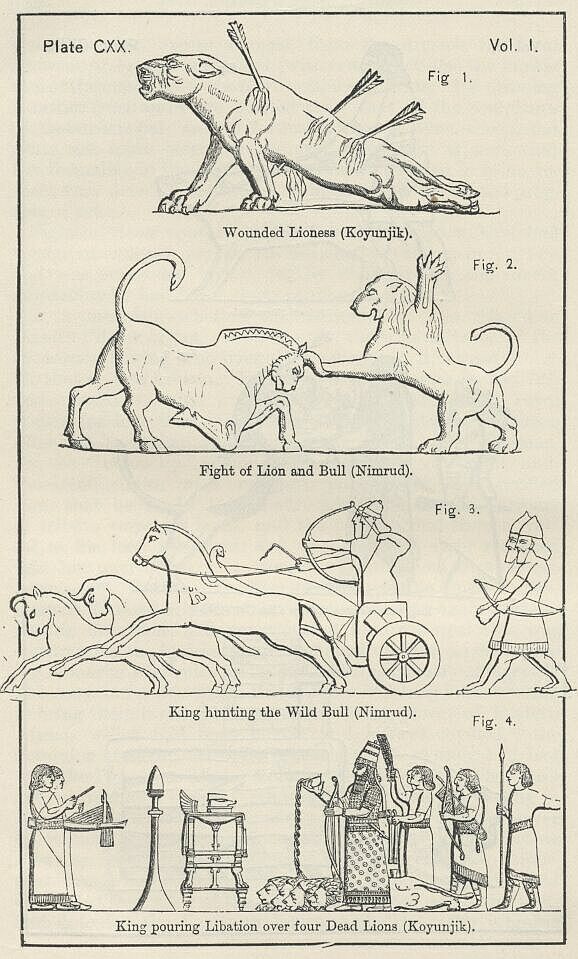
Next to the chase of the lion and lioness, the early Assyrian monarchs delighted in that of the wild bull. It is not quite certain what exact species of animal is sought to be expressed by the representations upon the sculptures; but on the whole it is perhaps most probable that the Aurochs or European bison (Bos urus of naturalists) is the beast intended. At any rate it was an animal of such strength and courage that, according to the Assyrian belief, it ventured to contend with the lion. [PLATE CXX., Fig. 2.] The Assyrian monarchs chased the wild bull in their chariots without dogs, but with the assistance of horsemen, who turned the animals when they fled, and brought them within the monarch’s reach. [PLATE CXX., Fig. 3.] The king then aimed his arrows at them, and the attendant horsemen, who were provided with bows, seem to have been permitted to do the same. The bull seldom fell until he had received a number of wounds; and we sometimes see as many as five arrows still fixed in the body of one that has succumbed. It would seem that the bull, when pushed, would, like the lion, make a rush at the king’s chariot, in which case the monarch seized him by one of the horns and gave him the coup de grace with his sword.
The special zest with which this animal was pursued may have arisen in part from its scarcity. The Aurochs is wild and shy; it dislikes the neighborhood of man, and has retired before him till it is now found only in the forests of Lithuania, Carpathia, and the Caucasus. It seems nearly certain that, in the time of the later kings, the species of wild cattle previously limited, whatever it was, had disappeared from Assyria altogether; at least this is the only probable account that can be given of its non-occurrence in the later sculptures, more especially in those of Asshur-bani-pal, the son of Esarhaddon, which seem intended to represent the chase under every aspect known at the time. We might therefore presume it to have been, even in the early period, already a somewhat rare animal. And so we find in the Inscriptions that the animal, or animals, which appear to represent wild cattle, were only met with in outlying districts of the empire—on the borders of Syria and in the country about Harrah; and then in such small numbers as to imply that even there they were not very abundant.
When the chase of the nobler animals—the lion and the wild bull—had been conducted to a successful issue, the hunters returned in a grand procession to the capital, carrying with then as trophies of their prowess the bodies of the slain. These were borne aloft on the shoulders of men, three or four being required to carry each beast. Having been brought to an appointed spot, they were arranged side by side upon the ground, the heads of all pointing the same way; and the monarch, attended by several of his principal officers, as the Vizier, the Chief Eunuch, the fan-bearers, the bow and mace bearers, and also by a number of musicians, came to the place, and solemnly poured a libation over the prostrate forms, first how-ever (as it would seem) raising the cup to his own lips. It is probable that this ceremony had to some extent a religious character. The Assyrian monarchs commonly ascribe the success of their hunting expeditions to the gods Nin (or Ninip) and Nergal; and we may well understand that a triumphant return would be accompanied by a thank-offering to the great protectors under whose auspices success had been achieved. [PLATE CXX., Fig. 4.]
Besides the wild bull and the lion, the Assyrians are known to have hunted the following animals: the onager or wild ass, the stag, the ibex or wild goat, the gazelle, and the hare.
The chase of the wild ass was conducted in various ways. The animal was most commonly pursued with dogs. The large and powerful hounds of the Assyrians, of which a certain use was made even in the chase of the lion, have been already noticed; but it may be desirable in this place to give a fuller account of them. They were of a type approaching to that of our mastiff, being smooth haired, strong limbed, with a somewhat heavy head and neck, small pointed but drooping ears, and a long tail, which was bushy and a little inclined to curl. They seem to have been very broad across the chest, and altogether better developed as to their fore than as to their hind parts, though even their hind legs were tolerably strong and sinewy. They must have been exceedingly bold, if they really faced the hunted lion; and their pace must have been considerable, if they were found of service in chasing the wild ass.
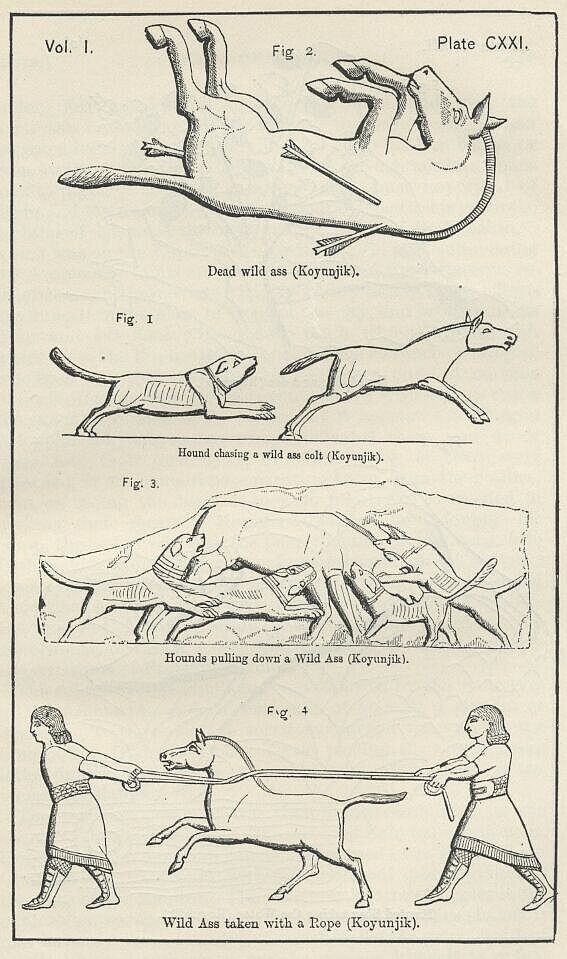
The hunters are represented as finding the wild asses in herds, among which are seen a certain number of foals. The King and his chief attendants pursue the game on horseback, armed with bows and arrows, and discharging their arrows as they go. Hounds also—not now held in leash, but free—join in the hunt, pressing on the game, and generally singling out some one individual from the herd, either a young colt or sometimes a full-grown animal. [PLATE CXXI., Fig. 1.] The horsemen occasionally brought down the asses with their shafts. [PLATE CXXI.. Fig. 2.] When their archery failed of success, the chase depended on the hounds, which are represented as running even the full-grown animal to a stand, and then worrying him till the hunters came up to give the last blow. Considering the speed of the full-grown wild ass, which is now regarded as almost impossible to take, we may perhaps conclude that the animals thus run down by the hounds were such as the hunters had previously wounded; for it can scarcely be supposed that such heavily-made dogs as the Assyrian could really have caught an unwounded and full-grown wild ass. [PLATE CXXI., Fig. 3.]
Instead of shooting the wild ass, or hunting him to the death with hounds, an endeavor was sometimes made to take him alive. [PLATE CXXI., Fig. 4] A species of noose seems to have been made by means of two ropes interlaced, which were passed—how, we cannot say—round the neck of the animal, and held him in such a way that all his struggles to release himself were vain. This mode of capture recalls the use of the lasso by the South Americans and the employment of nooses by various nations, not merely in hunting, but in warfare. It is doubtful, however, if the Assyrian practice approached at all closely to any of these. The noose, if it may be so called, was of a very peculiar kind. It was not formed by means of a slip-knot at the end of a single cord, but resulted from the interlacing of two ropes one with the other. There is great difficulty in understanding how the ropes were got into their position. Certainly no single throw could have placed then, round the neck of the animal in the manner represented, nor could the capture have been effected, according to all appearance, by a single hunter. Two persons, at least, must have been required to combine their efforts—one before and one behind the creature which it was designed to capture.
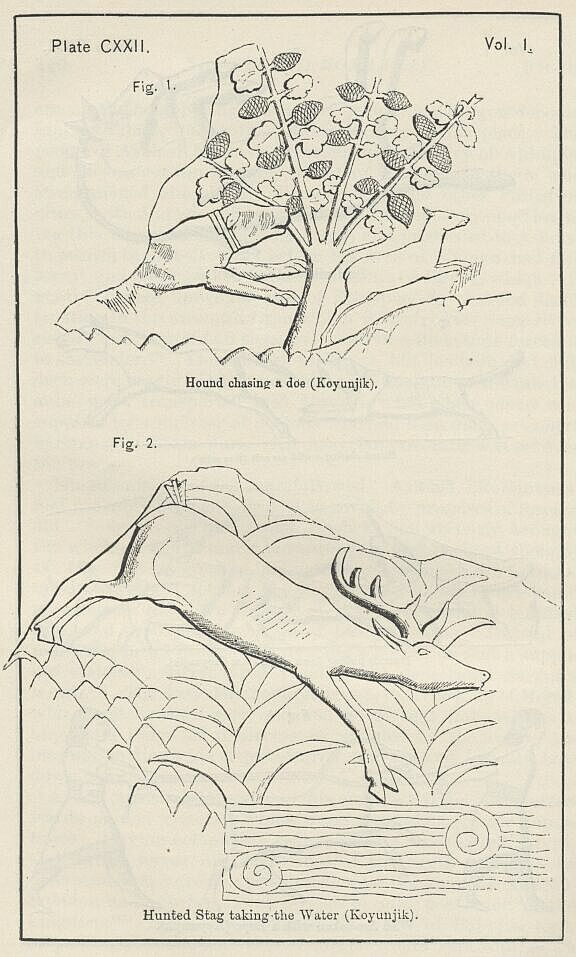
Deer, which have always abounded in Assyria were either hunted with dogs, or driven by beaters into nets, or sometimes shot with arrows by sportsmen. The illustration [PLATE CXXII., Fig. 1] represents a dog in chase of a hind, and shows that the hounds which the Assyrians used for this purpose were of the same breed as those employed in the hunt of the lion and of the wild ass. In [PLATE CXXII., Fig. 2.] we have a stricken stag, which may, perhaps, have been also hard pressed by hounds, in the act of leaping from rocky ground into water. It is interesting to find this habit of the stag, with which the modern English sportsman is so familiar, not merely existing in Assyria, but noticed by Assyrian sculptors, at the distance of more than twenty-five centuries from our own time.
When deer were to be taken by nets, the sportsman began by setting in an upright position, with the help of numerous poles and pegs, a long, low net, like the [dikrvov] of the Greeks. [PLATE CXXII., Fig. 1.] This was carried round in a curved line of considerable length, so as to enclose an ample space on every side excepting one, which was left open for the deer to enter. The meshes of the net were large and not very regular. They were carefully secured by knots at all the angles. The net was bordered both at top and at bottom by a rope of much greater strength and thickness than that which formed the network; and this was fastened to the ground at the two extremities by pegs of superior size. [PLATE CXXIII., Fig. 2.] The general height of the net was about that of a man, but the two ends were sloped gently to the ground. Beaters, probably accompanied by dogs, roused the game in the coverts, which was then driven by shouts and barkings towards the place where the net was set. If it once entered within the two extremities of the net (a b, [PLATE CXXIII., Fig. 1]), its destruction was certain; for the beaters, following on its traces, occupied the space by which it had entered, and the net itself was not sufficiently visible for the deer to rise at it and clear it by a leap.
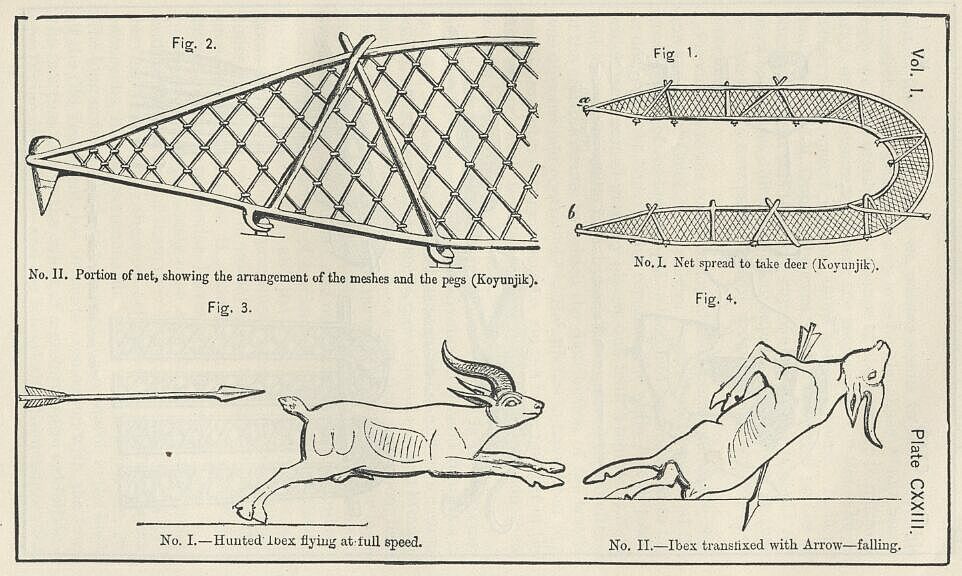
In the chase of the ibex or wild goat, horsemen were employed to discover the animals, which are generally found in herds, and to drive them towards the sportsman, who waited in ambush until the game appeared within bowshot. [PLATE CXXIII., Fig. 3.] An arrow was then let fly at the nearest or the choicest animal, which often fell at the first discharge. [PLATE CXXIII., Fig. 4.] The sport was tame compared with many other kinds, and was probably not much affected by the higher orders.
The chase of the gazelle is not shown on the sculptures. In modern times they are taken by the grayhound and the falcon, separately or in conjunction, the two being often trained to hunt together. They are somewhat difficult to run down with dogs only, except immediately after they have drunk water in hot weather. That the Assyrians sometimes captured them, appears by a hunting scene which Mr. Layard discovered at Khorsabad, where an attendant is represented carrying a gazelle on his shoulders, and holding a hare in his right hand. [PLATE CXXIV., Fig. 1.] As gazelles are very abundant both in the Sinjar country and in the district between the Tigris and the Zagros range, we may suppose that the Assyrians sometimes came upon them unawares, and transfixed them with their arrows before they could make their escape. They may also have taken them in nets, as they were accustomed to take deer; but we have no evidence that they did so.
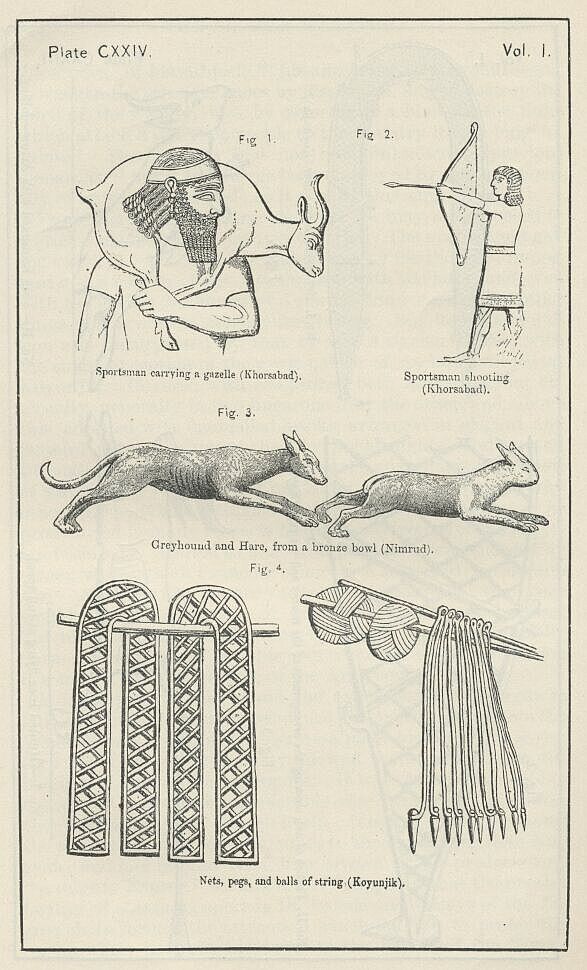
The hare is seen very commonly in the hands of those who attend upon the huntsmen. It is always represented as very small in proportion to the size of the men, whence we may perhaps conclude that the full-grown animal was less esteemed than the leveret. As the huntsmen in these representations have neither nets nor dogs, but seem to obtain their game solely by the bow, we must presume that they were expert enough to strike the hare as it ran.
There is no difficulty in making such a supposition as this, since the Assyrians have left us an evidence of their skill as marksmen which implies even greater dexterity. The game which they principally sought in the districts where they occasionally killed the hare and the gazelle seems to have been the partridge; and this game they had to bring down when upon the wing. We see the sportsmen in the sculptures aiming their arrows at the birds as they mount into the air [PLATE CXXIV., Fig. 21,] and in one instance we observe one of the birds in the act of falling to the ground, transfixed by a well aimed shaft. Such skill is not uncommon among savage hunting tribes, whose existence depends on the dexterity with which they employ their weapons; but it is rarely that a people which has passed out of this stage, and hunts for sport rather than subsistence, retains its old expertness.
Hunting the hare with dogs was probably not very common, as it is only in a single instance that the Assyrian remains exhibit a trace of it. On one of the bronze dishes discovered by Mr. Layard at Nimrud may be seen a series of alternate dogs and hares, which shows that coursing was not unknown to the Assyrians. [PLATE CXXIV., Fig. 3.] The dog is of a kind not seen elsewhere in the remains of Assyrian art. The head bears a resemblance to that of the wolf; but the form generally is that of a coarse grayhound, the legs and neck long, the body slim, and the tail curved at the end; offering thus a strong contrast to the ordinary Assyrian hound, which has been already represented more than once.
Nets may sometimes have been employed for the capture of small game, such as hares and rabbits, since we occasionally see beaters or other attendants carrying upon poles, which they hold over their shoulders, nets of dimensions far too small for them to have been used in the deer-hunts, with balls of string and pegs wherewith to extend them. [PLATE CXXIV., Fig. 4.] The nets in this case are squared at the ends, and seem to have been about eight or nine feet long, and less than a foot in height. They have large meshes, and, like the deer nets, are bordered both at top and bottom with a strong cord, to which the net-work is attached. Like the classical [evodia], they were probably placed across the runs of the animals, which, being baffled by then and turned from their accustomed tracks, would grow bewildered, and fall an easy prey to the hunters. Or, possibly, several of them may have been joined together, and a considerable space may then have been enclosed, within which the game may have been driven by the beaters. The ease of these three weak and tinnier animals, the gazelle, the hare, and the partridge, was not regarded as worthy of the monarch. When the king is represented as present, he takes no part in it, but merely drives in his chariot through the woods where the sportsmen are amusing themselves. Persons, however, of a good position, as appears from their dress and the number of their attendants, indulged in the sport, more especially eunuchs, who were probably those of the royal household. It is not unlikely that the special object was to supply the royal table with game.
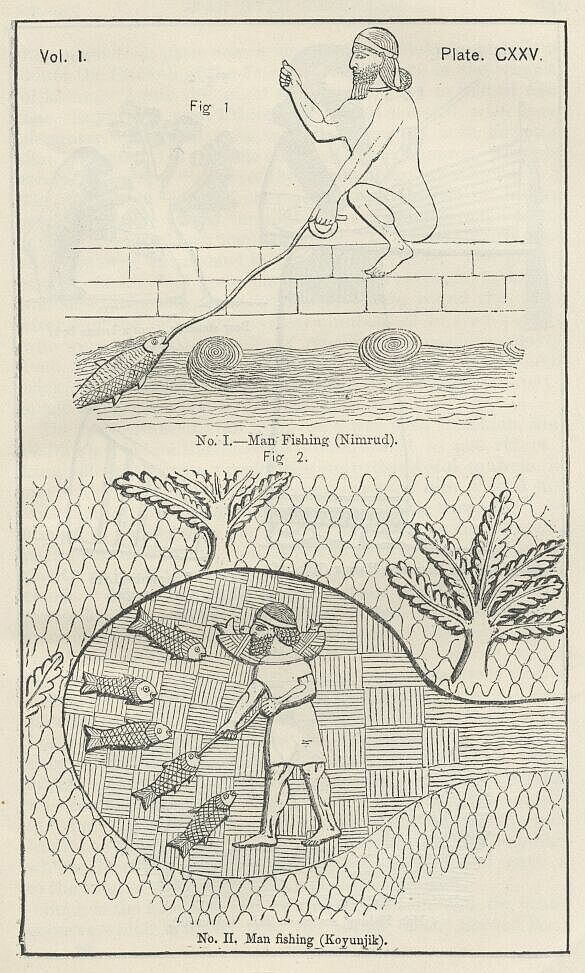
The Assyrians do not seem to have had much skill as fishermen. They were unacquainted with the rod, and fished by means of a simple line thrown into the water, one end of which was held in the hand. [PLATE CXXV., Figs. 1, 2.] No float was used, and the bait must consequently have sunk to the bottom, unless prevented from so doing by the force of the stream. This method of fishing was likewise known and practised in Egypt, where, however, it was far more common to angle with a rod. Though Assyrian fish-hooks have not been found, there can be no doubt that that invention was one with which they were acquainted, as were both the Egyptians and the early Chaldaeans.
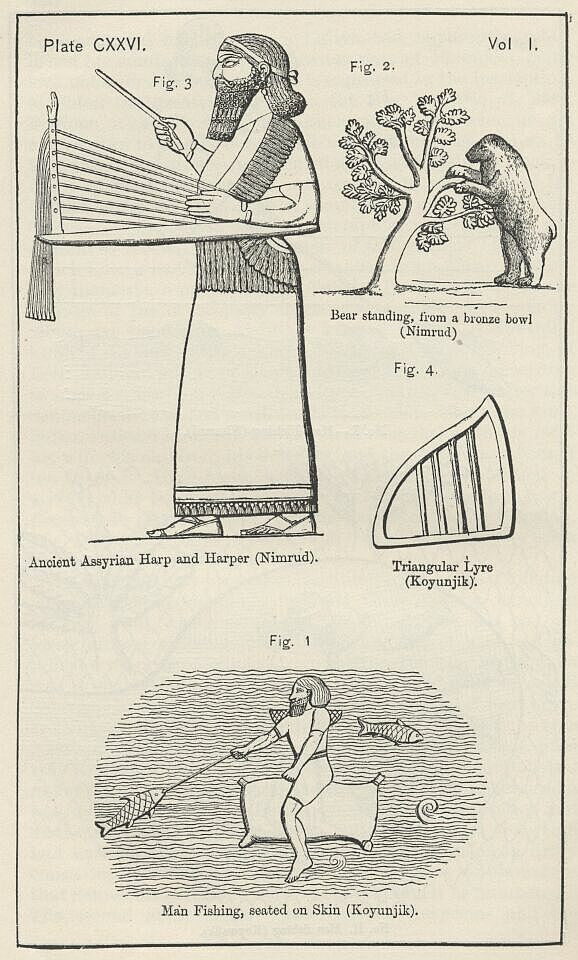
Fishing was carried on both in rivers and in stews or ponds. The angler sometimes stood or squatted upon the bank; at other times, not content with commanding the mere edge of the water, he plunged in, and is seen mid-stream, astride upon an inflated skin, quietly pursuing his avocation. [PLATE CXXVI., Fig. 1.] Occasionally he improved his position by amounting upon a raft, and, seated at the stern, with his back to the rower, threw out his line and drew the fish from the water. Now and then the fisherman was provided with a plaited basket, made of rushes or flags, which was fastened round his neck with a string, and hung at his back, ready to receive the produce of his exertions.
It does not appear that angling was practised by the Assyrians the way that the monuments show it to have been practised in Egypt, as an amusement of the rich. The fishermen are always poorly clothed, and seem to have belonged to the class which worked for its living. It is remarkable that do not anywhere in the sculptures see nets used for fishing; but perhaps we ought not to conclude from this that they were never so employed in Assyria. The Assyrian sculptors represented only occasionally the scenes of common everyday life; and we are seldom justified in drawing a negative conclusion as to the peaceful habits of the people on any point from the mere fact that the bas-reliefs contain no positive evidence on the subject.
A few other animals were probably, but not certainly, chased by the Assyrians, as especially the ostrich and the bear. The gigantic bird, which remained in Mesopotamia as late as the time of Xenophon, was well known to the Assyrian artists, who could scarcely have represented it with so much success, unless its habits had been described by hunters. The bear is much less frequent upon the remains than the ostrich; but its occurrence and the truthfulness of its delineation where it occurs, indicate a familiarity which may no doubt be due to other causes, but is probably traceable to the intimate knowledge acquired by those who hunted it. [PLATE CXXVI., Fig. 2.]
Of the other amusements and occupations of the Assyrians our knowledge is comparatively scanty; but some pages may be here devoted to their music, their navigation, their commerce, and their agriculture. On the first and second of these a good deal of light is thrown by the monuments, while some interesting facts with respect to the third and fourth may be gathered both from this source and also from ancient writers.
That the Babylonians, the neighbors of the Assyrians, and, in a certain sense, the inheritors of their empire, had a passion for music, and delighted in a great variety of musical instruments, has long been known and admitted. The repeated mention by Daniel, in his third chapter, of the cornet, flute, harp sackbut, psaltery, dulcimer, and all kinds of music—or, at any rate, of a number of instruments for which those terms were once thought the best English equivalents—has familiarized us with the fact that in Babylonia, as early as the sixth century B.C., musical instruments of many different kinds were in use. It is also apparent from the book of Psalms, that a variety of instruments were employed by the Jews. And we know that in Egypt as many as thirteen or fourteen different kinds were common. In Assyria, if there was not so much variety as this, there were at any rate eight or nine quite different sorts, some stringed, some wind, some merely instruments of percussion. In the early sculptures, indeed, only two or three musical instruments are represented. One is a kind of harp, held between the left arm and the side, and played with one hand by means of a quill or plectrum. [PLATE CXXVI., Fig. 3.] Another is a lyre, played by the hand; while a third is apparently cymbal. But in the later times we see besides these instruments—a harp of a different make played with both hands, two or three kinds of lyre, the double pipe, the guitar or cithern, the tambourine, a nameless instrument, and more than one kind of drum.
The harp of the early ages was a triangular instrument, consisting of a horizontal board which seems to have been about three feet in length, an upright bar inserted into one end of the board, commonly surmounted by an imitation of the human hand, and a number of strings which crossed diagonally from the board to the bar, and, passing through the latter, hung down some way, terminating in tassels of no great size. The strings were eight, nine, or ten in number, and (apparently) were made fast to the board, but could be tightened or relaxed by means of a row of pegs inserted into the upright bar, round which the strings were probably wound. No difference is apparent in the thickness of the strings; and it would seem therefore that variety of tone was produced solely by difference of length. It is thought that this instrument must have been suspended round the player’s neck. It was carried at the left side, and was played (as already observed) with a quill or electrum held in the right hand, while the left hand seems to have been employed in pressing the strings so as to modify the tone, or stop the vibrations, of the notes. The performers on this kind of harp, and indeed all other Assyrian musicians, are universally represented as standing while they play.
The harp of later times was constructed, held, and played differently. It was still triangular, or nearly so; but the frame now consisted of a rounded and evidently hollow, sounding-board, to which the strings were attached with the help of pegs, and a plain bar whereto they were made fast below, and from which their ends depended like a fringe. The number of strings was greater than in the earlier harp, being sometimes as many as seventeen. The instrument was carried in such a way that the strings were perpendicular and the bar horizontal, while the sounding-board projected forwards at an angle above the player’s head. It was played by the naked hand, without a plectrum; and both hands seem to have found their employment in pulling the strings. [PLATE CXXVII., Fig. 1.]
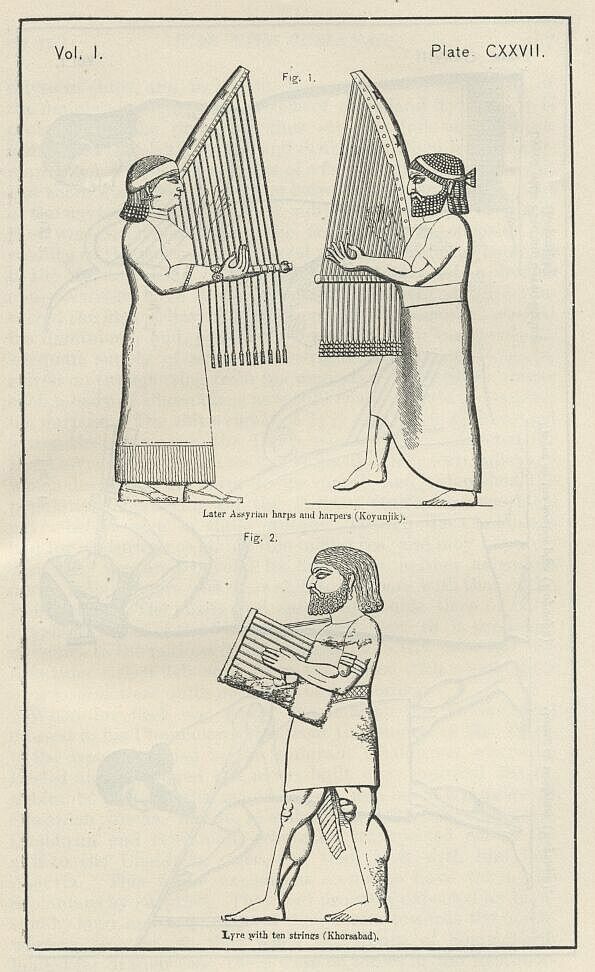
Three varieties of the lyre are seen in the Assyrian sculptures. One of them is triangular, or nearly so, and has only four strings, which, being carried from one side of the triangle to the other, parallel to the base, are necessarily of very unequal length. Its frame is apparently of wood, very simple, and entirely devoid of ornament. This sort of lyre has been found only in the latest sculptures. [PLATE CXXVI., Fig. 4.]
Another variety nearly resembles in its general shape the lyre of the Egyptians. It has a large square bottom or sounding-board, which is held, like the Egyptian, under the left elbow, two straight arms only slightly diverging, and a plain cross-bar at top. The number of strings visible in the least imperfect representation is eight; but judging by the width of the instrument, we may fairly assume that the full complement was nine or ten. The strings run from the cross-bar to the sounding-board, and must have been of a uniform length. This lyre was played by both hands, and for greater security was attached by a band passing round the player’s neck. [PLATE CXXVII., Fig. 2.]
The third sort of lyre was larger than either of the others, and considerably more elaborate. It had probably a sounding-board at bottom, like the lyre just described, though this, being carried under the left elbow, is concealed in the representations. Hence there branched out two curved arms, more or less ornamented, which were of very unequal length; and these were joined together by a cross-bar, also curved, and projecting considerably beyond the end of the longer of the two arms. Owing to the inequality of the arms, the cross-bar sloped at an angle to the base, and the strings, which passed from the one to the other, consequently differed in length. The number of the strings in this lyre seems to have been either five or seven. [PLATE CXXVIII., Figs. 2, 3.]
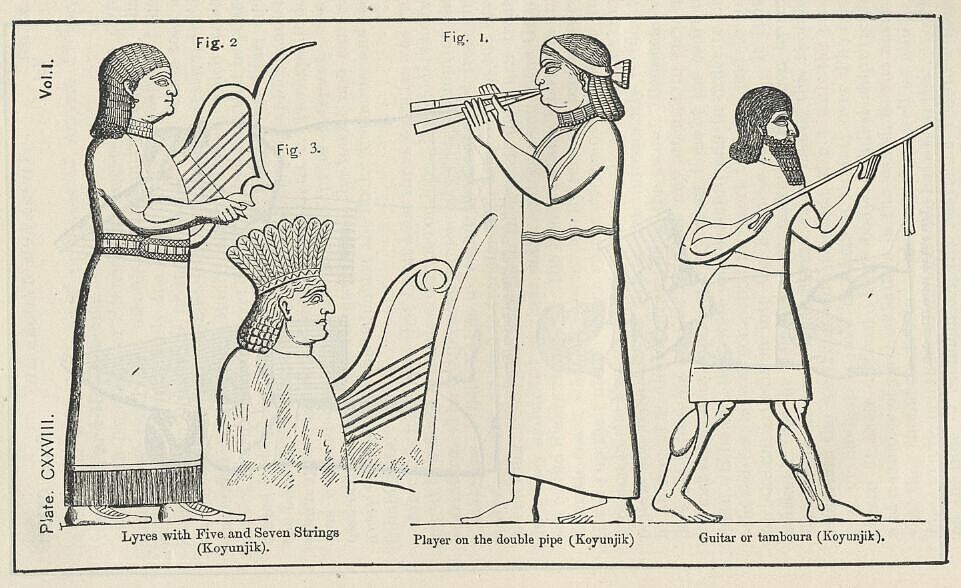
The Assyrian guitar is remarkable for the small size of the hollow body or sounding-board, and the great proportionate length of the neck or handle. There is nothing to show what was the number of the strings, nor whether they were stretched by pegs and elevated by means of a bridge. Both hands seen to be employed in playing the instrument, which is held across the chest in a sloping direction, and was probably kept in place by a ribbon or strap passed round the neck. [PLATE CXXVIII., Fig. 1.]
It is curious that in the Assyrian remains, while the double pipe is common, we find no instance at all either of the flute or of the single pipe. All three were employed in Egypt, and occur on the monuments of that country frequently; and though among the Greeks and Romans the double pipe was more common than the single one, yet the single pipe was well known, and its employment was not unusual. The Greeks regarded the pipe as altogether Asiatic, and ascribed its invention to Marsyas the Phrygian, or to Olympus, his disciple. We may conclude from this that they at any rate learnt the invention from Asia; and in their decided preference of the double over the single pipe we may not improbably have a trace of the influence which Assyria exercised over Asiatic, and thus even over Greek, music. [PLATE CXXVIII., Fig. 1.]
The Assyrian double pipe was short, probably not exceeding ten or twelve inches in length. It is uncertain whether it was really a single instrument consisting of two tubes united by a common mouthpiece, or whether it was not composed of two quite separate pipes, as was the case with the double pipes of the Greeks and Romans.
The two pipes constituting a pair seem in Assyria to have been always of the same length, not, like the Roman “right” and “left pipes,” of unequal length, and so of different pitches. They were held and played, like the classical one, with either hand of the performer. There can be little doubt that they were in reality quite straight, though sometimes they have been awkwardly represented as crooked by the artist.
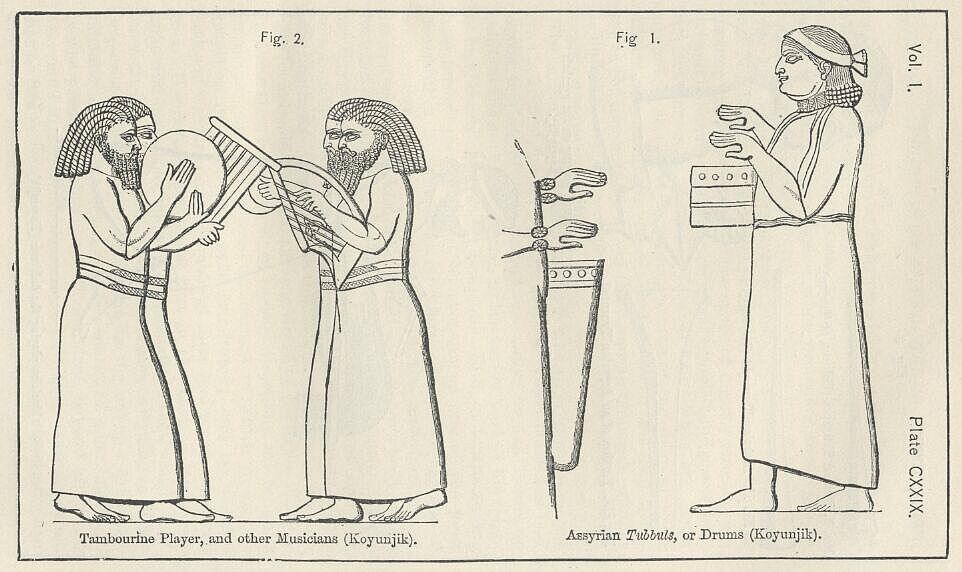
The tambourine of the Assyrian was round, like that in common use at the present day; not square, like the ordinary Egyptian. It seems to have consisted simply of a skin stretched on a circular frame, and to have been destitute altogether of the metal rings or balls which produce the jingling sound of the modern instrument. It was held at bottom by the left hand in a perpendicular position, and was struck at the side with the fingers of the right. [PLATE CXXIX., Fig. 1.]
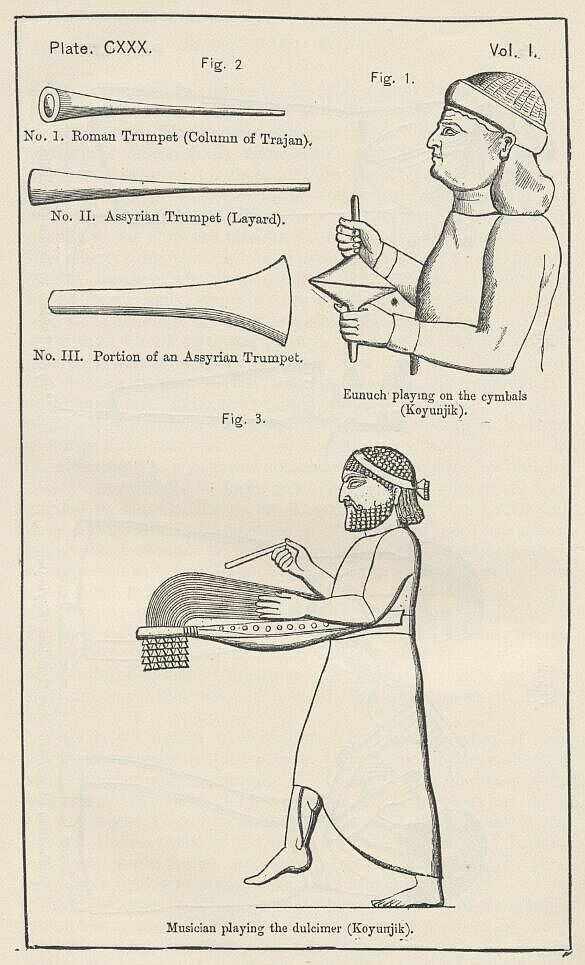
Assyrian cymbals closely resembled those in common use throughout the East at the present day. They consisted of two hemispheres of metal, probably of bronze, running off to a point, which was elongated into a bar or handle. The player grasped a cymbal in each hand, and either clashed theme together horizontally, or else, holding one cupwise in his left, brought the other down upon it perpendicularly with his right. [PLATE CXXX., Fig. 1.]
Two drums are represented on the Assyrian sculptures.
One is a small instrument resembling the tubbul, now frequently used by Eastern dancing girls. The other is of larger size, like the tubbul at top, but descending gradually in the shape of an inverted cone, and terminating almost in a point at bottom. Both were carried in front, against the stomach of the player—attached, apparently, to his girdle; and both were played in the same way, namely, with the fingers of the open hands on the top. [PLATE CXXX., Fig. 2.]
A few instruments carried by musicians are of an anomalous appearance, and do not admit of identification with any known species. One, which is borne by a musician in a processional scene belonging to the time of Sennacherib, resembles in shape a bag turned upside-down. By the manner in which it is held, we may conjecture that it was a sort of rattle—a hollow square box of wood or metal, containing stones or other hard substances which produced a jingling noise when shaken. But the purpose of the semicircular bow which hangs from the box is difficult to explain, unless we suppose that it was merely a handle by which to carry the instrument when not in use. Rattles of different kinds are found among the musical instruments of Egypt; and one of them consists of a box with a long handle attached to it. The jingling noise produced by such instruments may have corresponded to the sound now emitted by the side-rings of the tambourine.
Another curious-looking instrument occurs in a processional scene of the time of Asshur-bani-pal, which has been compared to the modern santour, a sort of dulcimer. It consisted (apparently) of a number of strings, certainly not fewer than ten stretched over a hollow case or sounding-board. The musician seems to have struck the strings with a small bar or hammer held in his right hand, while at the same time he made some use of his left hand in pressing them so as to produce the right note. It is clear that this instrument must have been suspended round the neck, though the Assyrian artist has omitted to represent the belt which kept it in place. [PLATE CXXIX., Fig. 2.]
In addition to all these various instruments, it is possible that the Assyrians may have made use of a sort of horn. An object is represented on a slab of Sennacherib’s which is certainly either a horn or a speaking-trumpet. It is carried by one of the supervisors of the works in a scene representing the conveyance of a colossal bull to its destination. In shape it no doubt resembles the modern speaking-trumpet, but it is almost equally near to the tuba or military trumpet of the Greeks and Romans. This will appear sufficiently on a comparison of the two representations, one of which is taken from Mr. Layard’s representation of Sennacherib’s slab, while the other is from a sculpture on the column of Trajan. As we have no mention of the speaking-trumpet in any ancient writer, as the shape of the object under consideration is that of a known ancient instrument of music, and as an ordinary horn would have been of great use in giving signals to workmen engaged as the laborers are upon the sculpture, it seems best to regard the object in question as such a horn—an instrument of great power, but of little compass—more suitable therefore for signal-giving than for concerts. [PLATE CXXX., Fig. 3.]
Passing now from the instruments of the Assyrians to the general features and character of their music, we may observe, in the first place, that while it is fair to suppose them acquainted with each form of the triple symphony, there is only evidence that they knew of two forms out of the three—viz, the harmony of instruments, and that of instruments and voices in combination. Of these two they seem greatly to have preferred the concert of instruments without voices; indeed, one instance alone shows that they were not wholly ignorant of the more complex harmony. Even this leaves it doubtful whether they themselves practised it: for the singers and musicians represented as uniting their efforts are not Assyrians, but Susianians, who come out to greet their conquerors, and do honor to the new sovereign who has been imposed on them, with singing, playing, and dancing.
Assyrian bands were variously composed. The simplest consisted of two harpers. A band of this limited number seems to have been an established part of the religious ceremonial on the return of the monarch from the chase, when a libation was poured over the dead game. The instrument in use on these occasions was the antique harp, which was played, not with the hand, but with the plectrum. A similar band appears on one occasion in a triumphal return from a military expedition belonging to the time of Sennacherib. [PLATE CXXI.]
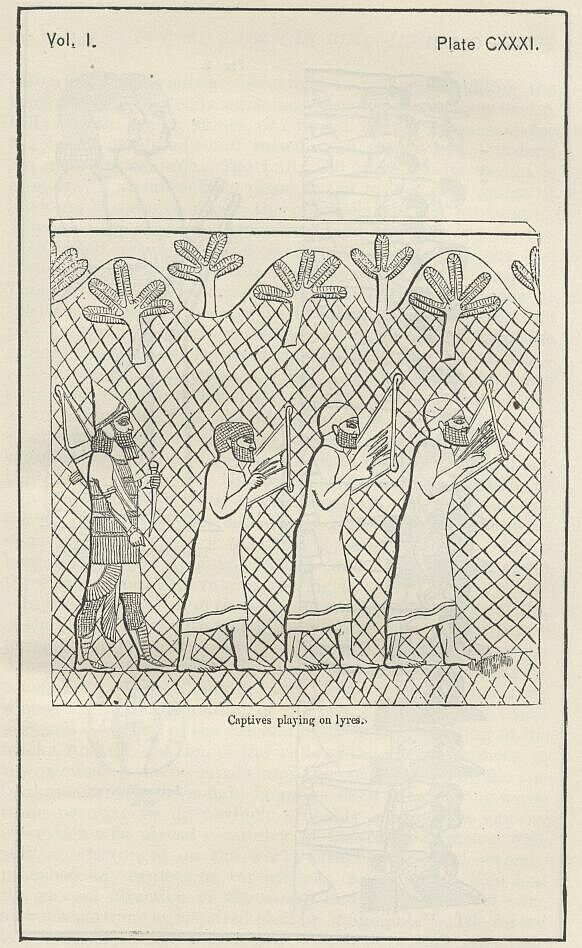
In several instances we find bands of three musicians. In one case all three play the lyre. The musicians here are certainly captives, whom the Assyrians have borne off front their own country. It has been thought that their physiognomy is Jewish, and that the lyre which they bear in their hands may represent that “kind of harp” which the children of the later captivity hung up upon the willows when they wept by the rivers of Babylon. There are no sufficient grounds, however, for this identification. The lyre may be pronounced foreign, since it is unlike any other specimen; but its ornamentation with an animal head is sufficient to show that it is not Jewish. And the Jewish kinnor was rather a harp than a lyre, and had certainly more than four strings. Still, the employment of captives as musicians is interesting, though we cannot say that the captives are Jews. It shows us that the Assyrians, like the later Babylonians, were in the habit of “requiring” music from their prisoners, who, when transported into a “strange land,” had to entertain their masters with their native melodies.
Another band of three exhibits to us a harper, a player on the lyre, and a player on the double pipe. A third shows a harper, a player on the lyre, and a musician whose instrument is uncertain. In this latter case it is quite possible that there may originally have been more musicians than three, for the sculpture is imperfect, terminating in the middle of a figure.
Bands of four performers are about as common as bands of three. On an obelisk belonging to the time of Asshur-izir-pal we see a band composed of two cymbal-players and two performers on the lyre. A slab of Sennacherib’s exhibits four harpers arranged in two pairs, all playing with the plectrum on the antique harp. Another of the same date, which is incomplete, shows us a tambourine-player, a cymbal-player, a player on the nondescript instrument which has been called a sort of rattle, and another whose instrument cannot be distinguished. In a sculpture of a later period, which is represented above, we see a band of four, composed of a tambourine-player, two players on two different sorts of lyres, and a cymbal-player.
It is not often that we find representations of bands containing more than four performers. On the sculptures hitherto discovered there seem to be only three instances where this number was exceeded. A bas-relief of Sennacherib’s showed five players, of whom two had tambourines; two, harps of the antique pattern; and one, cymbals. Another, belonging to the time of his grandson, exhibited a band of seven, three of whom played upon harps of the later fashion, two on the double pipe, one on the guitar, and one on the long drum with the conical bottom. Finally, we have the remarkable scene represented in the illustration, a work of the sane date, where no fewer than twenty-six performers are seen uniting their efforts. Of these, eleven are players on instruments, while the remaining fifteen are vocalists. The instruments consist of seven harps, two double pipes, a small drum or tubbel, and the curious instrument which has been compared to the modern santour. The players are all men, six out of the eleven being eunuchs. The singers consist of six women and nine children of various ages, the latter of whom seem to accompany their singing, as the Hebrews and Egyptians sometimes did, with clapping of the hands. Three out of the first four musicians are represented with one leg raised, as if dancing to the measure. [PLATE CXXXII., Fig. 1.]
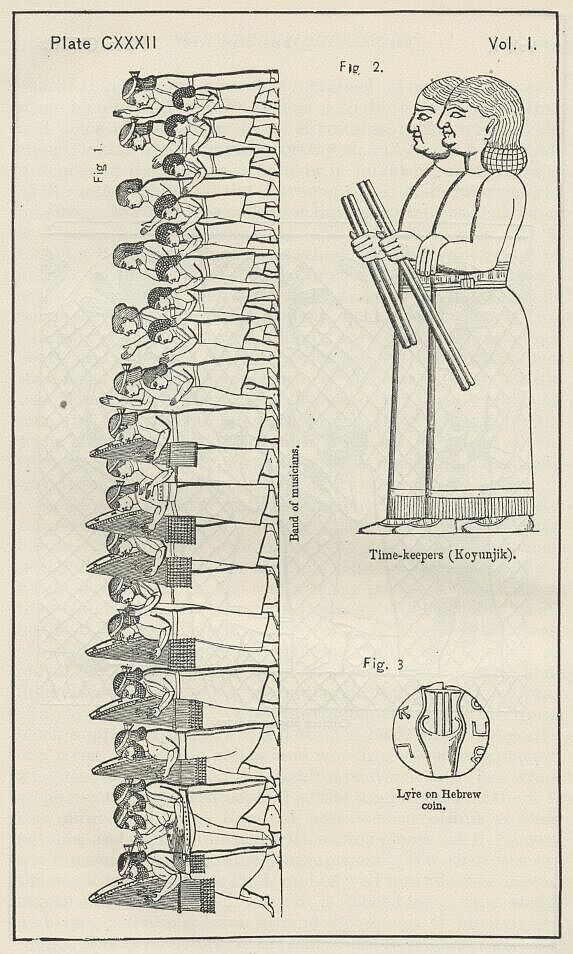
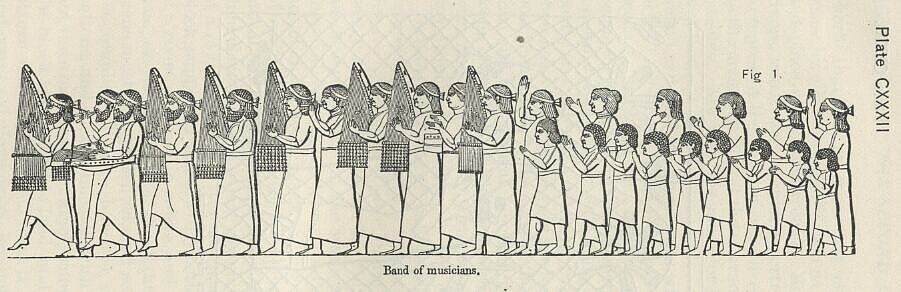
Bands in Assyria had sometimes, though not always, time-keepers or leaders, who took the direction of the performance. These were commonly eunuchs, as indeed were the greater number of the musicians. They held in one hand a double rod or wand, with which most probably they made their signals, and stood side by side facing the performers. [PLATE CXXXII., Fig. 2.]
The Assyrians seem to have employed music chiefly for festive and religious purposes. The favorite instrument in the religious ceremonies was the antique harp, which continued in use as a sacred instrument from the earliest to the latest times. On festive occasions the lyre was preferred, or a mixed band with a variety of instruments. In the quiet of domestic life the monarch and his sultana were entertained with concerted music played by a large number of performers: while in processions and pageants, whether of a civil or of a military character, bands were also very generally employed, consisting of two, three, four, five, or possibly more, musicians. Cymbals, the tambourine, and the instrument which has been above regarded as a sort of rattle, were peculiar to these processional occasions: the harp, the lyre, and the double pipe had likewise a place in them.
In actual war, it would appear that music was employed very sparingly, if at all, by the Assyrians. No musicians are ever represented in the battle-scenes: nor are the troops accompanied by any when upon the march. Musicians are only seen conjoined with troops in one or two marching processions, apparently of a triumphal character. It may consequently be doubted whether the Assyrian armies, when they went out on their expeditions, were attended, like the Egyptian and Roman armies, by military bands. Possibly, the musicians in the processional scenes alluded to belong to the court rather than to the camp, and merely take part as civilians in a pageant, wherein a share is also assigned to the soldiery.
In proceeding, as already proposed, to speak of the navigation of the Assyrians, it must be at once premised that it is not as mariners, but only as fresh-water sailors, that they come within the category of navigators at all. Originally an inland people, they had no power, in the earlier ages of their history, to engage in any but the secondary and inferior kind of navigation; and it would seem that, by the time when they succeeded in opening to themselves through their conquests a way to the Mediterranean and the Indian Ocean, their habits had become so fixed in this respect that they no longer admitted of change. There is satisfactory evidence which shows that they left the navigation of the two seas at the two extremities of their empire to the subject nations—the Phoenicians and the Babylonians contenting themselves with the profits without sharing the dangers of marine voyages, while their own attention was concentrated upon their two great rivers—the Tigris and the Euphrates, which formed the natural line of communication between the seas in question.
The navigation of these streams was important to the Assyrians in two ways. In the first place it was a military necessity that they should be able, readily and without delay, to effect the passage of both of them, and also of their tributaries, which were frequently too deep to be forded. Now from very early times it was probably found tolerably easy to pass an army over a great river by swimming, more especially with the aid of inflated skins, which would be soon employed for the purpose. But the materiel of the army—the provisions, the chariots, and the siege machines—was not so readily transported, and indeed could only be conveyed across deep rivers by means of bridges, rafts, or boats. On the great streams of the Tigris and Euphrates, with their enormous spring floods, no bridge, in the ordinary sense of the word, is possible. Bridges of boats are still the only ones that exist on either river below the point at which they issue from the gorges of the mountains. And these would be comparatively late inventions, long subsequent to the employment of single ferry boats. Probably the earliest contrivance for transporting the chariots, the stores, and the engines across a river was a raft, composed hastily of the trees and bushes growing in the neighborhood of the stream, and rendered capable of sustaining a considerable weight by the attachment to it of a number of inflated skins. A representation of such a raft, taken from a slab of Sennacherib, has been already given. Rafts of this kind are still largely employed in the navigation of the Mesopotamian streams, and, being extremely simple in their construction, may reasonably be supposed to have been employed by the Assyrians from the very foundation of their empire.
To these rafts would naturally have succeeded boats of one kind or another. As early as the time of Tiglath-Pileser I. (ab. B.C. 1120) we find a mention of boats as employed in the passage of the Euphrates. These would probably be of the kind described by Herodotus, and represented on one of the most ancient bas-reliefs—round structures like the Welsh coracles, made of wickerwork and covered with skins, smeared over with a coating of bitumen. Boats of this construction were made of a considerable size. The one represented contains a chariot, and is navigated by two men. [PLATE CXXXIII., Fig. 1.] In the later sculptures the number of navigators is raised to four, and the boats carry a heavy load of stone or other material. The mode of propulsion is curious and very unusual. The rowers sit at the stem and stern, facing each other, and while those at the stem pull, those at the stern must have pushed, as Herodotus tells us that they did. The make of the oars is also singular. In the earliest sculptures they are short poles, terminating in a head, shaped like a small axe or hammer; in the later, below this axe-like appendage, they have a sort of curved blade, which is, however, not solid, but perforated, so as to form a mere framework, which seems to require filling up. [PLATE CXXXIII., Fig. 3.]
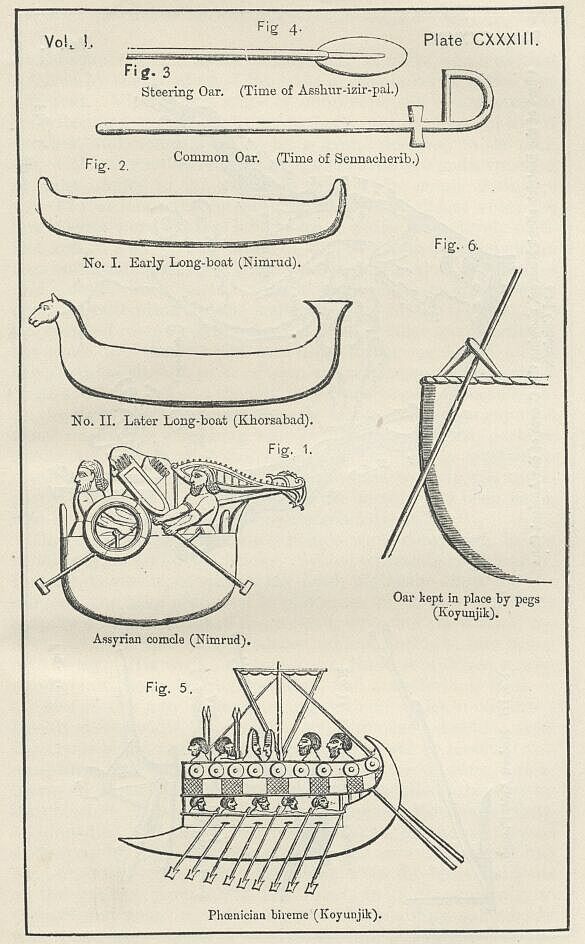
Beside these round boats, which correspond closely with the kufas in use upon the Tigris and Euphrates at the present day, the Assyrians employed for the passage of rivers, even in very early times, a vessel of a more scientific construction. The early bas-reliefs exhibit to us, together with the kufas, a second and much larger vessel, manned with a crew of seven men—a helmsman and six rowers, three upon either side and capable of conveying across a broad stream two chariots at a time, or a chariot and two or three passengers. This vessel appears to have been made of planks. It was long, and comparatively narrow. It had a flattish bottom, and was rounded off towards the stem and stern, much as boats are rounded off towards the bows at the present day. It did not possess either mast or sail, but was propelled wholly by oars, which were of the same shape as those used anciently by the rowers in the round boats. In the steersman’s hand is seen an oar of a different kind. It is much longer than the rowing oars, and terminates in an oval blade, which would have given it considerable power in the water. [PLATE CXXXIII., Fig. 4.] The helmsman steered with both hands; and it seems that his oar was lashed to an upright post near the stern of the vessel.