ILLUSTRATIONS (continued 5)
Reading edition
And Bulstrode had, however, firmly insisted that he could not really stop on—that he must go away. "There are," he wound up his arguments, "a thousand reasons why I should go."
But Westboro' had comprehendingly suggested that they might together bring "every reason" down to the country. "And," continued his Grace, "we'll narrow things into the most intimate circle possible. For I shall ask the Ravensworths of Surrey and their children, there are eight of them, ripping little things; they used to play with my boys. We'll turn them loose and have a tree, old man."
Jimmy watched his face with a keen pity, for there had not been one ray of light in it as he planned for his celebration.
"But you arrange to come back for Christmas Eve. There must be some one in charge—I mean to say, some one so that if the whole thing is too much for me, why I'll bolt and you'll have to stand by."
He was, as he spoke, writing the names on a sheet of paper. Bulstrode felt the plan to be rather triste and lifeless, and he knew that he could not and would not keep the Duchess' secret much longer, let its revelation cost him what it would.
"Westboro'," he said, "I shall have to be getting off to-morrow. You know I would stand by you if I could possibly see my way clear."
"I know perfectly well," the Duke acknowledged, "what a rotten bore I've been, and how sick of me you must be." He wrote on: "I shall ask Mrs. Falconer (her husband is in the States); she is quite alone in town at Lady Sorgham's." As he quoted this last name the Duke folded his list up. He nodded affectionately at Jimmy. "You'll arrange perhaps to come down with Mrs. Falconer on the Friday train?"
And Bulstrode capitulating weakly, murmured, "Oh, we'll fetch the toys and things for the tree," he offered.
"Ripping!" his Grace nodded.
Jimmy, on his way at last to London, stopped once more at The Dials, and was hurrying across the forest when the Duchess herself appeared to him at the big dial. She wore her furs, muff, and big enveloping stole, her hat with fur on it, and a veil. She was not in house or garden trim. The urban air of her toilet was a surprise to Bulstrode, and he took in her readiness for something he had not expected, something great, something decisive.
"It's good of you to come when you must be full of delightful ways of passing your time, Mr. Bulstrode," she said, "and I wanted so much to see you again."
"Again?"
"Of course," she replied nodding, "again and many times. But I mean I wanted to see you here." Bulstrode did not want her to tell him a piece of final news. He did not care to learn of an arbitrary departure, and he said, laughing: "Then you don't like my property? Any repairs you...?"
"Oh, I adore The Dials," she said gravely, "and I can't think why they ever let you buy it, or what you'll do with it after I'm gone." She smiled. ".... or with whom." Before he could speak she added: "Where is my husband to-day?"
"I left him wandering about the house like a lost spirit," Bulstrode replied. "Looking," he went on, "all about for something or other. I expect he himself didn't quite know what. For something to cheer up the empty rooms."
"Oh, don't," she murmured.
But he seemed pleased with the picture he drew. "I doubt if Westboro' stops in the house alone; he's probably gone out shooting."
"But he has a house full of people....?"
"No one has come, or is coming, after all."
"You don't mean to say that they've all refused!"
"Yes," Jimmy said, "every man of them, and all the women as well."
The Duchess put out her hand quickly, and said touchingly: "Oh, but you don't for a moment think——"
"That it's because of the scandal, dear lady?" he smiled. "Well, that would be a new phase. No, I think on the other hand they would revel, and the only reason in the world that they have not come down is that they were really asked too late. Christmas week, you know—
"And, of course, then, Mrs. Falconer," the Duchess's face brightened. "She——"
"Oh, she!" Bulstrode exclaimed, "she's as right as possible. She's sure to be along in good season."
"Oh!" accepted the Duchess, "and with whom does she come?"
Bulstrode waited. "Well, of course, the poor thing expects to find more or less some one to help her bear up her end. And I can't say how she will take the fact of only us two."
The Duchess interrupted cheerfully:
"Why, she, of course, will go directly back! You don't think for a second that she would stop on alone like that?"
"Alone?" Bulstrode gave her with a little malice. "But she'll have Westboro' and me so entirely to herself and one can always ask in the rector or curate or corral a neighbor."
But the Duchess shook her head as if she understood. "Oh, no, not at this time."
Bulstrode miscomprehended blithely: "Christmas time? You see, I know the visiting lady pretty well, and I believe she'll feel me to be more or less of a standby, and I know her spirit and her human kindness. I am inclined to think that she will feel it's up to her not to run off like a hare; to think that Westboro' may, in a way, need her; and that when she finds everybody's gone back on the poor man, and there's to be no tree after all, why, I'm tempted, by jove, to think——"
The Duchess helped him: "That she'll make a charity of it."
"Yes, if you like," he laughed. "Or be a sport," he preferred to put it. "Stay on, stand by. It will be perfectly ripping of her, you know."
But the Duchess had no sympathy for the other woman. Her eyes fixed themselves on the trees before her, and as a shot rang out in the distance she said abruptly: "Why, that might be Cecil, mightn't it? Does he shoot birds on your premises?"
Bulstrode wondered very much for what reason she was habited in street dress and furs, whether she had planned to leave The Dials or had intended going up to see her husband.
"Forgive me," he said, "if I seem to be shockingly in a hurry, but I must have a look at the time, for as it happens, even in this far-off place, I have an engagement."
Impulsively putting out her hand the Duchess exclaimed: "I can't ever, ever thank you."
"Oh, after your divorce——"
But she cried out so against his words that he hastened: "You want me to think then that you do not believe...."
"Believe!" she ardently repeated, "Oh, I don't know what I believe or think," and he saw that the poor thing spoke the truth. "It's I who am as unstable as the sea, I who am the derelict."
He contradicted her gently: "My dear, you're only trying to solve alone a problem which it takes two to answer. When you see Westboro' you will know."
She turned on him with the first sparkle of humor he had ever seen her display. "Why don't you marry Mrs. Falconer?"
He didn't start; indeed, the idea had such a familiar sound it would have been hard to frighten him with it from any corner.
"I thought you didn't believe in divorces?"
"Oh, but you'd make a wonderful husband!"
He laughed. "No one has ever thought so—la preuve....?"
With great frankness in her gesture and a great—he was quick to see it—a great affection—she put out her hand to him and said: "Oh, yes, you'd make a wonderful companion, and you've been a wonderful friend. If anything good comes to me now, I shall in great measure owe it to you."
He protested: "You owe me nothing, nothing."
There were tears in her eyes as she said: "But I want to, I like to, and I do. I don't know," she went on, "that I might not have been reconciled ultimately to my husband, but I feel quite sure it would only have been the basting up of the seam—it would have ripped away again. Did you ever—" she challenged him with still a little sparkle of humor, "hear of a thing called a change of heart?"
"Yes, at Methodist meetings."
She said gravely: "That's not what I mean. But whatever has happened it's only been since you told me things."
Her face was so girlish, her eyes so sweet, her humility so sudden, that her companion found himself embarrassed and could hardly find words to say good-by to her. She went on to say, in a tone so low that he bent a little over the dial to hear her. "You told me you could not advise my husband to come to me."
Ah, had he! It was hard to remember that. Had he said so?
"I think," she whispered, "you need not keep him away now, if he should want to come."
As her friend said nothing, she added in a voice more like a child than a great Duchess, "You may trust me. I want him to come— There, I've said it. I hope he'll come. If he doesn't—
"Why, then, you'll go away," he finished. "You can't bear it."
The Duchess shook her head. "I'll go to him, on the contrary."
"You were going?"
"Yes, when you came."
He cried out: "Oh, I'm off then, I'm off for London, and I shan't be back for the Christmas holidays. You may count on me."
The Duchess smiled delightfully, and was in a second the elusive woman, intangible, and impossible to seize.
"No, no," she said, "please don't exile yourself either to-day or to-morrow. It isn't after all the moment, and I want to prove to you that I'm not jealous. I've decided to wait until that lovely woman has gone away."
The waste of his territory, its largesse to no purpose, its vastness through which only unbearable silences echoed; accumulated revenues and hereditary title, only added to the Duke's melancholy.
He had planned the Christmas house party too late as it proved, and refusals, one after another, came in during the week. The poor gentleman's mood led him to resent each fresh defection on the part of his guests as personal wounds inflicted by old friends at a time when charity would have been sweet. And it was with really tragic melancholy that he threw the last letter down exclaiming:
"And they all with one consent began to make excuse."
He quite waited for a line from Mrs. Falconer, which would tell him that she, too, had decided to abandon him: and the thought of what he believed to be Jimmy's complications at The Dials caused him half to regard the matter with a pity for her.
"If Jimmy isn't married, he's the most whited of sepulchres!"
The satin shine of holly, the glimmer of pearly mistletoe, the odor of spruce and pine, and heavier scent of hemlock bewitched the castle throughout with their fragrance. Setting and decoration suggested a feast, and the Duke as he passed through the upper halls, and by the doors of his children's rooms, saw holly wreaths on the walls and that the little gates were twisted with green.
The day was dampish and the Duke, unable to bear the silence of the house, with his gun and his dogs and with a lack of resource and superfluity of ennui to urge him from the castle, started to tramp off his unrest. The afternoon was young, and the bare, naked sunlight fell over the bare nakedness of the land. The little low clumps of neutral-colored underbrush, the reddish-brown thickets between wood and field, would hide the birds well, and with his gun across his back, his hands in his pockets, his Grace covered many miles before he at length stopped to take in the length of the land or to listen for wings.
Coveys had flown up and away unseen by him, and their whirring unheard. His dogs had run off, and without being abruptly brought to heel, skulked back by themselves shamefaced and bewildered by the hunter's indifference. The holly reddened on the hedges, the scarlet berries bright among the glowing leaves; high in the poplars the parasite mistletoe with crystal balls, hung tiny white globules like fairy grapes; holiday in the air, and over the grey winter landscape the finest possible powder of snow lay pale under the furtive sun. As the forest edges closed about him and the Duke with still no idea of where he was going, continued to tramp, he unconsciously entered the property Bulstrode had lately acquired, and which he had begged his friend to avoid.
There was something in the country air, in its pungent sweetness, and in the season, that penetrated even Westboro's melancholy, and every now and then he lifted his head to breathe in deeply the fragrance of hemlock and the cold earthy aroma, the spice of bracken and the balm of a fragrant thicket that smelled like a rose. It was winter, however, and although a snow bird piped in it and the sun was out, there was a December quality that, in the mood he was in, overcame all the festivities of the time. He heard the bird who was persistent and sharp-voiced, and, for the first time thinking of the other game he had come out for, he paused. His dogs were gone, the beggars! He called them to no purpose, whistled and waited. They were a new brace and young. God knew where they had cut away to.
Before him, as he stood, the brown vistas of the winter forest opened out here and there into ochre circles and filled at this hour with brilliant sunlight, their round openings overflowing; the light filtered gently out and was swallowed up by the cold and closer wood. Under his feet there was only the faint ghost of the late snowfall on the turned-up, curled-up edges of the dry leaves. There beeches, red as copper, and iron-strong oaks struck their roots deep down into the mould. Westboro' did not know where he had wandered to, but here and there through the bare trees gleamed the white of a statue on its mossy base, and a little farther along, a broken pedestal held its slender column up amongst the tree trunks as mossy and veined as they, and right in the heart of the bowl, on a brick pedestal was a sundial, a round brass disc, cut into with the tooth of time, and all black and green. The sun at this moment shone full on it and its slight shadow fell along the noon. The Duke stooped down and through the glass read the inscription:
Utere dum licet.
"I'm a trespasser," he thought. "This is Bulstrode's property."
Through an opening just to the right he could see a brown path, and at the end of it a gate.
"What the deuce could Jimmy have so wanted this old place for? What was he hiding here?"
He turned back with the intention of taking as sudden leave of the place as he had made an entrance. He saw his dogs in front of him and called them. Before him lay the clean low fall of the meadow with the line of high hedge, and directly opposite him he could see the elms of his own park. He had not gone more than a couple of hundred feet away before he paused again and turned about to have one last look back at the enchanting place. As he stood thus, in Jimmy's property, he at first took it to be a trick of vision, for he stood perfectly rigid, peering back at the opening he had left not five minutes before. He leaned forwards, setting his eyeglass and staring at two figures who had come into the bowl and stood close by the big dial.
He set his gun on the ground and leaned upon it. There was a cordial meeting; he could hear the voices but he could not distinguish their words, and during all the interview, which must have consumed some fifteen minutes, the Duke never stirred. Finally, and curiously enough it seemed a short time to him, they took leave of each other, the man going out of the forest by a different path, the woman slowly turning down the neat walk that led to the brick arch, and to the old house. Whether or not the Duke had at this moment the vaguest suspicion of her, suspicion of his friend or of his wife that did them wrong, he never had time or clearness to reflect or to ask himself. A dense blindness took his senses away from him. He put his hands out to steady himself in vain, and staggered. His dogs were at his feet, he fell over them, struggled to get his balance back and like a stricken tree went down. In his heavy fall on his gun it discharged, filling his upper arm and shoulder with a quantity of bird shot. The scattering pain, instead of finishing his faint, roused him with a sharp, ugly sting, and the rush of the warm, wet blood. He half picked himself up, and then, aware of the pain tearing his muscles and flesh, he fell back like a dog on his haunches. Through his confusion he still contrived to remember a little path, and inch by inch he dragged himself towards it. He pulled along over the leaves and russet paths of ground. His bare hand finally struck the bricks of the little walk and he could still know that he was wonderfully in the road. There was a cloud before his swimming eyes and his troubled mind; his face, pale as death, was lifted towards the arch; leaving a bloody trail as he crawled along the ground, he contrived to reach the gate and fell across its threshold. His head lay on his arm, the string of his broken eyeglass wound pathetically about his wrist. The Duke proved to be a modern replica of the poor knight who fell, face downwards, on the grass when Elizabeth's carriage passed him by, some four hundred years before the present Duke.
After Bulstrode had left her, the Duchess of Westboro' hurried back to the house that was not her home; to the little long drawing-room that was not hers. For the first time since her voluntary exile, since her occupation of this asylum, she found it bereft of charm and the cosey, dear place as cold to her as if the snows had drifted in and filled a deserted nest. It had nevertheless been a cloister, and she knew it, where the best of her had prayed, where the true woman—and the true woman is always something of a saint—had folded submissive hands, where self had gone away and left nothing at all but love.
On this Christmas Eve, The Dials was the loneliest corner of England. The scarcely occupied house suggested to the Duchess the thought of a stocking hung before a chimney when there were no children who cared whether it was filled or not, when there was no reason why St. Nicholas should pass. But it was only the very edge of her thoughts that touched anything so fantastic as this picture. The Duchess was serious and lonely. With a sigh, and winking back tears she threw off her furs, laid off her hat, and, after poking up the fire into sparkling brightness, she wandered up-stairs to the apartment that she had made her bedroom. Under the low eaves the bed-chamber shone out gay with chintz, fresh and sweet as a midwinter bouquet, the frostiness coming in around it through the slightly opened window, and there was the scent of the firs and the cedar wood that closely hemmed the old place in.
"Heavens!" thought the Duchess, half aloud. "How dreadfully in love Jimmy Bulstrode is, how dreadfully, faithfully in love!" And then she went on to say: "How dreadfully I am myself in love, and no one is hurrying to me!"
She walked aimlessly about the pretty room, irritated and annoyed at the cloister effect. She found it too remote, too virgin, and no room for a wife. "I promised," she mused, "to wait until Mrs. Falconer has gone. I shall break my promise. Oh, I can't really wait at all! If things are going to be as bad as this, I want to leave England, I want at least to know. And Jimmy will forgive me, it's such a wonderfully good cause ... a woman going to find her husband on Christmas Eve!"
The Duchess threw open the window to its widest. Down in the garden on the stone wall the big dial lay in the shadow of the afternoon. She could not read its motto, but she knew perfectly what it said—Utere dum licet. As she leaned out above her garden, under her window the snowballs hung their waxen globes in a green tree. There were a few winter roses blooming, and the English garden had the beauty of summer in winter time.
The Duchess heard a sharp sound close to the house. It was a rifle shot, and died instantly on the still air. Shots were not uncommon in this season, but here in The Dials woods they were entirely out of character; in fact, they were quite inadmissible. There was no shooting let, and a shot could only mean poaching, or something more serious. The Duchess waited a few moments, but no other sound followed. She nevertheless drew the casement in, and, going down stairs threw her stole about her shoulders and opened the house door into the garden. At the sight of her, down by the other end of the wall, the gardener lifted up his bent form, and with a little pannier of hot-house violets in his hands, hurried towards his lady.
"Mellon," said she, "have you any violets?"
The Duchess took the fragrant basket with its delicate burden.
"A mort, my lady."
"Pick them all, Mellon, and all the flowers from the green-house too, every one of them, and fetch up whatever there is to the cottage."
The old man was deaf, as well as discreet, and if this sudden command to vandalism surprised him, he did not say so. Holding his hand behind his ear, he nodded.
"I shall send them," the Duchess thought, "up to Jimmy Bulstrode. I think he will understand, and I will ask him at the same time to take his friend off somewhere in a motor that I may go unobserved to the castle."
She said a few more words to the old man, asked him a few questions, then with the basket on her arm she was about to turn away when she remembered the shot.
"Did you hear a shot, Mellon? They should not be shooting about here, you know." But the old man had heard nothing, and, intending to find the lodgekeeper who was clipping the trees on the lower terrace and ask him to go through the woods for her, the Duchess walked toward the gate and in the direction of the brick path.
As she came up to it she gave a low cry, lifted her hands to her heart; the basket of flowers fell to the earth and scattered their purple blooms at her feet. Then the hands that had gone to her heart extended, she held out her arms and went forwards, crying her husband's name.
The Duke of Westboro' had managed to pick himself up. He was a strong man, in the fulness of health and vigor; there was nothing of the mollycoddle about the last Duke of the line. The sound of voices had reached his dull ear, his swoon was over, and he had manfully, with a few sturdy curses, pulled himself up and now stood, albeit very pale, clinging to the gatepost, leaning on it, finding his legs shaking and his balance not all he could wish. Before him was a little brick house, with bright curtains in the windows, and between it and himself, lovely as a ghost, and no less white, was his wife, and her arms were extended towards him.
"Cecil!" she cried. "Oh, my God! Cecil, what has happened to you?"
Before Westboro' knew it, the arms to which he had gone in visions were about him and the soft shoulder gave him a prop more fragile perhaps than the stone against which he leaned, but it was a living support, and it felt warm and wonderful.
"Don't," he said vaguely, "get near me. I'm nasty and bloody. It's all right; I'm only a bit scratched, really. A lot of beastly shot has gone off into my shoulder. Just call some one to help me, will you?"
"Cecil," she said, "lean on me, put your arm around my shoulder; you can perfectly well get along with only me. Come, come!"
The Duke saw that he could perfectly get along with another faint—he was near to it, but something besides his wound and his light head kept him manfully to his feet. With his left hand he very firmly pushed the Duchess a little away from him.
"Come?" he repeated. "Come where?"
"Home," said the Duchess with a catch in her voice—she was bearing up. "Oh, lean on me! You'll fall, you'll fall! Mellon!" she cried. "O Mellon!"
But the Duke put up his hand. "I'm all right," he said. "Don't call. What house is that? What home do you mean?"
"Mine," said the Duchess, "my house—that is, I mean to say, Mr. Bulstrode's."
The Duchess saw a slight wave of red rush up her husband's pale cheek.
"Damn Bulstrode!" he breathed. "What the devil does he do here? I saw you together—I saw you not half an hour since—that is the whole mischief of it—it was too much for me—it took away my senses and I fell on my gun, and the beastly thing went off. If I ever get back to where Bulstrode is——"
"Cecil!" cried the Duchess. She again wound her arms around him, and it was as well that she was a strong, fine creature and that the columns of the gate were back of him, for Westboro' was swaying like a child that has just learned to walk.
"He is fainting!" she cried. "Mellon, Mellon!"
The old man had not heard his mistress but he had seen her, and after staring open-mouthed at the couple at the gate, he came scurrying like a rabbit, dropping his shears on the wall. They hit the big dial with a ring.
The Duke heard the steps and tried to start forwards; also tried weakly to extricate himself from his wife's embrace. "I beg your pardon," he said, with a coolness that had something of the humorous in its formality—"I beg your pardon, but I am not going to Bulstrode's house, you know."
"Cecil," pleaded the woman tenderly, "how ridiculous you are! Bulstrode's house! Why, it's mine! Oh, don't break my heart. He's only bought it, you know, that's all."
"Break her heart!" It was a new voice that spoke to the Duke of Westboro'. He had never heard it in all his life. It was warm and struggling for clearness, it was full of tears and quivering, it was the voice of love, and unmistakable, certainly, to a lover.
"What was Bulstrode doing here?" he persisted.
"Going to Mrs. Falconer," breathed the Duchess.
The Duke moved a step forwards: "What are you doing here?"
"Going to you, Cecil—I have been going to you all day. I think I have been going to you ever since you left me that night on the Riviera; at any rate, I was on my way to the castle as you came."
The Duke halted again on his crawling way. Mellon, who had really reached his side, was doing his best to be of some use and kept himself well under the wounded arm, on which the blood had clotted and dried, but ceased to flow.
"Lean hard on me, your Grace," pleaded the gardener, and with his word, he looked over at his mistress to see if she realized who their noble visitor was.
With fine disregard for his help or existence, the Duke said crossly: "Send this damned gardener away."
"Oh, Cecil, no, no; you can't stand without him."
They had reached the garden wall, just at the place where the big dial, round and shining, had come a little out of the shadow and the last of the afternoon sun touched its edges. Westboro' lurched towards the wall. "Send this man away," he commanded.
"He is deaf, Cecil, as the stones." But at her husband's face she motioned to Mellon: "Stand away a bit. His Grace wants to rest on the wall. I'll call you."
With his wife's arms about him, Westboro' leaned on the garden wall, his ashen face lifted to her.
"I've only one arm," he said. He put it around her and he drew her down as close to him as he could. He felt her face warm against his, wet against his with tears. As the Duke, who, Bulstrode said, was no lover, kissed his wife, the dial seemed to sing its motto aloud.
"You were coming to me?" he breathed. "Do you forgive me? ... Then," said Westboro', satisfied by what he heard, "I'm cured. I love you—I love you."
The woman could not find her voice, but as she held him she was the warmest, sweetest prop that ever a wounded man leaned upon. After a few seconds she helped him to rise, helped him on, and he found his balance and his equilibrium to be very wonderful under the circumstances, and managed to reach the door-sill. Mellon and the maids were there, and as the Duchess passed in, leading her husband, she bade them send for a doctor as fast as they could and to send at once for Bulstrode at the castle.
Westboro's wound had become a sort of intoxication to him, and he assured her, "I'll be all right in an hour. I need no one but you; send them all away, all away."
He had never commanded her before, he had let her rule him, he had been indifferent to her disobedience. But now she did what he bade her, and led him to the drawing-room, suddenly repossessed of all its old charm; led him to the lounge, where he sank down. Here, by his side, she gave him stimulants and bathed his head and hands, waiting for the doctor to come; and Westboro', like his ancestors who had fought in the King's wars, bore up like a man with no resemblance whatsoever to the amorous cavalier whose curls had met the dust of the road for love of Queen Elizabeth.
The Duchess found him that best of all things—very much of a man, and knew that he was hers. And he, more wild with love for her than suffering physical pain, found her a woman and knew that she loved him and that she was his.
The house, so deserted and desolate an hour ago, grew fresh, warm, and rosy as over the west meadows the sunset, gilding the wall and The Dials, flushed the windows red, and the deserted bird's-nest, lately "filled with snow" appeared to have, as the light rained upon it, filled itself with roses. So, an hour later, it seemed to Bulstrode, when he came and found it housing the lovers.
THE EIGHTH ADVENTURE
VIII
IN WHICH HE COMES INTO HIS OWN
England, the heart of the countryside, freshened by December and drifted over by delicate breaths that are scarcely fog, and through which like a chrysanthemum seen behind ground glass the sun contrives to shine, the English country in December is one thing, London quite another.
Jimmy wandered across from Paddington to his destination, part of the time on foot, part of the time peering from a crawling hansom in immediate peril of collision with every other object that like himself lost bearings in the nightmarish yellow fog.
He fetched up before No. ——, Portman Square, at mid-day, and rang the door bell of Lady Sorgham's town-house, and in his eagerness to find his friend did not ask himself how the time accorded with calling hours.
She was at home.
An insignificant footman told him this, and the gentleman reflected that it was astounding what the words, heard often in the course of ten years, meant to him still.
In the sitting-room, before a coal fire, a writing table at her side, a pen in her hand, he found Mrs. Falconer.
He sincerely struggled with an inability to speak at once, even the consoling how-d'-dos that cover for us a multitude of feelings, were not at his tongue's end.
The fire had burned away a few feet of fog and lighted lamps and candles shone pallidly through an obscurity about whose existence there could be no doubt.
The inmates of Lady Sorgham's thoroughly English and thoroughly comfortable drawing-room were aliens, possessing neither of them a hearthstone within range of several thousand miles. But no sooner had they greeted—Bulstrode triumphantly peering at her through both real and mental haze—shaken hands, and each found a seat before the grate, than an enchanting homeliness overspread the place. Bulstrode felt it and smiled with content to think she did as well, and remembered an occasion in America when they had both of them missed a train for some out-of-the-way place and found themselves side by side in a mid-country station to pass there three hours of a broiling afternoon. The flies and mosquitoes buzzed about them, the thermometer registered ninety degrees, but happy, cool and unruffled Mary Falconer, smiling up at him from her hard bench, had said:
"Jimmy, let's build here!"
"No one, Jimmy, is old"—Mrs. Falconer had once said to him on an occasion when a word regarding gray hairs had drifted into their conversation. Noticing the smooth reflection of the light along her hair, Bulstrode had spoken of its golden quality, and the lady had suddenly covered the strand with her hand; she knew that there ran a line she did not want him to see.
"No one is old, Jimmy, who has even the least little bit of future towards which he looks! It's only those people whose doors are all shut, whose window blinds are all drawn to, who, no matter which way they look, see no opening into a distance towards which they will want to go—only those people are old!"
And as for Bulstrode, if Mrs. Falconer's idea were right, he was a very young man still, for at the end of every path others opened and led rapidly away. Scene gave on to scene, dissolved and grew new again. Every door gave to rooms whose suites were delightful, indefinite, and all followed towards a future whose existence Bulstrode never doubted. But there were certainly times, as the days went methodically on, there were decidedly many times when it took all his faith and his spirit to endure the étape that lay between self and life. Such a little tranquil home as a certain property he had lately acquired was what he dreamed of sharing with Mrs. Falconer. He did not, with any degree of anxiety, ask himself whether or not it were dead men's shoes he was waiting for, and no clear, formulated thought of tangible events took existence in his mind. But he knew that he waited for his own.
It was with some such personal feeling that in something that looked like a future he might one day lead the woman he loved home, that he had taken any pleasure whatsoever in his involuntary purchase of the old property known as The Dials. The gray house down in Glousceshire in its half-forsaken seclusion, the lie of the land round it, its shut-offness from the world, its ancient beauty, had been a constant suggestion to him of a future dwelling, and the doors, the windows, the low-inviting rooms, the shadowy stairways, ingles, gables, terraces, the dials and sunken gardens, had appeared to him conceived, planned and waiting to be the settings for a life of his own. He wanted very much to tell Mrs. Falconer all about the lovely English country-seat.
In the room where they now talked, wreaths of fog filled the corners like spiders' dusty webs that poised and swung. The odor that stamps England hung in the mist, furthermore permeated with the scent of a bouquet at Mrs. Falconer's elbow and which at one moment of his visit Jimmy recognized for a lot of roses sent by parcel post from the Westboro' greeneries.
"Do you ever sew?" he asked her, and she admitted to a thimble which persistently, with a suggestion of reproach, turned up every now and then amongst her belongings; now falling out from a jewel box, then stowed away in a handkerchief case, out of place and continually reproachful: kept because it had been her mother's.
If he did not speak other than in a general way of the rather long visit he had been making to the Duke of Westboro' in Glousceshire, he did tell his friend all about The Dials and dwelt on the fascination that the old place possessed. The Dials was, in point of fact, very agreeably described to Mrs. Falconer, who looked it out on the map of Glousceshire, and Bulstrode's purchase (for he had legally gone in for it, the whole thing), was made to seem a very jewel of a property.
"It's as lovely as an old print," she said, "as good as a Turner. You're a great artist along your lines, Jimmy. Don't have it rebuilt by some more than designing architect in trouble, or landscape-gardened by some inebriated Adam out of charity. Leave it beautifully alone."
"Oh, I will," he assured her. "It shall tumble away and crush away in peace. You shall see it all, however," he assured, "for you really will come down for Christmas? You see, poor old fellow, Westboro's house is rather empty."
"Yes," nodded Mrs. Falconer.
"You see, every one else has gone back on him."
"Poor dear," sympathized the lady. "Of course we'll go down."
No matter to what extent he had thought of her, and it was pretty sure to be a wide one, her beauty struck him every time afresh. There was the fine exquisiteness of fin de race in Mary Falconer. Her father had been an Irishman born, and the type of his island's lovely women was repeated in his daughter's blue eyes, the set of her head and her arms; her taper and small-boned little wrists, her cool hands with the slender fingers told of muscle and moulding and completed the well-finished, well turned-out creature whose race it had taken generations to perfect. These distinctions her clever father bequeathed her as well as her laugh and her wit, her blue eyes and her curling hair.
Bulstrode stayed on in the dingy delightful room, until at an order of his hostess, luncheon was served them on a small table, and over the good things of an amazingly well-understood buffet and a bottle of wine, they were left alone. Bulstrode stayed on until the fog in the corners darkened to the blackest of ugly webs and choked the fire and clutched the candles' slender throats as if to suffocate the flame. Tea was served and put away and the period known as entre chien et loup at length stole up Portman Square alongside the fog and found Bulstrode still staying on....
Later, much later, when the lamps in the street and the square found themselves, with no visible transition, lighting night-time as they had lighted day—when the hansoms began to swing the early diners along to their destinations, a hansom drew up before No. ——, Portman Square.
It was at the hour soft-footed London had ceased to roll its rubber tires down the little street, and only an occasional cab slipped by unheard. But a small hand cart on which a piano organ was installed wheeled by No. ——, Portman Square, and stopped directly under the Sorghams' window and a man began to sing:
"I'll sing thee songs of Araby And tales of old Cashmere."
The creature was singing for his living, for his supper doubtless, certainly for his breakfast, but he chanced to possess a remarkable gift and he evidently loved his trade. The silence—wherein all London appeared to listen, the quiet wherein the magically suspended room had swung and swung until even Bulstrode's clear mind and good sense began fatally to blur and swing with the pendulant room—was broken into by the song.
And as Bulstrode moved and turned away his eyes from the woman's lovely face, she sighed and covered her own eyes with her hands. The small coffee table had been taken away. Mrs. Falconer was in a low chair leaning forwards, her hands lying loosely in her lap. The distance between the two his hand could have bridged in one gesture. The voice of the street singer was superb, liquid and sweet. He sang his ballad well.
"I'll sing thee songs of Araby And tales of old Cashmere."
Mrs. Falconer's guest rose.
"You'll come down for Christmas," he said, "and I'll meet you as we have arranged, to-morrow."
"Jimmy," she protested, "it's only ten o'clock."
"I must, however, go."
"Nonsense. Where will you pass the next hour and a half? There's not a cat in town."
"Nevertheless, I promised a man to meet him at the...."
"Jimmy!"
He had reached the door, making his way with a dogged determination and, like a man who has touched terra firma after months on a dancing brig, still not feeling quite sure of the land or its tricks.
"How you hurry from me," she said softly.
"Oh, I'm hurrying off," he explained brightly, "because I want to get hold of that chap out there and take him to supper, and to find out why he isn't on the operatic stage. He's got a jolly voice. Good night, good night."
He was gone from her with scant courtesy and a brusquerie she knew well, adored and hated! During these last years she had done her cruel best, her wicked best, to soften and change and break it down.
The curtains, as she drew them back, showed that the fog had for the most part lifted, and she was just in time to see the piano and the two musicians disappear in the mist which still tenaciously held the end of the street in shadow—a gentleman in long evening cloak and high hat hurried after the street people. The woman's face was tender as she watched the distinguished figure melt into the fog, and at her last glimpse of her friend she blew a kiss against the pane.
Bulstrode did not go back that night to Westboro'. He wired out that Mrs. Falconer and himself would be down for dinner the following day and he also wired for a motor to meet him some few miles from Penhaven Abbey, as the motor did the next day.
As he speeded towards Penhaven Bulstrode leaned towards the man who drove him.
"Stop first at the inn, will you, Bowles? I'll order tea there, and then drive on to the station at the Hants. It's the three o'clock from London we're to meet, you know, and we've just the time."
The Abbey and its clustering village hung on the hill side some fifteen lovely miles away to the south of them. And Bulstrode, who was at length obediently answering the call of it, and in response to the fancied bell of the entire country side, religiously hastening to whatever might reward him, settled himself back in his corner.
He saw the mist fly by him as his carriage cut out its way rapidly through Glousceshire. The air was not too cold in spite of the dampness, for the vapor rose high, and above and below it the atmosphere was clear.
Mrs. Falconer herself had chosen Penhaven as a place possible to drive over to as far as Bulstrode was concerned, and far enough away to stop over in, for tea. Bulstrode carried in his pocket the note of it, she had written out for him. It bore the arrivals of trains, the address of the inn; she had herself written this, recurring to a pretty fallacy she liked to indulge in that Jimmy forgot trains, missed them, and forgot rendezvous, and that he never really knew. Well, at all events, he was not likely to miss meeting this one. He had thought about nothing else since he left her in London and prepared for her as he was always preparing for her as one makes ready for the dearest guest at a feast.
The fact that not only had she divinely consented to the Penhaven scheme, but that she had herself arranged the whole thing, made the romance of the idea first appeal to herself and then readily to Bulstrode; the fact that she had been the creator of the little excursion that gave them to each other for several hours before what the castle had to offer them of surprise or dulness—did not in any measure rob the occasion of the charm of the imprévue for the lady herself. Nor did she in the least feel that it was any the less his because it was so essentially her own plan.
It proved either too cold or too late to see the cathedral, to see anything more than the close which, side by side, they had wandered through together a few moments before tea. Penhaven's distinguished gloom was not disturbed, and in their subterranean vaults lying all along their stones, the dukes and the abbés and the duchesses remained unlit in their stern crypts by the verger's candle on this Christmas Eve.
At the little vulgar inn (in a stuffy sitting-room a fire had spluttered for some quarter of an hour before the train arrived), Mrs. Falconer had made Jimmy his tea in a vulgar little bowl-like teapot, and as her hands touched the pottery's blue glaze served very well for a halo. As she buttered him slices of toast herself, and spread them with gooseberry jam and herself ate and drank and laughed and chattered, she had been, with the tea things about her and her sleeves turned back as she cut and buttered and spread, she had been with the roundness of her wrists and the suave grace of her capable hands, most adorably a woman, most adorably dear.
Her furs and coat laid aside, the hat at his asking laid aside in order, although he did not tell her so, that the air of home might be more complete for them. Vis-à-vis they had eaten together and laughed together and talked together till it grew later and later, and the motor waited without in the yard amongst the ravens and the ducks who peered from the straw of their winter quarters at the big awkward machine.
"Jimmy" ... she had started when the crumbs and dishes had been cleared away, and for some seconds did not follow up his name with any other word. It was always Bulstrode who took wonderful care of the time. It was he who gave her her hat, its pins, her coat, her furs, her gloves, one by one, her muff last, his eyes on her, as each article slowly went to place, until her big white veil wound and wound and pinned and fastened and hid her. "Jimmy," she whispered, as he ruthlessly and definitely opened the door and the cold rushed in, "let's build here."
Still it was she who took all the blame of their tardy departure from the homely hospitality of the inn; she assured him that she could make a wonderful toilet and in an incredibly short time, and that for once she wouldn't be late for dinner at the castle.
"Not," Bulstrode assured her, "that it in the least matters, but the Duke, as likely as not, would choose to dine alone; he was a man of moods."
"In which case," she had stopped with her foot on the auto step, "Penhaven isn't a bad place for tea, and why wouldn't dinner at this perfect inn...."
But Bulstrode met her words with a shake of his head and a shrug of his shoulders, and helped her firmly into the motor and sat again by her side.
"I can't tell you," he said, "what will be going on at the castle. I haven't been back since I left it two days ago, and almost anything can have happened in that time. The Duchess of Westboro' herself, in the interval, may have gone back to her husband."
"Heavens!" Mrs. Falconer exclaimed, "in which case how horribly de trop we shall be."
But Bulstrode consoled her with the thought that if they were de trop they would at least be de trop ensemble.
Amongst the handful of letters waiting for her in her dressing-room at the castle there had been a despatch from America. Even this, and a hasty look at her mail had not succeeded in holding her attention or even carrying it beyond the house. Her husband had expected to land in Liverpool at the end of the coming week; he was to take her home with him. And until he arrived she was breathing, as she always did in his absence, deeply.
There had been no one to greet them as Bulstrode and herself came into the castle, and she had hurried to her rooms to begin without loss of time her boasted rapid toilet. The dress, whose harmony had impressed her host, the Duke, on a former visit at the castle, had been laid out for her; its sumptuous color overspread the bed. But the lady chose instead a white gown whose art of holding to her, and holding her, in its simple lines and splendid sheen, made its beauty.
There was much of the true woman in this entirely lovely creature, as she stood before her glass and saw herself, the best example of the really beautiful American. Her naturalness gave her a freedom, a frankness, a grace, a certain imperial set of the head.
Bulstrode had once said to the Duchess of Westboro' that a woman should above all "console." Mary Falconer would have known what he meant. That sex she gloriously represented! The sweetness and dearness of her. Well, there were few women no doubt like her. Jimmy hoped so for the sake of the race, for the sake of the hearts of other men. She was the ideal fireside of home, and when, as she had twice done, she bade him, as that time she had said, "Build here," he knew what she meant and felt, and that she herself was exquisitely home.
Leaning over her dressing-table she scrutinized not her face, whose ardent beauty seemed to bloom upon the glass, but her hair as it fell and rippled and flowed round her brows. Along the edge of one of the lustrous waves was a touch as if her powder puff had brushed her hair. Mrs. Falconer put up her hand, smoothed the line, then let it lie as it grew. It so declared itself to be the first unmistakable white. A gardener's basket full of roses and camelias, gardenias and carnations had been sent up for her; but under the diamond at her breast she chose rather to fasten in a spray of mistletoe with its pale, grape-like berries. A long green scarf fell over her arm and against the whiteness of her dress like a branch of spring verdure, and permitted by the fashion of the day, there shook and trembled in her ears long, pear-shaped pearls which, like her thimble, had been her mother's.
As she left the security of her room and fire for the corridors and the publicity of the lower rooms, for the first time in her life she had a sudden feeling of pruderie at the bare beauty of her neck and arms. She felt as if she were coming unclad into the street, and drew her scarf across her breast. But she found herself to be quite alone in the drawing-room, and before she had time to be bewildered at her long desertion, a letter was handed her with a few murmured words by a footman. It perhaps served her right, she reflected, for so blandly coming into a house during a state of domestic upheaval, that she should turn out to be not alone the only guest, but without host or friend! The letter told her, as gently as it could without the satisfaction of any explanation, that both Bulstrode and the Duke of Westboro' were unavoidably absent. She turned the letter over with keen disappointment. Her dress, her beauty which the drive from Penhaven and the afternoon's happiness had heightened to a point that she might be pardoned for seeing, was then all for nothing! On what extravagant bent could the two men have gone?
"Both of them," she soliloquized with a shrug, "off on a hunt, I dare say, after a fool of a woman who doesn't know enough to stop at home."
Before she could further lash at her absent hostess, she found herself a few seconds later taking the scarcely palpable arm of the rector, whom the Duke, in a moment of abstraction, had asked to the Christmas-tree and whom he had subsequently forgotten to put off. The rector alone, of all the expected, turned up, his smile vacuous and his appetite in order. At the table laid for four, and great enough for forty, the clergyman and the lady faced each other. Mrs. Falconer smiled kindly, for as her friend had told the Duchess on the same afternoon, she was kind; and if she resented the apology for a man her slender vis-à-vis presented, she did not show her scorn; she smiled kindly at him. His cloth and habit, and cut even, wore the air of disapproval. Her jewels, the bare splendor of her neck and arms, seemed out of place, and yet she could not but be perfectly sure that even the dull eyes of her vis-à-vis not alone reflected, but confirmed, how lovely she was.
The reverend gentleman was new to Glouceshire, but it turned out that he already knew its hearsays and its on dits and he knew when she asked him, something of the country and The Dials. It may have been that the bright aspect of the lady, her light mockery—for as she would she could not help falling into them even with this half-human creature—wickedly drew him on, gave the man license as he thought, to descend to scandal; at all events, after dinner, over a cigar smoked in her presence, the empty glass of Benedictine at his elbow, in his cheeks a muddy red diffused from his wine, the gentleman leaned forward, and tried to adapt his speech and topic to the worldly vein which he imagined was the habitual tenor of a fashionable woman's life.
"Even this lovely shire," he drawled its beauty—"cannot, so it would seem, be free from scandal. And where a minister would naturally look for help, wretchedly enough for the most part he only finds examples and warnings."
The rector lifted his eyes to the fine old ceiling as if in its shields and blazons he was impressed by the blots of recent sins.
His hand touched the little liqueur glass. He picked it up and in a second of abstraction tried to drain its oily emptiness.
"Let me ring," said Mrs. Falconer, "and send for some more Benedictine, or better still, for some fine."
"No," he refused, and sedately put her right. "No more of anything, I think, unless it might be a bottle of soda. You spoke of lovely Glousceshire and then spoke of The Dials. Do you know the place?"
Only, she told him, by hearsay.
He solemnly supposed so; so he himself chiefly knew it, as indeed all the country side was growing to know it.
The eyes of the lady to whom the rector was retailing his little gossip were intently on him. But Mrs. Falconer in reality was not looking at him, neither did she at once find ready words to refute, to cast down, to blot out, his hideous suggestion that filled the room with it sooty blot.
Mrs. Falconer, who had good-humoredly been amused by his intense Britishness thus far, his pale lack of individuality, his perfect type, now looked sharply at her companion.
The rector had been more than right, Mrs. Falconer was used to the indifferent, rather brutal handling by society of human lives. Possibly as she adored people, no one of her set was more interested in the comedies and dramas of her contemporains. But there are ways and channels: what runs clear in one runs muddy in another.
The rector, in his own way, told her that for several weeks a very beautiful lady had been living at The Dials. She had, it appeared, never been out of the garden gate, and the servants were foreign, all save a deaf old gardener. But the beautiful lady who sought such peculiar seclusion, had a very constant visitor. Of course the rector was not able or sufficiently daring to affirm; with a cleverness worthy a better story he left his hearer to guess, imagine, who the visitor might be.
"Don't you think," Mrs. Falconer breathed, after a very short lapse into silence, "that we might let such ghosts alone on Christmas Eve?"
She rose and stood before him in her soft, luminous dress; her eyes were intent on him, but in reality she was not looking at him.
He had grown so detestable that she could bear his presence no longer; she found herself, however, wanting to learn all his knowledge to its finest detail. She found that she despised herself for any interest she might take. She got rid of him at length, how, she never knew. But she saw him leave her presence with relief.
When the miserable man, as she called him, had taken his leave, the deserted guest looked about her rather defiantly, as if the objects with which the room was filled were hostile. Then, with a half-audible exclamation she sank down in a chair, her elbow on the left arm of it, and her chin in her hand.
Well, the imputation, the character of what she had just heard vulgarly said and to which, for a bewildered second, she had perhaps vulgarly listened—was highly dreadful, highly disordering to her fashion of thinking and believing about Jimmy Bulstrode! Oh, for a moment she had half believed what that creature said, and her eyes had winked fast at the game before them! In the swiftness of the revolutions it had seemed for a sole flash real; but now that the noise had stopped and the carousel as well, she saw how wooden the horses were and that they were as dead as doornails! If she had been disturbed, she came loyally back now, with a glow and a rush of tenderness as she instantly re-instated what could never lose caste.
Oh, The Dials! She couldn't conceive what Jimmy had in reality, rashly, delightfully done there; what he had planted or installed, if he had planted or installed anything. But whatever the truth was, it was sure to be essentially right, as far as ethics went—she knew that at least. But Jimmy's delicacy and his heart were all too fine for the crude wisdom of the world or for her common-sense, which would have told him no doubt, had he cared to ask, that he was rash and wild.
She was prepared to hear that he had made some Magdalen a home in this prudish country place. At this possibility Jimmy's kindness and charity stood out graciously in strong contrast to the prudish judgment.
There were several long mirrors set in the panels of the room like lakes between green shores of old brocade, and they reflected her as she leaned forwards in her chair and looked about her, taking in the brightness of the perfect little room. It had been cut off from the wider, grander spaces for more intimate passages in the social course of events, but there was nothing newly planned in its colors and tapestries, its hangings and furnishings; the effect was sombre rather, the objects had the air of use, of having participated in past existences, and like faithful servants, they seemed to wait to serve perfectly new events.
The especial brightness of the room came from the gay festooning that had found its way throughout the castle. The mirrors were dark with the velvet rounds of hemlock from which the miserable face of scandal, the sardonic face of divorce, under the conditions of the present domestic situation might well grin satyr-like from the Christmas wreaths. No doubt there were lots of ghosts about, ready to stride, to flutter, or to walk; the American woman put their histories and their legends impatiently by.
The facile way in which the Duchess of Westboro' had slipped out from the chafing of domestic harness, the egotistical geste with which she had so widely thrown over her responsibilities, fetched Mrs. Falconer up to her own life, from whose problems indeed her husband's absence alone set her free. Her affairs had lately rapidly progressed, flying, whirling. The circles the event of her marriage had originally created, touched at last the farthest limit; there was nothing left for them now but to scatter. The vortex had rapidly narrowed down, was narrowing down, and nothing remained but a sole object in the bed of the clear water; and as Mary Falconer looked at it she knew that the thing was a stone.
"We spend," she had once said to Bulstrode, "half our lives forging chains, and the other half trying to make ourselves free." Hadn't she wrenched with all her might to be rid of hers? materially she still wore her bonds and moved with a ball.
As she had driven away from Charing Cross Station, a month ago, after seeing her husband aboard the Dover and Calais special, she had breathed—breathed—breathed—stretched her arms and hands out to London, felt on her eye and brow a dew that meant the very dawning of liberty broke for her, and that she was for the time at least blessed by it, and free.
The Sorghams' London house had opened its refuge wide for her, and she had gone into it like a child, to sleep and rest, and there she had grown up again, to begin to think and to plan, project and puzzle as those who grow up must do. She had never thought to such practical purpose as she did in these days, and never come so nearly reaching an end.
Just before dressing for dinner on this night, at the sensation the touch of her husband's telegram gave her, she realized how near to a not unusual decision she was, and when she put the envelope by with the rest of her mail, the part of her mind which she would not let herself look into was in confusion and doubt.
More effectively than Falconer's coming could have done, his few telegraphed words brought him to his wife's consideration. And the fantastic story of The Dials helped her, ridiculous as it was, burlesque as it was, to think; in the very humor of it, a shock, and helped her more reasonably to consider what otherwise her feelings would have turned to tragedy.
Jimmy's ecstasies about the place recurred to her with renewed cordiality. He had spent an hour at least describing it, and when he had finished with "A woman must be there, it is made for a woman," Mary Falconer had only seen herself in the frame that the old place presented. She exclaimed aloud: "Oh, no, no," and continued to affirm to herself that it was too fantastically absurd—"Jimmy!"
"It's only some delightful bit of charity, and he's too afraid of my wretched conservatism and my ironies to have told me frankly about it."
Having in a very unfeminine way opened a crack for reason, its honest face peered through, and Mary Falconer glanced at it with a sigh and a half-amused recognition, as if she had not been face to face with anything so cool and eminent for a long time.
Jimmy had hinted to her of a secret, in London; there was something he said he wished to tell her about, would tell her in full later, something that involved much happiness to others, and could it have been this? Could it have been that he was really secretly married? That at last the step of which he had constantly spoken, for which indeed there had been times when together they had half-heartedly planned for it, could it be that the one safeguard for them both had actually been formed by him, and alone? But only a second would she permit this conception of The Dials to obtain hold. "Ridiculous!" she repeated, "ridiculous! Not that I believe a word or any innuendo of the shocking old wizard, but it only shows, it only shows the helplessness of a woman who is not bound to a man, and how entirely the man is free!"
Nothing a man does counts well for him with a woman but those things he does in accordance with her estimate of what his attitude towards her should be! And Bulstrode's high-minded control, the reserve—which since her marriage had been maintained, only counted now against him.
Wasn't she, in it all, rather counting without her host? Their bond was so tacit, so silent, so unworded. Indeed, he had made no bond, had asked her for no pledge. She was tied hand and foot, but he was free. And over that freedom what vague right had she? What dominion could she have? Isn't it, after all, in the life of a clever, delightful man, something not strictly a burden, the soul-absorbing entire devotion of a woman not too old and more or less not generally disliked? What did it—heavens, but she was analyzing—what did it cost him? Hadn't he always gone from her at a moment's warning, and stopped away for months and months? Imperious as by nature she was, she had always been wise enough to reserve a summons from her that, she had every reason to believe, would fetch him from any distance to her side. She never tested him, she scarcely ever wrote to him; she had been at the Sorghams', and alone for a month, and save for one perfectly delightful day he had not once turned up to keep her company.
As the woman's thoughts encompassed the subject they brought it up to this: that as far as things went, at all events, there was no blame: no matter how society had coupled their names, she had at least the conscience of her acts clear. Jimmy was to be thanked for it from beginning to end; as far as the conscience of her thoughts went, well, those were her own affair. Oh, she could recall skirmishes and narrow impasses! Her tactics had more than once been those only permitted by the codes of battle, and of another passion.
Her chair, which she had left, she passed and repassed as she walked up and down, trailing her soft dress across the floor. She stood before the fire, her foot held out to the fervent flame.
Her face softened as there came out clearly to her the real picture of Jimmy that always kept itself somewhere between her eyes and her brain. Ah, there were men of talent and fashion, who did not hesitate to make merry, who were more or less good, more or less anti-pathetic, and for whom society never had a word of reproach—but Jimmy! distinguished and charming, with every taste and means to gratify them, with—so to put it—the woman of his heart at his very doors—how did he live? Why, for everybody in the world but for himself. And through it all, in spite of the fact that he appeared blindly to shut his eyes against their mutual love, he lived for her. Oh, he was the best, the best!
She listened as she stood there for the hum of the motor which might tell her he was coming back. She wanted to ask him to tell her the truth about The Dials. She wanted, above all else, to see him again.
She remembered them, one by one, the happy occasions they had caught and made the most of, and each after the other they became lovely harbors where like ships her thoughts lay at anchor. Penhaven was certainly one of the best. She congratulated herself that she had conceived that day, and without any blame she acknowledged it to herself, that if Jimmy had only wished it they would have been there together now.
She had taken her chair again and sat back deeply in the great fauteuil. The brocade made a dark-hued background against which her head, frankly thrown back, defined its charming lines. Her bare arms folded across her breast, her foot swinging gently to and fro, she continued to muse and dream, and as she thought of Bulstrode, to love him.
Some one came in and piled up the fire and slipped out, but no message was brought her to tell her what had become of her host and her friend.
The long sympathetic silence beginning at the fireside flowed through the vast rooms and corridors, and out into the night, down the lanes and the road until its completeness and tonelessness were broken by the memory of the bells of Penhaven, as she and Jimmy had heard them whilst they rang the angelus in the close. And the discordant note of The Dials was drowned, confused and lost in her intense listening to the Penhaven bells. Some chord or other, or some fine spring touched as she so thought on, brought back to her the fact of the despatch upstairs, which if it had any, had an imperative importance. Falconer had sent it from Palm Beach where he had gone to get rid of a troublesome grippe. He did not, in the few lines which told he was seedy and had put off his sailing, suggest that she should go back. But he would not resent her return, she knew that, he would probably treat her decently for at least a fortnight.
"I don't know a creature," she praised herself, "who would have stayed on with Jack, and nothing but Jimmy has helped me to stick it out. If he really loved me would he have let me go on as I have gone on? I don't know. Unless he loved me could he have helped me at all? I think not."
Round the figure of her friend there began to group, as if for some special purpose, the kindnesses and charities she had seen him display. One by one she added up his gifts and benefits until the poor and outcast and forgotten and despised claimed all of them to be his friends; they gathered round him and in place of the categoric histories of self-love and indulgence, of passion that had in more or less degree characterized the men of her set, these things came till the dawn of them and the light of them made his figure shine. How, she thought, could he ever have been what he so wonderfully is, if he had lived for himself or been anything but the best? Upstairs, in her room, a few hours before, the mark of silver on her hair had been a whip to urge on her rebellion; to tell her to seize and make the most of the fleeting time, to warn her of the age which when her beauty and her youth were gone, was all that could remain for them both. But now there began to blow across her soul a freshness. She had indeed been drawing long breaths in her husband's absence, but free as they were they left her stifled and panting, as if to get the oxygen she had been obliged to climb too far. Now, on the contrary, she was lifted as by wings, and whilst they fluttered about her she breathed evenly yet fully, and the air on the heights was something better than wine.
There is an unspoiled enjoyment in the thing which has never given us pain. It may be a sensual and ecstatic prerogative of passion to make the object suffer, but there is a different sense of happiness in that which never does harm or hurt or wrong to the thing it loves. So she could think of Bulstrode, without pain, without regret, without reproach. And if the ardor and passion in her became suffused and slowly paled, there was a starry brightness, a beauty in her face and in her eyes such as Bulstrode, when he came in to find her waiting, had never seen before.
With every mile of the short run from The Dials back to the castle, Mrs. Falconer's friend had been preparing himself for his meeting with the woman he had left some few hours before. All his emotions culminated in a high, swinging excitement. The fact that he was going back alone to find Mary Falconer there, was the big motif, and as he thought of the dark, charming envelope the castle made, holding the treasure she was, keeping her there for him, his heart beat so high that he knew there was nothing more for him to feel. The ecstasy he had witnessed in the little house his chivalry had purchased, the meeting of the husband and wife, come together there after so much unhappiness, put it poignantly to him that sterile love is a very unsatisfactory thing indeed. And if the highest quality of gallantry is to consider a woman's honor before her love, it at least makes real happiness—so he felt then—impossible in the world.
One false swerve of the motor at the pace they were going, and there would not be any more problems to solve. If he died now he might justly say that he had not lived, he had not lived! Who would give him back what he had missed? The motto on the dials repeated itself to him: Utere dum licet.
He pushed into the castle on his arrival, hurried to dress, and went downstairs. It seemed to him as he put aside the portières, that these curtains were at last all there was between himself and her, that he was going home, coming home at last; that ways he had for years seen approaching, met at length to-night here. It was with the very clear realization of the culmination of the time that Bulstrode went in to find his friend.
He had stopped to make himself irreproachable, and expected to find her waiting and friendly and lovely. What, had he found her anything else? But as rising from her chair, the scarf slipping back from her bare shoulders, she put out her hand and greeted him, the dazzling sense that breaks on a man's consciousness when he finds himself alone with the woman he loves, proved for a second that he had need of all his control. He could not speak.
"Jimmy!" she exclaimed, "you're as white as a ghost! You look as though you'd been to a wake; and I don't believe you've had a mouthful of dinner."
He remembered that it might be polite to apologize to her for the entire desertion of the household.
"My poor friend, what in Heaven's name must you think of us all!"
"Of you all?" (True enough, there had been another!) She had thought volumes, comedies, tragedies, melodramas, but what she thought didn't so much matter as did the fact that he had not, whatever festivities he had honored, dined. Shouldn't they have something here together before the fire?
"I seem," she said, "to have a blighting effect upon my host."
"My friend Westboro' is the happiest man in Glousceshire."
"Which means that he has found his Duchess?"
"He has found his Duchess."
When her friend entered the room, by the light on his face like the brightness of the morning as he caught sight of her, Mary Falconer saw that for Jimmy Bulstrode she was still the one woman in the world. In the relief that this knowledge brought her she half attempted to play with what had been her suspicions, and to tease him, but this mood passed.
"That's a horrid old parson they chose to have me dine with," she said. "He told me dreadful scandals but I think now that I see through them all. The Duchess of Westboro' has been living incognita at The Dials, hasn't she, and her husband at last found her there?"
Bulstrode acknowledged that she had read the drama correctly. And Mary Falconer laughed.
"Yes, evidently the Duchess has a strong dramatic sense; she's very romantic, isn't she?"
And the man absently exclaimed: "Oh, I dare say, I dare say." Then turning to her with unusual vehemence: "Do, for Heaven's sake leave them and everybody. I want to forget them all."
He threw up his hand with a sort of supplication. He had seated himself on a tapestried stool close beside the chair she had taken again. Using her Christian name for one of the rare times in his life, he pleaded: "Can't we leave all other people, Mary, can't we?"
She looked at him startled and said that their host seemed pretty effectually to have left them, rising from her chair with the words, and crossing the room to one of the long windows, drew back the curtain.
The cold glass against which she pressed her cheek sent a shock through her, but she stayed for a second close to the pane as if she would implore the newer transport, the stiller transport, of the icy cold to transfuse her veins.
The changed temperature had chased away the fog, and the night spread its serene beauty over the park, where the moonlight lay along the terrace like snow. Far down the slope rose the outlines of the bare trees, and the wide landscape shone and shone until it finally was lost in the mists.
Bulstrode had followed over and stood by Mary Falconer's side, and the scene before him seemed full of joy, full of gifts, full of largesse. The ornament on the woman's bosom stirred with her breathing, shot a million fine sparkles, and below it the spray of mistletoe rose and fell, rose and fell.
He put his hand out and took the spray and fastened it in his buttonhole, saying that the mistletoe was above her head.
His voice, one she had never heard, made her unwisely turn to meet his eyes, to shake with the emotion of the adventurer trembling on the edge of the precipice; just to hang over which, and to shudder, he has climbed high. She put her hand out between them, holding him back.
"I've had a telegram from my husband. He's very ill. He's in Palm Beach and I'm going over to him next week."
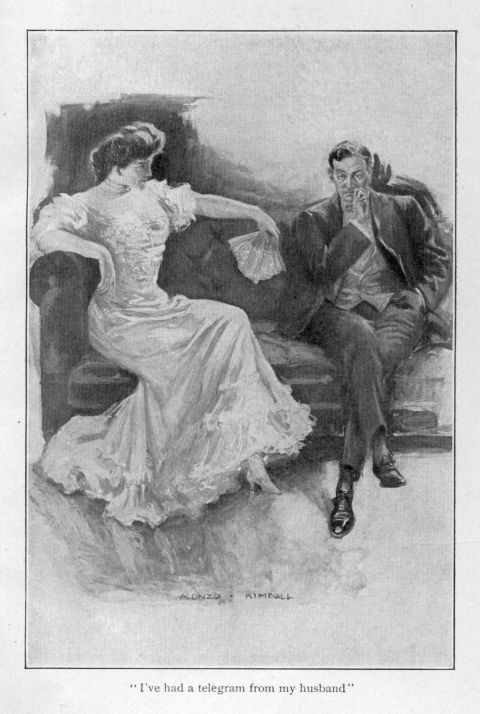
"I've had a telegram from my husband"
Falconer's name was sovereign for breaking spells as far as Jimmy was concerned, but the wife's phrase this time gave him only a more violent revelation of his cruel hope. She went on:
"It's not alarming, but with a heart like Jack's, anything might happen. It's only when I'm with him that he keeps up any sort of shape."
The fact of his holding in his the hand that she had put out to keep him from her, did not serve to aid in a serene continuation of her plans, and the silence became a burden which if she did not herself lift would crush her.
She said hurriedly: "And you will help me to go."
And then Bulstrode spoke: "No," he said, "Oh, no."
For the briefest space she yielded to what he meant and was at last wicked enough and human enough to promise to do. But she had on this solemn evening—for it had so been—come too far, gone up too high to drag down all the way with him on a single word. In supremest happiness, however, at what he said and how he said it, she gave a little soft laugh, and although she was under the mistletoe, she felt that she looked down on him, loving him so much more that in adorable weakness he had suddenly grown small and dear.
"Oh, Jimmy," she whispered, "how heavenly of you, but you can't go back on ten years in one week. You can't, you know! You've thrown me like a giant so far, I've gone right on up."
Still looking at her he shook his head as she repeated: "You'll help me, you'll help me! You can't go back!"
"I can go back," he said deeply, "on everything and everybody in the world."
At the frank simple words, and the sense of what they meant, at the sound of his new voice, it was as if all the dykes at last were down; and strong, bright, but most beautiful, the sea came rushing in. As she saw him coming toward her and knew that in a moment more she would be in his arms, and that at his first touch she would let everything go, she found one word to say and it proved only to be his name:
"Jimmy, Jimmy, Jimmy!"
But there was in it an appeal. She could count the times she had wept in her life, very nearly, she had often said that a woman weeps only when she has nothing else to do, and there had always been so much, every minute in her life; and as if in logical affirmation there seemed now for her nothing to do but to cry. The tears which covered her face and fell into her palms and against the chair on which she leaned, comforted her in a measure and served to loosen the tension of her mind. She had succeeded in miraculously keeping away from him, just within touch of her, held back by a hand whose white gentleness was not so exquisitely strong but that he loved her too well to break the tender barrier. She never afterward knew what appeals she made or how she besought, but it must have been of great force to keep him so transfixed and pale.
"Oh, you have told me over and over again! Do you think I am deaf or blind, or that I have found you dumb? Such love, Jimmy, such high, sweet perfectness! Why, there isn't a woman in a million who has known it or even dreamed what such love could mean. Why, there hasn't been a day or an hour for ten years that you have not spoken it to me in the most adorable way, in the most beautiful way; and in every kind thing you have done, in every foolish, dear thing, I have been so vain as to think that I counted for something in it, that you did it a little for me. Other women have had their lovers, their scandals, their great passions. But I have had you without flaw, without a change, without regret. Hush!" she cried, wiping her tears away, "Hush. It's quite safe to let me go on. The only fear is that you may speak."
The arm which she had held out to keep him from her had fallen upon his shoulder, lay about his neck as he knelt by her chair.
"It's been horrible!" she said, shaking her head, "Horrible—the days and the nights, the days and the nights! There have been times when I could have killed him and killed myself as well. But then you've come, and your presence has helped me, and that's the way I've pulled along; because by your silence you told me to pull along, because by the fact that you didn't speak I understood that you thought I should be brave, and I have been—thanks to you, and I shall be—thanks to you! Oh!" she cried passionately, "if you think because I am saying it all out that I want to go back, that I don't see what I am running away from, and what you mean, you're cruel, you're cruel!"
Her other hand had found its fellow and they both lay on his shoulders.
"I only think of you," he breathed, "and of how..."
She covered his lips. "Oh, hush, hush, you have told me, in the only way there was to tell. I'm too stupid to be able to combine a lover and a husband. The day and the hour you spoke I should never have seen my husband again. And that's where it stands; that's how it is, and you know it. You loved me because I was like that, and I love you because you are the bravest of the brave. There you are!" she cried, and drew away from him triumphantly, letting her arms fall. "There we both are!"
"Have you any vague conception of what this is for me?" Bulstrode asked.
"Oh, I dare say," she exclaimed, with a kind of petulance, "that I am only thinking of my own bewildering happiness. There," she exclaimed at his face, "I see you have a new weapon: pity. Oh, don't use that against me, and I warn you that everything in the world will crumble if you speak."
Her hands, which he was holding closely, she drew from him and laid them both on his breast and met his eyes full with her own. Her lips were slightly trembling, and she was as white as a winter day. In the moment of silence they passed like this, she seemed to him like some great precious pearl, some priceless rose fragrant, lustrous, made for him, gathered for him, and yet beyond his right. She seemed, above all, the woman, the mate; her glorious sex, her tenderness, her humanness, drew him and dazzled him; and, nevertheless, through his daze and over his desire, he heard with his finest her cry:
"Jimmy, Jimmy, don't speak, don't speak. Ah, if you really love me..."
He really loved her. Rising from where he knelt by her chair, Bulstrode went over, stood a second by the chimneypiece, and then took a few paces up and down the room, came back to her and said the thing the real man says to the woman he really loves:
"I want to make you happy, Mary. I will do whatever you wish me to do."
"Ah, then, go!"
Bulstrode looked wearily about as though of its own accord a door might unclose or a portière lift.
"Go where, pray, at this time of night, or morning?"
"Oh, to The Dials. Ring for a motor; they will take you in again; or go to the rector's."
The last of the fire had flared up. The flame went out.
Sinking back in her chair, she waited in a tranced stillness, her eyes on the ashes of the fire. She had said her say out, perhaps the man knew it, and as she leaned back in the cushions he saw how completely it all lay with him at the end. She thought he came back and waited a second at her side; she thought he bent a moment over her, but she did not stir until the cold wind from an opening door, till the clicking of a latch made her start, and then she turned to see that he had gone.
Bulstrode came back to the castle Christmas Day at nine o'clock. But the hour had the effect of being much earlier. The winter morning panoplied with festivity began its life slowly, and not all the day's brightness through which he had speeded his motor had yet come into the house. Bulstrode, drawn by it, went directly back to the room he had left several hours before, as though he expected still to find the woman he loved sitting before the extinguished fire.
Two parlor maids were whisking their skirts and dusters out of the opposite door, a footman at their heels. Touches of the inevitable order which reduces an agreeable disarray to the impersonal had already been put to the scene of Jimmy's tenderness, and the curtains drawn well away from the long windows let in the morning that entered broadly and fell across the hearth and the fresh-lit fire.
Clean logs replaced the cold ashes: the match had just finished with the kindlings, and Bulstrode went over to welcome the crackling of the young blaze. The absence of his host, the castle once more handed over to him for the time, gave him a feeling of proprietorship in the bright cordial room, but looking up at the portraits of Westboro's in puffs and velvets, Jimmy couldn't find an ancestor! Their amours and indulgences had written brilliant and amusing history; the gentlemen had gone mad at ladies' carriage wheels, they had carried off their scandals with the highest of hands, and still held their heads well. They had carved and raped and loved their way down to the present time, and were none the less a proud line of pure British blood. The American bachelor, about whose fine head nothing picturesque or worthy of history circled, looked up at the Dukes of Westboro' musingly, and there was not a peer or a noble better to look upon or who had been at heart a truer lover, although he did not know it.
During the lapse of time between leaving this same room and his present return, Bulstrode had not tossed on a sleepless bed; he had slept soundly, and during his rest the several dials had called out like bells, their voice, Utere dum licet; and finally a real bell had roused him to the fact that it was day, a new day, and that unless he was killed en route to the castle, nothing could keep him from the place and from her.
He had no consolation in the fact that the honor and decency of society were by him strengthened and retained, nor did he plan out the sane, wise project of not seeing her again. Nor did he weigh or balance his charge or responsibility. There had been a cessation of vibration of any kind, and only one supreme, sovereign reality took possession of the world and of himself, and the limitless beauty and the limitless delight he had breathed in ever since he left her and knew how she loved him. Nothing in life, he had so felt, could dull or tarnish the glory of her face; nothing, no matter what life held for them both, could efface the touch she had laid upon him, as her arms were about him. Through the interval his past life appeared to have been, on through the new and unlived interval to come, she would be as last night she had been, she would look at him as last night she had looked. "Heavens!" he meditated, in the faces of the self-indulgent, cynical Westboro's, "I am not going to be blasé through six paradises just because there happens to be a seventh!"
A new fire spun its lilac flames behind his back. The spicy breath of the wreaths of hemlock was deliciously sweet. Little by little the sun had made its eastern way and sparkled at the pane outside, and in the radiant clarity the terrace and its charming railing, the urns with the little cedars, stood out clearly; and more than all else, the truth cried itself to him, that whatever happened, she was still here, still in the house with him.
He had chosen a Christmas gift for her in London, and determined to send it up to her now with some roses, and in this way to announce the fact that he had come back from The Dials and was ready to use the day as she liked. He felt only how beautiful it would be to see her, that it did not for a second occur to him to wonder if she on her part would feel a certain embarrassment.
In answer to his ring, not a man servant, but the perfect housekeeper rustled in, her crisp silks, her cameos, and her "Christmas face," as one of the little Westboro' chaps had called her rosy countenance, on one of his few Christmas days.
"Where would Mr. Bulstrode please to have breakfast?"
"Why, wherever it best suited, went with the house, with the day. Where, indeed, and that was more to the point, would Mrs. Falconer have it?"
"Mrs. Falconer? Why, Mr. Bulstrode didn't know then that Mrs. Falconer had gone?"
She saw by his face that he knew nothing less in the world.
Why, directly the despatch had been fetched over from the Abbey station. There had been but twenty minutes between the getting of it and her starting away. A motor had been sent with her and the maid, and Mrs. Falconer had fortunately been able to make the train; the only one, it so happened, being Christmas Day, that connected with the Dover and Calais special.
The matter-of-fact bit of news came to Bulstrode so coldly and so ruthlessly that it took some seconds for the bitter thought that she had gone because she couldn't trust him, to penetrate. Then this gave place to an effulgent hope that it might be herself she couldn't trust! But the discovery that she had left him no message of any kind, and that she was above all irrevocably gone, struck him more cruelly than had any blow in his kindly life. He could not suffer in peace before the bland creature in silks and cameos. Crises and departures, battle, murder, and sudden death, he felt the housekeeper would accept serenely should any of them chance to occur at Westboro', and above all if they were part of the sacred family history. But Mrs. Falconer and he were not Westboro's, and he wanted to be rid of his companion and to find himself alone in order to consult time tables, to find out why it had been imperative to go to Calais, with what boat for America a Christmas-Day train could possibly connect, and to turn it all over in his mind. He at first believed that there had never been any telegram and that she had only employed a polite ruse in order to facilitate her flight.
Why, at all events, couldn't she have left him a line? She might, he ruefully complained, have strained a point and wished him a Merry Christmas! As he walked to and fro in the room now supremely deserted, he began slowly to approach a certain hypothesis which as soon as he granted, he as violently discarded. But the thought was imperious: something of its kind always haunted him like a bad ghost. It could usually be dismissed, but now it was persistent. A despatch from Falconer had certainly come the night before. Another might have followed on this morning, hard upon it? To have been sent over from the Abbey on a holiday must have been a very grave message indeed; "a matter," as the old term went, "of life and death." The phrase began to repeat itself and the conviction to grow, and as he was obliged to give it admittance and to face it, and to wonder what the shock would be to her, and what the news would be to him, how it would change things, and how they would both meet it—his promenade to and fro in the room brought him up before the centre table and he looked down upon it at length with a seeing eye. Why not? why not? he was wondering. We are all essentially mortal, and lightning never had struck yet, why not in this place? And since there had been neither shame nor blame, why couldn't he face the possibility of a perfectly natural mortality? Before him on the table lay Mrs. Falconer's green scarf, and as Bulstrode lifted the soft thing he saw that underneath it lay a despatch.