ILLUSTRATIONS (continued 2)
Reading edition
"Mais non!" Madame had a few minutes since gone out in the Park, the proprietor thought she would not be very far away.
Bulstrode thanked him, and crossed over to the hedge and the gateway and through it to the Palace Gardens. On all sides the paths stretched broad and inviting toward the various alleys, and upon the terrace to his left there shone a thousand flowers in June abundance. The gentleman chose the first path that opened, and went carelessly down it, and in a few moments the pretty ring of an embowered circle spread before him, but, although there was an inviting marble bench under a big tree at one side, and several eighteenth century marbles on their pedestals, illuminated by the bland eighteenth century smile, there was not a living woman in sight to make him, the visitor, welcome! He went a little further along and found another felicitous, harmonious circle, where a small fountain threw its jets on the June air. At the sound of the water Bulstrode remembered that the Grands Eaux were to play on this afternoon at Versailles.
"Ah, that is why they especially wanted me to come out to-day," he decided.
On the other side of the fountain, the vivid white of her summer dress making a flash like moonlight on the obscurity of the woods, a lady was standing looking across at Mr. Bulstrode.
"Hush!" she said; "come over softly, Jimmy; there is a timid third party here."
On a branch at her side, where an oriole sat, his head thrown back, his throat swelling, there was a little stir and flutter of leaves, for although the lady had put her finger to her lips, her voice broke the spell, and a bit of yellow flashed through the trees.
"I don't believe he will ever forgive you!" she cried; "you spoiled his solo, but I'll forgive you. What brought you out to Versailles to-day?"
"The fountains," Bulstrode told her; "I have never seen them play. Then, too—there are certain places to which, when I am asked to luncheon, I always go."
"That's quite true," she accepted; "you were invited!—but, to be perfectly frank, I did not expect you, so your coming on this occasion has only the pleasure of a surprise. As a rule, I hate them. My husband informed me that he would telephone you to meet him in Paris, but I think he must have forgotten you, Jimmy."
She was taking him in from his fresh panama to his boots, and she apparently found an air of festivity about him.
"Was it," she asked, "in honor of the fountains' playing that you have made yourself so beautiful?"
Bulstrode took the boutonnière out of his coat lapel and handed it to her. "Can't you pin it in somewhere?" Mrs. Falconer laughed and thrust the carnation into her bodice.
"I dressed to-day, more or less," Mr. Bulstrode confessed, "in order to attend—well, what shall I call it—a betrothal? That's a good old-fashioned word."
"Oh!" exclaimed the lady, "a fiançailles?"
"Yes."
The two had wandered slowly along, out of the Bosquet towards the canals.
"They make a great deal of these functions in France," Mrs. Falconer said.
Her companion agreed. "They made a great deal, rather more than usual, out of this one." And his tone was so suggestive that his companion looked up at him quickly.
"Who are your mysterious lovers?" she asked, "are they French? Do I know them?"
"They are not in the least mysterious," Bulstrode assured her. "I never saw anything less complex and more simple. They are Americans."
She seemed now to understand that she was to hear of "one of Jimmy's adventures," as she called his dashes in other people's affairs.
"I hope, Jimmy, in this case, that you have pulled the affair off to your credit, and that if you have made a match the creatures will be grateful to you for once! And, by the way," she bethought; "whatever has happened to the pretty girl whom you were quixotic enough to think you had to marry?"
"The last time I saw her she appeared to be in the best of circumstances," Bulstrode answered cheerfully. "In point of fact—it was, singularly enough, to her engagement party that I went to-day!"
And Mrs. Falconer now showed real interest and feeling. "No! how delightful. So she is really off your hands, Jimmy. Well, that is too good to be true. There's one at least whom you don't have to marry, Jimmy!"
"Oh, they grow beautifully less," he agreed.
Mrs. Falconer smiled softly.
"They are narrowing down every year," Jimmy went on; "when I am about sixty the number will be reduced, I dare say, to the proper quantity."
"What a goose you are," she said jestingly. "What a tease and a bother you are, Jimmy Bulstrode; I'll find you a proper wife!"
He accepted warmly. "Do, do! I leave myself quite in your hands."
His companion extended him her hand as she spoke, and after lifting it to his lips, Bulstrode drew it through his arm. It was clothed in a glove of pale coffee-color suede. It was a soft, dear hand, and rested as if it were at home on Bulstrode's gray sleeve. Side by side the two friends walked slowly out toward the broader avenues leading to the canals. The sky was faintly blue, touched with the edges of some drifting cloud, like dashes of foam. The trees about them lifted dark velvet masses and the air was sweet with the scent of the woods and flowers.
"Isn't this the most beautiful garden in the world?" murmured Mrs. Falconer. "Isn't it too beautiful!"
"Very," he incorrectly and vaguely answered. And the lady went on to say how brilliant she found the place with the suggestions and memories of the past royal times, whilst Bulstrode said nothing at all, because he did not want to tell her that Versailles and the charming alleys, and France, and the great big world, from limit to limit, was full of no ghosts to him, but of just one woman.
THE THIRD ADVENTURE
III
IN WHICH HE FINDS THERE ARE SOME THINGS WHICH ONE CANNOT BUY
After not a great deal of hesitation, toward the middle of a warm June, Bulstrode permitted himself to become the proprietor of a palace: not an inhabitant of the ordinary dwelling modelled after some old-world wonder, wherein American millionaires choose to spend their leisure in their own country—but of a real traditional palace, in whose charming rooms no object was younger than Bulstrode's great-grandfather, and where the enchanting women of the Fragonards and Nattiers almost made him, as he mused upon them, lose sight for a moment of a living lady.
On the very first day he went over the Hôtel Montensier from grenier to caves, Jimmy Bulstrode gave in, and accepted the Duc de Montensier's proposition to "fetch his traps for a few months to the hôtel and turn Parisian." He was in the heart of Paris, yet all around him, shut in by high walls, was a garden, to which the terraces of the house gave in flights of marble steps. When his friend suggested that Bulstrode turn Parisian, Jimmy laughed. "Do you think," he had asked, "that a chap born in Providence, educated in Harvard, and, if cosmopolitan, thoroughly American from start to finish, could, mon cher, turn Parisian?" And the Duc had assured him that he did not think Bulstrode had a "Latin eyelash," and that he needn't be at all afraid to try his luck at what a French house would do for him! "Why, your coat alone—the cut of it—" Montensier had laughed, "speaks of Poole with a Boston compromise!
The Duc had been in the United States—moreover, the Frenchman had plans of his own and he wanted very much to go to Newport and leave his house in the care of Jimmy Bulstrode. Whether the Puritan in him led Bulstrode to excuse to himself his enjoyment of so much luxury, at any rate he apologized, saying that nobody could expect a man with a love of the beautiful, and who had more or less a desire to shut himself up and to shut himself away for a time, to refuse.
The Falconers were off somewhere en auto. He had thought they had gone through Spain. It was pretty hot to do such a thing, however, and he did not really know. He wanted very much to be able not to let himself follow them, and he knew that there was little chance of his reaching such stoicism unless he began by not finding out where they were going! So he shut himself up with the books which the library offered and gave many charming little dinners and parties on his terraces in the bland summer nights, and tried with all his might and main to forget the flight of a certain motor over the fair white roads and, above all, to nerve himself up to refuse an invitation for the middle of July.
Directly opposite the white façade of the Montensiers' hôtel was a hostelry for beggars, for domestics without places; for poor professors; for actors with no stages but the last; for laborers with no labor; in short, for the riff-raff of the population, for those who no longer hold the dignity of profession or pay rent for a term. Sometimes Bulstrode would look out at the tenement, whose windows in this season were wide open; and the general aspect indicated that dislocated fortunes flourished. In one window, pirouetting or dancing in it, calling out of it, leaning perilously over the sill of it, was a child—as far as Bulstrode could decide, a creature of about six years of age. She was too small to see much of, but all he saw was activity, gesticulation, and perpetual motion. When the day was hot she fanned herself with a bit of paper. She called far out to the wine-merchant's wife, who sat with her family before the shop while her pretty children played in the gutter.
In Paris, when the weather climbs to eighty, Parisians count themselves in the tropics and the people, who lived apparently out of doors altogether, wore a melted, disheartened air. But the De Montensier garden, full of roses and heliotrope, watered and refreshed by the fountains' delightful falling, was a retreat not to be surpassed by many suburbs. Bulstrode gave little dinners on the terrace; little suppers after the theatre, when rooms and garden were lighted with fairy lanterns, and his chef outdid his traditions to please his American master.
One day as the American sat smoking on the terrace with nothing more disturbing than the drip of the fountain and the remote murmur of Paris to break his reverie, Prosper, his confidential man, made a tentative appearance.
"Would m'sieu, who is so good, see a young lady?"
His master smiled as he rose, instinctively at the words "jeune demoiselle," throwing away his cigar.
"Pardon, m'sieu, I thought it might amuse m'sieu—" and Prosper stepped back.
Bulstrode had been intently thinking of the caravansary opposite him, and he now saw that part of the hôtel meublé had come across the street; he recognized it immediately for the smallest part. Before him stood the ridiculous and pathetic figure of a dirty little girl in rags, tatters, and furbelows, her legs clad in red silk stockings evidently intended for fuller, shapelier limbs; her feet slipped about in pattens. She had on a woman's bodice, a long flounced skirt pinned up to keep her from tripping. Her head was adorned by a torn straw hat, also contrived and created for the coquetry of maturity.
"Monsieur is so good," she began in a flute-like voice. "I have come to thank monsieur with all my heart."
Bulstrode looked toward Prosper for enlightenment, but that individual had cleverly disappeared.
"To thank me, my child? But for what?"
"Why, for the eggs and butter and sugar that monsieur was so good as to send me. I have made the cake. It is beautiful! Monsieur le cuisinier of this house baked it for me. It is perhaps a little flat—but that was because I got tired stirring. See—it says—" She had, so he now saw, a book under her arm; letting fall a fold of her cumbersome dress with both hands and opening a filthy cook-book, she laid it on the table, bending over it. "It says stir briskly half an hour." (Her "rs" rolled in her throat like tiny cannons in a rosy hollow.) "Quelle idée! It was too stupid! Half an hour! I just mixed it round once or twice and then—voila! it has white on the top and shall have a candle."
"So you've made a cake?" he said kindly. "I'm sure it's a good one."
She nodded brightly. "It is for that I came to thank monsieur and to ask if he would accept a piece of it."
Poor Bulstrode, with dreadful suspicion, looked to see part of the horror immediately offered for his degustation. "I don't, my dear, understand. Why should you thank me—what had I to do with it?"
Her gesture was delightful. "But for monsieur it would not exist; for butter, eggs, and flour. Monsieur Prosper, when he gave them, said it was of the kindness of 'Monsieur Balstro.'"
(Oh, Prosper! "I have corrupted him," his master thought. "He is as bad as I am!")
"Well, I'm very glad indeed," and he said it heartily. "But what did you especially want to make it for—with the one candle? That means one year old. Who's birthday may it then be?"
"It is the birthday of maman." She shut the book, and as she did so raised her great black eyes, which dirt and neglect could not spoil. There was in her appearance so little suggestion of maternal care that Bulstrode nearly incredulously asked, "Your mother? And what, then, does your mother do?"
"She's a fish," informed the child tranquilly. And Bulstrode, although startled, could believe it. It too perfectly accounted for the cold-blooded indifference to this offspring. Not even a mermaid could have been guilty of so little care for her child. Still, he repeated:
"A fish?"
"Oui, a devil-fish in the aquarium at Bostock's. Oh, que c'est beau!" she clasped her little hands. "Maman wears a costume of red—quite a small, thin dress," she described eagerly. "And it is all spangles, like fire when she dives into the water. I have been; the waiter at the café downstairs took me. I screamed. I thought maman was drowned. But no—she comes up always!" The child threw her head back and lifted her eyes in ecstasy. "C'est magnifique!"
"What is your mother's name?"
"Mademoiselle Lascaze."
"And yours?"
"Simone."
"What do you do all day, Simone?"
"I wash and cook and sew and play—I have much to do—oh, much." She assumed an important air. "The bad air of the room makes maman ill, so she's out—'to breathe,' she says—and she locks me safely in. I play Bostock and dive like maman. And sometimes"—she lowered her voice, and looking back to see if they were alone—confided, "I cry."
"Ah!" sympathized Bulstrode.
"But, yes," she insisted, "when maman forgets to come home, and the night is so black; then the seamstress next door knocks on the wall, and I knock back for company."
"I see," he understood gently, "for company."
He rang for Prosper. "You will conduct mademoiselle home, Prosper, and give her everything she needs for her kitchen always."
"Yes, monsieur; I knew that monsieur would——"
At sight of Prosper the mite gathered up her voluminous skirts and bade her new friend a cordial good-by.
From the corrupted Prosper Bulstrode extracted what he wished to know concerning the child.
"It is of a scandalousness, monsieur! Four nights of the seven the poor little object is alone. The mother appears to have money enough, she pays her rent regularly, and there is therefore nothing to do. She sometimes even fetches her companions home with her, and Simone, when she is not making sport for them, is tied to a chair to keep her from falling off in her sleep."
Bulstrode expressed himself strongly, violently for him, went to see a lawyer and a charitable French countess and found out that so long as the mother did not actually ill-treat the child she could not be replaced by any other guardian.
"Mon cher ami," said the spirituelle lady, "leave the fish to her deviltry, and her child in her care. We are fin de race, if you like, and in direct opposition to your American progressive schemes, but we have a tradition that the family is sacred, and that, however bad it may be, a child is better off in its home than elsewhere. You will find it difficult to replace a mother by a machine or an institution, believe me."
And Bulstrode at the words felt a new sense of failure in philanthropies, and his benevolence seemed pure dilletantism. What was he likely to accomplish in the case of this child? Nothing more than the momentary pleasure a few toys and a few hours of play could secure. "And yet," as he mused he philosophically put it to himself, "isn't it, after all, about the sum total any of us get out of destiny?"
In New York he would have quite known how to proceed in order to help the child, but in the face of French law and strong family prejudice he came up against a stone wall.
"I'm no sort of a real benefactor," he remorsefully acceded, "and I don't believe I'm fit to be trusted alone with the poor."
Nevertheless he did not relinquish his idea entirely, and confided Simone to Prosper's sympathetic care and that of an emotional maid-servant, with the result that a cleaning woman penetrated by hook or crook into the room of "the fish" and treated it to more aqua pura than the piscatory individual had cognizance of outside of the aquarium.
The gentleman in this particular charity was surprised to find how simple it sometimes is to do good. In this case no one had come to him with a petition or a demand; on the contrary, a note of undeserved thanks had, with the strange little creature, been presented to him. It was so pleasantly easy to help a child! There were no arrières pensées—not that they would have troubled him, but there were none; there were no wire-pullings, no time infringements, no suggestion or criticism, no—he believed—expectations. Everything he could do was so annoyingly little! The charwoman cleaned, Simone had a complete wardrobe, the larder was full, and there remained nothing but toys to buy. The little thing was so womanly and capable—he had seen it and marvelled in their interviews at her age and accomplishments—her hands were so apt and almost creative, that toys seemed inadequate. She took her benefits charmingly; rushed over at the least provocation to pour out her gratitude, and Bulstrode, who hated thanks, liked these. Childhood, if it had been for sale on the Boulevard, even that he would have bought Simone if he could! As it was, he found himself pausing before a series of shops other than chemisièrs—florists, and jewellers'—shops where diminutive objects were displayed—and one afternoon had been standing ridiculously long in front of a certain window on the Rue de Rivoli when he was accosted by an agreeable and familiar voice.
"Jimmy! It isn't possible! don't tell me it has come so cruelly soon?"
The gentleman gave a violent, but an entirely happy start. Well, there were rewards then for people who didn't follow speeding motors through France! She was back and in Paris.
"What—has come so soon?" he asked.
Mrs. Falconer, on her way from a hat shop in her automobile, stopped by his side.
"Why, your second childhood, my dear man. Do you know what shop you are standing before?"
Bulstrode seemed to be perfectly aware of his dotage and to delight in it. Behind the big window pane there was a bright and very juvenile display.
Ships sailed there; dolls hung gaudily and smilingly aloft; giant parti-colored balls rounded out their harlequin sides; tiny dishes for pygmy festivals were piled with delicious carrots and artichokes on little white, blue-rimmed platters.
"Have you a moment to spare?" Bulstrode asked her.
"I have bought all my hats," she replied; "after that a woman's time hangs heavy on her hands."
"Ah!" he was as radiant as she had the genius for making him. "Come, then, in with me and help me choose a doll."
It was not the first purchase during the course of a long friendship which Bulstrode had made with this charming woman by his side, but for some reason he enjoyed it more than former errands. The bachelor and the childless woman were hard to please and their choice consumed an unconscionable time. As they lingered, the amiable shopman pressed various toys on monsieur and madame "pour les enfants," and the lady, finally depositing her friend with his parcels at the door of his hôtel, realized as she drove away that she knew nothing of the child for whom the purchases had been made. On her way up the Champs Elysées she smiled softly. "It's what you share," she mused, "what you give of yourself—with yourself—that's charity! Jimmy gives himself. I wonder who his new love is?"
Bulstrode, in order to share what should be his "new love's" ecstasy at first sight of the miraculous toy, sent for Simone. The Rue de Rivoli doll, on a small chair designed for diminutive ladies of the eighteenth century or for the king's dwarfs, held out stiff but cordial arms and was naturally, to a child, the first and sole object of the drawing-room.
"Monsieur!"
"For you, Simone."
"Monsieur!"
She said nothing else as she clasped her hands, and the color rushed into her face, but she felt the doll, touched reverently its feet, hair, dress, incontinently forgot Bulstrode, and quite suddenly, passionately, caught the image of life to her heart. Just over its blonde head, for it was nearly as large as herself, she met the gentleman's eyes.
"It's my child! I've prayed for it always, always! I've never had a doll, a bébé, m'sieu."
The tea-table with cakes and chocolate called them all too soon and, as Prosper served, the fountains sang, the heat stole through the garden and called up agreeable odors of sod and roses, the late afternoon sky spread its expanse over the terrace of the hôtel, where, perfectly happy both of them, animated by as gentle and harmless pleasure as any two in Paris that day, the child of the people and an American gentleman chatted over their tea.
Bulstrode, being an original, erratic, and reckless giver of alms, quite by this time knew that, more than often, for him to give was, if not to regret, to have at least misgivings whether in the hands of some colder, less poetic person his money would not have accomplished more good. In the case of Simone he had, as usual, happily gone on with abandon, relegating any remorse to a future which he hoped would never arrive.
But the middle of July did come and with it came poor Jimmy's exquisite temptation. A telephone helped it dreadfully. There was something so wonderful in the fact that in a couple of hours he could, if he would, let himself reach the side of the lovely voice which called to him over the wires. And being nothing but a human man, he threw all his good resolves to the wind, and went down and stayed three days at Fontainebleau.
Out under the sky, where the elastic earth sprang softly beneath her feet and the embowered forests were sifted through with gold, Mary Falconer finally asked him, "And your doll, Jimmy? Have you broken her yet?" Bulstrode felt a guilty twinge, for he had not once thought of the little girl, nor did Mrs. Falconer's mention of her bring the subject near enough for Bulstrode to tell her the pretty story. He had other things to say, and many things not to say, and this, as it always did when he was with his lady, kept him very absorbed and occupied. On this occasion he forgot all about little Simone.
The night of his return Paris was en fête and in no sense impatient to reach his lonely house—for it seemed to him this night the loneliest house in the world—he walked without haste up town along the quays.
It was hard to forget that not fifty miles away he had left the cool forests, their tempting roads, their alluring alleys. He had forgotten that it was the annual celebration and that at this late hour the fête would be in full swing, and as he strolled meditating along the Seine the spirit of the gay populace—good-humor, reckless pleasure, and the joie de vivre—poured itself out around him like cordial, like a generous gift from an over-charged horn of cheer. In his gray clothes, modish panama, a little white rose plucked by a dear hand from the trellis at Fontainebleau still in his buttonhole, Bulstrode scarcely remarked the crowds or heard the music as he passed outdoor dancing stands and was jostled by a dancing throng.
His own street, as he approached it, welcomed him with a strong odor of onions and fried potatoes; it had apparently turned itself out of doors and all of the houses seemed to have emptied themselves into the narrow alley. A hurdy-gurdy playing before the hôtel meublê tinkled and jangled in the centre of a crowd of merry-makers, and the metallic melody and wild ascending octaves were the first sounds Bulstrode consciously heard since he left Fontainebleau.
In the midst of this rabble little Simone was dancing like a mad child, hair, arms, and feet flying; her voice, thin and piercing, every now and then above the rattle of the hand-organ, cried out the lines of a popular song whose meaning on her lips was particularly horrifying. The wine-shop family encircled her, encoring her vociferously. As she paused for breath the light from over the shop-door shone on her excited little face.
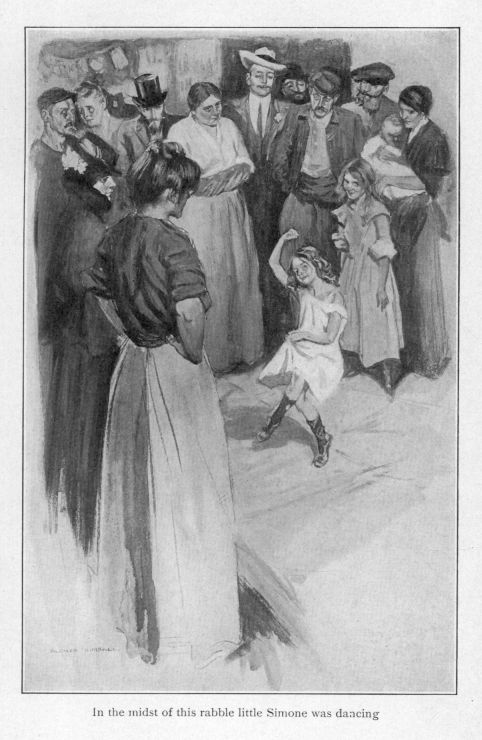
In the midst of this rabble little Simone was dancing
"I tired! Mon Dieu, que non! I could dance till morning. Play again, monsieur l'organiste. Play again."
Bulstrode, on the crowd's edge, watched her, and for once in his philanthropic history made no attempt to rescue. As Prosper let his master in he said:
"It's a shame, isn't it, monsieur? The people over there have let her run quite crazy. The poor little thing! Heaven knows where the mother is!"
Of which celestial knowledge Bulstrode had his doubts. It was close to twelve, and dismissing Prosper for the night, he took his cigar out on the terrace and to what solitude his garden might extend. Before long the noise of the music subsided, the people, tired out with hours of festivity, dispersed, and the alley settled into quiet. From the distance now and then came the soft, dull explosion of fireworks, the rumble and roar of Paris was a little accelerated; otherwise the silence about Bulstrode's garden grew and deepened as the night advanced.
It was rare for him to allow himself to be the object of his own personal consideration, or that indeed he at all thought of himself, and when he did the man he had long ignored had his revenge and made him pay up old scores.
On the late afternoon of this very day he was to have walked for miles through the Fontainebleau woods with Mrs. Falconer, and instead he had fled. Pleading a sudden summons to Paris, he left Fontainebleau.
It was well past four o'clock when he at last threw his cigar away and rose. He had been musing all night in his chair.
A sudden gust of noise blew down the quiet little street, the sound of loud singing and the shrill staccato of a woman's laugh. By the time the revellers had passed his house and the hubbub had died away, Bulstrode, with an idea at length of going up to his room, walked across the salon and prepared to extinguish the electricity, but the sound of some one tapping without caught his ear, and going over to the window that gave on the street, he looked out. From end to end the alley was deserted except for the figure of a woman. As he saw in the ruddy light of early morning she huddled against the threshold of the hôtel meublé—knocking persistently at the door. The tattered gauze of her dress, whose bold decolletée left her neck and shoulders bare, a garland of roses on the bandeaux of her black hair, she epitomized the carnival just come to its end—its exhaustion, its excess, spent at length, surfeited, knocking for entrance at last to rest. Bulstrode, as he remarked the sinuous figure that swayed as the woman stood, exclaimed to himself with illumination: "Why, she's the fish, of course! Simone's mother! And this is the state in which she goes to the miserable child!"
As, knocking at intervals, the object leaned there a few moments longer, evidently scarcely able to stand, his pity wakened and he slowly left the window, shut in its blinds, and crossed his ante-chamber, where the artificial light of electricity was met by the full sunshine of the breaking day streaming in through the open window of his terrace. Not entirely sure of his motive or to what excess of folly it might lead him, he nevertheless opened wide his front door, only to see that the woman on the opposite street had gone. She had been let in. With a glance of relief up and down the street where the confetti in disks of lilac and yellow and red lay in dirty piles or swam on the flushing gutters that sparkled in the light, Bulstrode shot to his door on the Parisian world and after a nuit blanche went upstairs to his rooms.
And there had intensely come to him during the period of his dressing the next morning after a tardy wakening the idea of taking the child, of—he was certain it could be done—buying the mother off. He would, in short, if he could, legally adopt the Parisian gamine for his own. It would give him a distinct interest, and life was empty for want of one; this, in a manner, however short of perfect, would supply the need of a loving living creature in his environment and would—his thrill at the idea proved to him how lonely he had been—give him companionship and a responsibility of a tender, personal sort. He could make a home at last for a child. Men are more paternal than they are credited with being, and Bulstrode directly foresaw delightful causeries in the future with—(he knew many women)—with one woman whose pretty taste, whose wit and humor, should counsel him in his new rôle. Mrs. Falconer would dress Simone—her hand should be wonderfully in it all. Bulstrode had let his fancy linger over the scheme. Certainly, during the hour in which he spun his fanciful plan, there was not one bar to its execution. Nor did there come to him any hint of its intrinsic sterility, or the idea that it was possibly an excuse for the interweaving of another interest more closely with his life—no idea that he was simply strengthening an old bond, or by means of this little tug pushing a mighty vessel nearer port.
He almost happily mused until a nursery grew out of thin air, a child's little garments lay on a chair, and festivities, whose charm is of the most mysterious, illuminated his reverie. Bulstrode, even without the shudder of the climatician, contemplated the rigors of his own country, for a rosy room grew out of his dream, fire-lit and fragrant with fir and holly, and in the centre shone The Tree, whose shiny globes and marvels were reflected till they danced in a child's eyes.
There had been an hour earlier the quick, brusque dash of a French thunder-storm, and the cooled air came refreshingly from the garden as Bulstrode stood out on the terrace before going into the noonday breakfast. Prosper, fetching his master's coffee at nine o'clock, had been informed that they were leaving Paris that day and received instructions as to the setting in order of the hôtel before returning it to its proprietor. Where his wanderings were to take him Bulstrode had not as yet made up his mind. It, after all, mattered so very little what a bachelor did with his leisure! It was the height of the season along the seacoast and a dozen places brilliantly beckoned; there were tri-weekly boats to the country, where he should most properly be.
"There is," he with recurrent leeway to his inclinations reflected, "always plenty of time to decide what one does not want to do!"
As he glanced at the little breakfast spread temptingly there for him on the terrace he was arrested by the sound of French voices in quick, agitated discussion, and looked up to see the unceremonious entrance of quite a little band of people who had in point of fact penetrated his seclusion. In a second of time a group was before him and he remembered afterward that certain figures in a twinkling assumed familiar shapes: the wine-shop keeper, his wife, one or two other patrons of the hôtel; but in the centre—he was sure of her!—pale and staring, stood little Simone, her big doll clasped in her arms.
Before the gentleman could ask their errand Madame Branchard, eager to tell it, pushed forward. Bulstrode afterward, when he thought of the scene, could always distinctly see her important red face, sleek, oily hair, and in spite of summer heat the crocheted shawl over her cotton gown.
"We decided at once to address to monsieur, who is so good"—(he was growing accustomed to the formula) "to monsieur who has been so like a father to the poor little thing. Not but that we are ready ourselves to do all we can for her—she is so sweet, so intelligent!"
"The sweet, intelligent child" appeared, as Bulstrode's pitying gaze, never leaving her, saw, to have shrunk overnight. In their midst she stood of a ridiculous smallness, her big doll nearly hiding her and over its blonde head Simone's eyes peered pathetically into, as it were, a vague and terrifying world. Bulstrode asked shortly in the face of the theatrical prelude:
"What is this all about? What have you come to tell me?"
"Ah, monsieur!" Madame Branchard's voice, particularly suited to retailing the tragedies of the streets, quavered. "There has been a malheur—it is too horrible—the mother!"
"Stop!" Bulstrode put out his hand. "Simone!"
The little thing dragged herself to him with a new timidity, as though she believed him in league with the world against her.
"Come," he encouraged, "come out here on the terrace, where you have so often played with your doll, and don't be frightened, mon enfant; everything will be all right."
When he had so settled her in the smallest of chairs he went back to the other bit of Paris street-life which had seethed in to him.
Madame Branchard, whom his manner had reduced to, for her, marvellous quiet and ease, approached impressively and lowered her voice as deeply as it would fall.
"Mademoiselle Lascaze, whom monsieur knows has been my tenant for months past, is dead—dead, monsieur!"
Bulstrode echoed, "Dead?" and his first thought was: "It was not she, then, whom I saw striving for entrance this morning. Ah, poor creature! Drowned?"
"Monsieur then knows?"
Knows—how should he know? He had thought of the aquarium and her often repeated feat.
"Monsieur is right, she is drowned; but it is not the aquarium—it is the Seine. It appears," the wine-merchant's wife went on, "that last night she made la fête in the streets. We over here lock up, well, at a decent hour, as monsieur will understand. Those who are in stay, those who are out—well, monsieur will understand——"
Yes, he understood. Would she go on?
"Mademoiselle Lascaze had evidently lost her key of entry—so it appears. We have this story from her comrades, a bad lot, like herself. She tried to get in about five o'clock—they left her knocking at the door. She must then have wandered the streets for an hour, for it was six when they met her again by chance quite by the Pont des Arts. They all had something to drink and started across the river, when the poor thing offered to give an exhibition of her circus feat and, before anyone could stop her, had dived off the bridge into the Seine."
He had, then, seen her knocking there in the dawn, and if he had hastened a little—not held conventionally back——
"It is all en règle," assured Madame Branchard. "As my husband will tell monsieur, he has been to the morgue to identify her."
The wine-merchant now at his cue, nodded impressively. "Mais oui, I assure monsieur she was quite natural—and she was une belle femme tout le même——"
His wife glanced at him scornfully. "She was a bad mother, and all the house will tell you so. Many times, monsieur, I have gone in with my pass-key and taken the poor little thing downstairs in my arms to give her all the supper she would have had, and many a time, on cold nights, when there was not a stick of fire in their room, and the woman abroad—many a time I have had her sleep in our bed with us—my husband will tell monsieur."
The wine-merchant nodded assent. "She speaks the truth, monsieur."
Bulstrode found presence of mind to wonder. "I suppose Mademoiselle Lascaze left debts?"
The husband and wife exchanged glances.
"En vérité, monsieur," confessed Madame Branchard, "she has left a few, but they are small and not significant; a hundred francs will cover them. It is not for our pockets we are come to monsieur."
Here the sentimentality having been disposed of by the woman, the husband broke in:
"It is like this, Monsieur Balstro" (Bulstrode saw how intimately the hôtel meublé knew him): "In a few moments even the authorities will be here to take charge of the woman's effects and Simone will become the property of the State. She has no relatives, as Monsieur will understand. Thinking, therefore, that monsieur, who is so good, might for some reason care to take an interest in the child's future——"
Branchard coughed and paused. Having given Mr. Bulstrode ample time to speak, to show some signs of life and of his usual quick benevolence, and being greeted with nothing other than quiet, meditative silence, the merchant shrugged and comprehensively relinquished suppositions and hopes in one large gesture.
"In which case" (evidently that of taking for granted that Bulstrode was less good than they had supposed), "in that case we shall put in a plea ourselves for Simone and adopt her."
Madame's voice, now in full and customary volume, expressed frankly her goodness. "We have five children and our means are modest, but"—and she put it sublimely—"one is not a mother for nothing."
Her tirade, however, was quite lost on Bulstrode, who was occupied with his own projects of benevolence. Turning to this contingent of the hôtel meublé a back scarcely more imperturbable than his face had been, he went out of the room to the terrace, where Simone sat just as he had left her. She was, on her low chair, so tiny that in order more nearly than ever before to approach her little point of view, to come into her little sphere, Bulstrode knelt down on one knee.
"Don't look so frightened, my child. Nothing will harm you—I assure you of that; don't you"—he called her loyally to answer—"don't you believe me, Simone?"
The little thing drew in a struggling breath and whispered: "Oui, m'sieu."
"Good!" He was smiling at her and had taken her ice-cold, dirty, little hands. "You are fond of me, Simone—you like a little M'sieu Balstro'?"
"Oh," she caught at her frightened voice and more clearly whispered, "oh, oui, m'sieu!"
"Bien encore!"
He wanted tactfully to break the ice which shock and terror had formed around the poor little heart, and yet not to prolong the moment.
"Voyons," he said to her lightly, as if he were only to bid her come and play in his garden, and not ask her to decide her destiny. "Voyons, how would you like to come and live with me? to have toys and pretty clothes and good things to eat—to be"—the bachelor put it bravely—"to be my little girl. How, Simone, would you like it?"
If further startled she was humanized by his warmth, which was melting her; her breast heaved, her lips trembled, and she asked: "Et puis—maman?"
Here Madame Branchard, in whom all feelings were subordinate to curiosity and motherhood, had approached until she stood directly behind the two on the terrace. Tears had sprung to her eyes and she sniffled and wiped them frankly away with her hand.
Bulstrode, singularly relieved by her appearance, turned and asked her, "What does she then know?"
"Nothing, m'sieur, nothing at all."
Simone got up on her feet and her big doll fell with a crash on the marble of the terrace and broke in a dozen pieces, but the catastrophe did not touch her.
"And maman?" she repeated. "Where is she? She did not come home last night?"
Bulstrode had descended to one knee in order to approach her, but Madame Branchard got down on both knees and tenderly put her arms around the child.
"Look, ma petite—your mother has gone away forever to a beautiful country, and she has left you here to be a good girl and do whatever this kind gentleman says. Will you go to be his little girl? He will give you everything in the world." She closed with this magnificent promise, whose breadth and wealth no child-mind could grasp. In order to give her more complete liberty in which to make her decision the wine-merchant's wife, after kissing her, set her free.
Simone made no audible reflection of wonder at her seeming desertion, no exhibition of distress, no melodramatic outburst of grief or surprise. She stood silent, absorbed, desolate, and ashamed, twisting in and out between her frail little fingers the fringe of Madame Branchard's black shawl.
"Or," brightly continued the good woman, "you can come home with me and play with Marie and Jeannette and have what we have. You can be my little girl, as you will—it is for you to decide—chez moi, or with this bon monsieur."
Was it fair of them—thus to lay on her six years the burden of her own destiny?
Simone raised her head; her cheeks had reddened a little at Madame Branchard's last words. She was unable to grasp the benefits that Bulstrode's magnificence offered, but she knew Marie and Jeannette—she knew the hands of Madame Branchard could tuck one in at night, and how warm and soft was the bosom on which she had already wept her little griefs. There were many beautiful things in the world, but Simone just then only wanted one. Madame Branchard was not her mother—but she was still a mother! Simone whispered so low that only the woman heard:
"I will go with you."
Prosper having embarked on a sea of indiscretion, went through the day consistently. With a love of the melodramatic in his Latin temperament he had admitted the hôtel meublé sans cérémonie: and late that afternoon he gave entrance to another group of quite a different order, and without formality ushered the lady and her friends to the terrace, where the solitary inhabitant of another man's house was taking a farewell beverage before leaving Paris.
"We have caught you in time, Jimmy!" Mrs. Falconer made a virtue of it. "If you are absconding with the Montensier treasures, then let me show Molly and the Marquis at least what has been left behind."
His bags and boxes in the hall, his automobile at the door, and Bulstrode himself in travelling trim, it looked very much like a flight, indeed. Miss Molly and the Marquis, it transpired, were able to explore for themselves and to find in the gallery and salons pictures and objects of interest to excuse a prolonged absence.
"They're engaged," Mrs. Falconer explained to her host. "Isn't it ridiculous? As you know, she hasn't a cent in the world, and his family are not in the secret, but Molly and De Presle-Vaulx are, and I am, and I brought them off in pity for a spin to Paris."
The apparition of the lady, whose mocking beauty had a fresh charm every time he saw her—her worldly wisdom and her keen reasonableness—made, as he stood talking with her, his past debauch in philanthropies seem especially grotesque. With a long breath of joy at the sight of her Bulstrode also realized how wonderfully separated from her the introduction of another life into his environment would have made him.
"Your garden is a waste," the lady criticised, "dusty and dull. I don't wonder you're getting away. Fontainebleau, too, was only a faute de mieux, and I have left it. One should get really far away at this season. It's the time when only the persons who are actually bred in its stones can stay in Paris—certainly the birds of passage may now, if ever, fly."
"We are going to Trouville," she said; "we are all going to motor through Normandy. Won't you come—won't you come?" He shook his head.
Mrs. Falconer looked across the terrace to where a little chair had been overturned, and on the floor by its side lay a broken doll.
"Jimmy!" she laughed in triumph at the sight. "You have broken your doll!"
Bulstrode said: "Yes, beyond repair, and I don't want another." Then in a few words, briefly, a little impatient, and still smarting under the child's defection, he gave her the story.
Listening, absorbed, her charming eyes on him or at one moment turned suspiciously away, the lady heard him to the end, and at the end said softly:
"Jimmy, my poor Jimmy! What have you nearly done! What would people have thought? Not that it matters in the least—it's what people do that counts—but oh, I tremble for your next folly!"
"It might"—he spoke with something like bitterness—"be less harmless and leave me less alone."
She had finished a glass of iced tea, put her goblet down on the tray and rose, coming over to where Bulstrode stood; she lightly laid her hand on his arm.
"You are, then, so very lonely? So lonely that you would be capable of doing this foolish thing? Oh, you would have found, as I have found, that it is those things which come into our lives, not those which we by force take, which mean all we want them to mean! This wasn't your child!" Mrs. Falconer's face softened as he had never seen it. "Nor yet is she the child of some woman you love. Believe me, it would have made you far lonelier if it so happened—if you should ever come to love—if you ever had loved——"
Bulstrode interrupted her abruptly:
"Yes, in that case I should no doubt be glad that Simone had gone back on me." He waited silent for a second, and then continued gently, "I am glad, very glad indeed!"
THE FOURTH ADVENTURE
IV
IN WHICH HE MAKES THREE PEOPLE HAPPY
There were times when Bulstrode decided that he never could see the woman he loved any more: there were times when he felt he must follow her to the ends of the world, just in order to assure himself that she was alive and serene. Such is the gentleman's character and point of view, that she must always be serene, no matter what his own troubled emotions might be.
He had the extraordinary idea that he could not himself be happy or make a woman happy over the dishonor of another man. It was old-fashioned and unworldly of Bulstrode: still, that was the way he was constituted.
It was on one of the imperious occasions when he felt as if he must follow her to the ends of the earth, that he steered his craft toward a little town on the edge of the Norman coast, to a very fashionable bit of France—Trouville. As soon as he understood that Mrs. Falconer was to be in Normandy for the race week, he packed his things and ran down and put up at the Hôtel de Paris. On this occasion the gentleman followed so fast that he overleaped his goal, and arrived at the watering-place before the others appeared. Bulstrode took his own rooms, and in response to a telegram, engaged the Falconers' apartments. He liked the way the little salon gave on the heavenly blue sea, and with a nice fancy to make it something more home-like for his friend to begin with, he filled it with flowers ... ran what lengths he dared in putting a few rare vases and several pieces of old Italian damask here and there.
"Falconer," he consoled himself, "will be too taken up with his horses to notice the inside of anything but a stable! And I shall tell the others that the hôtel proprietor is a collector: most of these Norman innkeepers are collectors." And, as his idea grew, he went to greater lengths, with the curiosity shops on either side the Rue de Paris to tempt him. The result was that when Mrs. Falconer came, she found the hôtel room wonderfully mellow and harmonious, and as a woman who revels in beauty she responded to its charm. She was delighted, her eyes sparkled, her cheeks glowed. And Jimmy Bulstrode had a moment of high happiness as she looked at him and touched with her pretty hands the flowers he had himself arranged. It was a delightful moment, a moment that was much to him.
The Falconers arrived with the usual lot of servants and motors and, moreover, with a racing outfit, for Falconer had decided to enter his English filly, Bonjour, for the events of August. There was also with them a Miss Molly Malines and a young sprig of nobility, the Marquis de Presle-Vaulx, to whom Bulstrode was a trifle paternal.
"He can't, at least, be after Molly's millions," he reflected; "he can't, at any rate, be a fortune hunter, for the girl's face is the only fortune she has!"
On a bright and beautiful morning, the first of all the days for many weeks—for Bulstrode reckoned his calendar in broken bits, beginning a New Year each time he saw his lady again—a bright and beautiful morning he walked out at the fashionable hour of noon and turned into the Rue de Paris.
The eyes of many women followed Bulstrode.
Being an early riser, he had already taken a brisk walk over the cliffs, had swum out beyond the buoys, and now in his flannels, his panama, a gay rose in the lapel of his coat, amongst the many debonnaire and pleasing people who filled the little fishing town, his was a distinguished figure. He trusted very much to instinct to discover his friend, and after a few moments found her at the extreme end of the street which the papers of Paris tell you is "the most worldly and fashionable in any part of the Continent, during race week at Trouville." Mary Falconer was of course dressed in the very height of the mode. She looked up and saw Bulstrode before he saw her, but she could wait until he made his leisurely way down to her side. She waited for him a great deal. He did not know how much, but then her point of view and her feelings have never come into the history. It amused her to make him her many clever little bits of speech, for he was so appreciative of everything she said, and looking up at him now as he approached she said: "These people never seem to have anything to do, do they? Leisure is like money: to enjoy thoroughly either money or leisure one should only have a little of each. Now for us good-for-nothings who have no occupation it doesn't make much difference what we do or where we do it!"
The lady's camp-stool had been set down at the end of the street. Those who are not promenading opened little chaises pliantes and watched from their little seats. Mrs. Falconer sat facing the ocean, or what was visible of it between the bathing tents. Pagodas gay with children's shovels and bright pails, striped bonbons and the sea of muslins, ribbons and feathers and sunshades of the midsummer crowd. All the capitals of Europe had poured themselves into Trouville, and the resort overflowed with beauty and fashion.
'"It's perfectly bewitching," Bulstrode said to her, "perfectly bewitching, and it makes one feel as though there were nothing but pleasure in the world."
She wore a white dress and her hat was bright with flowers. She opened her rose-lined parasol over her head.
"Jimmy," she said abruptly, and brought his eyes to hers like a flash, for he had been looking over the scene, "do you know I begin to see where the innkeeper found his rare treasures; there are a great many other things that suggest them in this little street!"
Bulstrode replied, "You don't want him to take them away, do you?"
She shook her head. "No," she said slowly, "they have been a great pleasure, but I don't want to buy them from him, either."
"I don't think he'd sell them," Bulstrode was certain of it, "they're extremely precious in his eyes."
"I'm a good judge of works of art, however," she said after a moment, "that is to say, I know a good thing when I see it. There was a little picture in one of the shops back of me that I would have given a lot to own."
Her friend exclaimed: "Are you going to buy it! That is to say, will Falconer buy it for you?"
"My dear soul—with his horse running to-morrow! At any rate, the bijou is already bought above my head. I went in yesterday to see what was the least they would take for it, and found the Prince Pollona, the Englishman who buys for the Wallace Collection, and somebody who, they tell me, was the Rockefeller of St. Petersburg. Well, my little picture was what they all wanted, and you can imagine that I retired from the running...! But I tell you this," she said, "only to show you how very good my taste is, and so that you may rely on my selections."
Bulstrode smiled in a way that said he thought he might rely on her, but still he asked rather quizzically, "Well, what are you going to recommend to me now?"
The lady at the moment, not having anything in mind, looked suddenly up, gave him whimsically:
"Molly and her Marquis."
The two young people with Jack Falconer were coming slowly along the Rue de Paris toward them. The grace of the girl, her freshness under her wide hat where flowers and ribbons danced and blended; the radiant pleasure she exhaled, the swing of her dress, her youth, expressed so happily the joy of life, recommended themselves easily in a flash....
"Oh, Molly—she's perfect!"
"And the Marquis?"
"He is perfectly in love," ... Bulstrode allowed him so much.
"My dear friend, remember I know my objets d'art."
"Oh, as an objet d'art...!"
Bulstrode took the young man in: his white immaculateness, his boutonnière, his panama—(not less than forty dollars a straw, as Jimmy knew) his monocle.
"As an objet d'art," he further conceded to her, "he's perfect, too!"
"As an homme de race," said the American lady eagerly, with the true Republican appreciation of blood and title, "as an homme du monde, as a..."
"Title?" he finished for her. "Oh, the Presle-Vaulx are all right! I'll grant him a perfect title, sound as a bell, first Crusade—Léonce de Presle-Vaulx main droite, or sur azur—Pour toi seule. It's a good old tradition—a good old name."
She scented his lack of sympathy. "Oh, I'll stand for him, Jimmy. I know the pâte, as they say. I know the ring and the tone; and you must, at my valuation, take him."
"Molly, dear lady, has done the taking." Bulstrode lifted his hat as the trio came up. "And what, after all, can we—the rest of us do?"
"The rest of them" watched the young couple with mingled emotions: Mary Falconer with all the romance in her, and in spite of unusual cool reasonableness she had a feminine share—Jimmy with the sympathy of a kindly nature, a certain sting of jealousy at the decidedly perfect completeness of young love, and with a singularly wide-awake practical common sense for an impulsive gentleman whose pleasure in life is to pour into people's hands the things they most long for and cannot without him ever hope to enjoy!
Bulstrode, although owning his share of horse-flesh and a proper number of automobiles and keeping, for the best part of the time, a yacht out of commission, was a sport only in a certain sense of the word. The people who liked him best and who were themselves able to judge, said he was a "dead game sport," but Jimmy smiled at this and knew that the human element interested him in life above all, and that he only cared for amusements as they helped others to enjoy. He was backing Falconer's horse, although he felt certain the winnings would go to the Rothschild's gelding. On the afternoon, however, when De Presle-Vaulx came up to him in the Casino and said: "On what are you going to put your money, Monsieur?" Bulstrode looked at him thoughtfully. He had stood by the young man the night before at baccarat and seen him lose enough to keep a little family of Trouville fisherfolk for a year.
"Are you going to play the races, Marquis?"
"But naturally!" ...
De Presle-Vaulx had an attractive frankness, and his smile was—Bulstrode understood what a girl would think about it!
"... But of course! One doesn't come to Trouville in la grande semaine not to play!"
He put his hand cordially on Bulstrode's arm.
"Entre nous," he said, "I don't believe Falconer's horse has a chance against Rothschild's Grimace. And you?"
"Oh, I shall back Jack Falconer's mare," the older man replied.
The Marquis played with his moustache. "She doesn't stand a show."
Bulstrode was walking slowly down the grand staircase by his companion's side. "And you will back Grimace?" He ignored the young man's prognostication.
De Presle-Vaulx said ingenuously: "I? Oh, seriously, I'm not betting. I lost at baccarat last night, and I haven't a sou for the race."
He looked boyish and regretful. The American put his hand in his pocket and took out his portefeuille.
"Let me," he suggested pleasantly, "be your banker."
The light dry rustle of French bank-notes came agreeably from between his fingers.
The young man hesitated, then put out his hand.
"A thousand thanks, Monsieur, you are too good—I will back Grimace, and after the race——"
Jimmy handed him the notes to choose from.
At the stair foot stood Molly and Mrs. Falconer.
"We went this afternoon to see Jack's horse," Miss Malines said to the Marquis. Whatever she said, no matter how general, she said to him—others might gather what they could. "Bon Jour's a beauty—a dear, and as fit as possible. Oh, she's in great form! Jack's crazy about her, and so is the jockey. I know Bon Jour will win! I'm going to put twenty-five francs on her to-morrow."
Mary Falconer smiled radiantly. "And you, Jimmy," she took for granted, "are of course betting on the favorite?"
"If you mean Grimace—" his tone was indifferent—"no, I shall back your husband's horse."
"Jimmy!" Her tone changed, and her expression as well.
De Presle-Vaulx saw it, and he knew what women's voices can mean. He was a Frenchman, and he understood what a slow, delicious flush, a darkening of the eyes, a sharp note in the voice can signify of feeling—as well as of gratitude, surprise and a little scorn. There was all this in Mary Falconer's exclamation and her face.
"And Maurice!" Molly said, "of course, you're doing the same?"
The Marquis met his fiancée's clear eyes, her girlish enthusiasm and her confidence. He bit his lip, shrugged, hesitated, looked at Bulstrode, at Molly, and laughed. The presence of the others and the custom of his country made it only a pretty courtesy—he lifted Molly's hand to his lips.
"Of course—chère Mademoiselle, I am backing Bon Jour with all my heart, cela va sans dire!"
Miss Malines regarded her friend with a pretty grimace and a smile.
As they walked along together all four, Bulstrode said to himself:
"He's a sport, a true sport—that's five thousand francs to the bad. He was game, however, he's a good sport and, better yet, he's a true lover!"
Whether or not Mary Falconer really had an exalted idea of the merits of Bon Jour, or whether she thoroughly understood the situation, how was her friend to know?
Falconer adored the horse, and the lady showed in the matter, as in everything else, a fine loyalty to her husband, which was undoubtedly one of the reasons why—but this is going too deeply into the domain of Bulstrode's feelings, which, since he keeps them honorably sealed, it is unworthy to surprise even in the interest of psychology.
Bulstrode saw that his friend was pleased: her color, her mounting spirits at dinner, showed it. She spoke with interest of the races, and with confidence greater than she had hitherto evinced in the fortunes of her husband's racer—indeed she talked horse to Molly's edification, her husband's delight, and Bulstrode's admiration. All this—the sense that the party was, so to speak, with him—put Jack Falconer in the best of spirits, and the unruffled course of the dinner, and, above all, the humor of the elder of the two ladies, quite repaid Jimmy Bulstrode for the sure loss of his stakes.
"Does she really think that I have faith in the horse?" he wondered—-meeting her charming eyes over the glass of champagne she was drinking. They did not answer in text his question, but their glow and the light of content in them answered for him other questions which were perhaps of greater interest.
She was not unhappy. All his life, since his acquaintance with her, it had been his aim, in so far as he could aid it, that she should not be unhappy. His idea of affection was that in all cases it should bring to the object—joy. In his own life these things which brought him, no matter how pleasant they might be, the after taste of regret and misery he strove with all his manliness to tear out: "and surely," he so argued, "if my presence in her life cause her for one moment anything but peace, it would be better that we had never looked into each other's eyes."
There was nothing especially buoyant, in the attitude of the young Marquis! His inclination to feminine will had cost him—he was so familiar with the turf and the next day's programme to feel sure—five thousand francs, which he had not the means to pay.
Later in the evening, very much later, indeed well on to one o'clock, Bulstrode, wandering through the baccarat rooms—for no other purpose, it would be said from his indifferent air, than to study types—saw Maurice de Presle-Vaulx just leaving the Casino.
Bulstrode's air was as friendly and as naïve as though he had not a pretty clear idea of just how the tide of events was fluctuating toward misfortune in the case of this young nobleman.
"What do you say," he suggested, "to getting something to drink or eat? What do you say to a piece of perdreau and some champagne?"
The Frenchman followed the older man, who in contrast to his pallor looked the picture of health and spirits. Bulstrode cheerily led him to a small table in the corner of the restaurant, where they sat opposite one another, and for a little time applied themselves in silence to the light supper served them.
The Marquis drank more than he ate, and Bulstrode dutifully finished the game and toast, quite glad, in truth, to break the fast of a long evening which he had spent in the close rooms: for no other reason than unseen, to befriend—and unasked, to chaperone Molly's lover. Finally, when he felt that the right moment to say something had come, he smiled at the young man, and said frankly:
"Voyons, mon ami, don't you feel that you can talk to me a little more freely than you could possibly to even so kind and charming a friend as Mrs. Falconer? We are not of the same race, perhaps, but then under certain circumstances such distinctions are not important. How do you"—he handled the words as though in presenting them to the young man he was afraid they might prick him—"How do you now stand?—I mean to say, the luck has been rather against you, I'm afraid."
Bulstrode would never be so near forty again, and De Presle-Vaulx was a spoiled child—at all events, all that could be spoiled in him had been taken care of by his mother, and in his own way he had spoiled a large part of what remained. He looked up smartly, for he had been following the pattern of the table-cloth. If the frankness of the other threatened to offend him, as he met the kind eyes of the American he found nothing there that could do otherwise than please him. He shrugged with his national habit, then threw out his hands without making any verbal reply, but his smile and his gesture comprehended so much that Bulstrode intelligently exclaimed:
"Oh, but you don't mean to say——?"
"I have not, monsieur, much to lose," the scion of an old house replied simply. "We have the reputation of being poor; but to-night and last night have quite 'wiped me out,' as you say in America. Je suis ruiné."
Bulstrode lit his cigar. De Presle-Vaulx took from his pocket one of his own cigarettes and puffed at it gently. Bulstrode smoked silently, and thought of the young man without looking at him. He liked him, and did not understand him at all: not at all! He supposed, that with his different traditions, his Puritanism, his New World point of view, he could never understand him, but he would enjoy trying to do so, for aside from the quality of spoiled boy, there was something of the man in De Presle-Vaulx to which the New Englander extremely responded.
His next remark was impersonal:
"Bon Jour, then, you think is not likely——?"
"Mon cher Monsieur! ... She is not even mentioned for place! Even in the event of her winning," De Presle-Vaulx was gloomy, "I should be able to discharge my debt to you and nothing more." Again he looked up quickly. "I shall, of course, be quite able to discharge that; I only mean to say that en somme, I am roulé completément roulé."
"What, then, are you going to do?"
De Presle-Vaulx looked at the end of his cigarette as though he took counsel from it, and said measuredly:
"There is, in my position, but one thing possible for a man to do."
"You mean to say, marry, make a rich marriage?"
The Marquis flashed at him:
"A month ago, yes! that would have been the one way out of my embarrassment: but I am no longer in the market. It is the other alternative."
Bulstrode in no case caring to hear put in words a tragically disagreeable means of solving the problems of debt and love, and having less faith in this extravagant, explosive alternative than in the marriage de convenance, did not urge the Frenchman further. He simply brought out—his quiet eyes fixed on the other:
"And the little girl?—Molly—Miss Malines?——"
He gave him three chances to think of the pretty child, and for the first De Presle-Vaulx's expression changed. He had with a nonchalance submitted to the discussion of his fortune and his fate, but now he distinctly showed dignity.
"Don't, I beg of you, speak of Mademoiselle Malines!" and then he said more gently, "mille pardons, mon cher ami!"
Bulstrode smoked his Garcia meditatively. He had not attempted the solving of other people's questions, had not played the good fairy for a long time. He had the hazy feeling—such as he often experienced just before stepping into the mysterious excitement of doing some good deed, of undergoing the effects of a narcotic which put to sleep reason and practical common-sense, and left alive only a desire to befriend. In this case, determined not again to be the victim of sentimentality, determined for once to unite common sense and common humanity, he forcibly dissipated the haze and said:
"Your family! I have, as you know, understood from Mrs. Falconer, the facts of the case. You must not be formal with me." He smiled delightfully. "I am an American; you know we have all sorts of barbarous privileges. We rush in quite where the older races fear to tread ... and Molly Malines' father is an old friend of mine."
(Mr. Bulstrode did not say what kind of an old friend! or even allow himself to remember the I.O.U.s and loans that his bankers had made to the visionary, good-humored, sanguine, unfortunate stockbroker.)
"Your family—how do they take the idea of your marriage to a poor American?"
De Presle-Vaulx pushed his coffee cup aside, leaned his arms on the table, bent over, and said with more confidence:
"Oh, they are entirely opposed to it. That's one reason, to be quite frank with you, why I have been so reckless."
He added: "My mother has refused her consent, and I can never hope to alter my father's attitude. I have their letters to-day as well as telegrams from Presle-Vaulxoron—they bid me 'come home immediately,' and so far as my people are concerned, their refusal puts an end to the affair!"
There was a mixture of amusement and reproach in Bulstrode's tone—"and you have found nothing better to do than to throw away at baccarat what money you had, and have found no other solution for the future than to...?" he eyed the young man keenly, and a proper severity came into his expression. "Nonsense," he said, and repeated the word with more indulgence: "nonsense, mon ami!"
His reproof was borne:
"We are an old race, M. Bulstrode——"
Bulstrode had heard this allocution before. It gave lee-way to so much; permitted so much; excused so much!
"... I don't need to tell you our traditions, or recall our customs. You of course know them. If I marry without my parents' consent I shall probably, during my mother's lifetime, never see her again, and I am her only son. It means that I sever all relations with my people."
Bulstrode knocked the ash off his cigar and said thoughtfully:
"It's too bad! A choice, if there is one, is always too bad. There should in real things be no choice. As soon as such a contingent arises, it proves that neither thing is really worth while! When a man loves a woman there can be no choice. My dear friend, when a man"—he paused—"loves—there is nothing in the world but the woman."
The Marquis looked at the fine face of the elder man. Years had, with their gentle history, and kindly records, touched Jimmy Bulstrode lightly. Every experience made him better to look at; "like a good picture," Mrs. Falconer had said, "painted by a master, and only growing more splendid." Nothing of the worldliness of the roué marked his expression. His memories were clear and honorable, and the Frenchman experienced a sensation of surprise and also one of enlightenment as he looked at him and responded to his expression. He had never seen any one quite like this man of the world, could not think of his prototype in France.
He repeated:
"Nothing but the woman in the world—? Honor—" Bulstrode quickly added, "and the woman—they are synonymous."
In watching his companion he wondered in how much of a tangle the Frenchman's mind was, and just how deep his feet were sunk in the meshes of conventionality and tradition, and decided: "Oh, is it too much to believe that he could——!"
As if in answer to his thoughts, De Presle-Vaulx spoke in the simplest manner possible:
"J'aime Molly."
Quite surprised at the simplicity, Bulstrode beamed on him and waited.
Then the other added:
"But I can't ask any woman to share poverty and debts, and I have no way of making a living; I'm not bred for it."
"You are not an invalid?"
"On the contrary."
"You can work."
De Presle-Vaulx smiled: "I am afraid not! No De Presle-Vaulx has done a stroke of work in three hundred years."
"It's time, then"—Bulstrode was tart—"that you broke the record. Why don't you?" He said as though suddenly illumined—"make me your banker, draw on me for whatever sum you will, and since you have faith in her and are so well supported by the public opinion—bet on Grimace. I believe, with you, that he is sure to win. You would recoup much of your loss here."
De Presle-Vaulx pushed back his chair and exclaimed: "Monsieur!"
"Oh," shrugged Bulstrode, "a woman's caprice, my dear fellow! A foolish little whim of a girl! You can't be expected to mix sport and flirtation to the tune of two or three thousand dollars."
He smiled deceptively.
The young man laughed bitterly:
"So that is something of what you think of me? for I see you are not serious! It's a folly, of course, a sentimental folly," he met Bulstrode's eyes that silently accused him of a like—"but only a man in love knows what sentimental follies are worth! There is"—the young man was suddenly serious, "a sort of prodigality in love only understood by certain temperaments, certain races: it may be degenerate: I suppose it is, and to push it quite to the last phase, is, of course, cowardly, certainly very weak, and men like you, Monsieur, will deem it so."
"You mean—?" and now Bulstrode's tone urged him to make himself clear.
"I mean," said De Presle-Vaulx firmly, "rather than renounce this woman I adore I will without doubt—(given the tangle in which the whole matter is!...") and he could not for the life of him put his intention into words. He smiled nevertheless unmistakably. Bulstrode leaned across the table and put his hand on the other's arm.
"Then you don't love her well enough not to break her heart? Or well enough to live a commonplace life for her?"
"I don't know how to do it."
"Well," said Bulstrode, "I have run upon quite a good many hard moments, perhaps some, in their way, as difficult as this, and I have never thought of getting out of the muddle. Perhaps it is a question, as you say, of temperament and race. I am inclined also to think, stubbornly, that it is a question of the quality of the love that one has for the woman. You won't think it impertinent of me, my dear friend,"—and his tone was such that no one could have thought it impertinent—"you won't, I am sure, take it amiss if we talk this over to-morrow, and if I try to show you something that means life, instead of what you plan."
"You know you as good as stood for De Presle-Vaulx."
Bulstrode held Mrs. Falconer's parasol, her fan, as well as a gold bag purse full of louis, a handkerchief and his own cane and field-glass. For the lady, standing on a chair the better to see the race-track, was applauding with enthusiasm the result of the first handicap. She had placed a bet on a horse called Plum-Branch "from a feeling of sentiment," as she said, because she had, that day, quite by chance, selected a hat with a decorative plum-branch amongst other garnitures.
"I am standing, certainly, Jimmy," she replied to his remark, "and to the peril of my high heels!— There, I've won! and won't you, like an angel, go and cash my bets?—give me the purse, you might have your hand picked! You can put my winnings in your pocket; they're not so enormous."
During his absence she watched the scene around her with animation. The spotless day, if one might so call it, when the sky and the turf and the whole world looked as though washed clean, and nature, seen in the warm sunlight, seemed to palpitate and flutter in the wind that gently stirred ends of ribbon or tips of plumes, and set the fragrance of the country air astir. Back of the lady the tribune was like a floral display: here and there a corner red as roses, there a mass of lily-white dresses enlivened by pink and blue parasols, and the green pesage stretched between the spectators and the race-track in bands of emerald, whilst across it promenaded or stood in groups those interested in the races. Mrs. Falconer acknowledged a friend here and there, glanced affectionately over to where Molly and the Marquis, seated near, fixed their attention on the race-course, where the winner, flying his blue ribbon, cantered triumphantly around the track.
One of a little group Falconer, the worse for many cocktails, stood by the railing, talking familiarly with his jockey, whilst Bon Jour, blanketed to the eyes, was being led up and down the outside track alongside of her rival, Rothschild's Grimace.
Bulstrode returning, gave his friend a handful of gold, which she put into her purse, and he repeated: "You remember that you stood, as it were, for De Presle-Vaulx?"
"I do," she said, "if you think the race-course is the place to take me to account for anything so serious, I do remember, and I do stand. What is the trouble that he needs me?"
"He needs," Bulstrode was serious, "a good many things, it seems to me, in order to get firmly on the plane where he should be!"
"And that is——?"
"On his feet, my dear friend."
"Well, he is head over heels in love," she nodded, "but when he finally lands I think you will find Maurice perfectly perpendicular."
"He won't," returned the other, "at all events, land in the bosom of his family."
"No?"—she looked away from the race-course and laughed—"you mean to say, Jimmy, has he heard, then?"
"I mean to say that they are quite clear in their minds about his marriage! They seem to have all the firmness that the young man lacks. Tell me," he asked his friend, "just what do you know about the matter? What happened that you so strongly took up his cause with Molly? You have not told me yet."
She relinquished the interests of the moment to those of the sentimental question.
"It seems," she said, lowering her tone, "that they have been secretly engaged for a year. Nothing that an American girl can do would surprise me, but you can imagine that I was overwhelmed at his part in the matter. When Molly joined me in Fontainebleau, De Presle-Vaulx promptly followed, and I naturally obliged her to tell me everything. I was dismayed at the lack of tenue he had shown. I had a plain talk with him. He said that he had first met Molly at some dance or other in the American colony, I don't know where; that he understood that American girls disposed of their own lives; that he loved her and wanted to marry her, and that he was only waiting to gain the consent of his family before writing to her father. He seemed delighted to talk with me and perfectly conventional in his feelings. He further told me that his parents until now knew nothing, that he had not been able to tear himself away from Molly long enough to go down to the country where they were and see them. I forced him to write at once; exacted myself that until he received their answer there should be nothing between Molly and him but the merest distant acquaintance. I did not know that he had heard from the Marquise or his father. You seemed to have suddenly entirely gained his confidence and taken my place." She looked over at the young couple. "Poor Molly!" she exclaimed. "He has not, I should say, told her: she looks so happy and so serene! It's of course only a question of dot, otherwise there could be no possible objection. She is perfectly beautiful, the sweetest creature in the world; and she is a born Marquise!"
Bulstrode interrupted her impatiently:
"It would be more to the purpose if he were a born bread-winner and she were a dairy-maid!"
"Jimmy, how vulgar you are!"
"Very—" he was wonderfully sarcastic for him—"money is a very vulgar thing, my dear friend; it's as vulgar as air and bread and butter. It is like all other clean, decent vulgarity, it can be abused, but it's necessary to life."
Mrs. Falconer opened her eyes wide on this new Bulstrode.
"Why, what has happened to you?"
He made a comprehensive gesture: "Oh, I am always supporting a family!" he said with an amusing attempt at irritability. "I am always supporting a family that is not mine, that does not sit at my hearthstone or at my table. I am always marrying other people to some one else, and dressing other people's children!"
He finished with a laugh: "There, No. 5 is up! Aren't you interested in this race?"
Mrs. Falconer and Bulstrode had walked a little from where the young couple chattered indifferent to everything but each other.
"No; I am only interested in what you are saying. What have you planned to do or thought out for them, Jimmy? What do your rebellious phrases imply? Are you really going to make a home for——?"
Bulstrode said stubbornly. "No! I am going to show him how to make one for himself."
He stopped short where he stood: he had resumed the care of her parasol, her fan, and purse.
Her face, as she took in his exposition of his plan for the regeneration of a decayed nobility, was inscrutable. Instead of exclaiming, she stopped to speak a moment to some people who passed, shook hands with the owner of the favorite, and when they were once again alone said to her friend:
"Isn't it too delightful! the whole scene? I mean to say, how perfectly they do it all. How thoroughly gay it is, how debonnair, graceful, and bien compris. Look at the wonderful color of the pesage, and the life of the whole thing! These Latin most thoroughly understand the art of living. You scarcely ever see a care-worn face in France. Look at Jack now! Did you ever see such anxiety as he represents? If Bon Jour is beaten I don't know what will become of him. What shall I do with him?"
Bulstrode's interest on this subject was tepid.
"Oh, he'll be all right!" he said indifferently. "Take him to the Dublin Horse Fair."
And then as though she had not capriciously left the other topic, Mrs. Falconer asked:
"Just what is your plan for Molly and her Marquis? May I not know?"
And Bulstrode who had never in any way thought out a plan or scheduled a scheme for the wise distribution of the good he intended to do, educated now, so he fondly hoped, by his failures, wiser, he was proud to believe, by several sharp lessons—with no little confidence and something of pride, said to his companion:
"I have a ranch out West, you know; a little property I took for a bad debt once. It has turned out to be a great and good piece of luck. That time I was fortunate—" (his tone, was congratulatory and Mrs. Falconer smiled prettily). "I now need a second overseer again—a man of brains, good temper, and physical endurance, who can keep accounts. Experience isn't at all necessary. There's my Englishman there, my Christmas tramp, you recall; he'll show De Presle-Vaulx his duties. It's a good enough berth for any determined chap who has his way to make and an ideal to work for. I purpose to send this Frenchman out on a salary and to see what stuff he's made of. After a year or two, with good sense and push, he will be in a position to ask any girl to be his wife. I'll raise his salary, and if Molly is the girl I take her for, she will help him there."
"And his family, Jimmy?"
"Damn his family!" risked the aroused Bulstrode.
Mrs. Falconer laughed.
"Really! It is casual of you! but you don't know them and can't! But they can quite spoil the whole thing as far as Molly is concerned. His tradition and race, his home and all it means to him—why you can't roughly run against all the old conventions like that, my dear man!"
"Well," said the ruthless gentleman, "then he can go and feed on their charity, can take to his flesh-pots and give up the girl. She is far too good for any foreign fortune-hunter anyway. You spoil a man, all of you. You'd prefer a disreputable roué to a cowboy with money in his pocket and a heart."
"Would it then prove to you De Presle-Vaulx's heart if he threw over his family and went West?"
"Yes," said the other quickly. "It would prove he loves the girl."
"You forget his mother."
Bulstrode fumed.
"I have not the honor to forget her; I don't know the Marquise de Presle-Vaulx."
"I do," interrupted his friend. "She is a charming, gentle old dear; narrow, if you call it so, clear-headed and delightful. She adores her only son, and thinks quite properly that his name, his estates, beautiful if mortgaged, are a fair exchange for an American dot. Maurice de Presle-Vaulx, after all, does not go poverty-stricken to the woman he marries. There are not so many ways to live after one is twenty-five, and to uproot this scion of an old race, to exact such a sacrifice——"
"It would make a man of him."
"He is one already. There are all kinds, I need not tell you so."
"He is head over heels in debt."
Mrs. Falconer laughed again.
"We make him out an acrobat between us."
"He gambles on borrowed money."
"You mean that you have forced him to borrow from you? He will pay what he owes, I am sure of him."
Bulstrode wheeled and scrutinized her, and said with the natural asperity of a man who is bored by a woman's too generous championship of another man:
"You stand for him warmly."
Mrs. Falconer, reading him, said quickly:
"Oh, I know him thoroughly! He has the faults of his race, but as an individual he is the right sort."
With their pretty habit, her cheeks had grown red in the course of the discussion.
"Please give me my parasol; it's awfully hot here."
He opened it for her and she held its rosy lining against the sun.
Mr. Falconer, who from the rail had been observing, through the haze formed by countless cocktails, the figure of his wife in her white dress, as well as the figure of her faithful squire, here came swaggering up to them both. He was never jealous, but Mr. Bulstrode's uniform courtesy and attention to the woman neglected by her husband often piqued him to attention. As he drew near, Mrs. Falconer asked quickly:
"And the Marquis, Jimmy? What do you suppose he will say to your Wild West scheme?"
Bulstrode smiled.
"Oh, you women understand us even when we are stupid mysteries to ourselves! Tell me, how will he take this?"
"He will refuse." The lady was quick in her decision. "He cannot in consistence do otherwise. He will consider your plan provincial and Yankee, and he will consider, what you ignore, that it will kill his mother. If he cannot marry Molly with the family consent in proper French fashion he will naturally give her up. But first of all, my dear Jimmy, he will put you in your place!"
Bulstrode cast a fatherly glance to where the young people sat talking together: the Marquis in gray clothes of the latest London make, a white rose in his button-hole, and monocle in his eye, a figure more unlike the traditional cowboy one could scarcely conceive.
"Your taste is good, ma chere amie," his voice was delighted. "Your instinct as a connoisseur is faultless; but you are not quite sure of your objet d'art this time." He nodded kindly at the Parisian—"He's all right! he's a true sport, a lover and a man. De Presle-Vaulx knows my Wild West scheme and has accepted."
Molly had put twenty-five francs on Bon Jour and expected to win it. The money Bulstrode played would have bought a very handsome present for his lady, and he felt as if he were making an anonymous gift to the woman he loved.
At the ringing of the bell Falconer left his post by the railing and came up and joined the little group of his friends just below the Grand Stand. He lit a cigar, threw down the match furiously, smoked furiously, and nerved himself for the strain.
Nodding toward the betting contingent he muttered: "They're sheep. They're all betting on the favorite naturally. Bon Jour wasn't mentioned for place even, poor little girl!"
The ignored little racer had ambled around the field, her jockey in crimson and white, doubled up upon her back after the manner of his profession. Bon Jour was as golden red as a young chestnut; she had four white feet that twinkled on the fragrant turf whose odors of crushed blades and green blades, of earth and the distant smell of the sea went to her pretty head. She threw it up eagerly as her disputants filled the field. There were nine horses scheduled, but only five qualified. The Rothschild gelding, an English gray, and two others named for probable places.
"She's cool as a rose," murmured Bon Jour's owner, "and just look at her form, will you!"
It was charming, and already the American's horse was attracting attention.
Molly, with De Presle-Vaulx's aid, rose on her chair, from which her excitement threatened at any moment to precipitate her.
"Oh, Maurice—of course she'll win. Isn't she a dear? How much shall I make on twenty-five francs?"
Bulstrode smiled.
"A frightful amount! There are twenty to one up on her, Molly."
The girl mentally calculated, exclaimed with pleasure and, with sparkling eyes, watched the lining-up of the racers. Neck to neck they stood, a splendid showing of satin and shine from fetlock to forelock, equine beauty enough to gladden a sporting man's heart, and all five were away before Miss Malines was even sure which one was the great Grimace.
From the first the favorite's nose was to the good. His shapely body followed, and when the horses came in sight again beyond the right-hand hedge, he had put four lengths between himself and the others. The winner of the Grand Prix had all the field with him. But the gray gelding who strained at Grimace's flanks had no staying powers, although he was backed as strongly for place as was Grimace to win; as he fell back Bon Jour began to attract notice.
Bulstrode and De Presle-Vaulx exchanged glances over the absorbed figure of Jack Falconer. "She may yet win place," murmured the younger man.
As they came up the wide turf sweep that lay like an emerald sea crested by the dark waves of the hedges, as the horses rocked like ships over the obstacle—Bon Jour closely followed the favorite.
At the moment Miss Malines cried: "Oh, a jockey's off! Oh, Jack, it's Bon Jour! She's thrown her jockey! I see the red and white."
But Falconer biting his cigar fiercely, laughed in scorn. "She's thrown them all right. She's left them all behind her—see!" he pointed, "there are only three running." And, indeed, as they came again in sight, one of the horses was seen to be wandering loose about the course, and another cantered nonchalantly some hundred yards behind.
"She's not even trying," murmured her enchanted owner. "She's cool as a rose."
The cries which had named the Rothschild gelding from the start were now mingled, and Bon Jour, flying around the emerald course, might have heard her name for the first on the public lips. She was running gracefully, her head even with the favorite's saddle and the English gray was a far-off third. Bon Jour was pressing to fame.
At the last hurdle as they appeared flying in full sight of the Grand Stand it was evident the pretty creature had made her better good. The horses leapt simultaneously and came down on all fours, with Grimace to the rear, and amongst the frantic acclamation with which the public is always ready to greet the surprise of unlooked-for merit, Bon Jour passed Grimace by half a metre at the goal. Jack Falconer was an interesting figure on the turf; his horse was worth twenty thousand pounds.
Several hours later, Bulstrode, early in the salon, walked up and down waiting the arrival of the ladies. He had paid downstairs a hundred francs for the privilege of dining in the window of the restaurant, because Mrs. Falconer chanced to remark that one saw the room better from that point. And the head waiter even after this monstrous tip said if "ces dames" were late there would be no possibility to keep this gilt-edged table for them. It was the night of the year at Trouville: Boldi and his Hungarians played to five hundred people in the dining-room.
Bulstrode looked at the clock; they had yet ten minutes' grace.
Extremely satisfied with himself, with Bon Jour, above all with the French Marquis—he felt a glow of affection for the whole French nation.
"How we misjudge them!" he mused; "how we accuse them of clinging to their families' apron strings, of being bad colonists; call them hearthstone huggers, degenerates; and declare that they lack nerve and force to rescue themselves from degeneration! And here without hesitation this young man——" At this moment the salon door opened, and one of the ladies he had been expecting came in, the youngest one, Miss Molly Malines, in a tulle dress, an enormous white hat, a light scarf over her shoulders, and the remains of recent tears on her face.
"Oh, Mr. Bulstrode!" she exclaimed, half putting out her hand and drawing it back again, as she bit her lips: "I thought I should find Mary here; I wanted to see her first to cry with! but of course it is you I should see and not cry with!"