PART SECOND
Reading edition
The Present Condition and Attitude of the Seminoles
To-day the Seminoles of Florida are a beggared and spectral type of a once powerful race. And in their swamp homes we find these brown-skinned people, living in the primeval customs of their fathers, little changed from the Indians De Soto found in the “Land of Flowers,” or Columbus upon the little island upon which he landed the weary and anxious cargo of the frail Pinta, and of whom he wrote to his Queen, “Because they showed much kindliness for us, and because I know they would be more easily made Christians through love than fear, I gave to them some glass beads for their necks, some red caps with which they were so delighted and entirely ours, it was a marvel to see.”
Thus we have dispossessed the original owners of as goodly a land as the sun ever shone upon, a land that cost us nothing but the beads of the early adventurers and the bullets of their successors, a race, savages ’tis true, but heroes many of them, and proud and courtly as their conquerors.
The American people expend thousands of dollars annually in scientific research for antiquities and many more thousands are spent by the antiquarian for the preservation of the relics and ancient records. The North American Indian is fast vanishing from the continent. Are not the Seminoles of Florida, the descendants of the old monarchs, this race around which shadowy romance hovers, as worthy of preservation as the inanimate treasures of ancient Egypt? Are there no Rameses in American history? In the old turbaned tribe of Florida, we have a remnant of the most picturesque, deserving and moral of all the Aborigines of America, and they belong to a type that is everywhere else extinct. Are they not worth preserving and protecting to a point worthy the proud and historic name of Seminole?
Secure in the mysterious marshes, these Indians present an eloquent picture of a helpless wandering tribe.
At the close of the war, a few bands of the Indians refused to submit to banishment and, concealing themselves in the fastnesses of the Everglades, made their removal an impossibility. This part of the tribe, according to their traditions, belonged originally to the Aztec race and for this reason they claim a preëminence over all the tribes of Aborigines of America.
Though defeated in war, they never submitted to the Government of the United States, and hence regard themselves as more valiant in defense, more determined in purpose than that part of the tribe which succumbed to emigration to the Indian Territory; in fact, the old chieftains say of the Indians who emigrated, “Arkansas Indians, cowards and traitors.”
So to-day the Seminoles of Florida occupy a unique position with respect to the United States Government, as, being unconquered and unsubdued, having no legal existence nor allegiance to our Nation; in short, so far as the United States is concerned officially, there are no Indians in Florida.
The tribe to-day numbers about 600 souls, living at peace with all mankind, independent, but suspicious of Washington officials, only asking to be let alone, a homeless people in a free land, ever pushing on before the insatiable cupidity of the white man.
An inexorable decree has forced the Florida Indian into the most desolate lands of Florida. Where they once trod as masters they now fear to place foot. We cannot be unmoved by the thought that here are the tattered and poverty stricken handfuls of a tribe of warriors that held at bay a strong government for half a century, a tribe that counted their cattle, their lands and their slaves in magnificent proportions. At the present time, to avoid complications with the South Florida cattle herders none of the race are permitted to own cattle. There is a certain pathos in the Indian’s story of his relation to the white race, which arrests our attention and compels sympathy. But, it is destiny! What of the future? Touch any point in the red man’s history, where you will, or how you will, and the helpless savage always gets the worst of it.
There is no use in muck-raking about it. We are leisurely taking our time at finishing the extermination of the original American. Whether or not the future historian chronicles this as a century of dishonor, the fact remains that, since he could not withstand the white faces, the Indian will go—pass out of existence.
We judge the Indian too harshly. It is hard to give up old traditions, especially if the adherence to them means a life of ease. We are all in the pursuit of that which will make us happy.
The story is the old one of merciless extinction of the lower race before the higher. It is a story of the “survival of the fittest.” The Florida Indian can go no further. An old anecdote is brought to light which illustrates the Indian’s own view of the case. The famous Seneca chief, Red Jacket, once met a government agent, and after pleasant greetings they both sat down on a log, when Red Jacket asked the agent to “move along.” The agent did so and the chief followed. This was done several times, the agent humoring the whim of the old chief, until he had reached the end of the log, when the same request, “move along” was repeated. “Why, man,” angrily replied the agent, “I can’t move along further without getting off the log into the mud.” “Ugh! Just so white man want Indian to move along—move along; can’t go no further, yet he say move along.” And so with the Seminole to-day. The clearings they have made in the forests and the only homes they have ever known have been bought from the State by speculators and they are compelled to “move along.” The history of the western Indian as he sells or surrenders the heart of his great reservation proves that the white man will have his way. The broken treaties of the past the Seminole has not forgotten. The old chiefs are as proud as the most imperious king. They regard these lands as their own, and cannot understand the Government’s claim. They say “What right has the big white chief at Washington to give to us what is already ours—the lands of our fathers?” The white man who receives any confidence from the Florida Indian must indeed possess great magnetism, for the Seminole is suspicious of every overture and will mislead his questioner on all occasions. And while the white man is studying “poor Lo,” “poor Lo” is similarly engaged in studying him, and continually revolving in his suspicious mind, “what can pale face want from the Indian anyway?”
The chiefs have taught the young braves all about the outrages perpetrated upon their tribe by unscrupulous agents during the wars; and while the Indians themselves in many cases practiced cruelty, it was always in retaliation for some grievous wrong of anterior date. History records case after case of robberies and enormities committed on the Seminoles previous to the war and during its progress. Micanopy requested a lawyer to draw a form of writing for him which soon after proved to be a conveyance of a valuable tract of land! Afterwards the war-whoop and the deadly hand of Micanopy was heard and felt among the swamps and prairies. Micanopy was one of the most powerful, as well as one of the wealthiest Seminole chieftains. His estate, a mile square, he ceded to the United States. Of the disposition of his slaves—he had eighty—nothing is said.
In connection with the portrait of Micanopy as used in this volume, this bit of almost forgotten history is worth mention. When the famous Indian portrait painter, Catlin, was commissioned by the War Department to paint the most prominent chiefs then in captivity at Fort Moultrie, Micanopy, as chief of the Nation, was first approached, but positively refused to be painted. After much persuasion, he at last consented, saying, “If you make a fair likeness of my legs,” which he had very tastefully dressed in a handsome pair of red leggins, “you may paint Micanopy for the Great Father,” “upon which, I at once began,” says Catlin, “as he sat cross legged, by painting them upon the lower part of the canvas, leaving room for the body and head above.”
When the chief saw every line and curve brought out on the canvas he smiled his approval, and the work proceeded, to the delight of both artist and subject.
In the mutual relations between the whites and the Indians it requires no skilled advocate to show on which side must lie the wrongs unrepaired and unavenged. Without doubt the Indian has always been the victim. One thing is certain, the Indian chiefs, when fairly dealt with, have always evinced an earnest desire to make just terms. Ever since the Caucasian landed on the shores of America, a white man with a gun has been watching the Indian. Four centuries have gone and with them a record of broken treaties and violated pledges. The records of the Indian Bureau support the statement that, before the first half of the present century had passed, we had broken seven solemn treaties with the Creeks, eleven with the Cherokees; the Chickasaws and Choctaws suffered too, saying nothing of smaller tribes. History reveals how well the Delawares fought for us in the Revolutionary War. They were brave “allies,” fighting out of loyalty to the “Alliance,” and inspired by the promised reward, viz.: “The territorial right to a State as large as Pennsylvania and a right to representation in our Congress.” But where are the Delawares to-day? One remove after another was made until we find only a remnant existing—some with the Cherokees, and a few with the Wichita agency.
A great deal has been written about the Florida Indian which is not in accordance with facts. There are many obstacles in the way of an intimate acquaintance with their customs and home life. Living as they do in the almost inaccessible morasses, their contact with civilization has been regulated by their own volition. Visitors, traders and government agents have been denied their confidence, and it is only on their visits to settlements for the purpose of trading that they meet the white man. At such times the Seminole is on the alert, ever suspicious, and to the numerous interrogations applied to him by the inquisitive stranger, his answer is an indifferent “Me don’t know.” When questions become of a personal character, touching upon subjects sacred to a Seminole, he quietly walks away, leaving his questioner wondering.
The Seminoles live to themselves, shun all intimacy with the Caucasian, and their personal appearance is therefore almost unknown to Americans. The greater part of the tribe seldom, if ever, leave their marshy homes. To reach their camps uninhabitable wilds must be traversed and sometimes miles of mud and water waded, then perhaps only to find the camp deserted. For, while the Seminole has regular settlements, at various times during the year the entire camp will assemble at some point where game is abundant and a “big hunt” will occupy a few weeks. Again syrup boiling will be the festival all will join in; at another time a large quantity of koonti (wild cassava) will be made into flour. At these gatherings the tribe or families occupy temporary dwellings called lodges.
The innate dislike of the Seminole toward strangers is his hardest prejudice to overcome; yet he is hospitable when he convinces himself that the visitor is no Government agent, nor come for any mercenary motive. The person who is fortunate enough to reach their hunting grounds, secure their confidence, observe their weird home life, and their childish untutored ways, meets with an attractive spectacle of romance and may study these aborigines in their primeval customs. For to-day, with the exception of the chiefs and a few of the adventuresome warriors, they know nothing of the innovations of the last half century. So strong are they in their resolution to hold no intercourse with our nation, that neither bribery nor cajolery will have any effect upon them. A few years ago an effort was made by the authorities of the Sub-Tropical Exposition at Jacksonville, Florida, to secure a few of the Seminole braves for exhibition. After many proffered bribes, the young warriors with the adventurous spirit of youth consented to go to the “big city.” A council was held and the chiefs said “halwuk (it is bad); if you go you never come back.” The council of the chiefs is always respected and the young braves remained with their fathers.
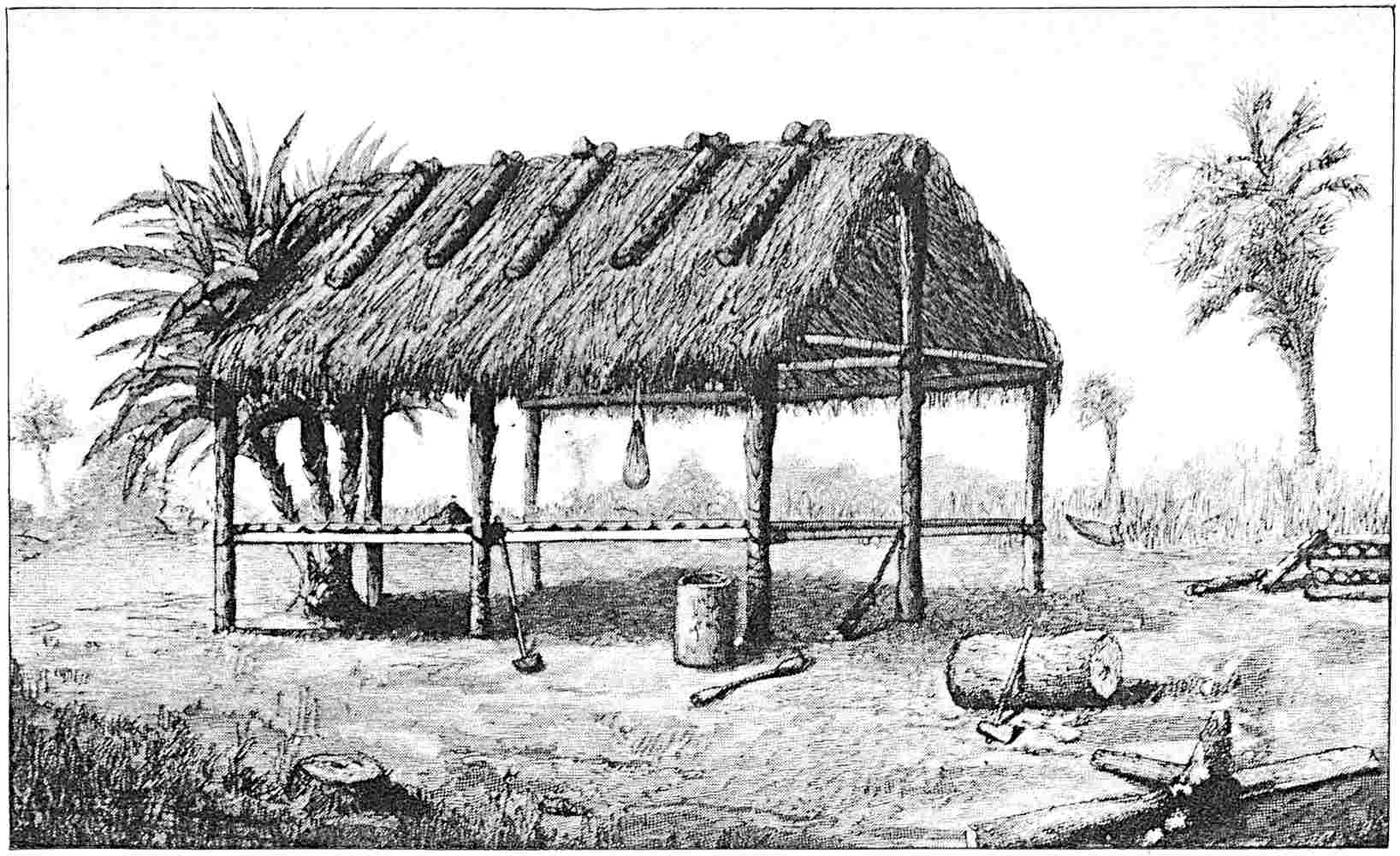
By the courtesy of the American Bureau of Ethnology.
A SEMINOLE DWELLING
The life of the Seminole has been without any aid or instruction from the white man. He has adopted a few of the implements, weapons and utensils of civilization; but in no other way has he imitated his pale-faced brother. In the natural course of evolution he has made some progress; he has not degenerated.
Government reports show an annual appropriation of almost $7,000,000 for the Indian service; yet the Florida Indian has not received any part of it and without it he has shown a prosperous condition. The Smithsonian report, in comparing this interesting people with the native white settlers, says “that success in agriculture and domestic industries is not to be attributed wholly to the favorable character of the climate and soil; for, surrounded by the same conditions, many white men are lazy and improvident, while the Seminoles are industrious and frugal.”
President Cleveland in his message for 1895 pertinently says, “In these days, when white agriculturists and stock raisers of experience and intelligence find their lot a hard one, we ought not to expect Indians to support themselves on lands usually allotted to them.”
Years later, while the late lamented ex-President was fishing in New River at the edge of the Everglades, he said, “This country was made for the Seminoles and they should be permitted to live here undisturbed forever.”
Yet in Florida, we find the red race not only self-sustaining, but refusing any aid from our Government. Twenty years ago the Government appropriated $6,000, “to enable the Seminoles of Florida to obtain homesteads upon the public lands, and to establish themselves thereon.” A few of the Indians consented to accept; but the agent, on investigation, found that the lands which the Indians desired had passed into State or Improvement Companies. Today the Seminole is embittered; and, having been driven from one reservation to another, he refuses to exchange “Indian’s good lands for white man’s bad lands,” and in the bitterness of his conquered spirit, takes his dusky tribe to the dark shadows of the cypress swamps, where no pale-faced Government officer dare disturb him. Again Congress tacked an item to the appropriation act, giving $7,000 “for the support of the Seminoles of Florida, for the erection and furnishing of a school for teachers and the furnishing of seeds and implements for agricultural purposes.” In the winter of 1889, an agent inspired with confidence in himself, and with the hope of manipulating a $12,000 appropriation, came to Florida by appointment from Washington to renew the effort “to find suitable lands upon which to settle the Indians, and to furnish the seat of an educational establishment.” Securing an interpreter the agent visited the Indian camp. A council of chiefs listened quietly to his overtures, but with the same proud spirit of Osceola’s day, they refused firmly to accept any aid from a Government which they regard as having stolen from them the lands of their fathers. As the agent dwelt on the presents the red men of Florida should receive from the big white chief, Tiger Tail, a worthy descendant of the invulnerable Tustenuggee, replied, “You came from Great Chief? You say that Great Chief give Indian plow, wagon, hoe?” Then pointing in the direction of a small settlement of shiftless whites, he added, “He poor man, give ’em him. Indian no want ’em.” Delivering his speech with the spirit of an old Norse King, the chief strode majestically away, leaving the agent no nearer the fulfillment of his trust.
An Indian Agency was established, however, in Florida in 1892, located east of Fort Myers, and about thirty-five miles from the nearest Seminole camp. It was supported by a yearly appropriation of $6,000, the appropriation act reading, “For the support, civilization and instruction of the Seminole Indians in Florida $6,000, one-half of which sum may be expended at the discretion of the Secretary of Interior in procuring permanent homes for said Indians.”
The Government built a saw mill, and attempted a school, but the Indians, according to the statement of Col. C. C. Duncan, U. S. Indian Inspector at that time, refused to send their children to the school or to work at the saw mill. Many white traders who purchase hides, plumes and furs from the Indians, tell them that the establishment of an agency is for the purpose of rounding them up and sending them west. These Indians have been cheated and baffled so often by knaves, who go among them for that purpose, that they imagine all whites to be of the same character, and cannot tell whether a “talk” comes from their great white father at Washington, or whether some imposter be imposing upon them for his own gains; hence, the Seminole never removed his cloak of suspicion. Little progress was made and the work of the agency as a government institution was abandoned.
Once or twice it has been tried to locate the Seminoles, but when the chiefs examined the land, they found it “ho-lo-wa-gus” (no good) and they refused the offer.
NATIONAL INDIAN ASSOCIATION Its Work and its Results
When the National Indian Association first organized, like many innovations in humanitarian work, it met with rebuffs and criticisms, and not until after five years of petitioning to Congress, newspaper recognition and the circulation of leaflets, did the splendid body receive legal recognition and protection for the United States Indians. With this much accomplished, the work became easier and plans to evangelize the Indians of the United States were instituted.
It became the duty of the Association to gather money for the work, establish stations, one by one, finance the expense of building mission cottages and chapels, and then when established, give the station, with all its property, to whichever of the denominational boards should ask for it.
The work has been one of the noblest of pioneer mission labor, for its activities are directed to America’s original owners, whose God-given inheritance should never be questioned by any patriot, whether he be Christian or moralist.
In 1891, this organization entered Florida and the Seminole Indians received recognition and the first ray of Christian light pierced the dark camps of the Everglade Indians.
While the missionary in charge found the work difficult and results were not flattering, still, the seeds were sown that have brought later and better results, and in 1893 the Mission was transferred to the Episcopal Church of the South Florida Diocese.
During the period of the National Organization’s stay in Florida, Congressional agitation of the subject of Seminole lands was aired by deeply interested friends and pauseless workers, and resulted in the voting of 800,000 acres of land by the Florida Legislature as a home for the Seminoles, a gift needing action on the part of Congress to make it a sure and permanent home for this long-neglected people. But this action alas! was never taken.[3]
In giving the Florida Station over to the Episcopal Church, the National Indian Association made no mistake, for through the untiring efforts of the Rt. Rev. William Crane Gray of the South Florida diocese, the mission has each year been getting better results. The Station has been named Im-mo-ka-lee (home), and is situated about thirty-five miles from Fort Myers. Forty miles farther is a hospital, called Glade Cross; here an immense white cross has been erected at the entrance to the glades.
The present arrangement, under the charge of the estimable Rev. Dr. Godden, seems to be solving the mission question better than any former plan. The mission owns a store where the Indians may buy or sell; the missionary in charge may meet and converse personally with the Indians; he wins their friendship and is able by degrees to instill religious thoughts into them. The Rev. Dr. Godden is working along industrial lines, and says, “We must fit these Seminoles by education and Christianity to meet the coming conditions, and teach them to become self-supporting by industrial pursuits and now is the time to do it.”
The work proposed is to erect suitable houses for the residence of the missionary and his family with sufficient room to entertain visiting Indians when in over night and a barrack or rest room for laborers employed in clearing land and working crops.
Writing in 1909 of the work and Mission, Dr. Gray says:
To Bishops, Clergy and Laity of The American Church, Greeting:
I desire to commend most heartily my well-beloved in the Lord, Rev. Irenæus Trout, Missionary to the Seminole Indians in Southern Florida. I believe that God has in a marvelous way designated him as the very man to go forward with the work in which he has already been signally blessed, viz: that of leading the Seminoles into the Kingdom of our Lord Jesus Christ. We are now at the very crisis of opportunity.
Hear him and help him. Here is a cry, not from Europe, Asia or Africa, but from the Everglades, in your own Florida: “Come and help us!” A thousand prayers accompany him from this Missionary District.
God gives you the privilege of helping this poor Seminole remnant into the kingdom.
Faithfully, For Christ and the Church,
(Seal)Wm. Crane Gray, Bishop of Southern Fla.
The Cathedral Church Of St. Luke, Orlando, Fla., Jan. 15, 1909.
THE FRIENDS OF THE FLORIDA SEMINOLES.
A few years ago great interest was manifested in these Florida wards, when a Society called “The Friends of the Florida Seminoles” was organized at Kissimmee, Fla., with the Rev. William Crane Gray, Bishop of the South Florida Episcopal Church, President; Rev. D. A. Dodge, Vice-president; Mr. James M. Willson, Jr., Secretary, and State Senator C. A. Carson, Treasurer. Other officers (trustees) were the late George W. Wilson, Editor-in-chief of the Florida Times-Union; Hon. J. R. Parrott, President of the Florida East Coast Railroad Co., and Capt. F. M. Hendry, Fort Myers, Fla.
This body, assisted by the active interest and sympathy of Gov. W. D. Bloxam, Mr. P. A. Van Agnew, and Mr. Kirk Munroe, made it possible for the Society to accomplish its State-wide results, numbering among its members philanthropic people from Maine to California.
The object of this society was to enlist the sympathy of the American people for these homeless people and to strenuously oppose the removal of the Seminoles from the State against their consent. No really true American, whether he be an Indian sympathizer or not, can feel any but sympathy for the Florida Seminole if he understand the true status of his condition, and when the Society of the Friends of the Florida Seminoles was established, a great wave of sympathy was felt all over the country and requests for membership came in from all ranks, the highest circles of finance, from social leaders, educational centers and government officials. It was recognized an honor to belong to the organization.
The membership list is still open and the Society earnestly appeals to the people of America to take a friendly interest in the future fate of this forlorn remnant, who are one of Florida’s most native possessions, and to aid in securing for them permanent homes in the unsettled portions of the State before it is too late.
The interest and work of the Society was greatly aided through the editorial columns of Harper’s Weekly, when Edward S. Martin made an appeal in behalf of that band of Seminoles known as the Cow Creeks. The object was to purchase a tract of land on which was located about seventy-five Indians. They had lived here for thirty years, cultivating part of the land and using the rest as a range for their hogs, but as they had no legal title to the land, they were at the mercy of squatters who coveted them. About four hundred dollars were raised, but when the attempt was made to locate these Indians, cowboys and land-grabbers had alarmed them, by telling them that the Government was getting ready to round them up and take them West, and like frightened deer they left their homes and retired again to the swamp fastnesses.
The Society purchased some fields upon which the Indians were camping with Harper’s fund—the remainder of the funds being held in trust for its original purpose. The Society secured great public sentiment in their favor, and hoped to obtain lands through legislation. Centuries of wrong from hands too powerful to be resisted have taught these red Americans the patience of despair.
Amid the blessings of Christianity, the Seminole is an outcast from sympathy and an alien to hope, yet he has never ceased to be manly. While we protect the deer and the alligator, the quail and the fish, shall we leave our brother in bronze a prey to the lawless and a helpless victim of every loafer?
The only way to protect these wards of Florida is to buy a reservation, and hold it in trust for them—forever.
Even at this writing, that trackless waste of saw-grass and water with its scattering islands and lagoons, constitutes the great political question among Florida people—the drainage of the Everglades.
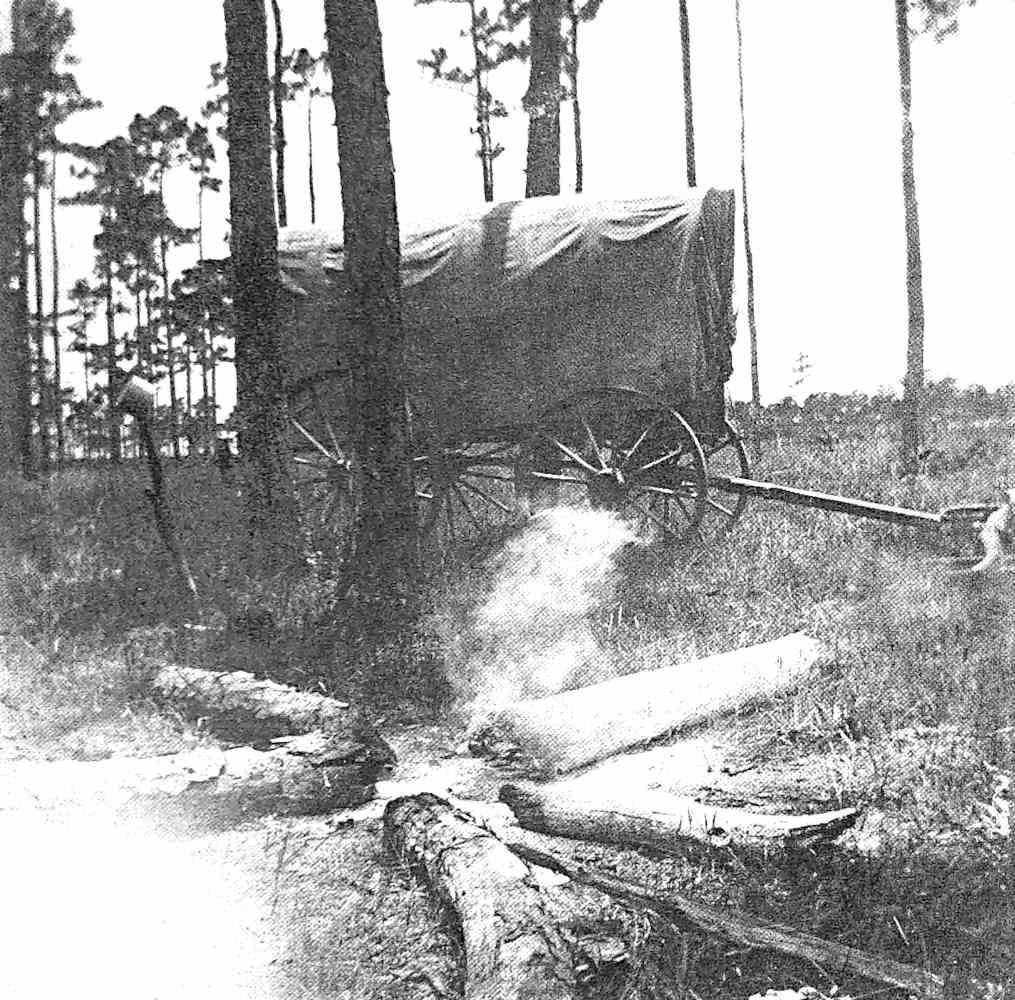
A SEMINOLE CAMP-FIRE The Indian mode of making a fire.
We cannot but admire the proud and independent spirit of the Seminole as he refuses, in firm but Indian-like measures, the proffered liberality of a Government which he believes has wronged him. And, from his high pinnacle of pride, he certainly bears the distinction of being the only American who has been found unwilling to share the spoils of the nation. So he says, “We have listened to the great father at Washington. The Great Spirit wishes no change in his red children. If you teach our children the knowledge of the white people, they will cease to be Indians. To know how to read and write is very good for white men, but very bad for red men. Long time ago, some of our fathers wrote upon a little piece of paper without the nation knowing anything about it. When the agent called the Indians together he told them the little paper was a treaty which their brethren had made with the great father at Washington, and lo! they found that their brethren by knowing how to write, had sold their lands and the graves of their fathers to the white race. Tell our great father at Washington that we want no schools, neither books, for reading and writing makes very bad Indians. We are satisfied. Let us alone.” After this speech delivered in the native tongue, the council breaks up, and the proud Seminole betakes himself to the Everglades. The Seminole is disposed to make a child’s bargain with the big white chief: “You let me alone, and I will let you alone.”
Photographs of the Carlisle Indian boys have been used to illustrate the improvement which follows education; but the Seminole youth turns away with disdain, as he notes the closely shaven head and the American dress, and says, “Indian no want books, make ’em white man, white man mean heap lie too much.” With a gesture faithful to the Indian, he refers to the “long time ago, Seminoles had lands, cattle, slaves; white man steal ’em.” This statement of the Indians is corroborated by the old white settlers of to-day, who fought the Indians. They tell that General Jessup’s army, on coming to the great cattle country of South Florida, began a systematic slaughter of all the cattle found. A body of soldiers, too large to fear an attack, would round up a herd of the Indian’s cattle and sitting on their horses, shoot them all down. Up to this time the Indians were regular stock dealers, their customers being the Cubans and Minorcans. General Jessup’s report of his march into the “Indian country,” says, “On the 28th (January, 1837), the army moved forward and occupied a strong position on ‘Ta-hop-ka-li-ga’ Lake, where several hundred head of cattle were obtained.”
The tribe to-day are taught by the chiefs to regard the whites, in general, as lacking in honor and courage, weak and insignificant, or in Seminole dialect, “white man—ho-lo-wa-gus” (no good). This is easily understood when we consider the strong attachment an Indian bears to his native hunting grounds; and when the memory runs back to the time when our Government banished their friends and relatives to the unknown wilds of the West, and they went silent and weeping toward the setting sun. Their bitterness is consistent with their ideas of injustices practiced upon them.
History, romance and poetry have held up the characteristics of the red man to our gaze from childhood. And while treachery may be a distinguishing feature of the Indian nature, yet the lowest one of them has some conception of honor when fairly approached. History shows that all through the Seminole war, misrepresentations and dishonorable schemes were practiced against them by the whites. Almost universal sympathy goes out to this remnant of people who fought so bravely and so persistently for the land of their birth, for their homes, for the burial place of their kindred. As their traditions tell them of the oppression their people suffered as they wandered in the wilderness thrice forty years, who can tell the secret of their hearts? To do this, it would be necessary to become, for the time, an Indian, to put ourselves in his place—and what white man has ever done this? Ask the waters of Tohopeliga, or the winds that waft across Okeechobee. To the elements are whispered the heart throbs of these red fawns of the forest. The present Florida Indians are descendants of that invincible tribe who were never conquered by the force of arms. Refusing in 1842 to accompany their people to the mysterious West, they ceased to exist save for themselves. Finding refuge in the almost inaccessible Everglades, they were for a time almost lost to the historian. They have no legal existence, and hence no rights that a white man is bound, by law, to respect. There are no Indian troubles in Florida at present, but every few months a cry comes from hungry land-grabbers, or from trappers and hunters, that the Seminoles are killing off the deer and plume birds. The changing conditions in the lower peninsular country will eventually lead up to difficulties; and “Where shall we locate the Indians?” becomes a serious problem.
The Florida Times-Union editorially says:
All the murderous, cut-throat, unkempt and squalid Indians in the United States whom the Government fears are provided with reservations and such luxuries as they never before had in their lives, but the Seminoles of Florida, the finest specimens of Indian manhood in this country, clean in body, pure in morals, and as brave as the lion that roams the desert, with whom so many treaties have been wantonly broken, are being driven farther and farther into the Everglades and their hunting grounds confiscated to the land grabbers. Is this justice?
Should the whites drive off the Seminoles, and thus approve their greed for land by taking the possessions the Indians now occupy, what good would it do them? Internal improvement companies, by their franchises, would sooner or later take the blood-stained acres from them. Let settlers in Florida, or in any part of the country, turn over their accounts and see how many acres have been credited to them, either from the State or from the general Government, without the equivalent of homesteading or for cash. The “Western” style of disposing of the Indian’s inheritance must not be followed in fair Florida. It seems hard that these natives who ask no aid of our nation, should be forced to the wall by the march of civilization. To the Western Indians, under the protection of the Government, and supplied in a large measure by the taxes which civilization pays, pages are devoted by philanthropists for the betterment of their condition. The rights of the Seminoles of Florida should be defended. The day is not far distant when they must be made to go to the reservation in Arkansas or to lands set apart for them in Florida. To remove them from their tropical homes to the chilling blasts of the Indian Territory would be an act of cruelty and wholly unnecessary. Those of us who have enjoyed life in this land of the palm, this land of the balmy air and life-giving sunshine, reveling in the eternal bloom of the flowers and the ceaseless song of the birds, can well picture the struggle it would cost the patient Seminole to be forced to a cold western land. No, fair Florida, the ancestors of these proud people were forced to the country of the setting sun silent and dejected. But, with the spirit of Osceola, if they must perish, it will be here—here upon the land of their birth, upon the graves of their kindred. The lands they now occupy are of little value to the white race and might be made a safe reserve for them—forever. Cowboys who hunt upon the Okeechobee plains, say the Indians are peaceably disposed and friendly, and have never yet disturbed or threatened. They are certainly not foot-sore for the warpath and are fearful of doing anything to arouse the whites. “Indian no fight,” is the answer to the questioner. They have sense enough to know that if war should come again it would mean extermination for them; and their love for the “Flower Land” is so deep that the thought of exile would cost a struggle they dare not attempt. Yet, feeble remnant that they are, with the same heroic blood coursing their veins that inspired their ancestors and made them almost invulnerable, the present Seminole would choose to die rather than submit to removal. And in their swampy fastnesses, they could maintain a contest that would cost us thousands of dollars and many precious lives.
OUR DUTY TO THESE WARDS OF THE NATION.
Under the present status the Seminoles are prosperous, happy and contented. But the vanguard of civilization is marching on, and thinking, friendly minds must solve the question of the protection for this remnant of a tribe we have dispossessed of their natural rights. Dwellers of every land, from Scandinavia to the Congo have a Christian welcome to our shores. The slums of Europe pour in upon us to fill our almshouses and to be supported by our taxes. We have during the past quarter century contributed more than $50,000,000 to the education of the freedmen, yet except in individual cases, the improvement is scarcely noticeable.
Men and women are sacrificing their lives for the heathen of other lands. Is not the Seminole, this remnant of a long-persecuted people, as worthy of consideration as the oppressed Cuban or the half-naked Filipino?
Christianity is donating millions of money to this end, while our own “wards,” too many of them, are yet living in the dark superstitions of their fathers.
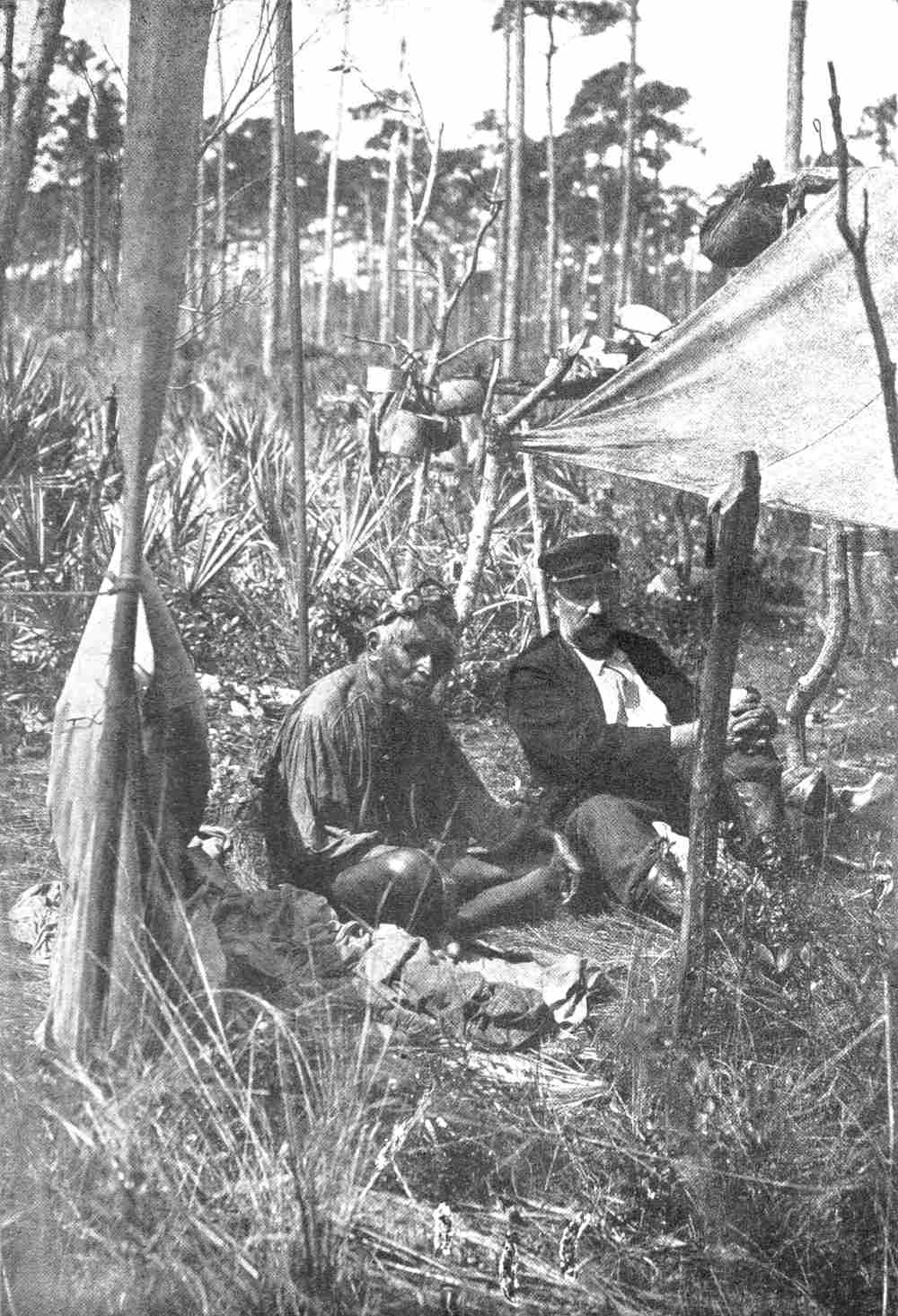
Photograph by E. W. Histed.
CHIEFTAIN TALLAHASSEE, WITH HIS WHITE FRIEND, THE LATE L. A. WILLSON
“The very history of the tribe is carved in poor Tallahassee’s face. He is the incarnation of ‘The Man without a Country.’”
It is possible it will take time and patience before any shining results are apparent. Not until confidence is restored will the embittered Seminole yield to the overtures of our Government. In an educational sense the older Indians will not be benefited, except through the influence of their children. The logic of events demands absorption of this people into our National life, not as Indians, but as American citizens; and the sooner they can be induced to accept lands from the Government, and education for the youth, the sooner will the civilization of the Seminole cease to be a theory. The permanent duty of the hour is to prepare the rising generation for the new order of events that must come. Because these bands of the Seminoles are prouder, more invincible than the old Saxons, because they are savages, yet heroes many of them, all the good of life should not be withheld from them. It has taken years of labor to obtain the shining of even the few rays of light that relieve the gloom of the heathen countries of the Orient. It would be unreasonable to expect the offspring of savages to attain in a short time to anything like the thrift of a Nation like ours. Yet, with a few years of humane treatment, unviolated pledges, with Christian and patriotic examples set before them, this little band of Florida Indians would become worthy representatives of this fair land.
Were any future danger to threaten the United States, the Seminoles would be found to be brave allies. The pledge to General Worth by this remnant of hostiles, who, in 1842, refused to emigrate with the rest of their tribe, temporarily agreeing “to confine themselves to certain limits and abstain from all aggressions upon their white neighbors,” seems to be held sacred by their descendants. The question was put to Billy Bowlegs, one of the most intelligent of the present Indians, as to what his people would do were the whites to encroach, and take the clearings of his tribe are now occupying, “Would Indian fight?” The young brave replied with downcast face, “Indian no fight, Indian no kill, Indian go.” Pursuing the subject further, “but, Billy, by and by, may be one year, five years, may be, white man go, take all your land, take Okeechobee, then where will Indians go?” With the same bowed head, the answer came low and soft, “Me don’t know—Indian go.” Then to test his idea of an ally, the question was asked, “What would Seminole Indians do, Billy, if the Spaniards from across the big salt water would come to fight the white people of Florida?” Quickly and with spirit came the answer, “Indians help white man to fight.” Unless action be taken, there will come a time, when, leaving no trace behind them, the Seminole shall pass out of the world. He shall go, like the mist.
We cannot undo the past, but the future is in the hands of the people. In Canada there are over 100,000 Indians. They are called the Indian subjects of His Majesty; all held amenable to the law and protected by it. Statistics show that on one side of the line the nation has spent millions of money in Indian wars, while on the other, with the same greedy Anglo-Saxon race, not one dollar has been spent, and there has never been a massacre.
The caustic remark that the only good Indian is a dead Indian might apply to the savage Apache; but when one has studied the home life of the Seminoles, observed their domestic felicity, from which many white men might take example, noted their peaceful, contented character, he can only see in them an attractive race, and worthy the proud lineage they claim. Surely if ever the strong were bound to aid the weak, we are bound to help them, to treat them as human beings, possessed of human rights, and deserving the protection of American law. This without doubt, they will be willing to accept, when our nation by kind, courteous and honorable means secures their lost confidence; and when our National Christianity shall take measures to make our land for them a home where they may dwell in peace and safety.
CHIEF TALLAHASSEE.
Almost four hundred years have passed since that fair April day when Ponce de Leon anchored on the verdant shores of Florida. Since the Spanish cavalier planted the silken flag of Spain upon her soil, Florida has been surrounded by a halo of romance and tragedy. Between the time of her discovery and to-day, what marvelous scenes have been witnessed upon her fair plains and along the borders of her wild, dark rivers.
The ancient race who greeted the old Castilian has vanished and, save in the little band of Seminoles secreted in the mysterious and weird wilderness of the Everglades, no trace of the red man is visible. A description of a type of this fragment of a people will enable the reader to form a better conception of the tribe as a whole; and no name is more worthy to place in these pages than that of Tallahassee.
The old chieftain in appearance is noble and intellectual, and there is that in his look and bearing which at once pronounces him something more than the mere leader of a savage tribe. While his silvered head marks the cycle of many years, in his attire of scarlet and white, embraced by the traditional brightly beaded sash, he exhibits a dignified and patriarchial bearing. His countenance, while indeed mellowed with the cares of four-score years and ten, is kindly, and shows a conquered spirit. The lineaments of noble features are traceable in the broad forehead, the firm, thin lips, and eyes that might pierce the rays of the sun. Tallahassee shows no resentment to the whites, yet he believes that they have treated the Indian badly.
It may seem strange to talk of gentlemanliness in an untutored savage, but the demeanor of this Seminole chief must dignify any family in the land. But that face! Heaven forbid that any native of free America should wear so sad, almost heartbroken an expression as that which seams poor Tallahassee’s face. No child could look upon it without being impressed by its mournful pathos. The very history of the tribe is carved there.
When Osceola, with his compatriots, went on the warpath, Tallahassee was a small boy, and remembers well when his father and a few companions were surrounded and killed by the soldiers near Tallahassee, the capital of the State. Chipco, the chief of the tribe, was Tallahassee’s uncle; he escaped from the soldiers, and made his way to the Everglades where he lived to be nearly one hundred years old. Rosa, the sister of Tallahassee, became his squaw. They were childless, and at Chipco’s death, Tallahassee inherited the title, but as a reward for bravery displayed in saving his life on two occasions, Chipco had made him chief years before he died.
There is no trace of a revengeful spirit in either word or manner when Tallahassee speaks of his father’s tragic death, but with the stoicism of a philosopher, he seems to have accepted it as one of the cruel fortunes of war, and has nobly “buried the tomahawk.” Tallahassee is no stern warrior with blood-stained hands, but wears worthily the dignities of his ancestral station, and in many ways might be imitated with profit by his more cultured pale-faced brother. He is a true type of the “noble red man,” and in any other walk of life would have risen to eminence. Of all the Seminoles, Tallahassee is the most friendly to the whites. With the inborn courtesy that is native to all true greatness, this untutored Indian will welcome you to his wigwam and with royal grace dispense the hospitalities at his command. Few enter his presence, and none leave it without this mental tribute to his high character. The old chief is treated with care and consideration, and a homage is paid to him by the younger members of the tribe. Among the Seminoles, when a member of the tribe becomes too old for usefulness or self-help, it becomes the duty of the young men to contribute their share to his support. They are taught to do this more as an honor than as a burden.
As the years pass, more pathetic grows the life of the hereditary chieftain.
A few years ago, after numerous invitations, Tallahassee was persuaded to leave his swamp home to make a visit to the home of the writer. The old patriarch was accompanied by Billy Bowlegs, who showed the tenderest care for him. With one horse between them they traveled from the Everglades to Bassinger, the terminus of the steamboat line to Kissimmee. Then they boarded the steamer Roseada, arriving at Kissimmee after two days’ river travel. They attracted much attention and were the recipients of many small presents from sympathetic friends. They were both in full costume, the old chief wearing the regalia of his rank, sashes of bead work and red beaded leggins. On reaching the home of their host, they immediately began unpacking the bundle they carried, which indicated they had been preparing for many moons back for this eventful visit. Numerous garments, new and fanciful, were carefully withdrawn. The next morning being the Sabbath, they dressed with greatest care for the Sunday School and church services, which they enjoyed to the fullest. Knowing the famous chieftain would attend service, the church was crowded and at the close of the services parents with their children crowded around the old chieftain eager to shake hands with him; and with a pleasant beam of gratitude in his eyes, he received these greetings of the white friends.
It is a pleasing fact that Tallahassee, a savage and the representative of an almost destitute people, received a homage and as kindly a greeting as was ever accorded to any visitor to the little city of Kissimmee. However adverse a man may be to the Florida Indian in general, if he looks into the history of the Seminoles of Florida, he not only becomes friendly, but eager to see justice meted out to them.
As Tallahassee bade “good-bye,” he said, “Me no more come to Kissimmee City—old too much.” He had come as an ambassador of his tribe to tell his white friends the history of his race, and as memory went back to the olden days of bloodshed and accounts of home after home wrested from his people, he trembled with suppressed emotion. Anguish, interblended with the mournful pathos of his face, made a picture too sad to look upon. It was a period of agonizing struggle for this gallant, but conquered Seminole.
Sad and prophetic were his farewell words, for a short time after he reached his swamp home, he was taken with violent pains in his head, and as Billy Bowlegs reported it, “Pain three days—pain go,—Tallahassee blind ojus” (heap). The old chieftain, though totally blind and physically helpless, rules his band with the same stoic will of days long ago, when he carried them to the wilderness and wrenched them from the white man’s bullets and Uncle Sam’s bloodhounds.[4]
INCREASING.
It is generally believed that the Seminoles are dying off, and can last but a few years longer. On the contrary, they have large families of strong, healthy children, and the past ten years has shown a marked increase in their number. The strict law allowing no persons of like gens to marry is a reason why the tribe does not multiply still more rapidly. There are instances where eligible young men find great difficulty in getting wives because of the strictness governing the gens or consanguinity law. One chief has two daughters who find the same trouble in getting married because the men of their choice are too closely connected to them. Thus, a member of the Deer clan may not marry into the same clan, no difference how far removed the relationship may be. Relationship on the father’s side is not guarded against so strenuously, as the gens is all counted through the mother. Very often the law of marriage causes strange alliances—young men twenty years of age having old women for wives. From the best obtainable resources, there were in the year 1859, only one hundred and twelve Indians left in Florida. In 1880, by actual count, as reported by the Smithsonian Institute, the Seminoles of Florida numbered two hundred and eight. According to data gotten from the Indians themselves the tribe to-day numbers nearly six hundred. Of this number a great proportion are young children, or in the language of the chief as he made a numerical calculation of the members of the different families—“heap pikcanannies, pikcaninnies ojus” (plenty). The Seminoles are divided into four bands, who live in groups apart; each independent of the other, but in friendly relation. They are the Miami Indians, the Big Cypress band, the Talla-hassees and the Okeechobees. Since the death of Woxo-mic-co (Great Chief) five years ago, no one has been elected to fill his place, and it is doubtful if his office will ever be filled.
No event in the history of the Seminole tribe since the closing of the war has been more tragic than the slaughter of eight of the band, by the hand of Jim Jumper, a half-breed belonging to the tribe. The killing occurred in February, 1891. According to the Indians, the negro had bought some bad whiskey from a white trader, and it made him “crazy too much in his head”—doubtless delirium tremens. With his Winchester in his hand he started out. The first victim was his faithful squaw who happened to be close by. Rushing forward and through the camp and meeting the venerable Woxo-mic-co, head chief over all the tribe, who was on a visit to the Cow Creek band from his council lodge at Miami, the crazy half-breed sent a ball through the old chief’s head, killing him instantly. Old Tom Tiger, one of the landmarks of the Indian wars, hearing the firing, came to the rescue, but was shot down before he had time to interpose. Young Tiger, stepping out of the wigwam in time to see his father fall to the ground, with a blood-curdling war-whoop sprang upon the maniac and a hand-to-hand fight ensued; but he was at the wrong end of the rifle, and before he could wrest it from his antagonist, another report was followed by the death-cry of the brave, young Indian. The wildest panic ensued, the women and children huddling in their wigwams or fleeing to the woods. The murderer now rushed into the wigwam of his sister, and with his knife murdered her and her two little children, who were clinging to her dress in terror. Brandishing his knife, he started into the woods, where he was killed by a bullet from Billy Martin’s rifle. The wailing and the anguish in that camp can better be imagined than described. After the burial ceremony over the murdered victims, the body of the murderer was dragged far into the swamp, to be fed upon by the vultures. Thus passed away in less than half an hour eight innocent lives, victims to the demoralizing influence of the white man’s whiskey. The Indian village was broken up, the entire band moving away to escape the visitations of the spirits of the murdered ones.
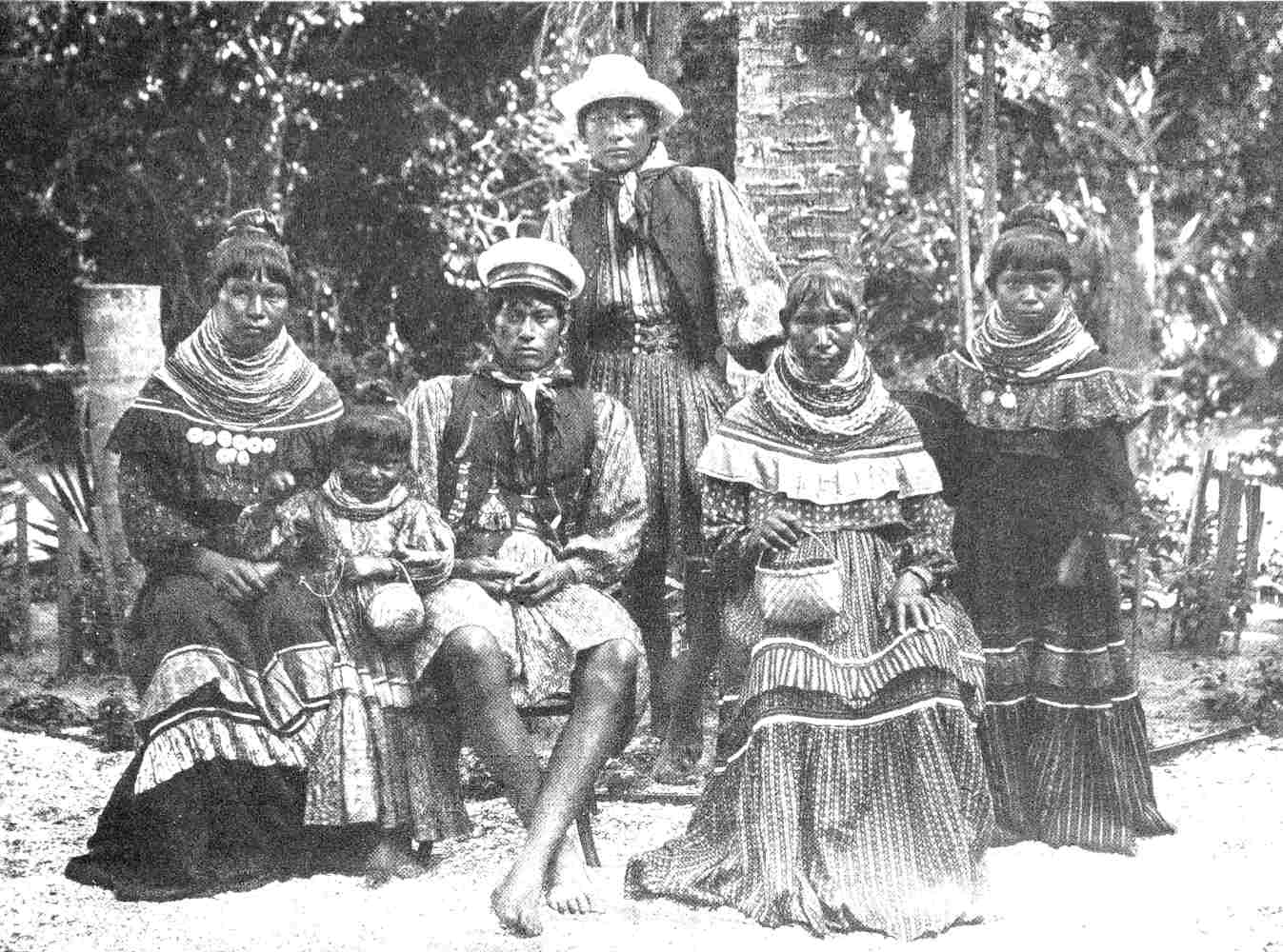
Photograph by E. W. Histed.
A SEMINOLE GROUP OF THE TALLAHASSEE BAND, KNOWN AS THE COW CREEKS
A people without a country.
On the death of Woxo-mic-co, four candidates for the position of Big Chief appeared, but five years have passed and yet no chief has been elected. In the old chieftain’s death the last vestige of Seminole war spirit is obliterated. Nowhere in their history is their determination to live at peace with their white neighbors more conclusively proven than in the abolition of the office of Great Chief, “Big Chief” and war councils, in their minds, being inseparable.
The authority of the sub-chiefs, who are leaders of the different bands, is purely personal; they cannot decree punishment—a jury or council alone can do this. The government is not harsh, and there is as much freedom as could be possible in these forest homes.
APPEARANCE AND DRESS.
In personal appearance, many a Seminole brave might be taken as a type of physical excellence. He is bright copper in color, is over six feet in height, his carriage is self-reliant, deliberate and strong. His step has all the lightness and elasticity that nature and practice can combine to produce, as lithe and soft as the tread of a tiger. The Yale, the Harvard or the Oxford student with years of training in the athletic school, would be but a novice in the art of grace, suppleness and mode of walking, as compared with this son of the forest. His features are regular, his eyes jet black and vigilant, always on the alert; his nose is straight but slightly broadened, his mouth firm as a stoic’s. The hair is cut close to the head, except the traditional scalplock of his fathers, which is plaited and generally concealed under the large turban that adorns his head.
The dress of the Seminole chief consists of a tunic embraced by a bright sash, close fitting leggins of deer-skin, which are embellished with delicately cut thongs of the same material, that hang in graceful lines from the waist to the ankle, where they meet the moccasin. The moccasin is also made of deer-skin, and covers a foot shapely and smaller than that of the average white man. A picturesque feature of the dress is the turban. Oriental in its effect, it has become the emblem of the race. It is worn almost constantly; and is made impromptu from shawls or colossal handkerchiefs wrapped round and round the head and then secured in shape by a band, often made of beaten silver which encircles the whole with brilliant effect. With young braves the more important the occasion, the more enormous the turban. Another characteristic of the dress is the number of handkerchiefs worn, knotted loosely about the neck. Regardless of the temperature, the Indian adorns himself with six, eight or perhaps a dozen of bright bandannas, exhibiting great pride in the number he possesses. A belt made of buckskin completes the costume. From this are suspended a hunting knife, a revolver, a pouch in which is carried the ammunition and small articles necessary for the chase.
The physique of the women will compare favorably with that of the men. They are healthy and robust, and among the younger members some comely well-featured women are found. The dress of the squaw is very simple, consisting of a straight, full skirt, made long enough to hide the feet. The upper part of the dress is a long sleeve, loose-fitting waist, which fails to meet the waist band of the skirt by about two inches; this oddly fashioned garment is cut large enough in the neck to be put on or taken off over the head. A large collar, fashioned after the collarettes worn by the fashionables of the season of 1896, completes the toilet. A Seminole woman wears no head-dress of any description. Even when visiting the white settlements they go with their heads uncovered. Neither do they wear moccasins, at home or abroad, in winter or in summer. They are always bare-footed.
Vanity and coquetry are inborn in the female character. The Seminole maiden whose life has been spent among the swamps “far from the madding crowd” and fashion’s emporium, still practices the arts of her pale faced sister. She affects the bang and the psyche knot with as much ease as the New York belle, and with such metropolitan airs soon captivates her forest lover. The same passionate desire for gold and jewels, ever uppermost in the heart of the civilized white woman, be she peasant or queen, shows itself in the Seminole squaw. Silver breast-plates, made from quarters and half dollars, beaten into various designs, add to their personal adornment on festal occasions. What the turban is to the brave, such is the necklace of beads to the woman. It is her chief glory and is worn constantly. Her ambition seems to be to gather as many strings of these highly colored beads about the neck as she can carry, often burdening herself with several pounds. Even the wee tots are adorned with small strings of the much prized necklace.
Many years ago, when the Indians were encamped on the Kissimmee River, Chief Tallahassee with two or three of the squaws visited Kissimmee. Being taken into a room to see a newly-born babe, he directed a squaw to take from her neck a string of beads and put it around the neck of the “little white pappoose.” This was done as an act of greatest honor, to show the Indian’s appreciation of hospitalities received at this house.
INDEPENDENCE AND HONOR.
To-day as we meet the Seminole “at home,” we find the wigwam made of palmetto leaves and the skins of wild animals; the floor of this structure is made of split logs and elevated about two feet above the ground. A few of the Indians have in late years built board houses, but the roof is made of palmetto thatch. Here, surrounded by the gloom and weirdness of the Everglades, miles from white man’s habitation, the baying of the alligator, the hooting of the great horn owl, and the croaking of the heron are the only sounds to be heard. Truly the picture is one of melancholy and profound dreariness. But here we find the aborigines contented because they are out of the white man’s power. Here they hold their councils, here around the camp fires the traditions of the old turbaned tribe are taught to the youths; here, too, they follow the same customs of the race of one hundred and fifty years ago. Here is instilled into the youth the story of the perfidies practiced upon their fathers by the white man; and as the children listen to the glories of Osceola, and the tragic ending of their hero, the spirit of conservatism is engendered, and with swelling hearts they go on, on, resolute in their determination to avoid disaster, by keeping aloof from the white man. Although far from the influence of civilization, knowledge has come to these people naturally which we have painfully acquired by books. Driven to these Florida jungles after a seven years’ bloody war, here the Seminole, thrown absolutely upon his own resources, has continued to dwell. He has accepted no aid, his people have increased, and in a manner have prospered. No alms-houses are supported for their benefit. This independent Indian does not increase the expense of the jail nor the penitentiary; he is no starving Indian who must be fed at the expense of the Government. In these red sons of the forest we meet the original “real Indian,” unchanged by contact with the white man. The visitor to the “Wild West,” who complains that “the Indians do not look like the Indians of fifty years ago,” would have little ground for his complaint were he to visit the Seminoles in their marshy fastnesses. Florida can boast of one of the few tribes of “real Indians” in the United States. The present Seminole must be credited with a high sense of honor; and he can keep a pledge as well as did Massasoit. A few years ago, during a terrific coast storm some Indian braves asked shelter of a Florida settler. The Indians were received and entertained until the weather settled. On leaving, the chief sweeping his hand toward the broad Savannah, said, “Captain, hunt deer?” The answer was “Sometimes.” “Indian no hunt Captain’s deer,” was the rejoinder. Very little in itself, but it meant much, for since that time there has not been an Indian hunter within miles of the place.
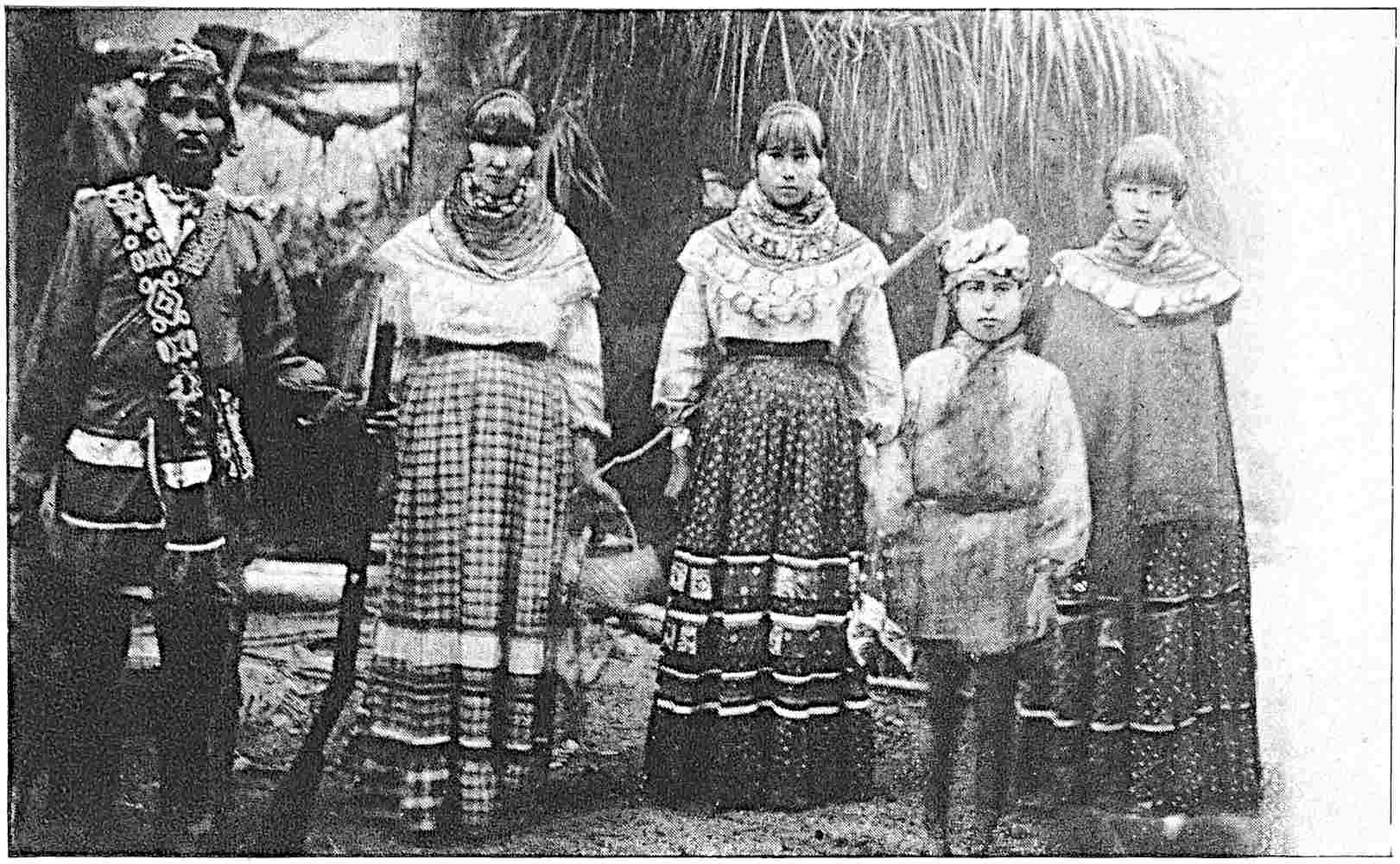
CHIEF TALLAHASSEE MARTHA TIGER SHE YO HEE TOMMY HILL MILAKEE
Famed in song and story is the pledge of the old turbaned tribe of the Seminoles. Not more worthy are they of commemoration than their descendants of to-day. A few months ago, Billy Bowlegs and Tommy Doctor paid an unexpected visit to Kissimmee. They walked from their camp at Okeechobee Marsh, a distance of one hundred and twenty-five miles to tell their white friend that “Indians no lie.” This was all. They apparently had no other business in town, and after a few hours’ visit left as quietly as they had come. Their mission was completed, their white brother believed them, their honor was clear; they could now dance at the Green Corn Dance with merry hearts.
A few months prior to this, these Indians had promised their white friend to act as guide on a bear hunt in the Everglades. All arrangements had been made for the hunt, except to fix the time and place of meeting. This was to be done through a white settler. Later, plans for the hunt were perfected, and word was sent to the Indian village. According to their promise the Indians came to the settler’s home on the day specified, but found that the white man had left his house early in the morning with no message as to how or where the Indians should follow. The Indians, not knowing which way to go to find the party, could do nothing but return to their camp—a distance of forty or fifty miles. Subsequent developments proved that the white man wished to act as guide, and thereby earn for himself the remuneration he expected the Indians would receive.
THE SEMINOLE’S UNWRITTEN VERDICT OF THE WHITE RACE.
“Es-ta-had-kee, ho-lo-wa-gus, lox-ee-o-jus” (White man no good, lie too much.)
In some mysterious way, the Seminole’s conception of the Decalogue neither to lie, nor steal, nor cheat, is the foundation stone upon which he builds his character, principle and honor, for it is taught to the race, from the cradle to the grave, to the swinging papoose on its mother’s shoulders, all through life, till the Great Spirit calls to the Happy Hunting Grounds. Let the reader stop and consider that here is a community of hundreds, living in open palmetto camps. No locks, no doors, no courts, and no officers to keep the law; a people, who for generations have lived, pure in morals, with no thieving, no trespassing, and no profanity (for the Seminole has no oath in his language). With his conception of the Deity, he reverences the name of the Great Spirit, and “Thou shalt not take the name of the Lord thy God in vain,” he venerates, as did the Hebrews in the days of Moses. What would be the result if an equal number of the negro race were left under the same conditions for two generations? Nay, what would be the history of six hundred whites forced to live for even twenty-five years like the Seminoles?
With the Seminole’s power to condense into a single phrase, he crystalizes his verdict of the white man into the above forcible expression. In pathetic, but terse language, it tells of generations of wrong treatment at the hands of the white brother; sharp practices and broken treaties, and misrepresentations are all included in the general summing up.
From his oral lexicon, he has chosen these few words, which reveal the throbbing inner soul of these red children of the forests.
No pages, no volumes, no libraries are required to chronicle his experience.
Be it remembered that all history of the relation of the two races has been written by the white historian, but were the Indian to write the story, the other side of the picture would be shown. The complaints of the white man are carried, as it were, on the wings of the wind, while that of the poor Indian is drowned in the tempest.
With a stoicism born of generations of training, the Seminole shows no ill-will, no resentment, and the harshest criticism he ever makes against his white conquerors and victorious brothers is this phrase, “Es-ta-had kee, ho-lo-wag-us, etc.” And whether in vindication of some offense, or given as a simple opinion, his pent-up feelings find expression in this one forcible epithet, and seems to be the missile he hurls at the white man.
The average American with his standard of morals calloused by dealings in the business and social world, smiles at the Seminole’s verdict of his character and with indifferent shrug, jocularly repeats it as being only—the opinion of an Indian.
But, measured by the Indian’s conception of honor, how small we must appear to the Seminole patriot, for, from his unwritten code of ethics, to one who knows the well grounded Indian character, his estimate of white manhood means more than is apparent underneath his calm exterior.
ENDURANCE AND FEASTS.
When one sees the great moral strength of the Seminoles, notes the wonderful physical endurance of which they are capable, observes the fearless, haughty courage they display, he cannot but be surprised that the Florida wars were not more disastrous than they were, or that any of the Seminoles ever yielded to removal. To test their endurance the old chiefs have been known to take a live coal from the camp fire, place it on the wrist and without an emotion let it burn until the heat was exhausted. Tustenuggee would remove the cool ember and quietly reach down and put a fresh one in its place. This old chief, so famous in history, never yielded to removal, and lived till a few years ago with his tribe in the Everglades. The goal of the Seminole is to learn to endure and to achieve. To this end is every Seminole boy educated, and different modes of developing the powers of endurance are employed. Carrying a deer for a long distance without fatigue, walking or running for many miles, jumping, wrestling, poling a canoe, etc., are some of the practical modes. The Spartan spirit is supreme in the minds of the tribe, and the youth are taught that no merit is greater than that of bearing pain without complaint. At the annual feast of the Green Corn Dance the young Indians of a certain age are initiated into the rights of warriors, and are subjected to trying ordeals. They must pass through the “In-sha-pit,” which means the cutting of the legs till the blood flows, and other cruel arts, after which the Indian boy is pronounced a warrior, ready for the battle of life, whatever the Great Spirit decrees. It is the strict adherence to the teachings of their ancestors that makes the present generation the brave and proud people that they are.
Strange as it may seem, the Seminoles celebrate a Christmas—“All same white man’s Kismas,” is their reply when questioned concerning the celebration. This is the great feast day of the “Shot-cay-taw,” (Green Corn Dance) and occurs each year about the first of July, and is the time for assembling the whole band.
The ceremony is largely under the control of the Medicine Men, who are important personages among all bands, and act as advisers, as priests and as doctors. In the authority of the Medicine Man one recognizes a similarity to the priests of the Ancient East as well as the doctrines laid down by the Aztecs. The festivals observed by the Florida Indians show teachings centuries old—blending the peculiarities of different races—the carnival of the Romans, with the Jewish feasts of Moses’s day, and the mystic link of the Aztec jubilee.
The Feast of the Shot-cay-taw has many similarities to the historical records of the National Festival of the Aztecs. The feast is for sorrowing, rejoicing and purifying. This is the beginning of the New Year when, following the traditions of ancient people, old fires are allowed to go out, not a spark is allowed to remain. New fire is produced artificially; this is the Sacred Fire and must be made with the flint rock of their ancestors. The new fire is presented from one tribe to another, and is received as a token of friendship. Then they assemble around the fires singing and dancing. Gratitude is expressed to the Great Spirit, if the year has been abundant. If death has overtaken the tribe mournful strains expressive of pity and supplication are invoked. This custom was borrowed from the ancient tribes who worshipped the sun. The Medicine Men arrange the date for the Green Corn Dance, which is governed by a certain phase of the moon, and runners are sent from band to band to announce the time.
The ceremony preceding the dance permits all men who have evaded the laws to be reinstated by indulging in certain trying ordeals. The transgressors appear a short time before the dance. They are placed in a closed skin tent where a large hot stone lies on the fire. The famous “Black Drink” of Osceola’s time is administered, water is poured on the stone, and the culprits are shut up in this suffocating heat. If they pass the ordeal, they are forgiven and allowed to join in the feasting and dancing when it occurs. This same “Black Drink” which is a nauseating medicine from herbs, is taken by all the tribe on the first day of the dance. This cleanses the system and enables them to “eat, drink, and be merry” to the fullest extent.
At this great re-union, old friendships are revived, courtships take a prominent part, and plans are formulated for hunting expeditions, syrup boilings and “Koonti” gatherings. Members of one settlement will agree to meet certain members of another family at a certain point on a fixed day of the moon.
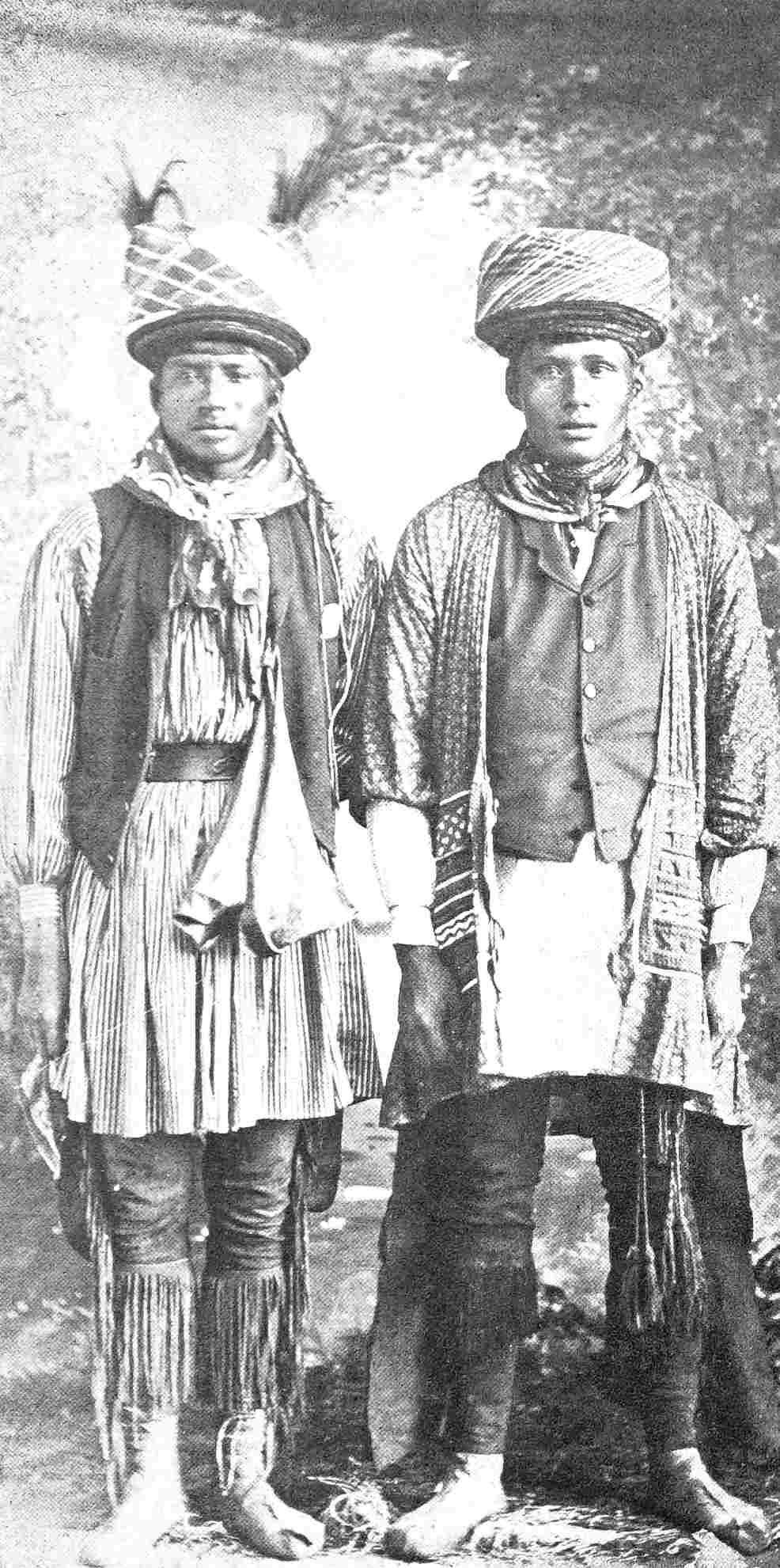
BILLY BOWLEGS AND TOMMY DOCTOR
“They walked one hundred and twenty-five miles to tell their white friend, ‘Indian no lie.’”
There will be no broken pledges—no disappointments. The Seminole promises nothing to his people that he will not fulfill.
One of the most picturesque games enjoyed by the Indians during this festival is the dancing around the festal pole. On the night of the full moon, they dance from sunset until sunrise. It is very interesting to see the harmony in running around the circle. As the women throw the ball at the pole in the center, the men catch it in their bags that are made around bent sticks, which have bows each about four inches in diameter, with a cross at the lower side.
When the dancing is over, the circle about the pole is perfectly symmetrical, and about ten inches deep, made by the running and dancing.
An exciting feature of the dance is the racing for a wife. A level course is laid off and the race begins. The dusky lover selects the maiden for whom he would strive, because he must catch her before he may court her. The Indian girl is his equal, and often his superior in fleetness, and need not be caught unless she so wishes. But, like her civilized sister, she generally encourages the pursuit until she is tired, and then gracefully yields on the homeward stretch. However, should she win the race the young lover need have no further aspirations in that direction. He may be saved the embarrassment of future humiliation.
THE HUNTING DANCE.
But the Hunting Dance! What memories of centuries past are kept alive by this brown-skinned race, as they observe the ancient feast of an aboriginal people.
With an invitation from the old chieftain, Tallahassee, who is patriarch of the tribe, to attend the Hunting Dance or Harvest Feast, the temptation was too great to resist. This festival occurs only in cycles—once every four years—and the character of its observance is known to but few, if any, white people. The Indian camps are so inaccessible that it takes nerve and muscle to reach them; but knowing that the entire band of Indians would be on hand in gala spirits and gorgeous attire, and knowing, too, that it was an opportunity that might come but once in a lifetime, the question of “to go or not to go,” was soon settled, and preparations for the irksome journey were under way.
By train ride of one hundred and sixty miles we reached a little Florida hamlet, where a teamster with a creaking wagon and a pair of lean, cadaverous-looking horses were secured. Then followed a drive of thirty miles through ponds, swamps, prairie flats, slush and water; with sand-flies whirring and buzzing in our ears as they seemed to offer their orchestral escort through the dismal funeral Allapata flats. The journey was nearing its end. The sun, shining with a July fierceness, glinted the wigwams of the Seminoles. Tired and hungry we approached the village. Here the signs of the festival were everywhere apparent. With the inborn courtesy, that is ever present with these untutored Seminoles in the presence of a friend, they met us with royal grace. A wigwam was placed at our disposal, our baggage was unloaded, and in a quiet and unobtrusive manner a fine saddle of venison was presented.
The Indians were bubbling over with excitement, for it was a time of rejoicing—a carnival, when men, women and children all joined in the merriment.
As our visit always means presents for the Indians, expectant faces from the little toddling children, as well as from the older members of the camp, reminded us that it was time to distribute tobacco, pipes, red handkerchiefs, trinkets for the women, candy and nuts for the little ones.
Happiness pervaded the Everglade village. The older Indians, with the exception of the old chief, played like children, keeping the joyous revelry up from hour to hour.
The afternoon of our arrival was devoted to a ball game. An aboriginal ball game! Certainly played by a code of rules more than one hundred and fifty years old, where no curved balls nor Yale coaching had entered, but where swelled and echoed the glad free trump of joy as the game went on with scientific strokes and measured tread, with now and then a “rush” as the ball missed its target and bounded out of its circle. Both men and women participated in the game, the women being as adept as the men. The game is unique, and might be practised with much pleasure by our American boys.
Within a circle whose circumference is about thirty feet is erected a pole, which serves as a goal. The players take sides, or in country school parlance, “choose up.” The object of the game is to strike the pole with the ball, which is knocked with a racket or stick, which is made of hickory, with a netted pocket made of deer thongs.
The ball is tossed up and caught in the netted pocket, and then hurled at the pole. The opposing side endeavor to prevent the ball from touching the post. Sometimes the ball strikes the ground away beyond the line of play, and then a scamper for it is a moment of great excitement. Men, women and children make a rush for the ball, the victor having the next play. A scorekeeper stands by the pole, keeping a record of the play.
As the twilight falls the players end the game and the feast begins. The edibles are distributed into three parts, the men taking their portion and going to a selected spot, the women likewise to a point designated for them, and the children to a third location. This peculiar arrangement is not indulged in at any other time, but has some ancient significance and is followed at this festival.
When the feast is over, which consisted of the fruits of the chase and the best products of the little palmetto-fenced gardens, the band assembled for the grand hunting dance. Campfires burned all around the dancing square, and as the dusky forms emerged from the shadows of the great live oaks, clad as they were in most fantastic attire, the scene was most picturesque.
Women, men and children gathered at the council lodge. Yards and yards of brightly-colored ribbons floated from the head, neck and shoulders of the women, with beads of various hues and many pounds in quantity around their necks, while beaten silver ornaments fastened on their waists added to the decoration. The men, likewise, were in brilliant coats and enormous turbans, with leggins gracefully adorned with the fringe of the doe skin, with moccasins fresh and new. Nor had the children been neglected, for, with swirling ribbons and bright red dresses that reached to their slim ankles, they came bubbling with joy and laughter, ready to take their places in the dance circle.
Now the dancers are ready. In the centre of the square the fire, the Sacred Fire, flashes and flickers. At each corner of the square stands a pole. The leader, who on this occasion is Chief Bill Stewart, waits at the door of the lodge. He starts a weird melody, and the band locks hands, marking time as they make up the chant. The chief leads off the entire band in the procession, making as picturesque a figure as was ever witnessed in a New York cotillion.
With the reader’s permission to digress—pertinent at this point is the ironical comment of an editorial writer in one of the great dailies, when he says, “Fancy Lo in a stove pipe hat.” We have seen him and he makes a good-looking native American. As he approached, the splendid form of Billy Doctor was recognized in stove pipe hat, full evening broadcloth suit, with white cravat, low cut waistcoat, and satin lined “spike tail” coat. The entire outfit was possibly the gift of some Palm Beach tourist. To Billy’s credit, he only wore the costume for fantastic effect.
If the reader will follow the lines of the accompanying diagram, tracing from left, he will see that the long line of dancers, as they pass around the poles, appears to be coming and going, sometimes three and four abreast, but all in such symmetrical motion that the dance is very beautiful, coupled with the grace and modesty of innocence, with an accompaniment of singing strangely sweet.
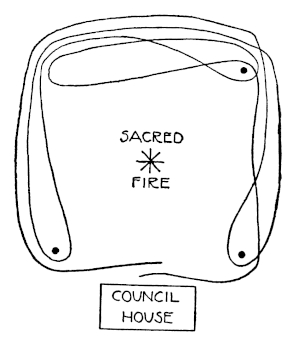
The various dances of these people show how close they live to nature. As they move to the rhythmical cadence of the owl song, we hear “Waugh-ho-ooo-whoo whoo,” of the great horned owl; then the penewa, or wild turkey dance, with its notes of the gobbling bird; and so on with many others.
A feature of the dance, and one that might be commended, is that those who dance must work or hunt. Each morning of the festival every member of the camp, down to the wee child, must hunt, leaving the camp by daybreak and hunting till twelve o’clock noon. The men hunt large game; the boys go for rabbits, birds and squirrels; while the women hunt the hogs and dig potatoes, and the very small children “hunt” water, and bring in sticks of wood. To their white friends, they said, “Dance to-night?” This was intended for an invitation, and was an honor rarely accorded; but with the stern, unwritten law before them, they explained, “White friends must hunt, hunt, hunt. All same Indian. No hunt, no dance.”
Another picturesque game is the dancing around the festal pole. In this dance, the women enter from one side, and the men from another. Around the ankles of the women are strapped clusters of shells of the highland terrapin, partly filled with pebbles; these shells are concealed by the long dress skirt, and as they dance, singing the long-cadenced song of their fathers, they make melodious music. A remarkable feature in the perfection of the dance is that as the women move off not a sound is heard, that bunch of shells is as silent as the tomb; and yet it would be practically impossible for one to move the shells by hand without causing them to rattle.
There is so much that is elevating and purifying in the conduct of these people that it would be hard to describe the scenes, the love and good humor that flash between the moments of the times spent in the council at the feasts and the dances.
SLAVERY.
That slavery existed among the present Seminoles has been a disputed question. That it did is known to a few; but any interference would have been received as an act of impertinence by the Indians, as well as by the slaves themselves; as was evidenced a few years ago when a tourist meeting Tustenuggee’s slave (who was watching his master’s canoe while his master sold some skins) attempted to enlighten the negro on his true condition. As the chief came back to the canoe, the philanthropist stranger began to explain his mission. The chief, with the ferocity which at once stamped him as a true Tustenuggee, ordered the negro to “go,” which command was instantly obeyed. Then, turning to the stranger, he said, “White man’s slave free. Injun este lusta (negro) belong to Injun—now you go.” The philanthropist also quickly obeyed.
Tallahassee’s squaw died about thirty-six years ago, leaving a family of six boys, the youngest one being but a small pickaninny. These boys were cared for by the two negro slaves who spoke only the Seminole language and were perfectly content to do the drudgery for the family. The number of slaves among the remnant left in Florida was small, but they were allied to the Indians and, while treated kindly, they were expected to obey. In the last few years they have all died off with the exception of one old slave, Hannah, in the Tallahassee band.
HANNAH, THE LAST LIVING SLAVE OF THE SEMINOLE INDIANS.
A character holding a position unparalleled in Uncle Sam’s domain, is Hannah, the negro slave, belonging to Tallahassee’s family. She is a full-blooded negress, with thick lips, broad flat nose and kinky hair, which is tied in little plaits with the proverbial string of the Southern negro.
Hannah is the last vestige of Seminole slavery—the one great subject of warfare seventy-five years ago between the Seminoles and the Southern planters, and upon which, truly speaking, was based the “Seven Years’ War.” Hannah does the work of the family, and, though she is kindly treated, yet a certain contempt is felt for her, for Hannah is an este lusta (a negro) and to the haughty Seminole a negro is the lowest of human creatures.
The occasion when Hannah’s picture was kodaked is fresh in memory. All preparations were being made for the feast, but Billy Ham, Tallahassee’s son, had not been able to get a deer, and so had purchased beef from a market thirty miles away. With pots and kettles in evidence, Hannah was preparing the beef, when the little box-like instrument was gently rested on a rail near by. Hannah’s eye detected the object and she turned away, and began busying herself around the boiling kettle on the ground. The camera was adjusted, finger on button ready to snap, and a masked indifference affected, and an animated conversation begun with one of the Indians near by. When Hannah returned to her work about the table, snap! went the button, and Hannah’s ebony face and twisted, string-tied locks was photographed on the plate, and proud was the owner to possess so good a likeness of Uncle Sam’s one and only unfreed slave.
UNWRITTEN LAWS.
The government among the Seminoles is peculiar, it is remarkable, it is magnificent. There is no lying, no stealing, no murder and yet apparently there is no restraining law. The Seminole has many noble traits; he is proverbially truthful. Pertinent was the reply to the hunter when he asked if it was safe to leave his gun in the wigwam. “Yes,” replied the chief, “there is not a white man within fifty miles of the place.”
Reverence, too, is one of his distinguishing features. His language contains no oath, nor any word to express disrespect to the Supreme Being. A missionary will receive most respectful attention, for their reverence to God will not permit them to laugh at His messenger.
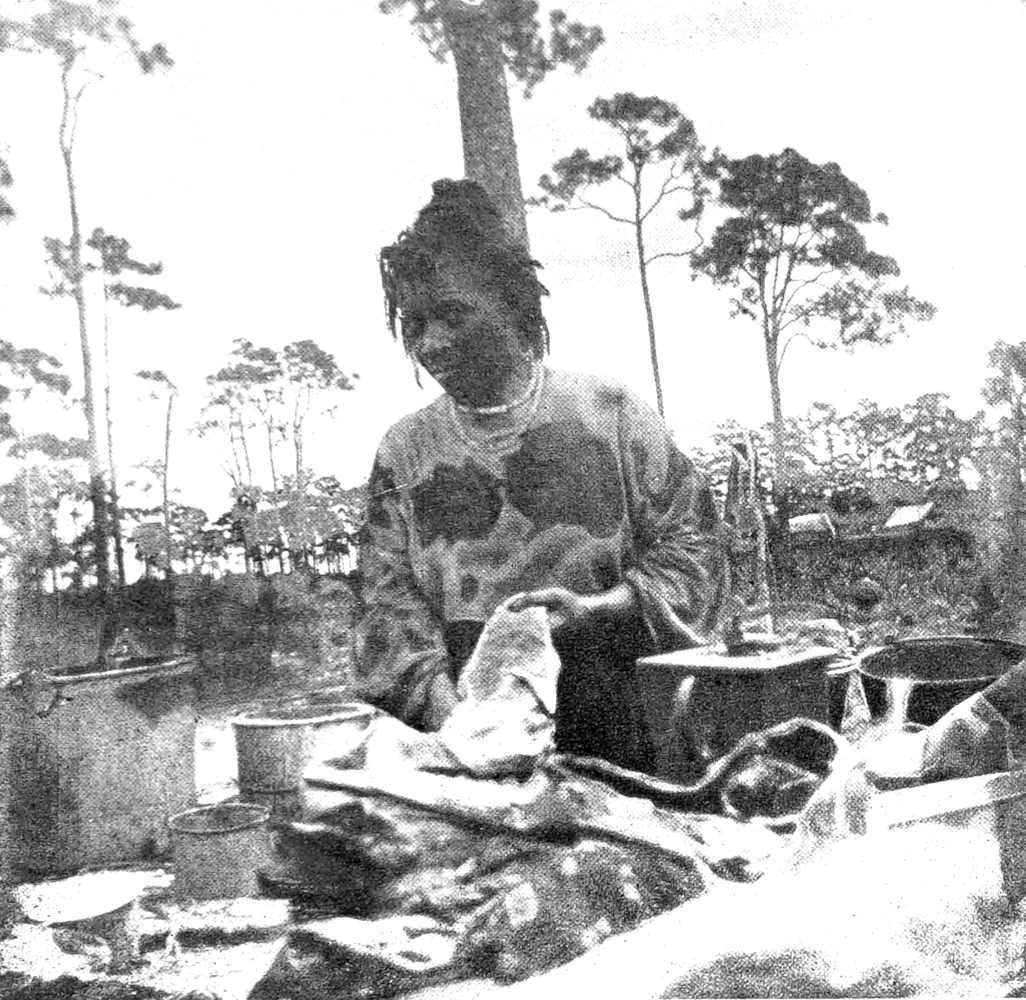
HANNAH, THE ONLY REMAINING SLAVE OF THE SEMINOLES
In Tallahassee’s camp making sofka for dinner.
If the annals of this heroic band were chronicled, they would say, “They are prouder than the proudest Inca, braver than the boldest Saxon knight, fearless and unrelenting as foes, devoted and unflinching in friendship, and the purity of their morals without a parallel in the history of any other race or tribe on the globe.”
Anxiously and carefully have we studied their form of Government, knowing that they leave their money, their trinkets and their garments in the open wigwam. With carefully-framed questions we asked of Billy Bowlegs, while on his recent visit to our home, “Billy, your money, you leave it in your wigwam, you go back, money hi-e-pus (gone), Indians steal it, then what you do?” He answered, “Me don’t know.” “Yes, but, Billy, white man come in my house, my money steal ’em—by-and-by, in jail me put him. Indian, all the same, bad Indian steal. What does Indian do?” Again the answer came, “Me don’t know.” Making the points plainer, illustrating by the theft of his gun, his provisions, showing him that a bad Indian from one of the other settlements might come in his absence and steal his Winchester, with perfect understanding of our meaning, the reply came as before, “Me don’t know, Indian no take ’em—Indian no steal.” In such a socialistic State, where there is no crime, there can be no punishment. Were a crime to be committed, a council of chiefs would meet and decree a punishment, and it would have enough severity to serve as a lesson for all future miscreants.
The only “fall from grace” we have ever known among any of the bands, extending over a period of twenty years’ acquaintance, was in the case of Buster Flint. Old Buster was a large, powerful Indian, but as the braves express it, he was “ho-lo-wa-gus” (no good), “lazy too much,” and laid around the settlement as a regular loafer, too indolent to work or hunt; and in consequence was ragged and unkempt. On one occasion, while our tent was pitched near the palmetto wigwams and the hunters had been absent for the day, on the return a small red napkin was found to be missing. Upon calling Captain Tom Tiger’s attention to the fact, he replied, “Me know,” and very soon the napkin was quietly returned to its place. Old Buster could not resist the bright red cloth and the others knew his weakness. What punishment was meted out to the old Indian was not learned, but certainly enough to terrify him during the remainder of our visit.
The Seminoles mean to be honest in their dealings with the whites. Occasionally the white man may be deceived when the Indian intends no wrong. As the National Editorial Excursion once made a tour of Florida, the train made a stop at a little trading post on the east coast. Quite a joke was innocently played upon the party by Captain Tom Tiger. A few Indians had come into the village to trade at the stores. Captain Tom had brought with him a load of sour oranges which grow wild in the region of his camp. The oranges are beautiful to the eye, but oh, how bitter! The merry editors saw the golden fruit and immediately offered to purchase. The chief was glad to sell, and only asked one cent apiece for the fruit; but the editors would not take advantage of the Indian’s ignorance of the price of oranges, so they paid him twenty-five cents per dozen for them. At this the load of oranges was soon disposed of and the chief, with perfect honesty of intention in the transaction, was the proud possessor of about twenty-five dollars. Those of the party who first tasted the fruit said nothing until all the oranges had been bought; then they were told to taste their oranges, and a laugh, long and loud, went up from one end of the car to the other, and as the train rolled away the good-natured but victimized passengers treated Captain Tom Tiger, chief of the Seminoles, to a shower of sour oranges. The Indian was dumbfounded. The wild orange is an article of barter in Florida, but not until the idea dawned upon Tom that the excursionists had mistaken his fruit for the sweet orange did he awaken from his bewilderment, and with earnest nods of the head and impressive gestures he soliloquized, “White man no like Indian’s orange—sour too much. Me tell white man, one orange, one cent. White man tell me one orange, two cents. Indian no cheat white man.”
The Seminoles look upon the dim past as a lost paradise in which there was happiness and innocence. “Before the white man came we were men,” says the Indian. Their faith in their forefathers is reverential. They believe they always did what was right. They were kind and true to their friends, but terrible to their enemies.
The Florida Indians are an industrious people. While the fruits of the chase are their main support, they cultivate the fields, raising vegetables, corn and sugar cane. The men make canoes, which they sell to hunters and trappers. Moccasins, baskets and koonti starch, plumes, smoked skins and venison are among their exports. Complaints are sometimes heard that the Indians are killing off the deer and the alligator, which is very true; but alike are the white men and the negro engaged in the same occupation. Before the white race taught the Indian the monetary value of the game of the country, he slew them only for food and clothing. Long centuries had he lived on this continent, but the herds of buffalo were not lessened; nor the vast quantities of game driven to the fastnesses of the forest. Till the white trader came to hunt the game as a source of revenue or for ruthless sport, the Indian knew no such motive.
Like his forefathers, the Seminole is no prohibitionist, but enjoys the fire water, as much as did the savage tribe that greeted the good ship, The Half Moon, in the land-locked waters of Manhattan, three hundred years ago, and drank the first American toast to the intrepid Henry Hudson. Since that first great tipple in New York which ended in such a scene of intoxication, causing the Mohicans to name the island “the place of the big drunk,” the Indian practices more precaution; and one of their number always remains sober and watches his boozy brother like a hawk. This is the practice of the Seminoles. Before going on a spree, a selection is made of one of the band whose duty it is to stand guard over all weapons and see that no injury is done to any member of the tribe. The “sprees” in which they indulge are too infrequent to warrant them being classed as intemperate. It is opportune at this point to say that only under the degrading influence of whiskey, which the white civilization brings to him, does the Seminole ever show any demoralized condition, and the proper official should see to the enforcement of the laws against selling liquor to these childlike people.
Only a few of the tribe talk broken English. The chiefs disapprove of it on general principles—for fear they will talk too much. To keep aloof from the white man, and the white man’s ways, is the training of the Seminole youth. Occasionally a few of the tribe leave their marshy homes. These talk sufficiently to do their trading when visiting towns to dispose of their plumes, deer skins, basket work, etc. These products always find ready sale, and when the great day of shopping begins, a “corner” in red calico and fancy colored beads is the result. The squaws have control of their own money, when on a purchasing expedition, a fact which makes them very American.
The squaws are about as sociable as the half-wild deer that are petted by the guests of the St. Augustine hotels. As seen in their camps, clustered together, half-alarmed, half-curious, the side glances from their dark-brown eyes seem to utter a protest against the Government’s eternal “move on.” A more severely pure-minded people are not to be found on the globe. The women are above reproach. Were a white man to insult a Seminole woman by word or look it would be well for that man never to appear in the presence of the tribe again. The Seminole girl who would unwisely bestow her affections would be killed outright by the squaws. In the history of the Everglade Indians only one such case is known and at the birth of the half-breed child the mother was taken to the woods and there hung to a tree by the indignant squaws. The infant was also destroyed. In questioning, as to which of the squaws did the killing, the answer was “All, every squaw.” On the principle of American lynch law each hand helped pull the rope.
GENS AND MARRIAGE.
The Seminoles, like other Indian tribes, are classified by gens. This lineage in the Florida tribe is traced through the mother. The child belongs to the clan which the mother represents. The mother exercises absolute ownership, and should a squaw and her husband separate for any cause, the children belong unconditionally to the wife.
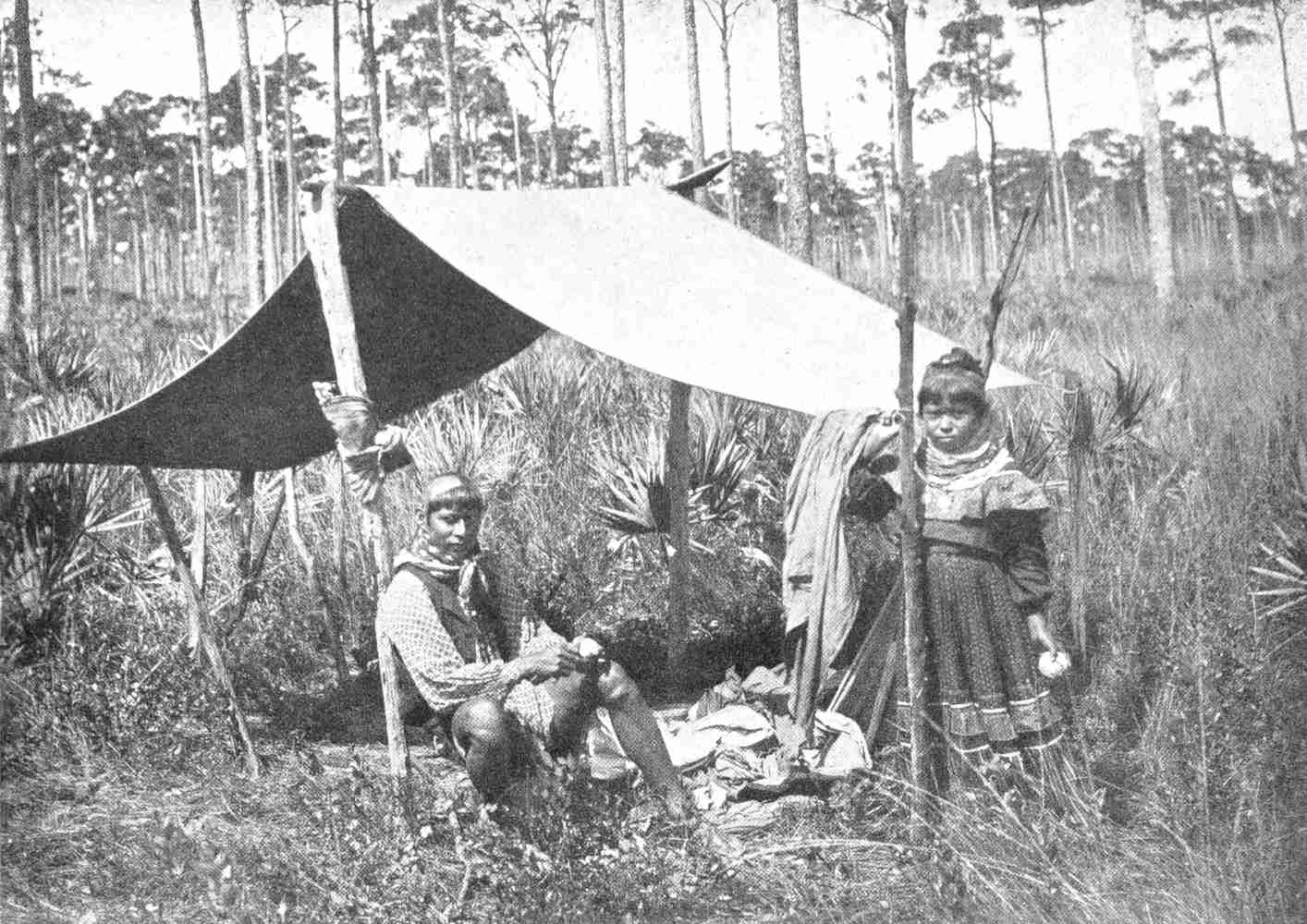
Photograph by E. W. Histed.
A PICTURESQUE GROUP
Seminoles of the Cow Creek band.
Modesty, as the great ornament of women, is taught to the girls, and as she is about to enter into life there is a moral sublimity in the counsel that teaches her to hold an implicit reverence for her husband, but at the same time she becomes a teacher and custodian of her children. One young Indian of our acquaintance is divorced from his squaw. They have one pickaninny now, three years old. Asking the father to give the boy up, and holding out alluring inducements, he replied, “Munks-chay (no), squaw’s pickaninny.” The gens represented in the Seminole tribe to-day are the Otter, the Tiger, the Deer, the Wind, the Bird, the Snake, the Bear, and the Wolf. Other gens are now extinct in Florida. Thus, in asking about the Alligator tribe, the chief replied, “All gone—long time ago—to Indian Territory.” A young brave dare not marry a girl from his own gens, he must select her from another clan. When asking a chief what he would do were he to want a girl from his own gens for a wife, and the girl should want to marry him, he replied, “Me no marry her.” The young Indian is shy and bashful in his courtships, and having resolved to marry, conceals his first overtures with all the Indian cunning. His intention is secretly conveyed to the girl’s parents, and should there be no objection the young woman is at liberty to accept or reject. No Seminole girl is forced into a marriage. The lover, with permission to woo, shows some token of affection; a deer is killed, and laid at the door of the wigwam. If the present is received the lover is happy. If it remains untouched, he may do as his white brother does, go hang himself, or, as is usual, go seek a more willing fair one. The prospective bride, to show her appreciation of her lover, makes a shirt and presents it to him. No pomp or ceremony is connected with the marriage. The day is set by the parents, the groom goes to the bride’s house, at the setting of the sun. He is now her husband, and at her home, he lives for a period. When the young couple build their own wigwam, they may build it at the camp of the wife’s mother, but not among the husband’s relatives.