PART SECOND (continued 2)
Reading edition
BEAUTY AND MUSIC.
The Indian has a high sense of beauty in woman, and has been demonstrated on several occasions during their visits to the different towns. A Seminole chief was taken to the parlor of a hotel, where a new piano was the exciting theme, to see what effect the music would have upon his savage mind. But the fair-haired performer absorbed his attention, and with a shrug which showed his appreciation for beauty more than for music, he said, “Ugh! white man’s squaw heap purty!”
Music is not a genius with the Seminoles. True, they have some songs which are monotone and rhythmical. They are the hunter’s songs, the camp songs and the lullabies. The war songs which sent such terror to the hearts of the white settlers in Seminole war days they seem to have forgotten. Some of the Indians have natural musical ears, and they are recognized by their people as musical leaders. They have no standard pitch, but start their songs where the natural quality of the voice renders it easiest to sing. The pitch of the song depends upon the individual.
An incident, full of pathos, yet illustrating one of life’s parodies, is recalled. It was occasioned by hearing the music of some old familiar tunes played in a gruesome Everglade home. As the picture recurs, one sees a savage tribe—a weird camp scene, with its storm-beaten wigwams in the background—and dusky warriors and squaws moving hither and thither in the dim shadows of the camp fire. In the center of the group sat the musician, who was the happy possessor of a “box of music,” an organette, which he had recently purchased. The melodies of “Home, Sweet Home,” “Hail Columbia,” and “Nearer My God To Thee,” floated out upon the stillness of the night, telling the story of the white man’s inheritance—happy homes, a free Government and an ennobling religion. To the Seminole the tuneful strains contained no more sentiment than the murmur of the brook: for they are a people without a home, without a country, and without a God in the sense of these songs.
RELATIONSHIP TO THE AZTECS AND EASTERN TRIBES “Yah-vey, Yah-vey”
To-day, the antiquarian may lay aside his musty parchments of antiquity and in the heart of the Big Everglades study the history of an ancient people through living authors.
“Jah-vey—Jah-vey—Yehovah—Yehovah!” Monotone, yet rhythmical, the brown-faced singers chanted the hymn. Over and over again were the words repeated by the Seminole choir, till the word “Jah-vey” mystical with the centuries past, dwelt with the listener. None but a Hebrew scholar would have caught the word with an understanding of its meaning. The occasion was a Fourth of July celebration when the Rt. Rev. Wm. Crane Gray was visiting the Seminole Mission at Im-mo-ka-lee, situated near the western border of the Florida Everglades.
The Indians, full of confidence and kindly feeling, had consented to sign and here appeared the wonderful, yes, startling, observation made by Bishop Gray. “Jah-vey” is the Hebrew word meaning Jehovah, a word held in such awe by the children of Israel, and as claimed by scholars, too sacred to pass the lips of man, that even its correct pronunciation is unknown.
To-day in the weird fastnesses of the Everglades, a band of wild Indians chant the name of the Great Jehovah in the Hebrew tongue, a name that is meaningless in its original form to thousands of educated Americans.
When questioned by Bishop Gray as to the meaning of the sacred word, the Indian answered, “God, white man’s God.” The question now appeals to the scientist, to the antiquarian, and to the theologian. From whence came the Seminole’s knowledge of the word?
From its use in the depth of the Everglades, one may work back to the prehistoric ruined temples of Mexico and Yucatan, so similar to those of Egypt; and thus may find in Seminole speech a language link to connect the new world with the old.
Is this single word as verified by Bishop Gray the keynote to the history and origin of the North American Indian?
With a close study of the Seminoles of Florida, one finds a subject mystical with the history of centuries past. We meet in this old-turbaned tribe a history vague, ’tis true, but as interesting as the data gleaned from the hieroglyphics of Mexico, or Egypt, and why not?
While the archæologist delves among the ruins of ancient Egypt, and as he disturbs the inanimate forms of the old Pharoahs, let him pause and like Diogenes of old, shine his lantern in scientific research for the American Rameses. Tracing the proud and invincible Florida Seminole through all his wanderings, from the plains of Mexico, we meet him to-day in the confines of the mysterious and weird Everglades.
Reaching Florida in 1750, under the name Seminole or Wanderers, his history verges into a singularly distressing drama and forms a tragical chapter in American history.
Tracing their lineage, as we may, to the Aztecs of Mexico, the student must find in their usages and customs links that connect their present history with that of the ancient tribes.
In this remnant, proud as the old Montezumas, may the scientist and antiquarian find a history teeming with interest, while the novelist may revel in story, both real and legendary—the most romantic of Indian life that has ever been written.
If we accept the Le Plongeon theory of prehistoric Mexico, as well as Professors Holmes and Seville’s research of Mexican antiquities, we must note the relationship between the early Central American civilization and the Ancient Egyptians; and that the builders of the pyramids and temples of Mexico and Yucatan were closely allied with the architects of the Cheops.
After the conquest of Mexico by Cortez in 1519-20, the Muskogee Indians left Mexico and gradually traversed the country till in 1620 we find them in Alabama, where they added other bands to their ranks. The British name them Creeks, from the many small streams that traversed the country.
Thus the great Muskogee tribe of the Mexican Empire vanquished by Cortez became one hundred years later the Creek Confederacy, from which branched the Seminoles.
It will take no great stretch of fancy to suppose that before the mysterious chain of migration the Aztecs and the early Egyptians were allied. As we study, to-day, the frail remnants of the vanishing Aborigines in the heart of the Everglades, may we not find a coincidence of usages that at least give abundant food for speculation, and the resemblance of the present Seminole to the ancient Egyptian suggests strong points of similitude to that of the old Israelites, and a common origin for the North American Indian and the older tribes, whose magnificent wrecks strew the borders of the Nile?
Prescott in his history of Mexico refers to some traditions of the Aztecs, as bearing a singular resemblance to those found in the Scriptures. More or less does one start with surprise and awe as he notes in the Indians of Florida a strict observance of those customs as well as religious beliefs as laid down in the book Leviticus.
The similarity existing between the ancient Egyptian principles and that of the Aztecs is conceded by scholars, and when the Florida Indian follows so closely these old religious rites, with the theory that the Florida Seminoles are traceable to the mighty Aztecs, may we not feel a pride in these red children of the forest homes and while it is yet possible preserve this almost forgotten remnant?
To-day the student may study, in the swamp fastnesses, the history of an ancient race, through the present-day Seminole.
Around the hereditary chief Tallahassee is the authority for the government of the Cow Creek band. He is the honored chieftain, whose duty it has been to teach to the younger generations the traditions of his ancestors. “My grandfather, old, old man, tell me, me tell my boys.” The stories never diverge—the same to-day that were told one hundred and fifty years ago, and different slightly from the teachings of the vanquished Muskogeeans of the Mexican Empire.
In their weird camps, by a glimmering light from the camp fire, is instilled into the youth the laws of the old turbaned tribe, laws startling in the rites they contain. A brief reference to a few of these observances must convince that there is at least a keynote for a chapter that must prove both interesting and valuable to science.
In the head dress of the Florida Indians, oriental in its effect, one quickly recognizes a perfect imitation of that as worn in 1800 B. C., as shown in the statue from Tel Loh (showing early Akkadian type).
Passing through the realms of history, covering a period of 3,000 years, in 1563 we find Le Moyne’s delineations of the turban, now worn by the Seminole chieftains. Likewise might the dress of old Tallahassee in his chieftain regalia be mistaken for the costume of the patriarchs in the days of the Pharaohs, when the long tunic embraced by the brightly embroidered sash, with its heavily-tasseled belt, made a picturesque attire.
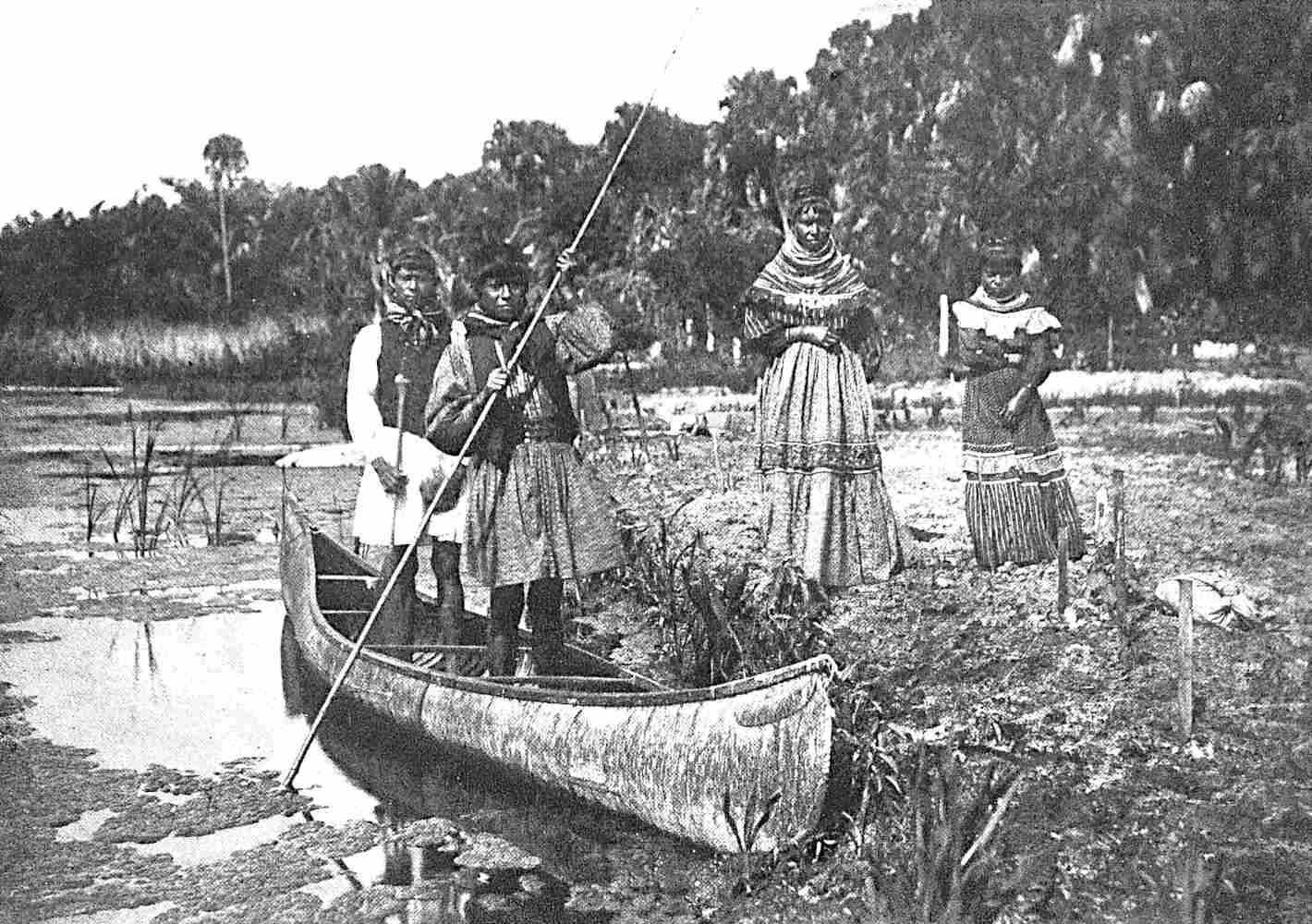
Photograph by E. W. Histed.
AN ENCHANTING STUDY OF THE YOUNGER GENERATION OF SEMINOLES
Not the least startling, after thirty-four centuries, do we find the Seminole observing the rigid laws of health as laid down to the Children of Israel after the Exodus. With reference to the preservation of health, we find in the Scriptures, that those affected by disease were separated from the tribe and as health returned, we read, Leviticus 15: 13, “Then shall he number himself seven days for his cleansing and wash his clothes and bathe his flesh in running water and be clean.” Verse 7, “And whosoever toucheth the flesh of him shall wash his clothes and be unclean until the evening.” Note the following: On a recent visit to the Seminole camps, and after receiving a warm welcome from the squaws and pickaninnies of former acquaintances, a solitary figure was observed sitting in a small detached wigwam. Approaching for the purpose of shaking hands, from all sides came gesticulations and dissenting tones from the squaws, and feeling that the woman was a prisoner or taking some kind of punishment, we passed on. During a visit of three days at the camps, the squaw was kept aloof from the band, receiving all necessary attention with the kindliest spirit, but fulfilling the law of Moses, as recorded in Leviticus, “And she shall be apart seven days and whosoever toucheth her shall be unclean.”
The Aztecs made crimes against society capital; among their registered laws, adultery was punishable, as with the Jews, by death. The same laws hold good among the Seminoles to-day.
Marriage laws are held sacred, but divorces are permitted where some incompatibility of temper is found. This is done after the manner of the old Jews—“out of mercy to the woman.” Either party may marry again, but the marriage must meet with the approval of the leaders of the band.
Taking up the question of land tenure, one sees the similarity between the Everglade Indians and that of the ancient tribes.
Their tribal organization being a socialistic and communistic order, it is not their policy to encourage individual land holdings.
Socialism finds its greatest example among the Seminoles and they realize freedom in a greater degree than can possibly be found in any community governed by man-made laws. They do not violate any teachings of the tribe and are honorable and upright in their dealings with one another and equally so with the white people with whom they come in contact. Their law allows of individual occupancy of land and the individual rights are respected, but the Indian is not allowed to acquire title.
The Seminole, like his Aztec ancestors, shows an honorable contrast to the other tribes of North America, in the treatment of the women. No severe agricultural labor is imposed upon them and the consideration shown them by the men would do credit to a high civilization. Those who know some of the habits of the Florida Indians (Seminoles) are cognizant of the fact that they will not eat the green corn until the second day of the annual feast.
On a visit to the camps, old chief Tallahassee was invited to join his white friends at dinner, and as he was offered a roasting ear, he said, “Me not eat green corn, Shot-kay-taw (Green Corn Dance) eat plenty.” Pointing to a small patch of corn from which the ears had been stripped, he said, “Squaws eat corn plenty, men no eat,” and as we read Leviticus, 23: 14, the thought comes: Is the law, though divested of part of its meaning, being fulfilled to-day by a band of wild Indians?
“And ye shall eat neither bread, nor parched corn, nor green ears, until the self-same day ye brought an offering to the Lord.”
Another link is a feast day which seems to correspond in its rites to the Day of Atonement on old Jewish days. It is of peculiarly solemn character and takes place in cycles. The sacredness attached to the assembling of the band prevents little insight from the outside world.
With only an oral tradition, with their unwritten but priceless history of an ancient race, with the white man daily encroaching on their last domain, the time for studying this primitive people in their purity will soon be over, and of their customs and usages, where is the Œdipus at this day who shall solve the riddle of their origin?
SEMINOLES AT HOME The Everglades
The characteristic of the Seminole is to make his camp in some secluded spot where the white man would least expect to find his habitation.
The peculiar physical formation of Florida makes this very possible. The Everglade region, which is the immediate environment of the Seminoles, is a watery prairie, with here and there high points of ground, and because land-grabbers, corporations and state officials are already clamoring for these watery wastes, and selling thousands of acres from paper plats, with the land still under water, a more detailed description of the Everglade region would be better appreciated. This vast region contains about 4,000 square miles of marsh lands and tropical forests, interlaced with thick clustering vines and is the greatest area of unexplored country in the United States.
The accounts of the interior of the mysterious swamp is to be found only in dim tradition or Indian legends.
However fast the door of the swamp may be locked, it opens quickly enough to whomsoever carries the key. The Seminole is the true key-bearer and with moccasined foot he enters when and where he will.
A writer, in a Miami paper, gives the following interesting account of his approach to the Indian camps:
“Traveling through this aquatic jungle in a light canoe, the motive power of which is plenty of muscle, a broad-blade paddle and a push pole about eighteen feet long, we enter a trackless waste of saw grass and water, with scattering islands and lagoons, channels running in all directions. These channels often terminate in what is called a pocket and then trouble begins, as these pockets are so shallow that a canoe or skiff has to be pulled by rope or pushed by hand through the mud and grass, until deep water is found. All signs fail in the Everglades, as often to go north you will take the other three points of the compass.”
“There is nothing quite so aggravating,” continues the writer, “as to get sewed up in one of these pockets, in the open saw grass with deep water in plain view and fine shady trees to welcome you, but tired and disgusted you stand as high as possible in the canoe and see only one chance in a hundred to find the right channel to go through.”
“There is no use for a compass, and it is a waste of time to think about it. There is a sure thing of going overboard in the mud or going back and starting over again.”
“When the water is high the trouble is not so great, but when it is low, the traveler can lay aside his Bible, quote a chapter from Dante’s Inferno, and plough through the mud until his energy is exhausted and wonder if Dante ever heard tell of the Everglades.”
The channels running through these Glades are alive with fish, while the saw grass ponds provide homes for thousands of alligators. The myrtle and cypress clumps are the winter homes of the heron and migratory birds.
From this vast morass, with an elevated position, and a rare atmosphere, the view that would meet the eye would differ from any other on the globe. Ballou says: “A thousand square miles of saw grass would be seen spreading out in the shape of an artist’s palette. Towards the end would be seen a series of little inland lakes, fed by minute rivers. Interblending with the lakes, thousands of islands would be visible, far beyond the saw-grass sea. The flutter of bird life would be like the milky way, and the swarm of insects like a distant sand storm on the Sahara.”
Bordering the sedgy lagoons, are dense cypress forests, with here and there cabbage palms, Indian rubber and mangroves, while tangled vegetation weaves itself in chaotic style over underbrush and tree. These are the primeval woods of the United States. To be lost in these great marshes means more than death. They are the paradise of the serpent and the alligator. It is said in old slavery days, slaves who ran away to the swamps, were entered on the books as dead.
Except the few points touched upon by adventurous botanists and hunters, this entire region has remained terra incognita until within the past two or three years, when the subject of drainage has caused deeper and more scientific investigation. These explorers have brought interesting accounts of the great swamp.
The subject of drainage of this vast aquatic jungle is causing many disputes and many opinions, but under the Legislature of 1907, with the imperturbable Governor Broward in power, the work of drainage was begun.
Those engaged in the reclamation of this rich soil look upon the enterprise as being one of the most colossal of American ingenuity and one that will made the Okeechobee region the Egypt of America. While it is not the object of the writer to enter into the question of reclamation—still, the thought comes, “Is it worth while to make this region fit for habitation?”
The Florida Everglades Land Company who are carrying on the work of drainage on scientific rules, in the employment of government experts and following natural laws, show in their practicable demonstrations, the great benefit the redemption of submerged Florida will be, not only to the South, but to the whole country.
Prof. H. W. Wiley, Chief of the Bureau of Chemistry, U. S. Department of Agriculture, says of this great State question of drainage: “There is possibly no other body of land in the world, which presents such remarkable possibilities of development, and with a depth of soil averaging perhaps eight feet, it reaches beyond the limits of prophecy.”
Then, when enterprise and capital enter the last home of the Seminole, converting the tropical swamp into golden Everglades, may we not pause to ask, “Is there not room enough for this remnant of a helpless people in the country to which they have been driven.”
Here in the heart of the Okeechobee country, we find the only remnant of our native American Indian, in his original simplicity, meeting in the hunting-grounds of his ancestors the mighty power of Capital, Industry and the Twentieth Century methods of progress. Shall we wrest from him every vestige of this last foothold in Florida, his last resting-place in his direst necessity?
The ultimate end of the Seminole should be, to be civilized and Christianized and assimilated into the present status of the American citizen. While to-day reclamation looks a calamity to the interests of the Florida Seminole, it is possible under the direction of an overruling Providence to be made an almoner of benefit. There is at this time plenty of land for both interests. It becomes the duty of the United States Government through its Indian Department and the friends of the dependent Seminole, to see to it that land sufficient for their use be left in the Okeechobee country, with Uncle Sam’s signboard reading, “Penalty to Tresspassers.”
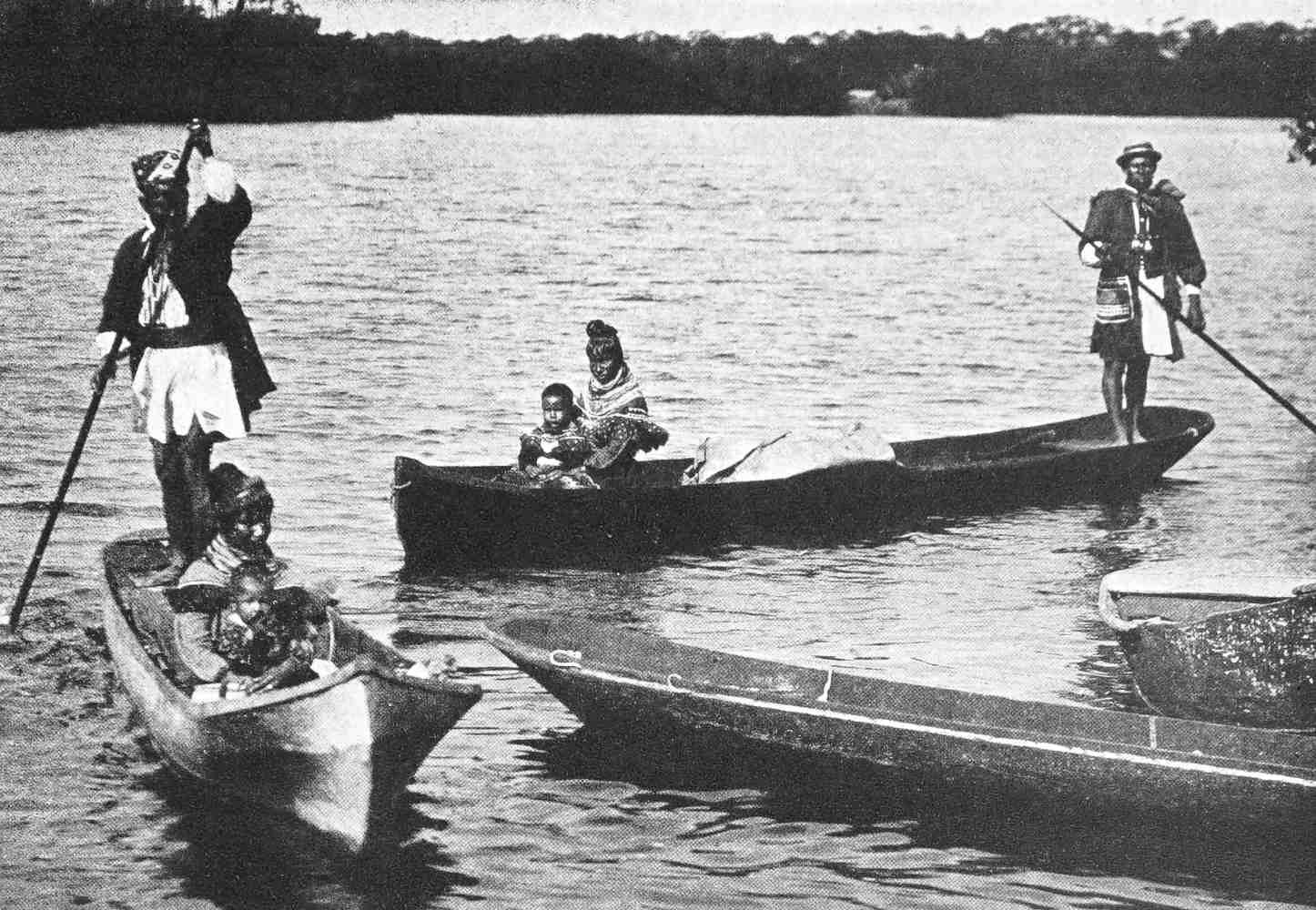
SEMINOLES ON THE MIAMI RIVER
Let us, as a great American jury, pause in our mad scramble for dollars, and consider our brother in red. As we plead for these relics of the warriors of old, we ask, “Why molest them? They are brave, self-supporting and piteously plead to be let alone.”
Over seventy-five years ago an officer of the Fourth Artillery wrote in a Charleston paper, “Can any Christian in the Republic pray for the continuance of blessings, when he is about to wrest from the unhappy Seminole all that the Great Spirit ever conferred upon him?”
On the larger islands of this tropical swamp are found the fertile hommocks, the home of the Seminole Indians. Approaching such a home one sees marks of labor; a clearing is made, the wigwams built, sugar cane, sweet potatoes and squash are growing. Chickens and pigs run about and an air of contentment pervades all.
A visit to these Indians is still fresh to memory. After an arduous journey, the village is reached. It was the occasion of the Green Corn Dance and preparations were going on. The hunters were out for game, the corn was ripening and an air of festivity was all around.
Dogs barked as the white guests approached, but a commanding Seminole reprimand soon drove them away; pickaninnies came around with timid advances, squaws greeted with handshaking. A wigwam was built for us by the hospitable hands, and the visitors were assigned to this part of the camp.
What a world of interest, both romantic and tragic, hangs around the wigwams of a Seminole family!
To Tallahassee was assigned the greatest part of the entertaining, and he it was who directed the movements that would add to the pleasure of the guests.
Without giving thought to it, the team was hitched to a pole that stood in the open. It proved to be the festal pole for the dance, and the spot was sacred for that occasion, but the innate courtesy of the old chief prevented his showing any offense, and in the morning he waved his hand in the direction of the horses and asked, “Horses, you want ’em there?” Learning what the pole was for, we were the ones to beg pardon and feel chagrin. Then came the attention to the guests, in showing around the little fields, telling the names and kinship of the various members as they came into camp. This devolved on Tallahassee, and the honor was two-fold.
As the shadows fell and the camp fire flickered, the old chief regaled the company with history dating back one hundred and fifty years. The old patriarch and warrior rambled on in low monotone, living over in dreamy reminiscence his hunting days, and with the record of seventy bear, to say nothing of panther, deer, ’coon, possum and turkey. How the enthusiasm of the twentieth century hunter was put on fire.
As the old chief drew closer his tunic, we asked, “Tallahassee, last winter, cold much; Kissimmee City, ice come; what you do?” A young brave spoke up, “Tallahassee old, get cold heap, blankets put on him and big log fire make.” Then came the jokes as told by one member on another and how these children of the forest would laugh as the tales were recounted. They are children only in mind, but full of discernment and strong in character.
A present of a picture containing Tallahassee’s picture had been sent to the old chief a year before, and this must now be brought out to show the visitors. Spelling and copybooks were the occasion of much comment and much praise from the white friends. The older Indians say, “Me no write—old too much. Little Tiger make letters by-and-by; write good—keep store.”
The utensils that hang around the wigwam would do credit to many a white family; they have buckets and pans of agate ware, and well made wagons purchased in Jacksonville.
The hum of the sewing machine was heard in the wigwams, being used equally well by both men and women.
While the patient Seminole is at the mercy of the white man, and each day becoming more helpless, he is still proud as the old race.
A purse of ten dollars had been made up for one family where the husband had died, but with the suspicion that the money was from the Government, the older members held a talk with the result: “Money no take ’em. Squaw no want ’em.” With mouth-watering glances the little ones on the same occasion refused candy and cakes; they had been forbidden to accept what the old Indians believed was from Washington—the home of the Big White Chief. (This was at the time the Indians had been alarmed by cowboys telling them the Government wanted them for Arkansas.)
To-day in the forest home of the Seminoles, where yet gleams the council fires, and within a mile of the palmetto thatched camp of the Osceolas, the big dredges groan an accompaniment, as it were, to the echo of the throbbing hearts, the death song, the Recessional, of the Seminole.
Dynamite blasts shake the very pans and kettles hanging around the wigwams and, while this monster of a machine destroys the only home of the tribe, is the time not ripe for decisive action in the protection of these wards of Florida?
A visit to the Seminoles’ camp reveals many interesting little things which touch the heart and evoke the sympathy of the observer. The affection displayed by the stern-faced father, when coddling his pappoose, convinces the most skeptical that in the fastnesses of the forest “The heart of man answers to heart as face to face in water,” whatever the skin it is under. Old Tom Tiger, without question one of the most ferocious-looking of the Seminoles, would take the baby-boy from its tired mother’s arms and softly croon a lullaby, swaying the pappoose backwards and forwards in his great strong arms till the little fellow would fall asleep.
Another instance of parental affection, as given by the Rev. Clay McCauley in his report on the Seminoles of Florida to the Bureau of Ethnology, is full of touching interest. While the incident occurred many years ago, and the little boy is now grown to manhood, still it cannot fail to reach the heart of the reader. We give it in the writer’s own words:
“Tallahassee’s wife had recently died, leaving him with the care of six boys; but the strong Indian had apparently become mother and father to his children. Especially did he throw a tender care about the little one of his household. I have seen the little fellow clambering, just like many a little pale face, over his father’s knees persistently demanding attention, but in no way disturbing the father’s amiability or serenity. One night, as I sat by the camp fire of Tallahassee’s lodge, I heard muffled moans from the little palmetto shelter on my right, under which the three smaller boys were bundled up in cotton cloth in deer skins for the night’s sleep. Upon the moans followed immediately the frightened cry of the little boy, waking out of bad dreams, and crying for the mother who could not answer; ‘Its-Ki, Its-Ki,’ (mother, mother) begged the little fellow, struggling from under his covering. At once the big Indian grasped his child, hugged him to his breast, pressed the little head to his cheek, consoling him all the while with caressing words, whose meaning I felt, though I could not translate them into English, until the boy, wide awake, laughed with his father and was ready to be again rolled up beside his sleeping brothers.”
Where the Seminole is hospitable is around the camp fire and the “Sof-ka” kettle. “Hum-bux-chay” (come eat) is his salutation. The kettle is placed in some convenient part of the camp and at the meal hour the members of the household sit around it. A large Sof-ka spoon rests in the pot, and is handed from one to another, each taking a single mouthful. A fastidious taste might shrink from using the large spoon, but to affect such taste would be to offend mine host. Sof-ka is the Seminole standard dish, and is simply a stew made by cooking the meat in a large iron pot, and thickening with meal, grits or vegetable. Sof-ka corresponds in its importance with the Seminole to “frijoles” among Mexicans. The Indians observe a regularity in meal hours, yet at most any hour the Sof-ka kettle is ready for those who may come in from the chase enhungered. So plentiful is game that it is a common sight to see a saddle of venison or a wild turkey and perhaps a duck roasting before the fire, and, as appetite prompts, any member of the camp may help himself to the savory roast.
The Seminole pickaninnies are healthy, good-natured little toddlers, and show no more savage spirit than do their little pale-faced brothers. They play with bows and arrows, make dolls and playhouses, revel in mud pies, roast the small birds they kill before a “spit fire,” and play they are roasting wild turkey. They rarely cry, as they are taught from infancy to show no such weakness; they must obey the slightest command of their elders. The little four-year-old is taught to assist in the duties of the camp. He can carry water, gather wood, watch the little pappoose, and learns thus early that he is an important feature in the tribe.
The boys are allowed to handle no weapons until old enough to use them successfully. When an Indian boy is taught to use a Winchester and returns from the chase with his first deer, favors are shown him by the elders, tokens are presented and he becomes for the time the young Nimrod of the tribe.
Seminole children are on the whole very much like other children, some bright, some good, some perverse, all exceedingly human. With the discipline already instilled into their natures, and education, first for the heart, and then for the mind, added, success would be assured. A Seminole luxury which serves as a target as well as food, is the fruit of the climbing pumpkin vine, which is often seen among the branches of the trees. When wanted a well-directed rifle ball cuts the stem and the pumpkin drops to the ground. This was the sport enjoyed by the troops during the Seminole war.
The absence of all earthenware is noticeable in a Seminole camp. The Seminoles say, “Long time ago,” their race made earthen pots, but white man’s kettle “heap good,” and they have long since ceased to work in clay. All through Florida pieces of pottery are found in the sand mounds. In the pine forests where the land is good for cultivation, broken pottery is frequently dug up out of the ground. These forests have grown over this land evidently since it was cultivated by former races. The pottery found in parts of Florida, is said by those having made a study of the subject to resemble the Aztec pottery to some extent.
One of the peculiarities of the Seminole man is the number of shirts and handkerchiefs he wears at one time. An instance is related where a white man in company with Billy Ham went out deer hunting. Emerging suddenly from the thick forest, some deer were observed feeding on the Savannah in front of them. The Indian was dressed in the bright colors of his race, and stealthily slipping back into the shadows of the tree, he began to remove shirt after shirt and untie handkerchiefs from around his neck. As each article was removed, the Indian became less conspicuous. After divesting himself of six or eight shirts and eight or ten handkerchiefs, the Indian and his costume now blended with the surrounding objects. His dusky form was in perfect symphony with the dead leaves and grasses, through which he silently crept toward his prey. The Indian prefers to make sure of his game by creeping upon it. He can advance to within a few feet of a deer. The deer, while feeding, is always on the alert for an enemy. If it sees nothing moving it will not be alarmed. This is where the strategy of the Indian comes in. He stops just before the animal raises its head. The lifting of the head is always preceded by a movement of the tail, hence the cunning Seminole watches the tail and knows when to be still.
ALLIGATOR HUNTING.
At this point, a detailed account of an alligator hunt with the Seminoles may prove interesting to the huntsman who may scan these pages.
Some tourists hire the Indians who frequent civilization to guide them in hunts, but it is poor Lo’s idea to show the white man his hunting; and he will take him around and around, always keeping out of sight of game, with a cunning that would do credit to a Connecticut Yankee.
Possessing that talisman, friendship and confidence of the Seminole chiefs, our hunter arranged for his first alligator hunt. To simplify the account of the tenderfoot’s experience, we give it as related to the writer.
“Taking the little steamer Roseada at Kissimmee City, a two days’ ride landed us at Basinger, where I was met by an ox-cart, driven and owned by the Seminoles. A ride of forty miles, slow but sure, took us to the Indian village. Here I was met by dogs, pickaninnies, squaws and braves. With time limited and eager for the hunt for big game, I rested but a few hours and then announced myself ready to hi-e-pus (go).
“In a cypress canoe, poled by Chief Tom Tiger Tail, we turned our boat toward the interior of the Everglades, and for three days traveled over as wild and weird a land as Stanley ever explored in Darkest Africa.
“Poling through water lilies, tall grass and overhanging branches, frequently getting stuck in the shallow water and marsh, all gave more zest to the square mile than a hundred hunts in the North could.
“Reaching the objective point of our trip, the chief tied up the canoe, and after a hearty repast, we were ready for the alligator hunt. No game laws obstructed our progress, no sign boards read, ‘No Trespassing,’ and soon we were equipped for the night’s hunt.
“With a bullseye lantern attached to my cap, I took my seat in the bow, while Tiger Tail, standing in the stern, propelled the canoe with long, dextrous strokes. Reaching a deep bayou, where the Seminoles kill hundreds of alligators each year, I was directed to throw the light quietly over the water, and the presence of the saurian would be revealed by the reflection. Silently, slowly, our canoe cleaved the dark waters. Truly, the scene was worthy the pencil of a Doré. A moonless sky, a wild expanse of bleak water, a canoe propelled by a savage, splendid and careless in his unconscious grace, and as silent as the oarsman of the River Styx. Soon the dismal solitude was broken by our entrance into the alligator haunt. With stealthy glide through the still, dark water, we were soon aware of being near a very large ’gator—the two balls of fire shining in the darkness told the tale. Without a ripple the Indian glided his canoe within ten feet of the monster, and a shot between the eyes from a .38 Winchester blew the top of his head into small pieces. Before the reptile could flounder out of reach, the carcass was grabbed and pulled into the canoe by Tom Tiger, and the spinal cord was severed with an axe to prevent any future trouble.
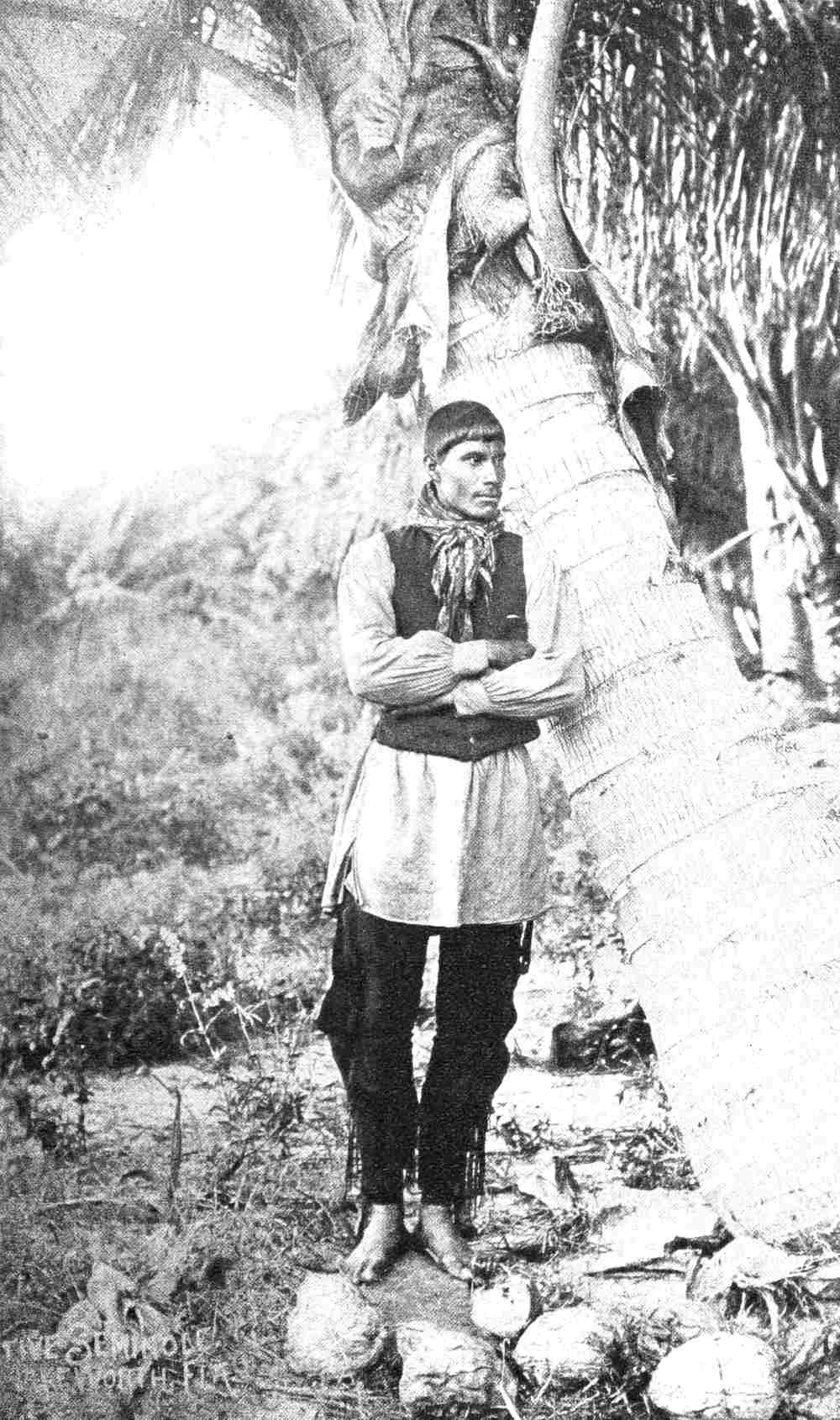
TIGER TAIL, A REPRESENTATIVE SEMINOLE
In picturesque harmony with the land of the cocoanut.
“At the first approach of our light the alligators gazed at it in the most fatuous manner, allowing the boat to approach within a very close position; but after one of their number had been slain they commenced a vibrating roaring, playing see-saw with their heads and tails and slowly rolling forth their feelings in deep, thundering tones. To me, there seemed to be 500 alligators in that body of black water that night, and each and every one seemed to turn his burning eyes on my little searchlight—and they shone like stars. I could easily tell a big fellow by noticing if his glaring balls were close together or far apart. After killing four or five I called out ‘Enough!’ The picture was growing too gruesome. The quivering mass of reptiles in our canoe made me think longingly of home. ‘Ungah’ (all right) from the Indian reassured me, and the canoe was turned toward camp. During the evening the Indian chief had killed an eleven foot ’gator, and so lifeless did it seem when dragged into the canoe that it was not considered necessary to cut the neck and back. The extraordinary vitality of an alligator keeps it from dying for some time, the nerves often living for several hours after the head has been severed. Our canoe was loaded to the water’s edge, with the large saurian in the bottom. Presently a low breathing greeted my ears; soon it grew louder, and a faint motion could be felt in the boat. Still I remained passive, the Indian poling through the deep, tortuous stream. I had instinctively drawn my feet up, when the great mouth, which was toward me, opened and began snapping angrily. His body began to writhe and twist and wriggle, which set all the other alligators in motion. The situation was growing critical and dangerous, when Captain Tom, perceiving the trouble, came to the rescue with his axe and none too soon, for the huge saurian began lashing his tail from side to side, and had the Indian been less skillful in handling the canoe we certainly would have been turned overboard. With the hideous cargo silenced, the Indian always cool and nerveless, looked up and with a humorous twinkle in his eye said, ‘White man ’fraid ojus’ (heap).”
BEAR HUNTING WITH THE SEMINOLES.
Under the head of American Sport, the following story of a “Bear Hunt with the Seminole Indians,” appeared in the columns of the Asian Sporting Newspaper of Calcutta, India.
The story had been accepted from the pen of the writer by Forest and Stream Publishing Company of New York, and because our British hunters of lion and elephant fame had appreciated an American hunt sufficient to scissor it (neither giving credit to the author nor to the American journal), the story is here appended:
“Hunting the black bear in Florida is a sport to which few are introduced. This bear is not fierce nor dangerous, but still he is big game, and a bear hunt is always full of incident and excitement. About ten miles from Kissimmee, is a cypress swamp—it is an aquatic jungle full of fallen trees, brush, vines and tangled undergrowth, all darkened by the dense shadows of the tall cypress trees, and full of moccasins and alligators. Running through the swamp is a chain of islands. Here is a field for sportsmen, and here live unmolested a whole colony of the bruin family. Hunters hear their growls, and numerous fresh tracks show where the night marauders have entered the hommock, where they feast on wild honey, huckleberries, the cabbage of the palmetto and the wild orange. They seldom come out to expose themselves during the day, hence they are rarely captured, and in consequence are on the increase. Settlers frequently report depredations on their hogs; but bruin is safe in his swamp home, for without dogs trained to hunting bear, even if he were surprised, he would quickly make his escape into the jungle.
“Of all game of the forest bear meat is the favorite dish of the Florida Indians; squaws, pickaninnies and dogs revel in it. With this knowledge, it was an easy matter to secure a party of Seminole chiefs and their trained dogs for a bear hunt. The auspicious day arrived. This picturesque hunting party came striding into Kissimmee as unconscious and statuesque as bronze figures of Mercury. The party was led by Chief Tom Tiger, following after in Indian file was old Chief Tallahassee, Doctor Tommy and Little Tiger, while trailing along by their sides were the formidable looking dogs. Dressed in their holiday attire, with new leggins and moccasins, bright calico shirts, a half-dozen red handkerchiefs around their necks, crowned with the immense red turban, the emblem of their race, with knives and cartridges in their belts and Winchesters at their sides, the Indians attracted as much attention as a Presidential party.
“If ever men deserved the name of Nimrods, it is these sons of the Everglades. Even Little Tiger, a boy of twelve, with his fine rifle, could put to shame many a skilled marksman. But on to the chase. The souls of the red men seemed to leap into them at the thought of the sport after bear, while the hounds barked gleefully, so with hasty preparations our hunting party started for the Reedy Creek jungle. At this point we will turn the story over to the tenderfoot, that the reader may better follow the chase.
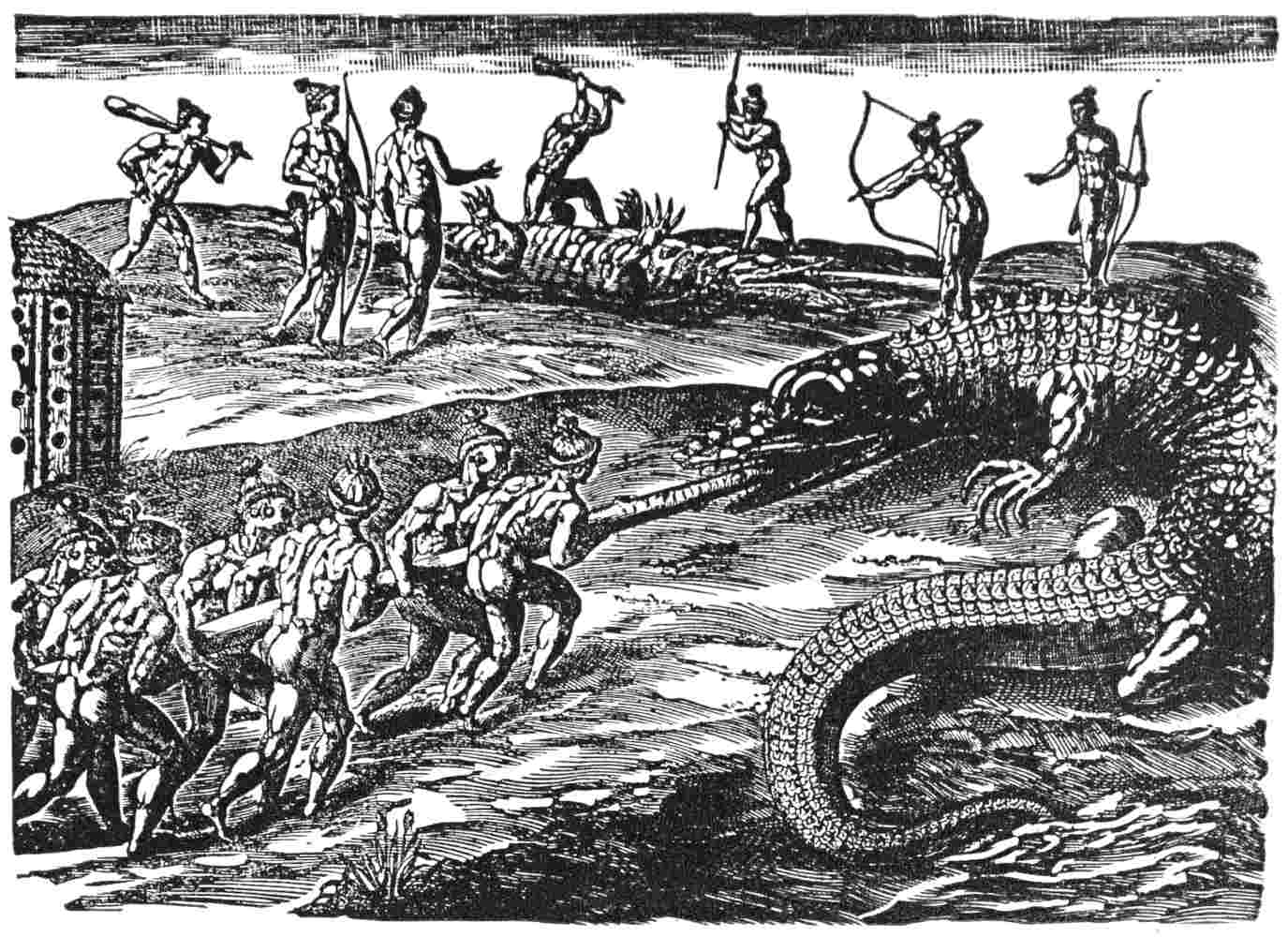
From Le Moyne’s Narrative of the French Expedition in 1563.
INDIAN MODE OF HUNTING ALLIGATORS IN FLORIDA, AS CONTRASTED WITH THE PRESENT DAY HUNTING
“As we reached the hommock, which has been for years a veritable elysium for the bears, the dogs seemed to become possessed of a very spirit of unrest; soon they struck a trail. ‘Lo-co-see ojus’ (bear plenty), exclaimed Captain Tom Tiger, as he observed the numerous cabbage palms with their buds freshly torn out, as well as the conduct of his dogs, and with a word of command to the hounds, he started. The rest of us followed, till we struck a marsh heavily timbered with cypress, which grew so close that sun’s rays could not reach the earth. It made a dark, damp and dangerous ground to enter. The dogs were now running with broad scent, heads well up and throats wide open. If ever there was a sound sweet to the hunter’s ears, it was the baying of five hounds close on bruins trail. With nerves on a tension we rushed along, with gun carried at ready. On swept the riot. The Indians yelled as only Indians can, and the tenderfoot brought up the rear. A hunt in a Florida jungle, pulling through soft mud, climbing over logs, pushing through vines, sprawling on hands and knees through the tangled, matted undergrowth, expecting or fearing each step we would strike a moccasin, are the penalties paid for the romantic, adventurous hunt with a Seminole Indian. At last the supreme moment arrived; the leading dog had reached the bear, and soon the five dogs and the bear were having a vigorous rough and tumble fight. We were in good hearing distance, but traveling was very difficult, and our progress was slow. The Indians’ cry, ‘Yo-ho-ee-hee, Yo-ho-ee-hee!’ to the hounds, made them fight furiously, so much so that bruin broke from cover and started on the chase just before we reached shooting distance. Further into the woods the chase led. Soon the sound of the pursuing dogs ceased, much to our surprise. We appealed to the nearest Indian for an explanation. ‘Lo-co-see (bear) climb tree,’ was the brief reply, and later, when we reached the dogs, they were running wildly around on the bank of a dark creek. We were again at a loss to comprehend the situation, until we were shown by the Indians a leaning tree, the top of which reached to the further side of the creek, over which bruin had safely passed. ‘Lo-co-see-hiepus’ (bear gone).
“Three hours’ tramping through the swamp and hot sun had taken all the enthusiasm out of us, and we were ready to play quits, but the stalwart red men had defiance in their faces as they said, ‘Big lo-co-see; fight heap; Indian kill lo-co-see to-day.’ Away to the left the brown legs of little Tiger Tom could be seen twinkling through the foliage; he had found some fresh tracks of a cub, and in his eagerness to capture a baby bear he proved a similar nature to his little pale-faced brother. But the stern hunters had no time for a cub, and soon started for old bruin, who by this time had crossed the marsh and gotten into a tree on the opposite bank, and by this trickery put the creek behind him. This did not daunt a Seminole Indian. Wading the shallow part of the creek, with water to the armpits, again cooled our ardor, but safety depended on not losing sight of the Indians, as we were miles in the swamp, and with no hope of finding our way out without the guidance of our red pilots. At last the bear was driven to a small island and surrounded, the island covered with tall grass and weeds hiding both dogs and bear. The dogs grew furious, and several times forced the bear to stand and fight, and such a battle as it was; the dogs didn’t hesitate to take hold of old bruin, and as a result were badly lacerated from the blows of her powerful paw. We closed in and our game was in a trap. The Indians were in their future heaven; but the tenderfoot was getting very shy of being hugged. Bruin, now finding herself cornered, made a break for the open, and as she emerged from the tall grass, with the dogs at her heels, she met the stalwart figure of Tom Tiger. Rising on her hind legs, with open arms, she made one dash for him, when stepping back, in a cool and deliberate manner, he pulled the trigger of his ‘scatter’ gun and emptied both barrels into the bear’s side. This ended the chase, and a happier set of Indians the world never saw. Immediately they drew their knives and commenced skinning the bear. As the skin adheres very tenaciously it should be taken off at once, as it then comes off much easier; besides, it is difficult to scrape away all the fatty tissue after it cools, and wherever any remains it rots the pelt.
“The Indians’ method of educating their dogs for hunting bear is well worth knowing. They take the gall of the bear and thoroughly saturate the nostrils of the young dog. This is excruciating pain to the dogs, and they howl and whine for hours; but it makes ‘bear dogs’ out of them, perfect on the trail, and this is the point with the Indian.
“The huge carcass of bruin was divided and each Indian carried a load to camp. A fire was soon built, and a huge chunk of bear meat was thrown on the coals. All night long they cooked and ate, the tenderfoot getting into his hammock beneath the bough of the oaks. We rested and dreamed—the flicker from the camp-fire, the Indians moving to and fro, the silence occasionally broken by their low, soft voices, and ever and anon in this wakeful slumber came the half-dreaming thought, ‘Betty and me killed the bear!’”
CHIEF TOM TIGER (MIC-CO TUSTENUGGEE).
It is a number of years now, that Tom Tiger, chieftain, reached Kissimmee after a ride of 160 miles. Tall, straight and muscular, he proved himself a worthy descendant of the royal Tustenuggee. Dressed in the regalia of a chief, and mounted on a raw boned horse, he might have been mistaken for a sheik of the Arabian desert. He had come on a friendly visit incidentally, but to tell his white friend his trouble over a horse which had been procured under a fraudulent pretense, by a white trader. The story is a long one, but suffice to say proceedings were instituted and with the result that Captain Tom Tiger, Seminole chieftain, was the first Florida Indian that ever stood up in a white man’s court, making, as the spectators remarked, the most imposing picture they had ever witnessed.
The tall, magnificent looking savage, with uplifted hand, took the oath on the holy Book, with a perfect understanding of its meaning.
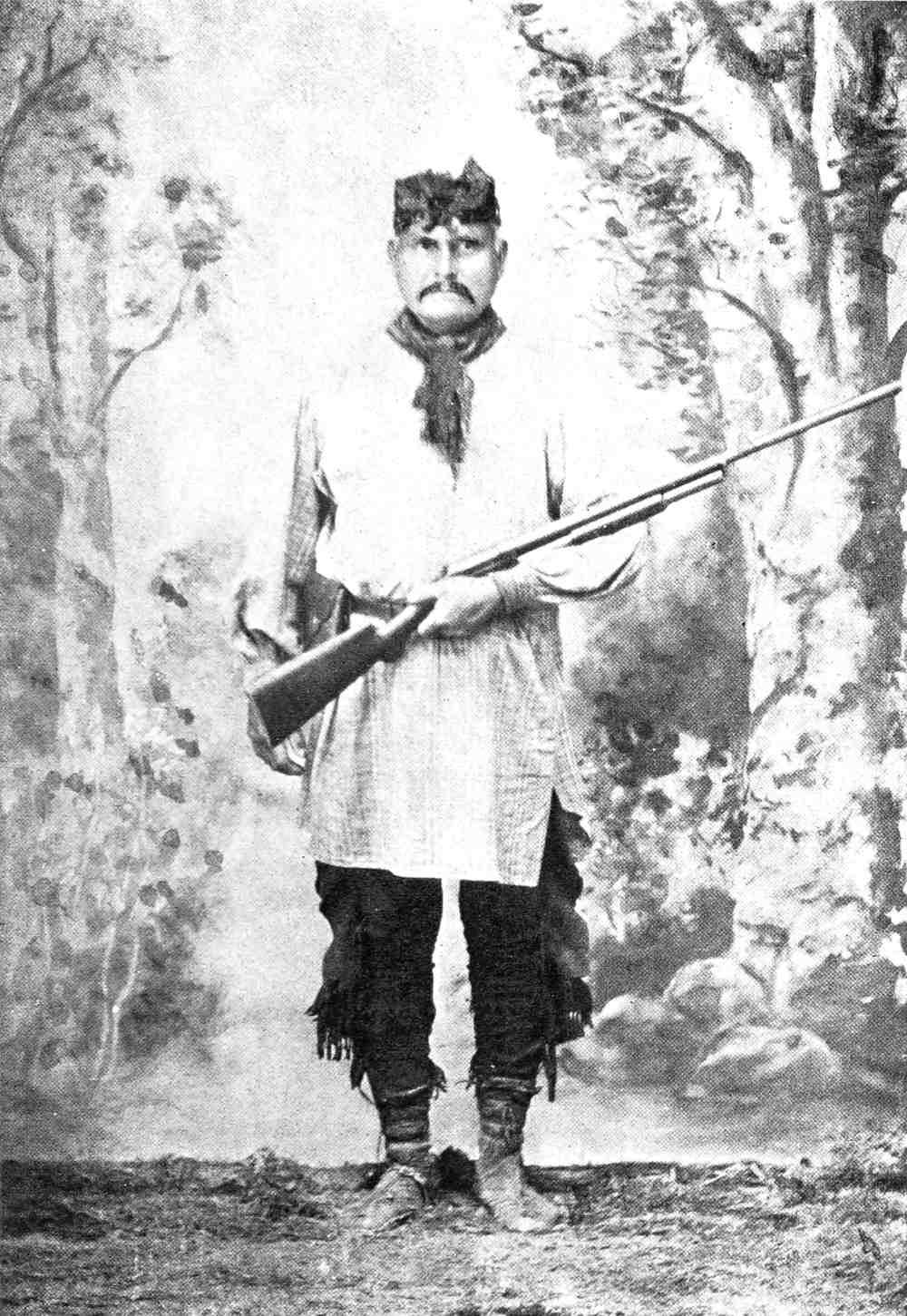
CAPT TOM TIGER
(Micco Tustenug-gee.)
The case was prosecuted by the Society, “Friends of the Florida Seminoles,” and achieved notoriety for being the first case in Florida in which a Seminole sought the protection of the court. It was told that the State’s Attorney made the most thrilling speech of his life as he pleaded for the barbarian of the swamp. The Indian never swerved under the strongest cross-examination, but told the story simply and direct. The status of the case was this: The white man was to return the horse at the end of two moons, binding the promise by writing. The argument was written on a cartridge box; a terrific rain storm came; the box was soaked in water, and the writing made illegible. Because Tom could not read, he could not make oath as to what was written on the box, the white man testifying he had bought the horse. On this simple technicality the case was lost and the white man escaped the penitentiary.
Like many of his race, Tom had a love for Wy-o-mee (whiskey), and was not averse to taking it. In speaking of a saloonkeeper he would say, “Captain, good man, five Indians go in saloon, five drinks give ’im. No money take,” but when Tom was asked to drink no whiskey in Kissimmee, he promised, “un-gah” (all right). A day or two after, the white friend stepped out of his office, and looking back saw the tall form of Tom just passing into the saloon—headed by three cowboys. Tom returned to the office, and his friend chided him for going to the saloon. “Whiskey, me no take ’em, lemonade, me take, cowboys wy-o-mee take.” The white friend’s trust had not been betrayed.
In this Indian’s visit of a week, many chapters were revealed of the character and home life of this tribe. Savages, it is true, but honor, justice and religion shine forth in their tribal life.
During his absence, the squaws and pickaninnies watched the potato and corn patch, and cared for the hogs, surely worthy tribute to a domestic life.
In relating a tragedy of the forest, Capt. Tom seemed much affected. The chief, attracted by the cries of young birds, found that a rookery of the beautiful white heron had been completely destroyed by plume hunters, and the grounds strewn with the mutilated bodies of the parent birds. From the tall trees overhead the starving nestlings were spending their waning strength in calling for food. The pitiful scene touched the heart of the strong red man, and he paused in his journey to find food for the helpless birdlings. In relating the circumstance, the Indian said, “Little birds, cry, cry, all day. No water, no fish,” till the Indian boys caught minnows and daily climbed the lofty trees and fed and watered the young egrets, a tribute to the savage mind over the cruelty of the civilized and Christianized white man.
A few years ago, Florida was an ornithological Eden, the winter home of countless thousands of the migratory birds of the North American Continent; but alas, the blood thirsty greed of the Caucasian for gold is shown in the brutal extermination of the plumed egret, and “the passing of the snowy heron” is the price of human callousness. The Indian chief probably did not see in the fate of the innocent plume bird, a prophecy of the destiny of the Seminole.
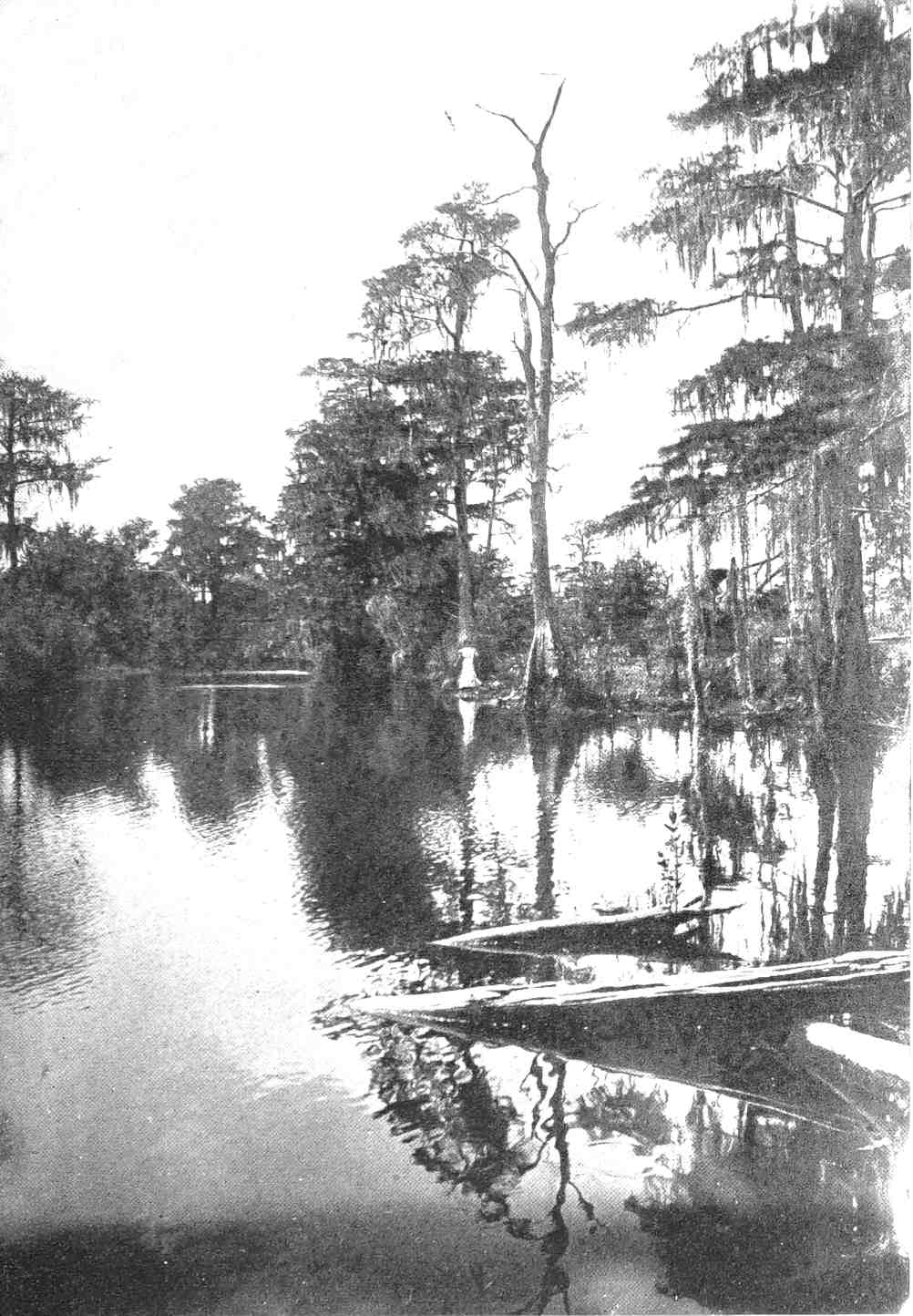
THE INDIAN’S HUNTING GROUND
“Within a mile of the wigwams, the big dredges clank and groan, an accompaniment as it were, to the dirge of the recessional Seminoles.”
The same forces are at work to-day to take from the helpless Seminole his home and happy hunting ground.
Tom Tiger made his last visit to Kissimmee during the Spanish-American war, and a touching and pleasing feature of the visit was the meeting between General Fitzhugh Lee and this Chieftain of the Seminoles.
The train bearing General Lee and staff stopped at Kissimmee, where crowds of citizens went to welcome the hero of the Southland. General Lee, dressed in his rank as U. S. general, Chief Tom Tiger in the regalia of a Seminole chieftain. The scene is indelibly impressed upon all who witnessed the meeting. The Indian chief with the Stars and Stripes in his hand, was introduced and shook hands with the great American soldier. In hearty tones General Lee responded, “I am glad to see you, Chief.”
Tom was told he must “yell” when the train came in. He understood and answered, “Me holler (ojus),” and he did, a genuine Seminole war cry, “Yo-he-ee-hee—Yo-ho-ee-hee!”
Driven and hunted, homeless and helpless, this Indian was a strong ally of the United States. “No fight white man,” meaning the people of the United States, “shoot Spaniards, ojus” (heap), was Tom’s reply when the attitude of the two countries was explained to him.
One by one the older Indians are passing away, and when word was received that Captain Tom Tiger had been killed by a stroke of lightning, the news was received with genuine sorrow. In his death, a fair, generous and faithful friend was gone. Captain Tom was building himself a dugout canoe on the edge of the cypress swamp, his family being with him at the time. Seeing an approaching storm, he sent them back to their wigwam. When he did not return, the Indians went to seek him and found his dead body. Other Indians turned the unfinished canoe into a mausoleum, and there rested his remains until an avaricious curio seeker sought it out and robbed it of the body of the chief. Considering the tender respect the Florida Indians have for their dead, and also the superstition that any desecrations of the bones bring dire calamities to the tribe, it is not surprising that this act of vandalism aroused the Seminoles to the highest pitch, and they were stirred as they have not been since the days of the Indian wars. The whites realized that unless they were pacified they were liable to give trouble.
Two of the leaders of the band visited the authorities at Fort Pierce, Florida, and the newspapers of that date give the following account, “Big Yankee steal bones of Tiger Tom, Indians Big Chief and best friend. Indians all fight. Kill white man ojus, bones no bring back by big white chiefs next moon.”
The matter was immediately taken up, and information filed by the State Attorney in the Circuit Court against the party, charging him with disturbing the grave of another and having in his possession a dead body. All over the United States the account was taken up by the press and looked upon as a matter of serious importance, as the Smithsonian Institution was credited with being behind the rapacious curio hunter.
The matter was brought to Mr. J. M. Willson, Jr., recognized as the Seminoles’ best friend among the whites.
The letter following explains the situation and is herein given:
SECRETARY RATHBUN’S STATEMENT.
“Mr. J. M. Willson, Jr., Secretary Society of Friends of Seminole Indians, Kissimmee; Fla.
“Dear Sir:—Replying to your letter of the 24th inst., I beg to say that about six weeks ago a Mr. ——, about whom nothing is known here, wrote to the National Museum and offered to present certain Indian relics which he had obtained in Florida, including a skeleton of an Okeechobee (not Seminole) chief. Assuming that these objects were properly acquired by him, he was notified that they would be accepted. No further word or the objects arriving, it has, therefore, been supposed that he disposed of the relics elsewhere. The heading of his letter paper indicates that he is the secretary and general manager of an amusement resort, called Island Park, at —— Pa., and it is not impossible that the relics were taken there.
“Although I find that the name of the chief was mentioned in Mr. ——’s letter, the fact that he spoke of him as belonging to the extinct Okeechobee tribe entirely misled the Museum authorities who did not associate him with the Seminole Captain Tom Tiger, about whom so much has lately been printed in the papers until the receipt of your letter to-day.
“I cannot express too strongly my abhorrence of the act of Mr. ——, whose desecration of this grave I consider outrageous and sacrilegious. The man had no connection with this museum or any branch of the Smithsonian Institute, as he seems to have claimed several weeks before he sent in his letter.
“You can readily understand, therefore, that the museum will be only too glad to coöperate with your society in securing the return of the remains and of any objects that may have been taken with them from the grave. If they should be received at the museum they will be promptly forwarded to Florida.
“I have forwarded your letter to Mr. ——, at the address given in his letter, viz: Box 531, ——, Pa., and I have also written him.
“Trusting that this unfortunate matter may soon be satisfactorily adjusted, I am, dear, sir, very respectfully yours,
“Rathbun,
“Assistant Secretary in charge of National Museum.”
The bones of the noted Indian were quietly restored, and all trouble averted, but of the throbbing hearts of these interesting countrymen of Osceola what shall we say?
NANCY OSCEOLA.
A short time ago, the press chronicled the news that the old Seminole squaw, Nancy, living at the Big Cypress camp, was dead. The account stated that Nancy was the widow of the famous chieftain (Osceola), and that she was survived by seven children. The associated press took up the story and many accepted it as true.
It is the desire of the writer to say that Osceola’s wives (for he had two) went into captivity and were with him when he died, a captive of the United States Government, and it is safe to suppose they, with his children, were taken with the other Seminole captives to the West.
Old Nancy was the squaw of a half-brother of Osceola—hence a sister-in-law. A few years ago she consented to have her picture taken amidst a group of her great-great grandchildren. Chief Tallahassee quickly recognized the picture and said, “Old too much—eyes no see, blind ojus.” When questioned as to her identity, with the suggestion that she might be Osceola’s widow, Tallahassee showed marked disdain, “No, no, Osceola, big chief. Squaw no got one in Florida. Old Nancy Osceola’s brother’s squaw.”
BILLY BOWLEGS (CHO-FEE-HAT-CHO).
Several months ago, Cho-fee-hat-cho (Billy Bowlegs), a warrior of more than usual intelligence, made his long-promised visit to Kissimmee.
Here, away from his natural surroundings, one could study his Indian characteristics from an unprejudicial standpoint.
As a specimen of manhood, he is far above the average. Although six feet, two inches tall, he is so symmetrically proportioned that one loses sight of his height. His features are good, his hands and feet remarkably small, his voice soft and low—a characteristic of every Seminole.
His dress was the holiday attire of the tribe, his tunic or shirt he had made himself, was highly decorated with bands of narrow red,—leggins and moccasins elaborately thonged, and around his neck about a dozen gaily colored handkerchiefs, not worn for warmth, but because it is a Seminole fashion.
His large turban was embraced by a silver band, made from four silver dollars beaten with the implements which can be found at an Indian village. He wore a gold watch and chain and regulated his timepiece by the railroad clock. Billy is a fantastic dresser, but he is a loyal Seminole and a progressive one, too. He keeps posted on the markets in his own particular line of business. His pockets bulge with letters received from New York and Jacksonville buyers of skins and otter pelts. He expects no favors, pays for what he receives and keeps a promise, although a year may elapse before he is able to do so. He is often a purchasing agent for members of the band, and in his small way has a mercantile mind, buying four shawls for $1.75 that would retail at fifty cents each, he will sell out, with the satisfactory remark, “25 cents me make ’em.”
Billy ventures beyond the confines of his Everglade home, much oftener than any other of the tribe. To the stranger he is all indifference, answering: “Yes,” “No,” “Me don’t know,” as it suits him.
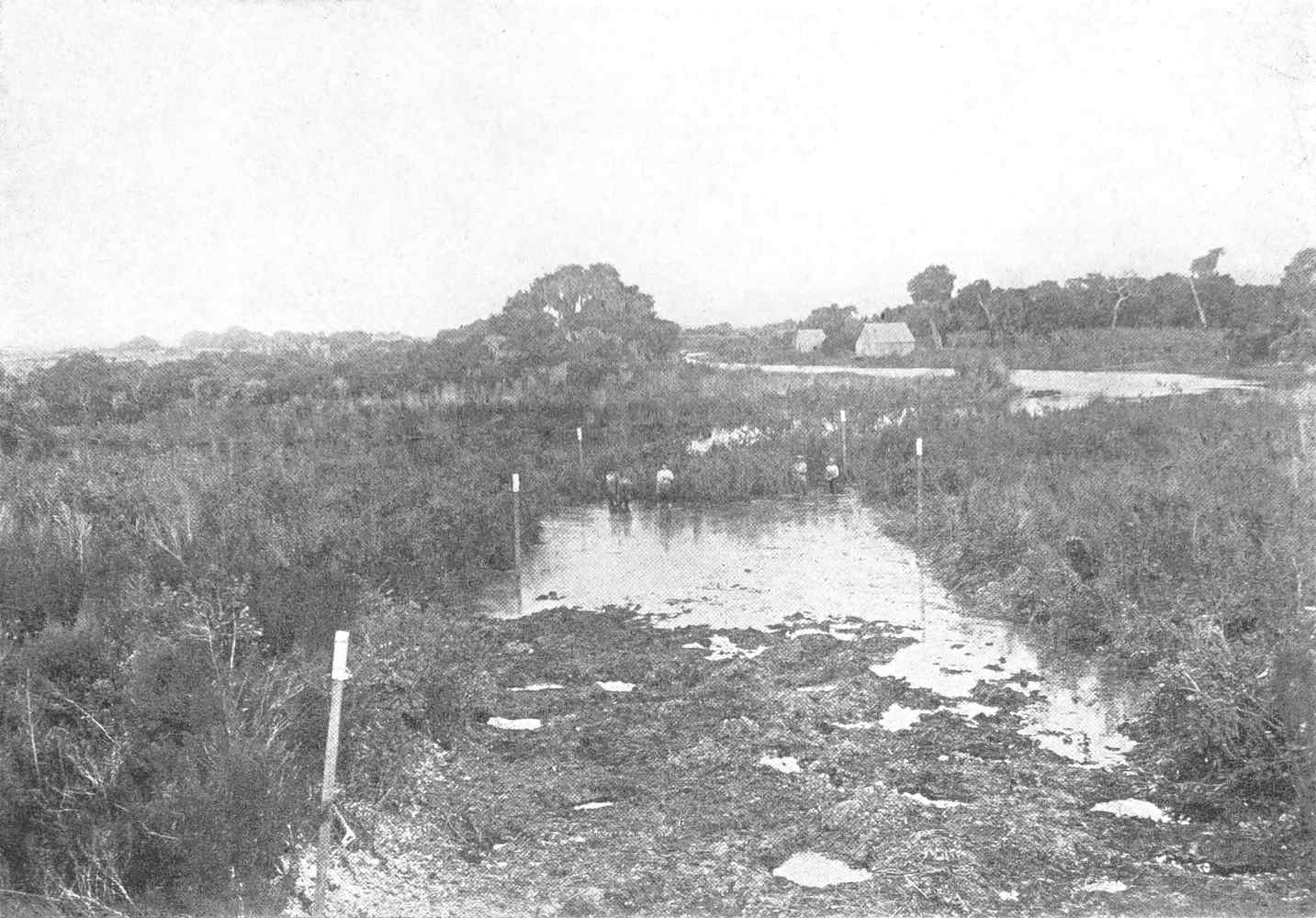
A SECTION OF A SAW GRASS SWAMP WITH THE STAKES SET FOR A NEW DRAINAGE WAY
“The onward march of the white brother into the last hunting ground of the Seminoles.”
Billy has visited St. Augustine, and has seen the Ponce De Leon Hotel, but explained that “no get inside.” The season was not “on,” otherwise the Seminole brave would have been one of the celebrities that enter its great portals. New York and Washington do honor to dukes and counts, and this Aboriginal American Knight is no less a Prince of the Everglades.
He has made several visits to Kissimmee, hence is well known to the white people. At the ringing of the church bells on Sunday morning it was explained to the Indian that they were to call the people to the church, so that the preacher might tell them of the white man’s God. With the inquiry, “You go?” to his host, and receiving an answer in the affirmative, Billy said, “Me go too.”
He was escorted to the chapel and through the long sermon was a model of propriety and conformed perfectly with the customs of the church. He expressed himself later as liking the music, but remarked that the “preacher talked too fast.”
From time to time colored pictures from Sunday School charts have been given or mailed to the Indians and Billy reports, “Indians got ’em,” keeping them with their treasures in boxes or trunks.
Blue backed spelling books had been sent to these Indians, for the spelling book is the Seminole’s ideal in literature, and Billy reported that the books were in good order—and Indian boys, spell “littly bit.”
Who shall say there is no hope for the civilization of this picturesque tribe?
Not a hair’s breadth will this Indian diverge from the truth. Even to the simple question as to when he would visit his white friends again, he replied, “Six moons; me don’t know, maybe ten moons; six moons, me say—no come, white man say, ‘Billy Bowlegs lock-a-dox ojus!’ (lie too much).”
Billy is grateful for favors shown him and on his return from a visit always sends some remembrance. A letter usually accompanies the present, and the following is a unique specimen of his literary ability:
“Indian Town, Fla., J. M. Willson, Jr., Kissimmee.
I write you Letter. I send you Big Alligator Feet skin. Big Alligator 12 ft. long 4½ inches. This time Indian no sick. All Good Well Ojus. You write to me Letter. Your Friend
Mr. Billy Bowlegs.”
In his signature, Billy always uses the prefix, “Mr.”
At another time on Billy’s return to his Okeechobee home, a letter was received which read:
“My Good Friend:
“Littly white birds me send. Indians all well.”
The egrets, snowy white and beautiful as a poem, came in a crate made of green palm stems, with a door fastened by buck skin hinges and buck skin catch, the whole a marvel of neatness and ingenuity.
The birds were at once given the freedom of the lawn, where they have been a constant surprise, in showing how full of confidence, how charming the wild heron can be made under habits of domestication. They love companionship and at meal time they station themselves like two sentinels, at the dining room piazza. Here they stand, with their long necks craning into the door-way, alert and tense, waiting for their beef to be thrown to them.
These white plumed egrets, with their dark, piercing eyes, their spotless white figures adorned in their bridal veil of long silken plumes, make a picture that an artist may envy.
It is a pleasing and encouraging fact that on all occasions when the Seminoles visit white settlements they are warmly welcomed by the whites and treated with the utmost respect and many times entertained as one would celebrities.
The Florida Times-Union always breaks a lance in favor of the Seminole. During a carnival season in Jacksonville, Billy Bowlegs visited the city, and of his visit an editorial read:
“Jacksonville has among her guests this week one of the most representative Indians in America to-day—the highest type of what is known as the savage tribe.... Billy was a conspicuous figure in last night’s parade; he rode in one of the most striking and effective floats of the parade, that of the Florida East Coast R. R. Company.... This float bore the distinction of conveying the noble figure of this Seminole chief and thus the only one with a member of the real and single strictly American race. Billy Bowlegs is no savage, but a magnificent specimen of physical manhood, with a dignity, a reserve, a keen intelligence and an honest heart—a representative of that forlorn remnant who regard honor with commendable sacredness.”
Billy visited the Times-Union office, and took the keenest interest in the mechanical equipments for making a newspaper.
A fac-simile of Billy’s writing appeared in the paper at this time and, a year later, it made an amusing picture to witness Billy’s expression when he was shown the fac-simile; the clipping having been taken from the paper at the time. Very quickly memory came to him and he said, “Me know; my name write big paper, Jacksonville.”
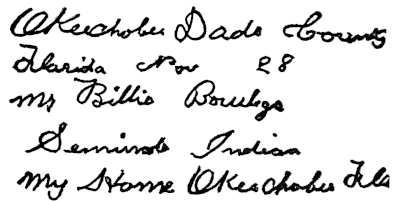
Such names as Tom Tiger, Doctor Tommy, Wild Cat and Billy Bowlegs, are white man’s names for the Indians. Each Indian has his Indian name, which is significant of some family or personal characteristic, and which contains the root word of the gens to which the Indian belongs. During the Indian’s visit he expressed a wish to have the Seminole names of a number of his people written down so that he might make a copy and carry home with him. Certainly this young brave could not be called stupid or sluggish. Knowing that the information was sought for the purpose of putting it into a book, so that “the people could read about the good Indians of Florida,” he showed the greatest interest in the questions, making his answers direct and truthful.
With the patience of a sphinx this Indian answered questions till dark. When asked if he were tired, he answered, “Tired ojus,” although his native politeness had not permitted him to show any special restlessness at the tedious afternoon’s questioning. An air of deepest solemnity would rest upon his face until he was assured his meaning was thoroughly understood. During his visit he expressed an eagerness to learn, and followed a copy with remarkable exactness. With the desire to read and write, however, ended all ambition to be like the white man.
Every effort was made to please so rare a visitor, favors were shown him, in fact he was treated as a most honored guest, yet this son of the forest received it all with a silent dignity that would have graced a monarch. When he was ready to leave he quietly arose, remarking, “Me hi-e-pus” (go), and noiselessly passed out of the house.
It is a disputed question whether a wild Indian of pure blood has ever been permanently civilized. One of the missionaries of the Osage band once said that “it took fifteen years to get a blanket off Joseph Pawnee-o-passhee, Chief of the Osage tribe, and it took Joseph just fifteen minutes to get it on him again.”
RELIGION.
A pretty tradition among the Seminoles is that a beautiful race of Indians, whose women they call the daughters of the sun, reside among the swamps and lakes of the O-kee-fee-ne-kee wilderness and live in uninterrupted felicity upon islands of eternal verdure, feasting upon the luxuries of the islands, but inaccessible to the approach of human footsteps.
Unlike the child of Africa, who lives in a world of ghosts and goblins, the Seminole is not superstitious. He has his traditions, his mythologies, and on these are based his history. He obeys the Great Spirit, but it is not from any spirit of fear; it is the teaching of his fathers, and becomes the duty of the Indian. The religion of the Seminole has been without question the most difficult of all their history to reach.
The Florida Indians believe in a Supreme Being; in the immortality of the soul; in the future existence and the resurrection of the dead. Reverence, too, is one of his distinguishing features. His language contains no oath, nor any word to express disrespect to the Great Spirit. A missionary will receive most respectful attention for their reverence to God will not permit them to laugh at His messenger. The Seminole qualifies the Supreme Being as the “Giver and Taker away of Life.” The Aztec designated, as the “God by Whom We Live.”
Their conception of the creation of man is very unique. “Long time ago, E-shock-e-tom-isee (God) took seeds and scattered them all around in a rich valley bordering a river. By and by, God saw fingers coming out of the ground and great people—heap too many came up from out of the sand. Some went to the river and washed, washed, washed too much; it made them weak and pale; this was the es-ta-chat-tee (white race). Others went to the river and washed not too much, they returned full of courage, strong, heap; this was the es-ta-had-kee (red race). The remainder no wash, lazy too much, es-ta-lus-tee (black man).”
In an extract taken from an old history printed in London in 1776, descriptive of the native inhabitants of Florida, these people are described as idolaters, worshipping the sun and moon—the worship consisting of saluting the rising sun, chanting his praise and offering sacrifices to the planet four times a year. They believe that the sun was the parent of life.
Whatever may have been the ancient rites of this race, the present people seem to have outlived all remembrance of them as well as of their early ancestors themselves. A glimmering of the Christian religion, no doubt instilled into the race more than two hundred years ago by the Franciscan priests, still seems to linger among the descendants of to-day and constitutes their religion largely. These rites they observe as faithfully as they did a century ago; and yet in all that time they have received no further teaching, and have no personal knowledge of the civilizing effects of the gospel of Christ. In the same length of time where would have been the religion of the Caucasian race, without the divine word, and without the influence of men who have devoted their lives to the cause of Christianity? The Seminoles believe in God (E-shock-e-tom-issee); that God had a son (E-shock-e-tom-issee-e-po-chee) who came on earth and lived with the Indians “long time ago to make them good Indians.”
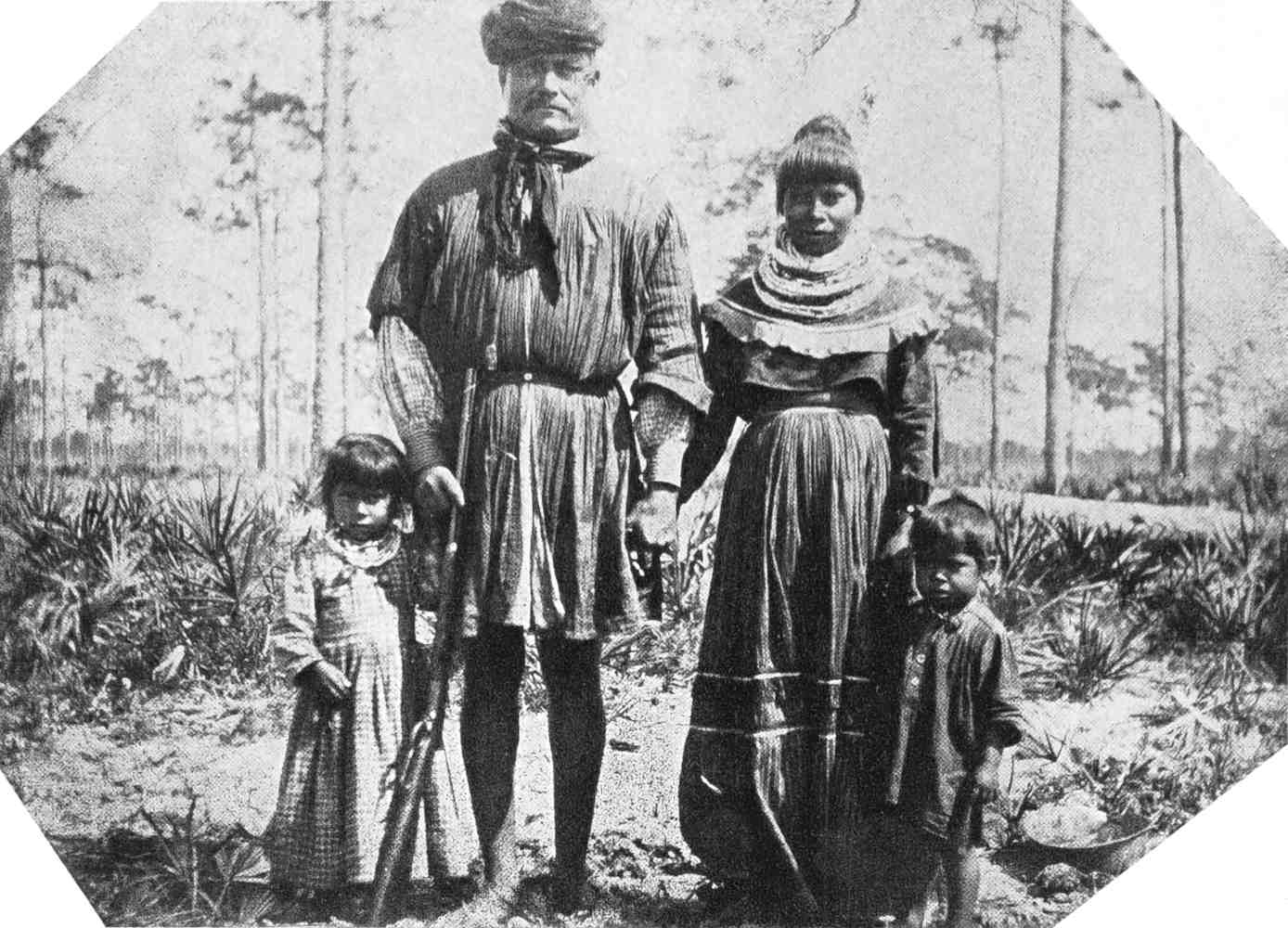
HI-E-TEE, CAPTAIN TOM TIGER, HO-TI-YEE, AND “LITTLE TIGER”
One is tempted upon an intimate knowledge of this race to wonder whether the Son of Man appeared to the Indian also; could not the Light of the World in some mysterious way have touched the soul of this innocent people? The more one studies the Seminole, the more one wonders. Christ, according to their traditions, was killed by the “wicked Spaniards” when they first came to this continent. Since that time it has been the duty of the medicine men to teach the Indians “to think with God,” and to impart the Great Spirit’s wishes to his red children. Each tribe has two or more medicine men who act as priests as well as doctors. These men are highly honored by the tribe, because they believe them to be directed by the Supreme Being. Just before the festival of the Green Corn Dance the medicine men leave the tribe, and going to a secret spot, there build a lodge. Here they fast for twenty-four hours, after which they take a potion, made of herbs, which causes a deep sleep to come over them. It is now that God appears to them in a dream and tells them how to make the Indians “think good,” and how they shall prepare the herbs for medicine. Returning in time to prepare for the great feast they occupy a most prominent position in the dance circle. The Seminole tradition of Christ’s coming to live with the Indians, is that the Son of God stopped at the most southern point of Florida, at which place he was met by three Indians who carried him around the Southern Peninsula on their shoulders, while he sowed the seeds of the “koonti” root, which was God’s gift to the red men. (This koonti is a wild cassava and found only in the extreme southern portion of Florida.) According to the legend, the Indians were in a starving condition. The ground was parched, no corn grew and the game had all left. During the long time in which the Indians waited for the koonti to grow, God rained down bread “heap, plenty,” which the Indians gathered and ate. In describing this bread, which came down in the rain each morning, the Indian illustrated in this wise: “Littly bread, white man’s biscuit all the same, good, every Indian eat plenty.” The Mosaic account of the manna from heaven is evident in this legend.
The Seminole believes in a future state, In-li-Ke-ta (heaven or home). To this place do the good Indians go after death. Here they may “hunt, hunt, hunt, plenty deer, plenty turkey, plenty bear find, and cool water ojus (plenty) all the time. Bad Indians after big sleep hunt, hunt, hunt, hunt deer, turkey, bear—no find ’em, hot water drink all the time.”
The Indians’ religion, for we may justly call it so, is sacred to him, and it is difficult to get him to reveal his inmost thoughts. His idea of the Bible is vague, because he understands it as the work of man. “White man got book, him good one day, he steal, cheat next day; book no good. Injun no make book, he no see hunting ground, him no go and come back. Big sleep, no come back, him no lie about it. Me think good Injun find hunting ground all right; me think me find it. White man, big sleep comes, me think no find In-li-Ke-ta (heaven) easy.”
After death the body of a Seminole is immediately prepared for burial, the corpse being clad in new clothes. When a chief dies one cheek is painted red, the other one is painted black. The rest of the tribe do not have the face painted for burial. It will be recalled that Osceola, with the death struggle already upon him, rose in his bed, and “with his own hand painted one-half of his face, his neck and his throat, his wrists, the back of his hands and the handle of his knife red, with vermillion,” the marks of a war chief.
At sunrise, on the day following a death, the body is carried by two Indian men to the place of interment. The corpse is placed on a base made of logs with the face to the rising sun. If the deceased be a warrior, his rifle and accoutrements are placed by his side, “that he may be fully armed on his arrival at the happy hunting grounds.” A bottle of Sof-ka is buried with him that he may eat on his long journey. Around the body is built a pen of logs sloping till they close at the top and thickly covered with palmetto leaves. The protection is to prevent the wild beasts from despoiling. With faces now turned reverently to the rising sun, they commend into the keeping of the Great Spirit the bivouac of the dead. The bearers of the dead then make a fire at each end of the grave, and the mourners return to camp, the women loudly wailing and tearing their hair. At the death of a husband the widow must live with disheveled hair for one year. Her long black tresses are worn over her face and shoulders, and she presents a forsaken, pitiable appearance. At the end of twelve moons her period of mourning is over, and she may again arrange her hair, don her beads, which have been removed during her period of mourning, and may marry again. The husband, on the death of his squaw, may not hunt for four days, and for a period of four moons must appear in mourning, which consists in the removal of his neck handkerchiefs, and the laying aside of his turban. When a death occurs in one band or settlement, the news is not communicated to the other bands until such time as it is convenient for a messenger to be sent.
BROUGHT BACK.
About fifteen years ago, one young Indian brave, Ko-nip-hat-cho by name, stepped beyond the Seminole law and asked permission to live with a white man at Fort Myers, Florida. He was eagerly received by the gentleman, and was taught much of the English language and civilized mode of living. But for a Seminole to so far forget the teachings of his fathers, as to wish to affiliate with the white race, caused the greatest dissatisfaction in the Indian camps. “Talk after talk” was “made” by the chiefs as they met in council concerning the actions of this bold young Indian. He was repeatedly warned to return to the tribe. They even threatened to kill him if he refused to do so. At length, however, artifice succeeded, where all else had failed. The daughter of Charles Osceola was promised to him for a wife if he would but return to his people and once more don the costume of his race. No Indian girl in all the nation could boast of the beauty of Nan-ces-o-wee; damask and dark, with features as refined as the Caucasian, a form superb in its symmetry, a step as graceful as the doe’s, a spirit as fearless as the falcon, such is the woman who moved Ko-nip-hat-cho from his foreign alliance. Ko-nip-hat-cho has four children, is contented and happy in his forest home, and with his knowledge is an important personage among his tribe. His wife is the belle of the Seminole nation. All the Indian braves say, “Ko-nip-hat-cho’s squaw heap purty,” and in their native tongue declare, “Nan-ces-o-wee most beautiful of all the Seminole squaws.”
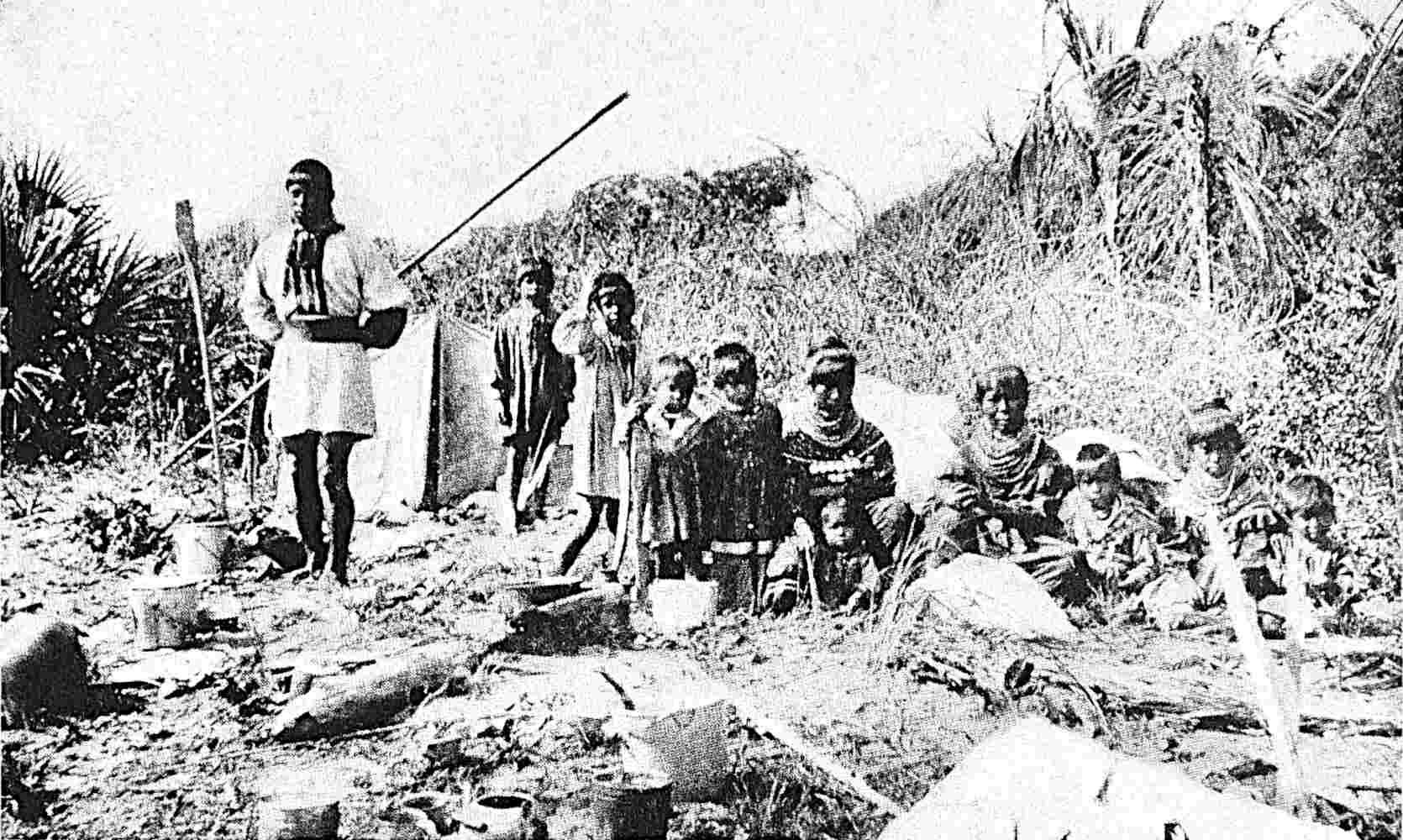
DR. JIMMIE TUSTANOGEE WITH HIS TWO WIVES AND THE CHILDREN
MOUNDS.
The great number of mounds found in Florida afford attractive study to the lover of scientific research. These mounds are of many shapes, heights and areas. They are found in all parts of the State, but are more abundant on or near the coast and along the water courses. Every few months some explorer, armed with shovels, picks and other instruments used in excavating mounds, comes before the public and announces new discoveries, based on new theories. The best possible explanation of the source of these mounds is founded on the theory that they are of Indian origin. One scientist has aimed a happy stroke at writers of our antiquities when he says, “Whoever has time and patience and will use his spade and his eyes together, and restrain his imagination from running riot among mounds, fortifications, etc., etc., will find very little more than the indications of rude savages, the ancestors of the present race.” No better theories can be advanced than those of Major Powell, who says, “Remove the Indian element from the problem and we are left without a hypothesis.” One of the latest mound excavations in Florida was made by Dr. Moore. A thousand skeletons were unearthed as well as many articles of pottery, and other things considered of great value by the explorer. The height and character of the Florida mounds indicate the different uses for which they were built. These mounds vary from three feet to thirty feet in height, and their areas range from a few square feet to four hundred feet square. The shell mounds which are numerous throughout the peninsula seem to have grown without any idea of purpose by the builders, and are merely accumulations of shells and soil. Year after year it was the custom of the tribes to congregate at certain localities for their festivals, and, living on shell fish, the shells in course of time formed vast mounds or elevations. There are a number of small mounds on the outskirts of Kissimmee City. Excavations have been made, and pieces of skeletons, beads, pottery and gold trinkets were exhumed. Other mounds in Florida indicate that they were built for tombs, while others, being composed of strata of sand and other soils, from their height might have been built for outlooks or signal towers. Chroniclers of De Soto’s day describe the manner in which the natives brought the earth to these spots and formed these elevations. The Indians say in Seminole war days these mounds were used to build their signal fires upon. By smoke telegraphy, they communicated war news from one band to another. By this means, with their fleet Indian runners, who acted also as spies, the entire tribe was kept informed of the innermost workings of the white army. In asking a chief about the burial mounds, he answered, “Long time ago heap many people here,” and that their “ancestors buried their dead in mounds so that other bands coming along might not disturb their bones.” Many times the body would be carried a great distance in order to bury in a sepulchre where rested the bones of their ancestors. “Now,” said the chief, “Seminoles no fight, not too many people;” and he buries his dead near his camp.
PICTURE WRITING.
The Seminoles have no picture writing, nor do their minds in any way run to art. They prefer the rough athletics of forest life, which educates them for the chase and makes them the vigorous and hardy people that they are. They would sooner “hook” an alligator than paint the finest picture the brush is capable of producing, and yet there is nothing in the white man’s home they enjoy more than studying the pictures of a book. In this way they may be taught much. Through the teaching by pictures they have learned the story of Pocahontas, and of William Penn, “the red man’s brother.” On an occasion the picture of a heathen Zuni god was shown to an Indian and its meaning explained. The effect produced would have done credit to a Christian believer.
MEDICINE.
The Seminoles have a superstitious faith in the efficacy of certain roots and herbs known to their tribe, the knowledge of which has been handed down from their remote ancestors. The curative property of these plants they never question. A few of the band to-day have carefully concealed about them small pieces of a root, which they call “hil-lis-waw.” This root was gotten by some of their tribe sixty years ago when their people were encamped at Tampa, and has been carefully treasured ever since, having been handed down from father to son. Their faith in the healing powers of this root is marvelous, their idea being that the smallest possible piece being made into a tea would restore life from death almost. Those fortunate enough to own a small piece the size of a pea are considered to have a great treasure. On testing this root it was found to be a simple plant, the great medicinal qualities of which exist largely in the minds of the Indians. They are ignorant as to what the root is and believe it to be very valuable, saying, “So much (what one could hold in the palm of his hand) cost $25.” “Long time ago,” says the Seminole, “chief sick heap too much; by-and-by, big sleep come. Medicine man bring hil-lis-waw, fix ’um quick. Chief get well.”
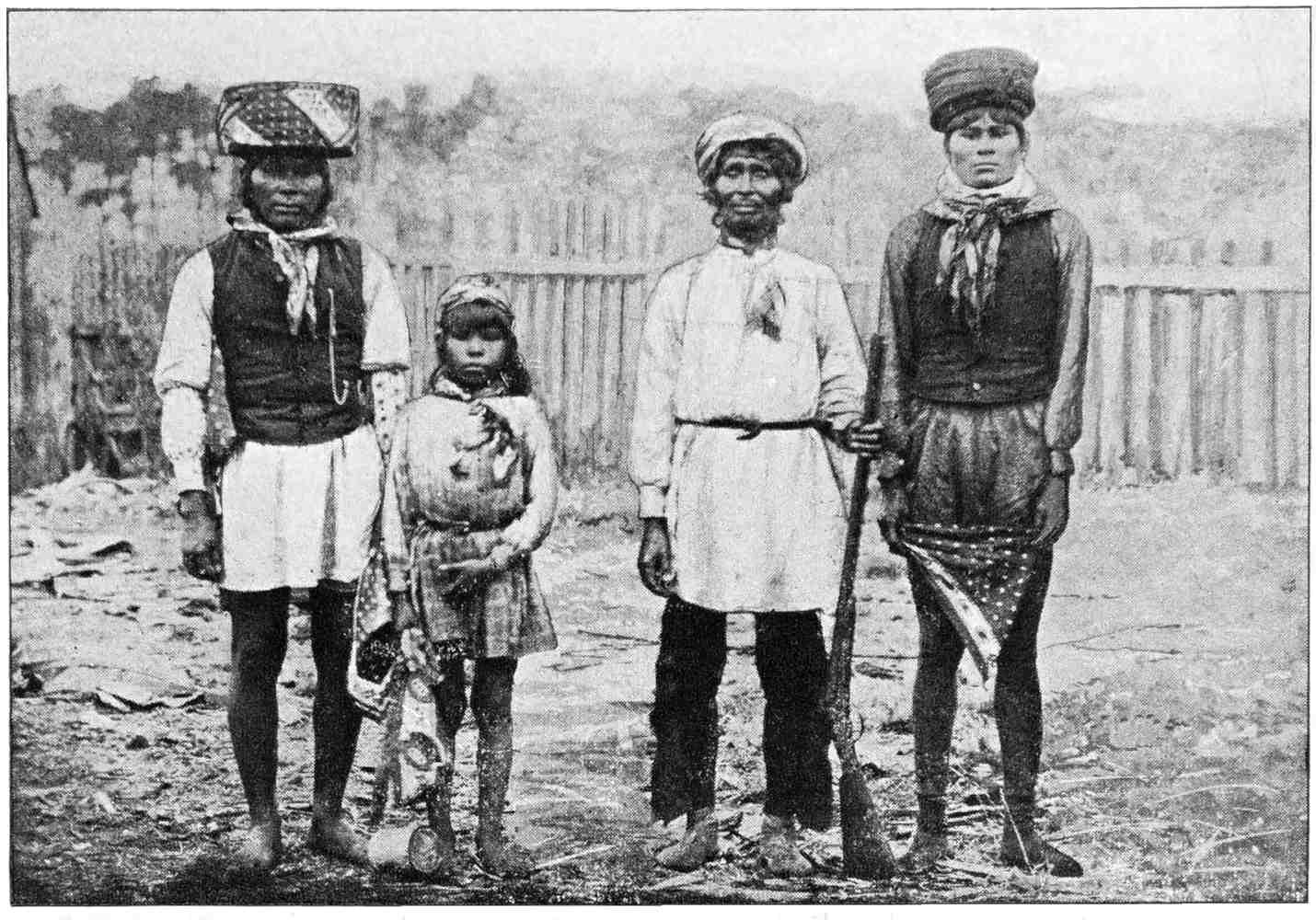
BILLY BUSTER TALLAHASSEE TOMMY HILL CHARLIE PEACOCK
A late incident occurred, showing the childlike faith of this people. The little son of Ko-nip-pat-cho was taken very ill and when Seminole medicinal efforts failed, the father learned from other Indians that their white friend at Kissimmee City could procure for them the “hil-lis-waw.” A runner was dispatched from the Everglades to the nearest boat landing (a distance of 160 miles from Kissimmee) where a note could be sent in person. This note was given to the Captain—the Indian waiting for the return of the steamer. The Indians reported afterwards, “Boy sick ojus, arms cold—feet cold—big sleep come soon—Indian bring medicine from white friend, boy no die.”
Did not the Great Spirit, Who watches over His children, reward the childlike faith of these Indians?
Pais-haw is the name applied to a plant which the Indians regard as an antidote to the rattlesnake bite. Old settlers tell that they have known of Indians allowing themselves to be bitten by a rattler on a wager of a silver dollar. The Indians after being bitten would go to the woods, a short distance away, and procure their antidote. Returning they would apparently be no worse for the bite. Requesting an Indian to procure some of the roots, he replied, “No find ’em here—by-and-by me go to Okeechobee swamps, find ’em plenty.”
A few weeks later there came through the mail a small box full of roots, neatly done up and addressed by the Indian’s own hand, a perfect copy of name and address as he had learned to write it during his visit.
On sending the roots to the Smithsonian Institute for analysis, the secretary reports that they belong to a species of plant known as Cyperus, and adds, “This is one of the large number of reputed cures for snakebites, which have become so regarded from the fact that a person who has been bitten has been known to recover after taking the drug.” The use of water enters largely into the materia medica of the Seminoles, bathing in cold water being one of their principal treatments for fevers. During the war with the whites a soldiers’ camp was found deserted; the Indians immediately appropriated the clothing, blankets and other things. Very soon the loathsome disease of small-pox broke out among them. Ignorant as to the nature of the malady, they immediately applied their bathing remedy. The result was a frightful mortality, few of that band were left to tell the story. In this instance, the Government army gained a victory over their foe without the firing of a gun.
FLORIDA’S ABIDING WORDS OF BEAUTY THE HERITAGE OF THE ABORIGINAL PATHFINDERS.
All through Florida the musical softness, peculiar to the Seminole dialect, is sustained in the names of the lakes and rivers. Each having a history descriptive of its character, or some incident connected therewith.
The old names of the chiefs were very euphonious, such as Osceola, Micanopy, Tusteenuggee, Coacoochee and Tallahassee. These are being displaced by names adopted by the whites, such as Billy Ham, Tommy John and Billy Buster. Accident, too, seems to have credited the aborigines with words not really their own if it be true that “Yankee” is only an attempt made by the Indian to speak the word English, and that pappoose is the effort of the natives to say “baby.” The symphonious cadence of such words as Alabama, Tuscaloosa, Caloosahatchee and Minnehaha has often been noticed.
Tohope Ke-liga is the name of one of the most beautiful lakes in Florida, its Indian significance meaning “fort site.” All around the lake are the old hunting grounds of the Indians and memorable points in Seminole war fame. To-day the Okeechobee drainage canal connects it with the lakes south, plantations surrounding its shores; the thriving city of Kissimmee is situated on its north side and all trace of the Seminole has vanished. The only memorials he has left are his words firmly embedded in the history of his conquerors. Kissimmee river is said to have taken its name from a romantic episode. A young Spanish grandee in a moment of impulse snatched a kiss from a Seminole girl, and the frightened maiden’s childlike plaint to her mother established the name of the river on whose banks the kiss was stolen—Kiss-him-mee.
The romance attached to our beautiful Kissimmee river gives it especial interest and we give it only as a traditional meaning. The present Indians cannot give the English rendition, saying, “Indian long, long time ago named the river,” which is corroborated by the Bureau of Ethnology, Smithsonian Institution, as follows:
In reply to your letter I regret to say that it is impossible to give you the meaning of “Kissimmee.” Several of our ethnologists think the word dates back to the Ais Caloosa, or some other tribe antedating the Seminoles, in which case the meaning will never be known.
Very respectfully yours,
W. H. Holmes, Chief.
So many of the euphonious words abounding in Florida belong to the ancient tribes and were picked up by the Seminoles.
An interesting bit of information was gotten after much care and questioning from Chief Tallahassee as to the meaning of his name—Tallahassee being only a nickname, or white man’s name for him—his Indian name being Fo-so-wa-los-te-nock-ee, meaning chief of the Bird gens or tribe.
The origin of the name of Florida’s State capital dates back to the days that are but traditions to the Seminole.
As the Seminole interprets, “Long, long time ago,” many Indians and houses were on the site where the city of Tallahassee now stands.
One day, as the tradition goes, all the Indians left. Some time after, some Indians came along, Seminoles presumably, and seeing many houses—but Indians “hiepus” (gone), exclaimed, “Tallahassee”—“all gone or deserted.”
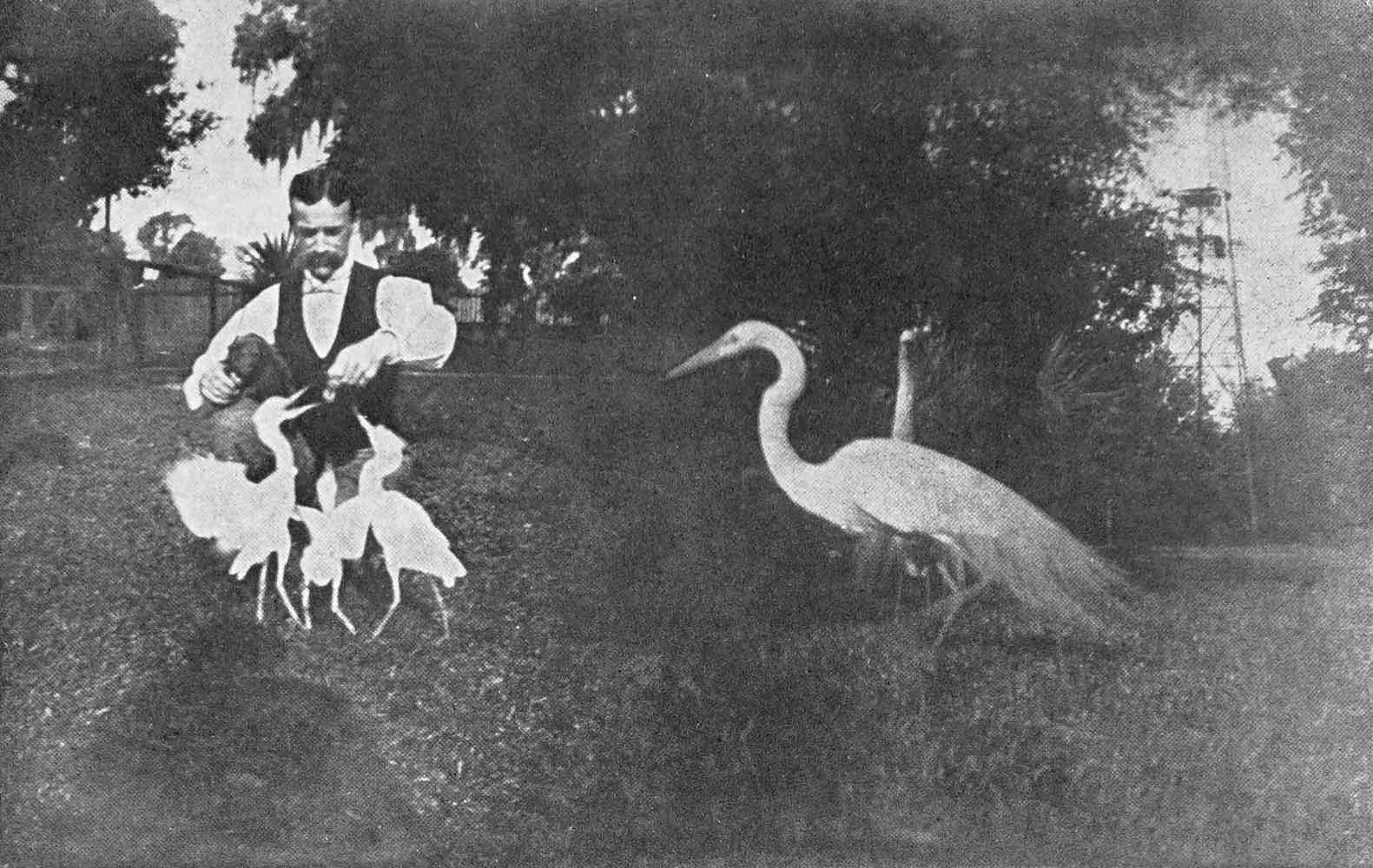
THE WILD HERON IN DOMESTICATION
“Littly white birds me send.”
“Mr. Billy Bowlegs.”
We-la-ka is the Indian name for the St. John river and describes it so graphically that the old Spaniards retrograded when they named the “river of lakes” for their patron saint. Ock-la-wa-ha, “crooked water,” appropriately describes the most crooked stream in America. Okeechobee, with her vast expanse of water and over-hanging mists, in Seminole significance means “the place of big water.” With-la-coo-chee, so memorable in Seminole war days as the place of Osceola’s strategic movements, is a long but very narrow stream, meaning, in the Seminole tongue, “Little Big river.” Alachua, “the big jug without a bottom,” We-Kiva, “mystery,” and so on all over the Peninsula do we find names preserved which mark the wanderings of the picturesque Aborigines.
The unwritten, but highly poetical, language of the Florida Indians, should be incorporated into schoolcraft form and preserved with the archives of history for future generations. One who has heard the war shouts, their mythological tales, the words accompanying their dancing tunes, or listened in the darkness of the night, with breathless wonder to the heart-moving dirges sung by wailing women as they move around the corpse of some dead member, the whole scene lit up by the flickering flames of the lurid camp fire, cannot doubt but that the Florida Indian has a literature, and the white race is to blame for its imperfect knowledge of the unwritten but priceless productions of a savage race.
The linguistic perfection of the Seminole language, with its fluent, oratorical powers, shows itself in every speech or talk ever made to the white man.
With linguistic research, the scientist readily finds that man does not invent language any more than a bird does its twittering or a tree its leaves. It requires a whole nation to produce a language.
Of the world’s famous orators we have our Demosthenes of the Greek, Cicero of the Roman, England’s great Gladstone, America with her Calhoun, Clay and Webster; but as yet has the world ever found greater eloquence than in the “talks” of the famous Indian chiefs?
Red Jacket, on the religion of the white man and the red race, is a marvel of eloquence. Then what shall we say of Tecumseh, the great Shawnee, as he delivered his famous talk to General Harrison, or Black Hawk, the captive, in his plea before General Street?
In dealing with the Seminole language we meet with long words and mammoth expressions. The Seminole greeting, “Ha-tee-eten-chee-hick-cha-hit-is-chay,” sounds formidable, yet it only means “Glad to see you.” These, with well-understood Indian phrases, such as “burying the tomahawk,” “going on the warpath,” we employ familiarly without a thought of the tribe we have dispossessed. The time for studying the aborigines of America will soon be over. Only remnants of the tribes remain among us. Old myths and customs are being displaced by new ones, and we can truly see that the red man’s inheritance is nearing the horizon of its destiny.
THE SEMINOLE’S RECESSIONAL.
When the last Seminole goes, he will in every sense be the last. He will leave no history; neither monument. His narrow path through the Savannah lasts no longer than the doe’s road to the ford of the stream. His race have had their joys, their triumphs and their defeats, and then been swept into oblivion.
Like the white plumed egret of the vast forests of the Everglades, he will pass, like the mist. As memories come up, we hear the faint rustle of the leaves and see the dusky forms of those ancient people as they glided through the leaf-carpeted aisles of the forests. We see the happy wigwam homes, gleaming in the red flames of the camp fire and hear the soft lullabies of the crooning mothers; the dusky hero of the chase returns game-laden from the hunt, and, in the picture, framed, as it were, by the boundaries of nature, we see long lines of moving life, the graceful forms of thousands of flying creatures, while the song of the forest minstrel hallows the wooded silence. It is the land of the Seminole.
Thou, Florida, with thy laughing waters and sunny skies, art the Seminole’s elysium. Thy spreading palms form the only canopy he desires. To part from thy loved scenes would be like separating from his kindred. No, under the shadows of the live oak and the magnolia has he lived, under their shadows let him die.
As the patient Seminole, with swelling heart “moves a little farther, and yet a little farther,” he goes not willingly, but with a sad heart and a slow step. Micanopy, when told by the officers that he might choose between emigration and death, answered, “Kill me here then, kill me quickly.” The same spirit is manifested by the Seminole to-day when he says, “We have never done anything to disgrace the land of our birth, nor the honor of an Indian. For fifty years the pledge to our great father has been kept inviolate. Our tongues are not forked and our feet tread not in the white man’s path. We threw away the rifle and grasped hands with the white skin. We know the white man’s power, and though we love peace, we fear not death. We will not leave the land of our birth. The Great Spirit loves his red children, and says to them, “Your bones must rest with the dust of your fathers.” Brothers, when the pale face came to the shores of our land, our fathers made him a fire from their flint rock to warm by, and gave him hominy to stay his hunger. Brothers, the Seminole wishes no harm to the white race, but his heart heaves and surges as it says, “Let us alone; let us alone. Though you slay us, you shall not move us.”