Front matter (continued 3)
Reading edition
One of the native scouts had brought word that the white men's floating village had gone, and the other savages, doubting (as uncivilised tribes invariably do) the word of one of their number, had gone to the shores of the creek to satisfy themselves on that point.
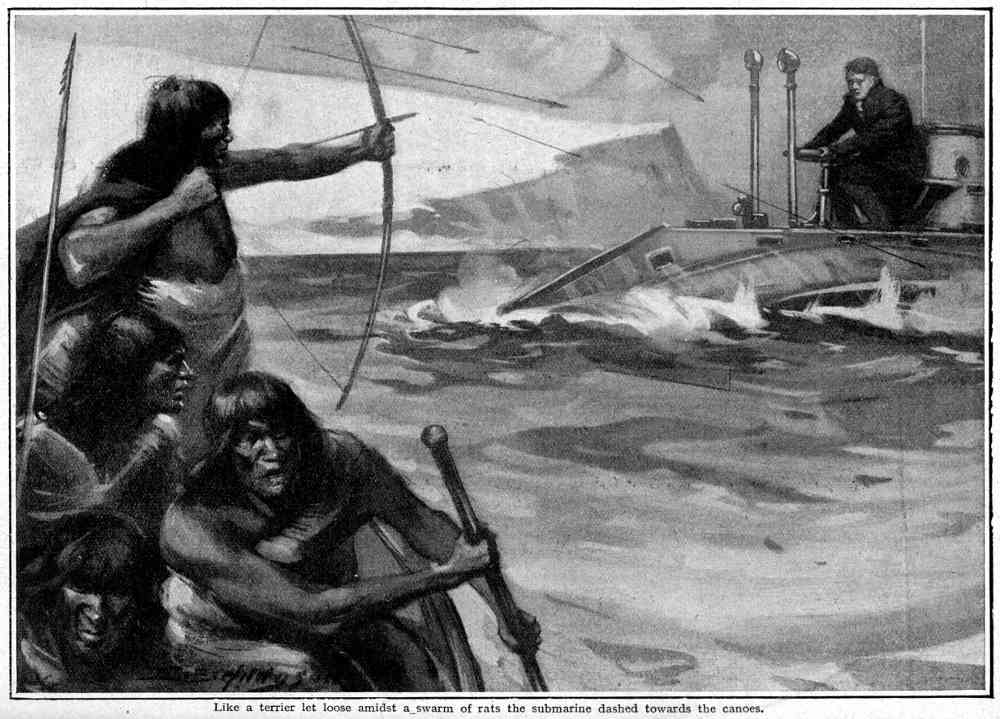
[Illustration: Like a terrier let loose amidst a swarm of rats the submarine dashed towards the canoes.]
In less than an hour the main body of the natives returned. They were in a great state of joy and excitement, for the Olive Branch had sailed, and the creek was clear, and they could now ferry themselves across and regain their miserable village without fear of molestation. Three litters were hastily constructed by means of spears and lengths of undressed hide, skins being thrown upon them to complete these rough-and-ready contrivances. Upon them the white captives were unceremoniously deposited, and with a weird song of triumph the savages wended their way through the forest to the shore of the creek.
Here a score of muscular arms soon righted the upturned canoes, and on being launched the unstable, yet heavy, dug-outs were so crowded that their gunwales amidships were barely six inches above water. Still scarcely alive to the hazardousness of his position, Stockton found himself lying at the bottom of one of the largest canoes, with Slade and the seaman beside him, both still unconscious and breathing heavily.
Well it was that the storm had abated as suddenly as it had sprung up, and that the ebb tide had now changed to the gentle flood, otherwise the canoes would have inevitably been swamped.
Urged by the powerful strokes of a score of paddles, the craft in which Jack lay shot ahead of the other canoes, its crew giving vent to a long-drawn song as they kept time with their quickly flashing blades.
Suddenly the song of the savages gave place to a yell of terror. They dropped their paddles, stood upright in their fragile craft as if paralysed by a nameless horror; then, overcoming their immobility, they plunged over the side. Relieved of their weight the canoe rocked violently, while a cascade of splashes from the agitated water descended upon the bodies of the three white men.
Then to Stockton's utter astonishment he heard a hearty voice exclaim, "Here they are, by Jove!" and three brawny seamen took a flying leap from somewhere fair into the bottom of the canoe.
"Be sharp! Pass them out!" ordered a voice that Jack knew so well, and the next moment he found himself being carefully, but swiftly, lifted from the canoe on to the narrow platform of the Olive Branch's submarine.
"Thank goodness you're saved!" muttered Gerald, fervently.
The survivors of the unfortunate expedition were carefully passed through the narrow forehatchway, then, scorning to take shelter, Gerald steered the submarine from the skeleton platform surrounding the outside of the conning-tower.
There was no need for the vessel to plunge; her sudden appearance from beneath the waters of Desolation Inlet had struck panic into the hearts of the savages, and now, like a terrier let loose amidst a swarm of rats, the submarine dashed towards the remaining canoes.
Some of the natives let fly a shower of spears in a half-hearted manner. Most of the weapons fell short, while a few glanced harmlessly from the rounded plating of the avenging craft.
Crash! The snout of the steel monster caught the nearest canoe a formidable blow amidships, the dug-out being lifted clear of the water by the impact. The next instant it fell, cut completely in two, and those of its occupants who were not killed or stunned by the concussion were swimming for their lives.
Gerald, in his lust for revenge, resolved to sink the remaining canoes. In their flight the savages lost all sense of strategy and kept together as if seeking comfort in companionship. Thus the submarine's work was rendered still more easy.
Just as the avenger reached the last of the native craft, a savage, in the courage of despair, took a flying leap upon the tapering bows of the submarine. Then, as agile as a cat, he ran along the narrow, sloping deck-plating, and, ere Gerald could avoid the unexpected attack, the muscular Patagonian grasped the sub-lieutenant round the waist.
Gerald's shout for aid was drowned by the crash of the shattered timbers of the canoe, and ere he could repeat the cry the native had shifted the grip of his right hand to his antagonist's throat, while with his left he strove to wrench Tregarthen from the narrow platform.
Realising that the moment he relaxed his grasp of the iron rail he was a lost man, Gerald contrived to strike out with his left. Handicapped by the fact that his hands were encased in thick woollen gloves, and that his reach was limited, the blow fell comparatively light. Then he tried to kick his antagonist clear, but at the first attempt the agile black, intent only on encompassing his enemy's destruction, twisted his legs in a crushing embrace round Gerald's waist, while both his sinewy hands were engaged in squeezing the sub-lieutenant's throat.
Tregarthen felt his strength was ebbing, his breath came in quick gasps, and he gurgled in the throat under the relentless pressure. Even in those few moments of peril Gerald realised that once he fell into the sea the submarine would leave him to his fate, plunging onwards till those below could see that by her erratic course she lacked a guiding hand at the helm. By that time it would be too late.
Held in the merciless grip, Gerald's range of vision was limited to the grey steel walls of the conning-tower two feet from his face. Even in the fierce, yet silent, struggle a slight dent in the metal wall exercised an unaccountable fascination till everything grew white and a filmy mist swam before his eyes.
His hands were relaxing their hold, stronger came the succession of heaves as the savage sought to hasten the end. Flesh and blood could stand the strain no longer; the rail seemed to slip from his grasp, and with his antagonist still locked in an unyielding embrace he fell backwards.
Weakened as he was Gerald braced himself to meet the shock of the icy-cold water, but with a jerk that almost broke his ankle he found his leg seized in a vice-like grip, while simultaneously the tenacious hold of the Patagonian was relaxed. He was dimly conscious of being unceremoniously hauled back to the platform of the submarine, and of Watson, one of the mechanics, making a sudden dart for the steering gear, a heavy spanner still grasped in his hand. Then everything became a blank.
[Illustration: CHAPTER XVIII]

THE CAPTAIN'S REVENGE
GERALD'S ruse had been successful. Knowing that the Indians of Patagonia frequently take prisoners any small parties of the crews of whaling vessels who allow themselves to be treacherously surprised, so as to plunder and afterwards hold them to ransom, he reasoned that the savages would remove their captives to their village directly the Olive Branch had left the anchorage. Evidently the natives wished to keep the locality of their village a secret, and only Tregarthen's scouting instincts had given him the clue.
So the submarine, in which were Lieutenant Palmer and the usual crew of that craft, was submersed in mid-channel till the canoes attempted the passage, the result of which was fatal to the savages and nearly so to the originator of the enterprise.
When Gerald came to himself he found himself lying in the fore part of the submarine in the company of the still unconscious members of Slade's force. The fore-hatch had been uncovered to admit the air, for 'tween decks the atmosphere was almost stifling.
"Well, old fellow, how goes it?" asked Mr. Palmer.
"I feel a bit rocky, but I shall be all right in a minute or two."
"Case for the sick bay, eh?"
"No fear; but it was a narrow squeak. I wonder how I managed to shake that brute off my back."
"You didn't. If it had not been for Watson noticing that the boat's head was pointing dead on shore you would not be here. He managed the rascal very neatly by a tap with a spanner, and grabbed you as you were on the point of disappearing overboard."
"Where are we now?"
"Brought up at the anchorage. We've telephoned to the Olive Branch, and she's on her way back."
Ten minutes later the cruiser appeared round a bend in the channel, and without undue delay the submarine was made fast alongside her parent ship. Stockton and Slade and the surviving seaman were hoisted over the side and sent below to the sick bay, while Gerald, still feeling the ill effects of his encounter, hastened to make his report to Captain Brookes.
"Excellent," was the captain's comment. "By the bye, you appear to have thoroughly adapted yourself to my views. This is a practical instance of the extermination of war. But we haven't done yet; I'm going to send a charge of dynamite ashore, stow it in the centre of their village, and blow the place to bits."
"Haven't we done enough, sir?" asked Gerald, for, now the excitement of the struggle was over, the appalling nature of the business was beginning to assert itself.
"Enough? No! Be thorough—that's my motto. Look here, Mr. Tregarthen, can you give me one good reason why I should withhold my hand when dealing with these rascals?"
"Suppose the whole tribe be wiped out—where does the warning to the others come in? They won't know who is responsible for the act, neither will they be able to understand why it was done. On the other hand, if we give these rascals a thundering good fright, they will have good cause to remember us, and behave better in the future."
Captain Brookes frowned. For the space of a minute he remained gazing in the direction of the inhospitable shore, then, wheeling swiftly, looked Gerald squarely in the face.
"Mr. Tregarthen, I don't know why it is, but you are the only man on the ship that dares to thwart my purpose. Nevertheless, I like you for your outspoken manner. Now carry on, and let me know what is your alternative."
"We have not as yet given the ZZ-rays a practical test," remarked Gerald, tentatively.
"Good gracious! The ZZ-rays!" exclaimed the captain, with astonishment. "The only argument in favour of the ZZ-rays in preference to a bombardment is that their action is instantaneous and consequently painless. Is that your idea of mercy?"
"No, sir. In any case we must land a party to search for our missing comrades. No doubt we can also 'round up' the savages, since they won't be in a state to offer much resistance."
"And then?"
"We can land a hundredweight of explosive, place it on yonder rock, which I believe is plainly visible from the village, and take the Olive Branch down to the mouth of Desolation Inlet, whence she can explode the stuff by means of the ZZ-rays."
"In the meantime what will the natives be doing?"
"We can leave a party to keep them under guard. I will undertake that task if required, sir."
"You have more faith in the infallibility of my invention than I have," observed Captain Brookes, with a grim smile. "What if I miscalculated the distance and wiped you out instead?"
"With due precautions there is no risk, sir."
"All right, Mr. Tregarthen. Since you are willing I make no objection. Only remember, the men required to guard the prisoners—if we succeed in taking any—must be volunteers, duly warned for the service."
Meanwhile the submarine had been submersed and housed in its accustomed berth; the divers had made rapid progress towards replacing the repaired propeller, and preparations were in hand for the proposed visit to the native village.
At sunrise on the following morning the launch, with the explosive safely stowed on board, lay alongside the cruiser. Captain Brookes signified his intention of heading the landing-party, which consisted of eighty well-armed men.
"I am going to land on the eastern side of the inlet first," said the captain. "I mean to visit the site of the ambuscade. This done, we will cross to the other side and make a survey of the village."
It was some time before the track of the unfortunate expedition could be picked up, since the snow had obliterated the footprints, and none of the survivors were sufficiently recovered to accompany the landing-party.
At length a "blaze" was found, and from that point the direction taken by the former expedition was followed with little trouble.
Although it was practically certain that all the natives who had taken part in the treacherous attack had been completely demoralised, Captain Brookes took no risks. Advanced and rear guards were told off, the men keeping their arms ready for instant use. In addition, the silencers had been removed from the rifles.
"Why are those men halting?" demanded Captain Brookes, as the advance guard came to an abrupt stop.
"They've found something, I think, sir," replied Lieutenant Sinclair.
"Then tell them to continue the advance."
By this means the gap between the three divisions being maintained, the main body arrived at the spot where their comrades had halted; then exclamations of rage burst from the lips of the infuriated seamen, for lying, half covered by a mantle of snow, were the bodies of the victims of the savages' treachery. "Isn't that enough to knock the sickly sentimentality out of the most case-hardened humanitarian?" asked Captain Brookes. "I may be wrong in my opinion, but with the experience of not only today, but of years past, I feel convinced that fear is the only means of keeping these savages in order, and, by Jove, I'll teach them a lesson!"
Having made this unpleasant discovery, Captain Brookes led his men back to the shore, whence they were transferred to the opposite bank of the inlet.
Here they again formed up and marched towards the village, which was cunningly concealed save from one particular direction—namely, from where Gerald had noticed it from the eastern shore of the creek.
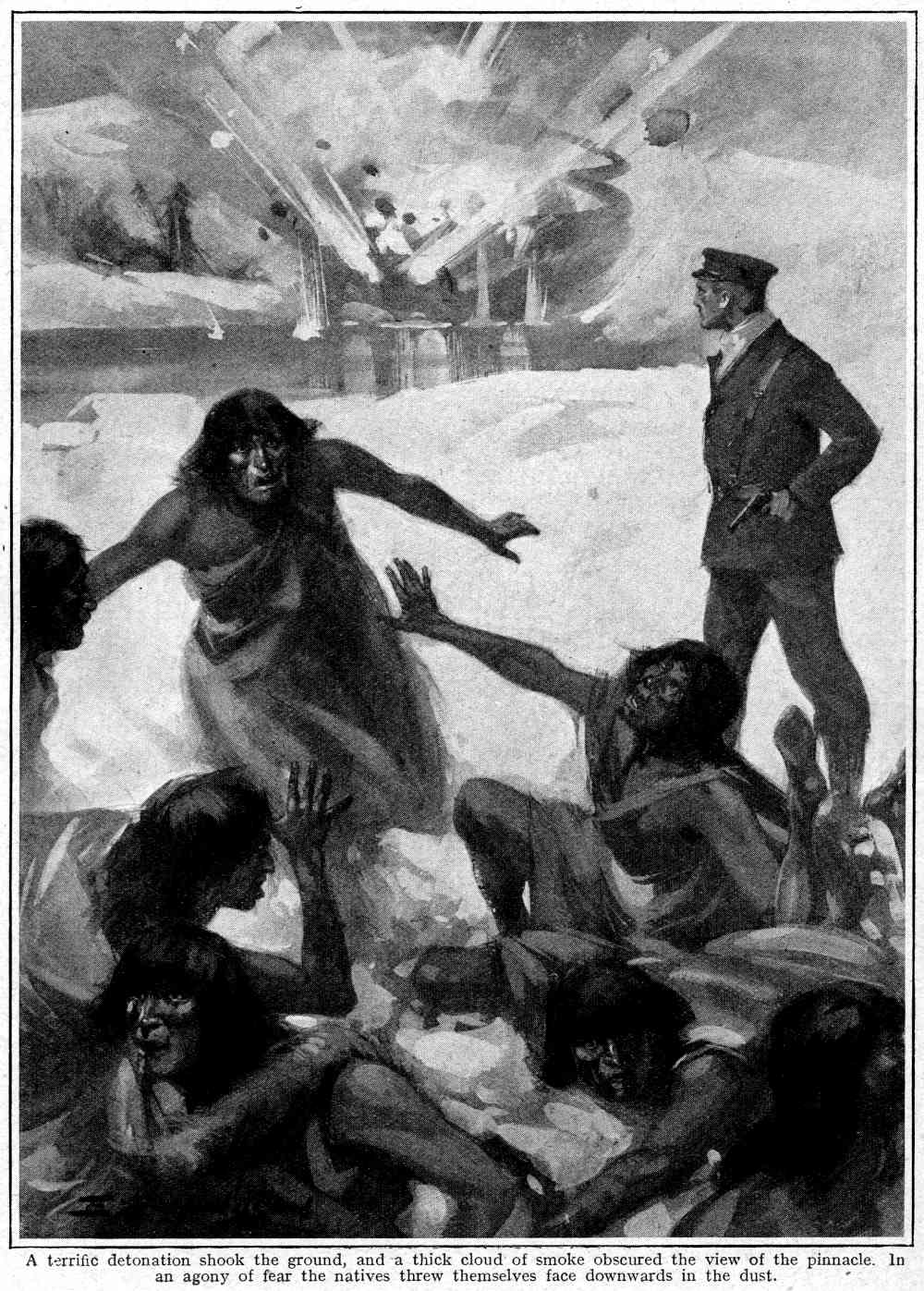
[Illustration: A terrific detonation shook the ground, and a thick cloud of smoke obscured the view of the pinnacle. In an agony of fear the natives threw themselves face downwards in the dust.]
Detaching a party of twenty men under Lieutenant Sinclair, with instructions to make a detour to the opposite side of the village, so that the savages' retreat would be cut off, Captain Brookes halted the main body till a prearranged signal was given to show that arrangements for surprise were complete.
"Now, forward, my lads!" exclaimed the captain, as the report of a rifle was heard in the distance.
At the double the seamen rushed towards the collection of hovels that formed the Patagonian village. A few of the natives showed fight, but the majority fled, yelling with terror, in the direction of the narrow defile held by Sinclair and his men.
Soon the fugitives were driven back; men, women, and children bolted to their huts, and the work of capturing the natives began.
The savages offered but little resistance as they were seized and securely bound. As for the women and children, they stoically remained with their men-folk and finding that they were not to be put to death—as they fully expected to be—the savages began to lose their sullen manner and to take a faint interest in the seamen's preparations.
On an open space in front of the village the natives were placed—the men, individually bound and roped together as an additional safeguard, sitting on the ground in a circle, with the women and children in the centre.
Meanwhile another party of seamen had carried seven tins of dynamite, each containing 16 1/2 lbs., to the base of the crag that Gerald had indicated—at a distance of a mile and a half from the village—and separated from it by the main channel of Desolation Inlet.
Gerald had detailed his volunteers for the task of guarding the prisoners, and all the preliminary preparations were now complete.
"Now for a practical test of the ZZ-rays, Mr. Tregarthen," exclaimed Captain Brookes, as he bade Gerald farewell. "It is now 10.30 a.m. At noon punctually I shall liberate the electric current from the Olive Branch, at a distance of nine sea miles from yonder crag. You will please remain here, and on no account release the prisoners till my return, which, I hope, will be at 1.30 p.m."
"Very good, sir," replied Gerald, with a salute, as the captain ordered the remainder of the landing-party to fall in.
Meanwhile the divers had been working incessantly, and the propeller was again fit for its task; the anchor was weighed, and the Olive Branch once more glided down the waters of Desolation Inlet.
Left in charge of the prisoners Gerald had ample time to reflect upon the action he had taken. In his anxiety to save the savages from extermination he had made a somewhat hasty proposal; and now, with the execution of his plan in progress, the force of Captain Brookes' objections came home to him.
The hitherto untried ZZ-rays might prove themselves far more destructive than their inventor claimed; their radius of action might overlap the area governed by those sinister chequers on the indicator; the distance and direction of the pinnacle from the Olive Branch might be misjudged—and then?
Tregarthen glanced at his watch. It was a quarter to twelve.
"Smith!" he called out, addressing one of the petty officers.
"Sir?"
"Pass the word for the men to take off their bandoliers, empty the magazines of their rifles, and stow the cartridges under yonder tree."
Without betraying his surprise at the unusual order the man hurried off to communicate Gerald's instructions. Implicit obedience was Smith's sheet anchor.
"There, I've taken every possible precaution," mused the young officer. "Now things must take their course."
As the minutes slowly sped the tension amongst the seamen increased. Even the savages seemed to have an inkling that something extraordinary was afoot.
Watch in hand Gerald waited till the long hand pointed at a minute to the hour.
"Look!" he shouted, pointing to the distant crag.
The natives, although they did not understand the word, followed the direction indicated, and a tense deathly silence seemed to fill the air.
Precisely at noon a terrific detonation shook the ground, and a thick cloud of dust and smoke obscured the view of the pinnacle. When the cloud had dispersed the rock had completely vanished, only a heap of boulders marking its position.
The effect upon the natives was astonishing. In an agony of fear they threw themselves face downwards in the dust, shrieking and moaning in a most dismal manner. By a pure coincidence the rock that Gerald had selected for destruction had been regarded by the savages as the home of the tutelar god of war, and its disintegration had appalled the superstitious savages far more than any personal chastisement. They realised that the power of the white man was greater than that of the deity whom they regarded as their protector in their treacherous attacks upon harmless trading and fishing vessels that stress of weather had driven into their harbours.
Punctually at the time stated Captain Brookes returned with the rest of the landing-party.
By means of signs the savages were told that they were spared on condition that they refrained from molesting the crews of any ships that might at some future time visit Desolation Inlet. This they seemed to understand, and by gesticulations promised to conform to their captors' commands.
"Cast them adrift," ordered Captain Brookes, then turning to Gerald he continued: "Well, that's done with. There's not much doubt as to the efficacy of the ZZ-rays. But the wireless is now in working order once more, and the first message that I received is one that requires our urgent presence in the Mediterranean Sea. Until I hear further details I had better not say any more, but, rest assured, Mr. Tregarthen, that compared with our next venture, recent events are mere child's play."
(To be continued)
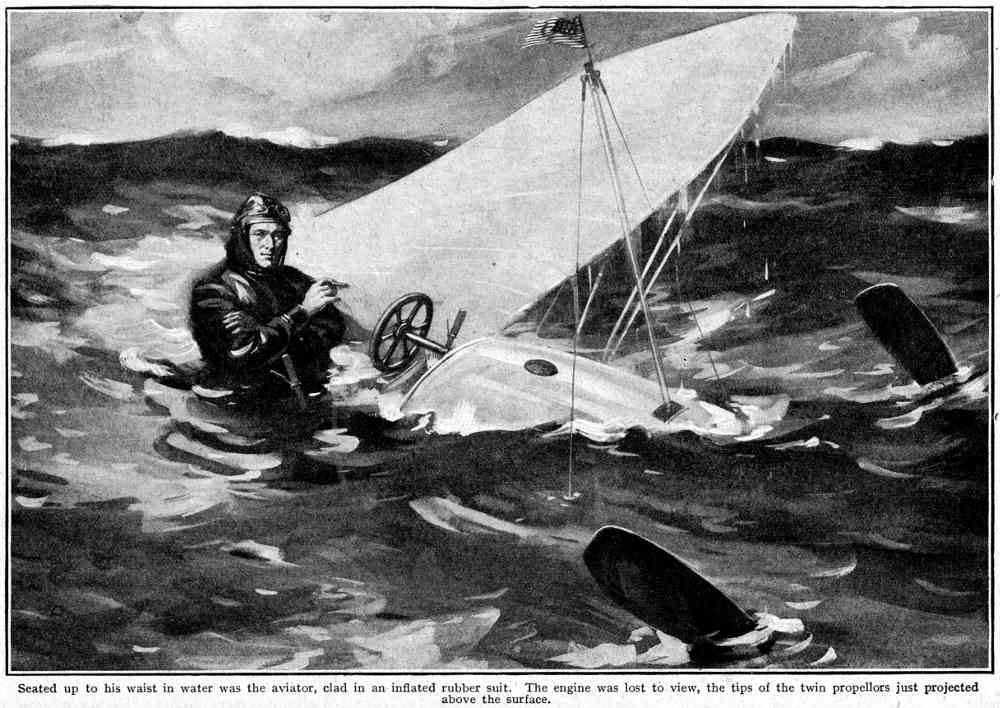
[Illustration: Seated up to his waist in water was the aviator, clad in an inflated rubber suit. The engine was lost to view, the tips of the twin propellers just projected above the surface.]
[Illustration: fifth instalment]
BY PERCY F. WESTERMAN
Author of "A Lad of Grit," etc.
ILLUSTRATED BY E. S. HODGSON
Synopsis
GERALD TREGARTHEN, sub-lieutenant of H.M.S. Calder, being on leave, sails from Poole with his old school-chum Jack Stockton on board the latter's yacht Playmate. In mid-Channel the yacht is run down; the two friends are rescued, and find themselves on board a mysterious cruiser—the Olive Branch—commanded by Captain Brookes. Finding that Tregarthen is a British naval officer, Captain Brookes announces his intention of keeping him on board, and, after due deliberation, Gerald decides to fall in with the captain's plans, as far as his sense of loyalty will permit.
Tregarthen is initiated into the secrets of the Olive Branch, including that of the deadly ZZ-rays—an irresistible charge of electricity whereby the destruction of a hostile ship can be made at will. Captain Brookes also explains that by the power at his command he hopes to make war so terrible that no nation will venture to declare war; thus universal peace will be assured. During the voyage south a German "tramp" is boarded for the recovery of some plans which had been stolen by a deserter, and for this action the Olive Branch is branded as a pirate.
Hostilities break out between Chili and Peru, and Captain Brookes determines to intervene. The Olive Branch is damaged by a mine, and while undergoing repairs is trapped by a British squadron. Captain Brookes is handicapped by a vow never to fire on a British vessel.
By the aid of the Z-rays, however, the Olive Branch escapes, though not without sustaining injury. The vessel puts into a creek in the Patagonian coast for repairs. A number of blacks which are encountered at first appear friendly, but afterwards prove treacherous, and to cower them Captain Brookes utterly destroys, by means of the ZZ-rays, a huge rock regarded by the natives as the home of their god of war. Later the captain receives a message which, without disclosing particulars, he tells Tregarthen is to the utmost urgency, and involves immediate action.
[Illustration: CHAPTER XIX]

GERALD'S PROMOTION
A WEEK later the Olive Branch was once more ploughing the waters of the North Atlantic. Since leaving Desolation Inlet her battered appearance had undergone a great change. The bridge and chart-house had been replaced, but the task of renewing the automatic steering-gear was, for the time being, beyond the resources of the ship. Thus, day and night, one of the quartermasters and two assistants had to take their places at the wheel, instead of merely keeping a sharp look-out as the Olive Branch, like an intelligent human being, pursued an unswerving course.
By this time the identity of the hitherto mysterious Olive Branch had become common property, and the principal European nations had agreed that she was not to be ignored as a fighting machine. Incidentally, Gerald's report to the British Admiralty had served a useful purpose, for, unknown to Captain Brookes and his officers, code messages had been dispatched to the numerous ships flying the White Ensign on the high seas, ordering them to abstain from hindering or molesting the cruiser, unless the latter were caught in the act of committing an outrage on British shipping. No doubt Captain Brookes's magnanimous forbearance when he ran the gauntlet from Talcahuano Harbour had much to do with this decision, but, being ignorant of it, the captain of the Olive Branch still took precautions to avoid coming into contact with a British man-of-war.
How this was to be accomplished, especially in the somewhat congested waters of the Straits of Gibraltar, through which he must pass in order to gain the Eastern Mediterranean—since the passage of the Suez Canal was out of the question—required careful forethought. News having been received by wireless from one of his agents that several of the Russian Volunteer Fleet were making the passage from Libau to Sevastopol gave Captain Brookes his opportunity; nor was he slow to act. The Olive Branch was to be disguised as a Russian vessel.
Accordingly, two huge canvas funnels were rigged up; an additional mast with a dummy wireless installation was erected; a calm day afforded the opportunity of painting the ship a greenish hue, similar to that adopted in the Imperial Russian Navy; the name Ekaterinoslav, conspicuously written in Slavonic characters, graced her stern, while the blue cross of St. Andrew on a white field floated from the ensign staff.
"I think that will pass muster," observed Captain Brookes. "But, by Jove! I hope we won't encounter a stiff breeze, or our make-believe funnels will sweep the deck."
"It will give the show away if they do," rejoined Lieutenant Sinclair. "We've guyed them as firmly as it is possible to do, and even now they are whipping before the wind."
"We must ease down a bit. I intended to in any case, so that we can slip through the Straits in a decorous manner. Will you please tell the engine-room to slow down to fifteen knots, and then stow and secure the windshields."
At sunset the Olive Branch, which was running in a northerly direction off the southwest coast of Spain, altered her course to S.E., and boldly stood in towards the historic Straits, so as to pass midway betwixt the batteries of Gibraltar on the north and Ceuta on the south, or African, shore.
The evening being warm, Gerald Tregarthen appeared on deck accompanied by Jack Stockton. The latter was making rapid progress under the skilful care of Dr. White, and though the wound had proved a severe one, no complications had arisen.
"That's Cape Tarifa," observed Gerald, as a fixed red light became visible on the port bow. "We ought soon to pick up the white light on Europa Point. But, by Jove! Jack, I hardly like this phase of the proceedings. Once we are in the Mediterranean, how are we to get out again if this blockading business is continued? It's all very well dodging a few cruisers, though, mind you, it was a fine performance; but when it comes to having to tackle the whole of the British Mediterranean Fleet, that's a rather tall order."
"But we seem to be slipping through unobserved."
"After the fashion of a crab entering a crab-pot—it's on the return trip that we have to pay toll. This disguise will serve us for the present, but the first appearance of the Olive Branch in her natural guise will set the whole of the Mediterranean Fleet about our ears."
"If they——"
Jack's sentence remained uncompleted, for with the suddenness peculiar to the Straits a vicious squall swept down from Carnero Point, taking the Olive Branch full on the broadside. Instantly the two dummy funnels disappeared overboard, where, held by the wire rope guys, they became gigantic drogues or floating anchors, against which the action of the rudder was powerless.
Then as swiftly as it had arisen the squall subsided.
Captain Brookes was, as usual when in a tight place, ready for all emergencies. Ordering the motors to be stopped lest the propellers should foul the straining canvas, he gave word for the bo'sun's mate to pipe the watch to clear away the wreckage.
Lustily the men sprang to their work, axe in hand, but, ere a dozen blows had been struck, the dazzling rays of a searchlight picked out the Olive Branch with the utmost precision.
"A cruiser," remarked Captain Brookes, calmly. "Carry on, men; then general quarters."
As he sprang towards the conning-tower the searchlight was switched off and a masthead signalling lamp began to "call up" the motionless Olive Branch.
"Acknowledge," ordered the captain, shortly; and in reply a lamp from the bridge began its succession of rapid short flashes.
"What ship is that?"
"It's no use bluffing them, Tregarthen. I'll show my true colours, and if they've any regard for their own safety they'll sheer off," remarked Captain Brookes, and turning to his signalman he ordered him to reply:—
"The cruiser 'Olive Branch.'"
Almost without a moment's hesitation the intercepting vessel signalled:—
"Is Lieutenant Tregarthen on board?"
"Ha, Mr. Tregarthen, you're promoted, I understand. Allow me to congratulate you," said his temporary "chief."
An affirmative reply having been given, the British cruiser—for British she undoubtedly was—continued:—
"I wish to communicate; am sending boat."
"They can't do us much harm while the boat's alongside," commented Captain Brookes. "Nevertheless, we must take precautions. A few revolutions with the port propellers, if you please, then carry on with the work of clearing away the wreckage."
Hardly had the accommodation ladder been rigged when the sound of oars could be heard, and the outlines of a cutter could be discerned as it approached the side of the Olive Branch.
"Two communications, sir; one for the officer commanding this ship, the other for Lieutenant Tregarthen. Will you please favour me with an acknowledgment in each case?" announced a lieutenant as he came over the side.
"I trust you will honour me with your presence in my cabin," replied Captain Brookes affably, and, as the party of officers moved towards the companion, he continued "Might I be inquisitive enough to inquire how you were so ready with your message?"
"Merely the result of a general order, sir," replied the lieutenant of H.M.S. Galatea, one of the latest super-Dreadnought cruisers. "Since your marvellous display of speed one never knows where you might turn up next. We happened to be the vessel that stood in your way."
There was a marked difference between the respective manners with which Captain Brookes and Gerald received their communications.
The former calmly and deliberately cut the flap of the envelope with a paper-knife, while his subordinate tore his with almost feverish anxiety.
Gerald's contained a copy of a general order, in which it was stated that Sub-Lieutenant Gerald Tregarthen had been promoted Lieutenant in His Majesty's fleet; and, further, that he was appointed for special duties for an indefinite period, thereby proving that My Lords were both willing and anxious for him to continue his stay on board the Olive Branch, although they hesitated to say so in plain words. Nevertheless, the communication lifted a great load off Gerald's mind, although in his excitement he could not fully realise his good fortune. Meanwhile Captain Brookes had completed the reading of the letter addressed to him. Not a sign did he give of its effect, but, inscrutable as the Sphinx, he carefully selected a quill, pointed it, and began to write.
Gerald had before remarked that these pens were the only obsolete articles on the ship. Captain Brookes, past master in the art of modern appliances, had a peculiar liking for quills; and it was with almost pre-Victorian punctiliousness that the captain penned his reply. This done, he carefully sealed the envelope with wax and handed it to the British officer with a courteous bow.
Then, having waited till Gerald had written his acknowledgment, he broke the official ice by requesting the lieutenant of the Galatea to partake of a bottle of choice old Madeira.
For nearly half an hour the midnight reception continued, and though the conversation was mainly small talk, Captain Brookes noticed that his visitor was keenly taking in his surroundings, though, the captain reflected, there was little information to be gleaned in that cabin that would prove of use to a stranger.
By the time the Galatea's cutter had returned to her parent ship the work of clearing away the debris was accomplished; and with a courteous interchange of signals the two vessels separated, the British cruiser heading towards Gibraltar Harbour, the Olive Branch tearing at forty-five knots towards the vast tideless waters of the Mediterranean.
Shortly before eight bells on the following morning all hands, save those whose absence was absolutely necessary, were mustered on the quarter deck.
As Gerald emerged through the companion he noticed that the Russian Ensign no longer floated aft, but held ready to be hoisted was the green and white flag that the Olive Branch claimed as her own.
"There's something in the air, Jack," he whispered to his chum.
The officers and men had mustered with anxious faces. They knew that a communication of some import had been received from a British cruiser, but the vaguest details of its contents were missing.
Presently Captain Brookes, in full uniform, came on deck, striding proudly like a young bantam, as the point of his scabbard clanked across the metal plating. Walking as he did between, yet slightly in advance of, two tall lieutenants, his gait would have appeared ridiculous had he been other than the captain of the Olive Branch; but there was a determination in his bearing that outweighed his comparatively diminutive stature and his pompous walk.
As eight bells were sounded the ship's ensign was hoisted, all hands standing rigidly to attention as was their wont. Then, taking from his pocket the document that he had received overnight, Captain Brookes began to read its contents.
From My Lords executing the office of Lord High Admiral of His Majesty's Ships and Vessels on the High Seas to the officer commanding the cruiser (nationality uncertain) "Olive Branch."
SIR,—You are hereby informed that, as far as His Majesty's Government is concerned, the decree of piracy issued against you, dated 29/8/—, is cancelled, provided that you and the vessel you command abstain from committing any act of violence against any of His Majesty's subjects, ships, buildings, or other properties of the Crown.—(Signed) BALDERSTOWE, Secretary to My Lords, etc., etc.
For a few seconds following the conclusion of this announcement absolute silence prevailed. The officers were too phlegmatic to allow themselves to express their feelings with acclamation; the men took longer to grasp the meaning of the declaration. When at length its significance came home to them, the seamen burst into a prolonged cheer.
Thoroughly loyal to their chief, the officers and crew had realised that the captain's policy had brought them into dangerous paths; nor could they forget that they were Britons by birth. But now the amnesty had been received the load on their minds had been removed; they could pursue their plans with a good grace.
"You see, my men," exclaimed Captain Brookes, "there's more in this than the British Admiralty feel inclined to put into writing. We are recognised as an important factor in preserving the world's peace. Nay, I will go farther. Should Great Britain in her hour of trial require our assistance—and events seem to show that clouds are already gathering on the political horizon—the Olive Branch will not hesitate to range herself on the side of the champion of true liberty.
"Now occurs the opportunity of informing you of the Olive Branch's present mission. For some considerable time past there have been signs of an approaching rupture between Turkey and Greece, and events have proved that the trouble between these two States has almost invariably ended in European war.
"I have every reason to believe that a secret treaty exists between Greece and Russia, whereby the Russian Black Sea fleet will force the passage of the Dardanelles directly the first shot is fired between the Greeks and Turks; while, on the other hand, Austria and Italy will support the Hellenes. It naturally follows that the Russian troops will swarm over the Carpathians. Under the existing understanding between Germany and Austria the former country will not remain passive while Muscovite armies are massing on her eastern frontier; nor is it unreasonable to suppose that France, ever burning to wipe out the indignity of losing Alsace-Lorraine, will side with her old ally, Russia.
"This conflict between Greece and Turkey must, therefore, be nipped in the bud. The encounter between the respective fleets must not take place; and it is the Olive Branch's duty to prevent it."
Another outburst of cheering greeted the conclusion of the captain's speech, and the men were dismissed.
As Captain Brookes was about to descend the companion, Selkirk, the chief engineer, came towards him.
"We're running verra short of fuel, sir," he reported. "A matter of twa days will clear us oot o' the last drap."
"That's serious, Mr. Selkirk."
"If she'll take a mixture of lubricating and paraffin maybe I'll screw another four hoors out o' the motors, sir; but the——"
"Very well, Mr. Selkirk. Economise as much as you can; meanwhile I'll see what's to be done."
Captain Brookes realised the gravity of the situation. At half speed it would be just possible to reach Malta, but it was deemed inadvisable to claim the hospitality of a British dependency at this early stage of reconciliation.
On the other hand, the Olive Branch would soon be in a state of comparative impotence, since the running of her dynamos from which her offensive and defensive power was derived, would be seriously affected by the under-fuelled motors.
Consequently, Captain Brookes decided to take a bold step; he would shape a course for the Straits of Messina, intercept one of the many oil-tank vessels plying between Baku and the French Mediterranean ports, and by fair means or foul take possession of her cargo.
[Illustration: CHAPTER XX]

THE AIRMAN
JUST before dawn the Olive Branch gained the northern approach of the Straits of Messina. Away on the starboard quarter glimmered the lights of the Sicilian town of Milazzo, while well down in the northern sky a faint ruddy glare betokened the position of the smouldering fires of Stromboli.
"There's Cape Faro," observed Sinclair, pointing to a headland that loomed against the pale diffusing light. "We'll soon be in the thick of the shipping."
"The sooner the better," rejoined Lieutenant Palmer. "The chief has just been informed that we can only keep going another two hours."
"Port light showing, sir," shouted the look-out, as a faint red star moved slowly from behind the intervening headland.
"Be careful not to excite suspicion," cautioned Captain Brookes, as she gave a warning blast on her syren. "Ask her to make her number."
A reference to the code-book showed that the stranger was the British steamer Bletchley Hall.
"Done this time!" grunted Sinclair, as the Olive Branch's helm was altered to show her red. Nor was the second venture more successful, the vessel in this case being the Pluton, from Zante to Castellamare.
Then, in order to economise their precious fuel, the Olive Branch's engines were stopped. As the sun rose, however, a tramp, emitting dense volumes of oil-fed smoke, laboured slowly through the Straits. The practised eye of Captain Brookes regarded her with satisfaction. "If that's not an oil-tank, I'm a Dutchman," he exclaimed.
Unsuspectingly the tramp gave her name, port of clearance, and destination, and the nature of her cargo—crude petroleum. Then, to the astonishment of her skipper, the Olive Branch made a peremptory signal for her to heave to.
To give the Russian credit he did not immediately accede to this demand. Smoke poured from the tramp's funnels in increasing volumes as she altered her course with the intention of seeking safety in flight. As well might a hedgehog seek to outpace a dog, for, with the last of her fuel the Olive Branch's motors worked up to a speed of thirty knots, while a solid shell, passing twenty yards in front of the tramp's bluff bows, caused her to stop and reverse her engines.
"Pipe away the cutter," ordered Captain Brookes. "Mr. Palmer, you will please take charge—you know your orders, I presume?"
"Yes, sir," replied the lieutenant.
As the cutter ranged alongside the tramp's rusty sides her captain, a tall, broad-shouldered, heavily bearded Slav, began abusing the intruders, cursing them in a medley of all the seafaring epithets of Europe.
"Belay there!" exclaimed Palmer. "Don't worry, old fellow! All we want is some oil."
"Then you'll haf to want," replied the irate skipper, who spoke English with tolerable fluency.
"We mean to pay you a fair rate."
"No, no—I will not sell."
"Then we must make you."
"Pirate, eh?" sneered the Russian. "Me report you, an' you'll go so," making a rapid circle with his thumb and finishing with an upward jerk. "What's the name of your sheep?"
"The Olive Branch—isn't that good enough for you?" retorted Palmer, beginning to lose his temper.
The effect of this announcement was almost magical. The crew of the tramp, mostly fair-haired Finns, disappeared from her bulwarks, while the captain hastened to leave the bridge and lower a rope-ladder over the side.
Thirty seconds later Palmer and six of his men were in possession of the Russian vessel, and the cutter was sent back to the cruiser. Then, carefully manoeuvred, the Olive Branch came alongside the tramp and the work of spoliation began.
The hoses were already connected up, and under the action of six powerful centrifugal pumps the precious oil was transferred to the tanks of the Olive Branch, till six hundred tons completed the carrying capacity of the cruiser.
This done, Captain Brookes made out a draft in payment and handed it to the Russian skipper, at the same time making him a present of a case of whisky, which the man received with an ill grace.
"We may as well give him a taste of the Z-rays, just to show there's no deception," remarked Captain Brookes as the Olive Branch showed her heels to the tramp.
"Will the rays not effect the submarine cable between Reggio and Messina?" asked Gerald.
"What matters? If they want an explanation there are the subjects for theory," replied the captain, waving his arm in the direction of the invisible Etna. "Volcanic disturbances, eh?"
The Z-rays were accordingly released for ten minutes, during which time the Olive Branch had passed the renowned Scylla and Charybdis of the ancients and was heading towards the port of Catania, sixty miles to the south'ard of the Straits.
"Wreck ahead, sir," reported the look-out.
Glasses were instantly levelled, and an object was discovered that at first sight appeared to be a small sailing craft lying on her beam ends.
"If that be the case, she's a rum sort of sailing boat," remarked Stockton. "She has a sail set on her keel as well."
"It's a monoplane," announced Captain Brookes. "The airman has come to earth on the water, to perpetrate an Irish bull. Stand by there, for'ard!"
Orders were given for the Olive Branch to reduce speed, while the crew prepared for salvage work. In the course of a few minutes the distance had decreased sufficiently for the wrecked aeroplane to be plainly visible to the naked eye. Although it owed its buoyancy to the fact that two cylindrical aluminium floats were attached to the chassis, the disabled monoplane was deeply submerged. The engine was lost to view, the tips of the twin propellers just projecting above the surface, while the extremities of the planes dipped to each successive swell.
Seated up to his waist in water was the aviator, clad in a partially inflated rubber suit. He had already seen that aid was approaching, and with the utmost deliberation he had taken an air-tight case from his pocket. From this he drew a huge cigar, which he proceeded to light with an automatic lighter, puffing away with the greatest unconcern, as if a plunge into the sea in a monoplane was an every-day event.
"Steady on your helm, there," cautioned the captain, as the huge hull glided slowly to leeward of the wrecked aeroplane; then leaning over the rail he hailed "Ahoy, there! What's the length of your planes?"
"Fifteen feet," came the reply.
Noiselessly one of the cranes swung outboard; the block with its electrical grappling device was lowered, and engaging the framework fairly amidships, held it in a vice-like grip. The next instant the monoplane was swinging in the air, a cascade of water and oil pouring from every point of its complicated framework.
"You've come to grief, I see," observed Captain Brookes genially, as the airman slipped from his seat on to the deck of the cruiser.
"No need to tell me that, sir," replied the stranger, speaking with a pronounced American twang. "I guess I'd give a dollar or two to find out how she busted up. First time I've known an engine of the Maxfield Universal Gold Star Motor Company, of Petersburg, Pa., to play that low-down trick. But here's my card, sir: Sidney P. Flew, of New York City, and of Portland, State of Oregon; until a few minutes ago, on tour from Queenstown to Cairo by monoplane. What ship is this, sir?"
"You are on board the Olive Branch," said Captain Brookes, taking the piece of pasteboard.
"What, that durned pirate? Wal, if I ain't come out on top after all. Shake, sir! I'm that downright fortunate that I feel like pinching myself in case I'm fooling myself."
"Then you have heard of the Olive Branch?"
"Heard of her? Why, the whole of Europe and the United States have been talking about her. When I left New York the last words my pa said to me were, 'Sidney, young fellow, mind that durned Olive Branch doesn't snap you up.' 'I wish she would,' says I. 'It would be the stunt of a lifetime, and you would be the proudest man in Broadway if you knew your son set foot aboard that vessel.' And now, here I am."
"Well, your wish is gratified, though I don't know whether your expectations will be realised, Mr. Flew," replied Captain Brookes, hardly knowing what to make of the young man's verbosity. "Meanwhile one of my officers will take you below. The hospitality of the Olive Branch is at your service for a few hours at least."
"No need of refreshment at present, sir. Had breakfast at Cosenza not two hours ago. With your permission I'll dismember my machine and overhaul the engine before the salt-water plays the mischief with it. Durned if I can cotton to it! The motor was going like a clock, when all of a heap it stopped. Ignition all to blazes. So down I planed, like a ptarmigan with a broken wing."
"I think I can explain it," observed Captain Brookes. "I was compelled for certain reasons to let fly an electrical current, and unfortunately for you, your monoplane came within its influence."
"More luck!" exclaimed the American, enthusiastically. "Sidney P. Flew, of New York City and Portland, fired at by the electrical guns of the world-renowned cruiser, Olive Branch. What a heading for the New York Herald."
"He's a harmless young enthusiast," remarked Captain Brookes to Gerald, as the aviator turned his attention to the rescued monoplane. "You might take him in hand and show him those parts of the ship that are of no particular importance. As soon as his craft is all ship-shape, we'll start him on his journey. By the bye, I hear that the Turkish fleet is still in the Golden Horn, and that nothing is likely to transpire for a few days. What do you say to a run across to Malta?"
"I should be glad of the opportunity, if no inconvenience is caused."
"There will be none. Sinclair is going, so if you care to take your friend, Stockton, now's the opportunity. The cutter will take you into Catania, whence a steamer plies regularly to Valetta."
Tregarthen and Stockton had barely fifteen hours ashore at Malta, but not a minute was wasted. Gerald had a previous knowledge of the island, and was thus able to pilot his chum. His chief object in making the trip was to procure a lieutenant's uniform. Now that the Admiralty had given the sanction to Gerald's presence on the Olive Branch he felt he could with propriety wear the uniform of his rank. So directly he landed at Valetta he hurried to a naval outfitter's, where by dint of promises of liberal payment he prevailed upon the Maltese tailor to have the uniform ready at the expiration of twelve hours.
"There's no time to be lost if we are to stop this business," was Captain Brookes's greeting on Gerald's return. "The Turkish fleet has cleared the Dardanelles at last. Turn in and take a good night's rest, for I'm sure you want it."
"One moment, sir—how's the airman?"
"Oh, he's a nuisance. Makes out he can't get his engine to work smoothly. I believe it's only an excuse to hang on. However, it can't be helped; I can't pitch him out at a minute's notice, so I've had the monoplane unrigged and stowed away beneath the armoured deck. After this business is over we can land him if he's still unable to fly. Look, there he is, talking to Palmer. By the bye, he seems very fond of that young fellow. Now, off you go, Mr. Tregarthen, for by sunrise to-morrow we may be cleared for action."
[Illustration: CHAPTER XXI]

THE MISSING WIRELESS GEAR
THE narrow waters of the strait between Negropont and Andros presented an unwonted spectacle to the crew of the Olive Branch as they stood at general quarters.
Straining and grinding at their utmost speed of nine knots were four Turkish battleships—the Azizieh, Mahmoudieh, Orkanieh, and Osmanieh, while on their flanks were the cruisers Abdul Medjid, Fezibahri, and Hamidieh, compelled, for defensive purposes, to reduce their speed to that of their consorts. By dint of strenuous exertions—so incomprehensible to the kismet-abiding Turk—the battleships had been cleaned of the deposit of barnacles that had encrusted their hulls during years of idleness in the Golden Horn, and were about to try conclusions with the smaller, yet more serviceable, warships of Greece.
The Hellenic fleet, consisting of the three battleships Hydra, Psara, and Spetsai, and three modern cruisers built by the Italian firm of Ansaldo, did not hesitate to put to sea, and now at less than seven miles apart the rival fleets prepared for the opening stages of the conflict.
At her utmost speed the Olive Branch dashed in between the fleets, a huge white flag flying from the truck of a forty-foot spar lashed to her diminutive signalling mast. Then, reversing her propellers, she brought up within three cables' lengths of the Turkish flagship, the Azizieh.
All hands on board the Olive Branch were now at their stations, only Captain Brookes, Gerald, Lieutenant Slade, the signal bo's'un, and two yeomen of signals remaining on the bridge or within the conning-tower.
"Make the general signal to both fleets," ordered the captain, and hoist after hoist rose to the yard-arm with the utmost celerity.
From captain of "Olive Branch" to the commanding officers Turkish and Hellenic Fleets:—
Abandon hostilities and return to respective ports. Every vessel disregarding this order by opening fire will be destroyed.
The Turkish admiral was beside himself with rage. He had heard of the Olive Branch, and of her dealings with the Peruvian fleet, but was he, a Mussulman, to be overridden by a Giaour? Slowly the foremast turret of the Azizieh swung round, the muzzle of the 9.2 Krupp pointing menacingly towards the distant Psara. For quite ten seconds the gun remained thus trained, the admiral still hesitating to give the word to fire.
Then, trained by the manual power imparted by a score of toiling seamen, the turret turned till the muzzle gaped straight at the Olive Branch.
"Better take shelter, gentlemen," remarked Captain Brookes, calmly. "The old gentleman yonder seems to be forgetting himself."
Even as he spoke the Krupp opened fire. The Turkish gun-layer, distrustful of the quality of the charge, had allowed for the admitted inferiority of the explosive; but this particular powder was far above the usual standard.
The result was that the projectile, possessing a high initial velocity and a low trajectory, flew handsomely over the Olive Branch, although sufficiently close to allow the windage to be felt by those on the bridge as they hastened to take cover.
"For'ard turret: load with Mark 2 projectile," ordered Captain Brookes. Then turning to Gerald he remarked: "Perhaps that gunner lost his head. I'll give them the benefit of the doubt."
The captain's humane consideration was thrown away. The shot had been intentional, and the Turkish admiral, finding there was no reply, prepared for a second round.
"Give it to her!" shouted the captain.
Mark 2 projectiles, though of low bursting power compared with the Olive Branch's first quality shells, were not to be despised.
The right-hand gun of No. 1 turret kicked slightly and emitted a slight bluish haze as the projectile screamed on its way towards the Turkish flagship.
The Azizieh was an old ship, being built on the Clyde in 1864, yet her 5 1/2in. belt was still capable of standing a lot of hammering; at least, so thought the Turkish authorities.
The 6in. shell took her fairly and squarely amidships, and though the ship was not instantly pulverised—as she would have been had Captain Brookes so wished—her destruction was none the less complete.
A small jagged hole marked the place of entry of the projectile; but on the explosion of the shell it seemed as if the vitals of the ship were thrown high in the air.
Twice the Azizieh made a double list, then settling down by the stern she showed that her wound was fatal. With true Oriental indifference the Turks had gone into action without throwing overboard their inflammable gear; even their wooden boats were still in davits or on the booms, and these were burning furiously.
Calmly the lithe, brown-skinned seamen lowered themselves over the side or plunged into the water. Many were caught by the propellers as the ship, by some inconceivable means, threw her stern in the air and plunged bows foremost beneath the waves, dragging down many of the swimmers in the smoke-enshrouded whirlpool that marked her grave. Then a deafening roar, as the water came in contact with her boilers, gave place to an ominous silence. The Azizieh was no more.
That was the end of the action. The rest of the Turkish vessels immediately went about and made off at full speed towards the Dardanelles; while the Grecian admiral, having made a signal thanking the Olive Branch for her intervention—an acknowledgment that Captain Brookes deliberately ignored—retired southward.
Thus the near Eastern difficulty was settled with a promptitude hitherto unknown; but, though Captain Brookes was unaware of it, the averting of a European war was not complete. The inevitable struggle was ere long to be diverted through another channel.
"See here, Mr. Tregarthen," remarked the American airman, a few days after this occurrence, "I'd just like to have a look inside that wonderful conning-tower. Can you work it?"
"I'm afraid not, Mr. Flew; at least, not without Captain Brookes's permission. Why don't you ask him?"
"Thanks, I just won't," was the reply. "Don't mention it to him."
Five minutes later the captain appeared on deck.
"Why is that Yank so keen on knowing what is within the conning-tower, Mr. Tregarthen?"
Gerald flushed with surprise. The perception of the captain of the Olive Branch seemed beyond comprehension.
"Don't look so flabbergasted, Mr. Tregarthen. You are not the first person that fellow has broached on the matter. "However, I've made up my mind to get rid of him at the earliest possible opportunity. He may be all right, but, bluntly, I don't like his inquisitive manner."
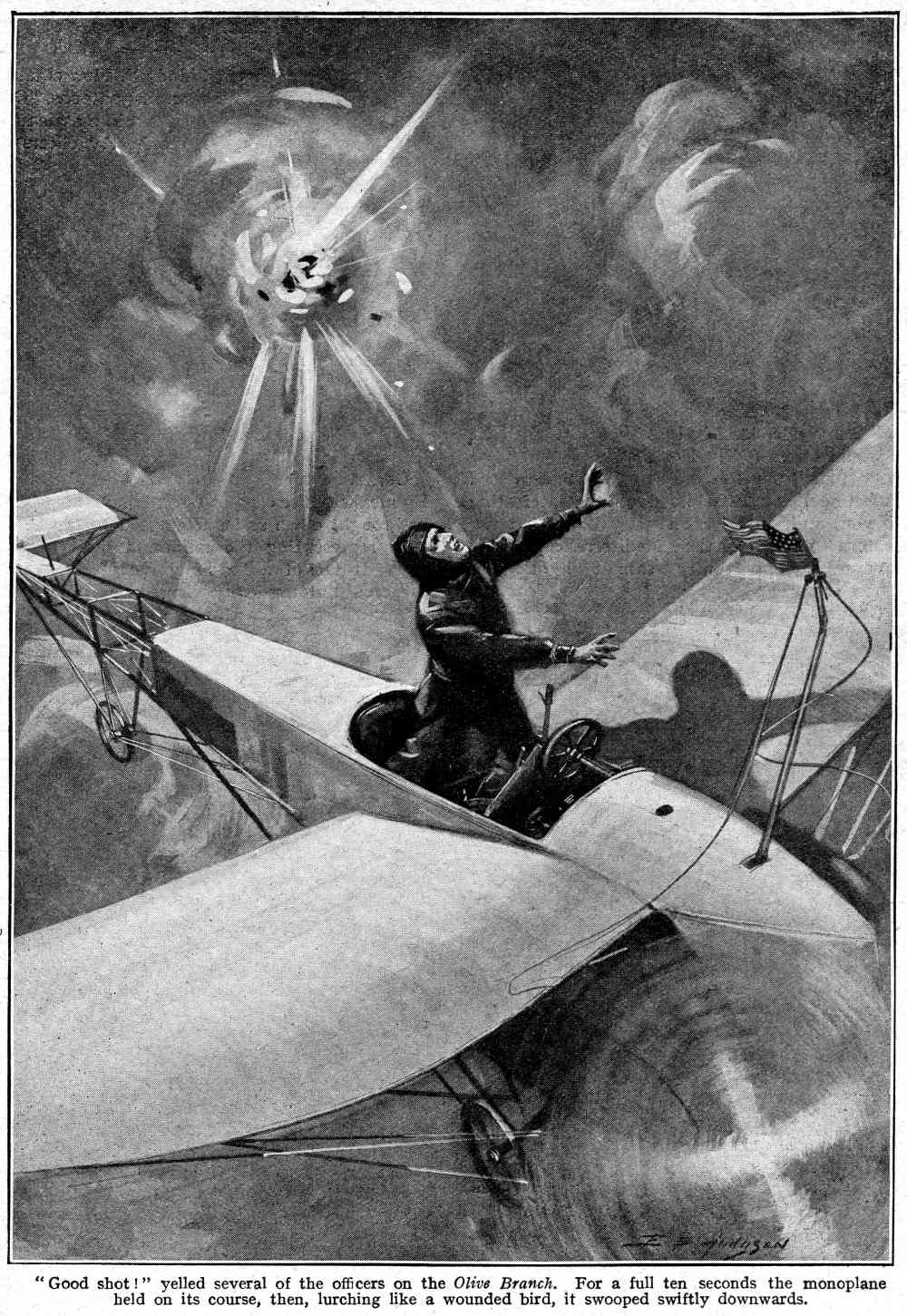
[Illustration: "Good shot!" yelled several of the officers on the Olive Branch. For a full ten seconds the monoplane held on its course, then, lurching like a wounded bird, it swooped swiftly downwards.]
"Inquisitiveness is one of the traits of the American character, sir."
"That I can make allowance for. But why didn't he come straight to me with his request?" Just then Flew, who was promenading the port side of the quarter-deck in company of Lieutenant Palmer, came abreast of the spot where the captain and Gerald were talking. In response to a sign from Captain Brookes the airman crossed the deck.
"How long will it take to get your motor tuned up, Mr. Flew?" asked the captain.
"A couple of hours; why?"
"See yonder land? It is the coast of Syria. I would suggest, Mr. Flew, that you continue your tour from this point. The Syrian and Palestine littoral will no doubt be interesting to you, and, as we are shortly bound for the eastern part of the Mediterranean, this favourable opportunity cannot lightly be ignored."
Captain Brookes spoke genially, but there was a veiled command that the airman could not fail to detect.
"Very good, sir," he replied deferentially. "I guess I'll quit right here."
As a matter of fact the work of assembling the monoplane and adjusting the motor was performed in less than an hour and a half, during which time the Olive Branch was running southward at an easy ten knots, keeping a course parallel to the Syrian coast.
"All ready now, sir."
"Then nip below and have some refreshment. By the bye, is this distance too great for your flight to land?"
"Not at all, sir."
"Will you require any of the stanchions to be cleared away?"
"No, I claim I can rise in the air at a less distance and more obliquely than any other aviator. I guess I'll not scratch the paintwork."
So saying, the airman, accompanied by Lieutenant Palmer, went below, where he remained for over half an hour. When he reappeared he was fully attired for his flight, though, protesting that the heat made the device uncomfortable, he would not inflate his indiarubber suit.
Practically all the officers and crew had assembled to watch his departure, the men crowding as far aft as they dared. Shaking hands with the officers, Sidney P. Flew climbed into his seat above the two air-pontoons. One or two preliminary touches, and like a gigantic hawk he was off, amid the hearty cheers of the crew.
While all eyes were fixed upon the rapidly soaring and receding figure there was a sudden commotion, and Lieutenant Palmer, white-faced and staggering like a drunken man, tottered up the companion.
"Stop him!" he gasped. "He's stolen the wireless reciprocators," and without another word he collapsed upon the quarter-deck.
Captain Brookes was one of the first to recover his composure—if indeed, he had lost it.
"To the conning-tower, Mr. Tregarthen. The Z-rays."
Gerald comprehended these brief orders. By means of the electric fluid the aviator would be brought down as he attempted to cross the zone representing the minimum limit of the rays. It meant a headlong race for'ard, but the crew automatically cleared a path for the young officer, and with the least possible delay he gained the armoured citadel.
Swiftly, yet deliberately, Gerald set the pointers. There was no answering spark. He tried another and yet another square; still no response. The Z-rays apparatus had been tampered with.
Realising the uselessness of investigation at that critical moment, Gerald tore aft and reported the occurrence.
Captain Brookes looked in the direction of the retreating aviator.
"Clear away that 6-pounder."
Quickly the gun was manned and a shining copper and steel cylinder thrust into the breach.
"Four thousand yards," sang out Lieutenant Sinclair, who, without waiting for instructions, had taken the distance by means of his pocket range-finder.
"Fire!"
"Good shot!" yelled several of the officers, carried away by their excitement, as, by the aid of their glasses the missile was seen to burst just above the fugitive.
For a full ten seconds the monoplane held on its course, then, lurching like a wounded bird, it swooped swiftly downwards, striking the water with a terrific splash.
"Full speed ahead. A leadsman in the chains," ordered Captain Brookes as he made his way to the bridge.
A few minutes were sufficient to bring the Olive Branch, with very little way on, immediately over the spot where the aeroplane had disappeared, the airman's cap and one of the inflated floats still marking the scene of the disaster.
The leadsman made a cast, then as he heaved the buoyed log-line overboard he shouted, "Eighty fathoms."
[Illustration: CHAPTER XXII]

THE TOUCHSTONE OF PERIL
"CLEAR away the cutter; pipe the creeping party. Three grapnels and the necessary line," ordered Captain Brookes; then turning to his officers he continued: "Before we take steps to sweep for the lost gear an investigation ought to be made. Will you, Mr. Slade, inspect the wireless room and report to me? Mr. White, you will please attend to Mr. Palmer, who evidently needs your services. Pull him together as far as you are able, so that he can give some account of this mystery. Now, Mr. Tregarthen, we'll see what's wrong with the Z-rays apparatus."
The fault in the conning-tower was quickly discovered. A small hole had been drilled in the steel column conveying the wires from the batteries to the indicator-board, and a metal rod had been inserted, thus causing a short circuiting of the current.
The mystery was as deep as ever, for how did the miscreant find time and opportunity to make his way unobserved into the conning-tower and proceed to drill the thick metal standard?
"There's hours of hard work in front of us," declared Captain. Brookes. "The disarrangement of this intricate mechanism is far more serious than one can imagine. Whether the ZZ-rays are similarly affected I cannot tell. We must find a clear field to undertake that experiment. However, we can do nothing more at present, as far as the conning-tower is concerned, so now for Slade's report."
"All the reciprocators are missing, sir, except the Plougastel one," announced Lieutenant Slade. "That happened to be in the instrument."
"Is the receiver damaged?"
"No, sir; at least, I was able to communicate with Plougastel."
"That's something to be thankful for," ejaculated the captain, fervently. "Though the loss of these reciprocators is irreparable. It means that we are cut off from all intelligence except by means of our Brittany agent. And now to interview Mr. Palmer."
"Mr. Palmer is now in a sufficiently normal state to be interrogated, sir," said the surgeon. "He is still suffering from the effects of a narcotic—opium by the symptoms."
"Very good, Mr. White," answered the captain. "I'll see him in his cabin."
Lieutenant Palmer, looking utterly miserable, staggered to his feet and saluted as his captain entered.
"Sit down, Mr. Palmer," said the captain, kindly. "Let me hear what you know of this business."
Captain Brookes took a seat and waited for the lieutenant to pull himself together, giving a hasty, yet comprehensive, glance round the room as he did so. The cabin was small and plainly furnished. In addition to the ordinary "fitments," there was a small indicator on the wall which at present was showing a blue light. This signified that the wireless was not in operation, a red light giving the operator warning that his presence was required in the wireless room.
On the table was a coffee pot and cup and saucer, large draughts of this beverage being beneficial in the treatment of opium poisoning; while on the floor stood a galvanic battery that Dr. White had used to a good purpose.
"Now, Mr. Palmer."
"I'm awfully, sorry, sir."
"So am I, but up to the present you've done nothing to be sorry for as far as I can see. Pray proceed."
"There is very little to say," began the lieutenant, simply. "The Yankee came in to my cabin to say good-bye and offered me a cigarette. I remember taking a few draws, then everything became misty, though I have a dim recollection of the man lifting me over to my bunk. How long I lay there I cannot tell, but somehow or the other I managed to open the port. The cool air revived me, and then I saw that the wireless indicator light was out. Naturally I looked towards the place where the key of the wireless room was kept, but the key was missing. Then I realised that I had been tricked, and rushing on deck to give the alarm, I found that Flew had already started."
"How were the reciprocators secured?"
"There are four of them, each in a small cylinder, with a steel chain passing through a ring-bolt at one end of each."
"Could they be concealed on his person without being separated?"
"I think so, sir."
"Then that simplifies matters. If he did not sever the chain—and most likely he had no time to do so—they might be grappled for, even if they fell clear during his downward plunge. However, that will do for the present, Mr. Palmer; I'll see how things are progressing on deck."
The cutter had already been launched and was running at a slow speed, barely half a knot, in ever diverging circles around the buoy that marked the spot where the airman had disappeared. Over her stern trailed a stout 3in. rope to which the grapnel was secured.
"What's that place yonder?" asked Stockton, pointing to a distant headland on the Syrian shore, as the two chums stood watching the dragging operations.
"Tripoli," replied Gerald, "so called because it was built simultaneously by the Syrians, Sidonians, and Aradians. It's a pity we can't go ashore there, for the ramshackle old place is full of historic interest. They say there are traces of the siege by the Crusaders early in the twelfth century. It is also—hello, what's happened?"
This ejaculation was occasioned by the sudden stopping of the cutter. Her crew began to haul in the rope, but as soon as the slack was taken up the grapnel obstinately refused to leave the bottom.
"She's fouled something, sir," shouted the lieutenant in charge of the boat.
"What strain have you put on?"
"As much as the rope will stand, sir; we can't get it home another foot."
"Then buoy the rope and haul up the lead," replied Captain Brookes.
The buoy indicating the lead-line was within a few feet of the cutter, and with but little trouble the buoy was transferred from the log-line to the grapnel-rope, and the former was hauled up.
"What have you got?" shouted Captain Brookes, as the heavy weight was lifted over the side of the boat.
Lieutenant Sinclair examined the "arming," or tallow filling the hollow in the base of the lead.
"Looks like iron scales, sir, or something covered with rust."
"Strange substance for the lead to bring up," muttered Captain Brookes; then hailing the boat, "Get out the second grapnel; sound a couple of lengths further out, and report."
The lead was again sent down. This time the cast revealed the presence of a dark ooze at seventy-four fathoms. Then the grapnel was set to work, but after traversing a short distance it became inexplicably entangled in some object. A third grapnel was lost in a similar manner.
"There's something out of the ordinary down below," remarked the captain, as the result of the third dragging operation was announced. "I'm afraid we're beaten."
"One moment, sir."
Captain Brookes turned sharply on his heel and saw Lieutenant Palmer, pale yet self-possessed, standing close to him.
"Well?"
"I'm responsible for this, sir, and I hope to be able to rectify matters. Can I descend in the submarine?"
"The submarine? You must be mad. Do you know the depth? Eighty odd fathoms, representing the tremendous pressure of 224lbs. to the square inch."
"The submarine is tested to 230lbs., sir."
"Much as I esteem your devotion, and much as I value the missing wireless gear, I cannot give my consent."
"Sir, I know the risk, and will take every precaution. With the electric grab there is no need to descend to the extreme depth."
"Mr. Palmer, I know you to be a levelheaded and calculating officer. I'm proud of you. If you will give me your word of honour to work cautiously, I'm willing to withdraw my refusal. Now, pick your crew; five men will be sufficient, and what is more, they must be volunteers, fully acquainted with the risk they are running."
"I'm with you," said Gerald, calmly.
"Thank you," replied Palmer, quietly, holding out his hand, which Tregarthen grasped firmly for a few seconds. It was a simple action, with a wealth of meaning behind it. Both men understood.
The remainder of the volunteer crew were quickly forthcoming. The difficulty was to pick and choose, since every man capable of service in the submarine signified his willingness to take part in the enterprise; but at length Palmer, Tregarthen, and three seamen fell in on the quarter-deck as the heroes of a desperate venture.
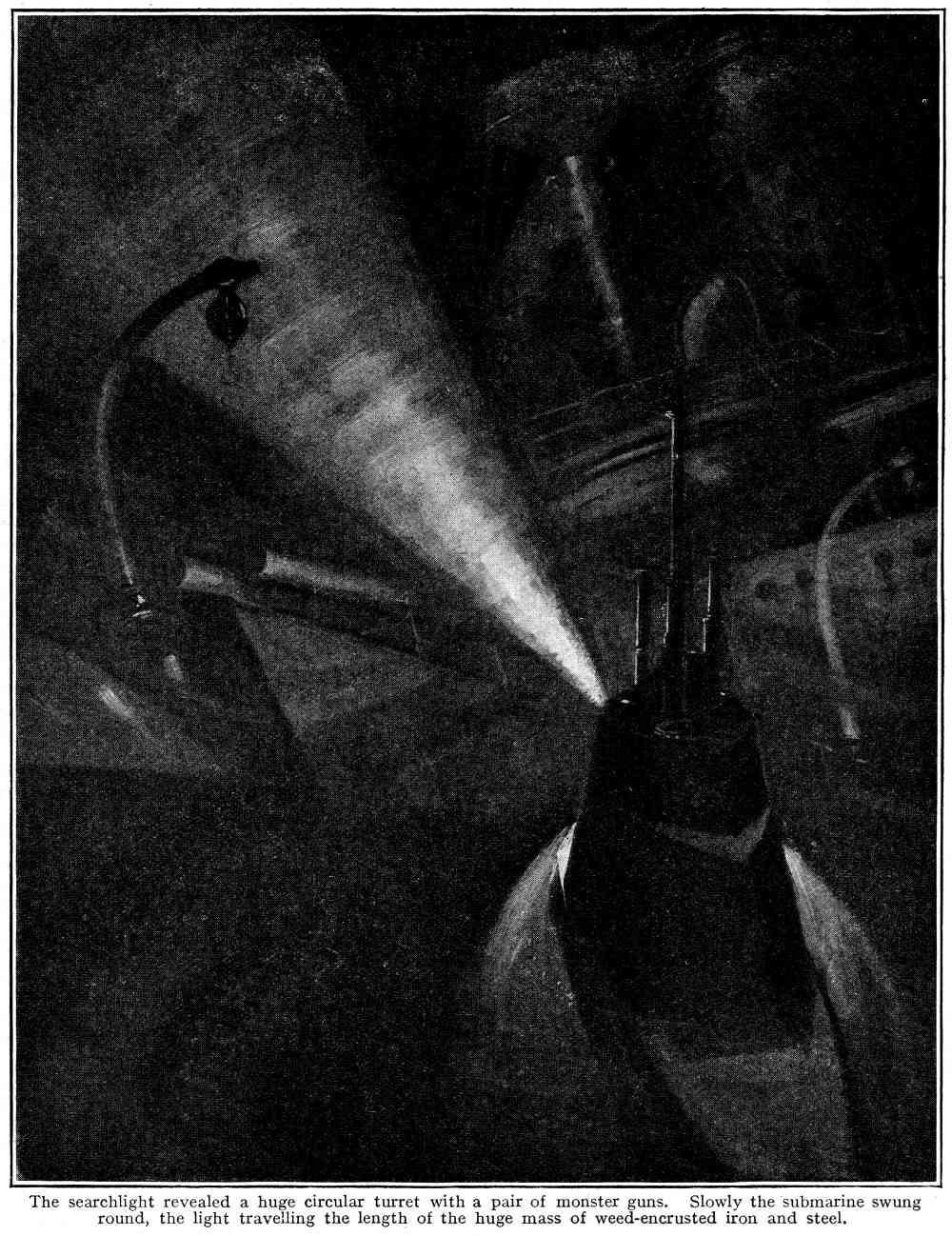
[Illustration: The searchlight revealed a huge circular turret with a pair of monster guns. Slowly the submarine swung round, the light travelling the length of the huge mass of weed-encrusted iron and steel.]
Captain Brookes addressed them in a few words, urging the men to carefully consider the step they were taking.
"You will," he continued, addressing Lieutenant Palmer, "descend for not more than one hour. If at the end of that time the submarine does not reappear I must take it for granted that some mishap has befallen you—which Heaven forfend. Meanwhile, all of you will do well to take a quarter of an hour's rest. Should any man, during that interval, think better of his decision, he may withdraw."
When the little crew were dismissed Gerald retired to the seclusion of his cabin. What he did during those fifteen minutes no human being knew, though many hazarded a guess that was not far from the truth.
Then, having shaken hands with his messmates and received their good wishes for the enterprise—though the proceedings savoured of a party of doomed men setting out for execution—the five members of the submarine's crew descended to the orlop deck and entered the vault-like cavity of the steel cylinder.
Hardly a word was spoken during the descent, save when, from time to time, Palmer's voice could be heard speaking slowly and deliberately into the wireless telephone to acquaint the Olive Branch of the submarine's downward progress.
Circling in wide curves the steel monster plunged slowly downwards. Every moment the pale green light that filtered through the sunlit sea grew dimmer, while as the pressure increased the revolution of the propeller became slower and slower.
At thirty-five fathoms the wireless telegraphy became useless, while the darkness became so opaque that the powerful electric searchlight in the conning-tower had to be switched on. By the aid of its gradually diverging beams Gerald could see a waste of water, boundless, trackless, lifeless. Sixty fathoms. The motor was running most abominably, emitting long sparks as the increased resistance of the water strove to stop the already slow-running propeller-blades.
"What's that?" hissed Palmer, pointing to a thick, indefinite line intercepting the rays of the searchlight.
Gerald looked, then thrusting the vessel's rudder over slightly, he allowed the submarine to glide past the obstruction.
"It's one of the grapnel lines."
"Impossible!"
"Yes, you've forgotten the magnifying power of the water. It shows we are not far out of our course."
"All right down there, Halliday?"
"Aye, aye, sir."
"Inform me the moment there's any sign of the plates yielding."
"Very good, sir."
The seaman was perfectly cool. Implicitly he trusted the two officers in the conning-tower, though he knew that now at any moment the massive steel structure might be crushed like an egg-shell by the tremendous weight of water without.
Suddenly, at sixty-five fathoms, Palmer seized the reversing lever and brought the forward motors of the craft to a standstill. Both he and Gerald saw a sight that filled them with nameless awe.
It was as if the submarine was heading straight for the summit of a mountain—a mountain of weed and barnacles covering an object that was not the work of Nature—it was the work of man.
Slowly the submarine swung round, her searchlight travelling the length of that mass of rusty, weed-encrusted iron and steel. Now the beams played upon a gaping gunport, its weapon still thrust aggressively forward, as if to repel an attack from above. Now the searchlight revealed a huge circular turret with a pair of monster guns; while beyond towered the fragments of a shattered bridge still carrying its silent semaphores.
Then, faintly outlined in the feeble ray, could be discovered a pair of funnels, both tottering through decay and held in position solely by the stout wire guys; while like a phantom could be traced the outlines of a mast with two military tops.
Already the submarine had gathered stern-way and was backing away from the threatening embraces of the shattered gear that surrounded the wreck, and as the vision faded slowly from their view both officers exclaimed simultaneously:—
"The Victoria!"
The two men had seen the melancholy relic of a disaster that, though it occurred twenty years ago, is still regarded as one of the most terrible that has ever overtaken the British Navy. Hidden from mortal eyes ever since the fatal day when the Camperdown rammed her, the Victoria lay in eighty fathoms of water, and now, by the wildest of coincidences, the submarine of the Olive Branch had descended nearly on top of the wreck of the ill-fated ship.
"If the reciprocators have fallen amongst that tangle they are hopelessly lost," remarked Lieutenant Palmer, indicating the position in which the wreck lay.
"That's what the grapnels fouled," added Gerald. "However, as the aeroplane sank its planes would doubtless cause it to describe a spiral-like motion. We may as well investigate all round the wreck. Have we backed sufficiently to turn?"
"I think so," replied Palmer, and ordering half-speed ahead, he thrust the helm hard over.
Seventy-five fathoms; only thirty feet from the bed of the sea. The searchlight was deflected till the lower sector of the ray was intercepted by the blunt nose of the submarine, while the light was of sufficient intensity to cast a faint luminosity over the wilderness of ooze that formed the floor of this marine desert.
"She's standing it all right," exclaimed Palmer, cheerfully. "Not a sign of a weak spot."
"Yes, it's safe enough, I think. Now, keep a sharp look-out."
The elevating planes were now turned to an almost horizontal position, barely sufficient to counteract the small reserve of buoyancy preserved by the submarine; and eddying in great circles the huge steel craft pursued her voyage of exploration.
The searchlight revealed a place of utter desolation. No trailing seaweed served to remind the men of the wonderful submarine pictures that artists love to depict; only a vast field of dark mud, surmounted by fathoms of practically opaque water.
Gerald feared for the success of their search in that maze of trackless ooze, for without a mark from which they might take their bearings the submarine must eventually wander far from the spot where she had descended. He glanced at his watch, it showed a quarter to five. That meant that in another twenty-five minutes the submarine must reach the surface, or Captain Brookes would imagine that some disaster had befallen them.
"How's the air below there?" sang out the officer in charge.
"All serene, sir; the mice are quite chirpy," replied one of the seamen.
"You had better be on the safe side and release a little more oxygen," continued Palmer. "Then stand by with the grapnel."
The grapnel was secured to the outside of the submarine, whence by means of an electric wire it could be lowered and engaged with the object to be salved. Its length was not sufficient to allow the possibility of fouling either the planes or the propeller.
"All ready, sir."
At that moment Gerald's quick eye caught sight of a mass of twisted aluminium bars and canvas. It was the monoplane.
Wedged between the framework was a long, thin object covered with a greyish material. The two officers could hardly recognise the body of the treacherous and ill-starred aviator.
Overcoming their feelings of horror the two men looked for the missing reciprocators. The submarine was now brought to a standstill, her keel resting on the ooze, while her searchlight played straight upon the victim of the tragedy.
"There they are, I believe; do you see those bulges under his coat?" exclaimed Palmer.
"It certainly seems so," replied Gerald. "Now, what do you propose to do?"
"Rise right over the aeroplane, engage the grapnel, and blow the ballast tank."
"Mind you don't overrun it, and get the propeller fouled," continued Tregarthen.
"I'll try not to. Now, here goes."
Slowly the submarine began to rise; the grapnel was dropped, and with an almost imperceptible jar the implement became entangled in the wreck of the monoplane.
"Easy ahead."
The motors, running jerkily in their endeavour to overcome the pressure of water on the propeller-blades, were gradually advanced to their utmost capacity, but still the submarine remained anchored to the bottom of the sea, till with a succession of sharp jerks the little craft wallowed helplessly in the ooze.
"Blow the for'ard ballast tank," ordered Palmer, calmly. "She'll rise like a bird."
Two of the men hastened to pump out the tank, but so great was the outside pressure that they were unable to expel the water. On the contrary, a slender stream hissed through the glands of the pumps with terrific force. One of the seamen, struck full in the face by the jet of water, was hurled against the arched sides of the vessel.
"Belay there!" exclaimed the commander, seeing that more harm than good was likely to result; then turning to Gerald he whispered, "Now, what's to be done?"
"Reverse the planes and try running the engine at full speed astern," suggested Tregarthen, now fully alive to the seriousness of their position.
For a few seconds it seemed as if this manoeuvre would prove successful, though the water hissed through the tightly packed propeller shafting as the blades went astern. Then, with a decided swoop, the submarine returned to her muddy bed.
"That's done it!" exclaimed Palmer, gloomily. "We've lost our slight reserve of buoyancy; don't say a word to discourage the men, but I fear it's all up."
Gerald did not reply. Mechanically he pulled out his watch; it was twenty minutes over the hour.
(To be continued)
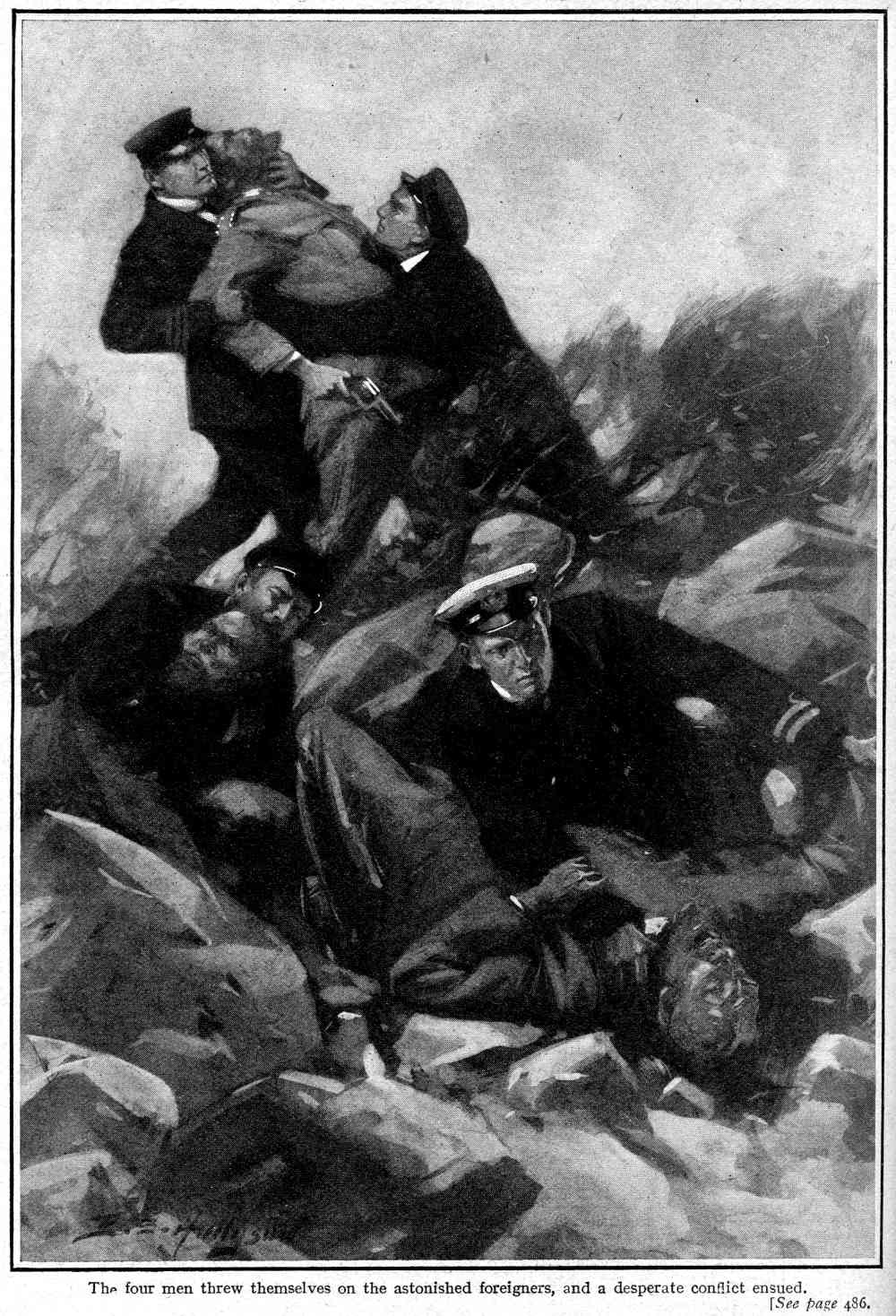
[Illustration: The four men threw themselves on the astonished foreigners, and a desperate conflict ensued.] [See page 486.
[Illustration: sixth instalment]
BY PERCY F. WESTERMAN
Author of "A Lad of Grit," etc.
ILLUSTRATED BY E. S. HODGSON
[Illustration: CHAPTER XXIII]

THE CRIPPLED SUBMARINE
"BETTER switch off the searchlight," said Gerald. "It's doing no good, and we must economise the air."
"There's enough oxygen to last for two hours," observed Palmer; "but we had better try the motors full speed ahead once more. It can't do much harm, and the longer we remain inactive the deeper the boat will sink in the ooze."
But beyond a slight pulsation of the hull the submarine remained in her hazardous position.
"Look here," exclaimed Gerald's companion, hopefully, "why not close the torpedo compensating tank and discharge all the torpedoes? That will get rid of some of our gear."
"What happens to the torpedoes when they have finished their run, provided they miss their mark?" asked Gerald.
"If they have practice-heads they rise to the surface; if provided with war-heads they sink."
"The same as our Whiteheads: the exhaustion of the compressed air actuating the propellers opens a valve that admits water into the air-chamber?"
"That is so."
"Then I'm afraid your plan is useless, for in expelling the torpedoes we are only getting rid of objects lighter than the weight of the water they displace."
"You're right," assented Palmer, ruefully.
"Beg pardon, sir," exclaimed one of the seamen, "but are we hitched up here for good?"
"It looks like it," replied Palmer, almost brutally.
"Then couldn't I go out by the air-lock—I am willing to risk it—and take a line up with me? We've nearly a hundred fathoms aboard."
"Impossible, man; you would be crushed to death."
"We ought to try something, sir; the oxygen seems to be giving out, and the mice are getting torpid."
"I thought we had two hours' supply?"
"So did I, sir, but something's wrong with the stuff."
"We will have to rely on the oxygen helmets, then. Serve them out; it may prolong our lives a few hours, though I know not to what purpose."
Slowly the minutes passed. Illuminated only by the glimmer of a solitary incandescent lamp the interior of the submarine presented a picture of gloomy despair. The crew began to realise that they were imprisoned in a living tomb.
"We must make some attempt to communicate with the Olive Branch," exclaimed Gerald, shaking off the growing feeling of apathy and drowsiness by a great effort. "Why not write a report stating our condition, enclose it in one of the torpedoes, and fire it to the surface?"
"To what purpose?" asked Palmer. "They can't help us."
"It will show them that we've done our best."
"All right, then, though personally I think it a waste of time."
Somehow or other Gerald wrote out a brief account of the vicissitudes of the submarine. This both he and Palmer signed, and enclosed in a practice-head of one of the torpedoes.
The impulse charge was sufficiently strong to eject the cigar-shaped cylinder from the tube, though at the expense of another slight rush of water; then, as there was nothing more to be done, the crew prepared for the worst.
It was a peculiar sensation that came over the doomed men. Apparently paying scant heed to their peril they sat down, with their heads buried in their arms, awaiting the sleep that precedes death. The white mice—the surest means of indicating the presence of impure gases—had long since been lifeless; only the soft purr of the dynamo and the laboured breathing of the men broke the oppressive silence.
How long Gerald remained in a semi-unconscious state he knew not; time and place were alike forgotten; he hardly possessed the power of thinking, and, knowing his fate, he seemed absolutely indifferent to it.
Suddenly a sharp metallic clank caught his ear, but, beyond hearing the sound, Tregarthen paid no heed to it. Yet something was moving across the outside of the massive steel shell. Perhaps, he wondered dreamily, it was one of those enormous submarine animals that exist only under enormous pressure, and whose bodies have from time to time been cast ashore, to the wonder of scientific men.
Slowly the bow of the submarine began to rise. Gerald sat bolt upright; he could scarce believe the evidence of his senses. Higher and higher it rose till his inert comrades rolled sideways upon the steel floor, and began to slide helplessly towards the dim recesses occupied by the motors.
Grasping the lowermost rung of the ladder leading to the conning-tower, Tregarthen tried to collect his scattered wits in order to find some explanation for the sudden tilting of the helpless boat. Perchance her afterpart had rested over a fissure, and the slimy bed had given way as the hull began to settle down.
Then the sensation of drowsiness began to reassert itself, and the lieutenant felt his grip relaxing, till, just as he was on the point of joining his companions who lay in a confused heap—dead perhaps, but at all events unconscious—a voice exclaimed peremptorily, "Empty your ballast tanks."
It was through the receiver of the loud-speaking wireless telephone that the voice came. It meant that the submarine had been raised several fathoms, sufficiently for the telephone to be used once more.
Staggering up the sloping deck, Gerald grasped the pump lever of the 'midship tank. Thank goodness the pressure had been reduced sufficiently for the powerful pump to act.
With his last remaining strength Tregarthen plied the lever, till at length a ruddy sunset glare streamed in through the thick glass apertures in the conning-tower. The submarine was awash.
Climbing the ladder into the conning-tower Gerald threw back the double-action lock securing the hatchway, but the task of opening the massive steel plate was beyond him. The next moment he was drinking in the pure air, supported by a burly petty-officer who had slid down from the cruiser to the deck of the submarine.
"Hurry up and pass these men out," he heard Captain Brookes exclaim. "Perhaps some of them may be still alive."
Half conscious, Gerald was lifted over the side of the Olive Branch, Jack Stockton supporting him with the utmost solicitude.
"A pretty fine pass," he heard Captain Brookes remark. "I did not think that Palmer would disobey orders. And nothing gained, after all."
Gerald stopped, just as he was about to be assisted down the companion ladder, and with a sudden impulse that surprised his chum, he wrenched himself clear and staggered across to where the captain stood.
"No, sir; something is gained after all. The missing wireless gear is strung underneath the submarine."
Then everything seemed to swim around him in a white mist, and but for Lieutenant Sinclair's prompt action he would have fallen headlong to the deck.
"We thought you were all done for when you did not return at the end of the hour," said Stockton next morning.
"So did I," replied Gerald. "But how did they manage to raise the boat?"
"Mainly by a slice of luck, and also through Captain Brookes's perseverance and energy, old chap. Directly we felt certain that something was amiss the captain ordered a couple of hands to the cable-cutting room. The dynameter detected the presence of a very weak current——"
"That must have been after we shut off the searchlight and stopped the motors."
"Well, at any rate, it was sufficient to enable us to fix your position. Three times the grab was lowered without result. During these operations a torpedo came to the surface."
"Yes, we discharged it without allowing the propellers to actuate, so that it would come nearly straight to the surface."
"By jove, it did! I should never have believed it had I not seen the thing jump. It shot nearly twenty feet in the air, missing the cutter by a bare boat's length. Then someone suggested unfixing the head, and within we found your message.
"With that we knew you were still alive, and that the submarine had not collapsed under the pressure of the water, as Captain Brookes had feared. Shortly afterwards the grab engaged, and we found that under a strain of half a ton it was beginning to come home. It was an anxious time, as the cable was only tested to twelve hundredweights, but it held, after all, as you know."
"How is Palmer?"
"Bad. The strain coming on top of the narcotic has played havoc with him. The other men are progressing favourably; but Gerald, old man, where's your shaving-mirror? Then hold it so that you can see the back of your head."
Tregarthen did so, and to his surprise he found that on his dark brown hair was a patch as white as snow, almost the size of a man's hand.
"That's strange, Jack. I remember putting my hand to my head when the boat began to tilt. It's a case of utter funk, I suppose."
"You've something to remember the eighty-fathom dive by for the rest of your natural life."
"I don't want that to remind me," replied Gerald, with a shudder.
"Well, it's all over now, and little harm done; but do you know there was something very remarkable about that message you sent up? You gave an account of everything that happened save one thing—the object of your trip. You never mentioned the missing wireless gear."
[Illustration: CHAPTER XXIV]

A FRUSTRATED PLOT
THE recovered reciprocators were none the worse for their prolonged submersion, thanks to the protection afforded by the steel cylinders in which they were encased.
A diver having removed them from the body of the ill-fated airman, the wrecked monoplane was released and allowed to sink once more to the bottom of the sea.
The aviator's body was brought on board the Olive Branch in order that it might be given a decent burial, and then it was that an astonishing discovery was made.
The man was not an American. Papers found on him, carefully concealed in the double thickness of his indiarubber coat, revealed the fact that he was the agent of a certain European power, and that it was his intention to find out as much about the Olive Branch as he was able to do. The flight across the Straits of Messina was part of a prearranged plan, and, though his fall into the sea under the influence of the Z-rays was not strictly in accordance with his programme, it materially helped to mature the plot that had all but succeeded.
The damage done to the Z-rays apparatus was considerable, necessitating the removal of the diagram board and the wires between the dynamo and the conning-tower. While this was being done the ZZ-rays were consequently out of action, hence Captain Brookes's anxiety to have the work put in hand without a moment's delay.
In this partially crippled state advantage was taken of the proximity of the Santorin Islands to clear the cruiser's under-body of the marine deposit that was already beginning to have an appreciable effect on her speed.
Practically the whole of these islands are of volcanic origin, sulphur springs, being strongly in evidence around the shores of Port Megalos, while the water possesses the property of killing and removing in less than thirty-six hours the weeds and barnacles that adhere to a ship.
"What do you say to a run ashore, gentlemen?" asked Captain Brookes of several of the officers on the afternoon of their arrival. "I'm told the crater is very interesting."
"I, for one, will be very glad of the opportunity, provided I can be spared," replied Sinclair.
"And I," exclaimed Gerald, Stockton, Temple, and Slade in chorus.
"Very well, only be careful not to go too close to the sulphur springs, and beware of loose stones rolling down the mountain. You will be practically in sight of the ship the whole time, so keep a good look-out in case I have to make a signal for recall."
Two hours later, by dint of much exertion and considerable agility, the party of officers gained the edge of the crater. For some time they remained looking at the scene of desolation.
"What's that, by Jove!" exclaimed Jack Stockton, pointing to an elongated yellow object swaying in a deep hollow a few hundred yards away. The others looked in the direction indicated.
"It's an airship—one of the Zeppelin type," said Gerald. "What on earth is it doing in this part of the globe?"
"I wish I'd brought my marine glasses," remarked Sinclair. "This looks like an interesting discovery. She's anchored, I think."
"Ay, and there are some men coming this way; they've just descended by a rope ladder. I wonder if they have spotted us?"
"I don't think so. Look here, you fellows, they mean mischief! Suppose we take cover and watch their little game?"
The only shelter worthy of the name was afforded by a clump of withered thorns. Foliage there was none, but by lying flat on the ground and keeping behind the thick uncovered roots, the officers could follow the movements of the men of the mysterious airship.
Evidently the clump was the objective of the strangers, since from it they could command a view of the Olive Branch without appearing on the skyline. The new comers were three tall, bearded men dressed in a brown uniform. One carried a revolver in a pouch, the others were apparently unarmed; all had field-glasses slung over their shoulders.
Unsuspectingly they stopped at the clump of thorns, only a few tangled branches separating them from Gerald and his comrades. Out came their glasses, and with them glued to their eyes the chance of detecting the concealed officers was materially lessened.
"Yes, there she is," exclaimed one of the strangers, speaking in a guttural tongue that both Gerald and Sinclair were conversant with. "Adolphe was right this time."
"Looking at her from here, sir, one would not imagine her to be such a formidable ship."
"Appearances are deceptive, Captain Dorge. However, there she is, and now is our opportunity. Once we settle with her our chances against England are wonderfully improved."
"Will forty kilos of the explosive be sufficient?"
"It will wipe her out of existence. We must be sharp, for the moon rises at two."
"If we blunder?"
"There will be no blunder. I'll bring the 'Voertwards' immediately above her, and drop to within thirty metres of her deck. They will never expect an attack in this harbour, especially from the sky."
Gerald's grasp tightened on Sinclair's shoulder. That officer nudged Temple in a manner that required no verbal explanation; while Stockton, who had observed the signal, was not slow to comprehend.
"Now!" shouted Sinclair.
Simultaneously the four men sprang to their feet, burst through the intervening bushes, and threw themselves on the astonished foreigners.
The man addressed as Captain Dorge made as if to draw his revolver, but Gerald had already seized him round the waist, while Jack Stockton deftly took possession of his weapon. In an instant he was capsized, Stockton sitting on his chest so that he could only writhe helplessly in the dust.
Temple, a strapping great Scot, had little difficulty in overpowering his antagonist, but Sinclair found all his work cut out in tackling his man. Fiercely they struggled, the stranger striving to grip his adversary by the throat. Failing that, he inserted his fingers in the lieutenant's hair and tried to gouge his eyes out with his thumbs—a continental trick that Sinclair was conversant with.
The first lieutenant's left arm shot out straight from the shoulder, and, taking his antagonist fairly in the chin, sent him reeling a dozen paces ere he fell like a log.
"Now what's to be done?" asked Gerald breathlessly, as he wiped the perspiration from his forehead.
"Done? Why, drag the bounders back to the ship," replied Sinclair. "We've three important hostages for the airship's good behaviour."
"Easier said than done."
"Not when you know the way, but we must look alive, for I see yonder gentleman is recovering from the effects of my knock-out blow. I wonder if the other fellows belonging to the airship have spotted us?"
So saying, Sinclair relieved the two prisoners of their belts, and, ordering the men to stand side by side, he fastened the left arm of one to the right arm of the other by means of the leather straps, tying their thumbs together by means of a piece of thin cord as an additional safeguard.
Meanwhile Gerald and Stockton had raised the semi-dazed officer, while Temple brought up the rear with the captured revolver well in evidence.
It had taken nearly two hours to climb the crater, but the descent occupied barely twenty minutes.
Smothered in clouds of pumice dust, continually dodging enormous boulders that rolled down the mountain side, the officers of the Olive Branch and their captives pursued their headlong descent, and on gaining the beach they found that a boat had already been despatched to bring them off to the ship.