Front matter (continued 2)
Reading edition
The captain's words were interrupted by the appearance of a lieutenant, pale-faced in spite of his tanned complexion, and evidently labouring under suppressed excitement.
"Sir," he exclaimed. "Will you come on deck? The officer of the watch has sent me to say that there's treachery aboard the Olive Branch."
"Oh, is that so?" asked Captain Brookes, calmly, then turning to Tregarthen he requested him to accompany him to the quarter-deck.
"Well, Mr. Sinclair," exclaimed the captain as the officer of the watch hurried to meet him. "What's amiss?"
"I observed someone in that vessel astern signalling from the shelter of the bridge, sir," he explained. "I couldn't make out the message, and judging by the manner in which they signalled I took it for granted that the sender wished to avoid outside attention. When I strolled aft the flag-wagging ceased, so I sent Mr. Weeks to your cabin to investigate. He informs me that Mr. Taylor is in the stern-walk and is signalling to yonder German."
"How could he gain the stern walk without attracting the attention of the sentry on the half-deck?"
"I believe, sir, that he slipped over the rail when no one was looking, lowered himself to the canopy of the gallery, and thence to the stern-walk; that's a comparatively easy matter."
"Very good, Mr. Sinclair; carry on as if nothing were amiss."
Thereupon Captain Brookes made for the shelter of the after-turret, whence from the sighting-hood he could command an uninterrupted view of the German vessel without being observed.
"Can you understand German?" he asked.
"Fairly well, sir," replied Gerald.
"Then see what you can make of that," pointing to the rapidly waving flag. "I shall require corroboration."
"'Make an attempt to leave the ship tonight; we will be awaiting you,'" read Gerald.
"That's it," assented Captain Brookes. "They've finished for the present; but I've learnt enough."
[Illustration: CHAPTER IX]

AN ACT OF PIRACY
DURING dinner there was nothing to indicate that ere morning strange doings were to be enacted on board the Olive Branch. Captain Brookes had given strict instructions to those who were in the secret to maintain silence and to abstain from any words that might alarm the traitor.
The meal therefore proceeded as smoothly as usual, though Gerald noticed that Taylor, alias Schneider, was ill at ease, refraining from indulging in conversation, and looking across the table in an absent-minded manner.
When permission was given to smoke the captain excused himself and withdrew.
"Well, Mr. Sinclair?" said he to the officer of the watch.
"I've examined the stern-walk, sir; there is a snatch-block and a coil of rope under the seat."
"You did not disturb them, I hope?"
"No, sir."
"Very good; I'll have the lights going in my cabin and the curtains drawn over the scuttles and gallery door. Keep an eye on Taylor without being observed, and when he makes for the stern-walk inform me."
Shortly after midnight word was brought that the scientist had lowered himself on to the stern gallery; and Captain Brookes, Gerald, Stockton, and the officer of the watch crept cautiously aft so that they could hear the traitor's movements.
The night was pitch dark. All the deck lamps were screened, save the navigation lights, which were invisible from the quarter-deck. The Olive Branch was still maintaining a steady ten knots, her wake showing a path of faint phosphorescence till it was interrupted by the hull of the German tramp a cable's length astern.
After a quarter of an hour's vigil the watchers were rewarded by the sound of a sullen splash, and a dark object, outlined in a spray of dim light, veered slowly astern.
"Has he jumped overboard?" whispered Jack Stockton.
"Hist! No, he's slung the life-buoy overboard. There's a line bent on to it."
"You're right," remarked Captain Brookes, as he watched the towed craft through a pair of night-glasses. "They've brought the buoy over the side."
Suddenly the canopy over the stern-walk vibrated violently. The watchers instantly drew back and laid themselves flat on the deck. The next instant the dark outline of a man appeared above the metal covering of the stern-walk. It was Schneider.
The man was active in spite of his obvious cowardice, for with the utmost dispatch he passed the heavy snatch-block over the hempen cable that connected the two vessels and closed its hinged side.
From the hook of the block was a bo's'un's chair. On this the rogue adroitly took his seat, and instantly let go. So cunningly had he laid his plans that he had omitted no detail to ensure success, for the sheave made no sound as the block descended the bight of the hawser, showing that he had not forgotten to oil the large lignum-vitae roller.
"Wait till he reaches the middle of the slack," ordered the captain. Then, having ascertained by the aid of his glasses that the fugitive was dangling a few feet from the water midway betwixt the Olive Branch and the German vessel, he whipped out a knife and proceeded to sever the hawser.
"Good heavens!" muttered Jack Stockton under his breath. "It's murder!"
"No fear; he'll only get a ducking. They'll haul him inboard by means of the whip," replied Gerald. "Stand by and look out for the hawser when she goes."
The warning had hardly been given when the last strands of the stout cable snapped, the inboard portion flying across the deck. Then, like a greyhound released from its leash, the Olive Branch darted off into the darkness.
"Pass the word for the searchlight to be run," ordered Captain Brookes. "Hard a-starboard with the helm."
Round spun the cruiser. Her giant beams swept the gently heaving water, and revealed the tramp, like a silver bark, lying well-nigh motionless a couple of miles away on the starboard bow.
"That will do. Keep yonder craft in sight," continued Captain Brookes. "Now gentlemen, we'll retire. To-morrow morning I'll finish up this business."
At daybreak Gerald went on deck, eager to learn the state of affairs, and found that Captain Brookes had already forestalled him.
Less than a mile away was the German vessel. Her crew had taken the severed cable on board, and had doubtless discovered that the parting of the tow-rope was caused by a deliberate act, for they had hoisted a staysail and trysail, and were heading slowly S.S.W.
In obedience to the captain's order the Olive Branch was brought within hailing distance of the vessel she had befriended, and had in return received such despicable treatment.
"Heave-to," thundered Captain Brookes. "I'm going to send a boat."
"Mr. Slade," he added, addressing one of the lieutenants, "you will please board yonder craft and bring back Mr. Taylor at any cost. Mr. Tregarthen, will you also accompany Mr. Slade?"
The gig's crew scrambled into the boat with alacrity. Every man was armed with a cutlass, while from their somewhat exaggerated holsters peeped the butts of revolvers. The lieutenant was also provided with a pistol, but Gerald preferred to go unarmed.
As the boat drew near to the foreigner the bulwarks of the latter were lined with fair-complexioned, stolid-faced Germans, but no attempt was made on their part to encourage the men of the cruiser to board.
"Throw us a line, will you?" shouted Slade.
"What do you want?" demanded the master of the tramp.
"We want the person who deserted from our ship last night. We know that you aided and abetted him," replied the lieutenant.
"You no come aboard my ship," retorted the master, resolutely. "See dis flag; dis ship German territory," and he pointed aft to where the red, white, and black ensign fluttered from the staff.
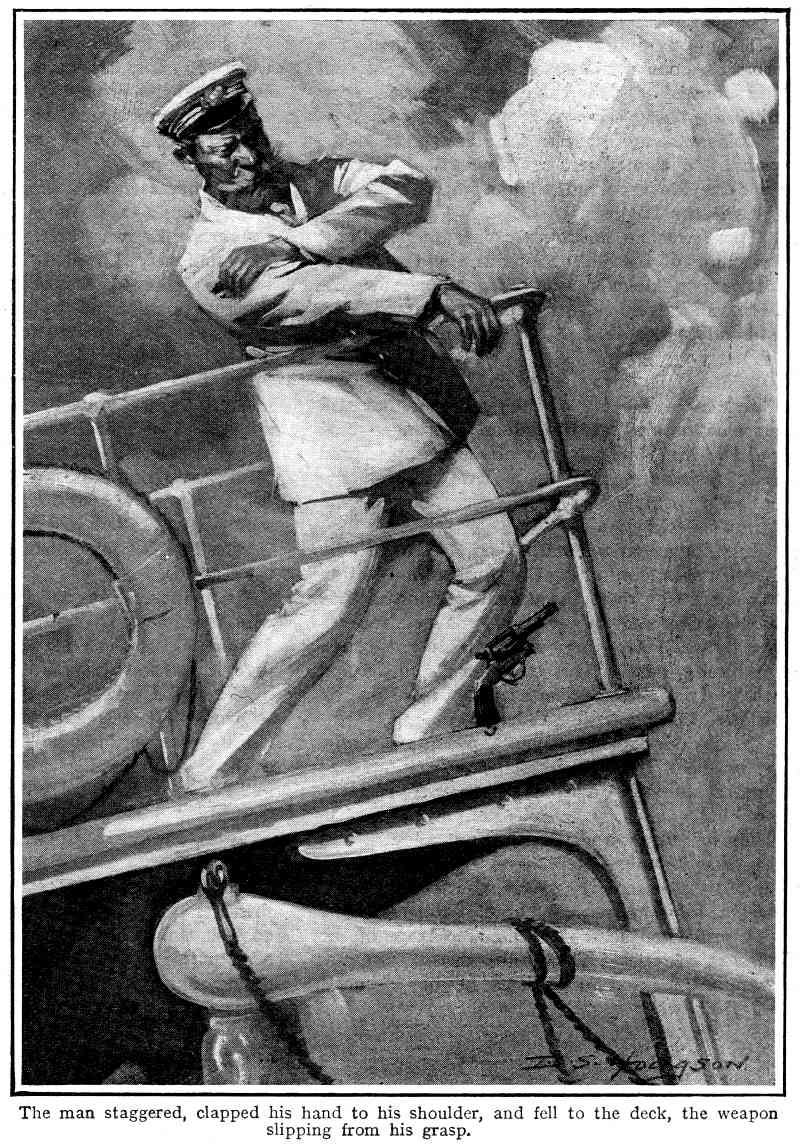
[Illustration: The man staggered, clapped his hand to his shoulder, and fell to the deck, the weapon slipping from his grasp.]
"In bow! Oars!" ordered the lieutenant, and the boat ran alongside the towering wall-sided hull.
Taking advantage of the roll of the ship the bowman managed to obtain a hold with his boathook on the iron bulwarks. The next instant a sweep with a hatchet severed the head of the boathook and a lump of coal was hurled into the boat. Fortunately it struck one of the thwarts, which prevented the little craft from being stove in.
Slade's face darkened with anger.
"Do that again, and I'll fire," he shouted. At this threat the Teutonic skipper leant over the bridge rails and flourished a revolver. "You pirates!" he drawled. "Stand off, or me fire!"
Then, on giving an order to his men, the cruiser's boat was saluted by a volley of coal and scraps of iron, some of the boat's crew receiving nasty injuries.
This was more than the lieutenant could stand. Without another moment's hesitation he drew his revolver, took a rapid aim, and pressed the trigger.
There was no flash, no noise, only a slight twitching of the lieutenant's arm as the powerful weapon kicked; but Tregarthen saw the German stagger, clap his hand to his shoulder, and fall to the deck, his weapon slipping from his nerveless grasp.
"Now, lads, away boarders!"
Aghast at the fall of their skipper, and still more astounded at the silent messenger that had laid him low, the crew of the tramp offered little resistance, and in a few minutes the cruiser's people were in possession of the tramp's deck.
In response to a signal a second boat left the Olive Branch, containing the surgeon in addition to an armed party. Examination showed that the German master's wound was not serious, the bullet having passed completely through the fleshy part of his shoulder; and having attended to the wounded man, Dr. White ordered his removal to his cabin.
"Look here, Tregarthen," exclaimed Slade, "you speak their lingo; tell the first mate to muster his men on deck, or there'll be more trouble."
Thoroughly cowed, the German obeyed, and the crew having fallen in on the upper deck, Slade told off a party of his men to search the Afrika, for that was the name of the vessel. A prolonged search revealed no trace of the missing scientist. The mate was sullen under examination, and for a time neither requests nor threats were of any use.
At length, unable to curb himself, Slade drew his revolver and pointed it at the man's head, bidding Gerald to inform him that Taylor must be produced, dead or alive, within five minutes.
Whether the lieutenant meant to keep his word or not his grim determined features compelled the mate to give way, and in response to a guttural order two of his crew, accompanied by four of the cruiser's men, descended to the fore-peak.
The deserter was discovered hidden in an empty tank, and in spite of his strenuous resistance he was brought on deck and unceremoniously bundled into the gig. Then, having achieved the object of their mission, the two boats' crews pulled back to the cruiser.
"Take him below and lock him in his cabin," ordered Captain Brookes, sternly. "Let two men remain with him in case he tries to injure himself. Mr. Tregarthen," he added, "I have to thank you for your assistance in the matter. No doubt you are in need of a meal; your breakfast awaits you."
"I wonder why the captain was so keen on seeing that I had my breakfast?" remarked Gerald to his friend Jack as the pair attacked their meal.
"Goodness only knows," replied Stockton, who had already been acquainted with the details of the visit to the Afrika. "But, by jove, if that man calls himself the Exterminator of War, all I can say is he's going a funny way to work. It will end with the Olive Branch being denounced as an ocean pariah, and we shall all be hanged."
"It's certainly an act of piracy," assented Gerald. "I should not be surprised if within a week an international squadron is sent in pursuit of us. Yes, Jack, it's rank piracy."
And even while Tregarthen was thus expressing himself, Captain Brookes, with the coolest audacity imaginable, had hoisted the white ensign to the gaff as the Olive Branch glided rapidly away from the outraged German ship.
(To be continued)

[Illustration: third instalment]
BY PERCY F. WESTERMAN
Author of "A Lad of Grit," etc.
ILLUSTRATED BY E. S. HODGSON
Synopsis
GERALD TREGARTHEN, sub-lieutenant of H.M.S. Calder, being on leave, sails from Poole with his old school chum Jack Stockton on board the latter's yacht Playmate. In mid-Channel the yacht is run down; the two friends are rescued, and find themselves on board a mysterious cruiser—the Olive Branch—commanded by Captain Brookes. Finding that Tregarthen is a British naval officer, Captain Brookes announces his intention of keeping him on board, and, after due deliberation, Gerald decides to fall in with the captain's plans, as far as his sense of loyalty will permit.
Tregarthen is initiated into the secrets of the Olive Branch, including that of the deadly ZZ-rays—an irresistible charge of electricity whereby the destruction of a hostile ship can be effected at will. Captain Brookes also explains that by the power at his command he hopes to make war so terrible that no nation will venture to declare war; thus universal peace will be assured.
During the voyage south Schneider, the ship's scientist, deserts, taking with him some important plans. He is found on board a German "tramp," and is brought back to the Olive Branch, whereby an act of piracy is committed.
[Illustration: CHAPTER X]

CLEARED FOR ACTION
IT was six bells in the forenoon watch. The Olive Branch, her speed reduced to a bare ten knots, slipped noiselessly through the oily waters, the tropical sun beating down fiercely upon the awning that had been spread over the quarter-deck.
Seated upon chairs abaft the after-turret were the ship's officers, while on either hand were mustered as many of the crew as could be spared from their duties. There was an air of sternness about the assembly, for Taylor, the scientist, was about to be tried on a charge of desertion and treachery.
"Bring in the prisoner!" ordered the captain, and escorted by two armed seamen the culprit was marched on deck and directed to take up a position facing his judges.
"Mark Taylor," exclaimed Lieutenant Palmer, who appeared as prosecutor, "you are accused upon direct evidence of having broken out of this vessel and having sought to obtain a refuge on board the German ship Afrika. That in itself is a serious charge; but not content with that breach of discipline you wittingly informed the master of the aforesaid Afrika of the secrets appertaining to the ordnance of this cruiser, the Olive Branch. Do you plead guilty or not guilty?"
"Not guilty," replied the accused man, with a forced tone of defiance. "I——"
"That will be sufficient for the present," said the lieutenant. "Your evidence will be taken in due course."
Five witnesses for the prosecution having been called, the prisoner was allowed to speak on his own behalf.
The accused scientist tacitly admitted that he had broken out of the ship, but strenuously denied having given any information regarding the cruiser to the master or any member of the crew of the Afrika. At first his speech was delivered in perfectly pure English, but by degrees he waxed excitable and spoke with a decided foreign accent.
"And I claim," he continued, "ze protection of ze German flag, for I am a German by nationality."
"Is that so?" demanded Captain Brookes. "How is it that this fact was concealed when you joined this vessel? And why has it remained a secret till this moment?"
"I am a German," reiterated the prisoner. "My name is Schneider, not Taylor. I told zese gentlemen it was so," indicating Gerald and Jack with a wave of his hand. "I told zem I was a German subject, and zat I was about to run away from ze ship as soon as I was able, and zey know it."
"Then why did you not report this to me, sir?" asked Captain Brookes, turning to Gerald.
"The man came into my cabin one evening in an excited manner," replied Gerald, calmly. "He certainly said his name was Schneider, and began to tell us a long rigmarole concerning his private affairs. We told him that if he had a grievance, you, sir, were the best person to hear it. With that we kicked him out."
"Thank you," said Captain Brookes, and, addressing the prisoner, continued, "Are you in a position to inform us where are the drawings and specifications relating to the 6in. shells?"
The accused turned a shade paler than before.
"In one of ze lockers in ze laboratory," he replied.
"If I send you to the laboratory under escort, can you produce them?"
"Hein! If zey are not zare zey haf been stolen," exclaimed Schneider. "Perhaps you haf hidden zem."
"They have been stolen, sir," rapped out the captain, harshly; "and by you. They were found in the cabin of the master of the Afrika by Lieutenant Slade. What have you to say to this?"
Schneider's limbs were trembling so violently that one of the seamen had to support him, otherwise he would have fallen to the deck.
"Well, gentlemen, your verdict?"
"Guilty on both counts."
"Mark Taylor, otherwise Schneider, you stand convicted on charges of desertion and treachery. With reference to the first crime I now admit that you are a German subject, and that I was in error in removing you from the protection of the German flag. However, the mischief is done, and I must abide the consequences, though I fear not the whole naval force of that Empire. As to your traitorous act, I can only point out that while in my pay and holding a position of trust on board this cruiser you wilfully betrayed your position as a responsible officer of the Olive Branch. In every community treachery against the supreme authority is punishable by death, and it is in my power to inflict that penalty upon you. As, however, your wretched crime has failed to achieve its object, and these drawings are again in our possession, I will waive the capital punishment. You are sentenced to solitary confinement, with sufficient exercise for the maintenance of your health, as long as the Olive Branch remains in commission. Remove the prisoner."
Escorted by the two armed sailors, Schneider was led from the quarter-deck. Grimly defiant, he marched between his guards, till on arriving at the companion ladder one of the men preceded him, the other stepping one pace in the rear.
The prisoner descended two steps, then, suddenly turning, he butted the seaman at the head of the ladder. The man fell, and Schneider, seizing his advantage, sprang over his prostrate body, cleared the rail with a single bound, and leapt into the sea.
There was a rush to the side to see the termination of the tragedy, but the luckless man was never seen again.
"That has saved us a great deal of trouble," said Captain Brookes; "unless the mischief's already done," he added, under his breath.
On the following day the Olive Branch was running off the east coast of Patagonia, the rugged barren heights of that inhospitable country being plainly visible on the starboard hand.
"Ah, good morning, Mr. Tregarthen," exclaimed Captain Brookes as Gerald made his appearance on deck. He spoke with an affability that had been missing during the last few days, but on this particular morning his customary geniality seemed to have reasserted itself. "At last I think that this vessel is fit for action; that is, as far as her armament is concerned. Of course, there may be failures, but these can be easily rectified. I mean to make an experiment to demonstrate the power of the Olive Branch, beyond that of her electrical means of offence. In another hour we ought to sight Carlos Rock—you've heard of that, perchance?"
"No, sir," replied Gerald.
"Carlos Rock is a small uninhabited island of less than a quarter of a mile in extent, and towering to a height of 600ft. How many rounds from a 13.5in. gun would demolish it, do you think?"
"I cannot say, sir; but one hit would make a great difference in its appearance."
"Then you'll have an opportunity of seeing what our 6in. gun will do. By the bye, why are most of the British Dreadnoughts able to fire two more guns astern than they can ahead."
"Merely the result of circumstances," replied Tregarthen, bridling under the sting of the suggestion. "The position of the after-turrets is to facilitate the broadside fire."
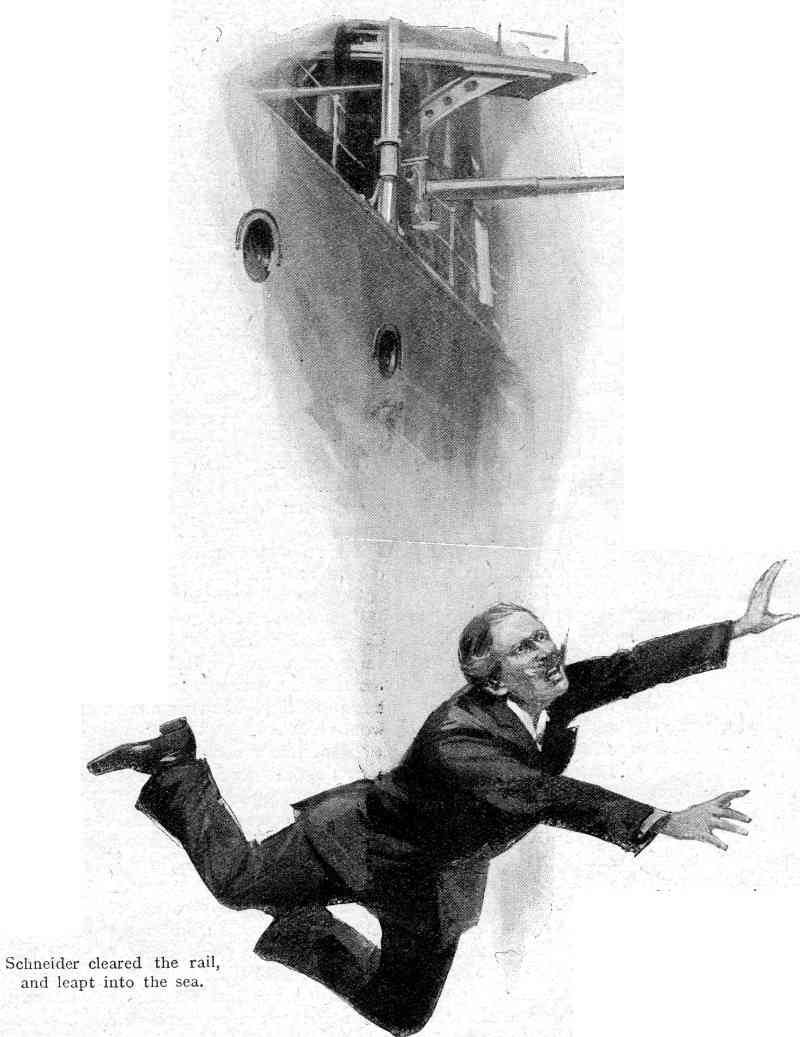
[Illustration: Schneider cleared the rail, and leapt into the sea.]
"Other nations may not think so."
"They can think what they like, sir," replied Gerald.
"So they can, so they can," rejoined Captain Brookes, with an air of a man wishing to remove a wrong impression. "Now, if you will accompany me to the conning-tower, we'll see what's to be done."
The order for general quarters was given by means of a bugle-call, and in a few minutes the scanty crew of the Olive Branch were busily engaged in un-shipping stanchions and rails. Then, in response to another order the decks were deserted.
"Do they call this 'cleared for action,' I wonder?" thought Tregarthen, but barely had his mind expressed the thought ere Captain Brookes thrust home a pair of levers. Silently the massive steel windshields athwartships sank flush with the deck; the funnel dropped out of sight; the steel boats and other deck lumber disappeared into yawning cavities prepared for their reception; while simultaneously every watertight door in the ship was hermetically sealed. From end to end of the upper deck everything was cleared, save for the four turrets, the light quick-firers, and the massive conning-tower.
"How's that?" asked Captain Brookes, enthusiastically. "Here we are cleared to rapid torpedo-boat attack. Now, watch while I move this lever."
This time the light quick-firers disappeared below the armoured deck, leaving only the principal armament, while heavy steel plates slid noiselessly over the pits into which they had vanished.
"This is where we score again. In modern battleships most, if not all, of the light torpedo-repelling armament is badly protected. In a general engagement the lighter guns would be dismounted in five minutes, and the ship would fall an easy prey to a torpedo-boat attack, especially if carried out with a combined dash. Here the guns are ready whenever they are required. Now, here's Carlos Rock."
Gerald glanced ahead and saw a mass of stone rising almost perpendicularly from the sea, its base lashed by the milk-white surf that pounded incessantly upon its iron-bound shores.
Meanwhile Captain Brookes had given directions to the quartermaster to encircle the rock at a distance of two miles so as to make sure that it was inhabited by no human beings. Ten minutes were sufficient for this manoeuvre, during which time the occupants of the conning-tower swept the desolate-looking island with their glasses; but beyond the presence of myriads of sea-birds the rock showed no signs of life.
"Now, stand by!" exclaimed the captain to Gerald. "I cannot go into details, but you will easily follow what I mean. All eight guns are coupled, ready to fire a broadside. You see those three index-hands? One shows the speed of the ship, the second the range of the object to be fired at, and consequently the required elevation, the third corrects the effect of windage. When set, a resultant pointer fitted with telescopic sights gives us the correct aim. Stand here and look through this aperture."
Tregarthen did so, and at that moment Captain Brookes depressed the firing-key. Instantly there was a slight tremor throughout the ship, an almost imperceptible recoil, and then a thin haze of brownish smoke, but no noise was audible save the shriek of the projectiles as they left the muzzle with a velocity of 2,500ft. per second. Four seconds later the whole face of Carlos Rock was covered by a dense cloud of dust, and with a dull rumble thousands of tons of rock slid into the sea.
"You've altered Carlos's features, sir," exclaimed Gerald, when he had recovered from the effects of watching this wonderful broadside.
"Ay!" assented Captain Brookes. "What ship would stand up to that, d'you think? Now you can go below and watch the loading operations, for we are going to keep up a rapid fire for half a minute."
Descending a spiral steel ladder which led from the conning-tower to below the armoured deck, Tregarthen found nearly the whole of the ship's company, including those men whom he knew to be captains of turrets. Why the latter should be away from the turrets he could not quite understand.
Seamen, stripped to the waist, were running small trucks laden with shells from the after-magazine. These were placed in a metal hopper at a position corresponding with the base of the foremost turret. When twelve rounds had been deposited in this hopper its doors were closed, and a red light instantly appeared in a dial overhead.
Once again a slight jar shook the ship, followed by eleven others in less than twice that number of seconds. The next instant the hopper door fell open and twelve empty and still smoking cylinders fell upon the floor; a seaman dashed a bucket of water into the compartment, and the work of reloading was repeated.
Then a bugle sounded the "Cease fire," and the officers returned on deck to observe the effects of the terrible ordnance of the Olive Branch.
"How's that for going into action?" asked Captain Brookes. "With the exception of three men and myself all hands were safe beneath the armoured deck. Automatic loading and firing, unerring aim, and the victory's won, eh?"
"I certainly should not like to be on board a craft that received one round from those guns, sir," replied Gerald. "But suppose, in the heat of an engagement, one pair of guns was trained so that some portion of this ship intercepted the line of fire?"
"That has been arranged for," said the captain. "Directly the arc of fire on one pair of guns is exceeded, that turret remains locked till the other guns are trained backward sufficiently for that pair to be automatically linked up, so that damage to our own ship from that cause is impossible. Of course, if necessary, each turret can be worked independently, and in that case the captains of the guns would have the control of the firing arrangements."
Further conversation was interrupted by the arrival of a signalman.
"Wireless message just received, sir," he reported, handing a sealed envelope to the captain with a salute.
Captain Brookes broke open the envelope, and read and reread its contents without moving a muscle; then he beckoned to those of the officers who happened to be on the quarter-deck.
"Gentlemen," he exclaimed, "a wireless of extreme importance has just been handed to me. The captain of the Afrika has reported an outrage by a ship flying the White Ensign, and representations have been made by the German Ambassador in London. The British Government has rightly repudiated the suggestion that the delinquent was a British man-of-war, and has asserted that, from the description given, it can only be the ex-Brazilian cruiser Almirante Constant. Consequently the British and German Governments have issued a joint note branding that vessel as a pirate, and have stated their intention of hounding her down at all costs, and invite the navies of all nations to join them in their task. So, gentlemen, the Olive Branch is a modern buccaneer. Every port and harbour is closed against her. However, I'll stick to my purpose, but, rest assured, I will never fire a shot against a British ship—I'll trust to the Olive Branch's speed to shake off pursuit. But"—here his face clouded ominously—"should a vessel of any other nationality attempt to interfere with us, I'll give her a fair warning. If she persist, by Jove, I'll blow her sky high!"
[Illustration: CHAPTER XI]

WIPED OUT
ALMOST without further incident the Olive Branch arrived off the coast of Chili. Hostilities had broken out between that State and her old rival, Peru, but beyond a few encounters between outposts on the frontier, no serious fighting had yet taken place. Both republics were unwilling to undertake the risk of sending an army into hostile territory until the safety of their respective seaboards was assured, and every day news of a decisive engagement between the rival fleets was expected.
Directly the Olive Branch was in touch with Captain Brookes's agent at Antofagasta a wireless message was despatched in the form of an ultimatum to the Presidents of Chili and Peru, stating that unless the two fleets returned to their respective ports and peace were declared within three days, the Olive Branch would be compelled to intervene.
The ultimatum was duly presented, and a copy appeared in the leading newspapers of the two republics. People began to ask, "What is the Olive Branch? And what is her nationality?" Then someone suggested that the message was the work of either a practical joker or a lunatic, and the heads of the two republics treated the message with contempt. Not for one moment did anyone connect the Olive Branch with the ex-Brazilian cruiser that had committed an outrage upon the German flag off the port of Pernambuco. The very idea of a vessel being able to travel from that port to Valparaiso—a distance of 4,600 miles—in less than four days never entered into anyone's head, and when the journal El Mundo broadly hinted that it was a ruse on the part of the Peruvians to frighten the antagonists, the Chilian fleet immediately put to sea.
This news was communicated to the Olive Branch from Antofagasta, followed by the information that the Peruvian fleet had steamed out of Callao, bound south.
"Now we'll have them!" exclaimed Captain Brookes. "We'll get in touch with the Chilian vessels first, then pass them hull down so as to get between the two fleets. This done I hold them in the hollow of my hand." Unfortunately for Captain Brookes his plans were doomed to failure. The fleet of the Southern Republic was sighted and passed as arranged, but in the interval the Peruvian squadron had altered its course and was steaming for Iquique.
"There they are," announced Captain Brookes, late one afternoon, pointing to a dense haze that obscured the otherwise clear horizon.
"Not much mistake about that, sir," assented Tregarthen. "If those vessels are not burning Lota coal, I'm a Dutchman!"
"It's too late to do anything much to-day," added the captain. "I'll give them a dose of Z-rays, and during the night we'll slow down and hang on their flanks. To-morrow we'll press the business."
Throughout the night the Peruvian fleet, unable to use searchlights and night-sights, pounded along, keeping an erratic compassless course towards Iquique. Unable to explain the cause of the sudden failure of their electrical gear, the officers and men were in a state of nervous tension, expecting every moment to find the Chilian fleet at their heels.
Just before daybreak the Olive Branch, to avoid being influenced by the Z-rays that permeated the fleet, put her helm hard over in order to allow the fugitives to gain a few miles.
As she did so a violent explosion shook the ship from stem to stern, and a huge column of water sprang up from alongside her starboard quarter.
"A mine, by Jove!" exclaimed Gerald.
He was right. The Peruvians had strewn the sea with mines as they fled for shelter, and, on turning, the Olive Branch's starboard propellers had struck the dangerous weapon.
There was no panic. Every man was at his post, cool and alert. The carpenter came on deck with the reassuring statement that the vessel was not making water, but on the other hand the engineer reported that the three starboard propellers were useless, and that the motors actuating them had to be shut off. Thus with only the three port propellers working, the speed of the Olive Branch was reduced to a bare fifteen knots.
"I'll make them pay for this!" exclaimed Captain Brookes, coolly. "Keep her as she is, and at daybreak I'll show them what the Olive Branch is capable of doing."
The short twilight changed into day, and the rising sun revealed the presence of the Peruvian fleet barely seven miles to the eastward.
There were four armoured cruisers—the Santa Rosa, Lima, Independencia, and Restauracion, the first three built at Elswick, and the last-named having been constructed at Stettin—and three gunboats. The latter were the lame ducks of the fleet, and in order to protect them the speed of the cruisers had to be reduced from twenty-three to fourteen knots.
But to the surprise of everyone on board the Olive Branch the Independencia turned and steamed straight for the solitary and apparently foolhardy pursuer, the Restauracion supporting her at three cables' length on her port quarter. Throughout the night the Olive Branch had been cleared for action, and all that was necessary now was for the men to go to their stations.
"She's too near to use the ZZ-rays," observed Captain Brookes to Gerald, who, at the former's request, had accompanied him to the conning-tower. "I've given orders for independent firing the moment she shows her teeth."
On came the Independencia, the foam flying from her bows, her funnels emitting dense clouds of smoke, while no less than five red and white national ensigns flew from her mast-heads and signal yard-arms.
Suddenly her forward 4.7in. Canet gun opened fire, and a huge 45-pounder came hurtling through the air. Fascinated, Gerald watched its approach, unable to tear himself away from the slit in the steel walls, though the projectile was apparently making straight for the conning-tower. Often from behind a gun had he watched the flight of a shell, but now the conditions were reversed.
The next thing he was aware of was a tremendous crash overhead, followed by the fall of splintered steel and a dense suffocating smoke.
"That's settled the charthouse and bridge," remarked Captain Brookes as calmly as if discussing some triviality, then, pressing an electric push, he gave orders for the forward turret to open fire.
The two 6in. weapons were discharged simultaneously, their noiselessness contrasting vividly with the rapid detonation of the Peruvian gun.
The doomed vessel was instantly swept out of existence. The massive, yet graceful, outlines of the cruiser seemed to melt into a hundred thousand fragments, then as the smoke slowly drifted, no trace of the Independencia was visible, only an ominous swirl in the agitated waters as the disintegrated hull plunged to its ocean grave.
Appalled by the fate of her consort, the Restauracion turned tail and fled, being joined in her flight by the remaining cruisers, the gunboats being left to their fate. But, satisfied by the moral effect of his victory, Captain Brookes desisted from the pursuit.
"We're in a pretty pickle," said Gerald as he joined his friend Stockton. "Partially crippled, and every port closed to us."
"Can't they make good the damage afloat?" asked Jack. "Divers could go down, couldn't they?"
"If it were merely a matter of replacing the propellers they might, but it's the damaged shafting that will cause all the trouble."
"Depend upon it, Captain Brookes will find a way out of the mess," replied Stockton, reassuringly. "The only thing that puzzles me is what he will do should we be overhauled by a British cruiser. If he keeps to his word he won't open fire on her, and if he attempts to run away he'll be overhauled. That's a moral certainty."
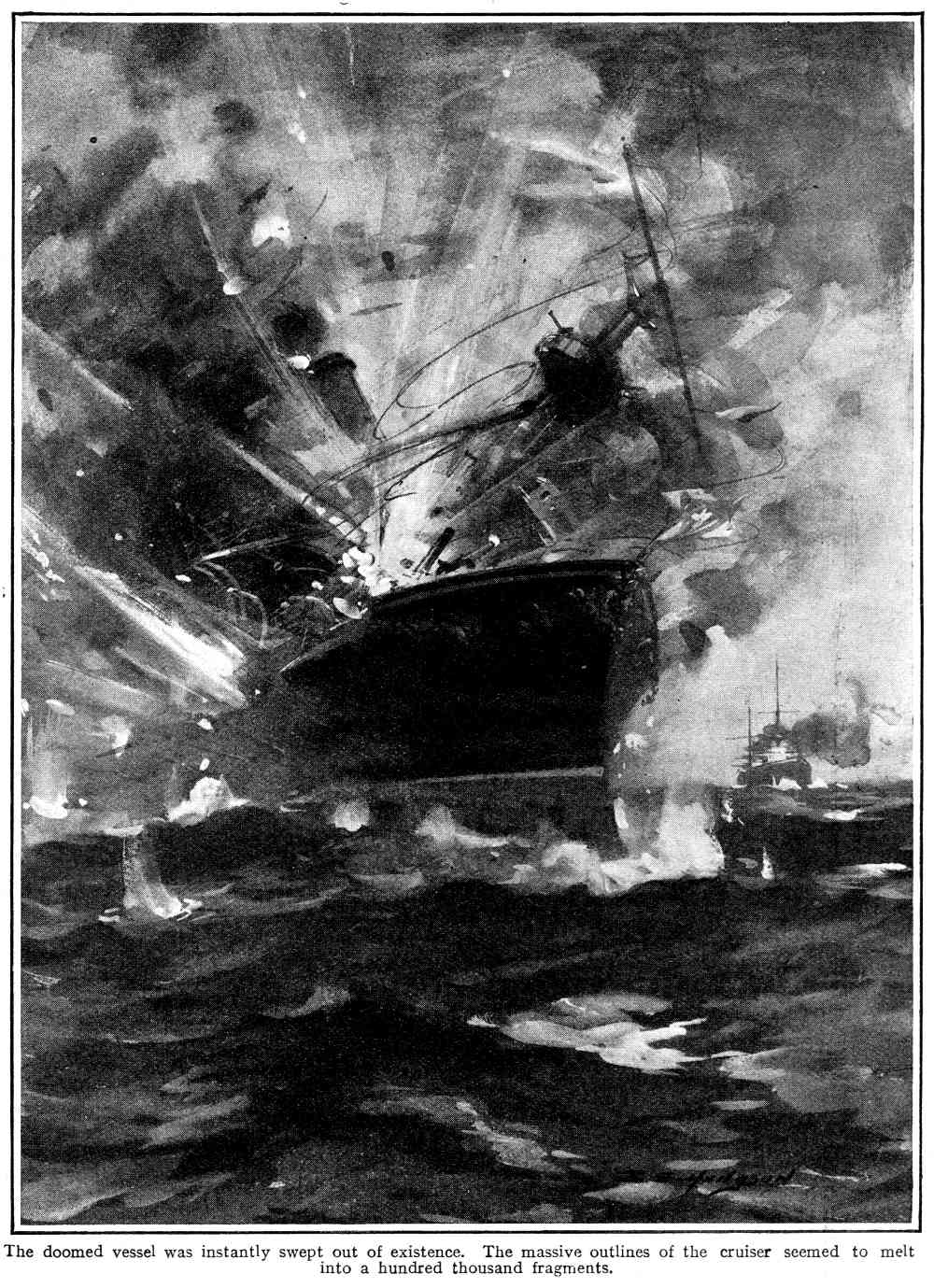
[Illustration: The doomed vessel was instantly swept out of existence. The massive outlines of the cruiser seemed to melt into a hundred thousand fragments.]
"Well, let's hope we shan't be put to the test," said Tregarthen. "But, by George, didn't the shell which hit us knock up a dust? It simply swept the charthouse and bridge away like brown paper. That means that all the steering will have to be done from the conning-tower until we find time to make good the damage. But stand by—here comes the captain."
Captain Brookes, however, passed them without apparently noticing their presence. He seemed intent upon some great problem, and, lost in thought, he descended the companion ladder and entered his cabin.
"What's the course, Mr. Slade?" asked Gerald of the navigating lieutenant.
"We're going to fall in with the Chilian fleet next," was the reply.
"More pulverising?"
"I cannot say; captain's orders," replied Lieutenant Slade, laconically.
At two bells in the first dog-watch the Chilian fleet was sighted, but the victory was an easy, bloodless one. By means of the Z-rays the fleet was demoralised, and thereupon a signal was sent to Admiral Zaetos's flagship, informing him of the fate of the Independencia. On learning that the Olive Branch was no myth, the Chilian admiral consented to return to Iquique to await further instructions from the President, and an hour later the Olive Branch was alone on the vast Pacific.
"Now to get the damage made good," remarked Captain Brookes, cheerfully. "Have you ever put into Talcahuano, Mr. Tregarthen?"
"No, sir."
"Neither have any of my officers; nevertheless I must do so, for there is a government dry dock there, the only one on the west coast of South America capable of taking the Olive Branch. Whether they like it or not, I mean to have the ship repaired there."
Early on the following morning the cruiser came in sight of the port of Talcahuano. Captain Brookes did not mince matters when dealing with the Chilian town; he promptly isolated it by interrupting telegraphic communication by means of the Z-rays, then falling in with a small trading brig he expressed his intention of compelling the master to pilot the Olive Branch into harbour.
"Mercy on me, señor, I dare not!" expostulated the terrified man. "The channel is mined; that is why my vessel was hove-to."
"Are you certain of this?" demanded the captain, sternly.
"Yes, señor."
"Well, gentlemen, you hear what the man says," continued Captain Brookes, turning to his officers. "What do you say?"
"We are willing to leave the matter entirely in your hands, sir," replied Lieutenant Sinclair, confidently.
"That's what I expected," continued Captain Brookes. "And now, señor, go forward and take the helm, for be there one or fifty mines, I mean to enter dry dock before sunset. Mr. Palmer, clear away the submarine."
[Illustration: CHAPTER XII]

THROUGH THE MINE FIELD
AT the mention of the word "submarine" Gerald felt the blood surge to his temples. It was not the surprise of hearing that the Olive Branch possessed one of these master craft that affected him; he was getting used to surprises. It was the glamour of the enterprise that thrilled him.
For months past Gerald's ambition was to serve in the submarine flotilla. His name had been on the "roster" as a volunteer for the hazardous, yet attractive, service, but up to the time of his leaving the Calder his hope in that direction had not been gratified.
"May I accompany Mr. Palmer, sir?" he asked, bringing his hand to his forehead with professional smartness.
"I think not," replied Captain Brookes. "This is a matter that requires skilled men."
"Very good, sir."
Gerald felt the disappointment keenly, but like a true Englishman he bore the refusal manfully. Not so with Stockton; his face showed unmistakable signs of relief when his chum had been thwarted in his desires to embark in a hazardous craft destined for a still more hazardous enterprise.
The Olive Branch was now within two miles of the entrance to the harbour. On either side of the narrow mouth were stone forts faced with earth, over which floated the Chilian flag—red, white, and blue, with a white star on the upper "canton" nearest the staff. Beyond were the Government works and the low stone houses of the town, while in the distance the snow-capped Andes reared their lofty peaks to a height of 14,000ft.
"Do you think they'll open fire, Mr. Sinclair?" asked Captain Brookes, jerking his thumb in the direction of the forts.
"I don't fancy so, sir," was the reply. "They will trust to their mines. Since the last war these johnnies think twice before tackling an ironclad."
"Very well, then—carry on. Are your men ready, Mr. Palmer?"
"Ay, ay, sir!"
"Then look sharp about it, if we are to warp into the dock before sunset. By the bye, Mr. Tregarthen," he continued, wheeling round and facing Gerald, "have you had any experience of creeping?"
"Plenty of it in the Vernon, sir."
"I've changed my mind; you may go with Mr. Palmer."
Accompanied by Stockton, who, now that his chum was permitted to take part in the expedition, wanted to share in the perils, Gerald followed the lieutenant and a dozen men down to the orlop-deck.
Here, almost amidships, was an oval-shaped steel box, projecting about three feet above the deck. Unfastening a massive securing-bar, one of the men touched a knob, and the huge rubber-lined lid slowly turned on its hinges and disclosed a similar, though slightly smaller, box. It was the conning-tower of the submarine.
To Stockton the next few minutes seemed like a dream. The lid of the conning-tower was raised, and five of the sailors descended into the recesses of the little craft. Palmer then motioned to Gerald to precede him, and with a hasty grasp of the hand Jack bade his friend a silent farewell.
Then Palmer followed, and ere the lid closed with a ponderous clang Stockton saw the dim glimmer of the electric light shining upon a mass of complicated machinery.
"Stand aside, please, sir!" said one of the men who still remained on the orlop-deck.
The cover of the outer box descended, the securing bar was carefully locked, and the sound of inrushing water was borne faintly to Stockton's anxious ears.
"They're off now, sir," added the seaman. "If you go on deck you'll be able to see something of what they're up to."
From the top of the conning-tower, which in lieu of the demolished bridge and charthouse was now the highest practicable coign of vantage, Stockton and several of the officers watched the tip of the submarine's periscope glide slowly along the surface of the water, while some 30ft. in the rear was the tell-tale swirl of the vessel's propeller and the characteristic wake of the submersed craft.
Every available glass was brought to bear upon the receding pole-like object, as it kept an unswerving course straight for the entrance of the harbour.
Suddenly a column of water was thrown 50ft. in the air. Stockton gave an involuntary gasp of horror—what if the submarine had fouled one of the deadly mines?
A minute passed. Even Captain Brookes began to look anxious, for no trace of the periscope was now discernible.
"There she goes again!" shouted one of the men, as another slender column rose high in the air.
Four times this was repeated, then once more came an ominous and prolonged silence. While the attention of all hands was directed towards the harbour the grey, porpoise-like hull of the submarine floundered to the surface less than a cable's length from the port bow of the Olive Branch. Thus, having announced her safe return, the little craft disappeared beneath the waves, and, guided by consummate skill and judgment, she glided underneath the hull of her parent ship.
Half an hour later her crew came on deck of the Olive Branch.
"All correct, sir," reported Lieutenant Palmer. "Every mine exploded; six in all."
"Very good," replied Captain Brookes. There were volumes of commendation in those two words, and every man who took part in the dangerous enterprise realised the fact.
"We must wait another hour till there's enough water on the bar, so our pilot informs me," continued Captain Brookes. "Mr. Sinclair, I'm going below; please report if anything unusual occurs."
"Well, old chap," exclaimed Stockton as the two friends gained the seclusion of their cabin "how did you get on?"
"Splendidly," replied Gerald, enthusiastically. "The submarine is a masterpiece. This was the mysterious object at which the captain hinted during our inspection of the wireless room. I think I've grasped the principle of it. The submarine is barely 30ft. in length and 8ft. in beam, and is housed in a cavity underneath the ship corresponding with the upper half of the submersible. Apparently its natural buoyancy keeps it adhered to the hull of the Olive Branch, but to prevent undue friction when running at full speed there are several steel doors, which, when closed, complete the normal curvature of the ship's bottom. You saw how we entered the submarine?"
"Yes, by means of a watertight door in the orlop-deck, and a corresponding one in the submarine's conning-tower."
"Well, directly I descended into the little craft I noticed that she was propelled by electric motors, of about 35 horse-power I should imagine. Forward there is a bow tube of less than 4ins. in diameter, consequently she can carry twenty small torpedoes to our submarines' four. I noticed that the vessel was submerged by means of water ballast instead of relying upon horizontal rudders, although the latter are utilised when running beneath the surface.
"Directly all hands were aboard Palmer opened a valve, and I saw the pale green light filter through the glass of the conning-tower; we had sunk clear of the Olive Branch's hull. We descended quite 80ft., in fact, almost to the bottom of the sea, for I could see the water discoloured by the muddy sediment caused by the rush of the still ebbing tide. Then the motors were started, and, once well away from the cruiser, Palmer hoisted the periscope, which hitherto had been housed within the submarine.
"'Now, then,' said he, 'you know a mine when you see one, so will you please stand by the conning-tower look-out; I'll keep the vessel on her course by means of the periscope.'
"So saying he descended a short iron ladder and took his stand before a small table coated with highly polished silver. This mirror reflected an erect, right image, or, in other words, a faithful reproduction of the horizon as seen from the surface.
"We were running at six knots, so that taking into consideration the strength of the ebb, our rate over the ground was a bare three knots, thus allowing an ample margin to bring up should we sight an obstruction."
"How far could you see ahead?"
"About 100ft., for the water was fairly translucent in the bright sunshine. Had it been dark we could have used a powerful searchlight.
"Suddenly I caught sight of a barrel-shaped object straining at its sinker and cable like a gigantic long-stalked mushroom. Palmer was instantly at my side, having ordered the motors to be eased down. The principle on which the torpedoes are fired is similar to that by which the guns are discharged on board this ship. I saw the slender, fish-shaped weapon leave the tube and glide towards the mark, but the target being a small one, and oscillating into the bargain, the torpedo missed it by a foot.
"The second shot was successful, and although I did not hear the detonation, the shock was sufficient to make the submarine lurch violently.
"This operation was repeated till we found ourselves right inside the harbour, the wharves and the shore being crowded with people attracted by the unwonted spectacle of the presence of a mysterious battleship in the offing."
"Then it's certain that all the mines have been destroyed?"
"All in the channel, at all events, for we could see the outlines of the shoal on either hand, and not a trace of a mine remained. But there's the engine-room telegraph; we're getting under way once more, so let's go on deck."
On gaining the fo'c'sle the two chums found the Chilian skipper shaking with apprehension and anxiety. He had been led for'ard and was conning the ship under the charge of Lieutenant Sinclair, who was an expert Spanish linguist. The lieutenant communicated the pilot's directions to the quartermaster in the conning-tower, who in turn held the Olive Branch on her course at a steady five knots.
Even then the depth on the bar was so little that for some considerable distance the ship's remaining propellers churned up columns of liquid mud. Cleared for action she slowly approached the harbour, but, as anticipated, there was no sign of resistance from the forts. On the contrary they respectfully dipped their flags, a compliment that the Olive Branch returned by lowering her green and white ensign.
"Mr. Sinclair, will you pipe away the cutter's crew. I want you to take this letter ashore, and your knowledge of their lingo will be useful in case they cannot translate it," said Captain Brookes. "I've told them my requirements, and offer to pay all lawful dock charges and dues. Inform them of events between the two republics, and of our part in the matter."
An hour later Lieutenant Sinclair returned with the information that Captain Brookes's requests were favourably received, and that the Olive Branch could go into dock at once. He also bore the intelligence that the alcalde and the commandante of Talcahuano were about to pay a complimentary visit to the cruiser that had, while engaged in the work of settling the differences between Chili and Peru, inflicted a severe loss upon the fleet of the latter republic.
"Good," remarked Captain Brookes, gleefully. "Nothing could be better, gentlemen. I mean to make use of both the alcalde and the commandante of the town during our stay here."
Without further delay the Olive Branch was warped into dock and shored up. The water was then pumped out, and, as the captain had prophesied, the cruiser was dry-docked before sunset.
[Illustration: CHAPTER XIII]

TRAPPED
DURING the docking of the Olive Branch crowds of townsfolks, soldiers, civilians, and peons flocked around the mysterious visitor, expressing astonishment at her appearance, yet without showing any signs of ill-will.
Nevertheless, no precautions were left undone to safeguard the ship. Two of the guns were pointed at the custom-house, the other pairs covered the arsenal, forts, and the principal public buildings, while, being unable to use the Z-rays on account of the possible consequences to the Olive Branch, a party of sailors under Lieutenant Sinclair landed and marched up to the telegraph office with instructions to prevent any messages being sent that related to the presence of the proscribed cruiser.
"Commandante coming off, sir," announced the officer of the watch, just as dinner was about to be commenced.
"Very well, then, turn out the guard of honour," replied Captain Brookes. "Gentlemen, we must postpone the function for a few minutes."
So saying he retired to his cabin to don his full-dress uniform, an example that was followed by the rest of the officers.
On gaining the quarter-deck Gerald found that the guard of honour had already formed up, while ashore a company of troops with a band in attendance had fallen in on the quayside. The Chilian soldiers were a mixed crowd of whites, half-castes, and blacks, attired in blue coats with scarlet facings, white trousers, and gaudily decorated shakos.
The commandante, who was accompanied by the alcalde and a staff of brilliantly uniformed officers, was awaiting with true Castilian punctiliousness the appearance of the captain of the Olive Branch, and directly the latter appeared at the head of the companion ladder, the troops stood at attention and the band prepared to play.
"What tune are they going to honour us with?" said Gerald, in an aside.
"Goodness only knows! As we are of no nationality, they cannot——"
Here Stockton's reply was interrupted by the blare of the band, and, to the amazement of everyone on board, the Chilians struck up the British National Anthem.
At the sound of the inspiring note, so thrilling to every true Englishman, the crew of the outlawed ship forgot everything but the fact that they were British-born. Circumstances that had caused the majority of them to forswear the land of their birth were lost sight of.
Standing stiffly to attention, the two groups of officers faced each other, the commandante at the head of the gangway, the captain of the cruiser in front of his staff; nor did anyone relax his rigid posture till the last strains of the Chilian National Anthem that followed the British one had died away. Then, led by Captain Brookes, the commandante was taken to the ward-room, the other officers mingling in an amicable manner, though signs had to take the place of ordinary conversation.
In spite of this difficulty, dinner was proceeded with, Sinclair undertaking the duties of interpreter, while from without came the ceaseless noise of hammering as the work of repairing the damaged shafting was in progress. It was not till after dessert that the commandante—a don with a string of names that showed a connection with the highest families of Spain—learned that he had made a mistake. Up to this point he had imagined that the cruiser was a British man-of-war, in spite of the fact that the green and white ensign floated from her ensign-staff.
"Yes, Commandante da Silva. According to the decree of the principal European nations this ship is a pirate."
"A pirate!" gasped the astonished officer. "What is your intention—to hold the town to ransom?"
"No, señor," replied Captain Brookes. "My intentions regarding the town of Talcahuano are perfectly straightforward and reasonable. As I said before, I am willing to pay all dues and charges, and when these urgent repairs are completed I'll put to sea once more. Meanwhile, señor, you and your worthy alcalde must consider yourselves as my guests till the time of sailing arrives."
"You would hold us prisoners? It is monstrous!"
"Pray do not look upon it in that light," replied Captain Brookes, urbanely. "Rather consider yourselves my honoured guests, though I must admit that my primary object in detaining you is to make use of you as hostages for the good behaviour of the town."
Seeing that resistance was useless, and being assured of courteous treatment, the commandante gave in with a good grace, and, with the alcalde, was provided with accommodation in the captain's own apartments.
This done, Captain Brookes took other steps to safeguard his interests. He seized the railway station and allowed no trains to leave the town, though he was unable to prevent them from coming in from the north. But he realised that it was impossible to completely cut off the town. Lota, a coaling centre, is barely twenty miles south of Talcahuano, and the means at the command of the captain of the Olive Branch were insufficient to prevent people from going thither and telegraphing the news of the daring "hold-up "; yet he had gained a decided advantage, and in consequence no time was lost in refitting the Olive Branch for sea.
The damage done by the mine was not so great as was anticipated. Two of the three port propellers' shafts were bent, and all three propellers were hopelessly damaged. Fortunately a spare set was carried on board, so the only difficult task was to draw the shafting and straighten it in the Government workshops. On the evening of the second day the work was completed, and preparations were in progress for undocking the Olive Branch at daybreak.
"Do you know, Mr. Palmer, that your gallant exploit in clearing the mine-field was unnecessary?" asked Captain Brookes during dinner.
"Unnecessary, sir?" exclaimed the astonished lieutenant. "How so, sir? Were they dummies?"
"No, not dummies, but real live electro mechanical mines. But our Z-rays had, so the commandante informs me, thrown the firing-gear out of action. It's strange that I never thought of that, though had they been contact mines the danger would have remained.
"And now, commandante," he continued, "I must make some slight amends for my conduct in detaining you. To-morrow, all being well, we must part company, but before so doing our paymaster will settle all accounts incurred ashore. Meanwhile, I ask you to accept this slight token in remembrance of the hurried visit of the Olive Branch."
So saying he handed the Chilian officer a morocco case, with a bow that would have put a high-born Spanish grandee in the shade. Within the box was an English hunter, with a solid gold case, on which was the representation of an olive branch set in diamonds. This gift, so unexpected, so overwhelmed the commandante that it was some minutes before he could frame a suitable reply.
To the alcalde Captain Brookes presented a jewelled scarf-pin, bearing a device similar to that of the watch, and it was evident by the expressions of gratitude of the two officials that they would have welcomed a similar visit every day in the week.
In the midst of these courtesies there came a rude interruption.
The officer of the watch rushed into the ward-room, his face pale with excitement.
"We're trapped, sir!". he exclaimed. "There's a British squadron outside the harbour, and they've spotted us with their searchlights. Signal just come from the flagship demanding our unconditional surrender at daybreak."
[Illustration: CHAPTER XIV]

RUNNING THE GAUNTLET
"DON'T distress yourself, Mr. Sinclair," said Captain Brookes, "it may cause my guests considerable uneasiness. Reply by merely acknowledging the signal; no more. Then report to me the earliest moment at which the ship can be undocked."
When the lieutenant had retired the captain turned to his officers.
"This is a strange business, gentlemen," he remarked, briskly, "though we must be prepared to deal with little unpleasantnesses of this sort. In the first place I did not expect a British squadron in these waters, still less did I think they would worry me with messages of this kind. I can only conclude that a telegraphic message has been sent from Lota or Coronel apprising the fleet of our presence here. In any case they've been mighty smart about it."
"What do you propose to do, sir?" asked Lieutenant Slade.
"Do? Why, trick them. Look here, Mr. Tregarthen," he added, "I'll remember my promise to you, and what is more, it's my resolution not to commit any action that may be regarded as the act of a belligerent. Meanwhile it would be a good opportunity for you to write your report to the Admiralty, for, mark my words, they'll send a boat in the morning."
"I've already done so, sir," replied Gerald. "Do you wish to see the document?"
"No, no; I have the greatest confidence in you, Mr. Tregarthen; it would be a breach of etiquette on my part if I were to supervise your correspondence."
"I have not the slightest objection——"
"But I have, so please say no more on this subject. Ha! Here's Sinclair once more."
"Message dispatched as stated, sir. The bos'n reports ship will be ready to be undocked at midnight," laconically announced the officer of the watch.
"Very good—carry on," was the stereotyped reply.
Captain Brookes appeared to be in no hurry. The dinner seemed unduly prolonged, and it was six bells ere the captain set the example by going on deck.
Away in the offing the powerful beams of the searchlights of the blockading squadron played continuously on the town and harbour, while from the mastheads of the ships the flashing signals blinked incessantly. Judging by the number of beams there were at least four vessels, but of what strength the officers of the Olive Branch were unable to ascertain.
In spite of Captain Brookes's coolness a sense of uneasiness pervaded the officers and men of the trapped cruiser, for without resorting to extreme measures it seemed impossible for the Olive Branch to make a bid for freedom.
Punctually at midnight the sound of rushing water announced that the sluices to the culverts were opened, and three-quarters of an hour later the cruiser, now fit to proceed to sea, was warped into the centre of the harbour.
The commandante and the alcalde were sent ashore, all claims settled, and with stores and water tanks replenished, the Olive Branch swung easily at her cable, awaiting the dawn.
"Do you recognise any of these vessels, Mr. Tregarthen?" asked Captain Brookes as the sun appeared over the summit of the Andes.
"Yes, sir; the one flying the commodore's broad pennant is the Niobe, protected cruiser; the others are the Melampus, Cambrian, and Amethyst."
"All out-of-date vessels on their last legs," commented the captain of the Olive Branch. "I suppose they are good enough for the ordinary work on this station; but, by Jove! it's lucky for them that I can keep myself under control. Either that commodore is mad, or he does not know the risk he's running."
"Is it madness to carry out orders, sir?" asked Gerald, quietly.
"Under certain conditions, yes; discretion should always be a proviso in such cases. But here comes a boat."
As he spoke a steam pinnace flying the white ensign came pelting towards the harbour, throwing up columns of spray as she plunged through the agitated water on the bar.
"Ship the accommodation ladder," ordered the officer of the watch, and for the first time in the commission of the Olive Branch was this means of gaining access to the cruiser made use of.
"Desire the officer to step down to my cabin," said Captain Brookes, as he turned to leave the quarter-deck.
The pinnace made the foot of the ladder to a nicety, and a lieutenant in full uniform, accompanied by a "sub," came over the side, punctiliously, yet sourly, returning the salute.
"Hello, Tregarthen! What the dickens are you doing aboard this packet?" exclaimed the British officer in undisguised astonishment. "Don't you know me?"
"Yes, of course; it's Blake."
"Right, old man; but again, why masquerading in mufti on this hooker?"
"Because I cannot help it," replied Gerald. "To be exact, I'm a prisoner, though only a nominal one. Also, I'm on leave. In another twenty-three days I am supposed to rejoin the Calder, but I'm afraid I shan't."
"We'll rescue you, old fellow, never fear."
"Don't be so sure about that. It's a long story, but this letter will explain matters. Now you had better be off, for the captain awaits you in his cabin, and the officer of the watch looks as if he's growing impatient." So saying Gerald handed the lieutenant the document he had prepared, and withdrew to where Stockton was observing, with mixed feelings, the pinnace of the Niobe as she lay alongside.
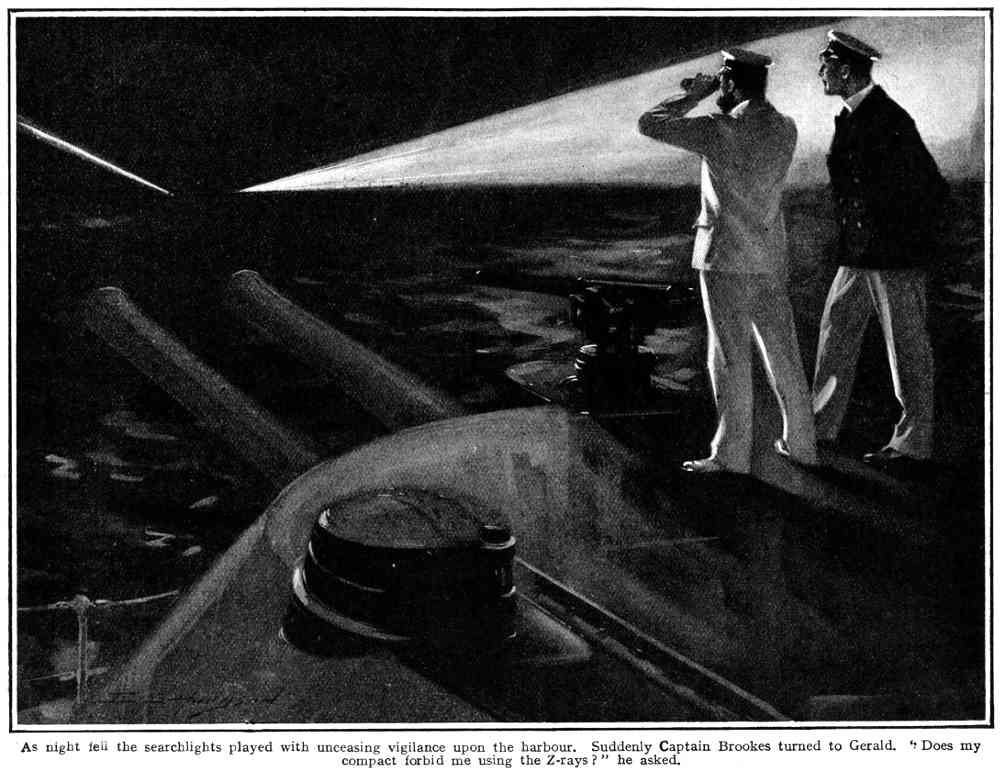
[Illustration: As night fell the searchlights played with unceasing vigilance upon the harbour. Suddenly Captain Brookes turned to Gerald. "Does my compact forbid me using the Z-rays?" he asked.]
In less than a quarter of an hour the English lieutenant, accompanied by Captain Brookes, reappeared on the quarter-deck. Without betraying any of the circumstances of the interview the former went over the side, and the pinnace steamed swiftly back to her parent ship.
"Well, gentlemen, it's only right that you should know the true state of affairs," began the captain. "I have affirmed that, save for the matter concerning the detention of Mr. Tregarthen and Mr. Stockton, I have never committed any action against the British Government that warrants such interference, and therefore I question the commodore's right to demand our surrender. If, in the execution of my self-imposed duty, I have unfortunately been compelled to take stern measures with the Afrika, that quarrel is between the German authorities and myself. On that score I have made my protest to the commodore of yonder squadron."
An hour later the pinnace returned, the lieutenant bearing a verbal message from the British commodore that he was there to carry out orders, not to quibble over them, but that he was prepared to put Captain Brookes's protest before the Admiralty in a favourable light should the surrender be immediately carried out.
This message the lieutenant gave in the presence of all the officers of the Olive Branch, possibly imagining that the moral effect might be greater.
Captain Brookes's swarthy countenance darkened.
"Go back to your ship, sir!" he thundered. "Inform your superior officer that I scornfully refuse his terms. Here is the Olive Branch. If he wants her, let him come in and take her."
A low murmur of applause from his officers greeted this announcement, and once again the English lieutenant returned to his ship.
"I am beginning to repent of our bargain, Mr. Tregarthen," remarked the captain. "But, by Jove! I'll keep my word. We are safe enough for the time being, for they will never dare to enter the harbour without obtaining the consent of the Chilian Government. Meanwhile I can only hope for an on-shore gale and a dark night."
All that day and the night following the blockading squadron remained on the qui vive, but on the next morning the gale that Captain Brookes wished for had begun.
Dead on shore it blew, the crested breakers thrashing upon the shallows that flanked the entrance. The sky was overcast, and heavy rain descended incessantly. At about noon the waves became so high that the British ships, already rolling their main decks under, stood out to sea so as to escape the discomforts of an on-shore berth. Nevertheless, as night fell, the searchlights played with unceasing vigilance upon the harbour of Talcahuano.
"Confound those searchlights!" muttered Captain Brookes, then turning to Gerald he exclaimed, "Look here, Mr. Tregarthen, does my compact forbid me the use of the Z-rays? I think not."
Gerald did not know what to reply. This act alone could hardly be termed a belligerent one, and at the same time no permanent damage to personnel or material was likely to ensue.
"I'll risk it," continued the captain, and giving orders to clear deck for general quarters, he made his way to the conning-tower.
One glance at the foaming bar where the water gleamed silvery white under the beams of the concentrated searchlights showed him that the plan was a desperate one. A deviation of half a cable's length to port or starboard would be fatal even to the Olive Branch, for no vessel could run aground on those deadly shoals and hope to survive.
Suddenly, as if by the touch of a magic hand, the searchlights vanished, leaving only a black expanse of storm-tossed waters. Captain Brookes had made use of the Z-rays.
Slowly the anchor came home from its muddy bed, the engine-room telegraph signalled full speed ahead, and at her utmost possible speed the Olive Branch dashed towards the bar, every revolution of her propellers bringing her nearer the alert yet mystified British squadron.
She was running the gauntlet. Perils unseen awaited her ahead and on either hand. Another five minutes would decide her fate.
(Another long instalment of this splendid serial next month.)
[Illustration: fourth instalment]
BY PERCY F. WESTERMAN
Author of "A Lad of Grit," etc.
ILLUSTRATED BY E. S. HODGSON
Synopsis
GERALD TREGARTHEN, sub-lieutenant of H.M.S. Calder, being on leave, sails from Poole with his old school chum Jack Stockton on board the latter's yacht Playmate. In mid-Channel the yacht is run down; the two friends are rescued, and find themselves on board a mysterious cruiser—the Olive Branch—commanded by Captain Brookes. Finding that Tregarthen is a British naval officer, Captain Brookes announces his intention of keeping him on board, and, after due deliberation, Gerald decides to fall in with the captain's plans, as far as his sense of loyalty will permit.
Tregarthen is initiated into the secrets of the Olive Branch, including that of the deadly ZZ-rays—an irresistible charge of electricity whereby the destruction of a hostile ship can be made at will. Captain Brookes also explains that by the power at his command he hopes to make war so terrible that no nation will venture to declare war; thus universal peace will be assured.
During the voyage south Schneider, the ship's scientist, deserts, taking with him some important plans. He is found on board a German "tramp," and is brought back to the Olive Branch, which when this action is reported is branded as a pirate.
Hostilities break out between Chili and Peru, and Captain Brookes determines to intervene. The Olive Branch is damaged by a mine, and puts into a Chilian harbour for repairs; but while in dock it is trapped by a British squadron demanding its surrender by daybreak. Captain Brookes is handicapped by a vow never to fire on a British vessel. At midnight when the damage to his ship has been repaired, he makes use of his Z-rays to extinguish the searchlights of the British squadron. Then the Olive Branch starts forward at full speed.
[Illustration: CHAPTER XV]

A ONE-SIDED ENGAGEMENT
THRASHING through the chaos of broken water on the bar, the spindrift flying in blinding showers over her knife-like bows, the Olive Branch held swiftly yet steadily on her course, steered by her impassive, automaton-like captain.
Every man was at his post, for the cruiser was cleared for action, although it was an understood thing that not a shot would be fired under any circumstances. Yet Gerald wondered, as he stood in the darkened conning-tower, whether the mental strain might prove too great, and whether the temptation to touch one of the deadly levers that were within arm's length might overcome the captain's iron nerve. Could any human being run the gauntlet, receive the fire of four cruisers armed with modern quick-firing guns, and yet withhold the means of offence at his command?
Not a word did Captain Brookes utter. With his hands steadily grasping the electrical steering-gear, his eyes peering through the narrow slit in the armoured walls into the intense blackness of the night, he stood as rigid as a marble statue, save for an occasional slight movement of his hand as he altered the vessel's helm.
To Tregarthen, looking through his aperture in the conning-tower, the task of steering through that mirk of blinding rain and spray seemed an impossibility; but, without a bearing to fix his course, and ignoring the presence of the compass, Captain Brookes seemed to feel his way by a supernatural instinct.
Exactly at four minutes from the time of getting under way a bright flash, followed almost instantaneously by a crash that out-voiced the roaring of the wind and sea, burst from the darkness away on the starboard bow. Then with a long-drawn shriek a 4.7in. shell screamed overhead.
Then another missile, coming from right ahead, struck the sea a bare twenty yards to port, knocking up a cascade of spray that rose high above the foam-flecked waves as it ricochetted into the darkness astern.
Still the Olive Branch held on, steering straight for the yet invisible cruiser that had fired the second shot. The firing now became general from the British cruisers, for the luminosity of the spray churned up by the swiftly moving blockade-runner gave the gunners some knowledge of the position of the on-coming craft.
Crash!
A 6in., striking the bow of the Olive Branch in an oblique direction, exploded with a deafening report, the flash throwing the outlines of the ship into strong relief.
Then, with a concussion that shook the massive conning-tower to its foundations, a heavy missile landed fairly on the base of the armoured citadel.
Gerald could not refrain from closing his eyes, though the danger of that particular shell had passed, yet he did not move from his position at the look-out slit. The experience gained in the action with the Independencia was beginning to assert itself.
Now the blows that ought to have been described as staggering redoubled as shell after shell struck the cruiser's armoured plating, while to the louder detonations of the 6in. and the 4.7in. guns was added the sharp bark of the 6- and 12-pounders. The air that eddied furiously through the apertures in the conning-tower was foul with the acrid fumes, while fragments of glowering metal even found their way into the steel shell.
Suddenly one of the quartermasters who was standing in reserve at the after end of the tower spun round, and blindly fumbling with his outstretched hands, sank lifeless to the deck. As he did so he grasped one of the levers, thrusting it downward as he fell.
Instinctively Gerald turned, disengaged the man's grasp, and replaced the lever; but the mischief was but partly averted. The funnel, windscreens, and the sliding hatches that concealed the boats were beginning to raise themselves above the deck, and, caught by the withering blast, the thin steel plating was riddled like paper.
Then did Captain Brookes shift his position; but it was not on account of the damage caused by the lifeless quartermaster. The Olive Branch was drawing within the danger zone of her own Z-rays.
Separating the pointers and springing back to his post, the captain put the helm hard over. Round swung the Olive Branch, listing dangerously outwards as he described a short curve with undiminished speed; and at that moment the British cruisers, freed from the irritating influence of the Z-rays, threw their searchlights upon the daring fugitive.
Having gained an offing, Captain Brookes shaped a course to the south'ard, thus presenting the whole broadside as a tempting target to the Niobe. Eight of her 6in. guns thundered on the irresistible Olive Branch with but little effect, though she reeled as the missiles smashed against her lofty sides. A round from one of the latter's weapons could pulverise the 11,000 tons unarmoured cruiser, yet even in the heat of this one-sided encounter Captain Brookes kept his word.
Then the running fight soon became a hopeless stern-chase, and fifteen minutes after leaving Talcahuano Harbour the report of the last gun died away in long-drawn reverberations like the growl of a beast of prey.
Giving the helm in charge of the remaining quartermaster, and ordering a lieutenant to take command of the conning-tower, Captain Brookes began a tour of inspection. It was too dark to see the amount of damage done on deck, for the arc lamps had been totally destroyed, but below the glow of the incandescent lights showed that the Olive Branch had not come scathless out of the fray.
Aft, the lighter side armour, above the lower or turtle-backed steel deck, had not been able to resist the passage of four 6in. shells. Three of the officers' cabins were completely wrecked, the fireproof furniture being shattered into fragments. The distilling plant and the bread-room were also demolished, while for'ard, the impact of two heavy projectiles on one spot had so weakened the armour plate that a third shell had burst under the fo'c'sle, the concussion injuring the delicate mechanism of the wireless gear.
Beyond the loss of the quartermaster the casualties were confined to minor contusions, though most of the crew complained of deafness for the next few days.
"This comes of adopting the principle of passive resistance," commented Captain Brookes. "There's a month's hard work to make all shipshape again."
"I must give the skipper due credit for his word," said Gerald to his chum as they turned in for the night. "I don't think I could have blamed him if he had kicked."
During the greater part of the following day the Olive Branch resumed her southerly flight, though for the space of one hour she was hove-to. Daylight had revealed the extent of the damage done on decks. Practically everything that could be shot away had vanished; the two quarter boats had been swept from their davits, which were twisted into fantastic shapes; the stanchions and handrails, though stowed flat on the deck, were torn like pack-thread, while the steel decks were furrowed in all directions by the glancing blows of the projectiles. As for the conning-tower, it seemed a marvel how any of its occupants could have escaped, for almost every square inch of its massive armour was dented by the heavy shells, and pitted by the hail of the quick-firers.
"Well, Mr. Tregarthen, how do you think the Olive Branch's mission of universal peace is progressing?" asked Captain Brookes.
"Since you've asked me, sir, I am afraid that I cannot say it is a success. You see, sir, we fired the first shot in the Chilian and Peruvian set-to, and sent a cruiser to the bottom."
"That I admit. But see the result. By the sacrifice of the Independencia the two fleets were prevented from coming to blows. I know these fellows; they fight like tigers, so I can claim credit for saving twenty times the number of poor fellows lost in the Peruvian cruiser, while the war is stopped—that is, unless that British squadron, by driving us away, have encouraged the two Republics to fly at each others' throats."
"That may be so," assented Gerald.
"Here comes Mr. Selkirk, with trouble written on every line of his face as plainly as A B C. Well, Mr. Selkirk, what's amiss now?"
Selkirk, the chief engineer, was a Scotsman whose whole existence seemed bound up in his beloved motors. He was a comparatively young man, with thin drawn features and a crop of sandy hair. When off duty he possessed a vein of dry humour that belied the oft-repeated statement that a man born north of the Tweed can never appreciate a joke; but while on duty his attention to his particular work was beyond reproach.
"No. 3 propeller on port side, sir," he exclaimed. "Wurkin' a wee bit loose."
"Then disconnect the shafting," replied Captain Brookes.
"Will ye no stop the ship awhile, sir. Wi' the shaft at rest the propeller may hauld on, but I ha' ma douts. An' ye'll call to mind we've no spare wan."
"In that case we'll haul it aboard. It's the best thing to be done, Mr. Selkirk. How long do you think it will take the divers to unkey it?"
"A matter of twa hoors, sir."
"Then carry on. I'll give orders to bring-to. Mr. Slade, tell the bo's'un's mate to warn the diving party for duty."
By this time the Olive Branch had outrun the storm, though by the erratic behaviour of the mercury there was every reason to expect a repetition of the gale. Nevertheless, there was a long heavy sea on, so that the task of shipping the defective propeller was hazardous both to the divers and the working party on deck.
When at length the propeller was hoisted in over the side Selkirk was on the verge of despair; for one of the phosphor bronze fans was so badly fractured that it was a marvel how the greater part of the blade had not been torn away.
"Yes, it's a bad job," asserted Captain Brookes, "but it cannot be helped. There's only one thing to be done, and that is to make for some secluded creek, take the fan ashore, and weld it. I don't think we can do better than make for Desolation Inlet."
[Illustration: CHAPTER XVI]

IN THE CLUTCHES OF THE PATAGONIANS
DESOLATION INLET is an unfrequented creek on the northern or Patagonian shores of the Magellan Straits. Save for the occasional visit of a hardy whaler the harbour is rarely occupied. The inlet well deserves its name. Imagine a tortuous channel of deep water, surrounded by lofty snow-clad mountains that tower to the height of 7,000ft., presenting the appearance of a Norwegian fjord without the beautifying effect of the foliage and pasture land in the intersecting valleys. For, with the exception of a few stunted pines and occasional patches of hardy, thorn-like scrub, vegetation does not exist.
It was early in September, or towards the end of the winter of the Southern Hemisphere, when the Olive Branch glided slowly up the placid waters of the creek. Although hardly a ripple disturbed the mirror-like surface, Desolation Inlet is subject to sudden storms that sweep down from the mountains with well-nigh irresistible force, so that their effect upon a slowly moving vessel was extremely dangerous.
Although the lead gave no depth at seventy fathoms during the first ten miles, Captain Brookes dared not proceed with more than a bare steerage way, owing to the extreme irregularity of the bottom of the badly charted harbour; and it was with undisguised relief that the order was given to let go in eight fathoms, with the shore less than two cables' length away on either hand.
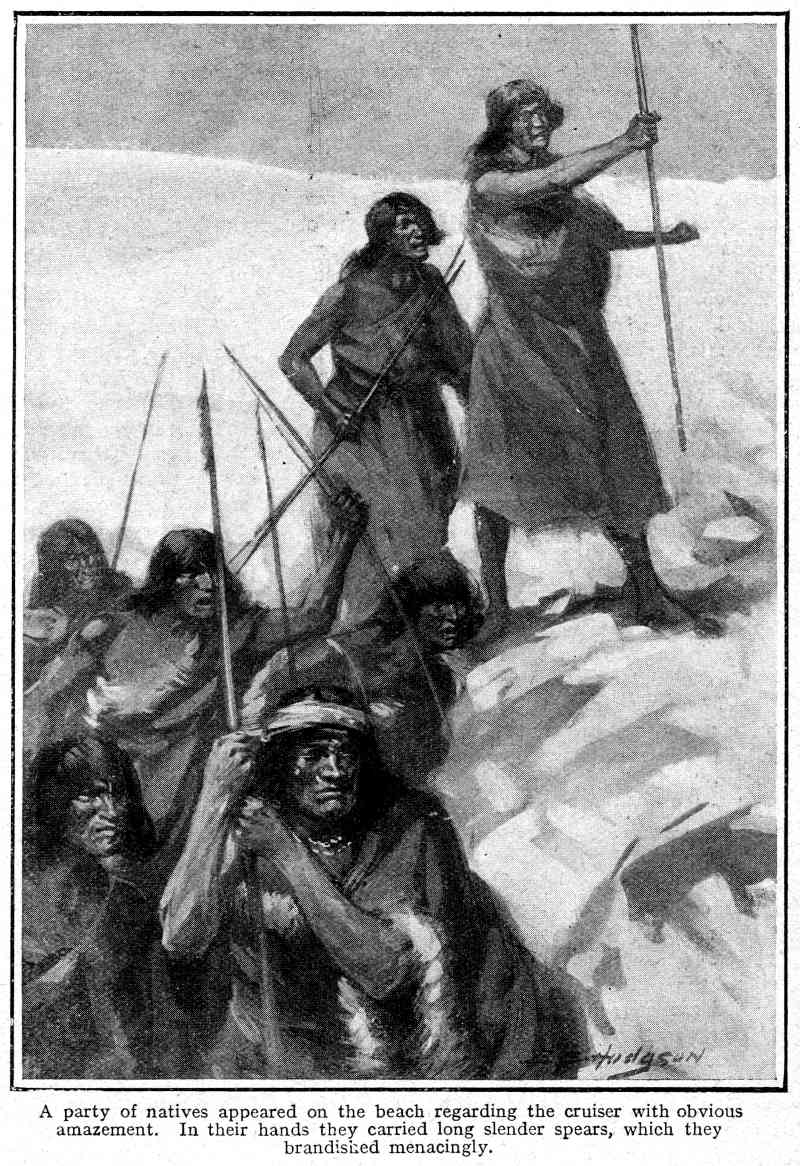
[Illustration: A party of natives appeared on the beach regarding the cruiser with obvious amazement. In their hands they carried long slender spears, which they brandished menacingly.]
Hardly had the Olive Branch moored when a party of natives appeared on the beach, regarding the huge cruiser with obvious amazement and curiosity. They were tall, muscular men, wild and shaggy in appearance, and scantily clothed in spite of the severity of the weather. In their hands they carried long, slender spears, which they brandished menacingly when a white flag was waved on board the cruiser.
Having lost the small boats in action the only means of communicating with the shore was by the motor cutter and the barge. These two boats were hoisted out by the crane with comparative ease, and a party of men prepared to go ashore for the purpose of setting up a temporary forge for the repair of the propeller.
Gerald and Jack asked, and readily obtained, permission to go ashore, Captain Brookes cautioning them not to wander far from the boat, and not to give the savages any cause for offence; so buckling on their revolvers they took their place in the cutter.
On the approach of the boat, moving swiftly and noiselessly through the water under her well-silenced motors, the natives fled precipitately, till they gained the shelter of a cluster of pine trees.
At length, by dint of signs, one of the savages was induced to come down to the water's edge. This he did slowly, and with manifest hesitation and distrust, but the bait of a piece of copper proved irresistible. No sooner had he obtained possession of the metal than he bolted back to his companions. Two more followed his example, received various blankets, and as promptly fled. Then others summoned up courage, and soon the shore was lined with natives, with every symptom of good-will, who accepted the various presents with the greatest eagerness.
The savages having been pacified, steps were immediately taken to build a forge, and the damaged fan was laid upon a bed of sand so as to receive the molten metal. This work took two days to perform, some of the seamen being lodged in temporary shelters so as to prevent any attempt on the part of the savages to remove the metal under cover of darkness; but so docile did the Patagonians seem that there appeared no necessity for the precaution.
While the welding operations were in progress Gerald and Jack, accompanied by a party of armed men, made several short excursions into the interior. The snow-drifts made walking a difficult matter, while the air was so piercingly cold that the men were especially cautioned against sitting down to rest while on their expeditions, as the result would be fatal.
"I wonder where those poor brutes sleep?" remarked Jack, as the chums trudged wearily through the fleecy mantle that covered the ground to the depth of a foot. "In caves or rough huts, I expect," replied Gerald. "They must be a wiry set. As far as I can make out their food consists wholly of shell-fish, yet they seem to thrive on it."
"What's that over there?" exclaimed Stockton, pointing to a series of snow-covered mounds standing about a foot from the ground on the shores of a small cove or creek.
"Canoes, turned bottom upwards," replied Gerald, after making a lengthy examination through his field-glasses. "And on the other side of the inlet is a small village, though what those people are doing on this side I cannot make out."
"Perhaps they don't want us to know the position of their village," remarked Jack, as they resumed their way back to the boat, the rest of the party straggling in the rear.
On returning to the landing-place they found that the repairs to the propeller had been completed and the massive casting had already been placed on board the cutter.
"We've been waiting for you the last half hour," observed Mr. Slade, with asperity, for the coldness of the atmosphere and the tedious delay had not improved his temper. "Now then, men, fall in. Number."
On the landing-party "numbering-up" the astounding discovery was made that one man was missing, and further inquiries revealed the knowledge that the straggler was a petty officer named Black, who was known to have accompanied Gerald's party.
"He must have fallen out on the way back to the shore," exclaimed one of the men.
"Well, it's no use standing here—he must be found," said Slade. "As I am in charge of the landing-party, I'm held responsible. Look here, Mr. Tregarthen, will you take command of the cutter, and take the propeller off to the ship? I'll take half a dozen men and go and look for Black."
Jack Stockton also expressed his intention of forming one of the search-party, so leaving twelve men on the shore to stand by the launch, Lieutenant Slade followed the well-defined footsteps through the snow, while Gerald undertook the duty of taking the cutter back to the ship.
Ere the little craft could accomplish her journey a squall swept down upon the harbour with its customary fierceness and intensity. In spite of the fact that the cruiser was riding to a strong ebb tide the strength of the icy blast caused her to swing broadside on and athwart the swirling stream. The motor craft, notwithstanding her comparatively high freeboard, took in water on both sides, nor was Gerald able to bring her alongside the Olive Branch till she had gained the comparative shelter of the lee of the cruiser.
Somewhat to young Tregarthen's surprise no one was waiting to receive the boat and its weighty and important cargo, so having secured the cutter to the swinging boom her crew clambered up the wire rope ladders and gained the deck of the Olive Branch.
Here they found that, in spite of the hissing shower of hail and snow, the whole of the remaining crew of the cruiser were lining the weather-side of the deck and peering intently ashore.
It was a strange sight that met Gerald's gaze as he crossed the deck and looked in the direction of the landing-place.
Sheltering under the lee-side of the forge and the adjacent temporary buildings were the men of the launch, quite oblivious of what was taking place a bare hundred yards from where they stood, while on the snow-covered plain betwixt the shore and the fringe of the pine trees a scene was being enacted in which those on board the Olive Branch were powerless to interfere.
Plunging and staggering across the snow was one of the seamen of the Olive Branch, at his heels a score or more of Patagonians, with their long spears poised ready to plunge into the fugitive's back, yet restraining themselves in order to prolong the savage delight of the chase. Against the fleet-footed natives, to whom the soft, yielding snow appeared to offer no obstacle to their speed, the sailor had no possible chance. Once he turned, raised his revolver, and fired, and one of the savages fell. But for the silencer the shot might have terrified his pursuers, but regarding the weapon merely as they would a piece of cold steel, the moral lesson was thrown away.
Evidently it was his last cartridge, for dashing the weapon in the face of the nearest native the man resumed his flight, till within twenty yards of the place where his unsuspecting comrades were sheltering he stumbled.
During his dash for safety the man gave vent to a warning shout; the men had just time to stand to their arms ere the Patagonians were upon them. The issue was not long at stake. The powerful yet silent weapons of the white men drove the savages back to the shelter of the forest.
"Hoist the signal for recall and clear away the for'ard turret," ordered Captain Brookes. "I'll shell the rest of those rascals into smithereens."
Muttering threats of vengeance against the treacherous natives the crew of the launch came over the side. Three of them had sustained slight wounds in the conflict on the shore that necessitated the attendance of the surgeon, though the wounded men submitted to his ministrations with a bad grace. As for the rest of the crew of the Olive Branch they besought their officers to lead them on an expedition to rescue or revenge their missing comrades.
To these entreaties Captain Brookes turned a deaf ear. "Too many risks have been taken already," he declared. What he meant to do was to inflict a stern punishment on the savages who had violated the hospitality of their visitors.
"One moment, sir," exclaimed Gerald. "If we open fire with the 6in. guns we'll probably exterminate friend and foe; that is, if our comrades are still alive, as I think they are. I quite agree with you, however, on the impracticability of sending a punitory force ashore."
"By Jove! it's worth trying," cried Captain Brookes, after the young sub-lieutenant had unfolded his plan, and to the astonishment of the rest of the officers and crew orders were given for the Olive Branch to weigh and proceed to sea. Twenty minutes later the cruiser had left her anchorage in the inhospitable waters of Desolation Inlet.
[Illustration: CHAPTER XVII]

GERALD'S RUSE
IT will now be necessary to return to the events that befell the expedition.
Having followed the tracks across the open plain with comparative ease the party plunged into the sombre gloom of the forest, if forest it might be termed, for the trees grew in clumps with frequently a clearing of fifty to a hundred yards between.
"We'll strike an arm of the creek in a few minutes," observed Stockton.
"The sooner the better," replied Slade, shortly, for in the keen biting air talking could only be maintained by an effort. Every breath seemed to lacerate the lungs, while the wind was so bitter that the thick woollen garments worn by the men seemed totally insufficient to withstand the numbing effects of the intense cold.
"It's snowing, sir," exclaimed one of the men. "I've served in the Arctic, and I know what this means. Our tracks will be covered up in a few minutes."
"Well, what do you propose?" asked Slade. "We've no compass."
"Send a man back to blaze the trees before the track is wiped out, sir, then do the same as we advance."
"Very good. Roberts, you make your way back and slice a piece of bark off a tree now and again, so that each mark can be seen from the one nearest to it. Now, look sharp, you others, if we are to find Black alive."
Roberts set out on his return journey, while the rest of the expedition, bending low in order to force their way against the driving hail and snow, proceeded on their way.
Suddenly above the moaning of the wind a blood-curdling yell, issuing simultaneously from a hundred throats, burst upon the ears of the astonished party, and a shower of spears thrown with tremendous force came hurtling through the air.
Three men fell, badly wounded, while two more received slight flesh-wounds. Taken completely by surprise the survivors strove to draw their revolvers, but ere their benumbed hands—rendered additionally clumsy by reason of their thick woollen gloves—could perform their task, the savages were upon them.
Having all his work cut out to defend himself, Jack Stockton could pay no heed to his companions; it was a case of each man for himself. Contriving to obtain a grip at his revolver Jack fired, but the small-calibred nickel bullet, with its high initial velocity, passed through the shoulder of his nearest opponent so cleanly that the muscular savage was unaware that he was hit. Even at that critical moment Stockton wondered whether the weapon had missed fire, till he remembered that it had "kicked," and quick as lightning the thought flashed through his mind that Captain Brookes's methods of exterminating war could not be favourably applied when opposed to savages.
The next instant Jack was grappling with the brawny Patagonian; and though the Englishman was powerfully built and "hard as nails," his strength was like that of a child compared with that of his antagonist.
He felt himself being forced backwards till it seemed as if his spine was on the point of snapping, jagged spear-heads were poised ready to be driven home, and ponderous clubs were whirled above his head.
Then a merciful unconsciousness came upon him and he remembered no more.
Meanwhile Slade, fighting right manfully, had succeeded in flooring three of his antagonists by well-directed blows of his fist; for, in spite of his gloves, the lieutenant's knuckles struck home with sledge-hammer force and precision. For a time it seemed as if he would be able to keep his foes at bay, till a wily savage, stealing up from behind, dealt him a crashing blow with a club. Slade possessed a thick skull in more senses than one, and on this occasion it served its purpose. Under the blow, that would have killed most men, Slade fell senseless in the snow.
When Stockton regained consciousness he found himself lying under the shelter of an overhanging rock, with Slade and one of the seamen lying close to him. Were it not for the actual contact all three would have been dead through exposure to the intense cold. At first he could hardly open his eyes, for the blood that had oozed from a gash in his forehead had congealed and had thus prevented a copious loss of the vital fluid.
Gathered around the prostrate forms of the survivors of the unfortunate expedition were nearly a hundred savages, some of whom were still squabbling over the distribution of their prisoners' effects, for every metal article had been unceremoniously taken from them. Gradually the details of the surprise dawned upon the young Englishman, and he vaguely wondered why the Patagonians had not completed their murderous work. Perhaps he and his companions were being reserved for a lingering death.
After a while Slade began to stir, then, starting to his feet, he stumbled a few paces, and collapsed in the snow. A roar of derisive laughter from the savages greeted this performance, and a pair of dusky giants lifted the lieutenant and dropped him by the side of his comrade.
"Hello, Slade!" began Jack, wearily, but in reply came a torrent of inarticulate words. The lieutenant was in a delirium. Once he shouted that the men were shirking their task of holy-stoning the decks; then he craved for a cocktail; the next moment begging for a draught of water, till his exhausted body sank beneath the strain and he relapsed into unconsciousness.
Stockton, too, was on the verge of insensibility when a native came running with some news of more than ordinary interest. What the intelligence was Jack could not, of course, comprehend, but the outcome of it was that most of the savages made off, leaving barely a score to watch their helpless prisoners.