Front matter (continued 9)
Reading edition
The Pridmores, at heart, were conventional. They were abreast of the times, were lively and intelligent, and could be at ease in Bohemia, but up till now Bohemia had known the deference due to Queen Street, Mayfair.
Lady Pridmore had always thought—and Silvia, Uncle George, and the Prince had agreed with her—that Mary was predestined for Edward Ambrose. For one thing, Edward, when his father died, would be very well off—not that the Pridmores were in the least mercenary. They simply knew what money means to such a being as man in such a world as the present. Then Edward was liked by them all. It had long been a mystery why Mary had not married him. He was always her faithful cavalier, and a rather exceptional man. And now she had suddenly gone off at half cock, as Uncle George expressed it.
During this period, tribulation was rife at other places also. Edward Ambrose was in no enviable frame of mind. The woman he loved and the friend he served were cutting deeply into his life. But of one thing he was convinced—neither of them realized their danger.
He was a sufficient judge of his kind to know that Henry Harper was not a man willfully to practice deceit. Ambrose was aware of the skeleton in the cupboard. It was ever present to his mind. And his position was rendered painfully difficult by the fact that he was under a pledge not to reveal it. The root of the matter, as far as Harper was concerned, was that his inexperience of the world might cause him to drift into a relationship which he did not intend and could not foresee.
Ambrose was tormented by a desire to tell Mary Pridmore all he knew. Surely it was his duty. Her ignorance of certain facts, which Harper most unwisely withheld, was a very real and grave danger. Ambrose realized how quickly such a woman, almost unknown to herself, could sweep a man off his feet. He also felt that Henry Harper, with his atmosphere of mystery, and his remarkable powers which needed the help of a strong and stable intelligence, might make an irresistible appeal to a girl like Mary Pridmore.
Ambrose felt that he alone knew the peril which beset his friends. Yet he could not warn one without treason to the other. His regard for both seemed to preclude all interference. He had a sincere affection for a brave-spirited man; for Mary he had long cherished something more than affection; yet in circumstances such as these an untimely word might do mischief untold.
For the present, therefore, he had better remain silent. In the meantime, the Sailor had descended once more into the pit. He had been cast again, by that grim destiny which had never failed to dog him from the outset of his life, into the vortex of overmastering forces. He felt the time was near when without the help of Mary Pridmore he could not keep on.
One day, worn out with anxiety, he called at Spring Gardens and had an interview with Mr. Daniel Mortimer. That gentleman could give little solace. The woman drew her allowance every week. There was reason to believe that she had bad bouts of drinking, but Mr. Mortimer was still unable to advise a petition for divorce. The whole matter was full of difficulty, there was the question of expense, also it would be wise not to ignore the consequences to a rising reputation.
Henry Harper felt the force of this reasoning. It was no use attempting to gainsay the view of an expert in the law. Moreover, he had a clear knowledge of Mary's opinion on the subject of divorce. In any event she would never consent to marry him.
The young man took leave of the kindly and wise Mr. Mortimer, and with despair in his heart walked slowly back to Brinkworth Street. Every yard of the way he wondered what he should do now. He felt like an animal caught in a trap. For more than a week he had not been able to think of his work.
He had not seen Mary for some days. He was trying to keep her out of his thoughts. But the more he denied himself the sight of her, the less power he had to fight the demon in whose grip he was now held. He was unable to work, he slept little, he had no appetite for food; for the most part, he could only walk up and down this wonderful and terrible city of London which had now begun to appall him.
He had outgrown his present strength. And, as only a woman can, she realized where and how she might help him. This deep-sea mariner should not call to her in vain. Athena, in her high maternal sanity, was ready to yield all.
Three days ago, when he had seen her last, and had sat with her in the shade of the park, her eyes, her voice had told him that. They had told him that, even when it had not been his to ask. It was this implicit declaration which had so gravely frightened him. The truth struck home that he was not treading the path of honor.
By the time he had returned to Brinkworth Street, he knew the necessity of a definite course of action. It was madness to go on in their present way. They had come to mean too much to each other; besides, a perception keenly sensitive had told him that her friends were beginning to regard him with a tacit hostility. It had not found expression in word or deed; he was always received with kindness; but except on the part of Klondyke, there was no real warmth of sympathy.
Circumstances had placed him in a terribly false position, and he must be man enough to break his fetters. He knew that there was still one way of doing that. The course was extreme, but honor demanded it.
He had been invited to tea the next day at the house of a friend they had in common. It was to be a large party, and he knew that if he carried out his original intention of going, he would see Mary and no doubt have a chance of talking to her. Much painful reflection that evening finally decided him. He would go prepared to tell everything. It must be their last meeting, for she would surely see how hopeless was the intimacy into which they had drifted.
Having quite definitely made up his mind, he was able to snatch a little more sleep that night than for some weeks past. Moreover, he got up the next day with his resolution strong upon him. Let the cost be what it might, he must accept a bitter and humiliating situation.
At half past four that afternoon he was one of many more or less distinguished persons filling the spacious rooms of a house in a fashionable square. The hostess, a quick-witted adroit woman, was very much a friend of both. She had a real regard for Mary, also a genuine weakness for a man of genius.
Athena was there already when the Sailor arrived. And as she sat on a distant sofa, nursing her teacup, with several members of her court around her, the young man was struck yet again, as he always was, by her look of vital power. She had in a very high degree that curious air of distinction which comes of an old race and seems to strike from a distance. The features were neither decisive nor regular, but the modeling of the whole face and the poise of the head no artist could see without desiring to render on canvas.
The Sailor had to steel his will. The thought was almost intolerable that at one blow he was about to sever his friendship with her. She was so strong and fine, she was a sacred part of his life, she was the key of those central forces that now seemed bent on his destruction.
Presently, amid the slow eddy of an ever changing crowd they came together. Her greeting was of a peculiarly simple friendliness. She seemed grave, with something almost beyond gravity. There was a shadow upon a face that hardly seemed to have known one in all its years of shelter and security.
"Is there anywhere we can talk?" he managed to say after a little while.
She rose from her sofa with the decision he had always lacked.
"Let us try the library," she said.
And with the assured skill of an experienced navigator of social waters, she led him there and found it empty.
XVII
Henry Harper's decision had been taken finally. But as soon as he entered this large and dull room, he felt the chill of its emptiness in an almost symbolical way. It was what his whole life was going to be, and the thought nearly wrung a groan out of him.
She was puzzled by a certain oddness in his manner, a feeling which of late had been growing upon her. It was hard to understand. She knew his need of help, his craving for it, yet now the time had come when he had only to ask in order to receive it he seemed at the mercy of a painful indecision which had the power to wound.
Here and now a subtle withdrawal of the highest part of himself seemed more than ever apparent. It was even in his face this afternoon, in the wonderful face of Ulysses that had all the oceans of the world in it. What did it portend? Was it that he was afraid?
What had he to fear? How could such a person as herself repel him? She had all to give if only he would demand it of her.
Of that he must be aware. The haunted eyes of the sailorman too clearly proclaimed his knowledge.
"How is 'A Master Mariner'?" she asked, in order to end the silence which had intervened as soon as they entered the room.
"It doesn't get on," he said, in a voice that did not seem to be his own.
"I'm very sorry." The deep note was sincerity itself.
"I don't know why," said the Sailor, "but it's too much for me now."
"Of course, it is all immensely difficult. The latter part particularly. Somehow, one always felt it would be."
"It's not that," said the Sailor. "Not the difficulty, I mean. That was always there, and I was never afraid of it. But I think I am losing grip."
She looked at him, a little disquieted. There was a note in his voice she heard then for the first time.
"That must not be," she said. "There's no reason for it."
"Ah, you don't know. I begin to feel now that I'll never be able to put it through."
"Why should you feel that? What reason can you have, a man of your wonderful powers, a man with all his life before him?"
"I just haven't the strength," he said in his quaint speech, "and that's all there is to it."
To her surprise, to her horror almost, he suddenly covered his face with his hands. Somehow, the sight of a weakness so palpable in a thing so strong and fine was unnerving.
"I'll never be able to put it through by myself."
As she stood facing him, she felt the truth of that.
"Is it necessary?" The words seemed to shape themselves in despite of her.
"Yes." Involuntarily, he drew away from her. A sure feminine instinct waited for the words that should follow. She read in those strange eyes that he must now speak. She could almost feel, as she stood so near him, a slow and grim gathering of the will. She could almost hear the surge of speech to his lips. But no words came, and the moment passed.
Now that he had to strike the knife into his heart, it could not be done. It was not cowardice, it was not a failure of the will, it was not even a momentary weakness of the soul. He was in the grip of ineluctable forces, of a power beyond himself. As he stood not three yards from her with the table supporting him, his whole nature seemed wrenched and shaken to the roots of being.
She couldn't help pitying him profoundly. There was something that had crept into his eyes which harrowed her. Poor mariner! For the first time in her life, she felt a curious sudden tightening of the throat. She could have shrieked, almost, at the sight of this tragic pain it was not to be hers to ease.
A moment later, she had regained control.
"You must keep on," said Athena. "You must keep on."
But he knew that he was down, and that the ineluctable forces were killing him.
She may have known it, too. No longer able to bear the look upon his face, she drew back, an intense pity striking her.
Was she upon the verge of some great tragedy? She did not dare to frame the question.
"Mary." ... She awoke to the sound of the Sailor's voice and of her own name on his lips.... "I've made up my mind to—to go away for a bit."
In the midst of these throes, an inspiration had come to him. It was no more than a miserable subterfuge, but it was all he could do.
"I somehow feel I'm on the rocks. I think I'll go a voyage. I'm losing myself. I'll perhaps be able to..."
A stifling sense of pity kept her silent.
"... to persuade Klondyke to come along with me."
"I wish I could have helped you." The words were wrung from her.
"You can't," he said, and he spoke with a gust of passion as one half maddened. "No one can help me."
She saw his wildness, and somehow her strength went out to him.
"You can't think what I've been through," he said, with something worse than rage entering his voice.
She knew she couldn't even guess, and was too wise to try. But again she was hurt by the sight of a suffering it could never be hers to heal.
"Henry," she said, "I would like you always to feel and always to remember that whatever happens to you, and wherever you are, I am your friend, if only I may be."
To this high and rare simplicity of Athena the goddess, he could make no response.
"And now I must go," she said, gathering the whole force of her resolution.
"Suppose I walk with you a little of the way?" he said.
She almost guessed that he meant it for their last stroll together.
It was a long step from the scene of the tea party to Mary's door, but no finer evening for a walk could have been desired. Neither knew why they chose to take it. For both it was a mere prolongation of misery. Perhaps it was that he still hoped, against hope itself, for the moment to return in which it would be possible to tell the secret that locked his lips.
Humiliated as he was, there may still have been that thought in his mind. But it was vain in any case. There could be no real intention now of telling her. By the time they had crossed the park, he had cast it entirely away. And now they fell to talking of other matters.
Unwilling to let her go, cleaving to her in his weakness to the very last second of the very last hour, he persuaded her to sit a few minutes on an empty bench under the trees ... under the trees within whose shade he had sat when he had seen her first. And there he had from her lips a definite expression of her faith.
It was with that they parted—finally, as he believed. He dared not put it to himself in a way so explicit, it was not a thing he could face in such bare, set terms, but in his brain the Aladdin's lamp was burning fitfully, and it was this that flashed the cruel light of truth.
"... If ever you want help!"
Those were the words of their parting, as the pressure of his fingers met the last touch of hers. And then she was gone, and he was gone ... and then a bleak, dull blindness came over him and he knew that more than life had gone with her.
XVIII
A rudderless ship in mid-ocean, he wandered long and aimlessly about the byways of the city. It was past midnight when he found himself back in Brinkworth Street. Without taking off his clothes, he flung himself face down on his bed.
After a while, he tried very hard to pull himself together. He must be a man, that was the whole substance of his thoughts. As ever, he knew that to be his simple duty. Throughout his overdriven life, he had always had to tell himself, and other people had always made a point of telling him, to be a man. Auntie had been the first to ask it of him when she had dragged him upstairs and tied him to the bed. "Enry Arper"—he had heard that shrill snigger above the roar of Knightsbridge—"what I shall do to you is going to hurt, but you must be a man and bear it." A jolly looking policeman had told him to be a man at the police station. Mr. Thompson had told him to be a man the night he carried him to sea. The Old Man had given him equally sound advice when he had gravely told him of the Island of San Pedro.
All his life, it seemed, he had not lacked good advice, and hell only knew he had always done his best to follow it. But as now he lay on his bed in Brinkworth Street in a cold summer dawn, he felt that he was done.
The plain fact was he was coming to believe that he had not had a square deal. Life was tolerable for some, no doubt; for people like the Pridmores, for instance, and his friend Edward Ambrose—he was not envying them meanly, nor was he merely pitying himself—for those who had been born right, who had had a fair start, who had been given a reasonably plumb wicket to play on, as Klondyke expressed it. But for gutter breeds such as himself, there was not one chance in a million of ever winning through. He had done all it was possible for a man to do, and now with a feeling of more than impotence, he realized that he was out.
He had learned a trick of praying this last year or two, but in this cold summer dawn he had no longer a use for it. What was the good? Somebody—it was not for him to say Who—had not played fair. Henry Harper, you must be a man and bear it! A sudden gust of rage swept through him as he lay. The voice of Auntie was coming back to him out of the years. And she was exhorting him to an inhuman stoicism in order that she might serve her private ends.
Some time between six and seven, in a state of awful dejection, he undressed and got into bed. He did not want Mr. Paley to find him like that when he brought the water for his bath at eight o'clock. It would not be right to wound the feelings of a good man. But if Henry Harper had had the courage to take a razor, well.... Mr. Paley would not have found him in bed. Since that night on the railway, now many years ago, he had lost the nerve for anything of that kind. He had always thought that on that night something had snapped in the center of himself.
At eight o'clock, when the punctual Mr. Paley came with the water can, Henry Harper told him that he was not going to get up at present, and that he would not be in need of breakfast.
"Aren't you well, sir?" asked Mr. Paley, in his discreet voice.
"No, I'm not very well."
"I'm sorry, sir." Mr. Paley had the gift of expressing true sympathy in his tone and bearing. "You have been a little run down some days now, have you not, sir?"
"Longer than that," said the Sailor. "Ever since I've been born, I've been a poor sort of brute."
"Robust health is an untold blessing. I'm glad to say I've always enjoyed it myself, and so has Mrs. Paley. Would you like to see a doctor, sir? I'll go along at once to Dr. Gibb at the end of the street."
"A doctor is no use for my complaint."
Mr. Paley was grieved, but he wisely withdrew without further comment.
The Sailor turned his face to the wall with a vague sort of prayer that he might be allowed to die. But it was not to heaven; the deadly pressure of events had forced him in spite of a lifetime's hard and bitter fighting to accept Mr. Thompson's theory. The troll of Auntie, who was exuding gin and wickedness around his pillow, had been now reinforced by the mate of the Margaret Carey.
A pleasant pair they made, these trolls from his youth. And there were others. If only that delicate spring had not snapped, he must have jumped out of bed and settled the business out of hand. "Be a man," said the voice of Auntie. "There's the case on the dressing table straight before your eyes. Be a man, Enry Arper, and set about it."
Auntie was right. He got out of bed. He took up the case and stood an instant holding it in his hand.
"Lay holt on it, bye." That was Mr. Thompson's gruff tone, and it was followed immediately by Auntie's shrill and peculiar snigger.
There was one other thing, however, on the dressing table: a comfortable, green-backed edition of the "Poems of John Milton." The Sailor didn't know why, but he took up the now familiar volume with his unoccupied hand. It may have been mere blind chance, it may have been one last cunning effort on the part of the genie, for by some means the book came open at a certain place in the middle. Suddenly the brown case fell to the carpet with a thud.
In spite of the trolls besieging him, the Sailor crept back to his bed with the book in his hands. What wonderful, wonderful worlds were these! And he was little more than twenty-eight. And the sun of Brinkworth Street had entered his chamber to tell him that this was a gorgeous morning of midsummer.
The battle was not over yet, however. Auntie and Mr. Thompson in the hour of their necessity had summoned to their aid the Old Man and Cora Dobbs. It was now all hell let loose.
"Chuck it, ducky." It was Cora's voice now. "You are not a man, you know, and never will be. You are no use, anyway. Get out of your little bed, now, and cut off the gas at the meter."
Time went on, but he made no attempt to reckon how much of it. He was too fiercely occupied in fighting the damned. Once or twice it seemed that they must surely down him. Their insane laughter hovered round his pillow continually, even in the broad light of a very glorious day. Sooner or later, he feared, there could only be one end to it all. John Milton or no John Milton, they almost had him out of bed again, when Mr. Paley came quite unexpectedly into the room.
"Mr. Pridmore, sir, has called. Shall I ask him up?"
Klondyke, however, had come up without waiting to be invited.
"Mary told me you were a bit below the weather," he said, "so I thought I'd come and see you. What's the matter?"
The Sailor could not answer the question. He could only gaze with wild eyes at his friend.
"You've been working too hard, I expect," said Klondyke, looking at him shrewdly. "Overdriving the buzz-box, my boy, with this new book that Ted Ambrose thinks is going to be great. You'll have to have rest and a change."
Klondyke perched on the edge of the bed, as if it had been Sailor's bunk in the half-deck of the Margaret Carey.
"Mary said you talked of going away for a bit, and she thought you might like me to come with you. Now what do you say to a little trip as far as Frisco, for the sake of old times? You can put me down there. I'm just beginning to feel, after a month here, that I shall be none the worse for another trek to Nowhere and back. And then you can come home by the next boat and finish your job, or go on a bit further round the coast, if you fancy it. What do you say, old friend?"
The Sailor, supine in his bed, was unable to say anything. But the trolls had no use for Klondyke. Hissing and snarling they had flown already to distant corners of the room.
"Shall we fix that? I'll go now to Cockspur Street and see if I can book a couple of saloon berths for tomorrow—there's a boat for Frisco most Wednesdays, and you are not up to roughing it at present. Besides, there's no reason why you should. Now, Sailor, what do you say?"
In spite of all the trolls there were in the universe, Klondyke was still Klondyke, it seemed. Perhaps he alone could have conquered them.
"That fixes it," he said. "Just get your gear together. You won't want much. And mine's ready any time. I'll go along at once, and come back and report."
Two minutes later, Klondyke was away on his errand, only too happy at the prospect of being in harness again.
For the time being, the trolls were overthrown. The battle was not yet won, but a staunch friend had given the Sailor new fighting power. He was by no means his own man; he felt he never could be again; all the same, when Klondyke returned about an hour later with the news that he had been able to secure two berths for the following day, Henry Harper was dressed, he was bathed and shaved, he was clothed in his right mind more or less.
XIX
On the following night, the Sailor put once more to sea. But it was very different faring from any he had known before. A craft of this kind was another new world to him. Indeed, so little did it resemble the Margaret Carey, that it was hard to realize at first that he was once more ocean bound. Even the tang of salt in the air and the wash of the waves against the sides of the great ship were scarcely enough to assure him that he was again afloat.
It was the presence of Klondyke which really convinced him.
"I never thought we should come to this," said his friend as they lingered in boiled shirts over an excellent dinner and a band the second day out. "It's better than having to turn out on deck at eight bells with your oilskins soaked and the nose of the Horn in front of you. You think so, Sailor, I know."
Henry Harper confessed that he did.
"How you stuck it all those years, I can't think," said Klondyke. "How any chap sticks it who doesn't really take to the sea passes me. But you were always a nailer for keeping on keeping on."
The case might be even as Klondyke said, but the Sailor had about reached his limit.
Klondyke himself, who was not a close observer, was struck by the change. He couldn't quite make him out. In his peculiar way, he had a great regard for the Sailor. He considered him to be a white man all through; and knowing so much of the facts of his life, he felt his grit was quite extraordinary. But now it had begun to seem that this gallant fighter was losing tenacity. There was something about him which suggested a boxer who has been knocked to the boards, who is trying to rise before he is counted out and sickly realizes that he can't.
What had happened? It was clear that he had had an awful facer. How had he come by it? Klondyke belonged to a type which strictly preferred its own business to that of anyone else, but it was impossible not to ask these questions, knowing as much of Henry Harper as he did.
Was Mary the cause? Had the blow been dealt by her? Somehow, he did not think that could be the case. And yet there was a doubt in his mind. He knew, at least, that Mary was fearfully upset. It was she who had come to him with a particular look in her eyes and had proposed a voyage for the Sailor on the plea that he had been working too hard. That certainly did not suggest any unkindness on her part. All the same, he knew that his family strongly disapproved of her intimacy with Henry Harper.
Putting two and two together, he was half inclined to believe that the Sailor had proposed to Mary, and that against her own wish she had refused him. But even that hypothesis did not account for the morbid and rudderless state he was in now.
Nevertheless, the Sailor had still a little fight left in him. About the third or fourth day out, he had begun to make an effort to pull himself together, and then it became clear that the voyage was doing him good. In a week he was a new man. He was still deeply mysterious, he was not keen and alert as he used to be, but to the unsubtle mind of Klondyke that implied a case of overwork.
Indeed, as far as he was concerned, that must always be the primary fact in regard to the Sailor. How the chap must have sapped in the nine years since last they had put to sea. It was almost incredible that a man who had made a reputation with his pen, who in speech and bearing could pass muster anywhere, should have been picked out of the gutter unable to write his own name, and set aboard the Margaret Carey.
Yes, this chap had enormous fighting power. There was not one man in a million who could have overcome such a start as that. It would be a tragic pity if he went under just as he was coming into his own.
When they reached Frisco the Sailor was so much more himself that Klondyke, who at one time had been disinclined to leave him, felt that now he might do so without any fear for his safety. In every way he seemed very much better. He was brighter, less silent. There was still a mysterious something about him which he could not account for, but he felt the worst was past and that there was no reason why Henry Harper should not go home alone.
Therefore, when they came to Frisco, Klondyke carried out his plan of trekking to nowhere and back, where boiled shirts would cease to trouble him, and where, with a rifle and a few cartridges, and one or two odds and ends in a makeshift carry-all which had accompanied him to the uttermost places of the earth, he would really feel that he was alive. He invited the Sailor to come with him, yet he knew that such a mode of life was not for Henry Harper. And the Sailor knew that, too. For one thing, he would be wasting precious time he could not afford to lose; again, now that fighting power was coming back to him, he must run his rede, must prepare to outface destiny.
Still, in taking leave of his friend, he was trying himself beyond his present strength.
The fact struck him with cruel force at the moment of parting on the waterfront at Frisco. Klondyke, wearing a fur cap the replica of one that would ever be the magic possession of Henry Harper, was on the point of going his way, and the Sailor had booked a return passage to Liverpool. It came upon him as they said good-by that it was more than he could bear.
"You'll win out," were the last words spoken in the familiar way. "You've not got so far along the course to be downed in the straight. Keep on keeping on, and you'll get through."
That was their farewell. But as soon as the Sailor was alone, the awaiting trolls were on him. He was in better shape now than in those hours in Brinkworth Street, but the conflict was grim. Every ounce of will was needed.
He went aboard feeling dazed. Even yet he had not grasped the worst. He did not know until the next day that England and Brinkworth Street were not yet possible, and that perhaps they never would be. Therefore, when they touched at the port of Boston he changed ship and put about, having suddenly determined to make the grand tour as a saloon passenger.
He was well off for money. Popularity had come to him as well as technical success. He could afford to sail round the world first class. And having reached this wise decision, he began in earnest to fight destiny.
He had made a pledge that he would not write to Mary, also, if his will endured, he would never see her again. It seemed the only course after that last failure.
John Milton was with him, also the Bible and Shakespeare and Shelton's "Don Quixote" and Boswell's "Life of Johnson," and a translation of Montaigne. Moreover, he had the Iliad and the Odyssey in English, also a Greek Lexicon. With the aid of this, he spent many an hour in quarrying painfully, but with a certain amount of success, in the original. This royal company did much to hold the trolls at bay. But in the evening they would hover round the lamp in the saloon; and during the night, when he awoke to the wash of the sea, expecting to hear eight bells struck and half wishing he was dead in consequence, because he would have to tumble out of his bunk and ascend shivering to the deck of the Margaret Carey, then was a time for the foe. But with John Milton and a greater than John by his elbow, and with Aladdin's wonderful lamp still burning fitfully through the night, although of late the genie had apparently forgotten to trim it, the demons for all their hissing and snarling were never really able to fasten their fangs upon him as they had done that morning in Brinkworth Street.
Weeks went by. He saw strange sights and many familiar ones, he touched at some unknown and some half remembered ports, he watched the sun gild many majestic cities. Once again he saw on the starboard bow the trees of the Island of San Pedro. Once again he saw the sharks with their dead-white bellies and heard their continual plop-plop in the water. Once again he heard the Old Man come up the cabin stairs. This time the heavens did not open, perhaps for the reason that there was no heaven to open for Henry Harper now.
About the third day out from Auckland on the homeward tack, he put forth a great effort to come to grips with "A Master Mariner," Book Three. But after a week of futile struggling he discovered that Aladdin's lamp was extinguished altogether.
The knowledge was bitter, but it must be accepted. Hope was the magic fuel with which the lamp was fed. If that priceless stuff should fail, the lamp could burn no more. Whatever he did now it seemed as clear as the glorious sun of the Antipodes that the mariner would never come into port.
Several times he changed ship. Mind and will steadily developed, but he was never captain of his soul. The demons of the past no longer besieged him, but Book Three was still becalmed. The hour was not yet in which he could return.
Months went by, but the future remained an abyss.
In the end, Ulysses came back to the shores of his native Ithaca for a prosaic but sufficient reason. It was merely that he was in need of money. After eleven months of wandering on the face of the waters, the liberal store he carried had almost disappeared. Quite suddenly one night, in the Mediterranean, he took the decision to return to London.
XX
The Sailor knew as soon as he stepped on the platform at Charing Cross that he had no wish to see again that city which had treated him with such unkindness. He left his gear in the station cloak room, and then by the time he had gone a few yards he regretted bitterly that he had ever come back at all. The mere sight of the omnibuses, of the names on the hoardings, of the grotesquely miscellaneous throngs in the Strand, told him that eleven months of ceaseless wandering had done nothing, or at the best very little, to heal the wound he bore.
These streets brought an ache that, steel his will as he might, he could hardly bear. There to the right was the National Gallery. It was on just such a morning as this that she had led him to the Turners. Farther along were Pall Mall and Edward Ambrose.
Five minutes he stood on the curb at the top of Northumberland Avenue, trying to decide whether he should cross Trafalgar Square. Once more the old sense of disintegration was upon him. Once more he was asking himself what he ought to do.
Eleven months had passed, but things were as they were. In that time not a line had been added to the work he was trying to do. Yet he felt that his first duty was to go to see Edward Ambrose. Let him go now. It was no use shirking it. But a curious instinct was holding him back. It was illogical, he knew, but every moment that he stood there seemed to make the task more difficult.
In a state of irresolution he crossed the road as far as an island in the middle. The sense of familiarity was growing at every step. Within a very few yards was Spring Gardens. He could see two doors up the street the brass plate of Messrs. Mortimer mocking him through a weird substitute for the light of day.
In spite of all the months that had passed, the sight of that brass plate was like a knife in his body. He turned from the island to dash across a very dangerous road, and came within an ace of the death that would have been so welcome. A taxi avoided him by an almost miraculous swerve, for which, when he realized it, he did not thank the driver.
All at sea he crossed the Square and entered Pall Mall. In the process of time he came to the home of Brown's Magazine. Edward Ambrose gave him a welcome that nearly brought tears to his eyes.
"My dear boy!" he said. "Not one word in all these months! Anyhow you have come back to us."
It was impossible to doubt the friendship and the affection of this greeting. The Sailor felt a pang of shame. As a fact, he had been too modest to expect such loyalty.
"I'm ... I'm sorry."
"You had no right to forget your friends," said Edward Ambrose, a little resentfully. He knew the workings of this childishly open mind, and it hurt him that a sincere emotion should have been underrated.
"Yes," said the Sailor queerly. "It was rotten."
"You are looking splendidly brown and well," said Edward Ambrose as soon as it seemed the part of wisdom to speak. "You don't mean to say that Dick Smith has been sailing the high seas all these long months?"
"Not Dick Smith. Ulysses."
Ambrose gave a little start of pure pleasure.
"Then," he said, "a master mariner has really come into port?"
"No." He stifled a groan. "And never will, I'm thinking. That poor sailor man is still becalmed east by west of Nowhere, and never a sign of land on either bow."
"But you must put it through somehow. Tell me ... is there anything I can do to help you?"
The Sailor shook his head miserably.
"I can't accept that as final," said Edward Ambrose. "It's—it's—I hesitate to say what it may be if only you carry it out as you have conceived it. If you don't do that I some how feel the high gods will never forgive you ... or me."
If anything could have rekindled Aladdin's lamp in the Sailor's soul it would have been the enthusiasm of this friend. But it was not to be; the trolls had him captive.
"I'm sorry," he said gently, knowing the stab he dealt. "It is no fault of yours. It's you that's made me all I am ... and if any man could have helped me here you would have been that man. But I'm just a broken mariner. It's no use mincing it—I'm done."
The stark simplicity of the confession made Edward Ambrose gasp. He could say nothing. In the honest eyes was a look of consternation.
"A mariner has got to have a star to work by. Even old Ulysses had to have that. But there's not one for Henry Harper in all the firmament." He fell into a sudden, odd, and queer kind of rage. "It's a black shame. If only I'd had a fair chance I'd have put this thing through. You might say"—the harsh laugh jarred worse than the baffled anger—"I'm a chap who has been handicapped out of the race. However..." The Sailor became silent.
Ambrose felt himself to be shaken. The impotent fury of this elemental soul was something beyond his experience. He hardened his heart. It must be his task to anchor this derelict adrift in uncharted seas until such time as help could come to him.
"Henry," he said suddenly, "does Mary Pridmore know you have returned?"
"No."
Edward Ambrose mustered his courage.
"If you don't bring the mariner into port it will be a heavy blow for her."
"What has it to do with her?" was the almost savage reply.
"She believes in you."
"Why should she?" There was almost a note of menace.
"She is your friend. We are both your friends."
The quiet tone somehow prevailed.
"Of course," he said queerly, "you are both my friends. And I'm not worthy of either."
"Suppose we leave her to be the judge of that."
The Sailor shook his head.
"She can't judge anything until ... until I've told her ... about Cora."
"She has not been told?" Ambrose spoke casually, impassively. Somehow he had allowed himself to guess that the Sailor had told her, and that she had sent him away. Why he should have come to that rather fantastic conclusion he didn't know, except that she had not had a line from Henry Harper in eleven months. But he saw at once that he was wrong.
He felt that he must use great care. The ice was even thinner than he had suspected. Moreover an acute perception told him that nothing would be easier than for ill informed well-meaningness to commit a tragic blunder.
"You don't mean to say you thought I had?" The Sailor put his question oddly, disconnectedly.
"The fact is," said Edward Ambrose jesuitically, "I have never been impertinent enough to think the matter out. I know nothing beyond the fact that Mary Pridmore is very much your friend."
"There's no use in saying that when I can never be hers."
"Ah, there I don't agree," said Edward Ambrose calmly.
"Why not look the facts in the face?"
"Yes, why not?"
"Friendship between us is impossible. That's why I went away. We ... we played it up too high. Friendship between a man and a woman is no use ... at least not to her and me ... although..."
"I'm not talking merely of friendship," said Edward Ambrose, very deliberately. "I'm talking of something else."
So charged with meaning were the words that the Sailor recoiled as if he had received a blow.
"What ... what are you saying!" he cried with a sudden blind rage in his face.
BOOK V
FULFILLMENT
I
"Why do you taunt me?" cried the Sailor after a pause hard to endure.
"I offer neither reason nor excuse for the words I have used," said Edward Ambrose calmly. "I can only say that she is more than your friend. You must remember that you have been away eleven months. In the meantime water still continues to flow under London Bridge."
"I don't follow you."
"Yes, of course—one assumes too much. One forgets that you have been away so long and that apparently you have not yet seen Mortimer."
"Mortimer!"
"Perhaps I ought to have told you ... yes ... I can see I ought to have. Mortimer has news."
"News!"
"Now I am going to put you out. Go at once and see him."
Henry Harper presently realized that he was again on the pavement of Pall Mall, but he was too bewildered to know how he had come there. He was in a kind of dream. But all he did had a specific purpose. For instance, he was going to see Mr. Mortimer. Yet he could not understand what lay behind his friend's desire that he should see the solicitor at once. The true explanation never occurred to him.
Mr. Mortimer had to tell him that his wife had died two months ago in the course of one of her bouts of drinking. At first the Sailor could not grasp the significance of the statement. It hardly seemed to make any impact upon him. He thanked Mr. Mortimer for all his services in a trying matter, and went out into the street, apparently giving very little thought to what had happened.
Here, however, he grew suddenly aware that the aspect of things had completely changed. Something had occurred which lay beyond his ken, but he knew already that the whole universe was different.
A new man in brain and heart, he collected his things from Charing Cross and drove to Brinkworth Street. His room was ready to receive him in spite of the fact that he had been away eleven months. He had written to Mr. Paley from time to time inclosing money and telling him that he hoped to be home presently. And home he was at last.
It was not at once that he could set his thoughts in order. But one fact was clear. He was free. He was free to enjoy the light of heaven, to breathe the breath of life.
In the height of the tumult now upon him he took a resolve. The barrier was down. He would put all to the touch. Somehow he had an implicit faith. A gulf was fixed, he knew, between Mary and himself. She belonged to a world far removed from the one in which he had been born, in which he had passed so much of his life. But he had that final pledge, "If ever you want help!" Well, there was only one way in which she could help him, and that she knew as well as he.
Soon after five he set out. If he went leisurely he would reach Queen Street about six, a propitious hour. She was generally at home at that time. It was hard to believe that he was the same man who had stood that morning on the curb at Charing Cross. He had absolutely nothing now in common with that broken mariner.
In those few brief hours he had suffered one sea change the more. The genie had relit the lamp. Again he was a forward-looking man. Nay, he was more. He was a prince of the blood approaching the portals of an imperial kingdom. Otto, a prince of that other kingdom, issued from the threshold of No. 50, while Venables, the butler, with polite surprise, was in the very act of receiving the Sailor.
"Hulloa, Harper," said the Prince. "Turned up again. We had all given you up for lost."
It might have been possible for a delicate ear to detect something other than welcome in the voice of his highness. But whether such was the case or not was a matter of no concern to the returned mariner.
Mary was at home and alone. At first he was a little unnerved by the sight of her, and she perhaps by the sight of him. The look of sadness in her face distressed him.
"Not one line," she said. But there was nothing of Edward Ambrose's half reproach in her voice.
"No."
"I was beginning to think I should never see or hear of you again." Her simplicity was the exact counterpart of his own.
"I don't think I ever meant you to."
She waited patiently for him to add to his strange words and was slow to realize that he couldn't.
"That would have been cruel," she said at last.
"It would have been cruel either way. However, it is all done with now."
"I'm afraid I don't understand," she said, finding that speech had failed him again.
"I don't know whether I can tell you."
Ought he to tell her? A harrowing doubt arose. She knew that there had been some grave reason for his going away. But what the hidden cause had been, hers was not a nature that would ask. She only knew that if speech and bearing meant anything, he was deeply in love with her, and yet for some unfathomable reason he had shirked the issue.
And now he had returned after these long months, which to her as well as to himself had been a time of more than bitterness, there was still this shadow between them. Yet it surely belonged to the past. There was no barrier between them now, except the memory of a secret which somehow he could not believe was vital.
In her immense desire to serve him she was ready to give all that he might ask. But there was still a reservation in his mind. In the sudden revelation, as it seemed to him, of the divine clemency, he was overwhelmed by a desire to confess all.
There may have been no need to do so, yet that was not a question to ask. She was his, he knew it; she would not be less, she would be doubly his, if she learned the circumstances of his life. Besides, so high was the revulsion of feeling now upon him that it seemed the course of honor. And was it not her right to know all concerning him before he demanded so great a sacrifice?
In this mood he never for a moment doubted that it would be a further bond. Let him tell his secret now that his lips had been unsealed.
"Mary," he said, "do you remember your words eleven months ago?"
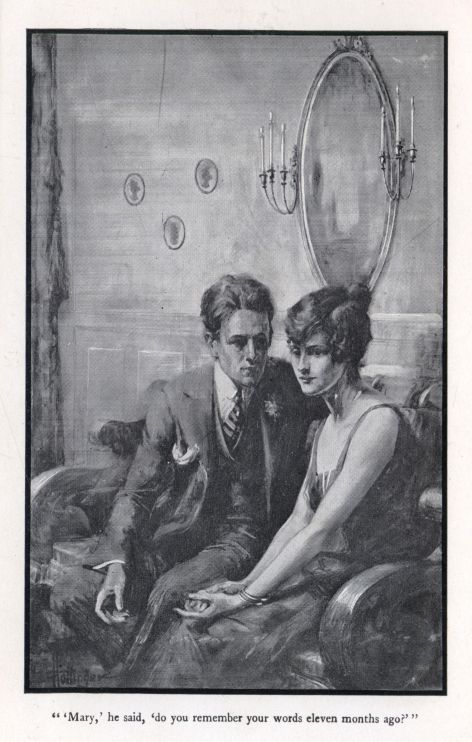
"'Mary,' he said, 'do you remember your words eleven months ago?'"
"I remember them perfectly."
"Well, there was only one way in which you could help me then, and that was why I went away. And I never intended to return unless I could claim that which you offered me."
"Was it necessary?"
"Mere friendship is no use to you and me. But I couldn't ask you to marry me then, although I knew ... at least I thought I knew ... you'll tell me if I am wrong..."
She couldn't help smiling a little at this rather childlike confusion.
"... that you would marry me if I asked you. But I didn't, because I couldn't. Do you understand that? Do you still look at things in the way you did?"
The soul of a poor mariner might be tempest tossed on all the oceans of the world, but the soul of Mary Pridmore was the fixed star of his faith. The mere thought seemed to brace his courage for the task that honor laid upon him.
He took her hand. It was the only manifestation he would allow himself until he had told her.
"I could not ask you to marry me then," he said, "because I had a wife."
"You had a wife." She repeated the words numbly, incredulously.
"I had a wife," he said, doggedly. "She died two months ago."
"And ... and you never told me!"
"No."
There was an edge to her tone that had struck like a knife.
"Henry!"
"I tried," he said feebly. "God knows I tried."
"You don't mean you deceived me?" Her voice was hardening.
"No." A queer kind of faintness was coming over him. "I don't mean that. You never asked me and ... and I never told you."
"But you knew I took it for granted that you were not married."
The order and precision of her speech began to frighten him. He could give no answer.
"You knew that." Her voice was hurting him terribly.
"I don't say I didn't," he said. He had a sick feeling that he was already in the jaws of a trap. God in heaven, what madness had lured him to tell her when he had no need to do so!
"Then you deceived me." The voice was pitiless.
He looked at her with scared eyes.
"Don't say that," he said.
He saw there was a cold light blazing in her and he began to grow miserably afraid.
"I tried very hard not to deceive you," he said. "God knows I tried. And it was because I couldn't go on with it that I went away and ... and never meant to see you again."
"I don't quite think that is an excuse."
Somehow the words seemed to goad him on to unknown perils. But he was in a quicksand, the ground was moving under his feet.
"You don't know what my life has been," he said desperately. "You don't know what a wife I married, you don't know anything about me, else you wouldn't be so hard."
She realized while he was speaking, realized with a kind of nausea, which came suddenly upon her, that all he said was true. There was a peculiar note creeping into his voice that assailed her fastidious ears like a sudden descent to a subterranean region which she knew to exist, but of which she had never had first-hand knowledge. The subtle change of tone was telling her as nothing else could have done that it was perfectly true that she knew neither what his life had been nor anything about him.
"Mary." In spite of an intense feeling for him it was beginning to make her wince to hear her name on his lips. "If you don't mind I think I'll tell you one or two things about my life and ... and how I came ... to get married."
"I think perhaps I would rather not know." It was not she who said that. Long generations of Pridmores and Colthursts had suddenly taken charge and had answered for her.
It was a tone he had never heard her use, not even at the dinner party at which she had discussed the question of divorce. It was almost as if she had hit him a blow and yet without intending to deal one. By this time he had grown so dazed and frightened that he had begun to lose his head.
"The woman I married was not respectable, and that was why I didn't tell you."
She drew away from him a little. It was quite an involuntary action, but he felt it like a knife in the flesh. In sick desperation he floundered on, suddenly losing touch with all the small amenities of speech and manner he had so painfully imposed upon himself. Moreover, he realized the fact with pangs that were almost murderous. There were notes from the Blackhampton gutter beginning to strike through his voice.
"You don't know what my life has been," he said. "You don't know where I started from."
Again she made that involuntary movement, almost as if she felt that the mere tone was defiling her.
"You must let me tell you ... let me tell you all, if you don't mind. It'll help you understand."
"I would rather you didn't." Again the Pridmores and the Colthursts were speaking.
He looked at her with a wildness that made her shiver. An intense pity for this man had suddenly begun to do battle with the Colthursts and the Pridmores. There was something in those eyes, as there always had been, that was almost beyond her power to meet.
"I never had a chance," he said, holding her in thrall with the voice she no longer recognized as his. "I've been handicapped out of the race. I'm going to tell you, Mary. It's not that I want your pity ... I ask more than that. It's more than pity will bring a sailorman like me into port."
A kind of defiance of himself and of her had entered his tone. His words seemed to open a vein in her heart. She had a great compassion for this man, but with all her strength of soul, with all her independence, she knew and felt that voice had already told her that the facts of his life were going to prove more than she could bear.
In a dogged way, with many of the tricks of speech and manner of former phases of his life, which he had sloughed as a snake its skin, and had now reassumed in the stress of overmastering agony, he told her all. He spared her nothing, not even his comparatively recent knowledge that his father had been driven to commit a murder, which in Henry Harper's view accounted for the price the son had had to pay. Nothing was spared her of Auntie, of the police, of the night on the railway, of Mr. Thompson and the Old Man, of the Margaret Carey and the Island of San Pedro, of Ginger and Blackhampton, of the first meeting with Klondyke, of the first meeting with Edward Ambrose, and, finally, an account of his fall into the clutches of Cora Dobbs and how he made the horrible discovery concerning her on the night of their own first memorable meeting at the dinner party in Bury Street.
Some insane demon seemed to urge him on. In spite of the look of horror in her eyes, he told her everything. Somehow he felt it was the only reparation he could make to her for being as he was.
"Klondyke gave me my first start," he said finally. "He knows nearly as much as you—except about that woman—but he's stood to me all through. I don't ask your pity. I admit I deceived you, Mary, an' I done wrong, but it warn't because I didn't want to do right. I got to pay for it, I can see that. I dare say it's right, but I'll only say ... and this is final ... Enry Arper, whatever 'is father done, don't deserve not a half, not a quarter of what's been done to him."
She had to hold on by the table. Something was stifling her. There were things in this elemental soul which the Pridmores and the Colthursts might once have known, but for long generations had forgotten.
She dare not look at him. An abyss had opened. She simply couldn't face it.
Somehow he knew that. It needed no words to tell him. Everything was lost. The mariner could never hope to come into port. Again that horrible sense of rage came on him, which a few hours ago had overthrown him in his interview with Edward Ambrose. It maddened him to think that he had been allowed to get so far along the road and that a subtle trick had defeated him when the goal was actually in sight.
Yet even at the last there was just one thing, and only one, that stood to him: if it was still possible he must be a man, a gentleman. He knew this woman was suffering cruelly, and he owed it to her and to his friends not to profane the God she worshiped. There was no God in heaven after all, it seemed, for Henry Harper, but for her, who had not the stain of a father's crime upon her, it was a different matter.
As he stood not three paces from her, clenched and incoherent, fighting not to strike her with the sudden awful blasphemies that were surging to his lips, he knew nothing of what was passing in her mind. Had he known she would have had his pity. All that her progenitors had stood for in the past had suddenly recoiled upon her. All those entries in Burke it had been her pleasure to deride, all the politicians and the landed proprietors, all the Lady Sophias and the Lady Carolines, all that flunkyfied reverence for concrete things of those generations of the Pridmores and the Colthursts, which had so long affronted her high good sense, were now having their word to say in the matter.
She had pledged her help to this man if ever he asked it, but now she found that help was not hers to give. Said the tart voice of her famous Aunt Caroline, it is not to be expected, my dear, of a sane Christian gentlewoman. Think of your father, my dear! By some strange irony, Mary Pridmore suddenly thought of him, that admired and bewhiskered servant of a generation which allowed his friend Bismarck to steal Schleswig and to murder France, but paid itself the tribute of building the Albert Memorial; the distinguished servant of a generation that had denied reading, writing, and arithmetic to its Henry Harpers and had turned them barefoot into its Blackhampton gutters.
Many things were coming home to the heart of Mary Pridmore in the awful silence of that room. She was no more to blame for the long line of her fathers whose governing abilities were commemorated in the England of the sixties than was their victim, Henry Harper, in whose bruised body and tormented soul had been commemorated his mother's murder. She was numb and dazed now she had heard his story, but she had nothing to give him.
The truth had come to him already. "Now, Enery, you must be a man and bear it," said the voice of Auntie, wheezing in the upper air. Well ... if his flesh and blood would only let him he must be a gentleman as long as he had the honor to converse with a real Hyde Park lady who believed in God ... that was all he knew at the moment. If there was a spark of manhood in him he must hold on to that.
"Miss Pridmore." ... He was able to pull himself together in a way that astonished even himself.... "I see it's all over with me and you. I'll never be able to get through without your help. I'm fair done in. But I don't blame you. An' I just want you to say you don't blame me, an' then I'll quit."
She couldn't speak. Aunt Caroline in a hoop and elastic-sided boots was simply imploring her to behave with dignity.
"Say you don't blame me, Miss Pridmore, an' then I'll quit. It's not reelly my fault about my father." He laughed a little, but she didn't hear him. "I'm sorry, though, about the Mariner. If we could have brought him into port, you and me, Miss Pridmore, there'd been nothing like him outside the Russians. However ... say I'm not to blame ... and then I'll quit."
She was unable to hear what he was saying.
"Won't you, Miss Pridmore? I can't bear you should think I've played it low down. If I could ha' told you afore I'd ha' done it ... you can lay to that."
It was not a voice that she knew, and she could not answer it.
"Well, I'm sorry."
Suddenly he took her hand, and its coldness startled him.
"I'll say good-by," he said with a sort of laugh.
Aunt Charlotte primly informed her niece that Mr. Harper was taking leave.
"Oh," she said. "Good-by."
Without venturing again to touch the hand she offered, he stumbled headlong out of the room and down the stairs. He took his hat from a table in the hall and let himself out of the front door before the butler could get there. He closed the door after him with a sharp bang—it was a door with a patent catch and could only be closed in that way—and as he did this and the sound re-echoed along Queen Street, the lamp in the right-hand corner of his brain suddenly went out.
By the time he came to the end of the street it had grown very dark. And as he turned a corner and found himself in a street whose name he didn't know he was unable to see anything. And then all at once he realized that Aladdin's lamp was broken in a thousand pieces, and he gave a little wild shriek of dismay. The savage hunted eyes of Mr. Thompson were gazing at him from under the helmet of a passing constable.
The trolls had got him.
Nothing could help him now. It had grown so dark that he couldn't see anything, although it was hardly seven at present of an evening in June. He almost shrieked again as he heard the sniggering voice of Auntie ascend above the gathering noises of the town: "Now, Enery, you must be a man and bear it."
He didn't know where he was now amid the maze of the little-frequented streets of Mayfair. He had lost his way and he couldn't see. He was blind already with an ever growing darkness. He was losing all sense of time and place. But the voice of Auntie was ever in his ears, exhorting him, with that shrill and peculiar snigger of which she never seemed to grow weary, to be a man and bear it, as he stumbled on and on into the night.
II
One afternoon about a week later, Edward Ambrose rang up No. 50, Queen Street, on the telephone to ask if Mary was at home. In reply he was told by Silvia that Mary had gone for a few days to Greylands to the Ellises, but her mother would be very glad if Edward would come and see her as she wished particularly to have a little talk with him. Edward certainly did not wish particularly to have a little talk with Lady Pridmore at that moment, but there was no way out of it. Thus in no very amiable frame of mind he drove to Queen Street.
Lady Pridmore was alone in the drawing-room. She received Edward with the grave cordiality that she reserved for favorites.
"It is very nice of you to come, Edward. Ring for some tea."
That was like her, when she knew quite well he never took tea.
"We are dreadfully worried about Mary."
That was like her again. She was always dreadfully worried about something, although nothing in wide earth or high heaven had the power really to upset her. But Edward for some reason was not feeling very sympathetic towards the Lady Pridmores of the world just now.
"And we blame you."
"Me?"
"Yes, we blame you. It was you who first brought that young man, Mr. Harper, to the house."
This was not quite in accordance with the facts. Still, there would be no point in saying so. Ambrose, therefore, contented himself with asking, "Well, what of him?" with as much politeness as he could muster in order to cover a growing impatience.
"It is not well, Edward, it is very far from well," said Lady Pridmore aggrievedly. "As I say, we are all dreadfully worried. Mr. Harper turned up here again one day last week, the first time for a year. And he saw Mary alone. Silvia and I were out—at—dear me!—but it doesn't matter——"
"Quite so," murmured the courteous Edward.
"Otto met him coming in as he went out."
"Well?"
"Well, as I say, Mary and Mr. Harper were together a long time and somehow—I'm sorry to tell you this—she has seemed quite ill ever since."
Edward expressed regret.
"And Dr. Claughton strongly advised a change."
"I am very sorry," he said gravely.
"She is so overstrung that she has had to have sleeping drafts. It is by Dr. Claughton's advice she has gone down to Woking."
"But what reason have you to connect all this with Mr. Harper?"
"The evening he saw her she didn't come down to dinner. Now I would like you to tell me a little more about—about Mr. Harper. You brought him here, you know. Otto says he is not altogether ... Do you think that?"
"Had I thought for a moment that he was not a desirable acquaintance I should not have brought him here." This was a shameless begging of the question; it was not he who had brought the young man there.
"I'm glad to hear you say that," said Lady Pridmore with feeling. "That is exactly what I said to Otto. I wish you would tell me all you know about this Mr. Harper."
"I am afraid I can only tell you one thing about him."
"Yes," said Lady Pridmore encouragingly!
"At the present moment he is very dangerously ill. The doctors take a very grave view of his case."
Lady Pridmore was grieved to hear that, but it fully confirmed what she had surmised.
What had she surmised?
"I am quite sure that something rather dreadful took place here a week ago."
Ambrose felt that was most probable.
"I wish you would tell me, Edward," said Lady Pridmore, "what in your opinion it was that happened."
The retort on the tip of Edward's tongue was, "How the devil should I know!" but fortunately he didn't allow it to pass. He contented himself with silence.
"I want to see Mary most particularly," he said, after a pause. "I think I'll send her a telegram to say that I am coming by the first train tomorrow."
"Do," said Lady Pridmore. "That will cheer her up."
III
He sent a telegram as he returned sadly to his rooms. He was in a miserable frame of mind. Somehow he was hating life, but he was now fully bent upon one thing, and no peace could be his until he had done it.
After dinner came an answer to say Mary would be very glad to see him. He sat smoking endless pipes, until he realized that it would soon be too late to go to bed if he was to catch an early train.
On arrival at Woking, Mary was at the station with her friend's car. She looked ill, he thought, but she seemed very glad to see him. At first they found little to say. Indeed, it was not until they had decided to use a fine morning in walking to Greylands, had sent on the car and taken to the road, that they were able to talk in the way they wished.
"I suppose you don't quite know why I've come?" said Ambrose.
"No, I frankly don't," said Mary, "but at least, Edward, it is always very, very good to see you."
Ever since she could remember, he had ranked as the chief of her friends, and that accounted, perhaps, for a certain attitude of mind towards him. But in all the years they had known each other, in all the hours they had spent in each other's company, never had they seemed so intimate as in this walk together. And there was a very clear reason why this should be so. Never had each felt such a need of the other's perceptiveness.
It was not for him to ask what had happened a week ago at that last interview in Queen Street. But she told him voluntarily.
"I had promised to help him," she said, growing pale at the recollection. "And he came to me and told me all ... all the facts and the circumstances ... things that not I and not you, Edward ... could ever have guessed."
"You were not able to do what he asked?"
"No, I simply was not. I simply couldn't. I meant to help him. I wanted to. Perhaps ... perhaps I ought to have ... but ... but it was an abyss he showed me ... you don't know..."
They walked on in silence a little way.
"... A year ago, I made a pledge. And he counted on it. I think that is why he told me the whole dreadful story. Had I not been a coward, I should never have..."
"You judge yourself too hardly. He asked too much."
"It should not have been too much. I ought to have been able to help him. At least ... I ought not to have sent him away as I did."
"Assuming it were not too late, do you think you could help him now?"
"But it is too late." She was evading the question.
"It is not the view I take myself. I saw both doctors yesterday, and they have very little hope of a recovery. But you and I are not bound to agree with them."
"What can we do ... in the face of such an opinion?"
"We can have faith."
"But the doctors?"
"It is a purely mental case. The mind is the key of the whole matter."
"Yes, I know ... I know."
"No doctor, however expert, can ever say anything positively in regard to the mind, provided the brain is not damaged."
"Isn't it bound to be?"
"They do not say that ... and there is our hope. It is a special case. We must always remember this man is different from other people. It is my firm belief that it is in your power to save him. The view may be entirely mistaken, but it is my own personal conviction."
A new Edward Ambrose was speaking. Here were a strength and a force which until that moment he had not known how to show her. It may have been that the occasion had never arisen, or perhaps the conventional timidity of his kind had never permitted it.
"I—I don't altogether understand," she said, faintly.
"You took away his belief. And I ask you to give it him back again."
She walked dully by his side, striving as well as she could to represent to herself the strange words he had used in a form she could accept.
"You do understand, Mary?"
"Isn't it too late?"
Tormenting fears were again upon her.
"It may be. Certainly the doctors think the balance of probability against it. But I firmly hold that such a view is not for those who know this poor sailorman. I cannot help thinking that no one is allowed to get so far along the road in the face of such paralyzing odds without there being still some hope of putting the thing through."
They stood in the middle of the road, looking at each other.
"I ... I think you are right. You understand him so much better than I."
"That we can neither of us believe." He spoke with a queer laugh. "But if I am asking you to give too much, you mustn't blame me. You have always taught me to ask too much." His voice tailed off in the oddest way. "But this time I don't ask for myself."
She was crying. "I was never the woman that you thought me. Or that I thought myself."
She stood a moment, the tears running down her cheeks.
"You must go to that poor mariner," he said, with odd suddenness, trying now for the first time in all the long years to impose his will upon hers. "He has a very wonderful cargo on board. You and I—we owe it to each other and perhaps to future generations—to see that it comes into port."
Such a tone was startling. She had never heard it before. A new and very potent voice was speaking.
"There is no time to lose." This was Edward Ambrose raised to a higher power. "Every hour is going to count. If it is still possible, go and offer him a refuge from the storm."
She stood irresolute. But already she had begun to waver. A masculine nature in its new and full expression was turning the scale.
"If we go back at once," he said, "there will be time to catch the twelve o'clock train from Woking. You can telegraph to your maid. And Catherine Ellis will understand. Or you can write and explain."
Either the call was stronger than her weakness, or she had underrated the forces within herself. For suddenly she turned round and they began to retrace their steps along the road they had come.
Good walking gave them time for the midday train to Waterloo. Upon arrival at that terminus, shortly before one, they drove to a nursing home in Fitzroy Square.
Permission had already been obtained by Ambrose for Mary Pridmore to see Henry Harper. It was felt that her presence at his bedside could do no harm, although there was very little hope that it could do good. At any rate, the nurse who received them made no difficulties about admitting her. Ambrose took leave of Mary on the doorstep in the casual rather whimsical way he affected in all his dealings with her, and then drove heroically to his club.
IV
The Sailor lay breathing heavily. He was still just able to keep on keeping on. But in spite of the darkened room and the blindness of his eyes, he knew at once that she had come to him ... the incarnation of the good, the beautiful, and the true ... gray-eyed Athena, with the plumes in her helmet.
His prayer had been heard, his faith had been answered. He knew she had come to him, this emanation of the divine justice and the divine mercy, even before her lips had breathed his name ... that name which through eons of time, as it seemed, he had been striving to fix in the chaos that once had been his brain.
V
It was rather less than a year later that Edward Ambrose, seated in his favorite chair in his rooms in Bury Street, knocked out the ashes of a last pipe before turning in. He had already given a startled glance at the clock on the chimney piece, and had found it was a quarter past three in the morning.
The truth was he had been oblivious of the flight of time for a good many hours. And the cause of this lapse was a bulky bundle of manuscript which was still on his knees. It had come to him from abroad with a letter the previous day. And having read the last page and having cleared the debris from his pipe, he yet returned the pipe, empty as it was, to his mouth and then read the letter again.
It said:
MY DEAR EDWARD,
In praying you to accept the dedication of what to you and none other I venture to call an epic of that strange and terrible thing, the unsubduable soul of Man, I make one more demand on your patience. I feel that only a very brave man could father such a thing as this poor mariner. It is not that he has not proved to be a stouter fellow than could ever have been hoped. To say otherwise would be black ingratitude to those who sought him out on the open sea and brought him safely into port. If his book is more than was to have been expected, it is yet less than the future promises now that other new, or shall we say recovered worlds, are continually opening to the gaze of the astonished sailorman as with Athena by his side he roams the shores of his native Ithaca.
Drink deep, O muse, of the Pierian spring, Unlock the doors of memory.
If this prayer is heard, on a day Ulysses may proclaim in native wood-notes wild the goodness of the living God, and hymn the glories of a universe that man, ill-starred as he may be, is powerless to defile. Even if such power is not granted to the mariner, he will yet have a happiness he had not thought possible for mortal men to know. And she who had Wisdom for her godmother, I hope and pray she is also happy in self-fulfillment. If this is a fatal egotism, I am not afraid to expose it to you. The mariner is not so blind that he does not see that it is a more developed, a far higher form of our species who sits with his old pipe in his favorite chair in Bury Street, St. James', frowning over this ridiculous letter. You and she begin where he leaves off. What virtue both must have inherited! And who shall dare to say how terribly a man may be punished for lack of virtue in his ancestors.
We send you our blessing and our affection.
H.H.
Having reread this letter, Edward Ambrose turned again to the concluding pages of the manuscript still lying upon his knees. The clock on the chimney piece struck four, but no heed was paid to it. The empty pipe was still between his teeth when finally he exclaimed: "Yes, it's wonderful ... very wonderful. It is even more wonderful than I had hoped."
He then took the pipe from his mouth and found the stem was bitten right through.