Front matter (continued 7)
Reading edition
He waited until the meal was over and Royal Daylight had cleared the table, and had also cleared away herself, before he mentioned the taxi. And then very bluntly, and in a tone entirely new to her as well as to himself, he demanded an explanation.
Cora, it seemed, was in a rather chastened mood. For one thing, she was now sober, and when she was sober she was not exactly a fool. She was not really repentant. He was too poor a thing to make a self-respecting woman repent. But now she was again herself, she was both shrewd and wary; after all, this double-adjectival idiot was the goose that laid the golden eggs.
"I was a bit on last night," she said, with well-assumed humility.
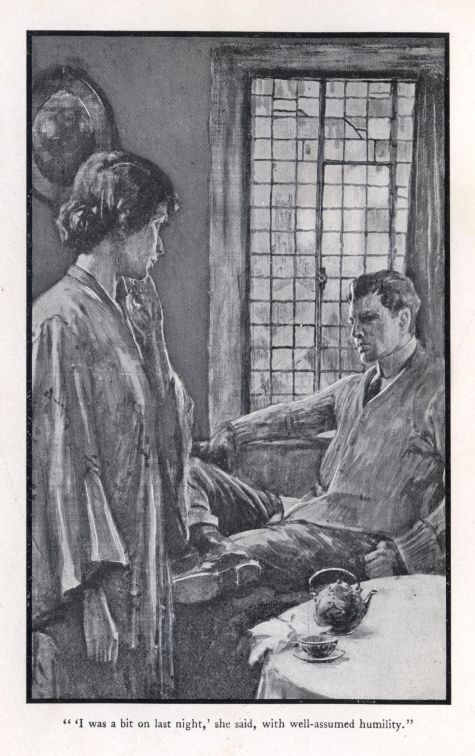
"'I was a bit on last night,' she said, with well-assumed humility."
"Yes, I heard you was when you come home," he said, with the new note in his voice that she didn't like.
"Oh, so you did hear." She suddenly determined to carry the war into the enemy's country. "Why didn't you open it, then?"
The cold impudence stung.
"I'd rather have died than have opened it to a cow like you." He hardly knew the words he used. They had seemed to spring unbidden from the back of beyond.
She half respected him for speaking to her in that way, and in such a tone; there was perhaps a little more to the double-adjectival one than she had guessed. And as the cards were dead against her now, she decided on a strategic grovel of pathos and brandy.
"Call yourself a gentleman?" Tears sprang reluctantly to the raddled cheek.
The sight of a lady in tears, even a lady who drank, was a little too much for Henry Harper.
"I beg your pardon," he said. "I oughtn't to have said that." He had remembered that the word "cow" as applied to the female sex was a Blackhampton expression and a favorite with Auntie.
The lady could only weep a little more profusely. This mug was as soft as butter.
He stood looking at her with tight lips and with eyes of sorrowful disgust.
"But you've no right to drink as much as you do," he said, determinedly. "And you've no right to ride in taxis with gentlemen and to let them put their arms round you."
"And you've no right to call your own lawful wife a cow," she said, tearfully.
"I've apologized for that," he said. "But you've given me no explanation of that gentleman."
"Didn't I say I was a bit on," she said aggrievedly.
"It's no excuse. It makes it worse."
"Yes, it does," said Mrs. Henry Harper, with a further grovel, "if it happened. But it didn't happen. You was mistaken, Harry. I'm too much the lady to let any gentleman, whether he was in evening dress or whether he wasn't, put his arm around me in a taxi. I wouldn't think of it now I'm married. Now, you kiss your Cora, Harry, for calling her a name."
She approached him with pursed lips. In spite of the shame he felt for such a lapse from his official duties, he retreated slowly before her.
"It's no use denying it," he said, as soon as the table had been placed successfully between them. "I saw his arm round you."
"You are mistaken, Harry." She did not like the look or the sound of him. She was beginning to be alarmed at her own folly. "I may have been a bit on, but I was not as bad as that. Honest."
"I saw what I saw," he persisted; and then feeling no longer able to cope with her or the situation, he slipped out of the room and out of the flat.
He had now to look forward in a dim way to the time when he would have to leave her. The time was not yet, but he was beginning to feel in the very marrow of his bones that it was near. Now that her secret was out and a hopeless deterioration had begun, there was something so revolting in the whole thing that he foresaw already their life together could have only one end. But in the meantime, he must be man enough to keep with a stiff upper lip a contract he ought never to have made.
Apart from his domestic relations, things were going very well indeed with him. He had completed the "Further Adventures of Dick Smith" to the satisfaction of Mr. Ambrose, and it was on the point of starting in the magazine. Moreover, the first series had won fame on both sides of the Atlantic. It was felt, so rare was its merits, that if Henry Harper never wrote anything else his reputation was secure for twenty years.
This, of course, was an amazing piece of fortune. Edward Ambrose, who had had no small share in bringing it about, and whose discriminating friendship had made it possible, compared it, in his own mind, with the success of Dickens, who, after a life of poverty and hardship, gained immortality at five and twenty. It was far too soon as yet to predict such a crown for Henry Harper, but he had certainly burst upon the world as a full-fledged literary curiosity. His name was coming to be in the mouth of all who could appreciate real imagination.
One of the first fruits of this success was his election to the Stylists' Club. This distinguished and esoteric body met on the afternoon of the first Tuesday of the autumn and winter months at Paradine's Hotel in Upper Brook Street, Berkeley Square, to discuss Style. Literary style only was within the scope of its reference; at the same time, the members of the club carried Style into all the appurtenances of their daily lives. Not only were they stylists on paper, they were stylists in manner, in dress, in speech, in mental outlook. The club was so select that it was limited to two hundred members, as it was felt there was never likely to be more than that number of persons in the metropolis at any one time who could be expected to possess an authentic voice upon the subject. Happily, these were not all confined to one sex. The club included ladies.
That the Stylists' Club, of all human institutions, should have sought out Henry Harper for the signal honor of membership, seemed a rare bit of byplay on the part of Providence. For a reason which he could not explain, Edward Ambrose gave a hoot of delight when the young man brought to him the club's invitation, countersigned by its president, the supremely distinguished Mr. Herbert Gracious, whose charmingly urbane "Appreciations," issued biennially, were known wherever the English language was in use. Mr. Herbert Gracious was not merely a stylist himself, he was a cause of style in others.
Henry Harper had been a little troubled at first by the hoot of Mr. Ambrose, and the feeling of doubt it inspired was not made less by a rather lame defense. All the same, Mr. Ambrose so frankly respected the young man's intense desire to improve himself that he urged him to join the club, and to attend the first meeting, at any rate, of the new session, if he felt he would get the least good out of it.
In response to a basely utilitarian suggestion, Henry Harper said he would do so. He was not in a frame of mind to face such an ordeal. But he must not let go of himself. Miserable as he was, he felt he must take such advice if only to prove his courage. He would attend the first meeting of the Stylists' Club on the ground of its being good for the character, if on no higher.
"I suppose you'll be there, sir?"
"No," laughed Mr. Ambrose. "I'm not a member. It's a very distinguished body."
Henry Harper looked incredulous. It did not occur to him that anybody could be so distinguished as to exclude such a man as Edward Ambrose.
"I don't think I'll go, then," said Henry Harper. "It will be a bit lonesome-like."
"Please do. And then come and tell me about it. Your personal impression will be valuable."
It was for this reason that the Sailor finally decided not to show the white feather.
XXI
Henry Harper found the Stylists' Club of far greater interest than he thought it would be. To one as simple as he it was a very stimulating body. Moving precariously towards fresh standards of life, he knew at once that he was in a strange new world. He knew even before a powdered footman had led him across the parqueted floors of Paradine's Hotel, and a personage hardly less gorgeous had announced him to the congeries of stylists who had assembled to the number of about sixty.
"It is such a pleasure, Mr. Harper," said a large, florid, benign and beaming gentleman, seizing him by the hand. "You will find us all at your feet."
Mr. Harper was overawed not a little by the size and the distinction of the company, but the benign and beaming gentleman, who was no less a person than Mr. Herbert Gracious himself, took him in charge and introduced him to several other gentlemen, most of whom were benign but not beaming, being rather obviously preoccupied with a sense of Style. Indeed, Mr. Herbert Gracious was the only one of its members who did beam really. The others were far too deeply engaged with the momentous matters they had met to consider.
When Mr. Henry Harper had been allowed to subside into a vacant chair in the midst of six stylists, four of whom were female and two of whom were male, he was able to pull himself together a little. He knew already that he was in very deep waters indeed: Mr. Esme Horrobins and Mr. Edward Ambroses were all around him. And these ladies ... these ladies who waved eyeglasses stuck on sticks were not of the Cora and the Miss Press and the Miss Bonser breed; they were of the sort that Klondyke put on a high hat and a swallowtail to walk with in Hyde Park. Yes, even for a sailor, he was in very deep waters just now, and he was obliged to tell himself once again, as he always did in such circumstances, that having sailed six years before the mast there was nothing in the world to fear.
All the same, at first he was very far from being happy. A dozen separate yet correlated discussions upon Style had been interrupted by his entrance. The announcement, "Mr. Henry Harper," had suspended every conversation. For a moment all the Mr. Esme Horrobins were mute and inglorious. But then, having glutted their gaze upon one whom Mr. Herbert Gracious himself had already crowned in the Literary Supplement of the Daily Age and Lyre, the Mr. Esme Horrobins and the Mrs. Esme Horrobins—the mere male was not allowed to have it all his own way in this discussion upon Style—took up the theme.
It was the part of Mr. Henry Harper to listen. The public press of England and America had compared his own style to that of Stevenson, Bunyan, Defoe, the Bible, Shakespeare, Lætitia Longborn Gentle, Memphis Mortmain Mimpriss, finally Dostoievsky, and then Stevenson again. In a true analysis Stevenson would have defeated all the other competitors together, leaving out Dostoievsky, who was a bad second, and excluding the Bible, Shakespeare, and Memphis Mortmain Mimpriss, who, to their great discredit, were an equally bad third. Stevenson was first and the rest nowhere. And there that glorious reincarnation sat, in a modest blue suit, but looking very neat and clean, listening to every word that fell in his vicinity from the lips of the elect. At least, that was, as far as it was possible for one human pair of ears to do so.
"Tell me, Mr. Harper," said Miss Carinthia Small, with all Kensington upon her eyebrows, imperiously attacking with a stick eyeglass, which she wobbled ferociously, this very obvious young genius who didn't know how to dress properly, as soon as Mr. Marmaduke Buzzard—M.B. of the Stylists' Review—had allowed her, much against his will and for purely physical reasons, to get in a word. "Tell me, Mr. Harper, exactly how you feel about Dostoievsky? Where do you place him? Before Meredith and after Cuthbert Rampant, or before Cuthbert Rampant and after Thomas Hardy?"
It was a dismal moment for Mr. Henry Harper. Fortunately he hesitated for a fraction of an instant, and he was saved. That infinitesimal period of time had given Mr. Marmaduke Buzzard his chance to get in again. And stung by the public acclamation of Mr. Cuthbert Rampant, a well-nourished young man in a checked cravat, who was curving gracefully over Miss Carinthia Small, he proceeded to show with some little violence, yet without loss of temper, that in any discussion of style qua style, Turgenieff alone of the Russians could possibly count.
"But everybody knows," breathed the defiant Miss Carinthia in the charmed ear of Mr. Cuthbert Rampant, "that had it not been for Dostoievsky, the 'Adventures of Dick Smith' could never have been written at all."
The considered reply of Mr. Cuthbert Rampant was lost in the boom and the rattle of Mr. Marmaduke Buzzard's heavy artillery.
Henry Harper might have sailed six years upon the high seas, but a flood of deep and perplexing waters was all around him now. Stylists to right of him, stylists to left of him, all discoursing ex cathedra upon that supreme quality. Never, since the grim days of the Margaret Carey had he felt a sterner need to keep cool and hold his wits about him. But with the native shrewdness that always stood to him in a crisis, he had grasped already a very important fact. It must be the task just now of the new Stevenson to sit tight and say nothing.
To this resolve he kept honorably. And it was less difficult than it might have been had not Style alone been the theme of their discourse, had not this been an authentic body of its practitioners, and had not "The Adventures of Dick Smith" been acclaimed as the finest example of pure narrative seen for many a year. All through the period of tea and cake, which Mr. Henry Harper contrived to hand about with the best of them, being honestly determined not to mind his inferior clothes and absence of manner, because, after all, these things were less important than they seemed at the moment, he kept perfectly mute.
Nevertheless he had one brief lapse. It was after he had drunk a cup of tea and the undefeated Miss Carinthia Small had drunk several, and Mr. Marmaduke Buzzard had retired in gallant pursuit of some watercress sandwiches, that the dauntless lady felt it to be her duty to draw him out.
"Tell me, Mr. Harper," said she, "what really led you to Stevenson?"
So much was the novice troubled by the form of the question that she decided to restate it in a simpler one, although heaven knew it was simple enough already!
"What is your favorite Stevenson?" she asked, looking Mr. Cuthbert Rampant full in the eye with an air of the complete Amazon.
The author of "The Adventures of Dick Smith" was bound to speak then. Unfortunately he spoke to his own undoing.
"I've only read one book by Stevisson," he said, in a voice of curious penetration which nervousness had rendered loud and strident.
"Pray, which is that?" asked Miss Carinthia Small in icy tones.
"It's the one called 'Virginibus Puerisk,'" said Mr. Henry Harper.
Miss Carinthia Small felt that a pin might have been heard to fall in Upper Brook Street, Berkeley Square. Mr. Cuthbert Rampant shared her emotion. Yet the area of the fatal silence did not extend beyond Mr. Marmaduke Buzzard, who had already reopened fire a short distance away, and was again doing immense execution.
Miss Carinthia Small and Mr. Cuthbert Rampant risked no further discussion of Stevisson with this strange young Visigoth from the back of beyond. Neither of them could have believed it to be possible. When he had been first ushered into the room by the benign Herbert, and had modestly sat down, he had looked so clean and neat, and anxious to efface himself that he might have been a product of some self-respecting modern university who was on a reconnaissance from a garden suburb. But how could that have been their thought! This was a cruel trick that somebody had played upon Herbert. There was malice in it, too. Dear Herbert, England's only critic, the British Sainte Beuve, had had his leg pulled in a really wicked manner! He had always prided himself upon being democratic and inclusive, but there was a limit to everything.
Happily the Sailor did not stay much longer. Many stylists were going already. It had been an interesting experience for the young man. If he had gained nothing beyond a cup of lukewarm tea and a cucumber sandwich, he certainly felt very glad that he had had the courage to face it.
"Good-by, ma'am," he said, squeezing a delicate white glove in a broad and powerful grip. "I'm very proud to have met you. What else ought I to read of Stevisson?"
Miss Carintha Small felt an inclination to laugh. But yet there was something that saved him. What it was she didn't know. She only knew it was something that Winchester and New College in the person of Mr. Cuthbert Rampant did not possess.
"Good-by." There was really very little of the stylist in her voice, although she was not aware of it, and would have been quite mortified had such been the case. "And you must read 'Treasure Island.' It is exactly your style, although 'Dick Smith' is very much deeper and truer and to my mind altogether more sincere."
Miss Carinthia Small had not meant to say a word of this. She had not meant to say anything. She had intended to efface this young man altogether.
The Sailor threaded his way through a perfect maze of stylists with almost a sense of rapture. It had been a delightful adventure to converse on equal terms with a real Hyde Park Lady: a brilliant creature who had neither chaffed him nor hit him in the back, nor addressed him as "Greased Lightning," nor had rebuked him with "Damn you." He walked out on air.
As the author of "The Adventures of Dick Smith" was retrieving his hat from the hotel cloak room, he was suddenly brought to earth. Two really imperial stylists were being assisted into elaborate fur coats by two stylists among footman.
"My dear Herbert." An abnormally quick ear caught the half humorous, half indignant remark, in spite of the fact that it was uttered in a very low tone. "This man Harper ... I assure you the fellow hasn't an aitch to his name."
XXII
It was not until Henry Harper had escaped from Paradine's Hotel and had managed to find a way into Regent Street that the words he had overheard seemed to hit him between the eyes. His mind had been thrown back years, to Klondyke and the waterlogged bunk in the half-deck of the Margaret Carey. He recalled as in a dream the great argument he had dared to maintain as to the true manner of spelling his name, and how, finally, he had been compelled to give in. Ever since that time, he had always put in the aitch in deference to his friend's superior artillery, which included Greek and Latin and other surprising things.
It was clear, however, that it was not a bit of use putting the letter aitch in your name unless you included it in your speech as well. It was amazing that he had not grasped such a simple truth until that moment. He had known, of course, for some little time now, in fact, ever since he had met Mr. Esme Horrobin at Bowdon House that his manner of speaking only very faintly resembled that in vogue in college and society circles.
On the edge of the curb at Piccadilly Circus, waiting to make the perilous crossing to the Avenue, the crushing force of the remark he had overheard seemed to come right home to him. Moreover, as he stood there he saw in an almost fantastically objective way that the letter aitch should be attended to at once. He must not be content merely to improve his mind, he must improve himself in every possible manner.
It was here, as he stood in deep thought, that his old friend Providence came rather officiously to his aid. A derelict walked past him in the gutter, and on the back of the human wreck was fixed a sandwich board bearing the legend:
Madame Sadleir gives lessons daily by appointment in voice production, elocution, correct speaking, and deportment. Apply for terms at 12, Portugal Place, W.
This was very friendly of Providence. The young man knew that two minutes ago he had passed Portugal Place. He was strung up to the point of adventure. This too long neglected matter was so vital to one who desired to mix with stylists on equal terms, that it would be the part of wisdom to see about it now.
At this moment thought was action with Henry Harper. Therefore he turned almost at once and retraced his steps into Regent Street. Within a very short time he was assailing the bell pull of 12, Portugal Place, W., third floor.
Providence had arranged that Madame Sadleir should be at home. She was alone, moreover, in her professional chamber, and fully prepared to enter into the matter of the letter aitch.
Madame Sadleir was stout and elderly, she wore an auburn wig, she was calm and efficient, yet she also had an indefinable quality of style. In spite of a certain genial grotesqueness she had an air of superiority. Henry Harper, his vibrant sensibilities still astretch from an afternoon of stylists, perceived at once that this was a lady with more or less of a capital letter.
Experience of Cora and her friends had by this time taught the Sailor that there were "common or garden" ladies, to use a favorite expression of Miss Press, and there were also those he defined as real or Hyde Park ladies. He had little first-hand knowledge, at present, of the latter; he merely watched them from afar and marked their deportment in public places. But there was a subtle quality in the greeting of Madame Sadleir, almost a caricature to look at as she was, which suggested the presence of a lady with a capital letter, at least with more or less of a capital letter, a sort of Hyde Park lady relapsed. Henry Harper was aware, almost before Madame Sadleir spoke a word, that she had been born to better things than 12, Portugal Place, W., third floor.
Completely disarmed by the calm but forthcoming manner of Madame Sadleir, Mr. Henry Harper stated his modest need with extreme simplicity. He just wanted to be taught in as few lessons as possible to speak like a real college gentleman that went regular—regularly (remembering his grammar in time)—into Society.
Madame Sadleir's smile was maternal.
"Why, certainly," she said in the voice of a dove. "Nothing easier."
The young man felt reassured. He had not thought, even in his moments of optimism, that there would be anything easy in the process of making a Mr. Edward Ambrose or a Mr. Esme Horrobin.
"It will be necessary," said Madame Sadleir, "to pay very particular attention to the course of instruction, and also to practice assiduously. But first you must learn to take breath and to assemble and control the voice. Do you desire the Oxford manner?"
Mr. Henry Harper, with recollections of Mr. Edward Ambrose and Mr. Esme Horrobin, said modestly that he did desire the Oxford manner if it could be acquired in a few lessons, which was yet more than he dared to hope.
"The number of lessons depends entirely upon your diligence and, may I add"—and Madame Sadleir did add—"your intelligence and natural aptitude. But, of course, to remove all misunderstanding, the Oxford manner is an extra."
Somehow he felt that such would be the case.
"Personally, one doesn't recommend it," said Mtdame Sadleir, "for general use."
Mr. Harper was a little disappointed.
"It is not quite so popular as it was," said Madame Sadleir, "unless one is going into the Church. In the Church it is always in vogue, in fact one might say a sine qua non in its higher branches. Do you propose to take Orders?"
Mr. Harper had no thoughts of a commercial life.
"Personally," said Madame Sadleir, speaking with the most engaging freedom and ease, "one is inclined to favor a good Service manner for all round general use. There is the A manner for the army subaltern, the B manner for the company officer, either of which you will find admirable for general purposes. There is also the Naval manner, but excellent as it is, I am afraid it is hardly to be recommended for social life. The Civil Service manner, which combines utility with a reasonable amount of ornament, might suit you perhaps. I am recommending it quite a good deal just now. And, of course, there is the Diplomatic or Foreign Office manner for advanced pupils, but it may be early days to talk of that at present. One does not like to raise false hopes or to promise more than one can perform. Now, Mr. Harper, kindly let me hear you read this leading article in the Times on 'What is Wrong with the Nation?' paying particular attention to the vowel sounds."
With grave deliberation, Mr. Henry Harper did as he was asked. Having painfully completed his task, Madame Sadleir, in a remarkably benign way, which somehow brought Mr. Herbert Gracious vividly to his mind, proceeded to deal with him with the utmost fidelity.
Said she: "It is my duty to tell you that for the present a good sound No. 3 Commercial manner is earnestly recommended. If you are diligent, it may be possible to graft a modified Oxford upon it, but I am afraid it would be premature to promise even that."
This was disappointing. But, after all, it was to be foreseen. Mr. Edward Ambroses and Mr. Esme Horrobins were not made in a day. And when he came to think the matter over at his leisure he was sincerely glad that they were not. It would have taken a mystery and a glamour from the world.
XXIII
About this time, Henry Harper became a member of a society which met once a week at Crosbie's in the Strand. This step was the outcome of a course of lectures he had attended at the London Ethical Institution, in Bloomsbury Square. They had been delivered by the very able Professor Wynne Davies, on that most fascinating of all subjects to the truly imaginative mind, the Idea of God.
During these lectures, and quite by chance, Henry Harper had made the acquaintance of a certain Arthur Reeves, a young journalist, who suggested that he should join the Social Debating Society, which met at Crosbie's every Tuesday. This he accordingly did; and being under no obligation to take an active part in the proceedings until he felt he could do so with reasonable credit, he was able to enjoy them thoroughly. Moreover, he was in full sympathy with these alert minds which for the most part were owned by young and struggling men.
Some of the discussions Henry Harper heard at Crosbie's made a deep impression upon him. All the members seemed to have a turn for speculative inquiry. The majority of those who took an active part in the debates spoke very well. Now and again, it is true, the pride of intellect raised its head. Some of its members were young enough to know everything, but there was also a leaven of older minds which saw life more steadily, and in as rounded a shape as it is possible for the eye of man to perceive it.
There was one man in particular who attracted Henry Harper. His name was James Thorneycroft, and he was in his way a rare bird, a bank manager with a strong ethical and sociological bias. He was one of the graybeards of the society, a man of sixty, who had the worn look of one who had been fighting devils, more or less unsuccessfully, all his life. For Henry Harper there was fascination and inspiration in James Thorneycroft. His was a mind capable of delving deep into spiritual experience, and of rendering it in terms which all could understand.
At the third meeting which Henry Harper attended at Crosbie's, his friend and introducer, Arthur Reeves, under the spell cast by the brilliant Professor Wynne Davies, ventured to combat a certain skepticism in regard to the scope and function of the Deity, which some of the advanced members had put into words at the previous meeting.
The performance of Arthur Reeves was crude and rather unphilosophical, and yet it was stimulating enough to bring James Thorneycroft on to his legs.
"My own view about God is this," he began in that curiously unpremeditated and abrupt way which made an effect of absolute sincerity. "There is a form of inherited belief that will overthrow the most fearless and independent mind if it ventures to disregard it. I suppose most men who think at all are up against this particular problem some time in their lives. But it all comes back to this: it is absolutely impossible for any man to banish the idea of God and continue as a reasoning entity. Of the First Cause we know nothing, of the Ultimate Issue we know even less, but my own faith is that as long as the idea of God persists, Man himself will not perish. I know there are many who will say that science is against me. They will say that there is nothing inherent in the mere idea of God which will or can prevent an earthquake banishing all forms of organic life from this planet in sixty seconds. Well, it is my faith that if that came to pass Man would still persist in some other form. Science would at once rejoin that he would cease to be Man, but to my own psychic experience that is not at all a clear proposition. Science is based upon reason which states as an absolute fact that two and two make four. The idea of God is based upon the fact that two and two plus One make five, and all the science and all the clear and exact thinking in the world can't alter it. Man is only a reasoning animal up to a point. He has only to keep exclusively to reason to bring about his own defeat. Every thinking mind, I assume, must oscillate at some period of its development between Reason on the one hand (two and two make four) and Experience (two and two make five) on the other. Well, if it won't bore you" ... "Go on, go on!" cried the meeting, not out of politeness merely, since all felt the fascination of the unconventional and childlike personality of James Thorneycroft.... "I will give you in as few words as I can the experience that happened to me nearly thirty years ago, which laid at rest all doubts I might ever have had on this point.
"At that time I was a clerk in a bank at Blackhampton. Employed at the bank was a young porter." ...
For a reason he could never explain, a strange thrill suddenly ran through Henry Harper.
"... And this young chap was one of the best and most promising fellows I ever met. He belonged to the working class, but he was tremendously keen to improve himself. When I met him first he couldn't even read—it makes one smile to hear people talk about the good old days!—but he very soon learned, and then he began to worry things out for himself. I lent him one or two books myself ... John Stuart Mill, I remember, and that old fool Carlyle, who ruled the roast at that time."—Here a bearded gentleman at the back had to be called to order.—"Then we both began to get into deeper waters, and with assistance from Germany, soon found ourselves in a flood of isms, although I am bound to say without being able to make very much of them.
"The time came, however, when this young man, who was really a very fine fellow, took the wrong turning. He somehow got entangled with a woman, a thoroughly bad lot I afterwards found out, a person of a type much below his own. He was an extraordinarily simple chap, he had the heart of a child. From a mistaken, an utterly mistaken sense of chivalry, he finally married her.
"If ever a man was imposed upon and entrapped it was this poor fellow. Of course he didn't know that at first. But from the hour of his marriage deterioration set in. Ambition and all desire for self-improvement began to go. Then he lost his mental poise, and he became cynical, and no wonder, because that woman made his life a hell. Even when the truth came to him he stuck to her, really I think out of some quixotic notion he had of reforming her. Certainly he stuck to her long after he ought to have, because slowly but surely she began to drag him down. At last, when the full truth came home to him, he killed her in a sudden fit of madness.
"Now, there was no real evil in that man. There were one or two soft places in him, no doubt, as there are in most of us, but it is my firm belief that had he married the right woman he would one day have been a credit to his country. He was in every way a very fine fellow—in fact, he was too fine a fellow. It was the vein of quixotic chivalry in his nature that undid him. That was the cruelest part of the whole thing. And I am bound to say that the doubts the higher criticism had put into my mind were very much assisted by the fact that it was this poor chap's real nobility of soul which destroyed him.
"From the point of view of reason, any man was wrong to marry such a woman, even allowing for the fact that he was ignorant of her real character and vocation when he married her. From the point of view of ethics he was wrong; that is to say, he had not even infringed the code of conventional morality, and was therefore under no obligation to do so. And where he was doubly wrong in the sight of reason and ethics, and where, in the sight of the Saviour of mankind, he was so magnificently right, was in sticking to her in the way he did.
"And yet that man came to the gallows. For years afterwards I could never think of him without a feeling of inward rage that almost amounted to blasphemy. But to return to Reason v. Experience, I am merely telling this story for the sake of what I am going to say now. I went to see that poor man in prison after his trial, when he had only one day to live, and I shall never forget the look of him. He was like a saint. He looked into my eyes and took my hand and he said, and I can hear his words now, 'Mr. Thorneycroft, you can take it from me, there is a God.'
"I have never forgotten those words. And many times since they were spoken I firmly believe it has only been the words of my poor friend, Henry Harper, spoken on the brink of a shameful grave, which have saved me." The name fell unconsciously from the lips of James Thorneycroft.
XXIV
The Sailor never went again to the meetings of the Social Debating Society at Crosbie's in the Strand, Somehow he had not the courage. The simple unadorned story of James Thorneycroft had taken complete possession of his mind.
Without making any researches into the subject, some instinct which transcended reason, which transcended experience itself, told him that the Henry Harper of the story was his own father. Moreover, he was prepared to affirm that it was his own presence in that room—unknown as he was to James Thorneycroft to whom he had never spoken a word in his life—which had been responsible for the story's telling.
This clear conviction brought no shame to Henry Harper. No man could have been more amply vindicated in the sight of others than his father had been by him who had given his story with a poignancy which had silenced all criticism of the deductions he had ventured to draw from it.
The feeling uppermost in the mind of Henry Harper was that one world more had been revealed. At various times in his life he had had intimations of the Unseen. There was something beyond himself with which he had been in familiar contact. But up till now he had never thought about it much.
The story he had heard seemed to alter everything. In a subtle way his whole outlook was changed. The fact that his father had died such a death brought with it no sense of ignominy. It was too remote, too far beyond him; besides, the man who had told the story had been careful to show his father's true character.
It was almost inconceivable that he did not apply the logic of this terrible event to his own case. By now it should have been clear that he was literally treading the same path. Perhaps the voice of reason could not argue with the overwhelming forces which now had Henry Harper in their grip. Once they had driven him into an identical position they forced him to act in a similar way. Just as the father had made the disastrous error of setting himself to reform his wife when he had found out what she was, the son was now preparing to repeat it.
He determined upon a great effort to win Cora from drink.
Since the quarrel over the man in the taxi, which had occurred nearly two months ago, they had drifted further apart. Cora had behaved with great unwisdom and she was aware of the fact. But she was not going to risk the loss of the golden eggs if she could possibly help it. She had been shaken more than a little by her own folly, and if Harry had not been a dead-beat fool it must have meant a pretty decisive nail in her coffin. Even as it was, and in spite of the softness for which she despised him, his tone had hardened perceptibly since the incident. Not that she cared very much for that. She did not believe he had it in him to go to extremities. And yet now he had taken this new tone she was not quite sure. Perhaps he was not quite so "soppy" as her friends always declared him to be.
Be that as it may, Cora accepted it in good part when Harry took upon himself to beg her earnestly to check her habit of drinking more than she ought. She was even a little touched; she had not expected a solicitude which she knew she didn't deserve. Instead of "telling him off," as she felt she ought to have done, she promised to do her best to meet his wishes.
He was so grateful that he tried to find a way of helping her. He must let her see that he was ready to assist any effort she might make by every means in his power. Therefore, several evenings a week he accompanied her to the Roc and sometimes they went on, as formerly, to a play or a music hall.
When, after an absence of many months, Henry Harper reappeared in these haunts of fashion, he had to run the gantlet of the girls and the boys. But Cora was secretly gratified to find that he was much better able to take care of himself now. Those months of sequestration, unknown to her, had been a period of very remarkable development. He had been mixing on terms of equality with a class much above hers, he had been enlarging the scope of his observation, he had been deepening his experience. Moreover, he had discovered the letter aitch, and with the help of the indefatigable Madame Sadleir, who was a skillful and conscientious teacher, was now making use of the new knowledge.
Yes, there was a great improvement in Harry. In the opinion of his critics he was much more a man of the world; callow youths and insipid ladies of the town could no longer "come it over him" in the way that had formerly delighted them. Even Miss Bonser and Miss Press had to use discretion. The new knowledge did not make him a prig, but it seemed to give his character an independence and a depth which called for respectful treatment.
He disliked these evenings as much as ever. The Roc and Cora's friends could never have any sort of attraction for Henry Harper. But there was now the sense of duty to sustain him. He was making a heroic effort to save Cora from herself, yet he sometimes felt in his heart that such a woman was hardly worth the saving.
The fact was, it was no use disguising it now, she jarred every nerve in his soul. The more he developed the more hopeless she grew. He knew now that she was very common, sordid clay. It was not in her to rise or to respond. She was crass, heavy-witted, coarse-fibered; his effort had to be made against fearful, and as it seemed with the new perceptions that were coming upon him, ever increasing odds.
By this he had learned from the new and finer world into which his talent had brought him that Cora had but a thin veneer of spurious refinement after all. He knew enough now to see how hopelessly wrong she was in everything, from the heart outwards. It began to hurt him more and more to be in her company in public places. Sometimes he could hardly bear to sit at the same table with her, so alien she was from the people he was meeting now on terms approximating to equality.
Edward Ambrose, realizing how the young man was striving to rise with his fortunes, was doing all that lay in his power to help him. At this time, the name of Mrs. Henry Harper had not been mentioned to him. Several times the Sailor had been at the point of revealing that sinister figure in the background of his life. More than once he had felt that it was the due of this judicious friend that he should know at least of the existence of Cora. But each time he had tried to screw his courage to the task a kind of nausea had overwhelmed him. The truth was Edward Ambrose and Cora stood at opposite poles, and whenever he tried to speak of her it became impossible to do so.
Henry Harper had been present at several of the very agreeable bachelor dinner parties in Bury Street, and on each occasion his host had noted an honorable and increasing effort on the part of the neophyte to rise to the measure of his opportunity. There could be no doubt he was coming on amazingly. The rough edges were being smoothed down and he was always so simple and unaffected that it was hardly possible for liberal-minded men whom fortune had given a place in the stalls at the human comedy to refrain from liking him.
"Henry," said his friend when the young man looked in one afternoon in Pall Mall, "what are you doing tomorrow week, Friday, the twenty-third?"
Henry was doing nothing in particular.
"Then you must come and dine with me," said Edward Ambrose.
"I'll be delighted."
"Wait a minute. That's not the important part. You'll have to take somebody in to dinner. And she's about the nicest girl I know, and she wants very much to meet the author of 'Dick Smith,' and I promised that she should. There will be two or three others ... Ellis and his fiancée ... I told you Ellis had just got engaged ... but we shall not be more than ten all told. Will you face it, Henry, just to oblige a friend?"
A dinner party of ten with ladies was rather a facer for Mr. Henry Harper, in spite of the fact that his social laurels were clustering thicker upon him.
"I suppose I'll have to if you've promised her," he said with not ungracious reluctance.
"I'm sure you'll like her as much as she'll like you," said Edward Ambrose.
That remains to be seen was the mental reservation in the mind of the Sailor.
XXV
Friday week soon came, but very unfortunately it found Cora "in one of her moods."
The first intimation she had of the dinner party was the arrival of a parcel of evening clothes, which Harry had purchased that morning in the Strand. As ladies were to be present, his sense of the fitness of things had led him at last to incur this long-promised expense. Indeed, Cora herself had said that sooner or later this would have to be. But now that the clothes had actually arrived and she insisted upon being told for what purpose they were required, she flew into a tantrum.
In Cora's opinion, there had been too much dining already with this Mr. Ambrose, and now that Harry was being invited to meet ladies, had Mr. Ambrose been a true gentleman she would have been invited as well. It did not occur to her that he was not aware of her existence. But in any case Harry ought not to be going to meet other women without his wife.
Cora became very sulky. And she mingled unamiability with abuse. The sad truth was, and her husband realized it with intense bitterness in the course of that afternoon, she had begun drinking heavily again in spite of all that he could do to check her. It was a failure of the will. There was no doubt life bored her. The restraints she had recently put upon herself, not in regard to drink alone, had become more than she could bear. For a week past she had known that another "break-out" was imminent.
She was now inclined to make this dinner party to which she was not invited a pretext for it.
"I see what it is," she said with ugly eyes. "Your lawful wife is not good enough for my lord Ambrose and his lady friends."
This stung, it was so exactly the truth.
"But don't think for a moment I am going to take it lying down. If you go to this party I'm coming too."
"You can't," said her husband quietly—so quietly that it made her furious.
"Oh, can't I!"
"No, you can't," he said with a finality that offered no salve. He was angry with his own weakness. He knew that it had caused him to drift into a false position. And yet what could he do—with such a wife as that?
"You're ashamed of me," she said, with baffled rage in her voice.
"You've no right to say that." It was a feeble rejoinder, but silence would have been worse.
"I am going to give you fair warning, Harry. If you go to this party and meet other women while I am left at home, I shall...."
"You'll what?" he said, recoiling from her heavy breathing ugliness.
"I shall go a good old blind tonight, I warn you."
She spoke with full knowledge of the effort he had made to help her and all that it had cost him.
"It won't be half a blind, I'm telling you," she said, reading his eyes. "I've done my best for weeks and weeks to please you. I've hardly touched a drop—and this is all the thanks I get. I'm flesh and blood like other people."
She saw with malicious triumph that she had him cornered.
"Look here, Cora," he said, "it's too late to get out of this now. It wouldn't be fair or right for me to break my word to Mr. Ambrose. But I'll promise this. If you will only keep sober tonight, I'll never go to another party without ... without your permission."
"Without my permission!"
"Without you, then, if that's what you want me to say."
"Oh, yes! I don't think!"
"I don't ever break my word," he said simply. "You know that. If I say a thing I try my best to act up to it."
"Well, it's not good enough for me, anyhow," she said, with a sudden and jealous knowledge of her own inferiority. "If you leave me tonight, so help me God, I'll get absolutely blind."
She saw the horror in his eyes and was glad. It gave her a sense of power. But it brought its own Nemesis. She forgot just then that he alone stood between her and the gutter.
"Be reasonable, Cora," he said weakly. There did not seem to be anything else he could say.
"I've warned you," she said savagely. "Leave me tonight and you'll see. I'll not be made a mark of by no one, not if I know it."
In great distress he retired to his bedroom in order to think things out. He felt that he was much in the wrong. Somehow he did not seem to be keeping to the terms of the bargain. Up to a point Cora had reason and justice on her side. Yet beyond that point was the duty to his friends.
In a miserable state of mind he sat on the bed. He was desperately unwilling to undo all the good work of the past six weeks, but it was certain that if he left Cora in her present mood something would happen. Twice he almost made up his mind not to go, but each time he was over-powered by the thought of his friend. It was really impossible to leave him in the lurch without a shadow of excuse.
At last, with a sense of acute misery, he came to a decision, or rather the swift passage of time forced it upon him. Suddenly he got off the bed, opened the parcel and spread out the new clothes.
BOOK IV
DISINTEGRATION
I
The process of dressing for Henry Harper's first dinner party was not a very agreeable operation. No man could have undertaken it in a worse state of despair. The new links he had bought could only be persuaded with difficulty into the cuffs of the boiled shirt; further trouble presented itself with the collar, and finally, when all the major operations were complete, he had to solve the problem of a white tie or a black one. In the end he chose a black one on the ground that it would be more modest, although he was not sure that it was right.
When at last he was complete in every detail, he returned to the sitting-room where his wife still was. She was smoking a cigarette.
"Cora," he said quietly and politely, "I am only going because I must. I couldn't look Mr. Ambrose in the face if I let him down without a fair excuse. But I'll promise this. I'll never go to another party without you, and I give you my solemn word I wouldn't go now if there was a way out."
She made no answer. Without looking at him, but with sour rage in her eyes, she threw the end of the cigarette she was smoking into the fire and lit another.
The young man was rather short of time, and remembering a former excursion to Bury Street which was yet quite easy to find from the top of the Avenue, he took a taxi. Driving in solitary state he was very nervous and strangely uncomfortable. The evening clothes felt horribly new and conspicuous, and they didn't seem to fit anywhere. Then again he knew this was an adventure of the first magnitude. The bachelor parties of two or three intimate friends were on a different plane from an affair of this kind. However, he determined to thrust unworthy fears aside. There could be no doubt he was far better equipped than he had been before Madame Sadleir took him in hand. Besides, when all was said, the feeling uppermost in his mind just now, outweighing even the black thought of Cora, was a sense of exhilaration. Somehow he felt, as his swift machine crossed Piccadilly Circus, in spite of Cora, in spite of new clothes, in spite of bitter inexperience, that for the first time in his life he was entering the golden realm whose every door had been double-locked, thrice-bolted against him by the dark and evil machinations of destiny.
Even when the taxi stopped before the now familiar portals in Bury Street and he had paid the driver his fare, he still had a sense of adventure. And this was heightened by what was going on around him. The magic door was open wide to the night, the august form of Portman, the butler, was framed in it, and at that very moment the Fairy Princess was descending from her chariot.
How did he know it was she? Some occult faculty mysteriously told him. She was tall and dark and smiling; a bright blue cloak was round her; he saw a white satin slipper. It was She. Beyond a doubt it was the real Hyde Park lady he was going to take in to dinner.
He hung back by the curb, a whole discreet minute, while Mr. Portman received her. She made some smiling remark that Henry Harper couldn't catch. He could only hear the beautiful notes of her voice. They were those of a siren, a low deep music.
The Sailor came to the door just as another chariot glided up. He greeted Portman, his old friend, of whom he was still rather in awe, and doffed his coat and hat in the entrance hall without flurry, and then went slowly up the stairs where he found that the butler had already preceded him. Moreover, he was just in time to hear him announce: "Miss Pridmore."
The name literally sang through the brain of the Sailor. Where had he heard it? But he had not time then to hunt it down in his memory.
"Mr. Harper." With a feeling of excitement he heard the rolling, unctuous announcement.
For a brief instant the vigorous grip and the laughing face of his host put all further speculation to flight. Edward Ambrose was in great heart and looking as only the Edward Ambroses of the world can look at such moments. But he merely gave Henry Harper time to note, with a little stab of dismay, that the tie he had chosen was the wrong color, when he was almost hurled upon Miss Pridmore.
"This is Mr. Harper, Mary, whom you wanted to meet." And then with that gay note which the Sailor could never sufficiently approve: "I promised him one admirer. He wouldn't have come without."
Where had he heard that name? The question was surging upon the Sailor as he stood looking at her and waiting for her to speak. A moment ago it had been uttered for the first time, yet it was strangely familiar to him. And that face of clear-cut good sense, with eyes of a fathomless gray, where had he seen it?
"I should love to have been a sailor." Those were her first words. That voice, where had he heard it? It seemed to be coming back to him out of the years, out of the measureless Pacific. A Hyde Park lady was speaking in Bury Street, St. James', but at that moment he was not in London, not in England, not in Europe at all. He was on the high seas aboard the Margaret Carey, he was in his bunk in the half-deck. In one hand he held a sputtering candle; in the other a torn fragment of the Brooklyn Eagle. It was Klondyke who was speaking. The Fairy Princess was speaking with the voice of his immortal friend.
"I have a brother who has sailed before the mast."
In a flash he remembered the inscription in Klondyke's Bible: "Jack Pridmore is my name, England is my nation." The mystery was solved. This was Klondyke's sister. There was no mistaking the resemblance of voice, of feature; this was the unforgettable girl he had seen with Klondyke in Hyde Park.
He suddenly remembered that he must say something. It would hardly be proper to stand there all night with his mouth open, yet with not a word coming out of it.
"I think I know your brother," were his first words. They were not the result of deliberate choice. Some new and strange power seemed to have taken complete possession of him.
"You've met my brother Jack?"
"Yes. We were aboard the same craft pretty near two years. We used to call him Klondyke."
A delightful laugh rang in his ears.
"What a perfect name for him! I must tell that to my mother. It was because he had been in the Klondyke, I suppose."
"Yes, that was it. He had been in the Klondyke. He used to yarn about it on the Margaret Carey. We were both berthed for'ard in the half-deck. His bunk was under mine."
"Isn't it odd that we should meet like this!"
"Yes, it's queer. But there are many queer things in the world, ain't there? At least I've seen a goodish few and so has Klondyke. But he was a grand chap."
Mary Pridmore, who felt rather the same about her brother Jack, although he was not a brother to be proud of, but quite the reverse, as the members of his family always made a point of explaining to him whenever they had the chance, was somehow touched by the tone of reverence with which his shipmate spoke of him.
"He's the black sheep of the family, of course you know that," she said, feeling it necessary to take precautions against this delightful young sailorman who had already intrigued her.
"He used to say so," said the Sailor, with the simplicity of his kind. "He used to say his mother was fearfully cut up about him. She thought he was a rolling stone and he would never be any good at anything. But you don't think so, Miss Pridmore, do you?" The eyes of the young man delighted her as they looked directly into hers. "No, I can see you don't. You think Klondyke's all right."
"Why should you think, Mr. Harper, that I think anything of the kind?" The voice was rebuking, but the eyes were laughing, and it was the eyes that mattered.
"You can't deny it!" he said with a charming air of defiance. "And if I was Klondyke's sister I wouldn't want to."
"As long as mother never hears anyone speak of him like that it really doesn't matter what we think of him, you know."
This wonderful creature, who in the sight of the Sailor was perfection from head to heel, whose very voice he could only compare to John Milton whom he had lately discovered, let her hand rest on his arm very lightly, yet with a touch that was almost affectionate. And then they went downstairs to dinner.
II
Politeness forbade that they should talk all the time to each other during that enchanted meal. Mr. Ellis was at the other side of Miss Pridmore, and an unknown lady of great charm and volubility was at the other side of Mr. Harper. These very agreeable people had to have a little share of their conversation, but during the major part of a delightful affair, Henry Harper was talking as he had never talked in his life before, not even to Klondyke himself, to Klondyke's sister.
It was not only about Klondyke that they talked. They had other things in common. Miss Pridmore was a perfectly sincere, a frankly outspoken admirer of "The Adventures of Dick Smith." She had never read anything like it; moreover she was quite fearless and nobly unqualified in her admiration of that fascinating tale of adventure, for the most part murderous adventure, on the high seas.
"We all have great arguments at home," she said, "as to which volume is the best. I say the first. To me those island chapters are incomparable. The Island of San Pedro. I say that's better than 'Robinson Crusoe' itself, which makes Uncle George furious. He considers it sacrilege to say anything of the kind."
"It is so," said the author with a little quiver of happiness.
"But you are bound to say that, aren't you?"
"I wouldn't say it if I didn't think it, Miss Pridmore."
The quaint solemnity delighted her.
"Uncle George says the Island of San Pedro is an imitation of 'Robinson Crusoe,' but nothing will ever make me admit that, so you had better not admit it either. Please say it isn't, to save my reputation for omniscience."
"I had not read 'Robinson Crusoe' when I wrote the Island, and I suppose if I had I should have written it differently."
"It's a very good thing you hadn't. There's nothing like the Island anywhere to my mind. You can see and feel and hear and smell and taste that Island. It is so real that when poor Dick was put ashore by the drunken captain of the brigantine Excelsior I literally daren't go to bed. And my brother Jack says—and I always quote this to Uncle George—that no more lifelike picture of a windjammer—it is a windjammer, isn't it?——"
"That's right."
"And of an island in the Pacific could possibly be given."
"Well, I wouldn't quite say that myself," said the sailorman, with the blood singing in his ears.
"Of course not. It wouldn't be right for you to say it."
"Where is Klondyke now, Miss Pridmore?" he asked suddenly.
"No one knows. He probably doesn't know himself. The last letter my mother had from him arrived about two months ago. He was then in the middle of Abyssinia. But he has moved since. He never stays long anywhere when the wanderlust is on him. But we don't worry. He'll turn up one of these days quite unexpectedly, looking rather like a tramp, and will settle down to civilization for a short time; and then one morning he'll go off again to the most outlandish place he can think of, and we may not see or hear anything of him for months or even years."
A dull period followed the dessert. Miss Pridmore and the other ladies went and the Sailor had to remain with four comparatively flat and tame gentlemen who smoked very good cigars and talked of matters which the young man did not feel competent to enter upon.
It was an irksome twenty minutes, but it had to be endured. And it was not really so very difficult because he was in heaven.
At last when the four other gentlemen had solemnly smoked their cigars, and he had smoked the mild cigarette which contented him, they went upstairs. And as they did so he felt the hand of Edward Ambrose on his shoulder and he heard a laughing voice in his ear. "Henry, you are going great guns."
That was quite true. He felt wonderful. There is no doubt people do feel wonderful when they are in heaven. And there was his divinity sitting in the middle of the smaller sofa, and as soon as he entered he was summoned with a gesture of charming imperiousness which the boldest of men would not have dared to disobey. And as he came to her she laughingly made room for him. He sat by her side and fell at once to talking again of Klondyke. From Klondyke, whom she would not admit was quite the hero the author of "Dick Smith" considered him to be, they passed to the High Seas, and then to Literature, and then to the Drama, and then to Life itself, and then to the High Seas again, and then to Edward Ambrose, whom she spoke of with great affection as a very old friend of hers and of her family, and then once more to Life itself. After the flight of a winged hour she rose suddenly and held out her hand. But as she did so she also said one memorable thing.
"Mr. Harper"—her fingers were touching his—"promise, please, you will come to tea one afternoon soon. No. 50, Queen Street, Mayfair. I am going to write it on a piece of paper if you will get it for me, so that there will be no mistake."
The Sailor got the piece of paper for Miss Pridmore. As he did so the eternal feminine rejoiced at his tall, straight, cleanly handsomeness, in spite of the reach-me-down which clothed it.
"Now that means no excuse," she said, with a little touch of royal imperiousness returning upon her. "No. 50, Queen Street. One of those little houses on the left. About half past four. Shall we say Wednesday? I want to hear you talk to my mother about Klondyke."
She gave him her hand again, and then after a number of very cordial and direct good-bys which Klondyke himself could not have bettered, she went downstairs gayly with her host.
"Tell me, Mary," said Edward Ambrose on the way down, "who in the world is Klondyke?"
"It's Jack," she said. "They were together on board the brigantine Excelsior—although that's not the real name of it."
"How odd!" said Edward Ambrose. "But what a fellow he is not to have said so. When one remembers how he gloated over the yarn one would have thought——"
"But how should he know? It must have been years ago. Yet the strange thing is he remembers Jack and he knew I was his sister because we are so exactly alike, which I thought very tactless."
"Naturally. Did you like him?" The question came with very swift directness.
"He's amazing." The answer was equally swift, equally direct. "He is the only author I have ever met who comes near to being——"
"To being what?" Mary Pridmore had suddenly remembered that she was being escorted downstairs by a distinguished man of letters.
"Do you press the question?"
"Certainly I press the question."
"Very well, then," said Mary Pridmore. "Wild horses will not make me answer it. But I can only say that your young man is as wonderful as his books. He's coming to tea on Wednesday, and it will be very disappointing if you don't come as well. Good-by, Edward. It's been a splendid evening." And she waved her hand to him as she sped away with an air of large and heroic enjoyment of the universe, while Edward Ambrose stood rather wistfully at the door watching her recede into the night.
III
"My friend," said Edward Ambrose, as he helped the last departing guest into his overcoat, "I suppose you know you have made a conquest?"
The Sailor was not aware of the fact.
"Mary Pridmore is ... well, she is rather ... she is rather..."
"We talked a lot," said the young man, with a glow in his voice. "I hope she wasn't bored. But as she was Klondyke's sister, I couldn't help letting myself go a bit. She's—she's just my idea of what a lady ought to be."
The young man, who was still in heaven, had the grace to blush at such an indiscretion. His host laughed.
Said he: "Had I realized that you were such a very dangerous fellow, I don't think you would have been invited here tonight. I mean it, Henry." And to show that he didn't mean it in the least, Edward Ambrose gave the Sailor a little affectionate push into Bury Street.
As the night was fine and time was his own, Henry Harper returned on foot to King John's Mansions. He did not go by a direct route, but chose Regent Street, Marylebone Road, Euston Road, and other circuitous thoroughfares, so that the journey took about four times as long as it need have done. Midnight had struck already when he came to the top of the Avenue.
By that time he was no longer in heaven. As a matter of fact, he had fallen out of paradise in Portland Place. It was there he suddenly remembered Cora. For several enchanted hours he had completely forgotten her. He had been in Elysium, but almost opposite the Queen's Hall he fell out of it. It was there the unwelcome truth came upon him that he had been surrendering himself to madness.
He clenched his teeth as if he had received a blow in the face. He was like an ill-found ship wrenched from its moorings and cast adrift in mid-ocean. God in heaven, how was he to go home to that unspeakable woman after such a draught of sheer delight!
For a moment, standing dazed and breathless in the middle of the road, he almost wanted to shriek. He had been drinking champagne, not with undignified freedom, yet for unseasoned temperaments it may be a dangerous beverage even in modest quantities. He had really drunk very little, but he felt that in the situation he had now to face it would have been better to have left it alone.
How was he going to face Cora now he had seen the péri, now he had looked within the Enchanted Gates?
There was only one possible answer to the question. And that had come to him as he had crossed, quite unnecessarily, the Marylebone Road, and had fetched up against the railings of Regent's Park. He must accept the issue like a man. Setting his teeth anew, he moved in an easterly direction towards the Euston Road.
He allowed himself to hope, as he turned the latchkey in the door of No. 106, King John's Mansions, that Cora had not carried out her threat. But he was not able to build much upon it. As he climbed up slowly towards the roof of the flats there seemed something indescribably squalid about the endless flights of bleak, iron-railed stone stairs.
When the door of No. 106 opened to his latchkey, the first thing he perceived was a stealthy reek of alcohol. A light was in the passage; and then as he closed the outer door, he caught an oddly unexpected sound of voices coming through the half open door of the sitting-room. He stood and listened tensely. One of the voices was that of a man.
It was not necessary to enter the sitting-room itself to confirm this fact. A man's hat, one of the sort called a gibus, which he knew was only worn with evening clothes, was hanging on one of the pegs in the passage. An overcoat lined with astrachan was under it.
He could hear a strange voice coming from the sitting-room. It was that of a man of education, but it had a sort of huskiness which betrayed the familiar presence of alcohol. Involuntarily, he stood to listen at the half open door.
"Cora, old girl, you are as tight as a tick." After all, the tones were more, sober than drunk. "I'll be getting a move on, I think. I'll soon be as bad as you, and then I won't be able to, I expect."
"Don't go yet, ducky. I am just beginning to like you." It was the voice of Cora—the voice of Cora drunk.
"I will, if you don't mind. That second bottle has been a mistake. And you are not so very amusing, are you?"
"Speak for yourself." And the voice of Cora subsided into some far and deep oblivion.
There was a silence. In the midst of it, the young man suddenly entered the room.
The visitor, who was tall and powerful and well dressed, had the look of a gentleman. Perhaps a gentleman run a little to seed. He was standing on the threadbare hearthrug, his hands in his pockets, in a rather contemptuous attitude, while Cora, unmistakably drunk, had subsided on the sofa. Several bottles with glasses beside them were on the table.
As Henry Harper entered the room, the man looked at him in utter astonishment. His surprise seemed too great to allow him to speak.
"'Ullo, Harry," muttered Cora from her sofa. She did not attempt a more formal or coherent greeting.
He did not know what to say or how to act. He was wholly taken aback by the man's air of cool surprise; indeed his attitude expressed grim resentment for the intrusion of a third person.
"Who is this gentleman, Cora?" at last the young man was able to ask.
"Go to hell," Cora muttered.
"Yes, go to hell," said the man, apparently grateful for the lead.
Harper stood nonplused, defeated. But he managed to say, feebly enough as it seemed to himself, "I don't know who you are, sir, but I'll thank you for an explanation."
The man laughed insolently. "It's the limit," he said.
At this point, Cora, by an effort verging upon the superhuman, sat up on the sofa.
"Charlie." Her voice was a wheeze. "I want you to set about this beauty—to oblige me."
"My God, I've a good mind to," said Charlie, who as he became more sober seemed to grow more dangerous. "I don't know who you are, my friend, but if you'll take advice you'll clear out."
As the man spoke, his eyes looked particularly ugly. But among the things the Sailor had learned aboard the Margaret Carey was the art of keeping cool in a crisis.
"You've no right here at all, sir," said the man. "You ought to know that."
"No right!" said Henry Harper, in astonishment.
"If you are a wise man, you will go away. I was here first."
"What do you mean?"
"I came at the invitation of this lady, Miss Cora Dobbs, who is a very old friend of mine."
The man turned towards the sofa. Cora nodded. But she was now bordering on a state of coma.
"Who are you, sir?" Harper tried hard to keep his temper in spite of the man's calculated insolence. "Are you a relation of hers?"
"A relation!" The man was taken aback. "We are both here for the same object, I presume."
"I don't know what you mean, but this is my flat and I'll be very thankful if you'll quit."
"Your flat!" A light seemed to dawn. The man turned to Cora: "Why didn't you tell me? I thought you were on your own, as you were before I went to Canada."
To the man's clear annoyance, Cora had now reached a phase which forbade her to answer this question. He then addressed Henry Harper with a sudden change of voice.
"She's not played the game," he said, half apologetically.
"I don't know what you mean by that. I don't understand you."
The man looked at him in astonishment. He then looked at Cora, who was half lying upon the sofa, mute, fuddled, and indifferent.
"Come outside," said the man, in a lower tone, "and I'll explain."
Feeling completely bewildered, Harper accompanied him into the passage.
"I apologize," said the man, as soon as they got there. "But Cora is entirely to blame. There's no need to say she never told me she was living with you."
"I don't understand," said Henry Harper.
The man stared at him. He was at a loss.
"Of course, I've known Cora Dobbs for years." He lowered his voice. "But I've been away in Canada. Before I went, I used to come here pretty regularly."
As the man spoke, light came to Henry Harper. All at once, a chill ran in his veins.
"But ... but she's ... she's my wife," he gasped, leaning heavily against the wall of the passage.
"She's your what!" the man almost shouted.
"She's my wife."
Again the man stared at him, but now with a look of consternation and pity.
"You mean to say you didn't know?"
The young man, still leaning against the wall, was unable to speak. A glance at the ashen face convinced the older man that there was no need to repeat the question.
"Well, I'm sorry, and I can only apologize," he said, after a moment's pause, and in a tone of good feeling. He then took his hat and coat from the peg, and suddenly darted out of the flat. The door closed after him with a bang.
IV
The Sailor continued to lean against the wall. An abyss had opened. The look on the face of Mr. Rudge, his late master, and the strange words he had used were returning upon him with awful force.
With this discovery came surprise, bewilderment, self-disgust. It hardly seemed possible that a man in his senses could be so blind, so ignorant, so gullible. Where had been his wits, that he should have allowed the creature at the other side of the passage wall, and her associates, to dupe him so completely?
As the feeling of amazement at his own folly deepened, a gust of fury swept through him like a storm. An overmastering desire came upon him to enter that room, to deal once and for all with this bird of prey. Let the world be rid of a foul thing. Let his be the hand to efface it in its infamy.
He would go in at once and make an end of her. A surge of inherited forces, a flood of old, unhappy, far-off things were whirling him like a piece of driftwood into the maëlstrom. He was in the grip of a terrible power ... a power beyond his control. It was not merely that she had entrapped him, or that he had been incredibly blind to the drab and sordid world in which she lived; in the light of a widening knowledge, the fact which now drove him to frenzy was that a creature so common and unclean should have found it so easy to make him her victim.
He did not return to the room at once. There were other forces, it seemed, vibrating in the air around him. There came a sudden reminder from the talisman that he bore continually in the right-hand corner of his brain. He heard a voice.
"Henry Harper, is she worth it? Remember, if you destroy her, you destroy yourself utterly, body and soul."
The words sank into him. The issue was joined, and there came the shock of battle. A will half wrenched asunder seemed about to be overthrown. The desire to enter the room was overmastering; a sense of duty was reinforced by the passion of revenge. There was madness in the thought that he was the dupe of a common woman of the streets.
Shaken with a fury that was awful, he still leaned against the wall of the passage. The voice of the genie was no longer heard. The talisman shone no more. The old, unhappy, far-off things had overwhelmed them.
"Kill her, kill her," they whispered savagely. "It is the only thing to do."
He was half down already. The forces of destiny were crushing out his life.
"Kill her. Kill her." The very walls were breathing commands in his ears. "It is a duty to others to avenge yourself."
There was subtlety in the demand. But this was a strong, not a subtle nature. It did not practice self-deception lightly. Aladdin's lamp was quick to reveal the sophist; moreover, it had its own answer ready. Suddenly it flashed before the mind of Henry Harper the elemental figure of the man James Thorneycroft simply relating his story. By a curious trick of the brain, the words of the condemned man were again in his ears.
"You can take it from me that there is a God."
He hardly knew what those words meant even as he heard them now. But he knew they had a significance beyond any which had previously touched his life. Then a miracle happened. The powers which had him in their grip began to relax. It was as if his whole being was translated. He was again his own man. Broken and shattered he was able to stagger to his own room and light the gas.
The battle was not decided yet. But a new power had come to him. Therefore Henry Harper's first act was to do that which he had never done before in his life. He kneeled by the side of his bed and prayed.
Presently he rose, and went out again into the little lobby, past the half open door through which could be heard a succession of drunken snores. He snatched his coat and hat from the peg and went hurriedly down into the street.
It was one o'clock. The Avenue and its environs were almost deserted, save for an occasional policeman and a few returning revelers. He had no idea as to the way he should go. His one desire was to get as far as he could from King John's Mansions in the shortest possible time.
Walking about the streets of the city hour after hour, he could not measure the abyss which had engulfed him. He was completely cast away, he had lost track of himself, he didn't know where he was, he had no chart by which to go.
Ceaseless wandering through remote and unknown places brought the dawn at last, and then he found that the spot he had reached was Camberwell Green. Overcome with fatigue, he sat on a public seat near a tram terminus for a little while. Then he tried to shape his thoughts, but the mind refused to act.
V
The longer he sat the more confused he became. At last it occurred to him that the best thing he could do was to seek the advice of Edward Ambrose. Indeed, in his present state that seemed the only course to take. Almost mechanically, he began to make his way in the direction of Bury Street, St. James'.
He had a long way to go, and the road was obscure, but as there was not the least need for hurry, he followed the tram lines as far as the Embankment. By the time he had reached Whitehall, it was about eight o'clock. Less than half an hour afterwards he had entered Bury Street, and was back in that house which a few short hours ago had given him his first glimpse of paradise.
"Why, Henry!" His friend gave a cry of surprise. And then to cover it he said: "You are just in time for breakfast. Another knife and fork, Portman. Take off your overcoat."
The young man had no wish to do so. He remembered that his evening clothes were under it. Nor had he any desire for breakfast.
As soon as the servant had retired, Edward Ambrose compelled him firmly but kindly to eat.
Ambrose had noted already that the Sailor was in a decidedly overwrought state. The ashen face, the wild eyes, the disheveled appearance was not pleasant to see.
"Tell me what has happened."
"Before I do that," said the young man, in a voice unlike his own, "I want you to consider this a secret between us."
"Yes ... of course."
"To begin at the beginning of a rotten story." There was a queer break in the voice. "You didn't know that I was married, did you?"
"No," said Ambrose, impassively.
"I dare say I ought to have told you. Several times I made up my mind that I would. I am very sorry now I didn't."
"You were under no obligation to do so."
"There wouldn't be so much to tell you now if I had," said the Sailor, with horror in his eyes. He then told his story at length, with detail and with difficulty, but concealing nothing.
Edward Ambrose was much affected. He somehow felt, as a generous mind was likely to feel in such a case, that it should have been his part to shield this lamb from the wolves. Yet he knew that blame did not lie at his door.
Still, he was deeply grieved. He accepted the story without question as it was told him. There could be no doubt that all the essential facts were exactly as they had been related. Harper, in his curious ignorance of the world, had fallen into a trap.
The young man ended the story with a pathetic appeal for advice. He made it clear that he could never go back to this woman; he dared not even venture to see her again lest he do her violence. He must get free of her at all costs. Could his friend tell him how such a thing must be managed?
"One feels it ought not to be very difficult in the circumstances," said Edward Ambrose, "if we go the right way to work. But the first thing is to consult a lawyer."
Accordingly, before he had finished a greatly interrupted meal, Ambrose went to the telephone and arranged to see his own solicitor as soon as that gentleman should arrive at his office in Spring Gardens. When he returned to the dining-room, he found Henry Harper striding up and down it. A sort of determined rage had taken possession of him. The hereditary forces that had so nearly overthrown him a few hours before had returned upon him.
"I'll never be so near murder as I was between twelve and one last night," he said, huskily, with a clenched and deadly look.
"She wouldn't have been worth it," said Edward Ambrose. He then turned abruptly from the subject. "You will want rooms, won't you—somewhere to go?" He had a fund of very practical kindness. "And you'll want clothes. And your papers and books. But I think we had better send one of Mortimer's clerks to collect those. As for rooms, perhaps Portman may know of some."
Upon due interrogation, Portman, it seemed, knew of some rooms that might be vacant. Thereupon he was sent on a diplomatic mission; the scale of charges must be strictly moderate. He must not show his nose, which prided itself on a resemblance to that of a certain very eminent statesman, in Bury Street again until his errand had been carried out successfully.
Presently, the solicitors, Messrs. Mortimer, Groves, Pearce, Son and Mortimer, rang up to say that Mr. Daniel Mortimer had arrived at the office, and would be glad to see Mr. Ambrose. Accordingly, Henry Harper went at once with his friend in a taxi to Spring Gardens.
Mr. Daniel Mortimer was the kind of man who would have greatly impressed the Sailor on an ordinary occasion. Mr. Mortimer was by nature very impressive. He could not help being so. Even when he was quite alone and merely warming his hands at the fire, he was impressive. In fact, it was a quality which was worth several thousands a year to him.
Mr. Mortimer had the reputation of being a very sound lawyer. He certainly looked a very sound lawyer. His geniality was most engaging, and there was a shrewd and knowledgeable personality beneath.
He greeted Mr. Ambrose less as a client than as a rather irresponsible nephew received by a preternaturally wise yet jovial uncle. Ambrose had been his fag at school.
"Well, Edward, what can we do for you?" was the pontifical greeting.
"Allow me to introduce Mr. Harper—Mr. Mortimer—and you can prepare to speak out of the depths of your wisdom after the ancient manner."
"Certainly," said Mr. Mortimer, with the air of one very well able to do so. "Won't you sit down?" He placed two chairs with innate and almost oriental magnificence. "We are now at your service." It was less a trick of speech than sheer pressure of human character which caused Mr. Mortimer always to refer to himself in the plural.
"I think you had better tell the story, Henry," said Edward Ambrose. "Tell it to Mortimer exactly as you have told it to me."
That gentleman assumed his armchair of state, and for the second time that morning Henry Harper told his strange story.
"And you never guessed!" was the solicitor's brief comment when it had been told.
"I can't think why I didn't," said the young man.
Mr. Mortimer frowned tremendously. He then took up a pencil and began with great freedom of style to draw on his blotting pad a portrait of no one in particular.
"Edward," he said, after he had continued to do this for several minutes, "I am afraid this is a difficult business."
"I am afraid so," said Edward Ambrose gravely. "And we have come to a very wise man to set it right for us. It oughtn't to be beyond your powers, ought it, having regard to the acknowledged character of the lady?"
"I fear," said Mr. Mortimer, "the character of the lady is too much acknowledged if the question of a divorce is running in your mind."
"Well, of course it is," said Edward Ambrose, with an air of deep disappointment as he looked at Henry Harper.
"I'll have a divorce if I can possibly get one," said the young man. "And I don't care what trouble I take or what it costs."
Mr. Mortimer continued to draw very spirited pictures on his blotting pad.
"Don't you advise it?" asked Edward Ambrose.
"Yes, I do, if we can get one. But in the special circumstances, it is going to prove uncommonly difficult, in fact, one might say impossible."
"You don't mean that, sir," said Henry Harper.
"It is only my opinion." Mr. Mortimer spoke as if there could be no other. "But let me be quite candid, as I am sure you want me to be. I am perfectly certain you will never get a British jury to believe the first part of your story."
"But you believe it?" said Henry Harper, with wild eyes.
"I most certainly believe it, I believe every word you tell me. But we have to deal with a British jury, and in any question affecting what it calls 'morality,' a British jury is a very difficult proposition. At least, that's my experience."
Both Henry Harper and his friend were so dismayed by the force of Mr. Mortimer's conviction, that at first they did not say anything. Soon, however, Edward Ambrose, who was looking particularly unhappy, remarked: "Then you don't advise him to fight it?"
"I don't. I am sorry to say I don't. There is not a dog's chance without very strong direction from the Bench, and there is little hope of that in a case of this kind. His Majesty's judges are quite as bad as a British jury when they are out on the 'morality' racket."
"The good bourgeois, in fact, without a spark of imagination?"
"Quite so. Of course, we might try, but really one doesn't advise it. There would be unwarrantable expense, and even if we were lucky enough to get a verdict, it would still be a very serious matter for a young and rising man. At least, that's my view."
"I don't doubt you are right," said Edward Ambrose, with a groan of sheer vexation.
"You mean, sir, I can't get free of her?" said the Sailor.
"Only with great difficulty, I am afraid. And in any event, the issue is uncertain. As I understand, you are in a position to prove very little. Conjecture will not satisfy a jury, and even that must be based on a set of circumstances that will not help your case."
"Well, what do you advise?" asked Edward Ambrose.
"I should be inclined to let matters take their course for the present. As she appears to be drinking heavily, it is not unreasonable to hope that in time things may adjust themselves automatically."
"But in the meantime how can she be kept from making herself objectionable?"
"If you care to leave that to us, I think a way may be found."
"By paying her a sum weekly?" suggested Edward Ambrose. "And by threatening to withdraw it if she doesn't behave herself?"
"I don't think it will be necessary to do that."
However, the young man felt it to be his duty to keep her from the gutter, which seemed to be her present destination.
"That is for you to consider," said Mr. Mortimer. "In my judgment, you are under no obligation to provide for her, but if on grounds of humanity you wish to do so, let no one dissuade you."
Edward Ambrose agreed.
The upshot of a painful matter was that it was left in Mr. Mortimer's hands. He undertook to deal in such a way with Mrs. Henry Harper that there should be no fear of molestation from her. Also, he would have inquiries made into her past history and her present mode of life; and if a subsequent reconsideration of the case should make a final appeal to the law seem in any wise expedient, then would be the time to invoke it. In the meantime a sum would be paid to her weekly. Mr. Mortimer undertook to send a clerk to the flat in order to collect Henry Harper's papers and other belongings.
It was an unhappy state of affairs, but the young man realized that for the present it would be the part of wisdom to leave the matter in the prudent hands of Mr. Mortimer.
VI
The Sailor found sanctuary at Bury Street until late in the afternoon. By that time a member of Mr. Mortimer's staff had retrieved his chattels from King John's Mansions; also the admirable Portman had returned from his quest "for lodgings, clean and decent, for a single man." Moreover, success had crowned it, as Edward Ambrose had been confident that it would.
Portman, it appeared, had found very nice rooms for a single gentleman in Brinkworth Street, Chelsea. They were kept by a friend of his who had been butler in the service of the Honorable Lady Price, relict of the late Sir O'Gorman Price, K.C.M.G., a former governor of the Bowerman Islands, who had given him an excellent character. It was also fortified by the fact that he had married the cook lately in the service of that lady. Portman was sure that Mr. Harper would find everything very comfortable.
Half an hour later, Henry Harper was on his way to Brinkworth Street with his few belongings. Before taking leave of Portman, he presented him with half a sovereign. This was a princely emolument in the eyes of the Sailor, but he felt that nothing less could meet the case.