SEVENTH NIGHT THE STORY OF BIRDS OF A FEATHER
Reading edition
When Sa'-zada the Keeper had gathered all his comrades in front of Chita's cage for the evening of the Bird talk, Magh clambered up on her usual perch, Hathi's head, expostulating against the folly of throwing the meeting open to such gabblers.
"Never mind," remarked Black Panther, "it's the great talkers that are thought most of here, I see. We, who have accomplished much, having earned an honest living, but are not over ready with the tongue, amount to but little."
"Scree-he-ah-h!" cried Cockatoo. "By my crest! I am surely the oldest one here; shall I begin, O Sa'-zada?"
"Cockatoo was born in Australia," declared Sa'-zada; "at least The Book says so, but the record of his age only goes back a matter of forty years."
"Just so," concurred the Cockatoo, "and from there I went to India on a ship; and for downright evil words there is no Jungle to compare with a ship. Why, damn it—excuse me, friends, even the memory of my voyage causes me to swear.
"My master, who was Captain of the ship, gave me to one of the Women-kind in Calcutta—'Mem-Sahib' the others called her. There I had just the loveliest life any poor exiled Cockatoo could wish for; it makes me swear—weep, I mean—when I think of the sweet Eatings she had for me. Not but that Sa'-zada is kind, only no one but a Woman knows how to look after a Cockatoo. At tiffin I was always allowed to come on the table, and the Mem-Sahib would take the cream from the top of the milk and give it to me. The Sahib threw pieces of bread at my head, which is like a Man's way, having no regard for the dignity of a Cockatoo.
"One day, being frightened because of something, I fluttered to the top of his head, which was all bare of feathers, and verily I believe the Man-fear, of which Hathi has spoken, came to my new master. I could almost fancy I was back on the ship, for his language was much like that of the fo'castle.
"Potai was the sweeper, a low-caste Hindoo of an evil presence; and save for the fact that he wore no foot-covering I should have been in a bad way. When the Mem-Sahib was not looking he beat me with his broom, simply because, that often being lonesome, I'd call aloud, 'Potai! Potai!' just to see him come running from the stables.
"Thinking to break him of his evil habit of beating me, many times I hid behind the purda of a door waiting for the coming of his ugly toes. Swisp! swisp! I'd hear the broom; 'Uh-h, uh-h!' old Potai would grunt, because of the stooping, and presently under the purda, which hung straight down, would peep his low-caste toes.
"Click! just like that I'd nip quick, and run for the Mem-Sahib, screaming that Potai was beating me. I'm sure it was not an evil act on my part, for if any Sahib saw it he would laugh, and give me nuts or something sweet. That was because everyone knew that Potai was evil and of a low caste.
"Many a time I saved the tiffin from the thieving crows——"
"Caw-w-w, what-a yar-r-r-n!" growled Kauwa the Crow. "We who are the cleaners of cities are not thieves. What is a Cockatoo? A teller of false tales and a breaker of rest."
"Ca-lack! even what Cockatoo has said of Kauwa is true," declared the Adjutant, solemnly, snapping his sword in its scabbard; "I, who am the cleaner of cities, consider Kauwa but a thief. Once many of the Seven Sisters, for that is the evil name of Kauwa's tribe, stole a full-flavored fish from my very teeth——"
"Aw, aw, aw! let me tell it, let me tell it," cried Kauwa; "let me tell the true tale of my solemn friend's stealing."
"Now we shall get at the real history of the Feathered Kind," chuckled Pardus. "When the Jungle Dwellers fall out amongst themselves and make much clatter, there is always the chance of an easy Kill."
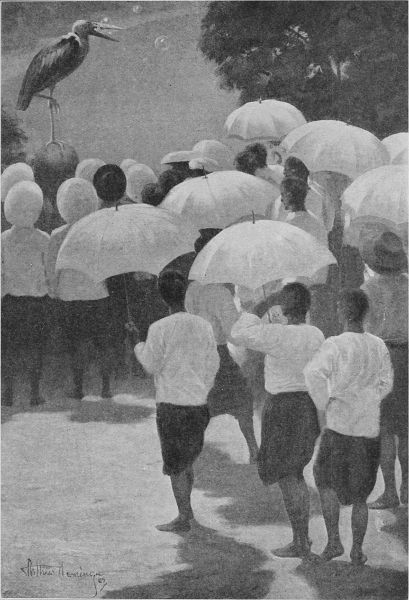
"Caw-aw-aw! It was this way," fairly snapped Crow. "A seller of small things, a box wallah, walking in an honest way fast after the palki of a great Sahib, even on the Red Road of Calcutta, by chance was struck by another palki and his box of many things thrown to the ground. Then this honest one of the straight face, Adjutant, seeing the mishap from his perch on the lion which is over the Viceroy's gate, swooped down like a proper Dacoit and swallowed some brown Eating which was like squares of butter, and made haste back to his perch. Even a Crow would have known better than that, for it was soap. And all day many of the Men-kind stood and looked at our baldheaded friend, for a great sickness came to him; and as he coughed, soap-bubbles floated upward. The Hindoos said it was a work of their gods."
"Just what I thought," grunted Pardus; "all clatter, and no true story of anything."
"Well," sighed Cockatoo wearily, "my Mem-Sahib always put me in a little house on the veranda at night. Though I didn't like it at all, still it was my house, and one day, in the midst of a rain, when I sought to enter, inside were two of the Cat young."
"AND AS HE COUGHED, SOAP BUBBLES FLOATED UPWARD."
"Kittens?" queried Sa'-zada.
"Ee-he-ah; and just behind me the old Cat with another in her mouth. Hard nuts! but such a row you never heard in your life. When I tried to drag the Kittens out, the Cat dug her beak——"
"Claws, you mean," corrected Sa'-zada.
"Ee-he-ah—claws in my back; but the Mem-Sahib took them away."
"Ugh, ugh! all lies! Bird talk!" grunted Boar. "What say you, Sa'-zada?"
"It is true," declared the Keeper, much to the disgust of his questioner; "for in The Book are also other true tales of Cockatoo. The Mem-Sahib has written that he was a great mischief-maker. She says that on the back veranda of her bungalow was a filter, and when 'Cocky' wanted a bath, he used to turn the tap, but never knew enough to shut it off, so the filter was always running dry.
"Also, there was a guava tree in the compound, and our friend ate all the guavas just as they ripened, so no one but Cocky got any of the fruit. That he was always fighting with Jock, her Scotch Terrier, and the clamor fair made her head ache."
"Whatever Sa'-zada reads from The Book is most certainly true," commented Magh.
"I've been thinking," began the Adjutant, solemnly——
"You look like it," growled Wolf.
"Of a story about Kauwa," continued the Adjutant——
"He stole three silver spoons from my Mem-Sahib," interrupted Cocky hastily, suddenly remembering the incident, "and hid them in the Dog-cart, where they were found next day; which shows that he is neither wise nor honest."
"Mine is a true tale," declared Adjutant, with great dignity. "One morning, looking calmly over the great city to see that all had been tidied up, I saw my little black friend, whose voice is like unto the squeak of a Bullock-cart, crouched in an open window, with wings well spread ready for flight.
"'A new piece of thieving,' thought I, and, drawing closer, I saw Kauwa hop to the floor, pass over to a bed on which slept a Sahib, and gently take a slice of toast from the top of a cup; then away went the thief.
"But the full wickedness was later, for when the Sahib awoke he spoke to his servant in the manner which Cockatoo has related of the ship. And when the other, who was of the Black Kind, declared he had put the toast beside his Master, the Sahib beat him for a liar. Even three mornings did Kauwa take the toast; but on the fourth the Sahib, who was pretending to sleep, nearly broke his back with the cast of a boot."
"Jungle Dwellers are Jungle Dwellers, and City Dwellers are City Dwellers," commenced Hornbill, gravely, "and I'm so glad I'm a Jungle Dweller. These tales show what city life is like. Save for an occasional row with Magh's friends, Hanuman and the rest, whose stomachs are out of all proportion to the quantity of fruit to be had, I have led a very peaceful life in the Jungle."
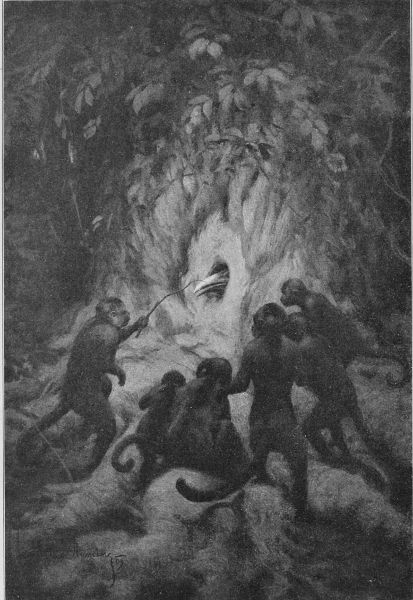
"LEAVING JUST A PLACE FOR HER SHARP BEAK."
"Tell me," queried Magh, maliciously, "do your Young roost on your nose?"
"No; that is to keep inquisitive folks at a distance. And, talking of Young, when my wife has laid her two big eggs in a hole in some tree, I shut her up there with the eggs—make her stay home to mind the house and the oncoming family. I plaster up the hole with mud, leaving just a place for her sharp beak; this to keep the Monkeys from stealing her and the eggs."
"Kaw-aw-aw! Talking of nests," said Kauwa, "when I was in Calcutta I designed a nest that would last forever—yes, forever. Each year before that time, because of the monsoon winds, my nest had always been destroyed; but the time I speak of, having a job on hand——"
"On beak, you mean!" laughed Sa'-zada.
"Aw-haw!—to clean up about a cook-house behind a certain place of the Sahib's in which they bottled water of a fierce strength—as I say, being busy in this same compound, I spied many, many twigs of wire."
"What's wire?" asked Mooswa; "I've never, that I know of, eaten such twigs."
Sa'-zada explained, "Kauwa means bottled soda water, I fancy, and the wire from the corks."
"A thought came to me," continued Kauwa, "to build my nest of these bright little things, and I did, first getting my mate's opinion on the matter, of course. Dead Pigs! but it was a nest! We would swing, and jump, and hang to it by our beaks, and never a break in the wall. But I had forgotten all about the selfish desire of the Men—but that was after. The first trouble was when Cuckoo—a proper budmash bird she is—came and laid two eggs in the nest. I saw the difference in the eggs at once, but my mate declared that they were all her own laying. She took rather a pride in her ability to lay eggs—to tell you the truth, we quarreled over it."
"I believe that," yawned Adjutant.
"However, she had her way, and started to hatch out these foreign devils; but the Men, as I have said, seeing my beautiful nest, sent a Man of low caste up the tree, and he took it away, Cuckoo eggs and all. It was a good joke on the Cuckoo Bird, and I was so mad at the way everything turned out, Caw-ha! I never made it again."
"I can swallow a plantain at one gulp," said Hornbill proudly.
"Why do you toss it up first?" asked Sa'-zada, alluding to the peculiar habit the Hornbill has of throwing everything into the air, and catching it as he swallows it.
"It's all in the way of slow eating," answered Hornbill.
"Now," said Myna, "it is surely my turn. I, Myna, who was the pride of the Calcutta Zoo in the matter of speech, have sat here like a Tucktoo not saying a word, and listening to such as Cockatoo boasting about the few paltry oaths he picked up from the Sailor-kind. Why, damn your eyes, sir——"
And before Sa'-zada could still the tumult, Cockatoo and Myna, the best talking Bird of all India, were hurling the most unparliamentary language at each other that had ever been bandied about a Bird gathering.
When Sa'-zada had stopped the indelicate scolding of the two Birds Myna proceeded to tell of his life.
"I was born in the Burma hills, amongst the Shans. That's where I got my beautiful blue-black coat and lovely yellow beak."
"Modest Bird," sneered Magh.
"It was Mah Thin who snared me; but she was good to me, though—rice and fruit, all I could eat; and she never once forgot to put the turmeric and ground chillies in my rice; for, you know, if I did not get something hot in my food I'd soon die. I was somewhat like Cockatoo in that a Ship-man bought me and took me to Calcutta. He made me a most wise bird, and taught me many clever sayings. And when he was in Calcutta with his ship I would be put in the Zoo, so that the Sahibs from all parts might hear my speech.
"One day Tom—that was my master's name; he taught me to call him Tom—said to me, 'To-morrow the Lat Sahib, the Sirdar, and many ladies are coming to hear you talk; Myna.' Then he made me repeat over and over again, 'Good-morning, your Excellency.'"
"It was a hard word he gave you," commented Magh.
"It was indeed. Let claw-nosed Cockatoo try it; he thinks he can talk—let him try that."
"Avast there, you lubber——" commenced Cocky, but Sa'-zada stopped him.
"Well, I said it over and over, and over again, and Tom was so pleased he gave me a graft mango to eat. Next day the Viceroy and many Mem-Sahibs and Sahibs gathered about my cage, and the Viceroy said, 'Good-morning, Polly.' Now this made me mad—to be called Polly, as though I had a hooked nose like Cockatoo; and in my anger I got excited, and, for-the-love-of-hot-spiced-rice, I couldn't think of what Tom had told me to say.
"'Speak up!' said Tom.
"In my anger, and forgetting the other thing, and seeing so many strange faces against the very bars of my cage, I blurted out, 'I'll see you damned first!' just as the sailors used to teach me."
"Caw-haw-haw-haw! Very funny, indeed. Next to a fat bone, or the hiding of a silver spoon, I like a joke myself," commented Kauwa. "Once at the first edge of the Hot Time I went to Simla. That was also at the time of the going of the Sahibs, but after Calcutta it was dull—fair stupid.
"One morning, as I was feeling most lonesome, I spied a long row of queer little Donkeys standing with their tails to a fence. They had brought loads of brick. I flew to the fence, and reaching far down, pulled the tail of my first Donkey. Much food! but he did kick—it made me laugh. I pulled the tail of every Donkey of the line, and when I had finished there wasn't a board left on the fence. Then the Man who was master of the fence, and the one that was master of the Donkeys, fought over this matter, and pulled each about by the feathers that were on their heads. It was the only real pleasant day I had in Simla."
"Did-you-do-it!" screamed the Redwattled Lapwing, suddenly roused to animation by falling off Mooswa's back, where he had been trying to balance himself with his poor front-toed feet.
"Caw-w-w! I did; and for three grains of corn I'd pull your tail, too."
"I wasn't speaking to you," retorted Titiri the Lapwing; "I was dreaming of my old home in India—dreaming that the hunters had come into the rice fields to shoot the poor Paddy Birds and Bakula (Egret) for their feathers."
"Murderers, you should call them, not Hunters," exclaimed Hathi. "It makes me sniff in my nose now when I think of the Birds I've seen murdered, just for their feathers."
"It's an outrageous shame," declared Sa'-zada.
"I did all I could," asserted Lapwing. "When I saw the Gun-men coming, sneaking along, crouched like Pardus——"
"Sneaking like Pardus—go on, Good Bird!" chimed in Magh.
"I flew just ahead of them, and cried 'Tee-he-he! Here come the Murderers!' so that every bird in all the jhils about could hear me. And when Bakula, and Kowar the Ibis, and all the others had flown to safety, I shouted, 'Did-you-do-it, did-you-do-it!' Then the Men used language much like the disgraceful talk we have had from Cocky and Myna to-night."
"You carried a heavy responsibility," remarked Sa'-zada.
"All lies," sneered Kauwa. "Fat Bones! why, he can't even sit on the limb of a tree."
"That is because of my feet," sighed Lapwing. "I have no toes behind."
"Where do you sleep?" asked Magh.
"On the ground," answered Lapwing.
"That's so," declared Sa'-zada, "for the Natives of the East say that Titiri sleeps on his back, and holds up the sky with his feet."
"But why should the Men kill Birds for a few feathers?" croaked Vulture. "I don't believe it. Nobody asked me for one of mine. In fact the great trouble of all eating is the feathers or skin."
"Whe-eh-eh!" exclaimed Ostrich, disgustedly. "Pheu! your feathers! Even your head looks like a boiled Lobster. They do not kill me—the Men—but I know they are crazy for feathers, for they pull mine all out. Some day I'll give one of them a kick that will cure him of his feather fancy. I did rake one from beak to feet once with my strong toe nail. When I bring a foot up over my head and down like this——"
As Ostrich swung his leg every one skurried out of the way, for they knew it was like a sword descending.
"Yes," cried Magh, "if you only had a brain the size of that toe-nail——"
"Stop it!" cried Sa'-zada, for this was an unpleasant truth; Ostrich, though such a huge fellow himself, has a brain about the size of a Humming Bird's.
"Talking of Wives," said Ostrich, with the most extraordinary irrelevance, "mine died when I was twenty-seven years old; and, of course, as it is the way with us Birds, I never took up with another, though I've seen the most beautifully feathered ones of our Kind—quite enough to make one's mouth water.
"She had queer ways, to be sure—my wife. As you all know, our way of hatching eggs is turn about, the Mother Birds sitting all day, while we Lords of the Nest sit at night. But my wife would take notions sometimes and not sit at all. In that case I always sat night and day until the job was finished. By-a-sore-breast-bone! but making a nest in the hard-graveled desert is a job to be avoided."
"Sore knuckles!" exclaimed Magh, "where are we at? We were talking of feathers."
"So we were, so we were," decided Mooswa. "And what I want to know is, do the Men eat the feathers they hunt for?"
"Oh, Jungle Dwellers!" exclaimed Magh; "if you were to sit in my cage for half a day you would see what they do with them. The Women come there with their heads covered with all kinds of feathers, red, and green, and blue—Silly! how would I look with my head stuck full of funny old feathers?"
"Like the Devil!" exclaimed Sa'-zada.
"Like a Woman," retorted Magh. "And their hair is so pretty, too. I've seen red hair just like mine, and then to cover it up with a crest of feathers like Cockatoo wears; I'd be ashamed of the thing."
"It's a sin to murder the Birds," whimpered Mooswa; "that's the worst part of it."
"Tonk, tonk, tonk!" came a noise just like a small Boy striking an iron telegraph post with a stick. It was the small Coppersmith Bird clearing his throat. Very funny the green pudgy little chap looked with his big black mustaches.
"The Men are great thieves," he asserted. "When I was a chick my Mother taught me to stick my tail under my wings for fear they would steal the feathers as I slept."
"Steal tail feathers!" screamed Eagle; "I should say they would. Out in the West, where was my home, when a Man becomes a great Chief he sticks three of my tail feathers in his hair; and when the Head Chief of a great Indian tribe rises up to make a big talk, what does he hold in his hand? The things that are bright like water-drops——"
"Diamond rings," exclaimed Sa'-zada, interrupting.
"No; he holds one of my wings to show that he is great."
"Yes, you are the King Bird, Eagle," concurred Sa'-zada, "the emblem of our country."
"I can break a lamb's back with my talons," assented Eagle, ignoring the sublime disdainfully, "but I wouldn't trust my nest within reach of any Man—they're a lot of thieves."
"Nice feathers are a great trouble," asserted Sparrow; "I'm glad I haven't any."
"What difference does it make?" cried Quail; "the Men kill me, and I'm sure I'm not gaudy."
"You're good eating, though," chuckled Gidar the Jackal. "After a day's shoot of the Men-kind, the scent from their cook-house is fair maddening. Oh-h-h, ki-yi! I've had many a Quail bone in my time."
"Even Lapwing can't save us from the Hunters," lamented Quail; "they play us such vile tricks. I've seen a rice field with a dozen bamboos stuck in it, and on top of each bamboo a cage with a tame Cock Quail; and in the center, hidden away, sat a man with a little drum which he tapped with his fingers. And the drum would whistle 'peep, peep, peep,' and the Birds in the cages would go 'peep, peep, peep,' and we Cock Birds of the Jungle, thinking it a challenge to battle, would answer back, 'peep, peep, peep,' and go seeking out these strange Birds who were calling for fight. Of course, our Wives would go with us to see the battle, and in the end all would be snared or shot by the deceitful Men."
"That's almost worse than being taken for one's feathers," said Egret. "I'm glad they don't eat me."
"No Mussulman would eat you, Buff Egret," said Gidar the Jackal. "It's because of your habit of picking ticks off the Pigs."
"Some Birds do have vile habits," declared Crow. "Paddy Bird has a Brother in Burma who gets drunk on the Men's toddy."
"I doubt if that be true," said Sa'-zada, "though he is really called 'Bacchus' in the science books."
Said Myna, "Of all Birds, I think the Jungle Fowl are the worst. The Cocks do nothing but fight, fight, all the time—fight, and then get up in a tree and crow about it, as though it were to their credit."
Said Kauwa the Crow, "When one of our family becomes quarrelsome, or a great nuisance, we hold a meeting—I have seen even a thousand Crows at such meetings—hear all there is to say about him, and then if it appears that he is utterly bad we beat him to death."
"Tub-full-of-bread!" exclaimed Hathi, sleepily, "it's my opinion that all Birds should be on their roosts—it's very late."
"And roost high, too," said Magh, "for Coyote and Gidar have been licking their chops for the last hour. I've watched them. And lock Python up, O Sa'-zada, for high roosts won't save them from him."
"All to bed, all to bed!" cried the Keeper. "To-morrow night we'll have some more tales."
The last cry heard on the sleepy night air after all were safely in their cages was Cockatoo's "Avast there, you lubber!" as Myna, sticking his saucy yellow beak through the bars of his cage, called across to him, "Want a glass of grog, Polly?"
Eighth Night
The Stories of Buffalo and Bison