NINTH NIGHT THE STORY OF UNT, THE CAMEL
Reading edition
The clink of a loose chain; the complaining wail of a swinging iron door; the squeak of a key turning an unwilling lock—a heavy-bolted lock; a flutter of wings; the crunch of giant feet on the echoing gravel; huge forms slipping through the moonlight, like prehistoric monsters; a slim, ribbon-like body gliding noiselessly over the grass cushion of the Park's sward; muffled laughter, bird calls and a remonstrative grunt from Wild Boar; the merry chatter of Magh the Orang; a guarded "Phrut-t-t, Phrut-t-t" from Hathi, the huge Elephant—ah, yes, all these; surely it was the gathering of old friends, who, like the listeners of the Arabian Night's tales, had for many evenings talked of their Jungle life in front of Black Panther's cage.
"You are all welcome," growled Pardus.
Magh hopped on the end of Hathi's trunk, and the latter lifted her gracefully to a seat on his broad forehead. She had Blitz, the Fox Terrier, with her. "You will hear some lies to-night, Pup," she confided to him. "But who is to talk?" she asked suddenly; "Chee-he! Sa'-zada, our good Keeper, who's to talk?"
"Camel is to tell us of his life," answered the Keeper.
"That stupid creature, who is too lazy to brace up and look spry, talk to us? Next we know we'll have a tale from Turtle."
"That's it," sneered Boar, "if one is honest and a plodder like Unt, bandy-legged creatures like Magh will call him stupid."
Unt, with a bubbling grunt, knelt down, doubled his hind legs under him like a jack-knife, made himself comfortable, and commenced his personal history.
"Bul-lul-luh!" he muttered. "I was born in Baluchistan, on the nice white sand plains of the Sibi Put (desert). As Mooswa has said, there must be some great Animal who arranges things for us. Think of it, Comrades, I had the good fortune to be born in just the loveliest spot any animal could wish for. As far as I could see on every side was the hot, dry sand of the beautiful Sibi desert."
"I know," interrupted Ostrich; "my home in Arabia was like that. I've listened to Arna here, and Bagh, telling of the thick Jungles where one could scarce see three lengths of his own body, and I must say that I think it very bad taste."
"Yes, it was lovely there," bubbled Unt. "No wonder that Bagh, when he was chased by the Beaters, fled to the sand damar and hid in the korinda thorns. Such sweet eating they are, firm under one's teeth. The green food is dreadful stuff. Once crossing the Sibi Put, when I was three days without food, I remember coming to Jacobabad, a place where the foolish ones of the Men-kind had planted trees, and bushes, and grass, and kept them green with water. I ate of these three green things, and nearly died from a swelling in my stomach.
"Well, as I have said, I was born in that nice sand place, and for three or four years did nothing but follow mother Unt about. Then they put a button in my nose, and tied me with a cord to the tail of another Unt, and put merchandise on my back for me to carry. There was a long line of us, and in front walked Dera Khan, the Master. We seemed to be always working, always carrying something; our only rest was when we were being loaded or unloaded. We were made to lie down when the packs were put on our backs, and many a time I have got up suddenly when the boxes were nearly all on, rose up first from behind, you know, and sent the things flying over my head. I would get a longer rest that way, but also I got much abuse, though I didn't mind it, to be sure; for, as Mooswa has said, our way of life is all arranged for us, and the abuse that was thrust upon me was a part of my way.
"But one year there came to Sibi many Men of the war-kind, and with them were the black ones from Bengal. It was a fat one of this kind, one of little knowledge of the ways of an Unt, a 'Baboo,' Dera Khan called him, who caused me much misery. It was my lot to take him and his goods to the Bolan Pass, so Dera said, for the One-in-Charge, a Sahib, had so ordered it. When I sought to rise, as usual, when the load was but half in place, he got angry and beat me with a big-leafed stick he carried to keep the heat from his head. But in the end I brought to his knowledge the method of an Unt who has been beaten without cause.
"When all his pots and pans, and boxes of books, wherein was writing, had been bound to my saddle, the Baboo clambered on top. I must say that I could understand little of his speech, for my Master, Dera Khan, was a Man of not many words, but the Baboo was as full of talk as even Magh is; and of very much the same intent, too—of little value."
"Big lip! Crooked neck! Frightener of Young!" screamed Magh, hurling the epithets at Camel with vindictive fury.
"Unt's tale is truly a most interesting one; there is much wit in his long head," commented Pardus. Camel rolled the cud in his mouth three or four times, dropped his heavy eyelids reflectively, bubbled a sigh of meek resignation and proceeded:
"When I rose from behind, the Baboo nearly fell over my neck; when I came sharply to my forefeet (for I was always a very spry, active Unt), he declared to Dera Khan that I had broken his back. But I knew this couldn't be true, for I was always a most unlucky Unt. Of course, this time I was not tied to the tail of a mate, but my leading line was with the Baboo. He shouted 'Jao' to me, and in addition called me the Son of an Evil Pig.
"Have any of you ever seen one of my kind run away?" Camel asked, swinging his big head inquiringly about the circle.
"I have," answered Black Panther. "Once, being hungry, I crept close to an Unt to ask him if he could tell me where I might find a Chinkara or other Jungle Dweller for my dinner. I saw that Camel run. For a small part of the journey I was on his back; but though I can cling to anything pretty well, yet the twists of his long legs were too much for me, and I landed on my head in the sand, nearly breaking my back."
"Well," resumed Camel, "you will understand how the Baboo and his pots and pans fared when I ran away with him, which I did as soon as Dera Khan moved a little to one side. At first I couldn't get well into my stride, for the Baboo pulled at the nose rope, and called to Dera in great fear. Dera also ran beside me, holding to the ropes that were on the boxes; many things fell, coming away like cocoanuts from a tree. An iron pot going down with much speed struck my Master on his head, and he said the same fierce words that he always used when I caused him trouble of any kind.
"You know, though I ran fast, yet by tipping my head a little to one side I could see what was doing behind, and I saw a basket in which were many round, white things——"
"Eggs," suggested Cockatoo. "Those were the round white things Potai brought from bazaar in a basket."
"Yes, they were in a basket," repeated Camel, solemnly; "so, as you say, Cocky, I suppose they were eggs; but, however, they came down all at once on the face and shoulders of my loved Master."
"And broke, Cah-cah-cah!" laughed Kauwa the Crow; "I know. More than once I've seen relatives of mine have their eggs broken through being thrown out of the nest by Cuckoo Bird."
"As I have said," continued Camel, "my Master was a Man of few words, but at this he let go of the rope, and the language he used still rings in my ears. Dry chewing! how I fled. And behind chased Dera Khan, a big knife in his hand—in spite of his violence I had to laugh at the color the eggs had left on his long beard—a knife in his hand, and crying aloud that he would cut the Baboo's throat.
"I REMAINED IN THE JHIL UNTIL MY MASTER HAD LOST THE FIERCE KILL-LOOK."
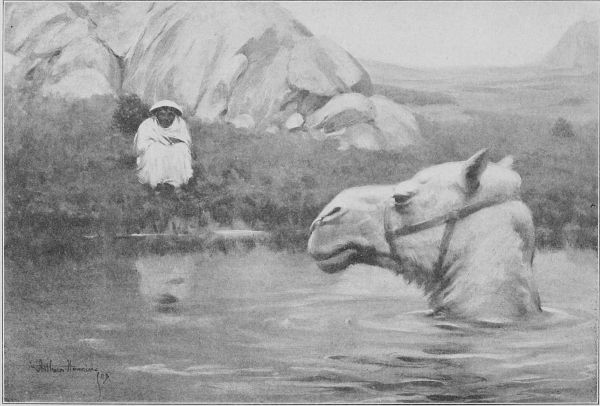
"As I swung first one side of my legs, and then the other over the sweet sand desert, I could feel the Baboo thumping up and down on my back, for he was clinging to the saddle with both hands. Sometimes he abused me, and sometimes he begged me to stop; that I was a good Unt—his Father and Mother, and his greatest friend. As he would not be shaken off because of his fear of Dera Khan's knife, I carried him into a jhil of much water; there he was forced to let go, and when he got to the bank, if it had not been for a Sahib he would most surely have been killed by my Master. Hathi has told us of the fear-look he has seen in the faces of the Men-kind, and there was much of this in the eyes of that Baboo. I remained in the jhil until my Master had lost the fierce kill-look, then I came out, and save for some of the old abuse there was nothing done to me.
"But we all went to the Bolan Pass, carrying food for those that labored there making a path for the Fire Caravan, the bearer of burdens that is neither Bullock, nor Unt, nor aught that I know of."
"It was a railroad," Sa'-zada, the Keeper, explained.
"Perhaps," grunted Unt, licking his pendulous upper lip; "perhaps, but we Unts spoke of it as the Fire Caravan. Still it was an evil thing, a destroyer of lives, many lives, for never in that whole land of sand-hills and desert was there so much heat and so much death.
"First the Bail (Bullocks) died as though Bagh the Killer had taken each one by the throat; then those of my kind fell down by the fire-path and could not rise again. And the air, that is always so sweet on the hot sand plains, became like the evil breath of the place wherein nests Boar."
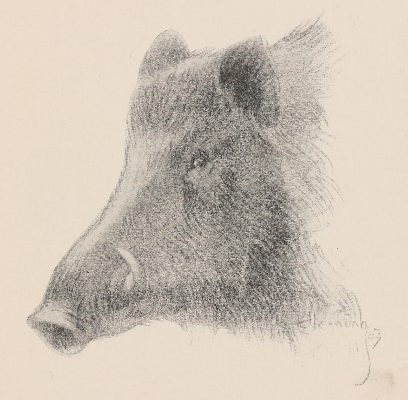
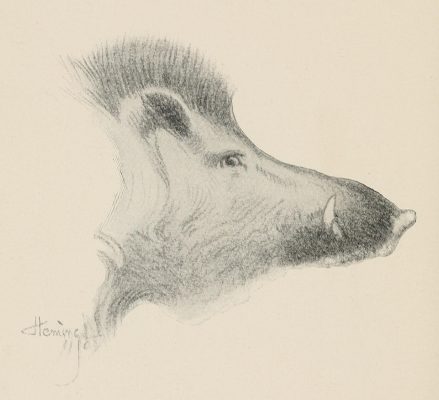
"Ugh, ugh!" grunted Wild Boar, "even there, by this stupid tale of Unt's, there was something evil to be likened to my kind."
"The water that had been sweet ran full of a sickness because of all this, and the Men that drank of it were stricken with the Black Death. At first it was those of the Black-kind, and then the others, the Sahibs, became possessed of it. And then the Burra-Sahib, Huzoor the Governor, was taken with it; so said one of the Sahibs who came to Dera Khan just as he was tying a rope about my foreleg so that I could not rise and wander in the night.
"'It is sixty miles to Sibi,' this Sahib, who was but young, said to my Master.
"'By the Grace of Allah, it is more,' Dera answered him.
"'The Big Sahib, who is my friend, is stricken with the Black Death,' said the young Sahib, 'and also the Baboo Doctor is the same, being close to his death; and unless I get a Healer from Sibi to-morrow, the Sahib who is my friend will surely die.'
"'If Allah wills it so, Kismet,' answered my Master.
"'Have you a fast Camel?' asked the young Sahib.
"'This is Moti,' replied my Master, putting his hand on my hump, 'and when he paces, the wind remains behind.'
"Then the young Sahib promised my Master many rupees and much work for the other Unts, so be it he might ride me to Sibi for a Doctor.
"By a meal of brown paper such as one picks up in a bazaar, I swear that I understood more of what that meant to my Master than many a Camel would have known, for had I not seen it all, this that I am about to tell? You know, Comrades, that the Burra-Sahib was a Man of a dry temper, and it so happened that one day Dera Khan had displeased him, which I just say was a way my Master had often. That was a full moon before the coming of the Black Sickness. Oh, Friends, but I had seen it all; it made me tremble, knowing of the readiness with which Dera Khan argued with his knife, like unto the manner of Pathans.
"The Big Sahib would have struck my Master but for this same young Sahib who had now come with his offer of many rupees—this Sahib who had been there at that time. So, Comrades, there was good hate for the sick man in Dera's heart.
"'Will you send the Camel?' said the young Sahib; and Dera, drawing himself up straight, even as I do under a heavy load, held out his hand and said, 'Allah! thou art a Man. My goods are your goods, but for the other, the one who is your friend and my enemy, the wrath of Allah upon him.'
"The Sahib was on my back in a little.
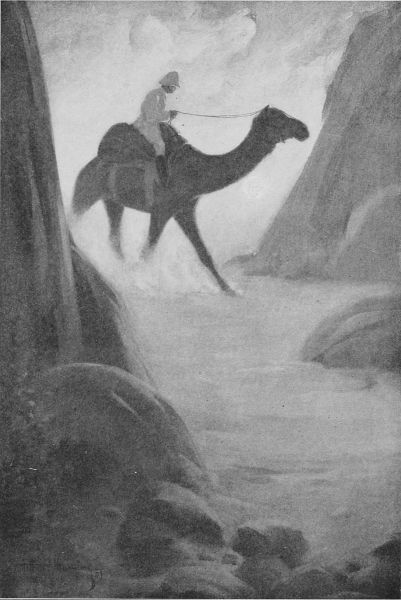
"I have said before that with the Baboo and many kettles on my back I ran fast, but think you, Comrades, of the weight, and also of the poor rider, for there is nothing an Unt dislikes so much as the knock, knock, against his hump of one having no knowledge of proper pace. How the Sahib sat! Close as a pad that had been tied on; and he coaxed and urged—even swore a little at times, but not after an unreasoning manner as had the Baboo. He called me a Bikaneer, even his Dromedary, which means one of great speed; and begged me, if I wished food for all time, to hasten. How we fled in the long night, down the hot paths, splashing many times through the cool water that crossed our path—Bolan River, it is called, the water that comes from the high-reaching sand lands that are all white on their tops."
"The snow mountains," explained Sa'-zada, for Camel's description was more or less vague.
"As I have said," continued Camel, "the water was cool. Never once did I fall, though the round stones were like evil things that twist at one's feet to bring him down. 'Hurry, hurry, hurry!' the young Sahib called to me, and I laughed, thinking he would tire before I should.
"On we went, passing little fires where those of the Cooly kind rested as they fled from the Black Death. Just as we came out on the flat sand which is the Sibi Desert, there were gathered in one place many Men. For a space we stopped, and my Rider asked if there was a Healer with them. They answered that they were Men of the war-kind going up to keep the workers from running away from the Black Death; even those at the little fires would be turned back, they said.
"Then on again I raced. I could hear my Rider talking back to his friend, the Burra-Sahib, who lay stricken with the evil sickness, though I know not how he could hear him, for we were full half way to Sibi.
"'Keep up your courage, Jack,' he would say, speaking to his Friend. 'Please God, I'll have a Surgeon there in time to save you yet.'
"Then he would fall to abusing some other of the Men-kind, perhaps he was not a friend, whom he blamed for all that was wrong. 'You puffed-up beast,' he would say, speaking to this other, 'to send a lot of Men to such a death hole with a brute of a Bengali-Baboo to doctor them—murder them, and a medicine chest that was emptied in a day. It's a bit of luck that Baboo died, but it doesn't help matters much.'
"That was the Baboo I had run away with; perhaps even the medicine chest had lost much through its fall from my back.
"Then to me, 'Hurry, hurry, hurry! Shabaz!' (push on); then to his Friend, 'Poor old Man, Jack! what will She say if I don't pull you out of this? I'll never go back to England as long as I live if this beastly thing snuffs you out.'
"Then to the other, the one who had done this evil: 'Curse you, with your red tape economy! You're a C. I. E.'—whatever that meant I don't know—'but you've murdered old Jack, who is a Man. You're out of this trouble up at Simla, but you'll roast for this yet.'
"You know, Comrades," said Unt, plaintively, "I didn't know all about this thing—I couldn't understand it, you see, being an Unt, and, as Magh says, stupid; but someway I felt like doing my best for the young Sahib who did not make me cross by beating me, but only cried 'Hurry! Shabaz! my swift runner,' and shook a little at the nose line in his haste."
"I have often felt that way," encouraged Hathi; "once I remember, it was in Rangoon, that time I was working in the timber yards. I had a Mahout who never stuck the sharp iron goad in my head at all. He always told me everything I was to do by different little knocks on my ears with his knees as he sat on my neck. And also by soft speech, of course, for, as you say, Unt, it keeps one from getting cross, or filled with fear, and so one has only to think of what the Master requires. You were right to run fast with such a rider."
"This is Camel's story," pleaded Sa'-zada.
"BUT SOME WAY I FELT LIKE DOING MY BEST."
"Never mind," bubbled Unt; "I was just trying to remember what time we got to Sibi—I know it was before the sands grew hot from the sun. Straight to the Teshil (Government office) the young Sahib rode me. Here he made an orderly bring me food and drink while he went quick to bring a Healer for his Friend. I had scarce time to store half the raji away for future cud-chewing, when back he came with a Healer of the White Kind.
"Now, the Teshildar, who was Chief of Sibi, was a slow-motioned Man, not given to hurry; that was because the hump on his stomach was large with the fat of great eating; and when the Sahib asked for another Unt to carry the Healer, this Man who was Chief made no haste—not at first; but when the young Sahib, no doubt thinking of his friend Jack, threatened him with the wrath of the Governor, also the smaller anger of his own fists, the Teshildar had an Unt of great speed quickly brought forth. Then the young Sahib, speaking to me, said, 'My heavy-eyed Friend, also one of much strength, can you go straight back the sixty miles?'
"Of course, at that time I couldn't speak in his words, though I could understand, so I just shook myself, and stretched out my long hind legs, as much as to say, 'Mount to my back, and I will try.'
"We started, the Healer on the other Unt, and the Sahib on my back. I shall never forget that ride. Sore legs! but at first it was not easy to keep up with my Comrade, who was fresh; but also was he a trifle like the Teshildar, fat in the hump, so in the end that had its effect, and I managed to keep pace with him.
"We reached back in the Bolan just as the sun was straight over our heads. By the raji that was still in my gullet I was tired; so was the young Sahib, for when I knelt down, and he slipped quickly from my back, he spun round and round like a box that has broken loose, and came to the ground in haste. Just as he fell, Dera Khan caught him, and lifted him up; then he and the Healer went to the tent where was his friend Jack. And I heard my Master, Dera, say afterward, that the little Sahib never slept while it was twice dark and twice light; that was until the Healer said the stricken one, Jack, the Burra-Sahib, was again free of the Black Death."
"I think it is a true tale," remarked Adjutant, putting down his left leg and taking up his right. "I have seen much of this Black Death in my forty years of life, and the Men of the White-kind take great care of each other. Now, those of the Black-kind get the Man-fear which Hathi has spoken of, in their eyes, and flee fast from this terrible sickness, crying aloud that their livers have turned to water. I, myself, though I am a bird of little speech, could tell tales of both methods."
"But what became of you, Unt?" queried Magh; "did you catch this sickness and die?"
"No," replied Camel, solemnly, not noticing the sarcasm; "the little Sahib took me from Dera Khan by a present of silver, and kept me to ride on, and in the end I was sent here to Sa'-zada."
"It's bed-time," broke in the Keeper; "let each one go quickly to his cage or corral."
Tenth Night
The Story of Big Tusk, the Wild Boar