VI
Reading edition
THE CITY OF THE REBORN GOD
THE murmur of many voices pierces the blanket over your head. Sleepy-eyed in the warmth, you peer out from the chrysalis of coverings to watch the people moving about. Alexsimevich has extricated himself from the mound which he constructs nightly on the floor, out of luggage-bags, felt mats, rugs, and overcoats. Under all the heaped wrappings that he uses in the icy Mongol tents, he has camped and slept close up against the white wall of the oven. Truly the Siberian is brother to the salamander. He pulls on now his big felt boots and runs a pocket-comb through his beard.
The wife of our host, come to the door for a survey, notes progress and returns to the female region. The Hazan Varlakoff, gray-bloused and wearing deerskin boots, enters next. He lights his first cigarette; his wife with the bowl of sugar and the plate of bread follows. She has gotten up earlier than her husband, so she is several cigarettes ahead, but he is cutting down the lead.
Perhaps one had better get up one’s self. It is an easy operation here. “Getting up” consists in emerging from the rolled blankets and stretching. “Dressing” means pulling on boots. One can wash over in the corner, where the brass can lets out a trickling stream of cold water when the needle-valve underneath is pushed up.
The samovar hums on the red cotton cloth of the table. Varlakoff moves along to make room. From the little pot of infused tea your glass is partly filled; then you place it under the spigot for hot water, and the beverage is ready for sipping. No lemons are here, as in Russia. In a few Chinese shops one can buy spherical citrons, but they are like unripe oranges, and are a luxury as great as pineapples in old New York.
A wool-buyer from Kiahta reaches for the bowl of broken loaf-sugar, and holds it for you to choose the piece whose size pleases best. The housewife comes from the kitchen over by her oven-door, bringing some crestfallen cake which she has made in your honor.
“Kuchete! kuchete!” she commands, arms akimbo, puffing contentedly on her cigarette.
We revel in the luxuries of Varlakoff’s room; warmth such that we may take off the cumbersome outer coats; chairs to sit upon, instead of crouching cross-legged; hot samovar-made drinks, and a chance to wash in water. The latter is a privilege which can be appreciated only after a period of ablutions in lukewarm tea. We stretch out and bask and sip, and whiff papirosi in epicurean idleness.
As we luxuriate, one by one the neighbors of the Russian colony come in, to hear the news of Kiahta from Alexsimevich. The expedition has become part of the gossip-transportation system. Half the population of Kiahta must have sent messages here,—half the Russian traders in Urga have come to receive them. First, there is the general news dispensed into the expectant ears of the group at Varlakoff’s. Alexsimevich is for an hour the cynosure. Questions and answers flash back and forth, going off sometimes explosively like fireworks. Then follow the special events and the individual messages. At last these are all detailed. Now come invitations from various men to visit their houses “Will the gaspadine come?”—“The gaspadine must see the city.”—“Da! da!” echoes the group.
Varlakoff goes out for his stick and overcoat. The wool-merchant gets into his fleece-lined shuba. He achieves the feat by the usual Siberian method. Putting the garment over his head, he pushes his arms through the sleeves, and gradually struggles and writhes up into it as one gets into a wet bathing-suit. Alexsimevich finishes his fourth glass of tea, lights one of the Hazan’s cigarettes, and worms his way also into his deerskin greatcoat. Then out we go into the bright sunlight and the snow-covered streets.
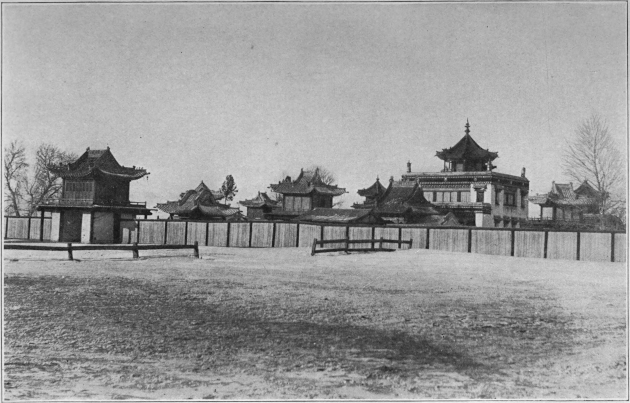
TEMPLE OF GIGIN, URGA
The houses of the Russian quarter of Urga were only glimpsed in the dusk of last night. We have daylight upon them now. Squat whitewashed buildings they are, with neatly paned windows and big square chimneys. Across the mounds and hillocks of a broad street is the one-storied Russian Club, where one may drink vodka, play billiards or cards, and while away the winter evenings. Further on is a row of shops. The bearded owners stand behind their counters, dressed in belted Mongol shubas and Russian fur caps. The doors to all the shops are open, that the Mongols, perplexed with knobs, may not take their trade elsewhere. Enameled kettles are hanging in festoons down the walls. The shelves are crowded with bolts of vivid-colored cotton cloths to be sewed into shubas by the Mongols who ride in to buy. There are big cases of sweetmeats, Moscowski caramels, acceptable offerings to the grotesque dokchits on the family shrines. Russian monopoly tobacco is there, in stamped paper packets for the delectation of Muscovites and Buriats who have the taste and the means, and villainous South-China tobacco and snuff for native purchasers. One can get vodka almost as bad as that of Siberia, and far cheaper, for it is compounded by a local distiller who rejoices in an excise-less market. Foreign brandies and wines fill big walls of shelves.
“Zdravstvouitie!” one of the merchants calls, hailing our party.
“It is Vassili Michaeloff, old friend of mine,” says Alexsimevich. “Let us go in.”
We enter and are led back into the private part of the house.
“Chai!” shouts the host to somebody behind the oven.
“Haracho,” comes the answer.
We all sit down. If any purchasers drift into the shop, they can wait until we get through our visit, or they can go down the line. For wherever the Eagles are planted, the Russian joyfully drops his business to entertain a friend. At the call of “tea” the shovel goes into the ditch, the ledger onto the shelf, the pen into the potato. If “chai” interferes with business, cut out business. Nor does it matter in the least that we have just had breakfast; by the rule of etiquette we must be entertained. “Tea” consists first in a ceremoniously clinked toast drowned in vodka. Then appears the samovar in charge of the woman of the house, the glasses, and the sugar. Next follow the cigarettes. The talk is animated, for its local history absorbs each little world. The fact comes out that the cousin of Michaeloff has bought a new pair of horses for a hundred roubles. The price, the quality of the animals and of the man, all go into the crucible. Kiahta beer arrives as the conversation turns to the death of one Ivan Vladimiraef, which it is agreed was not unnatural, since he had reached the age of ninety-odd years. Still the provisions come. The good wife brings in a heaping plate of lard-impregnated Hamburger steaks, called “cotlet,” which Alexsimevich attacks as if his last meal were half a day instead of half an hour distant. Other bottles accumulate to help out the dwindling flagon of vodka. We enter upon Château Yquem, Pomeranian, and Caucasian claret. Then cakes are set out, and more tea, and finally a quart bottle of champagne.
Alexsimevich stands to his guns like the 38th Siberians at Tien-tsin. But it is hard for any one of less rigorous training in this sort of thing to hold even the straggler’s pace at nine o’clock in the morning. Mentally we hoist the flag upside down, and wink at Alexsimevich as the outward and visible sign of the inward and spirituous distress. He takes the rest of the champagne in a last gulp, and with a series of thanks we gain the entrance to the shop, where two Mongols and a Buriat are waiting patiently, looking vacantly around at the crockery.
We are shown ceremoniously to the door, shake hands, remark about the weather, give our compliments to the wife, and depart. When at the corner, we glance back. Vassili Michaeloff is still standing on the threshold; his three customers too are looking out leisurely at the people passing.
“We have thrown his business out of gear,” we remark to Alexsimevich.
He seems surprised.
“There is plenty of time. Why should they mind waiting? Nietchevo.”
Another host is overjoyed to see us, for an engineering problem of great perplexity is, he tells us in due course, harassing his mind. No one in Urga can help him out, but perhaps we will.
“The Chinese governor, the Zinzin, wants to make an automobile line from Kalgan,” the host announces. “I saw an iron bridge once, so I agreed to build him one over the Lara River. Have you ever seen an iron bridge? How shall I do it?”
You allow that you have seen an iron bridge,—that you have even gone across one. You suggest that much depends on the river. “How wide is it, for instance?”
“I have not picked out the place for the bridge yet,” answers the host; “but the river is somewhere between sixty and three hundred feet wide. Have some vodka?”
“And how deep is the water?” you ask.
“Well,”—after much thought,—“it is deep in the middle and shallow at the edges. Have a cigarette! Have some tea! If we build this bridge, the Zinzin will give us a decoration. How much will the bridge cost?”
“That depends upon what sort of bridge you build, and how long it is, and how much material you use!”
Alexsimevich comes in.
“You see, the more iron you use, the more the bridge costs,” he observes.
“Navierno! navierno! you speak sagely, Alexsimevich. That is what I told the Zinzin.”
“It must have piers and abutments,” you venture.
“But the Zinzin does not like piers, because the water was not made to put such things into. Yet I said with you, one must always have piers. Here is brandy. Take a few sardines!”
The problem certainly needs something special for its elucidation. You ponder, and Alexsimevich and the host breathlessly watch the hatching of your official pronunciamento.
At last you deliver yourself.
“Find out how wide and deep the river is. Then write to a steel-manufacturing company, to quote prices. They will send a blue-print of an automobile bridge of the specified length, together with the weight of the steel. You can buy pieces to build it at so many kopecks a pound, just like butter.”
“Ah, my friend, you do not know how great a service you have rendered! What a providence is your coming! Pray, have some cognac! Will they send me a picture with piers,—a picture that I can show the Zinzin?”
“Yes,—yes, indeed.”
“I go to-morrow to tell him of this.”
We are once more in the street and the banded escort is turning into still another Russian’s house. Their idea of sightseeing is apparently to take tea with every Russian in the place. A mild desire is registered to come in contact with some of the other people. The idea strikes them in the light of a strange new doctrine.
“You wish to see Mongols?” one asks. Though surprised, they acquiesce amiably. “To-day they have holiday; you are favored. Go see the doings and make me visit later,” says the disappointed third host.
Then the wool-merchant speaks.
“Near by is the great temple of Urga, which few have seen, for it is one of the most holy places of the Lama faith. It is the temple of Maidari, the Future God. If the gaspadine wishes to see it, I, who have bought wool from the uncle of the keeper of the gate, can gain admittance.”
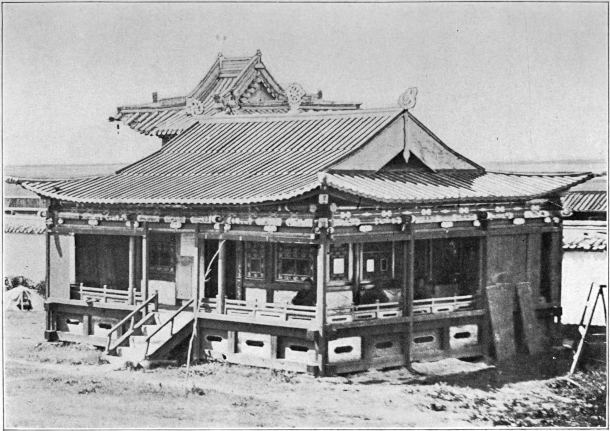
TEMPLE IN THE URGA LAMASERY
For this we start. The Russian section, made up of shops with posters and signs in Slavonic letters, and homes with centre chimneys and little square panes of glass, is left behind. Through a long dark lane we come out into the main thoroughfare of Mongol Urga. The town is in festival for the New Moon. The streets are ablaze with color. Red posters are on every door and wall. The brilliant picture is framed by the snowy girding hills and the green trees of the Holy Mountain to the south. The tomb-like altars on the plain are dazzlingly white against the gray-plastered fronts of the houses behind. The gilded gargoyles of the temples flash in the sun. Down the main street, a hundred feet broad, go bevies of girls, their hair bedecked with the gaudiest ornaments of silver and pearl, their silken robes striped and banded in green alternating with yellow and blue and gold. Lamas stride here and there dressed in bright orange robes and hats, their silver knives hanging at their sides. Great shaggy-haired dromedaries swing past. Horsemen, robed in vivid scarlet and blue and magenta, dash at full gallop across the wide open piazza in the centre of the town. A donkey-cart is driven slowly along, crowded with brightly-dressed girls. A squad of Chinese cavalry trot by in white jackets, red-lettered. Two of the Cossack garrison swagger past. A bearded Siberian trader strolls across, clothed in the dark Mongolian cloak which most have adopted, going toward the Russian quarter we have just left. A string of oxen plods by, drawing cartloads of wood.
Walking on, we come to a long line of kiosks which a continuous procession of pilgrims in holiday attire is entering. In each booth is a cask-shaped prayer-wheel, a magnified model of those which women carry, twirling them in their hands as they walk.
Along this main square of Urga, and girding her city stockade, are hundreds of these cylinders. All the day long, men and women are going in and out from one kiosk to another, turning. Some say that formerly one could enter a great Tibetan temple only after saying a prayer so long that even a Grand Lama’s memory could not carry it. So, for convenience, a cylinder with the written text was set up at the temple gate. By degrees it became the custom, without reading it, to rotate the petition for a blessing. Others say that the wheels are whirled in literal obedience to Buddha’s precept to “turn over and over his words.”
Alternating with the wheels are stone shrines graven with Tibetan characters, before which, on wooden couches, silken-dressed women are abasing themselves in abject worship. A long line of pilgrims is doing the circle of the city. They stand, then drop prostrate in the snow. Rising, they move conscientiously forward to where their heads touched, and again lie prone, making thus a penitential circuit of the stockade. Most are in deadly earnest. Some, hired for a proxy service, steal forward a few inches on each prostration.
Suddenly three distant guns boom out.
“Scurry, scurry toda!” says the wool-merchant. “Quick, this way. He is coming.”
You hurry forward to where a trail leads across the square. Afar off, in the direction of the Holy Mountain, is seen a band of galloping cavalry. The Mongols on horseback around you are drawing rein. The pilgrims are looking toward the approaching cavalcade. Brilliant red and yellow are the robes that flutter as the body-guard ride. Now a rumble of wheels is heard among the clattering hoofs. Preceded by twenty horsemen, followed by twenty more, rolls down a Russian droshky, with a yellow-robed lama driving. Propped among the multicolored cushions sits a clean-shaven, silk-robed man, with puffy cheeks and tired eyes. The European watch which he carries hangs in anomalous awkwardness at the breast of his robe; his leg is propped on the front seat, as if he were lame. Most turn their backs to him in Oriental honoring; many prostrate themselves in the snow; every horseman in the square has dismounted.
“He drives from his palace beside the Holy Mountain to the temple on the hill beyond the city,” says the wool-merchant.
“But who is it?” we ask, as the last galloper rides by.
The Russian looks at us as an old Roman might, if in the Forum we had not recognized Cæsar.
“That! That’s Gigin, the Living God! That’s Buddha come back to earth,—Gigin!”
You stand a moment to take it all in. Then, despite your purpose of respect, a smile works to the front.
At once the wool-merchant laughs gleefully. “Ask Varlakoff about the Buddha,” he chuckles. “Varlakoff sold him his ponies for ten thousand roubles. My friend showed him a picture of the ponies, little horses, you know, and Gigin told him to get them. They had to send to an island of Europe, Scotland. But Gigin was very pleased. He said Varlakoff was the only man who had never lied to him.”
The expression of the wool-merchant was that worn according to tradition by the Roman augurs.
“When there is not a holiday, the people have the market here in this square,” the merchant continues. “I was here in the bazaar with a friend last week, and we heard a commotion over by that prayer-wheel. We went up, to find that two of the Buddha’s lamas were borrowing a fine horse, worth three hundred roubles, which belonged to a Mongol woman. It was all she had, she told us, and it was being taken to the Living God’s stables. The woman was in great distress.
“‘It is mine. I will appeal to the Consul,’ said my friend.
“The Gigin’s men could not take a Russian’s horse, so they had to give it up. The Mongol woman came and wept on him, she was so glad. She brought a gift to my friend. Generally the Gigin returns such borrowed booty when he has used it a while, but often not. Anything that is new, the God will buy. These pilgrims, you see, bring him offerings. Kalmuks come all the way from the Volga, Manchus make pilgrimages, Buriats come down from north of Baikal, and tribesmen from Tibet. He has half a million roubles a year from his priests, and he does not care for anybody.”
Becoming more and more steeped in celestial gossip, we go past the gray-plastered compounds piled high with wood and timber, a main export of Urga. Tall masts with logs suspended from them are the signs. We reach at last a big stockaded courtyard, the beginning of the monastery quarters.
“Come, look in here!” says the guide.
You peer through the gateway at six of the biggest bronze burgoo-kettles that ever existed outside an ogre’s kitchen. Each kettle can hold a couple of cows.
“It is to feed the monks,” says your companion.
The Mongols are going up to the vessels, with buckets suspended to the end of a milkmaid’s yoke. They dip up a load. The soup looks like gray tapioca pudding. What it is made of remains one of the secrets of the monastery, whose chef is stirring the mixture with an oar.
A big stockade, enclosing tents and peaked soumé, from which the sound of chattering is heard, appears ahead. As we approach, a whole hive of boys swarm out and scatter in all directions. Some are in red, some in yellow, some wear ordinary Mongol caps, some wear high, yellow sugar-loaf fools’-caps, which fall over on one side. These are the novices in training for the lama hierarchy.
The first-born of each family must by immemorial custom become a lama. In babyhood and boyhood one of these dedicated children is clad in yellow robes and is especially tended. “Ubashi,” he is called. When about ten years old the boy goes to school, at Urga. He becomes a bandi, or student of the prayers and of the Tibetan language. He runs about as those we have just seen, and at about twenty he becomes a gitzul, or first-degree lama. Now he shaves head and beard, and wears a brilliant yellow and red robe. Next he takes the more advanced examination and catechism, and becomes a full priest, or gilun, forbidden to marry, to kill, or to work. He may continue his curriculum in one of the departments of the lamasery, studying divinity, medicine, or astrology.
In the divinity course a lama will memorize Tibetan prayers, and pore for years over the big holy books which lie within the chests of the lamasery chapels. He will repeat the creed over his beads, in rapt self-hypnotism, meditating in celestial holiness. He will pray down rain for the grass, and will exorcise glanders from the ponies.
A priest taking the medical course will gain a knowledge of the innumerable herbs that grow on the Tibetan mountains, many of which are of great value as drugs, and are known only to these monastic seekers. Massage, warm sulphur baths, and waters, are part of his pharmacopœia. Mixed with genuine instruction in anatomy and medicine, he will be taught the incantations that cast out tchutgours, or evil spirits, the words of power to be written on rice-paper and rolled into a pill for the patient to swallow. He will learn what devil is responsible for the disease which has brought low the lusty herdsman, and the right order of image to make for allaying the infernal anger. He will be taught when the fever crisis is at hand, so that the cymbal-clashers, the drum-beaters, and the prayer-wailers may assemble, and by these holy noises and a transcendental counter-excitement, lift the patient over the fever-point.
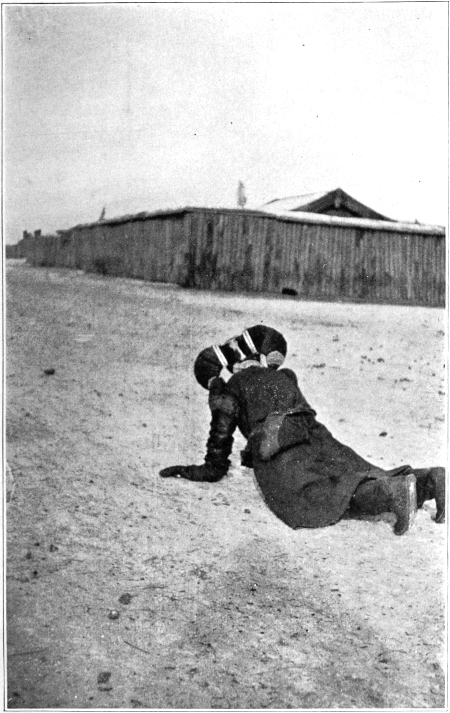
A PROSTRATING PILGRIMAGE
If he elects astrology, he will be instructed in casting horoscopes of unfailing value, in reading the stars, predicting their future stations and the coming of eclipses. He will be prepared to declare the reasons for visitations of murrain and to track the trail of straying camels.
Divers are the paths of knowledge, but all may lead to the honor of Grand Lama, head of a monastery, or member of the college of shabniars, who form the Council of the Living God. And when the great reaper has called the high priest from his earthly glory, a whitened tomb will be raised to his memory just outside some town along the camel-trail, while his ashes will be moulded into briquettes and godly images, to rest before the gods in the shrine of some soumé.
We have arrived at the gateway to the great temple. The wool-merchant disappears inside to work his pull. A young lama comes out to the door, smiles at the foreigner, and then goes in again, and you tremble lest your advent is being announced to some other than the one man who can supposedly be “fixed.” This is the most important temple of Urga, forbidden to foreigners, and seen through good fortune by a few only of the old residents. But every gate they bar to hate will open wide to love—and a ten-rouble note. The merchant comes back.
“We can go in while the lamas pray,” he whispers.
The uncle appears, with an expectant look on his face, and motions us in through the darkness to the anteroom of the temple sanctuary.
From the chamber curtained off at one side comes a low swelling chant.
“Service begins, you may see it from here,” the lama says, just above his breath.
Your station is in darkness, but just the other side of the curtain are the lamas, and their apartment is lighted by windows. Two rows of benches extend the length of their chamber, leaving an aisle between them, reaching from the door to the altar. A score of priests in yellow robes, with red sashes slung tartan-fashion over a shoulder, are sitting on these seats facing each other. They are ranged evidently in the order of their ages. Two old giluns, fluent in the Tibetan litany, sit next the altar. Then come younger lamas, the gitzul, not yet full priests. Finally next to the door are bandi, ten or twelve years old, intense in youthful delight that their part in the ceremony is to pound as lustily as they can the big prayer-drums. The service begins with the chanting of a ritual in form not unlike the Slavonic litanies of Siberia. At appointed times it is necessary to call the god’s attention to the fact that something is going on in his honor. At once a most deafening clamor begins. The small boy with a drum is drowned out by his big brother, further up the line, who officiates upon a huge wooden cornet, and by his uncle with the conch-shell or the cymbals. The droning of prayers is like the buzz of hiving bees. There seem to be no responses, but all of them read together. Presently comes a sudden clamor, almost like a fire-alarm; then the crash and the droning suddenly cease.
“It is over!” says the guide.
The lamas file out by a further door, and we tiptoe in to inspect the holy of holies at the heart of the great lama sanctuary. In the dimness one sees first before him the table for offerings, on which are the two main sacerdotal instruments,—a silver bell and a silver handle like a carving-knife-rest,—and row after row of targets made of dough-paste, of brass cups filled with oil to serve the tapers, of millet, rice, currants. Behind this altar, towering far up into the hollow of the dome, is the bronze colossus of the smiling Buddha, Maidari, the Future God.
Fifty feet in height, the figure is, cross-legged, with open, painted eyes. From Buddha’s hands hang long silken streamers. One of very fine quality is embroidered with the ten thousand gods.
“This,” the priest whispers, “is a present from the Dalai Lama.”
A great festival takes place in summer in honor of this god, who will rule a myriad years hence, when the race of giants descends to kill mankind and to people the earth with their own kindred. The Gigin’s elephant is brought out, and he himself takes the lesser dignity of a carriage in deference to Maidari. Even the gods of the present must honor the gods of the future.
The Gigin’s throne is to the left of the statue. It has triple silk cushions. Around are twelve colossi of Buddha, some ten feet in height, and entirely gilt save for the red lips and the eyes. The hands are held in differing positions, folded, outstretched, pointing. Here and there a silk scroll is hung.
The walls of the sanctuary are lined with shelves like a book-store, and these are loaded with statuettes of the ten thousand gods.
We tiptoe back the way we came, and are soon in the street of the monastery. The uncle has seen us safely away. We betake our route from the Mongol toward the Russian section.
“You saw the throne cushion of Dalai Lama?” the wool-merchant asks. “They have put it back now. Gigin kicked it out of the temple when Dalai Lama left. The Angleski drove Dalai Lama from Lhasa, and he came to Urga to visit Gigin, because here is the second great Buddhist holy place. Now Dalai Lama is very monkish, very austere, and always prays and fasts. But our Gigin”—here follows another expansive smile—“Gigin rode out with his Council, the shabniars, and took some of Pokrin’s best champagne in the cart, for they would not have it in Lhasa. Dalai Lama was very stiff. Gigin asked him, ‘Have a drink!’ Dalai did not understand, for drink is forbidden. Then he asked him again, and Dalai Lama refused rebukingly. They came to Gigin’s palace at the foot of the Holy Mountain, which is built like the Russian consulate. After the prostrations, Gigin said to Dalai that he had come far and few women were on the road and those mostly old and ugly. Dalai Lama refused that too. Cigarettes and snuff, and canned tomatoes he offered, but Dalai Lama refused them all. Then, in the Assembly of the Lamas, Dalai rebuked Gigin, and made him sit below his servants in penalty, for Dalai Lama is more of a god than Gigin. All the pilgrims came to offer gifts to Dalai Lama, and Gigin did not get his. For months Dalai Lama stayed here. Afterwards he went away to China. Gigin came to this temple then and kicked Dalai Lama’s throne, throwing it down. He celebrated in the summer palace when Dalai Lama left, for he was very happy.”
******
Mongol Urga is left behind, and we reënter the Russian town. A hail from one of the passers-by is not long delayed. “Will you have chai?” he questions. He is an alert-looking Russian, smartly clad in a shuba of green leather trimmed with sable.
“Must we eat any more dinners to-day?” we inquire.
“Only tea,” is the reply. It is not quite reassuring.
“That is Pokrin, the one that sells to the Gigin,” the wool-merchant whispers. “Go with him: he can tell you some tales.”
Obviously one must not miss the acquaintanceship of this modern Ganymede, cup-bearer of the many-bubbled French nectar and jugged ambrosia; so on we march to his compound.
Pokrin was on his way to a business appointment; but no rendezvous will interfere with prospective chai. He hangs his coat back on its peg, bids his wife start up the samovar, and produces the vodka-bottle. Yes, his family is very well, and he is very busy buying hides. We talk up and down and roundabout numberless themes, and at last venture: “The Gigin!”
“Ah, the Gigin was here to see me only a week ago.”
We bow our recognition of the host’s great importance, and he is started; soon he buckles down into the story.
“The Buddha came up in his carriage with his lamas riding beside him, and they tied their horses all around here in front. Then Gigin came in, walking softly because of his gout, and he said, ‘Let us drink together like friends, without quarreling.’
“I brought out the drinks, and we sat down,—Gigin and I with the lamas around us. Gigin likes best the strong drinks,—not vodka, but cognac and sweet champagne. Very many bottles we drank, Gigin and I. And at last I fell asleep. But Gigin drank still. Then he too fell asleep. In the morning the lamas carried him to his carriage, and back he drove to the palace, with the people lying down in the street as he passed. All the next day I had a very bad pain in my forehead, and it felt large.”
By non-Siberian standards Alexsimevich should be on the way to similar symptoms in the near future. For the purveyor to the Divinity has produced an assorted collection of his wares which are being sampled with due diligence. Cold meats and wheat-bread appear on the table with the samovar.
“We must eat, or he feels badly,” whispers Alexsimevich, as he makes a sandwich, an inch and a half through, which is about the depth of brandy in the Siberian highball.
Other neighbors drift in as the afternoon wears on. The talk turns to that greatest of local events, the Metropolitan Handicap of Mongolia, under the high patronage of the Living God. Things become decidedly stimulating, and the recitals lively. Everybody is living over the excitement, ejaculating and gesticulating. The child-quality in their minds keeps so vivid their impressions, that the scenes are projected almost as by a cinematograph.
From hundreds of miles around, the herdsmen have assembled. The plain before the city is a riot of color, as the horsemen ride here and there. In the centre of the field is the gay pavilion for the yellow-robed bishops and cardinals from distant lamaseries, guests of the great Gigin.
All through the morning, hundreds of riders and horses have been making for the starting-point, twenty li (about seven miles) distant. The jockeys are the smallest boys available: young red-cheeked lamas, perched bareback on the shaggy racing-ponies. The monks, who are stewards of the course, have with much shouting finally, at the hour, lined them up in a long row, facing Urga. One thousand ponies have been reported as entering. It is a regiment of boys. A signal starts the whole cavalcade together. The thousand small jockeys shout at once. A thousand whips come down on flanks. Two thousand heels dig into the ponies’ withers. Over the irregular plain tear the racers, dodging around gullies, stumbling in marmot-holes, galloping helter-skelter amid furious yells. At length they come within sight of Urga. Crowds, mounted, have gone out to follow them in. The shouts redouble, the people become frantic; the riders yell at one another, and the horses are as wild as their masters.
Shabniars and cardinals get to their feet as the cavalcade appears. The Living God’s heavy eyes brighten up with interest. His chief soul-mate waves a jewelled hand and chatters excitedly with a lama of the guard. The foremost rider is close at hand now, the jockey, wriggling like an eel and almost on the neck of his pony, yelling and slashing. The field thunders behind. The leader nears the pavilion, his pony is on the fierce final spurt,—a last cut of the whip, and in triumph, amid the deafening roar of the populace, the winner passes the line. Many other riders come in at his heels, but most straggle off to either side of the course when they see that the finish is lost. The victor is caught up by the priests and is brought before Gigin, where he lies on his stomach in adoration. He receives a gift, and is pensioned for life. The horse’s owner receives a good price for the animal, which is added to the Gigin’s stable. The mule-cart of the Buddha is then brought up and he is loaded in. The yellow bishops mount their steeds, and back to his palace goes the Living God. Thus ends the great Urga race.
There are other athletic tournaments during the season; most important of these is the championship wrestling-bout, which every year decides whether laymen or clergy are the better sportsmen. The Gigin’s pavilion fronts a ring, with dressing-tents on either side. From one emerges a layman. He advances by huge jumps and prostrates himself before the deity. Next, palms on the ground, like a great frog, he leaps into the ring. The chosen lama executes the same pass from the other side. They meet, jumping like game-cocks, with quick breaks. At length the clergyman gets a leg. In an instant he heaves up on it, and over goes the black man,—out! The whole assembled populace raises a stupendous howl. Bout succeeds bout, with differing champions and varying issues. Partisanship is intense. The clergy usually win in these matches, and have long held the championship.
One guest tells to-night of the photographer who bribed a lama, and got the first photograph of Gigin. The tale runs that this man, a Russian, secured admission among a crowd of pilgrims, and snapped the god, unawares, among his entourage of priests. This photograph, enlarged and colored, is the one now hawked to the Mongols, and which they set up for worship among their other gods. The lama was beheaded, they say. That was several years ago, however: since then Gigin has been photographed at the races and elsewhere.
At last we break away from the group and return to our lodgings at Varlakoff’s.
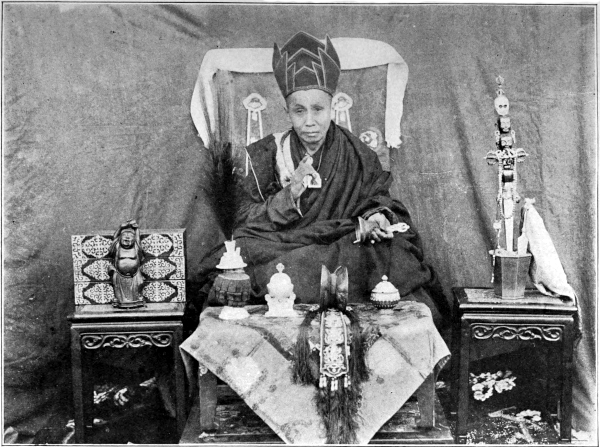
A GRAND LAMA
We are informed next day that among the invitations so lightly and uncomprehendingly accepted was one to take dinner with the mayor of the Russian settlement. We are expected therefore toward evening. So, late in the day, we gird on our greatcoat and move out heavily. Down the street we fare forth to the house of the host. A fine well-fed man is this mayor, with the cordial grip and the slow smile of good-fellowship. He wears a very long beard. He has taken a fancy to the embroidered green and pink Chinese ear-tabs as a substitute for the big fur cap of his own people. The ear-tabs are about as appropriate to his burgomaster build as baby-blue ribbon on the tail of a fighting bull-pup. Otherwise, deerskin boots and hunting-coat, he is the real Siberian. In the mayor’s large sitting-room, along the wall against which the table stands, is a rank of bottles of divers heights and fatness, like recruits out for their drill. The samovar of shining brass leads the array. Four different-sized glasses stand at each plate, and the intervening area is covered with platters of sausages, cheese, bread, sprats of every conceivable variety, and a medley of cold zakuska dishes.
The mayor reaches for the vodka.
“Please, none!” we blurt out.
The mayor looks hurt. Then an idea takes form in his head, and he shouts something to his Chinese boy, who promptly shuffles through the door into the street.
Out of the window we catch a glimpse of him turning into the establishment across the way, where Pokrin’s clerk sells the wherewithal to make a Russian holiday. The Chinese boy emerges with a bottle, and trots back across the street with the curious gait made requisite by the unattached thick-soled slippers. He shuffles into the dining-room and makes space for one more bottle. Whiskey! The mayor has bethought himself of the English label, and has sent for it, on the theory that not to drink, like not to sleep, is unbelievable.
Evidently one must again sidestep, so chai is besought and got down. Our virtue is rewarded, for the host smiles and is content.
“Poor Pokrin!” he says presently, reminded of the man by the beverage. “He made over a hundred thousand roubles from selling things to the Gigin. But now he can’t think of any more things to sell. You saw the Gigin’s new droshky? But that isn’t like selling an elephant or an electric-light plant. Pokrin is down to pelicans and fountain-pens.”
He shakes his head sympathetically, and reaches anew for the vodka-bottle. He goes on reminiscing, half-cynically, half-regretfully, of the past, while dinner to serve the appetite of a Cyclops keeps coming on.
In the midst of the repast cries arise outside. A Mongol with a flow of language is heard calling aloud for “Bulun Darga!” (fat policeman.)
“They are after me,” says the mayor resignedly.
The Mongol comes hurtling in, pushing past the Chinese boy.
“Fat policeman,” he cries; “Red Mustache and Long Nose and Blue Coat are drunk, and are disturbing my gir. Come quickly, O Lord, fat policeman.”
The mayor sighs. “I go”; then he turns to us. “Will you accompany me?”
“Gladly, if we don’t have to eat any more.”
The mayor considers this a back-handed compliment to the amplitude of his hospitality and smiles.
“V period, it is not far.”
He puts on his huge greatcoat, draws on his ponderous boots, takes a heavy stick, and in vividly embroidered Chinese ear-tabs stands ready to follow the Mongol. We shoulder open the felted door. From the low-ceilinged recess between this and the outer door he produces two other big sticks, like pilgrim’s staves. These he hands to his visitors.
“For the dogs!” he explains.
The Mongol’s hut is soon reached. It is in frightful disorder, and vodka-bottles are strewn around. The mayor looks up in a little book to see if Krasni, young Agueff, and Pugachev are not, as he suspects, the men who in native nomenclature are called Red Mustache, Blue Coat, and Long Nose. He finds that he has rightly surmised.
“I know them,” says the mayor. “They will come around to me in the morning. I will tell them to make the Mongol satisfaction. When they come back and say he is satisfied, I tell them to be good and to do this no more. Nietchevo!”
The irate man is jollied along, and is told that it will be fixed up soon. Consoled and soothed by the protection of authority, he admits it was not so bad after all, and he bids us, as we leave, a grinning “Sein oh!”
“Now,” says the mayor, “will you not come and see Urga at night?”
He leads along an icy back street, black as a canyon, with the bulging mud-plastered walls, twenty feet in height, so close that a cart can barely pass between them. Not a light is seen save as a ray pierces the shuttered planking of some compound door. Distant clanging of cymbals and far-off echoes alone break the stillness. Out from the gloom of the street we come into the open piazza, half a verst wide. It is unshadowed, and less dark. Threading the heaped-up refuse we stumble on. The black crows, with lancet-like blood-red beaks, which search the heaps by day, are gone. The black cannibal dogs wake and growl as we approach.
“They are afraid of a stick and don’t generally attack people. But, if several do come at you, crouch down and stay perfectly quiet,” the mayor counsels.
He then tells of the Cossack who last year, passing by a dog that did not move aside, drew his sabre and struck the beast. As soon as the other dogs smelled the fresh blood, they became mad, and half a dozen came at him. He put his back against the wall and slashed among them. Many he cut and wounded, but more came and more, in an instant. Soon he was pulled down, for hundreds were upon him.
A big black-furred brute looks insolently at us as we pass.
“They do not bury the dead here, you know,” the mayor says. “The corpses are taken to the mountain northward outside the town, and are left. It is cold to-night. There will be death in the market-place where the poor lie shelterless. And the dogs wait beside them.”
A little way off, where the prayer-wheel stands, is the twinkling light of a shrine. The new moon and the few brilliant stars are frigidly distant. They cast a pale white glow now on the dimly outlined walls and huts. A beggar, lying unseen, calls suddenly as we pass his heap of sodden hides. The six-foot Siberian hunter by our side cries out as he stumbles over and beholds a something, partly eaten, guarded by a great cannibal dog.
If the thought of the rights of man has drowned sympathy with all that concerns the government of Russia, visit Urga at night, and the Cossack of the Russian Guard, swaggering along among the Chinamen,—this Cossack whom you have heard execrated as the “knout of the Czar,”—will look to you like a Highlander at Lucknow. The chance to absorb an unwholesome amount of tannin by way of a samovar, and to sleep on the floor beside the oven in the whitewashed house of Michael Varlakoff, will become a privilege more prized than any possessed by His Holiness, the Living God.
The section of the Russian colony in which we have been lodging consists of five hundred-odd traders. They have drifted down from Siberia, and on the free ground of taxless Urga have established their shops of gaudy European cloths, enameled cooking-utensils, candles, and cutlery. These Russians, whose whitewashed many-paned houses fill a quarter of the town, have not the large interests watched by the English merchants, who dot the globe with their agencies. They are small Trans-Baikal shopkeepers, transplanted bodily. They build their houses in the Siberian way, and their wives toil personally at the oven. They wear blouses and felt boots as the house-dress, and keep the ikons in the corner. Prosperity is evidenced in the striking-clocks, the lamps, nickeled samovars, and curtained double windows. But they are still not many removes from the peasant.
There is, however, another section of Urga’s Russian colony, grouped around the consulate, a large compound situated a verst east of the Mongol town, which was built in 1863, and was fortified in 1900, against the Boxers. Within this compound are the Orthodox Church, the Russian doctor, the rooms of the twenty Cossacks of the Guard, and the great empty barracks of the two sotnias that were sent here in Boxer times, and were, to the regret of their compatriots, later removed. The barracks are still ready for any future visits, and the breastwork, with its stake and fosse lined with barbed-wire, is equal to any force which from a five-hundred-verst radius can assemble against it.
In this quarter, the Russian consul is autocrat. He is the official notary, without whose stamp no contract is legal, the chief of police, the guardian of orphans. Around him revolves the society of the few dozen mondaines of Urga, whose personnel consists of the officials, the garrison officers, and some half-dozen commercial agents, single generally, or with distant families. They conduct their bachelor quarters through Chinese servants, and their cuisines are helped out by all the canned and bottled delicacies that can be ordered from the frontier. The gold-mines, and the extensive wool-trade which produces a commerce of twenty to thirty millions, demand that first-grade men watch the interests of the great companies which handle the business. So men of the best cosmopolitan Russian type come, at salaries proportioned to their sacrifice. They gather in the consulate evenings, or sit in the fenced-off boxes at the theatrical performances, which periodically come down from Kiahta.
A few families who have made their sixteen-day camel-trip from Kalgan and Peking have foregathered here with their household goods and gods.
Buttressed by the companionship of books, this other class lives in splendidly-furnished rooms, with pictures purchased in Paris, statuettes from Rome, and grand pianos drawn for days over the passes by laboring oxen. One converses at the consulate in French, the mother tongue of none, but the common tongue of all. The few favored guests, who are invited of necessity over and over, play chess endlessly in the evenings. The ladies read the latest French novels, or sing the songs that distant friends have sent from the Riviera or St. Petersburg.
They drive in imported carriages and sleighs for the afternoon airing, and bemoan Nice and Monte Carlo in winter over the pages of Zola’s “Rome.” The men subscribe extensively to English, French, German, and Russian periodicals. They invite such relatives as can be persuaded for lengthy stays, and shower a guest with the hospitality of old claret, caviar, and the varied courtesies which the rarity of visitors from the world inspires. They take long adventurous horseback trips in the dull season,—explore forgotten monasteries, study the Tibetan inscriptions, print monographs on the folk-tales, and dream of promotion and Petersburg.
The consulate has one uniquely circumstanced personality, whose career is a romance of Eastern adventure. Born in the Baltic provinces, he studied in the Oriental training-schools, and entered the Russian diplomatic service at Peking. Here he applied himself indefatigably, until he knew the Chinese language as did hardly another European. He could write the ten thousand ideographs, and could speak flawlessly the Mandarin and the popular dialects. He went to Mongolia and mastered its languages also,—its spoken idioms and its written grapevine letters. Then, with his diplomatic entrée, his knowledge of men and tongues, and the initiative of an adventurer, he launched his grand coup in the palace of Peking.
He carried away the sole right to the gold of two eimucks, a territory as large as France. Not a Chinaman may pan the metal, not a Slav may open a mine, save through this concessionnaire. A third of all gold washed,—these are his terms to those who would lease from him; just double what he pays the Peking Yamen for his privilege. Fortune upon fortune he is reported to have made, and the Chinese gold-washers and the Russian miners who lease from him have gathered their own stakes, too, despite the Cæsar’s tribute which he exacpts of all that they produce.
He has spent large sums in bringing down machinery, to do on a great scale what the shallow veins of ore demanded should be done on a limited scale. An abandoned gold-dredge lies far up the Iro River, transported piecemeal at exorbitant expense over the hills. Traction-engines are here, which could not cope with the Mongol roads. They consumed forty days going one hundred and twenty miles to the largest mine. Now they lie rusting in their sheds. Thousands of ox-carts were engaged for hauling in the various purchases. River steamers and great oil-drills scattered over northern Mongolia are relics of his ambition.
His brick house, finely furnished, and his brick smelter stand hard-by the consulate. The Russians tell of masons imported from Sweden to build them. The life-history is a bizarre record of great things attempted by a man whose overleaping ambition stopped nowhere, and whose expenditures more than once brought him down. But his interesting meteoric career continues, and twenty pud of gold are said still to come down yearly from the mines to the most picturesque character in Russian Urga.
We drive down with one of the officials, to be present at another of the events in Urga’s meagre happenings—the arrival of the mail.
The Russian post, one delivery a week, crosses Mongolia. The horses bring in three mails from the Russian frontier. From Urga to Kalgan, the camel-post guarded by Cossacks, traverses the great desert of Gobi. Save the Imperial Chinese telegraph, it is the only regular method of intercourse with the outside world. The two thousand-odd roubles a year paid by Russia as a subsidy are a small expenditure for the opportunity of accustoming the people to her service, and for controlling the avenues of news and communication.
The post-office is at the consulate, and a new postmaster has just been installed. Thereby hangs a tale which is poured into your ear before your stay in Urga has been much protracted.
A telegram came from Irkutsk to seize and bring to Verhneudinsk as propagandists the postmaster’s son and daughter—twenty-one and eighteen. Twenty Cossacks surrounded the house at three in the morning. The two were arrested, taken to the mayor’s house, and lodged there. The next day they were started on the trail to Kiahta. Once over the border, there would be no more hope. Quickly the leading men of the colony assembled and telegraphed the Russian ambassador at Peking, knowing that if the ambassador had official cognizance, he could not safely authorize an arrest on Chinese soil by the Cossacks of the Guard. The response was delayed, but there was pressure enough upon the consul to get the prisoners held at the mining-camp beyond Iro until the answer was received. At length the ambassador replied that Chinese suzerainty must be respected. The two were free. But the father had been advised to resign his post and accept a station which was offered him at Kalgan, where there were only three Russians, all warranted proof against propaganda.
Beyond the Russian consulate, six versts, is the Chinese town called, as are many of these trading-posts, Maimachen, or place of trade. One can get there by the solitary Cossack-driven droshky that the Russian colony supports. But more appropriately we go on pony-back, borrowing an army-saddle and a purple fleece-lined shuba, whose skirts reach around the knees, and whose long sleeves fold over the hands, keeping a rider reasonably warm in cold weather.
The houses of Mongol Urga are soon left behind, the stockaded lamasery is passed on the left, and we are on a big open plain. A few minutes’ gallop takes us past the consulate. Beyond it stands a compound girded by a stockade of saplings, within which are the low mud walls of straggling houses, amid which the gilded eaves of a more pretentious residence lift themselves above the rest.
A troop of pig-tailed horsemen trots past: the white tunics of the riders are covered, back and breast, with red ideograph letters, which stigmatize the bearers as of the lowest caste—soldiers of the Celestial service. The man in front holds aloft a gilded pear-shaped standard, and between the ranks lumbers a covered cart with closed shutters. The cavalcade wheels to the right and turns in, dipping the standard as they pass under the gargoyle-tipped beams of the gateway. Servants come running out of the great house. From the cart is helped down a Manchu of pallid face and short gray mustache. That wooden house, girded by mud huts, is the seat of government for this greatest eimuck in Mongolia. The figure robed in cheap blue cotton is lord of life and death, the Zinzin, Viceroy for the Emperor of China.
This Manchu Viceroy, and his Tu-T’ung, or lieutenant-governor, who represents Chinese authority in the city of Kalgan, are responsible for the collection of tribute, the administration of justice in the cities, and the maintenance of order. Over the Chinese inhabitants in the Maimachen the rule through the agency of the prefect of police appointed by the Viceroy is direct and absolute.
Over the Mongols, Chinese rule is exercised in an irregular nebulous fashion, with some force in the centres and almost none in the outlying districts, where the old nomad organization of society, with princes, barons, or tai-tsi, clergy, and ordinary black men, still persists. A code of Chinese laws exists, but in general justice is dealt out by the local princes, or guns, who receive also the cattle-tax in some districts, and who go by turns for a year to Peking in symbol of homage.
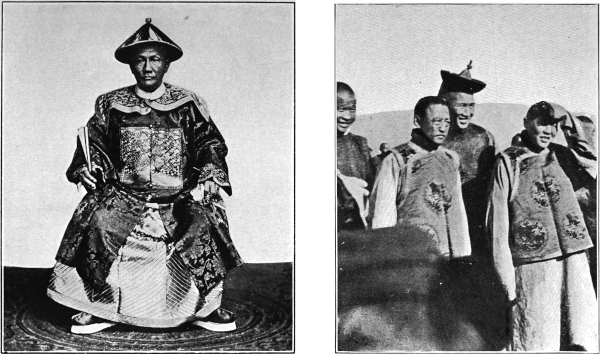
CHINESE MANDARIN GIGIN, THE LIVING BUDDHA
These Mongol guns, ruling over each of the hushouns, or counties, which compose the eimucks, are under feudal obligations to the Chinese Emperor. Their visible subjection to China consists of ceremonial visits with tribute, for which the Emperor’s return gifts are of far greater value. A total of one hundred and twenty thousand lens of silver ($90,000) goes yearly from the Emperor to the nomad nobility. A khan of the first rank receives two thousand lens ($1500) and twenty-five pieces of silk; lesser gentry in proportion.
This primitive aristocracy lives in barbaric state, with splendid carpets, silver-inlaid furniture, and jeweled accoutrements. The women are sometimes very good-looking. They are laden with ornaments, furs and silks, and have a spot of carmine on each cheek, which is the prerogative of a princess. But the normal imagination does not go beyond the gir as a dwelling. Finely fitted it may be, yet it remains a one-room hut, with the open brazier in its centre. Their wealth is in ancestral ornaments, and in the flocks and herds of their private domains. Their one relic and memorial of a past sway lies in the custom under which the Chinese rulers call by the old Mongol names the eimucks, which were the ancestors’ kingdoms. That of which Urga is capital still bears the name of Tu-she-tu.
The Mongol lords are responsible for the feudal army, and a caste of bannermen exists, who are paid nominally two ounces of silver per month and a supply of grain, with the corresponding duty of keeping their bows and arrows in order. In the Tu-she-tu khanate of the eastern Khalka tribes, there are twenty banners, each under an hereditary yassak, or tributary prince. In 1900 some banners of the Barukhs turned out to fight Russians, but they made no showing whatever, and hurriedly returned after a skirmish with the Cossacks. Spears and arrows are the only weapons the Mongol army can show.
While this feudal system applies in general to the whole eimuck, in Urga the Gigin has a unique position. The city is a great monastery, practically all of the permanent native population of fifteen thousand being priests. The laymen who are there are mostly pilgrims, or dependents upon the Church. Over these the Gigin is master, so that Urga is known as “The Holy Living God’s Encampment.”
Over the Russians and the Buriat tribesmen, the Chinese have no actual sway, and from them they collect no taxes. The Russian consul is dictator to this little flock; and behind his stockade, where the tricolor waves, rally the Orthodox in times of danger.
Across from the Zinzin’s doorway is a spiked stockade. Inside, where they have been thrust through a hole just big enough for a man’s body, are the miserable criminals. In the big pit dug with their naked hands, the wretches cower, shelterless, under the terrible cold of winter. They live or die there, sometimes fed by the charity of Mongols, sometimes forgotten, sometimes purchasing miserable fragments of offal with the unstolen remnants of the prison allowance. Few waste sympathy on the inmates. The low level of existence of those outside makes the place perhaps less terrible than it would be to people who had known other conditions. It is a grim Chinese jest, this loathsome prison for those who have stolen bread in the market-place, set opposite the palace of the grafting governor who has filched the tribute of Tu-she-tu.
From the Chinese city now, there begins to come the distant throb of drums and clash of cymbals. Three gorgeous Mongols gallop past in their splendid free-reined horsemanship. A sentry stalks to the door of the stockaded prison, and looks toward the gray walls and temples of Maimachen. The procession of the New Moon is to pass to-day.
You leap onto your little Mongol riding-pony, and spurring him into a gallop, hasten along the way to the Chinese city. He tears down the broad road. The resplendent trotting horsemen take the pace as a challenge, and yell joyfully for a race as their whips come down on their own horses’ flanks. Mongol girls walking hand in hand along the highway scatter and call out as the riders clatter by. It is contagious. Soon a score of riders are shouting, shaking bridles, and lashing ponies, and it is a cavalcade of racers that gallops up to the gate of Maimachen.
How different is this Chinese settlement from Mongol Urga! It is a magnified replica of the city at the frontiers. Instead of the straggly avenues a hundred yards broad, with cañon-like alleys flanked by high mud walls, all the streets are so narrow that two strides cross them. They are lined with miniature booths. Through the bars of their paper-paned windows one sees the little delicately-tinted pictures of pagodas and of Chinese girls, in quaint sweeping outlines. Red and black and gold, the New Year placards flame on every post and wall. Lanterns are hung before the gateways; green saplings stand sentinel by the doors; and in the unshuttered compounds innumerable lines of gaudy banners are seen, strung from side to side across the courtyards. From the houses come from time to time a thrumming and a picking of strings in minor music, broken by an occasional clang of cymbals or a drone of beaten drums. You pass a temple of marvelously carved wood, wrought into curves and flowers and arabesques, with eaves turning out into open-mouthed dragons. Everything is brilliant in paint and gilt—a blazing kaleidoscope of color.
In a friendly courtyard the horses are tied, and you walk into the teeming streets. All the Chinese of Maimachen and half the Mongols of Urga have come out to-day. Here is a little shifty-eyed Chinese clerk, in his low shoes, with white soles several inches thick, his white stockings, tied at the ankle, showing below the baggy trousers.
Here is a young Mongol lama, who hails you gleefully with a Russian word which he has learned from a Buriat, and points out where the procession will emerge. A Mongol woman passes, gorgeously dressed in flowered yellow silk, with red, sable-cuffed sleeves so long as nearly to touch the ground, and her head cuirassed with the burden of silver ornaments. She smiles at the burly Mongol camel-driver who so openly admires her.
A Chinese merchant, with red-buttoned cap, attended by a servant, is pushing through the crowd. His looks are surly; perhaps he is thinking of the whereabouts of his own establishment in this carnival.
Though the rich and wifeless Chinese may acquire Mongol companions, they cannot buy or give affection. For a poor Mongol, who has the sincerity and humanness which the Chinaman withholds, one of these Mongol concubines will either deceive her master, or, if he object too vigorously, will strip herself of his presents and go to her lover’s gir.
A big Celestial with a fuse comes hastily through the gateway from which the procession is to emerge. The crash of his firecrackers startles the Mongol ponies pushed close along the houses. Beneath the multi-colored gateway, next pour out a score of horsemen with pennanted spears. They ride two by two, in white coats with red letters on their breasts. Then comes a crowd of footmen, who fill the street in a torrent. The curious Mongols press to each side, and watch the procession of their alien overlords. Two ranks are robed in vivid red, and carry poles with big gold knobs. Blue-coated Chinamen, with cymbals and shrilling fifes, follow; then come more horsemen; then the great silken umbrella, and a gray-mustached dignitary on horseback,—the chief of police; next, more fifers and wand-carriers, six abreast. With fireworks and clashing music, the vivid ranks in red and blue, and yellow and gold, and green and purple, and every other conceivable combination of hues, make their way around the stockade and back again through the gated city.
The crowd seems to be trending now toward a brilliantly colored archway spanning the main street. With the Mongol holiday-makers we follow along into a cloistered courtyard flanked by peaked temple-like houses. A crowd of Chinese is pressing around some one clad in blue, who has just stepped out between the beater of a tom-tom and an artist with a big pair of cymbals. A preliminary flourish introduces the performer—a pasty-faced young Chinaman. He starts a rhythmic chant whose cadence is within a note or two of one of the old crooning Negro melodies of our South. Over and over again he chants it. A poet this is. He has conned his verses, and now comes out to sing them. He ends with a special swirl in what is evidently a very comic climax. The drum and cymbals crash out once more, and another chanter comes—this one old and feeble, with a curiously penetrating voice. He drones a long hexameter-footed epic, in which the harsh Chinese gh and wh sounds are not so coarsely enunciated as in the poem of the first reciter. “That is one of the old legend-singers,” you are told. It is such a ballad as Homer sang, or the Welsh bards chanted. It is the poetry and the history of the long past, the immemorial past, far before the infancy of other nations; for China keeps alive her antiquity, and in her old age never forgets.
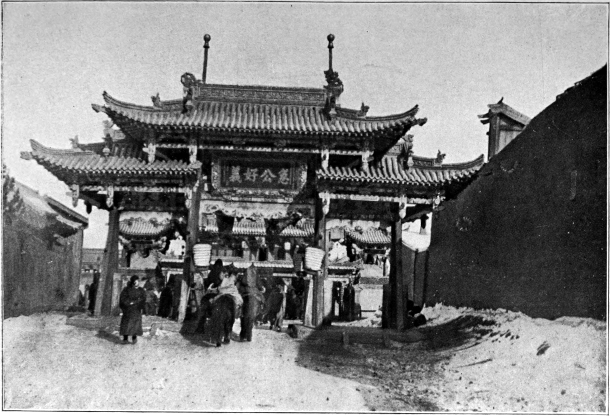
CHINESE ARCHWAY, URGA MAIMACHEN
This week there can be no buying or selling. The Moon must be honored, but visits are in order. Your friend brings you to meet a leading Chinese merchant. At the house, a grille of thick wooden bars runs down to the street level from the eaves just above one’s head. Looking through them, one can see over the little square window the most delicately-traced pictures on a white background. The panes are of paper, all save one, which is of glass, so that the owner may see if, coming down the street, any one turns and climbs the three steps into the ordinarily wide-open door of his house.
The home of our host, which is likewise his office, is finely fitted up and faultlessly clean. His light-blue silk robes are immaculate. Two servants wait at table, bringing in the best of China tea and French “petit-beurre” biscuits for our delectation. Everything is appetizing and orderly.
As we are sitting over the cups with the Chinese merchant, the boy comes to announce visitors, and two blue-robed fellow countrymen enter. One has a strip of light-blue silk laid over his two arms, which he stretches out. The host extends his own arms and receives it, then gives it back to the newcomer, who goes down on one knee and again presents it. The merchant takes it a second time and bows, this time retaining it. The two guests bend and leave the room. “New Year’s presents,” the merchant explains. Again the boy comes in and announces a guest. A Mongol messenger enters, goes down on one knee, and presents a red slip, black-lettered. “Visiting-card,” the host explains. Then, with a smile, “White, like yours, not polite.” He accepts this too. “Ch’ou Ta-tzu!” (the dirty Tatar!) he says as the latter leaves.
The calls continue, and our visit. The host is charming, cultured, educated; he speaks English well, and lacks in no attention. But you wonder if, when you leave, he is not going to murmur about you, “Yong-kwei-tsz!” (foreign devil!)
Throughout all intercourse with these Chinese, one has always the uneasy consciousness that one is doubtless, as with the card, unwittingly offending. There are three hundred rules of ceremony, three thousand formulæ of behavior, regulated by a classic tradition. The ritual is so drilled into the Chinese as to become instinctive. Celestial breeding would dictate that the little formalism which precedes a rubber, “May I play to hearts, if you please?” be stretched to cover every action of life. The left, not the right, is the place of honor, and to enter a room facing wrongly is a slight. An irregular method of folding a red New-Year’s card, and the failure in writing to raise one character above the level of the rest, are breaches of etiquette.
For our race there is always felt, behind the soul-mask of Chinese eyes, a contempt. The kindness of our host to-day is unfailing. Yet we are not at ease or sure of the ground. Errors, condoned to keep face, are often inwardly resented. If you put your hat on the Mongol’s altar, everybody in the hut will yell out for you to take it off. When you remove it, they will nod understandingly as the interpreter explains that the ignorant foreigner transgressed inadvertently. Forthwith all is forgotten in an enthusiastic discussion of the last case of botts among the horses. But with these Chinese one can never tell if, by taking a chop-stick between the wrong fingers, one has not intimated that the host’s grandfather was a cross-eyed coolie soldier. No one will challenge or set a man right, but the breach will be silently resented, though the tea continues to be smilingly offered.
The old-time Chinese dealers at Urga grew enormously wealthy in the tea-trade to Kiahta. These have mostly gone back to China. But there are still a number of the better-class merchants whose wares are sold to the traders and by them to the Mongols. The house of Liu-Shang-Yuan claims two hundred years of establishment. The Urga people are still prosperous, for great sums in religious tribute come from all Mongolia to this Lourdes of Lamaism. There are also many Chinamen who make large profits from wool.
Of a total trade in Urga estimated at twenty-five million roubles per year, nine tenths is in the hands of Celestials. The remainder is Russian, for the Mongols are entirely without a merchant class. Of the exports, wool is the main item. Some two hundred thousand puds are sent from Urga annually, four fifths of which go to the United States. While cotton cloth, cutlery, kitchen-utensils, and other European goods come down from Russia, the bulk of the imports are brought from China by caravan, through Kalgan. Silks come from Shanghai, and tea from Hankow, passing via Peking. There is trade, too, with Ulasati in western Mongolia. It is the centre of a fur and hide country which is isolated from outlets toward Russia by the high mountains, and must send caravans to Kiahta. Its communication with China is either by Urga and Kalgan, or by the caravan-route further south.
When the holiday-time is over we see more of the Chinese traders. Sitting in the shops, with one of these, and glancing out over the little counter of the sales-room, we converse as the customers come and go.
The Russian in his shop shows all he has of wares, the red and magenta cloths, the enameled kettles, the cutlery and sweetmeats. But the Chinaman wraps his goods in hieroglyphic-covered papers, and all that can be seen are rows of long-stemmed brass-bowled pipes, and an array of silver and bronze teapots on shelves at one side. Very rare things, too, our Chinese host can produce. Shanghai silks of finest texture, ten roubles the arsheen; jade mouthpieces for the pipes at a hundred taels; Hankow tea culled from the tenderest shoots. Everything is labeled and systematized in the Chinaman’s place, and he goes at once to the packet which he wishes to show.
A dozen Chinese, with bright blue silk jackets over their black surtouts, invade now the home of the merchant. The red knot on their black skull-caps and the length of their queues and finger-nails show them to be men of some importance. They take off the bright-colored ear-tabs as they enter. They are down to buy wool. To-day they visit, next week they will trade. Then all but one will sit in the outer shop, while the spokesman alone will go into the inner room and confer with the merchant. From time to time the spokesman will go back to the party and consult, till in the end the bargain is made. They will all hold to the agreement, too, whichever way the market goes. For in this the Chinese are inflexibly honest. A local Chinaman dispatched a mounted messenger the six versts to Urga, to return to us twenty kopecks which he had overcharged by a slip of his abacus-adder.
Yet the Scotch engineers saw shells in the arsenals loaded with clay when the native troops went against the Japanese. The English miners in the Province of Shan-tung have had their profits cut to nothing by the official “squeezes,” and Chinese have bought in the depreciated stocks.
The ethic code of the squeeze seems to be very nice. It is a point of honor, almost always scrupulously observed, that the first-fruits of official graft go to repaying the one who advanced the money to buy the office. A Chinaman, who could not be trusted to administer honestly a trust fund of a hundred taels, will repay this obligation to his backer. Thus must he keep face.
From the tax-appraiser who numbers the sheep to the civil governor who receives the lumps of silver tribute for transmission to Peking, every official gets his squeeze. They say in the eimuck of Ulasati, where sables are part of the tribute, that the officials take out the best furs and put back poor skins to keep the number the same; and in Urga, that the enormously rich administration takes a Tammany third of the tribute. There has never been a viceroy yet, it is reported, who has left Mongolia poor. Yet each official plays straight with his backer, his “belly-band.” Very curious is this race, and there live few Westerners who can at all understand it.
We ride back in the evening from the Chinese city (for none may stay for the night), buried in recurring reveries. How brightly glitters the face, and how barren is the heart in Maimachen! Never the thousand ties of kinship and affection, never the thrill of citizenship, never the love of a home. How little generosity, too, or sympathy for the people of the land! The Mongols are but “tame barbarians,” as of old were stigmatized the tributary Formosans. Now and then one finds a Chinaman out among the nomad Mongols. Perhaps he may be a watcher at a distant temple, perhaps a telegraph-operator on the two lines that go, one to Kalgan and Peking, one to Kiahta and Russia. Always he is something solitary—different. There is an almost sinister splendor in this aloofness—this self-sufficiency of walled cities and compounds where none but Chinese may dwell. What a rebuff of nationhood in the gates that shut out at night all save the alien outlanders! What contempt in the law that no woman of China may come among these Mongol people, as if the very air were contamination! How the natives are silently despised, whose bodies in death go to the dogs, while the Chinaman’s, in a casket, is sent back over the long leagues to his home!
The homeless, wifeless, Chinese city, with the quarter of Mongol women without the walls,—it is in many ways typical of all Chinese rule in Mongolia. For, as the Celestial trader defaults in the duty of marrying the Mongol mother of his children, so China defaults in many of the duties that are inherent in suzerainty. One resents the heavy Chinese yoke on the necks of these simple frank-hearted Mongolians. They are a race of great good-humored children, and they are exploited while disdained.
We are thinking of this unfairness as we ride back along the road to Urga. Behind is the distant Chinese city, the Manchu Viceroy’s straggling palace, the picketed prison-stockade. Before is the drooping tricolor banner of the Czar, and the white and green of the Greek Church, with its far-seen golden crucifix. A crowd of brilliantly-clad Mongols, lamas and laymen and girls and youths, are strolling back from Maimachen. They are laughing and chattering, and in uncouth playfulness are pushing one another about across the road.
Half a dozen of the Zinzin’s Chinese foot-guard are likewise coming from Urga, stolid-faced, superior. As they reach the tumultuous band it sinks into silence, and the men crowd to the side of the road that the Chinese may pass.
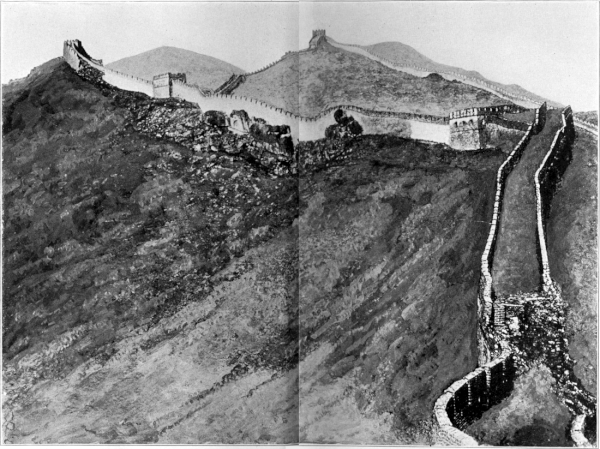
THE GREAT WALL
(click image to enlarge)
They tramp by without a glance. Then out from the Russian barrack-gate swings a little Cossack in his great black sheepskin hat, gray tunic, clattering curved sabre, boots and spurs. He is one of the Zabaikalskaia Buriats, whom Russians call Bratskie, the brotherly people. He speaks a tongue so similar to the Mongol that all these people can understand him. They look up to him as a rich relative, fortunate in overflowing measure. For on the pilgrimages of Buddhist Buriats to Urga, their wives have told the wondering Mongol women of the sewing-machines which they have at home to stitch linings, and have allowed the visitors to peep into their mirrors. The Mongol men have admired the Buriats’ breech-loading rifle, worth six horses at current quotations. They have enviously heard tell that in Russia one pays no cow-alba, but the young men get a uniform and free food when they ride out to give their Cossack service to the Czar. They have listened to Buriat boasts of the warm houses of Siberia, and stacks of hay, and stored-up harvests. So Mongols smile when the Buriats come to their girs. They say, “Rich smooth Buriats! Great lords! Give candle, give sugar, give tobacco, give vodka.”
Has not a little Zabaikalskaia Buriat reason to swagger when he starts from the Russian barrack-gate to see his lady in Urga? And should a Cossack of the Czar step aside for a Chinaman in the shadow of the Eagles? Head erect, with a look to right and then to left, hand on sabre, he swings straight down the centre of the road, and right through the Chinese soldiers. Without dispute they open a way. He chucks a not unwilling girl under the chin as he passes the Mongols, and he is good-naturedly hailed by the rest: “Hello, Cossack! Why so fast? She has gone away with a lama.” And he goes a bit faster toward Urga.
These Cossacks, terrible in war, friends and equals with the conquered in peace, are those who have held the Russian vanguard in this march to China,—the march which began when the two hatamans of Moscow, commanded by Ivan the Terrible, started in 1507 on their long tramp eastward. The Cossacks it was whom Yermak led to the conquest of Sibir. Through them, in storm and stress, despite oppression and convict-gangs, with faults and failings, omissions and commissions, the advance of Russia has been the way of civilization where none could otherwise have come.
“It will mean much when a Russian railway follows our trail from Kiahta,” says Alexsimevich; and André adds: “They will all be glad when the Cossacks come to Kalgan.”