IV
Reading edition
SLEDGING THROUGH TRANSBAIKALIA
THE sledge-route that leads to the Chinese frontier goes southward from Verhneudinsk across the territory of Transbaikalia. In old days one reached its starting-point by traversing the frozen Lake Baikal in sleighs, muffled in furs against the sweep of the terrible winds, with plunging ponies at full gallop.
Now, after mighty effort and at monumental cost, the line of the great railroad has been driven through the last obstacles that blocked an open way, and trains carry the traveler through the deep cuts and tunnels that pierce the barrier crags around the Holy Sea.
It is not the express that one takes at the Irkutsk station to reach the ancient fort, but the daily post-train, the servant of local traffic. Luggage-cumbered passengers crowd into the cars wherever there is a place. A few, and these mostly officials, establish themselves in the blue-painted first class. Many press into the yellow second class—merchants, lesser chinovniks, tradesmen, popes, and children on their way to the city schools. Swarms pour into the green wooden-benched third, where the thronging tousle-headed emigrants patiently huddle closer to give room to newcomers. Next to the engine, with its big smokestack, is the mail-wagon, on whose sides are painted crossed post-horns and the picture of a sealed letter. Behind this, with a sentry on guard, is the baggage-car. The sinister compartment of drawn shutters and barred windows is for the prisoners. In this princes or artel-workers, their identity unsuspected, can be run across a continent to their unknown places of exile.
The post-train starts from Irkutsk occasionally on time. In general, along the local line the time-table is about as reliable a guide as the calendars sold to the mujiks, with weather prophecies for each day of the year. Fifteen miles an hour is mean speed. Stops may be for minutes or for hours. One settles down therefore in the attitude sacred to a yachting cruise,—foie gras and bridge, if it is calm; double reefs and pilot-bread if it blows up. The high heavens alone know when we are to get in, and nobody cares. It is not unpleasant withal to sprawl over a great broad couch, and as the train crawls forward watch the white highlands slowly unroll, the towering cliffs and peaks with spear-like pines driving up through the snow, and the icy lake below.
For meals, one dashes out during the station-stops, and before the third bell gives warning of the start, devours meat-filled piroushkies and swallows lemon-tinctured tea at the long buffet-tables decked with hollow squares of wine-bottles, and beer from the seven breweries of Irkutsk. If one has a teapot he can get boiling water from the government-furnished samovar, and milk from the peasant-women who stand in booths hard-by. He can add salt fish and hot fowl, together with rye-bread and butter, and then consume his rations at leisure in the compartment. At night the seats are let down, and one sleeps in fitful naps among the hills of baggage. When morning comes, an hour-long procession forms to take turns at the wash-bowl with its trickle valve, in a towelless, soapless, and cindered lavatory.
We leave Irkutsk at ten in the morning, and reach Verhneudinsk at seven next day, covering in twenty-one hours the 446 versts. Here is the last of the railroad. With troika, sledge, and tarantass, by highway and byway, over frozen rivers and camel-tracked trails, we must now follow the old road into the heart of Asia.
The post-station that serves as point of departure for the sledge journey lies some distance away, at the edge of the town. An isvoschik, after due bargaining, proceeds to transfer thither us and our dunnage-bags.
As we ride through the town, just waking for the day, the streets, the lamps, the telegraph-wires, the comfortable houses,—each and every symbol of civilization takes on a new significance now that it is to be left behind. On the parade-grounds the recruits are at the morning drill, shouting lustily in unison, “Ras, dva, tre!” to keep the step. We pass the barracks, the shops with their brightly illustrated signs, and ride under the wooden yellow-painted Alexander Arch.
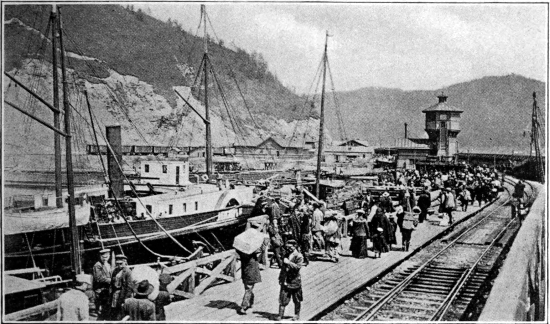
BAIKAL STATION
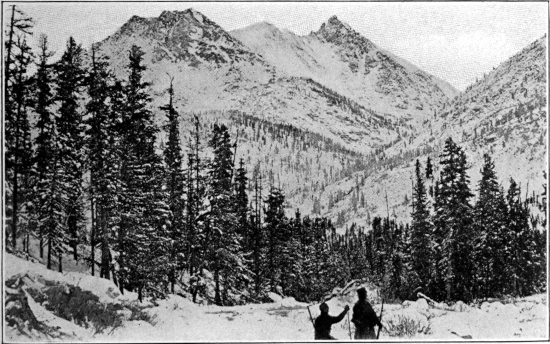
THE HIGHLANDS OF TRANSBAIKALIA
Soon we reach a street of low log houses, and a lofty boarded enclosure is ahead. At its gateway is swinging a black signboard, painted with post-horn and the Czar’s double-headed eagle. “Postava Stancie,” is inscribed over the lintel. Between the black and white-striped gate-posts we swing into the courtyard. To the left stretches a low log house. To the right, along the wall, are ranked sledges. In front are the stalls. Grooms, whip in hand, stand around in the courtyard, muffled against the cold.
“Is the gaspadine going on?” one of them asks.
On the reply, “Yes, at once,” he scurries off to start harnessing, and you shoulder open the low felted door of the post-house and enter the big waiting-room.
“Three horses?” asks the young black-mustached agent within.
“Yes, a troika sledge.”
He turns to the book of registry attached to the rough table by a long cord fastened with a big red seal, and begins to write.
“The name?” he asks. It goes down.
“The destination?”
“The Chinese frontier at Kiahta.”
“Your first relay-station is Nijniouboukounskaia, twenty-seven versts.”
The fare is set out in a printed placard posted up on the wall; as is the price of a samovar, fifteen kopecks, and all the other items that the traveler may require.
The agent hands you the slip: “One rouble, eighty-two kopecks, for two persons, the gaspadine and his courier”; something under three cents a passenger-mile.
As you wait for the harnessing of the post-sledge, the courier overlooks anew the bags and counts out again the parcels. As light as possible must be the impedimenta. Now is the last chance for change.
The big station-clock ticks on. The agent moves about in the warm dusky silence of the house. The courier straps tighter the dunnage-bag.
“Look that your furs are snugly fastened,” he says.
There is trample of footsteps by the door. A fur-clad, ruddy-faced driver stumbles in, makes the sign of the cross before the ikon on the further wall, and beckons to you.
“Ready!” he says.
Three shaggy ponies stand hitched to a wooden sledge, not high like those of city isvoschiks, but low and shaped like a wide bath-tub. The bottom is cushioned with hay and you are to sit some six inches above the runners. The bells hanging from the big arched duga over the centre horse jingle as he frets. The side horses, that will run loose between rope-traces, look around at the yamshik who stands by. He holds in his mittened hands four reins of leather, twisted into ropes—two for the centre trotter, one each, on the outside, for the gallopers.
You climb into the nest of rugs and furs superimposed upon your baggage! The yamshik leaps to the precarious perch that serves as his seat. The whip falls, and with a bound the horses are off. Always one starts at top speed, however bad the way. Always one finishes at a gallop, however jaded the horses. It is the rule of the Russian road.
With bells jingling, the driver shouting to clear the way, and a white cloud rising behind, the sledge skims out between the log houses which flank the straggling street. Dogs bark and the idle passers-by stare. Fur-covered pigs scramble up with a squeal, and scurry from their resting-places in the road. Girls, with shako-capped heads, peer through the windows. Little chubby boys, in big brown felt boots, cheer.
Soon the uttermost houses of the town are left, and emerging we plunge into the country road through open fields, dazzlingly, blindingly white. The trotter’s legs seem to move too fast, as if seen in a cinematograph. The gallopers, free of all weight and held only by the two traces which fasten them, outrigger fashion, swing on like wild ponies of the steppe. Crude and massive as the sleigh may look, its burden is almost nothing on the hard compacted snow. The horses in the rush through the bracing air seem to be the incarnation of the wind. A rut in the glistening road does not produce a disjointing shock, for, as a huntsman’s bullet glances from the skull of a wild boar, so the sleigh glides into the air and swiftly down again at a long low angle. It is a fact of “flying.”
The cold is intense. After an hour of riding you have learned a certain lesson which adds to your experience. Whether the traveler shall make this winter journey equipped with full camp-kit, portable stove, folding-forks, thermos bottles, and shell-reloading tools, or Tatar fashion, with a rifle and a haunch of mutton, is important but not vital. Let him make sure, however, that the huge all-enveloping sheepskin overcoat is at hand to supplement the coats beneath, and that a shaggy sleeping-rug is provided in addition to the blankets. One obstinate newcomer started with the insistence that a mink-lined Amerikanski overcoat, with two heavy rugs as lap-robes, would be ample. After an hour on the road, he turned into a peasant’s hut to thaw out upon boiling tea, while the driver went back to the town to buy the hairiest robe and coat obtainable. These were thenceforth worn on top of the initial outfit. Siberia for a midwinter sledging journey exacts this tribute of respect.
For versts the winter road follows down along the river between towering pinnacled rocks, where in summer eagles nest. The cliffs are vividly spotted with orange and green lichens; below they are fretted with the scourings of ice brought down in the spring freshets. All along beside the road are the familiar pine-saplings planted in mounds by the villagers to guide the way. In the vast monotony and drifting snows travelers would be lost but for these landmarks. Along the fertile river valleys hamlets are thick. A cluster of houses is met every six to ten versts. Presently the road leaves the river and bends to the left, cutting across fields. When it quits the bank, it climbs sharply a five-foot ascent. The driver does not even slacken speed. At the turn he swings the sure-footed ponies suddenly, and takes the slope, letting the outrigger bring up against a stiff clump of bushes. There is a crash, the sleigh has caromed off at right angles, nothing has befallen, and we are on again.
Verst after verst of plateau goes by, with rounded rolling hills of dimpled snow, treeless, houseless, a barren waste. Then comes a crest so steep that the horses can only toil up it at a walk, and the passengers must climb beside them. The forest closes in as the height is mounted,—white leafless birches and dark green pines. The light snow is seamed with rabbit-runs, and here and there are the far-spaced tracks of deer or wild goats.
A mound of stones and a small pole with a Buddhist prayer-flag—for here is the ancient home of the Buriats—mark the top of the ascent. There is a moment’s halt while you climb in and the driver tightens the saddle of the centre horse; then down the giddy descent we sweep, in full gallop once more. The pines flash past, and you hold your breath in fear of the smash that must come should a horse fall, should a trace break, should a side rut swing the sledge over. One is, however, so close to the ground that an overturn is usually harmless, save to the clothes and the nervous system, both of which are at a discount in Siberian sledging. Then too the outrigger arrangement is such that the craft turns a quarter of the way over and slides on the supplementary runner until it rights.
The cold is intense. One wipes away the snow from his fur collar, and the dampness on the handkerchief has caused it to become frozen stiff. It is a crackling parchment that goes back into the pocket. Eyeglasses are unwearable, for the rising vapor from one’s breath is caught and frozen on them in an opaque film. Fingers exposed but a moment become numb and useless, and uncovering the hand is an agony. Gradually as you ride, through the great felt boots, the triple flannels, the camel’s-hair stockings, the fur-lined gloves, the coats and rugs, the cold begins to bite. You have become fatigued and depressed of a sudden. The driver points to your cheek, where the marble whiteness is eating into the flesh, and bids you rub it with snow. An involuntary shudder grips and shakes you relentlessly from head to foot.
It is time to stop. If you try to go on beyond the next station you will, if the gods are lenient and you do not freeze, get out nerveless and trembling, not for hours to rally strength and energy. The chill will cling, however hot the post-house oven. Even now you are weak, beaten down, querulous, in a sudden feeble old age. The shudder means that the human animal is near his endurance limit.
On an urgent call, with special preparations, you may travel for a hundred hours, night and day, without halt save for change of relays. Physically, it is possible to fight cold for a time. You can run along in all your furs beside the horses, you can beat your arms together, and rub nose and cheeks to keep the blood in motion. You can drink copious glasses of scalding tea in the post-houses, and live by stimulants on the road. Through ceaseless vigilance and resolution you can keep from freezing, even while intense fatigue creeps on and vitality is going. But the persistent awful shudder is Nature’s red lantern. Run past it if you must,—it is at your peril.
Dark against the snows, now a low-lying village comes into sight,—Nijniouboukounskaia,—and among its first log houses is one bearing the post-horn signboard. A cry rouses the jaded horses to a gallop, and covered with snow, the sledge sweeps into the yard. Steaming and frosted white, the animals stand with lowered heads. Stablemen run to unharness them. Stiff with cold and muffled like a mummy, you clamber out, and on unsteady legs mount the steps to the felted door of the posting-inn. In the big bare room, beside the warm oven, robes and overcoats can be thrown off. A red-capped girl loads the samovar with glowing brands from the fire, and sets it humming for tea. Brown bread is produced and eggs, and a great bowl of warm milk. With these, and the contents of your bag of provisions, can be eked out a welcome obeid.
For the night’s rest one need not seek a bed. There is never a spring to ease the bones from Verhneudinsk to Kiahta. There was discovered just once on the journey—at Arbouzarskie—an iron skeleton, bearing to a spring bed about the relation that the three-toed Pleistocene prairie trotter holds to a modern horse. The post-keeper had carefully hewn with his axe five pine planks to cover the gaunt limbs of it. The voyageur slept on the soft side of these timbers. Bed and board are synonyms in Siberia.
For a couch there is to-night the narrow wooden law-provided bench, or—a less precarious perch, and equally resilient—the sanded floor. For bedding, one has one’s own blankets and coats. What if the shoulder slept on numbs with one’s weight, or the corner of the soap-box in the traveling-bag, serving as a pillow, dents the tired head! One draws off felt boots and some of the outer layers of clothes, rolls the sheepskin about one, covers the head with a blanket, and sleeps like the forest bears in their winter dens.
Just before daybreak is the best time to start, so that one can cover the most road possible while the sun is up. At ten or eleven, an hour’s stop for lunch is advisable, and then on again until sundown. It is better not to travel after nightfall, as the cold is so much more intense. We dedicate the evening to hot tea, and then turn to the blankets and the bench.
The stretch between Verhneudinsk and Troitzkosavsk, officially rated at two hundred and eighteen versts, is really somewhat longer. A run of average record took from 4:20 P.M. Tuesday to 11:30 A.M. Thursday—forty-three hours and ten minutes. This included all relaying, seven hours a night for sleeping, dinner and breakfast halts, two accidents (an overturning and a broken runner), and one calamity—a Siberian who snored. The actual driving-time, over a road for the most part hilly, was twenty-two hours, five minutes, or just about ten versts per hour.
Horses stand always ready, with special men at hand to harness. Drivers swing on their shaggy greatcoats, and with almost no loss of time one is out of the shadowed courtyard and on the road again in the dazzling whiteness of the winter day.
In traveling “post,” however, with relayed sleighs and big empty guest-rooms, one does not become acquainted with the life along the way. One has only hurried glimpses of slant-eyed Buriat tribesmen, of galloping Cossacks, trudging peasants, post-agents, girls who carry in samovars and silently steal out, rosy-cheeked boys on the streets, and women at the house-windows. To know the people and see their daily life one must get away from the beaten highroad, strike out from the government-regulated inns, and blaze one’s own path into the interior.
First, you get a low passenger-sledge, long enough to admit of stretching out, and without too many projecting nails on the inside; then, three good ponies of the hardy Cossack breed, that are never curried or taken into a stable through the bitterest winter. The best animals procurable are none too good for climbing the passes away from the river-courses. The whole outfit can be bought for three hundred roubles in any of the interior towns.
For drivers, there is a class of yamshik teamsters, who spend their lives guiding the sledge-caravans which carry the local traffic. One of these men, Ivan Kurbski, can guide you through a whole province, and lodge you every evening with some hospitable friend or recommended host. Whether he has himself been over all the changing by-paths in the wilderness of the Zabaikalskaia Oblast, or whether he mentally photographs the directions of his friends regarding each village, is an unsolved mystery.
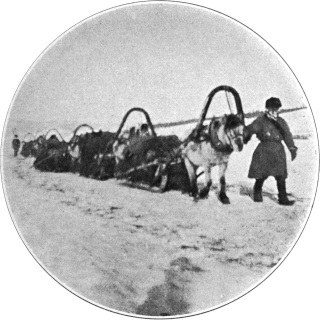
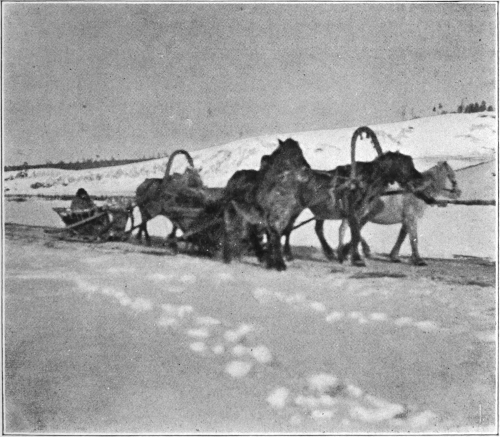
SLEDGING SOUTHWARDS
When the day’s journey is done, Ivan will drive slowly down the crooked street of the village he has settled upon for the night’s repose, looking keenly for landmarks visible only to him in this country, where every village and every house is mate to all the rest. Sometimes he will ask a question of one of the innumerable urchins. But generally he seems of himself to hit upon the desired domicile. Day after day he will take you the sixty versts, lead you to the village stores to replenish the supply of candles or sugar, bring you surely to food and shelter at night, and take off all the burden of care for the outcome of each day’s journey.
If for the third member of your personal suite you can get an old-time servant to keep the guns clean, build the camp-fires when midday tea is to be taken out of doors, bring in the baggage and rally the best resources of each halting-place, you are doubly lucky. You will be sedulously tended, and be treated partly as a prince, partly as a helpless baby.
Of this order is Jacov Titoff. Not the smallest personal service that he can render will you be permitted to do for yourself. The telling of unpleasant truths will be carefully avoided, however certain the ultimate revelation. Though honest beyond question, he pays you the naïve compliment of relying upon your generosity in all the little matters that concern provisions and petty luxuries. He will open the package which he is carrying back from the torgovlia to extract matches and cigarettes for his own delectation, and will rifle unstintingly the reserve of canned sardinki. He cheerfully freezes himself waiting for deer, and stumbles up miles of snowy mountain in the beats. He is always in good humor, and without complaint for whatever comes. He is ready anywhere, at any time, to sleep or drink vodka.
Thus outfitted and manned, take your place, muffled in furs, and seated on the felt sleeping-blankets. Guns are at your side, the bag of provisions is in front, your own little ponies paw the snow. They start off now, trotting and galloping beneath the duga. The air is frosty, clear, and thrilling as wine; the snow is feathery and uncrusted, as when it fell months back; bells are jingling, and the driver is crying his alternate endearments and curses upon the shaggy ponies. Down the long rock-flanked river valleys, amid birch and pine forests, you will skim, by unwonted paths, through out-of-the-world villages, to see in their own homes the red-bloused peasants, the women spinning at the wheel, the peddlers and priests, the traveling Mohammedan doctors, the rough Buriats, miners and merchants, along the white way.
The smooth main road is left now for newly broken sledge-trails across fields and over snow-covered marshland. Every available river is utilized as a highway, for along its winding length the path, smooth and level, is marked like a boulevard by the evergreen saplings planted by villagers to guide the winter traveler. One can pierce the districts flanking the Chickoya’s gorges, reachable at other seasons only by breakneck climbs. And one can see the real Siberia.
On this first night of his incumbency, Ivan Kurbski lodges us with friends. He leaves us for a moment while he enters the yard by the wicket-gate to make due announcement, and the ponies hang their tired frost-covered heads. Your own bows under an equal fatigue. But the wait is very brief. Soon the big double gates of the log-stockaded courtyard open. The horses of their own accord turn in, and swing up to the steps of the house. You are handed out like an invalid grand duke, and are welcomed at the threshold, with a hard hand-shake, by a red-bloused peasant who ushers you up the steps, across the low-eaved portico, and through the square felt-padded door into the big living-room.
As we all enter, Ivan and Jacov, caps in hand, bow and make the sign of the cross toward the grouped ikons high up in the corner opposite the door. The saints have guarded you on the way—are not thanks the devoir? Then you, as head of the party, must salute, with a “Zdravstvouitie,” your host, the old Hazan father of the peasant who, wearing a gray blouse sprayed with vivid flowers at breast and wrists, sits on a bench beside the window. Now you may sit down beside the massive table on the other bench, which is built along the whole length of the log walls, and survey the curious world into which you have fallen.
A woman of middle age, clad in bright red, is busy with a long hoe-like instrument pushing pots into a great square oven six feet high, ten feet to a side, and spotlessly whitewashed. To her right, in the room beside the oven, is a girl of fifteen or sixteen, rolling brown rye-dough on a little table, in perilous proximity to a trap-door leading into some dark nether region. An old bent woman gravitates between the two. Glancing up, one meets the wondering eyes of three sleepy blinking urchins, who peer down in solemn interest from a big cushion-covered shelf, two feet beneath the ceiling. Looking about to locate the muffled sound of crows and clucks, one discovers, beneath the oven, a corral of chickens, pecking with perky bills at the whitewash for lime. On the floor is sitting a little girl crooning some endless refrain to a baby in a sapling-swung cradle.
“The gaspadine will take chai?” asks the patriarch. From the woman’s room beside the oven the girl brings a samovar. She sets it on the floor, beside an earthenware jar standing near the door, and dips out the water to fill it. Then with tongs she takes a long red ember from a niche cut in the side of the oven, and drops it down the samovar funnel. Round loaves of frozen rye-bread are brought out and set to thaw. A plate of eggs is produced from the cellar. One rolls off as the girl passes, and falls to the floor. Instinctively you start. Not so the others. The egg has dropped like a stone and rolled away. But it is quietly picked up and put to boil with the rest. It is frozen so solidly that there is not even a crack on the shell.
Jacov meanwhile is making earnest inquiry of the “old one.”
“How are your cows, Dimitri Ivan’ich? Your horses, are they well? And your sheep? All well? And have you had good crops? Is there still plenty of pasture-land in this village? Good! Good!—and how is your wife?”
Poor withered wife; she is bustling around looking after the children, and trying to help her daughter-in-law. Not so the “old one,” the ancient man of the family to whom these courteous questions are addressed. The patriarch stopped his labors at fifty, and sits slumbering away his second prospective half-century in honored idleness. “Everybody works but father!”
The samovar is humming now, and the table is decked with a homespun-linen cloth ready for the obeid. The first formality, as dinner is about to begin, must be observed. The various members of the family turn, one after another, toward the ikons, reverently crossing themselves. Then the host produces a bottle of a colorless liquid, shakes it up and down, and brings the bottom sharply against his palm. The cork shoots out, and he pours into a little glass a drink of the national beverage, vodka, which one is supposed to swallow at a gulp.
Every time a guest enters, a bottle of vodka is brought out, costing 49¼ kopecks, half the average day-laborer’s pay in this district. On feast-days the visitors go from house to house drinking,—and these prasdniks number some fifty-two days in the Russian year. Every business deal is baptized with vodka. Every family festival, the return of a son from the army, the marriage of a daughter,—all are vodka-soaked. As one passes through villages on a saint’s day, he may meet a dozen reeling figures and hear the maudlin songs from the courtyards where the men have gathered. The part played by vodka in the people’s life is appalling.
In the house now, all, beginning with the “old one,” partake of this stimulant, solemnly gulping down their fiery potions. Then the family sits down in due rank and order, the “old one” in the cosiest corner, with the samovar convenient to his hand. You, as the guest, are beside him on the bench that lines the wall, then comes Jacov, next the son, then Ivan Kurbski the yamshik, and on stools along the inner side of the table, the grandmother and assorted infants. The mother alternates between the table and the oven.
The samovar is tapped for tea as the first course of the evening. For all who come, tea is the obligatory offering, in a cup if the visitor be familiar, but for special honor in a glass with a ragged lump of sugar hammered from a big cone-shaped loaf. This one nibbles as he drinks, for sugar is a luxury, not to be used extravagantly. The brown rye-bread, which has been thawed at the gaping oven-door, is next brought out, and raw blubber-like fat pork, in little squares, eaten as butter, and boiled potatoes, and the boiled eggs, curdled from the freezing.
At Little Christmas, the prasdnik day which comes in early January, pelmenis, or dumplings, egg-patties (grease-cooked), and meat will be served, with cranberries and white bread. In Butter-Week everybody gorges on buttered blinnies, or pancakes, garnished with sour cream. Even a substance showing rudimentary traces of a common ancestry with cake may be produced.
As the shadows of the northern evening close down, a piece of candle is lighted to-night in our honor. Generally the burning brands for the samovar, propped in a niche cut at the height of a man’s shoulder in the outer edge of the oven, throw the only light. Presently the candle is used up and the brands give a fitful flame, leaving the corners black as Erebus.
From the baby’s cradle comes now a plaintive cry, and one of the little girls goes over to dandle it. Up and down, to and fro, for hours together she works, singing her monotonous lullaby. The children, who have been lifted down from their eyrie above the oven, play on the sanded floor. The men remain oblivious and smoke their pipes, letting fall an occasional word, which comes forth muffled from their great beards.
Ox-like, all sit for a while, sipping occasional cups of tea. Then the woman and the girl go out and get wood, remove the pots from inside the oven, and build up a roaring fire. The children are rolled up for sleep in their little blankets on the floor. The men reach for their furs and felts. They go to the left of the oven, the women to the right, and the children are between, making a long row in front of the fire. Soon all are sunk in heavy sleep. The little girl alone sits up to rock the baby. As you doze off in the genial warmth of the newly-stoked oven she is still crooning her lullaby in the dim fitful light of the firebrands.
Through the long night all lie like logs. Toward morning, as the oven’s heat dies down and the bitter cold creeps in, sleep becomes uneasy. One stirs and then another. Finally the woman rises and wakes the girl, and they go out into the cold for wood and water. Presently the men bestir themselves, get up, and wait for their tea. The rising sun of another day casts its rays through the windows.
As the sleepers one by one arise and stretch, their blankets are folded by the watchful woman of the house, and thrust up on the children’s shelf. Some of the men go across the room and let the water from the little brass can in the corner trickle over their hands. Some do not do even this.
For the outlander of washing proclivities, peculiar problems are offered by a country of no wash-bowls, no soap, only occasional towels, and the tea samovar as the only source of hot water, a copious draft on which not only postpones breakfast but compels some of the women of the family to go out and chop ice for a new supply. Necessity evolves the tea-tumbler toilet method as our solution. You borrow one of the precious tea-glasses from the old woman, fill it to overflowing with warm water from the samovar, and prop it up on the window-sill. The top inch of water is absorbed into a sponge which is put aside for future use. Into the remaining two and a half inches a soaped handkerchief is dipped, with which one washes one’s face, touching tenderly the spots recently frozen. The reserved sponge will do to rinse off the detritus of this first operation. Two and a quarter inches of water are left, of which half an inch may be poured over the tooth-brush. With an inch and three quarters left, one has ample to lather for a shave, as well as to wet the nail-brush which is to scrub one’s hands that will be rinsed with the sponge. Half an inch remains finally to clean the brushes and razors. “There you are!” With two glasses one may have a bath.
When the breakfast of rye-bread and tea is ended, the men go out to their various winter tasks, of which the most serious is felling trees in the forests, cutting them up, and getting home the wood. The women keep stolidly at their cooking, cleaning, child-tending, and turn to the spinning-wheel and hand-loom when other work does not press.
In the weeks that follow, each night brings us to a different home, but never to a changed environment or atmosphere. This type of life is found, not only among the Trans-Baikal peasantry, but throughout all Siberia. The log houses down the long straggly village streets look out upon the same wooden-walled courtyards,—the women peering from their little windows as the sleighs jingle past. The same ikons with burning lamps look down as you enter; the same whitewashed oven and shelf and cradle are there as you push open the felted door. The women of each district wear the same traditional costume. The bearded host produces the same vodka. One of the most impressive sights, when one drives out before dawn into the frosty air, is to see at almost the same moment from every chimney the black smoke roll upwards, then dwindle to a thin gray streak. Each woman has risen and heaped green wood into the cooking-oven. It is as if one will actuated simultaneously all the people.
At places the master of the house has a trade, shoemaking or saddlery, and the big living-room is littered with pieces of leather and waxed cord as he stitches. Sometimes there are hunters in the family, and ancient flintlock muskets rest on the antlered trophies. The men gather together occasionally to drive deer. But in general, as the winter is the men’s idle time, a little wood is cut, the cattle are seen to, and for the rest, talk, tea, and tobacco, until it is time to eat and sleep once more. The women on the other hand seem to be always occupied, but they are not discontented.
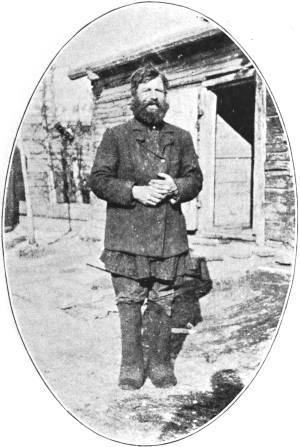
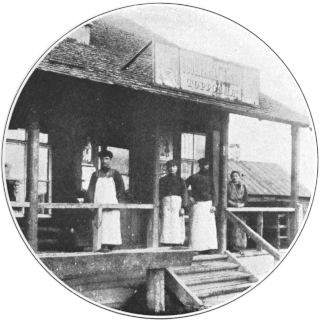
SIBERIAN TYPES PEASANT VILLAGE STOREKEEPER
The customs and institutions which bind together the household group are unique. In all families the Hazan is supreme. To him first of all, strangers pay their respects. To him every member of the household comes for advice as to whom he or she shall marry, and which calf shall be sold. Howsoever hard of hearing he may be, there is related to him all the events of the neighborhood with infinite minuteness. He is the repository of all moneys earned by logging for a neighboring mine-owner, or for bringing out to the railroad the sledge-loads of rye. As head of the family he can summon a forty-year-old son from the merchant’s counter in Krasnoyarsk, or his nephew from the fur-traffic in Irkutsk, and bid him return to his peasant hut. If a grandson wishes to go to Nerchinsk to seek his fortune, the “old one’s” consent must be obtained before the youth receives his passport. It is all at the patriarch’s sovereign pleasure.
We come one day upon a vexatious example of this ancestral authority. A report reaches us, by chance, of a hibernating bear’s hole some fifty versts away, which one of the peasants has located. The host, noting our interest, asks:—
“Would the gaspadine like to hunt him?”
There is no question on this score, so the peasant is quickly brought to the hut. Numerous friends crowd in with him, for one person’s business is everybody’s business in these primitive communities. For a liberal equivalent in roubles the man agrees to act as guide, and the start is to be made early next morning. All is arranged and he goes out with his body-guard to make the necessary preparations. By and by there is a stir. Our sledge-driver comes in with a long face. Then half a dozen peasants add themselves to the family quota in the hut. Soon more come, until the stifling room is as populous as a Mir Assembly. They are all talking at once, and there is a great hubbub. At length one voice louder than the rest seems to call a decision for them all. They turn backward again, and with many gesticulations bustle through the felted doors into the snowy streets, and through the village to a house which they enter in a body as if with intent of sacking it. Instead they bring out and over to our hut a slight bearded old man, bent with the weight of many winters—the father of the peasant guide.
Humble but resolute, he faces the assembly.
“No, I cannot consent that he lead the gaspadine to the Medvetch Dom.”
“But assure the ‘old one’ that his son will only point out the den and then go away.”
The “old one” answers:—
“The bear does not come to steal my pigs. Why should I get him shot? Besides, a bear chewed up three Buriats last year. It would be sad to be devoured even for the gaspadine’s fifty roubles.”
The reward is doubled, and forty kopecks’ worth of vodka produced. Many advisers give aid, and one suggests that “the son may mount a tree one hundred sagenes from the mansion of the bear!”
But still the father refuses. “No, I will not allow him to take out his horse and hunting-sledge.”
The son, whose half-dozen full-grown children are looking on, shakes his head dolefully. A big eagle-nosed peasant, of hunting proclivities, comes in.
“I will give my hunting-sleigh if he will go,” he calls.
But the shrill voice of the “old one” rings out again, “I do not consent. I do not consent. My son shall not go to the mansion of the bear.”
The guide shrugs his shoulders. We have hit the ledge of Russian authority. No one will budge. The old man has his way.
As is the management of the household, so is that of the village. While the Hazan rules over the common property of the family (izba), the village elder (Selski Starosta) is guardian over the grouped households which make up the Mir. As the household goods belong to no one individual, but are common property, so the land farmed by the villagers is a joint possession whose title rests with the commune. The family is held for the debts and behavior of all of its individuals; and similarly, with certain limitations, the village community is answerable for the taxes and discipline of each of its members.
On a humble scale it is the spirit of socialism incarnate. Within the commune no capitalistic employers, no wage-taking worker-class, no castes exist, and no individuals are born with special privileges. No distinctions of rank or fortune lift some above their fellows. The manner of living is the same for all. Each head of a family has a right of vote, and elects by the freest, simplest means his own judges and village rulers. The land, the source of livelihood, is divided among the producers by their own unfettered suffrage.
The chief man of the community—he who drums out the voters to the Mir, lists those who do not work sufficiently on the pope’s field, and reports the toll of taxes to the Government—is simply an elderly peasant clothed with a little brief authority. There is no household in the average village which is looked up to as more genteel than the rest. No such distinctions as prevail in America will reveal that such a farmer’s family is musical and well-read, such another has traveled to Niagara Falls, such a third has blue-ribbon sheep. In Russian peasant circles all is equality, almost identity.
Here is presented the best example in the world to-day of an applied system based upon the communistic as opposed to the individualistic theory. It is therefore of more than local interest. Most apparent of all results is the economic stagnation which has accompanied the elimination of special rewards for special efforts. The man, more daring or more far-sighted than his fellows, who would take for himself the risk of a new enterprise, who would mortgage his house to buy a reaper, or would seek a farther market, is fettered by his plodding neighbors. His financial obligations, if he fail, fall on the others of a common family, whose members have a veto on his freedom of action. His own and his neighbor’s fields by the allotment are proportioned in extent to the old hand-labor standard. A machine has few to serve until the fields are readjusted to a new standard. While technically a man may buy or rent lands outside the commune and may introduce a new rotation of crops or agricultural tools, actually the inertia of the peasants bound to him by the brotherhood of the Mir weighs the adventurous one hopelessly to the earth. Who can persuade an assembly of bearded conservatism-steeped “old ones” to buy for the Mir the costly new machines? Perhaps, with the visible demonstration of profits which private enterprise could make under an individual régime, the doubting elders might consent. But who is there to show them when every village checks back the swift to the lock-step of the clod?
Nor is it simply in material things that communism manifests its lotus-fruit in these country hamlets. Ignorance, unashamed, broods over them one and all. What a dead level is revealed by the fact that one peasant in a populous village on the Chickoya, our guide upon a shooting-trip, could not tell time by a watch, and had never seen such an invention.
Some instances are related where the more ambitious men of a Mir have clubbed together to bring in a teacher at their own expense. The Semieski, or “Old Believers,” big, red-bearded, obstinate men, settled in Urluck in the Zabaikal, who dissent from the sixteenth-century revisions of Bishop Nikon, will not send children to Slavonic schools and may have schools of their own. But these cases are rare. There is among the peasantry almost no education and comparatively little desire for it, yet how far this sentiment is from being a racial or national failing the crowds that come to the city universities bear ample witness. In one of the villages a teacher from Chita is established in the side room of a peasant’s house, wherein one night we sojourn. He has been appointed by the Commissioner of Schools of the Cossack Government. He is of a good Nerchinsk family and is brother to an elector of delegates to the second Duma. He is one of the “Intellectuals”—the student class which forms almost a caste by itself. A free-thinker, keenly interested in the rights of man, a Social Democrat by politics, he goes shooting on Sunday with some peasant cronies. He plays Russian airs on his balilika and gets the peasant’s daughter to dance for the guest. He produces specimens of antimony and chalcopyrite, and discusses the geological probability of finding silver or platinum ores in these districts. Photographs of the amateur-kodak variety are along the walls, and on a table in the corner are a mandolin and a pile of books. We pick up a volume,—“L’Évolution de la Moralité,” by Charles Letourneau. The young owner, who consumes a prodigious number of Moscow cigarettes, tells of the indifference to education among the people.
“Here we have a school in a big village, with two other communities near by. There are easily five hundred households,—with how many children in each, you can see. Yet we have but thirty boys at school. What can we do?”
He is discouraged, this single “Intellectual” of Gotoi. Profoundly solicitous for the future, an idealist, boundless in hopes for the good of his race, he sees the younger generation submerged at the threshold of opportunity by the inertia of the old.
“‘What good will it do for him to read?’ ask the peasants, when I urge, ‘Send your boy to the school.’ What can I say? The boy comes from my class after two years, and goes out with the men. He has no money to buy books if he wants them. No newspapers come to the village, no printed matter whatever, save that on the pictures which they buy in the fairs. In a few years all I have taught is forgotten. The darkness is over these villages. One must lift them despite themselves.”
Beyond the range of the village communes, no people show a more eager zeal for knowledge and study. In the cities almost all of the younger generation can read and write. The school-boys, with their big black ear-covering caps, smart blue coats, brightened with rows of brass buttons, and knapsacks of books, are one’s regular morning sight. “Realistic” and “Materialistic” schools are established in many towns.
The apathy of the rural element is to be laid at the door of the system which hinders those within the confines of the communes from reaping the fruits of special sacrifice and effort. No one attempts to raise himself in the Mir, where the dead weight of those bound to him is so hopeless. If any boy, brighter than the rest, follow some lodestar, it must be to a city. The aspirant must bury ambition, or leave the drudging Mir with its toll of taxes and recruits. He will not study law before the wood-fire as did Lincoln in his log cabin.
The cloud of deadening communism over their lives utters itself in the words continuously on the peasants’ tongues. It is the northern equivalent for that buttress of despotism—“mañana.” The possibility of the Russian condition is “nietchevo!” If the red cock (krasnai petuk) has crowed and has left the forty householders with charred embers where stood their homes, “nietchevo!” They build it up of wood and straw, with the oven chimney passing through as before. Does a raging toothache torture, “It is the will of God,—nietchevo!” If the weary day’s climb sees a gameless evening, “nietchevo!” If the son is frozen in the troop-train, “nietchevo!” If the Little Father send to Yakutsk the other one who has gone to the city, “nietchevo!” Is the unrevised tax for a family of ten men pressing down upon three, “It has got to be borne,—nietchevo!” It is this bowing to fate as a thing begotten of the gods, when it is a force to be fought here on earth; the long-taught submission to evil, when evil is to be conquered, to limitation when opportunity is to be won,—it is this spirit which is holding rural Russia still in her Dark Ages.
The origin of the present village-system goes back to the time of serfage, when the overlord held his dependents herded together for easy ruling. That it extended to unfettered Siberia, where the rewards of individual effort were so obvious, cannot be laid entirely to old custom or government compulsion. Nor is it to be explained by the early necessity for protection against wild beasts or hostile natives. The same dangers threatened the pioneers of our own country. Perhaps the Russian spirit of gregariousness lies at the root of the fact that in the Czar’s domains the peasant lives away from his fields to be near his neighbors, while our people live away from their neighbors to be near their fields. Whatever the cause, the outcome is that practically the whole rural population, even in the most thinly settled districts, is gathered into villages, and owns the lands in common.
The system makes enormously for homogeneity, welding, solidarity. The people are a “mass.” Units are lost in unity. Nothing save Nature’s imprint and law of individuality, that decree under which every created thing is some way different from every other, keeps the Russian peasant from quite losing his birthright. The commune, vodka, and resignation are the incubi of Siberia. In the towns and cities gather the energetic natures that have climbed out and above them. What these have done, their allied people—the peasants—can do. Beyond the horizon of the latter’s narrow lives lies still the borderland of possibilities. One cannot doubt the vigor of the stock, nor the certainty of its rise. This quality of rugged worth is the basis of all the great advance that the pioneers and the city populations have made. It is only in the Mirs, frozen fast in their lethargy of communism, that resurrection seems such a far-off dream. The way is long for the peasants of Siberia—long and toilsome. But their vast patience is allied to as vast a courage, and both will lift them into the larger day.
The measure passed by the last Duma, decreeing the division of the Mir lands in severalty, and private ownership of property, will be one of the most momentous and far-reaching enactments ever legislated for a people. It should end for rural Russia the stagnation, and open an era of mighty endeavor and achievement.
There are many races here among the serenely tolerant Siberians, undiscriminated against and uncoerced. While one of the Orthodox may not abjure the state religion without severe punishment, those born to an alien faith are unmolested by official or proselyting pope. “God has given them their faith as he has given us ours,” is the Russian rule.
This medley of races beneath the Russian banners gives to one’s earliest contact the conception of a heterogeneous disorganized jumble of nations and peoples. But closer acquaintance impresses upon one the dominating and surviving qualities innate in the Slav, whose unalterable solidarity is beneath and behind the kaleidoscopic types of aboriginal tribes and exiled sectarians. By race-absorption, like that which has evolved Celts, Danes, Saxon, and Norsemen into English; British, Dutch, Swedes, Germans and Italians into Americans, the Slav is dissolving, transmuting to his own type and moulding to his own institutions the varied peoples.
Though the heterogeneous blood adds to the total of Siberian country life, it is the Slavic race that determines the permanent order of this great land. Primarily too it is the peasantry who shape its destiny. Their possibilities are the limit of Russia’s ascent. Their condition is therefore of far deeper than sightseeing interest to the student. Unlike the picturesque peasantry of Holland, here they are the foundations of the state, forming not an insignificant minority but ninety per cent of the population.
Somewhat of a new spirit flickers here and there in Siberian hamlets. The peasant is superior to his Russian brother. The traditions of serfdom were broken by his severance from the old environment, and wider lands give him an abundance unknown save in a few favored parts of Europe. The political exiles have through the centuries added an upsurge of independence and personal self-consciousness, which is markedly higher than the Oriental humility of Occidental Russia.
The influence of the criminal, as distinct from the political convict, is felt primarily in the cities, such as Irkutsk and Vladivostok, to which the time-expired men drift. The convict element is always met with. It has been customary to billet a condemned, who was not wanted at home, upon some out-of-the-way village, giving him a passport for its confines alone. The victim might have been a Moscow professor or a locomotive engineer, but in the Mir he must farm the land given him. Naturally such seed as this planted in Siberian hamlets does not produce the traditional peasant faith in God and the Czar so faithfully preached by the popes.
Another influence making for upheaval is the returning recruit. We are in a peasant house when a soldat comes back to the family from his service. If he has not brought any great burden of salary, he has accumulated tales enough of the outer world to hold in breathless excitement the circle of friends and relatives which gathers at once when the tinkling sleigh-bells and the barking have announced to the village his return.
Far down the street is heard the jingle of his sledge. It brings every girl to her peep-hole window, and every boy from his sawing to the courtyard door. At the gateway where the newcomer turns in, he is heralded by the commotion of the household guardians, wolf-like in appearance and nature. Everybody within the important house runs to the door. The village knows now which family is making local history. The arrival is accompanied already by two or three men who have recognized him as he descends. He tramps in with military firmness of tread, head erect. Before he greets the grandfather even, he makes the sign of the cross to the holy ikons, and, bowing down, touches his lips to the floor. Then comes the respectful kiss to the old man, next to the mother, while the younger brother, soon to go to service himself, stands awkwardly by, and the little children look half-dubiously at a form scarcely known after his four years of absence.
Then there is a scurrying of the grown and half-grown daughters to prepare chai and to produce the pelmenis and brown bread. The villagers drift in one by one, cross themselves, and speak their greetings, until the little house is packed, and as hot as the steam-room of a banno. The vodka-bottle is out and everybody has settled down for an indefinite stay. The soldier’s tales of war and garrison duty and government and revolution hold the family and the audience breathless through the long evening. As you drop asleep, the hero is still reciting and gesticulating. The guests in departing will be careful not to stumble over you, so nietchevo.
In one of the houses where we put up, a shop adjoins the big living-room. It has dingy recesses from which hatchets and the commoner farm utensils can be produced, shelves of homespun cloth, and gaudy cottons for the men’s blouses, and beads for the women’s bonnets. Here, as in the country-stores of our own land, during the long idle winter days there is always a crowd and endless discussion of the village events,—the health of each other’s cows, births, marriages, deaths, drafts into the army, taxes. Even in this remoteness something of the echo of great Russia’s struggle is heard over the shopkeeper’s tea-cups. We hum, unthinking, a bar of Die Beide Grenadier, in which a refrain of the Marseillaise occurs.
A peasant looks quickly up. “It is not allowed, that song,” he says.
“Why not?”
“That is the song of the strikers.”
“But the gaspadine is a foreigner. He may sing it.”
“Yes,” says the peasant, “he may sing it, but I may not. Would that I might!”
One meets quaint characters in this inland journeying—veteran soldiers of the Turkestan advance; “sabbato sectarians,” who keep Saturday holy rather than Sunday; austere “Old Believers,” traveling peddlers, teamsters who have tramped beside their ponies over three provinces. One comes upon peripatetic Mussulman doctors, in snug-fitting black coats and small black skull-caps, who show their Arabic-worded road-maps and much-thumbed medical works bound in worn leather. Beside their plates at table the kindly hostess puts piles of leathery bread, unleavened, and made without lard in deference to their caste rules.
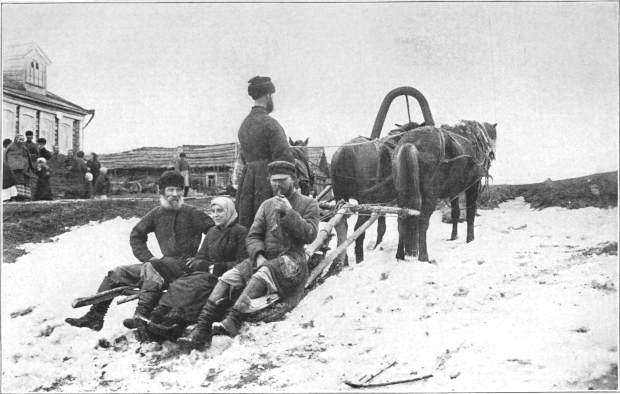
PEASANT TYPES
A shop in one village is kept by a Chinaman, who, lettered like most of his race, seems a far shrewder and more intellectual person than the uneducated Russian peasants. He invites the stranger to drink tea that his special caravan brings, and presents Chinese candy with the courtesy of a grandee. When, in reciprocity, the traveler buys sugar for his chai, he receives it wrapped in paper covered with hieroglyphics and exhaling the faint unmistakable Chinese odor.
Going always southward, one begins to meet more and more frequently the villages of the Mongol-descended Buriats. “Bratskie” (brotherly people), the Russians call them, for despite the forbidding aspect that flat Mongolian features, high thin noses, yellow-brown skins, and big squat bodies give them, no more peaceful, harmless, and hospitable people exist. They are great and fearless hunters, unexcelled riders, and though still only on the threshold of civilization, are rapidly moving to better things.
All phases of the advance from the nomad to the agricultural stage may be studied among them. The pastoral Buriats, decorated like the Chinese with queues, ride around after their flocks. Their villages lie far away from the lines of convoys, unmarked on the Ministry map, which one is supposed to be following. Each family occupies a little windowless wooden hut, some fifteen feet in diameter. In front of it is planted a pole, carrying at the top a weather-faded pennant, the colors of which in Buriat heraldry indicate the tribe and name of the occupant. Behind the hut are stacks of hay and a wooden corral with sheep and horses. Beside it stands the summer tent, of felt, looking like a great inverted bowl. It is empty in winter, save for a shrine with grotesque pictured gods, fronted by offerings.
In the homes of these least advanced Buriats we loiter no longer than we must. The wooden house which shelters them is hermetically sealed, and is crowded with people and animals. Fenced off in a corner of the first that receives us is a corral of thirteen lambs, which at uncertain moments begin to bleat suddenly in unison, producing, with startling effect, a prodigious volume of sound. When one has been roused from sleep half a dozen times a night by this chorus, he is strongly inspired to move on. The men are out during the day looking to their flocks. The women spend a good part of their time sewing furs or making felt. They are very unclean, and it is a decided relief to get out of their homes, to which the cold compels one to have recourse on a long journey. In spring, with great and understandable relief, these semi-nomads take to their felt tents and move where fancy and pasturage dictate.
One grade higher are those Buriats who have learned some rudimentary farming from the Orthodox. You will see the men threshing on a level floor beside the corral. They are dressed in long blue or magenta fur-lined cloaks and colored cone-shaped hats. Other Buriats are permanently resident in the Slavonic settlements, and send their rosy-faced children to school. They mix with the Russians, subject to almost no disabilities, and their better classes contract inter-racial marriages, which seem, to an outsider, at least, completely happy and successful.
It is no small thing, this which Russian rule has done for the Buriats. A people whom any other nation would spurn in racial ostracism, perhaps would eliminate, live side by side with the good-natured Slav in perfect accord, progressing in civilization and material well-being as high as the individual can aspire to and attain.
They are ruled by their own chiefs, whose sway is tempered by the benevolent supervision of the general government. They are represented in the Duma by men of their own selection. They freely worship the Buddhist Burhan in their lamasery near Cellinginsk, without pope to preach or missionary to proselyte. Their easy citizenship is unharassed by money taxes, and their only obligation is Cossack service in the army. But Cossack service to a Buriat is what a picnic is to a boy. Riding around on horseback, rationed by the Government, visiting a city with real tobacco and vodka sometimes attainable, sleeping on a straw-stuffed mattress with no tethered lambs to murder sleep, when they are used to a sheepskin on the dirt floor,—all this is luxury of blissful memory, during the years of the reserve. The net result is that the Buriats are entirely content. They are progressing all along the line, and are being made useful to the nation, not by unpayable taxation, but by the service which they are so especially fitted to render.
As one nears Chinese territory, by the lower waters of the Chickoya River, the villages of Slavic colonists who hold their land on tax-paying peasant tenure, have given place to the Buriat tribesmen and to the stanitzas of the Cossack guard that occupy the pale of land flanking the frontier. Within this border-belt, every village stanitza holds its quota of Cossacks. These soldiers are for the most part descendants of the levies from the Don region, transplanted to the Trans-Baikal by the Government’s despotic hand in the eighteenth century, and since then forming an hereditary military caste. Many of them are bearded Slavs, indistinguishable, save for their accoutrements, from their more peaceful neighbors. Others are of a peculiar cast of countenance, due to the mixture with the Asiatic tribes in ancient times, when the hunted people fled to their ancestors’ asylum, the territories beyond the Volga and on the Don. There is great variation in type among the imported Cossacks. Most are Orthodox, but a very large number are “Old Believers,” or Semieski. In all the houses now hang the yellow cap and the uniform coat, which must be ever ready against the call of duty. Arms are in the corners of the rooms, and everything has a military look, in marked contrast to the peasant homes. Crude, highly-colored prints of Japanese defeats, which circulated broadcast in Russia during the war, share the attention usually devoted exclusively to holy ikons. Portraits of Generals Linevitch and Kuropatkin, and Admiral Alexiev, are tacked to the walls. In one house we saw hanging a prized silver watch, one of those distributed by General Rennenkamp among the soldiers of his command.
One of our Cossack hosts is an old man, Orthodox, and of Russian origin, but with some ancient Asiatic blood, for only a stringy beard grows on his kindly, wrinkled face. With reluctant pride he tells of his three sons away on service, leaving but himself and two daughters at home. With frank happiness he shows you his medals. Every soldier at the front received a round brass service-medal; his, however, a silver cross with St. George and the Dragon on it, is given for valor. He will not drink the vodka he offers you,—rheumatism. But in order that you may smoke some alleged tobacco that greatly interests him because he gathered it himself by the roadside, in Manchuria, he starts up his pipe despite the dust-induced coughs that it begets. He is a kindly, loquacious old man.
Another Cossack, privileged to the broad yellow top on his cap and the yellow stripe on his trousers, is, for the time, our guide and gun-carrier. His flat strongly-mustached face is open and ingenuous. He tells of his sotnia in Manchuria.
“I was with Mitschenko at the front during the war, in his great raid,” he says. “Ten of our sotnia of a hundred were killed, forty wounded. We got behind the Japanese and burned four hundred of their wagons. We had two hundred rounds of cartridges, and more when we wanted them. But food often not, and meat sometimes not for two months. We had thirty Buriats in our hundred, but the Verhneudinsk Polk were almost all Buriats.”
In one house where ikons, oven, bench, and stockade reveal the Slav peasant’s home, the mirrors are shrouded for their forty days’ veiling. It is a place of death. The owner was a full-blooded Buriat married to a Russian woman. In silent grief she plods through her mechanically-executed duties. Their son, in red blouse, is in prayer beside his father’s body. They have pressed us to remain. The advent of strangers seems to distract their thoughts a little. From outside comes a hail, and heavily there dismounts from his pony an old grizzled Buriat Cossack. He has ridden two hundred versts to pay this last respect to his friend.
His military training makes the Cossack a little less gentle than the average peasant. When off duty, hen-roosts near a garrison are in some danger. For the rest, he is naturally brave, generous, and will share the chicken he has just ridden forty versts to lift. He will give his pipe to be smoked, and will behave with a thoughtfulness and courtesy that is not found in finer circles. His children have the free unrepressed air which speaks of genial home kindliness and sympathy. His wife is far from being a mute drudge.
Assuredly this is not the Cossack of legendary fame, the “implacable knout” of the czars. It requires almost courage, in the face of the savage of literary tradition, to assert that the Cossack is other than a dehumanized monster of oppression. Why then did he cut down with utter ruthlessness the helplessly frozen grenadiers of the Grande Armée? Why will he massacre indiscriminately men, women, and children on his path from Tien-tsin to Peking? Why will he beat with his knotted whip the striking girl students of Kiev? Who shall tell? To a certain extent he is callous to suffering because of a defective imagination. He will ride his best horse to death if need be. Loving it, he will yet leave it out in weather forty below. He is cruel, often, because he has not the substituting gift needed to translate another’s suffering into terms of his own. He is valorous because, even so far as regards himself, he cannot think beyond the immediate privation into the future of imaged dread, so he goes fearlessly into unpondered peril. He offends the traditional ideas of humanity and civilization in killing people, because of his failure to recognize a wider radius of sympathy than circles his own tribe. But if the tribe circumscribes his idea, the nation circumscribes the sympathies of others who make tariffs to crush an extra-national industry and raise armies to destroy a foreign liberty. But if outside the Cossack’s recognized circle, you are to him beyond the pale, in his home, you are, ipso facto, a member of the tribe, a brother in whose defense he will gayly risk his life, and spend his substance.
The deeds that are recalled to the Cossack’s discredit often fall for judgment really to those who plan and issue the orders which loyalty makes him obey. Where his allegiance has been once given, there it remains. His hataman is more than a superior officer; he is the chief of the clan, the head of all the tribe, and the subordinate is united to him by the traditions of centuries of mutual dependence. Where other than blood-kin officers are put over the Cossack he mutinies, as when, in Manchuria, Petersburg-schooled lieutenants were drafted and raised to command. But give him his own rightful chief, then if the Cossack is told to do something it is done. He will cross himself and jump from the tower, as in Holland did Peter the Great’s guardsman at the word of the chief to whom he had given his loyalty.
The savage valor of the warriors in Verestchagin’s picture, The Cossack’s Answer, is typical of the spirit of these soldiers. Surrounded by battalions of the foe, fated to annihilation when the summons to surrender is rejected, the leaders, laughing uproariously in approval, hear their hataman dictate the insulting reply that dooms them all. If one would ride to China he can have no better guards and comrades than the Cossacks.
We are close to the border now, climbing the last crest which separates the Chickoya from the Cellinga Valley, our toiling tired ponies white with frost. All day the long sweep of the hills has been taken through heavy snow. The landscape is barren, desolate, and lifeless save for the occasional sight of a distant Buriat horseman. The sun is slowly sinking.
The crest at last! The driver points with his whip to the dark masses of houses below, wreathed in the curling smoke of the evening fires. Here and there is a brilliantly painted building or tower, and sleighs and horsemen are passing in the streets. “Troitzkosavsk!” he says. He points further ahead to another more distant town, whose most dominant features are the great square tea-caravansaries and a mighty church, green-domed, with a gilded far-glimmering cross. The huddled houses end sharply toward the south, as if a ruler had marked off their limit in a straight stretch of white. Along this pale are little square sentry-boxes, striped black and white. In the evening sun a distant glint of steel flashes from the bayonet of a pacing sentry. “Kiahta!” the driver says. Then, across the white strip where a wooden stockade girds a settlement of gray-walled compounds, fluttering with tiny flags, gay with lofty towers and temples flaunting their red eaves, he points a third time: “Kitai!” (China).
He picks up the reins, and lifts the whip; “Scurry!” he cries to the horses. The ponies leap forward, throwing their weight against duga and collar, and we sweep down the hill toward the nearest Russian town, Troitzkosavsk, four versts from the border.
As we come down to the main road hard-by the town, officers of the garrison drive past with their spick-and-span fast trotters, city-wise, as one sees them in Irkutsk. Behind rolls a Mongol cart driven by a burly Chinaman. A Buriat, come to town to replenish his supply of powder and ball, follows on his shaggy pony.
Down a long street, flanked first by log cabins with courtyards and fences like those in the peasant villages, then by stucco-plastered houses, cement-walled government buildings, and great whitewashed churches, we pass and reach the centre of the town. Then we turn up a side street to the house of a mine-owner, to whom we are accredited.
Nicolai Vladimirovitch Tobagov meets us at the door of his log house, clad in gray flannel shirt and knee-boots. A not unnoteworthy product of Siberia is this man,—squarely built and yet wiry, with nervous strength expressed on his bearded face. He is self-made, risen from the masses. A peasant-boy, he started life as assistant to a surveyor, learning to read and write by his own efforts. During this apprenticeship he studied his chief’s books on geology, by the light of the brands for the samovar in the peasants’ houses where they were billeted nightly.
He located placer gold in a number of spots, at a time when the oblast was a lawless “no man’s domain,” without any legal means in existence for acquiring title to property. Guarding in silence his secret, he waited years, until at last a mining-law was enacted for the oblast where his prospects lay. When this law ultimately made private ownership possible, he started in to realize. A friend lent him the money for a mill, which he constructed, according to book-descriptions, on the model of those in California. At first it failed to work, and broke again and again. His riffles were set too steeply. They had let the gold scour away, and his neighbors reported that there was no gold to collect. But he fought it through to victory, returned every borrowed kopeck with interest, bought new machines, and prospered; till now, besides controlling several mines, he possesses a great domain in the river valley, some hundred versts away, with fields of wheat and rye and hay-meadows.
When the visitor has stamped the snow from his felt boots and emerged from his shaggy bearskin coat and hooded fur cap, he enters the main room, with its walls of great logs bare of ornament and showing the scorings of the axe, but clean as new-planed wood can be. Between the chinks straw and moss are packed to keep out the cold. Two great benches flank the sides of the room. Not a picture, not an ornament, not a curtain, not a drapery, not a shelf, breaks the plainness of the log wall, but here and there are hung guns and rifles. In essentials this large house does not greatly differ from the typical peasant’s dwelling. But a copy of the “Sibir” newspaper lies on the table, and photographs of the female members of the family are added to the many reproductions of relations in military dress, which the photographer has touched up with brilliant dashes of red, to pay tribute to the coat-lining, and white to indicate the gloves. Lamps replace the lowly tapers, and they burn before more gorgeously gilt ikons. The windows are double, with cotton-wool and strips of colored paper between. This is a great improvement on the single ice-crusted window, with its perpetual drippings down along the sill. There are the little sheet-iron stoves, whitewashed after the tradition of the oven; chairs with backs, as well as the square stools; and small rooms curtained off from each other. A clock hangs on the wall, and there are carpets on the floor. A large table stands at one end, on which is the ever-boiling samovar, which is nickel instead of brass.
We are made acquainted with the wife of the host, a stout matron of fine domestic proclivities. Though of humble origin, she has discarded her peasant shako and bandana-handkerchief headdress for a bonnet, and dispenses, as to the manner born, many luxuries. On the other hand, she has lost the robustness which keeps her peasant sisters fresh and hearty. Sewing-machines, and beds, and servants, must exact toll even in Siberia. Her boys are clean-cut and intelligent. They go to school and are the future “Intellectuals” that are seeding Siberia. Sixteen children—eleven Nicolai Tobagov’s own, five adopted in open-hearted generosity—sit down to four very solid meals a day in the big hall. Ivan Simeonski, optovie and argove merchant, and Nicita Baeschoef the lieutenant, traveling west on furlough, are stopping in this friendly house, and many other guests are here. The hospitality of the household is conducted on a scale of patriarchal magnificence.
Before our furs are fairly off, the host has called aloud for obeid. One’s first formality is, as usual, to salute the ikons and the guests. One’s second is to escape the scalding vodka, seventy proof, and then begin with the zakuska of ten cold dishes on the side table. There is black caviar from the Volga, though the rapid diminution of the supply has raised the price to ten roubles a pound. There is red caviar from the Chickoya, cold mutton, cold sturgeon, sardines, ham, and sliced sausages made at home. The latter must be abundantly and appreciatively sampled, because they have been specially prepared under the direction of the souprouga herself. One stands before the zakuska and dips from dish to dish. Next, the guests take the square wooden stools and draw up to the great table, where the plates are set for the real dinner. Each one helps himself to the smoking soup, which is passed in the tureen. As this is being ladled, a plate of round balls comes by, the delicious piroushki, dough-shells filled with hashed meat, always served with soup. We have entered upon a typical Siberian meal, with the boiled soup-meat eaten as the second course, and madeira, champagne, claret, and rum, indiscriminately offered. A perfect babel of conversation goes on, and one is pressed to try this, try that, try each and everything of the long menu, under the watchful eyes of the kindly host and hostess.
At all times of the day the samovar is left simmering, ready for any one of the multitudinous household to brew tea, and constantly replenished zakuska dishes deck the sideboard. Guests, attendants, children, and friends come and go in the utmost freedom. Such is the Hazan’s life.
In another part of the building there stuffs to repletion an army of dependents. Servants, artisans, drivers from the caravans which pass up from China by the road below the house, a whole other below-stairs world is here. Twenty caravan teamsters, karetniki or isvoschniki of the sledges and carts that fill the ample courtyard, huddle in the back rooms for tea. An old bespectacled maker of string-net doilies, who reads Alexander Pushkin’s poems, is working out a week’s board in the room where the chickens are kept. The housewife does not disdain, either, to find a place for the traveling sapojnik, who will put leather reinforcements on the felt boots which have been worn through at the heel. It is a large easy way of living, this of the man who holds a leading place in the border city.
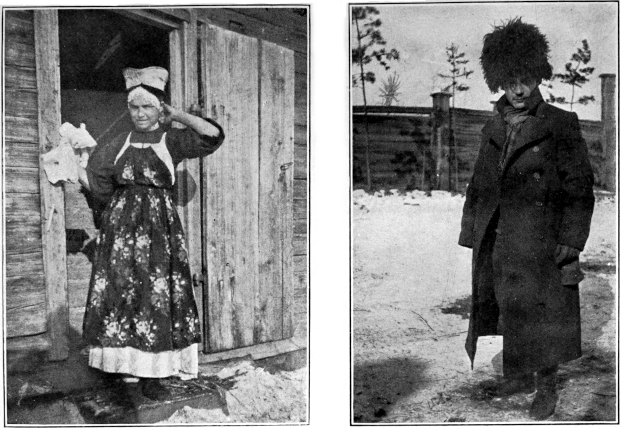
A CHICKOYA GIRL TROITZKOSAVSK STUDENT
A mixture of crudeness and culture, of luxury and hardship, of Orient and Occident, runs through the quaint fabric of frontier society, with its medley of races and types. Fine avenues flanked by stuccoed houses pierce the main city. Back of them lie the log houses of the plainer citizens, while the outskirts are occupied by the felt huts of the Buriats and Mongols. Students in uniform elbow Cossacks of the Guard, and maidens from the seminary brush the Mongol wood-choppers.
“Téatre?” suggests one evening the twenty-year-old son of your host. Of course the invitation is accepted. At eight o’clock you put on your felt boots, and tramp down past dark-shuttered log houses and the silent white church into the field, where stands a barn-like building placarded with the programme. The young guide secures seats at the ticket-counter of rough lumber. Seventy-five kopecks they are, each. With them are handed out eight numbered slips of red paper. Then together you break a way to the front rows, through the crowd of burly Cossacks of the garrison, bearskin-capped students, citizens with shiny black boots, and here and there a husky stolid-faced Buriat. Keeping hat and coat on, as does every one else, we find seats on the rough benches wheresoever we like or can; for nothing is reserved save the elevated perch of the musicians, where a four-piece orchestra drones out a monotonous Russian march. What a fire-trap! is the first thought. To each of the posts that sustain the rafters is fastened a lamp shedding an uncertain light on the hangings of bright-red cotton cloth, in dangerous proximity to which, utterly disregarding the “no smoking” signs, stand the crowd of forty-kopeck admissions, rolling and smoking perpetual papirosi.
As the impatient audience begins to pound and stamp, a bell rings, and the curtain rises on two comic characters busily engaged in packing for a hurried departure from their lodging. The stage has become a room, with red-cotton-covered walls and bright green curtains. A merchant comes with a bill for comestibles six months due. He is quieted with extravagant tales of forthcoming change for a hundred-thousand-rouble note. The landlady enters, and the shoemaker’s apprentice with a pair of mended boots. Both are likewise cajoled and bullied away. The Jewish money-lender is more difficult, but at length, to the manifest delight of the audience, he, too, is staved off, and the pair draw the vivid green curtains and go out through a window for parts unknown, amid much glee and applause.
We now go out to the “buffet” and contribute to the dangers of conflagration by smoking an offered cigarette. We also add to the theatre’s income by buying a glass of hot chai for ten kopecks. Something special is in the air for the next act. The audience is buzzing and moving in eager expectancy. We return to our seats. The curtain rises upon a double row of two-pud (sixty-four-pound) weights, such as are used at the bazaar to sell frozen beef. Amid a thunder of stampings on the plank floor one of the escaping debtors of the last act, dressed in tights, comes out from behind the green curtains, and lifts one of these above his head. Then he poises one with each hand. Finally a wooden harness is adjusted to his body, and sixteen weights (or about half a ton), are heaped upon him by the jack-booted Buriat stage-attendant on one side, and the defrauded merchant of the first play on the other. It is the most unspectacular performance possible, this athletic test, but it takes the place of a football match in Siberia. The applause is ferociously appreciative.
More chai and cigarettes, and we come back to hear a very pretty girl, dressed in the peasant’s costume of Little Russia, head a chorus, and to see a boy in red blouse and boots dance the wild dervish whirl which the peasants of tradition are supposed to execute. The boy is in the midst of his performance when there is a tumult among the forty-kopeckers under the musicians’ eyrie. The latter, being human, try to watch what is going on below and play jig-music at the same time, and sharps and flats fly wide of the mark till the sounds become frightful. Everybody jumps up on his bench to see a peasant having a turn with a Buriat, and further trouble brewing with a Cossack who has got upset in the mêlée. There is a chaos of tossing hats and brandished fists, and the two armed soldiers who are on guard as policemen press in, with gruff shouts to make them way. The tumult finally goes out the door and into the street, and we turn back to the poor dancer still trying to beat out his stunt.
The curtain rises next on the manager, who has been up to date weight-lifter, escaping boarder, and part of the peasants’ chorus. He is seated at a table, looking very ordinary in his street clothes. Behind him is another table covered with an assortment of crockery, mirrors, spoons, vases, pieces of cotton cloth, and a big striking clock. He calls for a volunteer from the audience for some unknown purpose, and a little rosy-cheeked uniformed Buriat schoolboy, who has been peeking behind flapping curtain between the acts, responds. The boy reaches into a box and pulls out a slip of paper. The manager reads a number from it, “Sto piatdeciet sem.” An eager voice from the rear answers “Jes!” The stage-attendant takes a glass tumbler from the table and carries it solemnly to the man who has answered. Your host nudges until you comprehend that you are to excavate the eight theatre-slips, which you do, to find that two only are seat-tickets. The rest are numbered billets, and you are liable at any moment to receive a perfumery-bottle or a candlestick from the lottery which is in progress. The scene now takes on an imminent personal interest shared with the banked forty-kopeckers behind. A breathless strain accompanies the drawing of the numbers. It mounts to a climax as the big musical clock is approached. The fateful billet is at last drawn in intense silence. Every eye is fixed on the reader. Not a Cossack speaks, not a Mongol moves.
“Dvesti tri!” and a sharp “Moi!” tells that the clock goes to ornament the table of a burly peasant, who grinningly receives it. The tense breaths are let out, the forms relax, and the crowd straggles to the door, lighting cigarettes and pulling down caps. The drama is over. Next morning at eight a soldier visits your host with a message from his chief.
“Bring to the police-station the passport of the stranger seen with you at the theatre last night.”
A town droshky will take one the few versts to Kiahta, where in the Geographical Society’s museum is the celebrated sketch of the Dalai Lama made at Urga by a Russian artist, when the young Tibetan monk had fled before the English expedition to Lhassa. Here, too, are ore samples and reconstructed Mongolian tents. But it is hard to look at fossil rhinoceros-heads and at stuffed sabre-toothed tigers and musk-deer when the camel-trains are passing and China is a verst away. A courier is necessary now, for resourceful Jacov and driver Ivan are strangers beyond the border. Perhaps our host knows of a man acquainted in Mongolia? He will inquire. Next day there presents himself a slight, bearded, intellectual man, Alexander Simeonovich Koratkov, usually called, for short, “Alexsimevich.” Bachelor of forty, educated in the Troitzkosavsk “Realistic” school. He speaks, as well as Russian, Mongolian, English, French, German, and some Chinese. He has translated for the English engineers who were brought in to work the Nerchinsk mines. He is deeply read in Buddhist mythology and sociology. Will he go down into Mongolia with you? Yes; and so it is arranged.
Provisions are cheap and abundant in the Siberian towns. Sixty kopecks buy a pound of caravan tea, seventeen kopecks a pound of sugar, the sort that comes in a cone like a Kalmuck hat. It is a luxury by warrant of public opinion, so much that it has, of note, been served on baked potatoes. Before the Buddha pictures of the Buriats, a few lumps may be the choicest offering. Flour costs six kopecks a pound. Beef, if a great pud-weight forequarter is bought at the market, twenty kopecks. Frozen butter will cost twenty-five kopecks per pound. Eggs, of the Siberian cold-storage variety, forty-eight kopecks a dozen. For thirty kopecks one gets a piece of milk as big as one’s head. But do not try to go beyond the native produce, for canned goods, coffee, or sardines. It is bankruptcy speedier than buying bear-holes. A big magazine will sell pâté de foie gras, imported from France, at two roubles the tin; while beneath the Chinese caravansaries’ arcade, bales of tea will be sold at a few kopecks a pound. One gets cigars in a glass-covered box, with the government stamp, for a rouble and a half, and they will be worth about as much as the strings of twisted tobacco-rope which the Mongols carry off as their single cherished luxury.
And now for transportation. The sledge can serve no more, for the snow goes bare in places along the caravan trail. We must have a tarantass, and in time one is produced for inspection. A cask sawed in half, lengthwise, is the image of its body, a lumber-cart the model of its clumsy wheels and framework. To the tarantass is hitched the trotter, with his big bow yoke to bring the weight of collar and shafts on his back rather than against his neck. At each side of him, with much such a rig as is used to tow canal-boats, are made fast the two galloping horses.
When one goes beyond the post-route with his own equipage he has, fastened under the driver’s seat and behind his own, bags of oats and hay, which must serve as emergency-rations for the horses against the days in which none can be secured along the often deserted trail. Personal provender must be likewise stored away, bags of bread, frozen dumplings to make soup with, tea, sugar, milk-chocolate, milk, candles, cheese, matches, kettles, and whatever else one can think of, or that the ingenuity of Alexsimevich can devise. Hay is piled into the tarantass bottom to supply the want of springs.
A driver who knows the trails has been found, André Banchelski, a tall Siberian, of timbering and hunting antecedents, who has a small stock of Mongol idioms regarding the price of hay and the location of water. He has reached a very good understanding with Katrinka, one of the household dependents, and Nicolai is taking an interest in him.
To-night we go to sleep on Nicolai’s plank couch, ready for the march of the next day. All is ready. To-morrow we cross the Chinese frontier.