"A Romance of Baluchistan" (continued 4)
Reading edition
But this appeal was lost on Umar Khan. He spat contemptuously and went on.
“I had meant to strike off thy head, thou pig, but will be merciful. As I walk lame, thou shalt walk lame. I will strike off both thy feet instead.”
A cold perspiration broke out from every pore as this was translated to the unfortunate man. Even if he survived the shock and agony of this frightful mutilation, the prospect of going through life maimed and helpless, and all that it involved—Oh, it was too terrible.
“I would rather die at once,” he said. “It will come to that, for I shall bleed to death in any case.”
“Bleed to death? No, no. Fire is a good hakîm,” (Physician), replied the Baluchi, with the laugh of a fiend. “Turn thy head and look.”
Campian was just able to do this, though otherwise powerless to move. Now he noticed that the fire near which they had been sitting had been blown into a glow, and an old sword blade which had been thrust in it was now red hot. The perspiration streamed from every pore at the prospect of the appalling torment to which they were about to subject him. Not even the thought that this was part of the forfeit he had to pay for the saving of Vivien availed to strengthen him. Unheroic as it may sound, there was no room for other emotion in his mind than that of horror and shrinking fear. The ring of savage, turbaned countenances thrust forward to witness his agony were to him at that moment as the faces of devils in hell.
Umar Khan drew his tulwar and laid its keen edge against one of the helpless man’s ankles.
“Which foot shall come off first?” he snarled. “You, Mohammed, have the hot iron ready.”
He swung the great curved blade aloft, then down it came with a swish. Was his foot really cut off? thought the sufferer. It had been done so painlessly. Ah, but the shock had dulled the agony! That would follow immediately.
Again the curved blade swung aloft. This time it was quietly lowered.
“Let him rise now,” said Umar Khan, with a devilish expression of countenance which was something between a grin and a scowl.
Those who held him down sprang off. In a dazed sort of way Campian rose to a sitting posture and stared stupidly at his feet. No mutilated stump spouting blood met his gaze. The vindictive savage had been playing horribly upon his fears. He was unharmed.
“I have another thought,” said Umar Khan, returning his sword to its scabbard. “I will leave thee the use of thy feet until to-morrow morning. Then thou shalt walk no more.”
The prospect of a surgical amputation, even when carried out with all the accessories of scientific skill, is not conducive to a placid frame of mind, by any means. What then must be that of a cruel mutilation, with all the accompaniments of sickening torture, for no other purpose than to gratify the vindictive spite of a barbarian? The reaction from the acute mental agony he had undergone had rendered Campian strangely helpless. It was a weariful feeling, as though he would fain have done with life, and in his desperation he glanced furtively around to see if it would not be possible to snatch a weapon and die, fighting hard. A desire for revenge upon the ruffian who had subjected him to such outrage then came uppermost. Could he but seize a tulwar, Umar Khan should be his first victim, even though he himself were cut to pieces the next moment. But he had no opportunity. The Baluchis guarded their weapons too carefully.
“Does that devil really mean what he says, Buktiar?” he took occasion to ask, “or is he only trying to scare me?”
“He mean it,” replied the cross-breed, somewhat gloomily, for were the prisoner injured the prospect of his own reward seemed to vanish. “Once he cut off one man’s feet—and hands too—and leave him on the mountain. Plenty wolf that part—dey eat him.”
This was cheering. How desperate was his strait, here, in the power of these cruel savages—in the heart of a ghastly mountain waste that a month or two ago he had never heard of—even now he did not know where he was. Their route the day before had been so tortuous that he could not guess how near or how far they had travelled from any locality known to him.
“I will give you a thousand rupees, Buktiar, if you help me to escape,” he said. “If you can’t help me, but do nothing to prevent me, I’ll give you five hundred.”
The cross-breed squinted diabolically as he strove to puzzle out how he was to earn this reward. Like most Asiatics he was acquisitive and money loving, and to be promised a rich reward, and yet see no prospect of being able to earn it, was tantalising to the last degree. He shook his head in his perplexity.
“Money good, life better,” he said. “Dey see me help you—then I dead. What I do?”
Then Umar Khan spoke angrily, and in the result Buktiar left the side of the prisoner, with whom he had no further opportunity of converse that day.
The night drew down in gusty darkness. A misty drizzle filled the air, and it was piercingly cold. The Baluchis huddled round their fires, having lighted two, and presently their deep-toned drowsy conversation ceased. One by one they dropped off to sleep.
Then a desperate resolve took hold of Campian’s mind. He was unbound, and, to all appearances, unguarded—why should he not make the attempt? Any death was preferable to the horrible prospect which morning light would bring. He might be cut down or shot in the attempt. Equally great was the probability of coming to a violent end among the cliffs and chasms of this savage mountain waste. No sooner resolved upon than he arose, and, drawing his poshteen tighter round him, walked deliberately forth; stepping over the unconscious forms of the sleeping Baluchis. His very boldness aided him. None moved. In a moment he was alone in the darkness outside.
A thrill of exultation ran through his veins. Yet what was there to exult over? He was alone upon the wild mountain side—unarmed, and without food—in a perfectly unknown land. Every step he took fairly bristled with peril. The wind increased in volume; the rain pattered down harder. He could not see an inch in front of him. Any moment might find him plunging from some dizzy height to dash himself into a thousand fragments and Eternity. Here again his very desperation saved him. Trusting entirely and blindly to luck, he skirted perils that would have engulfed a more careful and less desperate man. Anything rather than a repetition of his experience of that day.
On through the darkness—on ever. The howl of a wolf ranging the mountain side was now and then borne to his ears upon the wind and rain: and more than once the dislodgment of a loose stone or two, and its far away thud, after a momentary space of silence, told that he was skirting some vast height, whether of cliff or tangi—but even that failed to chill his blood. He was moving—his energies were in action. That was the great thing. He was no longer cold now. The exertion had warmed him. He felt more and more exultant.
Yet with morning light his enemies would be upon his track. Here, among their native rocks and crags, what chance had he against these persistent, untiring hillmen? The savage hatred of Umar Khan, enhanced by being deprived of a sure and certain prey, would strain every source to effect his recapture. Well, he had the long night before him, and the darkness and turbulence of the night were all in his favour.
If only he had some idea of his locality. The tidings of the outrage would have reached Shâlalai, and by now a strong military force would have been moved up to Mehriâb station to investigate the scene of the massacre, and follow up its perpetrators. But he had no idea in which direction Mehriâb station lay, or what mountain heights might have to be crossed before he could gain it.
Morning dawned. Weary eyed, haggard, exhausted with many hours of the roughest kind of walking, stumbling over boulders and stones, bruised, faint for want of food, the fugitive still held on. He was descending into a long, deep valley, whose sides were covered with juniper forest. Shelter, at any rate, its sparse growth might afford him. Ha! He knew now where he was. It was the Kachîn valley.
Yes, in the widening dawn every familiar feature was made more plain. He had come over the high kotal which he and Bhallu Khan had climbed to when stalking markhôr. There was the spur which shut out Chirria Bach, and away up yonder the forest bungalow. Could he gain the latter he could obtain food, of which he stood sorely in need, as well as arms and ammunition. Some of the servants were still there. They would have heard nothing of the tragedy on the railway line, and would be momentarily expecting the return of the household. Turning to the right he struck off straight for the house, full of renewed hope.
But that huge, practical joke entitled Life is, in its pitiless irony, fond of dashing such. He had barely travelled half a mile when a rattle of stones on the mountain side above arrested his attention. A score of turbaned figures were clambering down the rocks. Spread out in a half circle formation they were nearly upon him. There was no escape. Umar Khan and his savage freebooters were not going back on their reputation just yet. The fugitive’s long night of peril, and labour, and perseverance, had all gone for nothing. Several of the Ghazis were already pointing their rifles, and in loud, harsh tones were calling on him to halt.
Chapter Eighteen.
“Mohammed Er Rasoul Allah?”
“Ping-ping!” The bullets sang around him—splattering the rocks with blue lead marks. Not for a moment did he think of stopping. They might shoot him dead, but alive he would not yield. Besides there was one last desperate chance, and he meant to try it.
The markhôr cave! A final spurt would bring him to that. It was just round yon shoulder of cliff, which at present concealed it. His pursuers would not even see him enter it, and there were smaller holes and crannies around which would puzzle them. Besides, he remembered there were superstitions attaching to it. These might possibly deter them from entering at all. It was a straw, but a slender one.
One great and final effort. He penetrated its normally forbidding but now welcome blackness, and sank down panting on the rock-floor. For some minutes he thus crouched, listening intently. He heard the rattle of stones outside; now and then the tones of a deep voice, or the clink of rifle-barrel or scabbard against the rock. The search was proceeding right merrily, yet, why had it not begun here?
Some minutes went by. To the hunted man, crouching there, they meant hours. Then the sound of steps approaching. They were going to search the markhôr cave. His last chance had failed.
The footsteps outside halted. Then he heard the voice of their owner calling, and receiving answers from several other voices. He was calling to his comrades to come and aid in the search. Superstition, evidently, disinclined him to prosecute it alone. It could not be the fugitive that he feared, seeing that the latter was unarmed, and probably quite exhausted.
Then a wild and daring idea came into Campian’s mind—in fact, so utterly desperate a plan that were he allowed time to think of it, the bare thought would suffice to send a cold shiver through his frame. The chasm—into which he had so nearly stepped on the occasion of his first and last visit to this place! The chasm—into whose black depths he and Vivien had stood gazing, side by side. It was his last and only chance, but—what a chance!
His matchbox contained a few wax vestas. The pursuers, probably still collecting to explore the cave in force, had not begun to enter. Groping his way round a rock corner which would partially or entirely shield the light from those without, he struck a vesta, deadening, so far as he was able, the sound with his hollowed hands. It flamed forth—a mere flicker in the cavernous gloom. But it was sufficient for his purpose.
There lay the black rift, like the great serpent for which he had at first taken it. He was right at its brink. Then flinging into it the spent vesta, he grasped the edge and let himself carefully down, hanging by the grasp of his two hands alone on the lip of the fissure, in the pitchy darkness over that awful unfathomable depth which seemed to go down into the very heart of the earth.
The tension was fearful. He must let go. Every muscle was strained and cracking. And now a glow of light told that his enemies were entering with torches. Ha! he had overlooked that contingency. The light would reveal his strained fingers grasping the rock. One cut of a tulwar—and—
Then his feet came in contact with something—something that clinked faintly as with the sound of metal. Groping carefully with both feet, lo! they closed on what felt like an iron chain.
Heavens! it was a chain—a massive iron chain depending in some way from the rock above. In the increasing glow of the torches he could make out that. Here was a Heaven-sent chance. Grasping the great links firmly with knees and feet, he let go, first with one hand, then the other, and seized the chain. It, with its rough links, afforded a safe and solid resting place for a time.
The pursuers had now arrived right at the brink. Their bizarre, turbaned shadows on the opposite rock wall looked gnome-like in the smoky glare of the torches. But in the said glare he recognised, with a rush of hope, that unless they peered right over they could not see him, for the chain hung from an iron bolt let into the rock, which here projected just above his head.
The weird shadows on the rock danced and tossed, the guttering light grotesquely exaggerating every movement. He who hung there could hear the deep-toned voices right over him. The chain to which he clung swayed and shivered with the concussion of the tramp of many feet above. They held out a torch or two over the abyss, and dropped a few pebbles down—even as he himself had done when with Bhallu Khan. He could hear their exclamations as the stones struck far below with a faint thud. Could he have understood them, his relief would have been greater still. Among them, however, he thought to recognise the harsh, snarling voice of Umar Khan.
“If the dog has gone down here,” that worthy was saying, “why, then, he is already suffering the torments of hell. If he entered this place at all, how should he not have fallen in, seeing that it is darker than night within the cave, and this hole is a pitfall to the unwary, and a very entrance to the abode of devils?”
“In here he entered without doubt,” said Ihalil Mohammed, “for every other hole have we searched thoroughly.”
To this the others assented. Their prisoner had undoubtedly given them the slip. Dead or alive he would never be seen again.
All this the hunted man, thus hanging there, could not understand. Would they never give up the search, he was wondering. Well for him that he was in hard form and training—yet he was not so young as he used to be, he recognised bitterly, as every joint and muscle ached with the convulsive tension involved in thus supporting his own weight, for an apparently unlimited period, entirely by compression. Well for him, too, that the links were rough with red, flaky rust, thus affording increased facility of hold. Yet would these hell hounds never give up the search?
They were forced to at last. The red glow of the torches grew fainter, then died out—so, too, did the sound of footsteps and voices. Campian was in pitch darkness, suspended over this awful and unknown depth.
Now that the more active peril was withdrawn, and his attention thus drawn inwards, he was able to think, to realise the full horror of his position. How was he to return? Cramped, aching, exhausted, he felt as though he could hardly hold on, let alone work his way upward. His blood ran cold too as he realised what would have been his fate but for this solid and substantial means of support right to his hand. Half a yard further on either side, and—No, it would not bear thinking of, and no sooner had he arrived at this conclusion than one foot, unconsciously lowered, came in contact with something.
Something hard, wide, horizontal it was, for as he cautiously increased the pressure he felt it sway and tilt slightly. Then, with equal caution, he lowered the other foot on the other side of the chain. It, too, met with like support. Carefully, with both feet, he increased the pressure so as to test the weight, still preserving his hand-hold. Nothing gave way, and his heart leaped within him as he found he had secured a firm resting place whereon to recruit his strength against his return climb.
And now, safe for the time being, his thoughts were busy with speculation as to this structure hung here in the black depths of the gulf. A great massive iron chain supporting a convenient swinging platform, had not found its way there expressly to afford him a secure refuge in the hour of peril, that much was certain. Then his nerves thrilled and tingled as the conjecture uttered by Vivien in this very place came back to his mind: “What if the things are at the bottom of that cleft?” Heavens! Had this structure to do with the hidden treasure—the priceless ruby sword?
Instinctively he sought his matchbox. No. That would be madness. His pursuers might not even have left the entrance of the cave. Not for hours would it be safe to strike a light.
And for hours, indeed, he hung there and waited. He groped around the platform, first with one foot then with the other, and it dawned upon him that the structure was no ordinary board, or it would have tilted. It was a solid block of wood—no—a box.
A box? A chest! That was it. What if it held the treasure itself? And then by a strange fatality the conviction that this would prove to be the case took firm hold of his mind—and if so, by what a terrible sequence of tragic events had he been constituted its finder. Would not the recent dread experiences be worth going through to have led up to this splendid discovery? All would yet be well. The best of life was before him yet Vivien’s last look, as he descended from their place of refuge to purchase her safety by delivering himself into the hands of their enemies, burned warm within his soul. When he returned safe, as one who returned from the dead, what would not her welcome be? Surely the glow of the old days would be as nothing to this.
These and other such thoughts coursed through his mind as he hung there in the pitchy blackness—and indeed it was well for him that such was the case. Nothing is more utterly unnerving than any space of time spent in an absolutely silent and rayless gloom, but when, in addition to that, the subject is swung on a hanging platform, whose very stability he can vouch for with no degree of certitude, over a chasm of unknown depth, and that for hours, why, he needs a mental stimulus of a pretty strong and exalted type.
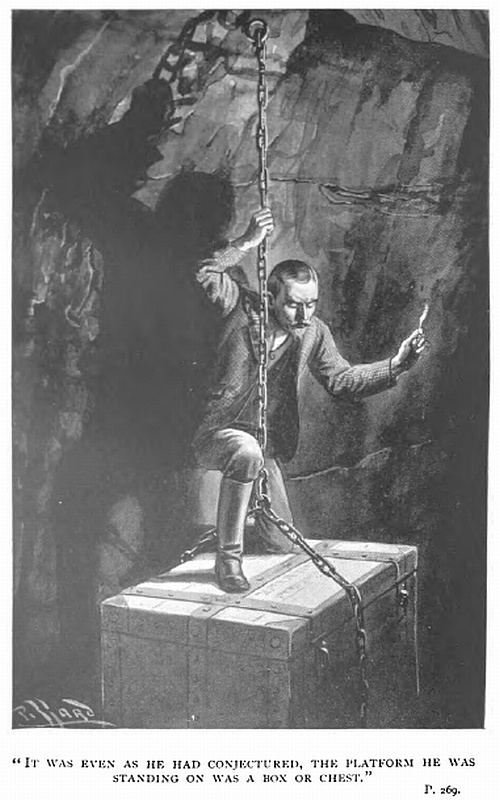
Judging it safe at last to do so, Campian struck a light. Feeble enough it seemed in the vast gloom, and not until it had burned out were his eyes capable of seeing anything after being for hours in black darkness. Then, stooping as low as he dared, he lit another. Yes. It was even as he had conjectured. The platform he was standing on was a box or chest.
It was of very old and hard grained wood, almost black, and clamped together with solid brass bindings. It showed no sign of having suffered from the ravages of time, and the upper part, which was all he could see, was covered with Arabic characters, curiously inlaid—probably texts from the Korân. He had no doubt but this was what had occupied so much of his thoughts, the hidden and forgotten treasure chest of the fugitive Durani chief, Dost Hussain Khan. Little is it to be wondered at if even there he felt thrilled with exultation as he remembered what priceless valuables it certainly contained.
But that thrill of exultation sustained a rude shock—in fact died away. For happening to glance up while lighting another match it came home to him that whether the chest contained valuables or not, the probability that he would ever be in a position to put that contingency to the test was exceedingly slender; for to gain the brink of the chasm, and the outer air again, looked from there an absolute impossibility. The chain, and that which it supported, depended from a solid bolt let into the rock, but the latter overhung it in a cornice or lip, which projected nearly half a yard. He would never be able to worm himself over this. And then it came home to him that he was beginning to feel quite faint with hunger, and that his strength was leaving him fast.
Well, the feat must be attempted. Lighting another match—and he had few left now—he sent a long steady look at the projection, the fastening of the chain, and the distance from the edge. Then he began his climb.
This was not great. The rock lip projected only about half a yard above his hands at their highest tension. He drew himself up. He was under the projection—groping outward along it in the darkness. Now he gripped it firmly with both hands—still clinging to the chain with feet and legs. He was about to swing himself off. One hand half-slipped away. No, he could not do it. His strength failed him, likewise his nerve. He was barely able to seize the chain again and let himself down to the vantage ground of the box, where he stood literally trembling.
This would not do at all. He must rest for a few moments and recruit his strength, must quell this shaky fit by sheer force of will. It could not be—he argued with himself—that he had come through all this, had made this royal discovery, by a chain of coincidences signal and tragic, only to fail at the last; to be swept into nothingness; to disappear from all human sight as completely as though dead and buried already. He was a bit of a fatalist, too, and this partially supported him now. If he was to come through safely, why he would — if not—! And with this thought, as by an inspiration, came another idea.
He could never raise himself above the rock projection from which the chain hung—that much was certain. But—the point whence he had let himself down was only a foot to the right. There the edge did not overlap.
Steadying his over-wrought nerves, he drew himself up once more. Holding on tightly he reached forth one hand. It grasped the brink. Carefully he felt along the hard rock. Yes—that would do. Now for it. He put forth the other hand.
And now the moment was crucial. One arm was already along the floor above the edge. Campian’s fate hung in the balance there in the pitchy gloom. Beneath him all black darkness, death, horror, annihilation. The merest feather weight either way would turn the scale. He let go of the chain with his feet. A last and mighty effort, and—he was lying safe and sound on the rock-floor above; well nigh unconscious with exhaustion and the awful strain his nerves had undergone.
For long he lay thus. Then the cravings of hunger became more than he could bear. Physical nature reasserted itself. He must obtain food at all risks. The forest bungalow was not far from that place. There he would find it.
It must have been hours since he took refuge here. His enemies had surprised him just at daybreak; now it was high noon. Prudence counselled that he should wait until night—physical craving argued that by then he would hardly have strength left him to make his way anywhere; and the physical argument prevailed, as it ordinarily does.
He stepped forth quickly and gained the shelter of the juniper forest. The glare of the sun blinded him, and the sparse foliage afforded but poor shade. He staggered along exhausted, yet full of renewed hope and resolution.
But for the mental and bodily exhaustion which half dulled his faculties, he would have become aware of a peculiar nasal, droning sound a short distance in front of him. As it was he hardly heard it, or if so, missed its significance. When, however, he became alive to the latter it was too late.
In a small open space, overhung on the further side by rocks, a score of turbaned figures were kneeling. They were in two rows, and, barefooted, were prostrating themselves in the approved method of the faithful at prayer. Then, rising, repeated, with one voice, their orisons, which were led by a single figure a little in advance of the rest. It was too late. With the first footfall of the intruder, round came several shaggy faces. The effect was magical. The entire band of fervid devotees sprang to its feet as one man. Tulwars whirled from their scabbards, and, in a moment, the intruder was surrounded. Well might the latter now despair. Well might he realise that the bitterness of death was indeed past. All that he had gone through was as nothing. He had walked, with his eyes open, right into the midst of his enemies, had placed, of his own act, his life in their hands. Foremost among the threatening, scowling countenances was the repulsive, exultant one of Umar Khan.
“Ah! ah!” snarled this implacable savage, with a grin of exultation. “Lo, the sheep returns to the slaughter, for so wills it God.”
“Allah?” repeated the destined victim, catching the last word. “Hearken, Moslem, în hearken!” he called out in Hindustani, eyeing with unconcern the uplifted sword of his arch enemy. Then, standing there in their midst, and facing in the direction they had been facing while at prayer, he extended both hands heavenward, and uttered in a loud, firm voice:
“La illah il Allah, Mohammed er rasoul Allah!”
A gasp of wonder went up from those who beheld. As by magic every weapon was lowered. Campian had professed the faith of Islam.
For some moments these fanatical brigands stared stupidly at each other, then at the figure of the sometime infidel, but now believer. The spell was broken by their leader.
“It is well!” he said, advancing upon Campian, and again raising his tulwar. “There is rejoicing in Paradise now, for in a moment it will be the richer for a newly gained soul.”
But before the weapon could descend, an interruption occurred. A little bowed, bent figure came hurrying into the group. Campian recognised the sometime leader of the devotions.
“Hold now, my children,” he cried, in tones quavering with age and excitement, as he interposed his staff and rosary between the weapon of Umar Khan and its intended victim. “Have ye not grievously offended God? Have ye not broken into his hour of prayer, with brawling and strife? Would you further damn your own souls by shedding the blood of a true believer within this holy ziarat (a local shrine or sanctuary)—for I myself have heard the profession of this Feringhi? Have no fear, my son—have no fear,” he added, turning to Campian, and placing an aged, wrinkled claw upon one shoulder. “None shall do thee hurt, thou, who art now one of the faithful—for if any harm thee,” shaking his staff menacingly, “let him shrivel before the curse of the Syyed Aïn Asrâf.”
The only words of this address intelligible to the now ransomed victim—though he understood the burden thereof—was the name—and at that he could not repress a start of amazement. Those around beholding this were equally astonished.
“See,” they said among themselves. “Even to the infidel has the fame and holiness of the Syyed Aïn Asrâf reached.”
Even Umar Khan dare not openly resist the will of one so holy as the Syyed, and that as a matter of fact. But though baulked for the present, he turned sullenly away, meditating further mischief.
Chapter Nineteen.
Hopes and Fears.
A Regimental band was playing in the grounds of the Shâlalai Club, which institution constituted the ordinary afternoon resort of the society of the station.
A row of subalterns were roosting on the railing in front of the exclusively male department of the club, while their dogs fought and frisked, and snarled and panted, on the sward underneath. Every variety of dog—large and small, mongrel and thoroughbred—was there represented; indeed far more variety than might have been discerned among their owners, who, for the most part, were wonderfully alike; as to ideas, no less than in outward aspect.
As the afternoon wore on, more subs would ride up by twos and threes, on bicycles or in dog-carts—or even the homely necessary “gharri”—with more dogs, and after going inside for a “peg,” would emerge to swell the ranks of those already on the rail; their dogs the while engaging in combat with those already on the sward.
This rail-roost was a deeply cherished institution, which no consideration apparently was able to shake; whether the frowns or hints of superiors, or the attractions of the ornamental sex. This was scarcely surprising, for the ornamental sex as represented at Shâlalai was, with very little exception, singularly unornamental; which, though paradoxical, was none the less fact.
The tennis courts were in full blast, with a fringe of spectators. There were many sunshades and up-to-date hats and costumes scattered about the lawn, yet upwards of forty British subalterns roosted upon the railing.
“Hallo, Cox,” sung out one, hailing a new comer. “When are you going to catch Umar Khan?”
“No betting on this time, Cox,” said another, “unless it’s on Umar Khan.”
He addressed was a handsome, pleasant, fresh faced young fellow, who held a somewhat important political post. The point of the banter on the subject of Umar Khan was that Cox had started in pursuit of that bold bandit immediately on receipt of the news of the Mehriâb station affair. He had started absolutely confident of success, but he might as well have started to stalk the wily markhôr with the regimental band playing before him. That had been some weeks ago, but as yet neither Cox nor anyone else had ever come within measurable prospect of laying the marauder by the heels.
“Oh, bus!” retorted Cox. “Pity they don’t turn out some of you fellows after him. A week or so of tumbling about among rocks and stones would do you all the good in life. Anyone know where Upward’s to be found, by the way?”
“The jungle-wallah? He was in the billiard room just now knocking fits out of old Jermyn with that tiger-potting stroke of his. Why? Anything fresh turned up?”
“I expect you fellows will soon be started after Umar Khan,” retorted Cox, looking knowing, as he turned away to find Upward.
“Wonder if he really means it?” said one of the rail-roosters, after he had left, and then they fell to talking about the notorious brigand, and discussing a current rumour to the effect that the Government contemplated arresting the principal Marri chiefs for suspected complicity in Umar Khan’s misdemeanours, and holding them as hostages against the surrender of that outlaw, and the safe restoration of his prisoner.
“Wonder if that poor devil Campian’s throat has been cut yet?” conjectured someone.
“More than likely. If not it will be, directly any of the chiefs are interfered with.”
“They won’t bone Mr Umar Khan,” said another Solon of the rail-roost. “He’s skipped over into Afghanistan long ago, and the Amir won’t give him up, you bet. Shouldn’t wonder if he was at the bottom of it all himself.” At that time the Amir of Kabul was a very Mephisto in the sight of the collective and amateur wisdom of the Northern border.
A wave of interest here ran along the line of the rail-roosters—evoked by the bowling up of a neat dogcart, whose occupants, two in number, were alighting at the door of the feminine department of the club.
“By Jove! Those are two pretty girls. And neither belong here,” added the speaker plaintively.
“She can handle the ribbons, that Miss Wymer,” cut in another of more sporting vein, who had been critically surveying the arrival of the turn-out. “She’s got a fine hand on that high-actioned gee of old Jermyn’s. Isn’t that the brute that Wendsley had to sell because his wife couldn’t drive him?”
“No. You’ve got the affair all mixed,” returned yet another emphatically. And then, while a warm horse argument grew and thrived among one section, another continued and fostered apace the discussion concerning those just deposited there through the motive power of the quadruped under dispute.
“I don’t think Miss Wymer is pretty,” declared a Solon of the rail. “She’s awfully fetching, though.”
“Rather. There’s a something about her you don’t often meet with, and you don’t know what the devil it is, either. By the way, wasn’t old Bracebrydge properly smashed on her?”
“Oh, he’s that on every woman under the sun—in rotation. This one let him have what for, though.”
“Did she? Eh, what about? How was it?” exclaimed several.
“Rather. They were talking about the Mehriâb affair, and Bracebrydge said something sneering about that poor plucky devil, Campian. You know what a blundering, tactless, offensive beast Bracebrydge can be. Well, he said they were all making too much of the affair, and more than hinted that Campian had only done what he did so as to seize the first opportunity of running away later on. Miss Wymer only answered that she thought she knew one or two who wouldn’t have waited for that—they’d have run away at the start. But it was the way she said it, looking him straight in the face all the time. By George, it was great, I can tell you—great. Bracebrydge looked as sick as if he had just been hit in the eye.”
“Serve him jolly well right,” declared one of the listeners, and his opinion was universally seconded, for Bracebrydge was not popular among those who roosted on the railing.
“I think Miss Cheriton’s the prettiest of the two,” said the youth who had first spoken. “She’s one of the most fetching girls I ever saw in my life.”
“Then why don’t you make hay while the sun shines?” rejoined another. “Go and make yourself agreeable—if you can, that is. They’ve just gone into the library. Go and ask her to play tennis, or something, chappie.”
“I think I will.” And sliding from the rail with some alacrity, away he went. Those remaining continued their subject.
“Bracebrydge must have been a double-dyed ass to have hit that particular nail on the head. It’s my belief he couldn’t have hit the wrong one harder, anyway.”
“The devil he couldn’t!”
“Well, I don’t know, mind. Only look at the opportunities they had, thrown almost entirely upon each other up there, for old Jermyn doesn’t count. If they hadn’t altogether set up a bundobust, it was most likely only a question of time.”
“Miss Wymer hasn’t been to a dance since that affair,” struck in another oracle of the rail. “Looks as if there was some fire beneath the smoke. What?”
“That don’t follow, either. Mind you, the chap deliberately went to have his throat cut so that the others should be let go, and while his fate is a matter of uncertainty it is only what a nice girl like that would do to keep a bit quiet. She wouldn’t care to think, while she was frisking about at dances, that at that very moment they might be hacking the poor chap to pieces.”
It so happened that the theory set forth by the last two speakers expressed with very fair accuracy the real state of affairs. Naturally self-contained, and with immense power of control over her feelings, Vivien was able to support the terrible strain of those weeks without—in popular parlance—giving herself away. And it was a strain. Day and night his image was with her, but always as she had seen him last; calmly and cheerfully delivering himself into the merciless hands of these cruel, marauding fanatics, giving his life for her and hers. Of the old days she dared not even think—and, since this tragedy had come between, they seemed so far away. Small wonder, then, if she refrained from joining in the ordinary round of station gaieties, yet not too pointedly, and she was the better able to do this that, being a comparative stranger in the place, her abstention was ascribed to a natural seriousness of temperament. Even thus, however, it could not entirely escape comment, as we have seen.
She and Nesta Cheriton had become great friends, although as different in temperament as in outward characteristics. In public, at any rate, they were generally about together, and in private, too, seemed to see a good deal of each other. It was almost as though they had some bond in common, and yet Vivien never by word or hint let out the ever present subject of her thoughts to any living soul. She had not quite lost hope, but as the days went by and nothing was heard either of the captive, or of the marauding outlaw who held him, she well nigh did lose it. Both seemed to have vanished into empty air.
For the stipulated ransom had been duly paid. Colonel Jermyn, with the aid of Upward and the head forest guard, had met Umar Khan’s envoy—none other than Ihalil Mohammed himself—he who had negotiated the terms. Great was the amazement and disgust of all when told that the prisoner would not be handed over. It was not in the bundobust. Nothing had been said as to the restoration of Campian on payment of the five thousand rupees. The Colonel and Der’ Ali stared at each other in blank dismay, for they recognised that this was only too true. No such stipulation had been made, they remembered. But, of course, it had been understood, they put it to the envoy. That wily Baluchi merely shook his head slightly, and repeated—as impassable as ever, “It was not in the bundobust.”
Then the Colonel raved and swore. It was treachery, black, infernal treachery. He believed they had murdered their prisoner already, at any rate, not one pice should they get from him until the sahib was handed over safe and sound. Then they should have every anna of it. Not before.
At this Ihalil Mohammed merely elevated one shaggy eyebrow, and remarked laconically:
“Sheep are flayed after they are dead, not before.”
The Colonel stared blankly over the apparent inconsequence of this remark, then, as the fiendish import of it dawned upon him, he lost his temper, and nearly his head. His hand flew to his revolver.
This time Ihalil Mohammed elevated two shaggy eyebrows and observed:
“Sheep are flayed and roasted after they are dead—not before.”
Then he relapsed into his wonted saturnine taciturnity.
The others consulted together. Ihalil seemed hardly interested enough even to watch them. The wily Baluchi knew that the key to the whole situation was in his own hand. He had marked the visible discomfiture produced by his hideous threat. He knew that the stipulated sum would be paid, and that he himself would be suffered to depart with it unmolested—and, indeed, such was the case.
“Is the sahib still alive?” asked the Colonel.
“He is still alive.”
“And well?”
“And well.”
“Very good. Now then, Der’ Ali. Tell this infernal scoundrel to tell his more infernal scoundrel of a chief that if he brings in the sahib safe and well within eight days from, this, and hands him over, we will pay him another five thousand rupees; but if any harm happens to him, then the Sirkâr will never rest until he has hung him and every man Jack of the gang—hung ’em in pigskins, by God, and burnt them afterwards. What does he say to that?”
Der’ Ali, being judicious, substituted courteous epithets for the naturally explosive ones which his master had directed at Umar Khan, and Der’ Ali, being a Moslem himself, refrained from repeating in plain terms so shocking a reference as that of which the blunt Feringhi had not scrupled to make use, substituting for it mysterious and sinister hints as to death by hanging under its most dreaded form. Ihalil’s reply was characteristically laconic.
“Well, what does he say?” repeated the Colonel testily.
“He say—he hears, Huzoor.”
“Are they going to bring the sahib back, Der’ Ali?”
“He say—he can’t say, Huzoor,” answered the interpreter, having elicited that terse reply.
“Tell him to go to the devil, then,” said the Colonel, unable to resist an angry stamp of the foot.
Der’ Ali rendered this as—“Go in peace,” and Ihalil, uttering an impassive “Salaam,” mounted his camel, and—did so.
They watched the form of the retreating Baluchi, fast becoming a mere white speck in the desert waste with every stride of his camel, and shook their heads despondently. Would these wolves ever release their prey? Bhallu Khan was of a kindred tribe. What did he think of the chances? But the old forester, who, like most barbarians or semi-barbarians, always answer what they imagine the inquirers would like best to hear, replied that he thought the chances were good. All men loved money—even the sahibs would rather have plenty than little—he interpolated with a whimsical smile. Baluchi loved money too. Umar Khan would probably release his prisoner if plenty of rupees were offered him.
But the eight days became fifteen, and still of the said prisoner there was no sign; and the fortnight grew into weeks, with like result. Then those interested in Campian’s fate felt gloomy indeed. They had almost abandoned hope.
But whatever private woes and trials, the world rubs on as usual. Shâlalai at large was not particularly interested in Campian’s fate, except as an item of political excitement. It was far more interested in the capture or destruction of Umar Khan than in the rescue or murder of his prisoner; for that bold outlaw had set up something of a scare. That sort of outbreak was catching among these fierce, fanatical, predatory races, and it struck home. Shooting parties became decidedly nervous, and fewer withal; and those delightful, moonlight bicycling picnics, miles out along the smooth, level, military road, were given up as unsafe—for did not the Brahui villages dotting the plain on either side contain scowling, shaggy, sword-wearing ruffians in plenty, and was there not a wave of restlessness heaving through the lot?
Fleming was one of those who decided that his own affairs were of paramount importance to himself; wherefore he continued to pay assiduous court to Nesta Cheriton. But the girl seemed to have altered somehow. She had grown quite subdued, not to say serious. The old, gay, sparkling high spirits were seldom there. Fleming, turning things over, shook a gloomy head, then dismissed his fears as absurd. Could it be there was anything between Campian and herself? They had perforce been thrown together a lot in Upward’s camp—moreover, when he and Bracebrydge had left, they had left the other behind them. Had he improved the shining hour then? Fleming recalled the tangi adventure, and swore to himself; but he soon recovered, and the restoration of his equanimity was effected through the agency of his looking-glass. It was too damned absurd, he told himself, surveying his really good-looking face and well-knit soldierly figure—that any girl could prefer a dry old stick like Campian, and a mere civilian at that—so, giving his gallant moustache an additional twist or two eyewards, he concluded to start off and place the matter beyond a doubt.
But on reaching Upward’s bungalow ill chance awaited him. Nesta was not alone, and her mood was unpropitious. What was that? He could hardly believe his ears. She was depreciating—yes, actually depreciating—the British Army.
“I don’t know what is the use of all these soldiers here in Shâlalai,” she was saying as he came in. “Thousands of them. How many are there, Captain Fleming? How many soldiers have we got in Shâlalai?”
“Oh, about five thousand—of all sorts.”
“About five thousand,” she repeated, “horse, foot, and artillery, and yet a dozen ragged Pathâns can race about the country, killing people at will.”
“That everlasting Umar Khan, I suppose?” said Fleming, somewhat shortly, for he was not a little nettled at her disparaging, almost jeering, tone.
“I think he is going to be the ‘everlasting’ Umar Khan,” she retorted quickly. “Why don’t some of you try and catch him, Captain Fleming? There are enough of you, at any rate.”
“We must wait for orders, Miss Cheriton,” he replied stiffly.
“If I were a man, and a soldier, I wouldn’t wait for orders if there was anything of that sort to be done,” she retorted, with delightful inconsistency. “I’d get leave to raise a troop, and I’d never rest till I brought in that Ghazi. All our jolly bicycle picnics are knocked on the head, and then Mr Upward has constantly to go into camp, and of course Mrs Upward will insist on going with him, and—I’m very fond of her.”
Fleming, who had been twirling his moustache eyeward somewhat viciously, suddenly quit that refuge for the perturbed. An idea had struck him. By George, it was not merely on Campian’s account she wanted Umar Khan run to earth! Vastly relieved, he said:
“There’s a good deal in what you say, Miss Cheriton. I must think out how the thing may be done.” Then he talked on other and indifferent matters, and shortly took his leave.
Meanwhile the bi-annual jirgeh, or tribal council, was in progress at Shâlalai, and representatives of all the tribes and clans and septs gathered daily in the durbar hall to meet the Sirkâr and ventilate grievances and settle disputes, and in short to discuss matters generally between themselves and the Executive. Stately chiefs and their retinues—tall, dignified men, picturesque in their snowy turbans and long hair and flowing beards, wending thither beneath the plane-shaded avenue—passed in strange contrast the dapper sub skimming along on his bicycle, or fashionably attired ladies in their high-wheeled dogcart flashing by at a hard trot, bound for club or gymkhana ground. Such, however, they eyed as impassively as they did the crowd of low caste Hindus which thronged the bazaar; for the training of their wild desert home had left no room for the display of emotions. Now and then, recognising some official, they might utter a grave “Salaam,” accompanied by a slight raising of the hand, but that was all. A contrast indeed! The unchanging East, in its melancholy dignity and fund of awe-suggesting power—because power held in the mystery of reserve—jostled by fussy, domineering, up-to-date civilisation; the fierce, wild, untamable spirits masked by those copper-hued and dignified countenances, side by side with the careless, pleasure loving, yet intensely pushing and practical temperament underlying the fresh, tawny-haired Anglo-Saxon faces. Even the very headgear suggested a vivid contrast—the multitudinous folds of the snowy and graceful turban expressive of absence of all capacity for flurry—cool deliberateness, repose, wisdom—even as the cock of the perky “bowler” seemed a very object lesson in itself of push and bounce and “there-to-stay” tenacity.
Now and then one or two of the sirdars would visit Upward to talk officially on forest matters in their respective districts, or to view his multifold trophies of the chase, which keenly interested them. These visits Upward encouraged, hoping to learn something of Campian’s fate. But it was of no avail. Of the massacre at Mehriâb station, and the doings of Umar Khan in general, the wily Asiatics professed the profoundest ignorance, not with effusive reiteration, but in a grave, nonchalant, dignified way, as though the matter were entirely unworthy of their notice or cognisance, once and for all. But to Vivien Wymer, who never lost an opportunity of studying these people, such visits were of untold interest; moreover, they seemed to result in a certain degree of hope renewed. These stately, courteous-mannered potentates had not got cruel faces. There was a noble look about most of them, even a benevolent one. Surely these were not the men to sanction a coldblooded murder.
Meanwhile, during the jirgeh, the matter of Umar Khan was receiving the full attention of the Executive. It was one thing for the chiefs to protest ignorance in private and unofficial conversation with Upward, with whom, diplomatically, they had no earthly concern. Carefully and with due deliberation the authorities narrowed the net—and it was decided to arrest Yar Hussain Khan, who, as the outlaw’s feudal chief, was responsible for his behaviour—and a sirdar of the Brahuis who was proved to have sheltered and screened him.
The chiefs in question made no trouble over the decision of the Sirkâr. With Oriental impassibility they accepted the situation, and were placed under guard accordingly. But two nights later Umar Khan swooped down upon a Levy post within ten miles of Shâlalai, surprised and massacred the handful of Hindu sepoys in charge, and rolled a couple of field pieces down the mountain side, retiring as swiftly as he had appeared: while the Brahui clans in the neighbourhood began to make themselves disagreeable by various small acts of aggression which rendered it unsafe to venture many miles beyond the lines.
Things began to look uncommonly lively in and about that station containing five thousand troops—horse, foot and artillery.
Chapter Twenty.
At Darkest Hour.
Away in the Kharawan desert the dust columns are whirling heavenward in many a tall spiral shaft; more like the hissing steam jets of some vast geyser than anything so dry and unadhesible as mere sand.
A dead flat level, stretching afar into misty distance on the skyline on every hand—its only vegetation a low scrubby attempt at growth; the fierce sun at a white heat overhead; the sky as brass—what life can this awful wilderness by any possibility support? Yet so wonderful, so inexhaustible are the resources of Nature that even here both man and beast can fare along, and that moderately well.
Camels, with their loads, kneel on the sand, resting from their labours; with their ugly heads and weird snaky necks and unceasing guttural snarling roar, conveying the idea of hideous antediluvian monsters somehow or other forgotten by the Flood in this desert waste. A flock of black goats, cropping daintily at the sparse attempt at herbage, or crouching in groups chewing the cud, represents the other phase of animal life there, unless three or four gaunt Pathân curs employed at assisting to herd the same. Here and there a tent, or mere shelter of tanned camel hide, blackened by the heat of innumerable suns, stretched upon poles, affords a modicum of shelter from the arid baking heat.
It is the hour of prayer. Grouped together the believers are kneeling—facing towards the holy city; whose exact direction they have a marvellous faculty for determining with accuracy. As one man they sink down in their twofold prostration, forehead to the earth, then rise again, and the droning hum of voices goes out upon the shimmer of the scorching air. One, in front of the rest, leads the devotions, a little, shrunken, aged figure, and by his side is another, but it is the form of a man in all the vigour of his prime.
With more than ordinary unction the prescribed formulae are repeated. No abstraction or looking round is here, such as the faithful when individually devout may occasionally give way to. Perhaps it is the holy character and reputation of the leader that ensures this edifying result, for the Syyed Hadji Aïn Asrâf is justly invested with both of these.
He who prays side by side with this pillar and prop of Moslem orthodoxy is arrayed like the rest. His white turban, cool and voluminous in its folds, is the same as that of these swarthy copper-hued sons of the desert—so, too, are the graceful flowing garments and chudda, in which he is clad. His shoes are off his feet, and his prostrations and general attitude differ in no wise from those employed by the other devotees—the outcome of a lifetime’s habit. Yet, as the orisons over, all rise and resume their shoes and their wonted and work-a-day demeanour, a close observer might well notice that this is no fanatical son of the Orient but a man of Anglo-Saxon blood—in short, none other than Howard Campian.
How then is it that the part has come to him so easily? He had professed Islam, it is true; but that as a mere expedient to save himself from the murderous blades of Umar Khan and his followers. Yet it is strange how the varying phases of life will unconsciously affect the man who is accustomed to pass through many of them. Your wooden headed, groove-compressed John Bull, in his stay-at-home, stick-in-the-mud-ishness, is impervious to any such impressions. He is too devoid of sympathy for the ideas of any other living soul, for one thing. But the true cosmopolitan, the globe wanderer, whose wanderings leave him more and more with an open mind, can see things differently, can even realise that the multifold races and tongues and creeds who inhabit this earth do not necessarily do so on gracious sufferance of John Bull aforesaid, with whom, by the way, they have not the shadow of an idea in common. It happened that Campian had some acquaintance with the Korân, in fact possessed an English translation of the sacred volume; a circumstance which stood him in right good stead with those who held him in durance. The faith of Islam had always struck him as a rational creed, moral and orderly, with the claims of a fair amount of antiquity behind it; wherefore now, under duress and as a matter of expediency, no great shock was entailed upon him in subscribing its tenets. Besides, his profession of faith involved no denial of any article of faith he might previously have held. The assertion that Mohammed was the prophet of God seemed not an outrageous one, looking at the fact that the stupendous creed, founded or revealed by the seer of Mecca, held and swayed countless millions, who for sheer devoutness, consistency to their own profession, and the grandeur of unity, could give large points to the cute, up-to-date Christian with his one day’s piety and six days’ fraud, and his jangling discord of multifold sects.
He was a good bit of a natural actor, wherefore, having a part to play, he identified himself with it, and played it thoroughly. Partly from motives of convenience, for his own clothing had undergone wild, rough treatment of late, partly from those of expediency, he had adopted the dress of his custodians, and his dark, sunbrowned face, clear cut features and full beard, framed in the white voluminous turban, was quite as the face of one of themselves. Only the eyes seemed to betray the Anglo-Saxon, yet blue or grey eyes are not uncommon among some of the Afghan tribes.
It is by no means certain that his profession of faith would have availed to save his life at the rancorous hands of Umar Khan—that lawless freebooter being impatient of the claims of creed when they conflicted with his own strong inclinations—but for the interference of the Syyed Aïn Asrâf. The dictum of the latter, however, especially in a matter of faith, was not to be gainsaid. Not by halves, either, had the Syyed done things. He rejoiced over his new convert, insuring for him good treatment, and, in short, everything but liberty. We have just stated that Campian possessed a translation of the Korân, and the fact that he did so seemed a mark to all that his was no sudden forced conversion. He had evidently been making a study of their holy religion, as the Syyed pointed out.
To this lead Campian assiduously played up. The volume was at the bungalow of the Colonel Sahib, where he had been staying, he explained, and thither he prevailed on them to accompany him, in order to fetch it. Nor was that all, for he made use of the circumstance to prevail upon them to spare the house, as having contained a volume of the sacred book, and under whose roof had come many inspirations which had led to his conversion. They had looted the place somewhat, but had refrained from doing much real damage.
The Syyed Aïn Asrâf then, had taken his proselyte completely under his wing, and, through the interpreting agency of Buktiar Khan, was never tired of instructing him in all the tenets and rules and discipline of Islam. This was not altogether unwelcome to the said proselyte, and that for diverse reasons. For one thing the subject really interested him, and greatly did it beguile the tedium and hardship of his captivity: for another he was anxious to establish the friendliest relationship with the old Syyed. The name had recalled itself to his recollection the moment he heard it uttered. This was the other name mentioned in connection with the treasure and the ruby sword—Syyed Aïn Asrâf, the brother of the fugitive Durani chief, Dost Hussain Khan.
Did this old man know? Was he in the secret, or had all clue been lost? Again, did that mysterious chest, so startlingly, so grimly lighted upon by himself, actually contain that rare and priceless treasure? Often would Campian’s thoughts go back to those awful hours spent hanging over the black depths of the chasm. Often would he wonder whether the discovery was an actual fact, or a dream, a phantasmagoria of his state of over-wrought mind and body, and in the hot glare of the desert he would shade his eyes as though the better to live over again those hours of horror and of pitchy gloom. But when he would have liked to sound the old Syyed on the subject, that curse, the barrier of language, would come in. Save for a smattering of the most ordinary words, which he had picked up, Campian could only communicate through the agency of Buktiar Khan, and Buktiar Khan was at best but a slippery scoundrel, and totally untrustworthy where a matter of such passing importance was involved.
Campian had long since given up his first idea, viz: that he was being held as a hostage, to be released on payment of the stipulated five thousand rupees. That sum he knew had been paid, duly as to time and conditions, but to his representations that he should be set at liberty the reply was consistently short and to the point. It was not in the bundobust. So he made up his mind to bide his time patiently, keep his eyes and ears open, pick up as much of the language as he could, and pursue his studies of the Korân under the tuition of his now spiritual guide, Aïn Asrâf.
That venerable saint found in him a most promising neophyte—and through the agency of the ex-chuprassi they would hold long theological debates on this or that point of faith, or the exact interpretation of the words of the Prophet, wherein the Moslem doctors were wont to read diverse or ambiguous meaning; and the cheap and spick and span English translation formed yet one more of those strange life contrasts beside the yellow parchment scroll covered with its Arabic text—while the Syyed, with the aid of pebbles placed out, or squares and circles described in the dust, strove to convey to his disciple some idea of the configuration of the holy city and the inviolable temple; the sacred Caaba and the stone of Abraham.
Strange and wild had been Campian’s experiences during the long weeks—months now—since his recapture. His jauntily-expressed self gratulation on the prospect of seeing something of the inner life of the Baluchis he can remember now with a rueful smile. Hurried here and hurried there—now freezing among bleak mountain-tops, now roasting on the waterless desert: subsisting on food perfectly abominable to civilised palate, and housed in low square huts, the nocturnal gambols of whose multifold tenantry tried his as yet scanty stock of Moslem patience—in truth he has had enough and to spare of such experiences. So interminable and tortuous withal have been his wanderings that at the present moment he has not the least idea as to his whereabouts, or whether Shâlalai is north, south, east, or west, or far or near—or indeed anything about it. One redeeming point about the situation is that after the first week of his captivity nothing more has been seen of Umar Khan. That obnoxious ruffian had disappeared as effectually as though death or his own free will had severed his connection with the band.
With the additional security the absence of the arch-brigand brought to him, there came fits of terrible depression. What was going to be the end of all this, and whither did they purpose to convey him? Northward, to wild untrodden regions of Afghanistan or Persia when the band should find it expedient to flee thither—and, what then? Sooner or later the enmity of Umar Khan would take effect in his murder, secret or open. And he was so helpless, for though, as we have said, he had adopted their costume as well as their creed, and was suffered to go out and in among them at will, never by any chance did his custodians allow him aught in the shape of a weapon.
And now, as we see him here in the heart of the Kharawan desert, after the hour of prayer, the old Syyed for the twentieth time and with unswerving patience and copious diagram is explaining the exact position of the stone of Abraham and its distance from the holy Caaba, he makes up his mind to try and break the ice.
“Ask the Syyed, Buktiar,” he says, “who was the Sirdar Dost Hussain Khan?”
But before the ex-chuprassi can put the question, a light dawns over the aged face. As the question is put it deepens and glows.
“Ya—Allah!” he responds, raising hands and eyes heavenward. “His soul is in the rim of Paradise, my son. Yet, what knowest thou of Dost Hussain Khan?”
Campian debated a moment or so what reply to make. There was nothing suspicious about this, for Orientals are never in a hurry. But he was spared the necessity of replying at all, for a diversion occurred which threw the camp into a state of wild excitement.
Away on the skyline a cloud of dust was rising. Onward it swept at a great rate of speed, whirling heavenward; and through it the tossing of horses’ heads, and the white turbans of their riders.
The dust cloud whirled over them. Recovering from the momentary blindness of its effect, Campian beheld a score and a half of wild Baluchis dashing up on horseback. A dozen of these had leaped from their steeds, and—yes—they were coming straight for him. He had no weapon, yet in that flash of time he noticed that not a tulwar was drawn. They flung themselves upon him, bore him to the earth by sheer weight of numbers, and in a trice he was powerless, bound fast in a cruelly painful attitude, being in fact trussed up in such wise as to be brought as nearly into the shape of a huge ball as the human frame is capable of being brought. Nor was this all. They rammed a gag into his mouth—a horrible gag composed of a wedge of wood covered with very dirty rag—and in this plight he was hauled to one of the kneeling camels, and, literally turned into a bale by being wrapped in sacking, was loaded up among the other packages upon the animal’s back.
The agony of it was excruciating. Every bone in his body ached with the distortion of the enforced and unwonted attitude. The rack would have been a joke to it. Moreover, what with the filthy gag, and the sacking which covered him, he was more than half suffocated. Flames danced and reeled before his eyes—his brain was bursting. Then a couple of sickening lurches and jolt—jolt—jolt. The roaring, snarling animal had risen and was proceeding at its ordinary pace—and now, in addition to the torture of his strained attitude, the jolting impact of the other packages seemed in danger of crushing the life out of him against the pack saddle.
Wherefore this outrage? A moment before, free, comparatively almost one of themselves, and now—What was the meaning of this abominable treatment?
Ha! What was that? The trampling of horses—the rush of many hoofs—nearer and nearer. Now it was thundering around—and racked, suffocated, half dead, in his agonising and ignominious position, the blood rushed tingling through the unfortunate man’s frame, for over and above the sudden tumult rose a loud English voice. Rescue at last! In his sore and painful plight, he nearly fainted with the revulsion of the thought.
“Tell the devils to stop,” it cried. “Now, Sohrâb, ask them who they are, and all about themselves.”
And he who listened there helpless, recognised the fresh, bluff voice. It was that of his quondam camp-mate—Fleming. If only he could make his presence known—but that noisome gag rendered all sound as impossible as his bonds rendered movement. He heard the question put by the Baluchi interpreter, likewise the long-winded reply. Then another English voice—an impatient one.
“I believe we’d better push on, Fleming. These devils’ll take half the day jawing here. I’m dead certain that was Umar Khan himself in that crowd just now, and they’ll have nearly half an hour’s start of us. Let’s get on, say I.”
“I don’t know quite what to do, Sinclair,” said the first voice. “I’ve a good mind to overhaul these chaps’ loads. There might be some clue in them—some bit of loot perhaps—which might be a guide to us.”
Heavens! How the wretched prisoner strained and tugged at his bonds. If he could but loosen that diabolical gag ever so slightly! He could see in imagination the whole scene—the two English officers at the head of their native troopers; the sullen, scowling Baluchis standing by their camels hardly deigning to do more than barely answer the questions put to them; then the impatience of the subaltern shading his eyes to gaze horizon-ward—and the more cautious, reflective countenance of the captain. Yes, he could see it all. Rescue, within a yard of him! Great God! was it to reach him—to touch him, and yet pass him by? He strained at his bonds till his eyes seemed to burst from his head. One sound would bring him immediate rescue, immediate freedom—yet not by a hair’s-breadth would that devilish gag relax its constraint.
“Pho! What could we find that would help us?” rejoined the impatient voice of the subaltern. “And every moment Umar Khan is putting another mile of this infernal desert between him and us.”
The argument seemed to weigh. The sharp, crisp word to advance—the rattle of sabres and the jingle of bits; the thud of the troop-horses’ feet, and the swish of the thrown-up sand—all told its own tale to the ears of the wretched prisoner as the troop swept onward, literally within a couple of yards of him, and soon died away. Then the renewed jolt—jolt, told that the camels had resumed their interrupted march. It was the last straw. Physical anguish and mental revulsion proved too much. The unfortunate man lost all consciousness in a dead swoon.
Chapter Twenty One.
The Durani Ring.
When he awoke to consciousness Campian realised that he was lying on a charpoy, within a low, mud-plastered room.
His limbs were no longer bound, but his whole frame ached from head to foot with a racking pain. With the first attempt to move he groaned, and once more closed his eyes. That last fearful ordeal had been too much for nerve and brain. Even now, as he awoke, the recollection of it came back with a rush.
A slight rustling and the sound of a quiet footstep caused him to look forth once more. A bearded, long-haired Baluchi was standing beside the bed with an earthen bowl in his hand.
“Kaha Syyed Aïn Asrâf hai?” queried Campian.
But the man only shook his head, set down the bowl, and departed.
He drank the contents, which consisted of slightly curdled goat’s milk, and feeling vastly better, made up his mind to rise.
The turban he had before worn was lying beside him. Twisting it on, he sallied forth.
The sun was sky high, but the air was no longer the scorching breath of the desert. It was fresh, almost cool. As he looked around he could see the towering head of a mountain beyond the line of roof.
A sort of labyrinth of mud-walls confronted and puzzled him, but of inhabitants he saw not a soul. Making his way carefully forward he came upon an open space, but walled in all round; in fact, he seemed to be in a kind of walled village, and of the surrounding country nothing could he descry but the mountain overhead.
Several savage looking Baluchis stood or squatted in groups. These muttered a sulky “salaam,” but their faces were all strange to him; not one among them seemed to have been of the party amid which his lot had formerly been cast. Women, too, here and there were visible—that is to say, their clothing was, for their closely drawn chuddas, with the two circular, barred eyeholes, conveyed to the spectator no sort of idea as to whether the face within was young or old, pretty or hideous, comely or hag-like.
Again he inquired for the old Syyed, only to meet with the same unconcerned headshake. The mention of Buktiar Khan met with no more satisfactory result. This was bad. The cross-eyed ex-chuprassi, slippery scoundrel as he might be, was, at any rate, somebody to talk to, and, furthermore, a valuable mouthpiece. For the kind-hearted old Syyed he had conceived a genuine regard, and it was with something like a real pang of regret that he missed the benevolent face and paternal manner of that venerable saint. But, more important than all, he missed the feeling of protection and security which the latter’s presence had inspired, and which, he realised with a qualm, he might only too soon need; for a more forbidding, murderous looking set of ruffians than the men who inhabited this village he thought he had never in his life beheld.
Two of these, engaged in their devotions, on one side of the square, attracted his attention. Moved by a desire to propitiate, he went over to them, and putting off his shoes, spread his chudda beside them and began to do likewise. And now, for the first time—realising his insecurity, and missing the presence of his kind old preceptor—in his strait and loneliness, a kind of reality seemed to come into the formula; and bowing himself down towards Mecca, he felt that this creed which unified the hearts of millions and millions might even be ordered so as to form a link of brotherhood between himself and the fierce hearts of those surrounding him—and, let it come from whatever source it might, the inspiration was a sustaining one. He arose with renewed confidence—even something of renewed hope.
Such, however, was not destined to last. As the days went by the demeanour of those around grew more and more hostile—at times even threatening. They would hardly reply to his civil and brotherly “salaam,” and would scowl evilly at him even during prayer. It began to get upon his nerves.
And well it might. In the first place he was a close prisoner, never being suffered to go outside the loop-holed walls, and the want of exercise told upon his health. Then, he had no idea as to where he was, or for what purpose he was being kept: that it was with the object of ransom he had more than begun to abandon hope, since the weeks had dragged into months, and yet no sign from the outside world. Into months—for there were signs of approaching winter now. The peak of the overhanging mountain took on more than one cap of powdery snow, and the air, at nights, became piercingly cold. And then with the growing hostility of those around, he framed a theory that they were but awaiting the return of Umar Khan to put him to death, with such adjuncts of cruelty as that implacable barbarian might feel moved to devise.
Would his fate ever be known? Why should it? Orientals were as close as death when they chose to keep anything a mystery. But what mattered whether it were known or not? Vivien? She would soon forget—or find some “duty” to console her, he told himself in all the bitterness fostered by his unnerved and strained state. No—but of her he would not think; and this resolve, framed from the earliest stage of his captivity, he had persistently observed. He needed all his strength, all his philosophy. To dwell upon thoughts of her—only regained in order to be re-lost—had a perilous tendency to sap both.
All manner of wild ideas of escape would come to him, only to be dismissed. He had made one attempt, and failed. If that had been unsuccessful—near home, so to say, and in country he knew—what sort of success would crown any such effort here in a wild and unknown region, which, for aught he knew, might be hundreds of miles from any European centre? To fail again would render his condition infinitely worse, even if it did not entail his death.
At last something occurred. It was just after the hour of morning prayer. A sound struck full upon his ears. Away over the desert it came—the long cracking roll of a rifle volley. Then another, followed by a few scattered and dropping shots. Others had heard it, too, and were peering through the loopholes in the outer wall. Faint and far it was, but approaching—oh, yes, surely approaching.
Rescue? Surely this time it was. A clue to his whereabouts had been found, and the search expedition had discovered him at last. The blood surged hotly in his veins at the thought—but—with it came another. Would these barbarians allow him to leave their midst alive? Not likely.
Then a plan formulated itself in his mind. He would retire to the room he occupied and barricade the door. That would allow his deliverers time to appear in force. So far, however, the people within the village fort made no hostile movement towards him. They seemed to have forgotten his presence, so engrossed were they in observing what might be going on outside. At last, however, the gates were thrown open to admit three men on camels, supporting a fourth. Him they lowered carefully to the ground, a fresh stream of blood welling forth from his wounds as they did so, crimsoning his dirty white garments; and, in the grim, drawn countenance, with its set teeth and glazing eyes, Campian recognised the lineaments of Ihalil Mohammed.
The man was dying. Nothing but the tenacity of a son of the desert and the mountain would have supported him thus far, with two Lee-Metford bullets through his vitals. There he lay, however, the sands of life ebbing fast, the very moments of his fierce, lawless, predatory career numbered.
“You take care. Baluchi very cross,” murmured a voice, in English, at Campian’s side. No need had he to turn to recognise in it that of Buktiar Khan.
The warning was needed—yet even then, fully alive to his peril, he could not forbear hurriedly asking what had happened. As hurriedly the ex-chuprassi told him; which he was able to do while loosening the saddle girths of his camel, the attention of the others, too, being occupied with the dying man. A body of native horse led by two English officers had come up to a neighbouring village, but the malik who ruled it had refused to allow them the use of the wells. The cavalry had persisted, and then the Baluchis had fired upon them. There had been a fight, and then a parley, and the English officers had set off in pursuit of Umar Khan, who had been present until he saw how things were going with his countrymen.
“No. The sahibs not come here. Umar Khan go right the other way,” concluded Buktiar. “But—you take care—Baluchi very cross.”
If ever there was point in a warning it was at that moment. Several of those around Ihalil turned their heads and were eyeing the prisoner ominously. The dying brigand, too, with hate in his glassy stare, seemed to be muttering curses and menace, then with a last effort, spat full in his direction. It was as though a signal had been given.
Campian, however, was quick and resourceful in his strait. In a flash, as it were, he had whirled Buktiar’s tulwar from its scabbard as the ex-chuprassi was still leaning over his camel-gear, and with a rapid cut had slashed the face of the foremost of the ferocious crew which now hurled itself, howling, upon him. Then two or three quick bounds backward and he was within his apartment, with the door banged to, and the charpoy and a heavy chest which stood in the room so wedged against it that it could not be forced by any method short of knocking out the opposite wall.
For a while the hubbub was appalling, as the infuriated Baluchis hurled themselves against the door, bellowing forth terrific shouts and curses. The beleaguered man within stood there, his tulwar raised, panting violently with the excitement and exertion, prepared to sell his life at the price of several, for a desperate man armed with a tulwar and driven to bay, is no joke—to the several. Then there was a sudden silence. Campian, with every faculty of hearing strained, was speculating what new device they would adopt to get at him. He had no hope now. It was only a question of time. Then Buktiar’s voice made itself heard, calling out in English: “You come out I’sirdar—he want speak with you.”
“Sirdar? What sirdar? Oh, skittles! You don’t come it over me with that thin yarn, Buktiar,” replied Campian, with a reckless laugh, evolved from the sheer hopelessness of his position.
“No. I speak true. I’sirdar—he just come—I’sirdar Yar Hussain Khan.”
“Umar Khan, you mean—eh?”
“No—not Umar Khan. Yar Hussain—big sirdar of Marri.”
“How am I to know if this fellow is lying or not?” soliloquised Campian aloud. “See here, Buktiar. You’re a damned fool if you don’t do all you can for me. You know I promised you a thousand rupees.”
“I know, sahib. This time I speak true. You come out or I’sirdar p’r’aps get angry and go away.”
Campian resolved to risk it. Therein lay a chance—otherwise there was none. Cautiously, yet concealing his caution, he flung open the door, and stepped boldly forth, his very intrepidity begotten of the extremity of his strait.
No. The ex-chuprassi had not lied. Standing there, his immediate retinue grouped behind him, was a tall, stately figure. Campian recognised him at a glance. It was the Marri sirdar, Yar Hussain Khan.
Behind the group several horses were standing, the chief’s spirited mount, with its ornate saddle cloth and trappings, being led up and down the square by one of the young Baluchis. Not a weapon was raised as the beleaguered man stepped forth. The village people stood around, sullen and scowling.
“Salaam, Sirdar sahib!” said Campian advancing, having shifted the tulwar, with which he would not part, to the left hand. “Buktiar, remind the chief, that when we met before, at the jungle-wallah sahib’s camp, he said he would be glad to see me in his village, and—here I am.” And he extended his right hand.
But Yar Hussain did not respond with any cordiality to this advance, indeed at first it seemed as though he were going to repel it altogether. However, he returned the proffered handshake, though coldly—and the sternness of his strong, dignified countenance in no wise relaxed as he uttered a frigid “salaam.”
Then a magical change flashed across his features, and his eyes lit up. Throwing his head back, he stared at the astonished Campian.
“Put forth thy hand again, Feringhi,” he said, in a quick, deep tone, as though mastering some strong emotion. Wondering greatly—as the request was translated by Buktiar—Campian complied. And now he saw light. What had attracted the chief’s attention was a ring he wore—a quaint Eastern ring, in which was set a greenish stone covered with strange characters.
“Where obtainedst thou this?” inquired Yar Hussain, still in the deep tones of eager excitement, his eyes fixed upon the ring.
“From my father, to whom it was presented by an Afghan sirdar whose life he was the means of saving. It was supposed to bring good fortune to all who wore it. Have you ever seen a similar one, Sirdar sahib?”
But for answer there broke from several of those on either hand of the chief, and who, with heads bent forward, were gazing upon the circlet, hurried ejaculations.
“The Durani ring!” they exclaimed. “Yes, Allah is great. The Durani ring!”
They stared at the circlet, then at its wearer, then at the ring again, and broke forth into renewed exclamations. Yar Hussain the while seemed as though turned into stone. Finally, recovering himself he said:
“This is a matter that needs talking over. We will discuss it within.”
At these words the malik of the village fort, with much deference, marshalled the sirdar to his own house. With him went Campian and two or three followers. Buktiar Khan, to his unmitigated disappointment, was left outside. When they were seated—this time comfortably on cushions, for this room was very different in its appointments to the bare, squalid one which had been allotted to the prisoner hitherto—one of the Baluchis addressed Campian in excellent English, to the latter’s unbounded astonishment.
“The sirdar would like to hear the story of that ring,” he said. “You need not fear to talk, sir. I am his half brother. I learnt English at Lahore when I was Queen’s soldier, so I tell the sirdar again all you say.”
Decidedly this was better than being dependent on an unreliable scamp such as Buktiar Khan, and Campian felt quite relieved. For somehow he realised that his peril was over—probably his oft repeated trials and wearing captivity, but that might depend upon his own diplomacy, and what deft use he might make of the circumstance of the ring.
For a few moments he sat silent and pondering. The story of the ring was so bound up with that of the ruby sword and the hidden treasure that it was difficult to tell the one without revealing the other. The information which he himself possessed declared that the only man who would be likely to know anything about the matter was the Syyed Aïn Asrâf. He, however, had not recognised the ring. Could there be two Syyeds Aïn Asrâf?
Then he remembered that Yar Hussain was of Afghan descent. Did he know anything of the hiding of the treasure, or at any rate where it was hidden? The first was possible, the second hardly likely, or he would almost certainly have removed it.
“What was the name of the Durani sirdar?” asked Yar Hussain at last. “Dost Hussain Khan,” replied Campian. “He is my father,” said the chief, “and he rests on the rim of Paradise. There is truth in thy statement, O Feringhi, who—they tell me—art now a believer. He was saved by a Feringhi, and an unbeliever, yet a brave and true man, and for him and his we never cease to pray.”
“Then are we brothers, Sirdar,” said Campian, “for the man who saved the life of thy father is my father.”
The astonishment depicted on the faces of those who heard this statement was indescribable.
“Ya Allah!” cried the chief, raising hands and eyes to heaven. “Wonderful are Thy ways! Hast thou a token, Feringhi?”
“Is not that of the ring sufficient?” returned Campian, purposely simulating offence. “If not, listen. The Sirdar Dost Hussain Khan, when pressed by his enemies, concealed his treasures, principal among which was a ruby hilted sword of wellnigh priceless value. This treasure is lost. None know of its whereabouts to this day.”
The chief’s kinsman, whose name was Sohrâb Khan, hardly able to mask his own amazement, translated this. An emphatic assent went up from all who heard.
“The treasure was enclosed in a strong chest of dark wood, three cubits in length, covered with words from the blessed Korân, and clamped with heavy brass bindings,” went on Campian. “The Durani sirdar was killed by the Brahuis. And now, why has the secret of its whereabouts been lost? Does not the Syyed Aïn Asrâf know of it?”
The astonishment on the faces of those who heard found outlet in a vehement negative.
Then Sohrâb Khan explained. The Syyed, he said, knew nothing. All that the Feringhi, now a believer, had said was true. But the Sirdar Yar Hussain Khan would fain repurchase the ring, because there was a tradition in their house that its gift to an unbeliever—good and brave man as that unbeliever was—had caused the disappearance of the treasure. When it was recovered the secret of the whereabouts of the ruby sword and the other valuables would be revealed. Would five thousand rupees repurchase it?
To this Campian returned no immediate answer. He was turning the matter over in his mind—not that of the sale and the proffered price, for on that head his mind was clear. Of whatever value this lost property might be, these people, and they alone, had any claim to it. There was a strange fatality about the way they had been enabled to save his life, and that at the most critical moments—first the Syyed Aïn Asrâf when the sword of Umar Khan was raised above his defenceless head—now the arrival of Yar Hussain and his following in time to rescue him from the savage vengeance of the friends and kinsmen of Ihalil. His father had foregone any claim upon the treasure, even when a share of it was proffered him by the grateful potentate whose life he had saved; and now he, too, meant to make no claim. He had ample for his own needs—all he asked was restoration to liberty. Yet even for this he did not stipulate.
“Listen,” he said at length, and during the time occupied by his meditations it was characteristic that no word or sign of impatience escaped those dignified Orientals, notwithstanding the grave import of the matter under discussion. “It seems that the tradition relating to the recovery of the ring is one of truth. For if it was given to an unbeliever—albeit a brave and true man—now is it recovered by a believer. See”—holding out his hand, so that all might see the green stone and its cabalistic characters—“see—am I not one of yourselves? And now, O my brother, Yar Hussain Khan, I will restore unto thee this treasure, even I; for it hath been revealed unto me. I have described it and the chest which containeth it. Now, let us fare forth to the valley called Kachîn that thou mayest possess it once more.”
Chapter Twenty Two.
The Ruby Sword.
As they rode forth from the village fort, and its gates closed behind them, Campian could not but once more realise the strangeness of life, and the sudden and unexpected turns the wheel of fate will take. He had entered in a state of swooning unconsciousness, swung, in agonising and ignominious attitude, one bale among the many which constitute a camel’s load. Now he rode forth at the right hand of the powerful Marri sirdar, whose honoured guest and almost blood-brother he had become, and that by a fortuitous chance which partook of the nature of a triviality. He was mounted on a fine steed, and his worn and dingy garments had been replaced, as though by magic, by the finest and snowiest of raiment—even to one of the chief’s highly ornamented vests of state.
How good it was to breathe again the air of freedom. Even the desert waste in its wide expanse, the jagged treeless mountain peaks, took on all manner of soft and changing lights in the golden glow of the cloudless afternoon. Soon his terrible experiences would be as a dream of the past. No impatience was upon him now. Life had taught him a certain amount of philosophy, and so completely had he identified himself with the part he had for months past been forced to sustain, that something of the Eastern stoicism had transmitted itself to him. Now he could allow himself to think—to dwell upon those last days before the tragedy that had forced him into captivity and peril and exile. Yet, why that uneasy stirring—why that misgiving? Could it be that his impending restoration to nineteenth century life brought with it something of the cares and pains and heart-searchings of busy, up-to-date, restless, end of the century struggle after chimeras and will o’ the wisps? For months now all trace of him would have been lost. He would have been given up as dead. How would Vivien accept the general opinion? Perhaps she had long since left Shâlalai. He remembered their last parting well—ah, so well! But it had taken place under stress of circumstances—of circumstances abnormal and strained. In cooler moments all might have been different. And acting upon this idea he had made no stipulation or request that he should be escorted to Shâlalai previous to revealing the place of concealment of the long buried treasure. He had known experience of a meeting of this sort—all the anticipation, the dwelling upon the thought thereof day and night, the figuring out of its programme, and all the rest of it—and then, when it came—mere commonplace; disappointment perhaps—not to say a strong dash of disillusionment.
To reach the Kachîn valley would take them some days—but Campian easily prevailed upon the sirdar to despatch a swift messenger to Shâlalai announcing his safety and approaching return—and, indeed, it suited Yar Hussain’s own plans to do this.
We left that chief under arrest. Not long, however, was he detained. It was found practically impossible on investigation to hold him responsible for the doings of Umar Khan; moreover he represented, and with perfect truth, that the hostage’s interests were likely to suffer from such detention—even if it did not entail upon him actual peril. So he was released.
Even then, however, he was in an ugly and vindictive frame of mind, and whether his intervention or protection would have been extended to the captive under ordinary circumstances, it is hard to say. As it was, the mere accidental glimpse of the ring worn by Campian had worked wonders.
The fact was that Campian seldom wore this ring. He had done so of late, thinking it in keeping with the Eastern dress he had assumed, but formerly he had hardly remembered that it was in his possession. Even of late, however, it had passed unnoticed, partly from the fact of Aïn Asrâf’s sight being dim with age partly that none of those who custodied him were of the family of Dost Hussain. Fortunate, indeed, that it had been upon his finger at that critical moment.
At a village on their road they fell in with Aïn Asrâf. The old Syyed was genuinely rejoiced at beholding his neophyte once more. The latter, in spite of his own protests, anger, menaces even, had been spirited off by the lawless and irreligious followers of Umar Khan, nor had he been able to learn his whereabouts.
“Ah, my son,” he said at the close of their cordial greeting, “Allah watches over His own—and His Prophet holds hell in store for they who oppress them. Yet, it is well. I may no more be with thee to instruct thee in the fair flowers of the faith. Yet forget not that Allah has delivered thee in thine extremity, and that not once.”
Then he signed that the hour of prayer was at hand, and all dismounted, and the same orisons—uttered alike by chief and lowest herdsman—by the upright and the criminal—by the true ally and treacherous outlaw—went up from the desert sand from that group with their faces to the setting sun.
The old Syyed attached himself to their band, being readily provided, by the people of the village, with a camel, for they had no horses, and was treated with great deference by all—both as the uncle of the chief, and in his capacity of saint. Through the medium of Sohrâb Khan, the English speaking Baluchi, Campian was able to while away the monotony of the road in converse. He learnt much of what had befallen since his captivity—of the arrest of the Sirdar, the anxiety as to his own fate, and the doings of Umar Khan, with whom his present friends seemed not altogether out of sympathy—in fact, he decided that if it depended upon their aid, the chances of capturing that redoubted freebooter were infinitesimal. Thus they fared onward, day after day, through tangi and over kotal, threading deep mountain valleys, and traversing sun-baked plains; now resting for the night at mud-walled villages, now camping out in the open beneath the desert stars.
The Kachîn valley at last! How well he remembered its long, deep configuration. Now after his enforced wanderings over those grim deserts, even its sparse foliage was like a cool and refreshing oasis. And what experiences, strange and startling, had he not known within its narrow limits. There, above the juniper growth rose the mass of rock wherein was the markhôr cave. It seemed strange to think that the face of that ordinarily rugged mountain side should contain what it did.
Then a misgiving seized him. What if it should contain nothing? What if he had been allowing his over-wrought imagination to run away with him? The chest was there—no doubt about that, but what if it contained nothing more than a lot of old parchments, or a storage of ordinarily trumpery trinkets? Things might, in that event, take an awkward turn. But no, he would not believe it. The strength of the chain, the weight of the chest, the weird, unheard of place of its concealment, the care and labour involved in designing such a hiding place, all pointed to this being the object of his search. And then, too, the topographical features of the surroundings were all exactly as set forth in his father’s instructions. Every piece of the puzzle seemed to fit in to a nicety.